1. Introduction
Differences in facial skeletal characteristics based on biological sex have become increasingly important with the growing demand for facial feminization and masculinization procedures. Although facial feminization surgery (FFS) is performed in the context of gender-affirming care, the underlying skeletal modifications are based on morphological differences associated with biological sex rather than gender identity itself. Although the sexual dimorphism of the facial skeleton has been extensively studied in anthropology, osteology, and forensic science, most of the existing literature focuses on sex estimation rather than surgical applicability [
1,
2].
Among facial bones, the mandible exhibits pronounced sexual dimorphism and plays a pivotal role in determining lower facial width, angularity, and overall facial contour. From a surgical perspective, the mandible is particularly relevant because its size, angular configuration, and inferior border morphology are directly modifiable through contouring osteotomy and genioplasty. Additionally, the mandible is the most durable facial bone and retains its morphology better than other craniofacial structures, making it a reliable substrate for morphological analysis [
1,
2].
Metric analysis of craniofacial structures has traditionally relied on two-dimensional cephalometric techniques. Conventional cephalometry, first introduced by Pacini in 1922, has been widely used to evaluate facial proportions and skeletal relationships [
3]. However, two-dimensional cephalometry is inherently limited by projection errors, rotational distortion, and reduced accuracy in patients with facial asymmetry, restricting its usefulness in detailed surgical planning [
4,
5].
With advances in imaging technology, three-dimensional CT-based cephalometric analysis has become increasingly important for preoperative evaluation and surgical simulation in craniofacial surgery. Three-dimensional imaging allows for the accurate assessment of mandibular morphology in all spatial dimensions and provides data that can be directly translated into surgical planning, particularly in complex procedures such as facial feminization surgery [
6].
Despite the clinical relevance of mandibular morphology in FFS, population-specific 3D morphological data applicable to surgical planning remain scarce in Korean individuals. Given the increasing demand for gender-affirming surgery in Asian populations, there is a critical need for quantitative mandibular data that reflect ethnic and anatomic specificity rather than extrapolation from Western datasets. Accordingly, the novelty of the present study lies in its deliberate alignment of three-dimensional mandibular morphometric analysis with surgically relevant regions and features commonly addressed during facial feminization surgery, rather than in a descriptive characterization of sexual dimorphism alone. Accordingly, the present analysis focuses on mandibular dimensions and features that are directly relevant to surgical contouring, as these regions are commonly addressed during mandibular osteotomy and genioplasty and play a key role in determining lower facial width and contour.
The purpose of this study was to analyze biological sex-based differences in mandibular morphology in a Korean population using three-dimensional CT-based measurements and non-metric characteristics and to provide population-specific anatomic reference data applicable to preoperative planning in facial feminization surgery. By identifying surgically relevant morphological differences between males and females, this study aims to provide an anatomic framework applicable to preoperative planning in facial feminization surgery.
2. Materials and Methods
In this retrospective study, we performed a cephalometric analysis of 3D-CT imaging data collected in a single center over a 3-year period. Subjects were selected from patients who underwent facial CT between January 2017 and December 2019 and satisfied the following inclusion criteria: (1) Korean adult men or women aged older than 15 years (because mandibular growth becomes stable at that age), (2) patients with no congenital or acquired dentofacial deformities (e.g., cleft lip or palate, craniofacial syndrome, jaw protrusion or retrusion, or post-traumatic deformity), (3) patients with no obvious facial asymmetry, (4) patients with no history of oral and maxillofacial surgery, (5) patients with a class I occlusal relationship, (6) patients without an edentulous mandible, (7) patients with no history of dental implant, and (8) patients with no mandible fracture. This study was designed and conducted following the Strengthening the Reporting of Observational Studies in Epidemiology (STROBE) guidelines.
Age stratification or age-adjusted multivariable analysis was not performed due to the study’s retrospective design and uneven age distribution; therefore, age-related effects were considered during interpretation rather than controlled analytically. Patients with clinically apparent facial asymmetry were excluded to reduce measurement noise and improve landmarking consistency for sex-based morphometric comparisons; however, this may limit generalizability to real-world facial feminization surgery populations where asymmetry is common. In the current study, we enrolled 275 Korean individuals (n = 275), comprising 151 men and 124 women, whose mean age was 42.40 ± 17.40 years (range, 16–87 years). The current study was approved by the Institutional Review Board (IRB) of our medical institution. All CT scans were obtained for clinical diagnostic purposes unrelated to facial feminization surgery. As this was a retrospective study based on clinically acquired imaging, the study population may not fully represent the general population. However, strict exclusion criteria were applied to minimize the influence of craniofacial pathology or deformity on mandibular morphology. The most common indications for facial CT at our institution include trauma evaluation, inflammatory/infectious conditions, and oncological or preoperative diagnostic work-up; CT indication was not used as a selection variable in this study.
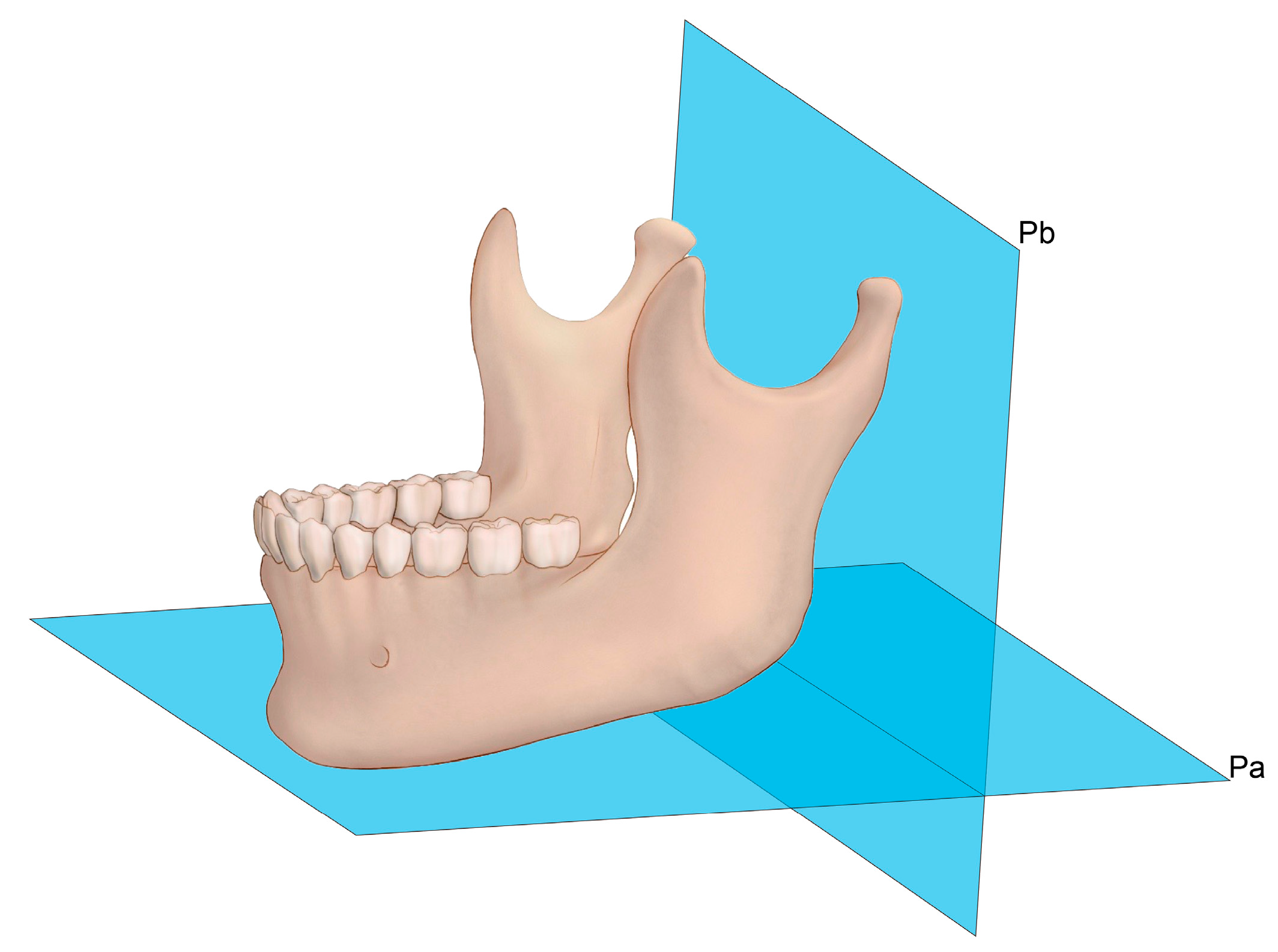
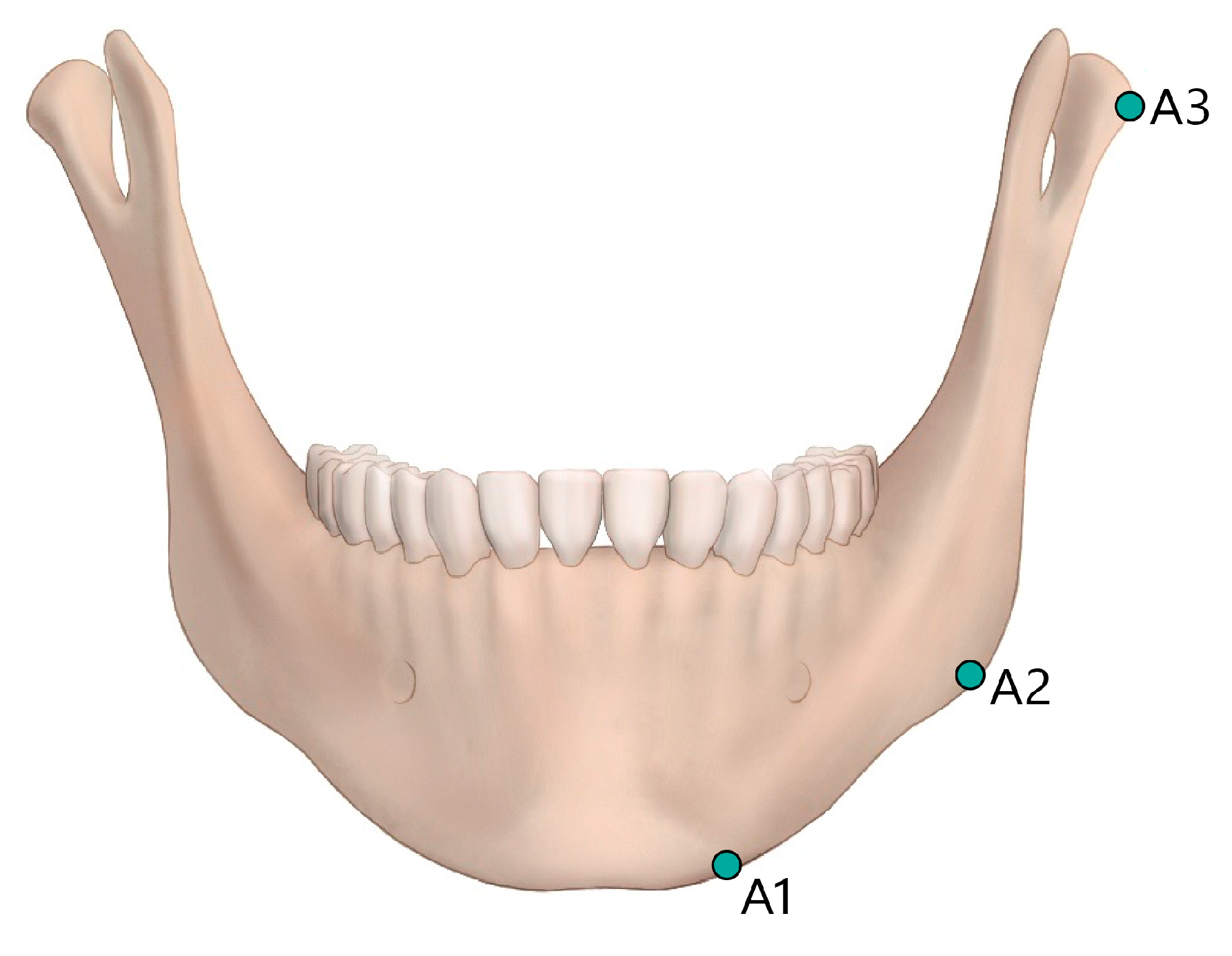
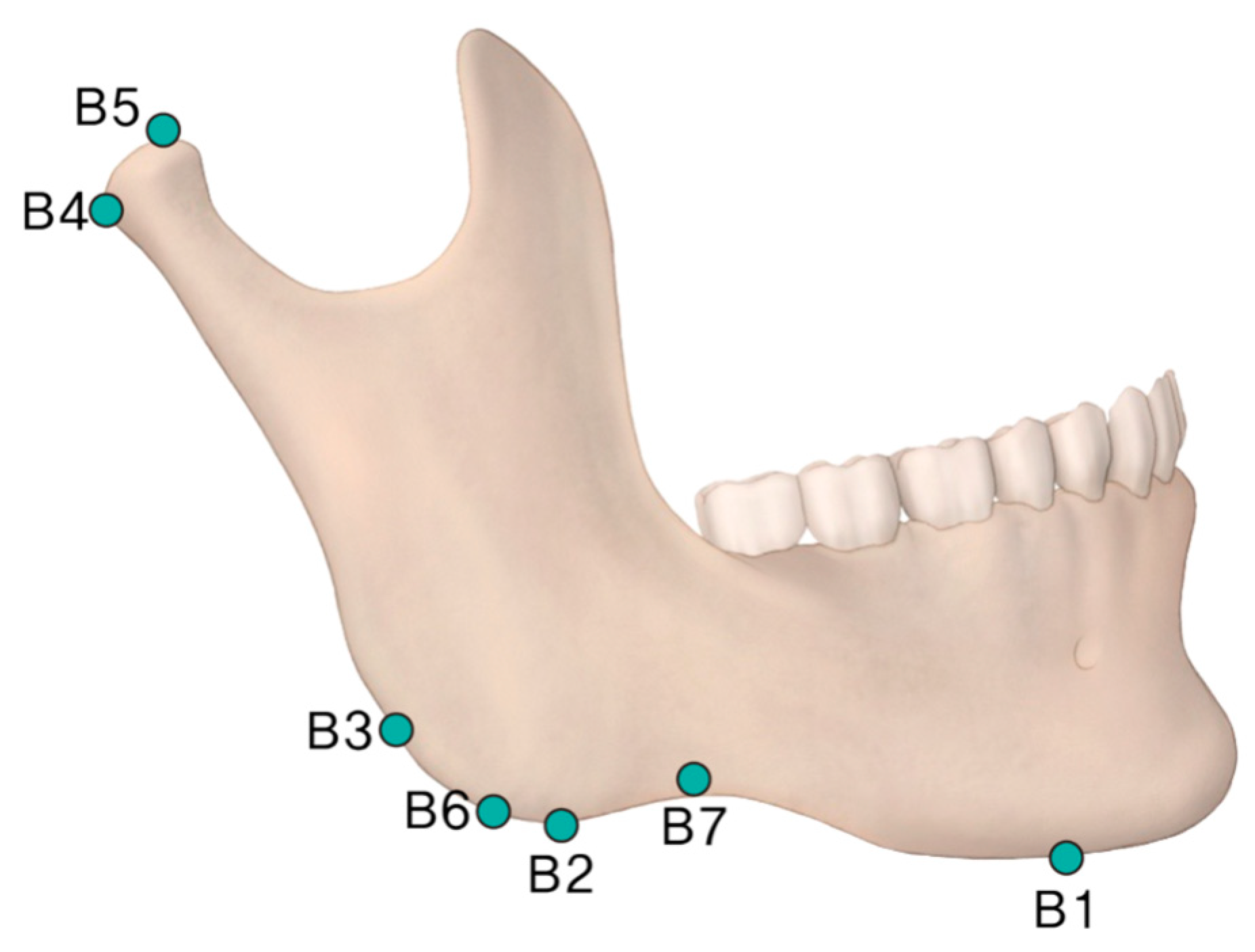
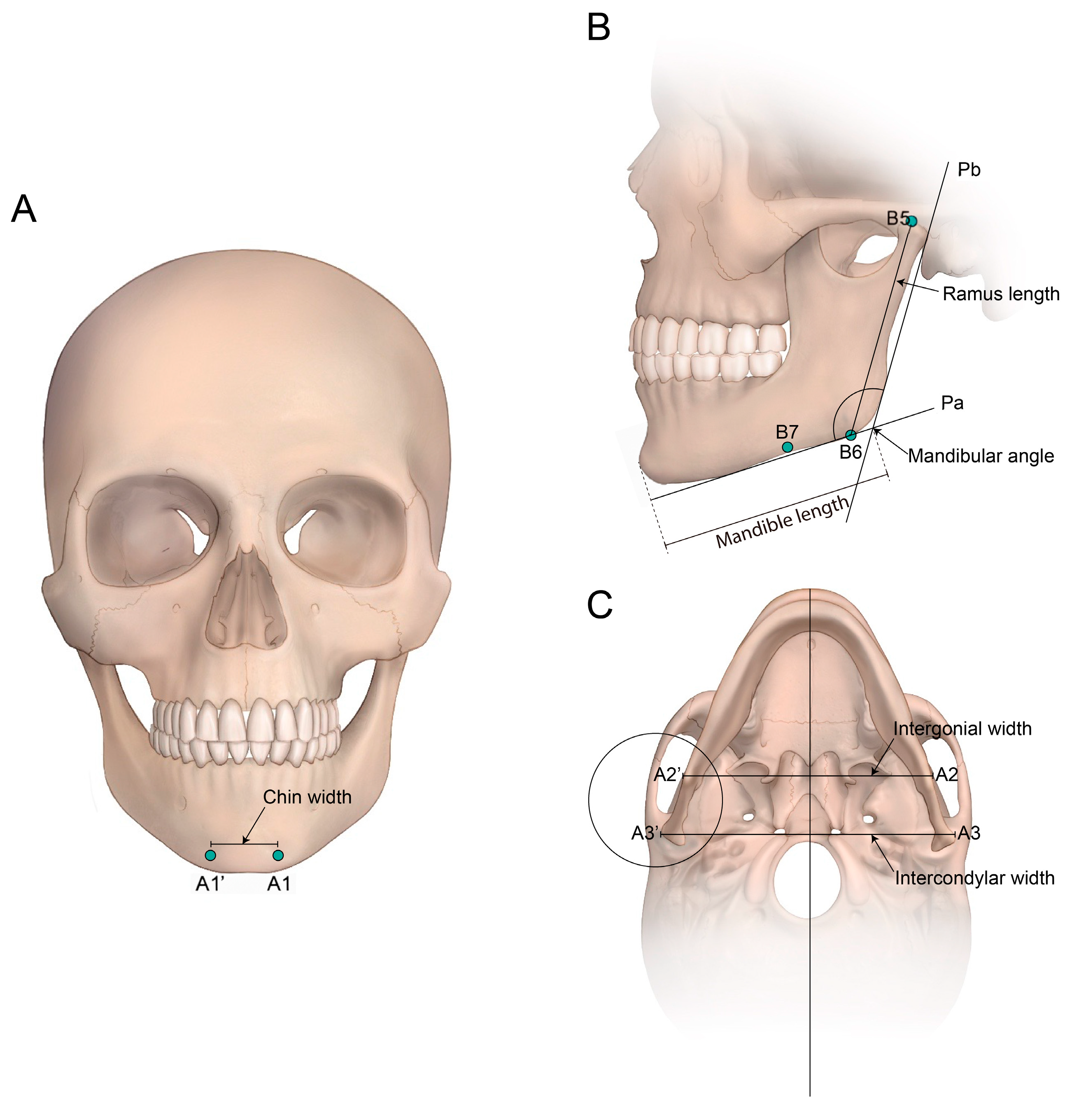
Each patient’s head was placed in the CT scanner (Siemenx, Erlangen, Germany) on a foam platform with the Frankfort horizontal plane parallel to the floor. Then, their head was placed in the center of the CT scanner in line with the midsagittal plane. The obtained images were sent to the image viewer, PiView STAR (Infinitt Co., Ltd., Seoul, Republic of Korea), which was used to identify conventional cephalometric hard tissue landmarks and to measure the distance and the angle in each dimension (
Figure 1,
Figure 2,
Figure 3 and
Figure 4). Measurements were taken by two independent researchers in order to minimize the identification error in selecting the landmarks and calculating measurements. Intraclass coefficient (ICC) analysis was performed and interpreted as the Cicchetti categorization system. The Cicchetti categorization system classifies the ICC as follows: <0.40, poor agreement; 0.40–0.59, fair agreement; 0.60–0.74, good agreement; and 0.75–1, excellent agreement [
7]. The detailed definitions of the landmarks used are provided in
Table 1. In addition, the detailed measurements of distances and angle are defined in
Table 2. Mandible length was intentionally defined using the anterior chin point to the posterior ramus reference line (Pb), rather than the conventional Go–Gn distance, to improve reproducibility in 3D datasets where gonion localization may vary with ramus flaring and mandibular angle morphology. Sagittal mandibular measurements were performed exclusively on the left side to reduce variability related to facial asymmetry and to ensure measurement consistency across subjects in this retrospective dataset.
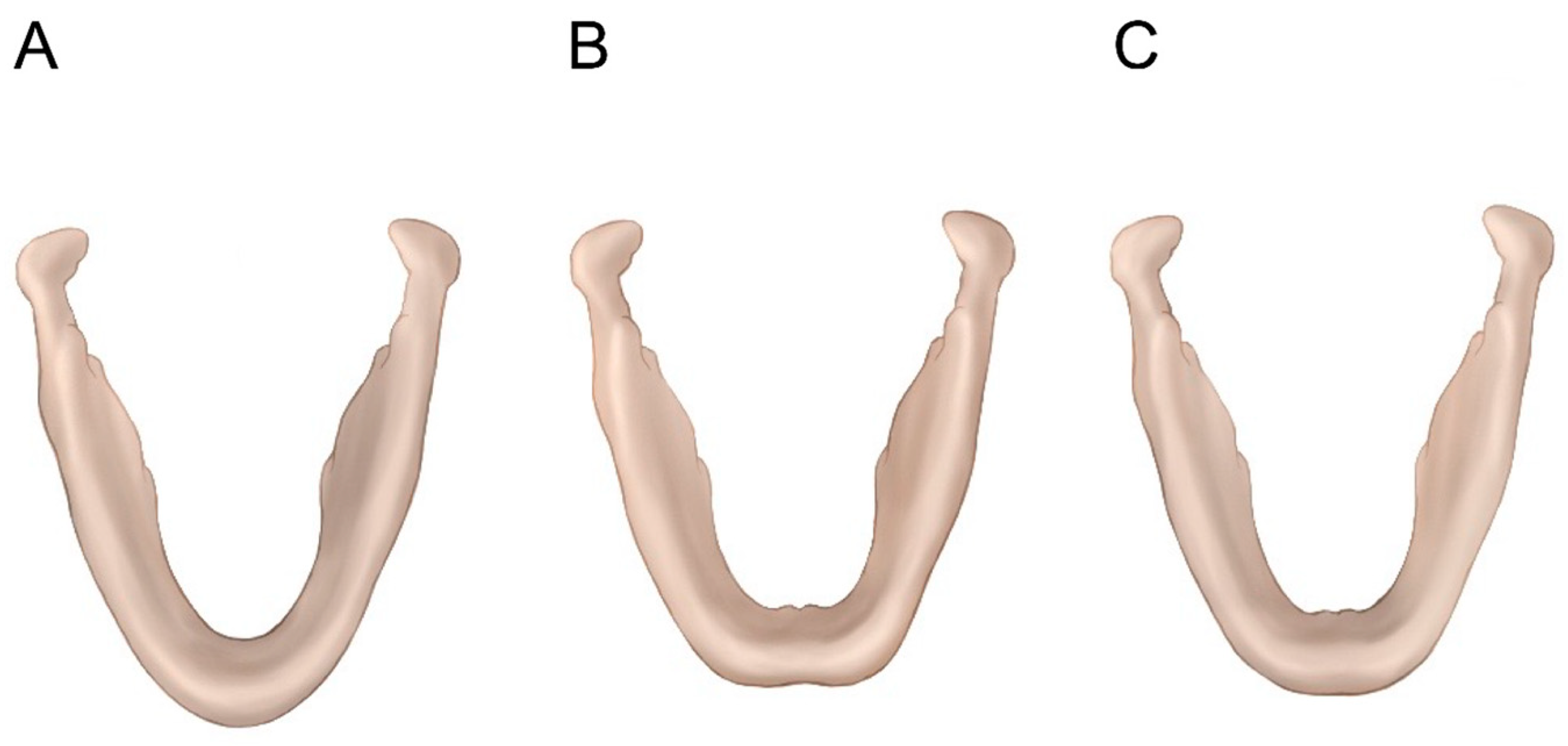
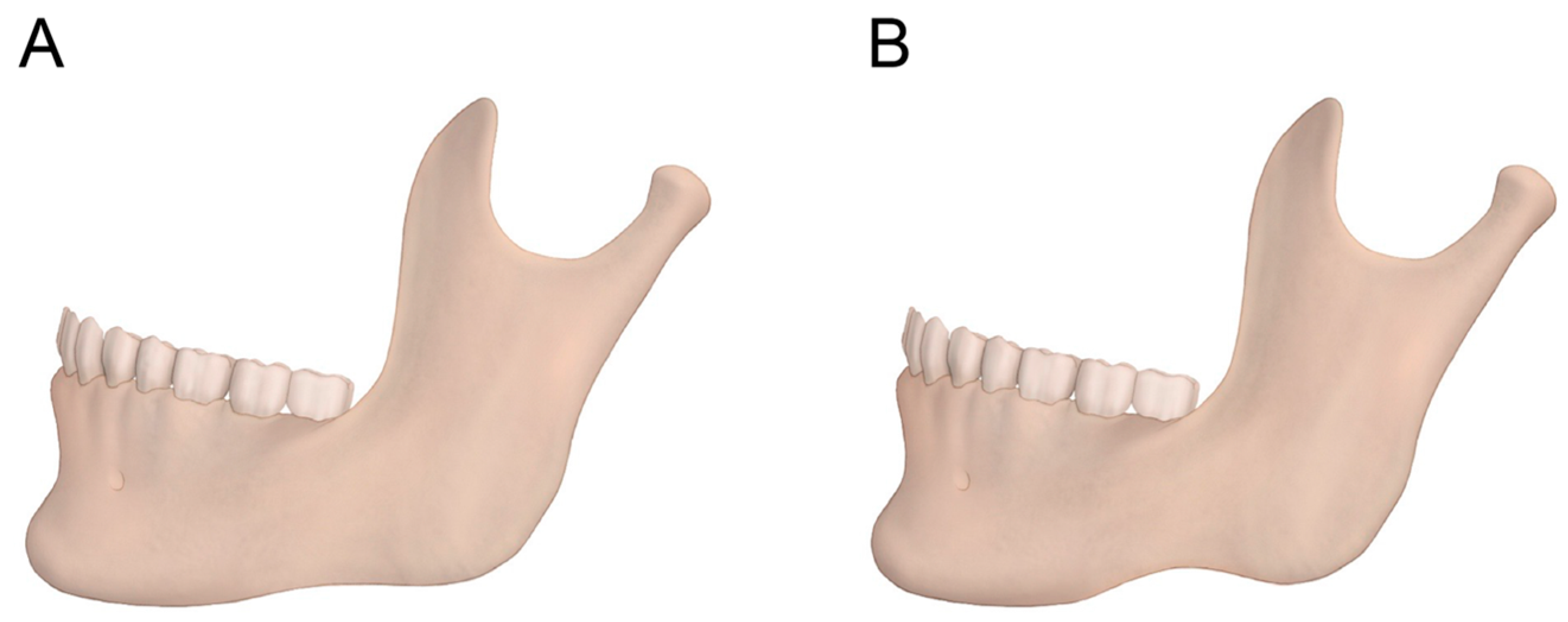
Non-metric characteristics, including chin shape and inferior mandibular border contour, were assessed using three-dimensional CT images. These features were independently classified by two observers who were blinded to patient biological sex. Prior to evaluation, observer calibration was performed using representative cases to standardize classification criteria. Interobserver agreement was assessed, and any discrepancies were resolved by consensus, to enhance the reproducibility of these categorical classifications. The shape of the chin and the contour of the lower border of the mandible were recorded using 3D-CT imaging. The shape of the chin was classified as pointed, square, or round (
Figure 5). The lower border of the mandible was classified as rocker-shaped or straight (
Figure 6).
These measurements were averaged for statistical analysis. The independent t-test and Pearson’s chi-squared test were, respectively, used to detect differences in measurements or non-metric characteristics of the mandible between males and females. Statistical significance was classified as a p-value < 0.05. The Statistical Product and Service Solution 27.0 software (SPSS Inc., Chicago, IL, USA) was used for statistical calculation.
3. Results
The studied population (n = 275) consisted of 54.9% males and 45.1% females with no significant differences in age. ICC values for interobserver variation are presented in
Table 3. The interobserver variation in external measurements showed excellent results for all measurements according to the Cicchetti categorization system (0.921 < ICC < 0.996).
Significant differences between males and females were found for five of seven 3D-CT-based mandibular measurements, excluding ramus length and chin width. First, the frontal measurements revealed that chin width was not significantly different between males and females (male, 22.7 ± 4.3; female, 22.1 ± 3.7; p = 0.703).
The sagittal measurements of the left side showed that females (123.3 ± 3.7) have a greater mean mandibular angle compared to males (120.7 ± 4.0), reaching statistical significance (p < 0.001). Mandible length (male, 73.5 ± 2.3; female, 68.6 ± 4.2; p < 0.001) and antegonial notch distance (male, 2.6 ± 0.7; female, 1.2 ± 0.3; p < 0.001) were significantly different between males and females. The ramus length of male patients (58.3 ± 4.8) was longer than that of female patients (56.1 ± 2.6) without any significant difference (p = 0.073).
The transverse measurements revealed that intercondylar width (male, 126.9 ± 7.6; female, 122.6 ± 6.1; p < 0.001) and intergonial width (male, 101.3 ± 4.5; female, 98.4 ± 2.2; p < 0.001) were significantly different between males and females.
The shape of the chin and the lower border of the mandible were significantly different between males and females (
p < 0.01). First, the chin of males was mainly round or square (79.5%), whereas the chin of females was mainly pointed (82.3%) (
Table 3). Additionally, most males (67.5%) had a notched lower border of the mandible, whereas most females (94.4%) had a straight lower border (
Table 4). In addition to statistical significance, the magnitude of sex differences was largest for antegonial notch distance and mandible length (large standardized effects), followed by transverse widths and mandibular angle (moderate effects), whereas chin width showed a small effect.
4. Discussion
Mandible measurements using 3D imaging and cephalometry are both valuable tools for evaluating craniofacial structures, but they serve different purposes and have their own advantages and limitations. Cephalometry is a two-dimensional X-ray imaging technique that provides a detailed assessment of the skeletal and soft tissue structures of the head and face and is widely used in orthodontics to diagnose and plan treatment for dental and skeletal malocclusions. Cephalometric analysis can provide measurements of angles and linear distances to assess the positional relationships of the maxilla, mandible, and other facial structures. However, from a surgical perspective, conventional two-dimensional cephalometry has inherent limitations in accurately representing complex three-dimensional mandibular morphology. On the other hand, three-dimensional imaging techniques such as computed tomography allow for the generation of highly detailed 3D models of the craniofacial skeleton, enabling a comprehensive assessment of skeletal structures in all spatial dimensions. This characteristic is particularly advantageous in procedures that require precise preoperative planning, such as facial feminization surgery (FFS) [
6].
There are known limitations to cephalometry, including projective displacement, rotational errors, and linear projective transformation, which reduce the reliability and reproducibility of measurements [
4,
8]. Moreover, most cephalometric analyses are susceptible to distortion in the presence of facial asymmetry, which is not uncommon in clinical practice [
5]. Given these limitations, three-dimensional imaging is increasingly preferred when a detailed morphological evaluation of the mandible is required for surgical decision making. Consequently, we elected to use 3D-CT data to measure mandibular length, angularity, and transverse dimensions in Korean individuals.
In the present study, mandibular length was defined as the distance from the most anterior point of the chin to a line placed along the posterior border of the mandibular ramus, rather than the conventional gonion–gnathion (Go–Gn) distance commonly used in cephalometric analyses [
9]. This methodological choice was based on considerations of objectivity and reproducibility in three-dimensional assessment. The gonion represents a geometric construct influenced by mandibular angle morphology and ramus flaring, and its precise localization can be challenging, even in three-dimensional datasets. In contrast, the posterior plane of the mandibular ramus (Pb) provides a more consistent and anatomically well-defined reference surface, while the most anterior point of the chin can be reliably identified across subjects.
It should be noted that the traditional Go–Gn measurement represents an oblique linear distance and therefore may yield slightly longer absolute values compared with projection-based measurements such as those used in the present study. Nevertheless, previous investigations have shown that differences between these measurement approaches do not substantially alter overall morphological trends or patterns of sexual dimorphism. Accordingly, although the absolute mandibular length values in our study may appear shorter than those reported in studies using the Go–Gn distance, the observed gender-related differences and directional tendencies remain comparable.
With regards to the evaluation of antegonial morphology, previous studies have frequently quantified the antegonial notch using area-based measurements. Although such approaches may capture the overall shape of the notch, they are inherently sensitive to landmark selection and contour tracing, which can introduce subjectivity and reduce reproducibility. In the present study, the antegonial notch was therefore assessed using a linear metric, defined as the perpendicular distance between the most concave point of the lower border of the mandible (B7) and the mandibular plane (Pa).
This measurement strategy was adopted to enhance objectivity and consistency by relying on clearly defined anatomic landmarks and reference planes rather than contour-dependent area calculations. A similar line-based approach has been employed in previous three-dimensional morphological studies, including that of Schutz et al., supporting the validity of this method for evaluating antegonial morphology [
10]. By focusing on the depth of the antegonial notch relative to a standardized mandibular plane, this linear measurement provides a practical and reproducible parameter that is well suited for three-dimensional CT-based analysis and surgical planning.
Previous studies across different populations have consistently demonstrated the sexual dimorphism of the mandible, although the degree and specific parameters vary by ethnicity. In an Indian population aged 18–30 years, analysis of 304 digital cephalometric radiographs revealed that females exhibited significantly larger gonial angles than males (
p = 0.035) [
11]. In a Korean population study conducted at Seoul St. Mary’s Hospital, Lin et al. analyzed 240 cranial CT scans and reported that 8 of 11 variables related to mandibular ramus flexure showed significant sexual dimorphism, with upper ramus vertical height demonstrating the greatest difference (77.1%) [
12]. In an Israeli population, Tunis et al. evaluated 25 CT-based mandibular measurements and found significant gender differences in most linear, angular, and transverse parameters, including mandibular length, ramus length, mandibular angle, bicondylar breadth, and bigonial breadth [
13].
In the present study, five of seven mandibular measurements demonstrated statistically significant gender differences using 3D-CT imaging. Overall, our findings are consistent with previously published CT-based studies, supporting the presence of robust sexual dimorphism in mandibular morphology. However, chin width and ramus length did not show statistically significant differences between males and females in our cohort. The lack of statistical significance for ramus length and chin width may reflect population-specific similarity in these dimensions, but it may also be influenced by variability in landmark identification and the wide age distribution, which can increase within-group variance and reduce power for certain parameters. Clinically, these findings suggest that not all lower-face components require uniform modification in feminization planning; rather, transverse width, mandibular angle configuration, and inferior border contour may provide more discriminative reference features in this cohort.
It should be noted that the relative effect size categories reported in this study reflect standardized statistical magnitude rather than direct clinical or surgical priority. Although mandible length demonstrated a large effect size, this parameter represents a global morphometric characteristic, whereas features such as mandibular angle, transverse width, and inferior border contour are more closely associated with regions typically emphasized during mandibular contour assessment in facial feminization surgery. Accordingly, statistical effect size and clinical interpretability should be regarded as distinct conceptual dimensions. This discrepancy suggests that not all mandibular dimensions contribute equally to sexual dimorphism and highlights the importance of population-specific analysis when defining surgically relevant anatomic targets. Another important limitation of this study is the wide age range of the included subjects. Although mandibular growth is generally considered complete after adolescence, age-related skeletal remodeling, including changes in mandibular angle, inferior border morphology, and cortical bone characteristics, may influence mandibular shape in older individuals. Because age-stratified or age-adjusted analyses were not performed, the observed morphological differences may partially reflect age-related variation in addition to biological sex–based dimorphism.
In addition to metric analysis, non-metric characteristics of the mandible were evaluated. Hu et al. reported that rocker-shaped mandibular bases predominated in males, whereas straight inferior borders were more common in females in a Korean population [
14]. Similarly, Nagaraj et al. found that all male mandibles exhibited a rocker-shaped inferior border, whereas all female mandibles demonstrated a straight inferior border in a South Indian population [
15]. In contrast, Deana and Alves reported less pronounced sexual dimorphism of the mandibular base in a Brazilian population, with rocker-shaped borders observed in both sexes [
16]. In our study, a rocker-shaped inferior mandibular border was significantly more common in males (67.5%), whereas a straight inferior border predominated in females (97.4%), closely aligning with previous findings in Korean and South Indian populations [
14,
15].
Chin morphology also demonstrated significant sexual dimorphism. Hu et al. reported that square chins were more common in males, whereas pointed chins predominated in females in a Korean population [
14]. Similar findings were reported in South Indian and Brazilian populations, where males more frequently exhibited square or bilobate chins and females more frequently exhibited pointed chins [
15,
16]. Consistent with these studies, our results showed that round or square chins predominated in males (79.5%), whereas pointed chins were most common in females (82.3%). These non-metric characteristics provide clinically intuitive information that complements quantitative measurements. However, their classification inherently involves a degree of subjectivity. Accordingly, these findings should be interpreted as supportive descriptive features rather than definitive criteria for surgical decision making. Although formal kappa statistics were not calculated for non-metric classifications, these features were intended as supportive descriptive findings and should be interpreted accordingly.
Measurements and non-metric characteristics of the mandible are important components of preoperative planning for facial feminization surgery. The mandible is a prominent determinant of lower facial width and contour prominence, and male mandibles are typically larger and more contour-prominent than female mandibles [
17]. Based on our findings, a relatively obtuse mandibular angle, reduced transverse width, straighter inferior border, and pointed chin morphology may serve as morphological features associated with a feminine mandibular contour in the Korean population. Rather than defining prescriptive surgical targets, the present findings should be regarded as population-specific anatomic reference data that may assist surgeons in contextualizing biological sex-based mandibular morphology during preoperative planning.
This study has several limitations. First, a single-detector CT system was used rather than a multi-detector CT, which may affect image resolution. Second, the retrospective study design limits control over potential confounding variables and may introduce selection bias. Lastly, sagittal measurements were limited to the left side of the mandible to minimize the confounding effects of asymmetry. Previous studies have reported statistically significant bilateral mandibular asymmetry, and future investigations incorporating bilateral measurements and postoperative outcomes are warranted [
18]. In summary, this study provides three-dimensional CT-based reference data describing the sexual dimorphism of the mandible in a Korean population. While significant differences were observed in selected mandibular parameters, these findings should be interpreted within the context of the study’s limitations, including the wide age range, unilateral sagittal assessment, and the descriptive nature of non-metric classifications. Accordingly, the present results are intended to support contextual understanding of sex-based mandibular morphology rather than to serve as prescriptive surgical guidelines.



 ,
,