ExoBDNF Probiotic Supplementation Enhances Cognition in Subjective Cognitive Decline




Abstract
1. Introduction
2. Method
2.1. Participants
2.2. Inclusion Criteria
2.3. Exclusion Criteria
2.4. Study Procedures
2.5. Outcome Measurement
2.6. Statistics
3. Results
3.1. Subjective Cognitive Outcomes
3.2. Psychological and Sleep Measures
3.3. Global Cognitive Function
3.4. Computerized Cognitive Test Battery
3.4.1. Go/No-Go (Attention and Inhibitory Control)
3.4.2. Task-Switching (Cognitive Flexibility)
3.4.3. Working Memory (Corsi Block-Tapping)
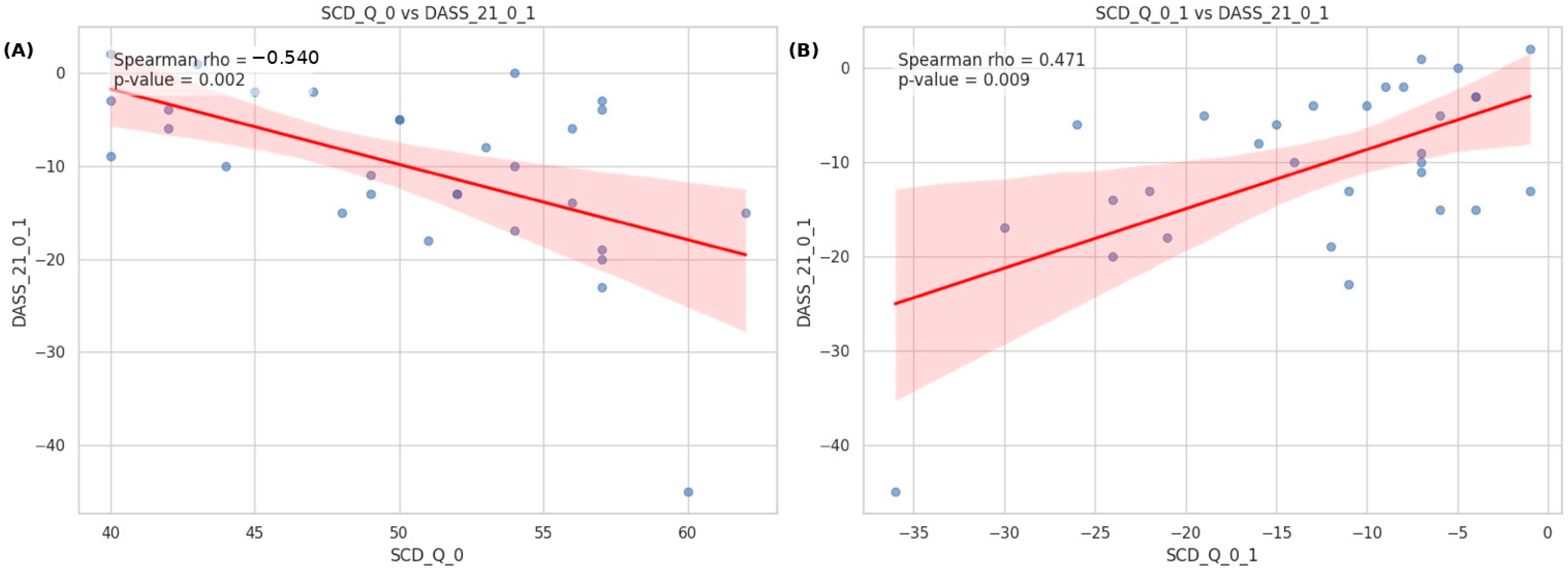
3.5. Correlation Between SCD-Q and DASS-21 Data
3.6. Safety and Tolerability
4. Discussion
5. Conclusions
Author Contributions
Funding
Institutional Review Board Statement
Data Availability Statement
Acknowledgments
Conflicts of Interest
References
- Klimova, B.; Valis, M.; Kuca, K. Cognitive decline in normal aging and its prevention: A review on non-pharmacological lifestyle strategies. Clin. Interv. Aging 2017, 12, 903–910. [Google Scholar] [CrossRef]
- Taylor, C.A.; Bouldin, E.D.; McGuire, L.C. Subjective Cognitive Decline Among Adults Aged ≥ 45 Years—United States, 2015–2016. MMWR. Morb. Mortal. Wkly. Rep. 2018, 67, 753–757. [Google Scholar] [CrossRef] [PubMed]
- Tuigunov, D.; Sinyavskiy, Y.; Nurgozhin, T.; Zholdassova, Z.; Smagul, G.; Omarov, Y.; Dolmatova, O.; Yeshmanova, A.; Omarova, I. Precision Nutrition and Gut-Brain Axis Modulation in the Prevention of Neurodegenerative Diseases. Nutrients 2025, 17, 3068. [Google Scholar] [CrossRef]
- Khan, M.T.; Zohair, M.; Khan, A.; Kashif, A.; Mumtaz, S.; Muskan, F. From Gut to Brain: The roles of intestinal microbiota, immune system, and hormones in intestinal physiology and gut-brain-axis. Mol. Cell. Endocrinol. 2025, 607, 112599. [Google Scholar] [CrossRef]
- Kim, C.S. Roles of Diet-Associated Gut Microbial Metabolites on Brain Health: Cell-to-Cell Interactions between Gut Bacteria and the Central Nervous System. Adv. Nutr. 2024, 15, 100136. [Google Scholar] [CrossRef] [PubMed]
- Doroszkiewicz, J.; Groblewska, M.; Mroczko, B. The Role of Gut Microbiota and Gut-Brain Interplay in Selected Diseases of the Central Nervous System. Int. J. Mol. Sci. 2021, 22, 10028. [Google Scholar] [CrossRef] [PubMed]
- Barber, T.M.; Valsamakis, G.; Mastorakos, G.; Hanson, P.; Kyrou, I.; Randeva, H.S.; Weickert, M.O. Dietary Influences on the Microbiota-Gut-Brain Axis. Int. J. Mol. Sci. 2021, 22, 3502. [Google Scholar] [CrossRef] [PubMed]
- Castells-Nobau, A.; Mayneris-Perxachs, J.; Fernández-Real, J.M. Unlocking the mind-gut connection: Impact of human microbiome on cognition. Cell Host Microbe 2024, 32, 1248–1263. [Google Scholar] [CrossRef]
- Kezer, G.; Paramithiotis, S.; Khwaldia, K.; Harahap, I.A.; Čagalj, M.; Šimat, V.; Smaoui, S.; Elfalleh, W.; Ozogul, F.; Esatbeyoglu, T. A comprehensive overview of the effects of probiotics, prebiotics and synbiotics on the gut-brain axis. Front. Microbiol. 2025, 16, 1651965. [Google Scholar] [CrossRef]
- Barrio, C.; Arias-Sánchez, S.; Martín-Monzón, I. The gut microbiota-brain axis, psychobiotics and its influence on brain and behaviour: A systematic review. Psychoneuroendocrinology 2022, 137, 105640. [Google Scholar] [CrossRef]
- Hwang, Y.K.; Oh, J.S. Interaction of the Vagus Nerve and Serotonin in the Gut-Brain Axis. Int. J. Mol. Sci. 2025, 26, 1160. [Google Scholar] [CrossRef]
- Dicks, L.M.T. Gut Bacteria and Neurotransmitters. Microorganisms 2022, 10, 1838. [Google Scholar] [CrossRef]
- Xu, J.; Lu, Y. The microbiota-gut-brain axis and central nervous system diseases: From mechanisms of pathogenesis to therapeutic strategies. Front. Microbiol. 2025, 16, 1583562. [Google Scholar] [CrossRef]
- Lai, Y.; Dhingra, R.; Zhang, Z.; Ball, L.M.; Zylka, M.J.; Lu, K. Toward Elucidating the Human Gut Microbiota-Brain Axis: Molecules, Biochemistry, and Implications for Health and Diseases. Biochemistry 2022, 61, 2806–2821. [Google Scholar] [CrossRef]
- Kasarello, K.; Cudnoch-Jedrzejewska, A.; Czarzasta, K. Communication of gut microbiota and brain via immune and neuroendocrine signaling. Front. Microbiol. 2023, 14, 1118529. [Google Scholar] [CrossRef]
- Aijaz, M.; Ahmad, M.; Ahmad, S.; Afzal, M.; Kothiyal, P. The gut-brain axis: Role of gut microbiota in neurological disease pathogenesis and pharmacotherapeutics. Naunyn-Schmiedeberg’s Arch. Pharmacol. 2025; Online ahead of print. [Google Scholar] [CrossRef] [PubMed]
- Wang, Y.; Hu, L.; Gao, B.; Yang, R.; Huang, Y.; Li, P.; Shang, N. Lactococcus lactis-derived extracellular vesicles: A novel nanodelivery system enhance the properties of nisin Z. Food Chem. 2025, 489, 144776. [Google Scholar] [CrossRef] [PubMed]
- Park, S.; Mok, J.; Yu, H.-M.; An, H.-J.; Choi, G.-H.; Lee, Y.-S.; Kwon, K.-J.; Choi, S.-J.; Kim, K.-H.; Kim, S.-J.; et al. Comparative and pharmacological investigation of bEVs from eight Lactobacillales strains. Sci. Rep. 2025, 15, 27263. [Google Scholar] [CrossRef]
- Lee, Y.R.; Park, K.M.; Lee, N.K.; Paik, H.D. Neuroprotective effects of Lactiplantibacillus plantarum and Pediococcus pentosaceus strains against oxidative stress via modulation of Nrf2-mediated antioxidation and anti-apoptosis. Brain Res. 2025, 1866, 149925. [Google Scholar] [CrossRef] [PubMed]
- Zheng, J.; Wittouck, S.; Salvetti, E.; Franz, C.M.A.P.; Harris, H.M.B.; Mattarelli, P.; O’Toole, P.W.; Pot, B.; Vandamme, P.; Walter, J.; et al. A taxonomic note on the genus Lactobacillus: Description of 23 novel genera, emended description of the genus Lactobacillus Beijerinck 1901, and union of Lactobacillaceae and Leuconostocaceae. Int. J. Syst. Evol. Microbiol. 2020, 70, 2782–2858. [Google Scholar] [CrossRef]
- Chen, Y.-Z.; Chen, C.-T.; Shih, T.-W.; Hsu, W.-H.; Lee, B.-H.; Pan, T.-M. Probiotic Potential of Pediococcus acidilactici SWP-CGPA01: Alleviating Antibiotic-Induced Diarrhea and Restoring Hippocampal BDNF. Microbiol. Res. 2025, 16, 261. [Google Scholar] [CrossRef]
- Wang, Y.; Gong, J.; Geng, K.; Chen, X.; Jia, M.; Yang, C.; Zhang, S.; Pan, J.; Wu, R.; Liu, Z.; et al. Pediococcus acidilactici attenuates chronic stress-induced depression via generating metabolite indole-3-lactic acid and downregulating neuroinflammation. J. Neuroinflamm. 2025, 22, 267. [Google Scholar] [CrossRef] [PubMed]
- Nair, A.B.; Jacob, S. A simple practice guide for dose conversion between animals and human. J. Basic. Clin. Pharm. 2016, 7, 27–31. [Google Scholar] [CrossRef]
- Tsai, C.-L.; Chou, K.-H.; Lee, P.-L.; Liang, C.-S.; Kuo, C.-Y.; Lin, G.-Y.; Lin, Y.-K.; Hsu, Y.-C.; Ko, C.-A.; Yang, F.-C.; et al. Shared alterations in hippocampal structural covariance in subjective cognitive decline and migraine. Front. Aging Neurosci. 2023, 15, 1191991. [Google Scholar] [CrossRef] [PubMed]
- Rami, L.; Mollica, M.A.; García-Sanchez, C.; Saldaña, J.; Sanchez, B.; Sala, I.; Valls-Pedret, C.; Castellví, M.; Olives, J.; Molinuevo, J.L. The Subjective Cognitive Decline Questionnaire (SCD-Q): A validation study. J. Alzheimer’s Dis. 2014, 41, 453–466. [Google Scholar] [CrossRef]
- Moret-Tatay, C.; Zharova, I.; Iborra-Marmolejo, I.; Bernabé-Valero, G.; Jorques-Infante, M.J.; Beneyto-Arrojo, M.J. Psychometric Properties of the Subjective Cognitive Decline Questionnaire (SCD-Q) and Its Invariance across Age Groups. Int. J. Environ. Res. Public Health 2023, 20, 1220. [Google Scholar] [CrossRef]
- Adolphe, M.; Sawayama, M.; Maurel, D.; Delmas, A.; Oudeyer, P.-Y.; Sauzéon, H. An Open-Source Cognitive Test Battery to Assess Human Attention and Memory. Front. Psychol. 2022, 13, 880375. [Google Scholar] [CrossRef]
- Crum, R.M.; Anthony, J.C.; Bassett, S.S.; Folstein, M.F. Population-based norms for the Mini-Mental State Examination by age and educational level. JAMA 1993, 269, 2386–2391. [Google Scholar] [CrossRef]
- Freitas, S.; Simões, M.R.; Alves, L.; Santana, I. Montreal cognitive assessment: Validation study for mild cognitive impairment and Alzheimer disease. Alzheimer Dis. Assoc. Disord. 2013, 27, 37–43. [Google Scholar] [CrossRef]
- Pinto, T.C.C.; Machado, L.; Bulgacov, T.M.; Rodrigues-Júnior, A.L.; Costa, M.L.G.; Ximenes, R.C.C.; Sougey, E.B. Is the Montreal Cognitive Assessment (MoCA) screening superior to the Mini-Mental State Examination (MMSE) in the detection of mild cognitive impairment (MCI) and Alzheimer’s Disease (AD) in the elderly? Int. Psychogeriatr. 2019, 31, 491–504. [Google Scholar] [CrossRef]
- Lacy, M.; Kaemmerer, T.; Czipri, S. Standardized mini-mental state examination scores and verbal memory performance at a memory center: Implications for cognitive screening. Am. J. Alzheimer’s Dis. Other Dement. 2015, 30, 145–152. [Google Scholar] [CrossRef]
- Yen, Y.-C.; Chiu, N.-Y.; Hwang, T.-J.; Su, T.-P.; Yang, Y.-K.; Chen, C.-S.; Li, C.-T.; Su, K.-P.; Lai, T.-J.; Chang, C.-M. A Multi-Center Study for the Development of the Taiwan Cognition Questionnaire (TCQ) in Major Depressive Disorder. J. Pers. Med. 2022, 12, 359. [Google Scholar] [CrossRef]
- Henry, J.D.; Crawford, J.R. The short-form version of the Depression Anxiety Stress Scales (DASS-21): Construct validity and normative data in a large non-clinical sample. Br. J. Clin. Psychol. 2005, 44, 227–239. [Google Scholar] [CrossRef]
- Mollayeva, T.; Thurairajah, P.; Burton, K.; Mollayeva, S.; Shapiro, C.M.; Colantonio, A. The Pittsburgh sleep quality index as a screening tool for sleep dysfunction in clinical and non-clinical samples: A systematic review and meta-analysis. Sleep Med. Rev. 2016, 25, 52–73. [Google Scholar] [CrossRef] [PubMed]
- Lee, M.T.; Chang, W.Y.; Jang, Y. Psychometric and diagnostic properties of the Taiwan version of the Quick Mild Cognitive Impairment screen. PLoS ONE 2018, 13, e0207851. [Google Scholar] [CrossRef] [PubMed]
- Adu, P.; Popoola, T.; Iqbal, N.; Medvedev, O.N.; Simpson, C.R. Validating the depression anxiety stress scales (DASS-21) across Germany, Ghana, India, and New Zealand using Rasch methodology. J. Affect. Disord. 2025, 383, 363–373. [Google Scholar] [CrossRef]
- Kim, R.H.; Paulino, Y.C.; Kawabata, Y. Validating Constructs of the Depression, Anxiety, and Stress Scale-21 and Exploring Health Indicators to Predict the Psychological Outcomes of Students Enrolled in the Pacific Islands Cohort of College Students. Int. J. Environ. Res. Public Health 2024, 21, 509. [Google Scholar] [CrossRef] [PubMed]
- Hinz, A.; Glaesmer, H.; Brähler, E.; Löffler, M.; Engel, C.; Enzenbach, C.; Hegerl, U.; Sander, C. Sleep quality in the general population: Psychometric properties of the Pittsburgh Sleep Quality Index, derived from a German community sample of 9284 people. Sleep Med. 2017, 30, 57–63. [Google Scholar] [CrossRef]
- Tsai, P.-S.; Wang, S.-Y.; Wang, M.-Y.; Su, C.-T.; Yang, T.-T.; Huang, C.-J.; Fang, S.-C. Psychometric evaluation of the Chinese version of the Pittsburgh Sleep Quality Index (CPSQI) in primary insomnia and control subjects. Qual. Life Res. 2005, 14, 1943–1952. [Google Scholar] [CrossRef]
- Dzierzewski, J.M.; Perez, E.; Ravyts, S.G.; Dautovich, N. Sleep and Cognition: A Narrative Review Focused on Older Adults. Sleep Med. Clin. 2022, 17, 205–222. [Google Scholar] [CrossRef]
- Price, R.B.; Duman, R. Neuroplasticity in cognitive and psychological mechanisms of depression: An integrative model. Mol. Psychiatry 2020, 25, 530–543. [Google Scholar] [CrossRef] [PubMed]
- Liu, N.; Yang, D.; Sun, J.; Li, Y. Probiotic supplements are effective in people with cognitive impairment: A meta-analysis of randomized controlled trials. Nutr. Rev. 2023, 81, 1091–1104. [Google Scholar] [CrossRef] [PubMed]
- Guo, H.; Liang, Y.; Qin, X.; Luo, Q.; Gong, X.; Gao, Q. Effects of probiotics on cognitive function across the human lifespan: A meta-analysis. Eur. J. Clin. Nutr. 2025, 80, 46–61. [Google Scholar] [CrossRef] [PubMed]
- Hsu, Y.-C.; Huang, Y.-Y.; Tsai, S.-Y.; Kuo, Y.-W.; Lin, J.-H.; Ho, H.-H.; Chen, J.-F.; Hsia, K.-C.; Sun, Y. Efficacy of Probiotic Supplements on Brain-Derived Neurotrophic Factor, Inflammatory Biomarkers, Oxidative Stress and Cognitive Function in Patients with Alzheimer’s Dementia: A 12-Week Randomized, Double-Blind Active-Controlled Study. Nutrients 2023, 16, 16. [Google Scholar] [CrossRef] [PubMed]
- Eastwood, J.; Walton, G.; Van Hemert, S.; Williams, C.; Lamport, D. The effect of probiotics on cognitive function across the human lifespan: A systematic review. Neurosci. Biobehav. Rev. 2021, 128, 311–327. [Google Scholar] [CrossRef]
- Fekete, M.; Lehoczki, A.; Major, D.; Fazekas-Pongor, V.; Csípő, T.; Tarantini, S.; Csizmadia, Z.; Varga, J.T. Exploring the Influence of Gut-Brain Axis Modulation on Cognitive Health: A Comprehensive Review of Prebiotics, Probiotics, and Symbiotics. Nutrients 2024, 16, 789. [Google Scholar] [CrossRef] [PubMed]
- Yeh, T.-C.; Huang, C.C.-Y.; Chung, Y.-A.; Park, S.Y.; Im, J.J.; Lin, Y.-Y.; Ma, C.-C.; Tzeng, N.-S.; Chang, H.-A. Resting-State EEG Connectivity at High-Frequency Bands and Attentional Performance Dysfunction in Stabilized Schizophrenia Patients. Medicina 2023, 59, 737. [Google Scholar] [CrossRef] [PubMed]
- Hung, C.-C.; Lin, K.-H.; Chang, H.-A. Exploring Cognitive Deficits and Neuromodulation in Schizophrenia: A Narrative Review. Medicina 2024, 60, 2060. [Google Scholar] [CrossRef] [PubMed]
- Doron, S.; Snydman, D.R. Risk and safety of probiotics. Clin. Infect. Dis. 2015, 60, S129–S134. [Google Scholar] [CrossRef] [PubMed]
- Liu, X.; Ning, L.; Fan, W.; Jia, C.; Ge, L. Probiotics and Cognitive-Related Health Outcomes: An Umbrella Review of Systematic Reviews and Meta-Analyses of Randomized Controlled Trials. Nutr. Rev. 2025, 83, 2144–2158. [Google Scholar] [CrossRef] [PubMed]


| Variables | Baseline (Mean ± SD) | Week 9 (Mean ± SD) | Paired t-Test/ Wilcoxon Signed-Rank Test | p |
|---|---|---|---|---|
| Age | 40.97 ± 12.05 | |||
| Sex (Female): N (%) | 21 (70%) | |||
| Education (years) | 16.33 ± 1.97 | |||
| Questionnaire | ||||
| SCD-Q | 50.6 ± 6.4 | 37.9 ± 8.4 | t = 7.8 | <0.001 |
| TCQ | 7.7 ± 3.1 | 3.4 ± 2.3 | t = 7.3 | <0.001 |
| PSQI | 8.5 ± 2.3 | 6.3 ± 2.9 | t = 4.0 | <0.001 |
| DASS-21 | 22.0 ± 12.6 | 11.6 ± 9.0 | z = −4.5 | <0.001 |
| MoCA | 27.5 ± 2.0 | 28.3 ± 2.3 | z = −2.0 | 0.047 |
| MMSE | 29.1 ± 1.2 | 29.2 ± 1.0 | z = −0.6 | 0.542 |
| Cognitive Test Battery | ||||
| Go/No Go | ||||
| correction rate (%) | 95.0 ± 6.3 | 97.3 ± 6.0 | z = −2.0 | 0.046 |
| reaction time (s) | 640.0 ± 97.1 | 627.5 ± 71.8 | z = 0.5 | 0.600 |
| Task-switching | ||||
| correction rate (%) | 95.7 ± 5.2 | 96.4 ± 8.3 | z = −1.9 | 0.053 |
| reaction time (s) | 1063.0 ± 287.0 | 919.3 ± 215.7 | z = −3.8 | <0.001 |
| Working memory | ||||
| correction rate (%) | 50.8 ± 20.1 | 52.0 ± 20.8 | z = −0.3 | 0.779 |
| reaction time (s) | 3827.0 ± 908.6 | 3542.5 ± 555.2 | z = −2.1 | 0.039 |
Disclaimer/Publisher’s Note: The statements, opinions and data contained in all publications are solely those of the individual author(s) and contributor(s) and not of MDPI and/or the editor(s). MDPI and/or the editor(s) disclaim responsibility for any injury to people or property resulting from any ideas, methods, instructions or products referred to in the content. |
© 2025 by the authors. Published by MDPI on behalf of the Lithuanian University of Health Sciences. Licensee MDPI, Basel, Switzerland. This article is an open access article distributed under the terms and conditions of the Creative Commons Attribution (CC BY) license.
Share and Cite
Lin, C.-E.; Chen, L.-F.; Fang, W.-H.; Chang, C.-C.; Chang, H.-A. ExoBDNF Probiotic Supplementation Enhances Cognition in Subjective Cognitive Decline. Medicina 2026, 62, 91. https://doi.org/10.3390/medicina62010091
Lin C-E, Chen L-F, Fang W-H, Chang C-C, Chang H-A. ExoBDNF Probiotic Supplementation Enhances Cognition in Subjective Cognitive Decline. Medicina. 2026; 62(1):91. https://doi.org/10.3390/medicina62010091
Chicago/Turabian StyleLin, Ching-En, Li-Fen Chen, Wen-Hui Fang, Chuan-Chia Chang, and Hsin-An Chang. 2026. "ExoBDNF Probiotic Supplementation Enhances Cognition in Subjective Cognitive Decline" Medicina 62, no. 1: 91. https://doi.org/10.3390/medicina62010091
APA StyleLin, C.-E., Chen, L.-F., Fang, W.-H., Chang, C.-C., & Chang, H.-A. (2026). ExoBDNF Probiotic Supplementation Enhances Cognition in Subjective Cognitive Decline. Medicina, 62(1), 91. https://doi.org/10.3390/medicina62010091