Trajectories of Kidney Function in Autosomal Dominant Polycystic Kidney Disease Patients Treated with Tolvaptan


Abstract
1. Introduction
2. Materials and Methods
- Diagnosis of ADPKD is established through imaging techniques (ultrasound, computed tomography, or magnetic resonance) and/or genetic testing.
- Age: Eighteen years and above.
- Evidence of rapid disease progression:
- ○
- An annual decline in eGFR of ≥5 mL/min/1.73 m2 in patients with eGFR between 30 and 90 mL/min/1.73 m2;
- ○
- An annual decline in eGFR of ≥2.5 mL/min/1.73 m2 during the last 5 years in patients with eGFR between 30 and 60 mL/min/1.73 m2;
- ○
- An annual increase in total kidney volume (TKV) assessed with magnetic resonance (MR) of > 5% or TKV of one kidney assessed with MR of >750 mL, or length of a larger kidney in ultrasound of >16.5 cm.
- Absence of contraindications:
- ○
- Liver disease or elevated liver enzymes;
- ○
- Inability to adhere to the required monitoring protocols;
- ○
- Pregnancy or breastfeeding;
- ○
- Hypovolemia or hypernatremia.
- Age at the time of the initiation of tolvaptan therapy, sex, race, height, weight, blood pressure, and kidney length;
- Self-reported daily fluid intake during therapy;
- Medicines used;
- Laboratory results of blood test: Serum creatinine from each consecutive visit (within approximately 1 year prior to administration and on tolvaptan), sodium, potassium, hemoglobin, C-reactive protein (CRP), and glucose;
- In urine: Urine-specific gravity and presence of proteinuria in the urinalysis.
3. Results
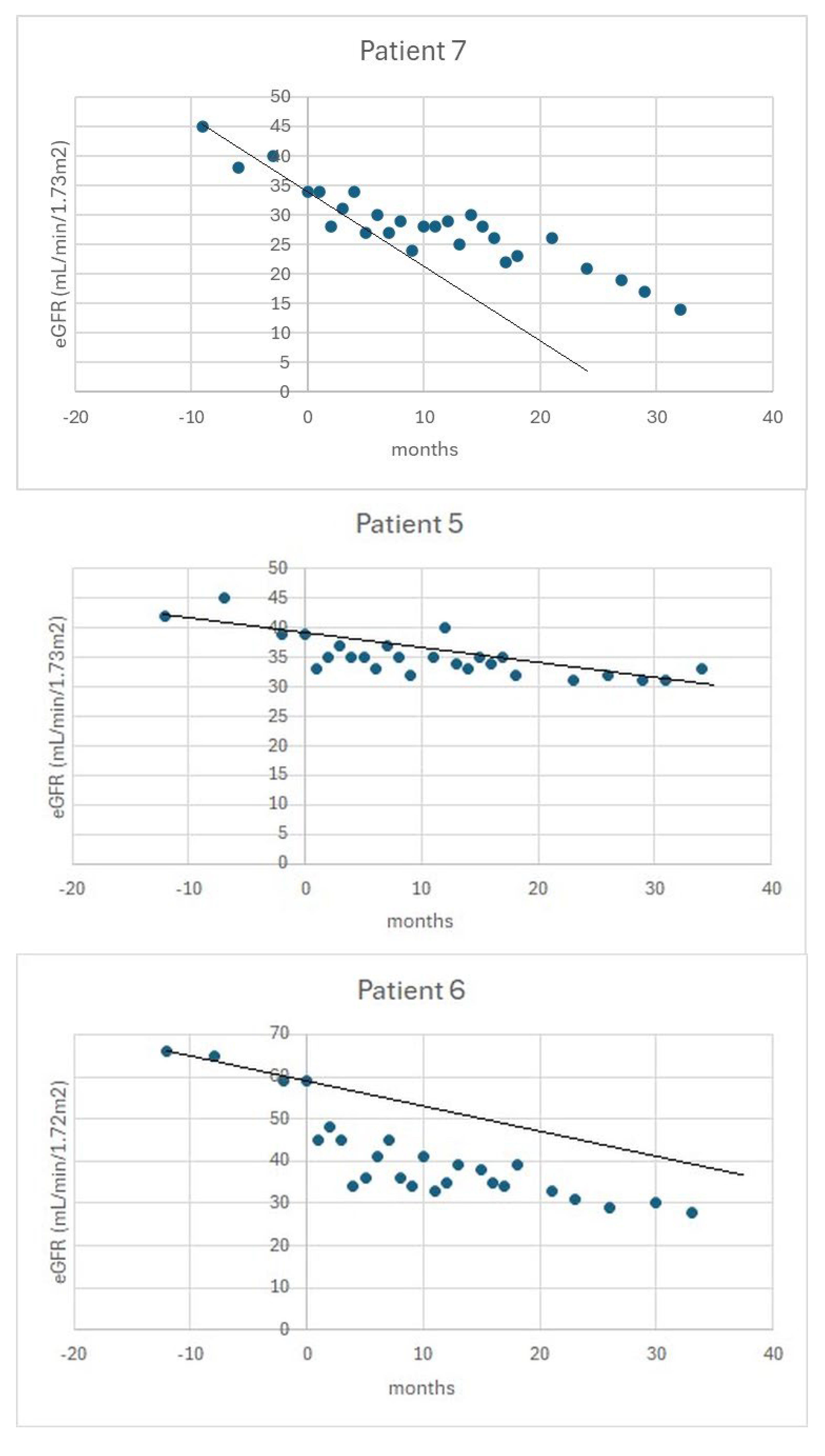
- Beneficiaries (n = 7), in whom an advantageous change in the rate of eGFR decline was observed with tolvaptan therapy;
- Stable (n = 8), in which tolvaptan did not lead to a change in the rate of progression of CKD;
- Progressors (n = 5), in which the rate of CKD progression accelerated on tolvaptan.
4. Discussion
5. Conclusions
Author Contributions
Funding
Institutional Review Board Statement
Informed Consent Statement
Data Availability Statement
Conflicts of Interest
Abbreviations
| ACE-I | Angiotensin-converting enzyme inhibitor |
| ADPKD | Autosomal dominant polycystic kidney disease |
| ARB | Angiotensin receptor blocker |
| CKD | Chronic kidney disease |
| CRP | C-reactive protein |
| eGFR | Estimated glomerular filtration rate |
| IQR | Interquartile range |
| SD | Standard deviation |
| SGLT2 | Sodium-glucose transporter 2 |
| TKV | Total kidney volume |
References
- Rangan, G.K.; I Alexander, S.; Campbell, K.L.; Dexter, M.A.; Lee, V.W.; Lopez-Vargas, P.; Mai, J.; Mallett, A.; Patel, C.; Patel, M.; et al. KHA-CARI guideline recommendations for the diagnosis and management of autosomal dominant polycystic kidney disease. Nephrology 2016, 21, 705–716. [Google Scholar] [CrossRef] [Scilit] [PubMed]
- Hateboer, N.; v Dijk, M.A.; Bogdanova, N.; Coto, E.; Saggar-Malik, A.K.; Millan, J.L.S.; Torra, R.; Breuning, M.; Ravine, D. Comparison of phenotypes of polycystic kidney disease types 1 and 2. European PKD1-PKD2 Study Group. Lancet 1999, 353, 103–107. [Google Scholar] [CrossRef] [Scilit] [PubMed]
- Torres, V.E.; Ahn, C.; Barten, T.R.M.; Brosnahan, G.; Cadnapaphornchai, M.A.; Chapman, A.B.; Gall, E.C.-L.; Drenth, J.P.; Gansevoort, R.T.; Harris, P.C.; et al. KDIGO 2025 clinical practice guideline for the evaluation, management, and treatment of autosomal dominant polycystic kidney disease (ADPKD): Executive summary. Kidney Int. 2025, 107, 234–254. [Google Scholar] [CrossRef] [Scilit] [PubMed]
- Muller, R.U.; Messchendorp, A.L.; Birn, H.; Capasso, G.; Gall, E.C.-L.; Devuyst, O.; van Eerde, A.; Guirchoun, P.; Harris, T.; Hoorn, E.J.; et al. An update on the use of tolvaptan for autosomal dominant polycystic kidney disease: Consensus statement on behalf of the ERA Working Group on Inherited Kidney Disorders, the European Rare Kidney Disease Reference Network and Polycystic Kidney Disease International. Nephrol. Dial. Transpl. 2022, 37, 825–839. [Google Scholar]
- Blair, H.A. Tolvaptan: A review in autosomal dominant polycystic kidney disease. Drugs 2019, 79, 303–313. [Google Scholar] [CrossRef] [Scilit]
- Torres, V.E.; Chapman, A.B.; Devuyst, O.; Gansevoort, R.T.; Perrone, R.D.; Koch, G.; Ouyang, J.; McQuade, R.D.; Blais, J.D.; Czerwiec, F.S.; et al. Tolvaptan in Later-Stage Autosomal Dominant Polycystic Kidney Disease. N. Engl. J. Med. 2017, 377, 1930–1942. [Google Scholar] [CrossRef] [Scilit]
- Borowiecka, J.; Pączek, L.; Niemczyk, M. Tolvaptan in autosomal dominant polycystic kidney disease—A real-life experience. Med. Res. J. 2024, 9, 130–135. [Google Scholar] [CrossRef] [Scilit]
- Raina, R.; Houry, A.; Rath, P.; Mangat, G.; Pandher, D.; Islam, M.; Khattab, A.G.; Kalout, J.K.; Bagga, S. Clinical Utility and Tolerability of Tolvaptan in the Treatment of Autosomal Dominant Polycystic Kidney Disease (ADPKD). Drug Healthc. Patient Saf. 2022, 14, 147–159. [Google Scholar] [CrossRef] [Scilit]
- Geertsema, P.; Bais, T.; Kuiken, V.; E Knol, M.G.; Casteleijn, N.F.; Vart, P.; Meijer, E.; Gansevoort, R.T. The long-term effect of tolvaptan treatment on kidney function and volume in patients with ADPKD. Nephrol. Dial. Transpl. 2025, 40, 1764–1774. [Google Scholar] [CrossRef] [Scilit]
- Bargagli, M.; Dhayat, N.A.; Anderegg, M.; Semmo, M.; Huynh-Do, U.; Vogt, B.; Ferraro, P.M.; Fuster, D.G. Urinary Lithogenic Risk Profile in ADPKD Patients Treated with Tolvaptan. Clin. J. Am. Soc. Nephrol. 2020, 15, 1007–1014. [Google Scholar] [CrossRef] [Scilit]
- Bargagli, M.; Vetsch, A.; Anderegg, M.; A Dhayat, N.; Huynh-Do, U.; Faller, N.; Vogt, B.; Ferraro, P.M.; Fuster, D.G. Tolvaptan treatment is associated with altered mineral metabolism parameters and increased bone mineral density in ADPKD patients. Nephrol. Dial. Transpl. 2023, 38, 1645–1654. [Google Scholar] [CrossRef] [Scilit] [PubMed]
- Li, X.; Li, W.; Li, Y.; Dong, C.; Zhu, P. The safety and efficacy of tolvaptan in the treatment of patients with autosomal dominant polycystic kidney disease: A systematic review and meta-analysis. Nefrol. Engl. Ed. 2023, 43, 731. [Google Scholar]
- Sahin, A.Z.; Ozdemir, O. The effect of tolvaptan on renal progression and systemic inflammation in ADPKD. Sci. Rep. 2025, 15, 32228. [Google Scholar] [CrossRef] [Scilit]
- Rigato, M.; Carraro, G.; Cirella, I.; Dian, S.; Di Vico, V.; Stefanelli, L.F.; Ravarotto, V.; Bertoldi, G.; Nalesso, F.; Calò, L.A. Effects Effects of Tolvaptan on Oxidative Stress in ADPKD: A Molecular Biological Approach. J. Clin. Med. 2022, 11, 402. [Google Scholar] [CrossRef] [Scilit] [PubMed]
- Chebib, F.T.; Perrone, R.D.; Chapman, A.B.; Dahl, N.K.; Harris, P.C.; Mrug, M.; Mustafa, R.A.; Rastogi, A.; Watnick, T.; Yu, A.S.L.; et al. A Practical Guide for Treatment of Rapidly Progressive ADPKD with Tolvaptan. J. Am. Soc. Nephrol. 2018, 29, 2458–2470. [Google Scholar] [CrossRef] [Scilit]
- Available online: https://www.gov.pl/web/zdrowie/obwieszczenie-ministra-zdrowia-z-dnia-21-pazdziernika-2021-r-w-sprawie-wykazu-refundowanych-lekow-srodkow-spozywczych-specjalnego-przeznaczenia-zywieniowego-oraz-wyrobow-medycznych-na-1-listopada-2021-r (accessed on 1 October 2025).
- Jankowska, M.; Dębska-Ślizień, A.; Krajewska, M.; Krzanowska, K.; Kurnatowska, I.; Durlik, M.; Niemczyk, M.; Małyszko, J.; Stompór, T.; Stróżecki, P.; et al. Principles of using tolvaptan in the treatment of patients with autosomal dominant polycystic kidney disease (ADPKD). Recommendations of the Working Group of the Polish Socirty of Nephrology. Ren. Dis. Transplant. Forum. 2023, 16, 113–119. [Google Scholar] [CrossRef] [Scilit]
- Gobburu, J.; Ivaturi, V.; Wang, X.; Shoaf, S.E.; Jadhav, P.; Perrone, R.D. Comparing Effects of Tolvaptan and Instruction to Increase Water Consumption in ADPKD: Post Hoc Analysis of TEMPO 3:4. Kidney360 2023, 4, 1702–1707. [Google Scholar] [CrossRef] [Scilit]
- Bankir, L.; Guerrot, D.; Bichet, D.G. Vaptans or voluntary increased hydration to protect the kidney: How do they compare? Nephrol. Dial. Transplant. 2023, 38, 562–574. [Google Scholar] [CrossRef] [Scilit]
- Akihisa, T.; Kataoka, H.; Makabe, S.; Manabe, S.; Yoshida, R.; Ushio, Y.; Sato, M.; Yajima, A.; Hanafusa, N.; Tsuchiya, K.; et al. Immediate drop of urine osmolality upon tolvaptan initiation predicts impact on renal prognosis in patients with ADPKD. Nephrol. Dial. Transplant. 2024, 39, 1008–1015. [Google Scholar] [CrossRef] [Scilit]
- Akihisa, T.; Manabe, S.; Kataoka, H.; Makabe, S.; Yoshida, R.; Ushio, Y.; Watanabe, K.; Sato, M.; Tsuchiya, K.; Mochizuki, T.; et al. Dose-Dependent Effect of Tolvaptan on Renal Prognosis in Patients with Autosomal Dominant Polycystic Kidney Disease. Kidney360 2021, 2, 1148–1151. [Google Scholar] [CrossRef] [Scilit]
- Rao, V.; Ammar, S.; Alshorman, A.; Fravel, M.; McGreal, K.A.; Winklhofer, F.T.; Noureddine, L.; Jalal, D.I.; Yu, A.S.L.; Mustafa, R.A. Real-World Tolvaptan Use in Autosomal Dominant Polycystic Kidney Disease: Insights from Two US Medical Centers. Kidney360 2025, 6, 1522–1531. [Google Scholar] [CrossRef] [Scilit]
- Ebrahimi, N.; Caliskan, Y.; Garimella, P.S.; Carriazo, S.; Chebib, F.T.; Bateni, G.H.; Dahl, N.K.; Rastogi, A.; Abdipour, A.; Norouzi, S. Cardiovascular Complications in ADPKD. Kidney Int. Rep. 2025, 10, 2953–2966. [Google Scholar] [CrossRef] [Scilit] [PubMed]
- Chebib, F.T.; Zhou, X.; Garbinsky, D.; Davenport, E.; Nunna, S.; Oberdhan, D.; Fernandes, A. Tolvaptan and Kidney Function Decline in Older Individuals With Autosomal Dominant Polycystic Kidney Disease: A Pooled Analysis of Randomized Clinical Trials and Observational Studies. Kidney Med. 2023, 5, 100639. [Google Scholar] [CrossRef] [Scilit] [PubMed]
- Nowak, K.L.; Steele, C.; Gitomer, B.; Wang, W.; Ouyang, J.; Chonchol, M.B. Overweight and Obesity and Progression of ADPKD. Clin. J. Am. Soc. Nephrol. 2021, 16, 908–915. [Google Scholar] [CrossRef] [Scilit] [PubMed]
- Torres, V.E.; Gansevoort, R.T.; Perrone, R.D.; Chapman, A.B.; Ouyang, J.; Lee, J.; Japes, H.; Nourbakhsh, A.; Wang, T. Tolvaptan in ADPKD Patients With Very Low Kidney Function. Kidney Int. Rep. 2021, 6, 2171–2178. [Google Scholar] [CrossRef] [Scilit]
- Sekine, A.; Hoshino, J.; Mochizuki, T.; Nakatani, S.; Nishio, S.; Suwabe, T.; Hayashi, H.; Kai, H.; Seta, K.; Hattanda, F.; et al. Kidney Function Trajectories with Tolvaptan in ADPKD Patients with CKD-G5. Kidney Int. Rep. 2025, 10, 1864–1873. [Google Scholar] [CrossRef] [Scilit]
- Mochizuki, T.; Matsukawa, M.; Tanaka, T.; Jiang, H. Initial eGFR Changes Predict Response to Tolvaptan in ADPKD. Kidney360 2024, 5, 522–528. [Google Scholar] [CrossRef] [Scilit]
- Ozkok, A.; Akpinar, T.S.; Tufan, F.; Kanitez, N.A.; Uysal, M.; Guzel, M.; Caliskan, Y.; Alisir, S.; Yazici, H.; Ecder, T. Clinical characteristics and predictors of progression of chronic kidney disease in autosomal dominant polycystic kidney disease: A single center experience. Clin. Exp. Nephrol. 2013, 17, 345–351. [Google Scholar] [CrossRef] [Scilit]
- Gansevoort, R.T.; Meijer, E.; Chapman, A.B.; Czerwiec, F.S.; Devuyst, O.; Grantham, J.J.; Higashihara, E.; Krasa, H.B.; Ouyang, J.; Perrone, R.D.; et al. Albuminuria and tolvaptan in autosomal-dominant polycystic kidney disease: Results of the TEMPO 3:4 Trial. Nephrol. Dial. Transplant. 2016, 31, 1887–1894. [Google Scholar] [CrossRef] [Scilit]
- Bailey, C.J.; Day, C.; Bellary, S. Renal Protection with SGLT2 Inhibitors: Effects in Acute and Chronic Kidney Disease. Curr. Diabetes Rep. 2022, 22, 39–52. [Google Scholar] [CrossRef] [Scilit]
- Minatoguchi, S.; Hayashi, H.; Umeda, R.; Koide, S.; Hasegawa, M.; Tsuboi, N. Additional renoprotective effect of the SGLT2 inhibitor dapagliflozin in a patient with ADPKD receiving tolvaptan treatment. CEN Case Rep. 2024, 13, 419–424. [Google Scholar] [CrossRef] [Scilit] [PubMed]
- Nishida, J.; Yamakawa, M.; Miura, S.; Yasutomi, M. Renoprotective effects of combination therapy with tolvaptan and dapagliflozin in autosomal dominant polycystic kidney disease: A four-case series. CEN Case Rep. 2025, 14, 500–506. [Google Scholar] [CrossRef] [Scilit] [PubMed]
- Sekine, A.; Hoshino, J.; Fujimaru, T.; Suwabe, T.; Mizuno, H.; Kawada, M.; Hiramatsu, R.; Hasegawa, E.; Yamanouchi, M.; Hayami, N.; et al. Genetics May Predict Effectiveness of Tolvaptan in Autosomal Dominant Polycystic Kidney Disease. Am. J. Nephrol. 2020, 51, 745–751. [Google Scholar] [CrossRef] [Scilit] [PubMed]


| Feature | Result |
|---|---|
| At initiation of therapy | |
| Men/women, n (%) | 11 (55)/9 (45) |
| Age at initiation of tolvaptan in years, mean (SD) | 43.35 (7.34) |
| Body mass index in kg/m2, mean (SD) | 26.99 (3.59) |
| Systolic blood pressure in mmHg, median (IQR) | 130 (9.5) |
| Diastolic blood pressure in mmHg, median (IQR) | 85 (8.0) |
| Maximum kidney length in cm, median (IQR) | 21.75 (3.75) |
| eGFR at initiation of tolvaptan in mL/min/1.73 m2, median (IQR) | 35.83 (25.12) |
| Natremia in mmol/L, mean (SD) | 139.9 (2.3) |
| Kalemia in mmol/L, mean (SD) | 4.45 (0.51) |
| Hemoglobin level in g/dL, mean (SD) | 13.58 (1.57) |
| Serum glucose in mg/dL, median (IQR) | 92.5 (7.0) |
| C-reactive protein in mg/L, median (IQR) | 1.05 (1.10) |
| Urine specific gravity in g/mL, median (IQR) | 1.009 (0.005) |
| Proteinuria, n (%) | 6 (30) |
| During therapy | |
| Change in eGFR during first 3 months of therapy in mL/min/1.73 m2, mean (SD) | −0.178 (6.802) |
| Self-reported daily fluid intake in liters, mean (SD) | 5.93 (1.36) |
| Medicine use, n (%): | |
| Statin | 12 (60) |
| ACE-I/ARB | 13 (65) |
| Calcium channel blocker | 12 (60) |
| Beta-blocker | 13 (65) |
| Alpha-blocker | 6 (30) |
| Diuretic | 14 (70) |
| Allopurinol | 7 (35) |
| SGLT2 inhibitors | 0 (0) |
| Aldosterone receptor antagonist | 0 (0) |
| GLP-1 analogs | 0 (0) |
| Mean daily dose of tolvaptan between the end of the 3rd month of therapy and the end of observation in mg, median (IQR) | 120 (0.5) |
| Feature | Beneficiaries (n = 7) | Non-Beneficiaries (n = 13) | p |
|---|---|---|---|
| Men/women, n (%) | 4 (57)/3 (43) | 7 (54)/6 (46) | p = 0.630 * |
| Age at initiation of tolvaptan in years, median, IQR, range | 42, 11, 32–55 | 42, 6, 35–60 | p = 0.692 ** |
| Body mass index in kg/m2, median, IQR, range | 27.50, 6.77, 21.61–32.89 | 28.06, 3.74, 20.20–33.00 | p = 0.579 ** |
| Systolic blood pressure in mmHg, median, IQR, range | 125, 8, 110–130 | 130, 10, 110–160 | p = 0.068 ** |
| Diastolic blood pressure in mmHg, median, IQR, range | 85, 5, 60–92 | 85, 5, 75–110 | p = 0.250 ** |
| Maximum kidney length in cm, median, IQR, range | 22, 3, 19–24 | 21, 4.5, 17.7–32 | p = 0.968 ** |
| eGFR at initiation of tolvaptan in mL/min/1.73 m2, median, IQR, range | 36.49, 24.17, 24.32–66.59 | 35.17, 27.96, 20.74–93.00 | p = 0.782 ** |
| boldNatremia in mmol/L, median, IQR, range | 140, 5.6, 136.3–144.0 | 139.9, 2.2, 136.0–143.0 | p = 0.691 ** |
| Kalemia in mmol/L, median, IQR, range | 4.60, 0.70, 3.44–4.87 | 4.40, 0.54, 3.80–5.51 | p = 0.905 ** |
| Hemoglobin level in g/dL, median, IQR, range | 13.6, 3.0, 10.9–18.0 | 13.2, 1.3, 11.7–15.2 | p = 0.721 ** |
| Serum glucose in mg/dL, median, IQR, range | 94.7, 7, 82–95 | 92.8, 8, 81–122 | p = 0.634 ** |
| C-reactive protein in mg/L, median, IQR, range | 1.0, 1.3, 0.8–15.4 | 1.5, 0.9, 0.6–4.0 | p = 0.968 ** |
| Urine specific gravity in g/mL, median, IQR, range | 1.007, 0.006, 1.003–1.011 | 1.009, 0.005, 1.005–1.022 | p = 0.267 ** |
| Proteinuria, n (%) | 1 (14) | 6 (46) | p = 0.177 * |
| Self-reported daily fluid intake in liters, median, IQR, range | 6, 1.5, 5–10 | 5.5, 1.5, 4–7 | p = 0.057 ** |
| Change in eGFR during first 3 months of therapy in mL/min/1.73 m2, median, IQR, range | −2.36, 5.01, −16.84–2.33 | −0.75, 10.04, −9.64–12.000 | p = 0.234 ** |
| Mean daily dose of tolvaptan between the end of the 3rd month of therapy and the end of observation in mg, median, IQR, range | 120, 0, 120–120 | 120, 0, 75–120 | p = 0.428 ** |
| Time of observation in months, median, IQR, range | 24, 20, 12–35 | 23, 17, 11–34 | p = 0.905 ** |
| ACE-I/ARB use, n (%) | 4 (57) | 9 (69) | p = 0.474 * |
Disclaimer/Publisher’s Note: The statements, opinions and data contained in all publications are solely those of the individual author(s) and contributor(s) and not of MDPI and/or the editor(s). MDPI and/or the editor(s) disclaim responsibility for any injury to people or property resulting from any ideas, methods, instructions or products referred to in the content. |
© 2026 by the authors. Published by MDPI on behalf of the Lithuanian University of Health Sciences. Licensee MDPI, Basel, Switzerland. This article is an open access article distributed under the terms and conditions of the Creative Commons Attribution (CC BY) license.
Share and Cite
Jankowska, Z.; Niemczyk, M. Trajectories of Kidney Function in Autosomal Dominant Polycystic Kidney Disease Patients Treated with Tolvaptan. Medicina 2026, 62, 194. https://doi.org/10.3390/medicina62010194
Jankowska Z, Niemczyk M. Trajectories of Kidney Function in Autosomal Dominant Polycystic Kidney Disease Patients Treated with Tolvaptan. Medicina. 2026; 62(1):194. https://doi.org/10.3390/medicina62010194
Chicago/Turabian StyleJankowska, Zofia, and Mariusz Niemczyk. 2026. "Trajectories of Kidney Function in Autosomal Dominant Polycystic Kidney Disease Patients Treated with Tolvaptan" Medicina 62, no. 1: 194. https://doi.org/10.3390/medicina62010194
APA StyleJankowska, Z., & Niemczyk, M. (2026). Trajectories of Kidney Function in Autosomal Dominant Polycystic Kidney Disease Patients Treated with Tolvaptan. Medicina, 62(1), 194. https://doi.org/10.3390/medicina62010194