Arterial Hypertension as a Modulator of Cognitive Response to CPAP Therapy in Moderate-to-Severe Obstructive Sleep Apnea

 , , , and
Abstract
1. Introduction
1.1. Obstructive Sleep Apnea and Cognitive Dysfunction
1.2. Assessment of Cognitive Impairment in OSA
1.3. Arterial Hypertension as a Potential Modifier of Cognitive Outcome
1.4. Cognitive Effects of CPAP Therapy and Existing Knowledge Gaps
1.5. Study Rationale and Objectives
2. Materials and Methods
2.1. Inclusion and Exclusion Criteria
2.2. Assessment of HTN
2.3. Baseline Assessments
2.4. Polysomnography
2.5. CPAP Therapy and Adherence
2.6. Event-Related Potentials
2.7. Additional Measurements
2.8. Follow-Up
2.9. Statistical Analysis
3. Results
4. Discussion
5. Conclusions
Author Contributions
Funding
Institutional Review Board Statement
Informed Consent Statement
Data Availability Statement
Conflicts of Interest
Abbreviations
| AHI | Apnea–hypopnea index |
| HTN | Arterial hypertension |
| BAER | Brainstem auditory evoked response |
| CPAP | Continuous positive airway pressure |
| ERP | Event-related potentials |
| OSA | Obstructive sleep apnea |
References
- Berry, R.B.; Brooks, R.; Gamaldo, C.; Harding, S.M.; Lloyd, R.M.; Quan, S.F.; Troester, M.T.; Vaughn, B.V. AASM Scoring Manual Updates for 2017 (Version 2.4). J. Clin. Sleep Med. 2017, 13, 665–666. [Google Scholar] [CrossRef] [Scilit]
- Benjafield, A.V.; Ayas, N.T.; Eastwood, P.R.; Heinzer, R.; Ip, M.S.M.; Morrell, M.J.; Nunez, C.M.; Patel, S.R.; Penzel, T.; Pépin, J.-L.; et al. Estimation of the global prevalence and burden of obstructive sleep apnoea: A literature-based analysis. Lancet Respir. Med. 2019, 7, 687–698. [Google Scholar] [CrossRef] [Scilit]
- Bonsignore, M.R.; Baiamonte, P.; Mazzuca, E.; Castrogiovanni, A.; Marrone, O. Obstructive sleep apnea and comorbidities: A dangerous liaison. Multidiscip. Respir. Med. 2019, 14, 8. [Google Scholar] [CrossRef] [Scilit]
- Šarić Jurić, J.; Grebenar Čerkez, M.; Zubčić, Ž.; Bašić, S.; Bašić, I.; Jandrić, S.; Kralik, K.; Jurić, S. Neurocognitive Recovery Following Continuous Positive Airway Pressure Therapy in Patients with Moderate to Severe Obstructive Sleep Apnea. J. Clin. Med. 2025, 14, 8319. [Google Scholar] [CrossRef] [Scilit]
- Beaudin, A.E.; Raneri, J.K.; Ayas, N.T.; Skomro, R.P.; Fox, N.; Hirsch Allen, A.J.M.; Bowen, M.W.; Nocon, A.; Lynch, E.J.; Wang, M.; et al. Cognitive Function in a Sleep Clinic Cohort of Patients with Obstructive Sleep Apnea. Ann. Am. Thorac. Soc. 2021, 18, 865–875. [Google Scholar] [CrossRef] [Scilit] [PubMed]
- Davidescu, D.A.; Goman, A.; Voita-Mekeres, F.; Bradacs, A.I.; Sabina Florina, S.F.; Csep, A.N.; Szilagyi, G.; Motofelea, A.C.; Davidescu, L. Assessing Cognitive Impairments in Obstructive Sleep Apnea Patients Using Montreal Cognitive Assessment (MoCA) Scores. Cureus 2024, 16, e70085. [Google Scholar] [CrossRef] [Scilit]
- Gagnon, K.; Baril, A.-A.; Montplaisir, J.; Carrier, J.; Chami, S.; Gauthier, S.; Lafond, C.; Gagnon, J.-F.; Gosselin, N. Detection of mild cognitive impairment in middle-aged and older adults with obstructive sleep apnoea. Eur. Respir. J. 2018, 52, 1801137. [Google Scholar] [CrossRef] [Scilit] [PubMed]
- Canavan, M.; O’Donnell, M.J. Hypertension and Cognitive Impairment: A Review of Mechanisms and Key Concepts. Front. Neurol. 2022, 13, 821135. [Google Scholar] [CrossRef] [Scilit] [PubMed]
- Mogi, M.; Hoshide, S.; Kario, K. Hypertension acts as a silent killer for dementia even before it shows its face. Hypertens. Res. 2025, 1–3. [Google Scholar] [CrossRef] [Scilit]
- Gottesman, R.F.; Egle, M.; Groechel, R.C.; Mughal, A. Blood pressure and the brain: The conundrum of hypertension and dementia. Cardiovasc. Res. 2024, 120, 2360–2372. [Google Scholar] [CrossRef] [Scilit]
- Bangash, A.; Wajid, F.; Poolacherla, R.; Mim, F.K.; Rutkofsky, I.H. Obstructive Sleep Apnea and Hypertension: A Review of the Relationship and Pathogenic Association. Cureus 2020, 12, e8241. [Google Scholar] [CrossRef] [Scilit]
- Gottlieb, D.J.; Punjabi, N.M. Diagnosis and Management of Obstructive Sleep Apnea: A Review. JAMA 2020, 323, 1389–1400. [Google Scholar] [CrossRef] [Scilit]
- Crawford-Achour, E.; Dauphinot, V.; Saint, M.M.; Tardy, M.; Gonthier, R.; Barthelemy, J.C.; Roche, F. Protective Effect of Long-Term CPAP Therapy on Cognitive Performance in Elderly Patients with Severe OSA: The PROOF Study. J. Clin. Sleep Med. 2015, 11, 519–524. [Google Scholar] [CrossRef] [Scilit]
- Seda, G.; Matwiyoff, G.; Parrish, J.S. Effects of Obstructive Sleep Apnea and CPAP on Cognitive Function. Curr. Neurol. Neurosci. Rep. 2021, 21, 32. [Google Scholar] [CrossRef] [Scilit] [PubMed]
- Hobzova, M.; Hubackova, L.; Vanek, J.; Genzor, S.; Ociskova, M.; Grambal, A.; Prasko, J. Cognitive function and depressivity before and after cpap treatment in obstructive sleep apnea patients. Neuroendocrinol. Lett. 2017, 38, 145–153. [Google Scholar]
- Nasreddine, Z.S.; Phillips, N.A.; Bédirian, V.; Charbonneau, S.; Whitehead, V.; Collin, I.; Cummings, J.L.; Chertkow, H. The Montreal Cognitive Assessment, MoCA: A brief screening tool for mild cognitive impairment. J. Am. Geriatr. Soc. 2005, 53, 695–699. [Google Scholar] [CrossRef] [Scilit]
- NCA—Continuous Positive Airway Pressure (CPAP) Therapy for Obstructive Sleep Apnea (OSA) (CAG-00093R2)—Decision Memo. Available online: https://www.cms.gov/medicare-coverage-database/view/ncacal-decision-memo.aspx?proposed=N&NCAId=204&fromdb=true (accessed on 7 December 2025).
- Gao, Y.; Zhu, S.; Li, W.; Lai, Y. Comparative efficacy of sleep positional therapy, oral appliance therapy, and CPAP in obstructive sleep apnea: A meta-analysis of mean changes in key outcomes. Front. Med. 2025, 12, 1517274. [Google Scholar] [CrossRef] [Scilit] [PubMed]
- Richards, K.C.; Gooneratne, N.; Dicicco, B.; Hanlon, A.; Moelter, S.; Onen, F.; Wang, Y.; Sawyer, A.; Weaver, T.; Lozano, A.; et al. CPAP Adherence May Slow 1-Year Cognitive Decline in Older Adults with Mild Cognitive Impairment and Apnea. J. Am. Geriatr. Soc. 2019, 67, 558–564. [Google Scholar] [CrossRef] [Scilit]
- Turner, K.; Zambrelli, E.; Lavolpe, S.; Baldi, C.; Furia, F.; Canevini, M.P. Obstructive sleep apnea: Neurocognitive and behavioral functions before and after treatment. Funct. Neurol. 2019, 34, 71–78. [Google Scholar] [PubMed]
- Bhat, S.; Gupta, D.; Akel, O.; Polos, P.G.; DeBari, V.A.; Akhtar, S.; McIntyre, A.; Ming, S.X.; Upadhyay, H.; Chokroverty, S. The relationships between improvements in daytime sleepiness, fatigue and depression and psychomotor vigilance task testing with CPAP use in patients with obstructive sleep apnea. Sleep Med. 2018, 49, 81–89. [Google Scholar] [CrossRef] [Scilit]
- Wang, G.; Goebel, J.R.; Li, C.; Hallman, H.G.; Gilford, T.M.; Li, W. Therapeutic effects of CPAP on cognitive impairments associated with OSA. J. Neurol. 2020, 267, 2823–2828. [Google Scholar] [CrossRef] [Scilit]
- Yerlikaya, D.; Hünerli-Gündüz, D.; Fide, E.; Özbek, Y.; Kıyı, İ.; Öztura, İ.; Yener, G.G. The reliability of P300 and the influence of age, gender and education variables in a 50 years and older normative sample. Int. J. Psychophysiol. 2022, 181, 1–13. [Google Scholar] [CrossRef] [Scilit]
- Tang, S.; Zhu, J.; Zhao, D.; Mo, H.; Zeng, Z.; Xiong, M.; Dong, M.; Hu, K. Effects of the excitation or inhibition of basal forebrain cholinergic neurons on cognitive ability in mice exposed to chronic intermittent hypoxia. Brain Res. Bull. 2020, 164, 235–248. [Google Scholar] [CrossRef] [Scilit]
- Jing, M.; Guo, M.; Wang, X.; Zhang, P.; Gu, C.; Zhang, N.; Ding, Z.; Su, K. Changes of regional brain activity in frontal areas associated with cognitive impairment in obstructive sleep apnea-hypopnea syndrome patients: A resting-state fMRI study. Front. Neurosci. 2025, 19, 1587180. [Google Scholar] [CrossRef] [Scilit]
- Mansukhani, M.P.; Kolla, B.P.; Somers, V.K. Hypertension and Cognitive Decline: Implications of Obstructive Sleep Apnea. Front. Cardiovasc. Med. 2019, 6, 96. [Google Scholar] [CrossRef] [Scilit] [PubMed]
- Vitulano, N.; Di Marco Berardino, A.; Re, A.; Riccioni, G.; Perna, F.; Mormile, F.; Valente, S.; Bellocci, F. Obstructive sleep apnea and heart disease: The biomarkers point of view. Front. Biosci. (Sch. Ed.) 2013, 5, 588–599. [Google Scholar] [CrossRef] [Scilit] [PubMed]
- Duan, W.; Liu, X.; Ping, L.; Jin, S.; Yu, H.; Dong, M.; Xu, F.; Li, N.; Li, Y.; Xu, Y.; et al. Distinct functional brain abnormalities in insomnia disorder and obstructive sleep apnea. Eur. Arch. Psychiatry Clin. Neurosci. 2023, 273, 493–509. [Google Scholar] [CrossRef] [Scilit]
- Gogisetti, Y.; Pathania, M.; Mittal, S.; Yadav, P.; Kharibam, P.; Kant, R.; Gogisetti, Y.; KL, P.Y. Assessment of Cognition in Hypertensives and Normotensives: A Comparative P300 Study. Cureus 2022, 14, e28397. [Google Scholar] [CrossRef] [Scilit] [PubMed]
- Kujovic, M.; Lipka, T.; Zalman, M.; Baumann, L.; Jänner, M.; Baumann, B. Treatment of hypertension and obstructive sleep apnea counteracts cognitive decline in common neurocognitive disorders in diagnosis-related patterns. Sci. Rep. 2023, 13, 7556. [Google Scholar] [CrossRef] [Scilit]
- Baumann, B.; Lipka, T.; Jänner, M.; Kujovic, M. The neurocognitive disorder cohort RIFADE: Aims, methods, first results showing cognitive improvement in a subgroup. Eur. Arch. Psychiatry Clin. Neurosci. 2023, 273, 941–952. [Google Scholar] [CrossRef] [Scilit]
- Zhuo, X.; Huang, M.; Wu, M. Analysis of cognitive dysfunction and its risk factors in patients with hypertension. Medicine 2022, 101, e28934. [Google Scholar] [CrossRef] [Scilit] [PubMed]
- Velescu, D.R.; Marc, M.S.; Pescaru, C.C.; Traila, D.; Vaștag, E.; Papava, I.; Motofelea, A.C.; Ciuca, I.M.; Manolescu, D.; Oancea, C. Impact of CPAP Therapy Adherence on Global Cognition in Patients with Moderate to Severe Obstructive Sleep Apnea: A One-Year Follow-Up. Medicina 2023, 59, 846. [Google Scholar] [CrossRef] [Scilit] [PubMed]



| Number (%) of Participants | p * Value | |||
|---|---|---|---|---|
| Without HTN (n = 30) | With HTN (n = 41) | Total (n = 71) | ||
| Gender | ||||
| M | 27 (90) | 30 (73) | 57 (80) | 0.08 |
| F | 3 (10) | 11 (27) | 14 (20) | |
| Median (IQR) | † Difference (95% CI) | p * Value | |||
|---|---|---|---|---|---|
| Total (n = 71) | Without HTN (n = 30) | With HTN (n = 41) | |||
| Age (years) | 51 (44–58) | 46 (37.5–51.25) | 56 (49.5–59.5) | 10 (5 to 14) | <0.001 |
| Body weight (kg) | 106 (92–136) | 103.5 (91.5–130) | 111 (92.5–138.5) | 4.5 (−6 to 18) | 0.34 |
| Body height (cm) | 176 (170–183) | 177.5 (171.5–183.5) | 174 (168–181) | −4 (−8 to 1) | 0.09 |
| BMI (kg/m2) | 34.3 (30.8–42.8) | 32.95 (29.08–37.69) | 35.9 (30.85–45.25) | 2.9 (−0.2 to 6.5) | 0.07 |
| Systolic blood pressure (SBP) (mmHg) | 130 (125–135) | 127.5 (120–135) | 130 (125–135) | 5 (0 to 10) | 0.18 |
| Diastolic blood pressure (DBP) (mmHg) | 80 (75–80) | 77.5 (75–80) | 80 (75–85) | 0 (0 to 5) | 0.09 |
| Sleep architecture | |||||
| Total recording time (min) | 465.8(447–502.2) | 460.1 (445.9–512.2) | 467.8 (443.2–492.9) | −5.7 (−29.5 to 15.7) | 0.57 |
| Total sleep time (min) | 403 (371.5–448) | 422 (384.3–471.6) | 402 (358–441.5) | −26 (−54.5 to 7) | 0.13 |
| NREM Stage 1 (%) | 10.9 (7.9–15.3) | 10 (7.3–13.4) | 13 (9.3–16.3) | 2.7 (0.3 to 5.4) | 0.03 |
| NREM Stage 2 (%) | 58.3 (52–65.1) | 55.35 (51–62.7) | 59.1 (53.6–65.1) | 2.8 (−3.1 to 7.2) | 0.29 |
| NREM Stage 3 (%) | 17.5 (12.8–25.5) | 19.65 (12.8–27.0) | 16.8 (13.1–20.9) | −2.9 (−7.6 to 1.3) | 0.18 |
| REM sleep (%) | 10.7 (8.4–15.9) | 12.25 (9.5–15.4) | 9.5 (7.3–16.1) | −2.1 (−4.4 to 0.4) | 0.10 |
| NREM sleep (%) | 89.1 (83.8–91.4) | 87.75 (83.8–90.9) | 90.3 (83.8–92.8) | 2 (−0.7 to 4.8) | 0.17 |
| Sleep onset latency (min) | 11.5 (6–24.5) | 9.15 (5.7–21.3) | 12.3 (5.9–27) | 1.5 (−2.6 to 7) | 0.47 |
| REM latency (min) | 124 (101.5–177) | 112.5 (87.5–142.4) | 143.5 (105.3–213.5) | 27.6 (3.5 to 57.5) | 0.03 |
| WASO (min) | 27.9 (8.3–62.1) | 10.3 (4.1–28.78) | 46.5 (21.1–74.8) | 26.1 (11.3 to 41.5) | <0.001 |
| Number of sleep cycles | 3 (3–4) | 4 (3–4) | 3 (3–4) | −1 (−1 to 0) | 0.008 |
| Sleep efficiency (%) | 86.4 (81.9–92.8) | 91 (85.5–96.2) | 84.2 (79.6–88.9) | −6.9 (−10.4 to −3.5) | <0.001 |
| Respiratory parameters | |||||
| REM AHI (events/h) | 62.4 (49.5–75.9) | 61 (42–76) | 62.4 (51.05–76.4) | 3.2 (−7.2 to 14.4) | 0.56 |
| NREM AHI (events/h) | 59.2 (37.8–72.9) | 64.45 (45.93–74.35) | 54.8 (31.45–72.65) | −6.5 (−16.2 to 3.3) | 0.20 |
| CPAP device parameters | |||||
| Average CPAP use (h:min) | 5:40 (4:49–6:16) | 5:37 (4:49–6:25) | 5:41 (4:45–6:16) | 0:05 (−0:01 to 0:02) | 0.93 |
| CPAP usage (%) | 92 (85–99) | 93 (86.75–98.93) | 90 (78–97.05) | −1.6 (−6 to 1.5) | 0.27 |
| AHI (events/h) (before CPAP) | 56.2 (40.3–71.7) | 56.45 (44.08–74.48) | 56.1 (36.25–71.45) | −3.4 (−13.3 to 6.3) | 0.45 |
| ESS (daytime sleepiness) (before CPAP) | 11 (7–15) | 12.5 (10.5–15.25) | 10 (6.5–15) | −2 (−4 to 1) | 0.17 |
| Total MoCA score (before CPAP) | 22 (19–25) | 23.5 (19–25.25) | 22 (19.5–24) | −1 (−2 to 1) | 0.39 |
| P300–Event-related potentials (before CPAP) | |||||
| P1 latency (ms) | 38 (26–48) | 34.5 (24.75–48.5) | 41 (26.5–47.5) | 3 (−3 to 10) | 0.30 |
| N1 latency (ms) | 95 (90–108) | 99 (90–108) | 94 (89.5–108.5) | −2 (−9 to 6) | 0.64 |
| P2 latency (ms) | 184 (171–198) | 185 (172.25–200.25) | 181 (170.5–195) | −3.5 (−12 to 8) | 0.52 |
| N2 latency (ms) | 238 (225–265) | 234.5 (223.5–276.5) | 240 (228.5–263) | 2 (−13 to 14) | 0.82 |
| P300 latency (ms) | 341 (324–352) | 344 (318–360.75) | 339 (329.5–349.5) | −1 (−13 to 12) | 0.85 |
| P300 amplitude (µV) | 9.7 (6–13.9) | 10.3 (5.48–14.1) | 9.7 (6.25–13.4) | −0.3 (−3.1 to 2.1) | 0.77 |
| Median (IQR) | † Difference | 95% CI | p * Value | ||
|---|---|---|---|---|---|
| Before CPAP | After CPAP | ||||
| AHI (events/h) | 56.2 (41.1–71.7) | 3.0 (2.0–4.9) | −53.4 | −58.3 to −48.7 | <0.001 |
| ESS (daytime sleepiness) | 11 (7.3–15.0) | 2.0 (1.0–3.0) | −9 | −10 to −8 | <0.001 |
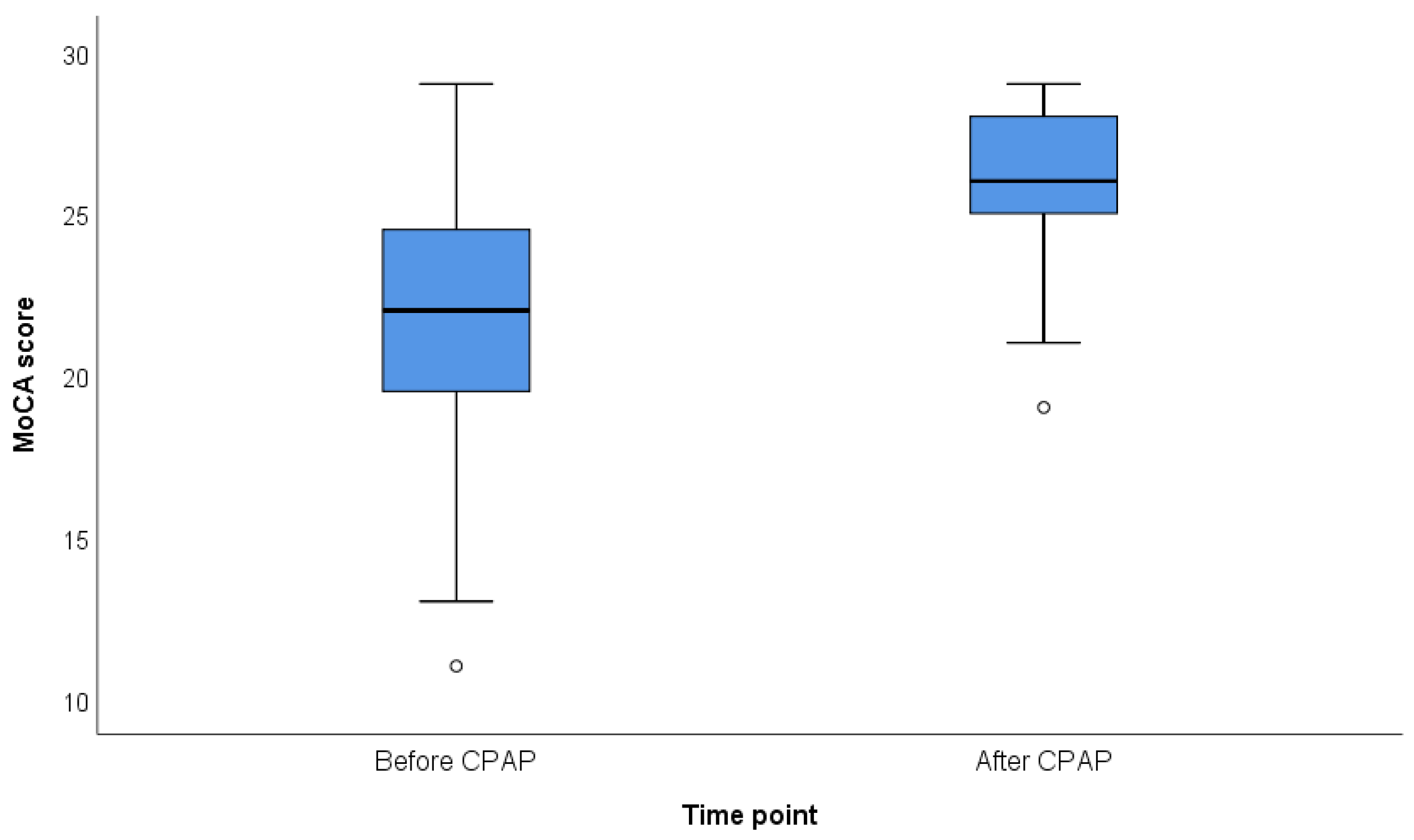
| Total MoCA score | 22 (19–25) | 26 (25–28) | 4 | 3 to 5 | <0.001 |
| P300–Event-related potentials | |||||
| P1 latency (ms) | 38 (26–48) | 31 (25–41) | −5 | −8 to −1 | 0.02 |
| N1 latency (ms) | 95 (90–108) | 95 (85–104) | −1 | −5 to 3 | 0.50 |
| P2 latency (ms) | 184 (171–198) | 176 (165–194) | −3 | −8 to 3 | 0.39 |
| N2 latency (ms) | 238 (225–265) | 236 (222–260) | −6 | −13 to 0.5 | 0.08 |
| P300 latency (ms) | 341 (325–352) | 313 (302–324) | −23 | −29 to −19 | <0.001 |
| P300 amplitude (µV) | 9.7 (6.1–13.9) | 10.8 (7.4–14.5) | 0.7 | −0.05 to 1.6 | 0.07 |
| Median (IQR) | † Difference | 95% CI | p * Value | ||
|---|---|---|---|---|---|
| Without HTN (n = 30) | With HTN (n = 41) | ||||
| AHI (events/h) | 2.9 (2.1–4.0) | 3.0 (2.0–5.2) | 0.2 | −0.6 to 1.2 | 0.59 |
| ESS score | 2 (1–3) | 1 (1–3) | 0 | −1 to 0 | 0.44 |
| Total MoCA | 27 (25–28) | 26 (24–28) | 0 | −1 to 1 | 0.54 |
| P300–Event-related potentials | |||||
| P1 latency (ms) | 31 (24–44) | 35 (25–40) | −1 | −6 to 4 | 0.71 |
| N1 latency (ms) | 94 (86–107) | 96 (85–101) | −1 | −8 to 6 | 0.74 |
| P2 latency (ms) | 177.5 (165–191) | 175 (164.8–195) | 0 | −10 to 10 | 0.99 |
| N2 latency (ms) | 225 (219–249) | 238 (226–265) | 9 | −5 to 21 | 0.21 |
| P300 latency (ms) | 307 (298–324) | 319 (309–328) | 9 | 0 to 17 | 0.05 |
| P300 amplitude (µV) | 9.5 (7.2–14.7) | 11.1 (7.5–13.3) | 0.5 | −1.8 to 2.7 | 0.67 |
| Number (%) of Participants | p * Value | |||
|---|---|---|---|---|
| Without HTN (n = 30) | With HTN (n = 41) | Total (n = 71) | ||
| MoCa before CPAP | ||||
| Normal cognitive function (MoCA ≥ 26) | 7 (23) | 6 (15) | 13 (18) | 0.37 |
| Impaired cognitive function (MoCA < 26) | 23 (77) | 24 (85) | 58 (82) | |
| MoCa after CPAP | ||||
| Normal cognitive function (MoCA ≥ 26) | 10 (33) | 15 (37) | 25 (35) | 0.81 |
| Impaired cognitive function (MoCA < 26) | 20 (67) | 26 (63) | 46 (65) | |
| β | Wald | p Value | OR (95% CI) | |
|---|---|---|---|---|
| Without adjustment for HTN | ||||
| Mean oxygen saturation | –0.13 | 4.23 | 0.04 | 0.87 (0.78–0.98) |
| Percentage of CPAP use | 0.08 | 5.71 | 0.02 | 1.09 (1.02–1.16) |
| Constant | 3.55 | 0.37 | 0.54 | — |
| Adjusted for HTN | ||||
| Mean oxygen saturation | –0.13 | 4.11 | 0.04 | 0.88 (0.77–0.98) |
| Percentage of CPAP use | 0.09 | 5.84 | 0.02 | 1.10 (1.02–1.17) |
| Constant | 3.07 | 0.27 | 0.60 | — |
| Factor | AUC | 95% CI | Sensitivity (%) | Specificity (%) | Cut-Off | Youden Index | p Value |
|---|---|---|---|---|---|---|---|
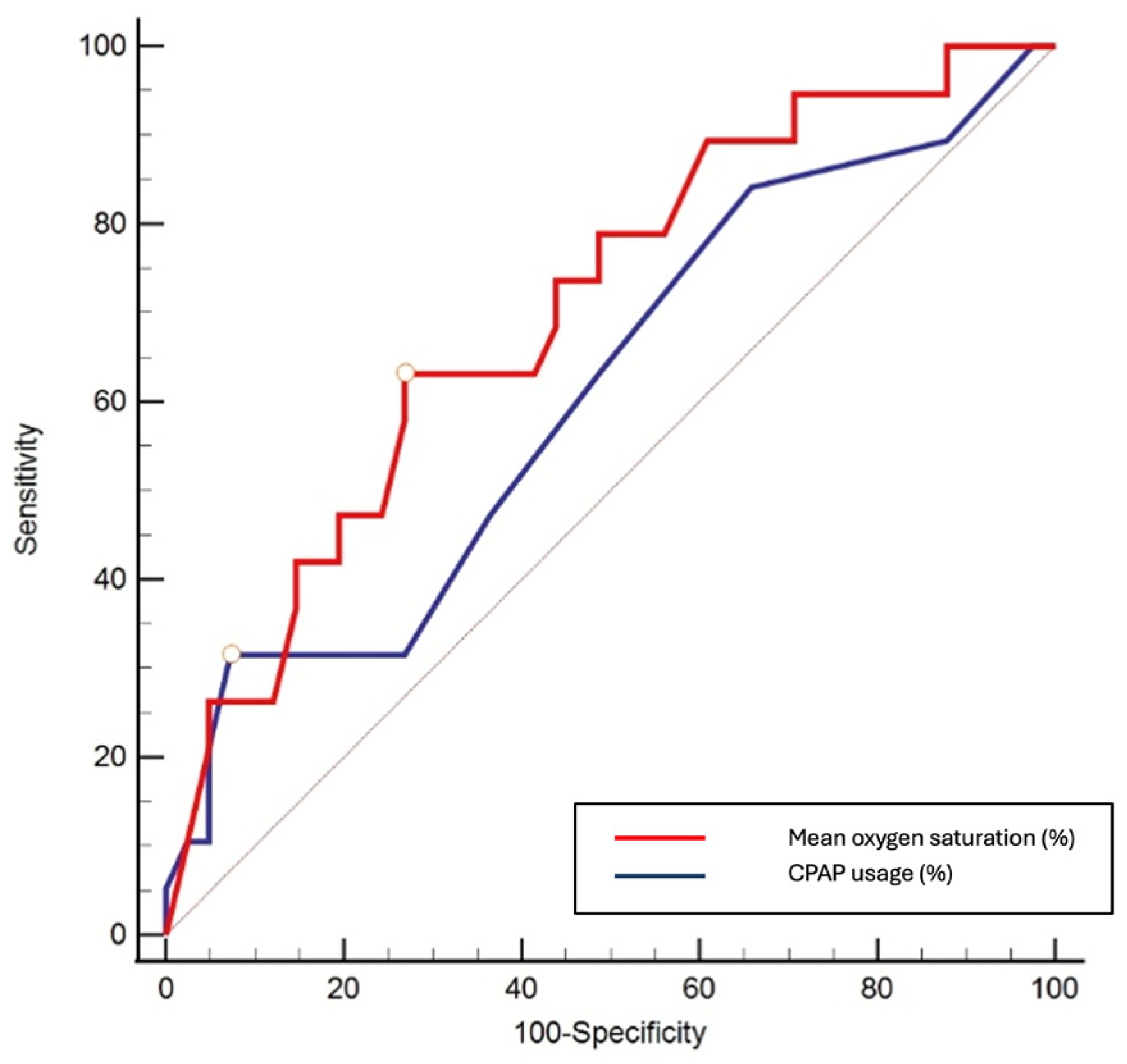
| Mean oxygen saturation (%) | 0.630 | 0.507–0.742 | 28.0 | 93.5 | ≤85 | 0.215 | 0.06 |
| CPAP usage (%) | 0.645 | 0.522–0.755 | 96.0 | 30.4 | >79 | 0.264 | 0.03 |
Disclaimer/Publisher’s Note: The statements, opinions and data contained in all publications are solely those of the individual author(s) and contributor(s) and not of MDPI and/or the editor(s). MDPI and/or the editor(s) disclaim responsibility for any injury to people or property resulting from any ideas, methods, instructions or products referred to in the content. |
© 2026 by the authors. Published by MDPI on behalf of the Lithuanian University of Health Sciences. Licensee MDPI, Basel, Switzerland. This article is an open access article distributed under the terms and conditions of the Creative Commons Attribution (CC BY) license.
Share and Cite
Šarić Jurić, J.; Grebenar Čerkez, M.; Birtić, D.; Kralik, K.; Jurić, S. Arterial Hypertension as a Modulator of Cognitive Response to CPAP Therapy in Moderate-to-Severe Obstructive Sleep Apnea. Medicina 2026, 62, 168. https://doi.org/10.3390/medicina62010168
Šarić Jurić J, Grebenar Čerkez M, Birtić D, Kralik K, Jurić S. Arterial Hypertension as a Modulator of Cognitive Response to CPAP Therapy in Moderate-to-Severe Obstructive Sleep Apnea. Medicina. 2026; 62(1):168. https://doi.org/10.3390/medicina62010168
Chicago/Turabian StyleŠarić Jurić, Jelena, Mirjana Grebenar Čerkez, Darija Birtić, Kristina Kralik, and Stjepan Jurić. 2026. "Arterial Hypertension as a Modulator of Cognitive Response to CPAP Therapy in Moderate-to-Severe Obstructive Sleep Apnea" Medicina 62, no. 1: 168. https://doi.org/10.3390/medicina62010168
APA StyleŠarić Jurić, J., Grebenar Čerkez, M., Birtić, D., Kralik, K., & Jurić, S. (2026). Arterial Hypertension as a Modulator of Cognitive Response to CPAP Therapy in Moderate-to-Severe Obstructive Sleep Apnea. Medicina, 62(1), 168. https://doi.org/10.3390/medicina62010168