Lacrimal Sac and Nasolacrimal Duct Tumors Mimicking Chronic Inflammation: A Systematic Review

 , and
, and
Abstract
1. Introduction
2. Materials and Methods
2.1. Protocol, Registration, and Reporting Standards
2.2. Research Question and PICO Statement
2.3. Eligibility Criteria
2.4. Information Sources
2.5. Search Strategy
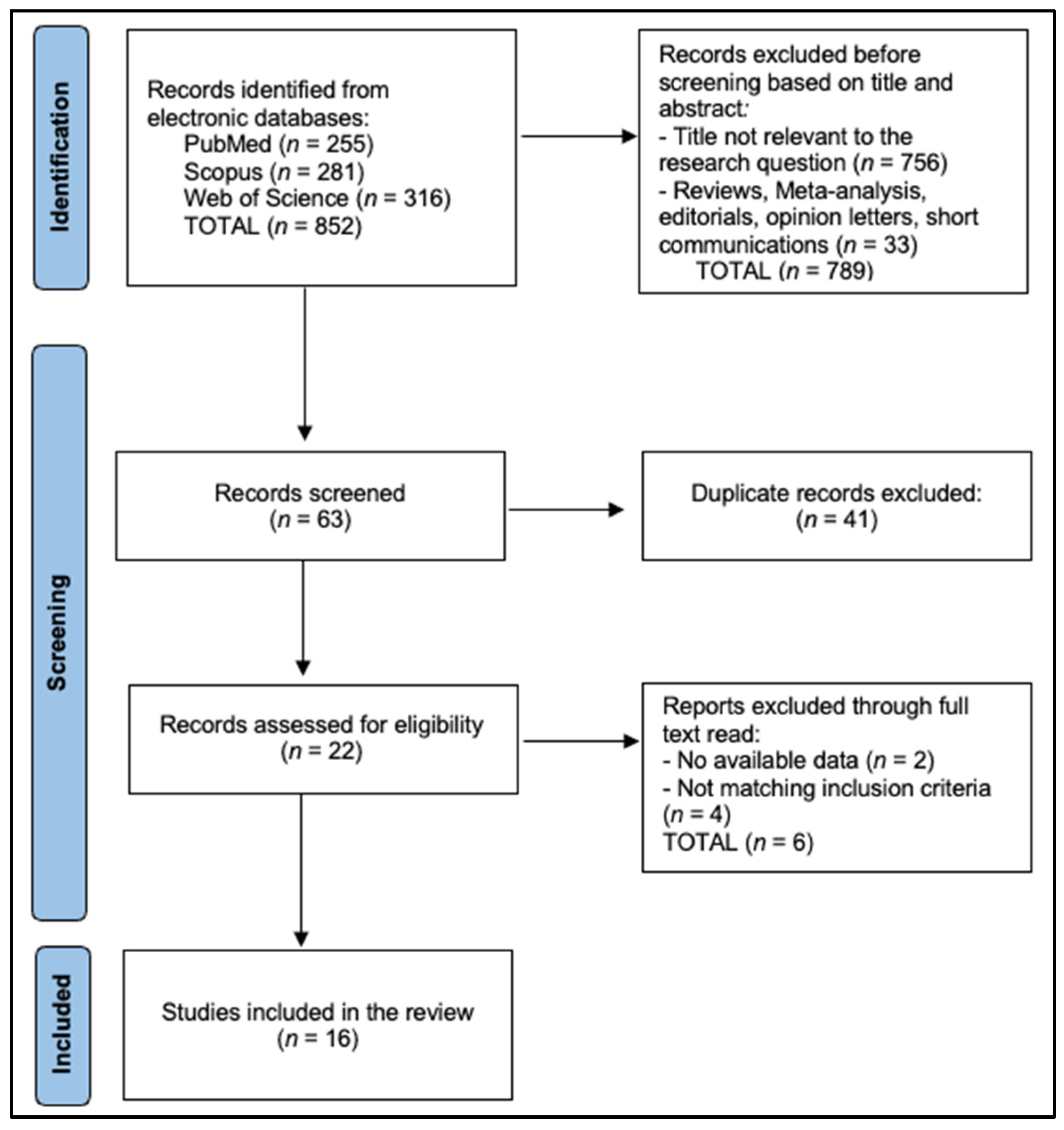
2.6. Study Selection and PRISMA Flow
2.7. Data Items and Extraction Procedures
2.8. Risk of Bias Assessment
3. Results
4. Discussion
4.1. Summary of Evidence
4.2. Limitations
5. Conclusions
Supplementary Materials
Author Contributions
Funding
Institutional Review Board Statement
Informed Consent Statement
Data Availability Statement
Acknowledgments
Conflicts of Interest
References
- Stefanyszyn, M.A.; Hidayat, A.A.; Pe’er, J.J.; Flanagan, J.C. Lacrimal Sac Tumors. Ophthalmic Plast. Reconstr. Surg. 1994, 10, 169–184. [Google Scholar] [CrossRef] [PubMed]
- Flanagan, J.C.; Stokes, D.P. Lacrimal sac tumors. Ophthalmology 1978, 85, 1282–1287. [Google Scholar] [CrossRef] [PubMed]
- Krishna, Y.; Coupland, S.E. Lacrimal Sac Tumors—A Review. Asia Pac. J. Ophthalmol. 2017, 6, 173–178. [Google Scholar] [CrossRef] [PubMed]
- Kadir, S.M.U.; Rashid, R.; Sultana, S.; Nuruddin, M.; Nessa, M.S.; Mitra, M.R.; Haider, G. Lacrimal Sac Tumors: A Case Series. Ocul. Oncol. Pathol. 2022, 8, 42–51. [Google Scholar] [CrossRef] [PubMed] [PubMed Central]
- Raslan, O.A.; Ozturk, A.; Pham, N.; Chang, J.; Strong, E.B.; Bobinski, M. A Comprehensive Review of Cross-Sectional Imaging of the Nasolacrimal Drainage Apparatus: What Radiologists Need to Know. AJR Am. J. Roentgenol. 2019, 213, 1331–1340. [Google Scholar] [CrossRef] [PubMed]
- Nair, J.R.; Syed, R.; Chan, I.Y.M.; Gorelik, N.; Chankowsky, J.; del Carpio-O’DOnovan, R. The forgotten lacrimal gland and lacrimal drainage apparatus: Pictorial review of CT and MRI findings and differential diagnosis. Br. J. Radiol. 2022, 95, 20211333. [Google Scholar] [CrossRef] [PubMed] [PubMed Central]
- Kaushik, M.; Juniat, V.; Ezra, D.G.; Verity, D.H.; Uddin, J.; Timlin, H. Blood-stained tears-a red flag for malignancy? Eye 2023, 37, 1711–1716. [Google Scholar] [CrossRef] [PubMed] [PubMed Central]
- Koturović, Z.; Knežević, M.; Rašić, D.M. Clinical significance of routine lacrimal sac biopsy during dacryocystorhinostomy: A comprehensive review of literature. Bosn. J. Basic Med. Sci. 2017, 17, 1–8. [Google Scholar] [CrossRef] [PubMed] [PubMed Central]
- Pandya, V.B.; Lee, S.; Benger, R.; Danks, J.J.; Kourt, G.; Martin, P.A.; Lertsumitkul, S.; McCluskey, P.; Ghabrial, R. External dacryocystorhinostomy: Assessing factors that influence outcome. Orbit 2010, 29, 291–297. [Google Scholar] [CrossRef] [PubMed]
- Song, X.; He, H.; Zhu, Y.; Wang, S.; Wang, J.; Wang, W.; Li, Y. Treatment outcomes after definitive radio(chemo)therapy for 17 lacrimal sac squamous cell carcinoma. Br. J. Radiol. 2020, 93, 20190633. [Google Scholar] [CrossRef] [PubMed] [PubMed Central]
- Neerukonda, V.K.; Stagner, A.M.; Wolkow, N.M. Lymphoma of the Lacrimal Sac: The Massachusetts Eye and Ear Experience with a Comparison to the Previously Reported Literature. Ophthalmic Plast. Reconstr. Surg. 2022, 38, 79–86. [Google Scholar] [CrossRef] [PubMed]
- Meng, F.-X.; Yue, H.; Zhang, R.; Yuan, Y.-F.; Bi, Y.-W.; Qian, J. Lacrimal sac lymphoma: A case series and literature review. Int. J. Ophthalmol. 2022, 15, 1586–1590. [Google Scholar] [CrossRef] [PubMed] [PubMed Central]
- Hongo, T.; Yamamoto, H.; Tanabe, M.; Yasumatsu, R.; Kuga, R.; Miyazaki, Y.; Jiromaru, R.; Hashimoto, K.; Tateishi, Y.; Sonoda, K.-H.; et al. High-risk HPV-related Squamous Cell Carcinoma in the Conjunctiva and Lacrimal sac: Clinicopathologic Characteristics and Diagnostic Utility of p16 and Rb Immunohistochemistry. Am. J. Surg. Pathol. 2022, 46, 977–987. [Google Scholar] [CrossRef] [PubMed]
- Ramberg, I.; Vieira, F.G.; Toft, P.B.; von Buchwald, C.; Heegaard, S. Viral and Genomic Drivers of Squamous Cell Neoplasms Arising in the Lacrimal Drainage System. Cancers 2022, 14, 2558. [Google Scholar] [CrossRef]
- Shao, J.-W.; Yin, J.-H.; Xiang, S.-T.; He, Q.; Zhou, H.; Su, W. CT and MRI findings in relapsing primary malignant melanoma of the lacrimal sac: A case report and brief literature review. BMC Ophthalmol. 2020, 20, 191. [Google Scholar] [CrossRef] [PubMed]
- Parikh, D.; Rodgers, R.; Kodsi, S. Primary lacrimal sac diffuse large B-cell lymphoma in a child. J. Am. Assoc. Pediatr. Ophthalmol. Strabismus 2019, 23, 53–55. [Google Scholar] [CrossRef] [PubMed]
- Mascarenhas, R.; Tellechea, O.; Oliveira, H.; Reis, J.; Cordeiro, M.; Migueis, J. Nasal septum perforation as the presenting sign of lupus erythematosus. Dermatol. Online J. 2005, 11, 12. [Google Scholar] [CrossRef] [PubMed]
- Karłowska-Bijak, O.; Stryjewska-Makuch, G.; Michalak-Kolarz, M.; Marków, M.; Lisowska, G. Malignant Lacrimal Sac Tumours-Review of the Literature and Report of Own Experience. Medicina 2025, 61, 533. [Google Scholar] [CrossRef] [PubMed] [PubMed Central]
- Swiatek-Machado, K.; Kaminska, B. STAT Signaling in Glioma Cells. Adv. Exp. Med. Biol. 2020, 1202, 203–222. [Google Scholar] [CrossRef] [PubMed]
- Takizawa, D.; Ohnishi, K.; Hiratsuka, K.; Matsuoka, R.; Baba, K.; Nakamura, M.; Iizumi, T.; Suzuki, K.; Mizumoto, M.; Sakurai, H. Primary adenocarcinoma of the lacrimal sac with 5-year recurrence-free survival after radiation therapy alone: A case report. Int. Cancer Conf. J. 2025, 14, 124–130. [Google Scholar] [CrossRef] [PubMed] [PubMed Central]
- Page, M.J.; McKenzie, J.E.; Bossuyt, P.M.; Boutron, I.; Hoffmann, T.C.; Mulrow, C.D.; Shamseer, L.; Tetzlaff, J.M.; Akl, E.A.; Brennan, S.E.; et al. The PRISMA 2020 statement: An updated guideline for reporting systematic reviews. Syst. Rev. 2021, 10, 89. [Google Scholar] [CrossRef] [PubMed] [PubMed Central]
- Bernardini, F.P.; Moin, M.; Kersten, R.C.; Reeves, D.; Kulwin, D.R. Routine histopathologic evaluation of the lacrimal sac during dacryocystorhinostomy: How useful is it? Ophthalmology 2002, 109, 1214–1217. [Google Scholar] [CrossRef] [PubMed]
- Anderson, N.G.; Wojno, T.H.; Grossniklaus, H.E. Clinicopathologic findings from lacrimal sac biopsy specimens obtained during dacryocystorhinostomy. Ophthalmic Plast. Reconstr. Surg. 2003, 19, 173–176. [Google Scholar] [CrossRef] [PubMed]
- Lee-Wing, M.W.; Ashenhurst, M.E. Clinicopathologic analysis of 166 patients with primary acquired nasolacrimal duct obstruction. Ophthalmology 2001, 108, 2038–2040. [Google Scholar] [CrossRef] [PubMed]
- Merkonidis, C.; Brewis, C.; Yung, M.; Nussbaumer, M. Is routine biopsy of the lacrimal sac wall indicated at dacryocystorhinostomy? A prospective study and literature review. Br. J. Ophthalmol. 2005, 89, 1589–1591. [Google Scholar] [CrossRef] [PubMed] [PubMed Central]
- Altan-Yaycioglu, R.; Canan, H.; Sizmaz, S.; Bal, N.; Pelit, A.; Akova, Y.A. Nasolacrimal duct obstruction: Clinicopathologic analysis of 205 cases. Orbit 2010, 29, 254–258. [Google Scholar] [CrossRef] [PubMed]
- Salour, H.; Hatami, M.-M.; Parvin, M.; Ferdowsi, A.A.; Abrishami, M.; Bagheri, A.; Aletaha, M.; Yazdani, S. Clinicopathological study of lacrimal sac specimens obtained during DCR. Orbit 2010, 29, 250–253. [Google Scholar] [CrossRef] [PubMed]
- Alkatan, H.; Al-Qurashi, M. Is routine histopathological examination of dacryocystorhinostomy/dacryocystectomy specimens necessary? A tertiary eye hospital experience. Can. J. Ophthalmol. 2017, 52, 34–41. [Google Scholar] [CrossRef] [PubMed]
- Makselis, A.; Petroska, D.; Kadziauskiene, A.; Jaruseviciene, R.; Ruzgys, A.; Cimbalas, A.; Besusparis, J.; Asoklis, R.S. Acquired nasolacrimal duct obstruction: Clinical and histological findings of 275 cases. BMC Ophthalmol. 2022, 22, 12. [Google Scholar] [CrossRef] [PubMed]
- Banks, C.; Scangas, G.A.; Husain, Q.; Hatton, M.P.; Fullerton, Z.; Metson, R. The role of routine nasolacrimal sac biopsy during endoscopic dacryocystorhinostomy. Laryngoscope 2020, 130, 584–589. [Google Scholar] [CrossRef] [PubMed]
- Eldsoky, I.; Ismaiel, W.F.; Hasan, A.; Abdelazim, M.H.; Ibrahim, A.A.A.; Alsobky, M.E.; Mohammed, A.R. The predictive value of nasolacrimal sac biopsy in endoscopic dacryocystorhinostomy. Ann. Med. Surg. 2021, 65, 102317. [Google Scholar] [CrossRef] [PubMed] [PubMed Central]
- Heindl, L.M.; Treutlein, E.; Jünemann, A.G.; Kruse, F.E.; Holbach, L.M. Selective lacrimal sac biopsy for external dacryocystorhinostomy: A clinical pathological study. Ophthalmologe 2010, 107, 1139–1144. [Google Scholar] [CrossRef] [PubMed]
- Kuo, C.Y.; Tsai, C.C.; Kao, S.C.; Hsu, W.M.; Jui-Ling Liu, C. Comparison of Clinical Features and Treatment Outcome in Benign and Malignant Lacrimal Sac Tumors. BioMed Res. Int. 2020, 2020, 3545839. [Google Scholar] [CrossRef] [PubMed] [PubMed Central]
- Song, X.; Wang, S.; Wang, J.; Wang, W.; Wang, S.; Yang, G.; Li, J.; Zhu, Y.; Chen, F.; Zhu, W. Clinical management and outcomes of lacrimal sac squamous cell carcinoma. Head Neck 2019, 41, 974–981. [Google Scholar] [CrossRef] [PubMed]
- Wakasaki, T.; Yasumatsu, R.; Tanabe, M.; Yoshikawa, H.; Jiromaru, R.; Hashimoto, K.; Matsuo, M.; Fujimura, A.; Nakagawa, T. Lacrimal Sac Tumors: A Single-institution Experience, Including New Insights. In Vivo 2023, 37, 1219–1225. [Google Scholar] [CrossRef] [PubMed] [PubMed Central]
- Chu, Y.-C.; Tsai, C.-C. Delayed Diagnosis and Misdiagnosis of Lacrimal Sac Tumors in Patients Presenting with Epiphora: Diagnosis, Treatment, and Outcomes. Diagnostics 2024, 14, 2401. [Google Scholar] [CrossRef] [PubMed]
- Kumar, V.A.; Esmaeli, B.; Ahmed, S.; Gogia, B.; Debnam, J.M.; Ginsberg, L.E. Imaging Features of Malignant Lacrimal Sac and Nasolacrimal Duct Tumors. AJNR Am. J. Neuroradiol. 2016, 37, 2134–2137. [Google Scholar] [CrossRef] [PubMed] [PubMed Central]
- Linberg, J.V.; McCormick, S.A. Primary acquired nasolacrimal duct obstruction. A clinicopathologic report and biopsy technique. Ophthalmology 1986, 93, 1055–1063. [Google Scholar] [CrossRef] [PubMed]
- Montalban, A.; Liétin, B.; Louvrier, C.; Russier, M.; Kemeny, J.L.; Mom, T.; Gilain, L. Malignant lacrimal sac tumors. Eur. Ann. Otorhinolaryngol. Head Neck Dis. 2010, 127, 165–172. [Google Scholar] [CrossRef] [PubMed]
- Zhang, L.; Zhang, W.; Li, L.; Liu, X.; Ding, Y.; Yang, F.; Ali, M.J.; Xiao, C. Primary Lacrimal Sac Tumors with Extension into Vicinity: Outcomes with Endoscopy-Assisted Modified Weber-Ferguson’s Approach. Curr. Eye Res. 2024, 49, 543–549. [Google Scholar] [CrossRef] [PubMed]
- Campobasso, G.; Ragno, M.S.; Monda, A.; Ciccarone, S.; del Giudice, A.M.; Barbara, F.; Gravante, G.; Lucchinelli, P.; Arosio, A.D.; Volpi, L.; et al. Exclusive or combined endoscopic approach to tumours of the lower lacrimal pathway: Review of the literature. Acta Otorhinolaryngol. Ital. 2024, 44, S67–S81. [Google Scholar] [CrossRef] [PubMed] [PubMed Central]
- Summary Stage 2018: Codes and Coding Instructions. National Cancer Institute SEER Program; 2024. SEER*RSA Lacrimal Sac Schema: Summary Stage Is the Only Applicable Staging System for Lacrimal Sac. Available online: https://staging.seer.cancer.gov/eod_public/input/3.0/lacrimal_sac/ss2018 (accessed on 12 October 2025).
- Grachev, N.; Rabaev, G.; Avdalyan, A.; Znamenskiy, I.; Mosin, D.; Ustyuzhanin, D.; Rabaev, G.; Lužbeták, M. HER2-Positive Lacrimal Sac Squamous Cell Carcinoma in a 57-Year-Old Man. Case Rep. Oncol. 2024, 17, 142–149. [Google Scholar] [CrossRef] [PubMed] [PubMed Central]
- Pereira-Da Silva, M.V.; Di Nicola, M.L.; Altomare, F.; Xu, W.; Tsang, R.; Laperriere, N.; Krema, H. Radiation therapy for primary orbital and ocular adnexal lymphoma. Clin. Transl. Radiat. Oncol. 2022, 38, 15–20. [Google Scholar] [CrossRef] [PubMed] [PubMed Central]
- Cheang, Y.F.A.; Loke, D. Inverted Papilloma of the Lacrimal Sac and Nasolacrimal Duct: A Case Report and Review of the Literature. Cureus 2020, 12, e6989. [Google Scholar] [CrossRef] [PubMed] [PubMed Central]
- Ito, S.; Hosono, M.; Kawabata, K.; Kawamura, H.; Ishikawa, M.; Kanagaki, M. Inverted papilloma originating from the lacrimal sac and the nasolacrimal duct with marked FDG accumulation. Radiol. Case Rep. 2021, 16, 3577–3580. [Google Scholar] [CrossRef] [PubMed] [PubMed Central]



| Study (Year) | Country/Setting | Cohort Focus/Strategy | N (pts) | Female (%) | Mean Age (y) | “Suspicious” Sac or Mass at Presentation | Any Neoplasia (%) | Malignant (%) | Unsuspected Malignant (%) | ENT Co-Management/Endoscopic DCR |
|---|---|---|---|---|---|---|---|---|---|---|
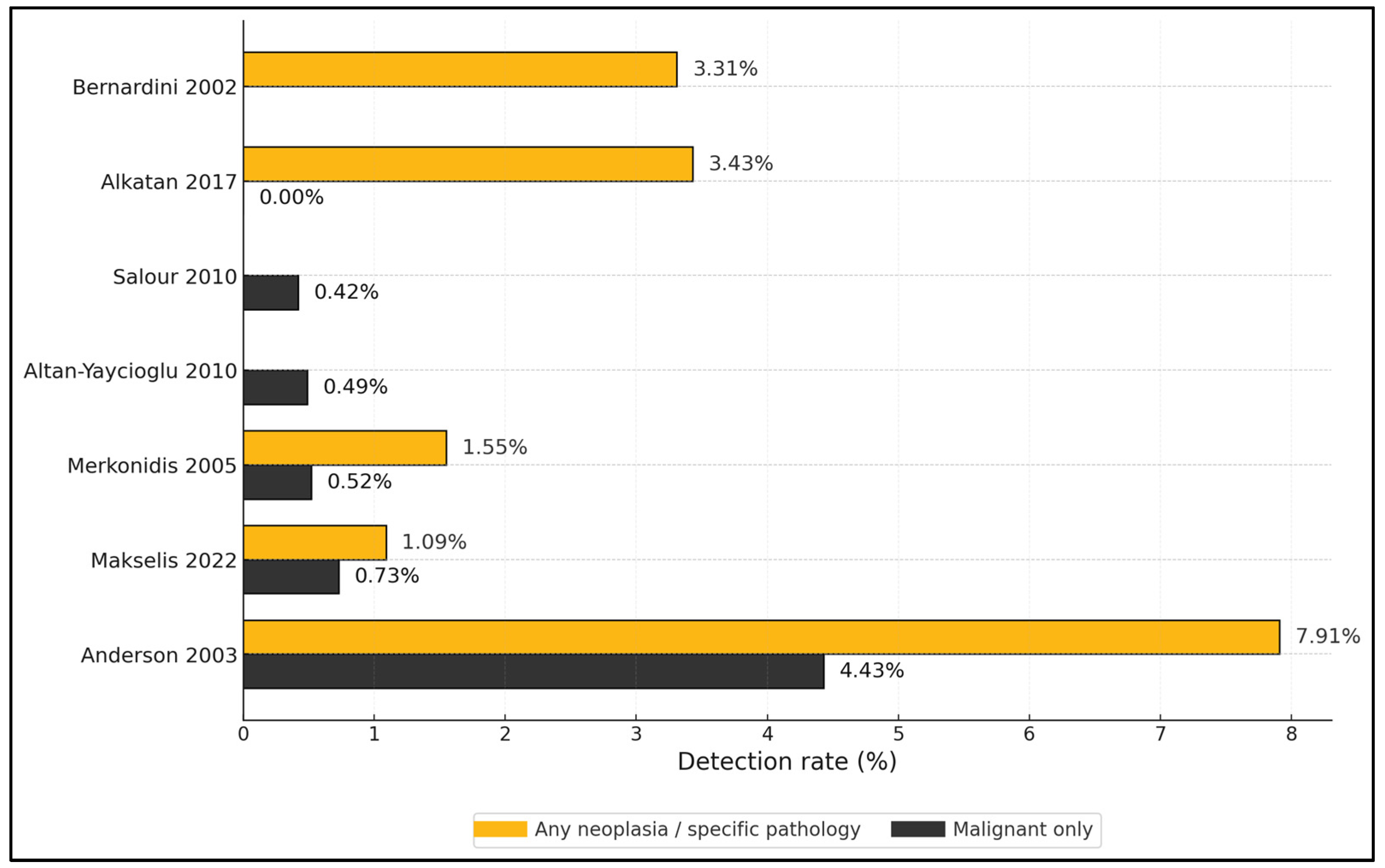
| Bernardini et al., 2002 [22] | Ophthalmology (U.S., single center) | Routine lacrimal sac biopsy during DCR | 258 pts/302 specimens | 65.8 | NR | Abnormal sac in 8/10 positive cases | 10/302 (3.31) | NR | NR | Mostly external DCR |
| Anderson et al., 2003 [23] | Ophthalmic Plast Reconstr Surg (U.S., Emory) | Routine pathology review of DCR specimens | 316 | NR | NR | Reviewed for “significant” pathology | 25/316 with significant (7.9) * | 14/316 neoplasms (4.43) | 8/316 (2.53) | Ophthalmology; pathology lab series |
| Lee-Wing & Ashenhurst, 2001 [24] | Ophthalmology (Canada) | PANDO clinicopathology at DCR | 166 | NR | NR | NR | 0 | 0 | 0 | Ophthalmology |
| Merkonidis et al., 2005 [25] | Br J Ophthalmol (UK) | Prospective, routine wall biopsy at endoscopic DCR | 164 pts/193 DCRs | 65.9 | 64 (mean) | Inquire/inspect; select biopsy if suspicious | 3/193 “specific” (1.55) ** | 0.52 (1 papilloma) | ~1.0 (2 unsuspected systemic) | ENT + Ophth (endoscopic DCR) |
| Altan-Yaycioglu et al., 2010 [26] | Orbit (Turkey) | PANDO clinicopathology | 205 | 62.4 | 69 (mean) | NR | NR | 1/205 (0.49) | NR | Ophthalmology |
| Salour et al., 2010 [27] | Orbit (Iran) | Routine lacrimal sac histology during DCR | 471 specimens | NR | NR | 2 grossly abnormal sacs | NR | 2/471 lymphoma (0.42) | 1/471 (0.21) | Ophthalmology |
| Alkatan et al., 2017 [28] | Can J Ophthalmol (Saudi Arabia) | Routine histopathology of DCR/DCT specimens | 459 pts/498 specimens | 70.8 | 51.6 ± 17.8 | 0.6% pre-op suspected | 17/495 unsuspected benign (3.43) | 0 | 0 | Ophthalmology |
| Makselis et al., 2022 [29] | BMC Ophthalmology (Lithuania) | 275 ANLDO with routine lacrimal sac biopsy | 275 | NR | NR | 0.7% palpable mass | 3/275 tumors (1.09) | 2/275 (0.73) | NR | Ophthalmology |
| Banks et al., 2020 [30] | Laryngoscope (U.S., Mass Eye and Ear) | Endoscopic DCR; role of routine sac biopsy | NR (retrospective) | NR | NR | ENT endoscopic service | NR | NR | NR | ENT lead |
| Eldsoky et al., 2021 [31] | Pan Arab J Ophthalmol (Egypt) | Predictive value of routine sac biopsy in endoscopic DCR | 50 | NR | NR | ENT endoscopic | Specific pathology yield reported | NR | NR | ENT lead |
| Heindl et al., 2010 [32] | Ophthalmologe (Germany) | Selective biopsies; malignant prevalence in all DCRs | ~500 DCR denominator | NR | NR | Biopsy if suspicious | NR | ~1.4 among all DCRs | NR | Mixed |
| Kuo et al., 2020 [33] | Sci Rep (Taiwan) | All lacrimal sac lesions (1995–2018) | 65 | NR | NR | Tumor registry | 100 (by design) | 29.2 malignant | NR | Ophthalmology |
| Song et al., 2019 [34] | Head and Neck (China) | Lacrimal sac SCC only | 69 | NR | NR | Cancer cohort | NR | 100 SCC | NR | Multidisciplinary (ENT/Opthal/Onc) |
| Wakasaki et al., 2023 [35] | In Vivo (Japan) | Lacrimal sac tumors (single institution) | 25 | 44 | 58.7 (avg) | 88% sac mass | NR | 22 malignant (88%) *** | NR | Multidisciplinary |
| Chu et al., 2024 [36] | Diagnostics (Taiwan) | Delayed/misdiagnosed lacrimal sac tumors | NR (retrospective) | NR | NR | Focus on delays | NR | Cohort includes multiple lymphomas | NR | Multidisciplinary |
| Kumar et al., 2016 [37] | AJNR (India) | Imaging spectrum of lacrimal sac pathologies | 38 | NR | NR | Imaging-based | NR | Mix of malignant/benign in imaging | NR | Radiology/ENT/Ophth |
| Linberg & McCormick, 1986 [38] | Ophthalmology (U.S.) | Excisional NLD biopsy technique; early series | 14 | NR | NR | Technique feasibility | NR | NR | NR | Ophthalmology |
| Study (Year) | Imaging Hallmarks (Malignant vs. Benign, %) | Diagnostic Delay | Treatment Composition | Nodal Status | Outcomes | Malignant Histology Details |
|---|---|---|---|---|---|---|
| Kuo et al., 2020 [33] | Bone erosion: 50% vs. 11% • Infiltrative pattern: 63% vs. 0% | NR | Malignant: Surgery 100%; adjuvant CRT 47.4%, RT 42.1% | NR | Recurrence 42%, metastasis 47%, mortality 53% (malignant subset) | Mixed epithelial + lymphoma cohort (counts in article) |
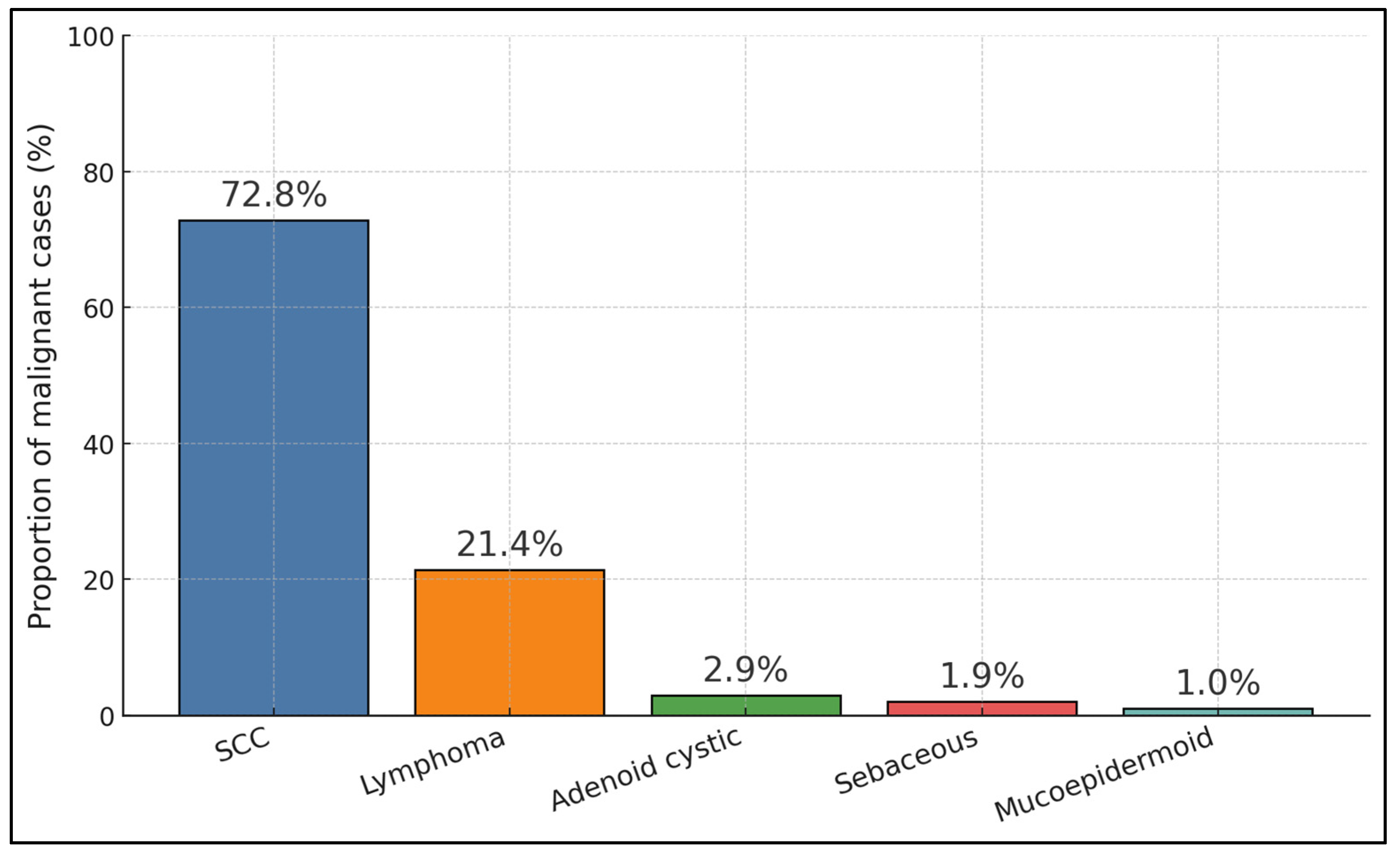
| Wakasaki et al., 2023 [35] | (qualitative; cohort-level, not % by modality) | Mean 14.7 mo; median 8 mo (range 1–96) | Epithelial tumors: Surgery 93.3%; post-op (chemo) RT in 8 cases; heavy-ion RT in 1; ICI used for 1 recurrence | NR | Local control in all but one case | SCC 6, lymphoma 10, adenoid cystic 2, sebaceous 2, mucoepidermoid 1 |
| Song et al., 2019 [34] | NR | NR | Mixed approaches (surgery + RT vs. definitive RT/CRT; proportions not stated in abstract) | Nodal positivity present and adverse | 5-yr OS 87.6%, 5-yr PFS 76.3% | SCC only (lacrimal sac) |
| Heindl et al., 2010 [32] | NR | — | Selective biopsy captured broad spectrum with few biopsies (policy description) | NR | 5-yr survival 87% (significant pathology) vs. 96% (no significant pathology) | NHL 3, SCC 2, MEC 1, melanoma 1, oncocytoma 1, plus inflammatory/granulomatous entities |
| Makselis et al., 2022 [29] | NR | NR | NR | NR | NR | Adenoid cystic 1, small B-cell lymphoma 1 (malignant subtypes within total tumors) |
| Salour et al., 2010 [27] | NR | NR | NR | NR | NR | Lymphoma 2 (malignant IDs among routine DCR specimens) |
Disclaimer/Publisher’s Note: The statements, opinions and data contained in all publications are solely those of the individual author(s) and contributor(s) and not of MDPI and/or the editor(s). MDPI and/or the editor(s) disclaim responsibility for any injury to people or property resulting from any ideas, methods, instructions or products referred to in the content. |
© 2026 by the authors. Published by MDPI on behalf of the Lithuanian University of Health Sciences. Licensee MDPI, Basel, Switzerland. This article is an open access article distributed under the terms and conditions of the Creative Commons Attribution (CC BY) license.
Share and Cite
Anglitoiu, A.E.; Marin, K.C.; Bratosin, F.; Avramut, R.; Boruga, O. Lacrimal Sac and Nasolacrimal Duct Tumors Mimicking Chronic Inflammation: A Systematic Review. Medicina 2026, 62, 142. https://doi.org/10.3390/medicina62010142
Anglitoiu AE, Marin KC, Bratosin F, Avramut R, Boruga O. Lacrimal Sac and Nasolacrimal Duct Tumors Mimicking Chronic Inflammation: A Systematic Review. Medicina. 2026; 62(1):142. https://doi.org/10.3390/medicina62010142
Chicago/Turabian StyleAnglitoiu, Alina Elisabeta, Karina Cristina Marin, Felix Bratosin, Robert Avramut, and Ovidiu Boruga. 2026. "Lacrimal Sac and Nasolacrimal Duct Tumors Mimicking Chronic Inflammation: A Systematic Review" Medicina 62, no. 1: 142. https://doi.org/10.3390/medicina62010142
APA StyleAnglitoiu, A. E., Marin, K. C., Bratosin, F., Avramut, R., & Boruga, O. (2026). Lacrimal Sac and Nasolacrimal Duct Tumors Mimicking Chronic Inflammation: A Systematic Review. Medicina, 62(1), 142. https://doi.org/10.3390/medicina62010142