Article

Effects of Different Exercise Interventions on Fall Risk and Gait Parameters in Frail Patients After Open Heart Surgery: A Pilot Study

by
Vitalija Stonkuvienė
*,
Raimondas Kubilius
and
Eglė Lendraitienė
Department of Rehabilitation, Faculty of Nursing, Medical Academy, Lithuanian University of Health Sciences, 44307 Kaunas, Lithuania
*
Author to whom correspondence should be addressed.
Medicina 2025, 61(2), 206; https://doi.org/10.3390/medicina61020206

Submission received: 28 December 2024 / Revised: 19 January 2025 / Accepted: 21 January 2025 / Published: 24 January 2025

Abstract

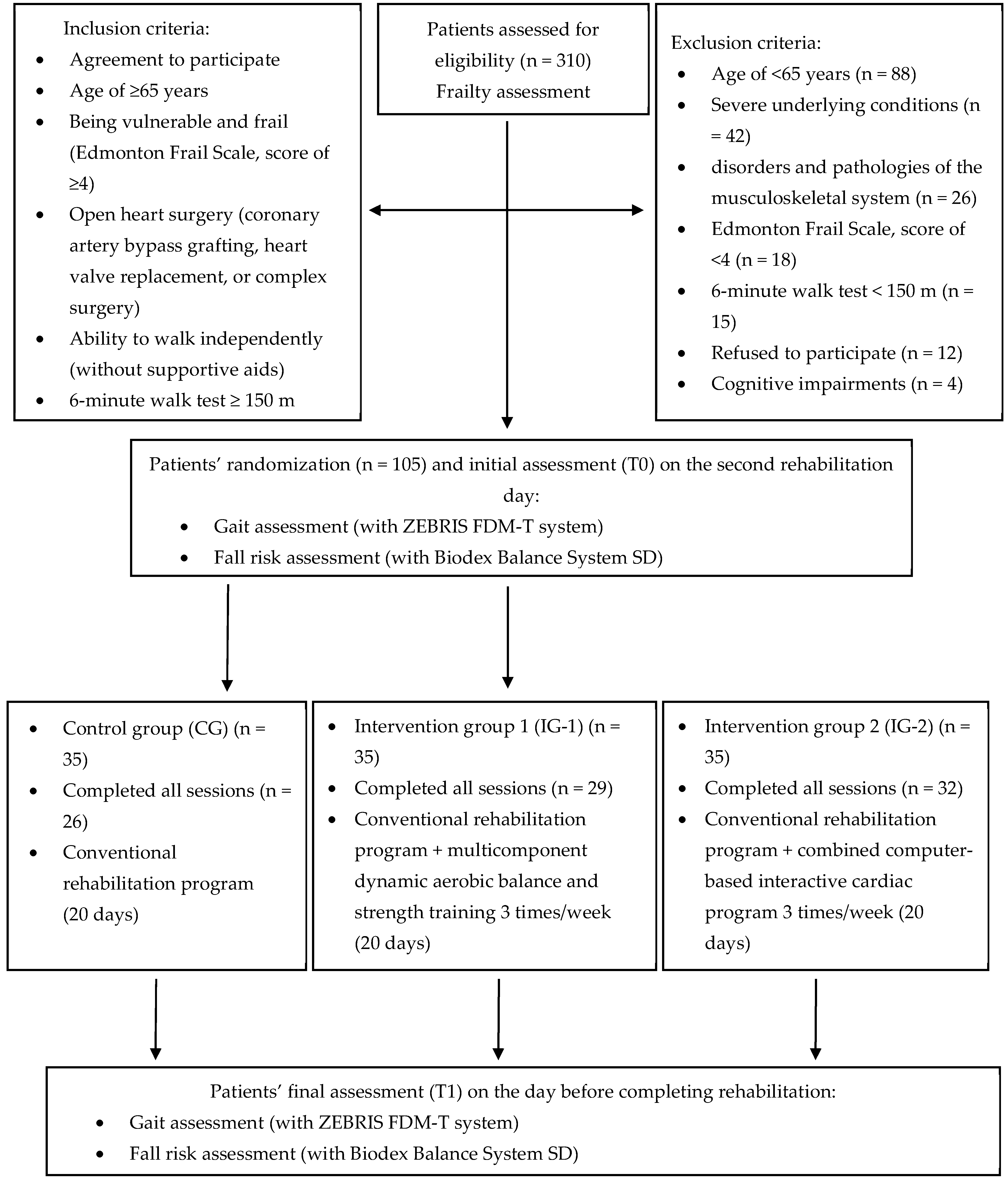
Background and Objectives: Research on the effectiveness of different exercise programs on reducing fall risk and improving gait parameters among frail patients after open heart surgery is scarce. Therefore, the aim of this study was to evaluate and compare the effects of different exercise interventions on fall risk and gait parameters in frail patients after open heart surgery during inpatient rehabilitation. Materials and Methods: A prospective randomized study was conducted at Kulautuva Hospital of Rehabilitation, Hospital of Lithuanian University of Health Sciences Kauno Klinikos, from July 2021 to November 2023. A total of 105 pre-frail and frail patients were randomized into three groups: control (CG, n = 35), intervention 1 (IG-1, n = 35), and intervention 2 (IG-2, n = 35). All three groups completed a conventional rehabilitation program that included aerobic training tailored based on each person’s health status six times/week. The IG-1 additionally received multicomponent dynamic aerobic balance and strength training three times/week, and the IG-2 received a combined computer-based interactive program three times/week. The overall stability index, as an outcome of fall risk, Short Physical Performance Battery (SPPB) score, and gait parameters (geometry, stance, and timing) were assessed before and after rehabilitation. Results: Of the 105 patients, 87 completed the study. The median age of the patients was 71 years (range: 65–88); 64.76% were male. After rehabilitation, within-group comparisons showed a significant improvement in the overall stability index, SPPB, and all phase gait parameters in all groups. Of all geometry gait parameters, none of the groups showed a significant improvement in step width, and foot rotation was significantly reduced only in the IG-2. All timing gait parameters improved in the CG and IG-2 after rehabilitation, while in the IG-1, only gait speed was significantly improved. Between-group comparisons after rehabilitation revealed significant differences in the overall stability index among the groups and in all phase gait parameters except for stance phase between the IG-1 and the IG-2. The greatest significant difference was documented for the double stance phase between the IG-1 and the IG-2, and the smallest was recorded for the single limb support phase. Significantly greater differences in step time and stride time were found in the IG-1 and the IG-2 than in the CG. Conclusions: All applied interventions were effective in reducing fall risk based on the overall stability index. However, interactive exercise interventions decreased fall risk based on the overall stability index by one-fifth as compared to the conventional rehabilitation program. The incorporation of interactive exercise interventions in rehabilitation resulted in improved double stance phase, stride time, and step time parameters, but did not have any effect on gait speed as compared to other exercise interventions.
Keywords: frailty; cardiac rehabilitation; open heart surgery; computer-based interactive program frailty; cardiac rehabilitation; open heart surgery; computer-based interactive program