Review

Infantile Spasms (West Syndrome): Integrating Genetic, Neurotrophic, and Hormonal Mechanisms Toward Precision Therapy


by
Bibigul Abdygalyk
1,
Marat Rabandiyarov
2,
Marzhan Lepessova
3,
Gaukhar Koshkimbayeva
3,*,
Nazira Zharkinbekova
4,
Latina Tekebayeva
5,
Azamat Zhailganov
2,
Alma Issabekova
3,
Bakhytkul Myrzaliyeva
3,
Assel Tulendiyeva
2,
Assem Kurmantay
3,
Arailym Turmanbetova
3 and
Sandugash Yerkenova
1,*
1
Department of Neurology, Kazakhstan’s Medical University “KSPH”, Almaty 050060, Kazakhstan
2
Children’s City Clinical Hospital No. 2, Almaty 050060, Kazakhstan
3
Department of General Medical Practice with Courses, Kazakh-Russian Medical University, Almaty 050060, Kazakhstan
4
Department of Neurology, South Kazakhstan Medical Academy, Shymkent 160000, Kazakhstan
5
“University Medical Center” Corporate Fund, Turan Street 32, Astana 010000, Kazakhstan
*
Authors to whom correspondence should be addressed.
Medicina 2025, 61(12), 2223; https://doi.org/10.3390/medicina61122223
Submission received: 3 November 2025 / Revised: 7 December 2025 / Accepted: 12 December 2025 / Published: 16 December 2025
(This article belongs to the Special Issue New Insights into Neurodevelopmental Biology and Disorders)

Abstract

Background and Objectives: Infantile spasms (ISs), or West syndrome (WS), represent an early-onset epileptic encephalopathy in which diverse structural, genetic, metabolic, infectious, and neurocutaneous conditions converge on a shared pattern of hypsarrhythmia, clustered spasms, and later developmental impairment. Growing use of genomic diagnostics has revealed that variants in STXBP1, KCNQ2, GRIN2A, GRIN2B, and TSC-related genes are more common than previously recognized and can be linked to partially actionable pathways. This review aimed to synthesize current evidence on the multifactorial etiology, network-based pathogenesis, and evolving targeted therapies for ISs, with particular attention to TSC-related forms. Materials and Methods: A structured narrative review was undertaken of publications from 1990 to 2025 in PubMed, Scopus, Web of Science, and Embase using terms related to ISs, WS, genetics, mTOR, ACTH, vigabatrin, ketogenic diet, and precision therapies. Authoritative guidance from ILAE and AAN was incorporated. Clinical, molecular, and therapeutic data were grouped under etiological, pathogenetic, and management domains. Results: Structural causes remained the largest group, but combined genetic, genetic–structural, and metabolic etiologies accounted for about one third of contemporary cohorts. Early network disruption involving cortex, thalamus, basal ganglia, and brainstem, together with imbalances in NGF, BDNF, and IGF-1, explained why distinct primary insults produce a uniform electroclinical phenotype. Early treatment with ACTH or high dose prednisolone, with or without vigabatrin, was consistently associated with higher electroclinical remission and better developmental outcome. Everolimus and related mTOR inhibitors showed benefit in TSC-associated ISs, while agents directed at NMDA receptors or KCNQ channels are emerging for genotype defined subgroups. Conclusions: ISs should be approached as a heterogeneous but mechanistically convergent disorder in which rapid diagnosis, parallel genetic testing, and early disease modifying therapy improve prognosis. Integration of molecular profiling with standardized outcome monitoring is likely to move management from symptomatic seizure control to pathway-specific intervention.

1. Introduction

Infantile spasms (ISs), historically referred to as West syndrome (WS) following Dr. William James West’s delineation in 1841, constitute one of the most severe variants of early-onset epileptic encephalopathy [1,2,3]. This condition is characterized by a triad consisting of clustered epileptic spasms, hypsarrhythmia evident on electroencephalography (EEG), and either developmental stagnation or regression [4,5]. Despite the apparent uniformity in clinical presentations, the etiological underpinnings are surprisingly diverse, encompassing structural cerebral anomalies, chromosomal and single-gene mutations, metabolic disorders, immune system dysfunctions, and postnatal injuries [6,7,8,9]. The commonality among these varied origins is the premature disruption of cortical-subcortical circuitry during a critical neurodevelopmental phase, which results in abnormal network synchronization and the onset of epilepsy [10]. A significant aim of contemporary neurogenetic and translational research has been to elucidate the convergent biological mechanisms that yield this shared electroclinical phenotype [11].
Over the past twenty years, significant advancements have been made in mapping the genetic and molecular framework of ISs [12]. Cutting-edge sequencing methodologies, such as next-generation sequencing (NGS), whole-exome sequencing (WES), and genome-wide copy-number analysis, have identified pathogenic variants across more than one hundred genes, including STXBP1, KCNQ2, GRIN2A, GRIN2B, ARX, and CDKL5 [13,14,15,16,17,18]. Numerous genes implicated in this condition encode proteins vital for neuronal migration, synaptic vesicle cycling, ion-channel modulation, and intracellular signaling pathways, thereby directly correlating molecular dysregulation with network instability [19]. Concurrently, investigations into TSC1 and TSC2 mutations have underscored the pathogenic significance of mTOR pathway hyperactivation in cortical dysplasia and epileptogenesis, thereby creating a mechanistic link between genetic and acquired etiologies [20,21,22]. These findings have transformed the understanding of WS from a strictly clinical entity to a continuum of molecularly characterized developmental and epileptic encephalopathies (DEEs) [23].
The prevalence of WS is approximated to be around 2–3.5 per 10,000 live births, representing nearly 10% of all epilepsy cases that manifest within the initial year of life [24]. Epidemiological investigations conducted in North America, Europe, and Asia consistently identify a peak incidence occurring between 3 and 7 months of age, with a slight male bias observed [25,26,27]. Structural and genetic factors collectively account for over 70% of instances, while idiopathic or cryptogenic variants comprise a diminishing minority as advancements in genetic diagnostics progress [28]. The prognosis is notably heterogeneous and largely influenced by underlying causes and the timing of therapeutic intervention. In spite of improvements in early identification, merely one-third of individuals attain long-term seizure remission, with approximately 50% encountering subsequent epileptic syndromes, such as Lennox–Gastaut syndrome or other developmental epileptic encephalopathies [29,30,31]. In areas with limited resources, delays in diagnosis and restricted availability of hormonal therapies further complicate developmental outcomes, highlighting the pressing necessity for standardized global treatment protocols.
At the pathophysiological level, ISs are increasingly conceptualized as a network disorder in which structural, metabolic, or genetic disturbances converge upon a restricted array of molecular pathways that regulate the excitatory–inhibitory equilibrium, neurotrophin expression, and neuroendocrine signaling [32,33]. Aberrations in GABAergic maturation, dysregulation of neurotrophic factors such as nerve growth factor (NGF) and insulin-like growth factor 1 (IGF-1), and mTOR-mediated hyperactivation represent recurring mechanistic patterns across various etiologies [34]. These observations clarify why therapeutic agents that act on different molecular pathways, including adrenocorticotropic hormone (ACTH), corticosteroids, vigabatrin, and the ketogenic diet, can each mitigate spasms by partially restoring the disrupted homeostatic balance. Simultaneously, neuroinflammatory and immunomodulatory mechanisms have garnered recognition as contributors to the process of epileptogenesis, thereby providing a basis for the effectiveness of corticosteroids and ACTH that extends beyond their endocrine actions [35,36,37].
In the last decade, therapeutic advancements have started to translate these mechanistic understandings into clinical practice [38]. Everolimus, an mTOR inhibitor, has shown clinical efficacy in WS associated with TSC1/TSC2 mutations, while NMDA receptor antagonists, such as memantine, and potassium-channel openers, like retigabine, are currently being investigated for their potential in GRIN2A/GRIN2B and KCNQ2-related epileptic encephalopathies, respectively [39]. Adjunctive neurosteroid analogs (e.g., ganaxolone) and peptides derived from IGF-1 represent additional strategies aimed at modifying disease progression that may help restore neurochemical equilibrium and synaptic integrity [40]. These targeted approaches herald a transformative shift from merely symptomatic seizure management toward precision-guided therapies specifically tailored to the underlying molecular anomalies [41,42].
Notwithstanding significant progress, the clinical management of WS continues to present considerable challenges, with numerous infants still facing delays in diagnosis, inadequate seizure control, and severe developmental consequences. Furthermore, the expanding genetic landscape has surpassed the pace of clinical application, leading to ambiguity regarding which genetic findings should influence treatment decisions. Consequently, this review aims to integrate current insights into the multifactorial origins, molecular mechanisms, and novel therapeutic approaches associated with ISs syndrome. By amalgamating clinical, genetic, and translational research data, the objective is to develop a cohesive framework that correlates early neurological disruptions with distinct molecular pathways and to identify practical targets that may guide precision medicine. The ultimate aim is to connect mechanistic insights with clinical relevance, thereby enhancing early diagnostic capabilities, optimizing treatment strategies, and improving neurodevelopmental outcomes for affected children.

2. Materials and Methods

This comprehensive narrative review was conducted through a structured literature search and synthesis process integrating clinical, molecular, and therapeutic aspects of ISs and WS. Peer-reviewed publications in English were retrieved from PubMed, Scopus, Web of Science, and Embase databases between 1990 and 2025 using the following search terms and their Boolean combinations: “infantile spasms,” “West syndrome,” “infantile epileptic spasms syndrome,” “pathogenesis,” “genetic etiology,” “mTOR,” “ACTH,” “vigabatrin,” “ketogenic diet,” “IGF-1,” “neurosteroids,” “TSC1,” “TSC2,” “STXBP1,” “KCNQ2,” “GRIN2A,” “GRIN2B,” “neurotrophins,” “molecular therapy,” and “CRISPR.” Additional sources were identified through manual cross-referencing of citations from relevant reviews and clinical guidelines issued by the International League Against Epilepsy (ILAE) and American Academy of Neurology (AAN). Inclusion criteria encompassed original clinical studies, cohort analyses, case reports, translational and experimental investigations, and authoritative review articles addressing epidemiology, genetics, pathophysiology, diagnostic methods, and therapeutic outcomes in ISs. Articles focusing solely on unrelated epileptic encephalopathies or adult-onset epilepsies were excluded. Data were extracted, categorized, and synthesized under predefined thematic domains including etiologic classification, molecular mechanisms, neuroendocrine pathways, and therapeutic innovations. Genetic information was cross-validated using OMIM, ClinVar, and GeneCards databases, and gene symbols were formatted according to the HUGO Gene Nomenclature Committee (HGNC) standards. The manuscript integrates 210 cited references, ensuring comprehensive coverage of the historical, mechanistic, and emerging perspectives on ISs and facilitating a coherent framework for future translational and clinical research.

3. Multifactorial Etiology

ISs, frequently referred to as WS, embody a cohesive clinical phenotype that may emerge from a diverse array of etiological mechanisms, which include but are not limited to structural, metabolic, infectious, immunological, and genetic anomalies (Figure 1). Similarly to other neurodevelopmental disorders characterized by seizures and developmental impairment, ISs may arise from a single pathogenic insult or from complex interactions among multiple contributing factors [43]. In certain instances, the etiological basis remains elusive despite exhaustive neuroimaging, metabolic, and genetic assessments, resulting in categorization as cryptogenic or of unknown origin, which is typically correlated with a relatively favorable prognostic outlook [44,45]. The ILAE has further delineated these classifications by differentiating between symptomatic, cryptogenic, and idiopathic subgroups of ISs, with the latter defined by a history of normal development prior to manifestation, unremarkable neuroimaging findings, and a hypsarrhythmic EEG pattern devoid of focal epileptiform discharges [46].
Symptomatic ISs are characterized by the presence of an identifiable etiology or an existing developmental delay at the moment of spasm onset. Approximately 60–70% of individuals are classified within this category [47,48]. The etiological spectrum of symptomatic ISs can be systematically categorized based on the timing of the inciting event into prenatal, perinatal, or postnatal origins, each of which corresponds to distinct pathogenic mechanisms. Prenatal etiologies encompass congenital anomalies of the central nervous system (CNS), including cortical dysplasia, lissencephaly, holoprosencephaly, and hemimegalencephaly, which collectively account for approximately 30% of all occurrences [49]. Neurocutaneous syndromes and other syndromic disorders frequently contribute to prenatal etiologies. Notably, tuberous sclerosis complex (TSC) represents the most prevalent condition, with around 68% of individuals diagnosed with TSC experiencing ISs [50,51]. Additionally, chromosomal and copy-number variations, such as trisomy 21, deletions on chromosome 7q11.23 associated with Williams–Beuren syndrome (WBS), and deletions on chromosome 16p12.1, are also substantial contributors, comprising up to 15% of prenatal etiological factors [52,53].
Recent advancements in molecular genetics have clarified that mutations in a variety of genes are directly associated with the pathogenesis of ISs. These encompass genes that encode syntaxin-binding protein 1 (STXBP1), calcium/calmodulin-dependent serine protein kinase (CASK), ALG13, and adenylosuccinate lyase [28,54,55]. Inborn metabolic errors constitute another significant etiological category, with a minimum of 25 metabolic disorders currently acknowledged. Among these, phenylketonuria persists as the most prevalent, particularly in areas where neonatal screening initiatives are not comprehensively enacted [56]. Furthermore, prenatal infectious agents, such as congenital toxoplasmosis, syphilis, cytomegalovirus infection, and Zika virus infection, also play a role in the complex etiological landscape of ISs [57].
Perinatal and postnatal occurrences represent additional pivotal factors. Hypoxic–ischemic encephalopathy and neonatal hypoglycemia rank among the most prevalent perinatal etiologies [58,59]. Moreover, low birth weight has been identified as a significant risk factor, manifesting three to four times more frequently in infants experiencing ISs in comparison to the general populace [60]. In the postnatal phase, traumatic injuries, perinatal strokes, central nervous system infections, and neoplasms have been associated, collectively accounting for 15–67% of symptomatic instances [61,62]. Importantly, numerous structural and acquired injuries exhibit convergent molecular and cellular mechanisms that overlap with genetic and metabolic disorders. For instance, the signaling pathways disrupted in tuberous sclerosis intersect with those implicated in cortical malformation syndromes and chromosomal anomalies of the brain, thereby exemplifying a shared pathogenic continuum [63].
Recent multicenter investigations have emphasized the increasing acknowledgment of genetic and molecular determinants as primary drivers or modifiers of ISs. In a cohort derived from the National Infantile Spasms Consortium, the etiological distribution among 161 patients with confirmed diagnoses indicated genetic etiologies in 14.4%, genetic–structural in 10.0%, structural–congenital in 10.8%, structural–acquired in 22.4%, metabolic in 4.8%, and infectious in 2% [64]. These observations underscore the manner in which contemporary diagnostic methodologies, including array-comparative genomic hybridization (array-CGH), NGS, WES, and whole-genome sequencing (WGS), are transforming our understanding of the pathogenesis of ISs [65,66,67]. The resultant molecular revelations propose that vascular, metabolic, and immune insults frequently operate against a genetically predisposed backdrop, thereby fortifying the notion of a multifactorial etiology that integrates both intrinsic and environmental influences [67,68].

3.1. Genetic and Molecular Determinants

Genetic causes represent one of the most extensively investigated etiologic groups in infantile epileptic spasms syndrome (IESS) (Table 1). As reported by Poeta et al. [69], the majority of genes implicated in IESS display considerable phenotypic heterogeneity, mirroring that observed in other DEEs. Familial clustering and concordance in monozygotic twins suggest that a genetic predisposition underlies many cases of IESS [69]. The earliest identified X-linked genes, ARX [69] and CDKL5 [70], are both located on the short arm of the X chromosome and are highly expressed during fetal neurogenesis. Mutations in these genes disrupt neuronal migration and interneuron differentiation, leading to severe early-onset epileptic spasms with profound developmental delay. The discovery of ARX and CDKL5 established the first molecular link between neurodevelopmental regulation and the IESS phenotype, highlighting the relevance of GABAergic circuit disruption in disease pathogenesis.
Subsequent studies expanded the genetic landscape to include several autosomal genes associated with cortical malformations [71,72,73,74,75,76,77]. Variants in PAFAH1B1/LIS1 [71], DCX [72], and TUBA1A [73] were recognized as key contributors to neuronal migration disorders, such as lissencephaly and subcortical band heterotopia, which frequently manifest with spasms in infancy. The role of STXBP1 [74] has been particularly emphasized as one of the most recurrent single-gene causes of IESS, associated with both classic hypsarrhythmia and broader epileptic encephalopathy spectra. Ion channel dysfunction also contributes significantly. Mutations in KCNQ2 [75] cause neonatal epileptic encephalopathy with subsequent progression to IESS, while alterations in GRIN2A [77] and GRIN2B [78] affect NMDA-receptor signaling and glutamatergic transmission, underscoring the importance of excitatory–inhibitory balance in seizure generation. Similarly, MAGI2 [76] deletions in the 7q11.23 region link synaptic scaffolding deficits with the onset of spasms.
Several other genes further illustrate the mechanistic diversity of IESS. Mutations in FOXG1 [79], NSD1 [80], and SPTAN1 [81] affect transcriptional regulation, chromatin remodeling, and cytoskeletal integrity, respectively, contributing to microcephaly, hypomyelination, and dysmorphic features observed in affected infants. Copy number variations (CNVs) involving NEDD4 [82] and CALN1 [83] have been reported as potential risk factors, possibly influencing synaptic plasticity and neuronal excitability. Other genes such as WDR45 [84], RARS2 [85], UBA5 [86], and IARS2 [87] illustrate the contribution of mitochondrial and metabolic dysfunctions, in which impaired energy metabolism or defective protein turnover lowers seizure thresholds. These findings confirm that both structural and biochemical alterations converge on a shared epileptogenic phenotype, consistent with the multifactorial nature of IESS.
Advances in NGS have led to the identification of numerous novel and candidate genes associated with IESS. Studies employing WES and array-CGH have revealed mutations in PHACTR1 [88], ATP2A2 [89], CD99L2 [90], CLCN6 [91], CYFIP1 [92], CYFIP2 [93], GNB1 [94], GPT2 [95], and HUWE1 [96], each implicated in synaptic regulation, ion transport, or intracellular trafficking. Furthermore, chromatin-modifying and cytoskeletal genes such as KMT2D [97] and MYO18A [98] have emerged as new contributors, particularly in syndromic forms with craniofacial or skeletal anomalies. The discovery of NOS3 [99], RYR1 [100], RYR2 [101], and RYR3 [102] variants underscores the growing recognition of calcium-signaling pathways in epileptogenesis. Mutations in TAF1 [103] and TECTA [104] have been described in WES-based cohort studies, supporting transcriptional and extracellular matrix dysregulation as additional molecular mechanisms.
Recent studies have also highlighted de novo mutations in PURA [106], which cause PURA-associated neurodevelopmental disorder characterized by severe intellectual disability, hypotonia, and early-onset spasms. Voltage-gated sodium channel genes SCN2A [106], SCN1A [107], and SCN8A [108] have been increasingly recognized as major contributors to IESS, particularly in early-infantile epileptic encephalopathies. These mutations disrupt neuronal excitability and contribute to overlapping phenotypes that include Dravet-like and Lennox–Gastaut-like presentations. Autosomal recessive defects in WWOX [109] and mosaic or germline variants in SLC35A2 [110] have been described in both structural and non-structural forms, the latter being associated with focal cortical dysplasia. Moreover, NF1 [111] and TSC2/TSC1 [112] remain among the most frequent syndromic causes of IESS, particularly when cortical tubers or subependymal nodules are evident on neuroimaging.
Finally, the expanding use of genome-wide sequencing continues to refine the genetic architecture of IESS. Emerging evidence points to TOP2B [113] as a novel candidate gene, with loss-of-function variants leading to neuronal maturation defects and cortical disorganization. Collectively, the growing list of genes listed in Table 1 highlights the remarkable etiologic diversity of WS, encompassing transcriptional regulators, ion channels, synaptic organizers, cytoskeletal proteins, and metabolic enzymes. This molecular heterogeneity reflects the convergence of distinct cellular pathways on a shared epileptic phenotype characterized by spasms and developmental arrest. As sequencing technologies and functional genomics evolve, it is expected that additional genes and network interactions will be uncovered, paving the way for improved diagnostic precision and genotype-guided therapeutic strategies.

3.2. Other Factors

Structural abnormalities of the developing brain represent a consistent and well-documented substrate for ISs. Malformations such as lissencephaly, focal cortical dysplasia, polymicrogyria, hydranencephaly [114], hemimegalencephaly, and other disorders of neuronal migration frequently precede the onset of spasms, since they disturb cortical organization and the balance of excitatory and inhibitory circuits. Classical lissencephaly is most often related to pathogenic variants in PAFAH1B1/LIS1 and DCX, and in affected cohorts epileptic spasms have been reported in up to 80% of children with these genetic forms, which confirms that disruption of the microtubule and migration machinery has a strong epileptogenic effect in early life. Additional structural–genetic observations support this view. A de novo heterozygous mutation of KIF2A was identified in a child with lissencephaly, developmental delay, and ISs [115], showing that kinesin-related defects can converge on the same phenotype. Another infant with periventricular nodular heterotopia and ISs carried an unbalanced translocation involving 3p26.2–10p15.1 together with a 6q22.31 duplication, which indicates that combined chromosomal dosage changes may also produce a cortical dysgenesis–IS profile [116]. A further report described a child with a novel homozygous nonsense mutation in B3GALNT2 who presented with Walker–Warburg syndrome, ISs, and sensorineural hearing loss, thereby linking defective glycosylation of α-dystroglycan to early epileptic spasms [117]. Taken together these observations show that very different developmental pathways, including cytoskeletal transport, vascular patterning, and O-mannosyl glycosylation, can all culminate in an ISs phenotype when cortical formation is severely disturbed.
ISs are also encountered within complex malformation or chromosomal syndromes. Down syndrome, Pallister–Killian syndrome, and WBS are the best characterized examples. In a series of 183 individuals with Down syndrome, 15 had epilepsy and 4 of them had ISs, which indicates that spasms occur in a non-negligible subset of these patients [118]. Tapp et al. [119] reported that seizures in Down syndrome occur in 1–13% of cases, and among these 6–32% present with ISs, suggesting that trisomy 21 creates a brain microenvironment that is permissive for early epileptogenesis. Pallister–Killian syndrome, which is caused by mosaic tetrasomy 12p, is characterized by dysmorphic facial features, pigmentary changes, alopecia, intellectual disability, and epilepsy; in these patients epileptic spasms tend to appear later than in classic WS [120]. In WBS, which is due to a 7q11.23 microdeletion, Marshall et al. [59] described a patient with ISs who had a larger deletion extending to 7q21.11 that included MAGI2, a synaptic scaffolding gene previously linked to ISs, indicating that enlargement of the deleted region may increase epileptic risk. Sporadic cases of ISs have also been described in Schinzel–Giedion, Smith–Lemli–Opitz, Smith–Magenis, Sotos, and Noonan-like syndromes with PPP1CB variants, showing that many multisystem developmental disorders can express spasms as an early neurological manifestation [121,122]. Two rare neurodevelopmental disorders, PEHO syndrome and Aicardi syndrome, often start clinically with spasms. PEHO is characterized by progressive encephalopathy, hypsarrhythmia, optic atrophy, and cerebellar atrophy resulting from granule cell loss; a mutation in ZNHIT3 was recently identified as the main genetic cause [123]. Aicardi syndrome affects only females and is defined by agenesis of the corpus callosum, chorioretinal lacunae, severe intellectual disability, ISs, and frequently asymmetric hypsarrhythmia; intracranial tumors of the choroid plexus have also been reported [124]. These syndromic associations underscore that ISs may be the earliest recognizable sign of a complex disorder and that targeted genetic testing is indicated when dysmorphic or multiorgan features accompany spasms.
Inborn errors of metabolism constitute another relevant etiologic group and should always be considered in infants with spasms, especially when neuroregression, movement disorders, or multiorgan involvement are present. Classical phenylketonuria (PKU), caused by biallelic variants in the PAH gene and characterized biochemically by defective conversion of phenylalanine to tyrosine, was historically a common cause of ISs in the pre-screening era, with affected infants exhibiting hypopigmentation, progressive cognitive impairment, and seizures including spasms due to severe white matter and gray matter injury [125]. The rarer tetrahydrobiopterin deficiency forms, which affect the cofactor of phenylalanine hydroxylase, show an even higher rate of early seizures that are often refractory to standard antiepileptic drugs. In a cohort of 80 infants with ISs, Alrifai et al. [126] identified an inborn or neurometabolic disorder in 12.5% of cases, showing that metabolic etiologies are not rare when actively searched for. The identified disorders included Leigh-like disease, ethylmalonic aciduria, non-ketotic hyperglycinemia due to GCSH deficiency, hyperinsulinemic hypoglycemia (HHF17), short-chain acyl-CoA dehydrogenase deficiency due to ACADS mutations, molybdenum cofactor deficiency caused by GPHN, primary carnitine deficiency due to SLC22A5, and hypoglycemia secondary to hypopituitarism (CPHD15). Other metabolic conditions in which ISs have been described comprise glycine encephalopathy caused by GLDC or GCST variants, DEND syndrome due to KCNJ11 mutations, methylmalonic acidemia (MUT), maple syrup urine disease (BCKDHA, BCKDHB, DBT, DLD), and propionic acidemia (PCCA, PCCB). Neurodegenerative metabolic diseases such as Krabbe disease caused by GALC mutations and Menkes disease due to ATP7A defects may also present with ISs as part of their epileptic phenotype [127,128,129]. Rarer associations include cerebrotendinous xanthomatosis due to CYP27A1 mutations [130], glucose transporter type 1 deficiency from SLC2A1 exon 9 mutations [131], and congenital disorders of glycosylation related to ALG1, ALG6, or ALG11 [132]. Pyridoxine-dependent epilepsy represents a special situation, since variants in ALDH7A1 lead to accumulation of toxic intermediates and to seizures of multiple types, including ISs, which can respond dramatically to high-dose pyridoxine; however, atypical and late-onset forms with metabolic decompensation and EEG abnormalities have been reported, which makes the diagnosis more difficult [133,134]. These data justify a systematic metabolic work-up in infants with spasms, particularly when standard imaging is unrevealing.
Neurocutaneous disorders or phacomatoses provide an important link between genetic pathways regulating cell growth and the occurrence of ISs. These disorders typically present with a combination of congenital cutaneous lesions, ocular involvement, central or peripheral nervous system structural anomalies, and multiorgan features affecting the heart, kidney, or lung [135,136,137]. TSC represents the prototypical phacomatosis associated with ISs [138,139]. Pathogenic variants in TSC1 or TSC2 disrupt the hamartin–tuberin complex and cause constitutive activation of the mTOR pathway, which in turn impairs cortical lamination and interneuron development. This process results in cortical tubers, white matter radial bands, subependymal nodules, and sometimes subependymal giant cell astrocytoma, which provide multiple epileptogenic foci [112,140]. In a cohort of 81 children with TSC, 91% experienced seizures and 32% had a history of ISs, confirming that spasms are a frequent early seizure type in this condition [141]. Surgical resection of a dominant cortical tuber has been shown to reduce or abolish seizures, including spasms, in selected drug-resistant patients [142,143]. mTOR inhibitors, administered as monotherapy or in combination, have been proposed as disease-modifying agents for TSC-related epilepsy and ISs, although their long-term use is limited by adverse effects and by the observation that the antiepileptic response may wane over time [144,145,146].
Other phacomatoses can rarely present with ISs. In NF1, caused by loss of function of NF1 and reduced activity of neurofibromin in the RAS–MEK–MAPK–ERK signaling cascade, epilepsy occurs in 5–6% of patients, although ISs account for only a small fraction and the overall prognosis of spasms in NF1 tends to be better than in structural or metabolic causes [135,137]. Sturge–Weber syndrome, which is caused by somatic activating variants in GNAQ, features capillary malformations of the face, leptomeningeal angiomatosis, and choroidal vascular involvement. Epilepsy develops in up to 77% of patients with unilateral and more than 90% with bilateral brain involvement, most often with focal seizures but occasionally with ISs when the cortical involvement is extensive and early [137]. These vascular neurocutaneous disorders illustrate that chronic cortical irritation, impaired venous drainage, and secondary cortical atrophy can also converge on the typical electroclinical pattern of ISs.
Overall, this body of evidence confirms that infantile spasms are not restricted to a single etiologic pathway but instead arise from diverse structural, chromosomal, metabolic, and neurocutaneous disorders that all impair early brain development. Identification of the precise cause is essential, since some of these conditions, particularly metabolic epilepsies and TSC, have targeted or disease-modifying treatments that may improve seizure control and developmental outcome when instituted promptly.

4. Pathogenesis and Molecular Mechanisms

4.1. Network-Level Pathophysiology: Disrupted Cortical–Subcortical Circuits

The pathophysiology of ISs is considered multifactorial and remains only partially understood, as diverse etiological factors can lead to the same electroclinical presentation (Table 2). Structural anomalies, genetic channelopathies, and acquired destructive lesions all appear to converge on a vulnerable stage of cortical and subcortical network development, producing the characteristic pattern of clustered spasms and hypsarrhythmia [66,147,148]. Structural anomalies such as lissencephaly, polymicrogyria, cortical tubers, and diffuse destructive conditions including hydranencephaly, together with genetically inherited channelopathies, have been identified as primary contributors to ISs. This suggests that the crucial factor is not the specific lesion type but its impact on early neuronal organization and on the maturation of cortical-subcortical circuits [66,147,148]. A widely accepted theoretical framework posits that early disruptions in neuronal and interneuronal connectivity lead to aberrant interactions between the neocortex, thalamus, basal ganglia, and brainstem. These network disturbances ultimately give rise to the hallmark symptoms of clustered spasms and hypsarrhythmia, even when MRI reveals only focal or unilateral abnormalities [148]. The clinical discrepancy between a localized injury and a generalized EEG pattern can be explained if a focal initiator recruits deep nuclei and thalamocortical pathways that propagate epileptic activity across both hemispheres, producing bilaterally symmetric spasms accompanied by widespread high-amplitude slow waves and spikes [149,150].
The association of ISs with cognitive impairment and autistic features can also be interpreted within this network framework. For example, deletions of SCN2A and SCN3A identified in a child with autism spectrum disorder and ISs reinforce the concept that shared genetic vulnerabilities may drive both abnormal cortical excitability and atypical cognitive or social development [151]. Similar observations across independent cohorts indicate that epileptic and neurobehavioral phenotypes may arise as parallel manifestations of an underlying developmental channelopathy or synaptopathy rather than as distinct complications [66,147]. This broader view places ISs within a spectrum of disorders characterized by impaired excitation–inhibition balance and disrupted large-scale neural integration.
ISs arise from dysfunction of distributed cortical–subcortical circuits rather than a single epileptogenic focus, and multimodal evidence consistently points to early involvement of deep structures that shape cortical excitability. Across human EEG-fMRI, resting-state fMRI, and peri-ictal EEG studies, thalamocortical pathways, cortico-striatal-thalamic loops, brainstem arousal systems, hippocampal–limbic structures, and large-scale interhemispheric networks repeatedly appear as nodes perturbed during hypsarrhythmia and spasm generation [192,193,194]. Notably, simultaneous EEG-fMRI demonstrates that BOLD activation begins in the brainstem and thalami before spreading to cortex [192], while GABAergic perturbations in a GABRB3 knock-in mouse model prolong thalamocortical oscillatory firing and reduce cortical inhibition [194]. Lesion-network mapping in tuberous sclerosis further reveals that heterogeneous cortical lesions converge functionally on the bilateral globi pallidi, suggesting a shared basal-ganglia vulnerability irrespective of tuber location [192]. Complementing these deep-structure findings, resting-state graph-theory analyses show decreased clustering, reduced small-worldness, and increased global efficiency, reflecting a shift toward more randomized cortical topology and impaired hemispheric integration [193]. Collectively, these multimodal data support a model in which early deep-structure dysregulation propagates to a cortex rendered vulnerable by reduced inhibition and immature connectivity.
Mechanistically, converging data from genetics, developmental neurobiology, lesion studies, and rodent models indicate that impaired inhibition, altered thalamocortical dynamics, and dysfunctional network hubs together shape the electroclinical phenotype of ISs. In APC conditional-knockout mice, reduced numbers of parvalbumin-positive interneurons and abnormal interneuron maturation demonstrate a significant excitation–inhibition imbalance during the developmental window in which spasms emerge. These deficits parallel human EEG microphysiology, which shows pre-ictal cortical pauses resembling down-states followed by intense up-states that can trigger spasms and produce the characteristic electrodecrement. Furthermore, the temporal sequence of deep-structure activation, including the brainstem, thalamus, hippocampus, and basal ganglia, during hypsarrhythmia helps explain the diffuse cortical desynchronization and chaotic interictal EEG pattern observed in ISs [195]. Graph-theory markers of network randomization correlate with seizure frequency and may account for the cognitive and developmental regression commonly associated with ISs [193]. Peri-ictal analyses of fast-ripple activity on EEG reveal increased global efficiency and dynamic shifts in hub organization during spasms, reflecting rapid reconfiguration of cortical networks across ictal and interictal states [196,197,198,199].
Despite substantial progress, several gaps limit the translation of these network insights into targeted therapies. Human imaging studies remain predominantly correlative, and interventional or longitudinal multimodal designs are required to determine whether modifying identified hubs such as thalamic or pallidal circuits meaningfully alters clinical trajectories [192]. The absence of tract-level diffusion MRI and MEG studies constrains precise mapping of structural pathways and source localization of fast oscillations. Etiological heterogeneity further complicates mechanistic interpretation, highlighting the need for larger, stratified cohorts to differentiate network signatures associated with genetic, structural, and metabolic causes [192,193]. In parallel, mechanistic findings from animal models, including interneuron deficits and GABA-A receptor dysfunction, have not yet been translated into human trials [192,194]. Therefore, priority next steps include prospective longitudinal EEG-fMRI with standardized event modeling, integration of DTI-based tractography and MEG source localization, and early-phase interventional trials such as thalamic or pallidal neuromodulation or interneuron-targeted pharmacotherapies combined with network-level readouts to test causality and refine circuit-directed strategies for ISs.

4.2. Neurotrophin Dysregulation (BDNF, NGF, GDNF): Dual Role in Injury and Epileptogenesis

Neurotrophic signaling is increasingly recognized as an important contributor to the age-restricted vulnerability characteristic of ISs. Neurotrophins such as brain-derived neurotrophic factor (BDNF), nerve growth factor (NGF), glial cell line-derived neurotrophic factor (GDNF) and insulin-like growth factors (IGF)-1 and -2 modulate survival play essential roles in neuronal survival, differentiation, interneuron maturation, and early circuit formation, while also participating in immune–neuroendocrine interactions [152,153,154,155]. This developmental framework aligns with observations that ISs emerge during a critical maturational window in which disturbances in neurotrophin availability may disproportionately affect excitatory–inhibitory balance and network stability [200,201]. Clinical studies in neonates with hypoxic–ischemic injury—one of the most frequent antecedents of symptomatic ISs—report increased CSF BDNF and reduced CSF NGF, a pattern interpreted as a compensatory attempt to protect neurons from excitotoxic injury and as a marker of selective impairment of NGF-secreting systems [156,157,158,159]. However, although neurotrophins are conceptually linked to IESS pathogenesis, the supplied literature does not include primary mechanistic studies detailing canonical receptor–signaling cascades (e.g., BDNF/TrkB, NGF/TrkA, GDNF/GFRα-RET), regional developmental expression, or pathway-specific contributions to spasms. Thus, receptor-level mechanistic inferences remain insufficiently supported by available evidence.
Clinical and preclinical data nonetheless suggest that neurotrophin dysregulation accompanies ISs in several etiologies. CSF studies demonstrate that β-NGF levels vary markedly across etiologic groups. Infants with ISs due to tuberous sclerosis or postinfectious injury exhibit exceptionally high CSF NGF concentrations, far exceeding values observed in age-matched controls or cryptogenic cases, whereas infants with ISs of structural or hypoxic origin often show reduced NGF levels and poorer responsiveness to ACTH therapy [160,161,162,163,164,202,203]. This bidirectional profile supports a dual-role model in which either NGF deficiency (reflecting neuronal loss or impaired trophic support) or NGF excess (potentially driven by inflammation or mTOR pathway activation) can disrupt synaptic maturation and contribute to epileptogenesis. Elevated NGF in tuberous sclerosis and postinfectious ISs has led to the hypothesis that excessive NGF may actively promote hyperexcitability and could represent a future therapeutic target in these subtypes [165,166]. More broadly, reviews and animal-model syntheses propose that neurotrophins may modulate the transition from acute injury to chronic epileptogenesis by influencing synaptic plasticity, circuit reorganization, and inhibitory maturation, although direct, region-specific, temporally resolved neurotrophin measurements in validated IESS models are not provided in the supplied corpus [164,200].
The therapeutic implications of these findings remain preliminary. Conceptually, modulating neurotrophic signaling during the infantile critical window could either enhance recovery or prevent maladaptive remodeling, yet no clinical trials directly targeting neurotrophin pathways in ISs are reported in the available literature [164,200]. Existing treatment evidence focuses instead on standard therapies such as ACTH, which does not selectively influence neurotrophin pathways but remains effective in seizure cessation for many infants [203]. Because neurotrophin signaling is highly time-dependent, determining whether and when to enhance versus inhibit specific pathways is a key translational challenge that the current evidence base cannot resolve. Consequently, research priorities include longitudinal and regionally resolved measurement of BDNF, NGF, GDNF, and related molecules in animal models and human samples; experimental manipulation of TrkB, TrkA, and GFRα-RET pathways during defined developmental windows to test causality; and the design of larger etiologically stratified clinical cohorts to evaluate neurotrophins as biomarkers and to guide ethically and mechanistically informed neurotrophin-targeted therapeutic trials.

4.3. IGF-1 Deficiency and Impaired Steroid-Driven Trophic Signaling

IGF-1 is a key trophic mediator in early brain development, linking growth hormone signaling, mTOR activity, synaptogenesis, interneuron maturation, and resistance to cellular stress [170,171,172,173]. It supports neuronal survival, promotes synaptogenesis and myelination, and reduces microglial and astrocytic inflammation during the critical developmental window in which ISs emerge [202,204]. Although the supplied literature does not detail IGF-1′s primary structure or transcriptional regulation, consistent evidence demonstrates that IGF-1 receptor activation is essential for establishing inhibitory connectivity in neonatal cortex, a process central to preventing the excitatory–inhibitory imbalance characteristic of IESS [204]. Importantly, IGF-1 bioavailability differs from circulating IGF-1 levels: glucocorticoid exposure can increase serum IGF-1 while simultaneously reducing tissue-bioactive IGF-1 through IGFBP processing and post-receptor resistance mechanisms [201]. These compartment-specific effects underscore why trophic signaling may be impaired even when serum IGF-1 appears normal.
Clinical and experimental findings converge to show that IGF-1 deficiency contributes to the pathophysiology of ISs, particularly in spasms secondary to prenatal, perinatal, or early postnatal injury. Infants with ISs of unknown etiology often have CSF IGF-1 values comparable to controls and respond well to ACTH, whereas children with spasms following early structural insults show markedly reduced CSF IGF-1, poor hormonal response, and later cognitive decline [172,173]. Similar developmental vulnerabilities are seen in premature infants with low perinatal IGF-1, who are at elevated risk of neurodevelopmental delay [174,175]. Mechanistic support for these clinical patterns comes from the TTX neocortical lesion model, in which cortical IGF-1 expression is significantly reduced, accompanied by loss of GABAergic presynaptic terminals and impaired inhibitory connectivity; conditional reduction in IGF-1R reproduces these deficits, confirming a causal role for IGF-1 in interneuron maturation [204]. Human neocortical tissue resected after perinatal stroke shows the same reductions in IGF-1 and inhibitory markers, with regionally heterogeneous patterns, including reduced interneuronal IGF-1 but increased astrocytic IGF-1, suggesting both focal injury and downstream network-level deficits [204]. Notably, serum IGF-1, IGFBP-3, and their ratio correlate with short-term ACTH response and EEG characteristics in IESS, highlighting their potential as biomarkers for treatment responsiveness [202].
Therapeutically, the restoration of IGF-1 signaling shows robust disease-modifying potential in experimental models. Treatment with the IGF-1–derived tripeptide (1–3) IGF-1 rescues interneuron connectivity, normalizes inhibitory synapses, abolishes spasms, and reverses hypsarrhythmia-like EEG abnormalities in most treated animals [204]. In addition, this peptide reduced vigabatrin-related retinal toxicity in the CURE Infantile Spasms Consortium trial, further supporting translational feasibility [175]. The interaction between IGF-1 and hormonal therapies provides further mechanistic insight: ACTH acts not only by stimulating adrenal glucocorticoids but also through central melanocortin receptors such as MC2R, which modulate seizure susceptibility and influence ACTH efficacy [205,206]. Glucocorticoids can both enhance serum IGF-1 and impair tissue IGF-1 signaling, while non-neural studies show that glucocorticoids and IGF-1 can synergistically engage the PI3K/Akt pathway, potentially explaining ACTH’s superior clinical performance in some cohorts [207]. Indeed, registry data and trial syntheses show that ACTH, prednisolone, and vigabatrin each improve spasm cessation, but ACTH often yields greater electroclinical improvement and longer relapse-free intervals [207,208,209]. Together, these findings position IGF-1 deficiency as a mechanistic driver of interneuron and network dysfunction in ISs and support a therapeutic framework in which hormonal therapy, trophic signaling, and IGF-1-based interventions converge to restore developmental homeostasis.

4.4. GABAergic Immaturity and Neurosteroid Deficiency

Alterations in inhibitory neurotransmission constitute a major pathogenic pathway in ISs, reflecting the unique developmental trajectory of GABAergic signaling in early life. In the neonatal brain, GABA is initially depolarizing because intracellular chloride concentrations remain high, and only with maturation-driven upregulation of the KCC2 chloride exporter does GABA_A receptor activation become hyperpolarizing and inhibitory [210]. Any process that delays or disrupts this developmental GABA_A “switch,” including impaired interneuron maturation, reduced KCC2 expression, or receptor-level dysfunction, can sustain a state of network hyperexcitability during the age range when ISs appear [207]. The pathogenic potential of receptor abnormalities is underscored by a GABRB3 beta3-subunit mutation that produces an IS-like phenotype in mice [211]. These mechanisms are consistent with clinical observations showing decreased GABA_A receptor expression and altered neurosteroid sensitivity in resected IS cortex [178,179,180], and with the therapeutic efficacy of vigabatrin, a GABA transaminase inhibitor that enhances synaptic GABA availability [212].
Human tissue studies and diverse animal models converge on a picture of interneuron immaturity, impaired inhibitory synaptic function, and chloride-handling deficits. Resected neocortex from infants with epileptic spasms demonstrates reduced GAD, parvalbumin, and synaptotagmin-2 expression, mirroring interneuron connectivity deficits in the TTX injury model [213]. Several genetic and acquired models provide etiologically specific support [214]. APC cKO mice display reduced PV-positive interneurons with altered inhibitory function at P9 (the peak spasm period) [215]. The Arx(GCG)10 + 7 model shows interneuron migratory defects and early postnatal apoptosis that can be rescued with neonatal estradiol or ACTH. The multiple-hit model indicates selective PV-interneuron loss, paralleling partial vigabatrin responsiveness in structural IS [207]. Environmental stressors can also influence GABAergic vulnerability, since prenatal stress increases susceptibility to NMDA-induced spasms and decreases KCC2 and GAD67 expression in offspring [208]. Although NKCC1 likely contributes to early chloride homeostasis, the supplied corpus does not provide direct NKCC1 measurements in IS, and the role of this transporter must therefore be regarded as insufficient evidence.
Neurosteroid biology provides an integrated mechanistic bridge between hormonal therapies and GABAergic maturation in ISs. Progesterone-derived metabolites such as 3-alpha-ol-20-one and endogenous steroids including THDOC act as potent positive allosteric modulators of GABA_A receptors, increasing both phasic and tonic inhibition while also reducing glutamatergic excitation [183,184,185]. These effects offer a compelling explanation for the rapid suppression of spasms following ACTH, which increases endogenous neurosteroid synthesis through adrenal and central melanocortin pathways [178,179,180,181,182]. ACTH nonresponders exhibit a low DHEA to androstenedione ratio, suggesting that impaired neurosteroidogenesis may reduce the efficacy of hormonal therapy [186]. Although direct measurements of neurosteroids or steroidogenic enzymes in human IS tissue are not provided in the available literature, indirect experimental support arises from the ARX model, where estradiol and ACTH restore interneuron density and suppress spasms. Broader neurosteroid studies further highlight the importance of CNS synthesis and of key enzymes such as 5-alpha-reductase and 3-alpha-hydroxysteroid dehydrogenase in regulating GABA_A receptor modulation [215,216].
Therapeutic implications follow from these converging pathways. Vigabatrin effectively increases brain GABA levels and is particularly beneficial in TSC-related IS, including presymptomatic seizure-prevention contexts [217]. However, models of structural-etiology IS show incomplete responsiveness, likely due to irreversible interneuron loss or transporter dysfunction. Hormonal therapies act through synergistic mechanisms related to anti-inflammatory effects, neurosteroidogenesis, and enhancement of GABA_A-mediated inhibition, and therefore complement GABAergic and chloride-stabilizing strategies [211]. Synthetic neurosteroids such as ganaxolone have been proposed for refractory ISs [188,189], although IS-specific clinical trial results are not included in the supplied corpus. Similarly, NKCC1 inhibitors such as bumetanide lack IS-focused clinical evidence. Biomarker development remains an unmet need. CSF GABA levels are lower in symptomatic ISs than in idiopathic cases or controls, reflecting reduced inhibitory tone [187], yet validated biomarkers predicting response to vigabatrin, steroid therapy, or neurosteroid-targeted treatment are not available. Priority research directions include longitudinal studies of GABAergic and neurosteroid biomarkers, etiology-stratified translational models, and combination therapies that target chloride homeostasis, GABAergic stabilization, and trophic support [216].

4.5. Immune Activation, Inflammation, and mTOR Pathway in IS Epileptogenesis

The interaction of immune signaling with neurotrophic imbalance and inhibitory network immaturity provides a coherent mechanistic framework for IS epileptogenesis. In TSC, epileptogenic tubers contain activated microglia and reactive astrocytes that release cytokines and disturb local trophic support. Cerebrospinal fluid studies report elevated NGF and reduced IGF-1 in affected infants, creating a proconvulsant environment during early development. These abnormalities occur in parallel with dysregulated mTOR activity, GABAergic dysfunction, and impaired network maturation, all of which increase susceptibility to ISs [218].
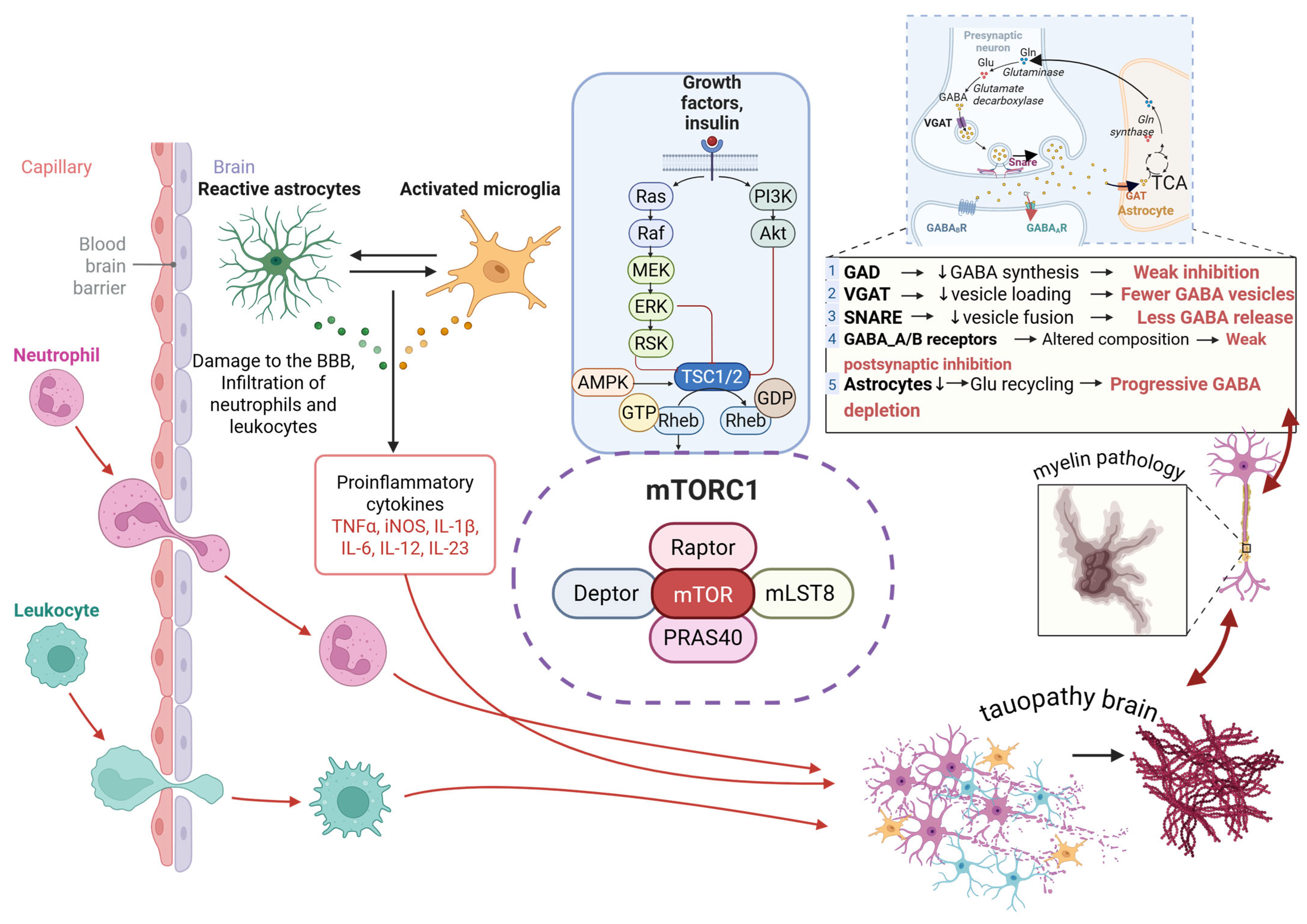
The interplay of neurotrophic imbalance, inhibitory dysfunction, immune activation, and mTOR pathway engagement creates a coherent framework for understanding IS epileptogenesis. In TSC, epileptogenic tubers contain activated microglia and reactive astrocytes that release cytokines, elevate CSF NGF, and reduce IGF-1, producing a proconvulsant and proinflammatory environment during early infancy [162,163,164,165]. A similar pattern appears in postinfectious IS, where systemic inflammation converges with immature GABAergic networks and enhances mTOR signaling. These inflammatory processes disrupt blood–brain barrier integrity, promote leukocyte entry, stimulate glial activation, alter glutamate and potassium buffering, and interfere with GABA synthesis, vesicle loading, and receptor trafficking. At the same time, mTORC1 hyperactivation affects interneuron development, synaptic maturation, and the balance between excitation and inhibition. Together, these events lower seizure thresholds and support the emergence of IS in vulnerable infants (Figure 2).
Growing evidence supports the presence of a proinflammatory neural environment during the early stages of IS. Human neuropathology and several animal models show early activation of microglia and astrocytes, which release cytokines and chemokines that influence neuronal excitability and synaptic maturation. Increased signaling through interleukin 1 receptor pathways and toll like receptors has been documented in developmental epileptic encephalopathies, including disorders marked by mTOR dysregulation [218]. Microglial proliferation and polarization toward inflammatory states increase extracellular glutamate, reduce debris clearance, and impair pruning mechanisms needed for healthy circuit development. Astrocyte dysfunction contributes to reduced glutamate and potassium buffering and abnormal GABA uptake, which destabilize inhibition. These mechanisms parallel findings in resected IS tissue where inflammatory gene expression is present even at early developmental stages. Together, these observations support the concept that neuroinflammation directly shapes the formation of epileptogenic networks in infancy.
Immune mediated contributions extend beyond resident glial cells. Blood–brain barrier dysfunction allows peripheral immune cells to enter the developing brain, where they release cytokines and free radicals. Studies in mTOR related disorders show albumin extravasation, endothelial activation, and metalloproteinase driven remodeling of the extracellular matrix [218]. These processes weaken barrier integrity and facilitate leukocyte trafficking. Perivascular astrocytes exposed to cytokines release mediators that increase oxidative stress and disturb ionic gradients. These events promote maladaptive synaptic remodeling and impair early functional connectivity, an effect that also appears in mosaic mTOR pathway disorders such as epidermal nevus syndromes, which frequently present with early-onset epilepsy and ISs [219]. Transcriptomic studies in infant brain tissue show increased expression of inflammatory transcription factors such as SPI1, indicating early microglial priming. In IS, the convergence of vascular inflammation, oxidative injury, and cytokine signaling contributes to widespread network disorganization and the abrupt emergence of hypsarrhythmia.
The mTOR pathway integrates immune activation, metabolic stress, and neurodevelopmental cues. Its dysregulation has emerged as a central driver of inflammation related epileptogenesis in IS. Hyperactivation of mTORC1 alters cell growth, interneuron development, and the balance of excitation and inhibition. Cytokines such as IL-1β and TNFα enhance these effects through upstream activation of PI3K–Akt signaling, suppression of autophagy, and promotion of oxidative stress. TSC provides a clear example of this mechanism. Prenatal mTOR overactivation in TSC leads to cortical malformations, persistent glial activation, disrupted myelination, and abnormal connectivity patterns that appear before seizure onset [218,220]. These abnormalities parallel defects in GABAergic maturation, including reduced GAD activity, altered vesicle loading, and impaired receptor trafficking. Similar mechanisms operate in neurocutaneous syndromes involving mosaic PI3K–Akt–mTOR mutations, where somatic pathway activation produces hemimegalencephaly and early-onset epileptic spasms [219]. Together, these data support a model in which immune activation and mTOR pathway overactivity act synergistically to impair neuronal circuit maturation, lower seizure thresholds, and drive the developmental epileptic encephalopathy that defines WS.

5. Therapeutic Approaches

The early detection and swift implementation of treatment remain the most pivotal factors influencing a positive prognosis in ISs. A plethora of clinical and population-based investigations have demonstrated that a reduced interval between the manifestation of spasms and the initiation of therapy significantly enhances seizure cessation rates, the resolution of hypsarrhythmia, and long-term neurodevelopmental outcomes [190,191]. Delays extending beyond four weeks from the initial presentation are consistently associated with diminished treatment responsiveness and an elevated risk of subsequent refractory epilepsy and cognitive deficits. The fundamental therapeutic principle is the early disruption of epileptogenic network activity prior to irreversible cortical remodeling. Once the electroclinical diagnosis is confirmed, therapeutic intervention should commence immediately, even before the complete clarification of etiology. The initial diagnostic approach frequently involves a trial of pyridoxine (vitamin B6), administered intravenously at a dosage of 100–150 mg over 5–10 min under electrocardiographic surveillance to exclude pyridoxine-dependent epilepsy, a treatable metabolic disorder linked to mutations in the ALDH7A1, PLPBP, or PNPO genes. In these instances, a notable clinical and electroencephalographic enhancement typically occurs within hours of administration [221]. Should no improvement occur, the infusion should be halted to avert toxicity. Some authorities advocate for a subsequent trial of pyridoxal-5′-phosphate in cases of suspected PNPO deficiency, especially in neonates with metabolic irregularities.
Concurrent biochemical analysis for α-aminoadipic semialdehyde and pipecolic acid in plasma or urine may further substantiate the diagnosis of vitamin B6-dependent epilepsies. When these etiologies are ruled out, disease-modifying therapy employing ACTH, corticosteroids, or vigabatrin should be promptly instituted. Findings from the National Infantile Spasms Consortium indicate that the commencement of therapy within two weeks of the onset of spasms nearly doubles the probability of achieving complete electroclinical remission compared to delayed treatment, and early responders tend to exhibit superior adaptive and cognitive development by 12 to 24 months, irrespective of the underlying etiology. Consequently, the prevailing management paradigm underscores the urgency of rapid recognition, immediate initiation of targeted therapy, and timely transition from diagnostic to disease-modifying interventions to avert permanent synaptic and neurodevelopmental compromise [220].
The foundation of pharmacological intervention in ISs continues to be the synergistic application of hormonal therapies alongside GABAergic modulation, which collectively seek to mitigate epileptiform activity and reestablish homeostatic equilibrium within the maturing brain. Within the category of hormonal agents, ACTH, corticosteroids (notably prednisolone), and vigabatrin form the primary therapeutic triad [190,191,221,222]. ACTH demonstrates pleiotropic effects on corticotropin receptors located in both the adrenal cortex and the central nervous system, resulting in enhanced glucocorticoid synthesis, inhibition of corticotropin-releasing hormone (CRH), which is a recognized proconvulsant peptide, and modulation of inflammatory cytokines associated with epileptogenesis. Despite the considerable variability in ACTH dosing protocols across different medical institutions, recent meta-analyses and multicenter investigations have indicated comparable efficacy between low-dose (20–30 IU/day) and high-dose (75–150 IU/day) treatment regimens, suggesting that lower dosages can yield equivalent electroclinical remission with a reduced incidence of metabolic and cardiovascular complications [223]. The standard therapeutic regimen typically encompasses a 2–4-week administration of intramuscular ACTH, followed by a gradual tapering phase, frequently transitioning to oral corticosteroids to avert relapse [223,224,225].
Prednisolone, which operates via glucocorticoid receptor-mediated transcriptional mechanisms, attenuates neuroinflammation and stabilizes hyperexcitable cortical networks. Several controlled trials, including the United Kingdom Infantile Spasms Study (UKISS) and subsequent randomized studies, have demonstrated that high-dose oral prednisolone (40–60 mg/day for 2 weeks) exhibits comparable efficacy to intramuscular ACTH in facilitating early cessation of spasms and normalization of EEG, thereby positioning it as a viable and cost-effective first-line alternative in settings with limited resources [226,227]. Additionally, the exploration of combination therapy utilizing hormonal agents alongside vigabatrin has been investigated as a synergistic strategy, revealing elevated short-term remission rates in specific cohorts, although the long-term developmental advantages remain inconsistent across various studies [228].
Adjunctive and non-hormonal therapies provide additional options for refractory or etiology-specific cases. Vigabatrin, an irreversible inhibitor of GABA transaminase, increases GABAergic inhibition and is particularly effective in ISs associated with tuberous sclerosis complex, achieving spasm cessation in up to 70 percent of cases. Its long-term use, however, carries a risk of retinal toxicity and reversible MRI signal changes in deep gray matter structures, which necessitates careful ophthalmologic and imaging surveillance [229]. Ketogenic dietary therapies represent another nonpharmacological option for drug-resistant ISs. The classical ketogenic diet, high in fat and low in carbohydrates, promotes ketone body production that stabilizes neuronal networks through enhanced mitochondrial function, increased GABA synthesis, and reduced oxidative stress. Clinical studies report complete or substantial seizure reduction in 40 to 60 percent of treated patients [227]. Modified dietary approaches, including medium-chain triglyceride and modified Atkins diets, offer improved tolerability and similar effectiveness [230]. These dietary therapies show particular benefit in metabolic etiologies such as pyruvate dehydrogenase deficiency and GLUT1 deficiency syndrome, where they function as disease-specific metabolic treatments. Together, these strategies demonstrate the growing importance of aligning therapy with underlying biochemical and metabolic mechanisms, which supports a precision-oriented approach.
When spasms persist despite first-line therapy, an early transition to a second-line agent is recommended. The choice of subsequent therapies depends on the suspected underlying mechanism. Sodium valproate, topiramate, levetiracetam, clobazam, and zonisamide have been used as monotherapies or adjuncts, achieving partial or complete remission in 20 to 40 percent of refractory cases [231,232,233]. Valproate remains widely accessible but requires monitoring for hepatotoxicity and mitochondrial dysfunction, particularly in children with POLG mutations [234]. Multicenter data show that roughly one-third of nonresponders achieve remission with a mechanistically distinct second-line therapy, highlighting the critical role of mechanism-based treatment sequencing [235].
Precision-oriented therapeutic strategies are becoming increasingly relevant in ISs as genetic and molecular findings begin to inform treatment selection. Everolimus and other mTOR inhibitors demonstrate significant benefit in patients with TSC1 or TSC2 mutations by reducing mTOR overactivation and improving seizure control [208]. Memantine has been explored in cases with pathogenic variants in GRIN2A or GRIN2B, where excessive NMDA receptor activity contributes to epileptogenesis, while retigabine provides a mechanistic match for disorders involving KCNQ2 or KCNQ3 channel dysfunction [235,236]. Neurosteroid analogs such as ganaxolone, which enhance GABAA receptor signaling, and IGF-1 derived peptides that support synaptic maturation, exemplify therapies guided by specific neurochemical deficits. Emerging approaches include antisense oligonucleotides and CRISPR-based strategies that aim to correct pathogenic variants in CDKL5 and ARX, although these remain in preclinical stages. These innovations mark a transition from empirical treatment toward biomarker-driven precision therapy, where genomic, transcriptomic, and metabolomic findings guide drug selection and predict treatment response.
Future priorities include establishing validated biomarkers that can stratify patients based on predicted therapy responsiveness, integrating molecular diagnostics into treatment algorithms, and designing clinical trials that evaluate etiology-specific interventions. Collectively, the expanding therapeutic landscape signals a shift away from generalized seizure suppression toward targeted modification of the underlying molecular pathology, offering the potential for improved developmental outcomes and durable remission.

6. Future Perspectives

Future directions in the management of ISs will hinge upon elucidating the reasons behind the differential responses of infants to ACTH or prednisolone, particularly in cases where treatment is initiated at an early stage. Pioneering studies comparing high-dose ACTH with prednisone demonstrated the efficacy of hormonal therapies; however, such efficacy is not universally applicable, suggesting that the influence of hormones on CRH, neurosteroids, and inflammatory mediators varies among individuals. This phenomenon necessitates a re-examination utilizing contemporary methodologies, ensuring that ACTH treatment is guided by biological predictors of response rather than applied empirically. It is imperative to prioritize prospective investigations that correlate early endocrine and CSF profiles with both seizure cessation and normalization of EEG readings, employing the standardized diagnostic and therapeutic frameworks previously established by the AAN/CNS, and ILAE for ISs [43,48,52,55].
A secondary approach involves the comprehensive incorporation of expedited genetic testing into the initial management pathway for infants exhibiting ISs. Several of the most commonly implicated genes associated with ISs, including STXBP1, KCNQ2, GRIN2A, as well as the TSC-related genes TSC1 and TSC2, are already classified as actionable or partially actionable. This indicates that identification of the specific molecular anomaly can guide therapeutic decisions regarding hormonal treatments, vigabatrin, mTOR inhibitors, or early metabolic and dietary interventions [28,68,234]. Consequently, clinical pathways ought to be realigned to ensure that array-CGH and NGS are conducted concurrently with hormonal therapy rather than subsequent to multiple pharmacological failures. This concurrent approach will facilitate the earlier transition to disease-modifying treatments for TSC-associated ISs and to targeted receptor or channel therapies for glutamatergic or potassium channel-related epileptic encephalopathies.
A tertiary, closely associated consideration is the formulation of combination therapies that address multiple disrupted pathways simultaneously. Evidence from ICISS and other multicenter studies indicates that the addition of vigabatrin to hormonal treatment enhances the early electroclinical response in specific subpopulations, although not uniformly across all developmental metrics. This finding implies that the GABAergic deficiency, along with neuroinflammatory or CRH-driven factors, should be concurrently addressed rather than sequentially [48,51]. Subsequent clinical trials should evaluate rational combination therapies such as ACTH combined with vigabatrin, ACTH with a ketogenic diet, or hormonal therapy paired with IGF-1 analogs in conditions where imbalances in IGF-1 and neurotrophins are established, utilizing predefined biomarkers for candidate selection and toxicity monitoring.
Lastly, precision and restorative therapeutic strategies must be implemented during early life stages, rather than restricted to refractory cases. The promising outcomes associated with everolimus in TSC-related epilepsy demonstrate that mTOR inhibition can mitigate seizure frequency when the underlying causal mechanisms are identified; similar reasoning applies to NMDA receptor antagonism in GRIN2A-associated ISs and to KCNQ openers in KCNQ2 epileptic encephalopathy [234,235,236]. The subsequent phase involves integrating these targeted pharmacological agents with longitudinal neurodevelopmental assessments, ensuring that seizure control is not the sole outcome measure. Multicenter registries, standardized outcome metrics, and early genetic stratification will be critical in demonstrating that pathogenetic, rather than merely symptomatic, interventions for ISs can enhance long-term cognitive, linguistic, and social adaptation outcomes.

7. Conclusions

ISs constitute a multifaceted, intricate epileptic encephalopathy wherein various genetic, structural, metabolic, and immunological factors converge upon a singular pathway of network dysregulation during a pivotal developmental phase. Despite the diverse origins contributing to its manifestation, the commonality lies in the premature disruption of the inhibitory and excitatory equilibrium within cortical-subcortical circuits, which is foundational to the electroclinical manifestation of hypsarrhythmia and the ensuing neurodevelopmental deterioration. Recent advancements in neuroimaging, molecular genetics, and neurochemical profiling have markedly enhanced the categorization of ISs, uncovering that genetic etiologies, including alterations in STXBP1, KCNQ2, GRIN2A, and TSC1/TSC2, are significantly more prevalent than previously acknowledged. The incorporation of high-throughput genomic diagnostics such as NGS and WES has facilitated the earlier identification of actionable genetic variants, thereby transforming the diagnostic framework from purely descriptive to mechanistic, thus bolstering the nascent paradigm of precision-targeted therapy.
Timely identification and prompt commencement of therapeutic interventions remain fundamental to achieving favorable outcomes. Hormonal therapies, including ACTH and prednisolone, alongside vigabatrin, persist as primary treatment modalities capable of disrupting epileptogenic activity and enhancing developmental trajectories when initiated within the initial weeks following onset. Supplementary strategies, incorporating ketogenic dietary therapy and neurosteroid-based interventions, offer additional pathways for seizure management, particularly in refractory cases or distinct etiological subgroups. Crucially, expedited transition from diagnostic assessment to disease-modifying treatment has been demonstrated to significantly enhance the probability of remission and to alleviate long-term cognitive ramifications, underscoring the imperative of therapeutic responsiveness as a vital factor influencing prognosis.
The therapeutic landscape surrounding ISs is progressively evolving towards targeted molecular and restorative strategies aimed at altering the fundamental disease biology, rather than solely focusing on seizure suppression. The successful implementation of mTOR inhibitors in TSC-associated ISs exemplifies how elucidating specific pathogenic pathways can yield efficacious, mechanism-oriented therapies. Similarly, novel pharmacological agents such as NMDA receptor antagonists for GRIN2A/GRIN2B mutations, KCNQ channel openers for KCNQ2-related epileptic encephalopathies, and IGF-1 analogues for trophic deficiency syndromes signify the forthcoming generation of personalized treatments. Preclinical investigations into antisense oligonucleotides and gene-editing technologies, including CRISPR-Cas9, present the potential to rectify causative mutations at their inception, marking a pivotal shift towards curative molecular medicine.
Ultimately, the management of ISs necessitates a multidisciplinary and progressive framework that integrates early clinical vigilance, thorough molecular diagnostics, and mechanistically informed interventions. The convergence of neurogenetic research, advanced neuroimaging, and neuroendocrine studies is poised to enhance our comprehension of how structural, synaptic, and biochemical anomalies yield the shared phenotype of ISs. By aligning precision medicine with early intervention strategies, the discipline is positioned to transform ISs from a devastating early-life encephalopathy into a manageable condition characterized by improved seizure control, preserved cognitive potential, and enhanced quality of life for affected children and their families.

Author Contributions

Conceptualization, B.A., M.R., A.K. and G.K.; methodology, M.L., N.Z. and L.T.; writing—original draft preparation, B.A., M.R., M.L. and A.Z.; writing—review and editing, A.K., G.K., A.I., B.M., A.T. (Assel Tulendiyeva), A.T. (Arailym Turmanbetova) and S.Y.; visualization, M.L. and A.T. (Arailym Turmanbetova); supervision, G.K. and S.Y.; project administration, G.K.; funding acquisition, S.Y. All authors have read and agreed to the published version of the manuscript.

Funding

This research received no external funding.

Conflicts of Interest

The authors declare no conflicts of interest.

Abbreviations

The following abbreviations are used in this manuscript:
ACADSAcyl-CoA dehydrogenase, C-2 to C-3 short chain
ACTHAdrenocorticotropic hormone
ADAutosomal dominant
AANAmerican Academy of Neurology
AASAα-Aminoadipic semialdehyde
ALG13Asparagine-linked glycosylation 13
ARXAristaless related homeobox
ATP2A2ATPase sarcoplasmic/endoplasmic reticulum Ca2+ transporting 2
B3GALNT2Beta-1,3-N-acetylgalactosaminyltransferase 2
CAGSSSCataract–ataxia–short stature–skeletal dysplasia–seizures syndrome
CDKL5Cyclin-dependent kinase-like 5
CNVCopy number variation
CNSCentral nervous system
DCXDoublecortin
DEEDevelopmental and epileptic encephalopathy
EEGElectroencephalography
FOXG1Forkhead box G1
GABAGamma-aminobutyric acid
GDNFGlial cell line-derived neurotrophic factor
GRIN2AGlutamate ionotropic receptor NMDA type subunit 2A
GRIN2BGlutamate ionotropic receptor NMDA type subunit 2B
IESSInfantile epileptic spasms syndrome
IGF-1Insulin-like growth factor 1
ILAEInternational League Against Epilepsy
ISsInfantile spasms
KCNQ2Potassium voltage-gated channel subfamily Q member 2
LIS1Platelet activating factor acetylhydrolase 1B subunit 1 (lissencephaly 1)
MAGI2Membrane associated guanylate kinase inverted 2
mTORMechanistic target of rapamycin
NF1Neurofibromin 1
NGFNerve growth factor
NSD1Nuclear receptor-binding SET domain protein 1
PKUPhenylketonuria
PNPOPyridox(am)ine 5′-phosphate oxidase
RARS2Arginyl-tRNA synthetase 2 (mitochondrial)
RYR1Ryanodine receptor 1 (skeletal muscle)
RYR2Ryanodine receptor 2 (cardiac)
RYR3Ryanodine receptor 3 (neuronal)
SCN1ASodium voltage-gated channel alpha subunit 1
SCN2ASodium voltage-gated channel alpha subunit 2
SCN8ASodium voltage-gated channel alpha subunit 8
STXBP1Syntaxin-binding protein 1
TSCTuberous sclerosis complex
TSC1Tuberous sclerosis complex 1 (hamartin)
TSC2Tuberous sclerosis complex 2 (tuberin)
VGBVigabatrin
WDR45WD repeat domain phosphoinositide-interacting protein 45
WESWhole-exome sequencing
WGSWhole-genome sequencing
WSWest syndrome
WWOXWW domain-containing oxidoreductase
ZNHIT3Zinc finger HIT-type containing 3
UKISSUnited Kingdom Infantile Spasms Study

References

  1. Zuberi, S.M.; Wirrell, E.C.; Yozawitz, E.; Wilmshurst, J.M.; Specchio, N.; Riney, K.; Pressler, R.; Auvin, S.; Samia, P.; Hirsch, E.; et al. ILAE Classification and Definition of Epilepsy Syndromes with Onset in Neonates and Infants: Position Statement by the ILAE Task Force on Nosology and Definitions. Epilepsia 2022, 63, 1349–1397. [Google Scholar] [CrossRef]
  2. Symonds, J.D.; Elliott, K.S.; Shetty, J.; Armstrong, M.; Brunklaus, A.; Cutcutache, I.; A Diver, L.; Dorris, L.; Gardiner, S.; Jollands, A.; et al. Early Childhood Epilepsies: Epidemiology, Classification, Aetiology, and Socio-Economic Determinants. Brain 2021, 144, 2879–2891. [Google Scholar] [CrossRef]
  3. Liu, L.Y.; Lu, Q.; Wang, Q.-H.; Wang, Y.-Y.; Zhang, B.; Zou, L.-P. Diagnostic Yield of a Multi-Strategy Genetic Testing Procedure in a Nationwide Cohort of 728 Patients with Infantile Spasms in China. Seizure 2022, 103, 51–57. [Google Scholar] [CrossRef]
  4. Chilcott, E.; Díaz, J.A.; Bertram, C.; Berti, M.; Karda, R. Genetic Therapeutic Advancements for Dravet Syndrome. Epilepsy Behav. 2022, 132, 108741. [Google Scholar] [CrossRef]
  5. Choudhary, P.K.; Chakrabarty, B. Treatment of West Syndrome: From Clinical Efficacy to Cost-Effectiveness, the Juggernaut Rolls On. Indian J. Pediatr. 2022, 89, 109–110. [Google Scholar] [CrossRef]
  6. Snyder, H.E.; Jain, P.; RamachandranNair, R.; Jones, K.C.; Whitney, R. Genetic Advancements in Infantile Epileptic Spasms Syndrome and Opportunities for Precision Medicine. Genes 2024, 15, 266. [Google Scholar] [CrossRef]
  7. Poke, G.; Stanley, J.; Scheffer, I.E.; Sadleir, L.G. Epidemiology of Developmental and Epileptic Encephalopathy and of Intellectual Disability and Epilepsy in Children. Neurology 2023, 100, e1363–e1375. [Google Scholar] [CrossRef]
  8. Knight, E.M.P.; Wyllie, E. West Syndrome and the New Classification of Epilepsy. Lancet Neurol. 2022, 21, 689. [Google Scholar] [CrossRef]
  9. Kuroda, Y.; Ikeda, A.; Naruto, T.; Kurosawa, K. Early-Onset West Syndrome with Developmental Delay Associated with a Novel KLHL20 Variant. Am. J. Med. Genet. A 2024, 194, e63600. [Google Scholar] [CrossRef]
  10. Farias, E.H.; Silva, A.M.P.D.; Santos, K.D.A.D.; Neto, A.P.M.; Koppanatham, A.; Souza, J.C.A.M.; Pacheco-Barrios, N.; Rocha, G.S.; Noleto, G.S. Corticotherapy versus Adrenocorticotropic Hormone for Treating West Syndrome: A Systematic Review and Meta-Analysis. Arq. Neuropsiquiatr. 2025, 83, s00451811173. [Google Scholar] [CrossRef]
  11. Zahan, S.; Sahu, J.K.; Madaan, P.; Suthar, R.; Pattanaik, S.; Saini, A.G.; Saini, L.; Kumar, A.; Sankhyan, N. Effectiveness and Safety of Nitrazepam in Children with Resistant West Syndrome. Indian J. Pediatr. 2022, 89, 37–44. [Google Scholar] [CrossRef]
  12. Sun, H.; Shen, X.-R.; Fang, Z.-B.; Jiang, Z.-Z.; Wei, X.-J.; Wang, Z.-Y.; Yu, X.-F. Next-Generation Sequencing Technologies and Neurogenetic Diseases. Life 2021, 11, 361. [Google Scholar] [CrossRef] [PubMed]
  13. Stoyanova, M.; Yahya, D.; Hachmeriyan, M.; Levkova, M. Diagnostic Yield of Next-Generation Sequencing for Rare Pediatric Genetic Disorders: A Single-Center Experience. Med. Sci. 2025, 13, 75. [Google Scholar] [CrossRef] [PubMed]
  14. Vinkšel, M.; Writzl, K.; Maver, A.; Peterlin, B. Improving Diagnostics of Rare Genetic Diseases with NGS Approaches. J. Community Genet. 2021, 12, 247–256. [Google Scholar] [CrossRef] [PubMed]
  15. Liu, Z.; Zhu, L.; Roberts, R.; Tong, W. Toward Clinical Implementation of Next-Generation Sequencing-Based Genetic Testing in Rare Diseases: Where Are We? Trends Genet. 2019, 35, 852–867. [Google Scholar] [CrossRef]
  16. Fernandez-Marmiesse, A.; Gouveia, S.; Couce, M.L. NGS Technologies as a Turning Point in Rare Disease Research, Diagnosis and Treatment. Curr. Med. Chem. 2018, 25, 404–432. [Google Scholar] [CrossRef]
  17. Ng, S.B.; Buckingham, K.J.; Lee, C.; Bigham, A.W.; Tabor, H.K.; Dent, K.M.; Huff, C.D.; Shannon, P.T.; Jabs, E.W.; Nickerson, D.A. Exome Sequencing Identifies the Cause of a Mendelian Disorder. Nat. Genet. 2010, 42, 30–35. [Google Scholar] [CrossRef]
  18. Goh, G.; Choi, M. Application of Whole-Exome Sequencing to Identify Disease-Causing Variants in Inherited Human Diseases. Genom. Inform. 2012, 10, 214. [Google Scholar] [CrossRef]
  19. Ramazi, S.; Dadzadi, M.; Darvazi, M.; Seddigh, N.; Allahverdi, A. Protein Modification in Neurodegenerative Diseases. MedComm 2024, 5, e674. [Google Scholar] [CrossRef]
  20. Man, A.; Di Scipio, M.; Grewal, S.; Suk, Y.; Trinari, E.; Ejaz, R.; Whitney, R. The Genetics of Tuberous Sclerosis Complex and Related mTORopathies: Current Understanding and Future Directions. Genes 2024, 15, 332. [Google Scholar] [CrossRef]
  21. Liu, G.Y.; Sabatini, D.M. mTOR at the Nexus of Nutrition, Growth, Ageing and Disease. Nat. Rev. Mol. Cell Biol. 2020, 21, 183–203. [Google Scholar] [CrossRef] [PubMed]
  22. Boff, M.O.; Xavier, F.A.C.; Diz, F.M.; Gonçalves, J.B.; Ferreira, L.M.; Zambeli, J.; Pazzin, D.B.; Previato, T.T.R.; Erwig, H.S.; Gonçalves, J.I.B.; et al. mTORopathies in Epilepsy and Neurodevelopmental Disorders: The Future of Therapeutics and the Role of Gene Editing. Cells 2025, 14, 662. [Google Scholar] [CrossRef] [PubMed]
  23. Surdi, P.; Trivisano, M.; De Dominicis, A.; Mercier, M.; Piscitello, L.M.; Pavia, G.C.; Calabrese, C.; Cappelletti, S.; Correale, C.; Mazzone, L.; et al. Unveiling the Disease Progression in Developmental and Epileptic Encephalopathies: Insights from EEG and Neuropsychology. Epilepsia 2024, 65, 3279–3292. [Google Scholar] [CrossRef] [PubMed]
  24. Pellock, J.M.; Hrachovy, R.; Shinnar, S.; Baram, T.Z.; Bettis, D.; Dlugos, D.J.; Gaillard, W.D.; Gibson, P.A.; Holmes, G.L.; Nordli, D.R.; et al. Infantile Spasms: A U.S. Consensus Report. Epilepsia 2010, 51, 2175–2189. [Google Scholar] [CrossRef]
  25. Widjaja, E.; Go, C.; McCoy, B.; Snead, O.C. Neurodevelopmental Outcome of Infantile Spasms: A Systematic Review and Meta-Analysis. Epilepsy Res. 2015, 109, 155–162. [Google Scholar] [CrossRef]
  26. Frost, J.D., Jr.; Hrachovy, R.A. Pathogenesis of Infantile Spasms: A Model Based on Developmental Desynchronization. J. Clin. Neurophysiol. 2005, 22, 25–36. [Google Scholar] [CrossRef]
  27. Galanopoulou, A.S.; Moshé, S.L. Pathogenesis and New Candidate Treatments for Infantile Spasms and Early Life Epileptic Encephalopathies: A View from Preclinical Studies. Neurobiol. Dis. 2015, 79, 135–149. [Google Scholar] [CrossRef]
  28. Wirrell, E.C.; Shellhaas, R.A.; Joshi, C.; Keator, C.; Kumar, S.; Mitchell, W.G. How Should Children with West Syndrome Be Efficiently and Accurately Investigated? Results from the National Infantile Spasms Consortium. Epilepsia 2015, 56, 617–625. [Google Scholar] [CrossRef]
  29. Scheffer, I.E.; French, J.; Hirsch, E.; Jain, S.; Mathern, G.W.; Moshé, S.L.; Perucca, E.; Tomson, T.; Wiebe, S.; Zhang, Y.; et al. Classification of the Epilepsies: New Concepts for Discussion and Debate—Special Report of the ILAE Classification Task Force of the Commission for Classification and Terminology. Epilepsia Open 2016, 1, 37–44. [Google Scholar] [CrossRef]
  30. Euro E-RESC; Epilepsy Phenome/Genome Project; Epi4K Consortium. De Novo Mutations in Synaptic Transmission Genes Including DNM1 Cause Epileptic Encephalopathies. Am. J. Hum. Genet. 2014, 95, 360–370. [Google Scholar] [CrossRef]
  31. Pardo, C.A.; Nabbout, R.; Galanopoulou, A.S. Mechanisms of Epileptogenesis in Pediatric Epileptic Syndromes: Rasmussen Encephalitis, Infantile Spasms, and Febrile Infection-Related Epilepsy Syndrome (FIRES). Neurotherapeutics 2014, 11, 297–310. [Google Scholar] [CrossRef] [PubMed]
  32. Bayat, A.; Bayat, M.; Rubboli, G.; Møller, R.S. Epilepsy Syndromes in the First Year of Life and Usefulness of Genetic Testing for Precision Therapy. Genes 2021, 12, 1051. [Google Scholar] [CrossRef] [PubMed]
  33. Epi4K Consortium; Epilepsy Phenome/Genome Project. De Novo Mutations in Epileptic Encephalopathies. Nature 2013, 501, 217–221. [Google Scholar] [CrossRef] [PubMed]
  34. Tang, X.; Jaenisch, R.; Sur, M. The Role of GABAergic Signalling in Neurodevelopmental Disorders. Nat. Rev. Neurosci. 2021, 22, 290–307. [Google Scholar] [CrossRef]
  35. Sahu, J.K.; Madaan, P.; Prakash, K. The Landscape of Infantile Epileptic Spasms Syndrome in South Asia: Peculiarities, Challenges, and Way Forward. Lancet Reg. Health Southeast Asia 2023, 12, 100170. [Google Scholar] [CrossRef]
  36. Hu, J.; Chen, L.; Zhang, G.; Fang, Y.; Zhang, H.; Li, Y.; Liao, J.; Zhao, C. Microstructural Injury to the Optic Nerve with Vigabatrin Treatment in West Syndrome: A DTI Study. Sci. Rep. 2025, 15, 25754. [Google Scholar] [CrossRef]
  37. Sampaio, L.P.B.; Henriques-Souza, A.M.M.; Silveira, M.R.M.D.; Seguti, L.; Santos, M.L.S.F.; Montenegro, M.A.; Antoniuk, S.; Manreza, M.L.G. Brazilian Experts’ Consensus on the Treatment of Infantile Epileptic Spasm Syndrome in Infants. Arq. Neuropsiquiatr. 2023, 81, 844–856. [Google Scholar] [CrossRef]
  38. Jamalinia, M.; Weiskirchen, R. Advances in Personalized Medicine: Translating Genomic Insights into Targeted Therapies for Cancer Treatment. Ann. Transl. Med. 2025, 13, 18. [Google Scholar] [CrossRef]
  39. Krueger, D.A.; Sadhwani, A.; Byars, A.W.; de Vries, P.J.; Franz, D.N.; Whittemore, V.H.; Filip-Dhima, R.; Murray, D.; Kapur, K.; Sahin, M. Everolimus for Treatment of Tuberous Sclerosis Complex-Associated Neuropsychiatric Disorders. Ann. Clin. Transl. Neurol. 2017, 4, 877–887. [Google Scholar] [CrossRef]
  40. Crombie, G.K.; Palliser, H.K.; Shaw, J.C.; Hodgson, D.M.; Walker, D.W.; Hirst, J.J. Neurosteroid-Based Intervention Using Ganaxolone and Emapunil for Improving Stress-Induced Myelination Deficits and Neurobehavioural Disorders. Psychoneuroendocrinology 2021, 133, 105423. [Google Scholar] [CrossRef]
  41. Knowles, J.K.; Helbig, I.; Metcalf, C.S.; Lubbers, L.S.; Isom, L.L.; Demarest, S.; Goldberg, E.M.; George, A.L., Jr.; Lerche, H.; Weckhuysen, S.; et al. Precision Medicine for Genetic Epilepsy on the Horizon: Recent Advances, Present Challenges, and Suggestions for Continued Progress. Epilepsia 2022, 63, 2461–2475. [Google Scholar] [CrossRef]
  42. Striano, P.; Minassian, B.A. From Genetic Testing to Precision Medicine in Epilepsy. Neurotherapeutics 2020, 17, 609–615. [Google Scholar] [CrossRef] [PubMed]
  43. Snead, O.C. How Does ACTH Work Against Infantile Spasms? Bedside to Bench. Ann. Neurol. 2001, 49, 288–289. [Google Scholar] [CrossRef] [PubMed]
  44. Baram, T.Z.; Mitchell, W.G.; Tournay, A.; Snead, O.C.; Hanson, R.A.; Horton, E.J. High-Dose Corticotropin (ACTH) versus Prednisone for Infantile Spasms: A Prospective, Randomized, Blinded Study. Pediatrics 1996, 97, 375–379. [Google Scholar] [CrossRef] [PubMed]
  45. Hrachovy, R.A.; Frost, J.D.; Kellaway, P.; Zion, T.E. Double-Blind Study of ACTH vs. Prednisone Therapy in Infantile Spasms. J. Pediatr. 1983, 103, 641–645. [Google Scholar] [CrossRef]
  46. Baram, T.Z. What Are the Reasons for the Strikingly Different Approaches to the Use of ACTH in Infants with West Syndrome? Brain Dev. 2001, 23, 647–648. [Google Scholar] [CrossRef]
  47. Hodgeman, R.M.; Kapur, K.; Paris, A.; Marti, C.; Can, A.; Kimia, A.; Loddenkemper, T.; Bergin, A.; Poduri, A.; Libenson, M.; et al. Effectiveness of Once-Daily High-Dose ACTH for Infantile Spasms. Epilepsy Behav. 2016, 59, 4–8. [Google Scholar] [CrossRef]
  48. Go, C.Y.; Mackay, M.T.; Weiss, S.K.; Stephens, D.; Adams-Webber, T.; Ashwal, S.; Snead, O.C.; Child Neurology Society; American Academy of Neurology. Evidence-Based Guideline Update: Medical Treatment of Infantile Spasms. Report of the Guideline Development Subcommittee of the American Academy of Neurology and the Practice Committee of the Child Neurology Society. Neurology 2012, 78, 1974–1980. [Google Scholar]
  49. Mackay, M.T.; Weiss, S.K.; Adams-Webber, T.; Ashwal, S.; Stephens, D.; Ballaban-Gill, K.; Baram, T.Z.; Duchowny, M.; Hirtz, D.; Pellock, J.M.; et al. Practice Parameter: Medical Treatment of Infantile Spasms. Report of the American Academy of Neurology and the Child Neurology Society. Neurology 2004, 62, 1668–1681. [Google Scholar] [CrossRef]
  50. Petroff, O.A.; Rothman, D.L.; Behar, K.L.; Collins, T.L.; Mattson, R.H. Human Brain GABA Levels Rise Rapidly after Initiation of Vigabatrin Therapy. Neurology 1996, 47, 1567–1571. [Google Scholar] [CrossRef]
  51. O’Callaghan, F.J.; Edwards, S.W.; Alber, F.D.; Hancock, E.; Johnson, A.L.; Kennedy, C.R.; Likeman, M.; Lux, A.L.; Mackay, M.; Mallick, A.A.; et al. Safety and Effectiveness of Hormonal Treatment versus Hormonal Treatment with Vigabatrin for Infantile Spasms (ICISS): A Randomised, Multicentre, Open-Label Trial. Lancet Neurol. 2017, 16, 33–42. [Google Scholar] [CrossRef] [PubMed]
  52. Scheffer, I.E.; Berkovic, S.; Capovilla, G.; Connolly, M.B.; French, J.; Guilhoto, L.; Hirsch, E.; Jain, S.; Mathern, G.W.; Moshé, S.L.; et al. ILAE Classification of the Epilepsies: Position Paper of the ILAE Commission for Classification and Terminology. Epilepsia 2017, 58, 512–521. [Google Scholar] [CrossRef] [PubMed]
  53. Yuskaitis, C.J.; Ruzhnikov, M.R.Z.; Howell, K.B.; Allen, I.E.; Kapur, K.; Dlugos, D.J.; Scheffer, I.E.; Poduri, A.; Sherr, E.H. Infantile Spasms of Unknown Cause: Predictors of Outcome and Genotype–Phenotype Correlation. Pediatr. Neurol. 2018, 87, 48–56. [Google Scholar] [CrossRef] [PubMed]
  54. Wheless, J.W.; Gibson, P.A.; Rosbeck, K.L.; Hardin, M.; O’Dell, C.; Whittemore, V.; Pellock, J.M. Infantile Spasms (West Syndrome): Update and Resources for Pediatricians and Providers to Share with Parents. BMC Pediatr. 2012, 12, 108. [Google Scholar] [CrossRef]
  55. Lux, A.L.; Osborne, J.P. A Proposal for Case Definitions and Outcome Measures in Studies of Infantile Spasms and West Syndrome: Consensus Statement of the West Delphi Group. Epilepsia 2004, 45, 1416–1428. [Google Scholar] [CrossRef]
  56. Watanabe, K. West Syndrome: Etiological and Prognostic Aspects. Brain Dev. 1998, 20, 1–8. [Google Scholar] [CrossRef]
  57. Osborne, J.P.; Lux, A.L.; Edwards, S.W.; Hancock, E.; Johnson, A.L.; Kennedy, C.R.; Newton, R.W.; Verity, C.M.; O’Callaghan, F.J. The Underlying Etiology of Infantile Spasms (West Syndrome): Information from the United Kingdom Infantile Spasms Study (UKISS) on Contemporary Causes and Their Classification. Epilepsia 2010, 51, 2168–2174. [Google Scholar] [CrossRef]
  58. Ohtahara, S.; Ohtsuka, Y.; Yamatogi, Y.; Oka, E.; Yoshinaga, H.; Sato, M. Prenatal Etiologies of West Syndrome. Epilepsia 1993, 34, 716–722. [Google Scholar] [CrossRef]
  59. Marshall, C.R.; Young, E.J.; Pani, A.M.; Freckmann, M.L.; Lacassie, Y.; Howald, C.; Fitzgerald, K.K.; Peippo, M.; Morris, C.A.; Shane, K.; et al. Infantile Spasms Is Associated with Deletion of the MAGI2 Gene on Chromosome 7q11.23–q21.11. Am. J. Hum. Genet. 2008, 83, 106–111. [Google Scholar] [CrossRef]
  60. Otsuka, M.; Oguni, H.; Liang, J.S.; Ikeda, H.; Imai, K.; Hirasawa, K.; Imai, K.; Tachikawa, E.; Shimojima, K.; Osawa, M.; et al. STXBP1 Mutations Cause Not Only Ohtahara Syndrome but Also West Syndrome: Result of a Japanese Cohort Study. Epilepsia 2010, 51, 2449–2452. [Google Scholar] [CrossRef]
  61. Striano, P.; Paravidino, R.; Sicca, F.; Chiurazzi, P.; Gimelli, S.; Coppola, A.; Robbiano, A.; Traverso, M.; Pintaudi, M.; Giovannini, S.; et al. West Syndrome Associated with 14q12 Duplications Harboring FOXG1. Neurology 2011, 76, 1600–1602. [Google Scholar] [CrossRef] [PubMed]
  62. Michaud, J.L.; Lachance, M.; Hamdan, F.F.; Carmant, L.; Lortie, A.; Diadori, P.; Major, P.; Meijer, I.A.; Lemyre, E.; Cossette, P.; et al. The Genetic Landscape of Infantile Spasms. Hum. Mol. Genet. 2014, 23, 4846–4858. [Google Scholar] [CrossRef] [PubMed]
  63. Zhongshu, Z.; Weiming, Y.; Yukio, F.; Cheng-Ning, Z.; Zhixing, W. Clinical Analysis of West Syndrome Associated with Phenylketonuria. Brain Dev. 2001, 23, 552–557. [Google Scholar] [CrossRef] [PubMed]
  64. Riikonen, R. Infantile Spasms: Infectious Disorders. Neuropediatrics 1993, 24, 274–280. [Google Scholar] [CrossRef]
  65. Guggenheim, M.A.; Frost, J.D.; Hrachovy, R.A. Time Interval from a Brain Insult to the Onset of Infantile Spasms. Pediatr. Neurol. 2008, 38, 34–37. [Google Scholar] [CrossRef]
  66. Pavone, P.; Striano, P.; Falsaperla, R.; Pavone, L.; Ruggieri, M. Infantile Spasms Syndrome, West Syndrome and Related Phenotypes: What We Know in 2013. Brain Dev. 2014, 36, 739–751. [Google Scholar] [CrossRef]
  67. Paciorkowski, A.R.; Thio, L.L.; Dobyns, W.B. Genetic and Biologic Classification of Infantile Spasms. Pediatr. Neurol. 2011, 45, 355–367. [Google Scholar] [CrossRef]
  68. Chachua, T.; Di Grazia, P.; Chern, C.R.; Johnkutty, M.; Hellman, B.; Lau, H.A.; Shakil, F.; Daniel, M.; Goletiani, C.; Velíšková, J.; et al. Estradiol Does Not Affect Spasms in the Betamethasone-NMDA Rat Model of Infantile Spasms. Epilepsia 2016, 57, 1326–1336. [Google Scholar] [CrossRef]
  69. Poeta, L.; Malacarne, M.; Padula, A.; Drongitis, D.; Verrillo, L.; Lioi, M.B.; Chiariello, A.M.; Bianco, S.; Nicodemi, M.; Piccione, M.; et al. Further Delineation of Duplications of ARX Locus Detected in Male Patients with Varying Degrees of Intellectual Disability. Int. J. Mol. Sci. 2022, 23, 3084. [Google Scholar] [CrossRef]
  70. Lombardo, A.; Sinibaldi, L.; Genovese, S.; Catino, G.; Mei, V.; Pompili, D.; Sallicandro, E.; Falasca, R.; Liambo, M.T.; Faggiano, M.V.; et al. A Case of CDKL5 Deficiency Due to an X Chromosome Pericentric Inversion: Delineation of Structural Rearrangements as an Overlooked Recurrent Pathological Mechanism. Int. J. Mol. Sci. 2024, 25, 6912. [Google Scholar] [CrossRef]
  71. Liu, X.; Bennison, S.A.; Robinson, L.; Toyo-Oka, K. Responsible Genes for Neuronal Migration in the Chromosome 17p13.3: Beyond Pafah1b1 (Lis1), Crk and Ywhae (14-3-3ε). Brain Sci. 2021, 12, 56. [Google Scholar] [CrossRef]
  72. Allen, K.M.; Gleeson, J.G.; Shoup, S.M.; Walsh, C.A. A YAC Contig in Xq22.3–q23, from DXS287 to DXS8088, Spanning the Brain-Specific Genes Doublecortin (DCX) and PAK3. Genomics 1998, 52, 214–218. [Google Scholar] [CrossRef]
  73. Lecourtois, M.; Poirier, K.; Friocourt, G.; Jaglin, X.; Goldenberg, A.; Saugier-Veber, P.; Chelly, J.; Laquerrière, A. Human Lissencephaly with Cerebellar Hypoplasia Due to Mutations in TUBA1A: Expansion of the Foetal Neuropathological Phenotype. Acta Neuropathol. 2010, 119, 779–789. [Google Scholar] [CrossRef] [PubMed]
  74. Campbell, I.M.; Yatsenko, S.A.; Hixson, P.; Reimschisel, T.; Thomas, M.; Wilson, W.; Dayal, U.; Wheless, J.W.; Crunk, A.; Curry, C.; et al. Novel 9q34.11 Gene Deletions Encompassing Combinations of Four Mendelian Disease Genes: STXBP1, SPTAN1, ENG, and TOR1A. Genet. Med. 2012, 14, 868–876. [Google Scholar] [CrossRef] [PubMed]
  75. Okumura, A.; Ishii, A.; Shimojima, K.; Kurahashi, H.; Yoshitomi, S.; Imai, K.; Imamura, M.; Seki, Y.; Shimizu, T.; Hirose, S.; et al. Phenotypes of Children with 20q13.3 Microdeletion Affecting KCNQ2 and CHRNA4. Epileptic Disord. 2015, 17, 165–171. [Google Scholar] [CrossRef]
  76. Röthlisberger, B.; Hoigné, I.; Huber, A.R.; Brunschwiler, W.; Capone Mori, A. Deletion of 7q11.21–q11.23 and Infantile Spasms without Deletion of MAGI2. Am. J. Med. Genet. A 2010, 152, 434–437. [Google Scholar] [CrossRef]
  77. Kalsi, G.; Whiting, P.; Bourdelles, B.L.; Callen, D.; Barnard, E.A.; Gurling, H. Localization of the Human NMDAR2D Receptor Subunit Gene (GRIN2D) to 19q13.1–qter, the NMDAR2A Subunit Gene to 16p13.2 (GRIN2A), and the NMDAR2C Subunit Gene (GRIN2C) to 17q24–q25 Using Somatic Cell Hybrid and Radiation Hybrid Mapping Panels. Genomics 1998, 47, 423–425. [Google Scholar] [CrossRef]
  78. Dimassi, S.; Andrieux, J.; Labalme, A.; Lesca, G.; Cordier, M.P.; Boute, O.; Neut, D.; Edery, P.; Sanlaville, D.; Schluth-Bolard, C. Interstitial 12p13.1 Deletion Involving GRIN2B in Three Patients with Intellectual Disability. Am. J. Med. Genet. A 2013, 161, 2564–2569. [Google Scholar] [CrossRef]
  79. Bertossi, C.; Cassina, M.; De Palma, L.; Vecchi, M.; Rossato, S.; Toldo, I.; Donà, M.; Murgia, A.; Boniver, C.; Sartori, S. 14q12 Duplication Including FOXG1: Is There a Common Age-Dependent Epileptic Phenotype? Brain Dev. 2014, 36, 402–407. [Google Scholar] [CrossRef]
  80. Castronovo, C.; Rusconi, D.; Crippa, M.; Giardino, D.; Gervasini, C.; Milani, D.; Cereda, A.; Larizza, L.; Selicorni, A.; Finelli, P. A Novel Mosaic NSD1 Intragenic Deletion in a Patient with an Atypical Phenotype. Am. J. Med. Genet. A 2013, 161, 611–618. [Google Scholar] [CrossRef]
  81. Nambot, S.; Masurel, A.; El Chehadeh, S.; Mosca-Boidron, A.L.; Thauvin-Robinet, C.; Lefebvre, M.; Marle, N.; Thevenon, J.; Perez-Martin, S.; Dulieu, V.; et al. 9q33.3q34.11 Microdeletion: New Contiguous Gene Syndrome Encompassing STXBP1, LMX1B and ENG Genes Assessed Using Reverse Phenotyping. Eur. J. Hum. Genet. 2016, 24, 830–837. [Google Scholar] [CrossRef]
  82. Zhao, Y.; Liu, S.L.; Xie, J.; Ding, M.Q.; Lu, M.Z.; Zhang, L.F.; Yao, X.H.; Hu, B.; Lu, W.S.; Zheng, X.D. NEDD4 Single Nucleotide Polymorphism rs2271289 Is Associated with Keloids in Chinese Han Population. Am. J. Transl. Res. 2016, 8, 544–555. [Google Scholar] [PubMed]
  83. Saito, F.; Kajii, T.S.; Oka, A.; Ikuno, K.; Iida, J. Genome-Wide Association Study for Mandibular Prognathism Using Microsatellite and Pooled DNA Method. Am. J. Orthod. Dentofac. Orthop. 2017, 152, 382–388. [Google Scholar] [CrossRef] [PubMed]
  84. Nakashima, M.; Takano, K.; Tsuyusaki, Y.; Yoshitomi, S.; Shimono, M.; Aoki, Y.; Kato, M.; Aida, N.; Mizuguchi, T.; Miyatake, S.; et al. WDR45 Mutations in Three Male Patients with West Syndrome. J. Hum. Genet. 2016, 61, 653–661. [Google Scholar] [CrossRef] [PubMed]
  85. de Valles-Ibáñez, G.; Hildebrand, M.S.; Bahlo, M.; King, C.; Coleman, M.; Green, T.E.; Goldsmith, J.; Davis, S.; Gill, D.; Mandelstam, S.; et al. Infantile-Onset Myoclonic Developmental and Epileptic Encephalopathy: A New RARS2 Phenotype. Epilepsia Open 2022, 7, 170–180. [Google Scholar] [CrossRef]
  86. Cabrera-Serrano, M.; Coote, D.J.; Azmanov, D.; Goullee, H.; Andersen, E.; McLean, C.; Davis, M.; Ishimura, R.; Stark, Z.; Vallat, J.M.; et al. A Homozygous UBA5 Pathogenic Variant Causes a Fatal Congenital Neuropathy. J. Med. Genet. 2020, 57, 835–842. [Google Scholar] [CrossRef]
  87. Upadia, J.; Li, Y.; Walano, N.; Deputy, S.; Gajewski, K.; Andersson, H.C. Genotype–Phenotype Correlation in IARS2-Related Diseases: A Case Report and Review of Literature. Clin. Case Rep. 2022, 10, e05401. [Google Scholar] [CrossRef]
  88. Hamada, N.; Ogaya, S.; Nakashima, M.; Nishijo, T.; Sugawara, Y.; Iwamoto, I.; Ito, H.; Maki, Y.; Shirai, K.; Baba, S.; et al. De Novo PHACTR1 Mutations in West Syndrome and Their Pathophysiological Effects. Brain 2018, 141, 3098–3114. [Google Scholar] [CrossRef]
  89. Yang, X.; Lv, L.; Zhang, Y.; Zhang, Z.; Zeng, S.; Zhang, X.; Wang, Q.; Dorf, M.; Li, S.; Fu, B. ATP2A2 Regulates STING1/MITA-Driven Signal Transduction Including Selective Autophagy. Autophagy 2025, 21, 2230–2245. [Google Scholar] [CrossRef]
  90. Gómez-González, C.; Rosas-Alonso, R.; Rodríguez-Antolín, C.; García-Guede, A.; Ibáñez de Cáceres, I.; Sanguino, J.; Pascual, S.I.; Esteban, I.; Pozo, A.D.; Mori, M.Á.; et al. Symptomatic Heterozygous X-Linked Myotubular Myopathy Female Patient with a Large Deletion at Xq28 and Decreased Expression of the Normal Allele. Eur. J. Med. Genet. 2021, 64, 104170. [Google Scholar] [CrossRef]
  91. He, H.; Cao, X.; Yin, F.; Wu, T.; Stauber, T.; Peng, J. West Syndrome Caused by a Chloride/Proton Exchange–Uncoupling CLCN6 Mutation Related to Autophagic–Lysosomal Dysfunction. Mol. Neurobiol. 2021, 58, 2990–2999. [Google Scholar] [CrossRef] [PubMed]
  92. Zhang, Y.; Lee, Y.; Han, K. Neuronal Function and Dysfunction of CYFIP2: From Actin Dynamics to Early Infantile Epileptic Encephalopathy. BMB Rep. 2019, 52, 304–311. [Google Scholar] [CrossRef] [PubMed]
  93. Nakashima, M.; Kato, M.; Aoto, K.; Shiina, M.; Belal, H.; Mukaida, S.; Kumada, S.; Sato, A.; Zerem, A.; Lerman-Sagie, T.; et al. De Novo Hotspot Variants in CYFIP2 Cause Early-Onset Epileptic Encephalopathy. Ann. Neurol. 2018, 83, 794–806. [Google Scholar] [CrossRef] [PubMed]
  94. Endo, W.; Ikemoto, S.; Togashi, N.; Miyabayashi, T.; Nakajima, E.; Hamano, S.I.; Shibuya, M.; Sato, R.; Takezawa, Y.; Okubo, Y.; et al. Phenotype–Genotype Correlations in Patients with GNB1 Gene Variants, Including the First Three Reported Japanese Patients to Exhibit Spastic Diplegia, Dyskinetic Quadriplegia, and Infantile Spasms. Brain Dev. 2020, 42, 199–204. [Google Scholar] [CrossRef]
  95. De Nittis, P.; Efthymiou, S.; Sarre, A.; Guex, N.; Chrast, J.; Putoux, A.; Sultan, T.; Raza Alvi, J.; Ur Rahman, Z.; Zafar, F.; et al. Inhibition of G-Protein Signalling in Cardiac Dysfunction of Intellectual Developmental Disorder with Cardiac Arrhythmia (IDDCA) Syndrome. J. Med. Genet. 2021, 58, 815–831. [Google Scholar] [CrossRef]
  96. Moortgat, S.; Berland, S.; Aukrust, I.; Maystadt, I.; Baker, L.; Benoit, V.; Caro-Llopis, A.; Cooper, N.S.; Debray, F.G.; Faivre, L.; et al. HUWE1 Variants Cause Dominant X-Linked Intellectual Disability: A Clinical Study of 21 Patients. Eur. J. Hum. Genet. 2018, 26, 64–74. [Google Scholar] [CrossRef]
  97. Cuvertino, S.; Hartill, V.; Colyer, A.; Garner, T.; Nair, N.; Al-Gazali, L.; Canham, N.; Faundes, V.; Flinter, F.; Hertecant, J.; et al. A Restricted Spectrum of Missense KMT2D Variants Cause a Multiple Malformations Disorder Distinct from Kabuki Syndrome. Genet. Med. 2020, 22, 867–877. [Google Scholar] [CrossRef]
  98. Peng, P.; Kessi, M.; Mao, L.; He, F.; Zhang, C.; Chen, C.; Pang, N.; Yin, F.; Pan, Z.; Peng, J. Etiologic Classification of 541 Infantile Spasms Cases: A Cohort Study. Front. Pediatr. 2022, 10, 774828. [Google Scholar] [CrossRef]
  99. Guey, S.; Hervé, D.; Kossorotoff, M.; Ha, G.; Aloui, C.; Bergametti, F.; Arnould, M.; Guenou, H.; Hadjadj, J.; Teklali, F.D.; et al. Biallelic Variants in NOS3 and GUCY1A3, the Two Major Genes of the Nitric Oxide Pathway, Cause Moyamoya Cerebral Angiopathy. Hum. Genomics 2023, 17, 24. [Google Scholar] [CrossRef]
  100. Schoonen, M.; Fassad, M.; Patel, K.; Bisschoff, M.; Vorster, A.; Makwikwi, T.; Human, R.; Lubbe, E.; Nonyane, M.; Vorster, B.C.; et al. Biallelic Variants in RYR1 and STAC3 Are Predominant Causes of King–Denborough Syndrome in an African Cohort. Eur. J. Hum. Genet. 2025, 33, 421–431. [Google Scholar] [CrossRef]
  101. Steinberg, C.; Roston, T.M.; van der Werf, C.; Sanatani, S.; Chen, S.R.W.; Wilde, A.A.M.; Krahn, A.D. RYR2-Ryanodinopathies: From Calcium Overload to Calcium Deficiency. Europace 2023, 25, euad156. [Google Scholar] [CrossRef]
  102. Li, J.; Ou, Y.; Duan, Y.; Gan, X.; Liu, H.; Cao, J. New Evidence Supports RYR3 as a Candidate Gene for Developmental and Epileptic Encephalopathy. Front. Neurol. 2024, 15, 1365314. [Google Scholar] [CrossRef] [PubMed]
  103. Cheng, H.; Capponi, S.; Wakeling, E.; Marchi, E.; Li, Q.; Zhao, M.; Weng, C.; Stefan, P.G.; Ahlfors, H.; Kleyner, R.; et al. Missense Variants in TAF1 and Developmental Phenotypes: Challenges of Determining Pathogenicity. Hum. Mutat. 2019, 41, 1075. [Google Scholar] [CrossRef] [PubMed]
  104. Wilmshurst, J.M.; Gaillard, W.D.; Vinayan, K.P.; Tsuchida, T.N.; Plouin, P.; Van Bogaert, P.; Carrizosa, J.; Elia, M.; Craiu, D.; Jovic, N.J.; et al. Summary of Recommendations for the Management of Infantile Seizures: Task Force Report for the ILAE Commission of Pediatrics. Epilepsia 2015, 56, 1185–1197. [Google Scholar] [CrossRef] [PubMed]
  105. Johannesen, K.M.; Gardella, E.; Gjerulfsen, C.E.; Bayat, A.; Rouhl, R.P.W.; Reijnders, M.; Whalen, S.; Keren, B.; Buratti, J.; Courtin, T.; et al. PURA-Related Developmental and Epileptic Encephalopathy: Phenotypic and Genotypic Spectrum. Neurol. Genet. 2021, 7, e613. [Google Scholar] [CrossRef]
  106. Wolff, M.; Johannesen, K.M.; Hedrich, U.B.S.; Masnada, S.; Rubboli, G.; Gardella, E.; Lesca, G.; Ville, D.; Milh, M.; Villard, L.; et al. Genetic and Phenotypic Heterogeneity Suggest Therapeutic Implications in SCN2A-Related Disorders. Brain 2017, 140, 1316–1336. [Google Scholar] [CrossRef]
  107. Ding, J.; Li, X.; Tian, H.; Wang, L.; Guo, B.; Wang, Y.; Li, W.; Wang, F.; Sun, T. SCN1A Mutation beyond Dravet Syndrome: A Systematic Review and Narrative Synthesis. Front. Neurol. 2021, 12, 743726. [Google Scholar] [CrossRef]
  108. Magielski, J.H.; Cohen, S.; Kaufman, M.C.; Parthasarathy, S.; Xian, J.; Brimble, E.; Fitter, N.; Furia, F.; Gardella, E.; Møller, R.S.; et al. Deciphering the Natural History of SCN8A-Related Disorders. Neurology 2025, 104, e213533. [Google Scholar] [CrossRef]
  109. Shaukat, Q.; Hertecant, J.; El-Hattab, A.W.; Ali, B.R.; Suleiman, J. West Syndrome, Developmental and Epileptic Encephalopathy, and Severe CNS Disorder Associated with WWOX Mutations. Epileptic Disord. 2018, 20, 401–412. [Google Scholar] [CrossRef]
  110. Vals, M.A.; Ashikov, A.; Ilves, P.; Loorits, D.; Zeng, Q.; Barone, R.; Huijben, K.; Sykut-Cegielska, J.; Diogo, L.; Elias, A.F.; et al. Clinical, Neuroradiological, and Biochemical Features of SLC35A2-CDG Patients. J. Inherit. Metab. Dis. 2019, 42, 553–564. [Google Scholar] [CrossRef]
  111. Rademacher, A.; Schwarz, N.; Seiffert, S.; Pendziwiat, M.; Rohr, A.; van Baalen, A.; Helbig, I.; Weber, Y.; Muhle, H. Whole-Exome Sequencing in NF1-Related West Syndrome Leads to the Identification of KCNC2 as a Novel Candidate Gene for Epilepsy. Neuropediatrics 2020, 51, 368–372. [Google Scholar] [CrossRef] [PubMed]
  112. Jóźwiak, S.; Curatolo, P.; Kotulska, K. Intellectual Disability and Autistic Behavior and Their Modifying Factors in Children with Tuberous Sclerosis Complex. Brain Dev. 2025, 47, 104322. [Google Scholar] [CrossRef] [PubMed]
  113. Zhu, G.Q.; Yao, Y.; Yang, L.Y.; Hua, Y.; Li, G.M. Infantile Epileptic Spasms Syndrome as a New Phenotype in TOP2B Deficiency Caused by a De Novo Variant: A Case Report and Literature Review. Front. Pediatr. 2025, 13, 1542268. [Google Scholar] [CrossRef] [PubMed]
  114. Neville, B.G. The Origin of Infantile Spasms: Evidence from a Case of Hydranencephaly. Dev. Med. Child Neurol. 1972, 14, 644–647. [Google Scholar] [CrossRef]
  115. Tian, G.; Cristancho, A.G.; Dubbs, H.A.; Liu, G.T.; Cowan, N.J.; Goldberg, E.M. A Patient with Lissencephaly, Developmental Delay, and Infantile Spasms Due to De Novo Heterozygous Mutation of KIF2A. Mol. Genet. Genomic Med. 2016, 4, 599–603. [Google Scholar] [CrossRef]
  116. Jones, K.; Weiss, S.K.; Minassian, B. Infantile Spasms with Periventricular Nodular Heterotopia, Unbalanced Chromosomal Translocation 3p26.2–10p15.1 and 6q22.31 Duplication. Clin. Case Rep. 2016, 4, 675–677. [Google Scholar] [CrossRef][Green Version]
  117. Al Dhaibani, M.A.; El-Hattab, A.W.; Ismayl, O.; Suleiman, J. B3GALNT2-Related Dystroglycanopathy: Expansion of the Phenotype with Novel Mutation Associated with Muscle–Eye–Brain Disease, Walker–Warburg Syndrome, Epileptic Encephalopathy (West Syndrome), and Sensorineural Hearing Loss. Neuropediatrics 2018, 49, 289–295. [Google Scholar] [CrossRef]
  118. Romano, C.; Tiné, A.; Fazio, G.; Rizzo, R.; Colognola, R.M.; Sorge, G.; Bergonzi, P.; Pavone, L. Seizures in Patients with Trisomy 21. Am. J. Med. Genet. Suppl. 1990, 7, 298–300. [Google Scholar] [CrossRef]
  119. Tapp, S.; Anderson, T.; Visootsak, J. Neurodevelopmental Outcomes in Children with Down Syndrome and Infantile Spasms. J. Pediatr. Neurol. 2015, 13, 74–77. [Google Scholar] [CrossRef]
  120. Cerminara, C.; Compagnone, E.; Bagnolo, V.; Galasso, C.; Lo-Castro, A.; Brinciotti, M.; Curatolo, P. Late-Onset Epileptic Spasms in Children with Pallister–Killian Syndrome: A Report of Two New Cases and Review of the Electroclinical Aspects. J. Child Neurol. 2010, 25, 238–245. [Google Scholar] [CrossRef]
  121. Lux, A.L. Latest American and European Updates on Infantile Spasms. Curr. Neurol. Neurosci. Rep. 2013, 13, 334–341. [Google Scholar] [CrossRef]
  122. Lin, C.H.; Lin, W.D.; Chou, I.C.; Lee, I.C.; Fan, H.C.; Hong, S.Y. Epileptic Spasms in PPP1CB-Associated Noonan-Like Syndrome: A Case Report with Clinical and Therapeutic Implications. BMC Neurol. 2018, 18, 150. [Google Scholar] [CrossRef] [PubMed]
  123. Anttonen, A.K.; Laari, A.; Kousi, M.; Yang, Y.J.; Jääskeläinen, T.; Somer, M.; Siintola, E.; Jakkula, E.; Muona, M.; Tegelberg, S.; et al. ZNHIT3 Is Defective in PEHO Syndrome, a Severe Encephalopathy with Cerebellar Granule Neuron Loss. Brain 2017, 140, 1267–1279. [Google Scholar] [CrossRef] [PubMed]
  124. Trifiletti, R.R.; Incorpora, G.; Polizzi, A.; Cocuzza, M.D.; Bolan, E.A.; Parano, E. Aicardi Syndrome with Multiple Tumors: A Case Report with Literature Review. Brain Dev. 1995, 17, 283–285. [Google Scholar] [CrossRef] [PubMed]
  125. Al Hafid, N.; Christodoulou, J. Phenylketonuria: A Review of Current and Future Treatments. Transl. Pediatr. 2015, 4, 304–317. [Google Scholar]
  126. Alrifai, M.T.; AlShaya, M.A.; Abulaban, A.; Alfadhel, M. Hereditary Neurometabolic Causes of Infantile Spasms in 80 Children Presenting to a Tertiary Care Center. Pediatr. Neurol. 2014, 51, 390–397. [Google Scholar] [CrossRef]
  127. Gullotta, F.; Pavone, L.; Mollica, F.; Grasso, S.; Valenti, C. Krabbe’s Disease with Unusual Clinical and Morphological Features. Neuropädiatrie 1979, 10, 395–400. [Google Scholar] [CrossRef]
  128. Tanzi, R.E.; Petrukhin, K.; Chernov, I.; Pellequer, J.L.; Wasco, W.; Ross, B.; Romano, D.M.; Parano, E.; Pavone, L.; Brzustowicz, L.M.; et al. The Wilson Disease Gene Is a Copper Transporting ATPase with Homology to the Menkes Disease Gene. Nat. Genet. 1993, 5, 344–350. [Google Scholar] [CrossRef]
  129. Smpokou, P.; Samanta, M.; Berry, G.T.; Hecht, L.; Engle, E.C.; Lichter-Konecki, U. Menkes Disease in Affected Females: The Clinical Disease Spectrum. Am. J. Med. Genet. A 2015, 167, 417–420. [Google Scholar] [CrossRef]
  130. Larson, A.; Weisfeld-Adams, J.D.; Benke, T.A.; Bonnen, P.E. Cerebrotendinous Xanthomatosis Presenting with Infantile Spasms and Intellectual Disability. JIMD Rep. 2017, 35, 1–5. [Google Scholar]
  131. Lee, H.H.; Hur, Y.J. Glucose Transporter 1 Deficiency Presenting as Infantile Spasms with a Mutation Identified in Exon 9 of SLC2A1. Korean J. Pediatr. 2016, 59, S29–S31. [Google Scholar] [CrossRef] [PubMed]
  132. Pereira, A.G.; Bahi-Buisson, N.; Barnerias, C.; Boddaert, N.; Nabbout, R.; de Lonlay, P.; Kaminska, A.; Eisermann, M. Epileptic Spasms in Congenital Disorders of Glycosylation. Epileptic Disord. 2017, 19, 15–23. [Google Scholar] [CrossRef] [PubMed]
  133. van Karnebeek, C.D.; Tiebout, S.A.; Niermeijer, J.; Poll-The, B.T.; Ghani, A.; Coughlin, C.R.; Van Hove, J.L.; Richter, J.W.; Christen, H.J.; Gallagher, R.; et al. Pyridoxine-Dependent Epilepsy: An Expanding Clinical Spectrum. Pediatr. Neurol. 2016, 59, 6–12. [Google Scholar] [CrossRef] [PubMed]
  134. Gospe, S.M., Jr. Pyridoxine-Dependent Epilepsy. In GeneReviews; Adam, M.P., Ardinger, H.H., Pagon, R.A., Wallace, S.E., Bean, L.J.H., Stephens, K., Amemiya, A., Eds.; University of Washington: Seattle, WA, USA, 1993. [Google Scholar]
  135. Ruggieri, M.; Pascual-Castroviejo, I.; Di Rocco, C. Neurocutaneous Disorders. Phakomatoses and Hamartoneoplastic Syndromes; Springer: Wien, Austria; New York, NY, USA, 2008. [Google Scholar]
  136. Islam, M.P.; Roach, E.S. Neurocutaneous Syndromes. In Handbook of Clinical Neurology; 3rd Series, No. 132; Elsevier: New York, NY, USA, 2015. [Google Scholar]
  137. Ruggieri, M.; Praticò, A.D. Mosaic Neurocutaneous Disorders and Their Causes. Semin. Pediatr. Neurol. 2015, 22, 207–233. [Google Scholar] [CrossRef]
  138. Curatolo, P.; Bombardieri, R.; Jozwiak, S. Tuberous Sclerosis. Lancet 2008, 372, 657–669. [Google Scholar] [CrossRef]
  139. Chu-Shore, C.J.; Major, P.; Camposano, S.; Muzykewicz, D.; Thiele, E.A. The Natural History of Epilepsy in Tuberous Sclerosis Complex. Epilepsia 2010, 51, 1236–1241. [Google Scholar] [CrossRef]
  140. Curatolo, P.; Moavero, R.; van Scheppingen, J.; Aronica, E. mTOR Dysregulation and Tuberous Sclerosis-Related Epilepsy. Expert Rev. Neurother. 2018, 18, 185–201. [Google Scholar] [CrossRef]
  141. de Vries, P.J.; Wilde, L.; de Vries, M.C.; Moavero, R.; Pearson, D.A.; Curatolo, P. A Clinical Update on “Tuberous Sclerosis Complex–Associated Neuropsychiatric Disorders (TAND)”. Am. J. Med. Genet. C Semin. Med. Genet. 2018, 178, 309–320. [Google Scholar] [CrossRef]
  142. Wilbur, C.; Sanguansermsri, C.; Chable, H.; Anghelina, M.; Peinhof, S. Manifestations of Tuberous Sclerosis Complex: The Experience of a Provincial Clinic. Can. J. Neurol. Sci. 2017, 44, 35–43. [Google Scholar] [CrossRef]
  143. Song, J.; Swallow, E.; Said, Q.; Peeples, M.; Meiselbach, M.; Signorovitch, J.; Kohrman, M.; Korf, B.; Krueger, D.; Wong, M.; et al. Epilepsy Treatment Patterns among Patients with Tuberous Sclerosis Complex. J. Neurol. Sci. 2018, 391, 104–108. [Google Scholar] [CrossRef]
  144. Fohlen, M.; Taussig, D.; Ferrand-Sorbets, S.; Chipaux, M.; Dorison, N.; Delalande, O.; Dorfmüller, G. Refractory Epilepsy in Preschool Children with Tuberous Sclerosis Complex: Early Surgical Treatment and Outcome. Seizure 2018, 60, 71–79. [Google Scholar] [CrossRef] [PubMed]
  145. Ji, S.; Lin, W.; Wang, L.; Ni, Z.; Jin, F.; Zha, X.; Fei, G. Combined Targeting of mTOR and Akt. Using. Rapamycin and MK-2206 in the Treatment of Tuberous Sclerosis Complex. Cancer 2017, 8, 555–562. [Google Scholar] [CrossRef] [PubMed]
  146. Franz, D.N.; Lawson, J.A.; Yapici, Z.; Ikeda, H.; Polster, T.; Nabbout, R.; Curatolo, P.; de Vries, P.J.; Dlugos, D.J.; Voi, M.; et al. Everolimus for Treatment-Refractory Seizures in TSC: Extension of a Randomized Controlled Trial. Neurol. Clin. Pract. 2018, 8, 412–420. [Google Scholar] [CrossRef] [PubMed]
  147. Nashabat, M.; Al Qahtani, X.S.; Almakdob, S.; Altwaijri, W.; Ba-Armah, D.M.; Hundallah, K.; Al Hashem, A.; Al Tala, S.; Maddirevula, S.; Alkuraya, F.S.; et al. The Landscape of Early Infantile Epileptic Encephalopathy in a Consanguineous Population. Seizure 2019, 69, 154–172. [Google Scholar] [CrossRef]
  148. Dulac, O. What Is West Syndrome? Brain Dev. 2001, 23, 447–452. [Google Scholar] [CrossRef]
  149. Wilmshurst, J.M.; Ibekwe, R.C.; O’Callaghan, F.J.K. Epileptic Spasms—175 Years On: Trying to Teach an Old Dog New Tricks. Seizure 2017, 44, 81–86. [Google Scholar] [CrossRef]
  150. Appleton, R.E. Investigations in West Syndrome: Which, When and Why. Pediatr. Neurol. Briefs 2015, 29, 42. [Google Scholar] [CrossRef][Green Version]
  151. Chong, P.F.; Saitsu, H.; Sakai, Y.; Imagi, T.; Nakamura, R.; Matsukura, M.; Matsumoto, N.; Kira, R. Deletions of SCN2A and SCN3A Genes in a Patient with West Syndrome and Autistic Spectrum Disorder. Seizure 2018, 60, 91–93. [Google Scholar] [CrossRef]
  152. Mobley, W.; Rutkowski, J.; Tennekoon, G.; Gemeski, J.; Buchanan, K.; Johnston, M. Nerve Growth Factor Increases Choline Acetyltransferase Activity in Developing Basal Forebrain Neurons. Brain Res. 1986, 1, 53–62. [Google Scholar] [CrossRef]
  153. Spranger, M.; Lindholm, D.; Bandtlov, C.; Heumann, R.; Ghahn, H.; Näher-Noe, M.; Thoenen, H. Regulation of Nerve Growth Factor (NGF) Synthesis in the Rat Central Nervous System: Comparison between the Effects of Interleukin-1 and Various Growth Factors in Astrocyte Cultures and In Vivo. Eur. J. Neurosci. 1990, 2, 69–76. [Google Scholar] [CrossRef]
  154. Scaccianoce, S.; Cigliana, G.; Muscolo, L.; Porcu, A.; Navarra, D.; Perez-Polo, R.; Angelucci, L. Hypothalamic Involvement in the Activation of the Pituitary-Adrenocortical Axis by Nerve Growth Factor. Neuroendocrinology 1993, 58, 202–209. [Google Scholar] [CrossRef]
  155. Levi-Montalcini, R.; Dal Toso, R.; Della Valle, F.; Skaper, S.; Leon, A. Update of the NGF Saga. J. Neurol. Sci. 1995, 130, 119–127. [Google Scholar] [CrossRef]
  156. Korhonen, L.; Riikonen, R.; Nawa, H.; Lindholm, D. Brain Derived Neurotrophic Factor Is Increased in Cerebrospinal Fluid of Children Suffering from Asphyxia. Neurosci. Lett. 1998, 240, 151–154. [Google Scholar] [CrossRef] [PubMed]
  157. Riikonen, R.; Korhonen, L.; Lindholm, D. Cerebrospinal Nerve Growth Factor—A Marker of Asphyxia? Pediatr. Neurol. 1999, 20, 137–141. [Google Scholar]
  158. Riikonen, R.; Kero, P.; Simell, O. Excitatory Amino Acids in Cerebrospinal Fluid in Neonatal Asphyxia. Pediatr. Neurol. 1992, 8, 37–40. [Google Scholar] [CrossRef] [PubMed]
  159. Hagberg, H.; Thornberg, E.; Blennow, M.; Kjellmer, I.; Lagercranz, H.; Thringer, K.; Hamberger, A.; Sandberg, M. Excitatory Amino Acids in the Cerebrospinal Fluid of Asphyxiated Infants: Relationship to Hypoxic-Ischemic Encephalopathy. Acta Paediatr. 1993, 82, 925–929. [Google Scholar] [CrossRef]
  160. Riikonen, R.; Söderström, S.; Vanhala, S.; Ebendal, T.; Lindholm, D. West’s Syndrome: Cerebrospinal Fluid Nerve Growth Factor and Effect of ACTH. Pediatr. Neurol. 1997, 17, 224–229. [Google Scholar] [CrossRef]
  161. Lindholm, D.; Castrén, E.; Berzaghi, M.; Blöchl, A.; Thoenen, H. Activity-Dependent and Hormonal Regulation of Neurotrophin mRNA Levels in Brain—Implications for Neuronal Plasticity. J. Neurobiol. 1994, 25, 1362–1372. [Google Scholar] [CrossRef]
  162. Boer, K.; Jansen, F.; Nellist, M.; Redeker, S.; van den Ouweland, A.; Spliet, W.; van Nieuwenhuizen, O.; Troost, D.; Crino, P.; Aronica, E. Inflammatory Processes in Cortical Tubers and Subependymal Giant Cell Tumors of Tuberous Sclerosis Complex. Epilepsy Res. 2008, 78, 7–21. [Google Scholar] [CrossRef]
  163. Prabowo, A.; Anink, J.; Lammens, M.; Nellist, M.; Ans, M.W.; van den Ouweland, A.; Adle-Biassette, H.; Sarnat, H.B.; Flores-Sarnat, L.; Crino, P.B.; et al. Fetal Brain Lesions in Tuberous Sclerosis Complex: TORC1 Activation and Inflammation. Brain Pathol. 2012, 23, 45–59. [Google Scholar] [CrossRef]
  164. Riikonen, R.; Kokki, H. CSF Nerve Growth Factor (β-NGF) Is Increased but IGF-1 Is Normal in Children with Tuberous Sclerosis and Infantile Spasms. Eur. J. Paediatr. Neurol. 2019, 23, 191–196. [Google Scholar] [CrossRef] [PubMed]
  165. Zhang, B.; Zou, J.; Rensing, N.; Yang, M.; Wong, M. Inflammatory Mechanisms Contribute to the Neurological Manifestations of Tuberous Sclerosis Complex. Neurobiol. Dis. 2015, 80, 70–79. [Google Scholar] [CrossRef] [PubMed]
  166. Aloe, L.; Rocco, M.L.; Bianchi, P.; Manni, L. Nerve Growth Factor: From the Early Discoveries to the Potential Clinical Use. J. Transl. Med. 2012, 10, 239. [Google Scholar] [CrossRef] [PubMed]
  167. Leventhal, P.; Russel, J.; Feldman, E. IGFs and the Nervous System. In The IGF System: Molecular Biology, Physiology and Clinical Application; Rosenfeld, C., Roberts, C., Eds.; Humana Press: Totowa, NJ, USA, 1999; pp. 425–455. [Google Scholar]
  168. Brunson, K.; Kramár, E.; Lin, B.; Chen, Y.; Colgin, L.L.; Yanagihara, T.; Lynch, G.; Baram, T.Z. Mechanisms of Late-Onset Cognitive Decline after Early-Life Stress. J. Neurosci. 2005, 25, 9328–9338. [Google Scholar] [CrossRef]
  169. Popowski, M.; Ferguson, H.A.; Sion, A.M.; Koller, E.; Knudsen, E.; van den Berg, C.L. Stress and IGF-I Differentially Control Cell Fate through Mammalian Target of Rapamycin (mTOR) and Retinoblastoma Protein (pRB). J. Biol. Chem. 2008, 283, 28265–28273. [Google Scholar] [CrossRef]
  170. Labandeira-Garcia, J.; Costa-Besada, M.; Labandeira, C.; Villar-Cheda, B.; Rodríguez-Pérez, A.I. Insulin-Like Growth Factor-1 and Neuroinflammation. Front. Aging Neurosci. 2017, 9, 365. [Google Scholar] [CrossRef]
  171. Szczesny, E.; Basta-Kaim, A.; Slusarczyk, J.; Trojan, E.; Glombik, K.; Regulska, M.; Leskiewicz, M.; Budziszewska, B.; Kubera, M.; Lason, W. The Impact of Prenatal Stress on Insulin-Like Growth Factor-1 and Proinflammatory Cytokine Expression in the Brain of Adult Male Rats: The Possible Role of Suppression of Cytokine Signalling Proteins. J. Neuroimmunol. 2014, 276, 37–46. [Google Scholar] [CrossRef]
  172. Riikonen, R.S.; Jääskeläinen, J.; Turpeinen, U. Insulin-Like Growth Factor-1 Is Associated with Cognitive Outcome in Infantile Spasms. Epilepsia 2010, 51, 1283–1289. [Google Scholar] [CrossRef]
  173. Walker, L.; Janigro, D.; Heinemann, U.; Riikonen, R.; Bernard, C.; Patel, M. WONOEP Appraisal: Molecular and Cellular Biomarkers for Epilepsy. Epilepsia 2016, 57, 1354–1362. [Google Scholar] [CrossRef]
  174. Riikonen, R. Insulin-Like Growth Factors in the Pathogenesis and Treatment of Neurological Disorders in Children. Int. J. Mol. Sci. 2017, 18, 2056. [Google Scholar] [CrossRef]
  175. Hellström, Å.; Ley, D.; Hansen-Pupp, I.; Hallberg, B.; Löfqvist, C.; van Marter, L.; van Weissenbruch, M.; Ramenghi, L.A.; Beardsall, K.; Dunger, D.; et al. Insulin-Like Growth Factor 1 Has Multisystem Effects on Foetal and Preterm Infant Development. Acta Paediatr. 2016, 105, 576–586. [Google Scholar] [CrossRef] [PubMed]
  176. Beck, K.L.; Powel-Braxton, L.; Widmer, H.R.; Valverde, J.; Hefti, F. IGF-1 Gene Disruption Results in Reduced Brain Size, CNS Hypomyelination, and Loss of Hippocampal Granule and Striatal Parvalbumin-Containing Neurons. Neuron 1995, 14, 717–730. [Google Scholar] [CrossRef] [PubMed]
  177. Rener-Primec, Z.; Lozar-Krivec, J.; Krivec, U.; Neubauer, D. Head Growth in Infants with Infantile Spasms May Be Temporarily Reduced. Pediatr. Neurol. 2006, 35, 197–203. [Google Scholar] [CrossRef] [PubMed]
  178. Agha, A.; Monson, J.P. Modulation of Glucocorticoid Metabolism by the Growth Hormone–IGF-1 Axis. Clin. Endocrinol. 2007, 66, 459–465. [Google Scholar] [CrossRef]
  179. Crino, P. Focal Brain Malformations: Seizures, Signaling, Sequencing. Epilepsia 2009, 50, 3–8. [Google Scholar] [CrossRef]
  180. Jansen, L.; Peugh, L.; Ojemann, J. GABAA Receptors in Catastrophic Infantile Epilepsy. Epilepsy Res. 2008, 81, 188–197. [Google Scholar] [CrossRef]
  181. Torres, J.M.; Ruiz, E.; Ortega, E. Effects of CRH and ACTH Administration on Plasma and Brain Neurosteroid Levels. Neurochem. Res. 2001, 26, 555–558. [Google Scholar] [CrossRef]
  182. Smith, S.; Shen, H.; Gong, Q.H.; Zhou, X. Neurosteroid Regulation of GABAA Receptors: Focus on the α4 and δ Subunits. Pharmacol. Ther. 2007, 116, 58–76. [Google Scholar] [CrossRef]
  183. Reddy, D.S. Neurosteroids: Endogenous Role in the Human Brain and Therapeutic Potentials. Prog. Brain Res. 2010, 186, 113–137. [Google Scholar] [CrossRef]
  184. Lan, N.C.; Gee, K.W. Neuroactive Steroid Actions at the GABAA Receptor. Horm. Behav. 1994, 28, 537–544. [Google Scholar] [CrossRef]
  185. Gunn, B.; Cunningham, L.; Scott, G.; Mitchell, S.; Lambert, J. GABAA Receptor-Acting Neurosteroids: A Role in the Development and Regulation of the Stress Response. Front. Neuroendocrinol. 2015, 36, 28–48. [Google Scholar] [CrossRef] [PubMed]
  186. Smith, C.; Gibbs, T.; Farb, D. Pregnenolone Sulfate as a Modulator of Synaptic Plasticity. Psychopharmacology 2014, 231, 3537–3556. [Google Scholar] [CrossRef] [PubMed]
  187. Riikonen, R.; Perheentupa, J. Serum Steroids and Success of Corticotropin Therapy. Acta Paediatr. Scand. 1986, 75, 598–600. [Google Scholar] [CrossRef] [PubMed]
  188. Airaksinen, E.; Tuomisto, L.; Riikonen, R. The Concentrations of GABA, 5-HIAA and HVA in the Cerebrospinal Fluid of Children with Infantile Spasms and Effects of ACTH Treatment. Brain Dev. 1992, 14, 386–390. [Google Scholar] [CrossRef]
  189. Kerrigan, J.; Shields, W.; Nelson, T.; Bluestone, D.; Dodson, W.; Bourgeois, B.; Pellock, J.M.; Morton, L.D.; Monaghan, E.P. Ganaxolone for Treating Intractable Infantile Spasms: A Multicenter, Open-Label, Add-On Trial. Epilepsy Res. 2000, 42, 133–139. [Google Scholar] [CrossRef]
  190. van der Poest Clement, E.; Jansen, F.E.; Braun, K.P.J.; Peters, J.M. Update on Drug Management of Refractory Epilepsy in Tuberous Sclerosis Complex. Paediatr. Drugs 2020, 22, 73–84. [Google Scholar] [CrossRef]
  191. Capal, J.K.; Bernardino-Cuesta, B.; Horn, P.S.; Murray, D.; Byars, A.W.; Bing, N.M.; Kent, B.; Pearson, D.A.; Sahin, M.; TACERN Study Group; et al. Influence of Seizures on Early Development in Tuberous Sclerosis Complex. Epilepsy Behav. 2017, 70, 245–252. [Google Scholar] [CrossRef]
  192. Maki, Y.; Natsume, J.; Ito, Y.; Okai, Y.; Bagarinao, E.; Yamamoto, H.; Ogaya, S.; Takeuchi, T.; Fukasawa, T.; Sawamura, F.; et al. Involvement of the Thalamus, Hippocampus, and Brainstem in Hypsarrhythmia of West Syndrome: Simultaneous Recordings of Electroencephalography and fMRI Study. AJNR Am. J. Neuroradiol. 2022, 43, 1502–1507. [Google Scholar] [CrossRef]
  193. Dong, Y.; Xu, R.; Zhang, Y.; Shi, Y.; Du, K.; Jia, T.; Wang, J.; Wang, F. Different Frequency Bands in Various Regions of the Brain Play Different Roles in the Onset and Wake–Sleep Stages of Infantile Spasms. Front. Pediatr. 2022, 10, 878099. [Google Scholar] [CrossRef]
  194. Stafstrom, C.E. KNOCK, KNOCK, KNOCK-IN ON GABA’S DOOR: GABRB3 Knock-in Mutation Causes Infantile Spasms in Mice. Epilepsy Curr. 2023, 23, 378–380. [Google Scholar] [CrossRef]
  195. Zhang, C.; Shi, W.; Wan, L.; Yang, G.; Yeh, C.H. Altered Neuronal Networks in Infantile Epileptic Spasms Syndrome: Investigation of Cross-Channel Interactions and Relapse. IEEE Trans. Neural Syst. Rehabil. Eng. 2025, in press. [Google Scholar] [CrossRef]
  196. Lian, D.; Guo, Q.; Zhao, Z.; He, W.; Yan, Y.; Hou, R.; Wang, X.; Li, Y.; Bao, W.; He, D.; et al. Connectivity Analysis of Hypsarrhythmia-EEG for Infants with West Syndrome. IEEE Trans. Neural Syst. Rehabil. Eng. 2025, 33, 1896–1904. [Google Scholar] [CrossRef]
  197. Ahn, S.H.; Jang, H.N.; Kim, S.; Kim, M.J.; Yum, M.S.; Jeong, D.H. Identification of Topological Alterations Using Microstate Dynamics in Patients with Infantile Epileptic Spasms Syndrome. Sci. Rep. 2025, 15, 9490. [Google Scholar] [CrossRef]
  198. Si Ahmed, H.; Megherbi, L.; Daoudi, S. West Syndrome and Multiple Sclerosis Association: A Case Report. Rom. Neurosurg. 2023, 37, 175–177. [Google Scholar] [CrossRef]
  199. Wang, Y.; Li, Y.; Yang, L.; Huang, W. Altered Topological Organization of Resting-State Functional Networks in Children with Infantile Spasms. Front. Neurosci. 2022, 16, 952940. [Google Scholar] [CrossRef]
  200. Modgil, A.; Rana, Z.S.; Sahu, J.K.; Punnakkal, P. Understanding the Neurobiology of Infantile Epileptic Spasms Syndrome (IESS): A Comprehensive Review. Seizure 2025, 133, 177–188. [Google Scholar] [CrossRef]
  201. Vitaliti, G.; Pavone, P.; Marino, S.; Saporito, M.A.N.; Corsello, G.; Falsaperla, R. Molecular Mechanism Involved in the Pathogenesis of Early-Onset Epileptic Encephalopathy. Front. Mol. Neurosci. 2019, 12, 118. [Google Scholar] [CrossRef]
  202. Riikonen, R. Biochemical Mechanisms in the Pathogenesis of Infantile Epileptic Spasm Syndrome. Seizure 2023, 105, 1–9. [Google Scholar] [CrossRef]
  203. Tekgul, H.; Serin, H.M.; Simsek, E.; Kanmaz, S.; Gazeteci, H.; Azarsiz, E.; Ozgur, S.; Yilmaz, S.; Aktan, G.; Gokben, S. CSF Levels of Neurotrophic Factors (Brain-Derived Neurotrophic Factor, Nerve Growth Factor) and Neuropeptides (Neuropeptide Y, Galanin) in Epileptic Children. J. Clin. Neurosci. 2020, 76, 41–45. [Google Scholar] [CrossRef]
  204. Dang, L.T. More Hormones, Less Spasms: IGF-1 as a Potential Therapy for Infantile Spasms. Epilepsy Curr. 2023, 23, 130–132. [Google Scholar] [CrossRef]
  205. Phitsanuwong, C. “Time to Feed the Baby”: Should There Be a Paradigm Change in the Treatment of Infantile Epileptic Spasms Syndrome? Epilepsy Curr. 2025, in press. [Google Scholar] [CrossRef]
  206. Galanopoulou, A.S.; Mowrey, W.B.; Liu, W.; Katsarou, A.M.; Li, Q.; Shandra, O.; Moshé, S.L. The Multiple Hit Model of Infantile and Epileptic Spasms: The 2025 Update. Epilepsia Open 2025, in press. [Google Scholar] [CrossRef]
  207. Lin, K.N.; Han, F.; Wang, Y.Y.; Zhao, W.; Wang, J.W.; Li, H.; Zhou, Y.Q. Association of Serum Insulin-Like Growth Factor-1 and Adrenocorticotropic Hormone Therapeutic Response in Patients with Infantile Epileptic Spasms Syndrome. Front. Pharmacol. 2025, 16, 1599641. [Google Scholar] [CrossRef]
  208. Innes, E.A.; Han, V.X.; Patel, S.; Farrar, M.A.; Gill, D.; Mohammad, S.S.; Dale, R.C. Aetiopathogenesis of Infantile Epileptic Spasms Syndrome and Mechanisms of Action of Adrenocorticotrophin Hormone/Corticosteroids in Children: A Scoping Review. Dev. Med. Child Neurol. 2025, 67, 1004–1025. [Google Scholar] [CrossRef]
  209. Galanopoulou, A.S.; Moshé, S.L. Neonatal and Infantile Epilepsy: Acquired and Genetic Models. Cold Spring Harb. Perspect. Med. 2015, 6, a022707. [Google Scholar] [CrossRef]
  210. Ryner, R.F.; Derera, I.D.; Armbruster, M.; Kansara, A.; Sommer, M.E.; Pirone, A.; Noubary, F.; Jacob, M.; Dulla, C.G. Cortical Parvalbumin-Positive Interneuron Development and Function Are Altered in the APC Conditional Knockout Mouse Model of Infantile and Epileptic Spasms Syndrome. J. Neurosci. 2023, 43, 1422–1440. [Google Scholar] [CrossRef]
  211. Katsarou, A.M.; Li, Q.; Liu, W.; Moshé, S.L.; Galanopoulou, A.S. Acquired Parvalbumin-Selective Interneuronopathy in the Multiple-Hit Model of Infantile Spasms: A Putative Basis for the Partial Responsiveness to Vigabatrin Analogs? Epilepsia Open 2018, 3, 155–164. [Google Scholar] [CrossRef]
  212. Pignatari, V.T.; Silva, G.A.L.; Cagliari, L.L.; Valotto, M.E.; Carvalho, J.C.; Serpa, P.G.S.; Tsujigushi, G.K. Pathophysiological Basis of West Syndrome: Literature Review. Res. Soc. Dev. 2024, 13, e8613445608. [Google Scholar] [CrossRef]
  213. Ng, A.C.; Choudhary, A.; Barrett, K.T.; Gavrilovici, C.; Scantlebury, M.H. Mechanisms of Infantile Epileptic Spasms Syndrome: What Have We Learned from Animal Models? Epilepsia 2024, 65, 266–280. [Google Scholar] [CrossRef]
  214. Carrascosa-Romero, M.C.; Vega, C.D.C.D.L. GABAergic Interneurons in Severe Early Epileptic Encephalopathy with a Suppression–Burst Pattern: A Continuum of Pathology. In Epileptology—The Modern State of Science; InTech: Houston, TX, USA, 2016. [Google Scholar] [CrossRef]
  215. Stafstrom, C.E.; Shao, L. Infantile Spasms in Pediatric Down Syndrome: Potential Mechanisms Driving Therapeutic Considerations. Children 2024, 11, 1513. [Google Scholar] [CrossRef]
  216. Schuck, M.; Swanson, C.I. Infantile Spasms: The Role of Prenatal Stress and Altered GABA Signaling. HAPS Educ. 2019, 23, 420–425. [Google Scholar] [CrossRef]
  217. Katsarou, A.M.; Moshé, S.L.; Galanopoulou, A.S. Interneuronopathies and Their Role in Early Life Epilepsies and Neurodevelopmental Disorders. Epilepsia Open 2017, 2, 284–306. [Google Scholar] [CrossRef]
  218. Aronica, E.; Specchio, N.; Luinenburg, M.J.; Curatolo, P. Epileptogenesis in Tuberous Sclerosis Complex-Related Developmental and Epileptic Encephalopathy. Brain 2023, 146, 2694–2710. [Google Scholar] [CrossRef]
  219. Flores-Sarnat, L. Epilepsy in Neurological Phenotypes of Epidermal Nevus Syndrome. J. Pediatr. Epilepsy 2016, 5, 97–110. [Google Scholar] [CrossRef]
  220. Chatterjee, A.; Sinha, M.K. Cutaneous and Neurological Profile of Tuberous Sclerosis Complex in Children: A Case Series and Literature Review. Panacea J. Med. Sci. 2022, 12, 215–220. [Google Scholar] [CrossRef]
  221. Yin, J.; Lu, Q.; Yin, F.; Wang, Y.; He, F.; Wu, L.; Yang, L.; Deng, X.; Chen, C.; Peng, J. Effectiveness and Safety of Different Once-Daily Doses of Adrenocorticotropic Hormone for Infantile Spasms. Paediatr. Drugs 2017, 19, 357–365. [Google Scholar] [CrossRef]
  222. Shumiloff, N.A.; Lam, W.M.; Manasco, K.B. Adrenocorticotropic Hormone for the Treatment of West Syndrome in Children. Ann. Pharmacother. 2013, 47, 744–754. [Google Scholar] [CrossRef]
  223. D’Alonzo, R.; Rigante, D.; Mencaroni, E.; Esposito, S. West Syndrome: A Review and Guide for Paediatricians. Clin. Drug Investig. 2018, 38, 113–124. [Google Scholar] [CrossRef]
  224. Wanigasinghe, J.; Arambepola, C.; Ranganathan, S.S.; Sumanasena, S. Randomized, Single-Blind, Parallel Clinical Trial on Efficacy of Oral Prednisolone versus Intramuscular Corticotropin: A 12-Month Assessment of Spasm Control in West Syndrome. Pediatr. Neurol. 2017, 76, 14–19. [Google Scholar] [CrossRef]
  225. Gowda, V.K.; Narayanaswamy, V.; Shivappa, S.K.; Benakappa, N.; Benakappa, A. Corticotrophin (ACTH) in Comparison to Prednisolone in West Syndrome: A Randomized Study. Indian J. Pediatr. 2019, 86, 165–170. [Google Scholar] [CrossRef]
  226. Kunnanayaka, V.; Jain, P.; Sharma, S.; Seth, A.; Aneja, S. Addition of Pyridoxine to Prednisolone in the Treatment of Infantile Spasms: A Pilot, Randomized Controlled Trial. Neurol. India 2018, 66, 385–390. [Google Scholar] [CrossRef]
  227. Kossoff, E.H. The Modified Atkins Diet. Epilepsia 2008, 49, 37–41. [Google Scholar] [CrossRef]
  228. Kossoff, E.H. Infantile Spasms. Neurologist 2010, 16, 69–75. [Google Scholar] [CrossRef]
  229. Song, J.M.; Hahn, J.; Kim, S.H.; Chang, M.J. Efficacy of Treatments for Infantile Spasms: A Systematic Review. Clin. Neuropharmacol. 2017, 40, 63–84. [Google Scholar] [CrossRef]
  230. Elterman, R.D.; Shields, W.D.; Bittman, R.M.; Torri, S.A.; Sagar, S.M.; Collins, S.D. Vigabatrin for the Treatment of Infantile Spasms: Final Report of a Randomized Trial. J. Child Neurol. 2010, 25, 1340–1347. [Google Scholar] [CrossRef]
  231. Auvichayapat, N.; Tassniyom, S.; Treerotphon, S.; Auvichayapat, P. Treatment of Infantile Spasms with Sodium Valproate Followed by Benzodiazepines. J. Med. Assoc. Thail. 2007, 90, 1809–1814. [Google Scholar]
  232. Hynynen, J.; Komulainen, T.; Tukiainen, E.; Nordin, A.; Arola, J.; Kälviäinen, R.; Jutila, L.; Röyttä, M.; Hinttala, R.; Majamaa, K.; et al. Acute Liver Failure after Valproate Exposure in Patients with POLG1 Mutations and the Prognosis after Liver Transplantation. Liver Transpl. 2014, 20, 1402–1412. [Google Scholar] [CrossRef]
  233. Knupp, K.G.; Leister, E.; Coryell, J.; Nickels, K.C.; Ryan, N.; Juarez-Colunga, E.; Gaillard, W.D.; Mytinger, J.R.; Berg, A.T.; Millichap, J.; et al. Response to Second Treatment after Initial Failed Treatment in a Multicenter Prospective Infantile Spasms Cohort. Epilepsia 2016, 57, 1834–1842. [Google Scholar] [CrossRef]
  234. Franz, D.N.; Belousova, E.; Sparagana, S.; Bebin, E.M.; Frost, M.D.; Kuperman, R.; Witt, O.; Kohrman, M.H.; Flamini, J.R.; Wu, J.Y.; et al. Long-Term Use of Everolimus in Patients with Tuberous Sclerosis Complex: Final Results from the EXIST-1 Study. PLoS ONE 2016, 11, e0158476. [Google Scholar] [CrossRef]
  235. Pierson, T.M.; Yuan, H.; Marsh, E.D.; Fuentes-Fajardo, K.; Adams, D.R.; Markello, T.; Golas, G.; Simeonov, D.R.; Holloman, C.; Tankovic, A.; et al. GRIN2A Mutation and Early-Onset Epileptic Encephalopathy: Personalized Therapy with Memantine. Ann. Clin. Transl. Neurol. 2014, 1, 190–198. [Google Scholar] [CrossRef]
  236. Kalappa, B.I.; Soh, H.; Duignan, K.M.; Furuya, T.; Edwards, S.; Tzingounis, A.V.; Tzounopoulos, T. Potent KCNQ2/3-Specific Channel Activator Suppresses In Vivo Epileptic Activity and Prevents the Development of Tinnitus. J. Neurosci. 2015, 35, 8829–8842. [Google Scholar] [CrossRef]
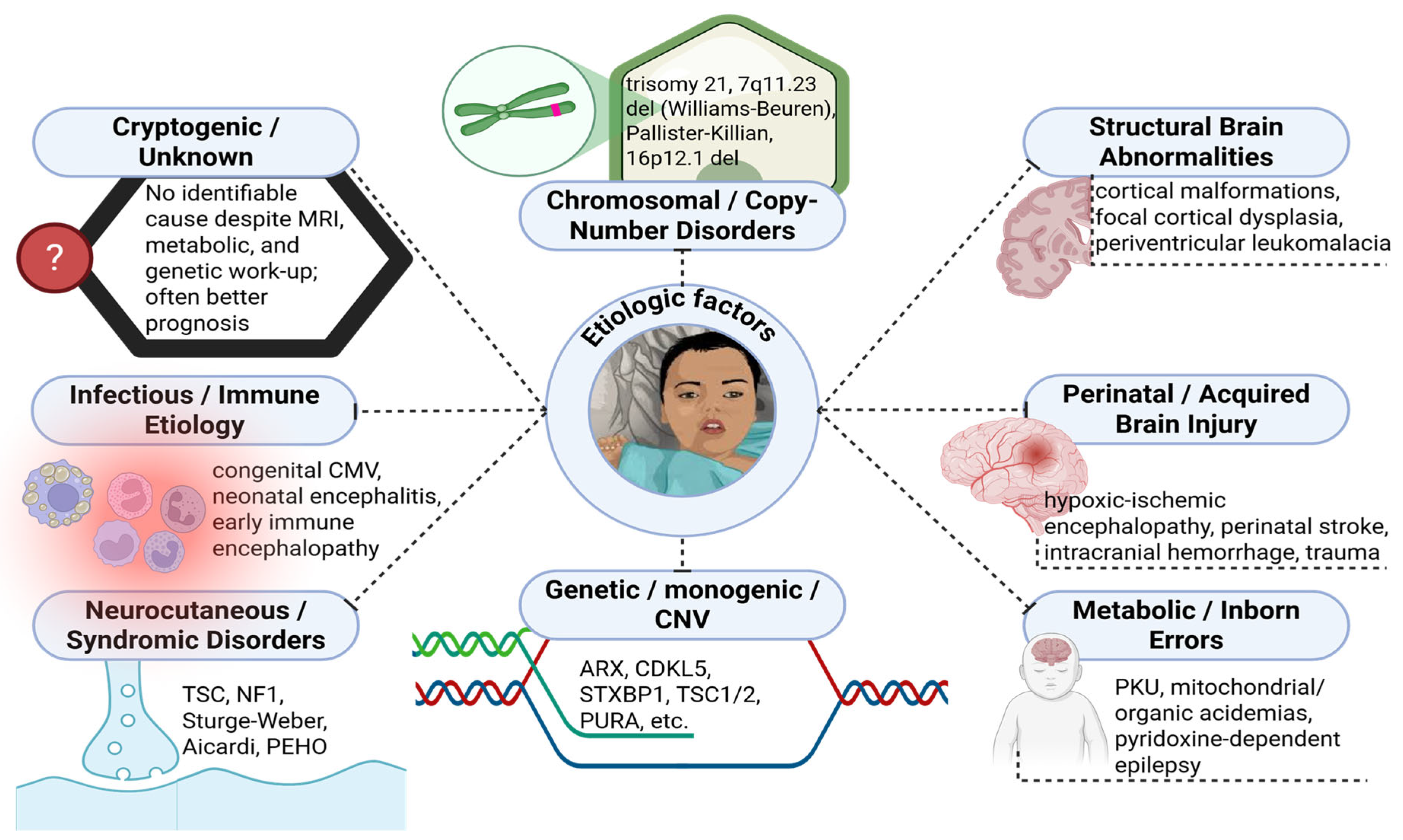
Figure 1. Major etiologic categories of WS [47,48,49,50,51,52,53]. This schematic summarizes the principal causes of infantile epileptic spasms syndrome, including structural brain abnormalities, genetic and monogenic disorders, chromosomal copy-number variations, metabolic/inborn errors, infectious or immune etiologies, neurocutaneous syndromes, perinatal/acquired brain injury, and cryptogenic cases with no identifiable cause despite thorough evaluation. Each category is illustrated with representative examples such as trisomy 21, TSC1/TSC2-related neurocutaneous disorders, and congenital infections. The diagram highlights the multifactorial nature of ISs and the convergence of diverse etiologies on a shared epileptic phenotype.
Medicina 61 02223 g001
Figure 2. Immune activation, neuroinflammation, mTOR pathway dysregulation, and GABAergic impairment in IS epileptogenesis. Peripheral immune cells cross a compromised blood–brain barrier and interact with reactive astrocytes and activated microglia, leading to increased production of proinflammatory cytokines (TNFα, iNOS, IL-1β, IL-6, IL-12, IL-23). These cytokines amplify glial activation, oxidative stress, and alterations in ionic and neurotransmitter homeostasis. Upstream inflammatory signals engage the TSC1/2 complex and enhance mTORC1 activation, which disrupts interneuron development, synaptic maturation, and the balance of excitation and inhibition. Parallel defects in GABAergic transmission include reduced GAD activity, impaired vesicle loading via VGAT, decreased SNARE-dependent vesicle fusion, altered GABAA/GABAB receptor composition, and disrupted astrocytic glutamine–glutamate cycling. Together, these interacting pathways promote circuit instability, lower seizure thresholds, and facilitate the emergence of ISs [162,163,164,165,218]. Arrows indicate the direction of signaling and functional interactions between immune, glial, and neuronal pathways, highlighting pathogenic processes contributing to network dysfunction.
Medicina 61 02223 g002
Table 1. Most frequently reported genes and loci associated with WS.
No.GeneCytogenetic LocationInheritance/Pattern (Typical)Comment/NoteRef.
1ARXXp21.3X-linked, often de novoClassic ISs gene, migration and interneuron defect[69]
2CDKL5Xp22.13X-linked, often de novoEarly-onset epileptic spasms, severe DD[70]
3PAFAH1B1/LIS117p13.3AD, de novoLissencephaly, classic structural-spasm link[71]
4DCXXq23X-linked, de novoLissencephaly/subcortical band heterotopia[72]
5TUBA1A12q13.12AD, de novoTubulinopathy with cortical malformation[73]
6STXBP19q34.11AD, de novoCommon single-gene cause of IESS[74]
7KCNQ220q13.33AD, de novoSevere neonatal epileptic encephalopathy[75]
8MAGI27q11.23AD, CNV/deletionReported in ISs, 7q11.23 region[76]
9GRIN2A16p13.2AD, de novo/familialGlutamatergic receptor, ISs and other DEE[77]
10GRIN2B12p13.1AD, de novoEarly-onset DEE with spasms[78]
11FOXG114q12AD, de novoPostnatal microcephaly, spasms reported[79]
12NSD15q35.3AD, de novoSotos phenotype, seizures/spasms[80]
13SPTAN19q34.11AD, de novoSpasms and hypomyelination[81]
14NEDD415q21.3AD, CNVPotential risk factor in ISs[82]
15CALN17q11.22AD, CNV/intronic deletionRisk factor in ISs CNV studies[83]
16WDR45Xp11.23X-linked, de novoNeurodegeneration with brain iron accumulation[84]
17RARS26p21.1ARPontocerebellar hypoplasia, spasms[85]
18UBA53q22.1AREarly infantile epileptic encephalopathy[86]
19IARS21q41ARCAGSSS spectrum, spasms[87]
20PHACTR16p24.1AD, de novoCandidate gene in ISs cohort[88]
21ATP2A212q24.11ADNovel candidate gene in Chinese cohort[89]
22CD99L2Xq28X-linkedCandidate gene in IESS cohort[90]
23CLCN61p36.22AD, de novoEpileptic encephalopathy with spasms[91]
24CYFIP115q11.2AD, CNVDevelopmental delay and seizures[92]
25CYFIP25q33.3AD, de novoDEE with spasms[93]
26GNB11p36.33AD, de novoDEE with hypotonia and spasms[94]
27GPT216q21ARMetabolic DEE with spasms[95]
28HUWE1Xp11.22X-linkedIntellectual disability and epilepsy[96]
29KMT2D12q13.12ADKabuki spectrum, seizures in infancy[97]
30MYO18A17q11.2AD/ARCandidate gene in Chinese cohort[98]
31NOS37q36.1ADCandidate variant, possible modifier[99]
32RYR119q13.2AD/ARCa2+ signaling, candidate gene[100]
33RYR21q43ADCa2+ release channel, candidate gene[101]
34RYR315q13.3–q14ADCandidate gene in 2020s cohorts[102]
35TAF1Xq13.1X-linkedDEE with early spasms[103]
36TECTA11q23.3ADCandidate gene in WES screen[104]
37PURA5q31.3AD, de novoPURA syndrome, seizures and spasms[105]
38SCN2A2q24.3AD, de novoCommon channel gene in IESS cohorts[106]
39SCN1A2q24.3AD, de novo/familialISs with Dravet-like features[107]
40SCN8A12q13.13AD, de novoEarly-onset DEE, spasms described[108]
41WWOX16q23.1ARWWOX-related encephalopathy with spasms[109]
42SLC35A2Xp11.23Somatic/germline, X-linkedMosaic ISs with focal dysplasia[110]
43NF117q11.2ADNF1 with early-onset epileptic spasms[111]
44TSC2/TSC116p13.3/9q34AD, de novo/familialFrequent syndromic cause of IESS[112]
45TOP2B3p24.3AD, de novoEmerging gene, single recent report[113]
ARX, aristaless related homeobox; CDKL5, cyclin dependent kinase like 5; PAFAH1B1/LIS1, platelet activating factor acetylhydrolase 1B subunit 1 (lissencephaly 1); DCX, doublecortin; TUBA1A, tubulin alpha-1A; STXBP1, syntaxin-binding protein 1; KCNQ2, potassium voltage-gated channel subfamily Q member 2; MAGI2, membrane associated guanylate kinase inverted 2; GRIN2A, glutamate ionotropic receptor NMDA type subunit 2A; GRIN2B, glutamate ionotropic receptor NMDA type subunit 2B; FOXG1, forkhead box G1; NSD1, nuclear receptor-binding SET domain protein 1; SPTAN1, spectrin alpha, non-erythrocytic 1; NEDD4, neural precursor cell-expressed developmentally down-regulated protein 4 E3 ubiquitin-protein ligase; CALN1, calneuron 1; WDR45, WD repeat domain phosphoinositide-interacting protein 45; RARS2, arginyl-tRNA synthetase 2 (mitochondrial); UBA5, ubiquitin-like modifier activating enzyme 5; IARS2, isoleucyl-tRNA synthetase 2 (mitochondrial); PHACTR1, phosphatase and actin regulator 1; ATP2A2, ATPase sarcoplasmic/endoplasmic reticulum Ca2+ transporting 2; CD99L2, CD99 molecule-like 2; CLCN6, chloride voltage-gated channel 6; CYFIP1, cytoplasmic FMR1-interacting protein 1; CYFIP2, cytoplasmic FMR1-interacting protein 2; GNB1, G protein beta subunit 1; GPT2, glutamate-pyruvate transaminase 2; HUWE1, HECT, UBA, WW domain-containing E3 ubiquitin-protein ligase 1; KMT2D, lysine methyltransferase 2D (Kabuki syndrome gene); MYO18A, myosin XVIII A; NOS3, nitric oxide synthase 3 (endothelial); RYR1, ryanodine receptor 1 (skeletal muscle); RYR2, ryanodine receptor 2 (cardiac); RYR3, ryanodine receptor 3 (neuronal); TAF1, TATA-box binding protein-associated factor 1; TECTA, tectorin alpha; PURA, purine-rich element-binding protein A; SCN2A, sodium voltage-gated channel alpha subunit 2; SCN1A, sodium voltage-gated channel alpha subunit 1; SCN8A, sodium voltage-gated channel alpha subunit 8; WWOX, WW domain-containing oxidoreductase; SLC35A2, solute carrier family 35 member A2; NF1, neurofibromin 1; TSC2/TSC1, tuberous sclerosis complex genes (hamartin and tuberin); TOP2B, DNA topoisomerase II beta; AD, autosomal dominant; AR, autosomal recessive; CNV, copy number variant; X-linked, mutation located on the X chromosome; DEE, developmental and epileptic encephalopathy; IESS, infantile epileptic spasms syndrome; DD, developmental delay; CAGSSS, cataract–ataxia–short stature–skeletal dysplasia–seizures syndrome; WES, whole-exome sequencing; WGS, whole-genome sequencing; CGH, comparative genomic hybridization.
Table 2. Pathogenetic and molecular mechanisms: neurotrophic, hormonal, and neurotransmitter interactions.
No.Pathogenetic/
Molecular Factor
Key Abnormality/Proposed MechanismClinical or Etiologic ContextTherapeutic Implication/TargetRef.
1Disruption of cortical–subcortical networksEarly distortion of neuronal and interneuronal connectivity causes abnormal interaction between cortex, thalamus, basal ganglia and brainstem. Focal lesion can generate generalized spasms and hypsarrhythmiaLissencephaly, polymicrogyria, cortical tubers, hydranencephaly, focal cortical lesions with generalized EEGEarly lesion localization and resection in focal cases; rationale for treating even when MRI looks focal[66,147,148,149,150,151]
2Genetic background for excitability and neurobehavioral phenotypeVariants in SCN2A, SCN3A and other developmental genes predispose to both epileptic spasms and ASD or cognitive delay through a shared channelopathy/synaptopathyISs with autism spectrum features or early developmental delay even before spasmsGenetic testing to define predisposition; possible future precision therapy[66,147]
3Neurotrophin imbalance (NGF, BDNF, GDNF)After hypoxic or inflammatory injury CSF BDNF increases while NGF may decrease. In TSC or postinfectious ISs NGF can be excessively high. Both deficiency and excess can disturb synaptic maturationHypoxic–ischemic encephalopathy, postinfectious ISs, TSC with epileptic tubersNGF modulation as experimental target; explains variable ACTH response[152,153,154,155,156,157,158,159,160,161,162,163,164]
4Low NGF in destructive or severe structural ISsLow CSF NGF correlates with poor ACTH response and more extensive neuronal loss, probably due to limited capacity for synaptic repairISs with known structural or hypoxic etiology and delayed developmentEarly hormonal therapy before severe loss; marker of poor prognosis[160,161,162,163,164,165,166,167,168,169,170,171]
5IGF-1 deficiency and impaired steroid driven trophic supportEarly stress, perinatal brain damage or ischemia reduces CSF IGF-1 and ACTH. This prevents mTOR-mediated survival, synaptogenesis and anti-inflammatory effects and favors epileptogenesisSymptomatic ISs after prenatal/perinatal insults; premature infants; ISs with cerebral atrophyIGF-1 or IGF-1 tripeptide (1–3) as adjunct; ACTH, steroids, ketogenic diet partly act through IGF-1[172,173,174,175,176,177]
6Preserved IGF-1 in cryptogenic/idiopathic ISsNormal CSF IGF-1 in infants with unknown etiology correlates with good ACTH response and better cognitive outcomeISs with normal MRI and no early insultUsual first line hormonal therapy is adequate[172]
7Experimental evidence of IGF-1 rescueIn TTX model of ISs loss of IGF-1 and astrogliosis mimicked human ISs. IGF-1 (1–3) restored inhibitory neurons, stopped spasms and normalized EEGExperimental ISs, neonatal stroke, postsurgical epileptic spasmsIGF-1 analogues and trofinetide are promising; can reduce vigabatrin retinal toxicity[171,173]
8Delay or failure of GABAA developmental switchGABA remains depolarizing in infancy if the switch is delayed. This maintains network hyperexcitability at the age when ISs occurEarly life epilepsies, symptomatic ISs, TSC, postinfectious ISsMake GABA more effective: vigabatrin, ACTH (via neurosteroids), ketogenic diet[178,179,180,181,182]
9Neurosteroid deficitReduced production of endogenous steroids gives poor enhancement of GABAA receptors. Low DHEA/androstenedione ratio seen in non-responders to ACTHACTH poor responders, symptomatic ISsPharmacologic neurosteroids such as ganaxolone[180,181,182,183,184,185,186,187,188]
10Reduced CSF GABA in symptomatic ISsSymptomatic etiologies show lower CSF GABA than idiopathic cases and controls, which confirms insufficient inhibitory toneStructural/metabolic ISs with poor developmentSupports use of GABAergic drugs and neurosteroid based strategies[187,188,189,190,191]
11Inflammatory and mTOR related epileptogenesisIn TSC and in postinfectious ISs inflammatory cells, cytokines and mTOR activation are found around epileptogenic lesions. This is paralleled by high NGF and low IGF-1 which favor seizuresTSC, postinfectious ISs, cortical tubers, mTORopathiesmTOR inhibitors, anti-inflammatory strategies, NGF modulation as adjuvant[162,163,164,165]
12Converging networks hypothesisDifferent primary hits (genetic, structural, metabolic, inflammatory) act on the same immature network where neurotrophins, GABA, IGF-1 and HPA axis are interlinked. Any disruption gives the same hypsarrhythmic outputExplains why ISs arise from many different causesJustifies use of ACTH, steroids, ketogenic diet, and possibly IGF-1 analogues although triggers differ[66,147,178]
Disclaimer/Publisher’s Note: The statements, opinions and data contained in all publications are solely those of the individual author(s) and contributor(s) and not of MDPI and/or the editor(s). MDPI and/or the editor(s) disclaim responsibility for any injury to people or property resulting from any ideas, methods, instructions or products referred to in the content.