Review

Real-Time Remote Tele-Mentored Echocardiography: A Systematic Review

1
Department of Emergency Medicine, University of Maryland School of Medicine, Baltimore, MD 21201, USA
2
Division of Pulmonary and Critical Care Medicine, University of Maryland School of Medicine, Baltimore, MD 21201, USA
*
Author to whom correspondence should be addressed.
Medicina 2020, 56(12), 668; https://doi.org/10.3390/medicina56120668

Submission received: 29 October 2020 / Revised: 28 November 2020 / Accepted: 30 November 2020 / Published: 2 December 2020

Abstract

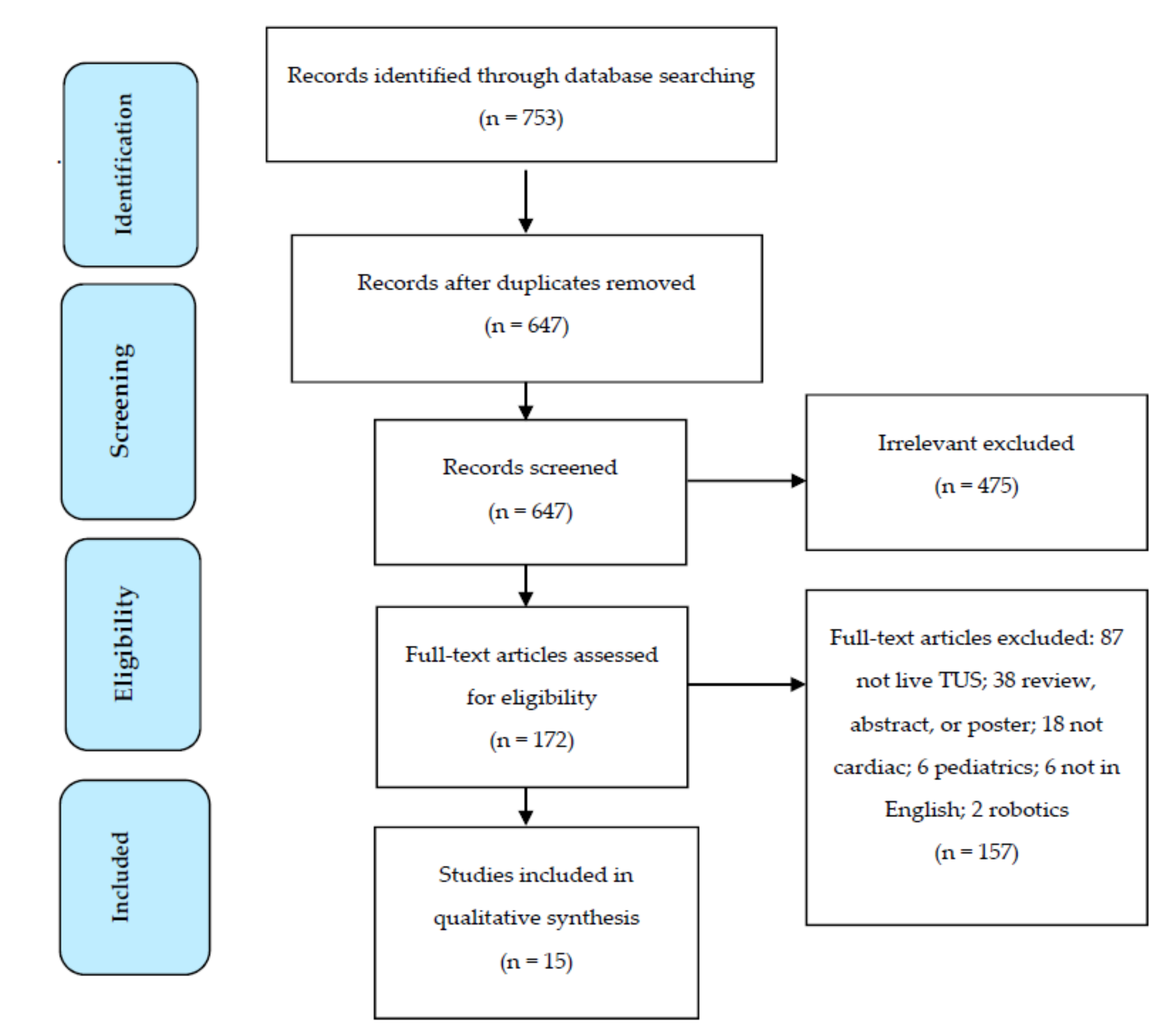
Background and Objectives: Real-time remote tele-mentored echocardiography (RTMUS echo) involves the transmission of clinical ultrasound (CU) cardiac images with direct feedback from a CU expert at a different location. In this review, we summarize the current uses of RTMUS to diagnose and manage cardiovascular dysfunction and discuss expanded and future uses. Materials and Methods: We performed a literature search (PubMed and EMBase) to access articles related to RTMUS echo. We reviewed articles for selection using Covidence, a web-based tool for managing systematic reviews and data were extracted using a separate standardized collection form. Results: Our search yielded 15 articles. Twelve of these articles demonstrated the feasibility of having a novice sonographer mentored by a tele-expert in obtaining a variety of cardiac ultrasound views. The articles discussed different technological specifications for the RTMUS system, but all showed that adequate images were able to be obtained. Overall, RTMUS echo was found to be a positive intervention that contributed to patient care. Conclusion: RTMUS echo allows for rapid access to diagnostic imaging in various clinical settings. RTMUS echo can help in assessing patients that may require a higher level of isolation precautions or in other resource-constrained environments. In the future, identifying the least expensive way to utilize RTMUS echo will be important.
Keywords: teleultrasound; clinical ultrasound; echocardiography; critical care; SARS-CoV-2 teleultrasound; clinical ultrasound; echocardiography; critical care; SARS-CoV-2