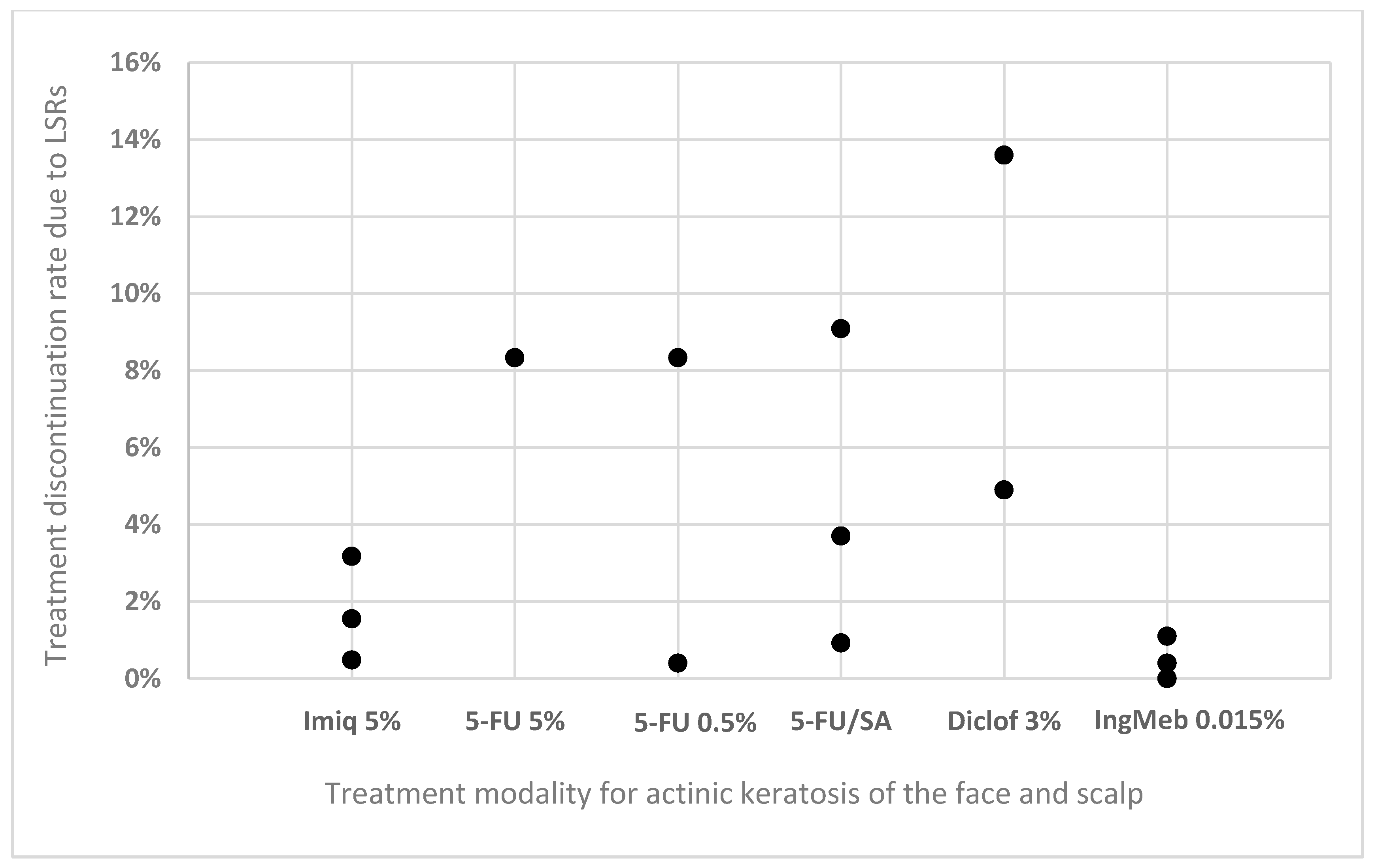
Prevalence, Discontinuation Rate, and Risk Factors for Severe Local Site Reactions with Topical Field Treatment Options for Actinic Keratosis of the Face and Scalp



Abstract
Share and Cite
Balcere, A.; Rone Kupfere, M.; Čēma, I.; Krūmiņa, A. Prevalence, Discontinuation Rate, and Risk Factors for Severe Local Site Reactions with Topical Field Treatment Options for Actinic Keratosis of the Face and Scalp. Medicina 2019, 55, 92. https://doi.org/10.3390/medicina55040092
Balcere A, Rone Kupfere M, Čēma I, Krūmiņa A. Prevalence, Discontinuation Rate, and Risk Factors for Severe Local Site Reactions with Topical Field Treatment Options for Actinic Keratosis of the Face and Scalp. Medicina. 2019; 55(4):92. https://doi.org/10.3390/medicina55040092
Chicago/Turabian StyleBalcere, Alise, Māra Rone Kupfere, Ingrīda Čēma, and Angelika Krūmiņa. 2019. "Prevalence, Discontinuation Rate, and Risk Factors for Severe Local Site Reactions with Topical Field Treatment Options for Actinic Keratosis of the Face and Scalp" Medicina 55, no. 4: 92. https://doi.org/10.3390/medicina55040092
APA StyleBalcere, A., Rone Kupfere, M., Čēma, I., & Krūmiņa, A. (2019). Prevalence, Discontinuation Rate, and Risk Factors for Severe Local Site Reactions with Topical Field Treatment Options for Actinic Keratosis of the Face and Scalp. Medicina, 55(4), 92. https://doi.org/10.3390/medicina55040092