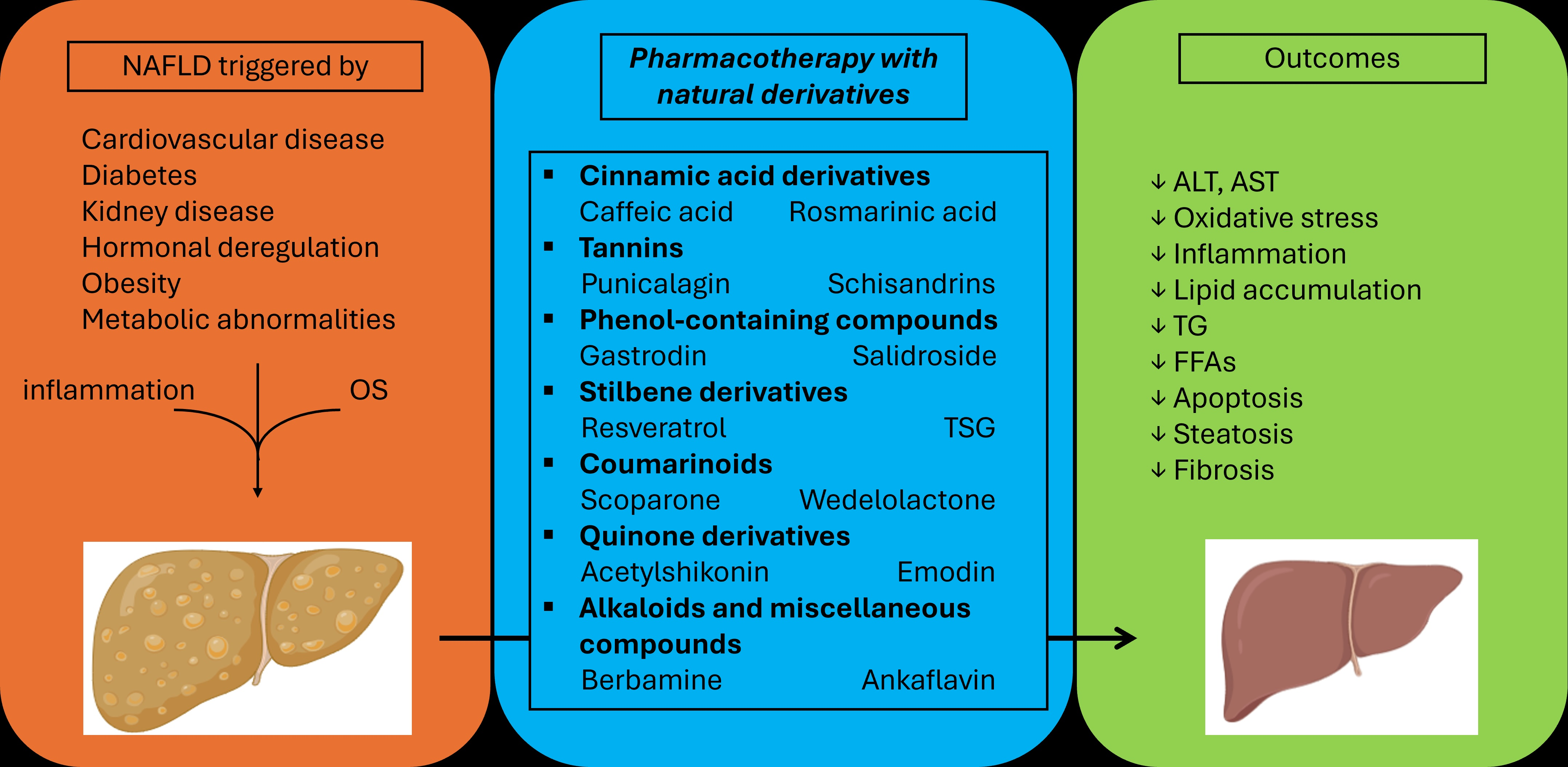
Natural Plant-Derived Compounds Targeting Oxidative Stress and Inflammation in NAFLD—Mechanisms and Repositioning Potential

Abstract
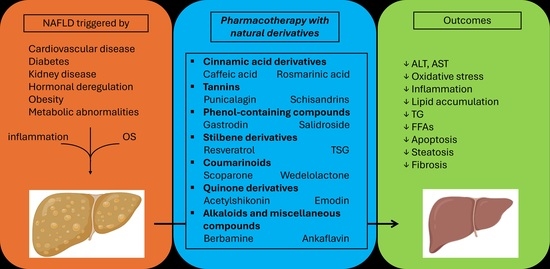
1. Introduction
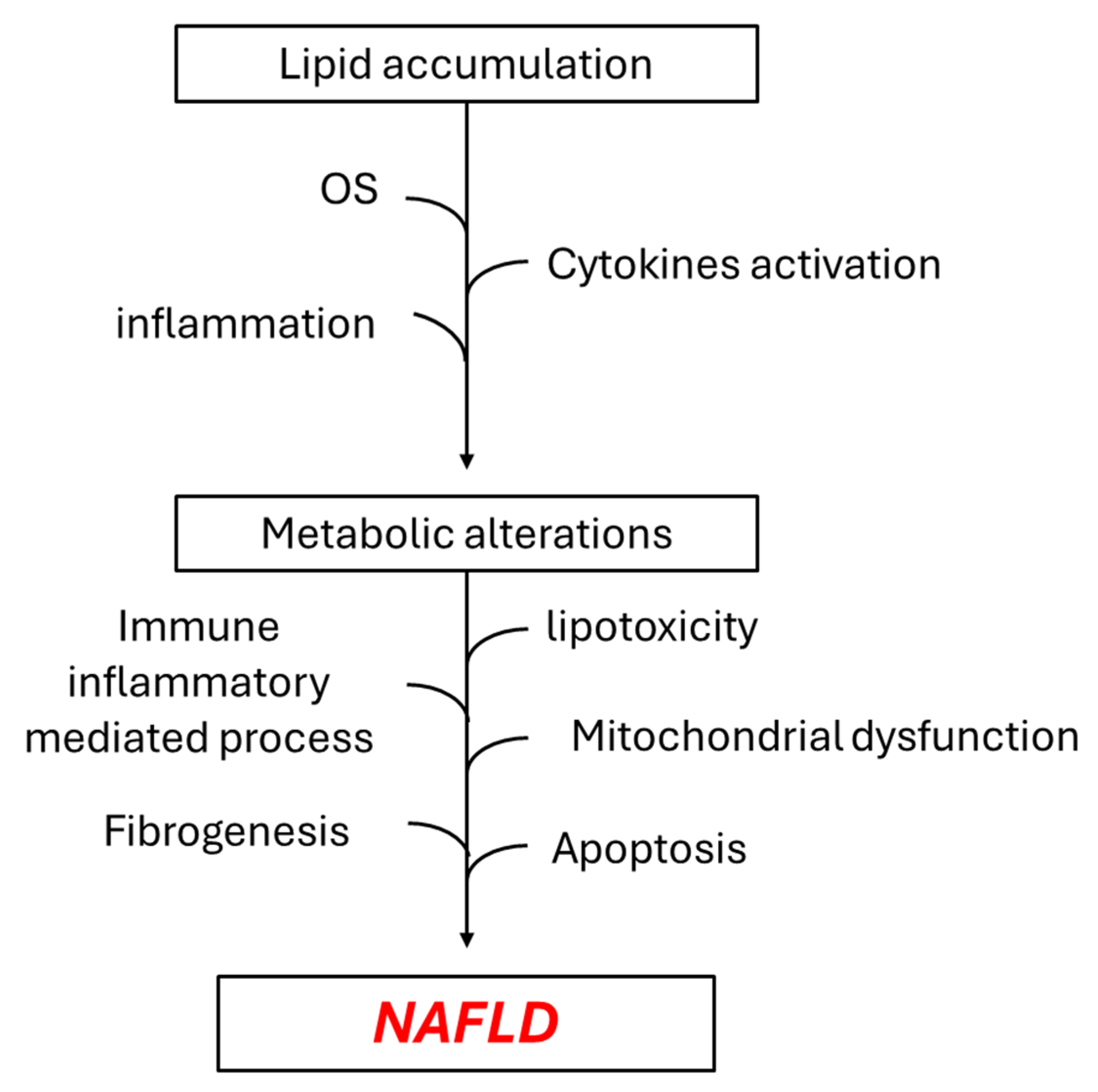
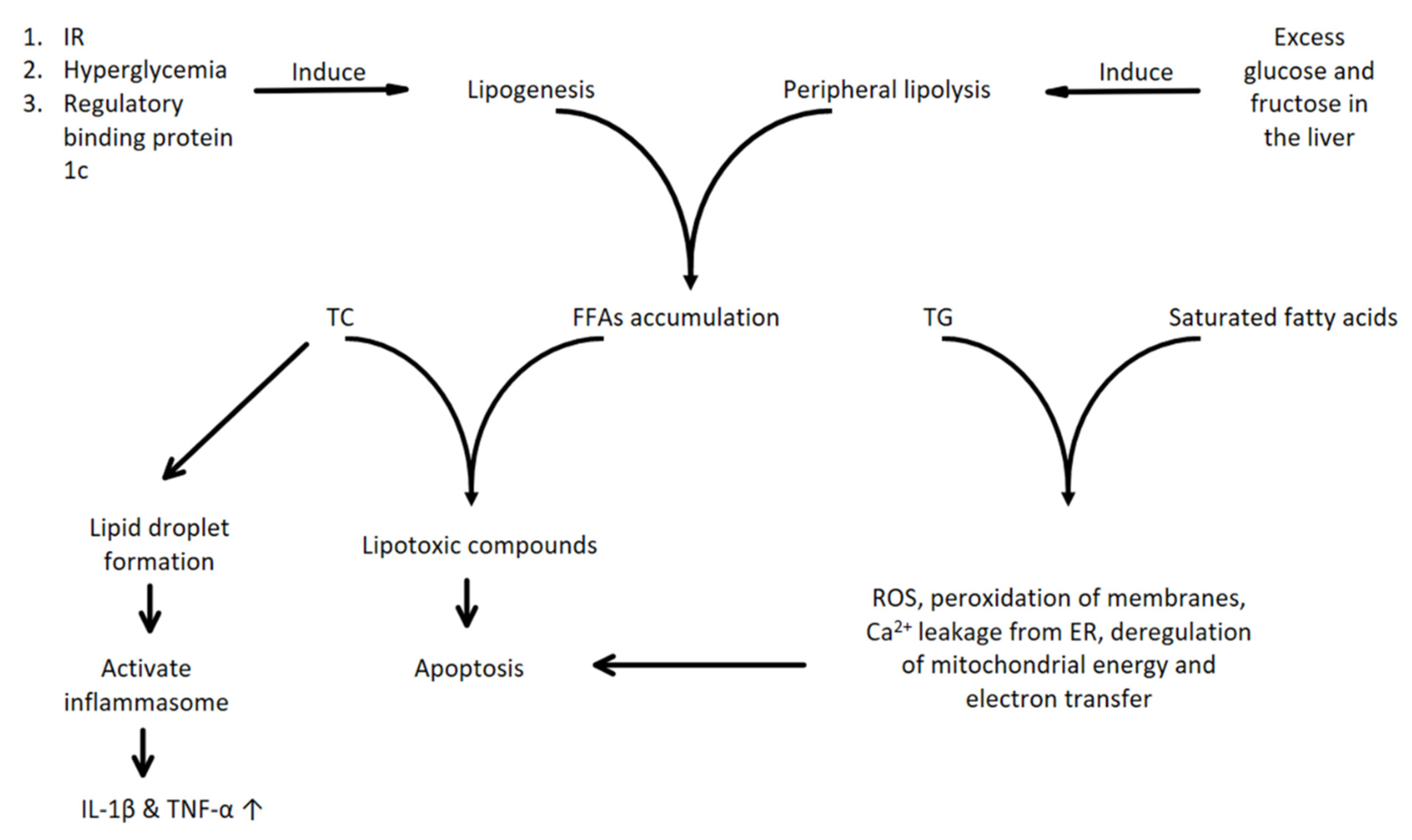
The Role of Oxidative Stress and Inflammation in the Pathogenesis of NAFLD
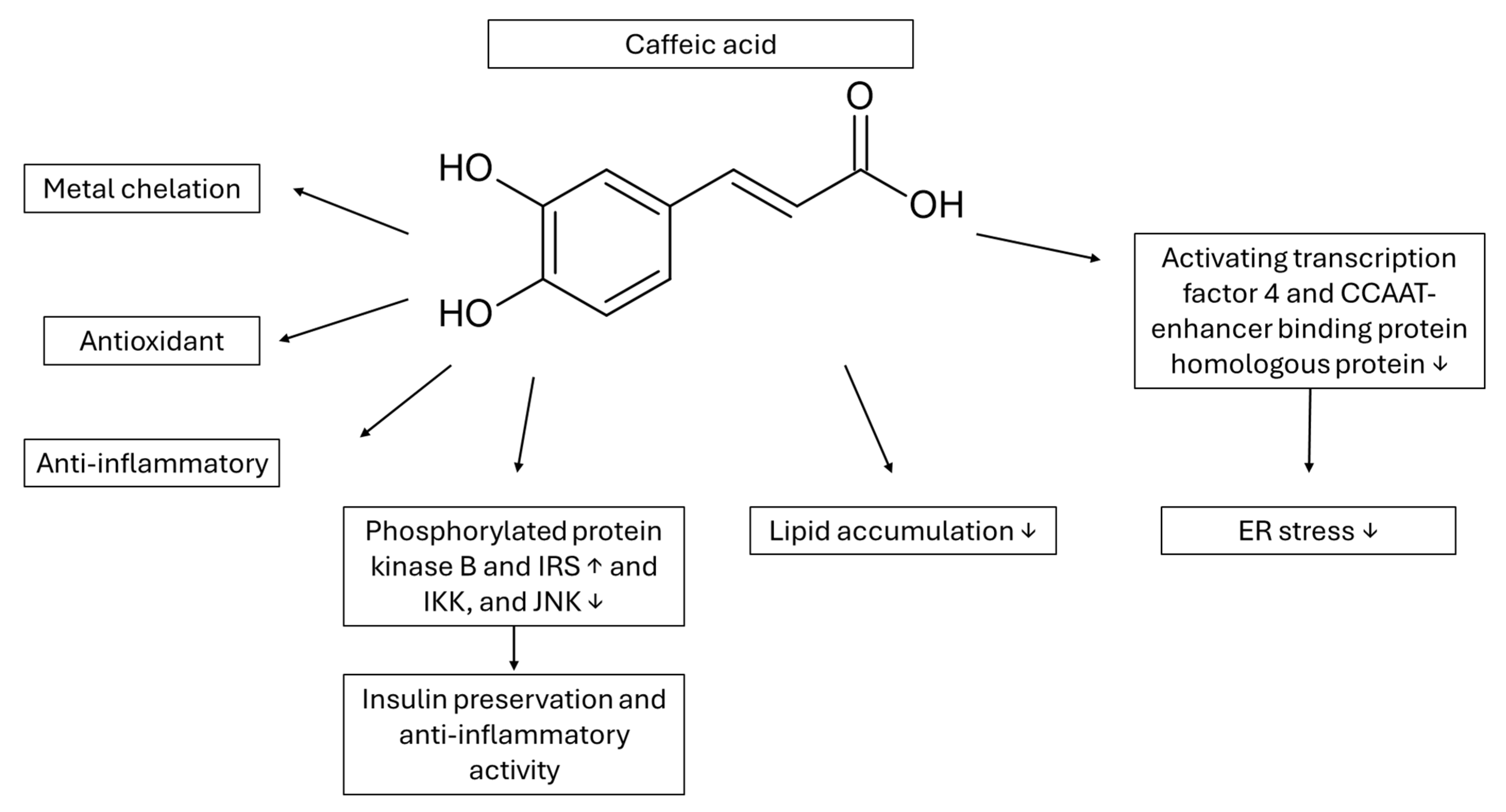
2. Cinnamic Acid Derivatives
3. Tannins
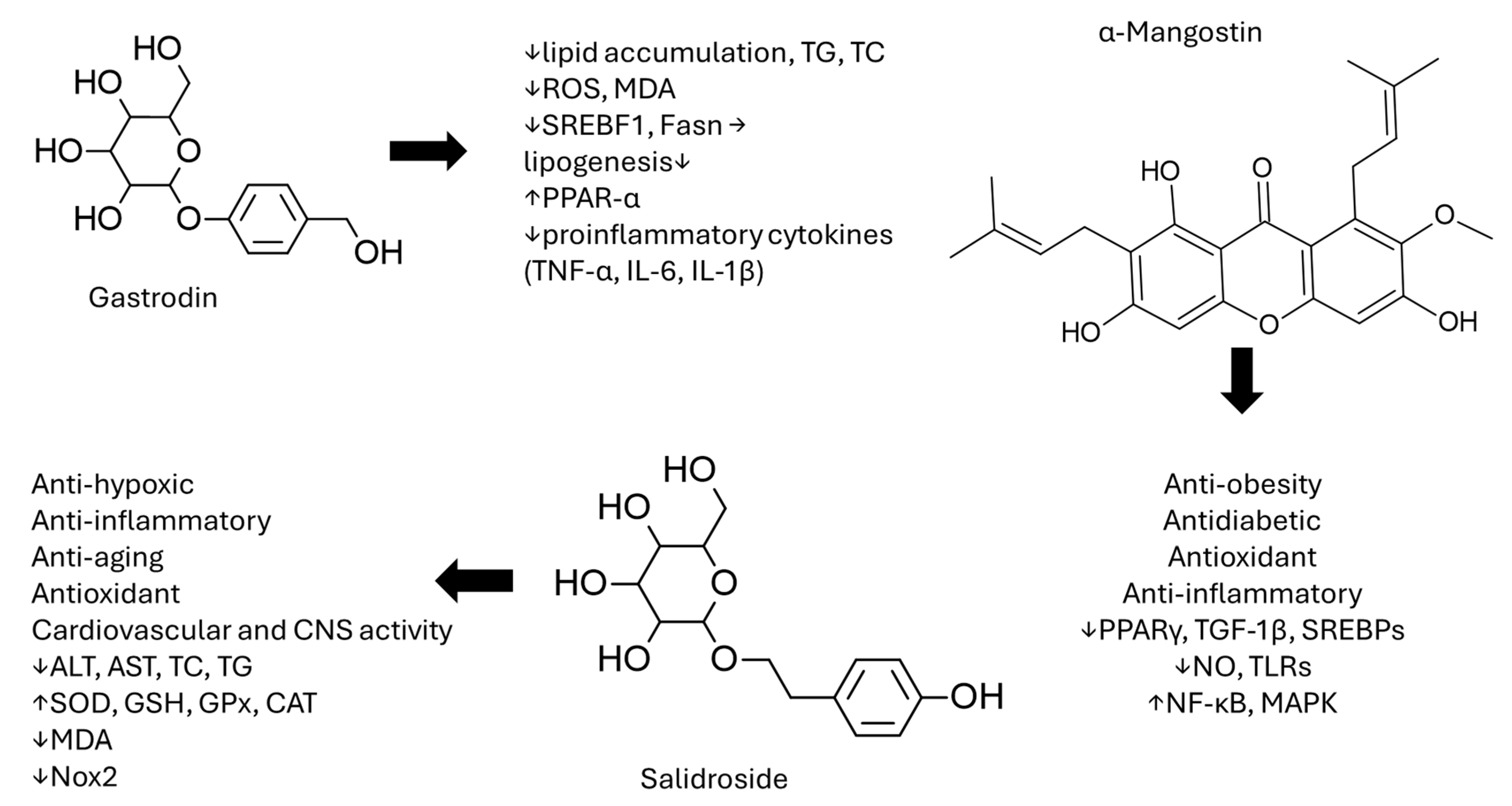
4. Miscellaneous Phenol-Containing Compounds
5. Stilbene Derivatives
6. Coumarinoids
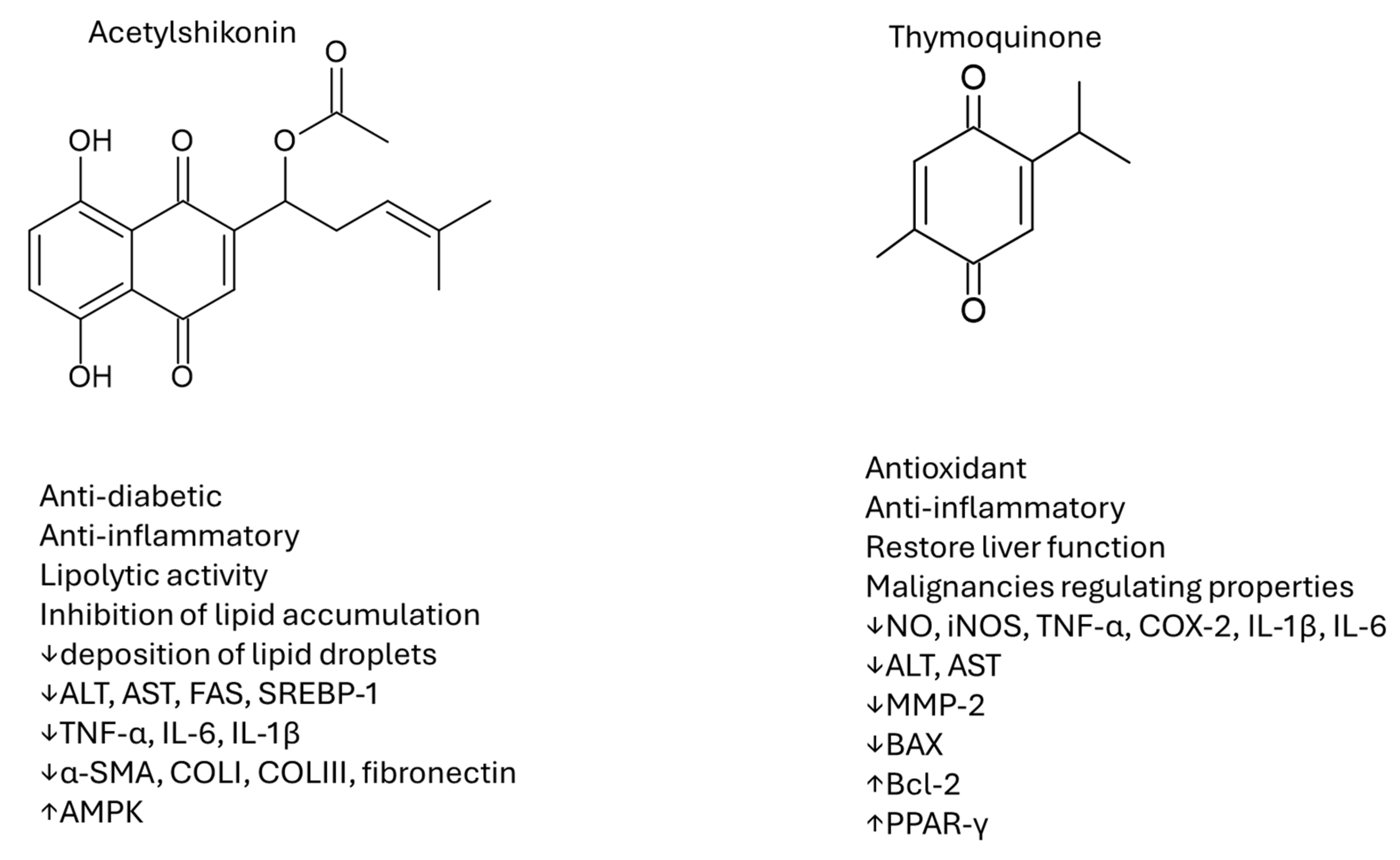
7. Quinone Derivatives
8. Alkaloids and Miscellaneous Derivatives
9. Limitations
10. Future Perspectives
11. Conclusions
Author Contributions
Funding
Institutional Review Board Statement
Informed Consent Statement
Data Availability Statement
Conflicts of Interest
Abbreviations
References
- Chalasani, N.; Younossi, Z.; Lavine, J.E.; Charlton, M.; Cusi, K.; Rinella, M.; Harrison, S.A.; Brunt, E.M.; Sanyal, A.J. The Diagnosis and Management of Non-Alcoholic Fatty Liver Disease: Practice Guidance from the American Association for the Study of Liver Diseases. Hepatology 2018, 67, 328–357. [Google Scholar] [CrossRef] [PubMed]
- Godoy-Matos, A.F.; Silva Júnior, W.S.; Valerio, C.M. NAFLD as a Continuum: From Obesity to Metabolic Syndrome and Diabetes. Diabetol. Metab. Syndr. 2020, 12, 60. [Google Scholar] [CrossRef]
- Zhao, Y.-C.; Zhao, G.-J.; Chen, Z.; She, Z.-G.; Cai, J.; Li, H. Nonalcoholic Fatty Liver Disease. Hypertension 2020, 75, 275–285. [Google Scholar] [CrossRef]
- Schuster, S.; Cabrera, D.; Arrese, M.; Feldstein, A.E. Triggering and Resolution of Inflammation in NASH. Nat. Rev. Gastroenterol. Hepatol. 2018, 15, 349–364. [Google Scholar] [CrossRef]
- Heindel, J.J.; Blumberg, B.; Cave, M.; Machtinger, R.; Mantovani, A.; Mendez, M.A.; Nadal, A.; Palanza, P.; Panzica, G.; Sargis, R.; et al. Metabolism Disrupting Chemicals and Metabolic Disorders. Reprod. Toxicol. 2017, 68, 3–33. [Google Scholar] [CrossRef] [PubMed]
- Bertolotti, M.; Lonardo, A.; Mussi, C.; Baldelli, E.; Pellegrini, E.; Ballestri, S.; Romagnoli, D.; Loria, P. Nonalcoholic Fatty Liver Disease and Aging: Epidemiology to Management. World J. Gastroenterol. 2014, 20, 14185–14204. [Google Scholar] [CrossRef] [PubMed]
- Eslam, M.; Sanyal, A.J.; George, J.; International Consensus Panel. MAFLD: A Consensus-Driven Proposed Nomenclature for Metabolic Associated Fatty Liver Disease. Gastroenterology 2020, 158, 1999–2014. [Google Scholar] [CrossRef]
- Tilg, H.; Moschen, A.R. Evolution of Inflammation in Nonalcoholic Fatty Liver Disease: The Multiple Parallel Hits Hypothesis. Hepatology 2010, 52, 1836–1846. [Google Scholar] [CrossRef]
- Reccia, I.; Kumar, J.; Akladios, C.; Virdis, F.; Pai, M.; Habib, N.; Spalding, D. Non-Alcoholic Fatty Liver Disease: A Sign of Systemic Disease. Metabolism 2017, 72, 94–108. [Google Scholar] [CrossRef]
- Serviddio, G.; Bellanti, F.; Vendemiale, G. Free Radical Biology for Medicine: Learning from Nonalcoholic Fatty Liver Disease. Free Radic. Biol. Med. 2013, 65, 952–968. [Google Scholar] [CrossRef]
- Polyzos, S.A.; Kang, E.S.; Boutari, C.; Rhee, E.J.; Mantzoros, C.S. Current and Emerging Pharmacological Options for the Treatment of Nonalcoholic Steatohepatitis. Metabolism 2020, 111, 154203. [Google Scholar] [CrossRef]
- Friedman, S.L.; Neuschwander-Tetri, B.A.; Rinella, M.; Sanyal, A.J. Mechanisms of NAFLD Development and Therapeutic Strategies. Nat. Med. 2018, 24, 908–922. [Google Scholar] [CrossRef]
- Negi, C.K.; Babica, P.; Bajard, L.; Bienertova-Vasku, J.; Tarantino, G. Insights into the Molecular Targets and Emerging Pharmacotherapeutic Interventions for Nonalcoholic Fatty Liver Disease. Metabolism 2022, 126, 154925. [Google Scholar] [CrossRef]
- Zhang, H.; Targher, G.; Byrne, C.D.; Kim, S.U.; Wong, V.W.; Valenti, L.; Glickman, M.; Ponce, J.; Mantzoros, C.S.; Crespo, J.; et al. MAFLD ICD-11 Coding Collaborators. A Global Survey on the Use of the International Classification of Diseases Codes for Metabolic Dysfunction-Associated Fatty Liver Disease. Hepatol. Int. 2024, 18, 1178–1201. [Google Scholar] [CrossRef] [PubMed]
- Hoofnagle, J.H.; Doo, E. Letter to the Editor: A Multi-Society Delphi Consensus Statement on New Fatty Liver Disease Nomenclature. Hepatology 2024, 79, E91–E92. [Google Scholar] [CrossRef] [PubMed]
- Bilson, J.; Mantovani, A.; Byrne, C.D.; Targher, G. Steatotic Liver Disease, MASLD and Risk of Chronic Kidney Disease. Diabetes Metab. 2024, 50, 101506. [Google Scholar] [CrossRef]
- Svegliati-Baroni, G.; Pierantonelli, I.; Torquato, P.; Marinelli, R.; Ferreri, C.; Chatgilialoglu, C.; Bartolini, D.; Galli, F. Lipidomic Biomarkers and Mechanisms of Lipotoxicity in Non-Alcoholic Fatty Liver Disease. Free Radic. Biol. Med. 2019, 144, 293–309. [Google Scholar] [CrossRef]
- Zhu, J.Y.; Chen, M.; Mu, W.J.; Luo, H.Y.; Guo, L. Higd1a Facilitates Exercise-Mediated Alleviation of Fatty Liver in Diet-Induced Obese Mice. Metabolism 2022, 134, 155241. [Google Scholar] [CrossRef]
- Packard, C.J.; Boren, J.; Taskinen, M.R. Causes and Consequences of Hypertriglyceridemia. Front. Endocrinol. 2020, 11, 252. [Google Scholar] [CrossRef] [PubMed]
- Jangra, A.; Kothari, A.; Sarma, P.; Medhi, B.; Omar, B.J.; Kaushal, K. Recent Advancements in Antifibrotic Therapies for Regression of Liver Fibrosis. Cells 2022, 11, 1500. [Google Scholar] [CrossRef]
- Zhang, V.X.; Sze, K.M.; Chan, L.K.; Ho, D.W.; Tsui, Y.M.; Chiu, Y.T.; Lee, E.; Husain, A.; Huang, H.; Tian, L.; et al. Antioxidant Supplements Promote Tumor Formation and Growth and Confer Drug Resistance in Hepatocellular Carcinoma by Reducing Intracellular ROS and Induction of TMBIM1. Cell Biosci. 2021, 11, 217. [Google Scholar] [CrossRef]
- Horn, C.L.; Morales, A.L.; Savard, C.; Farrell, G.C.; Ioannou, G.N. Role of Cholesterol-Associated Steatohepatitis in the Development of NASH. Hepatol. Commun. 2022, 6, 12–35. [Google Scholar] [CrossRef] [PubMed]
- Coué, M.; Falewee, J.; Aguesse, A.; Croyal, M. Spirulina Liquid Extract Protects against Fibrosis Related to Non-Alcoholic Steatohepatitis and Increases Ursodeoxycholic Acid. Nutrients 2019, 11, 194. [Google Scholar] [CrossRef] [PubMed]
- Farrell, G.C.; Haczeyni, F.; Chitturi, S. Pathogenesis of NASH: How Metabolic Complications of Overnutrition Favour Lipotoxicity and Pro-Inflammatory Fatty Liver Disease. Adv. Exp. Med. Biol. 2018, 1061, 19–44. [Google Scholar] [CrossRef]
- Ioannou, G.N.; Subramanian, S.; Chait, A.; Haigh, W.G.; Yeh, M.M.; Farrell, G.C.; Lee, S.P.; Savard, C. Cholesterol Crystallization within Hepatocyte Lipid Droplets and Its Role in Murine NASH. J. Lipid Res. 2017, 58, 1067–1079. [Google Scholar] [CrossRef]
- Cai, J.; Xu, M.; Zhang, X.; Li, H. Innate Immune Signaling in Nonalcoholic Fatty Liver Disease and Cardiovascular Diseases. Annu. Rev. Pathol. 2019, 14, 153–184. [Google Scholar] [CrossRef]
- Yan, Z.Z.; Huang, Y.P.; Wang, X.; Wang, H.P.; Ren, F.; Tian, R.F.; Cheng, X.; Cai, J.; Zhang, Y.; Zhu, X.Y.; et al. Integrated Omics Reveals Tollip as a Regulator and Therapeutic Target for Hepatic Ischemia–Reperfusion Injury in Mice. Hepatology 2019, 70, 1750–1769. [Google Scholar] [CrossRef]
- Al-Khafaji, A.B.; Tohme, S.; Yazdani, H.O.; Miller, D.; Huang, H.; Tsung, A. Superoxide Induces Neutrophil Extracellular Trap Formation in a TLR-4- and NOX-Dependent Mechanism. Mol. Med. 2016, 22, 621–631. [Google Scholar] [CrossRef]
- Theodosis-Nobelos, P.; Rekka, E.A. Efforts towards Repurposing of Antioxidant Drugs and Active Compounds for Multiple Sclerosis Control. Neurochem. Res. 2023, 48, 725–744. [Google Scholar] [CrossRef] [PubMed]
- Cai, J.; Zhang, X.J.; Li, H. Role of Innate Immune Signaling in Non-Alcoholic Fatty Liver Disease. Trends Endocrinol. Metab. 2018, 29, 712–722. [Google Scholar] [CrossRef]
- Yuan, T.; Yang, T.; Chen, H.; Fu, D.; Hu, Y.; Wang, J.; Yuan, Q.; Yu, H.; Xu, W.; Xie, X. New Insights into Oxidative Stress and Inflammation during Diabetes Mellitus–Accelerated Atherosclerosis. Redox Biol. 2019, 20, 247–260. [Google Scholar] [CrossRef] [PubMed]
- Yu, Y.; Cai, J.; She, Z.; Li, H. Insights into the Epidemiology, Pathogenesis, and Therapeutics of Nonalcoholic Fatty Liver Diseases. Adv. Sci. 2019, 6, 1801585. [Google Scholar] [CrossRef]
- Abais, J.M.; Xia, M.; Li, G.; Gehr, T.W.B.; Boini, K.M.; Li, P.L. Contribution of Endogenously Produced Reactive Oxygen Species to the Activation of Podocyte NLRP3 Inflammasomes in Hyperhomocysteinemia. Free Radic. Biol. Med. 2014, 67, 211–220. [Google Scholar] [CrossRef]
- Doridot, L.; Jeljeli, M.; Chêne, C.; Batteux, F. Implication of Oxidative Stress in the Pathogenesis of Systemic Sclerosis via Inflammation, Autoimmunity and Fibrosis. Redox Biol. 2019, 25, 101122. [Google Scholar] [CrossRef]
- Arab, J.P.; Arrese, M.; Trauner, M. Recent Insights into the Pathogenesis of Nonalcoholic Fatty Liver Disease. Annu. Rev. Pathol. 2018, 13, 321–350. [Google Scholar] [CrossRef]
- Samuel, V.T.; Shulman, G.I. Nonalcoholic Fatty Liver Disease as a Nexus of Metabolic and Hepatic Diseases. Cell Metab. 2018, 27, 22–41. [Google Scholar] [CrossRef] [PubMed]
- Donnelly, K.L.; Smith, C.I.; Schwarzenberg, S.J.; Jessurun, J.; Boldt, M.D.; Parks, E.J. Sources of Fatty Acids Stored in Liver and Secreted via Lipoproteins in Patients with Nonalcoholic Fatty Liver Disease. J. Clin. Investig. 2005, 115, 1343–1351. [Google Scholar] [CrossRef]
- Chen, Z.; Yu, Y.; Cai, J.; Li, H. Emerging Molecular Targets for Treatment of Non-Alcoholic Fatty Liver Disease. Trends Endocrinol. Metab. 2019, 30, 903–914. [Google Scholar] [CrossRef] [PubMed]
- Sunny, N.E.; Bril, F.; Cusi, K. Mitochondrial Adaptation in Nonalcoholic Fatty Liver Disease: Novel Mechanisms and Treatment Strategies. Trends Endocrinol. Metab. 2017, 28, 250–260. [Google Scholar] [CrossRef]
- Satapati, S.; Sunny, N.E.; Kucejova, B.; Fu, X.; He, T.T.; Méndez-Lucas, A.; Shelton, J.M.; Perales, J.C.; Browning, J.D.; Burgess, S.C. Elevated TCA Cycle Function in the Pathology of Diet-Induced Hepatic Insulin Resistance and Fatty Liver. J. Lipid Res. 2012, 53, 1080–1092. [Google Scholar] [CrossRef]
- Begriche, K.; Massart, J.; Robin, M.-A.; Bonnet, F.; Fromenty, B. Mitochondrial Adaptations and Dysfunctions in Nonalcoholic Fatty Liver Disease. Hepatology 2013, 58, 1497–1507. [Google Scholar] [CrossRef]
- Mooli, R.G.R.; Ramakrishnan, S.K. Emerging Role of Hepatic Ketogenesis in Fatty Liver Disease. Front. Physiol. 2022, 13, 946474. [Google Scholar] [CrossRef]
- Theodosis-Nobelos, P.; Rekka, E.A. The Antioxidant Potential of Vitamins and Their Implication in Metabolic Abnormalities. Nutrients 2024, 16, 2740. [Google Scholar] [CrossRef]
- Manne, V.; Handa, P.; Kowdley, K.V. Pathophysiology of Nonalcoholic Fatty Liver Disease/Nonalcoholic Steatohepatitis. Clin. Liver Dis. 2018, 22, 23–37. [Google Scholar] [CrossRef] [PubMed]
- Carnagarin, R.; Tan, K.; Adams, L.; Matthews, V.B.; Kiuchi, M.G. Metabolic Dysfunction-Associated Fatty Liver Disease (MAFLD)—A Condition Associated with Heightened Sympathetic Activation. Int. J. Mol. Sci. 2021, 22, 4241. [Google Scholar] [CrossRef] [PubMed]
- Yadati, T.; Bitorina, A.; Oligschlaeger, Y.; Gijbels, M.J.; Mohren, R. Inhibition of Extracellular Cathepsin D Reduces Hepatic Lipid Accumulation and Leads to Mild Changes in Inflammation in NASH Mice. Front. Immunol. 2021, 12, 675535. [Google Scholar] [CrossRef] [PubMed]
- Urso, C.J.; Zhou, H. Palmitic Acid Lipotoxicity in Microglia Cells Is Ameliorated by Unsaturated Fatty Acids. Int. J. Mol. Sci. 2021, 22, 9093. [Google Scholar] [CrossRef]
- López-Salazar, V.; Tapia, M.S.; Tobón-Cornejo, S.; Díaz, D.; Alemán-Escondrillas, G.; Granados-Portillo, O.; Noriega, L.; Tovar, A.R.; Torres, N. Consumption of Soybean or Olive Oil at Recommended Concentrations Increased the Intestinal Microbiota Diversity and Insulin Sensitivity and Prevented Fatty Liver Compared to the Effects of Coconut Oil. J. Nutr. Biochem. 2021, 94, 108751. [Google Scholar] [CrossRef]
- Geethangili, M.; Lin, C.W.; Mersmann, H.J.; Ding, S.T. Methyl Brevifolincarboxylate Attenuates Free Fatty Acid-Induced Lipid Metabolism and Inflammation in Hepatocytes through AMPK/NF-κB Signaling Pathway. Int. J. Mol. Sci. 2021, 22, 10062. [Google Scholar] [CrossRef]
- Luo, W.; Xu, Q.; Wang, Q.; Wu, H.; Hua, J. Effect of Modulation of PPAR-γ Activity on Kupffer Cells M1/M2 Polarization in the Development of Non-Alcoholic Fatty Liver Disease. Sci. Rep. 2017, 7, 44612. [Google Scholar] [CrossRef]
- Cai, C.; Zhu, X.; Li, P.; Li, J.; Gong, J.; Shen, W.; He, K. NLRP3 Deletion Inhibits the Non-Alcoholic Steatohepatitis Development and Inflammation in Kupffer Cells Induced by Palmitic Acid. Inflammation 2017, 40, 1875–1883. [Google Scholar] [CrossRef]
- Welch, R.D.; Billon, C.; Losby, M.; Bedia-Diaz, G.; Fang, Y.; Avdagic, A.; Elgendy, B.; Burris, T.P.; Griffett, K. Emerging Role of Nuclear Receptors for the Treatment of NAFLD and NASH. Metabolites 2022, 12, 238. [Google Scholar] [CrossRef]
- Lebeaupin, C.; Vallée, D.; Hazari, Y.; Hetz, C.; Chevet, E.; Bailly-Maitre, B. Endoplasmic Reticulum Stress Signalling and the Pathogenesis of Non-Alcoholic Fatty Liver Disease. J. Hepatol. 2018, 69, 927–947. [Google Scholar] [CrossRef]
- Lisbona, F.; Rojas-Rivera, D.; Thielen, P.; Zamorano, S.; Todd, D.; Martinon, F.; Glavic, A.; Kress, C.; Lin, J.H.; Walter, P.; et al. BAX Inhibitor-1 Is a Negative Regulator of the ER Stress Sensor IRE1α. Mol. Cell 2009, 33, 679–691. [Google Scholar] [CrossRef] [PubMed]
- Schattenberg, J.M.; Singh, R.; Wang, Y.; Lefkowitch, J.H.; Rigoli, R.M.; Scherer, P.E.; Czaja, M.J. JNK1 but Not JNK2 Promotes the Development of Steatohepatitis in Mice. Hepatology 2006, 43, 163–172. [Google Scholar] [CrossRef] [PubMed]
- Ushioda, R.; Nagata, K. Redox-Mediated Regulatory Mechanisms of Endoplasmic Reticulum Homeostasis. Cold Spring Harb. Perspect. Biol. 2019, 11, a033910. [Google Scholar] [CrossRef]
- Zeeshan, H.M.A.; Lee, G.H.; Kim, H.R.; Chae, H.J. Endoplasmic Reticulum Stress and Associated ROS. Int. J. Mol. Sci. 2016, 17, 327. [Google Scholar] [CrossRef]
- Cominacini, L.; Mozzini, C.; Garbin, U.; Pasini, A.; Stranieri, C.; Solani, E.; Vallerio, P.; Tinelli, I.A.; Fratta Pasini, A. Endoplasmic Reticulum Stress and Nrf2 Signaling in Cardiovascular Diseases. Free Radic. Biol. Med. 2015, 88, 233–240. [Google Scholar] [CrossRef]
- Sugimoto, H.; Okada, K.; Shoda, J.; Warabi, E.; Ishige, K.; Ueda, T.; Taguchi, K.; Yanagawa, T.; Nakahara, A.; Hyodo, I.; et al. Deletion of Nuclear Factor-E2-Related Factor-2 Leads to Rapid Onset and Progression of Nutritional Steatohepatitis in Mice. Am. J. Physiol. Gastrointest. Liver Physiol. 2010, 298, G283–G294. [Google Scholar] [CrossRef] [PubMed]
- Bartolini, D.; Dallaglio, K.; Torquato, P.; Piroddi, M.; Galli, F. Nrf2-p62 Autophagy Pathway and Its Response to Oxidative Stress in Hepatocellular Carcinoma. Transl. Res. 2018, 193, 54–71. [Google Scholar] [CrossRef]
- Day, E.A.; Ford, R.J.; Steinberg, G.R. AMPK as a Therapeutic Target for Treating Metabolic Diseases. Trends Endocrinol. Metab. 2017, 28, 545–560. [Google Scholar] [CrossRef]
- Zmijewski, J.W.; Banerjee, S.; Bae, H.; Friggeri, A.; Lazarowski, E.R.; Abraham, E. Exposure to Hydrogen Peroxide Induces Oxidation and Activation of AMP-Activated Protein Kinase. J. Biol. Chem. 2010, 285, 33154–33164. [Google Scholar] [CrossRef]
- Li, J.L.; Wang, Q.Y.; Luan, H.Y.; Kang, Z.C.; Wang, C.B. Effects of L-Carnitine against Oxidative Stress in Human Hepatocytes: Involvement of Peroxisome Proliferator-Activated Receptor Alpha. J. Biomed. Sci. 2012, 19, 32. [Google Scholar] [CrossRef]
- Blanquicett, C.; Kang, B.Y.; Ritzenthaler, J.D.; Jones, D.P.; Hart, C.M. Oxidative Stress Modulates PPARγ in Vascular Endothelial Cells. Free Radic. Biol. Med. 2010, 48, 1618–1625. [Google Scholar] [CrossRef] [PubMed]
- Sekiya, M.; Hiraishi, A.; Touyama, M.; Sakamoto, K. Oxidative Stress Induced Lipid Accumulation via SREBP1c Activation in HepG2 Cells. Biochem. Biophys. Res. Commun. 2008, 375, 602–607. [Google Scholar] [CrossRef] [PubMed]
- Zhande, R.; Mitchell, J.J.; Wu, J.; Sun, X.J. Molecular Mechanism of Insulin-Induced Degradation of Insulin Receptor Substrate 1. Mol. Cell. Biol. 2002, 22, 1016–1026. [Google Scholar] [CrossRef] [PubMed]
- Iwakami, S.; Misu, H.; Takeda, T.; Sugimori, M.; Matsugo, S.; Kaneko, S.; Takamura, T. Concentration-Dependent Dual Effects of Hydrogen Peroxide on Insulin Signal Transduction in H4IIEC Hepatocytes. PLoS ONE 2011, 6, e27401. [Google Scholar] [CrossRef]
- Murase, T.; Misawa, K.; Minegishi, Y.; Aoki, M.; Ominami, H.; Suzuki, Y.; Shibuya, Y.; Hase, T. Coffee Polyphenols Suppress Diet-Induced Body Fat Accumulation by Downregulating SREBP-1c and Related Molecules in C57BL/6J Mice. Am. J. Physiol. Endocrinol. Metab. 2011, 300, E122–E133. [Google Scholar] [CrossRef]
- Geng, Y.; Faber, K.N.; de Meijer, V.E.; Blokzijl, H.; Moshage, H. How Does Hepatic Lipid Accumulation Lead to Lipotoxicity in Nonalcoholic Fatty Liver Disease? Hepatol. Int. 2021, 15, 21–35. [Google Scholar] [CrossRef]
- Pal, S.C.; Méndez-Sánchez, N. Insulin Resistance and Adipose Tissue Interactions as the Cornerstone of Metabolic (Dysfunction)-Associated Fatty Liver Disease Pathogenesis. World J. Gastroenterol. 2023, 29, 3999–4008. [Google Scholar] [CrossRef]
- Tilg, H.; Adolph, T.E.; Dudek, M.; Knolle, P. Nonalcoholic Fatty Liver Disease: The Interplay Between Metabolism, Microbes and Immunity. Nat. Metab. 2021, 3, 1596–1607. [Google Scholar] [CrossRef]
- Al Qassab, M.; Chaarani, N.; Hamou, A.; Harb, R.; Jradi, A.; Zeineddine, M.; Ghadieh, H.E.; Khattar, Z.A.; Azar, S.; Kanaan, A.; et al. The Gut Microbiota–Insulin Resistance Axis: Mechanisms, Clinical Implications, and Therapeutic Potential. FASEB BioAdv. 2026, 8, e70080. [Google Scholar] [CrossRef] [PubMed]
- Simanjuntak, Y.; Halim, P.; Taslim, N.A.; Nurkolis, F.; Prananda, A.T.; Dalimunthe, L.A.; Zainalabidin, S.; Juwita, N.A.; Nugraha, A.P.; Tjandrawinata, R.R.; et al. Dietary Phytochemicals as Multitarget Strategies against Metabolic Syndrome: Mechanistic Basis and Translational Outlook. Food Chem. Adv. 2026, 10, 101226. [Google Scholar] [CrossRef]
- Moeini, A.; Sabouri, S.; Shariat-Panahi, S.S.; Khodadadi, S.; Malekigorji, M. Dietary Polyphenols and Gut Microbiota Cross-Talk: Symbiotic Interactions and Their Implications for Cardiometabolic Health. Nutrients 2024, 16, 2378. [Google Scholar]
- Li, H.; Gao, J.; Peng, W.; Sun, X.; Qi, W.; Wang, Y. Dietary Polyphenols–Gut Microbiota Interactions: Intervention Strategies and Metabolic Regulation for Intestinal Diseases. Biology 2025, 14, 1705. [Google Scholar] [CrossRef]
- Bezerra, R.M.N.; Veiga, L.F.; Caetano, A.C.; Rosalen, P.L.; Amaral, M.E.C.; Palanch, A.C.; de Alencar, S.M. Caffeic Acid Phenethyl Ester Reduces the Activation of the Nuclear Factor κB Pathway by High-Fat Diet-Induced Obesity in Mice. Metabolism 2012, 61, 1606–1614. [Google Scholar] [CrossRef]
- Theodosis-Nobelos, P.; Marc, G.; Rekka, E.A. Design, Synthesis, and Evaluation of Antioxidant and NSAID Derivatives with Antioxidant, Anti-Inflammatory, and Plasma Lipid Lowering Effects. Molecules 2024, 29, 1016. [Google Scholar] [CrossRef]
- Kim, H.M.; Kim, Y.; Lee, E.S.; Huh, J.H.; Chung, C.H. Caffeic Acid Ameliorates Hepatic Steatosis and Reduces ER Stress in High-Fat Diet-Induced Obese Mice by Regulating Autophagy. Nutrition 2018, 55–56, 63–70. [Google Scholar] [CrossRef] [PubMed]
- Stanciauskaite, M.; Poskute, M.; Kurapkiene, V.; Marksa, M.; Jakstas, V.; Ivanauskas, L.; Kersiene, M.; Leskauskaite, D.; Ramanauskiene, K. Optimization of Delivery and Bioavailability of Encapsulated Caffeic Acid. Foods 2023, 12, 1993. [Google Scholar] [CrossRef] [PubMed]
- Zhang, H.L.; Dai, L.H.; Wu, Y.H.; Yu, X.P.; Zhang, Y.Y.; Guan, R.F.; Liu, T.; Zhao, J. Evaluation of Hepatocyte-Protective and Anti-Hepatitis B Virus Properties of Cichoric Acid from Cichorium intybus Leaves in Cell Culture. Biol. Pharm. Bull. 2014, 37, 1214–1220. [Google Scholar] [CrossRef]
- Xiao, H.; Xie, G.; Wang, J.; Hou, X.; Wang, X.; Wu, W.; Xuebo, L. Chicoric Acid Prevents Obesity by Attenuating Hepatic Steatosis, Inflammation, and Oxidative Stress in High-Fat Diet-Fed Mice. Food Res. Int. 2013, 54, 345–353. [Google Scholar] [CrossRef]
- Yoo, J.H.; Kang, K.; Yun, J.H.; Kim, M.A.; Nho, C.W. Crepidiastrum denticulatum Extract Protects the Liver against Chronic Alcohol-Induced Damage and Fat Accumulation in Rats. J. Med. Food 2014, 17, 432–438. [Google Scholar] [CrossRef]
- Kim, M.; Yoo, G.; Randy, A.; Kim, H.S.; Nho, C.W. Chicoric Acid Attenuates Nonalcoholic Steatohepatitis by Inhibiting Key Regulators of Lipid Metabolism, Fibrosis, Oxidation, and Inflammation in Mice with Methionine and Choline Deficiency. Mol. Nutr. Food Res. 2017, 61, 1600500. [Google Scholar] [CrossRef]
- Wang, G.N.; Wang, J.P.; Zhang, H.; Miao, Y.T.; Bai, Y.; Liu, J.X. Determination of Chicoric Acid Content in Plasma and Urine of Rats by Ultra-Performance Liquid Chromatography and Related Pharmacokinetic Study. Chin. J. Vet. Med. 2021, 57, 97–101. [Google Scholar]
- Podrini, C.; Borghesan, M.; Greco, A.; Pazienza, V.; Mazzoccoli, G.; Vinciguerra, M. Redox Homeostasis and Epigenetics in Non-Alcoholic Fatty Liver Disease (NAFLD). Curr. Pharm. Des. 2013, 19, 2737–2746. [Google Scholar] [CrossRef]
- Xu, J.; Gao, L.; Liang, H.; Zhang, S.; Lai, P.; Chen, S. Evidence for the Anti-NAFLD Effectiveness of Chlorogenic Acid as a HAT Inhibitor Using In Vivo Experiments Supported by Virtual Molecular Docking. Phytomed. Plus 2021, 1, 100055. [Google Scholar] [CrossRef]
- Olthof, M.R.; Hollman, P.C.; Katan, M.B. Chlorogenic Acid and Caffeic Acid Are Absorbed in Humans. J. Nutr. 2001, 131, 66–71. [Google Scholar] [CrossRef] [PubMed]
- Farrell, T.L.; Dew, T.P.; Poquet, L.; Hanson, P.; Williamson, G. Absorption and Metabolism of Chlorogenic Acids in Cultured Gastric Epithelial Monolayers. Drug Metab. Dispos. 2011, 39, 2338–2346. [Google Scholar] [CrossRef] [PubMed]
- Bandiera, S.; Pfeffer, S.; Baumert, T.F.; Zeisel, M.B. miR-122—A Key Factor and Therapeutic Target in Liver Disease. J. Hepatol. 2015, 62, 448–457. [Google Scholar] [CrossRef]
- Csak, T.; Bala, S.; Lippai, D.; Satishchandran, A.; Catalano, D.; Kodys, K.; Szabo, G. microRNA-122 Regulates Hypoxia-Inducible Factor-1 and Vimentin in Hepatocytes and Correlates with Fibrosis in Diet-Induced Steatohepatitis. Liver Int. 2015, 35, 532–541. [Google Scholar] [CrossRef]
- Wu, Y.; Yang, L.; Wang, F.; Wu, X.; Zhou, C.; Shi, S.; Mo, J.; Zhao, Y. Hepatoprotective and Antioxidative Effects of Total Phenolics from Laggera pterodonta on Chemical-Induced Injury in Primary Cultured Neonatal Rat Hepatocytes. Food Chem. Toxicol. 2007, 45, 1349–1355. [Google Scholar] [CrossRef] [PubMed]
- Hao, B.J.; Wu, Y.H.; Wang, J.G.; Hu, S.Q.; Keil, D.J.; Hu, H.J.; Lou, J.D.; Zhao, Y. Hepatoprotective and Antiviral Properties of Isochlorogenic Acid A from Laggera alata against Hepatitis B Virus Infection. J. Ethnopharmacol. 2012, 144, 190–194. [Google Scholar] [CrossRef]
- Liu, X.; Huang, K.; Niu, Z.; Mei, D.; Zhang, B. Protective Effect of Isochlorogenic Acid B on Liver Fibrosis in Non-Alcoholic Steatohepatitis of Mice. Basic Clin. Pharmacol. Toxicol. 2019, 124, 144–153. [Google Scholar] [CrossRef]
- Fraile, J.M.; Palliyil, S.; Barelle, C.; Porter, A.J. Nonalcoholic Steatohepatitis (NASH): A Review of a Crowded Clinical Landscape, Driven by a Complex Disease. Drug Des. Dev. Ther. 2021, 15, 3997–4009. [Google Scholar] [CrossRef]
- Fu, J.; Cheng, K.; Zhang, Z.; Fang, R.; Zhu, H. Synthesis, Structure, and Structure-Activity Relationship Analysis of Caffeic Acid Amides as Potential Antimicrobials. Eur. J. Med. Chem. 2010, 45, 2638–2643. [Google Scholar] [CrossRef]
- Wu, Z.R.; Chen, P.; Li, Y.; Li, J.Y.; Wang, X.; Wang, Y.; Guo, D.D.; Cui, L.; Guan, Q.G.; Li, H.Y. Two Cinnamoyloctopamine Antioxidants from Garlic Skin Attenuate Oxidative Stress and Liver Pathology in Rats with Non-Alcoholic Steatohepatitis. Phytomedicine 2015, 22, 178–182. [Google Scholar] [CrossRef]
- Wu, J.; Xue, X.; Fan, G.; Gu, Y.; Zhou, F.; Zheng, Q.; Liu, R.; Li, Y.; Ma, B.; Li, S.; et al. Ferulic Acid Ameliorates Hepatic Inflammation and Fibrotic Liver Injury by Inhibiting PTP1B Activity and Subsequent Promoting AMPK Phosphorylation. Front. Pharmacol. 2021, 12, 754976. [Google Scholar] [CrossRef]
- Moore, J.; Yousef, M.; Tsiani, E. Anticancer Effects of Rosemary (Rosmarinus officinalis L.) Extract and Rosemary Extract Polyphenols. Nutrients 2016, 8, 731. [Google Scholar] [CrossRef] [PubMed]
- Liang, Z.; Xu, Y.; Wen, X.; Nie, H.; Hu, T.; Yang, X.; Chu, X.; Yang, J.; Deng, X.; He, J. Rosmarinic Acid Attenuates Airway Inflammation and Hyperresponsiveness in a Murine Model of Asthma. Molecules 2016, 21, 769. [Google Scholar] [CrossRef] [PubMed]
- Grigoletto, J.; Vasconcelos de Oliveira, C.; Beck Grauncke, A.C.; Lopes de Souza, T.; Schiefelbein Souto, N.; Lütchemeyer de Freitas, M.; Furian, A.F.; Soares Santos, A.R.; Schneider Oliveira, M. Rosmarinic Acid Is Anticonvulsant against Seizures Induced by Pentylenetetrazol and Pilocarpine in Mice. Epilepsy Behav. 2016, 62, 27–34. [Google Scholar] [CrossRef]
- Domitrovic, R.; Škoda, M.; Vasiljev Marchesi, V.; Cvijanovic, O.; Pernjak Pugel, E.; Bival Štefan, M. Rosmarinic Acid Ameliorates Acute Liver Damage and Fibrogenesis in Carbon Tetrachloride-Intoxicated Mice. Food Chem. Toxicol. 2013, 51, 370–378. [Google Scholar] [CrossRef]
- Ding, Y.; Zhang, Z.; Yue, Z.; Ding, L.; Zhou, Y.; Huang, Z.; Huang, H. Rosmarinic Acid Ameliorates H2O2-Induced Oxidative Stress in L02 Cells through MAPK and Nrf2 Pathways. Rejuvenation Res. 2019, 22, 289–298. [Google Scholar] [CrossRef] [PubMed]
- Wang, J.X.; Li, G.Y.; Rui, T.Q.; Kang, A.; Li, G.C.; Fu, T.M.; Li, J.; Di, L.; Cai, B. Pharmacokinetics of Rosmarinic Acid in Rats by LC-MS/MS: Absolute Bioavailability and Dose Proportionality. RSC Adv. 2017, 7, 9057–9063. [Google Scholar] [CrossRef]
- Villalva, M.; Jaime, L.; Aguado, E.; Nieto, J.A.; Reglero, G.; Santoyo, S. Anti-inflammatory and Antioxidant Activities from the Basolateral Fraction of Caco-2 Cells Exposed to a Rosmarinic Acid Enriched Extract. J. Agric. Food Chem. 2018, 66, 1167–1174. [Google Scholar] [CrossRef]
- Blažević, T.; Reznicek, G.; Ding, L.; Yang, G.; Haiss, P.; Heiss, E.H.; Dirsch, V.M.; Liu, R. Short Chain (≤C4) Esterification Increases Bioavailability of Rosmarinic Acid and Its Potency to Inhibit Vascular Smooth Muscle Cell Proliferation. Front. Pharmacol. 2021, 11, 609756. [Google Scholar] [CrossRef] [PubMed]
- Yan, C.; Sun, W.; Wang, X.; Long, J.; Liu, X.; Feng, Z.; Liu, J. Punicalagin Attenuates Palmitate-Induced Lipotoxicity in HepG2 Cells by Activating the Keap1-Nrf2 Antioxidant Defense System. Mol. Nutr. Food Res. 2016, 60, 1139–1149. [Google Scholar] [CrossRef]
- Mo, F.-F.; Lv, B.-H.; An, T.; Miao, J.-N.; Liu, J.-X.; Zhang, J.; Zhang, Z.-Y.; Ma, M.-H.; Yang, X.-Y.; Zhao, D.-D.; et al. Protective Mechanism of Punicalagin against Endoplasmic Reticulum Stress in the Liver of Mice with Type 2 Diabetes Mellitus. J. Funct. Foods 2019, 56, 57–64. [Google Scholar] [CrossRef]
- Zou, X.; Yan, C.; Shi, Y.; Cao, K.; Xu, J.; Wang, X.; Chen, C.; Luo, C.; Li, Y.; Gao, J.; et al. Mitochondrial Dysfunction in Obesity-Associated Nonalcoholic Fatty Liver Disease: The Protective Effects of Pomegranate with Its Active Component Punicalagin. Antioxid. Redox Signal. 2014, 21, 1557–1570. [Google Scholar] [CrossRef]
- Liu, H.; Zhan, Q.; Miao, X.; Xia, X.; Yang, G.; Peng, X.; Yan, C. Punicalagin Prevents Hepatic Steatosis through Improving Lipid Homeostasis and Inflammation in Liver and Adipose Tissue and Modulating Gut Microbiota in Western Diet-Fed Mice. Mol. Nutr. Food Res. 2021, 65, e2001031. [Google Scholar] [CrossRef]
- Park, S.Y.; Park, S.J.; Park, T.G.; Rajasekar, S.; Lee, S.J.; Choi, Y.W. Schizandrin C Exerts Anti-Neuroinflammatory Effects by Upregulating Phase II Detoxifying/Antioxidant Enzymes in Microglia. Int. Immunopharmacol. 2013, 17, 415–426. [Google Scholar] [CrossRef]
- Zhu, P.; Li, J.; Fu, X.; Yu, Z. Schisandra Fruits for the Management of Drug-Induced Liver Injury in China: A Review. Phytomedicine 2019, 59, 152760. [Google Scholar] [CrossRef]
- Jeong, M.J.; Kim, S.R.; Jung, U.J. Schizandrin A Supplementation Improves Nonalcoholic Fatty Liver Disease in Mice Fed a High-Fat and High-Cholesterol Diet. Nutr. Res. 2019, 64, 64–71. [Google Scholar] [CrossRef]
- Li, Z.; Xu, R.; Sun, Y.; Qiu, J.; Tao, H.; Shentu, C.; Niu, H.; Xu, T.; Zhou, Y. Schisandrin A Alleviates Non-Alcoholic Fatty Liver Disease by Improving Liver Metabolic Disorders and Suppressing the GSK3β Signaling Pathway. Food Biosci. 2024, 62, 105245. [Google Scholar] [CrossRef]
- Leong, P.K.; Ko, K.M. Schisandrin B: A Double-Edged Sword in Nonalcoholic Fatty Liver Disease. Oxid. Med. Cell. Longev. 2016, 2016, 6171658. [Google Scholar] [CrossRef] [PubMed]
- Checker, R.; Patwardhan, R.S.; Sharma, D.; Menon, J.; Thoh, M.; Bhilwade, H.N.; Konishi, T.; Sandur, S.K. Schisandrin B Exhibits Anti-Inflammatory Activity through Modulation of the Redox-Sensitive Transcription Factors Nrf2 and NF-κB. Free Radic. Biol. Med. 2012, 53, 1421–1430. [Google Scholar] [CrossRef] [PubMed]
- Jang, M.-K.; Yun, Y.-R.; Kim, S.H.; Kim, J.H.; Jung, M.H. Protective Effect of Gomisin N against Endoplasmic Reticulum Stress-Induced Hepatic Steatosis. Biol. Pharm. Bull. 2016, 39, 832–838. [Google Scholar] [CrossRef]
- Li, M.; Liu, G.T. Inhibition of Fas/FasL mRNA Expression and TNF-Alpha Release in Concanavalin A-Induced Liver Injury in Mice by Bicyclol. World J. Gastroenterol. 2004, 10, 1860–1863. [Google Scholar] [CrossRef]
- Li, Y.; Li, Y.; Liu, G.T. Protective Effects of Bicyclol on Liver Fibrosis Induced by Carbon Tetrachloride. Zhonghua Yi Xue Za Zhi 2004, 84, 1772–1776. [Google Scholar]
- Liu, G.T.; Li, Y.; Wei, H.L.; Zhang, H.; Xu, J.Y.; Yu, L.H. Mechanism of Protective Action of Bicyclol against CCl4-Induced Liver Injury in Mice. Liver Int. 2005, 25, 1074–1080. [Google Scholar] [CrossRef]
- Wang, H.; Li, Y. Protective Effect of Bicyclol on Acute Hepatic Failure Induced by Lipopolysaccharide and D-Galactosamine in Mice. Eur. J. Pharmacol. 2006, 540, 33–39. [Google Scholar] [CrossRef]
- Lou, X.E.; Xu, N.; Yao, H.P.; Chen, Z. Bicyclol Attenuates Pro-Inflammatory Cytokine and Chemokine Productions in CpG-DNA-Stimulated L02 Hepatocytes by Inhibiting p65-NF-κB and p38-MAPK Activation. Pharmazie 2010, 65, 189–194. [Google Scholar] [CrossRef]
- Zhao, T.M.; Wang, Y.; Deng, Y.; Fan, X.F.; Cao, X.C.; Hou, L.J.; Mao, L.H.; Lin, L.; Zhao, W.; Wang, B.M.; et al. Bicyclol Attenuates Acute Liver Injury by Activating Autophagy, Anti-Oxidative and Anti-Inflammatory Capabilities in Mice. Front. Pharmacol. 2020, 11, 582032. [Google Scholar] [CrossRef]
- Lu, H.; Li, Y. Effects of Bicyclol on Aflatoxin B1 Metabolism and Hepatotoxicity in Rats. Acta Pharmacol. Sin. 2002, 23, 1035–1039. [Google Scholar]
- Yu, H.Y.; Wang, B.L.; Zhao, J.; Yao, X.M.; Gu, Y.; Li, Y. Protective effect of bicyclol on tetracycline-induced fatty liver in mice. Toxicology 2009, 261, 112–118, Erratum in Toxicology 2010, 273, 60. [Google Scholar] [CrossRef]
- El-Sawy, S.A.; el-Shafey, A.M.; el-Bahrawy, H.A. Effect of Dimethyl Diphenyl Bicarboxylate on Normal and Chemically-Injured Liver. East Mediterr. Health J. 2002, 8, 95–104. [Google Scholar] [CrossRef]
- El-Beshbishy, H.A. The Effect of Dimethyl Dimethoxy Biphenyl Dicarboxylate (DDB) against Tamoxifen-Induced Liver Injury in Rats: DDB Use Is Curative or Protective. J. Biochem. Mol. Biol. 2005, 38, 300–306. [Google Scholar] [CrossRef]
- Wang, J.H.; Hwang, S.J.; Son, C.G. Comparative Analysis of the Antioxidative and Hepatoprotective Activities of Dimethyl Diphenyl Bicarboxylate in Four Animal Models of Hepatic Injury. Antioxidants 2021, 10, 1508. [Google Scholar] [CrossRef] [PubMed]
- Morsy, M.A.; Ibrahim, M.A.; Abd-Elghany, M.I. Dimethyl Dimethoxy Biphenyl Dicarboxylate Attenuates Hepatic and Metabolic Alterations in High Fructose-Fed Rats. Toxicol. Ind. Health 2016, 32, 59–67. [Google Scholar] [CrossRef]
- Peng, Z.; Wang, S.; Chen, G.; Cai, M.; Liu, R.; Deng, J.; Liu, J.; Zhang, T.; Tan, Q.; Hai, C. Gastrodin Alleviates Cerebral Ischemic Damage in Mice by Improving Antioxidant and Anti-Inflammation Activities and Inhibiting Apoptosis Pathway. Neurochem. Res. 2015, 40, 661–673. [Google Scholar] [CrossRef] [PubMed]
- Dai, J.N.; Zong, Y.; Zhong, L.M.; Li, Y.M.; Zhang, W.; Bian, L.G.; Ai, Q.L.; Liu, Y.D.; Sun, J.; Lu, D. Gastrodin Inhibits Expression of Inducible NO Synthase, Cyclooxygenase-2 and Proinflammatory Cytokines in Cultured LPS-Stimulated Microglia via MAPK Pathways. PLoS ONE 2011, 6, e21891. [Google Scholar] [CrossRef]
- Jiang, G.; Hu, Y.; Liu, L.; Cai, J.; Peng, C.; Li, Q. Gastrodin Protects against MPP(+)-Induced Oxidative Stress by Upregulating Heme Oxygenase-1 Expression through the p38 MAPK/Nrf2 Pathway in Human Dopaminergic Cells. Neurochem. Int. 2014, 75, 79–88. [Google Scholar] [CrossRef]
- Ahmad, O.; Wang, B.; Ma, K.; Deng, Y.; Li, M.; Yang, L.; Yang, Y.; Zhao, J.; Cheng, L.; Zhou, Q.; et al. Lipid Modulating Antioxidant Stress Activity of Gastrodin on Nonalcoholic Fatty Liver Disease Larval Zebrafish Model. Int. J. Mol. Sci. 2019, 20, 1984. [Google Scholar] [CrossRef]
- Geng, Y.; Yu, B.; Kong, W. Gastrodin Ameliorates Oleic Acid–Induced Fat Accumulation through Activation of the AMPK Pathway in HL-7702 Cells. Chin. Pharmacol. Bull. 2015, 31, 39–44. [Google Scholar] [CrossRef]
- Qu, L.L.; Yu, B.; Li, Z.; Jiang, W.X.; Jiang, J.D.; Kong, W.J. Gastrodin Ameliorates Oxidative Stress and Proinflammatory Response in Nonalcoholic Fatty Liver Disease through the AMPK/Nrf2 Pathway. Phytother. Res. 2016, 30, 402–411. [Google Scholar] [CrossRef] [PubMed]
- Cusi, K.; Orsak, B.; Bril, F.; Lomonaco, R.; Hecht, J.; Ortiz-Lopez, C.; Tio, F.; Hardies, J.; Darland, C.; Musi, N.; et al. Long-Term Pioglitazone Treatment for Patients with Nonalcoholic Steatohepatitis and Prediabetes or Type 2 Diabetes Mellitus: A Randomized Trial. Ann. Intern. Med. 2016, 165, 305–315. [Google Scholar] [CrossRef]
- Dai, Y.; Ban, W.; Yang, Z. Gastrodin, a Promising Natural Small Molecule for the Treatment of Central Nervous System Disorders, and Its Recent Progress in Synthesis, Pharmacology and Pharmacokinetics. Int. J. Mol. Sci. 2024, 25, 9540. [Google Scholar] [CrossRef]
- Yuan, Y.; Wu, S.J.; Liu, X.; Zhang, L.L. Antioxidant Effect of Salidroside and Its Protective Effect against Furan-Induced Hepatocyte Damage in Mice. Food Funct. 2013, 4, 763–769. [Google Scholar] [CrossRef]
- Yang, Z.R.; Wang, H.F.; Zuo, T.C.; Guan, L.L.; Dai, N. Salidroside Alleviates Oxidative Stress in the Liver with Nonalcoholic Steatohepatitis in Rats. BMC Pharmacol. Toxicol. 2016, 17, 16. [Google Scholar] [CrossRef]
- Shah, A.; Kumar, S.; Simon, S.D.; Singh, D.P.; Kumar, A. HIV gp120- and Methamphetamine-Mediated Oxidative Stress Induces Astrocyte Apoptosis via Cytochrome P450 2E1. Cell Death Dis. 2013, 4, e850. [Google Scholar] [CrossRef]
- Fei, S.F.; Hou, C.; Jia, F. Effects of Salidroside on Atherosclerosis: Potential Contribution of Gut Microbiota. Front. Pharmacol. 2024, 15, 1400981. [Google Scholar] [CrossRef] [PubMed]
- Kakkar, S.; Bais, S. A Review on Protocatechuic Acid and Its Pharmacological Potential. ISRN Pharmacol. 2014, 2014, 952943. [Google Scholar] [CrossRef]
- Harini, R.; Pugalendi, K.V. Antioxidant and Antihyperlipidaemic Activity of Protocatechuic Acid on Streptozotocin-Diabetic Rats. Redox Rep. 2010, 15, 71–80. [Google Scholar] [CrossRef]
- Scazzocchio, B.; Vari, R.; Filesi, C.; Del Gaudio, I.; D’Archivio, M.; Santangelo, C.; Iacovelli, A.; Galvano, F.; Pluchinotta, F.R.; Giovannini, C.; et al. Protocatechuic Acid Activates Key Components of the Insulin Signaling Pathway Mimicking Insulin Activity. Mol. Nutr. Food Res. 2015, 59, 1472–1481. [Google Scholar] [CrossRef]
- Radhiga, T.; Sundaresan, A.; Viswanathan, P.; Pugalendi, K.V. Effect of Protocatechuic Acid on Lipid Profile and DNA Damage in D-Galactosamine-Induced Hepatotoxic Rats. J. Basic Clin. Physiol. Pharmacol. 2016, 27, 505–514. [Google Scholar] [CrossRef]
- Watanapokasin, R.; Jarinthanan, F.; Nakamura, Y.; Sawasjirakij, N.; Jaratrungtawee, A.; Suksamrarn, S. Effects of Alpha-Mangostin on Apoptosis Induction of Human Colon Cancer. World J. Gastroenterol. 2011, 17, 2086–2095. [Google Scholar] [CrossRef]
- John, O.D.; Mushunje, A.T.; Surugau, N.; Guad, R.M. The Metabolic and Molecular Mechanisms of α-Mangostin in Cardiometabolic Disorders (Review). Int. J. Mol. Med. 2022, 50, 120. [Google Scholar] [CrossRef]
- Kim, H.M.; Kim, Y.M.; Huh, J.H.; Lee, E.S.; Kwon, M.H.; Lee, B.R.; Ko, H.J.; Chung, C.H. α-Mangostin Ameliorates Hepatic Steatosis and Insulin Resistance by Inhibition of C–C Chemokine Receptor 2. PLoS ONE 2017, 12, e0179204. [Google Scholar] [CrossRef]
- Zhao, Y.; Tang, G.; Tang, Q.; Zhang, J.; Hou, Y.; Cai, E.; Liu, S.; Lei, D.; Zhang, L.; Wang, S. A Method of Effectively Improved α-Mangostin Bioavailability. Eur. J. Drug Metab. Pharmacokinet. 2016, 41, 605–613. [Google Scholar] [CrossRef] [PubMed]
- Gutierrez-Orozco, F.; Chitchumroonchokchai, C.; Lesinski, G.B.; Suksamrarn, S.; Failla, M.L. α-Mangostin: Anti-Inflammatory Activity and Metabolism by Human Cells. J. Agric. Food Chem. 2013, 61, 3891–3900. [Google Scholar] [CrossRef] [PubMed]
- Yamaguchi, F.; Ariga, T.; Yoshimura, Y.; Nakazawa, H. Antioxidative and Anti-Glycation Activity of Garcinol from Garcinia indica Fruit Rind. J. Agric. Food Chem. 2000, 48, 180–185. [Google Scholar] [CrossRef] [PubMed]
- Pan, M.H.; Chang, W.L.; Lin-Shiau, S.Y.; Ho, C.T.; Lin, J.K. Induction of Apoptosis by Garcinol and Curcumin through Cytochrome c Release and Activation of Caspases in Human Leukemia HL-60 Cells. J. Agric. Food Chem. 2001, 49, 1464–1474. [Google Scholar] [CrossRef]
- Hung, W.L.; Tsai, M.L.; Sun, P.P.; Tsai, C.Y.; Yang, C.C.; Ho, C.T.; Cheng, A.C.; Pan, M.H. Protective Effects of Garcinol on Dimethylnitrosamine-Induced Liver Fibrosis in Rats. Food Funct. 2014, 5, 2883–2891. [Google Scholar] [CrossRef] [PubMed]
- Afrin, R.; Arumugam, S.; Rahman, A.; Wahed, M.I.; Karuppagounder, V.; Harima, M.; Suzuki, H.; Miyashita, S.; Suzuki, K.; Yoneyama, H.; et al. Curcumin Ameliorates Liver Damage and Progression of NASH in NASH–HCC Mouse Model Possibly by Modulating HMGB1–NF-κB Translocation. Int. Immunopharmacol. 2017, 44, 174–182. [Google Scholar] [CrossRef]
- Lee, G.H.; Lee, H.Y.; Choi, M.K.; Chung, H.W.; Kim, S.W.; Chae, H.J. Protective Effect of Curcuma longa L. Extract on CCl4-Induced Acute Hepatic Stress. BMC Res. Notes 2017, 10, 77. [Google Scholar] [CrossRef]
- Fu, Y.; Zheng, S.; Lin, J.; Ryerse, J.; Chen, A. Curcumin Protects the Rat Liver from CCl4-Caused Injury and Fibrogenesis by Attenuating Oxidative Stress and Suppressing Inflammation. Mol. Pharmacol. 2008, 73, 399–409. [Google Scholar] [CrossRef]
- Majeed, M.; Majeed, S.; Nagabhushanam, K.; Lawrence, L.; Mundkur, L. Novel Combinatorial Regimen of Garcinol and Curcuminoids for Non-Alcoholic Steatohepatitis (NASH) in Mice. Sci. Rep. 2020, 10, 7440. [Google Scholar] [CrossRef]
- Ebrahimzadeh, A.; Ebrahimzadeh, A.; Fooladshekan, S.; Mohseni, S.; Mohtashamian, A.; Babajafari, S.; Sohrabi, Z. Therapeutic Effects of Curcumin Supplementation on Liver Enzymes of Nonalcoholic Fatty Liver Disease Patients: A Systematic Review and Meta-Analysis of Randomized Clinical Trials. Food Sci. Nutr. 2024, 13, e4144. [Google Scholar] [CrossRef]
- Afarin, R.; Dinarvand, N.; Azizi Dariuni, H.; Orak, G.; Jaberian Asl, B.; Azizi, R.; Khedri, A. Curcumin and Saroglitazar Attenuate Diet-Induced Nonalcoholic Steatohepatitis by Activating the Nrf2 Pathway and Suppressing ERK1/2 Signaling. Iran. J. Basic Med. Sci. 2024, 27, 1015–1022. [Google Scholar] [CrossRef] [PubMed]
- Kroon, M.A.G.M.; van Laarhoven, H.W.M.; Swart, E.L.; van Tellingen, O.; Kemper, E.M. A Pharmacokinetic Study and Critical Reappraisal of Curcumin Formulations Enhancing Bioavailability. iScience 2025, 28, 112575. [Google Scholar] [CrossRef]
- Gajula, S.N.R.; Talari, S.; Chilvery, S.; Godugu, C.; Sonti, R. A Unique In Vivo Pharmacokinetic Profile, In Vitro Metabolic Stability, and Hepatic First-Pass Metabolism of Garcinol, a Promising Novel Anticancer Phytoconstituent, by Liquid Chromatography–Mass Spectrometry. RPS Pharm. Pharmacol. Rep. 2023, 2, rqad017. [Google Scholar] [CrossRef]
- Cheng, K.; Song, Z.; Zhang, H.; Li, S.; Wang, C.; Zhang, L.; Wang, T. The Therapeutic Effects of Resveratrol on Hepatic Steatosis in High-Fat Diet-Induced Obese Mice by Improving Oxidative Stress, Inflammation, and Lipid-Related Gene Transcriptional Expression. Med. Mol. Morphol. 2019, 52, 187–197. [Google Scholar] [CrossRef] [PubMed]
- Price, N.L.; Gomes, A.P.; Ling, A.J.; Duarte, F.V.; Martin-Montalvo, A.; North, B.J.; Agarwal, B.; Ye, L.; Ramadori, G.; Teodoro, J.S.; et al. SIRT1 Is Required for AMPK Activation and the Beneficial Effects of Resveratrol on Mitochondrial Function. Cell Metab. 2012, 15, 675–690. [Google Scholar] [CrossRef]
- Chen, M.L.; Yi, L.; Jin, X.; Liang, X.Y.; Zhou, Y.; Zhang, T.; Xie, Q.; Zhou, X.; Chang, H.; Fu, Y.J.; et al. Resveratrol attenuates vascular endothelial inflammation by inducing autophagy through the cAMP signaling pathway. Autophagy 2013, 9, 2033–2045, Erratum in Autophagy 2014, 10, 1877. [Google Scholar] [CrossRef]
- Charytoniuk, T.; Drygalski, K.; Konstantynowicz-Nowicka, K.; Berk, K.; Chabowski, A. Alternative Treatment Methods: Molecular Mechanisms and Clinical Trials. Nutrition 2017, 34, 108–117. [Google Scholar] [CrossRef] [PubMed]
- Cheng, K.; Ji, S.; Jia, P.; Zhang, H.; Wang, T.; Song, Z.; Zhang, L.; Wang, T. Resveratrol Improves Hepatic Redox Status and Lipid Balance of Neonates with Intrauterine Growth Retardation in a Piglet Model. Biomed Res. Int. 2020, 2020, 7402645. [Google Scholar] [CrossRef]
- Zakaria, S.S.; Hanafy, S.M. Unraveling the Beneficial Role of Resveratrol in Fructose-Induced Nonalcoholic Steatohepatitis with a Focus on the AMPK/Nrf2 Signaling Axis. Medicina 2025, 61, 139. [Google Scholar] [CrossRef]
- Intagliata, S.; Modica, M.N.; Santagati, L.M.; Montenegro, L. Strategies to Improve Resveratrol Systemic and Topical Bioavailability: An Update. Antioxidants 2019, 8, 244. [Google Scholar] [CrossRef]
- Harrison, S.A.; Bedossa, P.; Guy, C.D.; Schattenberg, J.M.; Loomba, R.; Taub, R.; Labriola, D.; Moussa, S.E.; Neff, G.W.; Rinella, M.E.; et al. MAESTRO-NASH Investigators. A Phase 3, Randomized, Controlled Trial of Resmetirom in NASH with Liver Fibrosis. N. Engl. J. Med. 2024, 390, 497–509. [Google Scholar] [CrossRef]
- Majumdar, A.S.; Giri, P.R.; Pai, S.A. Resveratrol- and Melatonin-Abated Ovariectomy and Fructose Diet-Induced Obesity and Metabolic Alterations in Female Rats. Menopause 2014, 21, 876–885. [Google Scholar] [CrossRef]
- Prunet-Marcassus, B.; Desbazeille, M.; Bros, A.; Louche, K.; Delagrange, P.; Renard, P.; Casteilla, L.; Pénicaud, L. Melatonin Reduces Body Weight Gain in Sprague–Dawley Rats with Diet-Induced Obesity. Endocrinology 2003, 144, 5347–5352. [Google Scholar] [CrossRef] [PubMed]
- Park, S.J.; Ahmad, F.; Philp, A.; Baar, K.; Williams, T.; Luo, H.; Ke, H.; Rehmann, H.; Taussig, R.; Brown, A.L.; et al. Resveratrol Ameliorates Aging-Related Metabolic Phenotypes by Inhibiting cAMP Phosphodiesterases. Cell 2012, 148, 421–433. [Google Scholar] [CrossRef]
- Zhang, Y.; Chen, M.L.; Zhou, Y.; Yi, L.; Gao, Y.X.; Ran, L.; Chen, S.H.; Zhang, T.; Zhou, X.; Zou, D.; et al. Resveratrol Improves Hepatic Steatosis by Inducing Autophagy through the cAMP Signaling Pathway. Mol. Nutr. Food Res. 2015, 59, 1443–1457. [Google Scholar] [CrossRef]
- Mordvinov, V.A.; Minkova, G.A.; Kovner, A.V.; Ponomarev, D.V.; Lvova, M.N.; Zaparina, O.; Romanenko, S.A.; Shilov, A.G.; Pakharukova, M.Y. A Tumorigenic Cell Line Derived from a Hamster Cholangiocarcinoma Associated with Opisthorchis felineus Liver Fluke Infection. Life Sci. 2021, 277, 119494. [Google Scholar] [CrossRef] [PubMed]
- Stefanova, N.A.; Muraleva, N.A.; Maksimova, K.Y.; Rudnitskaya, E.A.; Kiseleva, E.; Telegina, D.V.; Kolosova, N.G. An Antioxidant Specifically Targeting Mitochondria Delays Progression of Alzheimer’s Disease-Like Pathology. Aging 2016, 8, 2713–2733. [Google Scholar] [CrossRef]
- Zaparina, O.; Rakhmetova, A.S.; Kolosova, N.G.; Cheng, G.; Mordvinov, V.A.; Pakharukova, M.Y. Antioxidants Resveratrol and SkQ1 Attenuate Praziquantel Adverse Effects on the Liver in Opisthorchis felineus-Infected Hamsters. Acta Trop. 2021, 220, 105954. [Google Scholar] [CrossRef]
- Qiao, Y.; Sun, J.; Xia, S.; Tang, X.; Shi, Y.; Le, G. Effects of Resveratrol on Gut Microbiota and Fat Storage in a Mouse Model with High-Fat-Induced Obesity. Food Funct. 2014, 5, 1241–1249. [Google Scholar] [CrossRef]
- Wang, P.; Wang, J.; Li, D.; Ke, W.; Chen, F.; Hu, X. Targeting the Gut Microbiota with Resveratrol: A Demonstration of Novel Evidence for the Management of Hepatic Steatosis. J. Nutr. Biochem. 2020, 81, 108363. [Google Scholar] [CrossRef] [PubMed]
- Heebøll, S.; El-Houri, R.B.; Hellberg, Y.E.; Haldrup, D.; Pedersen, S.B.; Jessen, N.; Christensen, L.P.; Grønbaek, H. Effect of Resveratrol on Experimental Non-Alcoholic Fatty Liver Disease Depends on Severity of Pathology and Timing of Treatment. J. Gastroenterol. Hepatol. 2016, 31, 668–675. [Google Scholar] [CrossRef] [PubMed]
- Bujanda, L.; Hijona, E.; Larzabal, M.; Beraza, M.; Aldazabal, P.; García-Urkia, N.; Sarasqueta, C.; Cosme, A.; Irastorza, B.; González, A.; et al. Resveratrol Inhibits Nonalcoholic Fatty Liver Disease in Rats. BMC Gastroenterol. 2008, 8, 40. [Google Scholar] [CrossRef]
- Ahn, J.; Cho, I.; Kim, S.; Kwon, D.; Ha, T. Dietary Resveratrol Alters Lipid Metabolism-Related Gene Expression of Mice on an Atherogenic Diet. J. Hepatol. 2008, 49, 1019–1028. [Google Scholar] [CrossRef]
- Tauriainen, E.; Luostarinen, M.; Martonen, E.; Finckenberg, P.; Kovalainen, M.; Huotari, A.; Herzig, K.H.; Lecklin, A.; Mervaala, E. Distinct Effects of Calorie Restriction and Resveratrol on Diet-Induced Obesity and Fatty Liver Formation. J. Nutr. Metab. 2011, 2011, 525094. [Google Scholar] [CrossRef] [PubMed]
- Heebøll, S.; Kreuzfeldt, M.; Hamilton-Dutoit, S.; Kjær Poulsen, M.; Stødkilde-Jørgensen, H.; Møller, H.J.; Jessen, N.; Thorsen, K.; Hellberg, Y.K.; Pedersen, S.B.; et al. Placebo-Controlled, Randomised Clinical Trial: High-Dose Resveratrol Treatment for Non-Alcoholic Fatty Liver Disease. Scand. J. Gastroenterol. 2016, 51, 456–464. [Google Scholar] [CrossRef] [PubMed]
- Faghihzadeh, F.; Adibi, P.; Rafiei, R.; Hekmatdoost, A. Resveratrol Supplementation Improves Inflammatory Biomarkers in Patients with Nonalcoholic Fatty Liver Disease. Nutr. Res. 2014, 34, 837–843. [Google Scholar] [CrossRef]
- Chachay, V.S.; Macdonald, G.A.; Martin, J.H.; Whitehead, J.P.; O’Moore-Sullivan, T.M.; Lee, P.; Franklin, M.; Klein, K.; Taylor, P.J.; Ferguson, M.; et al. Resveratrol Does Not Benefit Patients with Nonalcoholic Fatty Liver Disease. Clin. Gastroenterol. Hepatol. 2014, 12, 2092–2103.e6. [Google Scholar] [CrossRef]
- Wang, W.; He, Y.; Lin, P.; Li, Y.; Sun, R.; Gu, W.; Yu, J.; Zhao, R. In Vitro Effects of Active Components of Polygonum multiflorum Radix on Enzymes Involved in Lipid Metabolism. J. Ethnopharmacol. 2014, 153, 763–770. [Google Scholar] [CrossRef]
- Zhang, L.; Chen, J. Biological Effects of Tetrahydroxystilbene Glucoside: An Active Component Extracted from Polygonum multiflorum Rhizome. Oxid. Med. Cell. Longev. 2018, 2018, 3641960. [Google Scholar] [CrossRef]
- Wang, C.; Hu, N.H.; Yu, L.Y.; Gong, L.H.; Dai, X.Y.; Peng, C.; Li, Y.X. 2,3,5,4′-Tetrahydroxystilbene-2-O-β-d-Glucoside Attenuates Hepatic Steatosis via IKKβ/NF-κB and Keap1-Nrf2 Pathways in Larval Zebrafish. Biomed. Pharmacother. 2020, 127, 110138. [Google Scholar] [CrossRef]
- Wang, C.; Dai, S.; Gong, L.; Fu, K.; Ma, C.; Liu, Y.; Zhou, H.; Li, Y. A Review of Pharmacology, Toxicity, and Pharmacokinetics of 2,3,5,4′-Tetrahydroxystilbene-2-O-β-d-Glucoside. Front. Pharmacol. 2022, 12, 791214. [Google Scholar] [CrossRef]
- Li, J.Y.; Cao, H.Y.; Sun, L.; Sun, R.F.; Wu, C.; Bian, Y.Q.; Dong, S.; Liu, P.; Sun, M.Y. Therapeutic Mechanism of Yin-Chen-Hao Decoction in Hepatic Diseases. World J. Gastroenterol. 2017, 23, 1125–1138. [Google Scholar] [CrossRef] [PubMed]
- Hui, Y.; Wang, X.; Yu, Z.; Fan, X.; Cui, B.; Zhao, T.; Mao, L.; Feng, H.; Lin, L.; Yu, Q.; et al. Scoparone as a Therapeutic Drug in Liver Diseases: Pharmacology, Pharmacokinetics and Molecular Mechanisms of Action. Pharmacol. Res. 2020, 160, 105170. [Google Scholar] [CrossRef]
- Noh, J.R.; Kim, Y.H.; Hwang, J.H.; Gang, G.T.; Yeo, S.H.; Kim, K.S.; Oh, W.K.; Ly, S.Y.; Lee, I.K.; Lee, C.H. Scoparone Inhibits Adipocyte Differentiation through Down-Regulation of Peroxisome Proliferator-Activated Receptor Gamma in 3T3-L1 Preadipocytes. Food Chem. 2013, 141, 723–730. [Google Scholar] [CrossRef]
- Masuyama, H.; Mitsui, T.; Maki, J.; Tani, K.; Nakamura, K.; Hiramatsu, Y. Dimethylesculetin Ameliorates Maternal Glucose Intolerance and Fetal Overgrowth in High-Fat Diet-Fed Pregnant Mice via Constitutive Androstane Receptor. Mol. Cell. Biochem. 2016, 419, 185–192. [Google Scholar] [CrossRef] [PubMed]
- Tasdemir, E.; Atmaca, M.; Yildirim, Y.; Bilgin, H.M.; Demirtaş, B.; Obay, B.D.; Kelle, M.; Oflazoğlu, H.D. Influence of Coumarin and Some Coumarin Derivatives on Serum Lipid Profiles in Carbon Tetrachloride-Exposed Rats. Hum. Exp. Toxicol. 2017, 36, 295–301. [Google Scholar] [CrossRef] [PubMed]
- Liu, B.; Deng, X.; Jiang, Q.; Li, G.; Zhang, J.; Zhang, N.; Xin, S.; Xu, K. Scoparone Alleviates Inflammation, Apoptosis and Fibrosis of Non-Alcoholic Steatohepatitis by Suppressing the TLR4/NF-κB Signaling Pathway in Mice. Int. Immunopharmacol. 2019, 75, 105797. [Google Scholar] [CrossRef] [PubMed]
- Liu, B.; Deng, X.; Jiang, Q.; Li, G.; Zhang, J.; Zhang, N.; Xin, S.; Xu, K. Scoparone Improves Hepatic Inflammation and Autophagy in Mice with Nonalcoholic Steatohepatitis by Regulating the ROS/P38/Nrf2 Axis and PI3K/AKT/mTOR Pathway in Macrophages. Biomed. Pharmacother. 2020, 125, 109895. [Google Scholar] [CrossRef]
- Mahmoud, A.M.; Hozayen, W.G.; Hasan, I.H.; Shaban, E.; Bin-Jumah, M. Umbelliferone Ameliorates CCl4-Induced Liver Fibrosis in Rats by Upregulating PPARγ and Attenuating Oxidative Stress, Inflammation, and TGF-β1/Smad3 Signaling. Inflammation 2019, 42, 1103–1116. [Google Scholar] [CrossRef]
- Wang, H.Q.; Wang, S.S.; Chiufai, K.; Wang, Q.; Cheng, X.L. Umbelliferone Ameliorates Renal Function in Diabetic Nephropathy Rats through Regulating Inflammation and the TLR/NF-κB Pathway. Chin. J. Nat. Med. 2019, 17, 346–354. [Google Scholar] [CrossRef]
- Park, N.W.; Lee, E.S.; Ha, K.B.; Jo, S.H.; Kim, H.M.; Kwon, M.H.; Chung, C.H. Umbelliferone Ameliorates Hepatic Steatosis and Lipid-Induced ER Stress in High-Fat Diet-Induced Obese Mice. Yonsei Med. J. 2023, 64, 243–250. [Google Scholar] [CrossRef]
- Kumar, V.; Bhatt, P.C.; Rahman, M.; Kaithwas, G.; Choudhry, H.; Al-Abbasi, F.A.; Anwar, F.; Verma, A. Fabrication, Optimization, and Characterization of Umbelliferone β-D-Galactopyranoside-Loaded PLGA Nanoparticles in Treatment of Hepatocellular Carcinoma: In Vitro and In Vivo Studies. Int. J. Nanomed. 2017, 12, 6747–6758. [Google Scholar] [CrossRef]
- Küpeli Akkol, E.; Genç, Y.; Karpuz, B.; Sobarzo-Sánchez, E.; Capasso, R. Coumarins and Coumarin-Related Compounds in Pharmacotherapy of Cancer. Cancers 2020, 12, 1959. [Google Scholar] [CrossRef]
- Xia, Y.; Chen, J.; Cao, Y.; Xu, C.; Li, R.; Ran, Y.; Chen, X. Wedelolactone Exhibits Anti-Fibrotic Effects on Human Hepatic Stellate Cell Line LX-2. Eur. J. Pharmacol. 2013, 714, 105–111. [Google Scholar] [CrossRef] [PubMed]
- Liu, Y.Q.; Zhan, L.B.; Liu, T.; Cheng, M.C.; Liu, X.Y.; Xiao, H.B. Inhibitory Effect of Ecliptae herba Extract and Its Component Wedelolactone on Pre-Osteoclastic Proliferation and Differentiation. J. Ethnopharmacol. 2014, 157, 206–211. [Google Scholar] [CrossRef] [PubMed]
- Zhao, Y.; Peng, L.; Yang, L.C.; Xu, X.D.; Li, W.J.; Luo, X.M.; Jin, X. Wedelolactone Regulates Lipid Metabolism and Improves Hepatic Steatosis Partly by AMPK Activation and Up-Regulation of PPARα/LPL and LDLR Expression. PLoS ONE 2015, 10, e0132720. [Google Scholar] [CrossRef]
- Su, M.; Huang, W.; Zhu, B. Acetylshikonin from Zicao Prevents Obesity in Rats on a High-Fat Diet by Inhibiting Lipid Accumulation and Inducing Lipolysis. PLoS ONE 2016, 11, e0146884. [Google Scholar] [CrossRef]
- Su, M.-L.; He, Y.; Li, Q.-S.; Zhu, B.-H. Efficacy of Acetylshikonin in Preventing Obesity and Hepatic Steatosis in db/db Mice. Molecules 2016, 21, 976. [Google Scholar] [CrossRef]
- Zeng, J.; Zhu, B.; Su, M. Autophagy Is Involved in Acetylshikonin Ameliorating Non-Alcoholic Steatohepatitis through the AMPK/mTOR Pathway. Biochem. Biophys. Res. Commun. 2018, 503, 1645–1650. [Google Scholar] [CrossRef]
- Li, X.; Lian, L.H.; Bai, T.; Wu, Y.L.; Wan, Y.; Xie, W.X.; Jin, X.; Nan, J.X. Cryptotanshinone Inhibits LPS-Induced Proinflammatory Mediators via the TLR4 and TAK1 Signaling Pathways. Int. Immunopharmacol. 2011, 11, 1871–1876. [Google Scholar] [CrossRef]
- Tang, S.; Shen, X.Y.; Huang, H.Q.; Xu, S.W.; Yu, Y.; Zhou, C.H.; Chen, S.R.; Le, K.; Wang, Y.H.; Liu, P.Q. Cryptotanshinone Suppresses Inflammatory Cytokine Secretion in RAW264.7 Macrophages through Inhibition of NF-κB and MAPK Signaling Pathways. Inflammation 2011, 34, 111–118. [Google Scholar] [CrossRef] [PubMed]
- Nagappan, A.; Kim, J.H.; Jung, D.Y.; Jung, M.H. Cryptotanshinone from Salvia miltiorrhiza Bunge Attenuates Ethanol-Induced Liver Injury by Activation of AMPK/SIRT1 and Nrf2 Signaling Pathways. Int. J. Mol. Sci. 2019, 21, 265. [Google Scholar] [CrossRef]
- Shi, M.J.; Dong, B.S.; Yang, W.N.; Su, S.B.; Zhang, H. Preventive and Therapeutic Role of Tanshinone IIA in Hepatology. Biomed. Pharmacother. 2019, 112, 108676. [Google Scholar] [CrossRef]
- Liu, Y.; Chen, H.; Jiang, Y. Effect of Tanshinone IIA on CCl4-Induced Liver Fibrosis in Rats. Zhong Yao Cai 2002, 25, 31–33. [Google Scholar] [PubMed]
- Lee, H.S.; Son, W.C.; Ryu, J.E.; Koo, B.A.; Kim, Y.S. Standardized Salvia miltiorrhiza Extract Suppresses Hepatic Stellate Cell Activation and Attenuates Steatohepatitis Induced by a Methionine-Choline Deficient Diet in Mice. Molecules 2014, 19, 8189–8211. [Google Scholar] [CrossRef]
- Woo, C.C.; Kumar, A.P.; Sethi, G.; Tan, K.H.B. Thymoquinone: Potential Cure for Inflammatory Disorders and Cancer. Biochem. Pharmacol. 2012, 83, 443–451. [Google Scholar] [CrossRef]
- Hossen, M.; Yang, W.; Kim, D.; Aravinthan, A.; Kim, J.H.; Cho, J.Y. Thymoquinone: An IRAK1 Inhibitor with In Vivo and In Vitro Anti-Inflammatory Activities. Sci. Rep. 2017, 7, 42995. [Google Scholar] [CrossRef]
- Awad, A.S.; Abd Al Haleem, E.N.; El-Bakly, W.M.; Sherief, M.A. Thymoquinone Alleviates Nonalcoholic Fatty Liver Disease in Rats via Suppression of Oxidative Stress, Inflammation, and Apoptosis. Naunyn Schmiedebergs Arch. Pharmacol. 2016, 389, 381–391. [Google Scholar] [CrossRef]
- Ayuob, N.N.; Abdel-Hamid, A.A.H.M.; Helal, G.M.M.; Mubarak, W.A. Thymoquinone reverses nonalcoholic fatty liver disease (NAFLD) associated with experimental hypothyroidism. Rom. J. Morphol. Embryol. 2019, 60, 479–486. [Google Scholar]
- Dong, X.; Fu, J.; Yin, X.; Cao, S.; Li, X.; Lin, L.; Huyiligeqi; Ni, J. Emodin: A Review of Its Pharmacology, Toxicity, and Pharmacokinetics. Phytother. Res. 2016, 30, 1207–1218. [Google Scholar] [CrossRef] [PubMed]
- Liu, X.; Liu, Y.; Qu, Y.; Cheng, M.; Xiao, H. Metabolomic Profiling of Emodin-Induced Cytotoxicity in Human Liver Cells and Mechanistic Study. Toxicol. Res. 2015, 4, 948–955. [Google Scholar] [CrossRef]
- Cui, Y.T.; Liu, B.; Xie, J.; Xu, P.; Habte-Tsion, H.M.; Zhang, Y.Y. The Effect of Emodin on Cytotoxicity, Apoptosis, and Antioxidant Capacity in the Hepatic Cells of Grass Carp (Ctenopharyngodon idellus). Fish Shellfish Immunol. 2014, 38, 74–79. [Google Scholar] [CrossRef]
- Dong, H.; Lu, F.E.; Gao, Z.Q.; Xu, L.J.; Wang, K.F.; Zou, X. Effects of Emodin on Treating Murine Nonalcoholic Fatty Liver Induced by High-Caloric Laboratory Chow. World J. Gastroenterol. 2005, 11, 1339–1344. [Google Scholar] [CrossRef]
- Alisi, A.; Pastore, A.; Ceccarelli, S.; Panera, N.; Gnani, D.; Bruscalupi, G.; Massimi, M.; Tozzi, G.; Piemonte, F.; Nobili, V. Emodin Prevents Intrahepatic Fat Accumulation, Inflammation, and Redox Status Imbalance during Diet-Induced Hepatosteatosis in Rats. Int. J. Mol. Sci. 2012, 13, 2276–2289. [Google Scholar] [CrossRef]
- Chang, C.H.; Hsu, C.C.; Lee, A.S.; Wang, S.W.; Lin, K.T.; Chang, W.L.; Peng, H.C.; Huang, W.C.; Chung, C.H. 4-Acetylantroquinonol B Inhibits Lipopolysaccharide-Induced Cytokine Release and Alleviates Sepsis through MAPK and NF-κB Suppression. BMC Complement. Altern. Med. 2018, 18, 108. [Google Scholar] [CrossRef]
- Li, T.Y.; Chiang, B.H. 4-Acetylantroquinonol B from Antrodia cinnamomea Enhances Immune Function of Dendritic Cells against Liver Cancer Stem Cells. Biomed. Pharmacother. 2019, 109, 2262–2269. [Google Scholar] [CrossRef]
- Yen, I.C.; Tu, Q.W.; Chang, T.C.; Lin, P.H.; Li, Y.F.; Lee, S.Y. 4-Acetylantroquinonol B Ameliorates Nonalcoholic Steatohepatitis by Suppression of ER Stress and NLRP3 Inflammasome Activation. Biomed. Pharmacother. 2021, 138, 111504. [Google Scholar] [CrossRef]
- Farooqi, A.A.; Wen, R.; Attar, R.; Taverna, S.; Butt, G.; Xu, B. Regulation of Cell-Signaling Pathways by Berbamine in Different Cancers. Int. J. Mol. Sci. 2022, 23, 2758. [Google Scholar] [CrossRef] [PubMed]
- Liu, X.Y.; Chen, G.N.; Du, G.M.; Pan, Y.; Song, W.Q.; Jiang, T.W.; Liu, H.L. Berbamine Ameliorates Ethanol-Induced Liver Injury by Inhibition of Hepatic Inflammation in Mice. Chin. J. Nat. Med. 2020, 18, 801–808. [Google Scholar] [CrossRef]
- Sharma, A.; Anand, S.K.; Singh, N.; Dwivedi, U.N.; Kakkar, P. Berbamine-Induced AMPK Activation Regulates the mTOR/SREBP-1c Axis and Nrf2/ARE Pathway to Allay Lipid Accumulation and Oxidative Stress in Steatotic HepG2 Cells. Eur. J. Pharmacol. 2020, 879, 173128. [Google Scholar] [CrossRef] [PubMed]
- Zhang, P.; Qiang, X.; Zhang, M.; Ma, D.; Zhao, Z.; Zhou, C.; Liu, X.; Li, R.; Chen, H.; Zhang, Y. Demethyleneberberine, a Natural Mitochondria-Targeted Antioxidant, Inhibits Mitochondrial Dysfunction, Oxidative Stress, and Steatosis in an Alcoholic Liver Disease Mouse Model. J. Pharmacol. Exp. Ther. 2015, 352, 139–147. [Google Scholar] [CrossRef]
- Qiang, X.; Xu, L.; Zhang, M.; Zhang, P.; Wang, Y.; Wang, Y.; Zhao, Z.; Chen, H.; Liu, X.; Zhang, Y. Demethyleneberberine Attenuates Non-Alcoholic Fatty Liver Disease with Activation of AMPK and Inhibition of Oxidative Stress. Biochem. Biophys. Res. Commun. 2016, 472, 603–609. [Google Scholar] [CrossRef]
- Rao, Y.; Liu, H.; Gao, L.; Yu, H.; Tan, J.H.; Ou, T.M.; Huang, S.L.; Gu, L.Q.; Ye, J.M.; Huang, Z.S. Discovery of Natural Alkaloid Bouchardatine as a Novel Inhibitor of Adipogenesis/Lipogenesis in 3T3-L1 Adipocytes. Bioorg. Med. Chem. 2015, 23, 6246–6253. [Google Scholar] [CrossRef] [PubMed]
- Le Lay, S.; Lefrère, I.; Trautwein, C.; Dugail, I.; Krief, S. Insulin and Sterol-Regulatory Element-Binding Protein-1c (SREBP-1C) Regulation of Gene Expression in 3T3-L1 Adipocytes: Identification of CCAAT/Enhancer-Binding Protein β as an SREBP-1C Target. J. Biol. Chem. 2002, 277, 35625–35634. [Google Scholar] [CrossRef]
- Watanabe, M.; Inukai, K.; Katagiri, H.; Awata, T.; Oka, Y.; Katayama, S. Regulation of PPARγ Transcriptional Activity in 3T3-L1 Adipocytes. Biochem. Biophys. Res. Commun. 2003, 300, 429–436. [Google Scholar] [CrossRef]
- Rao, Y.; Lu, Y.T.; Li, C.; Song, Q.Q.; Xu, Y.H.; Xu, Z.; Hu, Y.T.; Yu, H.; Gao, L.; Gu, L.Q.; et al. Bouchardatine Analogue Alleviates Non-Alcoholic Hepatic Fatty Liver Disease/Non-Alcoholic Steatohepatitis in High-Fat-Fed Mice by Inhibiting ATP Synthase Activity. Br. J. Pharmacol. 2019, 176, 2026–2040. [Google Scholar] [CrossRef]
- Hsu, W.H.; Liao, T.H.; Lee, B.H.; Hsu, Y.W.; Pan, T.M. Ankaflavin regulates adipocyte function and attenuates hyperglycemia caused by high-fat diet via PPAR-gamma activation. J. Funct. Foods 2013, 5, 124–132. [Google Scholar] [CrossRef]
- Hsu, W.H.; Pan, T.M. Treatment of metabolic syndrome with ankaflavin, a secondary metabolite isolated from the edible fungus Monascus spp. Appl. Microbiol. Biotechnol. 2014, 98, 4853–4863. [Google Scholar] [CrossRef] [PubMed]
- Hsu, W.H.; Chen, T.H.; Lee, B.H.; Hsu, Y.W.; Pan, T.M. Monascin and ankaflavin act as natural AMPK activators with PPARα agonist activity to down-regulate nonalcoholic steatohepatitis in high-fat diet-fed C57BL/6 mice. Food Chem. Toxicol. 2014, 64, 94–103. [Google Scholar] [CrossRef] [PubMed]
- Ikarashi, N.; Toda, T.; Okaniwa, T.; Ito, K.; Ochiai, W.; Sugiyama, K. Anti-obesity and anti-diabetic effects of Acacia polyphenol in obese diabetic KKAy mice fed high-fat diet. Evid. Based Complement. Altern. Med. 2011, 2011, 952031. [Google Scholar] [CrossRef]
- Yang, H.J.; Tang, L.M.; Zhou, X.J.; Qian, J.; Zhu, J.; Lu, L.; Wang, X.H. Ankaflavin ameliorates steatotic liver ischemia-reperfusion injury in mice. Hepatobiliary Pancreat. Dis. Int. 2015, 14, 619–625. [Google Scholar] [CrossRef]
- Erlich, M.N.; Ghidanac, D.; Blanco Mejia, S.; Ayoub-Charette, S.; Vittes Combe, C.; Khan, T.A.; Ramdath, D.; Crewson, H.; Beck, A.; Silva, C.; et al. Rationale, Design, and Participant Baseline Characteristics of a Parallel Randomized Trial of the Effect of Replacing SSBs with Cow’s Milk Versus Soymilk on Intrahepatocellular Lipid and Other Cardiometabolic Risk Factors in Adults with Obesity Who Consume Sugar-Sweetened Beverages: The Soy Treatment Evaluation for Metabolic Health (STEM) Trial. Nutrients 2026, 18, 1026. [Google Scholar] [CrossRef]
- Hu, W.; Gu, M.; Li, H.; Li, H.; Kan, J.; Zhang, L.; Ding, Q.; Zhu, Y.Z. Emerging Natural Products against Obesity and Metabolic Dysfunction-Associated Steatotic Liver Disease/Metabolic Dysfunction-Associated Steatohepatitis: Direct Target Discovery and Mechanistic Insights. Pharmacol. Rev. 2026, 78, 100125. [Google Scholar] [CrossRef]
- Madhankumar, S.; Asma, A. Advances in the Pharmacologic Management of MASLD. Gastroenterol. Insights 2026, 17, 17. [Google Scholar] [CrossRef]
- Li, G.; Dai, Z.; Guo, J. Therapeutic Nanomaterials in NAFLD: Current Advances and Potential Applications in Patients with Concurrent HBV Infection. Int. J. Nanomed. 2025, 20, 3803–3823. [Google Scholar] [CrossRef]
- Kotsiliti, E. Nanoparticles in NAFLD Therapeutics. Nat. Rev. Gastroenterol. Hepatol. 2023, 20, 414. [Google Scholar] [CrossRef]
- Patel, J.; Roy, H.; Khobragade, D.S.; Agrawal, S.; Das, N.R.; Patel, R.; Patel, V.; Lal, P. Natural Lipid-Based Nanoformulations for Enhancing Hepatoprotective Activity: Mechanisms, Efficacy, and Clinical Translation. Health Nanotechnol. 2025, 1, 11. [Google Scholar] [CrossRef]
- Parvin, N.; Aslam, M.; Joo, S.W.; Mandal, T.K. Nano-Phytomedicine: Harnessing Plant-Derived Phytochemicals in Nanocarriers for Targeted Human Health Applications. Molecules 2025, 30, 3177. [Google Scholar] [CrossRef]
- Faghieh Dinavari, M.; Abbasian, S.; Jabbaripour Sarmadian, A.; Vaezi, T.; Vaezi, T.; Nikniaz, Z.; Riazi, A. Multi-Strain Synbiotic and Lifestyle Modifications on Patients with Metabolic Dysfunction-Associated Steatotic Liver Disease (MASLD): A Randomized Double-Blinded Placebo-Controlled Trial. Eur. J. Med. Res. 2026, 31, 354. [Google Scholar] [CrossRef]
- Chauhan, D.; Yadav, P.K.; Sultana, N.; Agarwal, A.; Verma, S.; Chourasia, M.K.; Gayen, J.R. Advancements in Nanotechnology for the Delivery of Phytochemicals. J. Integr. Med. 2024, 22, 385–398. [Google Scholar] [CrossRef]
- Wu, Y.; Dong, P.; Wu, Q.; Zhang, Y.; Xu, G.; Pan, C.; Tong, H. Insights into Clinical Trials for Drugs Targeting MASLD: Progress, Challenges, and Future Directions. Clin. Pharmacol. Ther. 2025, 117, 1614–1626. [Google Scholar] [CrossRef]
- Zhou, D.; Fan, J. Drug Treatment for Metabolic Dysfunction-Associated Steatotic Liver Disease: Progress and Direction. Chin. Med. J. 2024, 137, 2687–2696. [Google Scholar] [CrossRef] [PubMed]
- European Association for the Study of the Liver (EASL); European Association for the Study of Diabetes (EASD); European Association for the Study of Obesity (EASO). EASL–EASD–EASO Clinical Practice Guidelines on the Management of Metabolic Dysfunction-Associated Steatotic Liver Disease (MASLD). J. Hepatol. 2024, 81, 492–542. [Google Scholar] [CrossRef] [PubMed]




Disclaimer/Publisher’s Note: The statements, opinions and data contained in all publications are solely those of the individual author(s) and contributor(s) and not of MDPI and/or the editor(s). MDPI and/or the editor(s) disclaim responsibility for any injury to people or property resulting from any ideas, methods, instructions or products referred to in the content. |
© 2026 by the authors. Licensee MDPI, Basel, Switzerland. This article is an open access article distributed under the terms and conditions of the Creative Commons Attribution (CC BY) license.
Share and Cite
Theodorou, R.-E.; Vrettos, N.; Theodosis-Nobelos, P. Natural Plant-Derived Compounds Targeting Oxidative Stress and Inflammation in NAFLD—Mechanisms and Repositioning Potential. Curr. Issues Mol. Biol. 2026, 48, 465. https://doi.org/10.3390/cimb48050465
Theodorou R-E, Vrettos N, Theodosis-Nobelos P. Natural Plant-Derived Compounds Targeting Oxidative Stress and Inflammation in NAFLD—Mechanisms and Repositioning Potential. Current Issues in Molecular Biology. 2026; 48(5):465. https://doi.org/10.3390/cimb48050465
Chicago/Turabian StyleTheodorou, Rafailia-Eirini, Nikiforos Vrettos, and Panagiotis Theodosis-Nobelos. 2026. "Natural Plant-Derived Compounds Targeting Oxidative Stress and Inflammation in NAFLD—Mechanisms and Repositioning Potential" Current Issues in Molecular Biology 48, no. 5: 465. https://doi.org/10.3390/cimb48050465
APA StyleTheodorou, R.-E., Vrettos, N., & Theodosis-Nobelos, P. (2026). Natural Plant-Derived Compounds Targeting Oxidative Stress and Inflammation in NAFLD—Mechanisms and Repositioning Potential. Current Issues in Molecular Biology, 48(5), 465. https://doi.org/10.3390/cimb48050465