Review

Phytochemical Quorum-Sensing Inhibitors Against Bacterial Pathogens: Mechanisms of Action and Translational Challenges


by
Christos Papaneophytou
Department of Life Sciences, School of Life and Health Sciences, University of Nicosia, Nicosia 2417, Cyprus
Curr. Issues Mol. Biol. 2026, 48(2), 214; https://doi.org/10.3390/cimb48020214
Submission received: 26 January 2026 / Revised: 10 February 2026 / Accepted: 13 February 2026 / Published: 14 February 2026

Abstract

Antimicrobial resistance is a critical global health challenge, driven by the rapid emergence of multidrug-resistant bacterial pathogens and exacerbated by extensive antibiotic use, which imposes intense selective pressure and disrupts host-associated microbial communities. In this context, quorum sensing (QS), a conserved molecular communication system that coordinates population-level gene regulation, virulence expression, and biofilm development, has emerged as an attractive target for anti-virulence intervention. A growing body of evidence indicates that phytochemicals, such as curcumin, carvacrol, carnosol, eugenol, and chlorogenic acid, can modulate key QS pathways, including acyl-homoserine lactone-, autoinducing peptide-, and LuxS/AI-2-mediated signaling, thereby attenuating pathogenic behaviors at sub-inhibitory concentrations that do not directly impair bacterial viability. Despite this promise, the translational development of phytochemical-based QS inhibitors remains limited. Because QS also regulates cooperative and homeostatic functions in beneficial bacteria, QS-targeted interventions raise concerns about microbiome disruption and ecological imbalance. Furthermore, the literature is marked by substantial methodological heterogeneity, reliance on indirect phenotypic endpoints, limited molecular target validation, and insufficient assessment of toxicity, bioavailability, and pharmacokinetics. The predominance of simplified in vitro models further constrains extrapolation to complex host-associated and polymicrobial environments. This review critically examines the molecular mechanisms underlying phytochemical modulation of bacterial QS, synthesizes pathogen-focused experimental evidence, and evaluates key translational challenges arising from QS conservation, microbiome considerations, and methodological limitations. Addressing these barriers through mechanism-resolved experimentation, standardized evaluation frameworks, and microbiome-aware testing strategies will be essential for advancing phytochemical QS inhibitors toward clinically and industrially relevant anti-virulence applications.

1. Introduction

Antibiotic resistance (AR) has become one of the most urgent global health challenges, undermining the long-term success of standard antimicrobial treatments. AR arises when bacteria acquire or regulate genetic and phenotypic traits that reduce susceptibility to antimicrobial agents, thereby diminishing the effectiveness of conventional therapies [1]. Beyond classical genetic resistance mechanisms, regulatory processes that promote antimicrobial tolerance and persistence are increasingly recognized as essential contributors to treatment failure. Among these, bacterial quorum sensing (QS), a cell-to-cell communication system that coordinates virulence, biofilm formation, stress responses, and horizontal gene transfer, has emerged as a key regulatory network that indirectly supports the persistence of resistant infections [2]. In this context, phytochemicals have attracted growing interest as QS inhibitors (QSIs) that attenuate QS-regulated pathogenic behaviors without imposing direct bactericidal pressure. QS is a conserved communication mechanism that enables bacteria to coordinate collective behaviors in response to population density and community context [3]. It relies on the production, release, accumulation, and detection of small signaling molecules termed autoinducers (AIs). As bacterial numbers increase, AI concentrations rise and, once a threshold is reached, trigger coordinated activation or repression of QS-regulated genes across the community [4,5]. Through QS, bacteria integrate information about local population structure with environmental and ecological cues, enabling dynamic adjustment of physiological programs within multispecies communities [6]. QS-regulated behaviors are often inefficient or ineffective at the single-cell level but become advantageous when executed collectively, enabling coordinated processes such as biofilm maturation, motility, conjugative gene transfer, and regulated expression of virulence-associated functions [7]. This population-level coordination underscores the social organization of bacterial communities and challenges the traditional view of bacteria as strictly unicellular organisms [8]. Despite diversity in signal chemistries and regulatory architectures, QS systems share a common operational logic: extracellular AIs accumulate in a cell-density–dependent manner and are detected by cognate cytoplasmic or membrane-associated receptors, which initiate signal-transduction cascades and frequently engage positive feedback (autoinduction) loops that synchronize gene expression at the community level [9,10].
QS plays a central role in bacterial pathogenicity by coordinating the timing and magnitude of virulence factor expression, thereby optimizing infection success against host defenses [11]. Consistent with this broad regulatory scope, QS has been estimated to influence approximately 4–10% of the bacterial genome and more than 20% of the proteome [12,13]. In addition to regulating virulence and biofilm programs, QS indirectly contributes to antimicrobial treatment failure by shaping phenotypes associated with tolerance and resistance [14]. Mechanistically, QS interfaces with multidrug efflux regulation (e.g., MexAB-OprM in Pseudomonas aeruginosa), stress-response pathways (including oxidative and SOS responses), and persistence-associated states [15,16], and it can facilitate the dissemination of resistance determinants by promoting horizontal gene transfer through conjugation and plasmid mobilization [17,18]. Together, these interconnected outputs position QS as a central regulator of pathogenicity and adaptive resistance.
Given its central regulatory role in pathogenic bacteria, QS has emerged as an attractive target for anti-virulence strategies that attenuate pathogenic traits without imposing direct bactericidal pressure, thereby reducing the selective forces that drive resistance [19]. In this context, natural products, including phytochemicals, microbial metabolites, and marine-derived compounds, have attracted growing interest as sources of QSIs (reviewed in [20]). Among them, phytochemicals have attracted special attention as QSIs because they have been reported to modulate QS signaling pathways and reduce virulence, biofilm formation, and infection-associated resistance phenotypes across diverse bacterial pathogens [20,21,22]. Plant-derived QS modulators, such as rosmarinic acid, apigenin, allicin, quercetin, and related compounds, have been shown to suppress QS-regulated behaviors, often at subinhibitory concentrations that do not directly inhibit bacterial growth or viability [23,24,25].
Importantly, QS-mediated communication is not limited to pathogens but is also widely used by commensal and beneficial members of the human microbiota, including lactic acid bacteria (LAB) commonly used as probiotics [26]. In these organisms, QS regulates functions associated with colonization and community stability, including adhesion, biofilm formation, metabolite production, stress tolerance, and host signaling. In addition, probiotic bacteria may produce quorum quenching (QQ) molecules that interfere with pathogen QS, thereby contributing to microbial community homeostasis [27]. This creates a key paradox for QS-targeted interventions: while QS inhibition can attenuate virulence and biofilm formation in pathogens, QS signaling may also support beneficial microbiota functions required for stable host–microbe homeostasis.
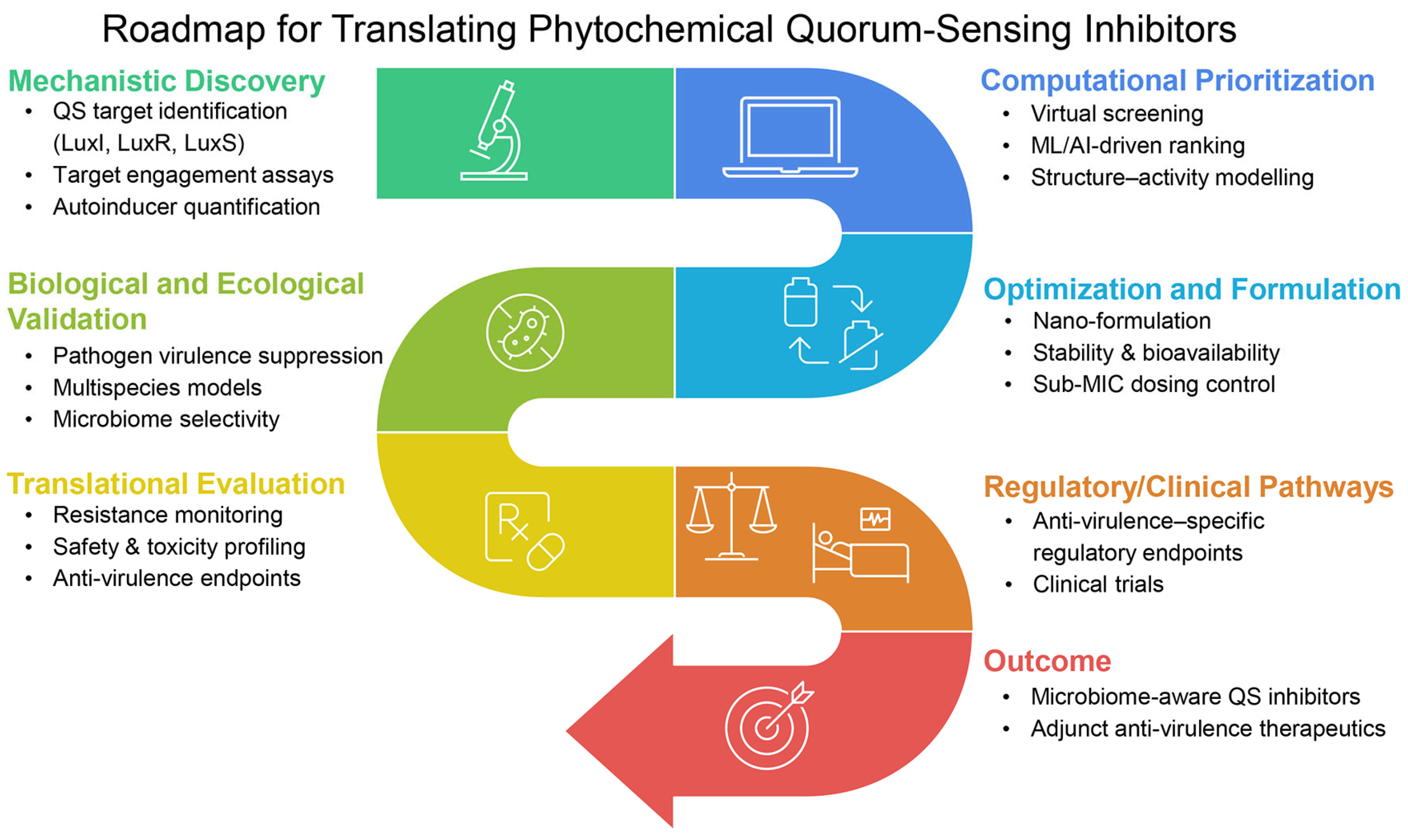
Because QS signalling logic is conserved across pathogenic and beneficial bacteria, a central unresolved question is how QS-targeting agents, particularly phytochemicals, modulate QS-regulated functions across diverse bacterial lifestyles. Although substantial evidence indicates that phytochemicals can attenuate QS-dependent virulence and biofilm formation in pathogens, the literature remains heavily skewed toward pathogen-focused studies, with comparatively few investigations examining QS modulation in commensal, symbiotic, or probiotic bacteria. Consequently, microbiome-level outcomes of QS-targeted interventions are still poorly defined, raising important safety and translational concerns. Addressing this knowledge gap is essential for evaluating the feasibility, selectivity, and clinical relevance of QS-based anti-virulence strategies. Accordingly, this review critically examines the molecular mechanisms, experimental evidence, and translational challenges associated with phytochemical modulation of bacterial quorum sensing, with particular emphasis on pathogen control, QS system conservation, and microbiome-related considerations. Although several recent excellent reviews (see, for example [4,28]) have comprehensively cataloged phytochemicals with QSIs and anti-biofilm activity, this review deliberately moves beyond compound-centric inventories. Instead, it focuses on the mechanistic ambiguities, methodological inconsistencies, and translational barriers that currently limit the development of phytochemical QS inhibitors, thereby framing QS modulation as a system.

2. Methodology

This narrative review was conducted through a structured qualitative analysis of the literature addressing QS mechanisms, QS inhibition, and QS modulation by natural products, with particular emphasis on bacterial pathogens, microbiome-related implications, and unresolved mechanistic and translational challenges. A comprehensive literature search was performed using PubMed, Scopus, and Web of Science.
Search strategies employed combinations of keywords including “quorum sensing,” “quorum sensing inhibition,” “quorum quenching,” “natural products,” “phytochemicals,” “anti-virulence,” “biofilm inhibition,” “antimicrobial resistance,” “LuxS/AI-2,” “AHL,” “AIP,” “microbiota,” and “probiotics.” The primary focus was on peer-reviewed articles published up to January 2026. Seminal studies published outside this timeframe were selectively included when they provided foundational mechanistic insights essential for contextual understanding of QS biology.
Studies were selected for relevance to QS regulation and QS-dependent phenotypes, including virulence, biofilm formation, and resistance-associated behaviors, and for the presence of experimental evidence supporting modulation of QS pathways by natural products. Both in vitro and in vivo studies were considered. Reviews, mechanistic investigations, and experimental reports describing phytochemical-derived QS modulators were included for synthesis and critical comparison. Articles focused exclusively on synthetic QS inhibitors without relevance to natural products or lacking experimental validation were excluded.
To ensure interpretability and reproducibility, priority was given to studies that used QS-specific readouts and provided sufficient methodological detail. Reports were deprioritized or excluded when conclusions relied primarily on nonspecific phenotypic endpoints (e.g., growth inhibition without QS assays), lacked appropriate controls or statistical reporting, used non-physiological concentrations without justification, or provided insufficient methodological detail to support evaluation of reproducibility and relevance to the review’s central themes.
Data were synthesized thematically and discussed in an integrated manner. Sections were organized by QS system type, biological context, and the mechanistic mode of QS modulation. This framework enabled critical comparisons across studies, the identification of consistent trends and contradictions, and the highlighting of unresolved questions and research challenges relevant to the development of microbiome-aware, QS-based anti-virulence strategies.

3. Quorum-Sensing Communication in Bacteria: Diversity of Chemical Languages

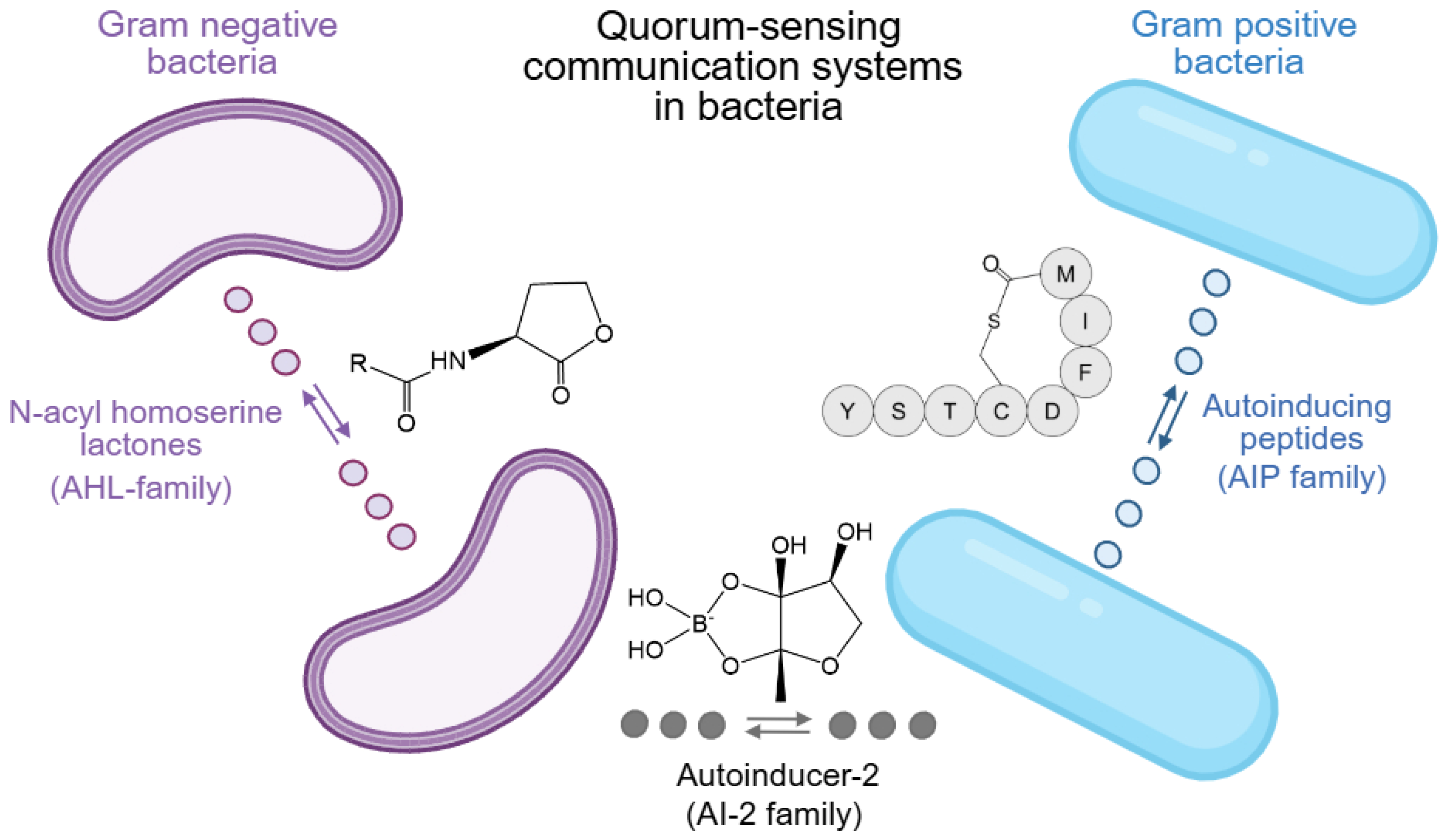
As bacterial populations span diverse taxa and ecological niches, a fundamental question arises: do all bacteria communicate using the same chemical “language,” or do QS mechanisms differ fundamentally between Gram-positive (G+) and Gram-negative (G) organisms? Although G+ and G bacteria employ distinct signal chemistries and signal-transduction architectures, most notably autoinducing peptides (AIPs) and acyl-homoserine lactones (AHLs), respectively, they nevertheless rely on shared organizational principles that enable population-density–dependent coordination of collective behaviors. In addition to these group-specific systems, many bacteria utilize the S-ribosylhomocysteine lyase (LuxS)/autoinducer-2 (AI-2) QS pathway, a widely conserved intercellular signaling mechanism that mediates both intra- and interspecies communication across G+ and G taxa. Figure 1 schematically summarizes these major QS communication strategies [6].
Through these conserved frameworks, QS regulates processes such as virulence expression, biofilm formation, persistence, and ecological adaptation, not only in pathogenic bacteria but also in commensal and symbiotic microbial communities, thereby contributing to cooperation, stability, and host–microbe homeostasis [6].
Recent comprehensive analyses have mapped the breadth, evolution, and mechanistic diversity of microbial QS research. In particular, the extensive review by Ruan et al. [4] provides an in-depth bibliometric and mechanistic synthesis of QS systems, detailing their molecular architectures, signaling hierarchies, and functional roles in biofilm formation, virulence regulation, symbiosis, and environmental adaptation. Building on this foundation, this section does not aim to provide an exhaustive mechanistic analysis. Instead, it offers a concise overview of the principal QS systems relevant to anti-virulence and quorum-quenching strategies.
Accordingly, the following subsections briefly summarize (i) AIP-mediated QS in G+ bacteria, (ii) AHL-mediated QS in G bacteria, and (iii) the LuxS/AI-2 system, which facilitates interspecies communication across both G+ and G bacteria. Other signaling pathways, including autoinducer-3 (AI-3)–mediated systems, are involved [29,30] in host–pathogen and inter-kingdom communication, particularly in enteric bacteria, and are acknowledged but lie beyond the scope of this review.

3.1. Quorum Sensing in Gram-Positive Bacteria: Autoinducing Peptide–Mediated Signaling

G+ bacteria predominantly employ AIPs as QS signals [31]. These short, cyclic peptides are synthesized as ribosomally encoded precursor proteins, which undergo post-translational processing and active export before engaging membrane-bound histidine kinase receptors to initiate signal transduction [31]. Because AIPs cannot freely diffuse across the cytoplasmic membrane, their maturation and secretion require specialized membrane-associated processing and transport machinery [32]. A well-characterized example is the Agr QS system of Staphylococcus aureus [33]. In this system, the AIP is derived from the precursor peptide AgrD through a dedicated biosynthetic pathway. The integral membrane endopeptidase AgrB cleaves the C-terminal region of AgrD and catalyzes thiolactone ring formation, while the type I signal peptidase SpsB removes the N-terminal leader sequence to release the mature, biologically active AIP into the extracellular environment [34]. Upon reaching a threshold extracellular concentration, AIPs bind to the extracellular domain of their cognate membrane-bound histidine kinase receptor, triggering receptor autophosphorylation and subsequent phosphotransfer to downstream response regulators. This phosphorylation cascade ultimately modulates transcription of QS-regulated genes controlling population-level behaviors, including biofilm formation, virulence factor expression, and stress adaptation [31].

3.2. Quorum Sensing in Gram-Negative Bacteria: Acyl-Homoserine Lactone–Mediated Signaling

G bacteria primarily employ small, diffusible molecules such as AHLs and other S-adenosylmethionine-derived signals that freely diffuse across membranes and bind cytoplasmic transcriptional regulators [35]. AHLs are synthesized by members of the acyl-homoserine-lactone synthase (LuxI) family of enzymes, which use two metabolic precursors: S-adenosylmethionine (SAM), which provides the homoserine lactone moiety, and an acyl group derived from acyl–ACP or, in some systems, acyl–CoA substrates [36,37]. LuxI enzymes catalyze amide bond formation between these substrates, followed by intramolecular lactonization to generate the mature AHL signal and release S-methylthioadenosine (MTA) as a by-product [38,39].
Different LuxI homologs (e.g., LasI, RhlI, AinS) exhibit substrate specificity for distinct acyl-ACPs, producing structurally diverse AHLs that vary in acyl chain length (C4 to C20), saturation, and substitution patterns (reviewed in [40]). As AHLs accumulate with increasing cell density, they reach a threshold concentration at which they bind their cognate LuxR-family transcriptional regulators [41]. LuxR proteins contain two functional domains: an N-terminal ligand-binding domain (LBD) and a C-terminal DNA-binding domain (DBD). Upon ligand binding, LuxR–AHL complexes typically become stable, dimerize, and bind target DNA sequences in a species-dependent manner to regulate transcription. Notably, for some LuxR-type regulators, autoinducer binding is required for proper folding, whereas unbound LuxR proteins may be rapidly degraded [42,43,44].
The resulting AHL–LuxR complexes form dimers or multimers that bind to specific promoter regions, thereby activating QS-regulated gene expression [45,46]. Canonical LuxI/LuxR-type systems, such as LasI/LasR and RhlI/RhlR in P. aeruginosa, mediate intercellular communication through endogenous AHL production and detection [47]. However, many bacteria encode LuxR-type AHL receptors even in the absence of a cognate LuxI AHL synthase. These unpaired LuxR-family proteins are termed “orphans” [48] or “solos” [49] because they function without a dedicated signal generator [42,49]. In the absence of LuxI synthases, such receptors can detect AHLs produced by other bacterial species, thereby facilitating interspecies communication [50].
Importantly, LuxI-type synthases are not essential for bacterial growth, making them attractive anti-virulence targets whose inhibition can suppress QS activation without directly affecting cell viability.

3.3. LuxS/AI-2–Mediated Quorum Sensing: An Interspecies Communication System in Bacteria

Beyond the species-specific systems discussed above, interspecies signaling molecules, such as AI-2, enable communication across diverse bacterial taxa. AI-2 is produced via the LuxS pathway and is conserved across G+ and G bacteria, mediating interspecific signaling within complex microbial communities [51]. The LuxS enzyme (EC 4.4.1.21) catalyzes the cleavage of S-ribosylhomocysteine into homocysteine and 4,5-dihydroxy-2,3-pentanedione (DPD), the precursor of AI-2, which spontaneously cyclizes into chemically distinct AI-2 derivatives depending on environmental conditions [52,53]. Importantly, AI-2 is not a single defined molecule but a family of interconverting DPD derivatives, including furanosyl borate diesters and related structures, whose chemical form depends on environmental parameters such as pH and borate availability [54]. This chemical plasticity allows AI-2 to function as a broadly conserved signaling currency rather than a species-specific ligand [55].
LuxP and LsrB are the best-characterized receptors for AI-2. Both are periplasmic substrate-binding proteins structurally related to ribose-binding proteins, despite limited primary sequence similarity. Notably, all known AI-2 receptors share high sequence similarity with, and complete conservation of the ligand-binding site with, LuxP or LsrB. [54,56]. These receptors belong to the high-affinity substrate-binding protein family but differ in their ligand specificities and downstream signaling mechanisms. Specifically, LuxP and LsrB recognize chemically distinct cyclic derivatives of the AI-2 precursor molecule DPD (S)-4,5-dihydroxypentane-2,3-dione) [54,56]. LuxP binds the borated AI-2 form, S-THMF-borate ((2S,4S)-2-methyl-2,3,3,4-tetrahydroxytetrahydrofuran-borate), whereas LsrB selectively recognizes the non-borated isomer, R-THMF ((2R,4S)-2-methyl-2,3,3,4-tetrahydroxytetrahydrofuran) [54]. This ligand discrimination is attributed to differences in the amino acid composition and architecture of the respective binding pockets.
Downstream regulatory responses also diverge according to receptor type. Upon AI-2 binding, LuxP modulates the activity of a membrane-spanning sensor histidine kinase, thereby controlling a phosphorylation-dependent signal transduction cascade. In contrast, LsrB functions as the periplasmic recognition component of an ATP-binding cassette (ABC) transporter that mediates AI-2 internalization [57,58]. LsrB was initially identified in Salmonella enterica serovar Typhimurium and, unlike LuxP—which appears to be restricted to members of the Vibrionales—is more broadly distributed among enteric bacteria and among species within the Rhizobiaceae and Bacillaceae families [59,60].
Furthermore, in Vibrio species, LuxP binding to AI-2 modulates the activity of the transmembrane sensor histidine kinase LuxQ, switching it from kinase to phosphatase mode and thereby regulating QS-controlled phenotypes such as bioluminescence, biofilm formation, and virulence factor production [12,61]. In contrast, in enteric bacteria such as Escherichia coli, the LsrB–AI-2 complex delivers AI-2 into the cytoplasm via the Lsr ATP-binding cassette transporter system, enabling intracellular signal integration [12]. LsrB-bound AI-2 can also influence chemotactic behavior through interactions with the periplasmic sensory domain of the chemoreceptor Tsr [62].
Notably, many bacteria that exhibit robust transcriptional and phenotypic responses to AI-2 lack identifiable LuxP- or LsrB-type receptors, suggesting the existence of additional, as-yet-uncharacterized AI-2 sensing mechanisms [63]. Supporting this notion, AI-2 has been shown to regulate gene expression, biofilm formation, and virulence-associated traits in pathogens such as P. aeruginosa and Enterococcus faecalis, despite the absence of canonical AI-2 receptors in these organisms [64].

4. Common Quorum-Sensing Mechanisms, Divergent Functional Outcomes in Pathogenic and Beneficial Bacteria

As discussed above, QS is employed not only by pathogenic bacteria but also by beneficial and symbiotic microorganisms. Although QS systems are built upon conserved molecular architectures across bacterial taxa, their biological functions and regulatory outcomes differ profoundly between pathogenic and beneficial bacteria, despite the vast diversity of bacterial lifestyles [65]. Across taxa, QS relies on the production, accumulation, detection, and interpretation of AI molecules, enabling bacterial populations to coordinate gene expression in response to cell density and community context [6]. These shared architectures encompass signal biosynthesis pathways, cognate receptors, signal transduction modules, and regulatory feedback loops that synchronize population-level behaviors. The conservation of QS machinery underscores its fundamental role in bacterial ecology rather than specialization for pathogenicity [66]. In both pathogenic and symbiotic bacteria, QS integrates environmental cues, metabolic status, and community composition to regulate collective behaviors that would be ineffective if executed by individual cells. Accordingly, QS should be regarded as a general regulatory framework for population-level coordination rather than an inherently virulence-associated system [4].
Despite this conserved signaling logic, QS circuits operate within distinct regulatory and ecological contexts that shape their biological outputs. In pathogenic bacteria, QS networks are frequently coupled to master virulence regulators and stress-response pathways, whereas in beneficial/symbiotic bacteria, they are more often embedded within metabolic, ecological, and homeostatic regulatory networks [65,67]. Consequently, identical or closely related QS architectures can govern markedly different phenotypic programs depending on bacterial lifestyle, ecological niche, evolutionary pressures, and host interactions.
This divergence between shared QS mechanisms and context-dependent regulatory outcomes is central to understanding the biological consequences of QS modulation. It explains why interference with QS signaling can strongly attenuate virulence, biofilm formation, and resistance-associated behaviors in pathogens, while eliciting more subtle, adaptive, or homeostatic effects in beneficial bacteria. These contrasts are summarized in Table 1, which provides a conceptual framework for interpreting the impact, and inherent limitations, of QS modulation, including that mediated by phytochemicals, as discussed in subsequent sections.

4.1. Quorum Sensing as an Amplifier of Virulence and Biofilm Formation in Pathogenic Bacteria

In pathogenic bacteria, QS functions not merely as a communication system but as a central amplifier of virulence, enabling population-wide coordination of behaviors that enhance infection, persistence, and resistance [70]. Increasing evidence indicates that bacterial communication extends beyond strict intraspecies signaling and includes interspecies “eavesdropping” and signal interception, allowing pathogens to sense and manipulate neighboring microorganisms within complex communities [71]. In pathogenic contexts, QS exploits this communicative capacity to synchronize collective behaviors that optimize infection efficiency and persistence [72].
Bacterial pathogens widely employ QS to coordinate the expression of multiple virulence-associated traits in a threshold-dependent, population-wide manner [73]. This synchronized activation ensures that virulence factors are deployed only when bacterial numbers are sufficient to overcome host defenses, thereby maximizing pathogenic success while minimizing premature immune detection. Consequently, QS circuitry in pathogenic bacteria is configured to drive abrupt and robust phenotypic transitions once critical signaling thresholds are reached.
Successful pathogenicity depends on a bacterium’s ability to adhere to and colonize host tissues, evade immune defenses, and produce toxins. QS serves as a central regulatory hub that integrates population density with environmental cues to orchestrate these energetically costly processes in a temporally and spatially controlled manner [2]. Rather than functioning as a simple on–off switch, QS integrates multiple signaling inputs to regulate toxin production, secretion-system activation, motility, immune evasion, biofilm maturation, and resistance-associated phenotypes [6].
A defining feature of QS in pathogenic bacteria is its tight coupling to virulence gene networks. In many clinically relevant species, QS systems are hierarchically organized and linked to master regulators that control extensive pathogenic regulons [74]. A well-characterized example is P. aeruginosa, in which AHL- and quinolone-based QS systems form interconnected regulatory circuits that govern the production of elastase, pyocyanin, rhamnolipids, lectins, and exotoxin A, as well as biofilm architecture and persistence [75,76,77,78]. Similarly, in Staphylococcus aureus, QS regulates the synthesis and secretion of hemolysins, protein A, enterotoxins, lipases, and fibronectin-binding proteins, all of which contribute to immune evasion and nutrient acquisition within the host [79].
Comparable QS-dependent coordination of virulence has been documented in other major pathogens, including Vibrio spp., Salmonella enterica, and E. coli, where QS controls toxin expression, adhesion factors, secretion systems, and motility programs essential for infection establishment and progression [73]. Collectively, these QS-regulated traits enable pathogens to overwhelm host defenses and optimize resource acquisition during infection.
QS-mediated regulation of biofilm formation represents a significant mechanism by which pathogens amplify virulence and persistence. Biofilms are structured microbial communities encased in a self-produced extracellular matrix that provides physical protection from antibiotics and immune clearance while creating microenvironments that promote stress tolerance and long-term survival [80]. QS regulates multiple stages of biofilm development, including initial surface attachment, extracellular matrix production, and biofilm maturation. Disruption of QS signaling frequently results in structurally compromised biofilms and increased susceptibility to antimicrobial agents, underscoring the central role of QS in biofilm-associated infections [81].
Beyond classical virulence traits, QS also contributes to antimicrobial resistance through several indirect but functionally significant mechanisms [72,82]. QS regulates the expression of multidrug efflux pumps, modulates stress-response pathways, and supports metabolic adaptations that enhance survival under antibiotic pressure. In addition, QS promotes horizontal gene transfer via conjugation and plasmid mobilization, thereby accelerating the dissemination of resistance determinants within pathogenic populations [83]. QS further facilitates the emergence of antibiotic persistence by enabling subsets of bacterial populations to enter transient, highly tolerant dormant states.
Taken together, these features establish QS as a virulence amplifier rather than a mere communication system in pathogenic bacteria. By synchronizing multiple virulence- and resistance-associated traits, QS enhances infection efficiency, persistence, and adaptability without directly affecting bacterial viability. This functional role provides a strong mechanistic rationale for targeting QS as an anti-virulence strategy. It sets the stage for evaluating how QS modulation, particularly by phytochemicals, may attenuate pathogenicity while avoiding the bactericidal selective pressures imposed by conventional antibiotics. This contrast becomes critical when QS functions in beneficial and symbiotic bacteria are considered in subsequent sections.
The major QS-regulated mechanisms that indirectly contribute to antimicrobial resistance in pathogenic bacteria are summarized in Table 2.

4.2. Quorum Sensing as a Homeostatic and Ecological Regulator in Commensal and Symbiotic Bacteria

QS systems are widely conserved among commensal, probiotic, and symbiotic members of the human microbiota, where they primarily function as regulators of cooperation, ecological fitness, and host–microbe homeostasis (reviewed in [87]). In contrast to pathogenic bacteria, where QS is often wired toward virulence amplification, QS in beneficial and symbiotic bacteria supports adaptive behaviors that promote stable colonization, metabolic coordination, and mutualistic interactions with the host. A comprehensive overview of QS systems in the intestinal microbiome and their roles in bacteria–host crosstalk has been provided by Wu and Luo [68], who summarize current evidence linking QS signaling to the maintenance of intestinal homeostasis under physiological conditions. Building on this foundation, the present section focuses on the broader ecological and homeostatic functions of QS in commensal and symbiotic bacteria, with particular emphasis on the implications of QS-targeted interventions.
Within the gastrointestinal tract, QS plays a key role in shaping the spatial organization and ecological structure of microbial populations. The gut represents a highly heterogeneous environment in which microbial density, nutrient availability, and physical architecture vary along its length and across distinct niches, including the mucus layer and the intestinal lumen. Experimental and modeling studies indicate that microbial aggregate size and population density influence both the quorum threshold required for effective QS signaling and the spatial range over which QS signals affect neighboring species [88,89]. In this context, QS enables bacteria to sense local population structure and dynamically adapt their behavior to specific ecological niches.
Among QS pathways, the LuxS/AI-2 system has emerged as a central mediator of interspecies communication within the gut microbiota. LuxS-dependent AI-2 production is critical for gastrointestinal transit, adhesion, and biofilm formation in Lactobacillus rhamnosus GG, with luxS deletion resulting in impaired colonization and reduced biofilm development [90,91]. AI-2 signaling further influences mucosal adhesion, biofilm formation, and iron metabolism in beneficial genera such as Lactobacillus and Bifidobacterium, as well as in Actinobacillus and Vibrio species [92,93,94]. Collectively, these findings suggest that AI-2 contributes to niche adaptation and efficient resource utilization within complex microbial communities. In LAB, LuxS/AI-2 signaling supports probiotic traits, including colonization persistence and cooperative behavior. For example, AI-2 enhances bacteriocin production in co-cultures of Lactobacillus plantarum AB-1 and Lactobacillus casei [95], promotes intestinal adhesion of L. plantarum KLDS 1.0391, and supports biofilm formation in L. rhamnosus GG [96].
QS also contributes to microbiota stability by modulating interactions with the host immune system. Gut microbes exert profound effects on host metabolic and immune functions, and QS-mediated signaling has been implicated in cross-kingdom communication between bacteria and intestinal epithelial or immune cells [68,97]. In healthy individuals, balanced QS signaling supports host–microbe homeostasis, whereas dysbiosis is associated with altered QS signal profiles. Notably, the abundance and composition of AHLs in fecal samples differ significantly between healthy individuals and patients with inflammatory bowel disease (IBD) [68]. One specific AHL, 3-oxo-C12:2-HSL, is markedly reduced in IBD patients and exhibits anti-inflammatory effects in intestinal epithelial cell models, suggesting that QS signals may serve as biomarkers of gut homeostasis and inflammatory status [98].
In addition to bacterial-derived signals, host cells participate in QS-like communication in the gut by producing AI-2–mimicking molecules in response to epithelial damage [99]. These host-derived cues serve as ecological signals sensed by diverse gut microbes, including commensals and opportunistic pathogens. Because AI-2 is a broadly conserved communication molecule, such mimics activate bacterial QS pathways across taxa. In enteric bacteria such as S. typhimurium, these signals are detected by the Lsr system, which triggers QS-regulated gene expression programs associated with metabolism, motility, and stress adaptation, rather than directly activating virulence. Although the precise ecological consequences of this signaling remain incompletely defined, host-driven QS activation may facilitate microbial organization and colonization at damaged epithelial sites, thereby supporting tissue repair and barrier recovery. In this context, pathogen responsiveness likely reflects signal exploitation rather than host intent. Collectively, these observations highlight the bidirectional nature of QS-mediated host–microbe interactions and their role in maintaining intestinal stability and homeostasis [99].
QS-regulated homeostatic functions extend beyond the gut to other mucosal environments, including the vaginal tract. Dominant vaginal Lactobacillus species, such as L. crispatus, L. gasseri, L. iners, and L. jensenii, form biofilm networks that protect against pathogen colonization and maintain low vaginal pH through lactic acid production [100,101]. Emerging evidence suggests that QS-regulated biofilm formation is critical for vaginal health. QS activity has been linked to epithelial adhesion and biofilm formation in Lactobacillus species, reinforcing mucosal barrier integrity [102]. Notably, recent studies have detected AHL production in certain G+ vaginal lactobacilli, including L. crispatus and L. jensenii, with higher AHL levels correlating with enhanced biofilm formation. Although preliminary, these findings suggest that non-canonical QS signaling may contribute to probiotic fitness in the vaginal niche [103].
Collectively, the evidence above supports a central translational principle: QS in commensal and symbiotic bacteria is primarily embedded in networks that stabilize colonization, resource sharing, and host–microbe homeostasis, so indiscriminate QS attenuation may carry ecological costs even when virulence is not the target. This implies that the therapeutic value of QS inhibition will depend not only on anti-virulence efficacy in pathogens but also on context-dependent selectivity within complex microbiome ecosystems. At present, this risk–benefit balance remains difficult to predict because most QSI studies rely on simplified pathogen-centric models and rarely quantify impacts on commensal fitness, community structure, or host signaling. Integrating microbiome-aware readouts and physiologically relevant models into QSI evaluation will therefore be essential to ensure that QS-targeted strategies, particularly phytochemical modulators, attenuate pathogenic behaviors without eroding beneficial microbial functions.
Key QS mechanisms involved in colonization, metabolism, immune modulation, and stability are summarized in Table 3.

5. Phytochemical Modulation of Quorum Sensing in Pathogenic Bacteria: Mechanistic Insights and Limitations

Phytochemical modulation of QS has been widely investigated as an anti-virulence strategy to suppress pathogenic behaviors, particularly the production of virulence factors and biofilm maturation. The disruption of QS, broadly termed QQ, encompasses any process that interferes with bacterial communication [105]. Mechanisms generally fall into two categories: enzymatic degradation of signaling molecules (often referred to as QQ enzymes) or small-molecule QSIs that perturb signaling without degrading the signal itself [106]. Interventions are typically classified by their primary functional target: (i) the synthesis or stability of AI molecules, (ii) signal perception at QS receptors, or (iii) downstream regulatory pathways [107,108]. This section focuses primarily on phytochemical interference with AI biosynthesis/availability and receptor engagement. These represent the most proximal and QS-specific intervention points, whereas downstream modulation is addressed only briefly, as it often converges on broader, less specific metabolic networks [109].
A central question arising from the conserved nature of QS systems discussed in Section 3 and Section 4 is: Can phytochemicals modulate QS with sufficient mechanistic specificity to attenuate pathogen behaviors while minimizing unintended ecological effects? Although diverse compound classes, such as phenolics, have demonstrated the capacity to inhibit QS-regulated behaviors across multiple strains [6,22,69,109], distinguishing specific mechanistic interference from general toxicity remains a challenge. Consequently, the following subsections synthesize pathogen-focused mechanistic evidence while critically evaluating the experimental constraints, such as reliance on indirect phenotypic endpoints and limited molecular target validation, that currently hinder the translation of these findings from proof-of-concept studies to viable anti-virulence strategies [110,111,112,113].

5.1. Phytochemical Inhibition of Autoinducer Biosynthetic Machinery

Disrupting QS by inhibiting AI biosynthesis, thereby targeting the molecular machinery responsible for signal production rather than the signaling molecules themselves, represents a promising anti-virulence strategy. However, the feasibility and mechanistic basis of this approach differ substantially across QS systems. Accordingly, the following subsections examine the modulation of AI biosynthesis by phytochemicals in G+-AIP systems, G-AHL systems, and the universally conserved LuxS/AI-2 pathway.

5.1.1. Phytochemical Modulation of Autoinducing Peptide Biosynthesis in Gram-Positive Bacteria

In G+ bacteria, inhibiting AIPs biosynthesis poses substantial mechanistic and translational challenges. AIPs are ribosomally synthesized precursor peptides that undergo post-translational processing by dedicated enzymes (e.g., AgrD/AgrB in staphylococci). These processing steps are essential for AIP production but not generally required for bacterial viability. By contrast, inhibition of broadly essential secretion or signal-peptidase enzymes can be bactericidal because those enzymes process many substrates beyond AIPs. Therefore, direct inhibition of AIP-specific biosynthetic components is typically an anti-virulence approach rather than a bactericidal one, and the therapeutic and evolutionary consequences differ accordingly [114]. This constraint has contributed to the relative paucity of studies directly targeting AIP biosynthesis in G+ bacteria.
Despite these limitations, considerable effort has been devoted to elucidating the molecular mechanisms governing AIP production, processing, and signal transduction, to identify regulatory nodes that can be modulated without directly compromising bacterial viability [115]. In this context, indirect interference with AIP biosynthesis or the agr system, rather than direct inhibition of ribosomal activity or essential peptidases, has emerged as a more feasible anti-virulence strategy.
Notably, phytochemicals have been reported to modulate AIP-dependent QS systems through indirect mechanisms. For example, polyphenolic compounds including curcumin and resveratrol have been shown to downregulate AIP biosynthesis and impair agr-mediated QS signaling in S. aureus, leading to reduced expression of QS-regulated virulence factors without overt effects on bacterial growth [116]. Collectively, these findings indicate that although direct inhibition of AIP biosynthesis remains problematic from a translational perspective, selective modulation of QS peptide signaling through upstream regulatory interference or signal attenuation may be a viable anti-virulence strategy. Importantly, these examples underscore the need for careful mechanistic dissection to distinguish genuine QS modulation from secondary effects arising from growth inhibition or metabolic stress.
Importantly, in contrast to AIP-based systems, certain QSIs directly target autoinducer synthases in LuxI/AHL-dependent systems of G bacteria [117], as well as the LuxS enzyme in the ‘universal’ AI-2–dependent system of both G and G+ bacteria, thereby preventing signal biosynthesis and subsequent QS activation [118]. These mechanisms are discussed in detail in the following subsections.

5.1.2. Phytochemical Modulation of Acyl-Homoserine Lactone Biosynthesis in Gram-Negative Bacteria

The AHL–mediated QS system is the most extensively characterized QS mechanism in G bacteria and represents a central regulatory pathway in many clinically relevant pathogens. In these organisms, QS signaling is primarily mediated by AHLs, which accumulate extracellularly in a cell-density-dependent manner. Upon reaching a threshold concentration, AHLs diffuse back into the cell and bind to the cytoplasmic LuxR-type transcriptional regulators, which activate QS-controlled gene expression programs that govern virulence, biofilm formation, and stress adaptation [12].
A growing body of evidence demonstrates that diverse phytochemicals can interfere with AHL biosynthesis by targeting LuxI-type enzymes or their transcriptional regulation. Inhibition of AHL synthase activity blocks QS signaling upstream of receptor activation, thereby preventing induction of QS-regulated genes and phenotypes [119]. Representative phytochemicals reported to modulate LuxI-dependent AHL biosynthesis in G bacteria are summarized in Table 4.
Among terpenoid compounds, carvacrol has been extensively investigated as a QS inhibitor. Burt et al. [120] demonstrated that sub-MICs of carvacrol suppress expression of cviI, the LuxI homolog in Chromobacterium violaceum, leading to reduced AHL production and downregulation of QS-dependent outputs, such as violacein synthesis and chitinase activity. Complementary findings in P. aeruginosa further indicate that carvacrol attenuates QS-regulated virulence phenotypes by disrupting AHL-dependent signaling pathways, consistent with indirect interference with LuxI-mediated autoinducer synthesis [121].
Structurally related monoterpenes exhibit similar effects. For example, Li et al. [122] showed that L-carvone significantly reduced AHL production in Hafnia alvei by downregulating both the AHL synthase gene halI and its cognate regulator halR, leading to impaired motility and biofilm formation. These findings underscore the capacity of small terpenoids to modulate QS at the level of signal biosynthesis and regulatory feedback.
Phenylpropanoid derivatives also display LuxI-targeting activity. Salicylic acid suppresses AHL production in P. aeruginosa and interferes with both the Las and Rhl QS systems, thereby reducing bacterial invasion and cytotoxicity in epithelial cell models [123,124]. Similarly, trans-cinnamaldehyde downregulates lasI, lasR, rhlI, and rhlR expression in P. aeruginosa PAO1 at sub-inhibitory concentrations, leading to substantial reductions in protease, elastase, pyocyanin, rhamnolipid production, and biofilm formation without bactericidal effects [125].
Table 4. Examples of phytochemicals reported to suppress AHL (LuxI-type) autoinducer biosynthesis in Gram-negative bacteria.
Phytochemical
(Class)
Model Organism/
QS System
Putative Mechanism
(AHL Biosynthesis-Related)
Key OutcomesRefs.
Carvacrol
(terpenoid)
Chromobacterium violaceum (CviI/CviR; AHL QS)
  • Downregulates AHL synthase gene (cviI) expression at sub-MIC
  • Decreases AHL accumulation upstream of receptor activation (transcriptional/production-level interference).
Reduced AHL-dependent violacein and chitinase; inhibited biofilm at sub-MIC.[120]
L-carvone
(terpenoid)
Hafnia alvei (HalI/HalR; AHL QS)
  • Suppresses AHL production by downregulating halI (AHL synthase) and halR (regulator)
  • Upstream inhibition of QS activation
Reduced motility and biofilm formation; decreased AHL signal output.[122]
Salicylic acid
(Phenolic acid)
P. aeruginosa (Las/Rhl systems) and ocular infection model
  • Represses AHL production and QS gene expression (lasI/rhlI/lasR/rhlR) at sub-inhibitory level
  • Reduces AHL output in whole-cell assays and in heterologous LasI/RhlI production systems, as shown by analytical AHL quantification (LC–MS) in some studies
Reduced AHL output and QS-regulated virulence traits; reduced host–cell invasion/cytotoxicity in epithelial models.[123,125,126,127]
trans-Cinnamaldehyde
(Phenylpropanoid)
P. aeruginosa (LasI/LasR and RhlI/RhlR)
  • Downregulates lasI/rhlI and associated QS regulatory genes at sub-inhibitory concentrations
  • Reduces AHL signal output in whole-cell systems and support from heterologous LasI/RhlI assays with AHL quantification (LC–MS) and docking in some studies
Reduced protease, elastase, pyocyanin; reduced biofilm; reduced QS gene expression.[125,127]
Tannic acid
(polyphenol)
P. aeruginosa
(Las/Rhl systems); heterologous LasI/RhlI AHL-production assay (reported)
  • Reduced AHL accumulation in LasI/RhlI-dependent assays (notably abolishing short-chain RhlI AHLs), consistent with interference in AHL biosynthesis
  • Direct LuxI enzymatic inhibition was not demonstrated (no purified-enzyme kinetics)
Reduced AHL signal output (biosensor/analytical) and QS-regulated phenotypes (reported).[127]
Eugenol (phenylpropanoid)P. aeruginosa
(LasI/RhlI; AHL QS)
  • Reduces 3-oxo-C12-HSL and C4-HSL levels and downregulates lasI/rhlI at sub-MIC
  • Consistent with upstream suppression of AHL biosynthesis.
Decreased pyocyanin, swarming, and rhamnolipid production; inhibited biofilm (nanoemulsion higher effect than free eugenol)[128]
In addition to simple phenylpropanoids, higher-order polyphenols have also been shown to interfere with AHL-dependent quorum sensing. Chang et al. [127] demonstrated growth-neutral inhibition of short-chain AHL production by tannic acid in their screening platform; however, the authors did not include luxI/lasI/rhlI expression or protein measurements, nor biofilm assays, so the mechanism and effects on QS-regulated biofilm remain to be established.
Eugenol provides another illustrative example of phytochemical-mediated inhibition of AHL biosynthesis. Lou et al. [128] demonstrated that eugenol and an optimized eugenol nanoemulsion significantly reduced AHL levels (3-oxo-C12-HSL and C4-HSL) in P. aeruginosa by downregulating lasI and rhlI expression, thereby suppressing QS-regulated virulence factors, swarming motility, and biofilm formation. Notably, nanoemulsion delivery enhanced eugenol’s anti-QS efficacy without affecting bacterial growth, highlighting formulation-dependent effects on QS.
Collectively, these studies demonstrate that inhibition of LuxI-dependent AHL biosynthesis is a mechanistically plausible and experimentally supported strategy for QS modulation in G pathogens. However, important limitations remain. Reported effects are frequently strain-specific and highly dependent on experimental conditions, including growth phase, assay system, and compound formulation. Moreover, relatively few studies directly interrogate LuxI enzymatic activity or confirm target engagement at the molecular level, compared with the large body of literature documenting phenotypic suppression of QS-regulated outputs.
This disparity raises a critical unresolved question: whether phytochemicals directly inhibit QS machinery or exert indirect effects through broader metabolic or stress-related pathways. Given the pleiotropic nature of many phenolic and terpenoid compounds, definitive attribution of QS inhibition to LuxI-targeted mechanisms requires rigorous biochemical validation. Addressing these methodological gaps will be essential for advancing phytochemical QS inhibitors toward translational anti-virulence applications.
Finally, although LuxI-type AHL synthases are mostly associated with G pathogens, they are also found in a subset of non-pathogenic and symbiotic G bacteria, where AHL signaling typically regulates colonization, metabolic coordination, or environmental adaptation rather than virulence. In contrast, many beneficial bacteria, particularly G+ probiotics, lack LuxI homologs and instead rely on peptide-based or LuxS/AI-2 quorum-sensing systems. These distinctions have important implications for the microbiome-level consequences of LuxI-targeted QS inhibition, as considered in subsequent sections.

5.1.3. Phytochemical Inhibition of LuxS-Dependent AI-2 Biosynthesis: A Conserved Target Across Gram-Positive and Gram-Negative Bacteria

A unique, evolutionarily conserved QS mechanism shared by both G+ and G bacteria is the production of AI-2 signaling molecules by the enzyme LuxS. Because AI-2 mediates interspecies communication, the LuxS/AI-2 system occupies a central role within complex microbial communities. Moreover, the LuxS/AI-2 system is widely distributed across phylogeny and is present in diverse bacterial taxa, including E. coli, S. aureus, Helicobacter pylori, Bacillus subtilis, and numerous commensal bacteria [51]. At the molecular level, LuxS is a metalloenzyme with a highly conserved metal-binding catalytic pocket, a feature that underpins both its enzymatic efficiency and its attractiveness as a pharmacological target [51,129]. Importantly, LuxS-mediated signaling regulates not only virulence and biofilm formation but also motility, stress responses, and metabolic coordination, depending on the bacterial lifestyle and ecological context [63,130].
Given these features, LuxS represents a promising anti-virulence target, particularly because its inhibition attenuates QS-regulated behaviors without directly impairing bacterial viability. This conceptual advantage has driven growing interest in phytochemicals as potential LuxS inhibitors, offering an alternative strategy to combat multidrug-resistant pathogens while minimizing selective pressure for resistance development.
Early evidence supporting AI-2–focused QS inhibition emerged from studies using plant extracts. For example, grape seed extract was shown to suppress AI-2–dependent behaviors in E. coli, including flagellar motility and Shiga toxin production [131], while extracts from broccoli, oregano, rosemary, turmeric, ginger, and basil inhibited swarming motility by disrupting the AI-2 signaling axis [109,132]. These findings established that AI-2 signalling can be modulated by complex phytochemical mixtures.
Building on this foundation, our group evaluated the anti-QS activity of ethanolic extracts from eight aromatic plants in the Cypriot flora, focusing specifically on AI-2–mediated QS in E. coli MG1655 [133]. Extracts from oregano, rosemary, and common sage were the most potent, suppressing AI-2 signaling by 60–90% in a dose-dependent manner. These effects were accompanied by marked reductions in biofilm formation and swimming/swarming motility, while bacterial growth remained unaffected—indicating genuine QS inhibition rather than bacteriostatic activity. LC-MS profiling identified shared phytochemicals, including carnosol, chlorogenic acid, and quercetin, suggesting these compounds as key contributors to LuxS modulation.
A subsequent mechanistic study from our group [118] extended these observations by interrogating purified phytochemicals using an integrated in silico–in vitro pipeline. Our molecular docking analysis revealed stable binding of carnosol, chlorogenic acid, quercetin, apigenin, and rosmarinic acid within the LuxS catalytic pocket. These predictions were experimentally validated with targeted biochemical assays, which confirmed reduced AI-2 production and impaired biofilm formation without growth inhibition—providing direct evidence of LuxS-targeted anti-QS activity. Notably, carnosol and chlorogenic acid showed the most potent effects, with IC50 values of approximately 60 μM.
Independent studies further support the general applicability of this mechanism. Fernandes et al. [134] identified curcumin and 10-undecenoic acid as inhibitors of LuxS/AI-2 signaling in B. subtilis, reporting concentration-dependent reductions in AI-2 activity ranging from 33–77% for curcumin and 36–64% for 10-undecenoic acid. Notably, both compounds also inhibited the LasI/LasR system in P. aeruginosa, highlighting their capacity to target multiple QS pathways across G+ and G bacteria.
Morgan et al. [132] demonstrated that carvacrol, cinnamaldehyde, and eugenol suppress QS-regulated motility and biofilm formation in multidrug-resistant uropathogenic E. coli (UPEC), concomitant with downregulation of luxS expression. Importantly, combining these phytochemicals with conventional antibiotics reduced antibiotic MICs and produced synergistic or partially synergistic effects, suggesting translational potential as QS-sensitizing adjuvants.
More recently, computational and molecular dynamics studies by Rath et al. [135] explored Triphala, a polyherbal formulation, as a LuxS-targeting agent in H. pylori. Several constituent phytochemicals—particularly furosin, corilagin, and ellagic acid—exhibited higher predicted LuxS binding affinity and stability than the reference antibiotic clarithromycin, with furosin emerging as the most stable inhibitor. These findings bridge traditional herbal medicine with modern structure-guided QS inhibitor discovery and further validate LuxS as a druggable QS target.
Representative studies targeting LuxS-dependent AI-2 biosynthesis are summarized in Table 5.
Current evidence shows LuxS-dependent AI-2 biosynthesis as a promising and conserved target for phytochemical-based QS inhibition. Unlike peptide- or AHL-based systems, LuxS is found in both pathogenic and non-pathogenic bacteria, linking AI-2 modulation to virulence and microbiome regulation. Many phytochemicals, such as polyphenols, terpenoids, and herbal formulations, have shown LuxS-linked anti-QS activity, but rigorous validation is limited. Differentiating direct LuxS inhibition from indirect effects is crucial for progress. LuxS remains a rare yet promising target for microbiome-aware anti-virulence strategies, particularly as future research integrates enzymology, structural biology, and in vivo studies.

5.2. Targeting Quorum-Sensing Receptors with Phytochemicals

The second mechanism of QS-inhibiting agents is to target QS signaling receptors, thereby inactivating them or competing for them. In most cases, the ligand-binding domains of receptors with the native AIs are highly conserved and can be bound by most AIs either competitively or noncompetitively [136].

5.2.1. Phytochemical Antagonists and Allosteric Modulators of AIP Receptors in Gram-Positive Bacteria

G+ bacteria typically detect secreted cyclic peptide AIPs via transmembrane sensor kinases embedded in two-component regulatory systems (for example, AgrC in Staphylococcus spp.), which transduce QS signals into gene-expression programs governing community behaviors such as virulence and biofilm formation [137]. These receptors can discriminate subtle sequence differences among AIPs, supporting largely species-specific communication; indeed, AIP-mediated QS systems (for example, the four thiolactone peptides AIP I–IV in S. aureus) underlie this specificity. In S. aureus, the accessory gene regulator (agr) pathway synthesizes the cyclic thiolactone pheromone from the AgrD precursor, exports it via AgrB, and detects it through the AgrC/AgrA two-component system. Upon AIP binding, AgrC activates the response regulator AgrA, which binds the agr promoters (P2 for RNAII and P3 for RNAIII) to coordinate downstream transcriptional outputs [138]. Consequently, QS-mediated pathogenicity in G+ bacteria can be attenuated by targeting AIP receptors with antagonists, and emerging evidence supports inhibition of the AgrC–AIP interaction as a promising therapeutic strategy [19,139]. Small-molecule kinase inhibitors, including closantel, RWJ-49815, and LY266500, have also been shown to disrupt QS signaling in G+ bacteria by interfering with receptor kinase activity [140].
Although multiple phytochemicals have been reported to suppress AIP-dependent agr outputs (e.g., biofilm formation, RNAIII, phenol-soluble modulins), direct evidence that plant-derived small molecules competitively bind or allosterically modulate AgrC remains limited. Most studies describe transcriptional or phenotypic inhibition without supporting biochemical binding assays, structural validation, or receptor mutagenesis. For example, Nakagawa et al. [141] reported that carnosic acid and carnosol from Rosmarinus officinalis (rosemary) specifically inhibit AIP-induced agr RNAIII and psmα expression in S. aureus reporter strains and in clinical isolates from patients with atopic dermatitis. Using luciferase reporter assays and qPCR, inhibition was observed at low micromolar concentrations for the purified compounds and at low µg/mL for rosemary extracts, with minimal impact on bacterial growth at the tested doses. The authors evaluated nine commercial rosemary extracts) and observed that activity correlated with carnosic acid/carnosol content; they further discussed topical anti-virulence applications in atopic dermatitis, while explicitly noting the absence of direct biochemical evidence for AgrC receptor binding. Given the limited number of studies and the lack of mechanistic validation at the receptor level, potential AIP receptor inhibitors are not discussed further herein.

5.2.2. Phytochemical Antagonism and Allosteric Modulation of LuxR-Family AHL Receptors in Gram-Negative Pathogens

In G bacteria (particularly Proteobacteria), the most common AHL receptors are LuxR-family transcription factors that bind AHLs to form LuxR–AHL complexes that regulate gene expression. Membrane sensor kinases and LuxR-solo (orphan) variants also contribute to AHL/autoinducer sensing in many species [50,142]. Targeting LuxR–AHL recognition with specific QSIs, therefore, represents a promising anti-virulence strategy. Notably, because LuxR homologs vary in ligand specificity and some bacteria employ alternative receptor architectures, combining receptor-targeting QSIs with strategies that inhibit signal synthesis or promote signal degradation can broaden efficacy and reduce the risk of escape.
Accordingly, disrupting LuxR–AHL recognition is a prominent anti-virulence strategy. Because LuxR homologs differ in ligand specificity and some pathogens employ alternative receptor architectures, receptor-directed QSIs are often best considered alongside complementary approaches that affect signal availability (e.g., synthesis inhibition or signal quenching), which may broaden efficacy and reduce the likelihood of escape [19,143]. As an illustrative example, the LasR–AHL system in P. aeruginosa is a central regulator of virulence and biofilm formation; LasR inhibition can attenuate AHL-dependent transcriptional programs and impair biofilm-associated phenotypes in this pathogen [144]. Table 6 summarizes representative compounds reported to interfere with LasR-mediated signaling in P. aeruginosa and related G bacteria and highlights the range of supporting evidence, from in silico prioritization to biochemical receptor assays and phenotypic validation.
A growing subset of reports uses quantitative structure-activity relationship (QSAR)/virtual screening, docking, and molecular dynamics to nominate phytochemical LasR antagonists. For example, Ali et al. [145] screened a library of 2727 phytochemicals against the LasR AHL receptor of P. aeruginosa using a QSAR-guided virtual screening pipeline combined with molecular docking and molecular dynamics. They identified several candidates with stronger LasR-binding profiles than the reference inhibitor FY1, particularly compounds 5,281,647, 57,331,045, and 52,81,672, which showed strong docking affinities, stable hydrogen-bonding networks, and favorable free-energy landscapes. Molecular dynamics simulations (200 ns) supported stable ligand–LasR complexes with sustained interactions involving key residues (e.g., Trp60, Asp73, Thr115, Ser129), underscoring the potential of phytochemicals as LasR-targeting QSIs that can interfere with AHL-mediated receptor activation and virulence regulation.
Almatroudi et al. [146] used a machine-learning–guided virtual screening strategy with docking, molecular dynamics, and MM/PBSA analyses to identify LasR inhibitors from a library of 9000 phytochemicals. A Random Forest classifier predicted 367 potential actives, of which 155 met drug-likeness criteria. Docking highlighted three top candidates—PubChem 3,795,981, 42,607,867, and 697,066—with strong predicted binding affinities (−11.8 to −12.0 kcal/mol) and consistent hydrogen bonding to residues important for pocket stabilization (e.g., Tyr56, Trp60, Thr75, Thr115, Ser129). Subsequent simulations indicated that PubChem 3,795,981 and 42,607,867 maintained particularly stable interactions and favorable binding free energies, supporting their potential as phytochemical LasR antagonists capable of disrupting AHL-dependent signaling and biofilm-associated virulence.
These computational studies are valuable for hypothesis generation and scaffold prioritization, but predicted binding affinity alone does not establish biological QS inhibition. Docking outputs do not capture key determinants of bacterial activity, including permeability barriers, efflux, compound stability in complex media, and growth-phase–dependent receptor availability; therefore, they require orthogonal experimental verification before target engagement can be inferred. In addition, series-level consistency (i.e., coherent structure–activity trends across related analogs) is generally more informative than single-compound docking scores when prioritizing candidates for development.
Experimental work provides stronger support for receptor-level mechanisms in several cases. The inhibitory activity of flavonoids against the autoinducer-binding receptors LasR and RhlR has been biochemically validated by Paczkowski et al. [147]. Nine flavonoids (phloretin, chrysin, naringenin, quercetin, baicalein, apigenin, 7,8-dihydroxyflavone, 3,5,7-trihydroxyflavone, and pinocembrin) were shown to inhibit QS via an allosteric, non-competitive mechanism, binding to sites on LasR/RhlR distinct from the canonical autoinducer pocket and thereby impairing receptor function. Structure–activity relationship analyses further indicated that two hydroxyl moieties in the flavone A-ring are critical for potent inhibition, providing a practical criterion for screening future phenolic compounds.
Kim et al. [148] applied an in silico approach, predicting that gingerol can bind the LasR QS regulator. Using standard phenotypic assays, they subsequently observed reduced production of multiple virulence factors and decreased biofilm formation after gingerol exposure, consistent with interference with the binding of the cognate signal molecule, 3-oxo-C12-HSL, to LasR.
Mechanistic complexity is further supported by Hernando-Amado et al. [149], who reported that naringenin inhibits the P. aeruginosa QS response through time-dependent competition with 3-oxo-C12-HSL. When added at time zero, naringenin inhibited QS-regulated genes and virulence factors by binding nascent LasR. In contrast, when introduced at the stationary phase, QS outputs were not inhibited because LasR had already been activated by 3-oxo-C12-HSL. These findings emphasize the importance of identifying QSIs that remain effective in dense, late-stage populations, rather than solely suppressing early phenotypes.
Quecan et al. [150] examined quercetin-rich onion extracts and major phenolics (quercetin aglycone and quercetin 3-β-D-glucoside) in Chromobacterium violaceum, P. aeruginosa, and Serratia marcescens. Red onion extract and quercetin aglycone significantly inhibited violacein production in C. violaceum, while both quercetin forms reduced swarming motility in P. aeruginosa and S. marcescens. Docking suggested that quercetin aglycone fits more effectively into the CviR receptor pocket than the glycosylated form, whereas both compounds could bind LasR. However, neither the extracts nor isolated quercetins inhibited biofilm formation at sub-MIC levels.
Collectively, these studies demonstrate that phytochemicals, particularly flavonoids and related phenolic compounds, can modulate QS pathways in P. aeruginosa through diverse receptor-level mechanisms, including competitive, non-competitive, and time-dependent inhibition of LuxR-type regulators. Experimental validation alongside computational screening highlights LasR as a recurrent and tractable molecular target, while structure–activity relationships provide actionable criteria for prioritizing candidate scaffolds. At the same time, variability in phenotypic outcomes, dependence on growth phase, and limited efficacy against mature biofilms underscore the mechanistic complexity of QS inhibition and caution against assuming uniform anti-virulence effects. Future efforts integrating high-resolution receptor assays, temporal dynamics, and in vivo validation will be essential to distinguish broadly effective QS inhibitors from context-dependent modulators and to advance phytochemical QSIs toward translational relevance.

5.2.3. Targeting AI-2 Receptors: Opportunities and Current Limitations

In addition to inhibiting AI-2 biosynthesis via LuxS, an alternative strategy for modulating AI-2–mediated QS involves targeting AI-2 signal perception at the receptor level. AI-2 detection is mediated by distinct periplasmic receptor systems across bacterial taxa, including LuxP in Vibrio harveyi, LsrB in S. typhimurium and E. coli, and the ribose-binding protein RbsB in Aggregatibacter actinomycetemcomitans [151]. These receptors initiate downstream QS responses that regulate bioluminescence, virulence, motility, and biofilm formation, making them conceptually attractive targets for QS interference.
Proof-of-concept studies using synthetic or non-phytochemical compounds have demonstrated that AI-2 receptor antagonism is feasible. For example, a sulfone-based molecule has been reported to function as an antagonist of the LuxP receptor in V. harveyi, while aromatic compounds, such as polyols and phenylboronic derivatives, reduce AI-2–dependent bioluminescence at subinhibitory concentrations. Similarly, the nucleoside analogue LMC-21 suppresses QS-regulated pigment and protease production in Vibrio anguillarum and inhibits biofilm formation in V. cholerae, V. vulnificus, and V. anguillarum [19]. In periodontal pathogens, D-galactose has been shown to reduce AI-2 activity and biofilm formation, consistent with interference at the level of AI-2 recognition. This effect is mechanistically plausible, as the AI-2 receptor RbsB shares structural similarity with D-galactose-binding proteins [152].
More recently, peptide-based approaches have been explored as alternatives to disrupt AI-2 signaling. A short peptide (designated 5906) was identified that binds LuxS and interferes with LuxS dimerization, thereby indirectly suppressing AI-2 production and QS signaling in Edwardsiella tarda [51]. While this strategy targets the enzyme rather than the receptor per se, it underscores the conceptual appeal of disrupting protein–protein interactions within the AI-2 signaling axis.
Despite these advances, receptor-level targeting of AI-2 signaling presents substantial conceptual and experimental challenges. LuxP functions as a periplasmic AI-2 receptor in V. harveyi and is a central component of a canonical two-component signaling system [56]. However, luxP deletion mutants retain partial AI-2 responsiveness through alternative receptor systems and parallel metabolic inputs, highlighting the redundancy and robustness of AI-2 sensing networks. In addition to LuxP, AI-2 uptake and sensing can be mediated by LsrB in E. coli, Salmonella enterica, and Bacillus species, and by RbsB-like proteins in other taxa. Furthermore, genomic analyses indicate that LuxP-like homologs are present in several G+ bacteria, although their functional roles and ecological relevance remain poorly defined [63,153].
This receptor heterogeneity complicates the development of broadly effective AI-2 receptor antagonists. In Vibrio species, multiple Lux homologs contribute to QS regulation, yet the precise division of labor among these components—particularly in species such as V. parahaemolyticus—remains incompletely resolved [154]. As a result, it is difficult to predict whether inhibition of a single AI-2 receptor would produce robust or durable QS suppression across strains or ecological contexts.
Importantly, there is currently no convincing experimental evidence demonstrating direct binding or functional antagonism of LuxP or LsrB by phytochemicals. While numerous plant-derived compounds suppress AI-2–dependent QS phenotypes, these effects are almost invariably attributed to inhibition of LuxS activity, interference with upstream metabolism, or downstream modulation of QS-regulated gene expression. Direct receptor-level inhibition by phytochemicals remains largely unexplored and represents a significant knowledge gap.
Targeting AI-2 receptors represents a theoretically attractive but experimentally underdeveloped strategy for QS modulation. While synthetic molecules and carbohydrate analogues demonstrate that receptor antagonism is possible, phytochemical-mediated inhibition of AI-2 receptors has not yet been convincingly demonstrated. The structural diversity and redundancy of AI-2 receptor systems, coupled with incomplete functional annotation across bacterial taxa, pose major barriers to translation. Consequently, current evidence supports LuxS inhibition as the primary and most substantiated phytochemical entry point into AI-2 quorum sensing, whereas receptor-level targeting remains a speculative but potentially valuable avenue for future research.

5.2.4. In Silico Insights: Structural Determinants and Methodological Limitations

Computational docking and QSAR analyses are increasingly used to prioritize phytochemical QSIs, enabling high-throughput triage of large natural product libraries. Recent modeling studies discussed above [145,146] suggest convergent structural features associated with putative QS inhibition, particularly for LuxR-type receptors. A recurring observation is the importance of hydrogen-bonding networks within the ligand-binding domain (LBD): virtual screening campaigns against P. aeruginosa LasR frequently identify interactions with conserved LBD residues as key contributors to predicted affinity and pose stability [145,146]. Many candidate scaffolds are also predicted to exploit the hydrophobic character of the AHL-binding pocket, in some cases partially mimicking the lactone/core geometry and hydrophobic substituent pattern of native AHL ligands, thereby generating testable hypotheses regarding pharmacophore requirements for competitive or destabilizing receptor modulation [155].
However, the reliability of docking-based inference varies markedly by target class. Soluble LuxR-family LBDs (e.g., LasR, TraR) are comparatively tractable because structural templates support more informative pose predictions [156]. In contrast, membrane-embedded sensors, such as histidine kinases (e.g., AgrC), introduce substantial uncertainty due to conformational dynamics and the limited availability of high-confidence structural models [157]. Likewise, docking to LuxS or AI-2 receptor proteins (e.g., LsrB, LuxP) can be confounded by water-mediated contacts and the chemical complexity of AI-2 adduct recognition, features that are often simplified in high-throughput protocols [60].
Crucially, docking scores and predicted binding free energies should be interpreted as hypothesis-generating rather than confirmatory. Computational pipelines typically do not capture physiological determinants of activity, including bacterial permeability, efflux, and compound stability in biological media, and therefore cannot, on their own, establish QS target engagement. Accordingly, in silico prioritization is most valuable for rationalizing structure–activity trends (series-level consistency) and guiding experimental triage, whereas “top-scoring” single compounds require orthogonal validation. Minimal validation standards should include QS-specific reporter assays with stringent growth controls, analytical quantification of AIs where feasible, and direct receptor competition or enzymatic inhibition assays before candidates are classified as bona fide QS inhibitors.

5.3. From Phenotype to Target Engagement: Strength of Mechanistic Evidence for Phytochemical Quorum Sensing Inhibition

While the previous subsections document diverse phytochemical effects on QS-regulated phenotypes, a recurring limitation in this literature is that QS inhibition is often inferred from downstream outcomes rather than demonstrated by direct engagement of the QS machinery. Reduced biofilm biomass or virulence factor output, while suggestive, can arise through QS-independent mechanisms, including growth suppression, membrane perturbation, oxidative or acid stress, metabolic remodeling, and global transcriptional dysregulation. Accordingly, claims of specific “LuxI,” “LuxR,” “LuxS,” or “AI-2 receptor” targeting must be evaluated in light of the level of mechanistic validation provided. For the purposes of this review, the strength of mechanistic evidence can be organized through an operational hierarchy:
  • Direct Target Engagement (Highest Confidence): This tier includes inhibition of purified synthases (e.g., LuxI, LuxS) or receptor binding/competition assays (e.g., LuxR-type proteins, AgrC, LsrB/LuxP). Ideally, such findings are supported by structure–activity relationships, orthogonal biophysical readouts (e.g., isothermal titration calorimetry, surface plasmon resonance), or genetic validation through mutagenesis and rescue experiments.
  • QS-Proximal Functional Evidence (Moderate Confidence): This category encompasses reduced autoinducer concentrations quantified by analytical chemistry (e.g., LC–MS/MS), validated QS-specific reporter outputs with stringent growth-matched controls, or consistent modulation of defined QS regulons. While such evidence supports involvement of the QS pathway, it does not establish the precise molecular target.
  • Phenotype-Only Evidence (Low Confidence): Studies reporting biofilm or virulence reduction without QS-specific readouts or appropriate growth controls fall into this tier. Such findings should be framed as correlative and hypothesis-generating rather than confirmatory of QS inhibition.
This evidence-tier perspective is particularly important for two scenarios: broadly acting phytochemicals with pleiotropic cellular effects, and conserved interspecies systems such as LuxS/AI-2, in which changes in biofilm formation or host interactions may arise through multiple overlapping pathways. Integrating direct target-engagement assays, autoinducer quantification, and QS genetic controls (e.g., QS-null mutants or pathway complementation) alongside standardized sub-MIC exposure frameworks will be essential for distinguishing bona fide QS inhibition from indirect physiological effects and for enabling mechanism-informed prioritization of phytochemical leads.

6. Challenges in Utilizing Phytochemicals as Quorum-Sensing Inhibitors

As discussed in the previous sections, several phytochemicals have been identified as potential QSIs, and numerous studies report that they attenuate QS-regulated phenotypes in bacterial pathogens. Despite this growing body of evidence, substantial gaps remain in our understanding of their safety, toxicological profiles, and translational feasibility, thereby hindering their practical application. Identifying phytochemicals that combine robust anti-QS activity with acceptable chemical stability, environmental compatibility, and host safety remains a key challenge.
Importantly, the limited translation of phytochemical QS inhibitors into clinical or industrial settings does not reflect a lack of biological activity. Rather, it stems from a convergence of mechanistic uncertainty, methodological variability, physicochemical constraints, and ecological complexity. As highlighted in a recent critical review by Alum et al. [28], multiple barriers, including incomplete mechanistic validation, inconsistent experimental frameworks, and insufficient consideration of safety and off-target effects, impede the progression of phytochemical QS inhibitors toward real-world applications. These challenges underscore the need for a more critical and systematic evaluation of phytochemicals as QS-modulating agents. Accordingly, this section examines the principal mechanistic, methodological, and translational limitations currently constraining the development of phytochemical-based QS inhibitors, with particular emphasis on the issues that must be addressed to enable their rational advancement as safe and effective anti-virulence strategies.

6.1. Variability and Lack of Standardization in Experimental Methodologies

A major limitation identified during the preparation of this review is the pronounced lack of methodological standardization across studies evaluating phytochemicals as QSIs. Although there is a broad consensus that many natural products can modulate QS-regulated phenotypes, conflicting and sometimes contradictory results are frequently reported. This issue is particularly evident for widely studied flavonoids and monoterpenoids—such as quercetin, naringenin, kaempferol, carvacrol, and L-carvone—whose reported QS-inhibitory efficacy varies substantially depending on experimental design, bacterial strain, and readout employed (Table 4 and Table 5).
In many studies, QS inhibition is inferred indirectly through reductions in biofilm formation, motility, or virulence factor production, without direct measurement of QS-specific endpoints such as autoinducer concentrations, LuxI/LuxS enzymatic activity, or signal–receptor interactions. As a result, it is often difficult to distinguish bona fide QS interference from secondary effects arising from metabolic stress, membrane perturbation, or growth retardation. This limitation is compounded by the frequent use of different reporter systems, growth conditions, and concentration ranges, which collectively hinder cross-study comparability and mechanistic interpretation.
The problem is further exacerbated by strain-dependent responses. Even within the same bacterial genus, phytochemical effects on QS can differ markedly depending on the strain’s genetic background, the specific QS circuit examined, and the biofilm’s maturation stage. Consequently, results obtained in one experimental system are not always transferable to others, limiting the generalizability of conclusions and complicating translational extrapolation.
An example of the above methodological fragmentation is particularly evident when comparing studies of structurally related monoterpenoids, such as carvacrol. While carvacrol is consistently reported to inhibit QS-associated phenotypes, the underlying mechanisms and experimental endpoints vary widely across studies. As summarized in Table 7, investigations differ with respect to bacterial species, QS readouts, analytical methods, and reporting of effective concentrations. For example, some studies directly quantify AHL levels using biosensor assays or LC–MS, whereas others infer QS inhibition solely from phenotypic suppression without measuring signal production or synthase activity.
Such discrepancies, including differences in assay type (biosensor vs. LC–MS vs. gene expression analysis), bacterial model (pathogenic vs. food-associated strains), QS endpoints (violacein, motility, biofilm formation, AHL quantification), and concentration units (mM, µg/mL, µL/mL),underscore the extent of methodological heterogeneity in the field. Without harmonized experimental frameworks, it remains challenging to determine whether observed QS inhibition reflects direct interference with LuxI-type AHL synthesis, indirect transcriptional regulation, or nonspecific physiological stress.
Collectively, these issues pose a major barrier to establishing reproducible potency metrics, comparing phytochemicals across studies, and drawing robust mechanistic conclusions. Addressing this challenge will require adopting standardized QS assays, including direct signal and enzyme measurements, and transparent reporting of experimental parameters. Without such rigor, the field risks overestimating the specificity and translational potential of phytochemical QS inhibitors.
The absence of standardized experimental frameworks remains a critical obstacle in quorum-sensing research. Without harmonized methodologies and direct mechanistic endpoints, it is not possible to reliably distinguish true QS inhibition from indirect or nonspecific effects, thereby limiting both mechanistic insight and translational progress. To improve cross-study comparability and reduce false attribution of “QS inhibition,” Table 8 summarizes commonly used QSI assays, their primary confounders, and the minimum validation criteria recommended for mechanistic interpretation and translational prioritization.

6.2. Questionable Selectivity of Phytochemicals and Potential Impact on Beneficial Bacteria

A fundamental, often underappreciated, limitation in developing phytochemicals as QSIs is their limited selectivity. QS systems are not exclusive to pathogenic bacteria but are widely conserved across pathogenic, commensal, and probiotic taxa. Core signaling components, particularly LuxS/AI-2 and, to a lesser extent, LuxI/LuxR-type systems, are shared among diverse microbial lifestyles. Consequently, phytochemicals designed to disrupt QS in pathogens may inadvertently interfere with QS-regulated functions in beneficial and symbiotic bacteria, raising concerns about unintended perturbation of the microbiome.
The potential impact of QSIs on commensal microbial communities remains poorly understood. QS plays a central role in coordinating interspecies interactions, metabolic cooperation, colonization, and host–microbe communication within complex microbial ecosystems. Broad interference with QS signaling therefore carries an inherent risk of dysbiosis, potentially undermining microbial homeostasis and host health. These risks are particularly relevant in the context of systemic or long-term QSI use, in which off-target effects on the resident microbiota may accumulate over time. We highlight LuxS/AI-2 first because of its universal interspecies role, then consider LuxI/AHL systems and broader mechanistic complications.
Concerns regarding selectivity are especially pronounced for LuxS/AI-2–mediated signaling. AI-2 functions as a universal interspecies communication molecule and regulates behaviors essential to microbial ecosystem stability, including biofilm formation, competitive fitness, and metabolic coordination. Experimental perturbation of LuxS/AI-2 signaling has been shown to alter probiotic traits: overexpression or AI-2 supplementation enhanced biofilm formation in bifidobacteria, whereas LuxS deletion in L. rhamnosus GG reduced biofilm, adhesion, and host colonization [90,93]. Thus, phytochemicals that inhibit LuxS activity or suppress AI-2 production may attenuate pathogen virulence while simultaneously destabilizing beneficial microbial communities.
However, the consequences of inhibiting QS in beneficial taxa remain inconclusive. A recent case study highlights this ecological ambiguity. Meng et al. [174] combined virtual screening, molecular dynamics/MM-PBSA, AI-2 reporter assays, RT-qPCR, and biofilm analyses to identify natural products (including mangiferin) that modulate LuxS activity in Lactobacillus reuteri 1-12. Notably, mangiferin reduced AI-2 reporter output yet increased probiotic biomass and biofilm integrity, illustrating that AI-2 pathway modulation by phytochemicals can produce context-dependent, potentially beneficial effects in commensal taxa. Taken together, these divergent outcomes point to two complicating factors: the pleiotropic activity of many phytochemicals and frequent indirect modulation of QS pathways. This example underscores that phenotype-only readouts cannot distinguish direct LuxS/LuxP/LsrB engagement from indirect metabolic or stress-related effects and highlights the need to evaluate candidate QSIs across representative commensal and pathogenic strains with targeted biochemical validation.
Although LuxI-dependent AHL signaling is most commonly associated with G pathogens, it is not exclusively linked to virulence. A subset of non-pathogenic and symbiotic G bacteria also employs AHL-mediated QS to regulate environmental adaptation, niche colonization, and interspecies interactions [65]. Broad inhibition of AHL biosynthesis or receptor function may therefore disrupt ecologically important processes in polymicrobial environments such as the gastrointestinal tract, oral cavity, and vaginal microbiome.
The pleiotropic nature of phytochemicals further complicates selectivity. Unlike conventional antibiotics, which target essential bacterial processes, many plant-derived compounds, including polyphenols, flavonoids, terpenoids, and phenolic acids, interact with multiple cellular targets. These compounds may affect enzymes, transcriptional regulators, membrane integrity, and redox-sensitive pathways, making it difficult to attribute observed QS inhibition to a single mechanism. This broad biological activity undermines the assumption that QS-targeting strategies are inherently microbiome-sparing.
Moreover, many phytochemicals modulate QS indirectly rather than by directly interfering with signal synthesis or reception. At sub-inhibitory concentrations, flavonoids and terpenoids can alter membrane fluidity, disrupt the proton motive force, or perturb intracellular redox balance, processes that influence QS signaling cascades downstream of canonical QS components. These indirect effects are unlikely to discriminate between pathogenic and beneficial bacteria, further eroding functional selectivity.
Importantly, most QS inhibition studies rely on monoculture models of beneficial bacteria and pathogen-centric endpoints, with limited attention to community-level effects or interspecies dynamics. As discussed in Section 3, QS serves fundamentally different roles in pathogenic versus beneficial bacteria, acting primarily as a virulence regulator in the former and as a homeostatic and cooperative mechanism in the latter. Disrupting these systems without accounting for ecological context may therefore lead to unintended outcomes, including reduced colonization resistance, compromised mucosal barrier function, or microbiome imbalance.
Furthermore, QS inhibition has been evaluated primarily in polymicrobial infection models, most commonly involving P. aeruginosa coexisting with S. aureus or fungal pathogens, where QS-targeted interventions can reduce virulence outputs, impair mixed-species biofilm development, and increase antibiotic susceptibility. These systems are intentionally designed to attenuate pathogen cooperation and persistence, rather than to assess impacts on beneficial microbial networks [175].
Although emerging work highlights that commensal microbiota possess diverse QS systems and may respond to both AI-1, AI-2, and peptide-based signals, direct experimental studies applying QS inhibitors or QQ enzymes to beneficial, commensal-dominated polymicrobial ecosystems remain scarce. A recent review on QS manipulation in commensal microbiota emphasizes that most current evidence derives from monoculture assays, pathogen-focused models, or conceptual proposals, with only early indications that QS/QQ could be leveraged for precision modulation of the gut microbiota [87]. Consequently, the field lacks robust in vivo or ex vivo studies demonstrating how QS inhibition alters the structure, stability, or functional outputs of beneficial polymicrobial consortia (e.g., gut, oral, or skin microbiota), leaving a major gap in understanding commensal ecosystem responses to QS disruption.
Taken together, these observations highlight a critical limitation of phytochemical QSIs: their biological activity is often insufficiently selective to ensure pathogen-specific targeting. Without a deeper understanding of QS network architecture, signal hierarchies, and context-dependent regulation across microbial communities, phytochemical modulation of QS risks replacing pathogen-driven dysbiosis with another form of microbial imbalance.

6.3. Physicochemical, Toxicological, and Pharmacokinetic Constraints Limiting the Translational Potential of Phytochemical QS Inhibitors

Despite the growing body of literature demonstrating phytochemical-mediated inhibition of QS, the translational potential of natural QSIs remains substantially constrained by physicochemical, toxicological, and pharmacokinetic limitations. While many QSIs exhibit robust anti-QS activity in vitro, their progression toward clinically viable anti-virulence agents has been impeded by inconsistent safety profiling, poor bioavailability, and inadequate validation in physiologically relevant models.
A fundamental limitation across the literature is the inconsistent reporting of mammalian cell toxicity. Although phytochemicals are often presumed to be inherently safe due to their natural origin, systematic toxicological evaluation is frequently lacking. In many studies, cytotoxicity is either not assessed or evaluated using a single cell line and limited concentration ranges, raising concerns regarding off-target effects and therapeutic windows. This issue is particularly relevant for microbial-derived QSIs such as surfactin and rhamnolipids, which, despite potent QS-inhibitory and antibiofilm activity, exhibit significant cytotoxicity at higher concentrations, thereby limiting their clinical applicability and host tissue compatibility [176].
In parallel, poor bioavailability and unfavorable pharmacokinetic profiles represent major barriers to systemic application of phytochemical QSIs. Many natural compounds, particularly polyphenols such as quercetin and curcumin, exhibit low aqueous solubility, rapid metabolic degradation, and short plasma half-lives, resulting in limited systemic exposure [177,178] despite strong in vitro QS inhibition. These properties severely restrict their effectiveness in vivo and complicate dose optimization. Consequently, QS inhibition observed under controlled laboratory conditions often fails to translate into consistent efficacy in animal infection models or clinically relevant settings.
The reliance on simplified in vitro experimental systems further exacerbates this translational gap. Most studies evaluating phytochemical QSIs employ planktonic cultures or static biofilm models that do not adequately recapitulate the complex physicochemical gradients, host immune pressures, and microbial community interactions present during human infections. As a result, compounds such as curcumin and allicin, which demonstrate marked inhibition of QS-regulated gene expression and biofilm formation in vitro, show inconsistent or attenuated efficacy in vivo, largely due to poor solubility, rapid metabolism, and limited tissue penetration [28,177].
Innovative drug delivery strategies, including nanoparticle encapsulation, liposomal formulations, and polymer-based carriers, have been proposed as potential solutions to overcome these limitations. Such approaches can enhance solubility, protect QSIs from premature metabolism, and improve tissue targeting. However, these strategies remain underexplored in the context of QS inhibition, and systematic comparative studies evaluating their impact on QS-specific endpoints, pharmacokinetics, and safety are still scarce [179].
Another unresolved challenge concerns interactions between QSIs and conventional antibiotics. Although several studies report synergistic or additive effects—such as enhanced antibiotic susceptibility and reduced biofilm tolerance when QSIs are combined with antimicrobial agents—other investigations document strain-dependent variability or no synergy at all. A representative example involves eugenol. Kong et al. [180] reported synergy between eugenol and colistin against colistin-resistant P. aeruginosa and Klebsiella pneumoniae, attributing the effect to membrane permeabilization that potentiates colistin. By contrast, Ashtiani et al. [181] examined eugenol’s impact on MexA and AcrA efflux pumps in P. aeruginosa and E. coli, reporting efflux inhibition and downregulation of pump expression as the mechanism increasing antibiotic susceptibility. Notably, both studies tested the same phytochemical but probed different mechanisms and contexts, illustrating how a single compound can produce divergent outcomes depending on species, antibiotic partner, assay, and experimental conditions. These discrepancies often reflect differences in experimental design (checkerboard/fractional inhibitory concentration index -FICi versus time-kill versus biofilm eradication assays), strain selection and growth phase, QSI and antibiotic concentrations, and the underlying QS circuitry. Consequently, there is a pressing need for standardized combination testing frameworks and mechanistically informed study designs that incorporate orthogonal assays, dose–response matrices, and representative in vivo or community models to resolve conflicting findings
Taken together, these constraints indicate that the limited clinical translation of phytochemical QSIs reflects not a lack of intrinsic biological activity but rather the convergence of suboptimal physicochemical properties, incomplete toxicological evaluation, insufficient pharmacokinetic optimization, and methodological limitations. To date, only a small number of QSIs have progressed beyond in vitro studies or preliminary animal models, and well-designed clinical trials assessing the safety, pharmacokinetics, and therapeutic efficacy of natural QS inhibitors in human infections remain notably lacking.
Despite their promise as sources of anti-virulence agents, the successful development of phytochemical QSIs into clinically or industrially viable interventions will require a shift from predominantly phenotype-driven screening toward mechanism-informed development strategies. In this context, rigorous toxicological profiling, pharmacokinetic refinement, advanced delivery systems, and validation in physiologically relevant infection models will be essential to bridge the gap between encouraging laboratory findings and effective real-world applications.

6.4. Potential for Resistance and Adaptive Responses to Quorum-Sensing Inhibitors

Targeting QS rather than bacterial viability assumes QSIs exert lower selective pressure, thereby reducing the risk of resistance. However, evidence indicates that bacteria can still adapt to bypass QS inhibition, thereby challenging the long-term effectiveness. In-host studies indicate resistance can develop but spreads more slowly than antibiotic resistance, emphasizing the need to study evolutionary dynamics in host models rather than just in vitro tests [182]. For example, the quorum-sensing model pathogen P. aeruginosa has been shown to develop resistance to QSIs in a synthetic medium containing adenosine as the sole carbon source [183]. Growth of P. aeruginosa on adenosine relies on the QS-regulated intracellular enzyme nucleoside hydrolase, and resistance in this context highlights how QS interference can directly affect bacterial fitness. It has therefore been suggested that the spread of resistance depends on whether QS influences fitness through regulation of private goods—products that benefit only the producer cell, such as nucleoside hydrolase—or public goods, such as extracellular proteases that support population-level growth on shared substrates [183].
Evidence for adaptive responses to QS inhibition is not limited to in vitro systems. Notably, the spread of resistance to quorum-sensing inhibition in populations of the QS model pathogen V. campbellii was monitored during up to 35 cycles of host infection and transmission, demonstrating that resistance can emerge and persist under biologically relevant conditions [184]. These observations underscore that QS-based strategies, while promising, are subject to evolutionary pressures similar to those acting on other antimicrobial interventions.
At the same time, accurate evaluation of QSI activity and avoidance of false conclusions regarding resistance require rigorous experimental validation to ensure that tested compounds do not impair bacterial growth. Minimal inhibitory concentration (MIC) assays must therefore be performed systematically, and QS-dependent phenotypic assays should be conducted strictly at sub-inhibitory concentrations [185]. At higher concentrations, many compounds classified as QSIs may exert conventional antibacterial effects by disrupting cell wall synthesis, nucleic acid replication, protein synthesis, or membrane integrity [186]. Failure to control for growth effects risks misattributing bacteriostatic or bactericidal activity to quorum-sensing inhibition, thereby confounding the interpretation of resistance and adaptation phenomena.
Importantly, even when growth effects are excluded, QSIs are not evolution-proof. Bacterial populations exposed to sustained QS inhibition can develop compensatory mechanisms that preserve communication, virulence, or fitness. One documented strategy involves activation of alternative or redundant QS pathways. For instance, P. aeruginosa can partially compensate for the inhibition of AHL-mediated signaling by upregulating secondary systems such as the Pseudomonas quinolone signal (PQS), thereby maintaining the regulation of virulence-associated traits [69,187].
Another well-characterized adaptive mechanism is the overexpression of multidrug efflux pumps, which actively export QSIs, thereby reducing their intracellular concentrations below effective thresholds [188]. Because many phytochemical QSIs are structurally similar to known efflux substrates, active export by multidrug efflux pumps can reduce intracellular QSI concentrations and limit sustained efficacy; phytochemicals have been reported both to inhibit and to be substrates of efflux systems, underscoring efflux as a key barrier to durable QSI activity [189]. In parallel, mutations in QS receptor proteins—such as LasR or RhlR in P. aeruginosa—can reduce QSI binding affinity while preserving responsiveness to native autoinducers, thereby restoring QS function under inhibitory pressure.
Beyond direct alterations to QS circuitry, metabolic bypass and regulatory rewiring further illustrate bacterial evolutionary plasticity. In some cases, bacteria upregulate alternative regulatory circuits or stress-response pathways that compensate for disrupted QS control, effectively decoupling virulence-associated phenotypes from canonical QS inputs [190]. Additionally, bacteria have been reported to produce decoy signaling molecules or enzymes that chemically modify or degrade QSIs, thereby reducing their functional availability [191].
Taken together, resistance to QSIs may develop more slowly than to antibiotics, but it is not negligible. Restoring group behaviors, such as biofilms and immune evasion, promotes adaptive responses during sustained QSI exposure. Long-term resistance studies are limited, creating a knowledge gap. While QSIs target communication rather than survival, resistance mechanisms, including efflux pumps, receptor mutations, pathway redundancy, and metabolic changes, are documented and must be addressed. Future efforts should focus on combination therapies, mechanistic validation, and long-term studies to ensure durable anti-virulence effects, as experimental evolution shows that mutations can restore group behaviors despite QSIs [183].

6.5. Translational and Regulatory Barriers

Despite substantial experimental evidence supporting the QSI activity of phytochemicals, their translation into clinically or industrially deployable anti-virulence agents remains limited. Beyond biological and mechanistic constraints, significant translational, regulatory, and manufacturing barriers continue to impede real-world implementation.
A major challenge arises from the intrinsic properties of natural products. Phytochemicals often exhibit batch-to-batch variability, complex and sometimes ill-defined chemical compositions, and limited scalability under good manufacturing practice (GMP) conditions. These factors complicate standardization, quality control, and reproducibility, requirements that are central to pharmaceutical development and regulatory approval [192].
Equally important, current regulatory frameworks are poorly suited to anti-virulence strategies. QSIs do not directly inhibit bacterial growth or viability, making their efficacy difficult to assess using conventional antimicrobial endpoints such as MIC or bacterial clearance. As a result, regulatory pathways for QS-targeting therapies remain underdeveloped, creating uncertainty in both preclinical evaluation and clinical trial design [193].
From a commercial perspective, investment in QSIs has been limited. Pharmaceutical development pipelines remain heavily biased toward bactericidal or bacteriostatic agents with well-defined regulatory precedents, and there is hesitancy to invest in non-traditional antimicrobial approaches whose clinical benefit may be context-dependent or adjunctive rather than standalone. Consequently, relatively few QSIs, particularly phytochemical-based agents, have progressed beyond in vitro or small-animal model studies [194].
Regulatory agencies such as the U.S. Food and Drug Administration (FDA) and the European Medicines Agency (EMA) will require clear guidance on efficacy endpoints, safety assessment, and the impact on the microbiome for QS-targeting therapies. Establishing such frameworks will likely necessitate new clinical trial designs that incorporate virulent attenuation, biofilm disruption, and synergy with conventional antibiotics as measurable outcomes. Large-scale, randomized controlled trials will be essential to define the therapeutic value of QSIs in human infections and to validate their proposed advantage of reduced resistance selection [195].
Addressing these challenges will require coordinated efforts across academia, industry, and regulatory bodies. Public–private partnerships, targeted funding mechanisms, and incentive structures may help bridge the gap between proof-of-concept studies and translational development. Ultimately, without rigorous mechanistic validation, standardized evaluation pipelines, and regulatory clarity, phytochemical QSIs are likely to remain confined to experimental settings despite their conceptual appeal.

6.6. Integrative Translational Assessment of Phytochemical QS Inhibition

To synthesize the mechanistic insights and translational challenges discussed above, Table 9 summarizes the key strengths, limitations, opportunities, and risks associated with phytochemical quorum-sensing inhibitors as anti-virulence agents. Collectively, these considerations underscore that the translational viability of QS-targeted phytochemicals is determined not by inhibitory potency alone, but by a balance between mechanistic specificity, pharmacokinetic feasibility, ecological selectivity, and safety within complex host–microbiome systems.
Importantly, many of the challenges identified are interdependent rather than isolated. For example, efforts to enhance QS-inhibitory potency through chemical modification or formulation may exacerbate off-target effects on commensal QS systems, whereas strategies aimed at preserving microbiome integrity may constrain efficacy against pathogenic populations. These trade-offs highlight the need for integrated evaluation frameworks that assess QS inhibition in biologically realistic contexts rather than simplified in vitro models. Building on this synthesis, the subsequent section outlines priority directions for future research, including rigorous mechanistic validation, standardized combination-testing paradigms, and microbiome-aware in vivo studies designed to advance QS-targeted phytochemicals toward clinically viable anti-virulence interventions.

7. Future Directions, Opportunities, and Recommendations

Despite substantial progress in identifying phytochemicals that QS, the field remains at an early translational stage. Moving phytochemical-based QS inhibitors from proof-of-concept observations toward clinically or industrially viable anti-virulence strategies will require coordinated advances across multiple domains, including mechanistic target validation, compound prioritization, formulation and delivery optimization, microbiome-aware evaluation, and regulatory alignment. Addressing these interconnected challenges requires an integrated, forward-looking framework rather than isolated experimental efforts. Accordingly, this section outlines key future directions, opportunities, and strategic recommendations for advancing QS-targeted phytochemicals. These priorities are synthesized into a translational roadmap (Figure 2), which highlights the critical mechanistic, computational, ecological, and regulatory steps required to enable the rational development and real-world application of phytochemical QSIs.

7.1. Future Directions in Mechanism-Guided Quorum Sensing Inhibition

Future research should prioritize mechanism-based QS inhibition rather than phenotypic suppression alone. Although reductions in biofilm formation, motility, or virulence factor production remain valuable initial indicators, these outcomes should be systematically linked to defined molecular targets, such as LuxI, LuxR, LuxS, or downstream QS regulators, using integrated biochemical, genetic, and structural approaches. Direct measurement of autoinducer levels, enzyme kinetics, receptor binding, and target engagement should become standard practice to distinguish true QS interference from indirect metabolic or stress-related effects.
A parallel priority is the transition from simplified monoculture systems to biologically relevant models. Moving beyond static in vitro assays toward multispecies consortia, organoid-based infection models, and in vivo systems will be essential for capturing population-density effects, signal redundancy, and compensatory regulatory pathways that shape QS behavior under physiological conditions.
In addition, longitudinal studies are needed to monitor adaptive bacterial responses to sustained QS inhibition. Although QS inhibitors are often described as resistance-sparing, accumulating evidence shows that bacteria can rewire signaling networks, upregulate alternative QS pathways, or modify regulatory hierarchies over time. Understanding these adaptive trajectories is critical for designing robust, durable QS-targeted strategies.

7.2. Emerging Opportunities Enabled by Virtual Screening, Artificial Intelligence, and Advanced Technologies

Virtual screening (VS) has emerged as a powerful tool in modern drug discovery, enabling rapid, cost-effective identification of bioactive candidates from large chemical libraries. In the context of QS inhibition, VS, particularly when combined with molecular docking and molecular dynamics simulations—offers a scalable strategy to prioritize phytochemicals with high predicted affinity for QS targets such as LuxI, LuxR, and LuxS prior to experimental validation.
More recently, machine learning (ML) and artificial intelligence (AI) have begun to transform QS research by enabling pattern recognition, predictive modeling, and large-scale data integration. ML algorithms, including deep neural networks and random forest classifiers, can analyze complex QS datasets that include chemical features, docking scores, binding energetics, and phenotypic outputs to identify structure–activity relationships and predict QS inhibitory potential with increasing accuracy. AI-assisted workflows have already demonstrated utility in identifying high-affinity LasR antagonists and in prioritizing phytochemicals with favorable binding stability and pharmacological properties [196,197].
Beyond compound discovery, AI facilitates the integration of heterogeneous QS data into curated databases, enabling the mapping of complex QS networks across pathogens, commensals, and polymicrobial communities. Wu et al. [198] developed a ML–driven framework to systematically identify QS components across the human gut microbiota and reconstruct a comprehensive QS communication network (QSCN). By integrating manual curation, homology searches, and four ML classifiers, they expanded known QS entries to over 28,000 QS-related proteins across 818 gut microbial species and mapped nine major QS “languages,” including AI-2. This resource provides a foundational knowledge map for understanding interspecies signaling and designing QS-targeted therapeutic strategies.
In parallel, Tuan and Uyen [199] reframed QS systems as adaptive, closed-loop control architectures, demonstrating how ML-enhanced controllers enable robust pattern recognition, predictive scheduling of gene expression, and real-time feedback control in QS-regulated systems. Their work highlights improvements in biofilm suppression, toxin reduction, and antibiotic potentiation achieved by integrating sensing, inference, and control layers into unified frameworks, while emphasizing interpretability, safety-by-design principles, and standardized reporting.
AI-enabled QS analysis is also expanding beyond therapeutics into diagnostics and surveillance. Paper-based microfluidic assays coupled with ML classification have been used to identify bacterial species based on QS-driven aggregation dynamics under controlled flow conditions, enabling low-cost, field-deployable tools for potable water monitoring and microbial surveillance.
Collectively, integrating VS, ML, and AI offers a rational path toward mechanism-guided, scalable, and reproducible discovery of phytochemical QS inhibitors, reducing reliance on empirical screening and accelerating translational progress.

7.3. Key Recommendations for Translational and Microbiome-Aware Development of QS Inhibitors

Translating QS-targeted phytochemicals into clinically meaningful anti-virulence interventions requires a coordinated shift from isolated experiments to a cohesive translational research framework. Despite promising evidence that many natural compounds can suppress QS-regulated behaviors, including AI-2 signaling, biofilm formation, and virulence gene expression, the field remains fragmented by inconsistent methodologies, limited ecological validation, and insufficient attention to delivery, pharmacokinetics, and regulatory integration. Moreover, because QS pathways such as LuxS/AI-2 play central roles not only in pathogens but also in commensal and mutualistic members of the human microbiome, future development must balance therapeutic inhibition with ecological safety. A successful translational pathway, therefore, demands standardized assays, microbiome-aware evaluation, optimized delivery systems, rational combination strategies, and structured regulatory alignment. The following recommendations outline the essential steps needed to transform QS-focused phytochemicals from promising laboratory findings into robust, safe, and scalable anti-virulence tools.
  • Standardization of Experimental Frameworks: QS inhibition studies should adopt harmonized protocols, including reliable MIC determination, validated QS-specific readouts, and standardized reporting of concentrations, growth conditions, and endpoints. Direct QS measurements should be prioritized over proxy phenotypes whenever possible.
  • Microbiome-Aware Testing Pipelines: Given the central role of QS, particularly LuxS/AI-2 signaling, in beneficial bacteria, QS inhibitor development must incorporate microbiome-aware models. Multispecies consortia, gut-relevant systems, and host-associated models are essential for assessing off-target effects, dysbiosis risk, and ecological resilience.
  • Optimization of Delivery and Pharmacokinetics: The therapeutic potential of many phytochemicals is limited by poor solubility, limited stability, and unfavorable pharmacokinetics. Systematic evaluation of formulation strategies, including nanoencapsulation, polymer-based carriers, and targeted delivery platforms, should be integrated early in development to maintain sub-inhibitory, anti-virulence concentrations over clinically relevant timeframes.
  • Adjunctive Rather Than Replacement Strategies: QS inhibitors are most likely to succeed as adjunctive therapies, used in combination with antibiotics, bacteriophages, or immune-modulating agents. Rational combination studies using standardized synergy frameworks are required, alongside longitudinal monitoring of adaptive bacterial responses.
  • Regulatory and Collaborative Alignment: Progress will depend on the establishment of clear regulatory pathways for anti-virulence agents, supported by consensus on efficacy endpoints, safety evaluation, and manufacturing standards. Public–private partnerships, shared QS databases, and interdisciplinary collaboration among microbiologists, chemists, data scientists, and clinicians will be critical to bridge the gap between discovery and application.

8. Conclusions

AR continues to undermine the effectiveness of conventional antimicrobials, prompting complementary strategies that attenuate pathogenic behaviors without directly targeting bacterial viability. In this context, QS remains a strategically attractive control layer because it coordinates virulence expression, biofilm maturation, and persistence programs that drive difficult-to-treat infections. In pathogen-focused studies, phytochemicals have emerged as a diverse source of QS modulators that suppress QS-regulated phenotypes by interfering with autoinducer availability and signaling perception. However, the central message of this review is that translational promise still exceeds mechanistic clarity. In many reports, QS inhibition is inferred from phenotypic changes rather than demonstrated by direct engagement of the target, making it difficult to distinguish bona fide QS interference from indirect physiological stress. Moreover, the conservation of QS systems across pathogens and commensals implies that efficacy cannot be evaluated in isolation from ecological selectivity, particularly for interspecies systems such as LuxS/AI-2, where microbiome-level effects may shape both safety and real-world performance.
Accordingly, advancing phytochemical QS inhibitors from proof-of-concept to application requires reframing success criteria from simple “phenotype suppression” to mechanism-verified, context-aware anti-virulence control. To facilitate this transition, a framework is proposed to connect discovery and implementation translation:
  • Mechanism Specificity Hypothesis: Virulence attenuation will persist after controlling for growth and stress effects only when direct QS target engagement is demonstrated. This can be tested by pairing standard phenotypic assays with direct quantification of AI molecules (e.g., using LC–MS) and with target-binding or enzymatic assays at matched sub-MICs.
  • Ecological Selectivity Hypothesis: Phytochemicals targeting species-specific LuxI/AHL signaling will exhibit greater pathogen selectivity than those perturbing the universal LuxS/AI-2 system, which is more likely to alter commensal community behaviors. Candidates should therefore be evaluated side by side in defined polymicrobial consortia (pathogen plus representative commensals), with community composition and host-relevant markers as primary endpoints.
  • Combination Predictability Hypothesis: Reported “synergy” with antibiotics will be reproducible only under standardized dose–response matrices tied to defined mechanisms (e.g., efflux modulation or biofilm disruption). This requires harmonized checkerboard and time-kill workflows, pre-registered potency metrics, and orthogonal mechanistic readouts.
Ultimately, bridging the gap between in vitro discovery and clinical translation requires a shift toward rigorous, mechanism-resolved, and microbiome-aware evaluation. By systematically addressing mechanism specificity, ecological selectivity, and combination predictability, phytochemical QS inhibitors can advance from promising experimental leads to validated anti-virulence candidates to combat resistant pathogens.

Funding

This research received no external funding.

Institutional Review Board Statement

Not applicable.

Informed Consent Statement

Not applicable.

Data Availability Statement

No new data were created or analyzed in this study. Data sharing is not applicable to this article.

Acknowledgments

During the preparation of this manuscript, the author used ChatGPT (OpenAI, GPT-5.2) for the purposes of improving the clarity, coherence, and grammar of the text. The author has reviewed and edited the output and takes full responsibility for the content of this publication.

Conflicts of Interest

The author declares no conflicts of interest.

References

  1. Larsson, D.G.J.; Flach, C.-F. Antibiotic resistance in the environment. Nat. Rev. Microbiol. 2022, 20, 257–269. [Google Scholar] [CrossRef]
  2. Rutherford, S.T.; Bassler, B.L. Bacterial quorum sensing: Its role in virulence and possibilities for its control. Cold. Spring Harb. Perspect. Med. 2012, 2, a012427. [Google Scholar] [CrossRef]
  3. Abisado, R.G.; Benomar, S.; Klaus, J.R.; Dandekar, A.A.; Chandler, J.R. Bacterial Quorum Sensing and Microbial Community Interactions. mBio 2018, 9, e02331-17, Erratum in mBio 2018, 9, e01749-18. https://doi.org/10.1128/mBio.02331-17. [Google Scholar]
  4. Ruan, Q.; Geng, S.; Yu, J.; Lu, L.; Liu, Y.; Chen, J.; Liao, Q.; Guo, R. Microbial quorum sensing: Mechanisms, applications, and challenges. Biotechnol. Adv. 2026, 86, 108733. [Google Scholar] [CrossRef]
  5. Waters, C.M.; Bassler, B.L. Quorum sensing: Cell-to-cell communication in bacteria. Annu. Rev. Cell Dev. Biol. 2005, 21, 319–346. [Google Scholar] [CrossRef]
  6. Liu, D.; Lu, Y.; Li, Z.; Pang, X.; Gao, X. Quorum sensing: Not just a bridge between bacteria. Microbiologyopen 2025, 14, e70016. [Google Scholar] [CrossRef]
  7. Narla, A.V.; Borenstein, D.B.; Wingreen, N.S. A biophysical limit for quorum sensing in biofilms. Proc. Natl. Acad. Sci USA 2021, 118, e2022818118. [Google Scholar] [CrossRef]
  8. Stubbendieck, R.M.; Vargas-Bautista, C.; Straight, P.D. Bacterial communities: Interactions to Scale. Front. Microbiol. 2016, 7, 1234. [Google Scholar] [CrossRef]
  9. Seed, P.C.; Passador, L.; Iglewski, B.H. Activation of the Pseudomonas aeruginosa lasI gene by LasR and the Pseudomonas autoinducer PAI: An autoinduction regulatory hierarchy. J. Bacteriol. 1995, 177, 654–659. [Google Scholar] [CrossRef] [PubMed]
  10. Kaplan, H.B.; Greenberg, E.P. Diffusion of autoinducer is involved in regulation of the Vibrio fischeri luminescence system. J. Bacteriol. 1985, 163, 1210–1214. [Google Scholar] [CrossRef] [PubMed]
  11. Patel, K.; Panchal, R.; Sakariya, B.; Gevariya, M.; Raiyani, R.; Soni, R.; Goswami, D. Combatting antibiotic resistance by exploring the promise of Quorum Quenching in targeting bacterial virulence. Microbe 2025, 6, 100224. [Google Scholar] [CrossRef]
  12. Papenfort, K.; Bassler, B.L. Quorum sensing signal-response systems in Gram-negative bacteria. Nat. Rev. Microbiol. 2016, 14, 576–588. [Google Scholar] [CrossRef]
  13. Camele, I.; Elshafie, H.S.; Caputo, L.; De Feo, V. Anti-quorum sensing and antimicrobial effect of mediterranean plant essential oils against phytopathogenic bacteria. Front. Microbiol. 2019, 10, 2619. [Google Scholar] [CrossRef] [PubMed]
  14. Juszczuk-Kubiak, E. Molecular aspects of the functioning of oathogenic bacteria biofilm based on quorum sensing (QS) signal-response system and innovative non-antibiotic strategies for their elimination. Int. J. Mol. Sci. 2024, 25, 2655. [Google Scholar] [CrossRef]
  15. Trastoy, R.; Manso, T.; Fernández-García, L.; Blasco, L.; Ambroa, A.; Pérez Del Molino, M.L.; Bou, G.; García-Contreras, R.; Wood, T.K.; Tomás, M. Mechanisms of bacterial tolerance and persistence in the gastrointestinal and respiratory environments. Clin. Microbiol. Rev. 2018, 31, e00023-18. [Google Scholar] [CrossRef]
  16. Hajiagha, M.N.; Kafil, H.S. Efflux pumps and microbial biofilm formation. Infect. Genet. Evol. 2023, 112, 105459. [Google Scholar] [CrossRef]
  17. Jiang, C.-Y.; Feng, X.-C.; Shi, H.-T.; Gao, S.-H.; Wang, W.-Q.; Xiao, Z.-J.; Ren, N.-Q. A feasible regulation strategy for conjugation of antibiotic resistance genes based on different bacterial quorum sensing inhibition methods. Water Res. 2025, 272, 122958. [Google Scholar] [CrossRef] [PubMed]
  18. Michaelis, C.; Grohmann, E. Horizontal Gene Transfer of Antibiotic Resistance Genes in Biofilms. Antibiotics 2023, 12, 328. [Google Scholar] [CrossRef]
  19. Naga, N.G.; El-Badan, D.E.; Ghanem, K.M.; Shaaban, M.I. It is the time for quorum sensing inhibition as alternative strategy of antimicrobial therapy. Cell Commun. Signal 2023, 21, 133. [Google Scholar] [CrossRef] [PubMed]
  20. Fydrych, D.; Jeziurska, J.; Wełna, J.; Kwiecińska-Piróg, J. Potential use of selected natural compounds with anti-biofilm activity. Int. J. Mol. Sci. 2025, 26, 607. [Google Scholar] [CrossRef]
  21. Chen, A.-Q.; Long, Z.-Q.; Xiao, Y.; Feng, Y.-M.; Zhou, Y.; Yang, S.; Liao, Y.-M.; Zhou, X.; Liu, L.-W.; Wu, Z.-B.; et al. Application of natural product-based quorum sensing inhibitors in plant pathogen control: A review. Arab. J. Chem 2025, 18, 106050. [Google Scholar] [CrossRef]
  22. Lima, E.M.F.; Winans, S.C.; Pinto, U.M. Quorum sensing interference by phenolic compounds—A matter of bacterial misunderstanding. Heliyon 2023, 9, e17657. [Google Scholar] [CrossRef] [PubMed]
  23. Chadha, J.; Harjai, K.; Chhibber, S. Repurposing phytochemicals as anti-virulent agents to attenuate quorum sensing-regulated virulence factors and biofilm formation in Pseudomonas aeruginosa. Microb. Biotechnol. 2022, 15, 1695–1718. [Google Scholar] [CrossRef] [PubMed]
  24. Xu, Z.; Zhang, H.; Yu, H.; Dai, Q.; Xiong, J.; Sheng, H.; Qiu, J.; Jiang, L.; Peng, J.; He, X.; et al. Allicin inhibits Pseudomonas aeruginosa virulence by suppressing the rhl and pqs quorum-sensing systems. Can. J. Microbiol. 2019, 65, 563–574. [Google Scholar] [CrossRef]
  25. Ouyang, J.; Sun, F.; Feng, W.; Sun, Y.; Qiu, X.; Xiong, L.; Liu, Y.; Chen, Y. Quercetin is an effective inhibitor of quorum sensing, biofilm formation and virulence factors in Pseudomonas aeruginosa. J. Appl. Microbiol. 2016, 120, 966–974. [Google Scholar] [CrossRef]
  26. Qian, X.; Tian, P.; Zhao, J.; Zhang, H.; Wang, G.; Chen, W. Quorum sensing of lactic acid bacteria: Progress and insights. Food Rev. Int. 2023, 39, 4781–4792. [Google Scholar] [CrossRef]
  27. Davares, A.K.L.; Arsene, M.M.J.; Viktorovna, P.I.; Vyacheslavovna, Y.N.; Vladimirovna, Z.A.; Aleksandrovna, V.E.; Nikolayevich, S.A.; Nadezhda, S.; Anatolievna, G.O.; Nikolaevna, S.I.; et al. Quorum-sensing inhibitors from probiotics as a strategy to combat bacterial cell-to-cell communication involved in food spoilage and food safety. Fermentation 2022, 8, 711. [Google Scholar]
  28. Alum, E.U.; Gulumbe, B.H.; Izah, S.C.; Uti, D.E.; Aja, P.M.; Igwenyi, I.O.; Offor, C.E. Natural product-based inhibitors of quorum sensing: A novel approach to combat antibiotic resistance. Biochem. Biophys. Rep. 2025, 43, 102111. [Google Scholar] [CrossRef]
  29. Kim, C.S.; Gatsios, A.; Cuesta, S.; Lam, Y.C.; Wei, Z.; Chen, H.; Russell, R.M.; Shine, E.E.; Wang, R.; Wyche, T.P.; et al. Characterization of Autoinducer-3 Structure and Biosynthesis in E. coli. ACS Cent. Sci. 2020, 6, 197–206. [Google Scholar] [CrossRef]
  30. Markus, V.; Paul, A.A.; Teralı, K.; Özer, N.; Marks, R.S.; Golberg, K.; Kushmaro, A. Conversations in the Gut: The Role of Quorum Sensing in Normobiosis. Int. J. Mol. Sci. 2023, 24, 3722. [Google Scholar] [CrossRef]
  31. Sturme, M.H.; Kleerebezem, M.; Nakayama, J.; Akkermans, A.D.; Vaugha, E.E.; de Vos, W.M. Cell to cell communication by autoinducing peptides in gram-positive bacteria. Antonie Leeuwenhoek 2002, 81, 233–243. [Google Scholar] [CrossRef] [PubMed]
  32. Bouillaut, L.; Perchat, S.; Arold, S.; Zorrilla, S.; Slamti, L.; Henry, C.; Gohar, M.; Declerck, N.; Lereclus, D. Molecular basis for group-specific activation of the virulence regulator PlcR by PapR heptapeptides. Nucleic Acids Res. 2008, 36, 3791–3801. [Google Scholar] [CrossRef]
  33. Touaitia, R.; Mairi, A.; Ibrahim, N.A.; Basher, N.S.; Idres, T.; Touati, A. Staphylococcus aureus: A review of the pathogenesis and virulence mechanisms. Antibiotics 2025, 14, 470. [Google Scholar] [CrossRef]
  34. Thoendel, M.; Horswill, A.R. Biosynthesis of peptide signals in gram-positive bacteria. Adv. Appl. Microbiol. 2010, 71, 91–112. [Google Scholar] [CrossRef]
  35. Wei, Y.; Perez, L.J.; Ng, W.L.; Semmelhack, M.F.; Bassler, B.L. Mechanism of Vibrio cholerae autoinducer-1 biosynthesis. ACS Chem. Biol. 2011, 6, 356–365. [Google Scholar] [CrossRef]
  36. Dong, S.H.; Frane, N.D.; Christensen, Q.H.; Greenberg, E.P.; Nagarajan, R.; Nair, S.K. Molecular basis for the substrate specificity of quorum signal synthases. Proc. Natl. Acad. Sci. USA 2017, 114, 9092–9097. [Google Scholar] [CrossRef]
  37. Churchill, M.E.; Chen, L. Structural basis of acyl-homoserine lactone-dependent signaling. Chem. Rev. 2011, 111, 68–85. [Google Scholar] [CrossRef]
  38. Watson, W.T.; Minogue, T.D.; Val, D.L.; von Bodman, S.B.; Churchill, M.E. Structural basis and specificity of acyl-homoserine lactone signal production in bacterial quorum sensing. Mol. Cell 2002, 9, 685–694. [Google Scholar] [CrossRef]
  39. Hanzelka, B.L.; Greenberg, E.P. Quorum sensing in Vibrio fischeri: Evidence that S-adenosylmethionine is the amino acid substrate for autoinducer synthesis. J. Bacteriol. 1996, 178, 5291–5294. [Google Scholar] [CrossRef] [PubMed]
  40. Fuqua, C.; Greenberg, E.P. Self perception in bacteria: Quorum sensing with acylated homoserine lactones. Curr. Opin. Microbiol. 1998, 1, 183–189. [Google Scholar] [CrossRef] [PubMed]
  41. Liu, L.; Zeng, X.; Zheng, J.; Zou, Y.; Qiu, S.; Dai, Y. AHL-mediated quorum sensing to regulate bacterial substance and energy metabolism: A review. Microbiol. Res. 2022, 262, 127102. [Google Scholar] [CrossRef]
  42. Hawver, L.A.; Jung, S.A.; Ng, W.L. Specificity and complexity in bacterial quorum-sensing systems. FEMS Microbiol. Rev. 2016, 40, 738–752. [Google Scholar] [CrossRef]
  43. Pinto, U.M.; Winans, S.C. Dimerization of the quorum-sensing transcription factor TraR enhances resistance to cytoplasmic proteolysis. Mol. Microbiol. 2009, 73, 32–42. [Google Scholar] [CrossRef]
  44. Zhu, J.; Winans, S.C. The quorum-sensing transcriptional regulator TraR requires its cognate signaling ligand for protein folding, protease resistance, and dimerization. Proc. Natl. Acad. Sci. USA 2001, 98, 1507–1512. [Google Scholar] [CrossRef]
  45. Prazdnova, E.V.; Gorovtsov, A.V.; Vasilchenko, N.G.; Kulikov, M.P.; Statsenko, V.N.; Bogdanova, A.A.; Refeld, A.G.; Brislavskiy, Y.A.; Chistyakov, V.A.; Chikindas, M.L. Quorum-sensing inhibition by Gram-positive bacteria. Microorganisms 2022, 10, 350. [Google Scholar] [CrossRef]
  46. Boo, A.; Ledesma Amaro, R.; Stan, G.-B. Quorum sensing in synthetic biology: A review. Curr. Opin. Syst. Biol. 2021, 28, 100378. [Google Scholar] [CrossRef]
  47. Steindler, L.; Bertani, I.; Sordi, L.D.; Schwager, S.; Eberl, L.; Venturi, V. LasI/R and RhlI/R Quorum Sensing in a Strain of Pseudomonas aeruginosa Beneficial to Plants. Appl. Environ. Microbiol. 2009, 75, 5131–5140. [Google Scholar] [CrossRef] [PubMed]
  48. Fuqua, C. The QscR quorum-sensing regulon of Pseudomonas aeruginosa: An orphan claims its identity. J. Bacteriol. 2006, 188, 3169–3171. [Google Scholar] [CrossRef] [PubMed]
  49. Subramoni, S.; Venturi, V. LuxR-family ‘solos’: Bachelor sensors/regulators of signalling molecules. Microbiology 2009, 155, 1377–1385. [Google Scholar] [CrossRef]
  50. Bez, C.; Geller, A.M.; Levy, A.; Venturi, V. Cell-Cell Signaling Proteobacterial LuxR Solos: A Treasure Trove of Subgroups Having Different Origins, Ligands, and Ecological Roles. mSystems 2023, 8, e0103922. [Google Scholar] [CrossRef]
  51. Wang, Y.; Liu, B.; Grenier, D.; Yi, L. Regulatory mechanisms of the LuxS/AI-2 system and bacterial resistance. Antimicrob. Agents Chemother. 2019, 63, e01186-01119. [Google Scholar] [CrossRef] [PubMed]
  52. Schauder, S.; Bassler, B.L. The languages of bacteria. Genes Dev. 2001, 15, 1468–1480. [Google Scholar] [CrossRef]
  53. Vendeville, A.; Winzer, K.; Heurlier, K.; Tang, C.M.; Hardie, K.R. Making ‘sense’ of metabolism: Autoinducer-2, LuxS and pathogenic bacteria. Nat. Rev. Microbiol. 2005, 3, 383–396. [Google Scholar] [CrossRef] [PubMed]
  54. Miller, S.T.; Xavier, K.B.; Campagna, S.R.; Taga, M.E.; Semmelhack, M.F.; Bassler, B.L.; Hughson, F.M. Salmonella typhimurium recognizes a chemically distinct form of the bacterial quorum-sensing signal AI-2. Mol. Cell 2004, 15, 677–687. [Google Scholar] [CrossRef]
  55. Xavier, K.B.; Bassler, B.L. Interference with AI-2-mediated bacterial cell-cell communication. Nature 2005, 437, 750–753. [Google Scholar] [CrossRef]
  56. Chen, X.; Schauder, S.; Potier, N.; Van Dorsselaer, A.; Pelczer, I.; Bassler, B.L.; Hughson, F.M. Structural identification of a bacterial quorum-sensing signal containing boron. Nature 2002, 415, 545–549. [Google Scholar] [CrossRef]
  57. Bassler, B.L.; Wright, M.; Showalter, R.E.; Silverman, M.R. Intercellular signalling in Vibrio harveyi: Sequence and function of genes regulating expression of luminescence. Mol. Microbiol. 1993, 9, 773–786. [Google Scholar] [CrossRef]
  58. Bassler, B.L.; Wright, M.; Silverman, M.R. Multiple signalling systems controlling expression of luminescence in Vibrio harveyi: Sequence and function of genes encoding a second sensory pathway. Mol. Microbiol. 1994, 13, 273–286. [Google Scholar] [CrossRef]
  59. Taga, M.E.; Semmelhack, J.L.; Bassler, B.L. The LuxS-dependent autoinducer AI-2 controls the expression of an ABC transporter that functions in AI-2 uptake in Salmonella typhimurium. Mol. Microbiol. 2001, 42, 777–793. [Google Scholar] [CrossRef]
  60. Pereira, C.S.; de Regt, A.K.; Brito, P.H.; Miller, S.T.; Xavier, K.B. Identification of functional LsrB-like autoinducer-2 receptors. J. Bacteriol. 2009, 191, 6975–6987. [Google Scholar] [CrossRef]
  61. Neiditch, M.B.; Federle, M.J.; Miller, S.T.; Bassler, B.L.; Hughson, F.M. Regulation of LuxPQ receptor activity by the quorum-sensing signal autoinducer-2. Mol. Cell 2005, 18, 507–518. [Google Scholar] [CrossRef]
  62. Laganenka, L.; Colin, R.; Sourjik, V. Chemotaxis towards autoinducer 2 mediates autoaggregation in Escherichia coli. Nat. Commun. 2016, 7, 12984, Correction in Nat. Commun. 2016, 7, 13979. https://doi.org/10.1038/ncomms13979. [Google Scholar] [CrossRef]
  63. Pereira, C.S.; Thompson, J.A.; Xavier, K.B. AI-2-mediated signalling in bacteria. FEMS Microbiol. Rev. 2013, 37, 156–181. [Google Scholar] [CrossRef] [PubMed]
  64. Li, H.; Li, X.; Wang, Z.; Fu, Y.; Ai, Q.; Dong, Y.; Yu, J. Autoinducer-2 regulates Pseudomonas aeruginosa PAO1 biofilm formation and virulence production in a dose-dependent manner. BMC Microbiol. 2015, 15, 192. [Google Scholar] [CrossRef] [PubMed]
  65. Hartmann, A.; Binder, T.; Rothballer, M. Quorum sensing-related activities of beneficial and pathogenic bacteria have important implications for plant and human health. FEMS Microbiol. Ecol. 2024, 100, fiae076. [Google Scholar] [CrossRef] [PubMed]
  66. Zahir, A.; Okorie, P.A.; Nwobasi, V.N.; David, E.I.; Nwankwegu, R.O.; Azi, F. Harnessing microbial signal transduction systems in natural and synthetic consortia for biotechnological applications. Biotechnol. Appl. Biochem. 2025, 72, 1079–1109. [Google Scholar] [CrossRef]
  67. de Kievit, T.R.; Iglewski, B.H. Bacterial quorum sensing in pathogenic relationships. Infect. Immun. 2000, 68, 4839–4849. [Google Scholar] [CrossRef]
  68. Wu, L.; Luo, Y. Bacterial quorum-sensing systems and their role in intestinal bacteria-host crosstalk. Front. Microbiol. 2021, 12, 611413. [Google Scholar] [CrossRef]
  69. Naga, N.G.; Shaaban, M.I.; El-Metwally, M.M. An insight on the powerful of bacterial quorum sensing inhibition. Eur. J. Clin. Microbiol. Infect. Dis. 2024, 43, 2071–2081. [Google Scholar] [CrossRef]
  70. Warrier, A.; Satyamoorthy, K.; Murali, T.S. Quorum-sensing regulation of virulence factors in bacterial biofilm. Future Microbiol. 2021, 16, 1003–1021. [Google Scholar] [CrossRef]
  71. Federle, M.J.; Bassler, B.L. Interspecies communication in bacteria. J. Clin. Investig. 2003, 112, 1291–1299. [Google Scholar] [CrossRef]
  72. Fan, Q.; Zuo, J.; Wang, H.; Grenier, D.; Yi, L.; Wang, Y. Contribution of quorum sensing to virulence and antibiotic resistance in zoonotic bacteria. Biotechnol. Adv. 2022, 59, 107965. [Google Scholar] [CrossRef]
  73. Castillo-Juárez, I.; Maeda, T.; Mandujano-Tinoco, E.A.; Tomás, M.; Pérez-Eretza, B.; García-Contreras, S.J.; Wood, T.K.; García-Contreras, R. Role of quorum sensing in bacterial infections. World J. Clin. Cases 2015, 3, 575–598. [Google Scholar] [CrossRef]
  74. Jiang, Q.; Chen, J.; Yang, C.; Yin, Y.; Yao, K. Quorum Sensing: A prospective therapeutic target for bacterial diseases. Biomed. Res. Int. 2019, 2019, 2015978. [Google Scholar] [CrossRef]
  75. Pearson, J.P.; Pesci, E.C.; Iglewski, B.H. Roles of Pseudomonas aeruginosa las and rhl quorum-sensing systems in control of elastase and rhamnolipid biosynthesis genes. J. Bacteriol. 1997, 179, 5756–5767. [Google Scholar] [CrossRef]
  76. Van Delden, C.; Pesci, E.C.; Pearson, J.P.; Iglewski, B.H. Starvation selection restores elastase and rhamnolipid production in a Pseudomonas aeruginosa quorum-sensing mutant. Infect. Immun. 1998, 66, 4499–4502. [Google Scholar] [CrossRef] [PubMed]
  77. Dietrich, L.E.; Price-Whelan, A.; Petersen, A.; Whiteley, M.; Newman, D.K. The phenazine pyocyanin is a terminal signalling factor in the quorum sensing network of Pseudomonas aeruginosa. Mol. Microbiol. 2006, 61, 1308–1321. [Google Scholar] [CrossRef]
  78. Duplantier, M.; Lohou, E.; Sonnet, P. Quorum sensing inhibitors to quench P. aeruginosa pathogenicity. Pharmaceuticals 2021, 14, 1262. [Google Scholar] [CrossRef] [PubMed]
  79. Carnes, E.C.; Lopez, D.M.; Donegan, N.P.; Cheung, A.; Gresham, H.; Timmins, G.S.; Brinker, C.J. Confinement-induced quorum sensing of individual Staphylococcus aureus bacteria. Nat. Chem. Biol. 2010, 6, 41–45. [Google Scholar] [CrossRef] [PubMed]
  80. Uruén, C.; Chopo-Escuin, G.; Tommassen, J.; Mainar-Jaime, R.C.; Arenas, J. Biofilms as promoters of bacterial antibiotic resistance and tolerance. Antibiotics 2020, 10, 3. [Google Scholar] [CrossRef]
  81. Saxena, P.; Joshi, Y.; Rawat, K.; Bisht, R. Biofilms: Architecture, resistance, quorum sensing and control mechanisms. Indian J. Microbiol. 2019, 59, 3–12. [Google Scholar] [CrossRef]
  82. Grooters, K.E.; Ku, J.C.; Richter, D.M.; Krinock, M.J.; Minor, A.; Li, P.; Kim, A.; Sawyer, R.; Li, Y. Strategies for combating antibiotic resistance in bacterial biofilms. Front. Cell. Infect. Microbiol. 2024, 14, 1352273. [Google Scholar] [CrossRef]
  83. Atkinson, S.; Williams, P. Quorum sensing and social networking in the microbial world. J. R. Soc. Interface 2009, 6, 959–978. [Google Scholar] [CrossRef]
  84. van Gestel, J.; Bareia, T.; Tenennbaum, B.; Dal Co, A.; Guler, P.; Aframian, N.; Puyesky, S.; Grinberg, I.; D’Souza, G.G.; Erez, Z.; et al. Short-range quorum sensing controls horizontal gene transfer at micron scale in bacterial communities. Nat. Commun. 2021, 12, 2324. [Google Scholar] [CrossRef]
  85. Koirala, P.; Doody, C.; Blackwell, H.; Chandler, J.R. Regulation of an antibiotic resistance efflux pump by quorum sensing and a TetR-family repressor in Chromobacterium subtsugae. bioRxiv 2023. [Google Scholar] [CrossRef]
  86. Dufour, D.; Li, H.; Gong, S.-G.; Lévesque, C.M. Transcriptome analysis of Streptococcus mutans quorum sensing-mediated persisters reveals an enrichment in genes related to stress defense mechanisms. Genes 2023, 14, 1887. [Google Scholar] [CrossRef]
  87. Ziegert, Z.; Dietz, M.; Hill, M.; McBride, M.; Painter, E.; Elias, M.H.; Staley, C. Targeting quorum sensing for manipulation of commensal microbiota. BMC Biotechnol. 2024, 24, 106, Erratum in BMC Biotechnol. 2025, 25, 14. https://doi.org/10.1186/s12896-025-00949-7. [Google Scholar] [CrossRef]
  88. Connell, J.L.; Kim, J.; Shear, J.B.; Bard, A.J.; Whiteley, M. Real-time monitoring of quorum sensing in 3D-printed bacterial aggregates using scanning electrochemical microscopy. Proc. Natl. Acad. Sci. USA 2014, 111, 18255–18260. [Google Scholar] [CrossRef] [PubMed]
  89. Gao, M.; Zheng, H.; Ren, Y.; Lou, R.; Wu, F.; Yu, W.; Liu, X.; Ma, X. A crucial role for spatial distribution in bacterial quorum sensing. Sci. Rep. 2016, 6, 34695. [Google Scholar] [CrossRef]
  90. Deng, Z.; Hou, K.; Valencak, T.G.; Luo, X.M.; Liu, J.; Wang, H. AI-2/LuxS quorum sensing system promotes biofilm formation of Lactobacillus rhamnosus GG and enhances the resistance to enterotoxigenic Escherichia coli in germ-free Zebrafish. Microbiol Spectr. 2022, 10, e00610-22. [Google Scholar] [CrossRef] [PubMed]
  91. Shi, Z.; Li, X.; Fan, X.; Zeng, X.; Zhang, T.; Wu, Z.; Wu, X.; Pan, D. The SlpX protein plays a crucial role in the intestinal juice tolerance of Lactobacillus acidophilus CICC6074. Food Biosci. 2024, 59, 103865. [Google Scholar] [CrossRef]
  92. Christiaen, S.E.; O’Connell Motherway, M.; Bottacini, F.; Lanigan, N.; Casey, P.G.; Huys, G.; Nelis, H.J.; van Sinderen, D.; Coenye, T. Autoinducer-2 plays a crucial role in gut colonization and probiotic functionality of Bifidobacterium breve UCC2003. PLoS ONE 2014, 9, e98111. [Google Scholar] [CrossRef]
  93. Sun, Z.; He, X.; Brancaccio, V.F.; Yuan, J.; Riedel, C.U. Bifidobacteria exhibit LuxS-dependent autoinducer 2 activity and biofilm formation. PLoS ONE 2014, 9, e88260. [Google Scholar] [CrossRef]
  94. Fong, K.P.; Gao, L.; Demuth, D.R. luxS and arcB control aerobic growth of Actinobacillus actinomycetemcomitans under iron limitation. Infect. Immun. 2003, 71, 298–308. [Google Scholar] [CrossRef] [PubMed]
  95. Li, J.; Yang, X.; Shi, G.; Chang, J.; Liu, Z.; Zeng, M. Cooperation of lactic acid bacteria regulated by the AI-2/LuxS system involve in the biopreservation of refrigerated shrimp. Food Res. Int. 2019, 120, 679–687. [Google Scholar] [CrossRef]
  96. Jia, F.F.; Zheng, H.Q.; Sun, S.R.; Pang, X.H.; Liang, Y.; Shang, J.C.; Zhu, Z.T.; Meng, X.C. Role of luxS in stress tolerance and adhesion ability in Lactobacillus plantarum KLDS1.0391. Biomed. Res. Int. 2018, 2018, 4506829. [Google Scholar] [CrossRef]
  97. Hollister, E.B.; Gao, C.; Versalovic, J. Compositional and functional features of the gastrointestinal microbiome and their effects on human health. Gastroenterology 2014, 146, 1449–1458. [Google Scholar] [CrossRef] [PubMed]
  98. Aguanno, D.; Coquant, G.; Postal, B.G.; Osinski, C.; Wieckowski, M.; Stockholm, D.; Grill, J.P.; Carrière, V.; Seksik, P.; Thenet, S. The intestinal quorum sensing 3-oxo-C12:2 Acyl homoserine lactone limits cytokine-induced tight junction disruption. Tissue Barriers 2020, 8, 1832877. [Google Scholar] [CrossRef]
  99. Ismail, A.S.; Valastyan, J.S.; Bassler, B.L. A host-produced autoinducer-2 mimic activates bacterial quorum sensing. Cell Host Microbe 2016, 19, 470–480. [Google Scholar] [CrossRef]
  100. Younes, J.A.; Lievens, E.; Hummelen, R.; van der Westen, R.; Reid, G.; Petrova, M.I. Women and their microbes: The unexpected friendship. Trends Microbiol. 2018, 26, 16–32. [Google Scholar] [CrossRef] [PubMed]
  101. Nicolò, S.; Tanturli, M.; Mattiuz, G.; Antonelli, A.; Baccani, I.; Bonaiuto, C.; Baldi, S.; Nannini, G.; Menicatti, M.; Bartolucci, G.; et al. Vaginal Lactobacilli and vaginal dysbiosis-associated bacteria differently affect vervical epithelial and immune homeostasis and anti-viral defenses. Int. J. Mol. Sci. 2021, 22, 6487. [Google Scholar] [CrossRef]
  102. Deng, Z.; Luo, X.M.; Liu, J.; Wang, H. Quorum sensing, biofilm, and intestinal mucosal barrier: Involvement the role of probiotic. Front. Cell. Infect. Microbiol. 2020, 10, 538077. [Google Scholar] [CrossRef]
  103. Sanchez, A.; Alimiran, F.; Gandhi, K.; David, S.; Babayco, C.B.; Fiveash, C.; Garza, J.; Le, D.; Le, T.; Oldham, A.; et al. Comparison of biofilm growth and quorum sensing molecules in vaginal Lactobacillus species: A preliminary report. Microbiol. Res. 2024, 15, 1486–1493. [Google Scholar] [CrossRef]
  104. Li, H.; Limenitakis, J.P.; Fuhrer, T.; Geuking, M.B.; Lawson, M.A.; Wyss, M.; Brugiroux, S.; Keller, I.; Macpherson, J.A.; Rupp, S.; et al. The outer mucus layer hosts a distinct intestinal microbial niche. Nat. Commun. 2015, 6, 8292. [Google Scholar] [CrossRef] [PubMed]
  105. Rehman, Z.U.; Momin, A.A.; Aldehaiman, A.; Irum, T.; Grünberg, R.; Arold, S.T. The exceptionally efficient quorum quenching enzyme LrsL suppresses Pseudomonas aeruginosa biofilm production. Front. Microbiol. 2022, 13, 977673. [Google Scholar] [CrossRef] [PubMed]
  106. Hetta, H.F.; Ramadan, Y.N.; Rashed, Z.I.; Alharbi, A.A.; Alsharef, S.; Alkindy, T.T.; Alkhamali, A.; Albalawi, A.S.; Battah, B.; Donadu, M.G. Quorum sensing inhibitors: An alternative strategy to win the battle against multidrug-resistant (MDR) bacteria. Molecules 2024, 29, 3466. [Google Scholar] [CrossRef]
  107. Rémy, B.; Mion, S.; Plener, L.; Elias, M.; Chabrière, E.; Daudé, D. Interference in bacterial quorum sensing: A biopharmaceutical perspective. Front. Pharmacol. 2018, 9, 203. [Google Scholar] [CrossRef]
  108. Deepika, K.V.; Bramhachari, P.V. Bacterial Quorum Sensing in Pathogenic Relationships: Relevance to Complex Signalling Networks and Prospective Applications. In Implication of Quorum Sensing System in Biofilm Formation and Virulence; Pallaval Veera, B., Ed.; Springer: Singapore, 2018; pp. 67–79. [Google Scholar] [CrossRef]
  109. Escobar-Muciño, E.; Arenas-Hernández, M.M.P.; Luna-Guevara, M.L. Mechanisms of inhibition of quorum sensing as an alternative for the control of E. coli and Salmonella. Microorganisms 2022, 10, 884. [Google Scholar] [CrossRef]
  110. Rather, M.A.; Saha, D.; Bhuyan, S.; Jha, A.N.; Mandal, M. Quorum quenching: A drug discovery approach against Pseudomonas aeruginosa. Microbiol. Res. 2022, 264, 127173. [Google Scholar] [CrossRef]
  111. Fong, J.; Zhang, C.; Yang, R.; Boo, Z.Z.; Tan, S.K.; Nielsen, T.E.; Givskov, M.; Liu, X.-W.; Bin, W.; Su, H.; et al. Combination therapy strategy of quorum quenching enzyme and quorum sensing inhibitor in suppressing multiple quorum sensing pathways of P. aeruginosa. Sci. Rep. 2018, 8, 1155. [Google Scholar] [CrossRef]
  112. Seleem, N.M.; Abd El Latif, H.K.; Shaldam, M.A.; El-Ganiny, A. Drugs with new lease of life as quorum sensing inhibitors: For combating MDR Acinetobacter baumannii infections. Eur. J. Clin. Microbiol. Infect. Dis. 2020, 39, 1687–1702. [Google Scholar] [CrossRef]
  113. Piewngam, P.; Chiou, J.; Chatterjee, P.; Otto, M. Alternative approaches to treat bacterial infections: Targeting quorum-sensing. Expert. Rev. Anti. Infect. Ther. 2020, 18, 499–510. [Google Scholar] [CrossRef]
  114. Wang, B.; Zhao, A.; Novick, R.P.; Muir, T.W. Key driving forces in the biosynthesis of autoinducing peptides required for staphylococcal virulence. Proc. Natl. Acad. Sci. USA 2015, 112, 10679–10684. [Google Scholar] [CrossRef] [PubMed]
  115. Vuong, C.; Saenz, H.L.; Götz, F.; Otto, M. Impact of the agr quorum-sensing system on adherence to polystyrene in Staphylococcus aureus. J. Infect. Dis. 2000, 182, 1688–1693. [Google Scholar] [CrossRef]
  116. Kashi, M.; Noei, M.; Chegini, Z.; Shariati, A. Natural compounds in the fight against Staphylococcus aureus biofilms: A review of antibiofilm strategies. Front. Pharmacol. 2024, 15, 1491363. [Google Scholar] [CrossRef]
  117. Chung, J.; Goo, E.; Yu, S.; Choi, O.; Lee, J.; Kim, J.; Kim, H.; Igarashi, J.; Suga, H.; Moon, J.S.; et al. Small-molecule inhibitor binding to an N-acyl-homoserine lactone synthase. Proc. Natl. Acad. Sci. USA 2011, 108, 12089–12094. [Google Scholar] [CrossRef]
  118. Sarigiannis, Y.; Papaneophytou, C. Targeting bacterial communication: Evaluating phytochemicals as LuxS inhibitors to disrupt quorum sensing. Macromol 2024, 4, 753–771. [Google Scholar] [CrossRef]
  119. Ampomah-Wireko, M.; Luo, C.; Cao, Y.; Wang, H.; Nininahazwe, L.; Wu, C. Chemical probe of AHL modulators on quorum sensing in Gram-Negative Bacteria and as antiproliferative agents: A review. Eur. J. Med. Chem. 2021, 226, 113864. [Google Scholar] [CrossRef]
  120. Burt, S.A.; Ojo-Fakunle, V.T.A.; Woertman, J.; Veldhuizen, E.J.A. The natural antimicrobial carvacrol inhibits quorum sensing in Chromobacterium violaceum and reduces bacterial biofilm formation at sub-lethal concentrations. PLoS ONE 2014, 9, e93414. [Google Scholar] [CrossRef]
  121. Tapia-Rodriguez, M.R.; Hernandez-Mendoza, A.; Gonzalez-Aguilar, G.A.; Martinez-Tellez, M.A.; Martins, C.M.; Ayala-Zavala, J.F. Carvacrol as potential quorum sensing inhibitor of Pseudomonas aeruginosa and biofilm production on stainless steel surfaces. Food Control 2017, 75, 255–261. [Google Scholar] [CrossRef]
  122. Li, T.; Mei, Y.; He, B.; Sun, X.; Li, J. Reducing quorum sensing-mediated virulence factor expression and biofilm formation in Hafnia alvei by using the potential quorum sensing inhibitor L-carvone. Front. Microbiol. 2019, 9, 3324. [Google Scholar] [CrossRef]
  123. Bandara, M.B.; Zhu, H.; Sankaridurg, P.R.; Willcox, M.D. Salicylic acid reduces the production of several potential virulence factors of Pseudomonas aeruginosa associated with microbial keratitis. Investig. Ophthalmol. Vis. Sci. 2006, 47, 4453–4460. [Google Scholar] [CrossRef]
  124. El-Mowafy, S.A.; Abd El Galil, K.H.; El-Messery, S.M.; Shaaban, M.I. Aspirin is an efficient inhibitor of quorum sensing, virulence and toxins in Pseudomonas aeruginosa. Microb. Pathog. 2014, 74, 25–32. [Google Scholar] [CrossRef]
  125. Ahmed, S.A.K.S.; Rudden, M.; Smyth, T.J.; Dooley, J.S.G.; Marchant, R.; Banat, I.M. Natural quorum sensing inhibitors effectively downregulate gene expression of Pseudomonas aeruginosa virulence factors. Appl. Microbiol. Biotechnol. 2019, 103, 3521–3535. [Google Scholar] [CrossRef] [PubMed]
  126. Prithiviraj, B.; Bais, H.P.; Weir, T.; Suresh, B.; Najarro, E.H.; Dayakar, B.V.; Schweizer, H.P.; Vivanco, J.M. Down regulation of virulence factors of Pseudomonas aeruginosa by salicylic acid attenuates its virulence on Arabidopsis thaliana and Caenorhabditis elegans. Infect. Immun. 2005, 73, 5319–5328. [Google Scholar] [CrossRef] [PubMed]
  127. Chang, C.-Y.; Krishnan, T.; Wang, H.; Chen, Y.; Yin, W.-F.; Chong, Y.-M.; Tan, L.Y.; Chong, T.M.; Chan, K.-G. Non-antibiotic quorum sensing inhibitors acting against N-acyl homoserine lactone synthase as druggable target. Sci. Rep. 2014, 4, 7245. [Google Scholar] [CrossRef]
  128. Lou, Z.; Letsididi, K.S.; Yu, F.; Pei, Z.; Wang, H.; Letsididi, R. Inhibitive effect of eugenol and its nanoemulsion on quorum sensing–mediated virulence factors and biofilm formation by Pseudomonas aeruginosa. J. Food Prot. 2019, 82, 379–389. [Google Scholar] [CrossRef]
  129. Hilgers, M.T.; Ludwig, M.L. Crystal structure of the quorum-sensing protein LuxS reveals a catalytic metal site. Proc. Natl. Acad. Sci. USA 2001, 98, 11169–11174. [Google Scholar] [CrossRef]
  130. Gu, Y.; Li, B.; Tian, J.; Wu, R.; He, Y. The response of LuxS/AI-2 quorum sensing in Lactobacillus fermentum 2-1 to changes in environmental growth conditions. Ann. Microbiol. 2018, 68, 287–294. [Google Scholar] [CrossRef]
  131. Sheng, L.; Olsen, S.A.; Hu, J.; Yue, W.; Means, W.J.; Zhu, M.J. Inhibitory effects of grape seed extract on growth, quorum sensing, and virulence factors of CDC “top-six” non-O157 Shiga toxin producing E. coli. Int. J. Food Microbiol. 2016, 229, 24–32. [Google Scholar] [CrossRef]
  132. Morgaan, H.A.; Omar, H.M.G.; Zakaria, A.S.; Mohamed, N.M. Repurposing carvacrol, cinnamaldehyde, and eugenol as potential anti-quorum sensing agents against uropathogenic Escherichia coli isolates in Alexandria, Egypt. BMC Microbiol. 2023, 23, 300. [Google Scholar] [CrossRef]
  133. Panayi, T.; Sarigiannis, Y.; Mourelatou, E.; Hapeshis, E.; Papaneophytou, C. Anti-quorum-sensing potential of ethanolic extracts of aromatic plants from the flora of Cyprus. Plants 2022, 11, 2632. [Google Scholar] [CrossRef]
  134. Fernandes, S.; Borges, A.; Gomes, I.B.; Sousa, S.F.; Simões, M. Curcumin and 10-undecenoic acid as natural quorum sensing inhibitors of LuxS/AI-2 of Bacillus subtilis and LasI/LasR of Pseudomonas aeruginosa. Food Res. Int. 2023, 165, 112519. [Google Scholar] [CrossRef]
  135. Rath, B.P.; Kar, S.; Pattnaik, S.; Mohanty, C. Computational methods to explore the therapeutic potential of Triphala, a polyherbal formulation, against LuxS protein of Helicobacter pylori. Microbe 2025, 9, 100559. [Google Scholar] [CrossRef]
  136. Khan, F.; Lee, J.W.; Javaid, A.; Park, S.K.; Kim, Y.M. Inhibition of biofilm and virulence properties of Pseudomonas aeruginosa by sub-inhibitory concentrations of aminoglycosides. Microb. Pathog. 2020, 146, 104249. [Google Scholar] [CrossRef]
  137. Williams, P.; Hill, P.; Bonev, B.; Chan, W.C. Quorum-sensing, intra- and inter-species competition in the staphylococci. Microbiology 2023, 169, 001381. [Google Scholar] [CrossRef]
  138. Queck, S.Y.; Jameson-Lee, M.; Villaruz, A.E.; Bach, T.H.; Khan, B.A.; Sturdevant, D.E.; Ricklefs, S.M.; Li, M.; Otto, M. RNAIII-independent target gene control by the agr quorum-sensing system: Insight into the evolution of virulence regulation in Staphylococcus aureus. Mol. Cell 2008, 32, 150–158. [Google Scholar] [CrossRef]
  139. Qian, L.; He, Y.; Lian, W.; Ji, Z.; Tian, Z.; Wang, C.; Cao, C.; Shern, T.; Stedman, T.; Sun, Y. AgrC biotinylation inhibits Staphylococcus aureus infection. PLoS ONE 2025, 20, e0318695. [Google Scholar] [CrossRef]
  140. Barrett, J.F.; Goldschmidt, R.M.; Lawrence, L.E.; Foleno, B.; Chen, R.; Demers, J.P.; Johnson, S.; Kanojia, R.; Fernandez, J.; Bernstein, J.; et al. Antibacterial agents that inhibit two-component signal transduction systems. Proc. Natl. Acad. Sci. USA 1998, 95, 5317–5322. [Google Scholar] [CrossRef]
  141. Nakagawa, S.; Hillebrand, G.G.; Nunez, G. Rosmarinus officinalis L. (Rosemary) extracts containing carnosic acid and carnosol are potent quorum sensing inhibitors of Staphylococcus aureus virulence. Antibiotics 2020, 9, 149. [Google Scholar] [CrossRef]
  142. Cai, Y.; Zhang, X. The atypical organization of the luxI/R family genes in AHL-driven quorum-sensing circuits. J. Bacteriol. 2024, 206, e00430-00423. [Google Scholar] [CrossRef]
  143. Styles, M.J.; Boursier, M.E.; Doody, C.M.; Nyffeler, K.E.; Blackwell, H.E. Insights into the mechanisms of small molecule-induced agonism and antagonism of a quorum sensing receptor in Pseudomonas aeruginosa. J. Am. Chem. Soc. 2025, 147, 22427–22443. [Google Scholar] [CrossRef]
  144. Hentzer, M.; Wu, H.; Andersen, J.B.; Riedel, K.; Rasmussen, T.B.; Bagge, N.; Kumar, N.; Schembri, M.A.; Song, Z.; Kristoffersen, P.; et al. Attenuation of Pseudomonas aeruginosa virulence by quorum sensing inhibitors. EMBO J. 2003, 22, 3803–3815. [Google Scholar] [CrossRef]
  145. Ali, A.; Zaidi, S.H.H.; Jassem Alsalman, A.; Al Hawaj, M.A.; Singla, N.; Imran, M. Exploring phytochemical compounds against Pseudomonas aeruginosa using QSAR, molecular dynamics, and free energy landscape. ChemistrySelect 2024, 9, e202401865. [Google Scholar] [CrossRef]
  146. Almatroudi, A. Identification of potential anti-biofilm agents targeting LasR in Pseudomonas aeruginosa through machine learning-driven screening, molecular docking, and dynamics simulations. Sci. Rep. 2025, 15, 44968. [Google Scholar] [CrossRef]
  147. Paczkowski, J.E.; Mukherjee, S.; McCready, A.R.; Cong, J.P.; Aquino, C.J.; Kim, H.; Henke, B.R.; Smith, C.D.; Bassler, B.L. Flavonoids suppress Pseudomonas aeruginosa virulence through allosterici nhibition of quorum-sensing receptors. J. Biol. Chem. 2017, 292, 4064–4076. [Google Scholar] [CrossRef]
  148. Kim, H.S.; Lee, S.H.; Byun, Y.; Park, H.D. 6-Gingerol reduces Pseudomonas aeruginosa biofilm formation and virulence via quorum sensing inhibition. Sci. Rep. 2015, 5, 8656. [Google Scholar] [CrossRef]
  149. Hernando-Amado, S.; Alcalde-Rico, M.; Gil-Gil, T.; Valverde, J.R.; Martínez, J.L. Naringenin inhibition of the Pseudomonas aeruginosa quorum sensing response is based on its time-dependent competition with N-(3-Oxo-dodecanoyl)-L-homoserine lactone for LasR binding. Front. Mol. Biosci. 2020, 7, 305. [Google Scholar] [CrossRef]
  150. Quecan, B.X.V.; Santos, J.T.C.; Rivera, M.L.C.; Hassimotto, N.M.A.; Almeida, F.A.; Pinto, U.M. Effect of quercetin rich onion extracts on bacterial quorum sensing. Front. Microbiol. 2019, 10, 867. [Google Scholar] [CrossRef]
  151. Rezzonico, F.; Smits, T.H.M.; Duffy, B. Detection of AI-2 receptors in genomes of Enterobacteriaceae suggests a role of type-2 quorum sensing in closed ecosystems. Sensors 2012, 12, 6645–6665. [Google Scholar] [CrossRef]
  152. Ryu, E.J.; Sim, J.; Sim, J.; Lee, J.; Choi, B.K. D-Galactose as an autoinducer 2 inhibitor to control the biofilm formation of periodontopathogens. J. Microbiol. 2016, 54, 632–637. [Google Scholar] [CrossRef] [PubMed]
  153. Rezzonico, F.; Duffy, B. Lack of genomic evidence of AI-2 receptors suggests a non-quorum sensing role for luxS in most bacteria. BMC Microbiol. 2008, 8, 154. [Google Scholar] [CrossRef] [PubMed]
  154. Lorenz, N.; Shin, J.Y.; Jung, K. Activity, abundance, and localization of quorum sensing receptors in Vibrio harveyi. Front. Microbiol. 2017, 8, 634. [Google Scholar] [CrossRef]
  155. Chane, A.; Barbey, C.; Bourigault, Y.; Maillot, O.; Rodrigues, S.; Bouteiller, M.; Merieau, A.; Konto-Ghiorghi, Y.; Beury-Cirou, A.; Gattin, R.; et al. A flavor lactone mimicking AHL quorum-sensing signals exploits the broad affinity of the QsdR regulator to stimulate transcription of the Rhodococcal qsd operon involved in quorum-quenching and biocontrol activities. Front. Microbiol. 2019, 10, 786. [Google Scholar] [CrossRef]
  156. Covaceuszach, S.; Degrassi, G.; Venturi, V.; Lamba, D. Structural insights into a novel interkingdom signaling circuit by cartography of the ligand-binding sites of the homologous quorum sensing LuxR-family. Int. J. Mol. Sci. 2013, 14, 20578–20596. [Google Scholar] [CrossRef]
  157. Ma, P.; Phillips-Jones, M.K. Membrane sensor histidine kinases: Insights from structural, ligand and inhibitor studies of full-length proteins and signalling domains for antibiotic discovery. Molecules 2021, 26, 5110. [Google Scholar] [CrossRef]
  158. Myszka, K.; Schmidt, M.T.; Majcher, M.; Juzwa, W.; Olkowicz, M.; Czaczyk, K. Inhibition of quorum sensing-related biofilm of Pseudomonas fluorescens KM121 by Thymus vulgare essential oil and its major bioactive compounds. Int. Biodeterior. Biodegrad. 2016, 114, 252–259. [Google Scholar] [CrossRef]
  159. Amer, A.N.; Attia, N.; Baecker, D.; Mansour, R.E.; El-Soudany, I. Growth-phase-dependent modulation of quorum sensing and virulence factors in Pseudomonas aeruginosa ATCC 27853 by sub-MICs of antibiotics. Antibiotics 2025, 14, 731. [Google Scholar] [CrossRef]
  160. Andersson, D.I.; Hughes, D. Antibiotic resistance and its cost: Is it possible to reverse resistance? Nat. Rev. Microbiol. 2010, 8, 260–271. [Google Scholar] [CrossRef]
  161. Goh, E.-B.; Yim, G.; Tsui, W.; McClure, J.; Surette, M.G.; Davies, J. Transcriptional modulation of bacterial gene expression by subinhibitory concentrations of antibiotics. Proc. Natl. Acad. Sci. USA 2002, 99, 17025–17030. [Google Scholar] [CrossRef] [PubMed]
  162. Skindersoe, M.E.; Alhede, M.; Phipps, R.; Yang, L.; Jensen, P.O.; Rasmussen, T.B.; Bjarnsholt, T.; Tolker-Nielsen, T.; Høiby, N.; Givskov, M. Effects of antibiotics on quorum sensing in Pseudomonas aeruginosa. Antimicrob. Agents Chemother. 2008, 52, 3648–3663. [Google Scholar] [CrossRef]
  163. Rosier, A.; Bais, H.P. Protocol: A simple method for biosensor visualization of bacterial quorum sensing and quorum quenching interaction on Medicago roots. Plant Methods 2022, 18, 112. [Google Scholar] [CrossRef] [PubMed]
  164. O’Loughlin, C.T.; Miller, L.C.; Siryaporn, A.; Drescher, K.; Semmelhack, M.F.; Bassler, B.L. A quorum-sensing inhibitor blocks Pseudomonas aeruginosa virulence and biofilm formation. Proc. Natl. Acad. Sci. USA 2013, 110, 17981–17986. [Google Scholar] [CrossRef]
  165. Ha, D.G.; Kuchma, S.L.; O’Toole, G.A. Plate-based assay for swimming motility in Pseudomonas aeruginosa. In Methods in Molecular Biology; Humana: New York, NY, USA, 2014; Volume 1149, pp. 59–65. [Google Scholar] [CrossRef]
  166. Preda, V.G.; Săndulescu, O. Communication is the key: Biofilms, quorum sensing, formation and prevention. Discoveries 2019, 7, e100. [Google Scholar] [CrossRef]
  167. Chan, K.-G.; Liu, Y.-C.; Chang, C.-Y. Inhibiting N-acyl-homoserine lactone synthesis and quenching Pseudomonas quinolone quorum sensing to attenuate virulence. Front. Microbiol. 2015, 6, 1173. [Google Scholar] [CrossRef]
  168. Lee, K.; Lee, C.-H.; Choo, K.-H. A facile HPLC-UV-based method for determining the concentration of the bacterial universal signal autoinducer-2 in environmental samples. Appl. Sci. 2021, 11, 9116. [Google Scholar] [CrossRef]
  169. Zhang, L.; Li, S.; Liu, X.; Wang, Z.; Jiang, M.; Wang, R.; Xie, L.; Liu, Q.; Xie, X.; Shang, D.; et al. Sensing of autoinducer-2 by functionally distinct receptors in prokaryotes. Nat. Commun. 2020, 11, 5371. [Google Scholar] [CrossRef]
  170. Schuster, M.; Lostroh, C.P.; Ogi, T.; Greenberg, E.P. Identification, timing, and signal specificity of Pseudomonas aeruginosa quorum-controlled genes: A transcriptome analysis. J. Bacteriol. 2003, 185, 2066–2079. [Google Scholar] [CrossRef]
  171. De Keersmaecker, S.C.J.; Varszegi, C.; van Boxel, N.; Habel, L.W.; Metzger, K.; Daniels, R.; Marchal, K.; De Vos, D.; Vanderleyden, J. Chemical synthesis of (S)-4,5-dihydroxy-2,3-pentanedione, a bacterial signal molecule precursor, and validation of its activity in Salmonella typhimurium. J. Biol. Chem. 2005, 280, 19563–19568. [Google Scholar] [CrossRef] [PubMed]
  172. Wnuk, S.F.; Robert, J.; Sobczak, A.J.; Meyers, B.P.; Malladi, V.L.; Zhu, J.; Gopishetty, B.; Pei, D. Inhibition of S-ribosylhomocysteinase (LuxS) by substrate analogues modified at the ribosyl C-3 position. Bioorg. Med. Chem. 2009, 17, 6699–6706. [Google Scholar] [CrossRef] [PubMed]
  173. Alisaac, A. In silico analysis of quorum sensing modulators: Insights into molecular docking and dynamics and potential therapeutic applications. PLoS ONE 2025, 20, e0325830. [Google Scholar] [CrossRef] [PubMed]
  174. Meng, F.; Zhang, F.; Chen, Q.; Yang, M.; Yang, Y.; Li, X.; Gu, W.; Yu, J. Virtual screening and in vitro experimental verification of LuxS inhibitors from natural products for Lactobacillus reuteri. Biomed. Pharmacother. 2022, 147, 112521. [Google Scholar] [CrossRef] [PubMed]
  175. Cui, S.; Kim, E. Quorum sensing and antibiotic resistance in polymicrobial infections. Commun. Integr. Biol. 2024, 17, 2415598. [Google Scholar] [CrossRef] [PubMed]
  176. Chong, H.; Li, Q. Microbial production of rhamnolipids: Opportunities, challenges and strategies. Microb. Cell Factories 2017, 16, 137. [Google Scholar] [CrossRef]
  177. Han, H.S.; Koo, S.Y.; Choi, K.Y. Emerging nanoformulation strategies for phytocompounds and applications from drug delivery to phototherapy to imaging. Bioact. Mater. 2022, 14, 182–205. [Google Scholar] [CrossRef]
  178. Bhalani, D.V.; Nutan, B.; Kumar, A.; Singh Chandel, A.K. Bioavailability enhancement teniques for porly aueous soluble drugs and therapeutics. Biomedicines 2022, 10, 2055. [Google Scholar] [CrossRef]
  179. Begines, B.; Ortiz, T.; Pérez-Aranda, M.; Martínez, G.; Merinero, M.; Argüelles-Arias, F.; Alcudia, A. Polymeric Nanoparticles for Drug Delivery: Recent Developments and Future Prospects. Nanomaterials 2020, 10, 1403. [Google Scholar] [CrossRef]
  180. Kong, J.; Wang, Y.; Yao, Z.; Lin, Y.; Zhang, Y.; Han, Y.; Zhou, T.; Ye, J.; Cao, J. Eugenol works synergistically with colistin against colistin-resistant Pseudomonas aeruginosa and Klebsiella pneumoniae isolates by enhancing membrane permeability. Microbiol. Spectr. 2023, 11, e03666-03622. [Google Scholar] [CrossRef]
  181. Ashtiani, E.E.; Gholizadeh Siahmazgi, Z.; Mirpour, M.; Soltani, B.M. RND pump inhibition: In-silico and in-vitro study by Eugenol on clinical strain of E. coli and P. aeruginosa. Silico Pharmacol. 2023, 11, 22. [Google Scholar] [CrossRef]
  182. Defoirdt, T. Resistance to quorum sensing inhibition spreads more slowly during host infection than antibiotic resistance. Gut Microbes 2025, 17, 2476582. [Google Scholar] [CrossRef]
  183. Maeda, T.; García-Contreras, R.; Pu, M.; Sheng, L.; Garcia, L.R.; Tomás, M.; Wood, T.K. Quorum quenching quandary: Resistance to antivirulence compounds. ISME J. 2012, 6, 493–501. [Google Scholar] [CrossRef]
  184. Yang, Q.; Defoirdt, T. Weak selection for resistance to quorum sensing inhibition during multiple host infection cycles. ISME J. 2024, 18, wrae251. [Google Scholar] [CrossRef]
  185. Defoirdt, T.; Brackman, G.; Coenye, T. Quorum sensing inhibitors: How strong is the evidence? Trends Microbiol. 2013, 21, 619–624. [Google Scholar] [CrossRef] [PubMed]
  186. Xie, Y.; Lu, H.; Liu, Y.; Hu, G.; Lian, S.; Liu, J.; Pang, S.; Zhu, G.; Ding, X. Unveiling the mechanisms of bacterial resistance and countermeasures. Pathogens 2025, 14, 1085. [Google Scholar] [CrossRef] [PubMed]
  187. Miranda, S.W.; Asfahl, K.L.; Dandekar, A.A.; Greenberg, E.P. Pseudomonas aeruginosa quorum sensing. In Advances in Experimental Medicine and Biology; Springer: Cham, Switzerland, 2022; Volume 1386, pp. 95–115. [Google Scholar] [CrossRef]
  188. Zhang, L.; Tian, X.; Sun, L.; Mi, K.; Wang, R.; Gong, F.; Huang, L. Bacterial Efflux Pump Inhibitors Reduce Antibiotic Resistance. Pharmaceutics 2024, 16, 170. [Google Scholar] [CrossRef]
  189. Borges, A.; Abreu, A.C.; Dias, C.; Saavedra, M.J.; Borges, F.; Simões, M. New perspectives on the use of phytochemicals as an emergent strategy to control bacterial infections including biofilms. Molecules 2016, 21, 877. [Google Scholar] [CrossRef] [PubMed]
  190. McCready, A.R.; Paczkowski, J.E.; Cong, J.-P.; Bassler, B.L. An autoinducer-independent RhlR quorum-sensing receptor enables analysis of RhlR regulation. PLoS Pathog. 2019, 15, e1007820. [Google Scholar] [CrossRef]
  191. Chien, I.-C.; Chu, C.-Y.; Huang, C.-Y. Isolation of Bacteria Capable of Degrading Various AHLs for Biofouling Control in Membrane Bioreactors. Water 2022, 14, 1712. [Google Scholar] [CrossRef]
  192. Srivastava, S.; Misra, A. Quality Control of Herbal Drugs: Advancements and Challenges. In New Age Herbals: Resource, Quality and Pharmacognosy; Singh, B., Peter, K.V., Eds.; Springer: Singapore, 2018; pp. 189–209. [Google Scholar] [CrossRef]
  193. Helmy, Y.A.; Taha-Abdelaziz, K.; Hawwas, H.A.E.; Ghosh, S.; AlKafaas, S.S.; Moawad, M.M.M.; Saied, E.M.; Kassem, I.; Mawad, A.M.M. Antimicrobial resistance and recent alternatives to antibiotics for the control of bacterial pathogens with an emphasis on foodborne pathogens. Antibiotics 2023, 12, 274. [Google Scholar] [CrossRef]
  194. Klug, D.M.; Idiris, F.I.M.; Blaskovich, M.A.T.; von Delft, F.; Dowson, C.G.; Kirchhelle, C.; Roberts, A.P.; Singer, A.C.; Todd, M.H. There is no market for new antibiotics: This allows an open approach to research and development. Wellcome Open Res. 2021, 6, 146. [Google Scholar] [CrossRef]
  195. Hariton, E.; Locascio, J.J. Randomised controlled trials—The gold standard for effectiveness research: Study design: Randomised controlled trials. BJOG Int. J. Obstet. Gynaecol. 2018, 125, 1716. [Google Scholar] [CrossRef] [PubMed]
  196. Shastry, R.P.; Abhinand, C.S. Targeting the Pseudomonas aeruginosa quorum sensing system to inhibit virulence factors and eradicate biofilm formation using AHL-analogue phytochemicals. J. Biomol. Struct. Dyn 2024, 42, 1956–1965. [Google Scholar] [CrossRef]
  197. Abbas, S.; Mujawar, S.; Yasmin, A.; Perveen, S.; Malik, P.A.; Gill, M.S.A.; Chohan, T.A. Targeting quorum sensing in Pseudomonas aeruginosa with high-affinity inhibitors: A high-throughput screening and in-silico analysis. Comput. Biol. Chem. 2025, 117, 108419. [Google Scholar] [CrossRef]
  198. Wu, S.; Feng, J.; Liu, C.; Wu, H.; Qiu, Z.; Ge, J.; Sun, S.; Hong, X.; Li, Y.; Wang, X.; et al. Machine learning aided construction of the quorum sensing communication network for human gut microbiota. Nat. Commun. 2022, 13, 3079. [Google Scholar] [CrossRef] [PubMed]
  199. Tuan, D.A.; Nhat Uyen, P.V. Machine learning-assisted quorum sensing monitoring and control systems for precision gene regulation: Revolutionizing synthetic biology and autonomous therapeutic applications. Biomed. Signal Process. Control 2026, 115, 109285. [Google Scholar] [CrossRef]
Figure 1. Quorum-sensing communication systems in Gram-negative and Gram-positive bacteria. Schematic overview of the major quorum-sensing (QS) signaling modalities used by bacteria to coordinate population-level behaviors. Gram-negative bacteria predominantly communicate via diffusible N-acyl homoserine lactones (AHLs), whereas Gram-positive bacteria rely primarily on secreted autoinducing peptides (AIPs) detected by membrane-associated receptors. In addition to these group-specific systems, both Gram-negative and Gram-positive bacteria utilize the LuxS-derived autoinducer-2 (AI-2) signaling pathway, which mediates intra- and interspecies communication within mixed microbial communities. Dots represent diffusible signaling molecules, arrows indicate bidirectional signal exchange, and simplified chemical motifs illustrate representative signal families. Created in BioRender. Papaneophytou, C. (2026) https://BioRender.com/hgt70kr.
Cimb 48 00214 g001
Figure 2. Translational roadmap for advancing phytochemical quorum-sensing inhibitors (QSIs) from discovery to application. The roadmap outlines the key scientific, technological, and regulatory steps required to translate phytochemical QS inhibitors into clinically or industrially viable anti-virulence strategies. Progress begins with mechanism-resolved target identification (e.g., LuxI, LuxR, LuxS, AI-2 signaling), followed by computational prioritization via virtual screening, machine learning, and structure–activity modeling to guide compound selection. Subsequent stages emphasize experimental validation, formulation and delivery optimization, and microbiome-aware evaluation in multispecies and host-relevant systems to minimize off-target effects on beneficial bacteria. The final phase highlights regulatory and translational considerations, including safety assessment, standardization, and combination strategies with existing antimicrobials. Collectively, the roadmap presents a coordinated, systems-level framework for overcoming current mechanistic, ecological, and translational barriers in developing phytochemical QS-targeted anti-virulence therapies.
Cimb 48 00214 g002
Table 1. Common quorum-sensing mechanisms and divergent biological outcomes in pathogenic and beneficial bacteria.
FeaturePathogenic Bacteria *Commensal/Symbiotic Bacteria *
Primary QS
function
Coordination of virulence, biofilm formation, and resistance traitsCoordination of cooperation, stress tolerance, and colonization
QS systems
involved
AHLs, AIPs, AI-2
(often hierarchical and virulence-linked)
AHLs, AIPs, AI-2
(often homeostatic and redundant)
Regulatory wiringOften coupled to master virulence regulatorsIntegrated with metabolic and ecological regulation
Phenotypic outputAbrupt, threshold-dependent activation of pathogenic programsGraded, adaptive responses
Effect of QS disruptionStrong attenuation of virulence and biofilmsVariable, often modest effects on fitness
Impact on viabilityViability preserved; pathogenicity reducedViability preserved
Evidence baseExtensive (in vitro, in vivo, clinical relevance)Limited, mainly in vitro and strain-specific
Knowledge gapsTranslational application, resistance evolutionMicrobiome-level and long-term effects
* Data were obtained from refs. [65,68,69].
Table 2. Quorum sensing–regulated mechanisms that indirectly contribute to antimicrobial resistance in pathogenic bacteria.
QS-Regulated MechanismFunctional RoleContribution to Antimicrobial
Resistance
Refs.
Biofilm formationQS coordinates biofilm initiation, maturation, and maintenance, leading to structured multicellular communities encased in a self-produced extracellular matrixLimits antibiotic penetration, protects cells from immune clearance, and promotes long-term persistence[81]
Horizontal gene transfer (HGT)QS enhances conjugation, competence development, and cell–cell contactAccelerates the dissemination of antibiotic resistance genes within and between bacterial populations[84]
Efflux pump regulationQS modulates the expression and activity of multidrug efflux systemsReduces intracellular antibiotic accumulation, decreasing drug efficacy[72,85]
Stress response and persistenceQS coordinates stress-adaptation pathways and promotes the formation of persister
subpopulations
Enables transient tolerance to
antibiotics without genetic resistance
[86]
Table 3. Quorum sensing–regulated mechanisms contributing to beneficial effects in symbiotic and probiotic bacteria.
QS-Regulated
Mechanism
Functional Role in Beneficial BacteriaRefs.
Spatial organization and niche adaptationRegulation of microbial aggregation, density sensing,
and spatial distribution in the gut
[68,88,89]
Adhesion and
colonization
Promotion of mucosal adhesion, gastrointestinal transit,
and biofilm formation
[90,92]
Biofilm formation
(protective)
Formation of stable, non-pathogenic biofilms that
support persistence and barrier function
[81,93]
Metabolic coordinationRegulation of iron uptake and metabolic cooperation
among commensals
[94,104]
Host immune
modulation
QS-mediated cross-kingdom signaling influencing
inflammation and epithelial repair
[97,99]
Competitive exclusion of pathogensBacteriocin production and QS-regulated antagonism
against invading microbes
[95]
Vaginal homeostasisQS-associated biofilm formation and maintenance
of a low-pH protective environment
[100,101,103]
Table 5. Phytochemicals targeting LuxS-dependent AI-2 biosynthesis.
Phytochemical/ExtractPhytochemical ClassTarget
Organism(s)
Evidence for LuxS/AI-2
Inhibition
Key QS-Regulated
Effects
Ref.
Grape seed extractPolyphenol-rich extractE. coliReduced AI-2–dependent motility↓ Flagellar motility,
↓ Shiga toxin
[131]
Oregano, rosemary, sage extractsPhenolic
diterpenes, polyphenols
E. coliStrong AI-2 suppression (60–90%)↓ Biofilm,
↓ swimming/swarming
[133]
CarnosolPhenolic
diterpene
E. coliDocking studies
In vitro LuxS inhibition
↓ AI-2 signaling,
↓ biofilm formation
[118]
Chlorogenic acidPhenolic acid
CurcuminPolyphenolB. subtilis,
P. aeruginosa
In vitro AI-2 inhibition ↓ QS signaling,
↓ virulence
[134]
10-Undecenoic acidFatty acid
derivative
CarvacrolMonoterpenoidUPEC 1↓ LuxS expression↓ Biofilm
↓ motility
[132]
CinnamaldehydePhenylpropanoid
EugenolPhenylpropanoid
Furosin, corilagin, ellagic acid (Triphala)Hydrolysable tannins/
polyphenols
H. pyloriDocking studies
MD 2 predicts LuxS
stable binding
Predicted QS inhibition[135]
1 UPEC: Uropathogenic E. coli; 2 MD: Molecular Dynamics; Symbol ↓ indicates reduction.
Table 6. Phytochemicals reported to modulate LuxR-family AHL receptors (LasR/RhlR/CviR) in Gram-negative bacteria (pathogen-focused evidence).
Phytochemical (Class)Primary Receptor Target(s)Model
Organism(s)
Mechanistic Evidence for
Receptor Targeting
QS-Linked Outcomes
Reported
Ref.
Library of
phytochemical hits
(e.g., CID 5,281,647, 57,331,045, 5,281,672)
LasRP. aeruginosa (in silico)
  • QSAR-guided virtual screening
  • Docking and MD 1 studies
  • Stable interactions with key LasR residues
Predicted LasR antagonism (virulence attenuation inferred)[145]
Top ML-screened phytochemical hits (e.g., PubChem 3,795,981; 42,607,867; 6,971,066)LasRP. aeruginosa (in silico)
  • ML 2 prioritization,
  • Docking and MD Studies
  • Stable binding with canonical pocket residues
Predicted LasR antagonism (biofilm/virulence disruption inferred)[146]
Flavonoid panel (naringenin, quercetin, apigenin, baicalein, etc.)LasR and RhlRP. aeruginosa receptor
assays
Biochemical validation supporting allosteric/non-competitive inhibition (not necessarily pocket competition)
  • QS inhibition consistent with receptor-level blockade
  • Downstream phenotypes reduced
[147]
Gingerol
(Phenolic ketone–
gingerol family)
LasR
(proposed)
P. aeruginosaDocking and phenotypic suppression consistent with LasR interferenceReduced virulence factor production and biofilm formation[148]
Naringenin
(Flavanone)
LasRP. aeruginosaTime-dependent competition model: effective when added early (before receptor activation), diminished when added lateReduced QS-gene expression and virulence outputs when timed appropriately[149]
Quercetin-rich onion extracts; quercetin aglycone; quercetin-3-glucoside
Flavonol (and extract mixture)
CviR and LasR (docking-supported)C. vilaceum,
P. aerginosa,
S. macescens
Docking and phenotype assays; aglycone often shows better receptor fit than glycoside
  • Reduced violacein and swarming
  • Biofilm effects variable/limited at sub-MIC 3
[150]
1 MD: Molecular Dynamics; 2 ML: machine learning; 3 MIC: Minimum Inhibition Concentration.
Table 7. Methodological variability in representative studies evaluating carvacrol as a quorum-sensing inhibitor.
Study Bacterial ModelQS System/Signal ExaminedPrimary QS EndpointsMethodologyKey FindingsMechanistic
Resolution
Burt et al. [120]C. violaceumLuxI/LuxR (AHL)Violacein, chitinaseGene expression (cviI), phenotypic assaysSub-MIC carvacrol downregulated cviI and reduced AHL-dependent phenotypesIndirect evidence for LuxI suppression
Myszka et al. [158]P. fluorescens KM121AHL-mediated QSAHL levels, motility, flgA expression, biofilmBiosensor assay, LC–MS, qRT-PCR~80% reduction in AHLs; suppressed motility and biofilmFunctional inhibition of AHL production; LuxI not directly assayed
Tapia-Rodríguez et al. [121]P. aeruginosaLasI/LasR, RhlI/RhlRViolacein (biosensor), biofilmBiosensor assay, biofilm quantificationStrong suppression of QS-dependent phenotypesQS inhibition inferred; no direct LuxI measurement
Table 8. Common assays used to evaluate quorum-sensing inhibition and key limitations, confounders, and recommended validation steps.
Assay/Readout
(Typical Use in QSI
Studies)
Outcome
(What the Assay Measures)
Major Limitations (Source of Heterogeneity)Recommended Controls/Orthogonal Validation (Minimum Standard)Refs.
MIC/sub-MIC definition (dose selection)Growth inhibition threshold; defines “sub-inhibitory” range“Sub-MIC” varies by strain/media/inoculum; QS phenotypes can change near growth-inhibitory zones; MIC often not re-determined under the QS assay conditionsRe-determine MIC under the same strain/media/inoculum conditions used for QS assays; report exact fraction (e.g., 1/8×, 1/4× MIC) and confirm no growth-rate change at test dose (growth curve and CFU)[159,160,161]
Growth/viability controls (OD600, CFU, resazurin/XTT)Fitness and viability; distinguishes QS effects from stress/growth inhibitionOD600 ≠ viability; metabolic dyes reflect activity (can change without killing); stress responses can suppress QS outputs indirectlyInclude OD600 and CFU at matched time points and doses used for QS endpoints; if metabolic dyes are used, corroborate CFU; report inoculum, media, and time course[161]
QS reporter strains/biosensors (pigment reporters; promoter fusions)Reporter output linked to QS circuitryReporter signal can change with stress/redox/metabolism; pigment inhibition ≠ QS inhibition; strain background variability; signal uptake differencesInclude growth controls and positive QSI control; verify reporter responsiveness (±exogenous AI); confirm with AI quantification (LC–MS/HPLC) and/or QS-regulon qPCR[162,163]
Virulence-factor assays
(elastase, protease, pyocyanin, rhamnolipids, hemolysins)
Downstream phenotypes often
QS-regulated
Not uniquely QS-controlled; strongly influenced by growth phase, nutrient/iron status, and stress; endpoint-specific variabilityNormalize to cell density and growth phase; include QS mutant or QS-inactivated control where feasible; support attribution with QS reporter/qPCR and/or AI quantification[164]
Motility assays (swarming/swimming/twitching)Behavioral outputs partly QS-regulatedHighly sensitive to agar %, plate drying, surfactants, viscosity, carbon source; growth inhibition falsely lowers motilityStandardize agar %, incubation, inoculum; confirm growth unaffected at dose; substantiate QS linkage with QS reporter/qPCR and/or AI measurements[165]
Biofilm formation
(crystal violet)
Total attached biomass (cells and matrix)Confounds: growth suppression, detachment, matrix-only effects; high inter-lab variability; prevention ≠ eradicationPair with planktonic growth control; add biofilm viability (CFU) or metabolic assay; report surface type, shear/flow, incubation time; test mature biofilms where relevant[166]
Exogenous AI “rescue”
(e.g., AHL/AI-2/AIP)
Whether the effect is upstream (signal) vs. downstreamNegative rescue not definitive (uptake/degradation/timing issues); AI form and timing criticalSpecify timing (early vs. late), AI concentration/form; include positive rescue control; interpret alongside AI quantification and receptor/enzyme assays[144,167]
Autoinducer quantification (LC–MS/HPLC; AI-2 activity reporters)Signal abundance/activity in supernatantsAI-2 reporters are indirect and matrix-sensitive; analytical chemistry needs standards; QS is time-dependentReport extraction/calibration/standards; sample multiple time points; normalize to growth; corroborate synthase inhibition or receptor assays when assigning targets[168,169]
qPCR/transcriptomics of QS regulonsQS network gene-expression changesGlobal stress can mimic QS downregulation; depends on marker selection and normalizationUse predefined QS-regulon markers and housekeeping controls; confirm no growth suppression confound; strengthen with AI quantification and/or target engagement assays[170]
Purified enzyme assays (LuxI/LuxS inhibition)Direct inhibition of AI synthesis machineryIn vitro inhibition may not translate intracellularly; aggregation/solubility artifacts; non-specific enzyme inhibitionReport enzyme/substrate conditions and IC50/kinetics; include solubility/aggregation controls; confirm concordant AI reduction in cells at matched sub-MIC exposures[171,172]
Receptor binding/competition assays (LuxR-family; LsrB/LuxP; AgrC where feasible)Direct receptor engagementMembrane sensors are difficult;
binding ≠ cellular efficacy
Report assay format and ligand controls; quantify competition/binding; connect to cellular QS readouts (reporter/qPCR) ± AI rescue to support causality[44,106]
Docking/QSAR/MD
(in silico prioritization)
Predicted binding pose/affinity (hypothesis generation)Scores ignore permeability/efflux/stability; template uncertainty (esp. membrane sensors); over-interpretation riskPresent as hypothesis-generating; prioritize series-level SAR over single “top hits”; require wet-lab validation (binding/enzyme assays, AI quantification, QS reporters with growth controls)[173]
Abbreviations: AHL: N-acyl homoserine lactone; AI: Autoinducer; AI-2: Autoinducer-2; AIP: Autoinducing peptide; CFU: Colony-forming units; HPLC: High-performance liquid chromatography;. IC50: Half-maximal inhibitory concentration; LC–MS: Liquid chromatography–mass spectrometry; LsrB: AI-2 binding protein of the Lsr transporter; LuxI: AHL synthase; LuxP: Periplasmic AI-2 binding protein; LuxR: AHL-responsive transcriptional regulator; LuxS: S-ribosylhomocysteinase (AI-2 synthase); MD: Molecular dynamics; MIC: Minimum inhibitory concentration; OD600: Optical density at 600 nm; qPCR: Quantitative polymerase chain reaction; QS: Quorum sensing; QSAR: Quantitative structure–activity relationship; XTT: 2,3-bis(2-methoxy-4-nitro-5-sulfophenyl)-2H-tetrazolium-5-carboxanilide.
Table 9. Translational strengths, limitations, opportunities, and risks of phytochemical quorum-sensing inhibitors.
DimensionKey PointsRelevance to QS-Targeted
Anti-Virulence Strategies
Strengths
  • Target virulence and biofilm formation without affecting bacterial viability
  • Reduced selective pressure compared to bactericidal antibiotics
  • Broad chemical diversity of phytochemicals enables interaction with multiple QS components
  • Demonstrated synergy with conventional antibiotics
Supports anti-virulence paradigms and combination therapies aimed at mitigating antimicrobial resistance
Limitations
  • Poor solubility, stability, and bioavailability of many phytochemicals
  • High concentrations are often required for QS inhibition in vitro
  • Variability across experimental models and QS assays
  • Limited in vivo and clinical validation
Constrains reproducibility and translational predictability
Opportunities
  • Nanocarriers and targeted delivery systems to improve pharmacokinetics
  • Semi-synthetic optimization of phytochemical scaffolds
  • Use as adjuvants to enhance antibiotic efficacy
  • Precision QS modulation preserving beneficial microbiota
Enables rational design of next-generation QS inhibitors with improved safety and efficacy
Risks/Challenges
  • Redundancy and plasticity of QS networks enabling bypass mechanisms
  • Potential off-target effects on commensal QS systems
  • Incomplete understanding of long-term ecological consequences
  • Regulatory uncertainty for anti-virulence therapeutics
Highlights the need for system-level evaluation and careful clinical translation
Disclaimer/Publisher’s Note: The statements, opinions and data contained in all publications are solely those of the individual author(s) and contributor(s) and not of MDPI and/or the editor(s). MDPI and/or the editor(s) disclaim responsibility for any injury to people or property resulting from any ideas, methods, instructions or products referred to in the content.