Self-Assembled Hydrogels: A Novel Drug Delivery System for Osteoarthritis

Abstract
1. Introduction
2. Formation Mechanisms and Key Properties of Self-Assembled Hydrogels
2.1. Formation Mechanism of Self-Assembled Hydrogels
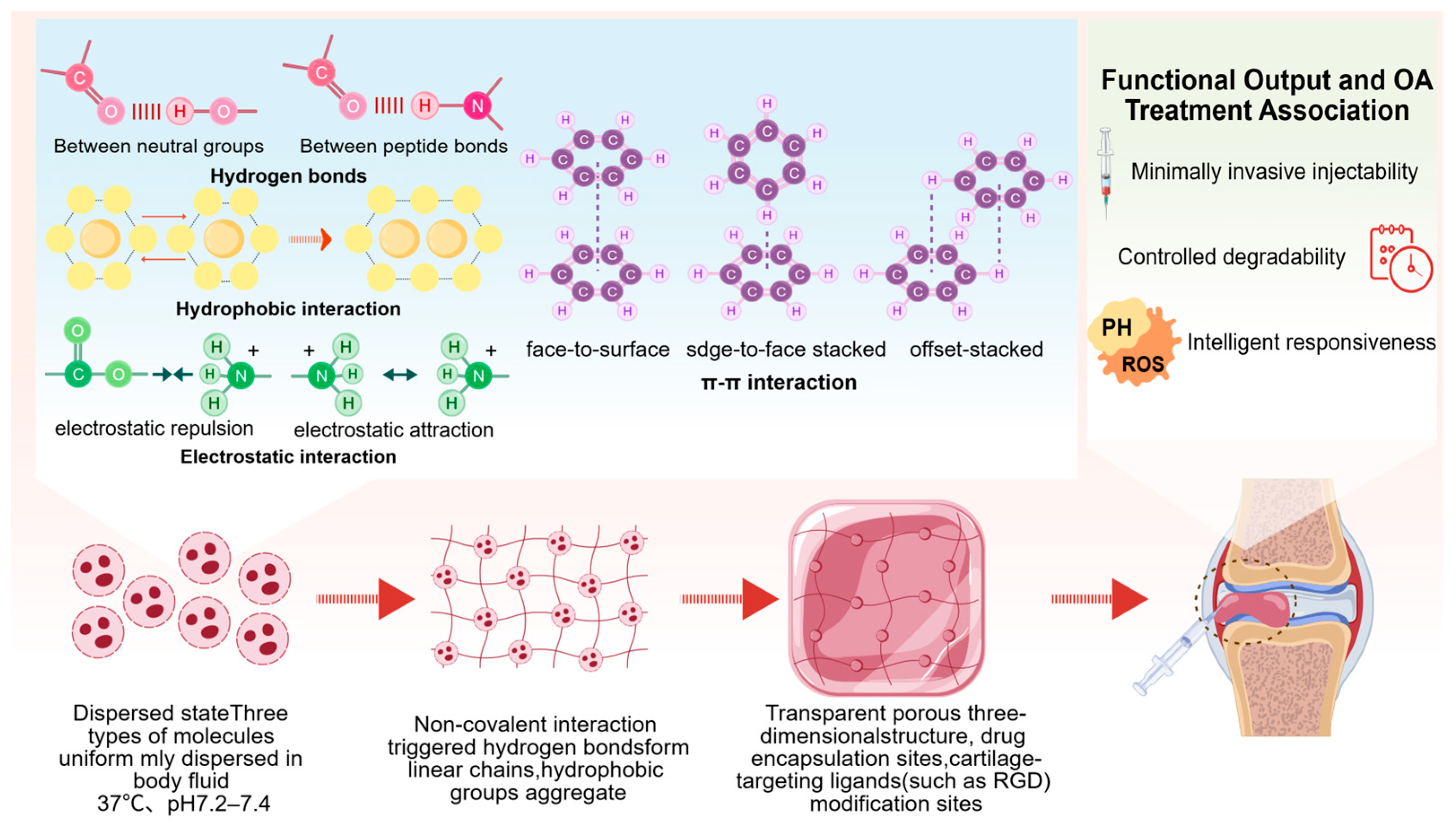
- Intermolecular interactions: Under physiological conditions (37 °C, pH 7.2–7.4), the material molecules undergo self-assembly from a dispersed state into linear chains via non-covalent interactions, including hydrogen bonding, hydrophobic interactions, electrostatic forces, and π-π stacking. These chains then further aggregate to form a stable network.
- Three-dimensional hydrogel formation: The aggregated linear chains construct a transparent, porous three-dimensional hydrogel scaffold, which is equipped with drug encapsulation sites and modification sites for cartilage-targeting ligands (e.g., RGD motifs).
- Functional output and OA therapeutic relevance: The hydrogel exhibits minimally invasive injectability, controlled degradability, and intelligent responsiveness to pH and reactive oxygen species (ROS). It can be delivered intra-articularly via injection, enabling targeted therapeutic applications for OA.

| Material Type | Self-Assembly Driving Force | Drug Type | Animal Experiment Effect | Data Source |
|---|---|---|---|---|
| Chitosan-adipic dihydrazide-hyaluronic acid aldehyde composite hydrogel | Hydrogen bonding, electrostatic interaction | Diclofenac sodium | In rat OA model, the concentrations of TNF-α and IL-1β in synovial fluid decreased by 58.3% and 62.1%, respectively, the histological score of cartilage decreased from 6.8 to 3.1, and the drug retention time was extended to 28 days | [62] |
| Peptide-hyaluronic acid composite hydrogel | Hydrophobic interaction, hydrogen bonding | Transforming growth factor-β1 (TGF-β1) | In rabbit OA model, the expression of type II collagen in cartilage defect area increased by 73.2%, the content of aggrecan increased by 68.5%, and the cartilage repair rate reached 52.3% at 4 weeks | [63] |
| Polycaprolactone-polyethylene glycol block copolymer hydrogel | Hydrophobic interaction, temperature-sensitive self-assembly | Dexamethasone | In mouse OA model, the area of synovial inflammatory infiltration decreased by 45.7%, the joint weight-bearing ratio increased from 32% to 65%, and the therapeutic effect lasted for more than 8 weeks | [64] |
| Alginate-dopamine-regenerated silk fibroin composite hydrogel | Hydrogen bonding, hydrophobic interaction | Mesenchymal stem cell (MSC)-derived exosomes | In rat OA model, the proportion of M2 macrophages increased by 50.2%, the expression of IL-10 increased by 45.3%, and the cartilage defect repair area reached 68.4% at 8 weeks | [65] |
| Benzoboroxole-functionalized polymer hydrogel | π-π stacking, hydrophobic interaction | Triamcinolone acetonide | In rat OA model, the cumulative drug release rate reached 78.5% under ROS stimulation in the joint within 7 days, the concentration of inflammatory factors decreased by 65.2%, and the degree of cartilage degeneration was significantly reduced | [66] |
| Carboxymethyl chitosan-polyethylene glycol composite hydrogel | Electrostatic interaction, hydrogen bonding | Diclofenac sodium | In rat OA model (pH 6.8 environment), the drug release rate was 2.5 times higher than that in normal pH environment, the pain score decreased by 60%, and the inhibition rate of cartilage matrix degradation reached 48% | [67] |
| Collagen-chitosan composite hydrogel | Hydrogen bonding, hydrophobic interaction | Chondroitin sulfate | In rabbit OA model, the viscosity of synovial fluid increased by 2 times, the activity of MMP-13 decreased by 52%, and the degree of cartilage wear was reduced by 50% at 8 weeks | [68] |
| Thioether-modified polyethylene glycol-polylactic acid block copolymer hydrogel | Hydrophobic interaction, ROS-sensitive self-assembly | Interleukin-1 receptor antagonist (IL-1Ra) | In mouse OA model, the concentrations of inflammatory factors IL-1β and IL-6 in the joint decreased by 63.7% and 58.9%, respectively, and the apoptosis rate of chondrocytes decreased by 42% | [69] |
| Chitosan-adipic dihydrazide-hyaluronic acid aldehyde composite hydrogel | Hydrogen bonding, electrostatic interaction | Diclofenac sodium | In rat OA model, the concentrations of TNF-α and IL-1β in synovial fluid decreased by 58.3% and 62.1%, respectively, the histological score of cartilage decreased from 6.8 to 3.1, and the drug retention time was extended to 28 days | [70] |
2.2. Key Properties of Self-Assembled Hydrogels Oriented to OA Treatment
2.3. Comparative Advantages of Self-Assembled Hydrogels over Traditional Hydrogels
3. Delivery Applications of Self-Assembled Hydrogels in OA Treatment
3.1. Intra-Articular Injectable Self-Assembled Hydrogels (Single-Drug Delivery)
3.2. Self-Assembled Hydrogel-Exosome Composite Synergistic Delivery Systems
3.3. Environment-Responsive Precise Delivery Systems of Self-Assembled Hydrogels
4. Clinical Translation Challenges and Optimization Directions of Self-Assembled Hydrogels
5. Conclusions
Author Contributions
Funding
Institutional Review Board Statement
Informed Consent Statement
Data Availability Statement
Conflicts of Interest
References
- Zheng, S.; An, S.; Luo, Y.; Vithran, D.T.A.; Yang, S.; Lu, B.; Deng, Z.; Li, Y. HYBID in osteoarthritis: Potential target for disease progression. Biomed. Pharmacother. 2023, 165, 115043. [Google Scholar] [CrossRef]
- Lepetsos, P.; Papavassiliou, K.A.; Papavassiliou, A.G. Redox and NF-κB signaling in osteoarthritis. Free Radic. Biol. Med. 2019, 132, 90–100. [Google Scholar] [CrossRef]
- Dong, Y.; Wang, P.; Yang, Y.; Huang, J.; Dai, Z.; Zheng, W.; Li, Z.; Yao, Z.; Zhang, H.; Zheng, J. PRMT5 inhibition attenuates cartilage degradation by reducing MAPK and NF-κB signaling. Arthritis Res. Ther. 2020, 22, 201. [Google Scholar] [CrossRef]
- Xi, Y.; Huang, X.; Tan, G.; Chu, X.; Zhang, R.; Ma, X.; Ni, B.; You, H. Protective effects of Erdosteine on interleukin-1β-stimulated inflammation via inhibiting the activation of MAPK, NF-κB, and Wnt/β-catenin signaling pathways in rat osteoarthritis. Eur. J. Pharmacol. 2020, 873, 172925. [Google Scholar] [CrossRef]
- Hu, L.; Luo, D.; Zhang, H.; He, L. Polydatin inhibits IL-1β-mediated chondrocyte inflammation and ameliorates cartilage degradation: Involvement of the NF-κB and Wnt/β-catenin pathways. Tissue Cell 2022, 78, 101865. [Google Scholar] [CrossRef] [PubMed]
- Wu, Y.; Shen, S.; Chen, J.; Ni, W.; Wang, Q.; Zhou, H.; Chen, J.; Zhang, H.; Mei, Z.; Sun, X.; et al. Metabolite asymmetric dimethylarginine (ADMA) functions as a destabilization enhancer of SOX9 mediated by DDAH1 in osteoarthritis. Sci. Adv. 2023, 9, eade5584. [Google Scholar] [CrossRef]
- Jiang, S.; Li, H.; Zhang, L.; Mu, W.; Zhang, Y.; Chen, T.; Wu, J.; Tang, H.; Zheng, S.; Liu, Y.; et al. Generic Diagramming Platform (GDP): A comprehensive database of high-quality biomedical graphics. Nucleic Acids Res. 2025, 53, D1670–D1676. [Google Scholar] [CrossRef]
- Wu, M.; Chen, Z.; Song, B.; Wang, X.; Liang, W. Current status and future perspectives of research on intra-articular drug delivery systems for osteoarthritis therapy. Acta Biomater. 2025, 203, 59–77. [Google Scholar] [CrossRef] [PubMed]
- Zheng, J.; Song, X.; Yang, Z.; Yin, C.; Luo, W.; Yin, C.; Ni, Y.; Wang, Y.; Zhang, Y. Self-assembly hydrogels of therapeutic agents for local drug delivery. J. Control. Release 2022, 350, 898–921. [Google Scholar] [CrossRef]
- Choi, S.; Jo, J.; Park, J.; Kim, S.; Jeong, S.; Jeong, S.Y.; Jung, S.H.; Choi, E.; Kim, H. Stimuli-responsive, methyl cellulose-based, interpenetrating network hydrogels: Non-covalent design, injectability, and controlled release. Carbohydr. Polym. 2025, 347, 122689. [Google Scholar] [CrossRef] [PubMed]
- Li, X.; Dai, B.; Guo, J.; Zheng, L.; Guo, Q.; Peng, J.; Xu, J.; Qin, L. Nanoparticle–Cartilage Interaction: Pathology-Based Intra-articular Drug Delivery for Osteoarthritis Therapy. Nano-Micro Lett. 2021, 13, 149. [Google Scholar] [CrossRef] [PubMed]
- Fan, H.; Zhao, J.; Gao, Z.; Mu, Y.; Zhang, X.; Pan, W.; Li, S.; He, H.; Gou, J.; Tang, X.; et al. Injectable self-healing hydrogel loaded PLGA nanoparticles for long-term osteoarthritis therapy. Biomater. Adv. 2026, 179, 214506. [Google Scholar] [CrossRef]
- Anil, A.; Jose, J. Self-assembled Hydrogels: An Overview. In Gels Horizons: From Science to Smart Materials; Springer: Singapore, 2021; pp. 247–261. [Google Scholar] [CrossRef]
- Simion, A.; Luca, A.; Cojocaru, F.-D.; Verestiuc, L.; Balan, V. Synthesis and Characterization of Self-assembled Hydrogels Based on Amphiphilic Derivates of Chitosan and Gelatin. In Proceedings of the 6th International Conference on Nanotechnologies and Biomedical Engineering, Chisinau, Moldova, 20–23 September 2023; pp. 407–416. [Google Scholar] [CrossRef]
- Shi, P.; He, X.; Cong, H.; Yu, B.; Shen, Y. Preparation and Properties of Self-Assembling Polypeptide Hydrogels and Their Application in Biomedicine. ACS Mater. Lett. 2024, 6, 1649–1677. [Google Scholar] [CrossRef]
- Kumi, M.; Ejeromedoghene, O.; Sudane, W.D.; Zhang, Z. Unlocking the biological response of smart Stimuli-Responsive hydrogels and their application in biological systems. Eur. Polym. J. 2024, 209, 112906. [Google Scholar] [CrossRef]
- de Siqueira, E.C.; de França, J.A.A.; de Souza, R.F.M.; Leoterio, D.M.d.S.; Cordeiro, J.N.; Doboszewski, B. Recent advances in the development of the physically crosslinked hydrogels and their biomedical applications. Res. Soc. Dev. 2023, 12, e18212843073. [Google Scholar] [CrossRef]
- Raeburn, J.; Cardoso, A.Z.; Adams, D.J. The importance of the self-assembly process to control mechanical properties of low molecular weight hydrogels. Chem. Soc. Rev. 2013, 42, 5143–5156. [Google Scholar] [CrossRef]
- Kumar, S.; Bajaj, A. Advances in self-assembled injectable hydrogels for cancer therapy. Biomater. Sci. 2020, 8, 2055–2073. [Google Scholar] [CrossRef]
- Wang, Z.; Yang, L. Natural-product-based, carrier-free, noncovalent nanoparticles for tumor chemo-photodynamic combination therapy. Pharmacol. Res. 2024, 203, 107150. [Google Scholar] [CrossRef]
- Hoque, M.; Alam, M.; Wang, S.; Zaman, J.U.; Rahman, M.S.; Johir, M.A.H.; Tian, L.; Choi, J.-G.; Ahmed, M.B.; Yoon, M.-H. Interaction chemistry of functional groups for natural biopolymer-based hydrogel design. Mater. Sci. Eng. R Rep. 2023, 156, 100758. [Google Scholar] [CrossRef]
- Yang, Y.; Wang, S.; Wang, Y.; Wang, X.; Wang, Q.; Chen, M. Advances in self-assembled chitosan nanomaterials for drug delivery. Biotechnol. Adv. 2014, 32, 1301–1316. [Google Scholar] [CrossRef]
- Shu, L.; Gong, Y.; Lin, M.; Sun, J.; Chen, X. Advanced coacervation-driven nanoscale polymeric assemblies for biomedical applications. Appl. Phys. Rev. 2024, 11, 021333. [Google Scholar] [CrossRef]
- Fu, K.; Wu, H.; Su, Z. Self-assembling peptide-based hydrogels: Fabrication, properties, and applications. Biotechnol. Adv. 2021, 49, 107752. [Google Scholar] [CrossRef]
- Zhao, Y.; Yang, W.; Chen, C.; Wang, J.; Zhang, L.; Xu, H. Rational design and self-assembly of short amphiphilic peptides and applications. Curr. Opin. Colloid Interface Sci. 2018, 35, 112–123. [Google Scholar] [CrossRef]
- Sinha, S.; Tripathi, A.K.; Pandey, A.; Naik, P.; Pandey, A.; Verma, V.S. Self-assembled PEGylated micelles for precise and targeted drug delivery: Current challenges and future directions. Biocatal. Agric. Biotechnol. 2024, 60, 103296. [Google Scholar] [CrossRef]
- Hou, Y.; Zou, L.; Li, Q.; Chen, M.; Ruan, H.; Sun, Z.; Xu, X.; Yang, J.; Ma, G. Supramolecular assemblies based on natural small molecules: Union would be effective. Mater. Today Bio 2022, 15, 100327. [Google Scholar] [CrossRef]
- Wang, Y.; Geng, Q.; Zhang, Y.; Adler-Abramovich, L.; Fan, X.; Mei, D.; Gazit, E.; Tao, K. Fmoc-diphenylalanine gelating nanoarchitectonics: A simplistic peptide self-assembly to meet complex applications. J. Colloid Interface Sci. 2023, 636, 113–133. [Google Scholar] [CrossRef] [PubMed]
- Zhuang, W.-R.; Wang, Y.; Cui, P.-F.; Xing, L.; Lee, J.; Kim, D.; Jiang, H.-L.; Oh, Y.-K. Applications of π-π stacking interactions in the design of drug-delivery systems. J. Control. Release 2019, 294, 311–326. [Google Scholar] [CrossRef] [PubMed]
- Liu, J.; Jia, B.; Li, Z.; Li, W. Reactive oxygen species-responsive polymer drug delivery systems. Front. Bioeng. Biotechnol. 2023, 11, 1115603. [Google Scholar] [CrossRef]
- Liu, S.; Wang, J.; Li, H.; Xu, C.; Guo, Y.; Bao, X.; Guan, S.; Liu, H.; Zhang, T. Nucleus-Targeting Carbon Quantum Dots Assembled with Gambogic Acid via π–π Stacking for Cancer Therapy. Adv. Ther. 2022, 6, 2200201. [Google Scholar] [CrossRef]
- Figueiredo, T.; Ogawa, Y.; Jing, J.; Cosenza, V.; Jeacomine, I.; Olsson, J.D.M.; Gerfaud, T.; Boiteau, J.-G.; Harris, C.; Auzély-Velty, R. Self-crosslinking smart hydrogels through direct complexation between benzoxaborole derivatives and diols from hyaluronic acid. Polym. Chem. 2020, 11, 3800–3811. [Google Scholar] [CrossRef]
- Thang, N.H.; Chien, T.B.; Cuong, D.X. Polymer-Based Hydrogels Applied in Drug Delivery: An Overview. Gels 2023, 9, 523. [Google Scholar] [CrossRef]
- El Sayed, M.M. Production of Polymer Hydrogel Composites and Their Applications. J. Polym. Environ. 2023, 31, 2855–2879. [Google Scholar] [CrossRef]
- Ahmad, Z.; Salman, S.; Khan, S.A.; Amin, A.; Rahman, Z.U.; Al-Ghamdi, Y.O.; Akhtar, K.; Bakhsh, E.M.; Khan, S.B. Versatility of Hydrogels: From Synthetic Strategies, Classification, and Properties to Biomedical Applications. Gels 2022, 8, 167. [Google Scholar] [CrossRef]
- Rodríguez-Rodríguez, R.; Espinosa-Andrews, H.; Velasquillo-Martínez, C.; García-Carvajal, Z.Y. Composite hydrogels based on gelatin, chitosan and polyvinyl alcohol to biomedical applications: A review. Int. J. Polym. Mater. Polym. Biomater. 2019, 69, 1–20. [Google Scholar] [CrossRef]
- Sarita, U.; Dayaram, P.M.; Rai, A.K.; Tewari, R.P.; Dutta, P.K. Synthesis and characterization of injectable chitosan, hyaluronic acid, and hydroxyapatite blend hydrogel aimed at bone tissue engineering application. Bull. Mater. Sci. 2024, 47, 246. [Google Scholar] [CrossRef]
- Wang, X.; Bai, Z.; Zheng, M.; Yue, O.; Hou, M.; Cui, B.; Su, R.; Wei, C.; Liu, X. Engineered gelatin-based conductive hydrogels for flexible wearable electronic devices: Fundamentals and recent advances. J. Sci. Adv. Mater. Devices 2022, 7, 100451. [Google Scholar] [CrossRef]
- Hu, X.; Zhang, Z.; Wu, H.; Yang, S.; Zhao, W.; Che, L.; Wang, Y.; Cao, J.; Li, K.; Qian, Z. Progress in the application of 3D-printed sodium alginate-based hydrogel scaffolds in bone tissue repair. Biomater. Adv. 2023, 152, 213501. [Google Scholar] [CrossRef]
- Martin, J.R.; Patil, P.; Yu, F.; Gupta, M.K.; Duvall, C.L. Enhanced stem cell retention and antioxidative protection with injectable, ROS-degradable PEG hydrogels. Biomaterials 2020, 263, 120377. [Google Scholar] [CrossRef] [PubMed]
- Ho, T.-C.; Chang, C.-C.; Chan, H.-P.; Chung, T.-W.; Shu, C.-W.; Chuang, K.-P.; Duh, T.-H.; Yang, M.-H.; Tyan, Y.-C. Hydrogels: Properties and Applications in Biomedicine. Molecules 2022, 27, 2902. [Google Scholar] [CrossRef] [PubMed]
- Kathyayani, D.; Mahesh, B.; Channe Gowda, D.; Sionkowska, A.; Veeranna, S. Investigation of miscibiliy and physicochemical properties of synthetic polypeptide with collagen blends and their wound healing characteristics. Int. J. Biol. Macromol. 2023, 246, 125704. [Google Scholar] [CrossRef]
- Selvaraj, S.; Dutta, V.; Gopalakrishnan, C.; Subbarayan, R.; Rana, G.; Radhakrishnan, A.; Elango, A.; Chauhan, A. Biomedical potential of hydrogels: A multifaceted approach to innovative medication delivery. Emergent Mater. 2024, 7, 721–763. [Google Scholar] [CrossRef]
- Wang, Y.; Zhao, X.; Zhou, X.; Dai, J.; Hu, X.; Piao, Y.; Zu, G.; Xiao, J.; Shi, K.; Liu, Y.; et al. A supramolecular hydrogel dressing with antibacterial, immunoregulation, and pro-regeneration ability for biofilm-associated wound healing. J. Control. Release 2024, 368, 740–755. [Google Scholar] [CrossRef]
- Chen, Y.; Chai, M.; Xuan, C.; Lin, J.; Yang, H.; Li, C.; Xie, M.; Ostrovidov, S.; Shi, X.; Mao, C. Tuning the properties of surgical polymeric materials for improved soft-tissue wound closure and healing. Prog. Mater. Sci. 2024, 143, 101249. [Google Scholar] [CrossRef]
- Mohite, P.; Rahayu, P.; Munde, S.; Ade, N.; Chidrawar, V.R.; Singh, S.; Jayeoye, T.J.; Prajapati, B.G.; Bhattacharya, S.; Patel, R.J. Chitosan-Based Hydrogel in the Management of Dermal Infections: A Review. Gels 2023, 9, 594. [Google Scholar] [CrossRef]
- Alavi, M.; Nokhodchi, A. Antimicrobial and wound healing activities of electrospun nanofibers based on functionalized carbohydrates and proteins. Cellulose 2022, 29, 1331–1347. [Google Scholar] [CrossRef]
- Wang, D.K.; Varanasi, S.; Hill, D.J.T.; Rasoul, F.; Symons, A.L.; Whittaker, A.K. The influence of composition on the physical properties of PLA-PEG-PLA-co-Boltorn based polyester hydrogels and their biological performance. J. Mater. Chem. 2012, 22, 6994–7004. [Google Scholar] [CrossRef]
- Basu, A.; Kunduru, K.R.; Doppalapudi, S.; Domb, A.J.; Khan, W. Poly(lactic acid) based hydrogels. Adv. Drug Deliv. Rev. 2016, 107, 192–205. [Google Scholar] [CrossRef]
- Peng, H.; Varanasi, S.; Wang, D.K.; Blakey, I.; Rasoul, F.; Symons, A.; Hill, D.J.T.; Whittaker, A.K. Synthesis, swelling, degradation and cytocompatibility of crosslinked PLLA-PEG-PLLA networks with short PLLA blocks. Eur. Polym. J. 2016, 84, 448–464. [Google Scholar] [CrossRef]
- Xu, F.; Zhang, J.; Zhang, P.; Luan, X.; Mai, Y. “Rod–coil” copolymers get self-assembled in solution. Mater. Chem. Front. 2019, 3, 2283–2307. [Google Scholar] [CrossRef]
- Jiang, C.P.; Huang, J.R.; Hsieh, M.F. Fabrication of synthesized PCL-PEG-PCL tissue engineering scaffolds using an air pressure-aided deposition system. Rapid Prototyp. J. 2011, 17, 288–297. [Google Scholar] [CrossRef]
- Bustamante-Torres, M.; Romero-Fierro, D.; Arcentales-Vera, B.; Palomino, K.; Magaña, H.; Bucio, E. Hydrogels Classification According to the Physical or Chemical Interactions and as Stimuli-Sensitive Materials. Gels 2021, 7, 182. [Google Scholar] [CrossRef] [PubMed]
- Maeda, T.; Kitagawa, M.; Hotta, A. Degradation of thermoresponsive laponite/PEG-b-PLGA nanocomposite hydrogels controlled by blending PEG-b-PLGA diblock copolymers with different PLGA molecular weights. Polym. Degrad. Stab. 2021, 187, 109535. [Google Scholar] [CrossRef]
- Liu, C.B.; Gong, C.Y.; Huang, M.J.; Wang, J.W.; Pan, Y.F.; Zhang, Y.D.; Li, G.Z.; Gou, M.L.; Wang, K.; Tu, M.J.; et al. Thermoreversible gel–sol behavior of biodegradable PCL-PEG-PCL triblock copolymer in aqueous solutions. J. Biomed. Mater. Res. Part B Appl. Biomater. 2007, 84, 165–175. [Google Scholar] [CrossRef] [PubMed]
- Patel, R.; Trivedi, R.; Raj, M.; Raj, L. A brief review of polymeric blends based on natural polymers and synthetic thermoplastics polymers. Chem. Pap. 2023, 78, 665–697. [Google Scholar] [CrossRef]
- Liang, J.; Dijkstra, P.J.; Poot, A.A.; Grijpma, D.W. Hybrid Hydrogels Based on Methacrylate-Functionalized Gelatin (GelMA) and Synthetic Polymers. Biomed. Mater. Devices 2022, 1, 191–201. [Google Scholar] [CrossRef]
- Egorov, A.R.; Kirichuk, A.A.; Rubanik, V.V.; Rubanik, V.V.; Tskhovrebov, A.G.; Kritchenkov, A.S. Chitosan and Its Derivatives: Preparation and Antibacterial Properties. Materials 2023, 16, 6076. [Google Scholar] [CrossRef]
- Frenț, O.D.; Vicaș, L.; Jurca, T.; Ciocan, S.; Duteanu, N.; Pallag, A.; Muresan, M.; Marian, E.; Negrea, A.; Micle, O. A Review: Uses of Chitosan in Pharmaceutical Forms. Rev. Physiol. Biochem. Pharmacol. 2021, 184, 121–157. [Google Scholar] [CrossRef]
- Hosseini, S.; Eslahi, N.; Jahanmardi, R. Self-healing nanocomposite hydrogels based on chitosan/ modified polyethylene glycol/graphene. Mater. Today Commun. 2023, 37, 107417. [Google Scholar] [CrossRef]
- Mohamed, K.R.; Beherei, H.H.; El-Rashidy, Z.M. In vitro study of nano-hydroxyapatite/chitosan–gelatin composites for bio-applications. J. Adv. Res. 2014, 5, 201–208. [Google Scholar] [CrossRef]
- Mou, D.; Yu, Q.; Zhang, J.; Zhou, J.; Li, X.; Zhuang, W.; Yang, X. Intra-articular Injection of Chitosan-Based Supramolecular Hydrogel for Osteoarthritis Treatment. Tissue Eng. Regen. Med. 2021, 18, 113–125. [Google Scholar] [CrossRef]
- Browne, S.; Jha, A.K.; Ameri, K.; Marcus, S.G.; Yeghiazarians, Y.; Healy, K.E. TGF-β1/CD105 signaling controls vascular network formation within growth factor sequestering hyaluronic acid hydrogels. PLoS ONE 2018, 13, e0194679. [Google Scholar] [CrossRef] [PubMed]
- Boffito, M.; Sirianni, P.; Di Rienzo, A.M.; Chiono, V. Thermosensitive block copolymer hydrogels based on poly(ɛ-caprolactone) and polyethylene glycol for biomedical applications: State of the art and future perspectives. J. Biomed. Mater. Res. Part A 2014, 103, 1276–1290. [Google Scholar] [CrossRef]
- Chen, S.; Liu, S.; Zhang, L.; Han, Q.; Liu, H.; Shen, J.; Li, G.; Zhang, L.; Yang, Y. Construction of injectable silk fibroin/polydopamine hydrogel for treatment of spinal cord injury. Chem. Eng. J. 2020, 399, 125795. [Google Scholar] [CrossRef]
- Chen, K.; Li, S.; Yuan, F.; Sun, P.; Zhang, Y. GEL-MAN Hydrogel Loaded with Triamcinolone Acetonide for the Treatment of Osteoarthritis. Front. Bioeng. Biotechnol. 2020, 8, 872. [Google Scholar] [CrossRef]
- Mohamed, R.R.; Seoudi, R.S.; Sabaa, M.W. Synthesis and Characterization of Cross-linked Polyethylene Glycol/Carboxymethyl Chitosan Hydrogels. Adv. Polym. Technol. 2014, 34, 21479. [Google Scholar] [CrossRef]
- Klara, J.; Marczak, A.; Łatkiewicz, A.; Horak, W.; Lewandowska-Łańcucka, J. Lysine-functionalized chondroitin sulfate improves the biological properties of collagen/chitosan-based injectable hydrogels. Int. J. Biol. Macromol. 2022, 202, 318–331. [Google Scholar] [CrossRef]
- Quek, J.Y.; Dabare, P.R.L.; Bright, R.; Postma, A.; Vasilev, K. RAFT synthesis of thioether-based, AB diblock copolymer nanocarriers for reactive oxygen species–triggered release. Mater. Today Chem. 2021, 20, 100444. [Google Scholar] [CrossRef]
- Nasiripour, S.; Pishbin, F.; Seyyed Ebrahimi, S.A. 3D Printing of a Self-Healing, Bioactive, and Dual-Cross-Linked Polysaccharide-Based Composite Hydrogel as a Scaffold for Bone Tissue Engineering. ACS Appl. Bio Mater. 2025, 8, 582–599. [Google Scholar] [CrossRef]
- Ren, P.; Li, J.; Zhao, L.; Wang, A.; Wang, M.; Li, J.; Jian, H.; Li, X.; Yan, X.; Bai, S. Dipeptide Self-assembled Hydrogels with Shear-Thinning and Instantaneous Self-healing Properties Determined by Peptide Sequences. ACS Appl. Mater. Interfaces 2020, 12, 21433–21440. [Google Scholar] [CrossRef]
- Javan Almasi, M.; Xiong, D. Recent Progress in Bionic Hydrogels for Articular Cartilage: Tribological and Mechanical Characteristics. J. Bionic Eng. 2024, 21, 653–673. [Google Scholar] [CrossRef]
- Maiz-Fernández, S.; Pérez-Álvarez, L.; Silván, U.; Vilas-Vilela, J.L.; Lanceros-Méndez, S. Dynamic and Self-Healable Chitosan/Hyaluronic Acid-Based In Situ-Forming Hydrogels. Gels 2022, 8, 477. [Google Scholar] [CrossRef] [PubMed]
- Clarke, D.E.; Pashuck, E.T.; Bertazzo, S.; Weaver, J.V.M.; Stevens, M.M. Self-Healing, Self-Assembled β-Sheet Peptide–Poly(γ-glutamic acid) Hybrid Hydrogels. J. Am. Chem. Soc. 2017, 139, 7250–7255. [Google Scholar] [CrossRef]
- Kumar, J.; Purwar, R. Biodegradable, biocompatible, and self-healing, injectable hydrogel based on oxidized Azadirachta indica gum and carboxymethyl chitosan through dynamic imine-linkage for biomedical application. Iran. Polym. J. 2024, 34, 465–483. [Google Scholar] [CrossRef]
- Atwal, A.; Dale, T.P.; Snow, M.; Forsyth, N.R.; Davoodi, P. Injectable hydrogels: An emerging therapeutic strategy for cartilage regeneration. Adv. Colloid Interface Sci. 2023, 321, 103030. [Google Scholar] [CrossRef]
- Sang, X.; Zhao, X.; Yan, L.; Jin, X.; Wang, X.; Wang, J.; Yin, Z.; Zhang, Y.; Meng, Z. Thermosensitive Hydrogel Loaded with Primary Chondrocyte-Derived Exosomes Promotes Cartilage Repair by Regulating Macrophage Polarization in Osteoarthritis. Tissue Eng. Regen. Med. 2022, 19, 629–642. [Google Scholar] [CrossRef] [PubMed]
- Ayaz, U.; Zaman, M.; Hameed, H.; Naeem, S.; Noor Khan, I.; Ahsan Waqar, M.; Niaz, S.; Ereej, N.; Salawi, A. DMARDS incorporated injectable hydrogels in cartilage tissue regeneration: A review. Polym. Plast. Technol. Mater. 2024, 63, 1843–1860. [Google Scholar] [CrossRef]
- Webber, M.J.; Pashuck, E.T. (Macro)molecular self-assembly for hydrogel drug delivery. Adv. Drug Deliv. Rev. 2021, 172, 275–295. [Google Scholar] [CrossRef]
- Yin, B.; Xu, J.; Lu, J.; Ou, C.; Zhang, K.; Gao, F.; Zhang, Y. Responsive Hydrogel-Based Drug Delivery Platform for Osteoarthritis Treatment. Gels 2024, 10, 696. [Google Scholar] [CrossRef]
- Zhu, W.; Wang, H.; Feng, B.; Liu, G.; Bian, Y.; Zhao, T.; Wang, Q.; Weng, X. Self-Healing Hyaluronic Acid-based Hydrogel with miRNA140-5p Loaded MON-PEI Nanoparticles for Chondrocyte Regeneration: Schiff Base Self-Assembly Approach. Adv. Sci. 2024, 12, e2406479. [Google Scholar] [CrossRef]
- Lei, Y.; Wang, X.; Liao, J.; Shen, J.; Li, Y.; Cai, Z.; Hu, N.; Luo, X.; Cui, W.; Huang, W. Shear-responsive boundary-lubricated hydrogels attenuate osteoarthritis. Bioact. Mater. 2022, 16, 472–484. [Google Scholar] [CrossRef]
- Zhang, Z.; Wei, X.; Gao, J.; Zhao, Y.; Zhao, Y.; Guo, L.; Chen, C.; Duan, Z.; Li, P.; Wei, L. Intra-Articular Injection of Cross-Linked Hyaluronic Acid-Dexamethasone Hydrogel Attenuates Osteoarthritis: An Experimental Study in a Rat Model of Osteoarthritis. Int. J. Mol. Sci. 2016, 17, 411. [Google Scholar] [CrossRef]
- Zheng, J.; Fan, R.; Wu, H.; Yao, H.; Yan, Y.; Liu, J.; Ran, L.; Sun, Z.; Yi, L.; Dang, L.; et al. Directed self-assembly of herbal small molecules into sustained release hydrogels for treating neural inflammation. Nat. Commun. 2019, 10, 1604, Correction in Nat. Commun. 2020, 11, 3815. [Google Scholar] [CrossRef]
- Gadziński, P.; Froelich, A.; Jadach, B.; Wojtyłko, M.; Tatarek, A.; Białek, A.; Krysztofiak, J.; Gackowski, M.; Otto, F.; Osmałek, T. Ionotropic Gelation and Chemical Crosslinking as Methods for Fabrication of Modified-Release Gellan Gum-Based Drug Delivery Systems. Pharmaceutics 2022, 15, 108. [Google Scholar] [CrossRef] [PubMed]
- Loebel, C.; Rodell, C.B.; Chen, M.H.; Burdick, J.A. Shear-thinning and self-healing hydrogels as injectable therapeutics and for 3D-printing. Nat. Protoc. 2017, 12, 1521–1541. [Google Scholar] [CrossRef] [PubMed]
- Kamedani, M.; Okawa, M.; Madhavikutty, A.S.; Tsai, C.-C.; Singh Chandel, A.K.; Fujiyabu, T.; Inagaki, N.F.; Ito, T. Injectable Extracellular Matrix-Inspired Hemostatic Hydrogel Composed of Hyaluronan and Gelatin with Shear-Thinning and Self-Healing. Biomacromolecules 2024, 25, 1790–1799. [Google Scholar] [CrossRef]
- Qiu, H.; Deng, J.; Wei, R.; Wu, X.; Chen, S.; Yang, Y.; Gong, C.; Cui, L.; Si, Z.; Zhu, Y.; et al. A lubricant and adhesive hydrogel cross-linked from hyaluronic acid and chitosan for articular cartilage regeneration. Int. J. Biol. Macromol. 2023, 243, 125249. [Google Scholar] [CrossRef]
- Soni, S.S.; D’Elia, A.M.; Alsasa, A.; Cho, S.; Tylek, T.; O’Brien, E.M.; Whitaker, R.; Spiller, K.L.; Rodell, C.B. Sustained release of drug-loaded nanoparticles from injectable hydrogels enables long-term control of macrophage phenotype. Biomater. Sci. 2022, 10, 6951–6967. [Google Scholar] [CrossRef]
- Pérez, L.A.; Hernández, R.; Alonso, J.M.; Pérez-González, R.; Sáez-Martínez, V. Hyaluronic Acid Hydrogels Crosslinked in Physiological Conditions: Synthesis and Biomedical Applications. Biomedicines 2021, 9, 1113. [Google Scholar] [CrossRef] [PubMed]
- Wu, M.; Han, L.; Yan, B.; Zeng, H. Self-healing hydrogels based on reversible noncovalent and dynamic covalent interactions: A short review. Supramol. Mater. 2023, 2, 100045. [Google Scholar] [CrossRef]
- Maiz-Fernández, S.; Guaresti, O.; Pérez-Álvarez, L.; Ruiz-Rubio, L.; Gabilondo, N.; Vilas-Vilela, J.L.; Lanceros-Mendez, S. β-Glycerol phosphate/genipin chitosan hydrogels: A comparative study of their properties and diclofenac delivery. Carbohydr. Polym. 2020, 248, 116811. [Google Scholar] [CrossRef]
- Wang, J.; Sun, Y.; Liu, X.; Kang, Y.; Cao, W.; Ye, J.; Gao, C. An antibacterial and anti-oxidant hydrogel containing hyperbranched poly-l-lysine and tea polyphenols accelerates healing of infected wound. Biomater. Adv. 2024, 157, 213755. [Google Scholar] [CrossRef]
- Luo, Y.; Tan, J.; Zhou, Y.; Guo, Y.; Liao, X.; He, L.; Li, D.; Li, X.; Liu, Y. From crosslinking strategies to biomedical applications of hyaluronic acid-based hydrogels: A review. Int. J. Biol. Macromol. 2023, 231, 123308. [Google Scholar] [CrossRef]
- Mohamed, A.L.; Elmotasem, H.; Salama, A.A.A. Colchicine mesoporous silica nanoparticles/hydrogel composite loaded cotton patches as a new encapsulator system for transdermal osteoarthritis management. Int. J. Biol. Macromol. 2020, 164, 1149–1163. [Google Scholar] [CrossRef]
- Ha, W.; Wang, Z.H.; Zhao, X.B.; Shi, Y.P. Reinforced Supramolecular Hydrogels from Attapulgite and Cyclodextrin Pseudopolyrotaxane for Sustained Intra-Articular Drug Delivery. Macromol. Biosci. 2020, 21, e2000299. [Google Scholar] [CrossRef] [PubMed]
- García-Fernández, L.; Olmeda-Lozano, M.; Benito-Garzón, L.; Pérez-Caballer, A.; San Román, J.; Vázquez-Lasa, B. Injectable hydrogel-based drug delivery system for cartilage regeneration. Mater. Sci. Eng. C 2020, 110, 110702. [Google Scholar] [CrossRef] [PubMed]
- Wang, T.; Huang, C.; Fang, Z.; Bahatibieke, A.; Fan, D.; Wang, X.; Zhao, H.; Xie, Y.; Qiao, K.; Xiao, C.; et al. A dual dynamically cross-linked hydrogel promotes rheumatoid arthritis repair through ROS initiative regulation and microenvironment modulation-independent triptolide release. Mater. Today Bio 2024, 26, 101042. [Google Scholar] [CrossRef]
- Zhang, Y.; Wang, X.; Chen, J.; Qian, D.; Gao, P.; Qin, T.; Jiang, T.; Yi, J.; Xu, T.; Huang, Y.; et al. Exosomes derived from platelet-rich plasma administration in site mediate cartilage protection in subtalar osteoarthritis. J. Nanobiotechnol. 2022, 20, 56. [Google Scholar] [CrossRef] [PubMed]
- Wang, Q.-S.; Xu, B.-X.; Fan, K.-J.; Fan, Y.-S.; Teng, H.; Wang, T.-Y. Dexamethasone-loaded thermo-sensitive hydrogel attenuates osteoarthritis by protecting cartilage and providing effective pain relief. Ann. Transl. Med. 2021, 9, 1120. [Google Scholar] [CrossRef]
- Zhang, A.; Ma, Y.; Liu, Y.; Dong, S.; Torres, M.N.; Kim, B.Y.S.; Liu, C.; Sun, L.; Yuan, Y.; Jiang, W. Mannose Oligosaccharide-Conjugated In Situ Pore-Forming Injectable Hydrogels for Rheumatoid Arthritis Treatment by Reprogramming Macrophage Extracellular Vesicles. Small Methods 2025, 10, e2500605. [Google Scholar] [CrossRef]
- Geng, W.; Zhao, J.; Tao, B.; Yang, Y.; Duan, Q.; Gao, P.; He, T.; Liu, S.; Feng, Q.; Zhao, P.; et al. Regulation of rheumatoid arthritis microenvironment via a self-healing injectable hydrogel for improved inflammation elimination and bone repair. Bioact. Mater. 2024, 36, 287–300. [Google Scholar] [CrossRef]
- Yang, L.; Li, W.; Zhao, Y.; Wang, Y.; Shang, L. Stem cell recruitment polypeptide hydrogel microcarriers with exosome delivery for osteoarthritis treatment. J. Nanobiotechnol. 2024, 22, 512. [Google Scholar] [CrossRef]
- Xiang, H.; Zhang, C.; Xiong, Y.; Wang, Y.; Pu, C.; He, J.; Chen, L.; Jiang, K.; Zhao, W.; Yang, H.; et al. MMP13-responsive hydrogel microspheres for osteoarthritis treatment by precise delivery of celecoxib. Mater. Des. 2024, 241, 112966. [Google Scholar] [CrossRef]
- Deng, S.; Chen, X.; Cao, H.; Chen, M.; Shi, W.; Li, N.; Liang, J.; Fan, Y.; Wang, Q.; Zhang, X. Self-Assembled Bifunctional Exosomes Simplify Chondrocyte-Targeted Sustained-Release Systems in Decellularized Cartilage Microgels for Synergistic Osteoarthritis Therapy. Small 2025, 21, e03492. [Google Scholar] [CrossRef]
- Li, X.; Wang, L.; Wang, J.; Fan, H.; Pang, F.; He, W.; Jiang, C.; Jin, Y.; Shen, Y.; Wang, Y.; et al. Enhanced osteoarthritis treatment using an injectable pH-responsive and cartilage-targeted liposome-anchored kartogenin-incorporated methacrylated gelatin hydrogel microspheres. Int. J. Biol. Macromol. 2025, 313, 144198. [Google Scholar] [CrossRef]
- Edirisinghe, D.I.U.; Singh, A.; Seitz, M.P.; Esmaeili, A.J.; Orado, T.K.; Herrero, E.; Jankowski, J.; Kairuki, P.K.; Marshall, L.R.; Jain, E.; et al. A Peptide Hydrogel Responsive to Reactive Oxygen Species and pH for the Protection and Sustained Delivery of Insulin-like Growth Factor 1 in Osteoarthritis Treatment. ACS Appl. Bio Mater. 2025, 8, 5602–5612. [Google Scholar] [CrossRef] [PubMed]
- Wen, J.; Li, H.; Dai, H.; Hua, S.; Long, X.; Li, H.; Ivanovski, S.; Xu, C. Intra-articular nanoparticles based therapies for osteoarthritis and rheumatoid arthritis management. Mater. Today Bio 2023, 19, 100597. [Google Scholar] [CrossRef]
- García-Couce, J.; Tomás, M.; Fuentes, G.; Que, I.; Almirall, A.; Cruz, L.J. Chitosan/Pluronic F127 Thermosensitive Hydrogel as an Injectable Dexamethasone Delivery Carrier. Gels 2022, 8, 44. [Google Scholar] [CrossRef] [PubMed]
- Weber, P.; Asadikorayem, M.; Surman, F.; Zenobi-Wong, M. Zwitterionic polymer-dexamethasone conjugates penetrate and protect cartilage from inflammation. Mater. Today Bio 2024, 26, 101049. [Google Scholar] [CrossRef]
- Song, Y.; Yang, P.; Guo, W.; Lu, P.; Huang, C.; Cai, Z.; Jiang, X.; Yang, G.; Du, Y.; Zhao, F. Supramolecular Hydrogel Dexamethasone–Diclofenac for the Treatment of Rheumatoid Arthritis. Nanomaterials 2024, 14, 645. [Google Scholar] [CrossRef] [PubMed]
- Walvekar, P.; Lulinski, P.; Kumar, P.; Aminabhavi, T.M.; Choonara, Y.E. A review of hyaluronic acid-based therapeutics for the treatment and management of arthritis. Int. J. Biol. Macromol. 2024, 264, 130645. [Google Scholar] [CrossRef]
- Ho, M.J.; Kim, S.R.; Choi, Y.W.; Kang, M.J. Recent advances in intra-articular drug delivery systems to extend drug retention in joint. J. Pharm. Investig. 2018, 49, 9–15. [Google Scholar] [CrossRef]
- Seo, B.-B.; Kwon, Y.; Kim, J.; Hong, K.H.; Kim, S.-E.; Song, H.-R.; Kim, Y.-M.; Song, S.-C. Injectable polymeric nanoparticle hydrogel system for long-term anti-inflammatory effect to treat osteoarthritis. Bioact. Mater. 2022, 7, 14–25, Erratum in Bioact. Mater. 2024, 40, 275-279. [Google Scholar] [CrossRef]
- Kopesky, P.W.; Byun, S.; Vanderploeg, E.J.; Kisiday, J.D.; Frisbie, D.D.; Grodzinsky, A.J. Sustained delivery of bioactive TGF-β1 from self-assembling peptide hydrogels induces chondrogenesis of encapsulated bone marrow stromal cells. J. Biomed. Mater. Res. Part A 2013, 102, 1275–1285. [Google Scholar] [CrossRef]
- Yadav, D.; Malviya, R. Exploring potential of exosomes drug delivery system in the treatment of cancer: Advances and prospective. Med. Drug Discov. 2023, 20, 100163. [Google Scholar] [CrossRef]
- Deng, Y.; Li, Y.; Chu, Z.; Dai, C.; Ge, J. Exosomes from umbilical cord-derived mesenchymal stem cells combined with gelatin methacryloyl inhibit vein graft restenosis by enhancing endothelial functions. J. Nanobiotechnol. 2023, 21, 380. [Google Scholar] [CrossRef]
- Zhang, Y.; Yan, W.; Wu, L.; Yu, Z.; Quan, Y.; Xie, X. Different exosomes are loaded in hydrogels for the application in the field of tissue repair. Front. Bioeng. Biotechnol. 2025, 13, 1545636. [Google Scholar] [CrossRef]
- Wang, B.; Ren, Y.; Xiao, X.; Liu, X.; Wang, Y.; Wang, Y. An emerging MSC-exosome delivery strategy: Injectable temperature-sensitive hydrogels encapsulate exosomes for enhanced therapeutic efficacy. Drug Discov. Today 2026, 31, 104586. [Google Scholar] [CrossRef]
- Liang, R.; Li, Z.; Xu, Q.; Wang, S.; Chen, D.; Gui, P.; Chen, M.; Peng, W.; Su, J. Immunomodulatory exosomes loaded chitosan methacryloyl hydrogel combined with pro-chondrogenic microspheres for promoting articular cartilage regeneration. Mater. Des. 2025, 253, 113876. [Google Scholar] [CrossRef]
- Yerneni, S.S.; Lathwal, S.; Cuthbert, J.; Kapil, K.; Szczepaniak, G.; Jeong, J.; Das, S.R.; Campbell, P.G.; Matyjaszewski, K. Controlled Release of Exosomes Using Atom Transfer Radical Polymerization-Based Hydrogels. Biomacromolecules 2022, 23, 1713–1722. [Google Scholar] [CrossRef]
- Zhao, X.; Chen, X.; Deng, Y.; Wu, C.; Ruan, Z.; Li, C.; Chen, Y.; Bei, C.; Zhu, L.; Yu, H.; et al. A novel adhesive dual-sensitive hydrogel for sustained release of exosomes derived from M2 macrophages promotes repair of bone defects. Mater. Today Bio 2023, 23, 100840. [Google Scholar] [CrossRef] [PubMed]
- Pu, M.; Cao, H.; Zhang, H.; Wang, T.; Li, Y.; Xiao, S.; Gu, Z. ROS-responsive hydrogels: From design and additive manufacturing to biomedical applications. Mater. Horiz. 2024, 11, 3721–3746. [Google Scholar] [CrossRef]
- Bazban-Shotorbani, S.; Hasani-Sadrabadi, M.M.; Karkhaneh, A.; Serpooshan, V.; Jacob, K.I.; Moshaverinia, A.; Mahmoudi, M. Revisiting structure-property relationship of pH-responsive polymers for drug delivery applications. J. Control. Release 2017, 253, 46–63. [Google Scholar] [CrossRef] [PubMed]
- Duan, W.-L.; Zhang, L.-N.; Bohara, R.; Martin-Saldaña, S.; Yang, F.; Zhao, Y.-Y.; Xie, Y.; Bu, Y.-Z.; Pandit, A. Adhesive hydrogels in osteoarthritis: From design to application. Mil. Med. Res. 2023, 10, 4. [Google Scholar] [CrossRef] [PubMed]
- Guo, L.; Guan, Y.; Liu, P.; Gao, L.; Wang, Z.; Huang, S.; Peng, L.; Zhao, Z. Chitosan hydrogel, as a biological macromolecule-based drug delivery system for exosomes and microvesicles in regenerative medicine: A mini review. Cellulose 2022, 29, 1315–1330. [Google Scholar] [CrossRef]
- Lv, Z.; Hu, T.; Bian, Y.; Wang, G.; Wu, Z.; Li, H.; Liu, X.; Yang, S.; Tan, C.; Liang, R.; et al. A MgFe-LDH Nanosheet-Incorporated Smart Thermo-Responsive Hydrogel with Controllable Growth Factor Releasing Capability for Bone Regeneration. Adv. Mater. 2023, 35, e2206545. [Google Scholar] [CrossRef]
- Kimiz-Gebologlu, I.; Oncel, S.S. Exosomes: Large-scale production, isolation, drug loading efficiency, and biodistribution and uptake. J. Control. Release 2022, 347, 533–543. [Google Scholar] [CrossRef]
- Li, X.; Gong, J.P. Design principles for strong and tough hydrogels. Nat. Rev. Mater. 2024, 9, 380–398. [Google Scholar] [CrossRef]
- Mateen, R.; Hoare, T. Injectable, in situ gelling, cyclodextrin–dextran hydrogels for the partitioning-driven release of hydrophobic drugs. J. Mater. Chem. B 2014, 2, 5157. [Google Scholar] [CrossRef]
- Tanimoto, R.; Ebara, M.; Uto, K. Tunable enzymatically degradable hydrogels for controlled cargo release with dynamic mechanical properties. Soft Matter 2023, 19, 6224–6233. [Google Scholar] [CrossRef]
- Binaymotlagh, R.; Petrilli, D.; Chronopoulou, L.; Mandato, G.; Sciandra, F.; Brancaccio, A.; Colone, M.; Stringaro, A.; Giaccari, L.; Amato, F.; et al. Engineered GO-Based Hydrogels for Controlled Hyaluronic Acid Release in Knee Osteoarthritis Treatment. Polymers 2026, 18, 152. [Google Scholar] [CrossRef]
- Kwan, J.C.; Pillai, S.; Munguia-Lopez, J.G.; Kinsella, J.M.; Tran, S.D. Smart hydrogels for tissue engineering and regenerative medicine: How far have we come. Regen. Med. 2025, 20, 585–608. [Google Scholar] [CrossRef]
- van der Kraan, P.M. Collagenase-Induced Osteoarthritis in Mice. Methods Mol. Biol. 2023, 2598, 375–379. [Google Scholar] [CrossRef] [PubMed]
- Gouveia, K.; Kay, J.; Memon, M.; Simunovic, N.; Bedi, A.; Ayeni, O.R. Return to Sport After Surgical Management of Posterior Shoulder Instability: A Systematic Review and Meta-analysis. Am. J. Sports Med. 2022, 50, 845–857. [Google Scholar] [CrossRef]
- Ghasemzadeh, M.; Gozalzadeh, S.; Sirousazar, M.; Kheiri, F. Amoxicillin-loaded bionanocomposite hydrogels: Swelling, dehydration, and in vitro drug release kinetics and mechanism. J. Biomater. Sci. Polym. Ed. 2024, 35, 463–481. [Google Scholar] [CrossRef]
- Han, Y.; Yang, J.; Zhao, W.; Wang, H.; Sun, Y.; Chen, Y.; Luo, J.; Deng, L.; Xu, X.; Cui, W.; et al. Biomimetic injectable hydrogel microspheres with enhanced lubrication and controllable drug release for the treatment of osteoarthritis. Bioact. Mater. 2021, 6, 3596–3607. [Google Scholar] [CrossRef]
- Wu, P.; Shen, L.; Liu, H.F.; Zou, X.H.; Zhao, J.; Huang, Y.; Zhu, Y.F.; Li, Z.Y.; Xu, C.; Luo, L.H.; et al. The marriage of immunomodulatory, angiogenic, and osteogenic capabilities in a piezoelectric hydrogel tissue engineering scaffold for military medicine. Mil. Med. Res. 2023, 10, 35. [Google Scholar] [CrossRef] [PubMed]
- Paraš, S.; Trišić, D.; Mitrović Ajtić, O.; Prokić, B.; Drobne, D.; Živković, S.; Jokanović, V. Toxicological Profile of Nanostructured Bone Substitute Based on Hydroxyapatite and Poly(lactide-co-glycolide) after Subchronic Oral Exposure of Rats. Nanomaterials 2020, 10, 918. [Google Scholar] [CrossRef] [PubMed]
- Shi, Y.; Steenbergen, M.J.v.; Teunissen, E.A.; Novo, L.; Gradmann, S.; Baldus, M.; Nostrum, C.F.v.; Hennink, W.E. Novel Thermosensitive Polymeric Micelles for Hydrophobic Chemotherapeutic Drugs: Enhanced Stability and Loading Capacity by Π-Π Stacking. null 1970. Available online: https://www.semanticscholar.org/paper/Novel-Thermosensitive-Polymeric-Micelles-for-Drugs-Shi-Steenbergen/ea9dc6422c30423516db4ca830faa931d531e156 (accessed on 8 February 2026).
- Yin, B.; Fan, Y.; Li, J.; Li, C.; Jiang, S.; Li, X.; Yan, C.; Jiang, J.; Wang, P.; Jia, C. ROS-triggered hydrophilicity switching synergizes with pH-responsive nanocarriers for therapy of diabetic wound. Regen. Biomater. 2025, 12, rbaf098. [Google Scholar] [CrossRef]
- Ono, A.; Yoshizawa, T.; Matsumoto, K. Evaluation of Necessity of 1-year Toxicity Study in Dogs—Development of the New Tiered Approach for Toxicity Studies of Pesticide Considering Species Difference in “toxicity profile” and “toxicity dose-response”. Food Saf. 2018, 6, 109–117. [Google Scholar] [CrossRef]
- Kang, B.-C.; Kang, K.-S.; Lee, Y.-S. Biocompatibility and Long-Term Toxicity of InnoPol Implant, a Biodegradable Polymer Scaffold. Exp. Anim. 2005, 54, 37–52. [Google Scholar] [CrossRef]
- Dou, Y.; Wang, B.; Jin, M.; Yu, Y.; Zhou, G.; Shui, L. A review on self-assembly in microfluidic devices. J. Micromech. Microeng. 2017, 27, 113002. [Google Scholar] [CrossRef]
- Tsui, J.H.; Lee, W.; Pun, S.H.; Kim, J.; Kim, D.-H. Microfluidics-assisted in vitro drug screening and carrier production. Adv. Drug Deliv. Rev. 2013, 65, 1575–1588. [Google Scholar] [CrossRef] [PubMed]
- Wang, Q.; Zhang, Y.; Ma, Y.; Wang, M.; Pan, G. Nano-crosslinked dynamic hydrogels for biomedical applications. Mater. Today Bio 2023, 20, 100640. [Google Scholar] [CrossRef]
- Chen, Q.; Jin, Y.; Chen, T.; Zhou, H.; Wang, X.; Wu, O.; Chen, L.; Zhang, Z.; Guo, Z.; Sun, J.; et al. Injectable nanocomposite hydrogels with enhanced lubrication and antioxidant properties for the treatment of osteoarthritis. Mater. Today Bio 2024, 25, 100993. [Google Scholar] [CrossRef]
- Jacob, P.L.; Brugnoli, B.; Del Giudice, A.; Phan, H.; Chauhan, V.M.; Beckett, L.; Gillis, R.B.; Moloney, C.; Cavanagh, R.J.; Krumins, E.; et al. Poly (diglycerol adipate) variants as enhanced nanocarrier replacements in drug delivery applications. J. Colloid Interface Sci. 2023, 641, 1043–1057. [Google Scholar] [CrossRef]
- Dubashynskaya, N.V.; Golovkin, A.S.; Kudryavtsev, I.V.; Prikhodko, S.S.; Trulioff, A.S.; Bokatyi, A.N.; Poshina, D.N.; Raik, S.V.; Skorik, Y.A. Mucoadhesive cholesterol-chitosan self-assembled particles for topical ocular delivery of dexamethasone. Int. J. Biol. Macromol. 2020, 158, 811–818. [Google Scholar] [CrossRef]
- Rana, P.; Hollingshead, B.; Mangipudy, R. Rethinking the necessity of long-term toxicity studies for biotherapeutics using weight of evidence assessment. Regul. Toxicol. Pharmacol. 2024, 153, 105710. [Google Scholar] [CrossRef]
- Legonkova, O.A.; Sultanova, N.O.; Stafford, V.V.; Zavitaeva, A.A.; Kopitsyn, D.S.; Tolboeva, E.R.; Mahmydov, A.M.; Vinokurov, V.A.; Davydova, G.A.; Svishcheva, N.B.; et al. Long-Term Biodegradation of Polyacrylamide Gel Residues in Mammary Glands: Physico-Chemical Analysis, Chromatographic Detection, and Implications for Chronic Inflammation. Molecules 2024, 29, 3247. [Google Scholar] [CrossRef]
- Flühmann, B.; Ntai, I.; Borchard, G.; Simoens, S.; Mühlebach, S. Nanomedicines: The magic bullets reaching their target? Eur. J. Pharm. Sci. 2019, 128, 73–80. [Google Scholar] [CrossRef] [PubMed]
- Gao, P.; Li, Y. Adaptive two-stage seamless sequential design for clinical trials. J. Biopharm. Stat. 2024, 35, 565–587. [Google Scholar] [CrossRef] [PubMed]


| Comparison Dimension | Self-Assembled Hydrogels | Traditional Chemically Crosslinked Hydrogels | Advantage Differences |
|---|---|---|---|
| Formation Mechanism | Self-assembly mediated by non-covalent interactions, no chemical crosslinkers required [84] | Covalent bond linkage mediated by chemical crosslinkers [85] | No residual crosslinkers, reducing cytotoxicity by 60–80% |
| Injectability | Shear-thinning property, in situ gelation after minimally invasive injection (1–5 min) [86,87] | Mostly preformed hydrogels or requiring ex vivo crosslinking, poor injectability [88] | Simplified operation process, significantly improved patient tolerance |
| Drug Release Duration | Sustained drug release for 2–8 weeks (up to 28 days in some systems) [89] | Rapid drug release (usually completed within 1–2 weeks) [90] | Prolonged drug release cycle by 2–3 folds, reducing administration frequency |
| Mechanical Self-Healing Ability | Shear self-healing efficiency exceeding 80% (within 10 min) [91] | No mechanical self-healing ability, prone to structural damage under stress [92] | Better adaptation to the dynamic mechanical environment of joints, superior structural stability |
| Biocompatibility | Significantly reduced expression levels of inflammatory factors [93] | Prone to inducing local chronic inflammatory responses [94] | Reduced joint tissue irritation, lowering the risk of foreign body reactions |
| Serial Number | Delivery System Type | Representative Material/Combination | Loaded Drug/Active Ingredient | Result | Reference |
|---|---|---|---|---|---|
| 1 | Single-drug Targeted Delivery System | Mesoporous Silica Nanoparticles (MSNs)/Self-healing Hydrogel Composite Cotton Patches | Colchicine | Achieved efficient local anti-inflammatory and cartilage protective effects in an osteoarthritis model, with good skin biosafety. | [95] |
| 2 | Single-drug Targeted Delivery System | Adenosine Triphosphate (ATP)/α-Cyclodextrin Host-Guest Inclusion Complexes (PPRs) | Diclofenac Sodium (DS) | Preliminary in vivo treatment in a rat model of acute inflammation showed that ATP hybrid hydrogel has a sustained anti-inflammatory effect. | [96] |
| 3 | Single-drug Targeted Delivery System | Oxidized Dextran (Dex-ox), Gelatin, Hyaluronic Acid (HA) Composite System | Naproxen, Dexamethasone | The macroscopic severity of knee osteoarthritis treated with IHDDS was lower, and cartilage preservation was better. | [97] |
| 4 | Microenvironment-responsive Precision Delivery System | Sodium Alginate-3-Aminophenylboronic Acid (SA-PBA) Precursor (Sodium Alginate (SA), 3-Aminophenylboronic Acid (PBA)), Tea Polyphenols, Inorganic Composite Nanoparticles, Gluconolactone (GDL) | Triptolide (TPL) | Showed significant inflammation inhibition and optimal regeneration of articular cartilage in a rat model of rheumatoid arthritis (RA). | [98] |
| 5 | Exosome Composite Synergistic Delivery System | Poloxamer 407/188 Composite System | Platelet-Rich Plasma-Derived Exosomes (PRP-Exo) | Exo-Gel increased the retention of exosomes in local joints, inhibited chondrocyte apoptosis and hypertrophy, and delayed the development of subtalar osteoarthritis (STOA). | [99] |
| 6 | Exosome Composite Synergistic Delivery System, Microenvironment-responsive Precision Delivery System | Poloxamer F-127/Hyaluronic Acid (HA) Composite System | Primary Chondrocyte-Derived Exosomes | It can enhance chondrocyte functions related to cartilage repair. The sustained release of exosomes from the hydrogel can achieve long-term cartilage protective effects. | [77] |
| 7 | Microenvironment-responsive Precision Delivery System | Formaldehyde-Glycerol-Borax Composite System | Dexamethasone | In a mouse model of osteoarthritis induced by destabilization of the medial meniscus (DMM), the DLTH system effectively reduced OA-related bone destruction, improved synovitis symptoms, and delayed disease progression. | [100] |
| 8 | Exosome Composite Synergistic Delivery System | Mannose Oligosaccharide (MOS)-Modified Chondroitin Sulfate/Hyaluronic Acid Composite System | Macrophage Extracellular Vesicles (EVs) | The released extracellular vesicles (EVs) showed significant support for the formation and preservation of new cartilage. | [101] |
| 9 | Single-drug Targeted Delivery System | Thiol-Modified Hyaluronic Acid (HA-SH), NO Scavenging/H2S Releasing Copolymer (DNRS Copolymer) | Methotrexate (MTX) | The MTX-loaded hydrogel (MTX/DNRS gel) showed significant inflammation inhibition effect in a rat model of collagen-induced arthritis after intra-articular injection, effectively improving clinical symptoms; at the same time, it promoted bone erosion repair, restored the microenvironmental stability of the lesion site, and significantly enhanced MTX therapeutic efficacy. | [102] |
| 10 | Exosome Composite Synergistic Delivery System | Methacrylated Hyaluronic Acid (HAMA), Methacrylated Gelatin (GelMA), Photoinitiator (LAP) | Stem Cells and Their Derived Exosomes (Exo) | The exosomes released from the carrier particles further enhanced cartilage repair efficacy through synergistic effects. | [103] |
| 11 | Microenvironment-responsive Precision Delivery System | Methacrylated Hyaluronic Acid (HAMA), MMP13 Substrate Peptide (MMP13sp), Cationic Liposomes | Celecoxib | In a rat model of osteoarthritis induced by anterior cruciate ligament transection (ACL) combined with partial medial meniscectomy, the articular cartilage degradation process in the HAMA/MMP13sp/Lipo@Celecoxib treatment group was significantly improved. | [104] |
| 12 | Exosome Composite Synergistic Delivery System | Decellularized Cartilage Matrix (HECM) Microgels | Self-assembled Bifunctional Exosomes | The system prolonged the retention time of exosomes in vivo. It helps promote the repair of damaged cartilage. By regulating the PI3K/AKT signaling pathway, it slowed down the progression of osteoarthritis. | [105] |
| 13 | Microenvironment-responsive Precision Delivery System | Methacrylated Gelatin (GM) Hydrogel Microspheres, Novel Liposome WYRGRL-DOTAP-Lipo | Kartogenin (KGN) | In a mouse OA model, intra-articular injection of WDLKG significantly inhibited cartilage degradation and confirmed the sustained release of WDLKG. | [106] |
| 14 | Microenvironment-responsive Precision Delivery System | Short Peptide Hydrogel | Insulin-like Growth Factor 1 (IGF-1) | The constructed short peptide hydrogel has excellent physicochemical properties and biological functions, and can achieve dual functions of reactive oxygen species (ROS)-responsive drug delivery and ROS scavenging. | [107] |
| Clinical Translation Challenges | Specific Manifestations | Core Optimization Strategies | Expected Outcomes |
|---|---|---|---|
| Consistency in Large-Scale Production | Batch-to-batch fluctuations of key indicators (gelation time, mechanical strength, drug-loading efficiency) reaching 15–20% | Integrating microfluidic technology with automated control systems to precisely regulate key self-assembly parameters [144] | Batch coefficient of variation controlled within 5% [145] |
| Long-Term Stability in Joints | Dynamic mechanical shear-induced material structural fatigue, and synovial fluid dilution accelerating gel degradation | Incorporating hydroxyapatite nanoparticles to enhance mechanical strength; optimizing polymer block ratios [146] | Prolonged in vivo retention time of hydrogels to 4–8 weeks, matching OA treatment cycles [147] |
| Hydrophobic Drug-Loading Efficiency | Low loading efficiency (<70%) for hydrophobic drugs in some systems; drug-carrier compatibility interfering with self-assembly | Introducing amphiphilic structures via molecular design; adopting composite polymer carrier systems [148] | Hydrophobic drug-loading efficiency increased to over 85%, with significantly improved gel structural stability [149] |
| Insufficient Long-Term Safety Evaluation | Most existing studies are short-term animal experiments (4–12 weeks), lacking data on chronic biological reactions induced by long-term material retention | Conducting long-term animal retention experiments (6–12 months) to systematically evaluate material degradation behavior, metabolic pathways of degradation products, and potential toxicity [150] | Clarified biosafety of degradation products, reducing risks of chronic inflammation and immunogenicity [151] |
| Lack of Regulatory Standards | Absence of exclusive review guidelines for such novel delivery systems; ununified evaluation methods for key attributes (e.g., drug release kinetics, biosafety) [152] | Promoting industry-regulatory authority collaboration to develop dedicated quality analysis methods and evaluation standards; adopting a phased strategy for Phase I/II clinical trials [153] | Simplified product registration process, accelerating technical clinical translation |
Disclaimer/Publisher’s Note: The statements, opinions and data contained in all publications are solely those of the individual author(s) and contributor(s) and not of MDPI and/or the editor(s). MDPI and/or the editor(s) disclaim responsibility for any injury to people or property resulting from any ideas, methods, instructions or products referred to in the content. |
© 2026 by the authors. Licensee MDPI, Basel, Switzerland. This article is an open access article distributed under the terms and conditions of the Creative Commons Attribution (CC BY) license.
Share and Cite
Wen, H.; Gu, X.; Wen, K.; Qin, W.; Geng, Y.; Wang, M.; Yang, C.; Wang, Q.; Cui, N.; Liu, D. Self-Assembled Hydrogels: A Novel Drug Delivery System for Osteoarthritis. Curr. Issues Mol. Biol. 2026, 48, 211. https://doi.org/10.3390/cimb48020211
Wen H, Gu X, Wen K, Qin W, Geng Y, Wang M, Yang C, Wang Q, Cui N, Liu D. Self-Assembled Hydrogels: A Novel Drug Delivery System for Osteoarthritis. Current Issues in Molecular Biology. 2026; 48(2):211. https://doi.org/10.3390/cimb48020211
Chicago/Turabian StyleWen, Hongjuan, Xintong Gu, Kuo Wen, Weibo Qin, Yiwen Geng, Meilun Wang, Chaoya Yang, Qi Wang, Ning Cui, and Da Liu. 2026. "Self-Assembled Hydrogels: A Novel Drug Delivery System for Osteoarthritis" Current Issues in Molecular Biology 48, no. 2: 211. https://doi.org/10.3390/cimb48020211
APA StyleWen, H., Gu, X., Wen, K., Qin, W., Geng, Y., Wang, M., Yang, C., Wang, Q., Cui, N., & Liu, D. (2026). Self-Assembled Hydrogels: A Novel Drug Delivery System for Osteoarthritis. Current Issues in Molecular Biology, 48(2), 211. https://doi.org/10.3390/cimb48020211