This is an early access version, the complete PDF, HTML, and XML versions will be available soon.
Review

Angelica sinensis as a Multi-Targeted Natural Product Candidate: Constituent-Specific Mechanisms, Exposure Constraints, and Translational Development Challenges
1
State Key Laboratory of Integration and Innovation of Classic Formula and Modern Chinese Medicine, National Chinmedomics Research Center, Metabolomics Laboratory, Department of Pharmaceutical Analysis, Heilongjiang University of Chinese Medicine, Heping Road 24, Harbin 150040, China
2
State Key Laboratory of Quality Research in Chinese Medicine, Macau University of Science and Technology, Avenida Wai Long, Taipa, Macau, China
*
Authors to whom correspondence should be addressed.
Pharmaceuticals 2026, 19(7), 1073; https://doi.org/10.3390/ph19071073
Submission received: 25 May 2026 / Revised: 6 July 2026 / Accepted: 10 July 2026 / Published: 12 July 2026
(This article belongs to the Special Issue Multi-Targeted Natural Products as Therapeutics, 2nd Edition)

Abstract

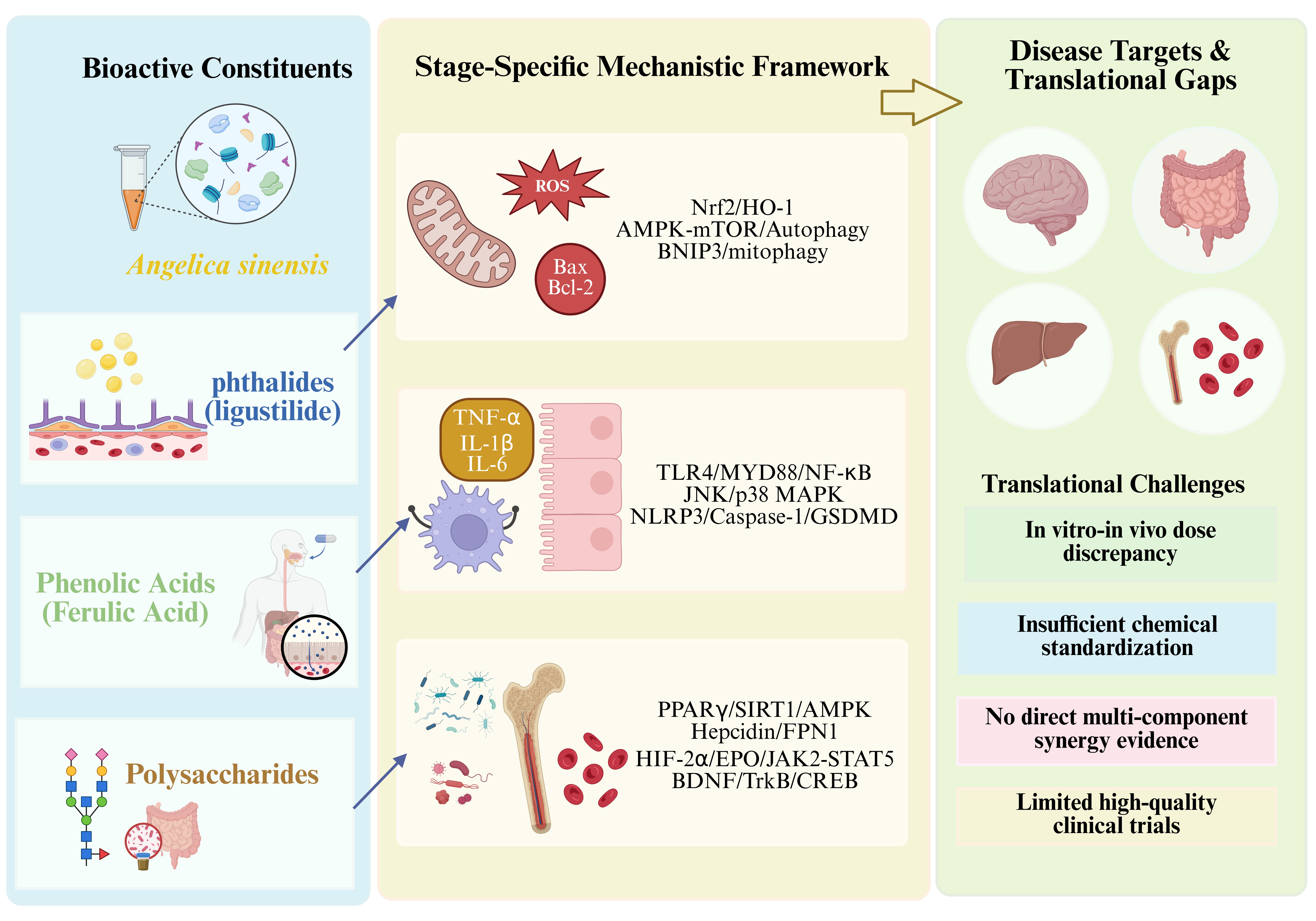
Angelica sinensis (Oliv.) Diels (A. sinensis), commonly known as Danggui, is a chemically complex medicinal plant widely used in East Asian medicine and reported to exert anti-inflammatory, antioxidant, immunomodulatory, hematopoietic, neuroprotective, vasoprotective, metabolic, and tissue-repair effects. This narrative translational review evaluates literature published up to May 2026 and reappraises A. sinensis through a constituent-specific and exposure-relevant framework, focusing on phthalides, ferulic acid-related phenolic acids, polysaccharides, and representative preparations. Phthalides are mainly associated with neurovascular protection, mitochondrial homeostasis, autophagy/mitophagy regulation, and anti-apoptotic responses, but their translational relevance is constrained by chemical instability and low oral exposure. Ferulic acid and related phenolic acids are more consistently linked to inflammatory attenuation, redox regulation, epithelial barrier protection, and metabolic stress responses; however, many in vitro studies use concentrations exceeding plausible free systemic exposure. Polysaccharides are most strongly associated with hematopoietic support, immune modulation, gut microbiota regulation, metabolic homeostasis, and microenvironmental remodeling, although structural heterogeneity limits cross-study comparability. Direct clinical evidence for single-herb A. sinensis remains limited, and most clinical signals derive from multi-herb formulas. Overall, this review highlights the importance of distinguishing constituent-specific mechanisms, exposure plausibility, and attribution directness when evaluating the translational potential of A. sinensis.
Keywords: Angelica sinensis; ligustilide; ferulic acid; polysaccharides; pharmacokinetics; translational pharmacology Angelica sinensis; ligustilide; ferulic acid; polysaccharides; pharmacokinetics; translational pharmacology
Graphical Abstract