This is an early access version, the complete PDF, HTML, and XML versions will be available soon.
Article

Cardioprotective and Antioxidant Effects of Marine-Derived Xestospongia testudinaria in an Isoprenaline-Induced Rat Model of Heart Failure

by
Rajasegar Anamalley
1,*,†,
Iman Nabilah Abd Rahim
2,*,†,
Siti Nurhannah Irdina Hasmar Honiz
1,
Stephenie Tamil Many
1,
Partiban Manoharan
1,
Satirah Zainalabidin
3,
Sasimalani Surgunnam
1,
Nurzafirah Mazlan
4,
Fikri Akmal Khodzori
4,
Muhammad Dawood Shah
4 and
Rahayu Zulkapli
5,6
1
Faculty of Health and Life Sciences, Management and Science University, Shah Alam 40100, Selangor, Malaysia
2
Iman NaturePro, Bandar Indera Mahkota, Kuantan 25200, Pahang, Malaysia
3
Centre of Toxicology and Health Risk Study (CORE), Universiti Kebangsaan Malaysia, Kuala Lumpur 50300, Federal Territory of Kuala Lumpur, Malaysia
4
Borneo Marine Research Institute, Universiti Malaysia Sabah, Kota Kinabalu 88400, Sabah, Malaysia
5
Faculty of Dentistry, Universiti Teknologi MARA, Sungai Buloh 47000, Selangor, Malaysia
6
Cardiovascular Advancement and Research Excellence Institute (CARE Institute), Universiti Teknologi MARA, Sungai Buloh 47000, Selangor, Malaysia
*
Authors to whom correspondence should be addressed.
These authors contributed equally to this work.
Pharmaceuticals 2026, 19(7), 1030; https://doi.org/10.3390/ph19071030
Submission received: 18 May 2026 / Revised: 22 June 2026 / Accepted: 23 June 2026 / Published: 30 June 2026

Abstract

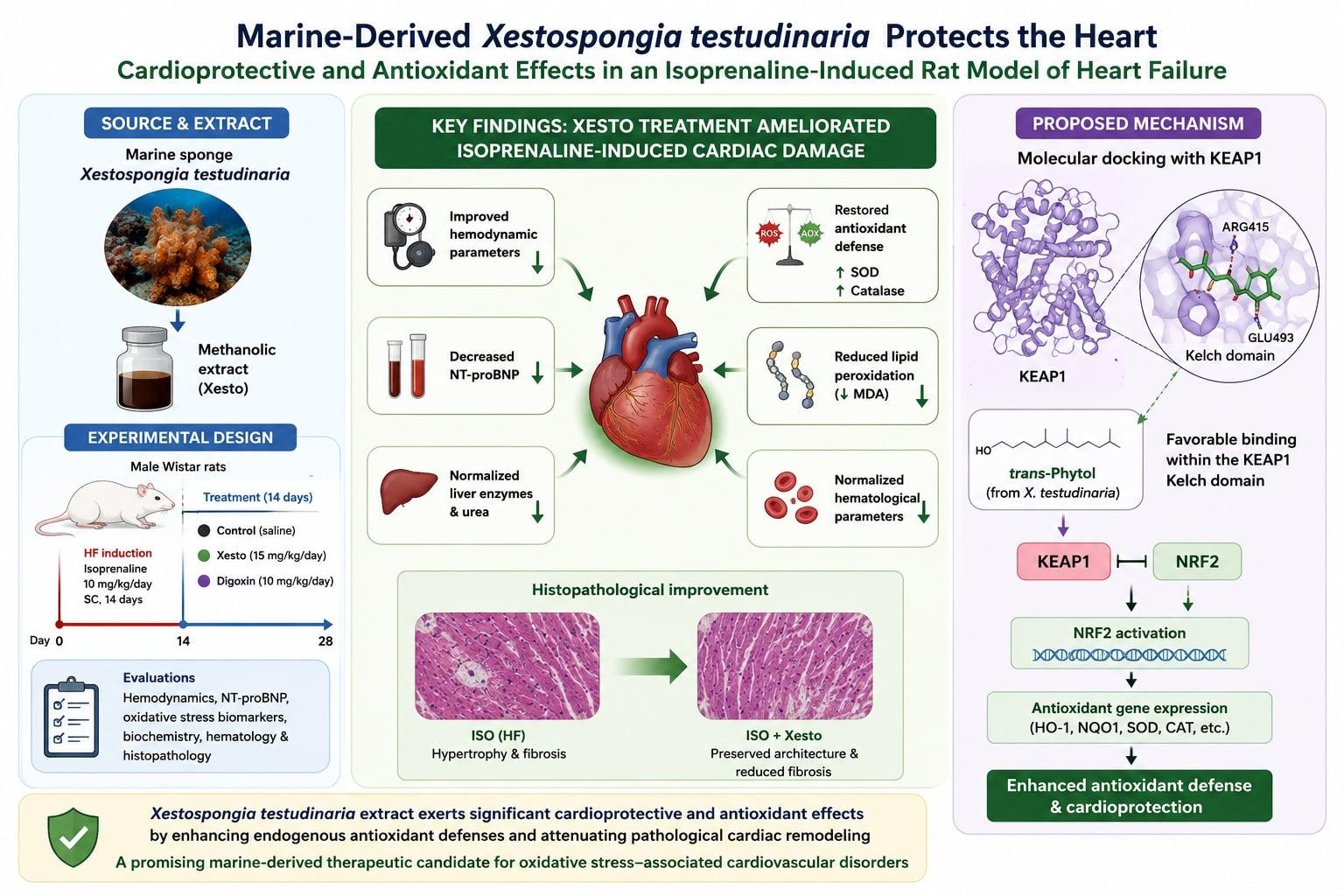
Background: Oxidative stress and maladaptive cardiac remodeling are key contributors to heart failure progression. Xestospongia testudinaria, a marine sponge rich in bioactive compounds, possesses antioxidant and lipid-modulating properties. This study investigated the cardioprotective and antioxidant effects of Xestospongia testudinaria methanolic extract (Xesto) in an isoprenaline-induced rat model of heart failure. Methods: Thirty-five healthy male Wistar rats weighing 200–250 g were used in this study. Heart failure was induced in rats via subcutaneous administration of isoprenaline (10 mg/kg/day) for 14 days. Rats were subsequently treated with Xesto (15 mg/kg/day, oral gavage), digoxin (10 mg/kg/day), or saline for an additional 14 days. Hemodynamic parameters, serum NT-proBNP, oxidative stress biomarkers, biochemical indices, hematological parameters, and histopathological changes were evaluated. Molecular docking was performed to assess the interaction of Xesto constituents with Kelch-like ECH-associated protein 1 (KEAP1). Results: Isoprenaline administration significantly increased blood pressure, NT-proBNP, malondialdehyde, hepatic enzymes, and urea levels, while reducing superoxide dismutase and catalase activities. Xesto treatment significantly improved hemodynamic parameters, restored antioxidant enzyme activities, reduced lipid peroxidation, and normalized biochemical and hematological alterations. Histological analysis demonstrated reduced cardiomyocyte hypertrophy and collagen deposition in Xesto-treated rats. Docking analysis showed favorable binding of trans-phytol within the KEAP1 Kelch domain, suggesting possible modulation of antioxidant regulatory pathways. Conclusions: Xestospongia testudinaria exhibited significant cardioprotective and antioxidant effects in isoprenaline-induced heart failure, potentially through enhancement of endogenous antioxidant defenses and attenuation of pathological cardiac remodeling. These findings support its potential as a marine-derived therapeutic candidate for oxidative stress-associated cardiovascular disorders.
Keywords: Xestospongia testudinaria; heart failure; oxidative stress; cardioprotection; isoprenaline; KEAP1; NRF2; marine natural products; antioxidant activity Xestospongia testudinaria; heart failure; oxidative stress; cardioprotection; isoprenaline; KEAP1; NRF2; marine natural products; antioxidant activity
Graphical Abstract