Article

Precipitation-Based Encapsulation of Fibrinogen in Calcium Carbonate for Non-Compressible Hemorrhage Control


1
Defence Research and Development Canada, Toronto Research Centre, Toronto, ON M3K 2C9, Canada
2
Defence Research and Development Canada, Suffield Research Centre, Medicine Hat, AB T1A 8K6, Canada
3
Versiti Blood Research Institute, Milwaukee, WI 53226, USA
4
Department of Surgery, Division of Trauma and Acute Care Surgery, Medical College of Wisconsin, Milwaukee, WI 53226, USA
5
Department of Biochemistry, Medical College of Wisconsin, Milwaukee, WI 53226, USA
6
Department of Biomedical Engineering, Medical College of Wisconsin, Milwaukee, WI 53226, USA
7
Department of Pharmacology and Toxicology, Medical College of Wisconsin, Milwaukee, WI 53226, USA
8
Michael Smith Laboratories, University of British Columbia, Vancouver, BC V6T 1Z4, Canada
9
St. Michael’s Hospital, University of Toronto, Toronto, ON M5B 1W8, Canada
10
Royal Canadian Medical Services, Ottawa, ON K1A 0K2, Canada
*
Author to whom correspondence should be addressed.
Pharmaceuticals 2026, 19(6), 923; https://doi.org/10.3390/ph19060923 (registering DOI)
Submission received: 22 April 2026 / Revised: 31 May 2026 / Accepted: 4 June 2026 / Published: 11 June 2026

Abstract

Background: Uncontrolled hemorrhage, especially at non-compressible sites, remains a major cause of preventable trauma deaths. This study reports the development of fibrinogen-loaded calcium carbonate (CaCO3) microparticles that combine hemostatic activity with self-propelling capability for targeted delivery against blood flow, with a focus on understanding formulation-dependent trade-offs among particle yield, protein loading, clotting performance, and transport behavior. Methods: Microparticles were synthesized via a precipitation method using different carbonate sources and characterized for yield, morphology, size, and fibrinogen encapsulation. Hemostatic function was assessed using rotational thromboelastometry (ROTEM) in fibrinogen-deficient plasma. Propulsion behavior was evaluated following exposure to protonated tranexamic acid (TXA+), which triggers CO2 generation. Particle size and encapsulation were examined by microscopy and fluorescence imaging. Results: The precipitation method produced spherical micrometer-sized particles, with fibrinogen inclusion reducing yield and particle size relative to unload controls. Fluorescence microscopy confirmed successful encapsulation. Encapsulation efficiency varied with formulation, with sodium carbonate-based particles showing higher relative fibrinogen loading. ROTEM analysis demonstrated that fibrinogen-loaded particles significantly improved clot formation, increasing maximum clot firmness compared to fibrinogen-free particles, although performance remained formulation-dependent. TXA+-triggered propulsion achieved maximum speeds up to 4.221 cm/s. Fibrinogen-loaded particles exhibited longer activation lag times than unloaded particles, indicating a trade-off between hemostatic functionality and propulsion kinetics. Conclusions: Fibrinogen-loaded CaCO3 microparticles exhibit both hemostatic activity and chemically triggered motion in vitro. The study identifies key formulation-dependent trade-offs between particle yield, fibrinogen loading, clotting performance, and propulsion behavior. While these findings support the feasibility of combining localization and clot stabilization mechanisms, further studies under physiologically relevant flow conditions and in vivo models are required to evaluate their potential for active delivery in non-compressible hemorrhage.

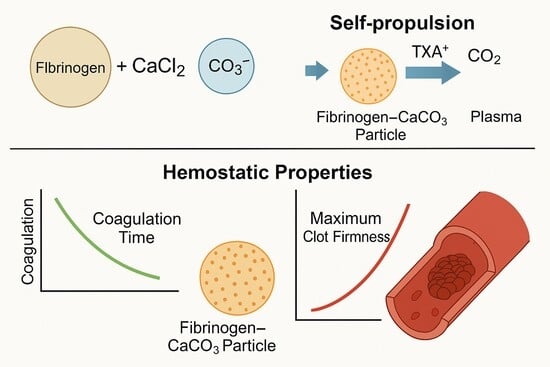
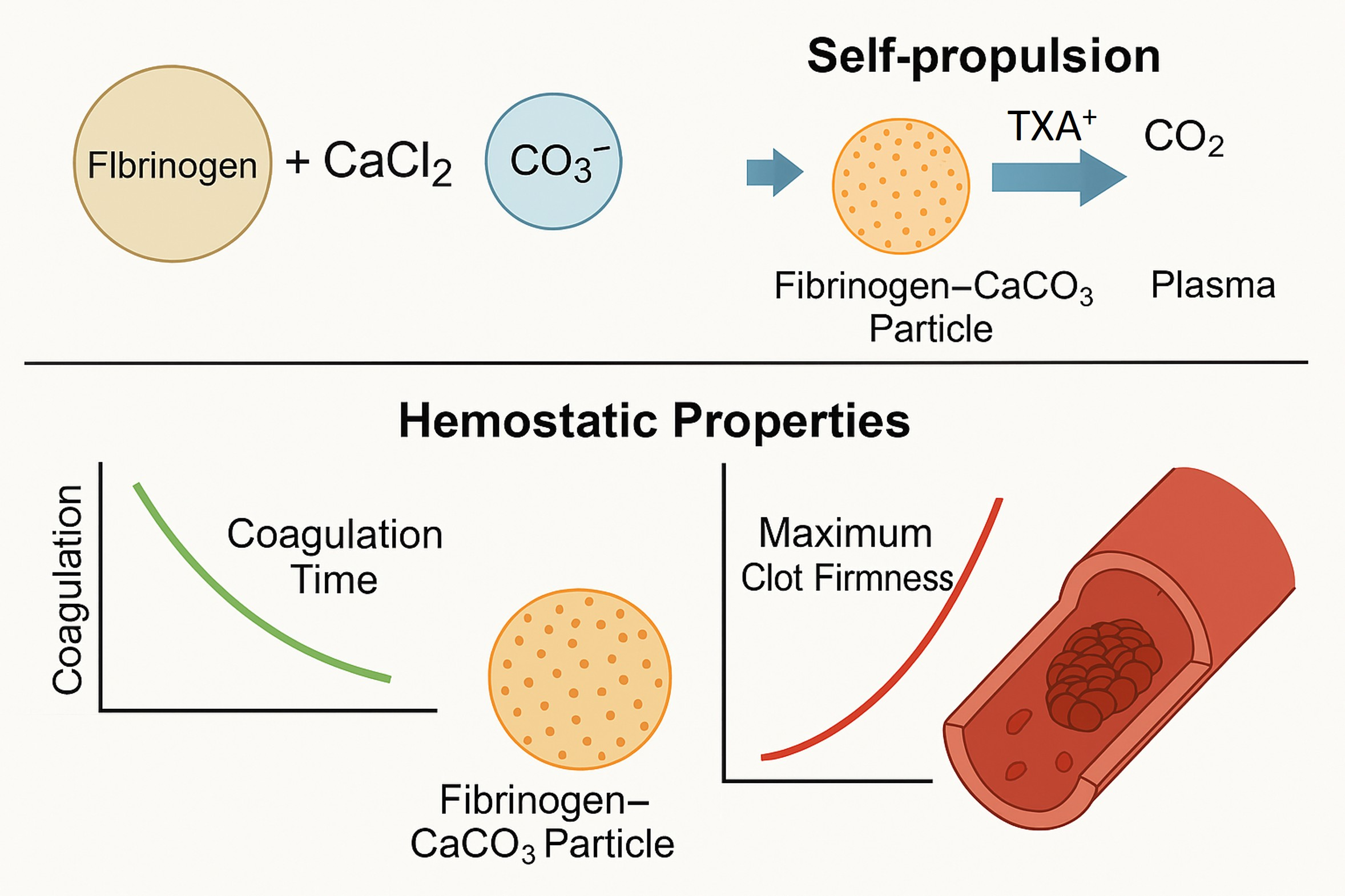
Graphical Abstract

1. Introduction

Uncontrolled hemorrhage, particularly from non-compressible internal bleeding, remains a leading cause of preventable death in both military and civilian trauma [1,2,3]. While conventional methods such as compression, hemostatic dressings, and tourniquets are effective for superficial, junctional or extremity bleeding [4,5], they are inadequate for non-compressible, deep, irregular, or high-flow bleeding, which accounts for over 60% of preventable trauma deaths [6].
Hemorrhage also poses significant risks in surgical contexts, particularly in cardiovascular and hepatic procedures, where uncontrolled bleeding can lead to prolonged operative times, infection, delayed healing, organ failure, and maternal mortality during childbirth [7]. Traditional hemostatic techniques such as electrocautery, suturing, and stapling are often ineffective in complex, deep, or irregular wounds and may exacerbate tissue damage.
Recent developments in topical and injectable hemostatic agents have focused on enhancing clot formation through a combination of biological and material-based mechanisms, including platelet activation, fibrin generation, and antifibrinolytic activity [8,9,10,11,12,13]. However, many current materials rely on passive diffusion or external application and are susceptible to displacement by blood flow. This limitation is particularly evident for particulate and powder-based systems, which, despite their high surface area and potential for minimally invasive delivery, may be washed away before effective clot formation occurs. Furthermore, incomplete retention at the injury site can reduce efficacy while increasing the risk of undesirable systemic distribution.
However, many current agents require manual pressure and are limited in their ability to reach deep or irregular bleeding sites. For example, field-deployed dressings like Combat Gauze and ChitoGauze rely on compression [14], while newer devices like XStat offer pressure-independent control but lack biodegradability and must be removed post-use [15]. Hemostatic powders, though promising for internal and irregular wounds due to their small size and high surface area [16,17], are often displaced by pressurized blood flow, limiting their efficacy [18,19]. Additionally, some powders pose embolization risks if they dissolve or disperse into circulation [20].
To overcome these limitations, self-propelling particles have been developed as a strategy to improve localization and retention of hemostatic agents [18]. These particles, composed of calcium carbonate (CaCO3), fibrinogen or thrombin, and protonated tranexamic acid (TXA+), generate CO2 gas upon contact with blood, propelling procoagulants into bleeding sites [21,22]. TXA+ enhances clot stability by inhibiting fibrinolysis [23], while calcium ions may further support coagulation and mitigate trauma-induced coagulopathy [24]. Studies have shown that dressings loaded with these particles outperform Combat Gauze in swine models of severe bleeding, even without manual pressure [25,26,27]. Furthermore, a self-propelling formulation consisting of CaCO3 particles and TXA+ demonstrated greater efficacy in inhibiting fibrinolysis and promoting hemostasis than a non-propelling formulation composed of CaCO3 and non-protonated TXA, as shown in in vitro fibrinolysis assays and in murine and swine models of hemorrhage [27].
Fibrinogen is a particularly attractive component for such systems due to its central role in clot formation and its early depletion during trauma [28]. We previously demonstrated the efficacy of CaCO3 particles loaded with fibrinogen [22]. However, simple mixing methods may result in incomplete loading and poor delivery to bleeding sites. To address this, we developed CaCO3-encapsulated fibrinogen particles using a water–oil–water emulsion method, which enabled encapsulation but involved complex processing and introduced limitations in scalability, reproducibility, and control over particle formation [29]. In contrast, precipitation-based synthesis offers a simpler and potentially more scalable approach; however, its ability to achieve efficient fibrinogen loading while preserving both hemostatic function and TXA+-driven propulsion remains unclear.
The key knowledge gap addressed in this study is therefore to define how precipitation-based encapsulation influences these coupled properties and to determine whether formulation parameters can be tuned to balance competing requirements. Rather than introducing a new hemostatic mechanism, the primary contribution of this work lies in establishing a synthetically simplified and tunable preparation method and providing systematic insight into formulation-dependent trade-offs between biological activity and transport behavior.
Specifically, we synthesize fibrinogen-loaded CaCO3 microparticles using a precipitation method and characterize their yields, morphology, particle size, fibrinogen content, hemostatic efficacy, and TXA+-triggered self-propulsion. By systematically varying key parameters—including carbonate source, concentration, reaction time, and mixing conditions—we evaluate their effects on particle yield, encapsulation efficiency, clotting performance, and propulsion characteristics. These results provide a framework for understanding the interplay between formulation and function and inform the rational design of multifunctional hemostatic materials with potential relevance for the management of severe bleeding, including non-compressible hemorrhage.

2. Results

A total of 27 formulations of CaCO3 particles, both unloaded and loaded with fibrinogen, were prepared under varying precipitation conditions. Results are presented in five subsections: (i) particle yield, (ii) particle morphology and size, (iii) gel electrophoresis and fibrinogen content, (iv) hemostatic properties, and (v) propulsion behavior.

2.1. Particle Yield

As shown in Table 1, particle yields varied substantially across formulations, ranging from 11% (Pre AC Fib2× 30 min) to 85% (Pre 2×SC 2×CaCl2 NoFib 30 min). The presence of fibrinogen consistently reduced particle yield across all carbonate sources, likely due to interference with CaCO3 crystallization. For example, SC-based particles at 0.33 M showed a yield reduction from approximately 80% to 40–60% (e.g., 82% for Pre SC NoFib 30 min vs. 54% for Pre SC FibCO3R 30 min; 78% for Pre SC NoFib 2×Spd 4 h vs. 47% for Pre SC FibCO3R 2×Spd 4 h). When both SC and CaCl2 solutions contained fibrinogen, yields dropped further to 37% and 36% (Pre SC Fib2× 2 h and Pre SC Fib2× 30 min, respectively). Reducing fibrinogen concentration from 20 to 15 g/L increased yield from 46% to 64% (Pre SC FibCO3R 2 h vs. Pre SC FiblowCO3R 2 h).
Similar trends were observed with AC and SBC systems. For instance, yields decreased from 35% to 30% (Pre AC NoFib 2 h vs. Pre AC FibCO3R 2 h), and from 41% to 26% (Pre SBC NoFib 2 h vs. Pre SBC FibCO3R 2 h). Doubling SBC concentration improved yield from 26% to 51% (Pre SBC FibCO3R 2 h vs. Pre 2×SBC FibCO3R 2 h). When both carbonate and calcium solutions contained fibrinogen, yields dropped further (e.g., 30% to 19% in Pre AC FibCO3R 2 h vs. Pre AC Fib2× 2 h).
Under identical conditions (1.65 mmol carbonate and calcium, 200 RPM, 2 h), SC produced the highest yield (46%), followed by AC (30%) and SBC (26%). Doubling CaCl2 concentration increased yield to 66%, and doubling both SC and CaCl2 further increased it to 73%. Conversely, reducing either CaCl2 or both SC and CaCl2 decreased yield to 39% and 29%, respectively. Variations in mixing speed (200 vs. 400 RPM) and mixing order had minimal impact, with yields ranging from 47 to 55%. Extending reaction time from 30 min to 4 h did not improve yield.
In summary, particle yield is primarily governed by carbonate and calcium concentrations and is consistently reduced by fibrinogen incorporation.

2.2. Particle Morphology and Size

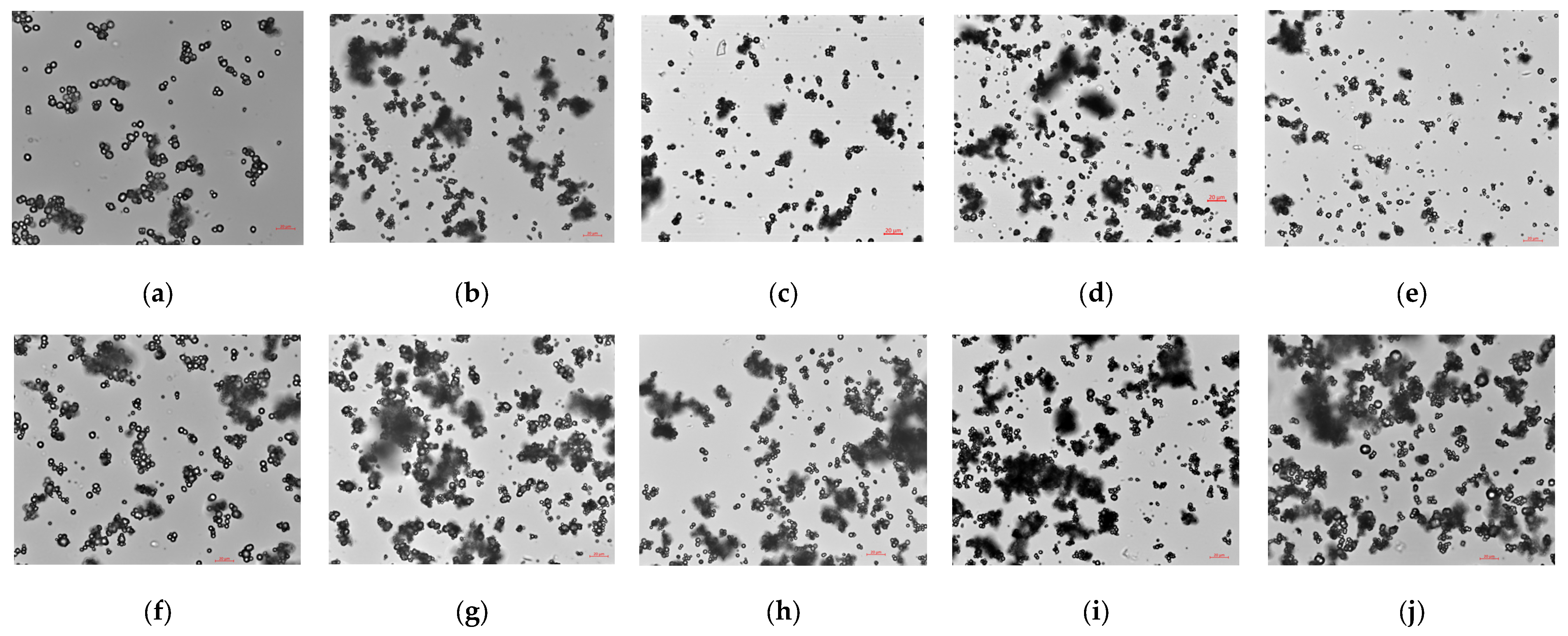
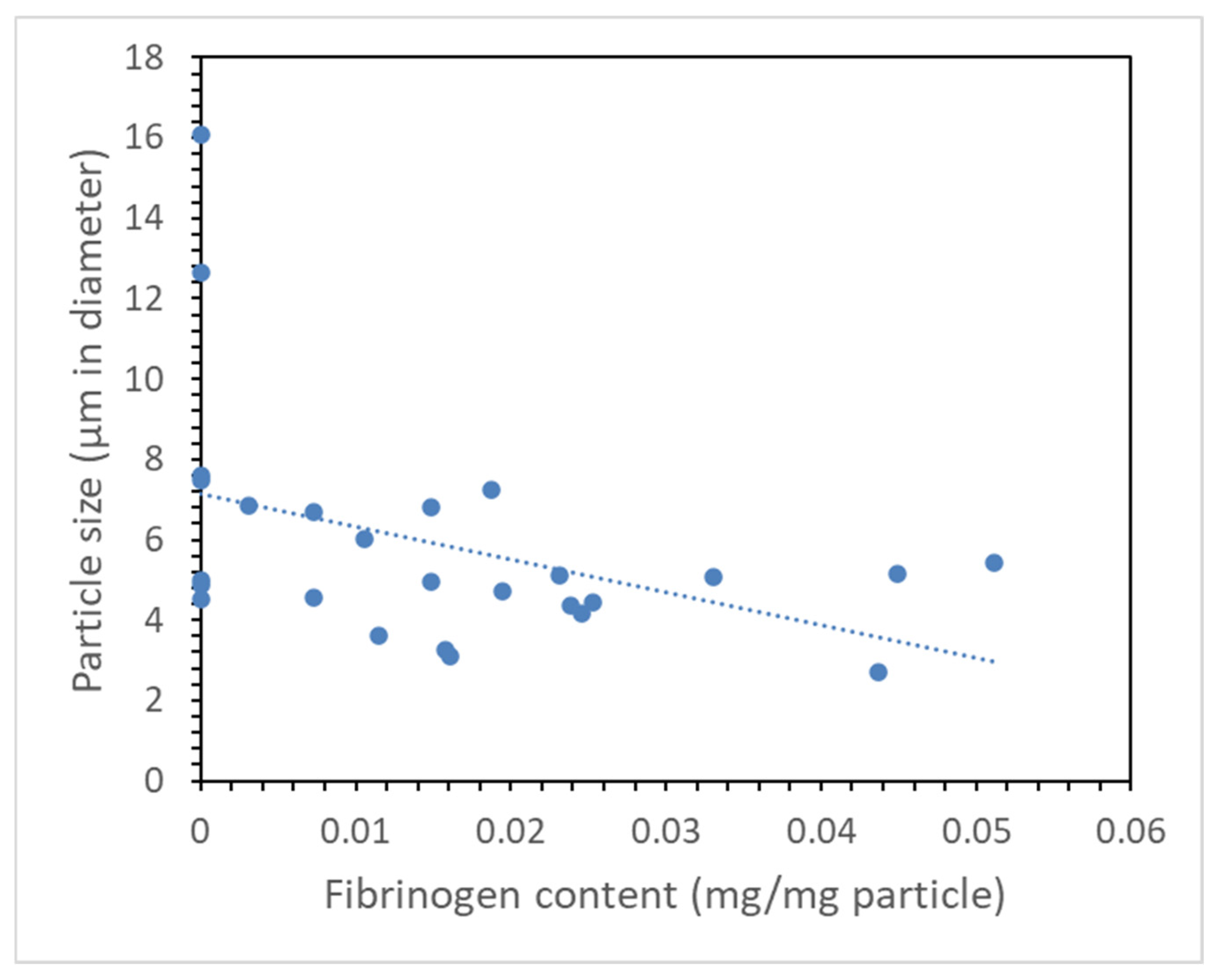
Figure 1 shows light microscopy images of SC-based CaCO3 particles prepared under various conditions. All particles exhibited spherical morphology with bright central regions and darker edges, often forming aggregates. Fibrinogen inclusion generally reduced particle size and appeared to diminish crystallinity compared to NoFib controls. An inverse relationship between particle size and fibrinogen content was observed (Figure A1).
As summarized in Table 2, particle diameters ranged from 2.701 μm to 16.095 μm. The smallest particles were observed in Pre SC FibCO3R 2×Spd 30 min, and the largest in Pre AC NoFib 2 h. At equal molar ratios of SC and CaCl2, particles were smaller (Pre SC FibCO3R 2 h) than those prepared at lower or higher ratios (Pre SC FibCO3R 0.5×CaCl2 2 h and Pre SC FibCO3R 2×CaCl2 2 h). Fibrinogen-containing SC particles were consistently smaller than their NoFib counterparts (e.g., Pre SC Fib2× 30 min and Pre SC FibCO3R 30 min vs. Pre SC NoFib 30 min). Reducing fibrinogen concentration from 20 to 15 g/L increased particle size from 3.117 μm to 6.019 μm.
At the equal molar ratio and reaction time of 30 min, the mixing order and the solution containing fibrinogen also influenced size: adding SC to CaCl2 with fibrinogen produced the smallest particles (Pre SC FibCaCl2 30 min), while the reverse produced the largest (Pre SC FibCO3 30 min).
Doubling SC and CaCl2 concentrations increased particle size from 4.185 to 5.056 μm, while halving them reduced size from 5.634 to 4.716 μm. Increasing mixing speed from 200 to 400 RPM reduced particle size at 30 min (5.168 to 2.701 μm), but increased it at 4 h (4.347 to 6.684 μm). Notably, Pre AC NoFib 2 h and Pre SBC NoFib 2 h produced unusually large particles (>12 μm).
At equal molar concentrations, AC produced the largest particles, followed by SBC and SC (6.818 μm, 4.579 μm, and 3.117 μm, respectively). Similar to the SC-based particles, fibrinogen-containing AC and SBC particles were consistently smaller than their NoFib controls. When both AC and CaCl2 solutions contained fibrinogen, the particle size was even smaller. Doubling SBC concentration reduced particle size in NoFib samples (12.657 to 4.874 μm) but had minimal effect on fibrinogen-loaded particles.
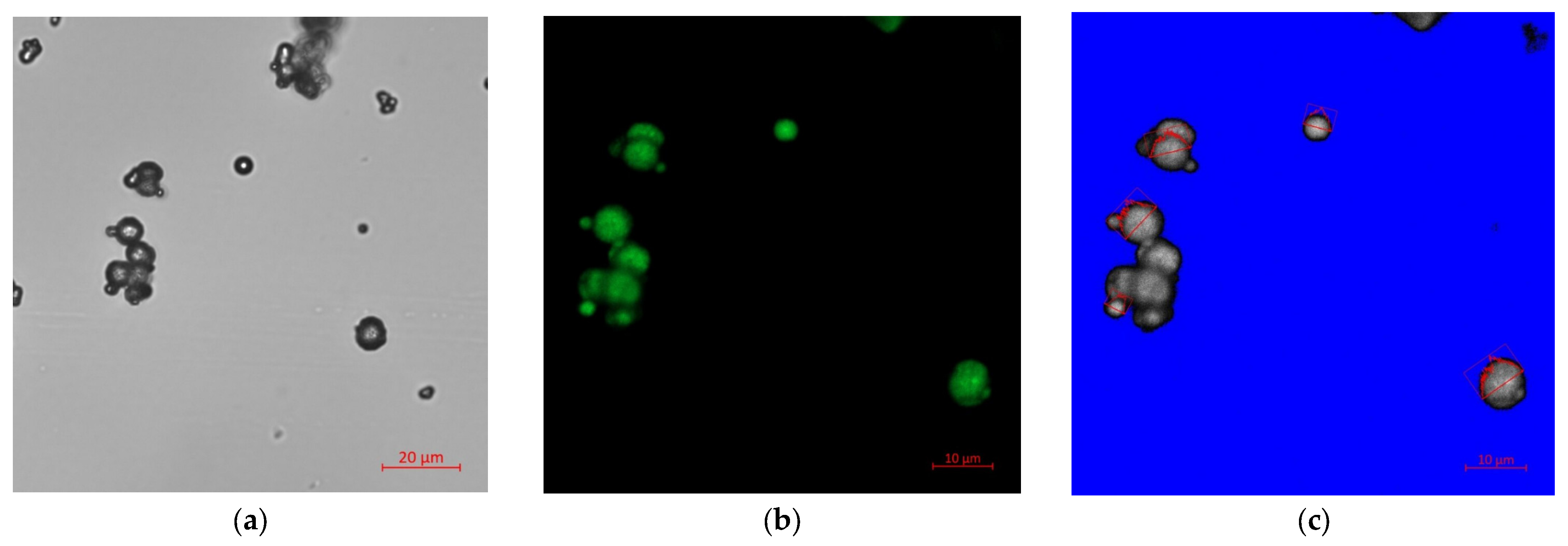
Fluorescence microscopy revealed a relatively uniform distribution of fibrinogen within the particles, with a concentrated core and a dark shell (Figure 2). This contrasts with light microscopy images, which primarily showed spherical particle morphology and aggregation patterns but did not provide insight into internal protein localization. The fluorescence images suggest that fibrinogen preferentially accumulates near the particle center during precipitation, forming a dense core. It should be noted that FITC labeling was used solely for visualization and may have influenced particle characteristics, including size and fibrinogen content.
In summary, fibrinogen incorporation reduces particle size and alters structure, but multiple interacting parameters govern morphology, and observed trends should be interpreted cautiously.

2.3. Gel Electrophoresis and Fibrinogen Content

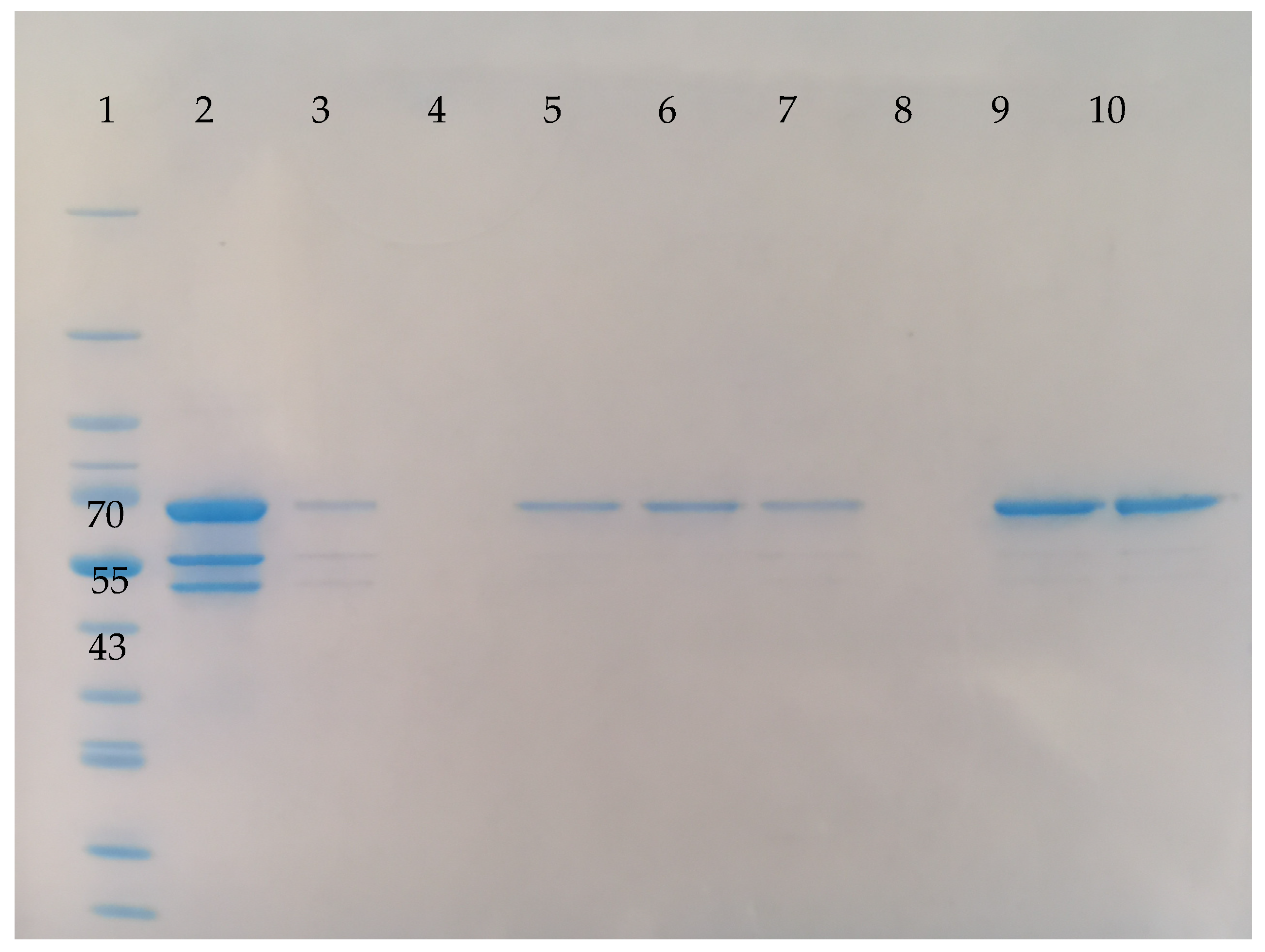
Gel electrophoresis was employed to detect and quantify fibrinogen encapsulated within CaCO3 particles. As shown in Figure 3, the fibrinogen standards exhibited the characteristic triplet of bands corresponding to the α-, β-, and γ-chains at approximately 64 kDa, 56 kDa, and 47 kDa, respectively (lanes 2 and 3) [31]. Band intensity decreased proportionally with fibrinogen concentration, ranging from 1 mg/mL to 0.04 mg/mL, confirming the sensitivity of the assay.
All particle samples exhibited a prominent α-chain band near 64 kDa, with varying intensities across formulations, indicating successful encapsulation of fibrinogen. Several samples also showed faint β- and γ-chain bands around 56 and 47 kDa, respectively, further confirming the presence of intact fibrinogen. Notably, the SC particle prepared with a lower CaCl2 concentration (Pre SC 0.5×CaCl2 FibCO3R 2 h, lane 8) showed no clear characteristic bands, indicating minimal fibrinogen encapsulation under those conditions. Fibrinogen content was estimated by comparing band intensities to those of the standards and is summarized in Table 2.
Fibrinogen content varied significantly across formulations. For SC-based particles, the sample prepared at an equal molar ratio of SC and CaCl2 (Pre SC FibCO3R 2 h) contained 0.0161 mg fibrinogen/mg particle, which was higher than those prepared at lower (0.0031 mg/mg, Pre SC 0.5×CaCl2 FibCO3R 2 h) or higher (0.0115 mg/mg, Pre SC 2×CaCl2 FibCO3R 2 h) calcium concentrations. When both carbonate and calcium solutions contained fibrinogen, encapsulation increased further (0.0231 mg/mg, Pre SC Fib2× 2 h).
Increasing reaction time from 30 min to 4 h did not increase the fibrinogen content in the Pre SC FibCO3R particles. In fact, the 30 min reaction (Pre SC FibCO3R 30 min) yielded 0.045 mg/mg, higher than the 2 h and 4 h reactions. This trend suggests that prolonged reaction times may lead to denature or diffusion of fibrinogen out of the forming particles, or reduced incorporation efficiency due to slower precipitation kinetics. As expected, increasing fibrinogen concentration from 15 to 20 g/L improved encapsulation (0.0105 vs. 0.0161 mg/mg).
Mixing order also influenced fibrinogen loading. Adding CaCl2 to fibrinogen-containing SC solution resulted in higher content (Pre SC FibCO3R 30 min), while doubling both carbonate and calcium concentrations increased fibrinogen content from 0.0149 to 0.0331 mg/mg (Pre SC FibCaCl2 30 min vs. Pre 2×SC 2×CaCl2 FibCaCl2 30 min). Doubling mixing speed had minimal effect at 30 min but reduced fibrinogen content at 4 h (from 0.0239 to 0.0073 mg/mg), further supporting the notion that extended exposure during precipitation may negatively affect fibrinogen retention. These findings highlight the importance of optimizing reaction time and mixing speed to balance particle formation and protein encapsulation efficiency.
Among carbonate sources, SC yielded the highest fibrinogen content (0.0161 mg/mg), followed by AC (0.0148 mg/mg) and SBC (0.0073 mg/mg). Doubling SBC concentration significantly improved encapsulation (to 0.0253 mg/mg, Pre 2×SBC FibCO3R 2 h).
It is noteworthy that formulation conditions may have opposing effects on yield and fibrinogen content. For example, while increasing CaCl2 concentration improved particle yield, the highest fibrinogen encapsulation was achieved at equal molar ratios of SC and CaCl2.
In summary, fibrinogen loading is highly formulation-dependent and often inversely related to yield, highlighting a key trade-off between production efficiency and protein incorporation.

2.4. Hemostatic Properties

To confirm the presence of fibrinogen within the particles and assess their hemostatic functionality, ROTEM assays were performed using human plasma with abnormally low fibrinogen levels and human whole blood obtained from healthy donors. Changes in viscoelastic properties were evaluated by CT, reflecting the onset of coagulation, and MCF, reflecting final clot strength, upon exposure to the particles.
As summarized in Table 2, all fibrinogen–CaCO3 particles enhanced hemostasis, evidenced by shortened CT and increased MCF compared to their corresponding control particles prepared without fibrinogen. CT values ranged from 473 to 1874 s, while MCF values ranged from 4 to 8 mm, with the highest MCF (8 mm) observed for Pre AC Fib2× 2 h. Preparation conditions, except for carbonate type, did not markedly influence hemostatic performance. Particles produced with AC and SBC exhibited greater effects (MCF: 7–8 mm) than those from SC (MCF: 4–6 mm), despite their relatively low fibrinogen content. No detectable coagulation occurred with any control particles, confirming the necessity of fibrinogen for clot formation.
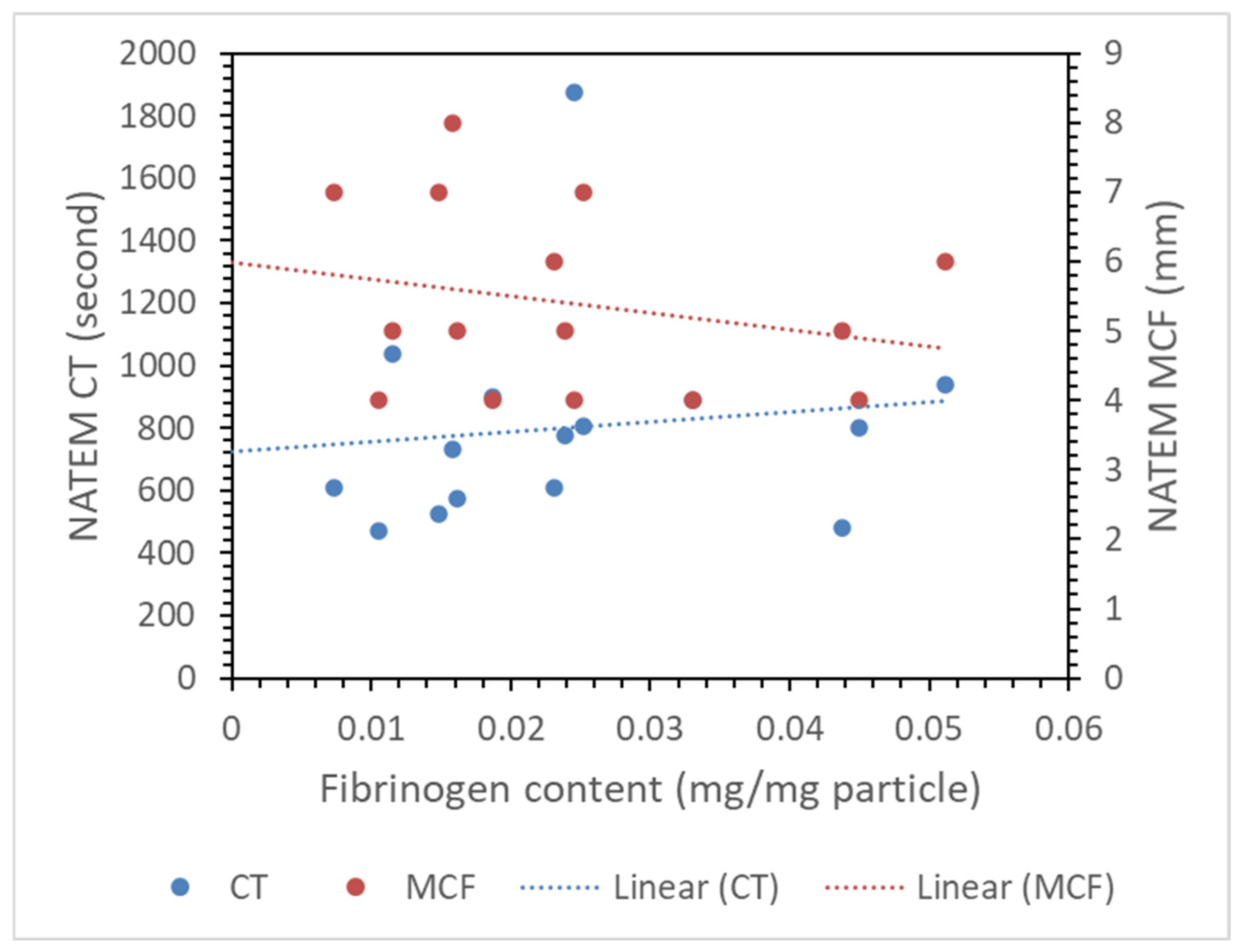
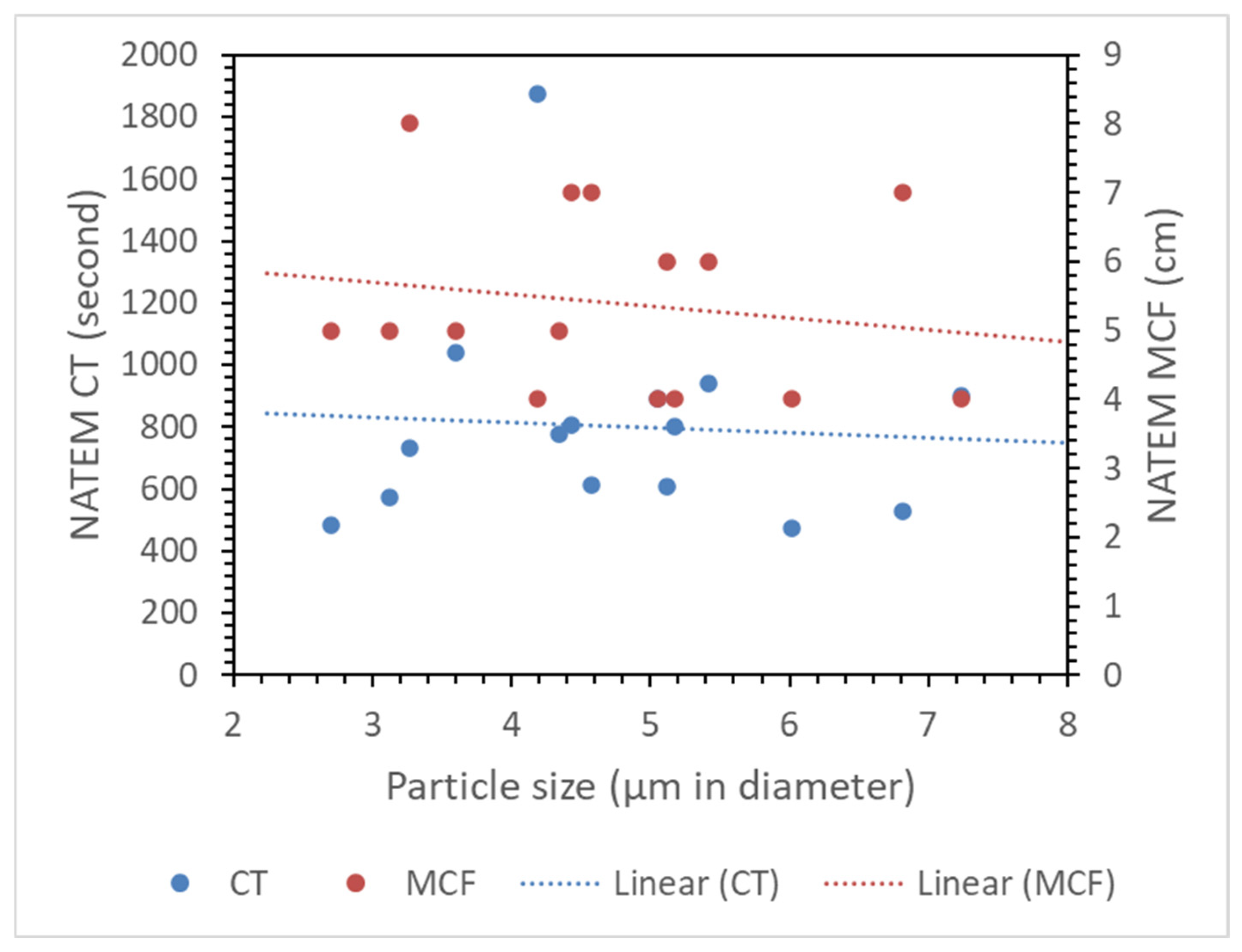
Interestingly, the hemostatic effect of fibrinogen–CaCO3 particles did not correlate significantly with fibrinogen content or particle size (Figure A2 and Figure A3). ROTEM runs with an MCF lower than 4 mm are not recognized by the instrument, and any data from such runs are indicated as no detectable coagulation. Consequently, all control particles falling below this threshold were omitted for the correlation analyses, as it would be impossible to accurately assess their effects.
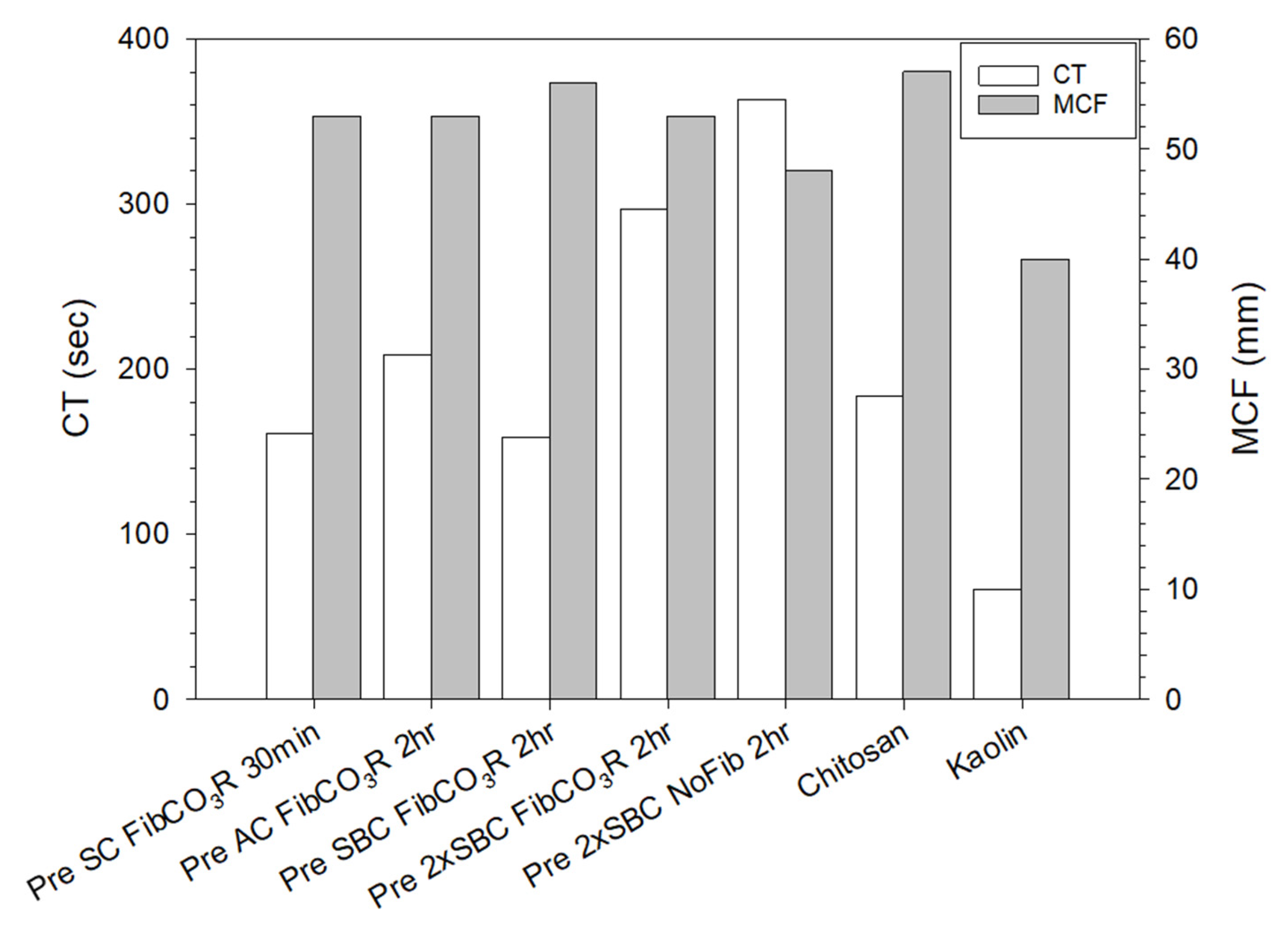
Figure 4 illustrates the hemostatic effects of the particles on human whole blood as measured by CT and MCF. Among the tested formulations, Pre SBC FibCO3R 2 h exhibited the most pronounced effect, reducing CT to 159 s and increasing MCF to 56 mm, indicating rapid clot initiation and strong clot structure. Pre SC FibCO3R 30 min and Pre AC FibCO3R 2 h showed intermediate effects, with CT values of 161 and 209 s and MCF of 53 mm. Pre 2×SBC FibCO3R 2 h demonstrated a longer CT (297 s) and comparable MCF of 53 mm.
The fibrinogen-free control (Pre 2×SBC NoFib 2 h) exhibited the weakest performance, with the longest CT (363 s) and a lower MCF (48 mm), confirming the critical role of fibrinogen in clot initiation and strength. When compared with benchmark hemostatic agents, chitosan generated an MCF comparable to Pre SBC FibCO3R 2 h (57 mm) but required a longer CT (184 s), whereas kaolin produced the fastest clot initiation (CT 67 s) but the lowest MCF (40 mm). Collectively, these results indicate that these fibrinogen–CaCO3 particles demonstrate hemostatic performance similar to chitosan while exerting a less pronounced effect on CT than kaolin, yet offering a more substantial enhancement of MCF.
In summary, encapsulated fibrinogen is essential for hemostatic activity, and particles enhance clot strength; however, no clear relationship between fibrinogen content or particle size and ROTEM outcomes was identified (Figure A2 and Figure A3).

2.5. Self-Propelling Properties

As summarized in Table 2, fibrinogen-containing particles consistently showed longer lag times and faster speeds than their NoFib control particles. For instance, Pre SBC FibCO3R 2 h showed the longest lag time (16.612 s) with a speed of (1.664 cm/s), while Pre SBC NoFib 2 h showed the shortest lag time (0.444 s) and lowest speed (1.194 cm/s). Fibrinogen particles, such as Pre SC Fib2× 30 min, demonstrated significantly enhanced motility (4.221 cm/s) with moderate lag time (2.411 s), indicating that increased fibrinogen concentration and reduced reaction time enhance particle movement.
Among fibrinogen–CaCO3 particles, SC-based formulations generally outperformed SBC-based counterparts. For example, Pre SC FibCO3R 2 h exhibited a shorter lag time (2.744 s) and higher speed (3.261 cm/s) than Pre SBC FibCO3R 2 h with a much prolonged lag time (16.612 s) and reduced speed (1.664 cm/s), whereas Pre 2×SBC FibCO3R 2 h showed improved performance with a shorter lag time (2.511 s) and higher speed (3.154 cm/s), indicating an effect of SBC concentration.
Notably, Pre SC NoFib 30 min achieved a speed of 3.426 μm/s, suggesting that SC alone may contribute to enhanced motility even in the absence of fibrinogen. However, the inclusion of fibrinogen consistently elevated performance metrics across SC-based samples.
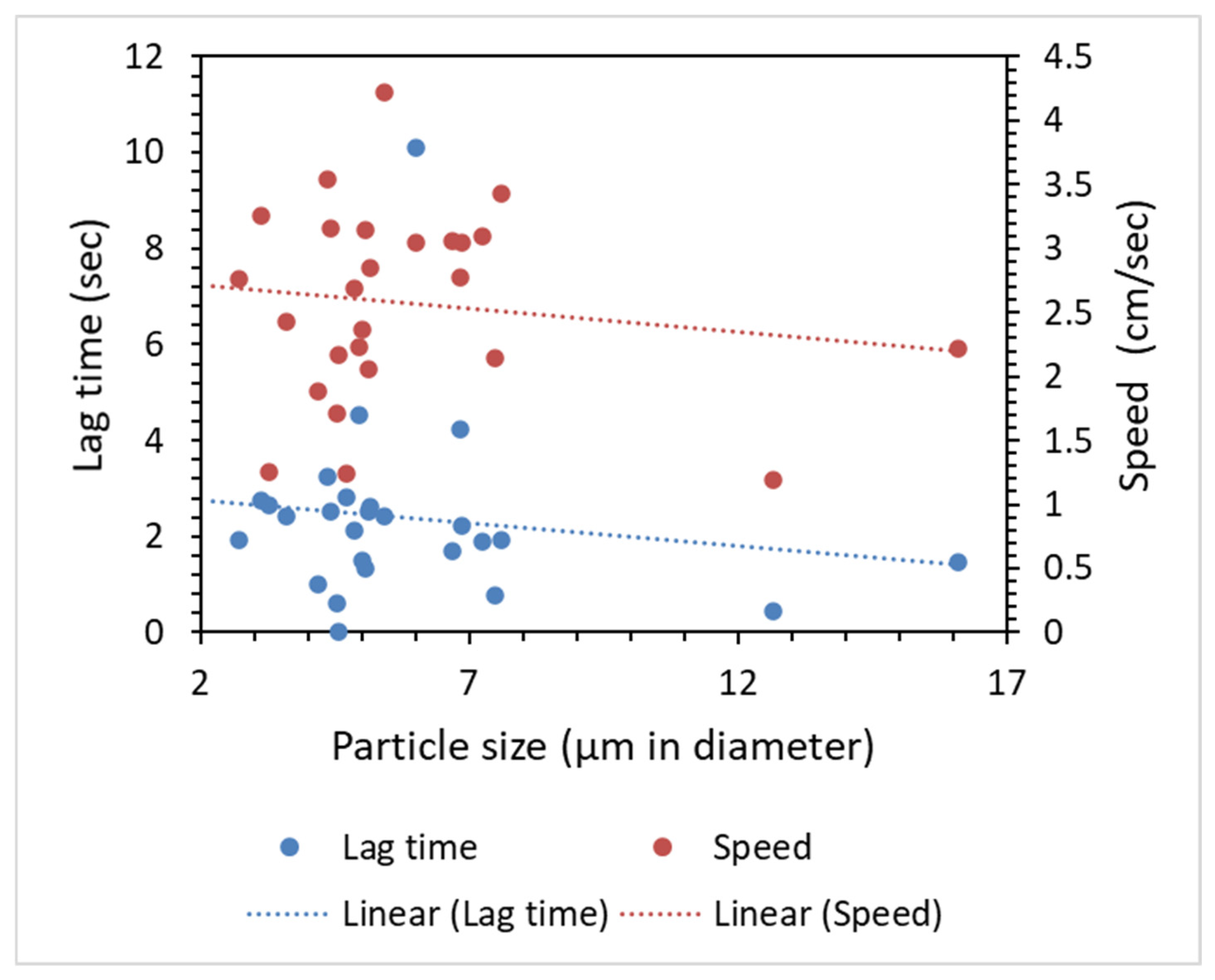
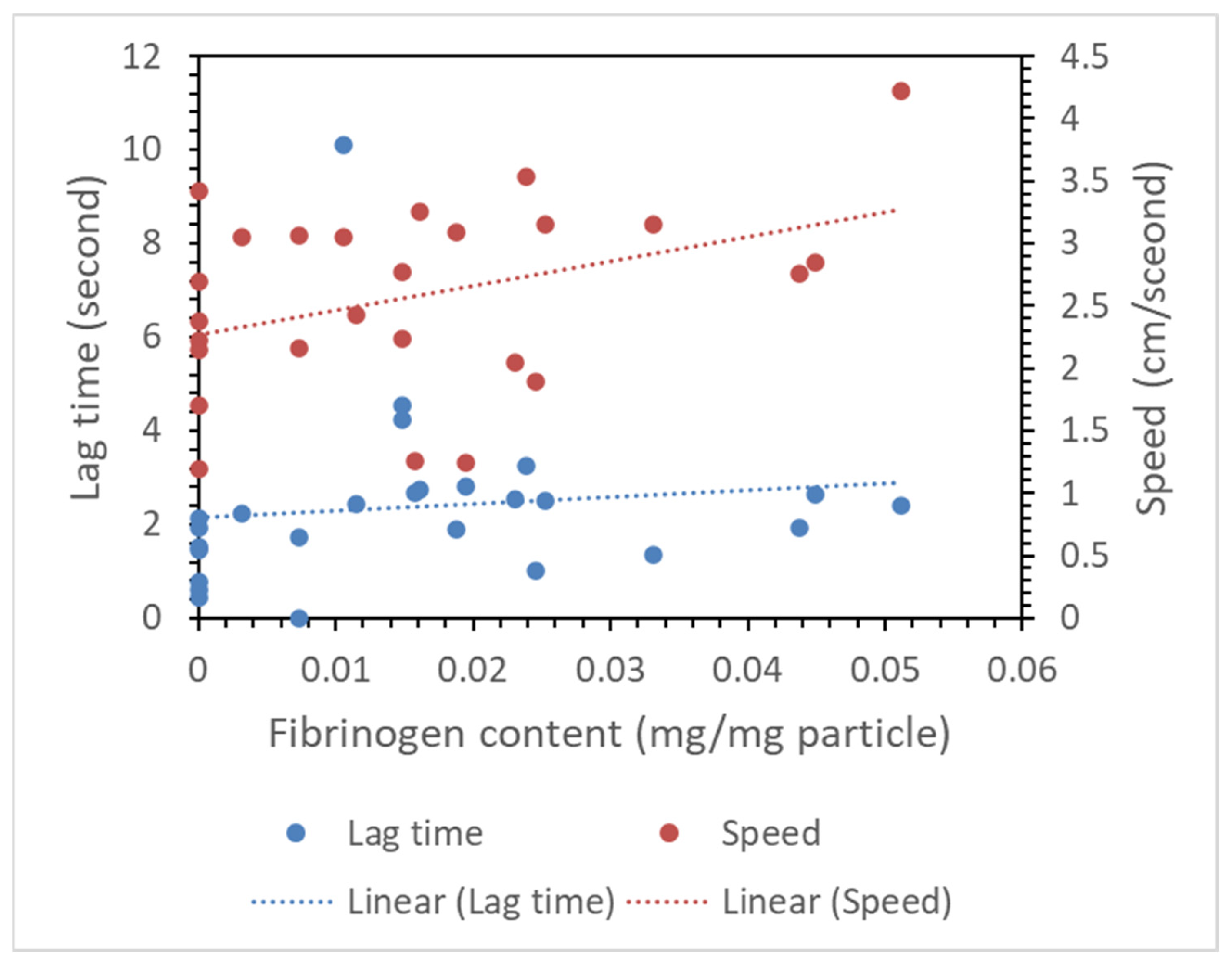
These results demonstrate that fibrinogen inclusion, salt type and composition, and reaction time are critical determinants of activation kinetics and motility. SC-based particles, particularly those with optimized reaction times and concentrations, offer superior performance for applications requiring rapid and sustained movement. Two formulations (Pre SC FiblowCO3R 2 h and Pre SBC FibCO3R 2 h) exhibited unusually long lag times (>10 s) compared to others. Self-propelling properties showed no significant correlation with particle size or fibrinogen content (Figure A4 and Figure A5).
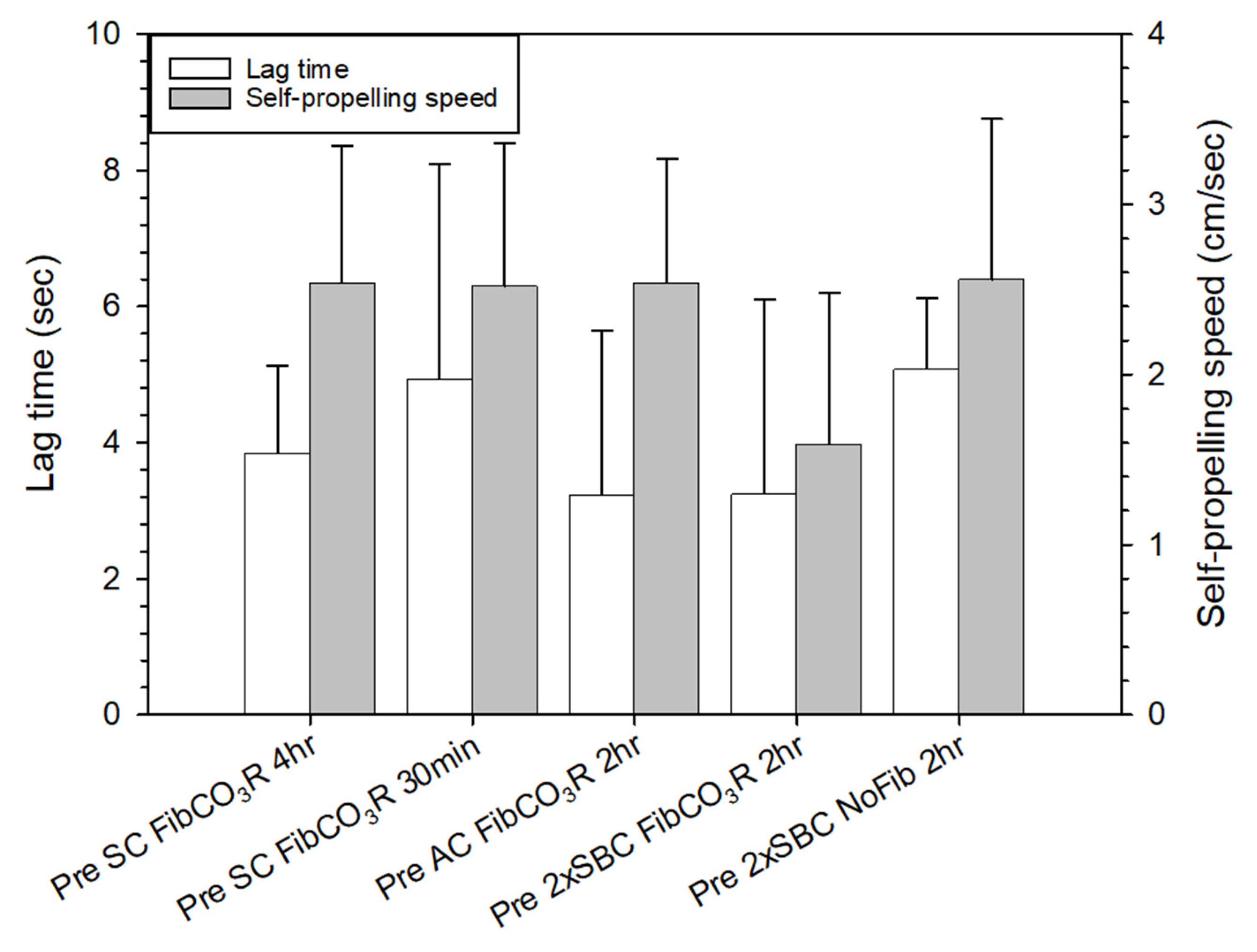
Figure 5 compares the lag time and self-propelling speed of the different CaCO3-based particle formulations. Lag time ranged from approximately 3 to 5 s, while self-propelling speed varied roughly from 1.6 to 2.6 cm/s across all groups. Among the fibrinogen-containing particles, Pre AC FibCO3R 2 h and Pre 2×SBC FibCO3R 2 h exhibited the shortest lag times (~3 s), indicating faster initiation of propulsion. In contrast, Pre SC FibCO3R 30 min and Pre 2×SBC NoFib 2 h showed longer lag times (~4.5–5 s). Self-propelling speed was relatively consistent across formulations, with most groups achieving speeds near 2.5 cm/s, except Pre 2×SBC FibCO3R 2 h, which showed slightly lower speed (~1.6 cm/s). Despite these descriptive differences, no statistically significant differences were detected between groups due to the high variability within measurements. It is also worth noting that, even in citrated plasma with low-fibrinogen concentration, the Pre SBC FibCO3R 2 h formulation triggered rapid coagulation, which prevented completion of the propulsion test.
Lag time and self-propelling speed were compared between plasma and water for the five particle formulations (Table 2). Plasma generally increased lag time and reduced propulsion speed, with the exception of Pre AC FibCO3R 2 h, which showed a shorter lag in plasma. The largest lag increase occurred in Pre 2×SBC NoFib 2 h (138%), which was also the only statistically significant change (p = 0.009), suggesting that fibrinogen absence amplifies plasma-induced delays. Although other formulations exhibited large effect sizes, these did not reach statistical significance due to the high variability within measurements and the small sample size (n = 3).
In summary, self-propulsion behavior is sensitive to formulation and environment, with evidence of trade-offs between activation kinetics and speed, but relationships remain variable and require further investigation.

3. Discussion

CaCO3 microparticles are widely recognized for their biocompatibility, tunable porosity, and ability to encapsulate bioactive molecules, making them attractive for drug delivery and biomedical applications [32,33,34]. Their polymorphism—ranging from amorphous CaCO3 to vaterite, aragonite, and calcite—offers opportunities for functional tailoring but also introduces challenges in controlling particle morphology, stability, and protein compatibility [35,36].
This study demonstrates the successful development and characterization of fibrinogen–CaCO3 particles prepared via a precipitation method, with a focus on optimizing hemostatic efficacy and self-propelling behavior. The results highlight the critical influence of formulation parameters—including salt type and concentration, mixing sequence, and fibrinogen loading—on particle yield, clotting performance, and propulsion dynamics.
The carbonate source significantly influenced particle yield, morphology, and functional performance, consistent with prior reports on CaCO3 crystallization kinetics [37]. The highest yield obtained with SC as the carbonate source may be ascribed to its fastest reaction with CaCl2 compared to AC and SBC. These CaCO3 microcapsules likely underwent encapsulation of proteins and phase transition from vaterite to calcite in various aqueous solutions [38]. The reaction rate of CaCO3 with TXA+, which affects self-propelling and release of procoagulants, can be adjusted by controlling the crystal phase of CaCO3 [39].
SC has been the main carbonate source to produce CaCO3 with high yield and the main crystalline phase of vaterite, which is a metastable phase of crystalline CaCO3 [37,40]. However, SC’s high alkalinity (pH > 11) risks fibrinogen denaturation, as supported by our observation of protein precipitation at elevated pH. To mitigate this, AC and SBC were explored as alternatives, offering milder pH conditions (pH 7.8–8.2) and improved protein stability [41,42]. These findings underscore the trade-off between crystallization kinetics and protein integrity, a critical consideration for scaling up.
Furthermore, fibrinogen was dissolved in either SC or CaCl2 solutions with different mixing orders. Strategies involving sequential addition of carbonate to calcium (CO3 → CaCl2) or vice versa (CaCl2 → CO3) produced higher yields than simultaneous fibrinogen loading in both solutions. This supports the hypothesis that controlled nucleation and growth phases are essential for CaCO3 precipitation and efficient encapsulation.
Fluorescence microscopy confirmed fibrinogen encapsulation, and particle sizes were comparable to those reported for other CaCO3-based carriers [37]. It is hypothesized that the reaction between calcium and carbonate ions may occur around the fibrinogen macromolecule, potentially acting as a template or a nucleation point for CaCO3 precipitation, which results in encapsulation of fibrinogen inside. However, this mechanism warrants further investigation [43]. Additionally, these CaCO3 microcapsules likely underwent protein encapsulation and phase transition from vaterite to calcite in various aqueous solutions [38].
Interestingly, fibrinogen-loaded particles exhibited more amorphous morphologies than protein-free controls, suggesting mutual influence between protein conformation and CaCO3 crystallization [44,45]. Such interactions are complex and warrant further mechanistic studies.
The following mechanistic model can be proposed for CaCO3 particle formation and fibrinogen incorporation:
  • Pre-nucleation stage: Fibrinogen in solution interacts with Ca2+ and/or CO32− ions, potentially forming complexes.
  • Nucleation stage: Local supersaturation triggers formation of CaCO3 nuclei, which may occur either: in the bulk solution or in proximity to fibrinogen molecules.
  • Growth stage: Crystals grow through ion addition; fibrinogen at the surface may inhibit or redirect crystal growth.
  • Encapsulation stage: Protein becomes entrapped within the forming mineral matrix.
This model provides a framework for interpreting the observed trade-offs between particle yield, size, morphology and fibrinogen incorporation, but requires further validation using techniques such as in situ imaging, kinetic monitoring, or polymorph characterization. ROTEM testing confirmed that fibrinogen encapsulation is essential for clot formation. Conversely, NoFib controls showed no detectable coagulation of low-fibrinogen plasma, reinforcing the functional necessity of fibrinogen. However, no clear quantitative correlation between fibrinogen content and clotting performance was observed.
This apparent decoupling may be explained by several factors:
  • Encapsulation measurements include both active and inactive fibrinogen,
  • Hemostatic activity depends not only on total content but also on release kinetics and accessibility,
  • CaCO3 dissolution under neutral ROTEM conditions may be limited, restricting fibrinogen availability.
These factors suggest that functional performance is governed by effective delivery and release rather than total loading alone.
ROTEM testing with whole blood confirmed that the CaCO3 particles contained functional fibrinogen and enhanced clot initiation and firmness, following trends similar to those observed in plasma. However, the hemostatic effects were less pronounced in whole blood, since non-fibrinogen controls still produced coagulation within reference ranges for whole blood (CT 254–837 s; MCF 46–69 mm).
Chitosan and kaolin, two established hemostatic agents, showed expected response patterns [46]. Chitosan, a polycationic biopolymer that agglutinates erythrocytes and interacts with platelets, produced high MCF with moderate CT, reflecting strong clot consolidation driven by electrostatic cell–polymer interactions rather than rapid coagulation factor activation [47]. In contrast, kaolin, a classical activator of FXII and the intrinsic pathway, accelerated coagulation onset (short CT) but generated lower MCF [48,49], consistent with rapid triggering of clotting without substantial enhancement of fibrin polymerization or cross-linking under the conditions tested.
In comparison, the hemostatic efficacy of fibrinogen-loaded CaCO3 particles combined with TXA+ arises from multiple complementary and synergistic mechanisms acting at several stages of hemostasis. These include localized delivery of fibrinogen to promote rapid fibrin network formation and clot reinforcement, calcium-mediated support of coagulation reactions through Ca2+ release from the CaCO3 matrix, and stabilization of the newly formed fibrin clot via antifibrinolytic inhibition by TXA+. In addition, transient particle transport enhances local accumulation of hemostatic components at the bleeding site. This multimodal mechanism distinguishes the system from single-component topical hemostats, while further in vivo studies are required to fully delineate their relative contributions under active bleeding conditions.
Self-propelling behavior was observed across all fibrinogen–CaCO3 formulations, with speeds ranging from 1.194 cm/s to 4.221 cm/s. The fastest propulsion was recorded in Pre SC Fib2× 30 min, which also had one of the shortest lag times, indicating rapid activation and strong driving force. These results suggest that increased fibrinogen concentration and reduced reaction time enhance propulsion, possibly by facilitating more vigorous CO2 generation during the neutralization reaction with TXA+. While fibrinogen inclusion generally increased lag time, this trade-off was offset by improved clotting performance, making these formulations promising for internal bleeding scenarios where rapid delivery is critical.
Importantly, propulsion performance did not show strong correlations with particle size or fibrinogen content, reflecting the complex coupling between chemical reactivity, particle morphology, and surrounding media properties. Given the high variability and small sample size, these observations should be interpreted cautiously.
Differences in propulsion between plasma and water largely reflect plasma’s higher viscosity and protein content, which slow bubble nucleation, prolong lag time, and reduce propulsion speed [50,51]. Additionally, protein adsorption onto particle surfaces may alter acid–base reaction kinetics, slowing CO2 generation and propulsion [52].
Across formulations, particles still achieved rapid propulsion, with speeds sufficient for movement under bleeding [21]. While propulsion was largely governed by CaCO3–acid reactions, fibrinogen remained critical for both propulsion and clotting outcomes. The ability to combine propulsion with intrinsic hemostatic components (e.g., fibrinogen, calcium ions) addresses a key limitation of conventional topical agents, which often fail under high-flow or non-compressible conditions.
Given the presence of multiple propulsion mechanisms and the complex rheology of blood in wounds—including turbulent or pulsatile flow, increased viscosity relative to water or plasma, and heterogeneous cellular constituents—particles were not expected to sustain comparable speeds or unidirectional motion under active bleeding [21]. These findings highlight the potential of self-propelling, protein-loaded CaCO3 particles as next-generation hemostatic agents for non-compressible hemorrhage, a leading cause of preventable trauma deaths. Unlike passive dressings, these particles actively navigate against blood flow, deliver procoagulants (fibrinogen, thrombin), and leverage TXA+ for both propulsion and antifibrinolytic protection. This multifunctionality addresses key limitations of current hemostatic technologies.
CaCO3 is widely employed as a delivery platform owing to its abundance, biocompatibility, and biodegradability [34]. Nonetheless, a full assessment of potential cytotoxic, immunological, and thrombogenic risks will be needed to establish the complete safety profile of this hemostatic particle.
Notably, previous studies using self-propelling CaCO3 systems—including thrombin-loaded and TXA+-modified particles—reported no adverse local or systemic effects in small or large animal hemorrhage models [21,53]. In addition, our previous studies demonstrated minimal hemolysis associated with CaCO3-based formulations [29]. Combined with published evidence demonstrating low cytotoxicity and negligible hemolytic activity of bioactive compound–CaCO3 particles [54,55], these data collectively suggest that CaCO3-encapsulated fibrinogen particles are likely to exhibit favorable biocompatibility.
As this study focused on the premise of making and characterizing the particles, it has limitations. One key limitation is the relatively small sample size. However, given the simplicity of the preparation process, the wide availability and low cost of raw materials, further large-scale studies are warranted. Moreover, characterization of these particles using other analytical techniques (e.g., Fourier-transform infrared spectroscopy, electron microscopy, and X-ray diffraction) would offer insights into the chemical and physical structures of the particles, the mechanistic model for particle formation and fibrinogen incorporation, facilitating further optimization. More importantly, our study was limited to in vitro models and simplified propulsion assays, which do not fully replicate the complexity of active bleeding. Future work should include:
  • In vivo validation in animal models of non-compressible hemorrhage to assess efficacy, safety, and systemic coagulation effects, including direct comparison with established hemostatic standards such as chitosan-based Celox granules and kaolin-impregnated Combat Gauze.
  • Mechanistic studies on fibrinogen release kinetics, dosing effects, particle–blood interactions, and the role of carbonate polymorphs in propulsion and clotting.
  • Integration of additional bioactives (e.g., thrombin, alginate, antimicrobial peptides) for multifunctional wound care.
  • Optimization of particle architecture (e.g., porosity, surface roughness) to fine-tune propulsion and release profiles.
  • Safety profiling, including thrombosis risk and biodisposition, to ensure clinical translation.

4. Materials and Methods

4.1. Materials

Ammonium carbonate (AC, ACS grade), sodium carbonate (SC, 98% purity), sodium bicarbonate (SBC, >99% purity), anhydrous calcium chloride (CaCl2, ≥96% purity), 4-(2-hydroxyethyl)-1-piperazineethanesulfonic acid (HEPES, 99% purity), tranexamic acid (>98% purity), fluorescein isothiocyanate (FITC), Invitrogen™ Novex™ tris-glycine mini protein gels (8–16%, 1.0 mm, WedgeWell™ format), iBright™ prestained protein ladder, sodium dodecyl sulphate (SDS) buffer, dithiothreitol (DTT, 99.5% purity), and coomassie blue (SimplyBlue™ SafeStain) were purchased from Fisher Scientific (Ottawa, ON, Canada). Chitosan powder (85% deacetylation, medium molecular weight; viscosity 0.34 Pa·s for 1% solution in 1% acetic acid) and kaolin powder (USP grade) were obtained from Sigma-Aldrich Canada Ltd. (Oakville, ON, Canada). Fibrinogen concentrate was sourced from CSL Behring (King of Prussia, PA, USA), bovine thrombin (129 U/mg) from VWR International (Mississauga, ON, Canada), citrated human plasma with abnormally low fibrinogen (<0.7 g/L) from Precision BioLogic Inc. (Dartmouth, NS, Canada), and normal human whole blood from Fisher Scientific (Ottawa, ON, Canada).

4.2. Preparation of Self-Propelling Particles

Self-propelling particles were composed of fibrinogen–CaCO3 microparticles and protonated TXA (TXA+). Fibrinogen–CaCO3 particles were synthesized via a precipitation method as detailed below.

4.2.1. Precipitation Method

The precipitation method was adapted from previously validated protocols [22]. In a typical preparation, 11.9 mg HEPES and 100 mg fibrinogen were dissolved in 5 mL Milli-Q water. This solution was slowly mixed with 174.9 mg SC to avoid premature fibrinogen precipitation. Separately, 183.1 mg CaCl2 was dissolved in 5 mL Milli-Q water and gradually added to the carbonate solution under stirring (200 rotations per minute (RPM), room temperature, 120 min), resulting in the formation of fibrinogen–CaCO3 particles. Resulting particles were collected by centrifugation (3000 RPM, 10 min), washed thrice with Milli-Q water, and lyophilized.
Several formulations were prepared in 3 independent batches, performed on separate days using freshly prepared reagents. All characterization and functional assays were conducted on independently prepared batches unless otherwise specified.
Particle yield (%) was defined as:
Y i e l d =   m a s s   o f   d r i e d   p a r t i c l e s   r e c o v e r e d t h e o r e t i c a l   m a s s   o f   C a C O 3   f o r m e d + i n i t i a l   f i b r i n o g e n   i n p u t   × 100
The theoretical CaCO3 mass was calculated based on limiting reagent stoichiometry.
Variations included adjusting carbonate source (SC, SBC, AC) and concentration, fibrinogen concentration, mixing order and speed, and reaction time. Control particles (without fibrinogen) were prepared under identical conditions. Table 1 summarizes the preparation conditions and yields for various batches.

4.2.2. Protonation of TXA

TXA+ was prepared by dissolving TXA (10% w/v) in Milli-Q water and adjusting the pH to 4.3 using HCl, as previously described [21]. The solution was lyophilized to obtain solid TXA+.

4.3. Characterization of Particles

The morphologies of CaCO3-encapsulated fibrinogen particles were characterized by light and fluorescent microscopy. As essential requirements for their use in non-compressible hemorrhage control, the hemostatic and self-propelling properties of the particles were measured by a number of methods as described below. The presence and hemostatic effects of fibrinogen were quantified by gel electrophoresis and rotational thromboelastometry (ROTEM), respectively. Both methods have been used to analyze fibrinogen [56]. Self-propelling ability of the particle when mixed with TXA+ in water was measured following the method as previously reported [22]. Furthermore, self-propulsion phenomena of the particles were video recorded in real time and quantitatively analyzed for their response time and moving speed.

4.3.1. Light and Fluorescent Microscopy

Microscopy images were acquired by ZEISS LSM 800—Airyscan, monitored by ZEN BLUE (Carl Zeiss Canada Ltd., North York, ON, Canada) for all the particles. A small sample of particles was spread onto a glass slide, and then shaken to remove excess particles.
FITC Labelling
FITC-labeled fibrinogen was prepared by reacting FITC with fibrinogen (0.15 molar ratio) in dimethylformamide, incubated in the dark for 30 min at 200 RPM. FITC-labeled particles were washed with isopropanol to remove excess dye. Controls included FITC-labeled particles without fibrinogen.
Imaging Analysis
Fluorescence was excited at 488 nm and detected across 488–620 nm. All imaging parameters were kept constant across all samples to ensure comparability. Imaging settings were optimized empirically and fixed as follows:
  • Laser intensity: 2%
  • Pinhole: 43 μm (1 Airy Unit)
  • Master gain: 650 V
  • Digital offset: −15,000
  • Digital gain: 1.0
Fluorescence intensity values are reported in arbitrary units (0–65,535) determined by detector output. While not absolute measurements, they are internally consistent under fixed acquisition parameters, enabling valid comparison between samples.
All images were analyzed using ZEISS ZEN software (version 3.1). The HISTO function was used to select regions corresponding to individual particles and to calculate their average fluorescence intensity. Background fluorescence was determined using NoFib-FITC control samples (particles without fibrinogen), which account for signal arising from entrapped free FITC independent of fibrinogen presence. These background values were subtracted from the fluorescence intensities of fibrinogen-loaded particles using the Image Calculator function. The resulting corrected intensities were assumed to represent fluorescence specifically associated with the encapsulated fibrinogen.

4.3.2. Gel Electrophoresis

To quantify fibrinogen encapsulation, 10 mg particles were dissolved in 0.5 mL TXA+ (pH 4.3) for 2 h. Supernatants were mixed with SDS buffer, DTT, and Milli-Q water, heated at 90 °C for 5 min, and analyzed via SDS-PAGE (125 V, 50 mA, 100 min). Gels were stained with Coomassie Blue and compared to molecular weight standards.
The relative optical intensity of each band was quantified by densitometric analysis using the program ImageJ (version 1.54j) downloaded from http://rsb.info.nih.gov/ij/index.html (accessed on 15 June 2024). The fibrinogen content in the CaCO3 particle samples was estimated by comparing the band intensity (peak area) to a standard curve generated from known fibrinogen concentrations ranging from 0.04 to 1 mg/mL included in each run.

4.3.3. Rotational Thromboelastometry (ROTEM)

ROTEM was used to assess the hemostatic effects of the particles, following established protocols [57]. Tests were performed at 37 °C on a ROTEM Delta analyzer (Instrumentation Laboratory, Bedford, MA, USA) using human plasma with a low concentration of fibrinogen and normal whole blood. For each run, 6 mg of fibrinogen-loaded CaCO3 particles, or blank CaCO3 controls, were added to a ROTEM cup, followed by 20 µL of star-tem (0.2 M CaCl2) and 300 µL of citrated plasma or whole blood, as per the manufacturer’s NATEM procedure. All measurements were recorded for at least 60 min. The primary ROTEM parameters evaluated were clotting time (CT) and maximum clot firmness (MCF).

4.3.4. Self-Propulsion Test

Self-propulsion was assessed by mixing fibrinogen-loaded or unloaded CaCO3 particles with TXA+ at a mass ratio of 1.2, as previously reported [22]. The mixture was placed on an aluminum weigh boat and aliquoted into approximately equal piles. A sealed pipette containing 0.6 mL of water or citrated plasma with abnormally low fibrinogen was applied to the sample, initiating the reaction. Particle movement was tracked using Tracker software (version 6.2) [https://physlets.org/tracker/] (accessed on 15 June 2024). Metrics included lag time (time to movement initiation) and speed (cm/s over the first 20 data points).

4.3.5. Statistical Analysis

Data are presented as mean ± standard deviation (SD), with n = 3 unless otherwise stated. Normality and homogeneity of variance were assessed using Shapiro–Wilk and Levene’s tests, respectively. Parametric data that satisfied both assumptions (particle size, self-propulsion lag time and speed) were analyzed using one-way ANOVA and t-tests. All statistical analyses were conducted using SPSS Statistics 28 (IBM Corporation, Armonk, NY, USA). A p value of less than 0.05 was considered significant.

5. Conclusions

This study demonstrates the feasibility of precipitation-based encapsulation of fibrinogen in CaCO3 microparticles. Fibrinogen incorporation was essential for hemostatic activity, as fibrinogen-free particles showed no detectable clot formation. Formulation parameters, including carbonate source, concentration, reaction time, and mixing sequence, strongly influenced particle yield, fibrinogen loading, morphology, and propulsion behavior.
The results highlight clear formulation-dependent trade-offs, with no single condition optimizing all performance metrics simultaneously. Overall, these findings establish a proof-of-concept system and underscore the need for further studies to evaluate performance under physiologically relevant conditions and to assess translational potential.

Author Contributions

Conceptualization, H.T.P., C.T., C.J.K. and A.B.; methodology, H.T.P. and T.B.; validation, H.T.P., T.B., C.T., C.J.K. and A.B.; formal analysis, H.T.P. and T.B.; investigation, H.T.P., C.T., C.J.K. and A.B.; resources, H.T.P., C.T., C.J.K. and A.B.; data curation, H.T.P. and T.B.; writing—original draft preparation, H.T.P.; writing—review and editing, T.B., C.T., C.J.K. and A.B.; visualization, H.T.P. and T.B.; supervision, H.T.P., C.J.K. and A.B.; project administration, H.T.P. and C.T.; funding acquisition, H.T.P. and C.T. All authors have read and agreed to the published version of the manuscript.

Funding

This research was funded by Defence Research and Development Canada, Program Activity People_017.

Institutional Review Board Statement

Not applicable.

Informed Consent Statement

Not applicable.

Data Availability Statement

The original contributions presented in this study are included in the article. Further inquiries can be directed to the corresponding author.

Acknowledgments

We would like to thank Canadian Forces Healthy Services, Surgeon General’s Health Research Program, and Defence Research and Development Canada for their support of this research.

Conflicts of Interest

The authors declare no conflicts of interest.

Abbreviations

The following abbreviations are used in this manuscript:
ACAmmonium Carbonate
CTClotting Time
DTTDithiothreitol
FITCFluorescein Isothiocyanate
HEPE4-(2-Hydroxyethyl)-1-Piperazineethanesulfonic Acid
MCFMaximum Clot Firmness
ROTEMRotational Thromboelastometry
RPMRotations Per Minute
SBCSodium Bicarbonate
SCSodium Carbonate
SDStandard Deviation
SDSSodium Dodecyl Sulphate
TXA+Protonated Tranexamic Acid

Appendix A

Figure A1. Effects of fibrinogen content on the size of CaCO3-encapsulated fibrinogen particles. A linear relationship with a Pearson correlation coefficient of −0.425 (p = 0.03) was observed.
Pharmaceuticals 19 00923 g0a1
Figure A2. Effects of fibrinogen content on ROTEM clotting time (CT) and maximum clot firmness (MCF). ROTEM NATEM tests were performed with human plasma containing an abnormally low level of fibrinogen. It should be noted that all control particles prepared in the absence of fibrinogen resulted in non-detectable coagulation and were omitted. The Pearson correlation coefficient between the fibrinogen content and NATEM CT: r = 0.125 (p = 0.66), and NATEM MCF: r = −0.242 (p = 0.39).
Pharmaceuticals 19 00923 g0a2
Figure A3. Effects of particle size on ROTEM clotting time (CT) and maximum clot firmness (MCF). ROTEM NATEM tests were performed with human plasma containing an abnormally low level of fibrinogen. It should be noted that all control particles prepared in the absence of fibrinogen resulted in non-detectable coagulation and thus were omitted. The Pearson correlation coefficient between the particle size and CT: r = −0.063 (p = 0.82), and MCF: r = −0.166 (p = 0.55).
Pharmaceuticals 19 00923 g0a3
Figure A4. Effects of particle size on self-propelling lag time and speed. The Pearson correlation coefficient between the particle size and lag time: r = −0.138 (p = 0.50), and speed: r = −0.161 (p = 0.43).
Pharmaceuticals 19 00923 g0a4
Figure A5. Effects of fibrinogen content on self-propelling lag time and speed. The Pearson correlation coefficient between the particle size and lag time: r = −0.053 (p = 0.80), and speed: r = 0.371 (p = 0.06).
Pharmaceuticals 19 00923 g0a5

References

  1. Eastridge, B.J.; Mabry, R.L.; Seguin, P.; Cantrell, J.; Tops, T.; Uribe, P.; Mallett, O.; Zubko, T.; Oetjen-Gerdes, L.; Rasmussen, T.E.; et al. Death on the battlefield (2001–2011): Implications for the future of combat casualty care. J. Trauma Acute Care Surg. 2012, 73, S431–S437. [Google Scholar] [CrossRef]
  2. Mazuchowski, E.L.; Kotwal, R.S.; Janak, J.C.; Howard, J.T.; Harcke, H.T.; Montgomery, H.R.; Butler, F.K.; Holcomb, J.B.; Eastridge, B.J.; Gurney, J.M.; et al. Mortality review of us special operations command battle-injured fatalities. J. Trauma Acute Care Surg. 2020, 88, 686–695. [Google Scholar] [CrossRef] [PubMed]
  3. US Burden of Disease Collaborators. The state of us health, 1990-2010: Burden of diseases, injuries, and risk factors. JAMA 2013, 310, 591–606. [Google Scholar] [CrossRef]
  4. Eastridge, B.J.; Hardin, M.; Cantrell, J.; Oetjen-Gerdes, L.; Zubko, T.; Mallak, C.; Wade, C.E.; Simmons, J.; Mace, J.; Mabry, R.; et al. Died of wounds on the battlefield: Causation and implications for improving combat casualty care. J. Trauma 2011, 71, S4–S8. [Google Scholar] [CrossRef]
  5. Stannard, A.; Morrison, J.J.; Scott, D.J.; Ivatury, R.A.; Ross, J.D.; Rasmussen, T.E. The epidemiology of noncompressible torso hemorrhage in the wars in Iraq and Afghanistan. J. Trauma Acute Care Surg. 2013, 74, 830–834. [Google Scholar] [CrossRef]
  6. Eastridge, B.J. Injuries to the abdomen from explosion. Curr. Trauma Rep. 2017, 3, 69–74. [Google Scholar] [CrossRef]
  7. Curry, N.S.; Davenport, R.; Pavord, S.; Mallett, S.V.; Kitchen, D.; Klein, A.A.; Maybury, H.; Collins, P.W.; Laffan, M. The use of viscoelastic haemostatic assays in the management of major bleeding: A british society for haematology guideline. Br. J. Haematol. 2018, 182, 789–806. [Google Scholar] [CrossRef]
  8. Peng, T. Biomaterials for hemorrhage control. Trends Biomater. Artif. Organs 2010, 24, 27–68. [Google Scholar]
  9. Peng, H.T.; Shek, P.N. Novel wound sealants: Biomaterials and applications. Expert Rev. Med. Devices 2010, 7, 639–659. [Google Scholar] [CrossRef]
  10. Grissom, T.E.; Fang, R. Topical hemostatic agents and dressings in the prehospital setting. Curr. Opin. Anaesthesiol. 2015, 28, 210–216. [Google Scholar] [CrossRef] [PubMed]
  11. Simpson, A.; Shukla, A.; Brown, A.C. Biomaterials for hemostasis. Annu. Rev. Biomed. Eng. 2022, 24, 111–135. [Google Scholar] [CrossRef]
  12. Shao, H.; Wu, X.; Xiao, Y.; Yang, Y.; Ma, J.; Zhou, Y.; Chen, W.; Qin, S.; Yang, J.; Wang, R.; et al. Recent research advances on polysaccharide-, peptide-, and protein-based hemostatic materials: A review. Int. J. Biol. Macromol. 2024, 261, 129752. [Google Scholar] [CrossRef] [PubMed]
  13. Wang, L.; Hao, F.; Tian, S.; Dong, H.; Nie, J.; Ma, G. Targeting polysaccharides such as chitosan, cellulose, alginate and starch for designing hemostatic dressings. Carbohydr. Polym. 2022, 291, 119574. [Google Scholar] [CrossRef]
  14. Butler, F.K.; Bennett, B.; Wedmore, C.I. Tactical combat casualty care and wilderness medicine: Advancing trauma care in austere environments. Emerg. Med. Clin. N. Am. 2017, 35, 391–407. [Google Scholar] [CrossRef]
  15. Cox, J.M.; Rall, J.M. Evaluation of xstat(r) and quickclot(r) combat gauze(r) in a swine model of lethal junctional hemorrhage in coagulopathic swine. J. Spec. Oper. Med. 2017, 17, 64–67. [Google Scholar] [CrossRef] [PubMed]
  16. Li, N.; Yang, X.; Liu, W.; Xi, G.; Wang, M.; Liang, B.; Ma, Z.; Feng, Y.; Chen, H.; Shi, C. Tannic acid cross-linked polysaccharide-based multifunctional hemostatic microparticles for the regulation of rapid wound healing. Macromol. Biosci. 2018, 18, e1800209. [Google Scholar] [CrossRef] [PubMed]
  17. Li, L.; Du, Y.; Yin, Z.; Li, L.; Peng, H.; Zheng, H.; Yang, A.; Li, H.; Lv, G. Preparation and the hemostatic property study of porous gelatin microspheres both in vitro and in vivo. Colloids Surf. B Biointerfaces 2020, 187, 110641. [Google Scholar] [CrossRef]
  18. Baylis, J.R.; Chan, K.Y.; Kastrup, C.J. Halting hemorrhage with self-propelling particles and local drug delivery. Thromb. Res. 2016, 141, S36–S39. [Google Scholar] [CrossRef]
  19. Shi, Z.; Lan, G.; Hu, E.; Lu, F.; Qian, P.; Liu, J.; Dai, F.; Xie, R. Targeted delivery of hemostats to complex bleeding wounds with magnetic guidance for instant hemostasis. Chem. Eng. J. 2022, 427, 130916. [Google Scholar] [CrossRef]
  20. Liu, L.; Hu, E.; Yu, K.; Xie, R.; Lu, F.; Lu, B.; Bao, R.; Li, Q.; Dai, F.; Lan, G. Recent advances in materials for hemostatic management. Biomater. Sci. 2021, 9, 7343–7378. [Google Scholar] [CrossRef]
  21. Baylis, J.R.; Yeon, J.H.; Thomson, M.H.; Kazerooni, A.; Wang, X.; John, A.E.S.; Lim, E.B.; Chien, D.; Lee, A.; Zhang, J.Q.; et al. Self-propelled particles that transport cargo through flowing blood and halt hemorrhage. Sci. Adv. 2015, 1, e1500379. [Google Scholar] [CrossRef]
  22. Peng, H.; Walford, D. Development of Biomaterials for Treating Battlefield Hemorrhage Part 1: Self-Propelling Particles; Report No. DRDC-RDDC-2020-R135; Defence Research and Development Canada, Toronto Research Centre: Toronto, ON, Canada, 2020. [Google Scholar]
  23. Montroy, J.; Hutton, B.; Moodley, P.; Fergusson, N.A.; Cheng, W.; Tinmouth, A.; Lavallee, L.T.; Fergusson, D.A.; Breau, R.H. The efficacy and safety of topical tranexamic acid: A systematic review and meta-analysis. Transfus. Med. Rev. 2018, 32, 165–178. [Google Scholar] [CrossRef]
  24. Vasudeva, M.; Mathew, J.K.; Groombridge, C.; Tee, J.W.; Johnny, C.S.; Maini, A.; Fitzgerald, M.C. Hypocalcemia in trauma patients: A systematic review. J. Trauma Acute Care Surg. 2021, 90, 396–402. [Google Scholar] [CrossRef]
  25. Cau, M.F.; Ali-Mohamad, N.; Baylis, J.R.; Zenova, V.; Khavari, A.; Peng, N.; McFadden, A.; Donnellan, F.; Owen, D.R.; Schaeffer, D.F.; et al. Percutaneous delivery of self-propelling hemostatic powder for managing non-compressible abdominal hemorrhage: A proof-of-concept study in swine. Injury 2022, 53, 1603–1609. [Google Scholar] [CrossRef]
  26. Cau, M.F.; Ali-Mohamad, N.; Yeh, H.; Baylis, J.R.; Peng, H.; Gao, H.Z.; Rezende-Neto, J.; Grecov, D.; White, N.J.; Tenn, C.; et al. Percutaneous delivery of self-propelling thrombin-containing powder increases survival from non-compressible truncal hemorrhage in a swine model of coagulopathy and hypothermia. J. Trauma Acute Care Surg. 2022, 93, S86–S93. [Google Scholar] [CrossRef]
  27. Baylis, J.R.; Lee, M.M.; John, A.E.S.; Wang, X.; Simonson, E.; Cau, M.; Kazerooni, A.; Gusti, V.; Statz, M.L.; Yoon, J.S.; et al. Topical tranexamic acid inhibits fibrinolysis more effectively when formulated with self-propelling particles. J. Thromb. Haemost. 2019, 17, 1645–1654. [Google Scholar] [CrossRef]
  28. Aubron, C.; Reade, M.C.; Fraser, J.F.; Cooper, D.J. Efficacy and safety of fibrinogen concentrate in trauma patients—A systematic review. J. Crit. Care 2014, 29, 471.e11–471.e17. [Google Scholar] [CrossRef]
  29. Peng, H.T.; Bonnici, T.; Chen, Y.; Kastrup, C.; Beckett, A. Emulsion-based encapsulation of fibrinogen with calcium carbonate for hemorrhage control. J. Funct. Biomater. 2025, 16, 86. [Google Scholar] [CrossRef]
  30. Peng, H.T.; Bonnici, T.; Kastrup, C.; Beckett, A. Encapsulation of fibrinogen with calcium carbonate for hemorrhage control. Mil. Med. 2025, 190, 662–669. [Google Scholar] [CrossRef]
  31. Schulz, P.M.; Gehringer, W.; Nöhring, S.; Müller, S.; Schmidt, T.; Kekeiss-Schertler, S.; Solomon, C.; Pock, K.; Römisch, J. Biochemical characterization, stability, and pathogen safety of a new fibrinogen concentrate (fibryga®). Biologicals 2018, 52, 72–77. [Google Scholar] [CrossRef]
  32. Zhao, P.; Tian, Y.; You, J.; Hu, X.; Liu, Y. Recent advances of calcium carbonate nanoparticles for biomedical applications. Bioengineering 2022, 9, 691. [Google Scholar] [CrossRef]
  33. Tan, C.; Dima, C.; Huang, M.; Assadpour, E.; Wang, J.; Sun, B.; Kharazmi, M.S.; Jafari, S.M. Advanced CaCO3-derived delivery systems for bioactive compounds. Adv. Colloid Interface Sci. 2022, 309, 102791. [Google Scholar] [CrossRef]
  34. Li, S.Y.; Lian, B. Application of calcium carbonate as a controlled release carrier for therapeutic drugs. Minerals 2023, 13, 1136. [Google Scholar] [CrossRef]
  35. Niu, Y.Q.; Liu, J.H.; Aymonier, C.; Fermani, S.; Kralj, D.; Falini, G.; Zhou, C.H. Calcium carbonate: Controlled synthesis, surface functionalization, and nanostructured materials. Chem. Soc. Rev. 2022, 51, 7883–7943. [Google Scholar] [CrossRef]
  36. Fadia, P.; Tyagi, S.; Bhagat, S.; Nair, A.; Panchal, P.; Dave, H.; Dang, S.; Singh, S. Calcium carbonate nano- and microparticles: Synthesis methods and biological applications. 3 Biotech 2021, 11, 457. [Google Scholar] [CrossRef]
  37. Fujiwara, M.; Shiokawa, K.; Morigaki, K.; Zhu, Y.; Nakahara, Y. Calcium carbonate microcapsules encapsulating biomacromolecules. Chem. Eng. J. 2008, 137, 14–22. [Google Scholar] [CrossRef]
  38. Fujiwara, M.; Shiokawa, K.; Araki, M.; Ashitaka, N.; Morigaki, K.; Kubota, T.; Nakahara, Y. Encapsulation of proteins into caco3 by phase transition from vaterite to calcite. Cryst. Growth Des. 2010, 10, 4030–4037. [Google Scholar] [CrossRef]
  39. Yang, H.; Wang, Y.F.; Liang, T.X.; Deng, Y.Q.; Qi, X.P.; Jiang, H.H.; Wu, Y.J.; Gao, H.C. Hierarchical porous calcium carbonate microspheres as drug delivery vector. Prog. Nat. Sci. Mater. Int. 2017, 27, 674–677. [Google Scholar] [CrossRef]
  40. Wu, G.X.; Ding, J.; Xue, J. Synthesis of calcium carbonate capsules in water-in-oil-in-water double emulsions. J. Mater. Res. 2008, 23, 140–149. [Google Scholar] [CrossRef]
  41. Kusova, A.M.; Sitnitsky, A.E.; Zuev, Y.F. The role of ph and ionic strength in the attraction–repulsion balance of fibrinogen interactions. Langmuir 2021, 37, 10394–10401. [Google Scholar] [CrossRef]
  42. Okude, M.; Yamanaka, A.; Akihama, S. The effects of ph on the generation of turbidity and elasticity associated with fibrinogen-fibrin conversion by thrombin are remarkably influenced by sialic acid in fibrinogen. Biol. Pharm. Bull. 1995, 18, 203–207. [Google Scholar] [CrossRef]
  43. Vikulina, A.S.; Feoktistova, N.A.; Balabushevich, N.G.; Skirtach, A.G.; Volodkin, D. The mechanism of catalase loading into porous vaterite CaCO3 crystals by co-synthesis. Phys. Chem. Chem. Phys. 2018, 20, 8822–8831. [Google Scholar] [CrossRef]
  44. Yang, L.; Guo, Y.; Ma, X.; Hu, Z.; Zhu, S.; Zhang, X.; Jiang, K. Cooperativity between pepsin and crystallization of calcium carbonate in distilled water. J. Inorg. Biochem. 2003, 93, 197–203. [Google Scholar] [CrossRef]
  45. Kanoje, B.; Patel, D.; Kuperkar, K. Morphology modification in freshly precipitated calcium carbonate particles using surfactant-polymer template. Mater. Lett. 2017, 187, 44–48. [Google Scholar] [CrossRef]
  46. Elsabahy, M.; Hamad, M.A. Design and preclinical evaluation of chitosan/kaolin nanocomposites with enhanced hemostatic efficiency. Mar. Drugs 2021, 19, 50. [Google Scholar] [CrossRef]
  47. Gheorghita, D.; Moldovan, H.; Robu, A.; Bita, A.I.; Grosu, E.; Antoniac, A.; Corneschi, I.; Antoniac, I.; Bodog, A.D.; Bacila, C.I. Chitosan-based biomaterials for hemostatic applications: A review of recent advances. Int. J. Mol. Sci. 2023, 24, 10540. [Google Scholar] [CrossRef]
  48. Peng, H.T.; Grodecki, R.; Rizoli, S.; Shek, P.N. A comparative study of tissue factor and kaolin on blood coagulation assays using rotational thromboelastometry and thromboelastography. Blood Coagul. Fibrinolysis 2016, 27, 31–41. [Google Scholar] [CrossRef]
  49. Wang, C.; Shi, C.; Huang, J.; Wei, X.; Shi, Y.; Xiao, L.; Fan, J. Synergistic procoagulant mechanism and application of kaolin-zeolite composite hemostat for effective hemorrhage control. ACS Appl. Mater. Interfaces 2024, 16, 49186–49196. [Google Scholar] [CrossRef]
  50. Li, Q.; Hu, E.; Yu, K.; Xie, R.; Lu, F.; Lu, B.; Bao, R.; Zhao, T.; Dai, F.; Lan, G. Self-propelling janus particles for hemostasis in perforating and irregular wounds with massive hemorrhage. Adv. Funct. Mater. 2020, 30, 2004153. [Google Scholar] [CrossRef]
  51. Xu, H.; Medina-Sanchez, M.; Maitz, M.F.; Werner, C.; Schmidt, O.G. Sperm micromotors for cargo delivery through flowing blood. ACS Nano 2020, 14, 2982–2993. [Google Scholar] [CrossRef] [PubMed]
  52. Li, Q.; Hu, E.; Yu, K.; Lu, M.; Xie, R.; Lu, F.; Lu, B.; Bao, R.; Lan, G. Magnetic field-mediated janus particles with sustained driving capability for severe bleeding control in perforating and inflected wounds. Bioact. Mater. 2021, 6, 4625–4639. [Google Scholar] [CrossRef]
  53. Ali-Mohamad, N.; Cau, M.F.; Zenova, V.; Baylis, J.R.; Beckett, A.; McFadden, A.; Donnellan, F.; Kastrup, C.J. Self-propelling thrombin powder enables hemostasis with no observable recurrent bleeding or thrombosis over 3 days in a porcine model of upper GI bleeding. Gastrointest. Endosc. 2023, 98, 245–248. [Google Scholar] [CrossRef] [PubMed]
  54. Rao, C.H.; Li, M.; Sun, X.Q.; Li, M.L.; Lian, X.J.; Wang, H.F.; Jia, L.; Niu, B.L.; Li, W.F. Preparation and characterization of phosphate-stabilized amorphous calcium carbonate nanoparticles and their application in curcumin delivery. Mater. Chem. Phys. 2020, 255, 123552. [Google Scholar] [CrossRef]
  55. Li, H.; Zhang, X.; Lin, X.; Zhuang, S.; Wu, Y.; Liu, Z.; Rong, J.; Zhao, J. CaCO3 nanoparticles ph-sensitively induce blood coagulation as a potential strategy for starving tumor therapy. J. Mater. Chem. B 2020, 8, 1223–1234. [Google Scholar] [CrossRef] [PubMed]
  56. Peng, H.T.; Beckett, A. Stability of reconstituted fibrinogen concentrate in hemostatic function and concentration. Mil. Med. 2021, 186, 286–292. [Google Scholar] [CrossRef]
  57. Lechner, R.; Helm, M.; Mueller, M.; Wille, T.; Friemert, B. Efficacy of hemostatic agents in humans with rotational thromboelastometry: An in-vitro study. Mil. Med. 2016, 181, 907–912. [Google Scholar] [CrossRef] [PubMed]
Figure 1. Light microscopy images of (a) Pre SC NoFib 30 min, (b) Pre SC FibCO3R 30 min, (c) Pre SC FibCO3R 2 h, (d) Pre SC FibCO3R 4 h, (e) Pre SC FibCO3R 2×Spd 30 min, (f) Pre SC FibCO3 30 min, (g) Pre SC FibCl2 30 min, (h) Pre SC FibCl2R 30 min, (i) Pre 2×SC 2×Cl FibCl2 30 min, (j) Pre SC Fib2× 30 min. Particles were prepared by the precipitation method under various conditions. Scale bars represent 20 µm. See Table 1 and Section 4.2.1 for details of sample preparation and image acquisition.
Pharmaceuticals 19 00923 g001
Figure 2. Light microscopy image (a) and fluorescence microscopy images of the particle Pre 2×SBC FibCO3R 2 h before (b) and after subtraction of its corresponding fibrinogen-free control (c). See Table 1 and Section 4.2.1 for details of sample preparation and image acquisition. Figure 2 (c) was previously published as Figure 2B in Ref. [30]. As indicated in (c) (highlighted in red), a path-dependent intensity profile was generated along the largest cross-section of the particles to visualize the spatial distribution of encapsulated fibrinogen across the particle diameter.
Pharmaceuticals 19 00923 g002
Figure 3. Coomassie-stained sodium dodecyl sulfate-polyacrylamide gel electrophoresis analysis of fibrinogen standards and CaCO3-encapsulated fibrinogen particle samples dissolved in TXA+ solution. Each sample except standard proteins (Mw STD) was reduced with 5% dithiothreitol and analyzed by gel electrophoresis. Indicated molecular weights were estimated by Mw STD with known molecular weights from 10 to 205 kDa. From left to right, each sample represents: Mw STD (Lane 1), fibrinogen standard (1 mg/mL, Lane 2), fibrinogen standard (0.2 mg/mL, Lane 3), fibrinogen standard (0.04 mg/mL, Lane 4), Pre 2×SBC FibCO3R 2 h (Lane 5), Pre SC FibCO3R 2 h (Lane 6), Pre SC 2×CaCl2 FibCO3R 2 h (Lane 7), Pre SC 0.5×CaCl2 FibCO3R 2 h (Lane 8), Pre SC FibCO3R 30 min (Lane 9), Pre SC FibCO3R 2×spd 30 min (Lane 10). See Table 1 for details of each batch of samples.
Pharmaceuticals 19 00923 g003
Figure 4. Hemostatic effects of CaCO3-encapsulated fibrinogen particles on human whole blood, as assessed by ROTEM. CT and MCF are shown in comparison with fibrinogen-free control particles, chitosan and kaolin.
Pharmaceuticals 19 00923 g004
Figure 5. Lag time and self-propelling speed of CaCO3-based particle formulations measured in citrated plasma with a low fibrinogen concentration. Each value represents mean ± SD (n = 3). Plasma measurements reflect the impact of higher viscosity and particle–protein interactions on propulsion performance, resulting in increased lag times and reduced speeds for most formulations relative to water-based measurements.
Pharmaceuticals 19 00923 g005
Table 1. Preparation of CaCO3-encapsulated fibrinogen particles by the precipitation method under various conditions.
Batch 1Carbonate Concentration (M)Fibrinogen Concentration (g/L)Calcium Concentration (M)Mixing Speed (RPM)Mixing Time (min)Mixing StepYield (%) 2
Pre SC 2×CaCl2 FibCO3R 2 h0.33200.66200120CaCl2 -> FibCO366
Pre SC 0.5×CaCl2 FibCO3R 2 h0.33200.165200120CaCl2 -> FibCO339
Pre SC Fib2× 2 h0.3320 × 20.33200120FibCaCl2 -> FibCO337
Pre SC Fib2× 30 min0.3320 × 20.3320030FibCaCl2 -> FibCO336
Pre SC NoFib 30 min 30.3300.3320030CaCl2 -> CO383 ± 1
Pre SC FibCO3R 4 h0.33200.33200240CaCl2 -> FibCO358
Pre SC FibCO3R 2 h0.33200.33200120CaCl2 -> FibCO348 ± 2
Pre SC FiblowCO3R 2 h0.33150.33200120CaCl2 -> FibCO364
Pre SC FibCO3R 30 min0.33200.3320030CaCl2 -> FibCO354
Pre SC FibCO3 30 min0.33200.3320030FibCO3 -> CaCl255
Pre SC FibCaCl2R 30 min0.33200.3320030FibCaCl2 -> CO347
Pre SC FibCaCl2 30 min0.33200.3320030CO3 -> FibCaCl254
Pre 2×SC 2×CaCl2 FibCaCl2 30 min0.66200.6620030CO3 -> FibCaCl273
Pre 2×SC 2×CaCl2 NoFib 30 min 30.6600.6620030FibCaCl2 -> CO385
Pre 0.5×SC 0.5×CaCl2 FibCO3 30 min0.165200.16520030FibCO3 -> CaCl229
Pre 0.5×SC 0.5×CaCl2 NoFib 30 min 30.16500.16520030CO3 -> CaCl269
Pre SC FibCO3R 2×Spd 30 min0.33200.3340030CaCl2 -> FibCO355
Pre SC FibCO3R 2×Spd 4 h0.33200.33400240CaCl2 -> FibCO347
Pre SC NoFib 2×Spd 4 h 30.3300.33400240CaCl2 -> CO378
Pre AC FibCO3R 2 h0.33 M AC200.33200120CaCl2 -> FibCO333 ± 4
Pre AC NoFib 2 h 30.33 M AC00.33200120CaCl2 -> CO335
Pre AC Fib2× 2 h0.3320 × 20.33200120FibCaCl2 -> FibCO319
Pre AC Fib2× 30 min0.3320 × 20.3320030FibCaCl2 -> FibCO311
Pre SBC FibCO3R 2 h0.33200.33200120CaCl2 -> FibCO330 ± 5
Pre SBC NoFib 2 h 30.3300.33200120CaCl2 -> CO341
Pre 2×SBC FibCO3R 2 h0.66200.33200120CaCl2 -> FibCO356 ± 7
Pre 2×SBC NoFib 2 h 30.6600.33200120CaCl2 -> CO381 ± 1
1 Each batch was named as Pre for Precipitation, carbonate type (AC for ammonium carbonate, SBC for sodium bicarbonate, SC for sodium carbonate) with changes to the default concentrations of carbonate and calcium solutions (e.g., 2×SC 2×CaCl2), the solution containing fibrinogen (FibCO3 for the carbonate solution containing fibrinogen, FibCaCl2 for the CaCl2 solution containing fibrinogen, Fib2× for both carbonate and CaCl2 solutions containing fibrinogen), mixing speed if doubled (2×Spd), reaction time, R for reversed order of mixing step (i.e., CaCl2 solution was added into carbonate solution CaCl2 -> FibCO3 instead of the default procedure FibCO3 -> CaCl2); 2 calculated as the actual amount of product divided by the sum of theoretical amount of CaCO3 that should be produced and initial amount of added fibrinogen in the preparation; 3 control particles, i.e., CaCO3 particles in the absence of fibrinogen.
Table 2. The size, fibrinogen content, hemostatic and self-propelling properties of fibrinogen–CaCO3 particles prepared by the precipitation method under different conditions.
Sample IDParticle Size in Diameter (µm, n = 10) Encapsulated Fibrinogen mg/mg ParticleROTEMLag Time (s)Self-Propelling Speed (cm/s)
CT (s)MCF (mm)
Pre SC 2×CaCl2 FibCO3R 2 h3.602 ± 0.3070.0115103952.433 ± 0.7052.431 ± 0.513
Pre SC 0.5×CaCl2 FibCO3R 2 h6.856 ± 0.6510.0031No detectable coagulation2.221 ± 0.3103.049 ± 0.685
Pre SC Fib2× 2 h5.115 ± 0.5370.023160962.532 ± 0.8332.052 ± 0.368
Pre SC Fib2× 30 min5.412 ± 0.5740.051294062.411 ± 0.7244.221 ± 0.803
Pre SC NoFib 30 min7.593 ± 0.5490No detectable coagulation1.922 ± 0.3793.426 ± 0.766
Pre SC FibCO3R 4 h4.347 ± 0.5480.023977653.256 ± 0.9073.541 ± 0.741
Pre SC FibCO3R 2 h3.117 ± 0.2740.0161444 ± 1854.5 ± 0.7 2.744 ± 0.7693.261 ± 0.892
Pre SC FiblowCO3R 2 h6.019 ± 1.1480.0105473410.116 ± 4.2733.048 ± 1.323
Pre SC FibCO3R 30 min5.168 ± 0.7820.045060442.633 ± 0.4342.852 ± 0.678
Pre SC FibCO3 30 min5.634 ± 0.6550.018790041.889 ± 0.6353.094 ± 0.674
Pre SC FibCaCl2R 30 min4.946 ± 0.6250.014980044.537 ± 4.0472.237 ± 1.397
Pre SC FibCaCl2 30 min4.185 ± 0.4840.0246187441.001 ± 0.8021.888 ± 0.819
Pre 2×SC 2×CaCl2 FibCaCl2 30 min5.056 ± 0.5960.033188941.344 ± 0.3513.149 ± 0.563
Pre 2×SC 2×Cl NoFib 30 min4.532 ± 0.4550No detectable coagulation0.622 ± 0.4171.707 ± 0.591
Pre 0.5×SC 0.5×CaCl2 FibCO3 30 min4.716 ± 1.1480.0195--2.813 ± 3.0831.246 ± 0.892
Pre 0.5×SC 0.5×Cl NoFib 30 min7.471 ± 0.4850No detectable coagulation0.767 ± 0.1332.149 ± 1.101
Pre SC FibCO3R 2×Spd 30 min2.701 ± 0.1530.043748251.922 ± 0.3172.759 ± 0.644
Pre SC FibCO3R 2×Spd 4 h6.684 ± 0.7810.0073--1.711 ± 0.395 3.061 ± 0.653
Pre SC NoFib 2×Spd 4 h5.003 ± 0.7110No detectable coagulation1.511 ± 0.3832.371 ± 0.887
Pre AC FibCO3R 2 h6.818 ± 1.7720.0148632 ± 1746.7 ± 2.14.220 ± 0.9662.776 ± 1.197
Pre AC NoFib 2 h16.095 ± 3.8650No detectable coagulation1.468 ± 0.9342.221 ± 0.788
Pre AC Fib2× 2 h3.262 ± 0.5030.015873082.668 ± 4.0621.252 ± 0.605
Pre SBC FibCO3R 2 h4.579 ± 0.9750.0073579 ± 456.5 ± 0.716.612 ± 7.9831.664 ± 0.990
Pre SBC NoFib 2 h 12.657 ± 2.5770No detectable coagulation0.444 ± 0.317 1.194 ± 0.589
Pre 2×SBC FibCO3R 2 h4.431 ± 0.2850.0253657 ± 2397.0 ± 12.511 ± 0.8473.154 ± 0.728
Pre 2×SBC NoFib 2 h 4.874 ± 1.2410No detectable coagulation2.133 ± 0.2332.691 ± 0.939
Disclaimer/Publisher’s Note: The statements, opinions and data contained in all publications are solely those of the individual author(s) and contributor(s) and not of MDPI and/or the editor(s). MDPI and/or the editor(s) disclaim responsibility for any injury to people or property resulting from any ideas, methods, instructions or products referred to in the content.