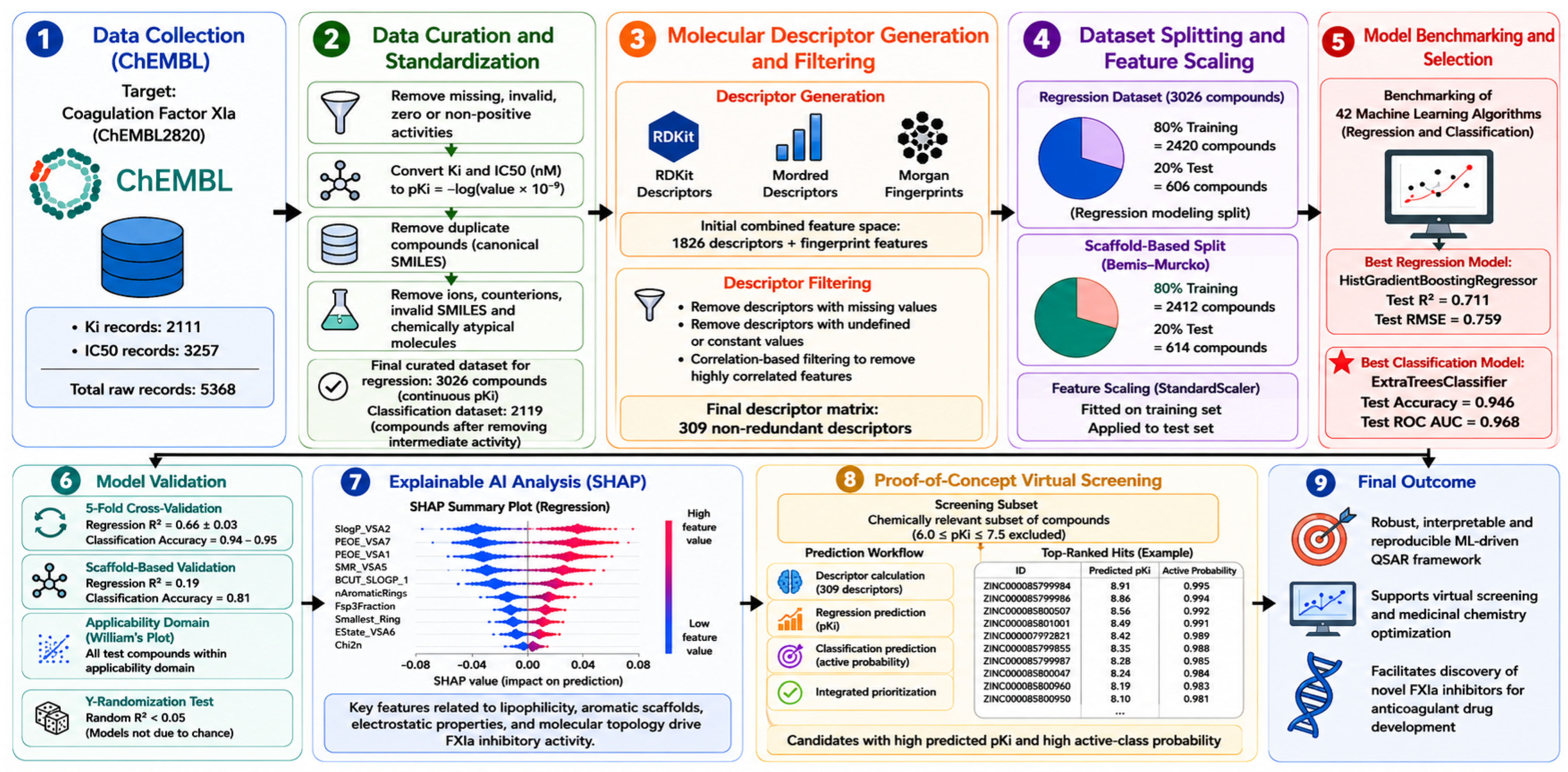
Machine Learning-Driven QSAR Modeling of FXIa Inhibitors for Virtual Screening and Rational Drug Design

Abstract
1. Introduction
2. Results and Discussion
2.1. Dataset Curation and Descriptor Filtering
2.2. Benchmarking and Regression Model Performance
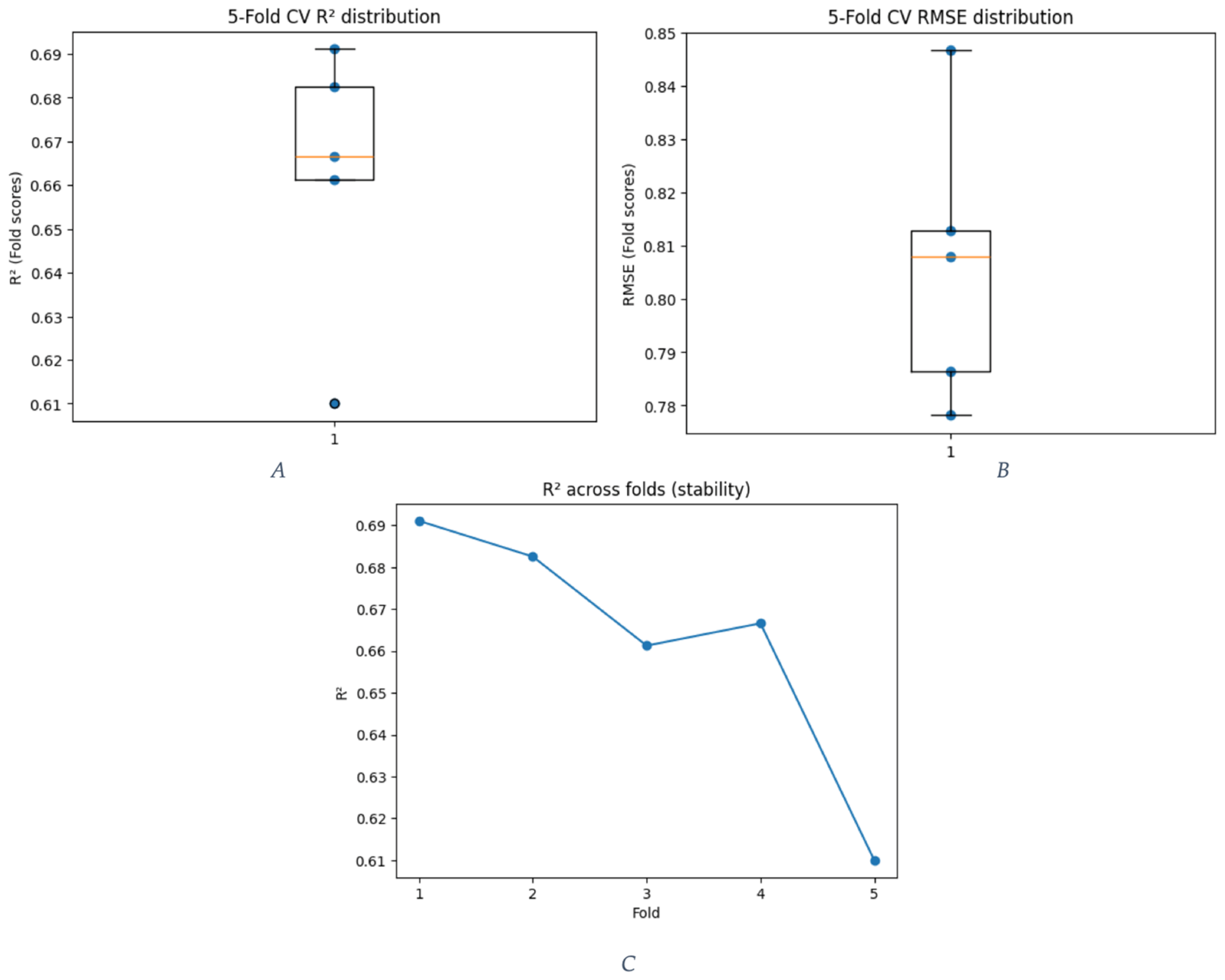
2.3. Cross-Validation and Hyperparameter Optimization
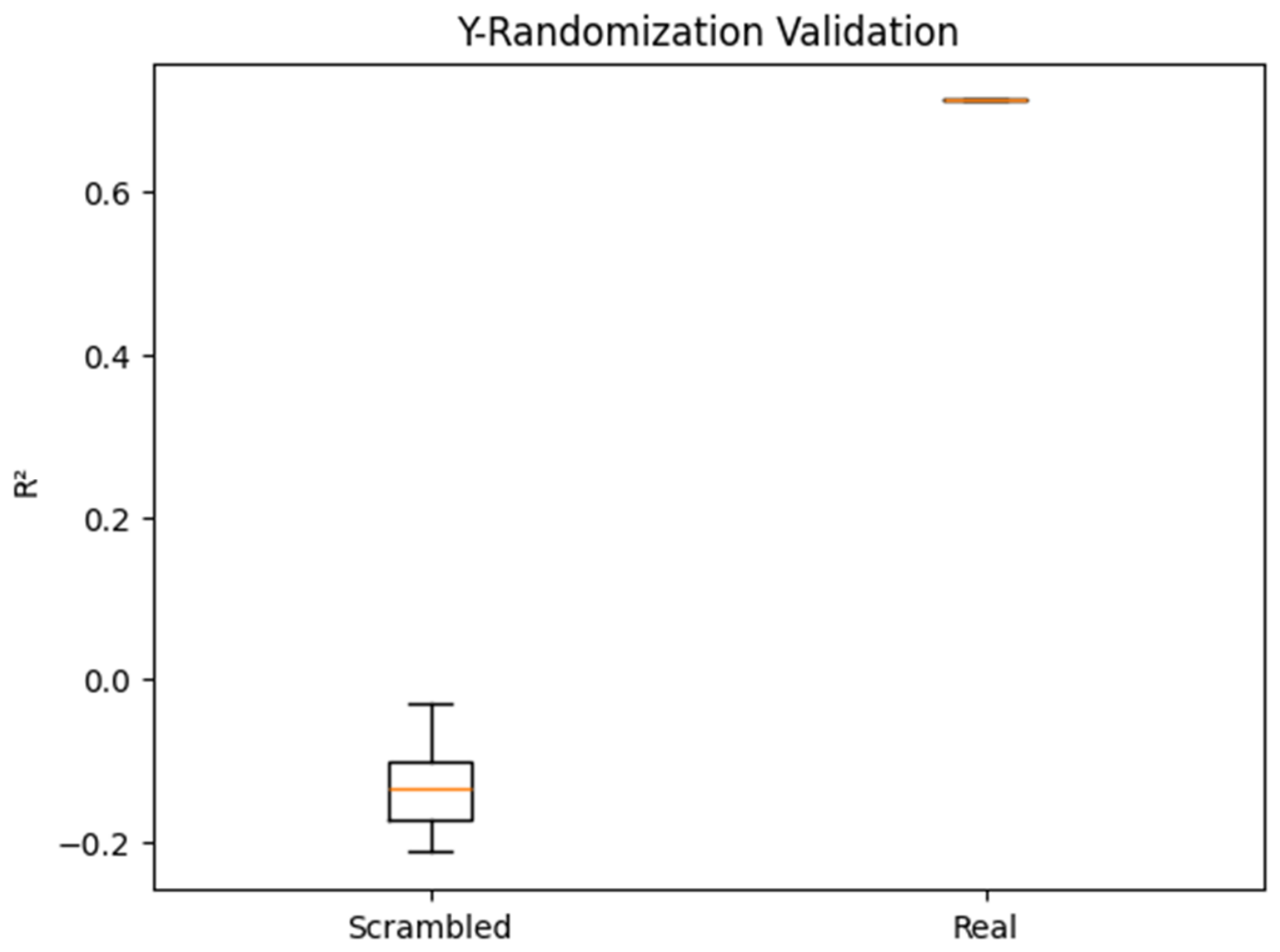
2.4. Y-Randomization Analysis
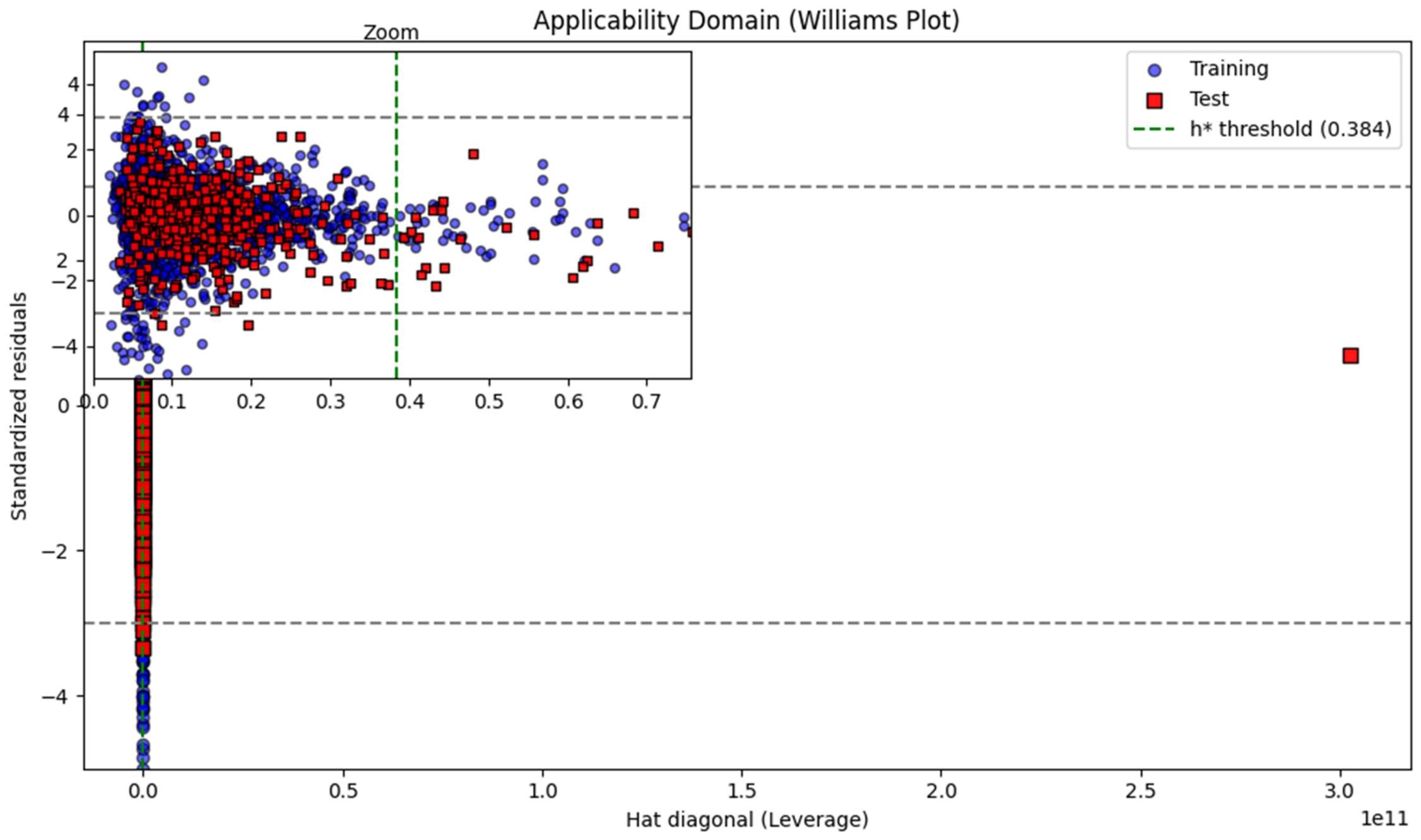
2.5. Applicability Domain Analysis
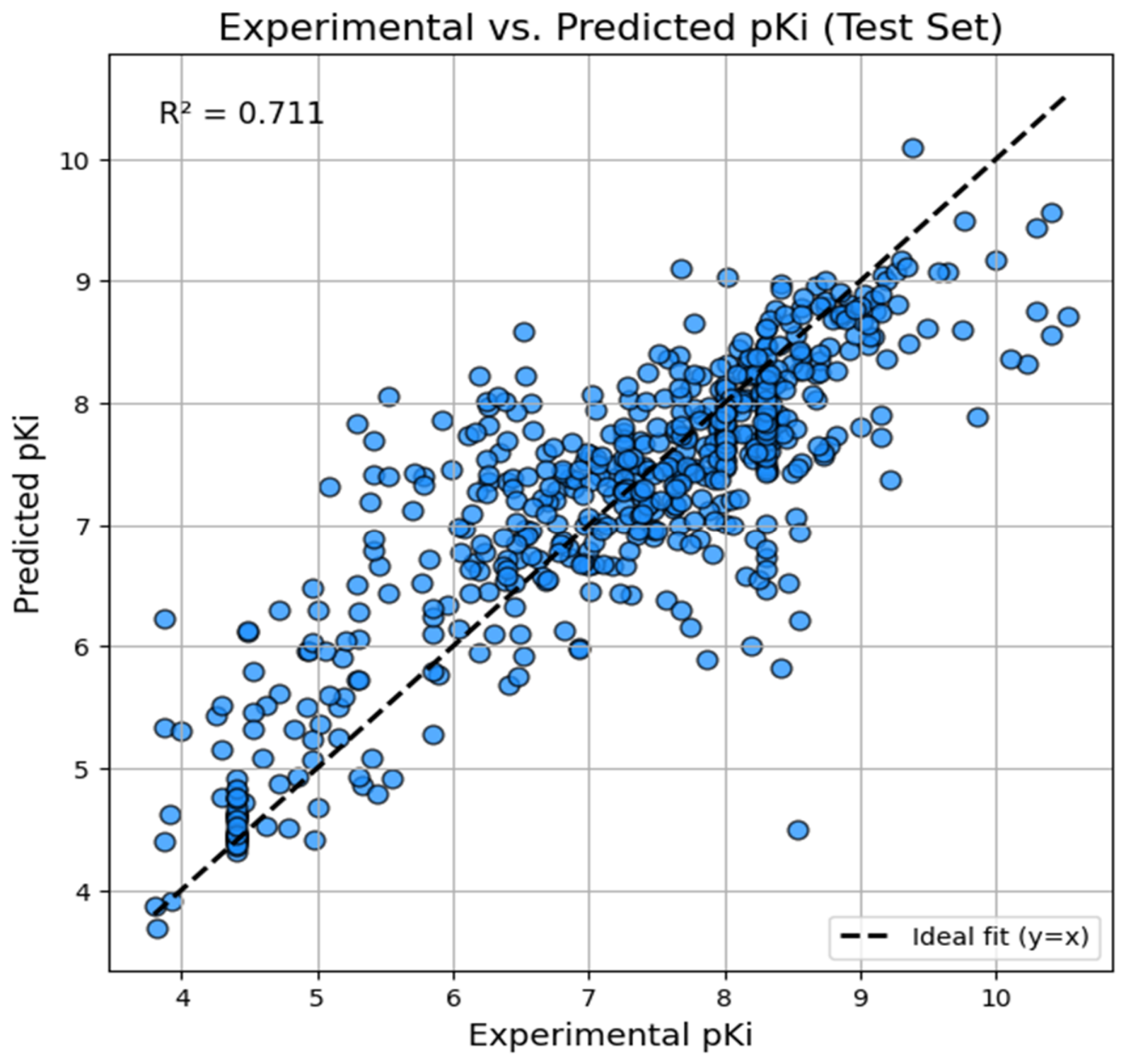
2.6. Experimental Versus Predicted pKi Analysis
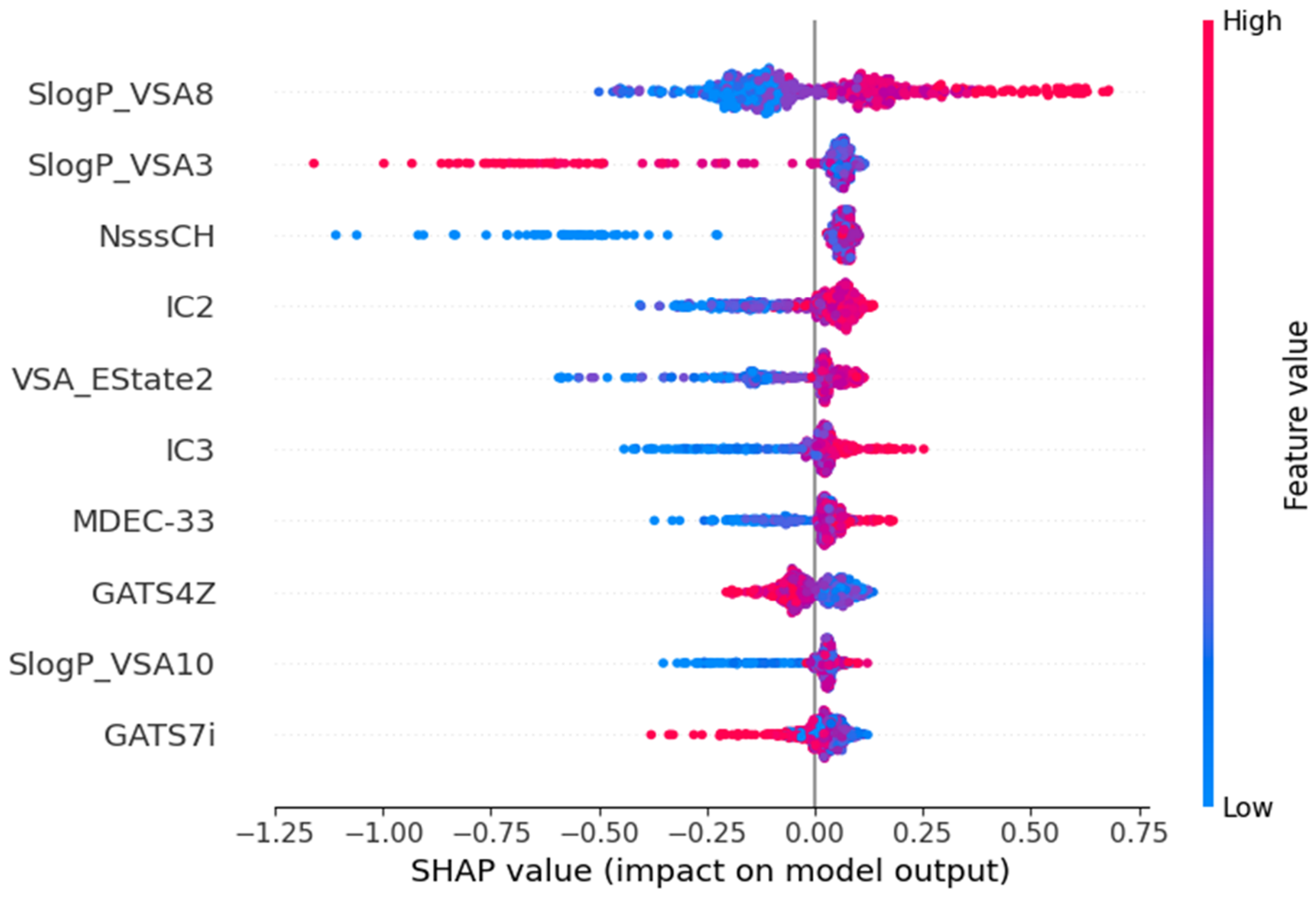
2.7. SHAP-Based Mechanistic Interpretation of FXIa Inhibition
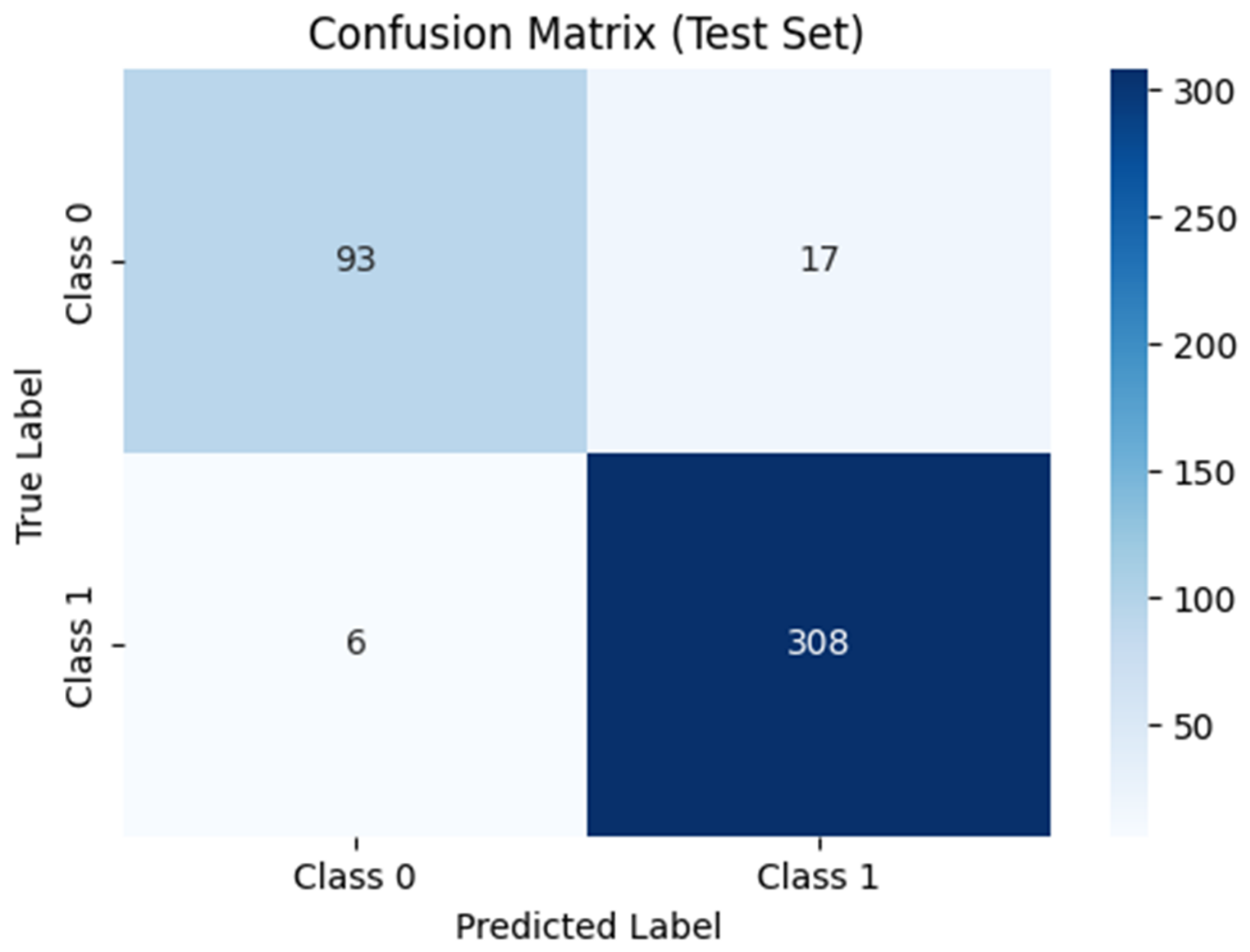
2.8. Classification Modeling and Predictive Performance
2.9. Overall Evaluation of the Developed QSAR Framework
2.10. Proof-of-Concept Virtual Screening
3. Materials and Methods
3.1. Data Collection and Bioactivity Retrieval
3.2. Activity Standardization and Molecular Data Curation
3.3. Molecular Descriptor Generation and Feature Filtering
3.4. Dataset Splitting and Feature Scaling
3.5. Model Evaluation Metrics
3.6. Benchmarking and Machine Learning Modeling
3.7. Hyperparameter Optimization
3.8. Regression Cross-Validation and Y-Randomization Analysis
3.9. SHAP-Based Interpretability Analysis
3.10. Classification Modeling
3.11. Classification Cross-Validation and Y-Randomization
3.12. Proof-of-Concept Virtual Screening Workflow
4. Conclusions
Supplementary Materials
Author Contributions
Funding
Institutional Review Board Statement
Informed Consent Statement
Data Availability Statement
Conflicts of Interest
Abbreviations
| FXIa | Coagulation Factor XIa |
| QSAR | Quantitative Structure–Activity Relationship |
| ML | Machine Learning |
| SHAP | SHapley Additive exPlanations |
References
- Palareti, G. Direct Oral Anticoagulants and Bleeding Risk (in Comparison to Vitamin K Antagonists and Heparins), and the Treatment of Bleeding. Semin. Hematol. 2014, 51, 102–111. [Google Scholar] [CrossRef]
- Levine, M.; Goldstein, J.N. Bleeding Complications of Targeted Oral Anticoagulants: What Is the Risk? Hematology 2014, 2014, 504–509. [Google Scholar] [CrossRef]
- Gailani, D.; Gruber, A. Targeting Factor XI and Factor XIa to Prevent Thrombosis. Blood 2024, 143, 1465–1475. [Google Scholar] [CrossRef]
- Hsu, C.; Hutt, E.; Bloomfield, D.M.; Gailani, D.; Weitz, J.I. Factor XI Inhibition to Uncouple Thrombosis From Hemostasis: JACC Review Topic of the Week. J. Am. Coll. Cardiol. 2021, 78, 625–631. [Google Scholar] [CrossRef] [PubMed]
- Waisman, D.M.; Bharadwaj, A.G. (Eds.) Fibrinolysis-Past, Present and Future; IntechOpen: London, UK, 2025; p. 65. [Google Scholar] [CrossRef]
- Del Toro-Mijares, R.; Porres-Aguilar, M.; Bertoletti, L.; Tafur, A.J.; Benzidia, I.; Cueto-Robledo, G.; Douketis, J.D. Venous Thromboembolism Prevention and Treatment with Factor XI/XIa Inhibitors: Current Status and Future Perspectives. J. Thromb. Thrombolysis 2025, 59, 23–34. [Google Scholar] [CrossRef] [PubMed]
- Xie, Z.; Meng, Z.; Yang, X.; Duan, Y.; Wang, Q.; Liao, C. Factor XIa Inhibitors in Anticoagulation Therapy: Recent Advances and Perspectives. J. Med. Chem. 2023, 66, 5332–5363. [Google Scholar] [CrossRef]
- Xia, Y.; Hu, Y.; Tang, L. Factor XIa Inhibitors as a Novel Anticoagulation Target: Recent Clinical Research Advances. Pharmaceuticals 2023, 16, 866. [Google Scholar] [CrossRef]
- Cherkasov, A.; Muratov, E.N.; Fourches, D.; Varnek, A.; Baskin, I.I.; Cronin, M.; Dearden, J.; Gramatica, P.; Martin, Y.C.; Todeschini, R.; et al. QSAR Modeling: Where Have You Been? Where Are You Going To? J. Med. Chem. 2014, 57, 4977–5010. [Google Scholar] [CrossRef] [PubMed]
- Todeschini, R.; Consonni, V. Handbook of Molecular Descriptors; Wiley: Hoboken, NJ, USA, 2000. [Google Scholar] [CrossRef]
- Gaulton, A.; Bellis, L.J.; Bento, A.P.; Chambers, J.; Davies, M.; Hersey, A.; Light, Y.; McGlinchey, S.; Michalovich, D.; Al-Lazikani, B.; et al. ChEMBL: A Large-Scale Bioactivity Database for Drug Discovery. Nucleic Acids Res. 2012, 40, D1100–D1107. [Google Scholar] [CrossRef]
- Dragos, H.; Gilles, M.; Alexandre, V. Predicting the Predictability: A Unified Approach to the Applicability Domain Problem of QSAR Models. J. Chem. Inf. Model. 2009, 49, 1762–1776. [Google Scholar] [CrossRef]
- Udeabor, S.E.; Ishfaq, M.; Shah, S.J.; Khalid, I.; Baig, F.; Hamid, M.M.M.; Elfadeel, A.S.A.; Onwuka, C.I.; Ali, S.A.A.; Mustafa, M.M. Discovery of Novel FGFR1 Inhibitors for Oral Squamous Cell Carcinoma Using a Multi-Class QSAR Model, Virtual Screening, and Molecular Dynamics Simulations. BMC Cancer 2025, 26, 146. [Google Scholar] [CrossRef]
- Schulte, L.; Ledel, B.; Herbold, S. Studying the Explanations for the Automated Prediction of Bug and Non-Bug Issues Using LIME and SHAP. Empir. Softw. Eng. 2024, 29, 93. [Google Scholar] [CrossRef]
- Liang, Y.; Qiao, Z.; Meng, F. Identifying TMPRSS2 Inhibitors by Drug Repurposing Screenings of Known FXIa Inhibitors: A Computational Study. Lett. Drug Des. Discov. 2022, 21, 590–601. [Google Scholar] [CrossRef]
- Wu, J.; Yue, H.; Wang, X.; Yao, Y.; Du, N.; Gong, P. Structure-Based Design and Synthesis of Novel FXIa Inhibitors Targeting the S2’ Subsite for Enhanced Antithrombotic Efficacy. Mol. Divers. 2024, 29, 4131–4158. [Google Scholar] [CrossRef] [PubMed]
- Li, Q.; Zhang, H.; Guan, S.; Du, J.; Zhang, Y.; Wang, S. Molecular Dynamics Simulation of the Inhibition Mechanism of Factor XIa by Milvexian-like Macrocyclic Inhibitors. Comput. Theor. Chem. 2023, 1225, 114131. [Google Scholar] [CrossRef]
- Tropsha, A. Best Practices for QSAR Model Development, Validation, and Exploitation. Mol. Inform. 2010, 29, 476–488. [Google Scholar] [CrossRef]
- Chen, H.; Engkvist, O.; Wang, Y.; Olivecrona, M.; Blaschke, T. The Rise of Deep Learning in Drug Discovery. Drug Discov. Today 2018, 23, 1241–1250. [Google Scholar] [CrossRef] [PubMed]
- Sheridan, R.P. Time-Split Cross-Validation as a Method for Estimating the Goodness of Prospective Prediction. J. Chem. Inf. Model. 2013, 53, 783–790. [Google Scholar] [CrossRef]
- Wu, Z.; Ramsundar, B.; Feinberg, E.N.; Gomes, J.; Geniesse, C.; Pappu, A.S.; Leswing, K.; Pande, V. MoleculeNet: A Benchmark for Molecular Machine Learning. Chem. Sci. 2018, 9, 513–530. [Google Scholar] [CrossRef]
- Barredo Arrieta, A.; Díaz-Rodríguez, N.; Del Ser, J.; Bennetot, A.; Tabik, S.; Barbado, A.; Garcia, S.; Gil-Lopez, S.; Molina, D.; Benjamins, R.; et al. Explainable Artificial Intelligence (XAI): Concepts, Taxonomies, Opportunities and Challenges toward Responsible AI. Inf. Fusion 2020, 58, 82–115. [Google Scholar] [CrossRef]
- Ekins, S.; Puhl, A.C.; Zorn, K.M.; Lane, T.R.; Russo, D.P.; Klein, J.J.; Hickey, A.J.; Clark, A.M. Exploiting Machine Learning for End-to-End Drug Discovery and Development. Nat. Mater. 2019, 18, 435–441. [Google Scholar] [CrossRef]
- Haider, I.; Li, M.; Kamran Jamil, M. Graph-Based Stacking Ensemble Approach for Physicochemical Properties Prediction of Oncology-Relevant Compounds. J. Supercomput. 2026, 82, 428. [Google Scholar] [CrossRef]
- Korlagunta, S.R.; Selvan, I.M.; Dhanasekaran, S. Machine Learning-Driven QSAR and Docking Pipeline for Identification of Amyloid Beta-A4 Inhibitors in Alzheimer’s Disease. J. Pharmacol. Pharmacother. 2026, 1–9. [Google Scholar] [CrossRef]
- Golbraikh, A.; Tropsha, A. Beware of Q2! J. Mol. Graph. Model. 2002, 20, 269–276. [Google Scholar] [CrossRef]
- Selassie, C.D.; Mekapati, S.B.; Verma, R.P. QSAR: Then and Now. Curr. Top. Med. Chem. 2002, 2, 1357–1379. [Google Scholar] [CrossRef]
- Rücker, C.; Rücker, G.; Meringer, M. Y-Randomization and Its Variants in QSPR/QSAR. J. Chem. Inf. Model. 2007, 47, 2345–2357. [Google Scholar] [CrossRef]
- Eriksson, L.; Jaworska, J.; Worth, A.P.; Cronin, M.T.D.; McDowell, R.M.; Gramatica, P. Methods for Reliability and Uncertainty Assessment and for Applicability Evaluations of Classification- and Regression-Based QSARs. Environ. Health Perspect. 2003, 111, 1361. [Google Scholar] [CrossRef]
- Tropsha, A.; Gramatica, P.; Gombar, V.K. The Importance of Being Earnest: Validation Is the Absolute Essential for Successful Application and Interpretation of QSPR Models. QSAR Comb. Sci. 2003, 22, 69–77. [Google Scholar] [CrossRef]
- Eriksson, L.; Johansson, E.; Lindgren, F.; Wold, S. GIFI-PLS: Modeling of Non-Linearities and Discontinuities in QSAR. Quant. Struct.-Act. Relatsh. 2000, 19, 345–355. [Google Scholar] [CrossRef]
- Todeschini, R.; Consonni, V. Molecular Descriptors for Chemoinformatics, 2nd ed.; Wiley: Hoboken, NJ, USA, 2009; Volume 41, 1257p. [Google Scholar] [CrossRef]
- Hawkins, D.M. The Problem of Overfitting. J. Chem. Inf. Comput. Sci. 2003, 44, 1–12. [Google Scholar] [CrossRef] [PubMed]
- Gramatica, P. Principles of QSAR Models Validation: Internal and External. QSAR Comb. Sci. 2007, 26, 694–701. [Google Scholar] [CrossRef]
- Jaworska, J.; Nikolova-Jeliazkova, N.; Aldenberg, T. QSAR Applicability Domain Estimation by Projection of the Training Set in Descriptor Space: A Review. ATLA Altern. Lab. Anim. 2005, 33, 445–459. [Google Scholar] [CrossRef] [PubMed]
- Polishchuk, P. Interpretation of Quantitative Structure–Activity Relationship Models: Past, Present, and Future. J. Chem. Inf. Model. 2017, 57, 2618–2639. [Google Scholar] [CrossRef] [PubMed]
- Muratov, E.N.; Bajorath, J.; Sheridan, R.P.; Tetko, I.V.; Filimonov, D.; Poroikov, V.; Oprea, T.I.; Baskin, I.I.; Varnek, A.; Roitberg, A.; et al. QSAR without Borders. Chem. Soc. Rev. 2020, 49, 3525–3564. [Google Scholar] [CrossRef] [PubMed]
- Sheridan, R.P. Interpretation of QSAR Models by Coloring Atoms According to Changes in Predicted Activity: How Robust Is It? J. Chem. Inf. Model. 2019, 59, 1324–1337. [Google Scholar] [CrossRef]
- Al-Horani, R.A.; Desai, U.R. Recent Advances on Plasmin Inhibitors for the Treatment of Fibrinolysis-Related Disorders. Med. Res. Rev. 2014, 34, 1168–1216. [Google Scholar] [CrossRef]
- Murray, C.W.; Rees, D.C. The Rise of Fragment-Based Drug Discovery. Nat. Chem. 2009, 1, 187–192. [Google Scholar] [CrossRef]
- Lipinski, C.A.; Lombardo, F.; Dominy, B.W.; Feeney, P.J. Experimental and Computational Approaches to Estimate Solubility and Permeability in Drug Discovery and Development Settings. Adv. Drug Deliv. Rev. 1997, 23, 3–25. [Google Scholar] [CrossRef]
- Capodanno, D.; Alexander, J.H.; Bahit, M.C.; Eikelboom, J.W.; Gibson, C.M.; Goodman, S.G.; Kunadian, V.; Lip, G.Y.H.; Lopes, R.D.; Mehran, R.; et al. Factor XI Inhibitors for the Prevention and Treatment of Venous and Arterial Thromboembolism. Nat. Rev. Cardiol. 2025, 22, 896–912. [Google Scholar] [CrossRef]
- Presume, J.; Ferreira, J.; Ribeiras, R. Factor XI Inhibitors: A New Horizon in Anticoagulation Therapy. Cardiol. Ther. 2024, 13, 1–16. [Google Scholar] [CrossRef]
- Powers, D.M.W. Evaluation: From Precision, Recall and F-Measure to ROC, Informedness, Markedness and Correlation. J. Mach. Learn. Technol. 2020, 2, 2229–3981. [Google Scholar]
- Gedeck, P.; Rohde, B.; Bartels, C. QSAR—How Good Is It in Practice? Comparison of Descriptor Sets on an Unbiased Cross Section of Corporate Data Sets. J. Chem. Inf. Model. 2006, 46, 1924–1936. [Google Scholar] [CrossRef]
- Sinha, K.; Ghosh, N.; Sil, P.C. A Review on the Recent Applications of Deep Learning in Predictive Drug Toxicological Studies. Chem. Res. Toxicol. 2023, 36, 1174–1205. [Google Scholar] [CrossRef]
- Jiménez-Luna, J.; Grisoni, F.; Schneider, G. Drug Discovery with Explainable Artificial Intelligence. Nat. Mach. Intell. 2020, 2, 573–584. [Google Scholar] [CrossRef]
- Jiménez-Luna, J.; Skalic, M.; Weskamp, N.; Schneider, G. Coloring Molecules with Explainable Artificial Intelligence for Preclinical Relevance Assessment. J. Chem. Inf. Model. 2021, 61, 1083–1094. [Google Scholar] [CrossRef] [PubMed]
- Mater, A.C.; Coote, M.L. Deep Learning in Chemistry. J. Chem. Inf. Model. 2019, 59, 2545–2559. [Google Scholar] [CrossRef] [PubMed]
- Walters, W.P.; Barzilay, R. Applications of Deep Learning in Molecule Generation and Molecular Property Prediction. Acc. Chem. Res. 2020, 54, 263–270. [Google Scholar] [CrossRef] [PubMed]
- Rodríguez-Pérez, R.; Bajorath, J. Interpretation of Machine Learning Models Using Shapley Values: Application to Compound Potency and Multi-Target Activity Predictions. J. Comput. Aided Mol. Des. 2020, 34, 1013–1026. [Google Scholar] [CrossRef]
- Walters, W.P.; Murcko, M. Assessing the Impact of Generative AI on Medicinal Chemistry. Nat. Biotechnol. 2020, 38, 143–145. [Google Scholar] [CrossRef]
- Schneider, G. Automating Drug Discovery. Nat. Rev. Drug Discov. 2017, 17, 97–113. [Google Scholar] [CrossRef]
- Lo, Y.C.; Rensi, S.E.; Torng, W.; Altman, R.B. Machine Learning in Chemoinformatics and Drug Discovery. Drug Discov. Today 2018, 23, 1538–1546. [Google Scholar] [CrossRef]
- Gawehn, E.; Hiss, J.A.; Schneider, G. Deep Learning in Drug Discovery. Mol. Inform. 2016, 35, 3–14. [Google Scholar] [CrossRef]
- Baskin, I.I.; Winkler, D.; Tetko, I.V. A Renaissance of Neural Networks in Drug Discovery. Expert Opin. Drug Discov. 2016, 11, 785–795. [Google Scholar] [CrossRef]
- Kaya, A.O. Interpretable Machine Learning-Driven QSAR Modeling for Coagulation Factor X Inhibitors: From Molecular Descriptors to Predictive Potency. J. Comput. Aided Mol. Des. 2026, 40, 53. [Google Scholar] [CrossRef] [PubMed]
- Moriwaki, H.; Tian, Y.S.; Kawashita, N.; Takagi, T. Mordred: A Molecular Descriptor Calculator. J. Cheminformatics 2018, 10, 4. [Google Scholar] [CrossRef]
- Tosco, P.; Stiefl, N.; Landrum, G. Bringing the MMFF Force Field to the RDKit: Implementation and Validation. J. Cheminformatics 2014, 6, 37. [Google Scholar] [CrossRef]
- Niazi, S.K.; Mariam, Z. Recent Advances in Machine-Learning-Based Chemoinformatics: A Comprehensive Review. Int. J. Mol. Sci. 2023, 24, 11488. [Google Scholar] [CrossRef] [PubMed]
- Lin, H.H.; Han, L.Y.; Yap, C.W.; Xue, Y.; Liu, X.H.; Zhu, F.; Chen, Y.Z. Prediction of Factor Xa Inhibitors by Machine Learning Methods. J. Mol. Graph. Model. 2007, 26, 505–518. [Google Scholar] [CrossRef]
- Koirala, M.; Yan, L.; Mohamed, Z.; DiPaola, M. AI-Integrated QSAR Modeling for Enhanced Drug Discovery: From Classical Approaches to Deep Learning and Structural Insight. Int. J. Mol. Sci. 2025, 26, 9384. [Google Scholar] [CrossRef]
- Lavecchia, A. Machine-Learning Approaches in Drug Discovery: Methods and Applications. Drug Discov. Today 2015, 20, 318–331. [Google Scholar] [CrossRef]
- Vamathevan, J.; Clark, D.; Czodrowski, P.; Dunham, I.; Ferran, E.; Lee, G.; Li, B.; Madabhushi, A.; Shah, P.; Spitzer, M.; et al. Applications of Machine Learning in Drug Discovery and Development. Nat. Rev. Drug Discov. 2019, 18, 463–477. [Google Scholar] [CrossRef]



| Rank | Model | Adjusted R2 | R2 (Test) | RMSE (Test) |
|---|---|---|---|---|
| 1 | HistGradientBoostingRegressor | 0.41 | 0.711 | 0.759 |
| 2 | LGBMRegressor | 0.398 | 0.705 | 0.767 |
| 3 | ExtraTreesRegressor | 0.393 | 0.703 | 0.77 |
| 4 | SVR | 0.386 | 0.699 | 0.774 |
| 5 | NuSVR | 0.361 | 0.688 | 0.789 |
| 6 | RandomForestRegressor | 0.351 | 0.683 | 0.796 |
| 7 | XGBRegressor | 0.332 | 0.673 | 0.808 |
| 8 | GradientBoostingRegressor | 0.303 | 0.659 | 0.825 |
| 9 | KNeighborsRegressor | 0.248 | 0.632 | 0.857 |
| 10 | BaggingRegressor | 0.222 | 0.619 | 0.872 |
| 11 | LassoLarsIC | 0.163 | 0.59 | 0.904 |
| 12 | MLPRegressor | 0.161 | 0.59 | 0.905 |
| 13 | Ridge | 0.158 | 0.588 | 0.906 |
| 14 | RidgeCV | 0.155 | 0.587 | 0.908 |
| 15 | BayesianRidge | 0.133 | 0.576 | 0.92 |
| 16 | LinearRegression | 0.129 | 0.574 | 0.922 |
| 17 | PoissonRegressor | 0.107 | 0.563 | 0.933 |
| 18 | ElasticNetCV | 0.082 | 0.551 | 0.947 |
| 19 | LassoCV | 0.08 | 0.55 | 0.948 |
| 20 | HuberRegressor | 0.078 | 0.549 | 0.949 |
| Rank | Model | Accuracy | ROC-AUC | F1-Score |
|---|---|---|---|---|
| 1 | ExtraTreesClassifier | 0.946 | 0.968 | 0.945 |
| 2 | LogisticRegression | 0.941 | 0.974 | 0.941 |
| 3 | XGBClassifier | 0.941 | 0.974 | 0.94 |
| 4 | LinearSVC | 0.936 | 0.953 | 0.936 |
| 5 | RandomForestClassifier | 0.934 | 0.976 | 0.932 |
| 6 | SVC | 0.939 | 0.969 | 0.937 |
| 7 | LGBMClassifier | 0.934 | 0.973 | 0.933 |
| Rank | Smiles | pKi | Predicted pKi | Active Probability |
|---|---|---|---|---|
| 1 | CN1CCN(c2cccc3c2CCN(C(=O)/C=C/c2c(-n4cnnn4)ccc(Cl)c2F)[C@H]3C(=O)Nc2ccc(C(=O)O)cc2)C(=O)C1 | 6.5229 | 8.6779 | 1.0000 |
| 2 | CC1CCC[C@H](N2CCC(c3c(C(F)(F)F)ccc(Cl)c3F)=CC2=O)c2cc(ccn2)-c2ccc(C(=O)O)cc2NC1=O | 6.4660 | 8.5179 | 0.9900 |
| 3 | CNC(=O)c1ccc(NC(=O)C(CCOC)n2cc(OC)c(-c3cc(Cl)ccc3-n3cc(F)cn3)cc2=O)cn1 | 7.4318 | 8.4878 | 0.9800 |
| 4 | COC(=O)Nc1ccc(-c2cc([C@H](C[C@@H]3CCCN(C(C)=O)C3)NC(=O)/C=C/c3cc(Cl)ccc3-n3cnnn3)nnc2Cl)cc1 | 7.0506 | 8.3319 | 0.8900 |
| 5 | COC(=O)Nc1ccc2c(c1)NC(=O)CC(C)CC[C@H](NC(=O)/C=C/c1cc(Cl)ccc1-n1cnnn1)c1nc-2c[nH]1 | 7.4437 | 8.3126 | 0.9800 |
| 6 | COc1cn(C(CC2CCOC2)C(=O)Nc2ccc(C(=O)O)cc2)c(=O)cc1-c1cc(Cl)ccc1C#N | 6.3279 | 8.1810 | 0.8500 |
| 7 | CN(C)C(=O)C1CCN(c2cccc3c2CCN(C(=O)c2cn(-c4cccc(Cl)c4F)nn2)[C@H]3C(=O)Nc2ccc(C(=O)O)cc2)CC1 | 7.4802 | 8.1395 | 1.0000 |
| 8 | COc1cn(C(CC2CCC(O)CC2)C(=O)Nc2ccc(C(=O)O)cc2)c(=O)cc1-c1cc(Cl)ccc1C#N | 6.8861 | 8.1336 | 0.6800 |
| 9 | C[C@@H]1CCC[C@H](N2CCC(c3c(F)ccc(Cl)c3F)=CC2=O)c2cc(ccn2)-c2cc(CO)ccc2NC1=O | 7.0453 | 8.1259 | 0.9900 |
| 10 | O=C(O)c1ccc(NC(=O)[C@H]2c3cccc(N4CCC(O)CC4)c3CCN2C(=O)c2cn(-c3cccc(Cl)c3F)nn2)cc1 | 7.3665 | 8.1259 | 1.0000 |
| 11 | COC(=O)Nc1ccc2c(c1)NC(=O)[C@@H](C)CCC[C@H](N1CCC(c3cccc(Cl)c3F)=CC1=O)c1ccnc-2c1 | 7.3583 | 8.1119 | 0.9900 |
| 12 | O=C(O)c1ccc(NC(=O)C2c3cccc(C(=O)N4CCNCC4)c3CCN2C(=O)/C=C/c2c(-n3cnnn3)ccc(Cl)c2F)cc1 | 6.2576 | 8.0610 | 0.9900 |
| 13 | CN(C)C1CCN(c2cccc3c2CCN(C(=O)c2cnn(-c4cccc(Cl)c4F)c2)[C@H]3C(=O)Nc2ccc(C(=O)O)cc2)CC1 | 7.2636 | 8.0250 | 0.9700 |
| 14 | COCCC(C(=O)Nc1ccc2nc(-c3ccc(F)cc3)cn2c1)n1cc(OC)c(-c2cc(Cl)ccc2C#N)cc1=O | 7.4815 | 8.0245 | 0.9400 |
| 15 | COCCC(C(=O)Nc1ccc2nn(C)cc2c1)n1cc(OC)c(-c2cc(Cl)ccc2-c2cocn2)cc1=O | 7.4089 | 8.0239 | 0.9700 |
| 16 | C[C@@H]1CCC[C@H](N2CCC(c3c(F)ccc(Cl)c3F)=CC2=O)c2cc(ccn2)-c2ccc(NC(=N)N)cc2NC1=O | 7.0410 | 8.0209 | 0.9600 |
| 17 | N[C@H](CF)[C@H]1CC[C@H](C(=O)N2CC[C@H](c3ccccc3)[C@H]2C(=O)Nc2ccc3oc(C(=O)NS(=O)(=O)N4CCOCC4)cc3c2)CC1 | 6.1612 | 8.0114 | 0.8400 |
| 18 | CCC(C(=O)Nc1ccc2nn(C)cc2c1)n1cc(OC)c(-c2cc(Cl)ccc2-c2cnc(C(F)F)o2)cc1=O | 7.1192 | 7.9927 | 0.9800 |
| 19 | CC1(C)Cc2c(cccc2N2CCNCC2)[C@H](C(=O)Nc2ccc(C(=O)O)cc2)N1C(=O)/C=C/c1c(-n2cnnn2)ccc(Cl)c1F | 6.9706 | 7.9864 | 0.9900 |
| 20 | COC(=O)Nc1ccc2c(c1)NC(=O)[C@H](C)C(=O)CC[C@H](N1CCC(c3c(F)ccc(Cl)c3F)=CC1=O)c1cc-2ccn1 | 7.3439 | 7.9682 | 0.9900 |
Disclaimer/Publisher’s Note: The statements, opinions and data contained in all publications are solely those of the individual author(s) and contributor(s) and not of MDPI and/or the editor(s). MDPI and/or the editor(s) disclaim responsibility for any injury to people or property resulting from any ideas, methods, instructions or products referred to in the content. |
© 2026 by the authors. Licensee MDPI, Basel, Switzerland. This article is an open access article distributed under the terms and conditions of the Creative Commons Attribution (CC BY) license.
Share and Cite
Kaya, A.O.; Emre, M.C.; Emre, N. Machine Learning-Driven QSAR Modeling of FXIa Inhibitors for Virtual Screening and Rational Drug Design. Pharmaceuticals 2026, 19, 912. https://doi.org/10.3390/ph19060912
Kaya AO, Emre MC, Emre N. Machine Learning-Driven QSAR Modeling of FXIa Inhibitors for Virtual Screening and Rational Drug Design. Pharmaceuticals. 2026; 19(6):912. https://doi.org/10.3390/ph19060912
Chicago/Turabian StyleKaya, Ali Onur, Mert Can Emre, and Nesrin Emre. 2026. "Machine Learning-Driven QSAR Modeling of FXIa Inhibitors for Virtual Screening and Rational Drug Design" Pharmaceuticals 19, no. 6: 912. https://doi.org/10.3390/ph19060912
APA StyleKaya, A. O., Emre, M. C., & Emre, N. (2026). Machine Learning-Driven QSAR Modeling of FXIa Inhibitors for Virtual Screening and Rational Drug Design. Pharmaceuticals, 19(6), 912. https://doi.org/10.3390/ph19060912