This is an early access version, the complete PDF, HTML, and XML versions will be available soon.
Article

Synthesis of Phenyl 2-Acetamidoselenogalactoside Mimetics and Interaction with Amyloid β1–42
1
Centro de Química Estrutural, Institute of Molecular Sciences, Faculdade de Ciências, Universidade de Lisboa; Ed C8, Piso 5, 1749-016 Lisboa, Portugal
2
Independent Researcher, Chemin de Joulens, 1, 1110 Morges, Switzerland
3
Independent Researcher, Basingstoke RG25, UK
4
Independent Researcher, Ascot SL5, UK
5
5 Department of Chemistry, University of Sheffield, Brookhill, Shefield S3 7HF, UK
6
Mass Spectrometry Facility, Centro de Química Estruttural, Instituto Superior Técnico, Av. Rovisco Pais, 1049-001 Lisboa, Portugal
*
Author to whom correspondence should be addressed.
Pharmaceuticals 2026, 19(6), 836; https://doi.org/10.3390/ph19060836 (registering DOI)
Submission received: 21 April 2026 / Revised: 8 May 2026 / Accepted: 19 May 2026 / Published: 27 May 2026
(This article belongs to the Section Medicinal Chemistry)

Abstract

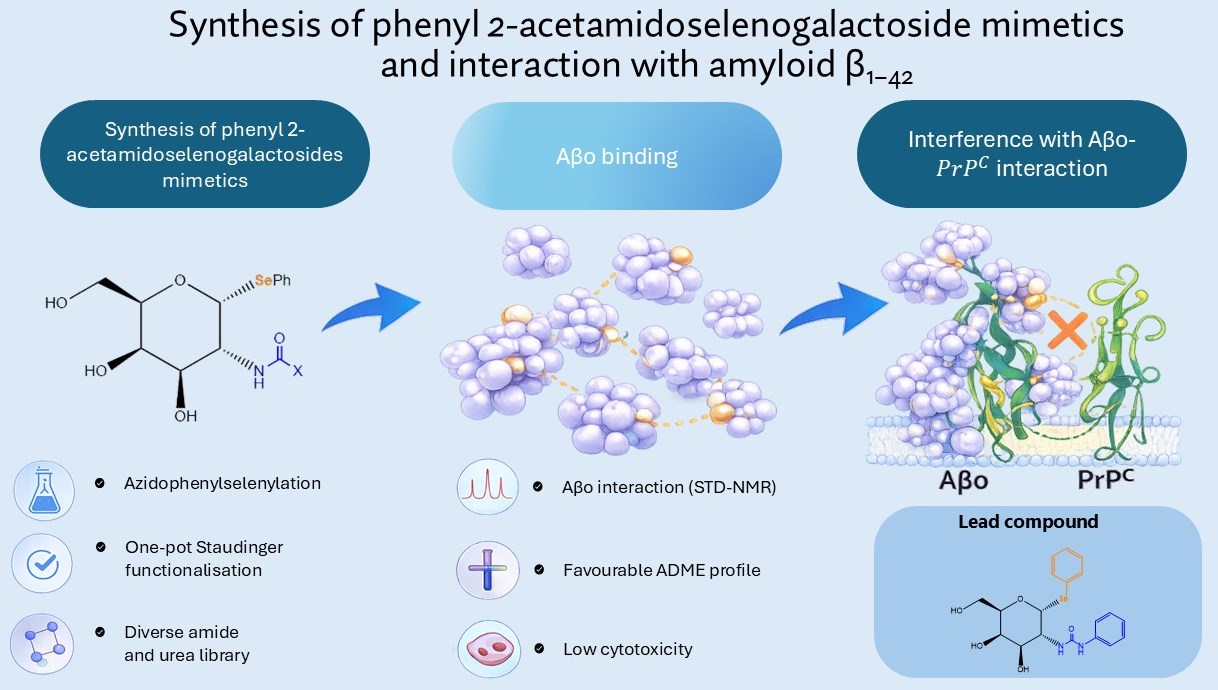
Background/Objectives: Protein–carbohydrate interactions are implicated in amyloid aggregation pathways associated with Alzheimer’s disease (AD). Designing glycomimetics that modulate amyloid assembly represents a promising strategy. In addition, the interaction of Aβ1–42 oligomers (Aβo) with prion protein (PrPC) activates Fyn kinase and leads to Tau hyperphosphorylation, another process characterizing AD. Thus, we generated a library of phenyl 2-acetamidoselenogalactoside mimetics to evaluate their interactions with Aβo and disruption of Aβo–PrPC binding, and consequently their potential to inhibit Fyn kinase activation. Methods: The synthetic approach comprised azidophenylselenylation, a modified one-pot Staudinger reduction–acylation, a selective α-glycosylation, and deacetylation. Structural diversity was achieved mainly via acylation or ureation. The compounds were screened for binding to Aβo using STD-NMR, 19F-NMR, and rapid equilibrium dialysis (RED). ADME properties were assessed through microsomal metabolism and solubility assays, while cytotoxicity was evaluated by MTT assays in human embryonic kidney (HEK) cells. Results: Several compounds bound Aβo in STD-NMR experiments, mainly through aromatic and anomeric protons, and phenyl 2-deoxy-2-phenylureido-1-seleno-α-d-galactopyranoside (34) showed the most consistent response, with >50% increase in relative binding signal in competition assays, demonstrating also some inhibition of Aβo–PrPC interactions (12%). Selenium at the anomeric position enhanced binding compared to sulphur and oxygen analogs. RED experiments confirmed weak binding interactions, consistent with STD-NMR results. ADME revealed that acetylated compounds undergo microsomal metabolism, whereas deacetylated derivatives displayed high aqueous solubility (>100 μM) and showed no cytotoxicity. Conclusions: Phenyl 2-acetamidoselenogalactosides are a novel class of amyloid-binding glycomimetics. Among them, 34 emerges as the most promising compound, combining favorable solubility, metabolic stability, low toxicity, and measurable interference with Aβo and Aβo–PrPC interactions, thus supporting further developments toward therapeutic applications in AD.
Keywords: phenyl 2-acetamidogalactoside mimetics; selenogalactosides; synthesis; carbohydrate–amyloid β interaction; amyloid disease phenyl 2-acetamidogalactoside mimetics; selenogalactosides; synthesis; carbohydrate–amyloid β interaction; amyloid disease
Graphical Abstract