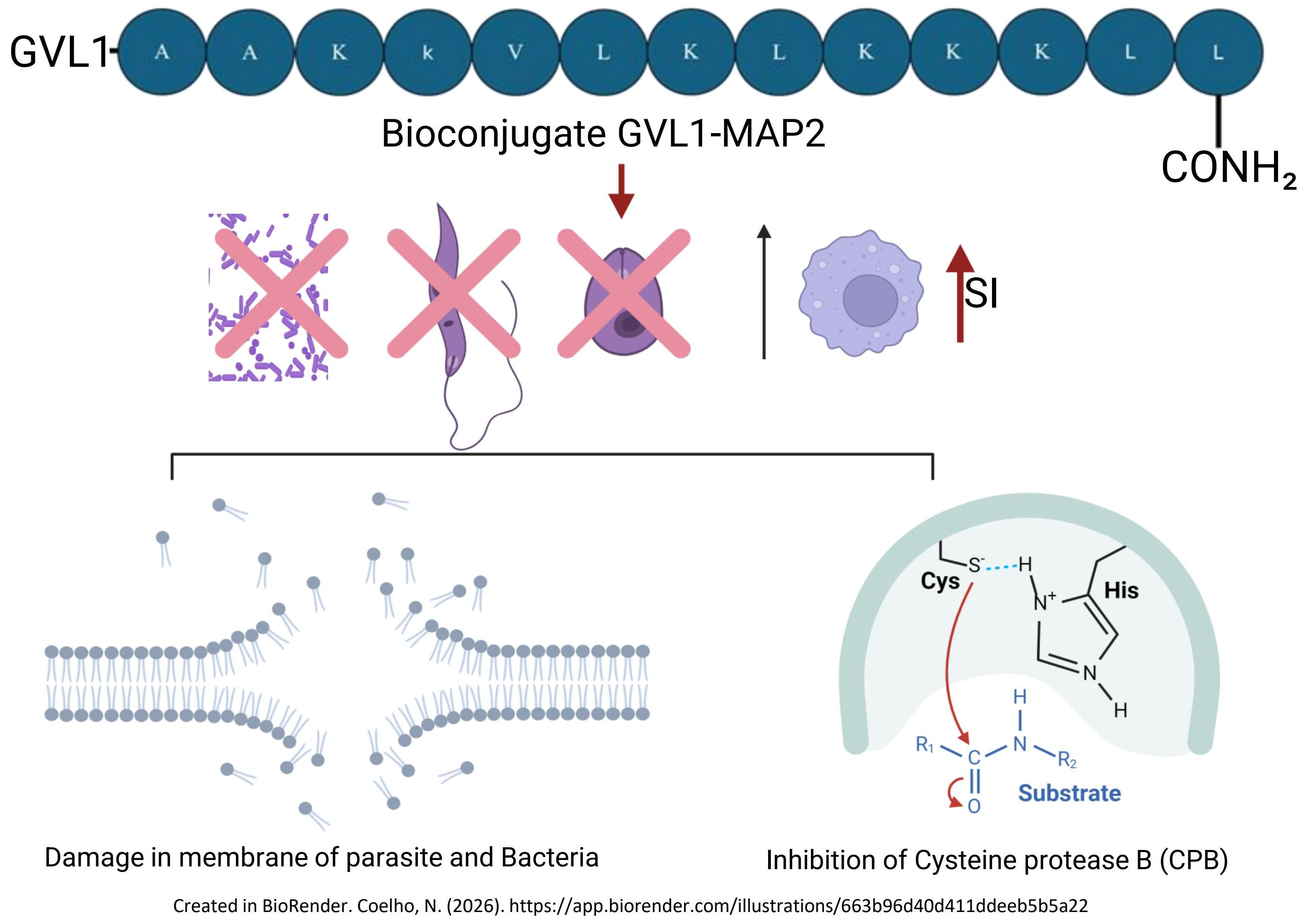
Evaluation of Antileishmanial and Antibacterial Activity of Bioconjugate Guanidine–Temporin


 , , , , , , ,
  , , and
Abstract
1. Introduction
2. Results
2.1. Synthesis of GVL1-MAP1 and GVL1-MAP2 Bioconjugates
2.2. Biological Assays
2.2.1. Antileishmanial and Cytotoxic Activities Evaluation
2.2.2. Stability Assay with Active Fetal Bovine Serum
2.2.3. Antibacterial Assays
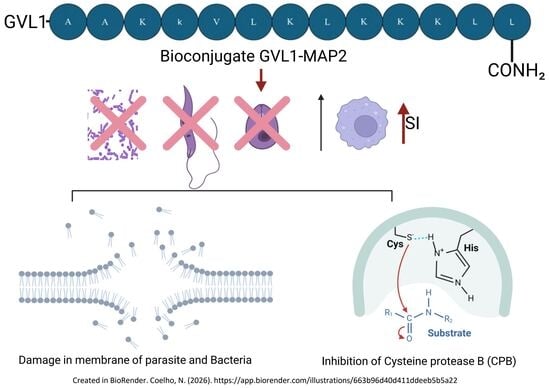
2.3. Mechanism of Action
2.3.1. Vesicle Permeabilization
2.3.2. Cysteine Protease Enzyme Inhibition
3. Discussion
4. Materials and Methods
4.1. Peptides and Bioconjugates Synthesis
4.2. Molecule Purification and Characterization
4.3. Antileishmanial Activity
4.4. Active Serum Stability
4.5. CPB Enzyme Inhibition
4.6. Antibacterial Activity
4.7. LUV Permeabilization Model Assay
4.8. Cytotoxicity Assay on Murine Peritoneal Macrophages
4.9. Statistical Analysis
5. Conclusions
Supplementary Materials
Author Contributions
Funding
Institutional Review Board Statement
Informed Consent Statement
Data Availability Statement
Acknowledgments
Conflicts of Interest
Abbreviations
| AMPs | Antimicrobial peptides |
| Amp B | Amphotericin B |
| AMR | Antimicrobial resistance |
| CF | Carboxyfluorescein |
| CL | Cutaneous leishmaniasis |
| CPB | Cysteine proteases B |
| CPP | Cell penetration peptide |
| DIEA | N,N-Diisopropylethylamine |
| GIPL | Glycoinositolphospholipids |
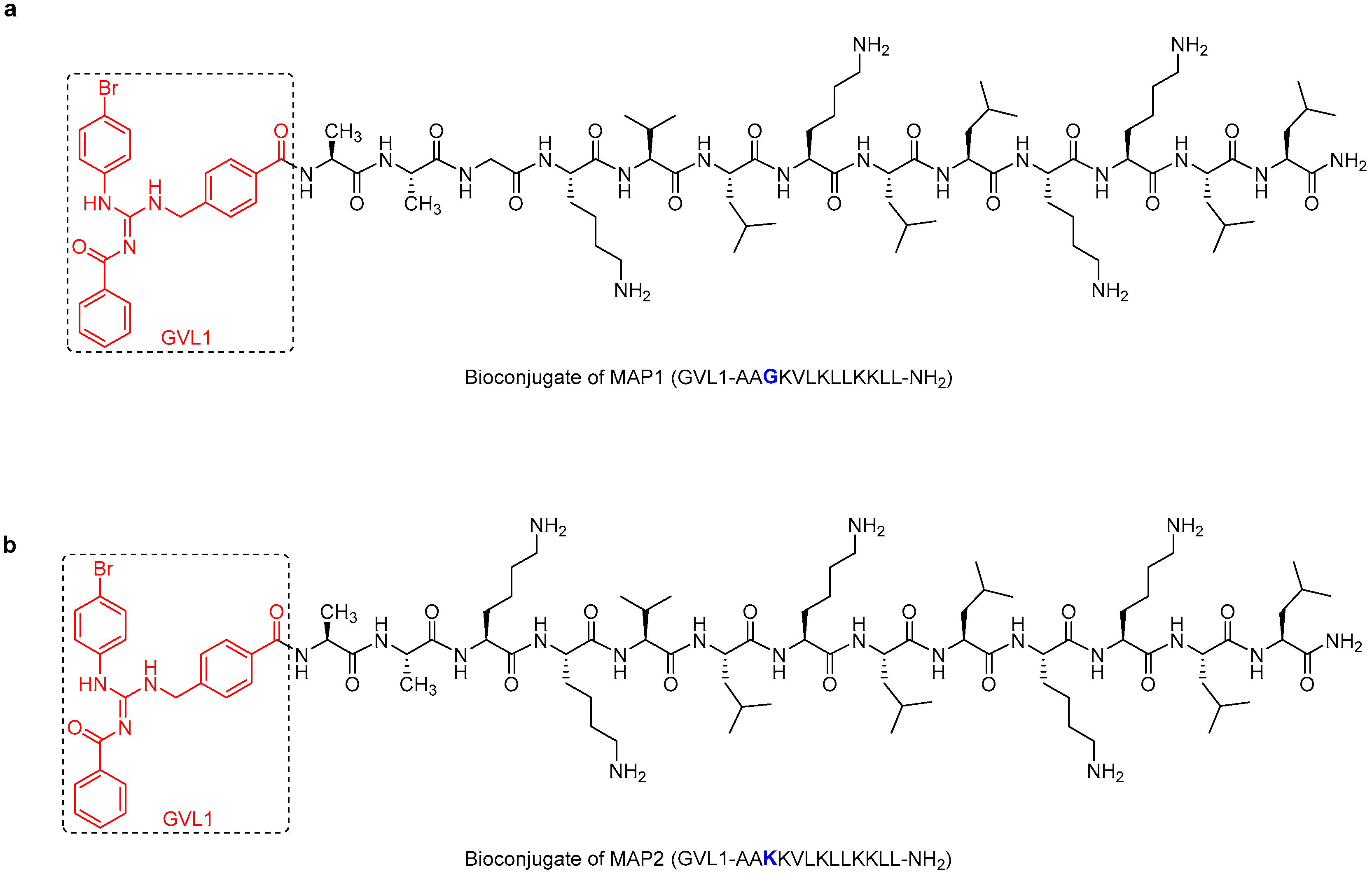
| GVL1 | (Z)-4-((2-benzoyl-3-(4-bromophenyl)guanidino)methyl) benzoic acid |
| HATU | 2-(1-H-7-azabenzotriazol1-yl)-1,1,3,3-tetramethyluroniumhexafluorophophate |
| LPG | Lipophosphoglycan |
| MAP1 | AAGKVLKLLKKLL-NH2 |
| MAP2 | AAKKVLKLLKKLL-NH2 |
| MBC | Minimum bactericidal concentration |
| MIC | Minimum inhibitory concentration |
| POPC | 1-palmitoyl-2-oleoyl-sn-glycero-3-phosphocholine |
| POPS | 1-palmitoyl-2-oleoyl-sn-glycero-3-phospho-L-serine |
| SI | Selectivity index (MBC/MIC ratio) |
References
- Baker, R.E.; Mahmud, A.S.; Miller, I.F.; Rajeev, M.; Rasambainarivo, F.; Rice, B.L.; Takahashi, S.; Tatem, A.J.; Wagner, C.E.; Wang, L.F.; et al. Infectious Disease in an Era of Global Change. Nat. Rev. Microbiol. 2022, 20, 193–205. [Google Scholar] [CrossRef] [PubMed]
- Taslimi, Y.; Zahedifard, F.; Rafati, S. Leishmaniasis and Various Immunotherapeutic Approaches. Parasitology 2018, 145, 497–507. [Google Scholar] [CrossRef]
- Ponte-Sucre, A.; Gamarro, F.; Dujardin, J.C.; Barrett, M.P.; López-Vélez, R.; García-Hernández, R.; Pountain, A.W.; Mwenechanya, R.; Papadopoulou, B. Drug Resistance and Treatment Failure in Leishmaniasis: A 21st Century Challenge. PLoS Negl. Trop. Dis. 2017, 11, e0006052. [Google Scholar] [CrossRef]
- World Health Organization. 2019 Antibacterial Agents in Clinical Development: An Analysis of the Antibacterial Clinical Development Pipeline; World Health Organization: Geneva, Switzerland, 2019; Available online: https://iris.who.int/server/api/core/bitstreams/945de890-a22e-47ee-95ae-610c9dc0250a/content (accessed on 12 April 2026).
- Huemer, M.; Mairpady Shambat, S.; Brugger, S.D. Antibiotic Resistance and Persistence—Implications for Human Health and Treatment Perspectives. EMBO Rep. 2020, 21, e51034. [Google Scholar] [CrossRef]
- Alzain, M.; Daghistani, H.; Shamrani, T.; Almoghrabi, Y.; Daghistani, Y.; Alharbi, O.S.; Sait, A.M.; Mufrrih, M.; Alhazmi, W.; Alqarni, M.A.; et al. Antimicrobial Peptides: Mechanisms, Applications, and Therapeutic Potential. Infect. Drug Resist. 2025, 18, 4385–4426. [Google Scholar] [CrossRef] [PubMed]
- de Souza, J.V.M.; Costa, N.C.S.; Brasil, M.C.O.A.; dos Anjos, L.R.; de Menezes, R.P.B.; Zampieri, E.H.; de Lima, J.S.; Velasquez, A.M.A.; Scotti, L.; Scotti, M.T.; et al. Guanidines Conjugated with Cell-Penetrating Peptides: A New Approach for the Development of Antileishmanial Molecules. Molecules 2025, 30, 264. [Google Scholar] [CrossRef] [PubMed]
- da Silva Sanches, P.R.; Sanchez-Velazquez, R.; Batista, M.N.; Carneiro, B.M.; Bittar, C.; De Lorenzo, G.; Rahal, P.; Patel, A.H.; Cilli, E.M. Antiviral Evaluation of New Synthetic Bioconjugates Based on GA-Hecate: A New Class of Antivirals Targeting Different Steps of Zika Virus Replication. Molecules 2023, 28, 4884. [Google Scholar] [CrossRef]
- Hollunger, G. Guanidines and Oxidative Phosphorylations. Acta Pharmacol. Toxicol. 1955, 11, 1–84. [Google Scholar] [CrossRef]
- Alexander, J.; Coombs, G.H.; Mottram, J.C. Leishmania Mexicana Cysteine Proteinase-Deficient Mutants Have Attenuated Virulence for Mice and Potentiate a Th1 Response1. J. Immunol. 1998, 161, 6794–6801. [Google Scholar] [CrossRef]
- Costa, N.C.S.; dos Anjos, L.R.; de Souza, J.V.M.; Brasil, M.C.O.d.A.; Moreira, V.P.; Graminha, M.A.S.; Lubec, G.; Gonzalez, E.R.P.; Cilli, E.M. Development of New Leishmanicidal Compounds via Bioconjugation of Antimicrobial Peptides and Antileishmanial Guanidines. ACS Omega 2023, 8, 34008–34016. [Google Scholar] [CrossRef]
- Souza e Silva, P.; Ferreira, M.A.; de Moraes, L.F.R.; de Barros, E.; Preza, S.L.E.; Cardoso, M.H.; Franco, O.L.; Migliolo, L. Synthetic Peptides Bioinspired in Temporin-PTa with Antibacterial and Antibiofilm Activity. Chem. Biol. Drug Des. 2022, 100, 51–63. [Google Scholar] [CrossRef] [PubMed]
- Merrifield, R.B. Solid Phase Peptide Synthesis. III. An Improved Synthesis of Bradykinin. Biochemistry 1964, 3, 1385–1390. [Google Scholar] [CrossRef]
- Pankey, G.A.; Sabath, L.D. Clinical Relevance of Bacteriostatic versus Bactericidal Mechanisms of Action in the Treatment of Gram-Positive Bacterial Infections. Clin. Infect. Dis. 2004, 38, 864–870. [Google Scholar] [CrossRef]
- Krauson, A.J.; He, J.; Wimley, W.C. Determining the Mechanism of Membrane Permeabilizing Peptides: Identification of Potent, Equilibrium Pore-Formers. Biochim. Et Biophys. Acta (BBA) Biomembr. 2012, 1818, 1625–1632. [Google Scholar] [CrossRef] [PubMed]
- Cabezas, Y.; Legentil, L.; Robert-Gangneux, F.; Daligault, F.; Belaz, S.; Nugier-Chauvin, C.; Tranchimand, S.; Tellier, C.; Gangneux, J.-P.; Ferrières, V. Leishmania Cell Wall as a Potent Target for Antiparasitic Drugs. A Focus on the Glycoconjugates. Org. Biomol. Chem. 2015, 13, 8393–8404. [Google Scholar] [CrossRef]
- dos Santos, M.G.; Muxel, S.M.; Zampieri, R.A.; Pomorski, T.G.; Floeter-Winter, L.M. Transbilayer Dynamics of Phospholipids in the Plasma Membrane of the Leishmania Genus. PLoS ONE 2013, 8, e55604. [Google Scholar] [CrossRef]
- Dueñas-Romero, A.M.; Loiseau, P.M.; Saint-Pierre-Chazalet, M. Interaction of Sitamaquine with Membrane Lipids of Leishmania Donovani Promastigotes. Biochim. Biophys. Acta Biomembr. 2007, 1768, 246–252. [Google Scholar] [CrossRef] [PubMed]
- Baileyid, F.; Mondragon-Shem, K.; Haines, L.R.; Olabi, A.; Alorfi, A.; Ruiz-Postigo, J.A.; Alvar, J.; Hotez, P.; Adams, E.R.; Vélez, I.D.; et al. Cutaneous Leishmaniasis and Co-Morbid Major Depressive Disorder: A Systematic Review with Burden Estimates. PLoS Negl. Trop. Dis. 2019, 13, e0007092. [Google Scholar] [CrossRef]
- Katsuno, K.; Burrows, J.N.; Duncan, K.; Van Huijsduijnen, R.H.; Kaneko, T.; Kita, K.; Mowbray, C.E.; Schmatz, D.; Warner, P.; Slingsby, B.T. Hit and Lead Criteria in Drug Discovery for Infectious Diseases of the Developing World. Nat. Rev. Drug Discov. 2015, 14, 751–758. [Google Scholar] [CrossRef]
- Schroeder, J.; Aebischer, T. Vaccines for Leishmaniasis: From Proteome to Vaccine Candidates. Hum. Vaccin. 2011, 7, 10–15. [Google Scholar] [CrossRef]
- Maharjan, R.; Khan, A.I.; Nadeem-ul-Haque, M.; Maresca, M.; Choudhary, M.I.; Shaheen, F.; Simjee, S.U. Serum Stable and Low Hemolytic Temporin-SHa Peptide Analogs Disrupt Cell Membrane of Methicillin-Resistant Staphylococcus Aureus (MRSA). Probiotics Antimicrob. Proteins 2022, 14, 391–405. [Google Scholar] [CrossRef]
- Eggimann, G.A.; Sweeney, K.; Bolt, H.L.; Rozatian, N.; Cobb, S.L.; Denny, P.W. The Role of Phosphoglycans in the Susceptibility of Leishmania Mexicana to the Temporin Family of Anti-Microbial Peptides. Molecules 2015, 20, 2775–2785. [Google Scholar] [CrossRef]
- Silva, P.S.e.; Guindo, A.S.; Oliveira, P.H.C.; de Moraes, L.F.R.N.; Boleti, A.P.d.A.; Ferreira, M.A.; de Oliveira, C.F.R.; Macedo, M.L.R.; Rossato, L.; Simionatto, S.; et al. Evaluation of the Synthetic Multifunctional Peptide Hp-MAP3 Derivative of Temporin-PTa. Toxins 2023, 15, 42. [Google Scholar] [CrossRef] [PubMed]
- Raja, Z.; André, S.; Abbassi, F.; Humblot, V.; Lequin, O.; Bouceba, T.; Correia, I.; Casale, S.; Foulon, T.; Sereno, D.; et al. Insight into the Mechanism of Action of Temporin-SHa, a New Broad-Spectrum Antiparasitic and Antibacterial Agent. PLoS ONE 2017, 12, e0174024. [Google Scholar] [CrossRef]
- Zhang, S.K.; Song, J.W.; Gong, F.; Li, S.B.; Chang, H.Y.; Xie, H.M.; Gao, H.W.; Tan, Y.X.; Ji, S.P. Design of an α-Helical Antimicrobial Peptide with Improved Cell-Selective and Potent Anti-Biofilm Activity. Sci. Rep. 2016, 6, 27394. [Google Scholar] [CrossRef] [PubMed]
- Turco, S.J.; Descoteaux, A. The Lipophosphogl Yean of Leislfmania Parasites. Annu. Rev. Microbiol. 1992, 46, 65–92. [Google Scholar] [CrossRef]
- McConville, M.J.; Ferguson, M.A.J. The Structure, Biosynthesis and Function of Glycosylated Phosphatidylinositols in the Parasitic Protozoa and Higher Eukaryotes. Biochem. J. 1993, 294, 305–324. [Google Scholar] [CrossRef]
- Zhang, K.; Beverley, S.M. Phospholipid and Sphingolipid Metabolism in Leishmania. Mol. Biochem. Parasitol. 2010, 170, 55–64. [Google Scholar] [CrossRef]
- Wimley, W.C.; Hristova, K. The Mechanism of Membrane Permeabilization by Peptides: Still an Enigma. Aust. J. Chem. 2020, 73, 96–103. [Google Scholar] [CrossRef]
- Batista, M.N.; Sanches, P.R.d.S.; Carneiro, B.M.; Braga, A.C.S.; Campos, G.R.F.; Cilli, E.M.; Rahal, P. GA-Hecate Antiviral Properties on HCV Whole Cycle Represent a New Antiviral Class and Open the Door for the Development of Broad Spectrum Antivirals. Sci. Rep. 2018, 8, 14329. [Google Scholar] [CrossRef]
- Gagat, P.; Ostrówka, M.; Duda-Madej, A.; Mackiewicz, P. Enhancing Antimicrobial Peptide Activity through Modifications of Charge, Hydrophobicity, and Structure. Int. J. Mol. Sci. 2024, 25, 10821. [Google Scholar] [CrossRef]
- Gentilucci, L.; De Marco, R.; Cerisoli, L. Chemical Modifications Designed to Improve Peptide Stability: Incorporation of Non-Natural Amino Acids, Pseudo-Peptide Bonds, and Cyclization. Curr. Pharm. Des. 2010, 16, 3185–3203. [Google Scholar] [CrossRef]
- Mahlapuu, M.; Håkansson, J.; Ringstad, L.; Björn, C. Antimicrobial Peptides: An Emerging Category of Therapeutic Agents. Front. Cell. Infect. Microbiol. 2016, 6, 194. [Google Scholar] [CrossRef] [PubMed]
- Ferrara, F.; Castagna, T.; Pantolini, B.; Campanardi, M.C.; Roperti, M.; Grotto, A.; Fattori, M.; Dal Maso, L.; Carrara, F.; Zambarbieri, G.; et al. The Challenge of Antimicrobial Resistance (AMR): Current Status and Future Prospects. Naunyn. Schmiedebergs. Arch. Pharmacol. 2024, 397, 9603–9615. [Google Scholar] [CrossRef]
- Salam, M.A.; Al-Amin, M.Y.; Salam, M.T.; Pawar, J.S.; Akhter, N.; Rabaan, A.A.; Alqumber, M.A.A. Antimicrobial Resistance: A Growing Serious Threat for Global Public Health. Healthcare 2023, 11, 1946. [Google Scholar] [CrossRef] [PubMed]
- Dadgostar, P. Antimicrobial Resistance: Implications and Costs. Infect. Drug Resist. 2019, 12, 3903–3910. [Google Scholar] [CrossRef] [PubMed]
- Gallo-Francisco, P.H.; Brocchi, M.; Giorgio, S. Leishmania and Its Relationships with Bacteria. Future Microbiol. 2022, 17, 199–218. [Google Scholar] [CrossRef]
- Endris, M.; Takele, Y.; Woldeyohannes, D.; Tiruneh, M.; Mohammed, R.; Moges, F.; Lynen, L.; Jacobs, J.; Van Griensven, J.; Diro, E. Bacterial Sepsis in Patients with Visceral Leishmaniasis in Northwest Ethiopia. BioMed Res. Int. 2014, 2014, 361058. [Google Scholar] [CrossRef]
- do Espírito Santo, R.D.; Velásquez, Á.M.A.; Passianoto, L.V.G.; Sepulveda, A.A.L.; da Costa Clementino, L.; Assis, R.P.; Baviera, A.M.; Kalaba, P.; dos Santos, F.N.; Éberlin, M.N.; et al. N,N′,N″-Trisubstituted Guanidines: Synthesis, Characterization and Evaluation of Their Leishmanicidal Activity. Eur. J. Med. Chem. 2019, 171, 116–128. [Google Scholar] [CrossRef]
- Misra, P.; Singh, S. Site Specific Microbiome of Leishmania Parasite and Its Cross-Talk with Immune Milieu. Immunol. Lett. 2019, 216, 79–88. [Google Scholar] [CrossRef]
- Ang, Q.A.; Arfan, G.; Ong, C.Y.F.; Ng, F.M.; Ong, E.H.Q.; Chia, C.S.B. Designing a Leucine-Rich Antibacterial Nonapeptide with Potent Activity against Mupirocin-Resistant MRSA via a Structure–Activity Relationship Study. Chem. Biol. Drug Des. 2021, 97, 1185–1193. [Google Scholar] [CrossRef]
- Raheem, N.; Straus, S.K. Mechanisms of Action for Antimicrobial Peptides With Antibacterial and Antibiofilm Functions. Front. Microbiol. 2019, 10, 2866. [Google Scholar] [CrossRef]
- Ghapanvari, P.; Taheri, M.; Jalilian, F.A.; Dehbashi, S.; Dezfuli, A.A.Z.; Arabestani, M.R. The Effect of Nisin on the Biofilm Production, Antimicrobial Susceptibility and Biofilm Formation of Staphylococcus Aureus and Pseudomonas Aeruginosa. Eur. J. Med. Res. 2022, 27, 173. [Google Scholar] [CrossRef] [PubMed]
- Pandidan, S.; Mechler, A. Latest Developments on the Mechanism of Action of Membrane Disrupting Peptides. Biophys. Rep. 2021, 7, 173–184. [Google Scholar] [CrossRef]
- Lei, J.; Sun, L.; Huang, S.; Zhu, C.; Li, P.; He, J.; Mackey, V.; Coy, D.H.; He, Q. The Antimicrobial Peptides and Their Potential Clinical Applications. Am. J. Transl. Res. 2019, 11, 3919. [Google Scholar]
- Matsuzaki, K.; Sugishita, K.; Ishibe, N.; Ueha, M.; Nakata, S.; Miyajima, K.; Epand, R.M. Relationship of Membrane Curvature to the Formation of Pores by Magainin 2. Biochemistry 1998, 37, 11856–11863. [Google Scholar] [CrossRef]
- Cameron, P.; McGachy, A.; Anderson, M.; Paul, A.; Coombs, G.H.; Mottram, J.C.; Alexander, J.; Plevin, R. Inhibition of Lipopolysaccharide-Induced Macrophage IL-12 Production by Leishmania Mexicana Amastigotes: The Role of Cysteine Peptidases and the NF-ΚB Signaling Pathway1. J. Immunol. 2004, 173, 3297–3304. [Google Scholar] [CrossRef]
- Pollock, K.G.J.; McNeil, K.S.; Mottram, J.C.; Lyons, R.E.; Brewer, J.M.; Scott, P.; Coombs, G.H.; Alexander, J. The Leishmania Mexicana Cysteine Protease, CPB2.8, Induces Potent Th2 Responses. J. Immunol. 2003, 170, 1746–1753. [Google Scholar] [CrossRef] [PubMed]
- Mottram, J.C.; Coombs, G.H.; Alexander, J. Cysteine Peptidases as Virulence Factors of Leishmania. Curr. Opin. Microbiol. 2004, 7, 375–381. [Google Scholar] [CrossRef] [PubMed]
- Moreira, D.; Rodrigues, V.; Abengozar, M.; Rivas, L.; Rial, E.; Laforge, M.; Li, X.; Foretz, M.; Viollet, B.; Estaquier, J.; et al. Leishmania Infantum Modulates Host Macrophage Mitochondrial Metabolism by Hijacking the SIRT1-AMPK Axis. PLoS Pathog. 2015, 11, e1004684. [Google Scholar] [CrossRef]
- Moreira, V.P.; da Silva Mela, M.F.; dos Anjos, L.R.; Saraiva, L.F.; Arenas Velásquez, A.M.; Kalaba, P.; Fabisiková, A.; Clementino, L.d.C.; Aufy, M.; Studenik, C.; et al. Novel Selective and Low-Toxic Inhibitor of LmCPB2.8ΔCTE (CPB) One Important Cysteine Protease for Leishmania Virulence. Biomolecules 2022, 12, 1903. [Google Scholar] [CrossRef]
- Zaiou, M.; Nizet, V.; Gallo, R.L. Antimicrobial and Protease Inhibitory Functions of the Human Cathelicidin (HCAP18/LL-37) Prosequence. J. Investig. Dermatol. 2003, 120, 810–816. [Google Scholar] [CrossRef]
- Brooks, D.R.; Tetley, L.; Coombs, G.H.; Mottram, J.C. Processing and Trafficking of Cysteine Proteases in Leishmania Mexicana. J. Cell Sci. 2000, 113, 4035–4041. [Google Scholar] [CrossRef]
- Mahmoudzadeh-Niknam, H.; McKerrow, J.H. Leishmania Tropica: Cysteine Proteases Are Essential for Growth and Pathogenicity. Exp. Parasitol. 2004, 106, 158–163. [Google Scholar] [CrossRef]
- Rawat, A.; Roy, M.; Jyoti, A.; Kaushik, S.; Verma, K.; Srivastava, V.K. Cysteine Proteases: Battling Pathogenic Parasitic Protozoans with Omnipresent Enzymes. Microbiol. Res. 2021, 249, 126784. [Google Scholar] [CrossRef]
- Carneiro, P.P.; Conceição, J.; Macedo, M.; Magalhães, V.; Carvalho, E.M.; Bacellar, O. The Role of Nitric Oxide and Reactive Oxygen Species in the Killing of Leishmania Braziliensis by Monocytes from Patients with Cutaneous Leishmaniasis. PLoS ONE 2016, 11, e0148084. [Google Scholar] [CrossRef]
- Juliano, M.A.; Brooks, D.R.; Selzer, P.M.; Pandolfo, H.L.; Judice, W.A.S.; Juliano, L.; Meldal, M.; Sanderson, S.J.; Mottram, J.C.; Coombs, G.M. Differences in Substrate Specificities between Cysteine Protease CPB Isoforms of Leishmania Mexicana Are Mediated by a Few Amino Acid Changes. Eur. J. Biochem. 2004, 271, 3704–3714. [Google Scholar] [CrossRef]
- Oba, M. Development of Cell-Penetrating Peptides and Their Application to DDS. Chem. Pharm. Bull. 2025, 73, 574–580. [Google Scholar] [CrossRef]
- Almeida, F.S.; Moreira, V.P.; Silva, E.d.S.; Cardoso, L.L.; de Sousa Palmeira, P.H.; Cavalcante-Silva, L.H.A.; de Araújo, D.A.M.; do Amaral, I.P.G.; González, E.R.P.; Keesen, T.S.L. Leishmanicidal Activity of Guanidine Derivatives against Leishmania Infantum. Trop. Med. Infect. Dis. 2023, 8, 141. [Google Scholar] [CrossRef]
- Nosratabadi, S.J.; Sharifi, I.; Sharififar, F.; Bamorovat, M.; Daneshvar, H.; Mirzaie, M. In Vitro Antileishmanial Activity of Methanolic and Aqueous Extracts of Eucalyptus Camaldulensis against Leishmania Major. J. Parasit. Dis. 2015, 39, 18–21. [Google Scholar] [CrossRef]
- Maria Arenas Velásquez, A.; Campos Ribeiro, W.; Venn, V.; Castelli, S.; Santoro de Camargo, M.; Pires de Assis, R.; Alves de Souza, R.; Rimoldi Ribeiro, A.; Gaban Passalacqua, T.; Aristeu da Rosa, J.; et al. Efficacy of a Binuclear Cyclopalladated Compound Therapy for Cutaneous Leishmaniasis in the Murine Model of Infection with Leishmania amazonensis and Its Inhibitory Effect on Topoisomerase 1B. Antimicrob. Agents Chemother. 2017, 61, e00688-17. [Google Scholar] [CrossRef]
- Clinical and Laboratory Standards Institute. Performance Standards for Antimicrobial Susceptibility Testing; CLSI Document M100; CLSI: Wayne, PA, USA, 2013. [Google Scholar]
- Lorenzón, E.N.; Piccoli, J.P.; Cilli, E.M. Interaction between the Antimicrobial Peptide Aurein 1.2 Dimer and Mannans. Amino Acids 2014, 46, 2627–2631. [Google Scholar] [CrossRef]
- de Almeida, L.; Passalacqua, T.G.; Dutra, L.A.; da Fonseca, J.N.V.; Nascimento, R.F.Q.; Imamura, K.B.; de Andrade, C.R.; dos Santos, J.L.; Graminha, M.A.S. In Vivo Antileishmanial Activity and Histopathological Evaluation in Leishmania Infantum Infected Hamsters after Treatment with a Furoxan Derivative. Biomed. Pharmacother. 2017, 95, 536–547. [Google Scholar] [CrossRef]



| Compound | IC50 (µM) Promastigote | IC50 (µM) Amastigote | CC50 (µM) Macrophage | SI (Amastigote) |
|---|---|---|---|---|
| GVL1 | 51.8 ± 0.10 | 7.5 ± 3.50 | >2000 ± 0.01 | >267 |
| MAP1 | 43.0 ± 4.20 | 10.0 ± 1.24 | 117 ± 1.20 | 12 |
| GVL1-MAP1 | 7.3 ± 2.70 | 0.9 ± 0.05 | 21 ± 2.80 | 23 |
| MAP2 | NA | 5.0 ± 1.00 | 135 ± 0.02 | 27 |
| GVL1-MAP2 | 3.2 ± 0.50 | 0.6 ± 0.10 | 125 ± 0.05 | 201 |
| Amp B | 3.3 ± 0.20 | 0.75 ± 0.10 | 24 ± 0.02 | 32 |
| Compound | IC50 (µM) Promastigote | IC50 (µM) Amastigote | CC50 (µM) Macrophage | SI (Amastigote) |
|---|---|---|---|---|
| MAP2 | NA | 7.80 ± 0.50 | 135 ± 0.02 | 17 |
| GVL1-MAP2 | 2.50 ± 0.50 | 1.00 ± 0.40 | 125 ± 0.05 | 125 |
| GVL1 | 50.0 ± 2.20 | 9.50 ± 2.50 | >2000 ± 0.01 | >210 |
| Amp B | 5.40 ± 0.50 | 1.25 ± 0.10 | 24 ± 0.02 | 19 |
| Compound | IC50 (µM) L. amazonensis | IC50 (µM) L. infantum |
|---|---|---|
| GVL1-MAP2 | 9.9 ± 0.20 | 4.4 ± 0.80 |
| MAP2 | 81.5 ± 1.40 | 17.4 ± 5.40 |
| Bacterial Strains | MIC (mg/mL) | MBC (mg/mL) | MBC/MIC | Activity * | ||||||
|---|---|---|---|---|---|---|---|---|---|---|
| GVL1 | MAP1 | GVL1-MAP1 | GVL1 | MAP1 | GVL1-MAP1 | MAP1 | GVL1-MAP1 | MAP1 | GVL1-MAP1 | |
| S. epidermidis ATCC 35984 | 128 | 4 | 16 | >512 | 8 | 32 | 2 | 2 | Bactericide | Bactericide |
| S. aureus ATCC 25923 | 256 | 128 | 16 | 512 | 128 | 32 | 1 | 2 | Bactericide | Bactericide |
| S. aureus ATCC 8095 | 128 | 64 | 16 | >512 | 64 | 32 | 1 | 2 | Bactericide | Bactericide |
| E. faecalis ATCC 29212 | 256 | 512 | 64 | >512 | >512 | 512 | N.D. | 8 | N.D. | Bacteriostatic |
| E. faecium ATCC 700221 | 256 | 16 | 8 | >512 | 64 | 16 | 4 | 2 | Bactericide | Bactericide |
| K. pneumoniae ATCC 700603 | >512 | 16 | >256 | N.R. | 16 | N.R. | 1 | N.R. | Bactericide | N.R. |
| E. coli ATCC 25922 | >512 | 16 | >256 | N.R. | 16 | N.R. | 1 | N.R. | Bactericide | N.R. |
| A. baumannii ATCC 19606 | >512 | 16 | 32 | N.R. | 16 | 32 | 1 | 1 | Bactericide | Bactericide |
| P. aeruginosa ATCC 27853 | >512 | 32 | 64 | N.R. | 128 | >256 | 4 | N.D. | Bactericide | N.D. |
| Bacterial Strains | MIC (mg/mL) | MBC (mg/mL) | MBC/MIC | Activity * | ||||
|---|---|---|---|---|---|---|---|---|
| MAP2 | GVL1-MAP2 | MAP2 | GVL1-MAP2 | MAP2 | GVL1-MAP2 | MAP2 | GVL1-MAP2 | |
| S. epidermidis ATCC 35984 | 16 | 32 | 16 | 64 | 1 | 2 | Bactericide | Bactericide |
| S. aureus ATCC 25923 | 128 | 32 | 256 | 32 | 2 | 1 | Bactericide | Bactericide |
| S. aureus ATCC 8095 | 32 | 16 | 64 | 16 | 2 | 1 | Bactericide | Bactericide |
| E. faecalis ATCC 29212 | 512 | 64 | 512 | 64 | 1 | 1 | Bactericide | Bactericide |
| E. faecium ATCC 700221 | 32 | 16 | 64 | 16 | 2 | 1 | Bactericide | Bactericide |
| K. pneumoniae ATCC 700603 | 32 | 64 | 32 | 64 | 1 | 1 | Bactericide | Bactericide |
| E. coli ATCC 25922 | 32 | 64 | 32 | 64 | 1 | 1 | Bactericide | Bactericide |
| A. baumannii ATCC 19606 | 16 | 32 | 32 | 32 | 2 | 1 | Bactericide | Bactericide |
| P. aeruginosa ATCC 27853 | 128 | 64 | 256 | 64 | 2 | 1 | Bactericide | Bactericide |
| Compound | CPB (20 μM) Inhibitory Activity (%) | IC50 CPB Inhibitory Activity (μM) |
|---|---|---|
| MAP2 | 94.60 ± 0.26 | 1.50 ± 0.20 |
| GVL1-MAP2 | 88.90 ± 2.12 | 3.80 ± 0.30 |
| GVL1 | 14 ± 2.80 | --- |
Disclaimer/Publisher’s Note: The statements, opinions and data contained in all publications are solely those of the individual author(s) and contributor(s) and not of MDPI and/or the editor(s). MDPI and/or the editor(s) disclaim responsibility for any injury to people or property resulting from any ideas, methods, instructions or products referred to in the content. |
© 2026 by the authors. Licensee MDPI, Basel, Switzerland. This article is an open access article distributed under the terms and conditions of the Creative Commons Attribution (CC BY) license.
Share and Cite
Santoro, G.A.; Costa, N.C.S.; Brandão, S.T.R.; de Lima, J.S.; Velasquez, A.M.A.; dos Anjos, L.R.; Abrão, C.D.; de Souza, J.V.M.; Argentin, M.N.; Camargo, I.L.B.d.C.; et al. Evaluation of Antileishmanial and Antibacterial Activity of Bioconjugate Guanidine–Temporin. Pharmaceuticals 2026, 19, 835. https://doi.org/10.3390/ph19060835
Santoro GA, Costa NCS, Brandão STR, de Lima JS, Velasquez AMA, dos Anjos LR, Abrão CD, de Souza JVM, Argentin MN, Camargo ILBdC, et al. Evaluation of Antileishmanial and Antibacterial Activity of Bioconjugate Guanidine–Temporin. Pharmaceuticals. 2026; 19(6):835. https://doi.org/10.3390/ph19060835
Chicago/Turabian StyleSantoro, Gabriel Antunes, Natalia Caroline Souza Costa, Sarah Tolentino Rocha Brandão, Jhonatan Santos de Lima, Angela Maria Arenas Velasquez, Luana Ribeiro dos Anjos, Cauã Dias Abrão, João Victor Marcelino de Souza, Marcela Nunes Argentin, Ilana Lopes Baratella da Cunha Camargo, and et al. 2026. "Evaluation of Antileishmanial and Antibacterial Activity of Bioconjugate Guanidine–Temporin" Pharmaceuticals 19, no. 6: 835. https://doi.org/10.3390/ph19060835
APA StyleSantoro, G. A., Costa, N. C. S., Brandão, S. T. R., de Lima, J. S., Velasquez, A. M. A., dos Anjos, L. R., Abrão, C. D., de Souza, J. V. M., Argentin, M. N., Camargo, I. L. B. d. C., Graminha, M. A. S., Gonzalez, E. R. P., & Cilli, E. M. (2026). Evaluation of Antileishmanial and Antibacterial Activity of Bioconjugate Guanidine–Temporin. Pharmaceuticals, 19(6), 835. https://doi.org/10.3390/ph19060835