Article

PCSK9 Inhibitor Use and the Risk of Age-Related Macular Degeneration in Patients with Atherosclerotic Cardiovascular Disease


1
Department of Ophthalmology, Hualien Tzu Chi Hospital, Buddhist Tzu Chi Medical Foundation, Hualien 970, Taiwan
2
School of Medicine, Tzu Chi University, Hualien 970, Taiwan
3
Center for Clinical Epidemiology and Biostatistics, Hualien Tzu Chi Hospital, Buddhist Tzu Chi Medical Foundation, Hualien 970, Taiwan
4
Center for Aging and Health, Hualien Tzu Chi Hospital, Buddhist Tzu Chi Medical Foundation, Hualien 970, Taiwan
5
Department of Family Medicine, Hualien Tzu Chi Hospital, Buddhist Tzu Chi Medical Foundation, Hualien 970, Taiwan
*
Author to whom correspondence should be addressed.
These authors contributed equally to this work.
Pharmaceuticals 2026, 19(5), 750; https://doi.org/10.3390/ph19050750
Submission received: 15 March 2026 / Revised: 20 April 2026 / Accepted: 30 April 2026 / Published: 11 May 2026

Abstract

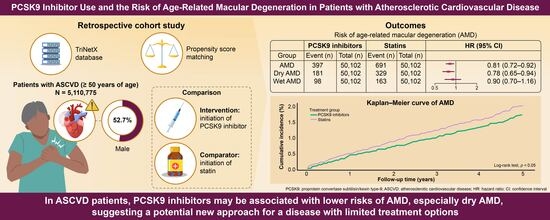
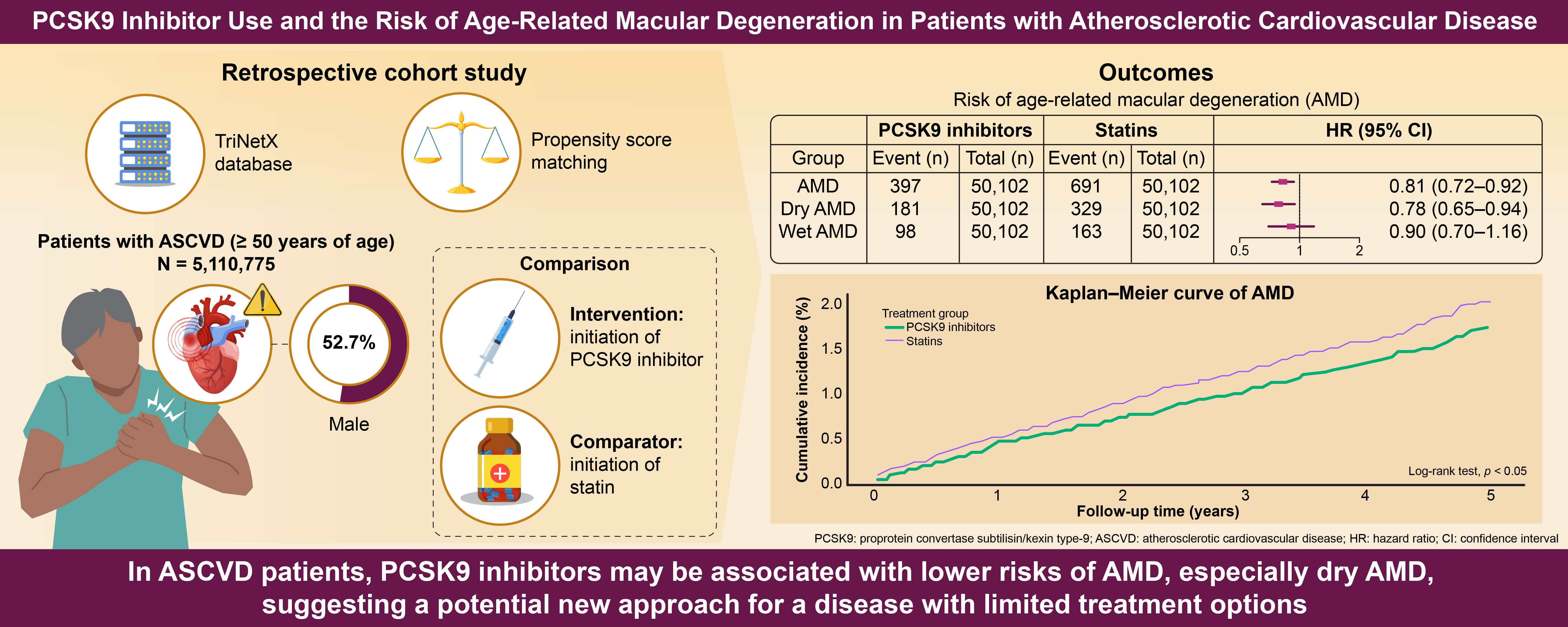
Background/Objectives: Emerging evidence suggests that alterations in lipid metabolism may play a contributing role in the pathogenesis of age-related macular degeneration (AMD). Proprotein convertase subtilisin/kexin type 9 (PCSK9) inhibitors, a novel class of lipid-lowering agents, offer anti-inflammatory and antioxidant benefits, which may provide protective effects against AMD. We aimed to evaluate the risk of developing AMD among patients with atherosclerotic cardiovascular disease (ASCVD) who were newly treated with PCSK9 inhibitors compared with those receiving statins. Methods: This retrospective cohort study utilized data from the Global Collaborative Network within the TriNetX Research Network. Patients with ASCVD who were newly initiated on PCSK9 inhibitors or statins were identified and matched for age, sex, race, laboratory data, comorbidities, and concomitant medications. The primary outcomes were the hazard ratios (HRs) for developing AMD, dry AMD, and wet AMD. Propensity score matching (PSM) was used to adjust for baseline demographics and comorbidities. Results: After PSM, 50,102 patients were included in each group (PCSK9 inhibitor users vs. statin users). Compared to statin users, PCSK9 inhibitor users had significantly lower risks of AMD (HR, 0.81; 95% confidence interval [CI], 0.72–0.92) and dry AMD (HR, 0.78; 95% CI, 0.65–0.94), but not wet AMD (HR, 0.90; 95% CI, 0.70–1.16). Stratified and subgroup analyses showed reduced AMD risk among patients aged ≥65 years, White patients, female patients, and evolocumab users. Conclusions: In patients with ASCVD, compared with use of statins, use of PCSK9 inhibitors is associated with reduced risks of AMD and dry AMD, suggesting a potential novel strategy for managing a condition with limited therapeutic options.

Graphical Abstract

1. Introduction

Despite advances in evidence-based therapies, atherosclerotic cardiovascular disease (ASCVD) remains the leading cause of global morbidity and mortality [1,2]. A causal link exists between low-density lipoprotein cholesterol (LDL-C) and ASCVD. Interventions targeting LDL-C, particularly statins, have demonstrated safety and efficacy in reducing major cardiovascular events [3]. Monoclonal antibodies targeting proprotein convertase subtilisin/kexin type 9 (PCSK9) represent a newer class of lipid-lowering agents that significantly lower LDL-C levels [4]. Clinical studies have demonstrated that PCSK9 inhibitors reduce ischemic cardiovascular events both as monotherapy and in combination with statins [5,6].
Age-related macular degeneration (AMD) is the primary cause of vision impairment among adults aged ≥50 years [7,8], with a global prevalence of 196 million in 2020, which is projected to rise to 288 million by 2040. Increasing evidence suggests that AMD poses a significant public health challenge in aging populations [7]. A growing body of evidence suggests an association between AMD and various cardiovascular diseases (CVDs) such as acute myocardial infarction, stroke, and heart failure [9,10,11]. Atherosclerosis has long been hypothesized as a shared pathophysiological mechanism, potentially involving oxidation-specific epitopes, consequent innate immune responses, pathological neovascularization, and lipid accumulation in Bruch’s membrane [12,13,14,15]. Dysregulated lipid metabolism plays a central role in AMD pathogenesis by promoting the accumulation of lipid-rich deposits beneath the retinal pigment epithelium (RPE) and contributing to visual decline [16]. PCSK9 inhibitors exhibit pleiotropic effects, such as reducing inflammatory cytokines, oxidative stress, and apoptosis, while improving endothelial function, which may offer therapeutic benefits for AMD [17,18,19]. However, few studies have directly investigated the role of PCSK9 inhibitors in preventing AMD.
Given the increasing prevalence of ASCVD within the aging demographic, a population also susceptible to AMD development, investigating the potential pleiotropic effects of PCSK9 inhibitors on AMD risk is a pertinent clinical concern. Therefore, in this study, we aimed to evaluate the risk of developing AMD among patients with ASCVD undergoing treatment with PCSK9 inhibitors.

2. Results

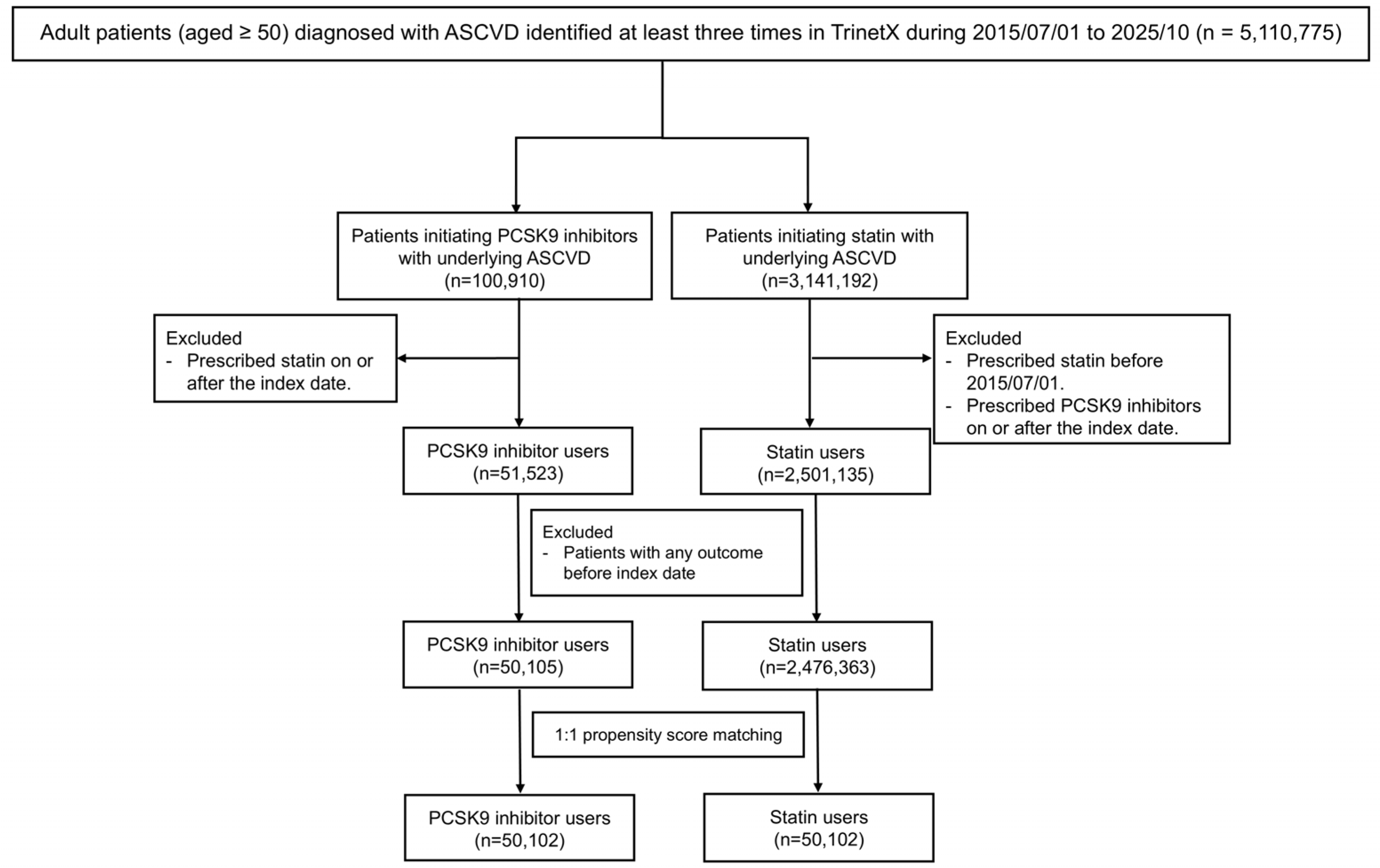
We initially identified 5,110,775 patients with ASCVD from the TriNetX dataset. After applying the inclusion and exclusion criteria, 50,102 patients were finally included in the PCSK9 inhibitor user and statin user groups (Figure 1). The mean age was 68.1 years in the PCSK9 inhibitor user group and 67.9 years in the statin user group, with female patients comprising 47.0% and 47.4% of each group, respectively. After propensity score matching (PSM), all baseline characteristics were well-balanced between the study groups (Table 1). Baseline characteristics of the study groups before PSM are shown in Table S1.

2.1. Risk of AMD

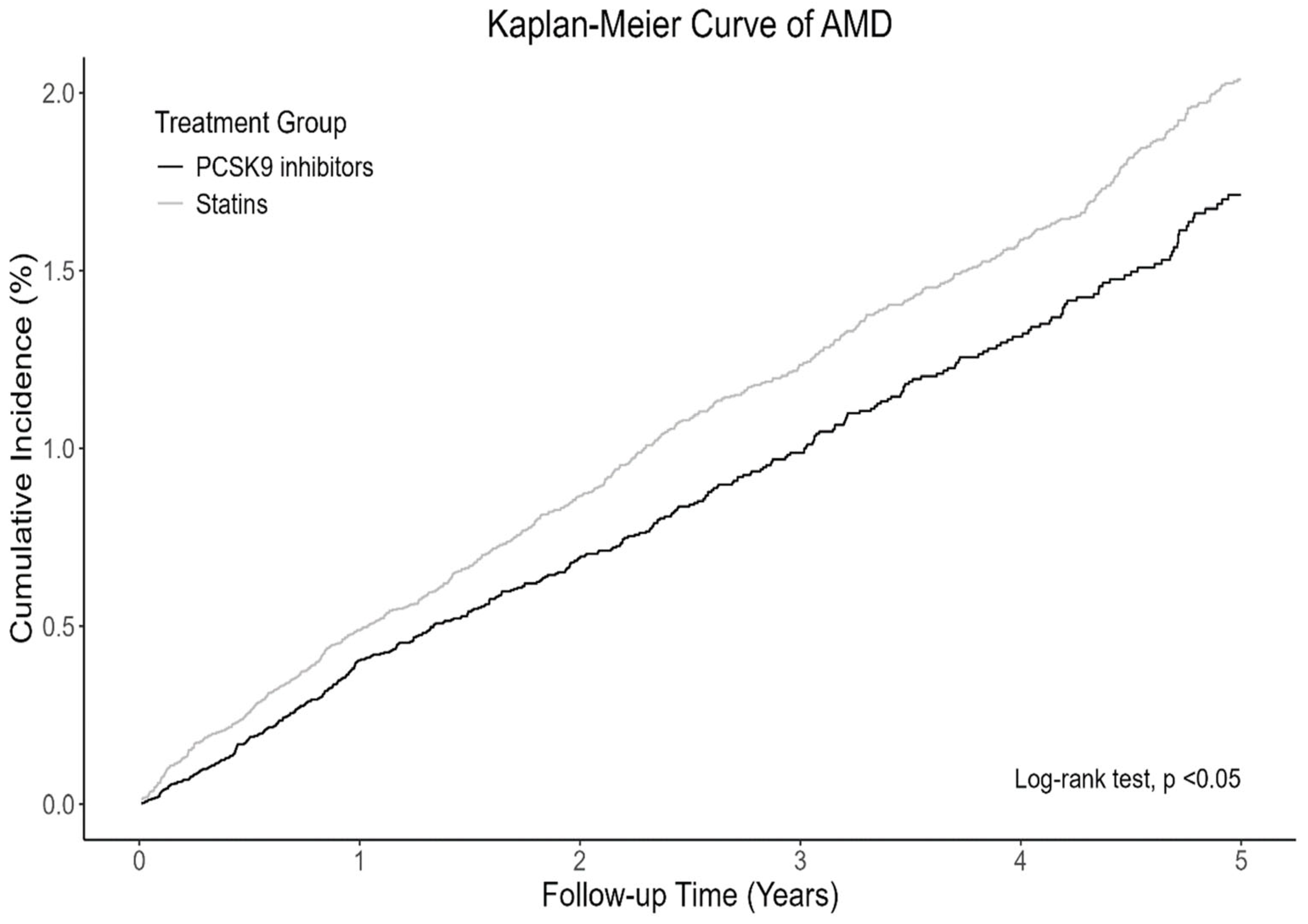
Overall, 397 PCSK9 inhibitor users and 691 statin users developed AMD (Table 2). The mean follow-up durations for the PCSK9 inhibitor and statin user groups were 2.36 (standard deviation [SD]: 1.67) and 3.34 (SD: 1.72) years, respectively. PCSK9 inhibitor users had a significantly lower risk of developing AMD (hazard ratio [HR]: 0.81; 95% confidence interval [CI]: 0.72–0.92) than statin users did. Figure 2 illustrates the cumulative incidence curve of the PCSK9 inhibitor user and statin user groups. Regarding individual outcome analyses, PCSK9 inhibitor use was associated with a lower risk of dry AMD (HR: 0.78; 95% CI: 0.65–0.94) but not wet AMD (HR: 0.90; 95% CI: 0.70–1.16) (Table 2).

2.2. Stratified and Subgroup Analyses

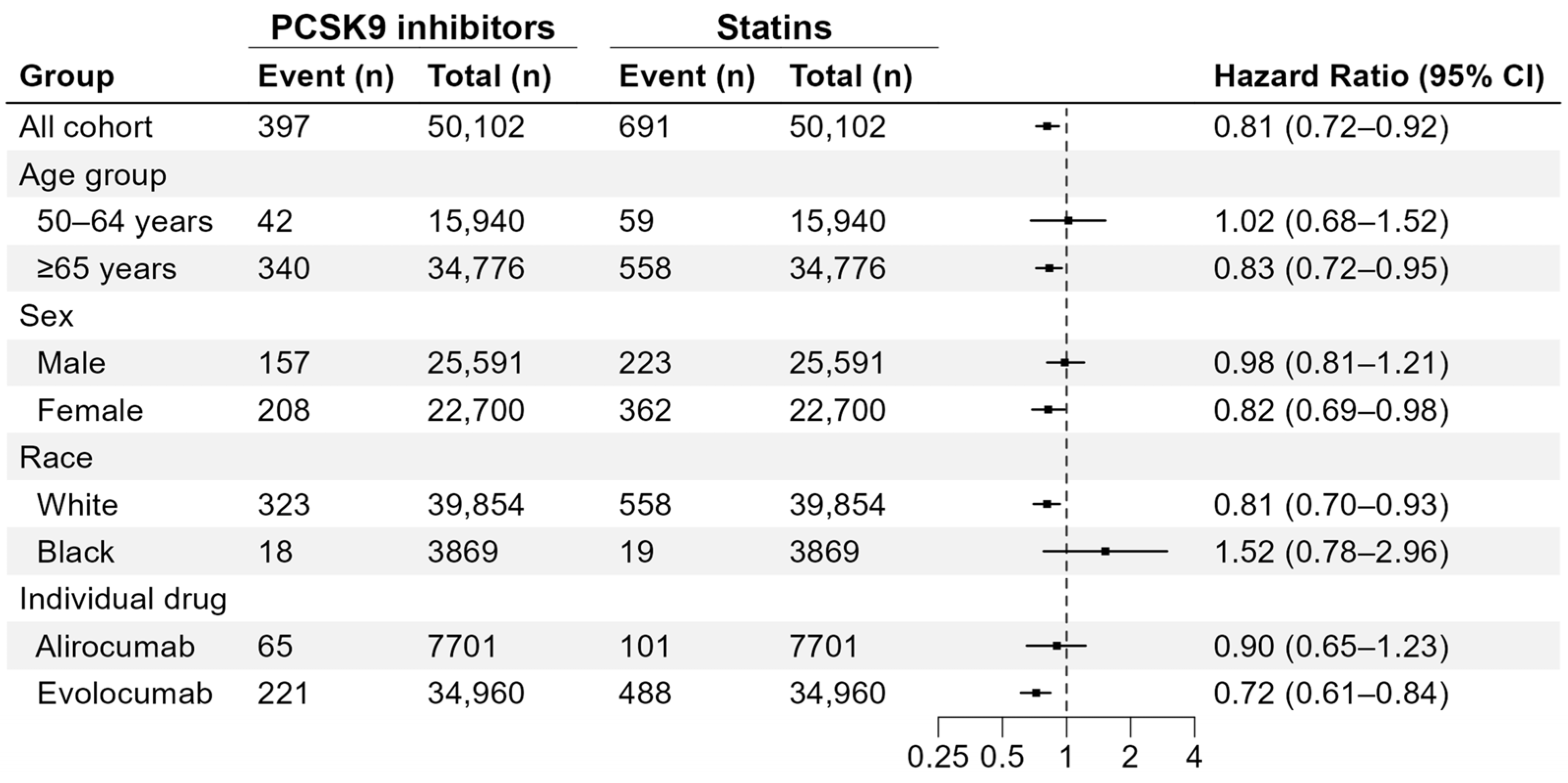
The results of the stratified and subgroup analysis are shown in Figure 3. By age group, PCSK9 inhibitor use was significantly associated with reduced AMD risk among patients aged ≥65 years (HR: 0.83; 95% CI: 0.72–0.95) but not among those aged 50–64 years (HR: 1.02; 95% CI: 0.68–1.52). By sex, PCSK9 inhibitor use was significantly associated with a reduced risk of AMD among female patients (HR: 0.82; 95% CI: 0.69–0.98) but not among male patients (HR: 0.98; 95% CI: 0.81–1.21). When stratified by race, the association of PCSK9 inhibitor use with a reduced risk of AMD was significant among White patients (HR: 0.81; 95% CI: 0.70–0.93) but not among African American patients (HR: 1.52; 95% CI: 0.78–2.96). Among individual drugs, evolocumab use was associated with lower AMD risk (HR: 0.72; 95% CI: 0.61–0.84), whereas alirocumab was not (HR: 0.90; 95% CI: 0.65–1.23).

2.3. Sensitivity Analyses

In the sensitivity analyses restricted to patients with ASCVD aged ≥60 years, PCSK9 inhibitor users exhibited a reduced risk of AMD (HR: 0.85; 95% CI: 0.74–0.97), compared with statin users. A similar trend of a protective effect was found for dry AMD (HR: 0.87; 95% CI: 0.71–1.06); however, no significant association was observed for wet AMD (HR: 1.15; 95% CI: 0.88–1.50). Among patients aged ≥70 years, similar results were observed (AMD HR: 0.81; 95% CI: 0.70–0.93; dry AMD HR: 0.77; 95% CI: 0.62–0.95; wet AMD HR: 1.06; 95% CI: 0.80–1.41; Table S2).

3. Discussion

In this large cohort study, patients initiated on PCSK9 inhibitors demonstrated a lower risk of developing AMD, compared with those newly treated with statins. Our sensitivity analyses results remained consistent when restricted to patients with ASCVD aged ≥60 years (or ≥70 years).
Although the precise mechanisms remain unclear, previous studies provide potential explanations. First, pathological studies have shown lipid accumulation in Bruch’s membrane in AMD, resembling atherosclerotic changes in CVD [20,21,22,23]. More than 40% of drusen—the hallmark histopathologic feature of AMD—consists of lipids, including esterified cholesterol, unesterified cholesterol, and phosphatidylcholine [24]. PCSK9, a key regulator of LDL-C metabolism, may play a role in mitigating AMD. One case report [25] documented improvement in pachydrusen during PCSK9 inhibitor therapy, with subsequent worsening after discontinuation. Considering that PCSK9 proteins circulate systemically, including in the vitreous fluid of eyes with retinal detachment, they likely reach areas of high blood flow, such as the choroid [26]. Second, although AMD ultimately causes neurodegeneration, it likely originates in the choroidal vasculature. The vascular model of macular degeneration suggests that impaired choroidal perfusion of the RPE leads to lipoprotein accumulation in drusen and Bruch’s membrane [27]. Additionally, retinal microcirculation in AMD is influenced by genetic factors, choroidal characteristics, and clinical determinants [28]. Disruptions in choroidal and retinal blood flow are critical to AMD progression. PCSK9 inhibitors have been shown to improve retinal microvascular function and reduce small artery stiffness, which may benefit diseases such as AMD that are influenced by microvascular health [29]. Lastly, protective effects of PCSK9 inhibitors against inflammation have been demonstrated in rat retinal Müller cells [30]. This anti-inflammatory effect is partly mediated through the negative regulation of the Toll-like receptor 4 and nuclear factor-kappa B signaling pathway, a mechanism that may be relevant to AMD [31,32]. By improving lipid profiles and mitigating retinal vascular dysfunction, oxidative stress, and inflammation, PCSK9 inhibitors may reduce the risk of AMD.
Our findings indicate that PCSK9 inhibitors are associated with a reduced risk of dry AMD but not wet AMD, and this pattern was consistent in sensitivity analyses among individuals aged ≥60 and ≥70 years. However, the direction of the association was similar across AMD subtypes. The non-significant finding for wet AMD is likely due to the smaller number of events, resulting in limited statistical power and wider confidence intervals. Therefore, these findings should not be interpreted as conclusive evidence of a differential effect between AMD subtypes. Further studies with larger sample sizes are warranted to confirm this association. Our findings align with a recent study demonstrating the protective effect of PCSK9 inhibitors against AMD risk, particularly the dry subtype. Of note, our current study differs from this prior work in three main aspects [33]. First, we evaluated patients with established ASCVD instead of general dyslipidemia, a population chosen due to the potential shared mechanisms between cardiovascular conditions and AMD [34]. Second, our analysis utilized a different set of covariates to account for potential confounding factors. Third, we included stratified analyses to further explore these associations within specific clinical subgroups. These methodological differences may provide supplementary insights that add to the existing literature.
Age- and sex-stratified analyses revealed numerically lower AMD risks across all comparisons, with a significant association observed in individuals aged ≥65 years and female patients. Given the higher risks of AMD in older and female patients [35], the effect of PCSK9 inhibitors may be more pronounced in groups with a higher disease burden. Also, previous studies indicate that PCSK9 concentrations fluctuate with the menstrual cycle and menopausal status, suggesting a potential regulatory role for estrogen [36,37,38]. This hormonal influence is hypothesized to be mediated by the activation of G-protein-coupled estrogen receptors on hepatocytes [36,37]. Given that our female cohort consists entirely of individuals over 50 years of age, they are presumed to largely represent a postmenopausal demographic. Consequently, we speculate that the physiological decline in estrogen levels following menopause might contribute to elevated PCSK9 expression, which could potentially explain the pronounced effects observed in these women [38]. Further research exploring potential sex-specific differences is needed to evaluate the generalizability of these initial observations.
The racial distribution suggests that AMD is most common in White populations, with studies reporting prevalences of 5.4, 4.6, and 2.4% in Whites, Asians, and African Americans, respectively [39]. The higher prevalence of AMD in White populations may lead to a more pronounced reduction in AMD risk among PCSK9 inhibitor users of these races. On the other hand, racial differences in the use of lipid-lowering treatments have been documented, and prior research [40] indicates that African American patients may be less likely to trust the effectiveness of these medications, which might partly explain the opposite, although not statistically significant, trend observed in this group. However, because PCSK9 inhibitors are relatively new, there is still limited evidence on patient adherence to and access to these therapies. Genetic differences may also play a role in the observed outcome. As indicated by previous research [41], there are differences in PCSK9 levels and activity among different ethnicities. However, further multi-ethnic studies are still needed to confirm the findings. Notably, although we utilized the Global Collaborative Network for our analysis, patients of Asian descent comprised less than 5% of the population within the TriNetX Research Network. This limited sample size precluded meaningful stratified analyses for this specific subgroup.
To date, few studies have examined the association between PCSK9 inhibitors and AMD risk; our study addresses this gap. The main strengths of this study include the use of a large-scale cohort, as well as novel findings linking PCSK9 inhibitors to reduced AMD risk. Sensitivity analyses reinforce the robustness of our results. However, some limitations of this study must be acknowledged. First, despite the vast scale of the TriNetX database, it inherently lacks granular data on critical lifestyle and clinical variables, including dietary habits, tobacco use, and physical activity. Because these are established risk factors for AMD, their absence leaves the analysis susceptible to residual confounding. Second, the database does not provide details on medication dosage, duration, or frequency, limiting assessment of treatment intensity. Thirdly, reliance on diagnostic codes may lead to misclassification of exposures and outcomes. However, this misclassification is likely to be non-differential across treatment groups, which would tend to bias effect estimates toward the null [42]. Lastly, a notable limitation of this study is the shorter follow-up duration in the PCSK9 inhibitor group compared with the statin group, which may reflect the more recent clinical adoption of these agents. Given the slow progression of AMD, shorter follow-up may lead to under-ascertainment of events. However, time-to-event analyses utilized in this study account for varying follow-up durations and right-censoring, and thus this difference is unlikely to have substantially biased the estimated associations. Further studies with longer follow-up durations are warranted to better capture the long-term risk of AMD.

4. Materials and Methods

4.1. Study Design and Data Sources

This retrospective cohort study was conducted using data from the Global Collaborative Network within the TriNetX Research Network (Cambridge, MA, USA) [43]. TriNetX collects deidentified electronic health record data across healthcare organizations, primarily those based in the United States, as well as locations in Australia, the United Kingdom, Spain, Bulgaria, India, Malaysia, and Taiwan. The network includes hospitals, primary care providers, and specialists who contribute data from both insured and uninsured patients. TriNetX offers access to deidentified electronic health records from more than 250 million individuals across over 120 healthcare organizations worldwide. Detailed information about TriNetX is available on their website: https://trinetx.com/ (accessed on 4 November 2025). Data quality within TriNetX is assessed using standardized criteria that evaluate metrics such as conformance, completeness, and plausibility [44]. The study adhered to the Strengthening the Reporting of Observational Studies in Epidemiology guidelines for cohort studies. The research ethics committee at Hualien Tzu Chi Hospital gave its approval for the study protocol (REC number: IRB114-194-C).

4.2. Study Population and Exposure

Adults aged ≥50 years with ASCVD between July 2015 and October 2025 were included. As the FDA first approved the PCSK9 inhibitor evolocumab in 2015, the enrollment period for participants with ASCVD began in July 2015 [45]. ASCVD was defined as at least three separate diagnoses of ischemic heart disease (International Classification of Diseases, 10th Revision [ICD-10] code: I20–I25), cerebrovascular disease (ICD-10 code: I60–I69), or peripheral artery disease (ICD-10 code: I73) during the study period. The first cohort, the “PCSK9 inhibitor users,” comprised individuals prescribed PCSK9 inhibitors alirocumab (RxNorm code: 1659152), evolocumab (RxNorm code: 1665684), and inclisiran (RxNorm code: 2588243), as classified by the National Library of Medicine’s normalized naming system for generic and branded drugs. For this group, the initiation of PCSK9 inhibitor therapy marked the index date. Patients who used statins after the index date (switchers) were excluded. In contrast, the cohort labelled “statin users” included individuals who were newly prescribed statins (Anatomical Therapeutic Chemical code C10AA). This cohort included ASCVD patients initiating statin therapy after July 2015, with no prior statin prescriptions, and the date of this initial prescription served as their index date. To prevent confounding, we excluded patients who subsequently used PCSK9 inhibitors (switchers). Furthermore, to ensure the evaluation of only incident cases, individuals diagnosed with AMD prior to their respective index dates were excluded from both the exposed and nonexposed cohorts.

4.3. Outcome Measures

The primary outcome was incident AMD, identified using the ICD-10 codes H35.30, H35.31, and H35.32. Tracking of all study participants began at their respective index dates and continued until the occurrence of AMD, death, or the end of available date in the databases, whichever occurred first. Additionally, individual outcome analyses were conducted for dry AMD (ICD-10 code: H35.31) and wet AMD (ICD-10 code: H35.32). In these analyses, patients were followed up until the specific outcome occurred; for example, a patient diagnosed with dry AMD who later developed wet AMD was also included in the wet AMD analysis.

4.4. Covariates and Confounders

The baseline characteristics of eligible patients were extracted from the TriNetX dataset and included age, sex, race, ethnicity, healthcare utilization, lifestyle factors, comorbidities, and baseline medication use. Pre-existing comorbidities and medication use at baseline (Table S3), identified as potential confounders, were selected based on prior studies [46,47]. A comorbidity was considered present if a diagnosis had been recorded within 1 year before the index date. Baseline medication use was defined as any recorded prescription within 1 year before the index date.

4.5. Statistical Analyses

All statistical analyses were conducted using the TriNetX Analytics network platform and R software version 4.4.1 (R Foundation for Statistical Computing, Vienna, Austria). Systematic differences in the baseline characteristics and potential confounders between the exposed and unexposed cohorts were addressed through PSM following cohort definition. Multivariable logistic regression models incorporating covariates listed in Table 1 were used to calculate the propensity scores, estimating each patient’s likelihood of receiving PCSK9 inhibitors or statins. Nearest-neighbor matching without replacement was applied using a caliper width of 0.2 standard deviations of the logit of the propensity score [48,49]. Before any data analysis, including overall, subgroup, and stratified analyses, PSM was performed separately for each comparison set. Standardized mean differences were used to assess differences in baseline characteristics between study cohorts, with values <0.1 indicating negligible differences [50]. The Kaplan–Meier method was used to plot cumulative incidence curves, and the log-rank test was employed to compare time-to-event outcomes. The HRs for each outcome were estimated using Cox proportional hazards models. The proportional hazards assumption was tested using the generalized Schoenfeld method integrated into the TriNetX platform, with no violations detected [51].
Stratified analyses were performed by age group (50–64 and ≥65 years), sex (male and female), and race (White, African American, and Asian) to explore potential effect modification. Based on the first prescribed type of PCSK9 inhibitors, the exposed cohort was further classified into two subgroups: evolocumab and alirocumab users. These subgroups were compared with the statin cohort to estimate the relative effect of each PCSK9 inhibitors on AMD risk. A two-tailed p-value < 0.05 was considered statistically significant.
Sensitivity analyses were conducted to assess the robustness of the findings. Given the age-related increase in AMD risk, we limited the cohort to older patients (≥60 and ≥70 years) to examine the effects in the most relevant demographic [7].

5. Conclusions

Our analysis reveals a protective association between PCSK9 inhibitor use and the incidence of AMD–particularly dry AMD–among patients with ASCVD compared to statin users. Considering the limited therapeutic options for dry AMD, this potential association highlights an interesting avenue for future research into the secondary effects of lipid-lowering therapies.

Supplementary Materials

The following supporting information can be downloaded at: https://www.mdpi.com/article/10.3390/ph19050750/s1, Table S1: Demographic data of the study population before propensity score matching; Table S2: Risk of incident AMD in patients aged ≥60 and ≥70 years with ASCVD treated with PCSK9 inhibitors versus statins; Table S3: Codes for covariates.

Author Contributions

Conceptualization: H.-R.T.; formal analysis: H.-R.T., J.-Z.H. and H.-K.H.; data curation, H.-R.T., J.-Z.H. and H.-K.H.; writing—original draft preparation, H.-R.T.; writing—review and editing: H.-K.H.; project administration: C.-H.L.; supervision: C.-H.L. and H.-K.H. All authors have read and agreed to the published version of the manuscript.

Funding

This research was funded by the Hualien Tzu Chi Hospital, grant number TCRD115-012.

Institutional Review Board Statement

The study was conducted in accordance with the Declaration of Helsinki, and approved by the Research Ethics Committee of Hualien Tzu Chi Hospital (REC No: IRB114-194-C).

Informed Consent Statement

The requirement for written informed consent was waived due to the retrospective nature of the study.

Data Availability Statement

The original contributions presented in this study are included in the article and Supplementary Materials Further inquiries can be directed to the corresponding author due to TriNetX’s data protection policy.

Conflicts of Interest

The authors declare no conflicts of interest.

Abbreviations

The following abbreviations are used in this manuscript:
AMDAge-related macular degeneration
ASCVDAtherosclerotic cardiovascular disease
CIConfidence interval
CVDCardiovascular disease
HRHazard ratio
ICD-10International Classification of Diseases, 10th Revision
LDL-CLow-density lipoprotein cholesterol
PCSK9Proprotein convertase subtilisin/kexin type 9
PSMPropensity score matching
RPERetinal pigment epithelium
SDStandard deviation
VEGFVascular endothelial growth factor

References

  1. Younus, A.; Aneni, E.C.; Spatz, E.S.; Osondu, C.U.; Roberson, L.; Ogunmoroti, O.; Malik, R.; Ali, S.S.; Aziz, M.; Feldman, T.; et al. A systematic review of the prevalence and outcomes of ideal cardiovascular health in US and non-US populations. Mayo Clin. Proc. 2016, 91, 649–670. [Google Scholar] [CrossRef] [PubMed]
  2. Vasan, R.S.; Enserro, D.M.; Xanthakis, V.; Beiser, A.S.; Seshadri, S. Temporal trends in the remaining lifetime risk of cardiovascular disease among middle-aged adults across 6 decades: The Framingham Study. Circulation 2022, 145, 1324–1338. [Google Scholar] [CrossRef] [PubMed]
  3. Ference, B.A.; Ginsberg, H.N.; Graham, I.; Ray, K.K.; Packard, C.J.; Bruckert, E.; Hegele, R.A.; Krauss, R.M.; Raal, F.J.; Schunkert, H.; et al. Low-density lipoproteins cause atherosclerotic cardiovascular disease. 1. Evidence from genetic, epidemiologic, and clinical studies. A consensus statement from the European Atherosclerosis Society Consensus Panel. Eur. Heart J. 2017, 38, 2459–2472. [Google Scholar] [CrossRef] [PubMed]
  4. Urban, D.; Pöss, J.; Böhm, M.; Laufs, U. Targeting the proprotein convertase subtilisin/kexin type 9 for the treatment of dyslipidemia and atherosclerosis. J. Am. Coll. Cardiol. 2013, 62, 1401–1408. [Google Scholar] [CrossRef]
  5. Sabatine, M.S.; Giugliano, R.P.; Keech, A.C.; Honarpour, N.; Wiviott, S.D.; Murphy, S.A.; Kuder, J.F.; Wang, H.; Liu, T.; Wasserman, S.M.; et al. Evolocumab and clinical outcomes in patients with cardiovascular disease. N. Engl. J. Med. 2017, 376, 1713–1722. [Google Scholar] [CrossRef]
  6. Schwartz, G.G.; Steg, P.G.; Szarek, M.; Bhatt, D.L.; Bittner, V.A.; Diaz, R.; Edelberg, J.M.; Goodman, S.G.; Hanotin, C.; Harrington, R.A.; et al. Alirocumab and cardiovascular outcomes after acute coronary syndrome. N. Engl. J. Med. 2018, 379, 2097–2107. [Google Scholar] [CrossRef]
  7. Wong, W.L.; Su, X.; Li, X.; Cheung, C.M.G.; Klein, R.; Cheng, C.Y.; Wong, T.Y. Global prevalence of age-related macular degeneration and disease burden projection for 2020 and 2040: A systematic review and meta-analysis. Lancet Glob. Health 2014, 2, e106–e116. [Google Scholar] [CrossRef]
  8. Jonas, J.B.; Cheung, C.M.G.; Panda-Jonas, S. Updates on the epidemiology of age-related macular degeneration. Asia-Pac. J. Ophthalmol. 2017, 6, 493–497. [Google Scholar] [CrossRef]
  9. Wu, J.; Uchino, M.; Sastry, S.M.; Schaumberg, D.A. Age-related macular degeneration and the incidence of cardiovascular disease: A systematic review and meta-analysis. PLoS ONE 2014, 9, e89600. [Google Scholar] [CrossRef]
  10. Jung, W.; Han, K.; Kim, B.; Hwang, S.; Yoon, J.M.; Park, J.; Lim, D.H.; Shin, D.W. Age-related macular degeneration with visual disability is associated with cardiovascular disease risk in the Korean nationwide cohort. J. Am. Heart Assoc. 2023, 12, e028027. [Google Scholar] [CrossRef]
  11. Chang, C.C.; Huang, C.H.; Chou, Y.C.; Chang, J.Y.; Sun, C.A. Association between age-related macular degeneration and risk of heart failure: A population-based nested case-control study. J. Am. Heart Assoc. 2021, 10, e020071. [Google Scholar] [CrossRef]
  12. Binder, C.J.; Papac-Milicevic, N.; Witztum, J.L. Innate sensing of oxidation-specific epitopes in health and disease. Nat. Rev. Immunol. 2016, 16, 485–497. [Google Scholar] [CrossRef] [PubMed]
  13. Sene, A.; Khan, A.A.; Cox, D.; Nakamura, R.E.I.; Santeford, A.; Kim, B.M.; Sidhu, R.; Onken, M.D.; Harbour, J.W.; Hagbi-Levi, S.; et al. Impaired cholesterol efflux in senescent macrophages promotes age-related macular degeneration. Cell Metab. 2013, 17, 549–561. [Google Scholar] [CrossRef]
  14. Wynn, T.A. Common and unique mechanisms regulate fibrosis in various fibroproliferative diseases. J. Clin. Investig. 2007, 117, 524–529. [Google Scholar] [CrossRef]
  15. Handa, J.T.; Bowes Rickman, C.; Dick, A.D.; Gorin, M.B.; Miller, J.W.; Toth, C.A.; Ueffing, M.; Zarbin, M.; Farrer, L.A. A systems biology approach towards understanding and treating non-neovascular age-related macular degeneration. Nat. Commun. 2019, 10, 3347. [Google Scholar] [CrossRef]
  16. Álvarez-Barrios, A.; Álvarez, L.; Sáenz de Santa María, P.; García, M.; Álvarez-Buylla, J.R.; Pereiro, R.; González-Iglesias, H. Dysregulated lipid metabolism in a retinal pigment epithelial cell model and serum of patients with age-related macular degeneration. BMC Biol. 2025, 23, 96. [Google Scholar] [CrossRef] [PubMed]
  17. Cammisotto, V.; Baratta, F.; Simeone, P.G.; Barale, C.; Lupia, E.; Galardo, G.; Santilli, F.; Russo, I.; Pignatelli, P. Proprotein convertase subtilisin kexin type 9 (PCSK9) beyond lipids: The role in oxidative stress and thrombosis. Antioxidants 2022, 11, 569. [Google Scholar] [CrossRef]
  18. Schremmer, J.; Busch, L.; Baasen, S.; Heinen, Y.; Sansone, R.; Heiss, C.; Kelm, M.; Stern, M. Chronic PCSK9 inhibitor therapy leads to sustained improvements in endothelial function, arterial stiffness, and microvascular function. Microvasc. Res. 2023, 148, 104513. [Google Scholar] [CrossRef]
  19. Morales-Portano, J.D.; Trujillo-Cortés, R.; Roa-Martínez, B.M.; Pérez-Cabeza de Vaca, R.; García, S.; Mondragón-Terán, P.; Suárez-Cuenca, J.A. Expression of pro- and anti-inflammatory cytokines during anti-proprotein convertase subtilisin/kexin type 9 therapy in patients with statin-resistant familial hypercholesterolemia. Front. Cardiovasc. Med. 2024, 11, 1417044. [Google Scholar] [CrossRef]
  20. Vavvas, D.G.; Daniels, A.B.; Kapsala, Z.G.; Goldfarb, J.W.; Ganotakis, E.; Loewenstein, J.I.; Young, L.H.; Gragoudas, E.S.; Eliott, D.; Kim, I.K.; et al. Regression of some high-risk features of age-related macular degeneration (AMD) in patients receiving intensive statin treatment. eBioMedicine 2016, 5, 198–203. [Google Scholar] [CrossRef] [PubMed]
  21. Curcio, C.A.; Johnson, M.; Rudolf, M.; Huang, J.D. The oil spill in ageing Bruch membrane. Br. J. Ophthalmol. 2011, 95, 1638–1645. [Google Scholar] [CrossRef]
  22. Curcio, C.A.; Johnson, M.; Huang, J.D.; Rudolf, M. Aging, age-related macular degeneration, and the response-to-retention of apolipoprotein B-containing lipoproteins. Prog. Retin. Eye Res. 2009, 28, 393–422. [Google Scholar] [CrossRef]
  23. Curcio, C.A. Antecedents of Soft Drusen, the Specific Deposits of Age-Related Macular Degeneration, in the Biology of Human Macula. Investig. Ophthalmol. Vis. Sci. 2018, 59, AMD182–AMD194. [Google Scholar] [CrossRef]
  24. Wang, L.; Clark, M.E.; Crossman, D.K.; Kojima, K.; Messinger, J.D.; Mobley, J.A.; Curcio, C.A. Abundant lipid and protein components of drusen. PLoS ONE 2010, 5, e10329. [Google Scholar] [CrossRef]
  25. Chantarasorn, Y.; Funilkul, K. A Temporal association between regression of pachydrusen and use of proprotein convertase subtilisin kexin 9 inhibitor: A case report. Case Rep. Ophthalmol. 2024, 15, 614–620. [Google Scholar] [CrossRef] [PubMed]
  26. Santos, F.M.; Gaspar, L.M.; Ciordia, S.; Rocha, A.S.; Castro, E.; Sousa, J.P.; Paradela, A.; Passarinha, L.A.; Tomaz, C.T. iTRAQ quantitative proteomic analysis of vitreous from patients with retinal detachment. Int. J. Mol. Sci. 2018, 19, 1157. [Google Scholar] [CrossRef]
  27. Nassisi, M.; Tepelus, T.; Nittala, M.G.; Sadda, S.R. Choriocapillaris flow impairment predicts the development and enlargement of drusen. Graefe’s Arch. Clin. Exp. Ophthalmol. 2019, 257, 2079–2085. [Google Scholar] [CrossRef]
  28. Krytkowska, E.; Ulanczyk, Z.; Grabowicz, A.; Mozolewska-Piotrowska, K.; Safranow, K.; Palucha, A.; Krawczyk, M.; Sikora, P.; Matczynska, E.; Stahl, A.; et al. Retinal vessel functionality is linked with ARMS2 A69S and CFH Y402H polymorphisms and choroidal status in AMD patients. Investig. Ophthalmol. Vis. Sci. 2021, 62, 30. [Google Scholar] [CrossRef]
  29. Nägele, M.P.; Raemy, Y.; Kreysing, L.; Barthelmes, J.; Ruschitzka, F.; Flammer, A.J.; Sudano, I. Improvement of retinal microvascular function after initiation of lipid-lowering therapy with PCSK9 inhibitors—An observational study. J. Clin. Lipidol. 2025, 19, 982–989. [Google Scholar] [CrossRef] [PubMed]
  30. Zhou, Q.; Tang, H.; Li, S. Protective effect of evolocumab on Müller cells in the rat retina under hyperglycaemic and hypoxic conditions. J. Diabetes Complicat. 2023, 37, 108593. [Google Scholar] [CrossRef] [PubMed]
  31. Roshanipour, N.; Shahriyari, E.; Ghaffari Laleh, M.; Vahedi, L.; Mirjand Gerami, S.; Khamaneh, A. Associations of TLR4 and IL-8 genes polymorphisms with age-related macular degeneration (AMD): A systematic review and meta-analysis. Ophthal. Genet. 2021, 42, 641–649. [Google Scholar] [CrossRef] [PubMed]
  32. Navneet, S.; Wilson, K.; Rohrer, B. Müller glial cells in the macula: Their activation and cell-cell interactions in age-related macular degeneration. Investig. Ophthalmol. Vis. Sci. 2024, 65, 42. [Google Scholar] [CrossRef]
  33. Shah, J.; Gerendás, L.; Serhan, H.; Ahmed, H.; Festok, M.; Mahrous, M.A.; Kovacs, K.D.; Kiss, S. Association between PCSK9 inhibitor use and risk of age-related macular degeneration. Eye 2026, 40, 739–740. [Google Scholar] [CrossRef]
  34. Mauschitz, M.M.; Finger, R.P. Age-Related Macular Degeneration and Cardiovascular Diseases: Revisiting the Common Soil Theory. Asia-Pac. J. Ophthalmol. 2022, 11, 94–99. [Google Scholar] [CrossRef]
  35. Age-Related Eye Disease Study Research Group. Risk factors associated with age-related macular degeneration. A case-control study in the Age-Related Eye Disease Study: Age-Related Eye Disease Study Report Number 3: Age-Related Eye Disease Study Report number 3. Ophthalmology 2000, 107, 2224–2232. [Google Scholar] [CrossRef]
  36. Jia, F.; Fei, S.F.; Tong, D.B.; Xue, C.; Li, J.J. Sex difference in circulating PCSK9 and its clinical implications. Front. Pharmacol. 2022, 13, 953845. [Google Scholar] [CrossRef]
  37. Fu, W.; Gao, X.P.; Zhang, S.; Dai, Y.P.; Zou, W.J.; Yue, L.M. 17β-Estradiol Inhibits PCSK9-Mediated LDLR Degradation Through GPER/PLC Activation in HepG2 Cells. Front. Endocrinol. 2020, 10, 930. [Google Scholar] [CrossRef]
  38. Ghosh, M.; Gälman, C.; Rudling, M.; Angelin, B. Influence of physiological changes in endogenous estrogen on circulating PCSK9 and LDL cholesterol. J. Lipid Res. 2015, 56, 463–469. [Google Scholar] [CrossRef] [PubMed]
  39. Klein, R.; Klein, B.E.K.; Knudtson, M.D.; Wong, T.Y.; Cotch, M.F.; Liu, K.; Burke, G.; Saad, M.F.; Jacobs, D.R. Prevalence of age-related macular degeneration in 4 racial/ethnic groups in the multi-ethnic study of atherosclerosis. Ophthalmology 2006, 113, 373–380. [Google Scholar] [CrossRef] [PubMed]
  40. Nanna, M.G.; Navar, A.M.; Zakroysky, P.; Xiang, Q.; Goldberg, A.C.; Robinson, J.; Roger, V.L.; Virani, S.S.; Wilson, P.W.F.; Elassal, J.; et al. Association of Patient Perceptions of Cardiovascular Risk and Beliefs on Statin Drugs with Racial Differences in Statin Use: Insights from the Patient and Provider Assessment of Lipid Management Registry. JAMA Cardiol. 2018, 3, 739–748. [Google Scholar] [CrossRef]
  41. Enkhmaa, B.; Kim, K.; Zhang, W.; Prakash, N.; Truax, K.; Anuurad, E.; Berglund, L. PCSK9 in African Americans and Caucasians in Relation to Lp(a) Level, Apo(a) Size and Heritability. J. Endocr. Soc. 2020, 4, bvaa073. [Google Scholar] [CrossRef] [PubMed]
  42. Höfler, M. The effect of misclassification on the estimation of association: A review. Int. J. Methods Psychiatr. Res. 2005, 14, 92–101. [Google Scholar] [CrossRef]
  43. TriNetX. Available online: https://trinetx.com/ (accessed on 4 November 2025).
  44. Kahn, M.G.; Callahan, T.J.; Barnard, J.; Bauck, A.E.; Brown, J.; Davidson, B.N.; Estiri, H.; Goerg, C.; Holve, E.; Johnson, S.G.; et al. A harmonized data quality assessment terminology and framework for the secondary use of electronic health record data. EGEMs 2016, 4, 1244. [Google Scholar] [CrossRef]
  45. Hess, P.L.; Kennedy, K.; Cowherd, M.; Virani, S.S.; Masoudi, F.A.; Navar, A.M.; Yeh, R.W.; Ho, P.M.; Maddox, T.M. Implications of the FDA approval of PCSK9 inhibitors and FOURIER results for contemporary cardiovascular practice: An NCDR Research to Practice (R2P) project. Am. Heart J. 2018, 195, 151–152. [Google Scholar] [CrossRef] [PubMed]
  46. Fleckenstein, M.; Keenan, T.D.L.; Guymer, R.H.; Chakravarthy, U.; Schmitz-Valckenberg, S.; Klaver, C.C.; Wong, W.T.; Chew, E.Y. Age-related macular degeneration. Nat. Rev. Dis. Primers 2021, 7, 31. [Google Scholar] [CrossRef]
  47. Guymer, R.H.; Campbell, T.G. Age-related macular degeneration. Lancet 2023, 401, 1459–1472. [Google Scholar] [CrossRef]
  48. Austin, P.C. An introduction to propensity score methods for reducing the effects of confounding in observational studies. Multivar. Behav. Res. 2011, 46, 399–424. [Google Scholar] [CrossRef]
  49. Austin, P.C. Optimal caliper widths for propensity-score matching when estimating differences in means and differences in proportions in observational studies. Pharm. Stat. 2011, 10, 150–161. [Google Scholar] [CrossRef] [PubMed]
  50. Austin, P.C. Balance diagnostics for comparing the distribution of baseline covariates between treatment groups in propensity-score matched samples. Stat. Med. 2009, 28, 3083–3107. [Google Scholar] [CrossRef] [PubMed]
  51. Xue, X.; Xie, X.; Gunter, M.; Rohan, T.E.; Wassertheil-Smoller, S.; Ho, G.Y.F.; Cirillo, D.; Yu, H.; Strickler, H.D. Testing the proportional hazards assumption in case-cohort analysis. BMC Med. Res. Methodol. 2013, 13, 88. [Google Scholar] [CrossRef]
Figure 1. Flow diagram of the patient enrollment process. Abbreviations: ASCVD, atherosclerotic cardiovascular disease; PCSK9, proprotein convertase subtilisin/kexin type 9.
Pharmaceuticals 19 00750 g001
Figure 2. Cumulative incidence curve of AMD based on Cox proportional hazards models in patients receiving PCSK9 inhibitors or statins after PSM. Abbreviations: AMD, age-related macular degeneration; PCSK9, proprotein convertase subtilisin/kexin type 9; PSM, propensity score matching.
Pharmaceuticals 19 00750 g002
Figure 3. Results from stratified and subgroup analyses. Abbreviations: CI, confidence interval; PCSK9, proprotein convertase subtilisin/kexin type 9.
Pharmaceuticals 19 00750 g003
Table 1. Demographic data of the study population after propensity score matching.
Characteristics *
PCSK9 Inhibitor Users
(n = 50,102)
Statin Users
(n = 50,102)
SMD
Age at the index date68.1 ± 8.467.9 ± 8.90.027
Sex, n (%)
    Male26,489 (52.9)26,311 (52.5)0.007
    Female23,563 (47.0)23,748 (47.4)0.007
Unknown sex50 (0.1)43 (0.1)0.005
Ethnicity, n (%)
    Not Hispanic or Latino40,538 (80.9)40,943 (81.7)0.021
    Hispanic or Latino1408 (2.8)1251 (2.5)0.019
    Unknown ethnicity8156 (16.3)7908 (15.8)0.013
Race, n (%)
    White41,340 (82.5)42,327 (84.5)0.053
    African American3874 (7.7)3514 (7.0)0.027
    Asian1209 (2.4)1105 (2.2)0.014
    American Indian or Alaska Native173 (0.3)170 (0.3)0.001
    Native Hawaiian or Other Pacific Islander121 (0.2)131 (0.3)0.004
    Other race885 (1.8)818 (1.6)0.010
    Unknown race2500 (5.0)2037 (4.1)0.044
Comorbidities, n (%)
    Hypertension32,322 (64.5)31,934 (63.7)0.016
    Diabetes mellitus14,333 (28.6)13,454 (26.9)0.039
    Heart failure7300 (14.6)6591 (13.2)0.041
    Atrial fibrillation and flutter6797 (13.6)6387 (12.7)0.024
    Hypermetropia365 (0.7)332 (0.7)0.008
    Chronic kidney disease6563 (13.1)6032 (12.0)0.032
Lifestyle
    Tobacco use, n (%)1551 (3.1)1388 (2.8)0.019
Laboratory data
    BMI30.3 ± 6.130.6 ± 6.80.041
    BMI ≥ 30 kg/m2, n (%)18,261 (36.4)18,238 (36.4)0.001
    Triglyceride 169.2 ± 149.5173.0 ± 140.20.026
    HDL48.0 ± 17.447.1 ± 19.10.051
    LDL123.5 ± 50.4122.8 ± 46.00.016
    LDL ≥ 130 mg/dL, n (%)15,509 (31.0)15,269 (30.5)0.010
    Total cholesterol204.5 ± 58.9203.6 ± 56.80.016
Medical service utilization, n (%)
    Office or other outpatient services27,270 (54.4)27,345 (54.6)0.003
    Emergency department services9413 (18.8)8759 (17.5)0.034
    Hospital inpatient and observation care services7643 (15.3)6859 (13.7)0.044
Medication, n (%)
    Corticosteroid17,831 (35.6)17,800 (35.5)0.001
    Non-steroidal anti-inflammatory drug8977 (17.9)8776 (17.5)0.011
    Metformin4679 (9.3)4514 (9.0)0.011
    Lutein209 (0.4)168 (0.3)0.013
    Zeaxanthin25 (0.1)30 (0.1)0.004
* All covariates listed were used for propensity score matching. A standardized mean difference <0.1 indicates a negligible difference. Abbreviations: BMI, body mass index; HDL, high-density lipoprotein; LDL, low-density lipoprotein; PCSK9, proprotein convertase subtilisin/kexin type 9; SMD, standardized mean difference.
Table 2. Risk of incident AMD among patients with ASCVD treated with PSCK9 inhibitors vs. statins.
Patients with Outcome
OutcomesPCSK9 Inhibitor Users
(n = 50,102)
Statin Users
(n = 50,102)
HR * (95% CI)p-Value for Log-Rank Test
AMD3976910.81 (0.72–0.92)0.001
Dry AMD1813290.78 (0.65–0.94)0.011
Wet AMD981630.90 (0.70–1.16)0.444
* The HRs were calculated using a univariable Cox regression model with propensity score matching, with the corresponding statin user group as the reference. Abbreviations: AMD, age-related macular degeneration; ASCVD, atherosclerotic cardiovascular disease; CI, confidence interval; HR, hazard ratio; PCSK9, proprotein convertase subtilisin/kexin type 9.
Disclaimer/Publisher’s Note: The statements, opinions and data contained in all publications are solely those of the individual author(s) and contributor(s) and not of MDPI and/or the editor(s). MDPI and/or the editor(s) disclaim responsibility for any injury to people or property resulting from any ideas, methods, instructions or products referred to in the content.