Glucosinolate Derivatives: Emerging Anti-Inflammatory Agents

 ,
,  ,
,  ,
,  and
and
Abstract
1. Introduction
2. Methodology
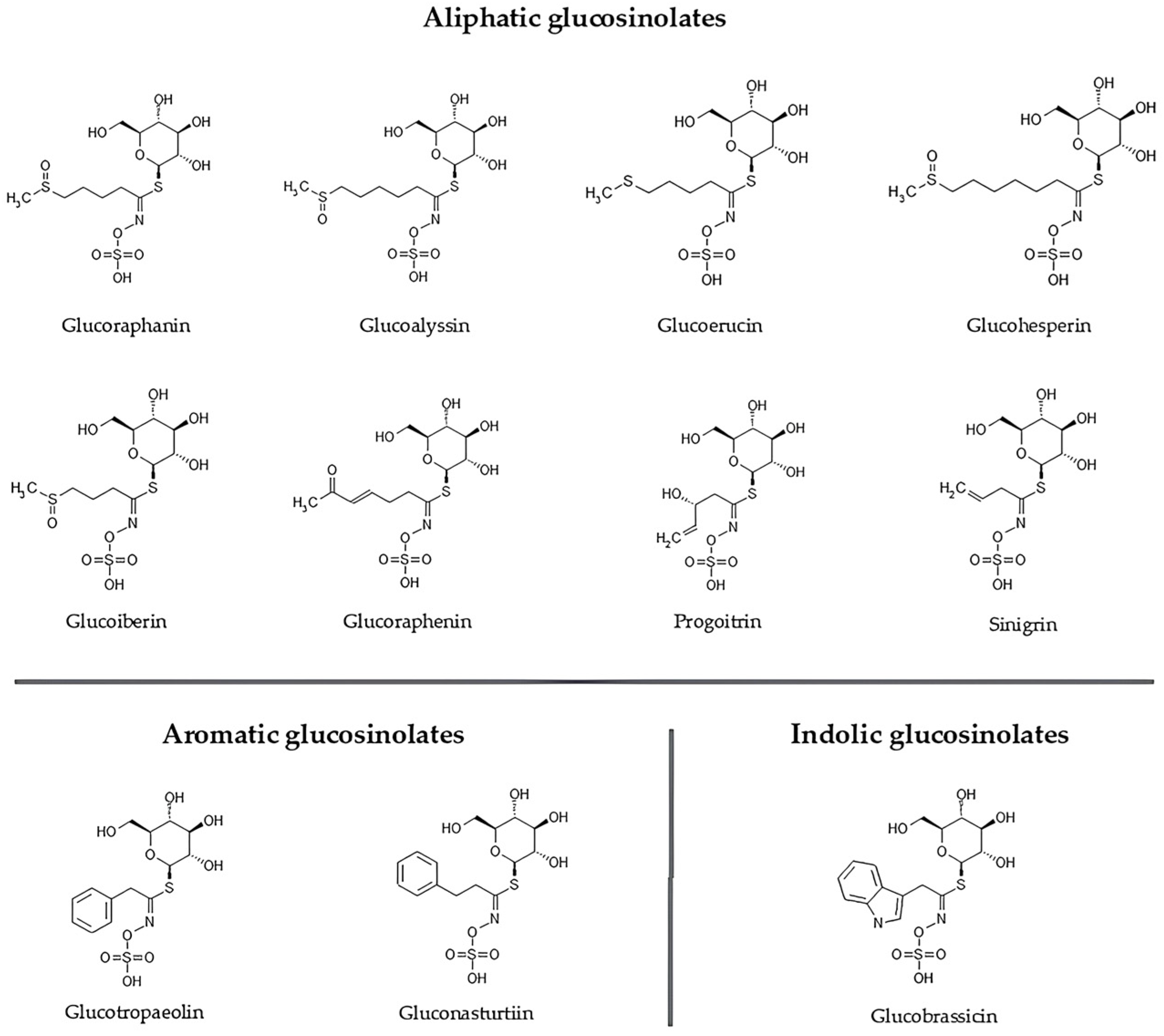
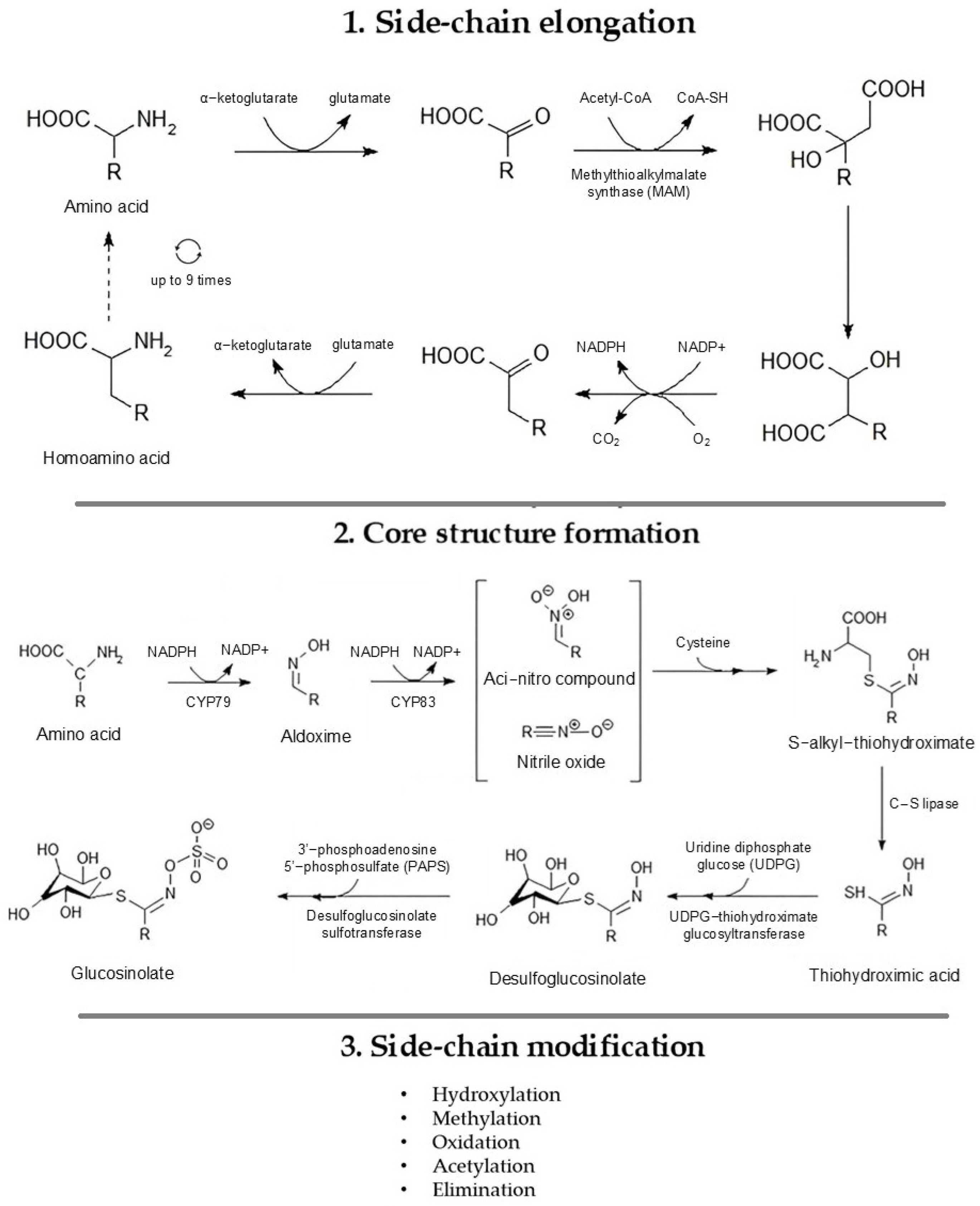
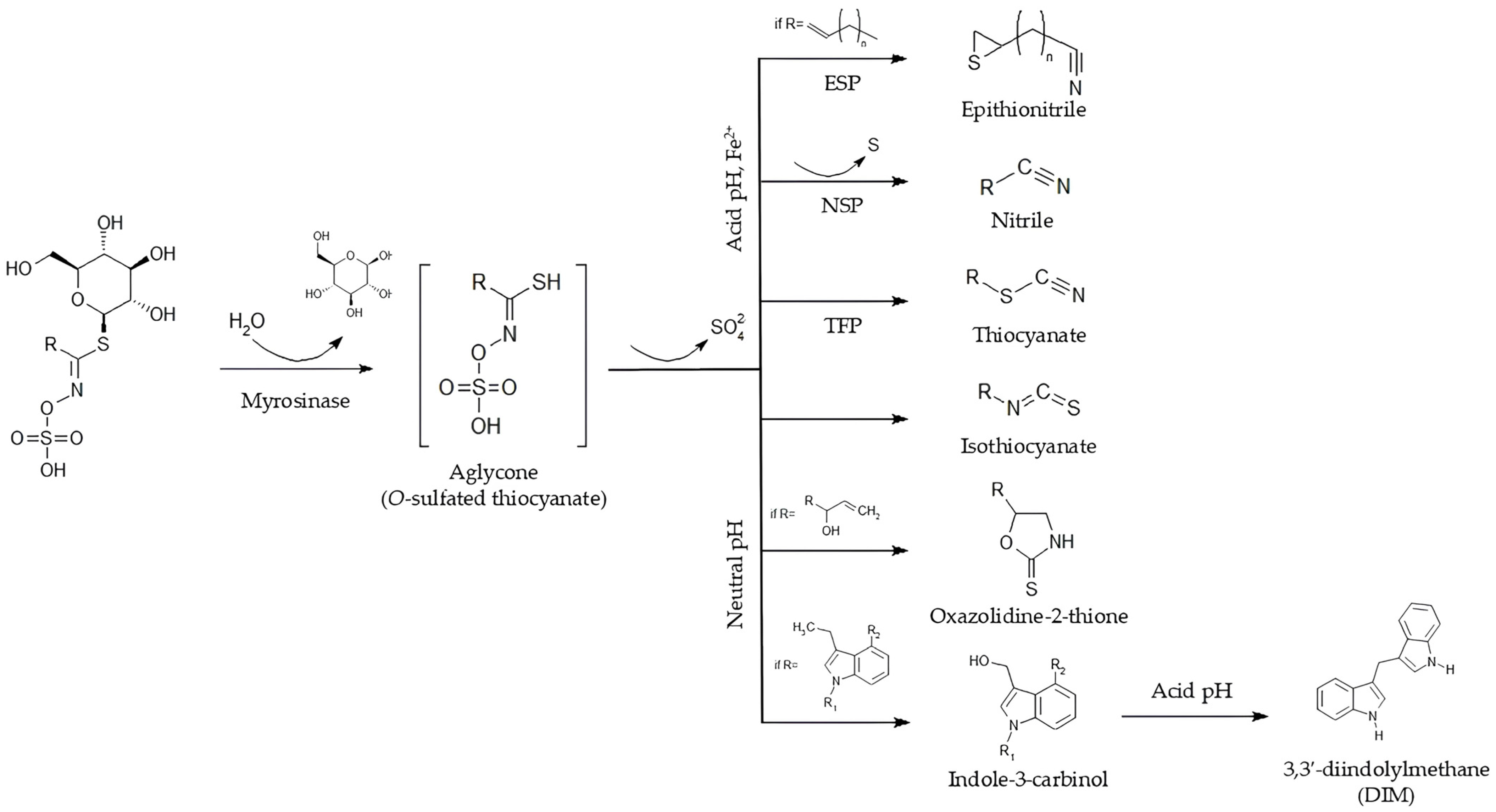
3. Structure, Classification and Biosynthesis of Glucosinolates
4. Extraction and Analysis of Glucosinolates and Their Hydrolysis Products
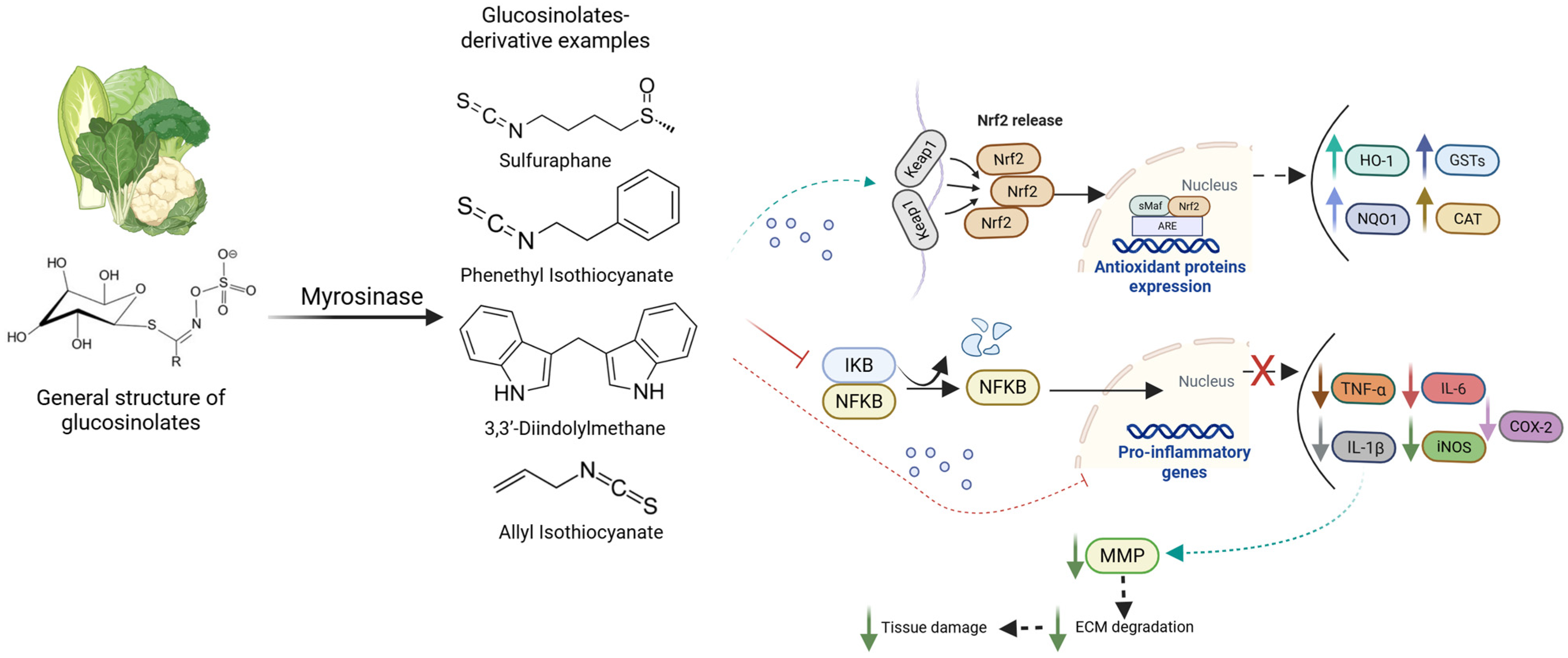
5. Anti-Inflammatory Activity of Glucosinolate Derivatives

| Species | Family | Identified Glucosinolates | Extract/Fraction/Part | In Vitro Assay | In Vivo Assay | Reference |
|---|---|---|---|---|---|---|
| Armoracia rusticana | Brassicaceae | Sinigrin | Methanolic extract from roots | LPS-stimulated J774A.1 macrophages: Decreased NO, TNF-α and IL-6 release; downregulated iNOS and COX-2; inhibited NF-κB p65 activation; reduced ROS release; increased HO-1 expression | — | [90] |
| Brassica juncea | Brassicaceae | Sinigrin | — | — | — | [91] |
| — | Methanolic extract from leaves; fractionated: n-butanol and ethyl acetate | LPS-stimulated mouse peritoneal macrophages: decrease NO production | — | [92] | ||
| — | Hydroethanolic extract (50%) from seeds | — | TPA-induced ear edema (mice), Arachidonic acid-induced ear edema (mice) and Croton oil-induced chronic ear inflammation: Decreases ear thickness, MPO activity, TNF-α and IL-6 expression | [93] | ||
| — | Methanolic extract from seeds | — | Carrageenan-induced paw edema (rats): Reduces paw swelling. | [94] | ||
| Brassica nigra | Brassicaceae | Sinigrin | Methanolic extract from leaves, seeds and stems | — | — | [95] |
| — | Ethanolic extract from leaves | Protease inhibition assay: Shows in vitro anti-inflammatory activity | Carrageenan-induced paw edema (rats): indicates moderate anti-inflammatory activity | [96] | ||
| Brassica oleracea | Brassicaceae | Sulforaphane | Aqueous extract and hydroethanolic extract (80%) from sprouts/leaves | LPS-induced RAW 264.7: Decreases NO, TNF-α and IL-6 production | Carrageenan-induced paw edema (mice); DSS colitis; LPS-induced liver injury: Decreases edema and inflammatory mediators | [97] |
| Sulforaphane | Hydromethanolic extract (80%) from florets; fractionated: n-hexane, ethyl acetate, n-butanol, aqueous fractions | LPS-induced RAW 264.7: Decreases NO production; downregulates iNOS, COX-2, TNF-α and IL-1β expression (ethyl acetate fraction). | — | [98] | ||
| Glucoraphanin | Aqueous extract from sprouts/leaves | — | Carrageenan-induced paw edema (mice): Reduces paw swelling and inflammatory response | [99] | ||
| Neoglucobrassicin | ||||||
| Glucoiberin | ||||||
| Glucobrasicin | ||||||
| Glucoerucin | ||||||
| 4-Methoxyglucobrassicin | ||||||
| 4-Hydroxyglucobrassicin | ||||||
| Brassica rapa | Brassicaceae | — | Hydroethanolic extract (95%) from roots; fractionated: n-hexane and ethyl acetate, ethyl acetate, n-butanol, aqueous fractions | LPS-induced RAW 264.7: Inhibits NF-κB activation; decreases NO, TNF-α and IL-6 production; downregulates iNOS expression (ethyl acetate fraction). | Carrageenan-induced paw edema (rats): Reduces paw swelling and inflammatory mediators (ethyl acetate fraction). | [100] |
| — | Aqueous extracts from leaves | LPS-induced RAW 264.7: Suppresses NO production; decreases TNF-α and IL-6; inhibits iNOS and COX-2 expression. | — | [101] | ||
| — | Hydroethanolic extract (80%) from leaves | — | Carrageenan-induced paw edema (mice): Decreases paw edema and inflammatory mediators; dose-dependent anti-inflammatory activity. | [102] | ||
| Gluconasturtiin | Hydroethanolic extract (80%) from roots fractionated: n-hexane, chloroform, ethyl acetate, n-butanol and water fractions | LPS-induced RAW 264.7: Reduces NO and PGE2 production; inhibits TNF-α, IL-1β, IL-6; downregulates iNOS, COX-2 and IL-6 gene expression (ethyl acetate fraction). | — | [103] | ||
| — | Methanolic extract of root peel and pulp | — | Carrageenan-induced paw edema (rats): Reduces paw swelling; peel extracts are most effective; decreases TNF-α, IL-6, CRP, RF. | [104] | ||
| Capparis spinosa | Capparaceae | Glucocapparin | Hydromethanolic extract from leaves, flowers and flower buds (caper) | — | — | [105] |
| Glucobrassicin | ||||||
| 4-hydroxyglucobrassicin | ||||||
| 4-methoxyglucobrassicin | ||||||
| Neoglucobrassicin | ||||||
| Sinigrin | ||||||
| Glucotropaeolin | ||||||
| — | Methanolic extract; fractionated: water fraction | CFSE-based proliferation assay in human PBMCs: Decreased IL-17, increased IL-4 expression (water fraction) | — | [106] | ||
| — | Aqueous extract from fruits; fractionated | — | Carrageenan-induced paw edema (mice): Decreased edema (2 fractions) | [107] | ||
| — | Methanolic extract from flower buds | — | Carrageenan-induced paw edema (rats) and air pouch model (mice): Reduced edema, TNF-α, IL-1β, neutrophil migration | [108] | ||
| Carica papaya | Caricaceae | — | Ethanolic extract from leaves | — | Carrageenan-induced paw edema (rats): Reduced paw edema; cotton pellet granuloma: Decreased granuloma formation; formaldehyde-induced arthritis: Reduced persistent edema | [109] |
| — | Hydroethanolic extract (96%) from leaves | — | Carrageenan-induced paw edema (rats): Decreases paw edema; dose-dependent anti-inflammatory activity. | [110] | ||
| Glucotropaeolin | Aqueous extracts from seeds | — | — | [111] | ||
| — | Aqueous extracts from seeds | — | Hepatotoxicity induced by CCl4 (rats): Inhibits NF-κB activation; decrease TNF-α, IL-6, TGF-β e p53 production | [112] | ||
| Cleome gynandra | Cleomaceae | Glucocapparin | — | — | — | [113] |
| — | Hydromethanolic extract (90%) from leaves | — | Adjuvant-induced arthritic rats: Reduced paw edema and restored hematological/biochemical markers | [114] | ||
| Eruca sativa | Brassicaceae | Glucoerucin | Extract of seeds | NSC-34 motor neurons exposed to medium of LPS-induced RAW 264.7: prevented neuronal apoptosis; suppressed TLR4 and COX-2 expression; inhibited NLRP3 inflammasome activation; restored IL-10 expression | — | [115] |
| Eutrema japonicum | Brassicaceae | Sinigrin | Hydroetanolic extract (60%) and methanol-acetone-water (3:1:1) from leaves, stems and roots | — | — | [116] |
| Glucohesperin | ||||||
| Glucoibarin | ||||||
| Glucobrassicanapin 4-methoxyglucobrassicin | ||||||
| 5-hexenyl glucosinolate | ||||||
| Glucochlearin | ||||||
| Gluconapin | ||||||
| Glucoalyssin | ||||||
| Glucoputranjivin | ||||||
| — | Hydroethanolic extracts (50%) from roots | — | DSS-induced colitis model (mice) | [117] | ||
| Isatis tinctoria | Brassicaceae | Glucobrassicin | Methanolic extract from leaves | — | — | [118] |
| — | Hydroethanolic extract (70%) from leaves | LPS-stimulated RAW 264.7: inhibits NF-κB activation; decrease NO, TNF-α, IL-6 production (anti-inflammatory effects) | DSS-induced colitis (mice): reduced colonic inflammation | [119] | ||
| — | Ethanolic extract from seeds | — | Carrageenan-induced paw edema (rats): Reduced paw swelling; normalized inflammatory biomarkers (CRP, fibrinogenic) | [120,121] | ||
| — | Supercritical fluid extraction from root | — | LPS-induced periodontitis (rats): decreased TNF-α, IL-6, IL-1β in the gingival tissue; reduced inflammatory cell infiltration | [122] | ||
| Lepidium sativum | Brassicaceae | Glucotropaeolin | Ethanolic extract from in seed and whole plant | — | — | [123] |
| Gluconasturin | ||||||
| — | Aqueous extract from seeds | — | Carrageenan- and formaldehyde-induced paw edema (rats): Reduced edema in both acute and chronic models | [124] | ||
| — | Aqueous extract from seeds; fractionated | — | Carrageenan-induced paw edema (mice): Significant reduction of edema. | [125] | ||
| Moringa oleifera | Moringaceae | Glucomoringin | Hydromethanolic extract from stems, leaves and seeds | — | — | [126] |
| — | Ethanolic extract from leaves; fractionated: butanol, ethyl acetate, chloroform, and hexane | LPS-induced RAW 264.7 macrophages: Decreased NO, TNF-α, IL-6, IL-1β; downregulated iNOS and COX-2; inhibited NF-κB and MAPK | — | [127] | ||
| — | Hydroethanolic extract (80%) from flowers | LPS-induced RAW 264.7: Decreased NO, TNF-α, IL-6 and IL-1β; suppressed iNOS and COX-2; inhibited NF-κB signaling; increased IκB-α expression | — | [128] | ||
| — | Hydroethanolic extracts from leaves (50, 70 and 90%) | LPS-induced RAW 264.7: Decreased NO, PGE2, TNF-α, IL-6 and IL-1β production; downregulated iNOS and COX-2 expression; inhibited NF-κB activation; increased IL-10 expression | — | [129] | ||
| — | Hydromethanolic extract (80%) from roots, leaves and fruits | LPS-induced RAW 264.7: Decreased NO, TNF-α, IL-6 and IL-1β; inhibited NF-κB; increased IκB-α expression (fruits extract) | — | [130] | ||
| — | Hydroethanolic extract (90%) of whole pods | LPS-induced RAW 264.7: Decreased NO, TNF-α, IL-6 and IL-1β; inhibited NF-κB and MAPK | — | [131] | ||
| — | Aqueous extract from leaves | — | Carrageenan and formaldehyde induced paw edema (rats); Cotton pellet-induced granuloma (rats): Reduced edema and granuloma formation in acute and chronic models | [132] | ||
| — | Aqueous extract from roots | — | Carrageenan-induced paw edema (rats): Reduced paw swelling. | [133] | ||
| — | Ethanolic extract from bark | — | Carrageenan and egg albumin induced paw edema (rats): Dose-dependent reduction of edema | [134] | ||
| — | Hydroethanolic extract from seeds; fractionated: chloroform fraction | — | Acetic acid-induced colitis (rats): Decrease colonic inflammation | [135] | ||
| — | Aqueous extracts from leaves | — | Acetic acid-induced colitis (rats): Decrease inflammatory markers | [136] | ||
| — | Hydroethanolic extract from leaves | — | DSS-induced colitis (mice): decrease colonic inflammation | [137] | ||
| — | Aqueous extract from leaves | — | DSS-induced colitis (mice): decrease colonic inflammation | [138] | ||
| Nasturtium officinale | Brassicaceae | Gluconasturtiin | Hydromethanolic extract (70%) from aerial parts | — | — | [139] |
| — | Hydroethanolic extract (70%) from aerial parts | — | Carrageenan-induced paw edema (rats); Formalin-induced paw edema (rats); TPA-induced ear edema (mice): Reduced edema and histological inflammation (systemic and topical) | [140] | ||
| — | Aqueous, ethanolic and hydroethanolic extracts from aerial parts | — | Carrageenan-induced paw edema (rats): inhibition of paw edema. | [141] | ||
| — | Hydroethanolic extract (70%) from roots | LPS-induced RAW 264.7: decrease NO, PGE2, TNF-α, IL-1β, IL-6; Downregulated iNOS and COX-2 expression; Inhibited JAK2/STAT3 phosphorylation; Activated the NRF2/HO-1 signaling pathway | — | [142] | ||
| Raphanus sativus | Brassicaceae | Glucoraphasatin | Aqueous extract from roots | — | — | [143] |
| Glucoraphanin | ||||||
| Glucoerucin | ||||||
| Glucobrassicin | ||||||
| — | Methanolic extract of leaves; fractionated: n-hexane, chloroform, ethyl acetate, n-butanol, and water fractions | LPS-induced RAW 264.7: suppressed NO production; inhibited iNOS and COX-2 expression; inhibited NF-κB activation (chloroform fraction) | — | [144] | ||
| — | Aqueous extract from seeds | — | Ulcerative colitis models (DSS, TNBS) | [145] | ||
| — | Aqueous extract from seeds; fractionated ethyl acetate, n-hexane, n-butanol and water fractions | LPS-induced RAW 264.7: decreasing NO production, TNF-α and IL-6 levels, downregulating iNOS expression, and inhibiting NF-κB and p38 MAPK signaling (Ethyl acetate fraction) | LPS-induced systemic inflammation model (mice): attenuated inflammatory response and improved survival (Aqueous extract) | [146] | ||
| — | Fresh leaf and root juice | — | Carrageenan-induced paw edema and formalin-induced paw edema (rats): reduced paw swelling. | [147] | ||
| Glucotropaeolin | Aqueous and DMSO extract | LPS-stimulated human PBMCs: decreased TNF-α release; inhibited COX-2 expression; suppressed PGE2 and LTB4 pathways | — | [148] | ||
| Tropaeolum majus | Tropaeolaceae | Glucotropaeolin | Hydromethanolic extract from leaves and flowers | — | — | [149] |
| — | Aqueous and ethanolic extracts from leaves | — | Carrageenan induced paw edema (rats); Histamine induced paw edema (rats) and Cotton pellet granuloma (rats): Decrease edema and granuloma formation | [150] |
6. Conclusions
Author Contributions
Funding
Institutional Review Board Statement
Informed Consent Statement
Data Availability Statement
Conflicts of Interest
Abbreviations
| 13C CP-MAS | Carbon-13 Cross-Polarization Magic Angle Spinning |
| 6-MSITC | 6-Methylsulfinylhexyl isothiocyanate |
| AITC | Allyl isothiocyanate |
| AOAC | Association of Official Analytical Chemists |
| BALB/c | BALB/c mice |
| BITC | Benzyl isothiocyanate |
| BMMs | Bone marrow-derived macrophages |
| C4-2B | C4-2B prostate cancer cells |
| C57BL/6 | C57BL/6 mice |
| C57BL/6 WT | C57BL/6 wild-type mice |
| CAT | Catalase |
| CCL2 | C-C motif chemokine ligand 2 |
| COX-2 | Cyclooxygenase-2 |
| COSY | Correlation Spectroscopy |
| CRP | C-reactive protein |
| CXCL10 | C-X-C motif chemokine ligand 10 |
| DEAE | Diethylaminoethyl |
| DIM | 3,3′-Diindolylmethane |
| DNA | Deoxyribonucleic acid |
| DSS | Dextran sulfate sodium |
| ER | Erucin |
| ESP | Epithiospecifier protein |
| GBM 8401 | Human glioblastoma cells |
| GCLM | Glutamate–cysteine ligase modifier subunit |
| GC-FID | Gas chromatography–flame ionization detection |
| GC-MS | Gas chromatography–mass spectrometry |
| GPx | Glutathione peroxidase |
| GR | Glutathione reductase |
| GSH | Glutathione |
| GSK-3β | Glycogen synthase kinase-3 beta |
| GSTs | Glutathione S-transferases |
| HaCaT | Human keratinocyte cell line |
| Hep3B | Human hepatocellular carcinoma cells Hep3B |
| Hepa1c1c7 | Murine hepatoma cells Hepa1c1c7 |
| HepG2 | Human hepatocellular carcinoma cells HepG2 |
| HFF | Human foreskin fibroblasts |
| HMBC | Heteronuclear Multiple Bond Correlation |
| HMC-1 | Human mast cell line-1 |
| HO-1 | Heme oxygenase-1 |
| HPDLCs | Human periodontal ligament cells |
| HPLC | High-performance liquid chromatography |
| HPLC-PDA | High-performance liquid chromatography with photodiode array detection |
| HPLC-UV | High-performance liquid chromatography with ultraviolet detection |
| HSQC | Heteronuclear Single Quantum Coherence |
| HT-29 | Human colorectal adenocarcinoma cells HT-29 |
| I3C | Indole-3-carbinol |
| ICR | Institute of Cancer Research mice |
| IL-1β | Interleukin-1 beta |
| IL-4 | Interleukin-4 |
| IL-6 | Interleukin-6 |
| IL-8 | Interleukin-8 |
| IL-10 | Interleukin-10 |
| IL-17 | Interleukin-17 |
| iNOS | Inducible nitric oxide synthase |
| IPEC-J2 | Intestinal porcine epithelial cell line J2 |
| J774A.1 | Murine macrophage cell line J774A.1 |
| JAK/STAT | Janus kinase/signal transducer and activator of transcription |
| JAK2/STAT3 | Janus kinase 2/signal transducer and activator of transcription 3 |
| LC-HRMS | Liquid chromatography–high-resolution mass spectrometry |
| LC-MS | Liquid chromatography–mass spectrometry |
| LC-MS/MS | Liquid chromatography–tandem mass spectrometry |
| LNCaP | Lymph node carcinoma of the prostate cells |
| LPS | Lipopolysaccharide |
| LTB4 | Leukotriene B4 |
| MAPK | Mitogen-activated protein kinase |
| MCP-1 | Monocyte chemoattractant protein-1 |
| MCF-7 | Human breast adenocarcinoma cells MCF-7 |
| MDA-MB-231 | Human breast adenocarcinoma cells MDA-MB-231 |
| MIC-1 | Moringin |
| MMP-2 | Matrix metalloproteinase 2 |
| MMP-9 | Matrix metalloproteinase 9 |
| MMPs | Matrix metalloproteinases |
| MPO | Myeloperoxidase |
| MRM | Multiple reaction monitoring |
| NF-κB | Nuclear factor kappa B |
| NSC-34 | Motor neuron-like cells 34 |
| NSP | Nitrile specifier protein |
| PBMCs | Peripheral blood mononuclear cells |
| PC-3 | Human prostate cancer cells PC-3 |
| PEITC | Phenethyl isothiocyanate |
| PGE2 | Prostaglandin E2 |
| PGC-1α | Peroxisome proliferator-activated receptor gamma coactivator 1-alpha |
| PLA2 | Phospholipase A2 |
| qHNMR | Quantitative proton nuclear magnetic resonance |
| QTOF | Quadrupole time-of-flight |
| RANKL | Receptor activator of nuclear factor kappa-B ligand |
| RAW 264.7 | Murine macrophage cell line |
| RF | Rheumatoid factor |
| ROS | Reactive oxygen species |
| SCID/NOD | Severe combined immunodeficiency/non-obese diabetic mice |
| SFE | Supercritical fluid extraction |
| SFN | Sulforaphane |
| SK-Hep1 | Human hepatoma cells |
| SOD | Superoxide dismutase |
| SPME | Solid-phase microextraction |
| STAT1 | Signal transducer and activator of transcription 1 |
| STAT3 | Signal transducer and activator of transcription 3 |
| TFP | Thiocyanate-forming protein |
| THP-1 | Human monocytic leukemia cell line |
| TIMP-2 | Tissue inhibitor of metalloproteinases-2 |
| TLC | Thin-layer chromatography |
| TLR4 | Toll-like receptor 4 |
| TNBS | 2,4,6-Trinitrobenzenesulfonic acid |
| TNF-α | Tumor necrosis factor-alpha |
| TPA | 12-O-tetradecanoylphorbol-13-acetate |
| TR146 | Human oral squamous carcinoma cell line TR146 |
| UHPLC-MS/MS | Ultra-high-performance liquid chromatography–tandem mass spectrometry |
| VEGF | Vascular endothelial growth factor |
References
- Vierheilig, H.; Bennett, R.; Kiddle, G.; Kaldorf, M.; Ludwig-Müller, J. Differences in glucosinolate patterns and arbuscular mycorrhizal status of glucosinolate-containing plant species. New Phytol. 2000, 146, 343–352. [Google Scholar] [CrossRef]
- Mithen, R.; Bennett, R.; Marquez, J. Glucosinolate biochemical diversity and innovation in the Brassicales. Phytochemistry 2010, 71, 2074–2086. [Google Scholar] [CrossRef]
- Rodman, J.E.; Soltis, P.S.; Soltis, D.E.; Sytsma, K.J.; Karol, K.G. Parallel evolution of glucosinolate biosynthesis inferred from congruent nuclear and plastid gene phylogenies. Am. J. Bot. 1998, 85, 997–1006. [Google Scholar] [CrossRef]
- Pormetter, L.; Pfalz, M.; Kagho, M.D.; Klahn, P.; Vogel, H.; Kroymann, J.; Wittstock, U. Glucosinolate diversity in seven field-collected Brassicaceae species. PLoS ONE 2025, 20, e0336172. [Google Scholar] [CrossRef]
- Daxenbichler, M.E.; Spencer, G.F.; Carlson, D.G.; Rose, G.B.; Brinker, A.M.; Powell, R.G. Glucosinolate composition of seeds from 297 species of wild plants. Phytochemistry 1991, 30, 2623–2638. [Google Scholar] [CrossRef]
- Fahey, J.W.; Zalcmann, A.T.; Talalay, P. The chemical diversity and distribution of glucosinolates and isothiocyanates among plants. Phytochemistry 2001, 56, 5–51. [Google Scholar] [CrossRef] [PubMed]
- Halkier, B.A.; Gershenzon, J. Biology and Biochemistry of Glucosinolates. Annu. Rev. Plant Biol. 2006, 57, 303–333. [Google Scholar] [CrossRef] [PubMed]
- Leite, P.M.; Castilho, R.O. Chemosystematics of Brassicales. Biochem. Syst. Ecol. 2017, 71, 205–211. [Google Scholar] [CrossRef]
- Kuchernig, J.C.; Burow, M.; Wittstock, U. Evolution of specifier proteins in glucosinolate-containing plants. BMC Evol. Biol. 2012, 12, 127. [Google Scholar] [CrossRef]
- Kissen, R.; Bones, A.M. Nitrile-specifier Proteins Involved in Glucosinolate Hydrolysis in Arabidopsis thaliana. J. Biol. Chem. 2009, 284, 12057–12070. [Google Scholar] [CrossRef]
- Matusheski, N.V.; Swarup, R.; Juvik, J.A.; Mithen, R.; Bennett, M.; Jeffery, E.H. Epithiospecifier Protein from Broccoli (Brassica oleracea L. ssp. italica) Inhibits Formation of the Anticancer Agent Sulforaphane. J. Agric. Food Chem. 2006, 54, 2069–2076. [Google Scholar] [CrossRef]
- Matusheski, N.V.; Juvik, J.A.; Jeffery, E.H. Heating decreases epithiospecifier protein activity and increases sulforaphane formation in broccoli. Phytochemistry 2004, 65, 1273–1281. [Google Scholar] [CrossRef]
- Lambrix, V.; Reichelt, M.; Mitchell-Olds, T.; Kliebenstein, D.J.; Gershenzon, J. The Arabidopsis Epithiospecifier Protein Promotes the Hydrolysis of Glucosinolates to Nitriles and Influences Trichoplusia ni Herbivory. Plant Cell 2001, 13, 2793–2807. [Google Scholar] [CrossRef] [PubMed]
- Kattel, S.; Antonious, G.F.; Kattel, S.; Antonious, G.F. Glucosinolates in Cruciferous Vegetables: Genetic and Environmental Regulation, Metabolic Pathways, and Cancer-Preventive Mechanisms. Int. J. Plant Biol. 2025, 16, 58. [Google Scholar] [CrossRef]
- Abdel-Massih, R.M.; Debs, E.; Othman, L.; Attieh, J.; Cabrerizo, F.M. Glucosinolates, a natural chemical arsenal: More to tell than the myrosinase story. Front. Microbiol. 2023, 14, 1130208. [Google Scholar] [CrossRef]
- Heiss, E.; Herhaus, C.; Klimo, K.; Bartsch, H.; Gerhäuser, C. Nuclear Factor κB Is a Molecular Target for Sulforaphane-mediated Anti-inflammatory Mechanisms. J. Biol. Chem. 2001, 276, 32008–32015. [Google Scholar] [CrossRef]
- Folkard, D.L.; Marlow, G.; Mithen, R.F.; Ferguson, L.R. Effect of Sulforaphane on NOD2 via NF-κB: Implications for Crohn’s disease. J. Inflamm. 2015, 12, 6. [Google Scholar] [CrossRef]
- Habtemariam, S. Anti-Inflammatory Therapeutic Mechanisms of Isothiocyanates: Insights from Sulforaphane. Biomedicines 2024, 12, 1169. [Google Scholar] [CrossRef]
- Nguyen, V.P.T.; Stewart, J.; Lopez, M.; Ioannou, I.; Allais, F.; Nguyen, V.P.T.; Stewart, J.; Lopez, M.; Ioannou, I.; Allais, F. Glucosinolates: Natural Occurrence, Biosynthesis, Accessibility, Isolation, Structures, and Biological Activities. Molecules 2020, 25, 4537. [Google Scholar] [CrossRef] [PubMed]
- Sikorska-Zimny, K.; Beneduce, L.; Sikorska-Zimny, K.; Beneduce, L. The Metabolism of Glucosinolates by Gut Microbiota. Nutrients 2021, 13, 2750. [Google Scholar] [CrossRef] [PubMed]
- Holst, B.; Williamson, G. A critical review of the bioavailability of glucosinolates and related compounds. Nat. Prod. Rep. 2004, 21, 425–447. [Google Scholar] [CrossRef]
- Ressurreição, S.; Salgueiro, L.; Figueirinha, A. Diplotaxis muralis as an Emerging Food Crop: Chemical Composition, Nutritional Profile and Antioxidant Activities. Plants 2025, 14, 844. [Google Scholar] [CrossRef]
- Ressurreição, S.; Salgueiro, L.; Figueirinha, A. Chemical Composition, Nutritional Profile, and Bioactive Properties of Diplotaxis tenuifolia, a Health-Promoting Food. Molecules 2026, 31, 417. [Google Scholar] [CrossRef]
- Sikorska-Zimny, K.; Beneduce, L. The glucosinolates and their bioactive derivatives in Brassica: A review on classification, biosynthesis and content in plant tissues, fate during and after processing, effect on the human organism and interaction with the gut microbiota. Crit. Rev. Food Sci. Nutr. 2021, 61, 2544–2571. [Google Scholar] [CrossRef]
- Radojčić Redovniković, I.; Glivetić, T.; Delonga, K.; Vorkapić-Furač, J. Glucosinolates and their potential role in plant. Period. Biol. 2008, 110, 297–309. [Google Scholar]
- Chhajed, S.; Mostafa, I.; He, Y.; Abou-Hashem, M.; El-Domiaty, M.; Chen, S. Glucosinolate Biosynthesis and the Glucosinolate–Myrosinase System in Plant Defense. Agronomy 2020, 10, 1786. [Google Scholar] [CrossRef]
- Wittstock, U.; Burow, M. Glucosinolate Breakdown in Arabidopsis: Mechanism, Regulation and Biological Significance. Am. Soc. Plant Biol. 2010, 2010, e0134. [Google Scholar] [CrossRef]
- Textor, S.; Gershenzon, J. Herbivore induction of the glucosinolate–myrosinase defense system: Major trends, biochemical bases and ecological significance. Phytochem. Rev. 2009, 8, 149–170. [Google Scholar] [CrossRef]
- Del Carmen Martínez-Ballesta, M.; Moreno, D.A.; Carvajal, M. The Physiological Importance of Glucosinolates on Plant Response to Abiotic Stress in Brassica. Int. J. Mol. Sci. 2013, 14, 11607–11625. [Google Scholar] [CrossRef]
- Bones, A.M.; Rossiter, J.T. The myrosinase-glucosinolate system, its organisation and biochemistry. Physiol. Plant. 1996, 97, 194–208. [Google Scholar] [CrossRef]
- Lv, Q.; Li, X.; Fan, B.; Zhu, C.; Chen, Z. The Cellular and Subcellular Organization of the Glucosinolate–Myrosinase System against Herbivores and Pathogens. Int. J. Mol. Sci. 2022, 23, 1577. [Google Scholar] [CrossRef]
- Ressurreição, S.; Salgueiro, L.; Figueirinha, A. Diplotaxis Genus: A Promising Source of Compounds with Nutritional and Biological Properties. Molecules 2024, 29, 2612. [Google Scholar] [CrossRef]
- Mumm, R.; Burow, M.; Bukovinszkine’Kiss, G.; Kazantzidou, E.; Wittstock, U.; Dicke, M.; Gershenzon, J. Formation of Simple Nitriles upon Glucosinolate Hydrolysis Affects Direct and Indirect Defense Against the Specialist Herbivore, Pieris rapae. J. Chem. Ecol. 2008, 34, 1311–1321. [Google Scholar] [CrossRef] [PubMed]
- Ahuja, I.; de Vos, R.C.H.; Rohloff, J.; Stoopen, G.M.; Halle, K.K.; Ahmad, S.J.N.; Hoang, L.; Hall, R.D.; Bones, A.M. Arabidopsis myrosinases link the glucosinolate-myrosinase system and the cuticle. Sci. Rep. 2016, 6, 38990. [Google Scholar] [CrossRef] [PubMed]
- Mbudu, K.G.; Witzel, K.; Börnke, F.; Hanschen, F.S. Glucosinolate profile and specifier protein activity determine the glucosinolate hydrolysis product formation in kohlrabi (Brassica oleracea var. gongylodes) in a tissue-specific way. Food Chem. 2025, 465, 142032. [Google Scholar] [CrossRef]
- Joković, N.; Pešić, S.; Vitorović, J.; Bogdanović, A.; Sharifi-Rad, J.; Calina, D. Glucosinolates and Their Hydrolytic Derivatives: Promising Phytochemicals With Anticancer Potential. Phytother. Res. 2025, 39, 1035–1089. [Google Scholar] [CrossRef]
- Aires, A.; Mota, V.R.; Saavedra, M.J.; Rosa, E.A.S.; Bennett, R.N. The antimicrobial effects of glucosinolates and their respective enzymatic hydrolysis products on bacteria isolated from the human intestinal tract. J. Appl. Microbiol. 2009, 106, 2086–2095. [Google Scholar] [CrossRef] [PubMed]
- Baldelli, S.; Lombardo, M.; D’Amato, A.; Karav, S.; Tripodi, G.; Aiello, G. Glucosinolates in Human Health: Metabolic Pathways, Bioavailability, and Potential in Chronic Disease Prevention. Foods 2025, 14, 912. [Google Scholar] [CrossRef]
- Fuentes, F.; Paredes-Gonzalez, X.; Kong, A.-N.T. Dietary Glucosinolates Sulforaphane, Phenethyl Isothiocyanate, Indole-3-Carbinol/3,3′-Diindolylmethane: Antioxidative Stress/Inflammation, Nrf2, Epigenetics/Epigenomics and In Vivo Cancer Chemopreventive Efficacy. Curr. Pharmacol. Rep. 2015, 1, 179–196. [Google Scholar] [CrossRef]
- Kołodziejski, D.; Koss-Mikołajczyk, I.; Glatt, H.; Bartoszek, A. The comparison of cytotoxic and genotoxic activities of glucosinolates, isothiocyanates, and indoles. Sci. Rep. 2022, 12, 4875. [Google Scholar] [CrossRef]
- Srikanth, Y.; Reddy, D.H.; Anusha, V.L.; Dumala, N.; Viswanadh, M.K.; Chakravarthi, G.; Nalluri, B.N.; Yadagiri, G.; Ramakrishna, K. Unveiling the Multifaceted Pharmacological Actions of Indole-3-Carbinol and Diindolylmethane: A Comprehensive Review. Plants 2025, 14, 827. [Google Scholar] [CrossRef]
- Angelino, D.; Jeffery, E. Glucosinolate hydrolysis and bioavailability of resulting isothiocyanates: Focus on glucoraphanin. J. Funct. Foods 2014, 7, 67–76. [Google Scholar] [CrossRef]
- Angelino, D.; Dosz, E.B.; Sun, J.; Hoeflinger, J.L.; Van Tassell, M.L.; Chen, P.; Harnly, J.M.; Miller, M.J.; Jeffery, E.H. Myrosinase-dependent and–independent formation and control of isothiocyanate products of glucosinolate hydrolysis. Front. Plant Sci. 2015, 6, 157079. [Google Scholar] [CrossRef]
- Fahey, J.W.; Wehage, S.L.; Holtzclaw, W.D.; Kensler, T.W.; Egner, P.A.; Shapiro, T.A.; Talalay, P. Protection of Humans by Plant Glucosinolates: Efficiency of Conversion of Glucosinolates to Isothiocyanates by the Gastrointestinal Microflora. Cancer Prev. Res. 2012, 5, 603–611. [Google Scholar] [CrossRef]
- Liou, C.S.; Sirk, S.J.; Diaz, C.A.C.; Klein, A.P.; Fischer, C.R.; Higginbottom, S.K.; Erez, A.; Donia, M.S.; Sonnenburg, J.L.; Sattely, E.S. A Metabolic Pathway for Activation of Dietary Glucosinolates by a Human Gut Symbiont. Cell 2020, 180, 717–728.e19. [Google Scholar] [CrossRef]
- Narra, F.; Galgani, G.; Harris, C.B.; Moreno, D.A.; Núñez-Gómez, V. Bioavailability, Human Metabolism, and Dietary Interventions of Glucosinolates and Isothiocyanates: Critical Insights and Future Perspectives. Foods 2025, 14, 2876. [Google Scholar] [CrossRef] [PubMed]
- Dinkova-Kostova, A.T.; Kostov, R.V. Glucosinolates and isothiocyanates in health and disease. Trends Mol. Med. 2012, 18, 337–347. [Google Scholar] [CrossRef] [PubMed]
- Li, F.; Hullar, M.A.J.; Beresford, S.A.A.; Lampe, J.W. Variation of glucoraphanin metabolism in vivo and ex vivo by human gut bacteria. Br. J. Nutr. 2011, 106, 408–416. [Google Scholar] [CrossRef] [PubMed]
- Bouranis, J.A.; Beaver, L.M.; Ho, E. Metabolic Fate of Dietary Glucosinolates and Their Metabolites: A Role for the Microbiome. Front. Nutr. 2021, 8, 748433. [Google Scholar] [CrossRef]
- Traka, M.; Mithen, R. Glucosinolates, isothiocyanates and human health. Phytochem. Rev. 2009, 8, 269–282. [Google Scholar] [CrossRef]
- Clarke, J.D.; Dashwood, R.H.; Ho, E. Multi-targeted prevention of cancer by sulforaphane. Cancer Lett. 2008, 269, 291–304. [Google Scholar] [CrossRef]
- Cunniff, P. (Ed.) Official Methods of Analysis of AOAC International, 16th ed.; AOAC International: Gaithersburg, MD, USA, 1995; ISBN 978-0-935584-54-7. [Google Scholar]
- ISO 9167-1:1992; Rapeseed—Determination of Glucosinolates Content. ISO: Vernier, Switzerland, 1992.
- ISO 9167:2019; Rapeseed and Rapeseed Meals–Determination of Glucosinolates Content–Method Using High-Performance Liquid Chromatography. ISO: Vernier, Switzerland, 2019.
- Clarke, D.B. Glucosinolates, structures and analysis in food. Anal. Methods 2010, 2, 310–325. [Google Scholar] [CrossRef]
- Doheny-Adams, T.; Redeker, K.; Kittipol, V.; Bancroft, I.; Hartley, S.E. Development of an efficient glucosinolate extraction method. Plant Methods 2017, 13, 17. [Google Scholar] [CrossRef]
- Grosser, K.; Dam, N.M. van A Straightforward Method for Glucosinolate Extraction and Analysis with High-pressure Liquid Chromatography (HPLC). J. Vis. Exp. (JoVE) 2017, 121, e55425. [Google Scholar] [CrossRef]
- Sut, S.; Boschiero, I.; Solana, M.; Malagoli, M.; Bertucco, A.; Dall’Acqua, S. Supercritical CO2 Extraction of Eruca sativa Using Cosolvents: Phytochemical Composition by LC-MS Analysis. Molecules 2018, 23, 3240. [Google Scholar] [CrossRef] [PubMed]
- Wagner, H.; Bladt, S. Plant Drug Analysis: A Thin Layer Chromatography Atlas, 2nd ed.; Springer: Berlin/Heidelberg, Germany, 1996; ISBN 3-540-58676-8. [Google Scholar]
- Rochfort, S.J.; Trenerry, V.C.; Imsic, M.; Panozzo, J.; Jones, R. Class targeted metabolomics: ESI ion trap screening methods for glucosinolates based on MSn fragmentation. Phytochemistry 2008, 69, 1671–1679. [Google Scholar] [CrossRef]
- Karanikolopoulou, S.; Revelou, P.-K.; Xagoraris, M.; Kokotou, M.G.; Constantinou-Kokotou, V. Current Methods for the Extraction and Analysis of Isothiocyanates and Indoles in Cruciferous Vegetables. Analytica 2021, 2, 93–120. [Google Scholar] [CrossRef]
- Cataldi, T.R.I.; Rubino, A.; Lelario, F.; Bufo, S.A. Naturally occurring glucosinolates in plant extracts of rocket salad (Eruca sativa L.) identified by liquid chromatography coupled with negative ion electrospray ionization and quadrupole ion-trap mass spectrometry. Rapid Commun. Mass Spectrom. 2007, 21, 2374–2388. [Google Scholar] [CrossRef]
- Palmieri, S.; Leoni, O.; Iori, R. A steady-state kineties study of myrosinase with direct ultraviolet spectrophotometric assay. Anal. Biochem. 1982, 123, 320–324. [Google Scholar] [CrossRef] [PubMed]
- Sharma, A.; Rai, P.K.; Prasad, S. GC–MS detection and determination of major volatile compounds in Brassica juncea L. leaves and seeds. Microchem. J. 2018, 138, 488–493. [Google Scholar] [CrossRef]
- Klopsch, R.; Witzel, K.; Artemyeva, A.; Ruppel, S.; Hanschen, F.S. Genotypic Variation of Glucosinolates and Their Breakdown Products in Leaves of Brassica rapa. J. Agric. Food Chem. 2018, 66, 5481–5490. [Google Scholar] [CrossRef]
- Zeng, W.; Tao, H.; Li, Y.; Wang, J.; Xia, C.; Li, S.; Wang, M.; Wang, Q.; Miao, H. The flavor of Chinese kale sprouts is affected by genotypic variation of glucosinolates and their breakdown products. Food Chem. 2021, 359, 129824. [Google Scholar] [CrossRef]
- Marchioni, I.; Martinelli, M.; Ascrizzi, R.; Gabbrielli, C.; Flamini, G.; Pistelli, L.; Pistelli, L. Small Functional Foods: Comparative Phytochemical and Nutritional Analyses of Five Microgreens of the Brassicaceae Family. Foods 2021, 10, 427. [Google Scholar] [CrossRef] [PubMed]
- Ghawi, S.K.; Methven, L.; Niranjan, K. The potential to intensify sulforaphane formation in cooked broccoli (Brassica oleracea var. italica) using mustard seeds (Sinapis alba). Food Chem. 2013, 138, 1734–1741. [Google Scholar] [CrossRef]
- Azizi Naser, S.; Amiri-Besheli, B.; Sharifi-Mehr, S. The Isolation and Determination of Sulforaphane from Broccoli Tissues by Reverse Phase-High Performance Liquid Chromatography. J. Chin. Chem. Soc. 2011, 58, 906–910. [Google Scholar] [CrossRef]
- Shen, L.; Su, G.; Wang, X.; Du, Q.; Wang, K. Endogenous and exogenous enzymolysis of vegetable-sourced glucosinolates and influencing factors. Food Chem. 2010, 119, 987–994. [Google Scholar] [CrossRef]
- Raffo, A.; Masci, M.; Moneta, E.; Nicoli, S.; Sánchez del Pulgar, J.; Paoletti, F. Characterization of volatiles and identification of odor-active compounds of rocket leaves. Food Chem. 2018, 240, 1161–1170. [Google Scholar] [CrossRef]
- Wieczorek, M.N.; Jeleń, H.H. Volatile Compounds of Selected Raw and Cooked Brassica Vegetables. Molecules 2019, 24, 391. [Google Scholar] [CrossRef]
- Wieczorek, M.N.; Majcher, M.; Jeleń, H. Comparison of Three Extraction Techniques for the Determination of Volatile Flavor Components in Broccoli. Foods 2020, 9, 398. [Google Scholar] [CrossRef] [PubMed]
- Wieczorek, M.N.; Majcher, M.A.; Jeleń, H.H. Identification of aroma compounds in raw and cooked broccoli. Flavour Fragr. J. 2021, 36, 576–583. [Google Scholar] [CrossRef]
- Wei, S.; Xiao, X.; Wei, L.; Li, L.; Li, G.; Liu, F.; Xie, J.; Yu, J.; Zhong, Y. Development and comprehensive HS-SPME/GC–MS analysis optimization, comparison, and evaluation of different cabbage cultivars (Brassica oleracea L. var. capitata L.) volatile components. Food Chem. 2021, 340, 128166. [Google Scholar] [CrossRef]
- Ibrahim, N.; Allart-Simon, I.; De Nicola, G.R.; Iori, R.; Renault, J.-H.; Rollin, P.; Nuzillard, J.-M. Advanced NMR-Based Structural Investigation of Glucosinolates and Desulfoglucosinolates. J. Nat. Prod. 2018, 81, 323–334. [Google Scholar] [CrossRef]
- Borges, R.M.; Ferreira, G.d.A.; Campos, M.M.; Teixeira, A.M.; Costa, F.d.N.; das Chagas, F.O.; Colonna, M. NMR as a tool for compound identification in mixtures. Phytochem. Anal. 2023, 34, 385–392. [Google Scholar] [CrossRef] [PubMed]
- Combourieu, B.; Elfoul, L.; Delort, A.M.; Rabot, S. Identification of new derivatives of sinigrin and glucotropaeolin produced by the human digestive microflora using 1H NMR spectroscopy analysis of in vitro incubations. Drug Metab. Dispos. 2001, 29, 1440–1445. [Google Scholar]
- Zhang, Y. The 1,2-Benzenedithiole-Based Cyclocondensation Assay: A Valuable Tool for the Measurement of Chemopreventive Isothiocyanates. Crit. Rev. Food Sci. Nutr. 2012, 52, 525–532. [Google Scholar] [CrossRef]
- Jezek, J.; Haggett, B.G.D.; Atkinson, A.; Rawson, D.M. Determination of Glucosinolates Using Their Alkaline Degradation and Reaction with Ferricyanide. J. Agric. Food Chem. 1999, 47, 4669–4674. [Google Scholar] [CrossRef] [PubMed]
- Gallaher, C.M.; Gallaher, D.D.; Peterson, S. Development and Validation of a Spectrophotometric Method for Quantification of Total Glucosinolates in Cruciferous Vegetables. J. Agric. Food Chem. 2012, 60, 1358–1362. [Google Scholar] [CrossRef] [PubMed]
- Zhou, B.; Huang, W.; Feng, X.; Liu, Q.; Ibrahim, S.A.; Liu, Y. Identification and quantification of intact glucosinolates at different vegetative growth periods in Chinese cabbage cultivars by UHPLC-Q-TOF-MS. Food Chem. 2022, 393, 133414. [Google Scholar] [CrossRef]
- Song, L.; Morrison, J.J.; Botting, N.P.; Thornalley, P.J. Analysis of glucosinolates, isothiocyanates, and amine degradation products in vegetable extracts and blood plasma by LC–MS/MS. Anal. Biochem. 2005, 347, 234–243. [Google Scholar] [CrossRef]
- Yao, M.; Xing, S.; Yao, G.; Yong, W.; Ling, Y.; Chu, B. Simultaneous quantification of 14 glucosinolates in rapeseeds by ultra high performance liquid chromatography–Tandem mass spectrometry. Food Chem. 2025, 467, 142302. [Google Scholar] [CrossRef]
- Mazzini, S.; Zuccolo, M.; Bassoli, A.; Gardana, C.; Borgonovo, G. Quantification of Glucosinolates in Seeds by Solid-State 13C-Nuclear Magnetic Resonance (NMR). Seeds 2025, 4, 27. [Google Scholar] [CrossRef]
- Guo, Q.; Li, Z.; Shen, L.; Xiao, Y.; Cheng, Z. Quantitative 1H nuclear magnetic resonance (qHNMR) methods for accurate purity determination of glucosinolates isolated from Isatis indigotica roots. Phytochem. Anal. 2021, 32, 104–111. [Google Scholar] [CrossRef] [PubMed]
- Wu, J.; Cui, S.; Liu, J.; Tang, X.; Zhao, J.; Zhang, H.; Mao, B.; Chen, W. The recent advances of glucosinolates and their metabolites: Metabolism, physiological functions and potential application strategies. Crit. Rev. Food Sci. Nutr. 2023, 63, 4217–4234. [Google Scholar] [CrossRef] [PubMed]
- Muscarà, C.; Gugliandolo, A.; Mazzon, E.; Calì, G. Glucosinolate Metabolites and Brain Health: An Updated Review on Their Potential Benefits in Neurodegenerative, Neurodevelopmental, and Psychiatric Disorders. Antioxidants 2025, 14, 818. [Google Scholar] [CrossRef]
- Miękus, N.; Marszałek, K.; Podlacha, M.; Iqbal, A.; Puchalski, C.; Świergiel, A.H. Health Benefits of Plant-Derived Sulfur Compounds, Glucosinolates, and Organosulfur Compounds. Molecules 2020, 25, 3804. [Google Scholar] [CrossRef]
- Marzocco, S.; Calabrone, L.; Adesso, S.; Larocca, M.; Franceschelli, S.; Autore, G.; Martelli, G.; Rossano, R. Anti-inflammatory activity of horseradish (Armoracia rusticana) root extracts in LPS-stimulated macrophages. Food Funct. 2015, 6, 3778–3788. [Google Scholar] [CrossRef]
- Yadav, M.; Rana, J.S. Quantitative analysis of Sinigrin in Brassica Juncea. J. Pharmacogn. Phytochem. 2018, 7, 948–954. [Google Scholar]
- Kim, H.Y.; Yokozawa, T.; Cho, E.J. Mustard Leaf Suppresses Nitric Oxide Synthesis by Mouse Macrophages. J. Nutr. Sci. Vitaminol. 2005, 51, 200–203. [Google Scholar] [CrossRef]
- Xian, Y.-F.; Hu, Z.; Ip, S.-P.; Chen, J.-N.; Su, Z.-R.; Lai, X.-P.; Lin, Z.-X. Comparison of the anti-inflammatory effects of Sinapis alba and Brassica juncea in mouse models of inflammation. Phytomedicine 2018, 50, 196–204. [Google Scholar] [CrossRef]
- Chouhan, Y.S.; Kataria, H.C.; Goswami, C.S. Anti-inflammatory activity of methanolic extract of brassica juncea seed on carrageenan induced paw edema in rats. Int. J. Pharm. Sci. Res. 2014, 5, 3849–3851. [Google Scholar] [CrossRef]
- Shahawany, A.W.A.; Hattab, Z.N.A.; Tahhan, S.F.A. Qualitative and Quantitative Analysis of Sinigrin in Different Parts In Vitro and In Vivo of Brassica nigra Plants. Biomed. Biotechnol. 2017, 4, 19–24. [Google Scholar]
- Alam, M.B.; Hossain, M.S.; Haque, M.E. Antioxidant and anti-inflammatory activities of the leaf extract of brassica nigra. Int. J. Pharm. Sci. Res. 2011, 2, 303–310. [Google Scholar] [CrossRef]
- Sim, H.W.; Lee, W.-Y.; Lee, R.; Yang, S.Y.; Ham, Y.-K.; Lim, S.D.; Park, H.-J. The Anti-Inflammatory Effects of Broccoli (Brassica oleracea L. var. italica) Sprout Extract in RAW 264.7 Macrophages and a Lipopolysaccharide-Induced Liver Injury Model. Curr. Issues Mol. Biol. 2023, 45, 9117–9131. [Google Scholar] [CrossRef]
- Hwang, J.-H.; Lim, S.-B. Antioxidant and Anti-inflammatory Activities of Broccoli Florets in LPS-stimulated RAW 264.7 Cells. Prev. Nutr. Food Sci. 2014, 19, 89–97. [Google Scholar] [CrossRef]
- Guadarrama-Enríquez, O.; Moreno-Pérez, G.F.; González-Trujano, M.E.; Ángeles-López, G.E.; Ventura-Martínez, R.; Díaz-Reval, I.; Cano-Martínez, A.; Pellicer, F.; Baenas, N.; Moreno, D.A.; et al. Antinociceptive and antiedema effects produced in rats by Brassica oleracea var. italica sprouts involving sulforaphane. Inflammopharmacology 2023, 31, 3217–3226. [Google Scholar] [CrossRef]
- Shin, J.-S.; Yun, C.H.; Cho, Y.-W.; Baek, N.-I.; Choi, M.-S.; Jeong, T.-S.; Chung, H.-G.; Lee, K.-T. Indole-Containing Fractions of Brassica rapa Inhibit Inducible Nitric Oxide Synthase and Pro-Inflammatory Cytokine Expression by Inactivating Nuclear Factor-κB. J. Med. Food 2011, 14, 1527–1537. [Google Scholar] [CrossRef] [PubMed]
- Choi, H.; Kim, H.; Han, S.; Park, H.W.; Ha, I.J.; Kim, J.S.; Lee, S.-G. Antioxidant and Anti-Inflammatory Activities of High-Glucosinolate-Synthesis Lines of Brassica rapa. Antioxidants 2023, 12, 1693. [Google Scholar] [CrossRef] [PubMed]
- Amin, M.N.; Hussain, F.; Islam, M.M.; Kabir, A.K.L.; Islam, M.M. In vivo Anti-Inflammatory and Antinociceptive Activity Evaluation of Brassica Rapa Ssp. Chinensis Ethanolic Extract with In Vitro Thrombolytic and Anthelmintic Activity Test. Biomed. Pharmacol. J. 2024, 17, 599–606. [Google Scholar] [CrossRef]
- Oh, B.-M.; Oh, H.H.; Moon, K.E.; Jang, S.-W.; Song, G.-S. Antioxidant activity and anti-inflammatory effect of solvent fractions from Chinese cabbage roots (Brassica rapa L. ssp. pekinensis). Food Sci. Biotechnol. 2024, 33, 2663–2671. [Google Scholar] [CrossRef] [PubMed]
- Nazar, N.; Hussain, A.I.; Rathore, H.A. Inter-Varietal Variation in Phenolic Profile, Antioxidant, Anti-Inflammatory and Analgesic Activities of Two Brassica rapa Varieties: Influence on Pro-Inflammatory Mediators. Molecules 2024, 29, 117. [Google Scholar] [CrossRef]
- Maldini, M.; Foddai, M.; Natella, F.; Addis, R.; Chessa, M.; Petretto, G.L.; Tuberoso, C.I.G.; Pintore, G. Metabolomic study of wild and cultivated caper (Capparis spinosa L.) from different areas of Sardinia and their comparative evaluation. J. Mass Spectrom. 2016, 51, 716–728. [Google Scholar] [CrossRef] [PubMed]
- Moutia, M.; El Azhary, K.; Elouaddari, A.; Al Jahid, A.; Jamal Eddine, J.; Seghrouchni, F.; Habti, N.; Badou, A. Capparis spinosa L. promotes anti-inflammatory response in vitro through the control of cytokine gene expression in human peripheral blood mononuclear cells. BMC Immunol. 2016, 17, 26. [Google Scholar] [CrossRef]
- Zhou, H.; Jian, R.; Kang, J.; Huang, X.; Li, Y.; Zhuang, C.; Yang, F.; Zhang, L.; Fan, X.; Wu, T.; et al. Anti-inflammatory Effects of Caper (Capparis spinosa L.) Fruit Aqueous Extract and the Isolation of Main Phytochemicals. J. Agric. Food Chem. 2010, 58, 12717–12721. [Google Scholar] [CrossRef]
- Kernouf, N.; Bouriche, H.; Kada, S.; Messaoudi, D.; Assaf, A.M.; Senator, A. Anti-inflammatory and Immuno-modulatory Effects of Capparis spinosa Flower Bud Extract. Annu. Res. Rev. Biol. 2018, 25, 1–11. [Google Scholar] [CrossRef]
- Owoyele, B.V.; Adebukola, O.M.; Funmilayo, A.A.; Soladoye, A.O. Anti-inflammatory activities of ethanolic extract of Carica papaya leaves. Inflammopharmacology 2008, 16, 168–173. [Google Scholar] [CrossRef]
- Aulianshah, V.; Thaharah, Y.R.; Zakiah, N.; Handayani, R. Anti-Inflammatory Effect Of Carica Papaya Leaves Extract In Male Wistar Rats Based On Variation Of Concentration. Int. J. Health Pharm. (IJHP) 2024, 4, 503–507. [Google Scholar] [CrossRef]
- Nakamura, Y.; Yoshimoto, M.; Murata, Y.; Shimoishi, Y.; Asai, Y.; Park, E.Y.; Sato, K.; Nakamura, Y. Papaya Seed Represents a Rich Source of Biologically Active Isothiocyanate. J. Agric. Food Chem. 2007, 55, 4407–4413. [Google Scholar] [CrossRef]
- Shaban, N.Z.; El-Kot, S.M.; Awad, O.M.; Hafez, A.M.; Fouad, G.M. The antioxidant and anti-inflammatory effects of Carica Papaya Linn. seeds extract on CCl4-induced liver injury in male rats. BMC Complement Med. Ther. 2021, 21, 302. [Google Scholar] [CrossRef]
- Mano, J.; Dicko, C.; Ouédraogo, J.C.W.; Bonzi-Coulibaly, Y.L. Glucosinolate profiling in Cleome gynandra L. aerial parts based on two extraction methods. Can. J. Chem. 2025, 103, 27–36. [Google Scholar] [CrossRef]
- Narendhirakannan, R.T.; Kandaswamy, M.; Subramanian, S. Anti-Inflammatory Activity of Cleome gynandra L. on Hematological and Cellular Constituents in Adjuvant-Induced Arthritic Rats. J. Med. Food 2005, 8, 93–99. [Google Scholar] [CrossRef] [PubMed]
- Gugliandolo, A.; Giacoppo, S.; Ficicchia, M.; Aliquò, A.; Bramanti, P.; Mazzon, E. Eruca sativa seed extract: A novel natural product able to counteract neuroinflammation. Mol. Med. Rep. 2018, 17, 6235–6244. [Google Scholar] [CrossRef]
- Dos Santos Szewczyk, K.; Skowrońska, W.; Kruk, A.; Makuch-Kocka, A.; Bogucka-Kocka, A.; Miazga-Karska, M.; Grzywa-Celińska, A.; Granica, S. Chemical composition of extracts from leaves, stems and roots of wasabi (Eutrema japonicum) and their anti-cancer, anti-inflammatory and anti-microbial activities. Sci. Rep. 2023, 13, 9142. [Google Scholar] [CrossRef]
- Kang, J.-H.; Choi, S.; Jang, J.-E.; Ramalingam, P.; Ko, Y.T.; Kim, S.Y.; Oh, S.H. Wasabia japonica is a potential functional food to prevent colitis via inhibiting the NF-κB signaling pathway. Food Funct. 2017, 8, 2865–2874. [Google Scholar] [CrossRef]
- Mohn, T.; Plitzko, I.; Hamburger, M. A comprehensive metabolite profiling of Isatis tinctoria leaf extracts. Phytochemistry 2009, 70, 924–934. [Google Scholar] [CrossRef]
- Chung, Y.C.; Lee, A.; Jang, C.H.; Ryuk, J.A.; Ha, H.; Hwang, Y.-H. Isatidis Folium Represses Dextran Sulfate Sodium-Induced Colitis and Suppresses the Inflammatory Response by Inhibiting Inflammasome Activation. Nutrients 2024, 16, 3323. [Google Scholar] [CrossRef] [PubMed]
- Al-Yahya, M.A.; Mossa, J.S.; Ageel, A.M.; Rafatullah, S. Pharmacological and safety evaluation studies on Lepidium sativum L., Seeds. Phytomedicine 1994, 1, 155–159. [Google Scholar] [CrossRef] [PubMed]
- Yahla, I.; Benguiar, R.; Riazi, A. In vivo anti-inflammatory activity of Lepidium sativum (L.) seeds. S. Asian J. Exp. Biol. 2021, 11, 81–85. [Google Scholar] [CrossRef]
- Lee, S.W.; Cho, Y.W. Anti-Inflammatory Effect of the Isatis tinctoria L. Root Extract on Lipopolysaccharide-Induced Periodontitis in Rats. J. Biosci. Med. 2019, 7, 81–95. [Google Scholar] [CrossRef]
- Malar, M.S.J.; Vanmathi, S.J.; Chairman, K. Phytochemical Analysis of Lepidium Sativum Using UV-VIS and GC-MS. Int. J. Adv. Res. 2018, 6, 813–825. [Google Scholar] [CrossRef]
- Raval, N.D.; Ravishankar, B.; Ashok, B.K. Anti-inflammatory effect of Chandrashura (Lepidium sativum Linn.) an experimental study. AYU Int. Q. J. Res. Ayurveda 2013, 34, 302. [Google Scholar] [CrossRef]
- Khan, I.U.; Jamil, Y.; Shams, F.; Farsi, S.; Humayun, M.; Hussain, A.; Ahmad, A.; Iqbal, A.; Alrefaei, A.F.; Ali, S. Unlocking the in vitro and in vivo antioxidant and anti-inflammatory activities of polysaccharide fractions from Lepidium sativum seed-coat mucilage. Heliyon 2024, 10, e36797. [Google Scholar] [CrossRef]
- Amaglo, N.K.; Bennett, R.N.; Lo Curto, R.B.; Rosa, E.A.S.; Lo Turco, V.; Giuffrida, A.; Curto, A.L.; Crea, F.; Timpo, G.M. Profiling selected phytochemicals and nutrients in different tissues of the multipurpose tree Moringa oleifera L., grown in Ghana. Food Chem. 2010, 122, 1047–1054. [Google Scholar] [CrossRef]
- Arulselvan, P.; Tan, W.S.; Gothai, S.; Muniandy, K.; Fakurazi, S.; Esa, N.M.; Alarfaj, A.A.; Kumar, S.S. Anti-Inflammatory Potential of Ethyl Acetate Fraction of Moringa oleifera in Downregulating the NF-κB Signaling Pathway in Lipopolysaccharide-Stimulated Macrophages. Molecules 2016, 21, 1452. [Google Scholar] [CrossRef]
- Tan, W.S.; Arulselvan, P.; Karthivashan, G.; Fakurazi, S. Moringa oleifera Flower Extract Suppresses the Activation of Inflammatory Mediators in Lipopolysaccharide-Stimulated RAW 264.7 Macrophages via NF-κB Pathway. Mediat. Inflamm. 2015, 2015, 720171. [Google Scholar] [CrossRef] [PubMed]
- Fard, M.; Arulselvan, P.; Karthivashan, G.; Adam, S.; Fakurazi, S. Bioactive extract from moringa oleifera inhibits the pro-inflammatory mediators in lipopolysaccharide stimulated macrophages. Pharmacogn. Mag. 2015, 11, s556–s563. [Google Scholar] [CrossRef]
- Lee, H.-J.; Jeong, Y.-J.; Lee, T.-S.; Park, Y.-Y.; Chae, W.-G.; Chung, I.-K.; Chang, H.-W.; Kim, C.-H.; Choi, Y.-H.; Kim, W.-J.; et al. Moringa fruit inhibits LPS-induced NO/iNOS expression through suppressing the NF-κ B activation in RAW264.7 cells. Am. J. Chin. Med. 2013, 41, 1109–1123. [Google Scholar] [CrossRef] [PubMed]
- Muangnoi, C.; Chingsuwanrote, P.; Praengamthanachoti, P.; Svasti, S.; Tuntipopipat, S. Moringa oleifera Pod Inhibits Inflammatory Mediator Production by Lipopolysaccharide-Stimulated RAW 264.7 Murine Macrophage Cell Lines. Inflammation 2012, 35, 445–455. [Google Scholar] [CrossRef]
- Mittal, A.; Sharma, M.; David, A.; Vishwakarma, P.; Saini, M.; Goel, M.; Saxena, K.K. An experimental study to evaluate the anti-inflammatory effect of moringa oleifera leaves in animal models. Int. J. Basic Clin. Pharmacol. 2017, 6, 452–457. [Google Scholar] [CrossRef]
- Ndiaye, M.; Dieye, A.M.; Mariko, F.; Tall, A.; Sall Diallo, A.; Faye, B. Contribution to the study of the anti-inflammatory activity of Moringa oleifera (moringaceae). Dakar Med. 2002, 47, 210–212. [Google Scholar]
- Chauhan, N.; Sharma, V.; Pareek, R.; Kushwaha, A. Anti Inflammatory Potential of Moringa Oleifera Lam. Bark In Jaipur Region. Asian J. Pharm. Res. Dev. 2021, 9, 78–83. [Google Scholar]
- Minaiyan, M.; Asghari, G.; Taheri, D.; Saeidi, M.; Nasr-Esfahani, S. Anti-inflammatory effect of Moringa oleifera Lam. seeds on acetic acid-induced acute colitis in rats. Avicenna J. Phytomed. 2014, 4, 127–136. [Google Scholar] [PubMed]
- Noubissi, P.A.; Njilifac, Q.; Fokam Tagne, M.A.; Dongmo Nguepi, M.S.; Foyet Fondjo, A.; Kouémou Emégam, N.; Ngakou Mukam, J.; Zintchem, R.; Wambe, H.; Fankem, G.O.; et al. Anxiolytic and anti-colitis effects of Moringa oleifera leaf-aqueous extract on acetic acid-induced colon inflammation in rat. Biomed. Pharmacother. 2022, 154, 113652. [Google Scholar] [CrossRef]
- Zhang, Y.; Peng, L.; Li, W.; Dai, T.; Nie, L.; Xie, J.; Ai, Y.; Li, L.; Tian, Y.; Sheng, J. Polyphenol Extract of Moringa Oleifera Leaves Alleviates Colonic Inflammation in Dextran Sulfate Sodium-Treated Mice. Evid.-Based Complement. Altern. Med. 2020, 2020, 6295402. [Google Scholar] [CrossRef]
- Mohamed Husien, H.; Peng, W.; Su, H.; Zhou, R.; Tao, Y.; Huang, J.; Liu, M.; Bo, R.; Li, J. Moringa oleifera leaf polysaccharide alleviates experimental colitis by inhibiting inflammation and maintaining intestinal barrier. Front. Nutr. 2022, 9, 1055791. [Google Scholar] [CrossRef]
- Jeon, J.; Bong, S.J.; Park, J.S.; Park, Y.-K.; Arasu, M.V.; Al-Dhabi, N.A.; Park, S.U. De novo transcriptome analysis and glucosinolate profiling in watercress (Nasturtium officinale R. Br.). BMC Genom. 2017, 18, 401. [Google Scholar] [CrossRef] [PubMed]
- Mostafazadeh, M.; Sadeghi, H.; Sadeghi, H.; Zarezade, V.; Hadinia, A.; Panahi Kokhdan, E. Further evidence to support acute and chronic anti-inflammatory effects of Nasturtium officinale. Res. Pharm. Sci. 2022, 17, 305–314. [Google Scholar] [CrossRef] [PubMed]
- Negi, N.; Upadhyay, S.; Rana, M. Phytochemical Investigation, Antioxidant and Anti-inflammatory activity of Nasturtium officinale W.T. Aiton. J. Chem. Health Risks 2023, 13, 913–919. [Google Scholar]
- Jeon, H.; Yang, D.; Lee, N.H.; Ahn, M.; Kim, G. Inhibitory Effect of Black Radish (Raphanus sativus L. var. niger) Extracts on Lipopolysaccharide-Induced Inflammatory Response in the Mouse Monocyte/Macrophage-Like Cell Line RAW 264.7. Prev. Nutr. Food Sci. 2020, 25, 408–421. [Google Scholar] [CrossRef]
- Hanlon, P.R.; Webber, D.M.; Barnes, D.M. Aqueous Extract from Spanish Black Radish (Raphanus sativus L. Var. niger) Induces Detoxification Enzymes in the HepG2 Human Hepatoma Cell Line. J. Agric. Food Chem. 2007, 55, 6439–6446. [Google Scholar] [CrossRef]
- Park, H.-J.; Song, M. Leaves of Raphanus sativus L. Shows Anti-Inflammatory Activity in LPS-Stimulated Macrophages via Suppression of COX-2 and iNOS Expression. Prev. Nutr. Food Sci. 2017, 22, 50–55. [Google Scholar] [CrossRef]
- Choi, K.-C.; Cho, S.-W.; Kook, S.-H.; Chun, S.-R.; Bhattarai, G.; Poudel, S.B.; Kim, M.-K.; Lee, K.-Y.; Lee, J.-C. Intestinal anti-inflammatory activity of the seeds of Raphanus sativus L. in experimental ulcerative colitis models. J. Ethnopharmacol. 2016, 179, 55–65. [Google Scholar] [CrossRef]
- Kook, S.-H.; Choi, K.-C.; Lee, Y.-H.; Cho, H.-K.; Lee, J.-C. Raphanus sativus L. seeds prevent LPS-stimulated inflammatory response through negative regulation of the p38 MAPK-NF-κB pathway. Int. Immunopharmacol. 2014, 23, 726–734. [Google Scholar] [CrossRef] [PubMed]
- Kamble, S.; Ahmed, M.Z.; Ramabhimaiaha, S.; Patil, P. Anti-Inflammatory Activity of Raphanus sativus L in Acute and Chronic Experimental Models in Albino Rats. Biomed. Pharmacol. J. 2015, 6, 173–177. [Google Scholar] [CrossRef]
- Tran, H.T.T.; Márton, M.-R.; Herz, C.; Maul, R.; Baldermann, S.; Schreiner, M.; Lamy, E. Nasturtium (Indian cress, Tropaeolum majus nanum) dually blocks the COX and LOX pathway in primary human immune cells. Phytomedicine 2016, 23, 611–620. [Google Scholar] [CrossRef] [PubMed]
- Aguilera-Angel, E.-Y.; Ballesteros-Vivas, D.; Vera-Bravo, R.; García, N.; Robles-Camargo, J.-E.; Costa, G.M.; Espinal-Ruiz, M.; Caicedo-Trejos, J.P.; Camacho, A.K.C.; Arroyo-Maya, I.-J.; et al. Chemical profiling, antioxidant, and antibacterial properties of Tropaeolum majus L. extract as a functional food ingredient. Front. Nutr. 2025, 12, 1626562. [Google Scholar] [CrossRef]
- Ahmed, S.M.; Middha, A.; Omer, M.; Ramakrishna, D. Analgesic and anti-inflammatory activity of ethanolic and aqueous leaf extract of Tropaeolum majus L. Int. J. Pharm. 2015, 5, 1347–1353. [Google Scholar]
- Medzhitov, R.; Horng, T. Transcriptional control of the inflammatory response. Nat. Rev. Immunol. 2009, 9, 692–703. [Google Scholar] [CrossRef]
- Olayanju, J.B.; Bozic, D.; Naidoo, U.; Sadik, O.A. A Comparative Review of Key Isothiocyanates and Their Health Benefits. Nutrients 2024, 16, 757. [Google Scholar] [CrossRef]
- Hosokawa, I.; Hosokawa, Y.; Okamoto, R.; Ozaki, K.; Hosaka, K. Alyssin Modulates Inflammatory Mediators Expression in Interleukin-1β-Stimulated Human Periodontal Ligament Cells. J. Biochem. Mol. Toxicol. 2025, 39, e70314. [Google Scholar] [CrossRef]
- Cho, H.J.; Seon, M.R.; Lee, Y.M.; Kim, J.; Kim, J.-K.; Kim, S.G.; Park, J.H.Y. 3,3´-Diindolylmethane Suppresses the Inflammatory Response to Lipopolysaccharide in Murine Macrophages123. J. Nutr. 2008, 138, 17–23. [Google Scholar] [CrossRef]
- Williams, D.E. Indoles Derived From Glucobrassicin: Cancer Chemoprevention by Indole-3-Carbinol and 3,3’-Diindolylmethane. Front. Nutr. 2021, 8, 734334. [Google Scholar] [CrossRef]
- Li, Y.; Kong, D.; Ahmad, A.; Bao, B.; Sarkar, F.H. Antioxidant Function of Isoflavone and 3,3′-Diindolylmethane: Are They Important for Cancer Prevention and Therapy? Antioxid. Redox Signal. 2013, 19, 139–150. [Google Scholar] [CrossRef]
- Krajka-Kuźniak, V.; Szaefer, H.; Bartoszek, A.; Baer-Dubowska, W. Modulation of rat hepatic and kidney phase II enzymes by cabbage juices: Comparison with the effects of indole-3-carbinol and phenethyl isothiocyanate. Br. J. Nutr. 2011, 105, 816–826. [Google Scholar] [CrossRef]
- Takada, Y.; Andreeff, M.; Aggarwal, B.B. Indole-3-carbinol suppresses NF-κB and IκBα kinase activation, causing inhibition of expression of NF-κB-regulated antiapoptotic and metastatic gene products and enhancement of apoptosis in myeloid and leukemia cells. Blood 2005, 106, 641–649. [Google Scholar] [CrossRef]
- Ernst, I.M.A.; Schuemann, C.; Wagner, A.E.; Rimbach, G. 3,3′-Diindolylmethane but not indole-3-carbinol activates Nrf2 and induces Nrf2 target gene expression in cultured murine fibroblasts. Free. Radic. Res. 2011, 45, 941–949. [Google Scholar] [CrossRef]
- Saw, C.L.-L.; Cintrón, M.; Wu, T.-Y.; Guo, Y.; Huang, Y.; Jeong, W.-S.; Kong, A.-N.T. Pharmacodynamics of dietary phytochemical indoles I3C and DIM: Induction of Nrf2-mediated phase II drug metabolizing and antioxidant genes and synergism with isothiocyanates. Biopharm. Drug Dispos. 2011, 32, 289–300. [Google Scholar] [CrossRef] [PubMed]
- Reyes-Hernández, O.D.; Figueroa-González, G.; Quintas-Granados, L.I.; Gutiérrez-Ruíz, S.C.; Hernández-Parra, H.; Romero-Montero, A.; Del Prado-Audelo, M.L.; Bernal-Chavez, S.A.; Cortés, H.; Peña-Corona, S.I.; et al. 3,3′-Diindolylmethane and indole-3-carbinol: Potential therapeutic molecules for cancer chemoprevention and treatment via regulating cellular signaling pathways. Cancer Cell Int. 2023, 23, 180. [Google Scholar] [CrossRef]
- Yen, G.-C.; Tsai, C.-M.; Lu, C.-C.; Weng, C.-J. Recent progress in natural dietary non-phenolic bioactives on cancers metastasis. J. Food Drug Anal. 2018, 26, 940–964. [Google Scholar] [CrossRef]
- Lee, Y.M.; Seon, M.R.; Cho, H.J.; Kim, J.-S.; Park, J.H.Y. Benzyl isothiocyanate exhibits anti-inflammatory effects in murine macrophages and in mouse skin. J. Mol. Med. 2009, 87, 1251–1261. [Google Scholar] [CrossRef] [PubMed]
- Lai, K.-C.; Huang, A.-C.; Hsu, S.-C.; Kuo, C.-L.; Yang, J.-S.; Wu, S.-H.; Chung, J.-G. Benzyl Isothiocyanate (BITC) Inhibits Migration and Invasion of Human Colon Cancer HT29 Cells by Inhibiting Matrix Metalloproteinase-2/-9 and Urokinase Plasminogen (uPA) through PKC and MAPK Signaling Pathway. J. Agric. Food Chem. 2010, 58, 2935–2942. [Google Scholar] [CrossRef] [PubMed]
- Badawy, S.A.E.; Ogaly, H.A.; Abd-Elsalam, R.M.; Azouz, A.A. Benzyl isothiocyanates modulate inflammation, oxidative stress, and apoptosis via Nrf2/HO-1 and NF-κB signaling pathways on indomethacin-induced gastric injury in rats. Food Funct. 2021, 12, 6001–6013. [Google Scholar] [CrossRef]
- Lee, C.-M.; Lee, D.-S.; Jung, W.-K.; Yoo, J.S.; Yim, M.-J.; Choi, Y.H.; Park, S.; Seo, S.-K.; Choi, J.S.; Lee, Y.-M.; et al. Benzyl isothiocyanate inhibits inflammasome activation in E. coli LPS-stimulated BV2 cells. Int. J. Mol. Med. 2016, 38, 912–918. [Google Scholar] [CrossRef]
- Chuang, W.-T.; Yen, C.-C.; Huang, C.-S.; Chen, H.-W.; Lii, C.-K. Benzyl Isothiocyanate Ameliorates High-Fat Diet-Induced Hyperglycemia by Enhancing Nrf2-Dependent Antioxidant Defense-Mediated IRS-1/AKT/TBC1D1 Signaling and GLUT4 Expression in Skeletal Muscle. J. Agric. Food Chem. 2020, 68, 15228–15238. [Google Scholar] [CrossRef] [PubMed]
- Hwang, E.-S.; Lee, H.J. Benzyl isothiocyanate inhibits metalloproteinase-2/-9 expression by suppressing the mitogen-activated protein kinase in SK-Hep1 human hepatoma cells. Food Chem. Toxicol. 2008, 46, 2358–2364. [Google Scholar] [CrossRef] [PubMed]
- Cho, H.J.; Lee, K.W.; Park, J.H.Y. Erucin Exerts Anti-Inflammatory Properties in Murine Macrophages and Mouse Skin: Possible Mediation through the Inhibition of NFκB Signaling. Int. J. Mol. Sci. 2013, 14, 20564–20577. [Google Scholar] [CrossRef]
- Ciccone, V.; Piragine, E.; Gorica, E.; Citi, V.; Testai, L.; Pagnotta, E.; Matteo, R.; Pecchioni, N.; Montanaro, R.; Di Cesare Mannelli, L.; et al. Anti-Inflammatory Effect of the Natural H2S-Donor Erucin in Vascular Endothelium. Int. J. Mol. Sci. 2022, 23, 15593. [Google Scholar] [CrossRef]
- Wagner, A.E.; Sturm, C.; Piegholdt, S.; Wolf, I.M.A.; Esatbeyoglu, T.; De Nicola, G.R.; Iori, R.; Rimbach, G. Myrosinase-treated glucoerucin is a potent inducer of the Nrf2 target gene heme oxygenase 1—Studies in cultured HT-29 cells and mice. J. Nutr. Biochem. 2015, 26, 661–666. [Google Scholar] [CrossRef]
- Martelli, A.; Piragine, E.; Gorica, E.; Citi, V.; Testai, L.; Pagnotta, E.; Lazzeri, L.; Pecchioni, N.; Ciccone, V.; Montanaro, R.; et al. The H2S-Donor Erucin Exhibits Protective Effects against Vascular Inflammation in Human Endothelial and Smooth Muscle Cells. Antioxidants 2021, 10, 961. [Google Scholar] [CrossRef] [PubMed]
- Shimoyama, M.; Hosokawa, Y.; Hosokawa, I.; Ozaki, K.; Hosaka, K. Effects of erucin on inflammatory mediators and antioxidant enzymes’ expression in TNF-α-stimulated human oral epithelial cells. Immunopharmacol. Immunotoxicol. 2024, 46, 49–54. [Google Scholar] [CrossRef]
- Bello, I.; Smimmo, M.; d’Emmanuele di Villa Bianca, R.; Bucci, M.; Cirino, G.; Panza, E.; Brancaleone, V. Erucin, an H2S-Releasing Isothiocyanate, Exerts Anticancer Effects in Human Triple-Negative Breast Cancer Cells Triggering Autophagy-Dependent Apoptotic Cell Death. Int. J. Mol. Sci. 2023, 24, 6764. [Google Scholar] [CrossRef]
- Tarozzi, A.; Morroni, F.; Bolondi, C.; Sita, G.; Hrelia, P.; Djemil, A.; Cantelli-Forti, G. Neuroprotective Effects of Erucin against 6-Hydroxydopamine-Induced Oxidative Damage in a Dopaminergic-like Neuroblastoma Cell Line. Int. J. Mol. Sci. 2012, 13, 10899–10910. [Google Scholar] [CrossRef] [PubMed]
- Shimoyama, M.; Hosokawa, Y.; Hosokawa, I.; Ozaki, K.; Hosaka, K. 6-(Methylsulfinyl) Hexyl Isothiocyanate Inhibits IL-6 and CXCL10 Production in TNF-α-Stimulated Human Oral Epithelial Cells. Curr. Issues Mol. Biol. 2022, 44, 2915–2922. [Google Scholar] [CrossRef] [PubMed]
- Uto, T.; Hou, D.-X.; Morinaga, O.; Shoyama, Y. Molecular Mechanisms Underlying Anti-Inflammatory Actions of 6-(Methylsulfinyl)hexyl Isothiocyanate Derived from Wasabi (Wasabia japonica). Adv. Pharmacol. Pharm. Sci. 2012, 2012, 614046. [Google Scholar] [CrossRef]
- Lohning, A.; Kidachi, Y.; Kamiie, K.; Sasaki, K.; Ryoyama, K.; Yamaguchi, H. 6-(methylsulfinyl)hexyl isothiocyanate (6-MITC) from Wasabia japonica alleviates inflammatory bowel disease (IBD) by potential inhibition of glycogen synthase kinase 3 beta (GSK-3β). Eur. J. Med. Chem. 2021, 216, 113250. [Google Scholar] [CrossRef]
- Hou, D.-X.; Korenori, Y.; Tanigawa, S.; Yamada-Kato, T.; Nagai, M.; He, X.; He, J. Dynamics of Nrf2 and Keap1 in ARE-Mediated NQO1 Expression by Wasabi 6-(Methylsulfinyl)hexyl Isothiocyanate. J. Agric. Food Chem. 2011, 59, 11975–11982. [Google Scholar] [CrossRef]
- Morroni, F.; Sita, G.; Graziosi, A.; Turrini, E.; Fimognari, C.; Tarozzi, A.; Hrelia, P. Protective Effects of 6-(Methylsulfinyl)hexyl Isothiocyanate on Aβ1-42-Induced Cognitive Deficit, Oxidative Stress, Inflammation, and Apoptosis in Mice. Int. J. Mol. Sci. 2018, 19, 2083. [Google Scholar] [CrossRef]
- Pan, X.; Xie, K.; Chen, K.; He, Z.; Sakao, K.; Hou, D.-X. Involvement of AMP-activated Protein Kinase α/Nuclear Factor (Erythroid-derived 2) Like 2-iniatived Signaling Pathway in Cytoprotective Effects of Wasabi 6-(Methylsulfinyl) Hexyl Isothiocyanate. J. Cancer Prev. 2022, 27, 58–67. [Google Scholar] [CrossRef]
- Bartkowiak-Wieczorek, J.; Malesza, M.; Malesza, I.; Hadada, T.; Winkler-Galicki, J.; Grzelak, T.; Mądry, E. Methylsulfinyl Hexyl Isothiocyanate (6-MSITC) from Wasabi Is a Promising Candidate for the Treatment of Cancer, Alzheimer’s Disease, and Obesity. Nutrients 2024, 16, 2509. [Google Scholar] [CrossRef]
- Korenori, Y.; Tanigawa, S.; Kumamoto, T.; Qin, S.; Daikoku, Y.; Miyamori, K.; Nagai, M.; Hou, D.-X. Modulation of Nrf2/Keap1 system by Wasabi 6-methylthiohexyl isothiocyanate in ARE-mediated NQO1 expression. Mol. Nutr. Food Res. 2013, 57, 854–864. [Google Scholar] [CrossRef] [PubMed]
- Yamaguchi, H.; Kamiie, K.; Kidachi, Y.; Noshita, T.; Umetsu, H.; Fuke, Y.; Ryoyama, K. Intracellular accumulation of structurally varied isothiocyanates correlates with inhibition of nitric oxide production in proinflammatory stimuli-activated tumorigenic macrophage-like cells. Bioorganic Med. Chem. 2014, 22, 440–446. [Google Scholar] [CrossRef]
- Hosokawa, Y.; Hosokawa, I.; Shimoyama, M.; Fujii, A.; Sato, J.; Kadena, K.; Ozaki, K.; Hosaka, K. The Anti-Inflammatory Effects of Iberin on TNF-α-Stimulated Human Oral Epithelial Cells: In Vitro Research. Biomedicines 2022, 10, 3155. [Google Scholar] [CrossRef] [PubMed]
- Ernst, I.M.A.; Palani, K.; Esatbeyoglu, T.; Schwarz, K.; Rimbach, G. Synthesis and Nrf2-inducing activity of the isothiocyanates iberverin, iberin and cheirolin. Pharmacol. Res. 2013, 70, 155–162. [Google Scholar] [CrossRef]
- Yahiya, Y.I.; Hadi, N.R.; Raghif, A.A.; Qassam, H.; Habooby, N.G.S.A. Role of Iberin as an anti-apoptotic agent on renal ischemia-reperfusion injury in rats. J. Med. Life 2023, 16, 915–919. [Google Scholar] [CrossRef]
- Sailaja, B.S.; Aita, R.; Maledatu, S.; Ribnicky, D.; Verzi, M.P.; Raskin, I. Moringa isothiocyanate-1 regulates Nrf2 and NF-κB pathway in response to LPS-driven sepsis and inflammation. PLoS ONE 2021, 16, e0248691. [Google Scholar] [CrossRef]
- Sailaja, B.S.; Hassan, S.; Cohen, E.; Tmenova, I.; Farias-Pereira, R.; Verzi, M.P.; Raskin, I. Moringa isothiocyanate-1 inhibits LPS-induced inflammation in mouse myoblasts and skeletal muscle. PLoS ONE 2022, 17, e0279370. [Google Scholar] [CrossRef] [PubMed]
- Jaja-Chimedza, A.; Graf, B.L.; Simmler, C.; Kim, Y.; Kuhn, P.; Pauli, G.F.; Raskin, I. Biochemical characterization and anti-inflammatory properties of an isothiocyanate-enriched moringa (Moringa oleifera) seed extract. PLoS ONE 2017, 12, e0182658. [Google Scholar] [CrossRef]
- Zhang, T.; Zhao, L.; Xu, M.; Jiang, P.; Zhang, K. Moringin alleviates DSS-induced ulcerative colitis in mice by regulating Nrf2/NF-κB pathway and PI3K/AKT/mTOR pathway. Int. Immunopharmacol. 2024, 134, 112241. [Google Scholar] [CrossRef]
- Cheng, D.; Gao, L.; Su, S.; Sargsyan, D.; Wu, R.; Raskin, I.; Kong, A.-N. Moringa Isothiocyanate Activates Nrf2: Potential Role in Diabetic Nephropathy. AAPS J. 2019, 21, 31. [Google Scholar] [CrossRef]
- Farias-Pereira, R.; Camayoc, P.; Raskin, I. Isothiocyanate-Rich Moringa Seed Extract Activates SKN-1/Nrf2 Pathway in Caenorhabditis elegans. Int. J. Mol. Sci. 2024, 25, 10917. [Google Scholar] [CrossRef]
- Xie, J.; Qian, Y.-Y.; Yang, Y.; Peng, L.-J.; Mao, J.-Y.; Yang, M.-R.; Tian, Y.; Sheng, J. Isothiocyanate From Moringa oleifera Seeds Inhibits the Growth and Migration of Renal Cancer Cells by Regulating the PTP1B-dependent Src/Ras/Raf/ERK Signaling Pathway. Front. Cell Dev. Biol. 2022, 9, 790618. [Google Scholar] [CrossRef] [PubMed]
- Moon, P.-D.; Kim, H.-M. Anti-inflammatory effect of phenethyl isothiocyanate, an active ingredient of Raphanus sativus Linne. Food Chem. 2012, 131, 1332–1339. [Google Scholar] [CrossRef]
- Dey, M.; Kuhn, P.; Ribnicky, D.; Premkumar, V.; Reuhl, K.; Raskin, I. Dietary phenethylisothiocyanate attenuates bowel inflammation in mice. BMC Chem. Biol. 2010, 10, 4. [Google Scholar] [CrossRef]
- Ma, C.; Zhang, L.; Huang, Q.; Deng, Q.; Huang, F.; Xu, J. Phenethyl isothiocyanate ameliorates liver injuries secondary to inflammatory bowel disease. Food Funct. 2025, 16, 2589–2597. [Google Scholar] [CrossRef]
- Boyanapalli, S.S.S.; Paredes-Gonzalez, X.; Fuentes, F.; Zhang, C.; Guo, Y.; Pung, D.; Saw, C.L.L.; Kong, A.-N.T. Nrf2 Knockout Attenuates the Anti-Inflammatory Effects of Phenethyl Isothiocyanate and Curcumin. Chem. Res. Toxicol. 2014, 27, 2036–2043. [Google Scholar] [CrossRef] [PubMed]
- Park, H.-J.; Kim, S.-J.; Park, S.-J.; Eom, S.-H.; Gu, G.-J.; Kim, S.H.; Youn, H.-S. Phenethyl isothiocyanate regulates inflammation through suppression of the TRIF-dependent signaling pathway of Toll-like receptors. Life Sci. 2013, 92, 793–798. [Google Scholar] [CrossRef] [PubMed]
- Lee, Y.M.; Cho, H.J.; Ponnuraj, S.P.; Kim, J.; Kim, J.-S.; Kim, S.G.; Park, J.H.Y. Phenethyl Isothiocyanate Inhibits 12-O-Tetradecanoylphorbol-13-Acetate-Induced Inflammatory Responses in Mouse Skin. J. Med. Food 2011, 14, 377–385. [Google Scholar] [CrossRef]
- Liu, S.; Lin, Z.; Mao, X.; Ge, L.; Hou, L.; Le, G.; Gan, F.; Wen, L.; Huang, K. Nontoxic dose of Phenethyl isothiocyanate ameliorates deoxynivalenol-induced cytotoxicity and inflammation in IPEC-J2 cells. Res. Vet. Sci. 2021, 136, 66–73. [Google Scholar] [CrossRef] [PubMed]
- Hoch, C.C.; Shoykhet, M.; Weiser, T.; Griesbaum, L.; Petry, J.; Hachani, K.; Multhoff, G.; Bashiri Dezfouli, A.; Wollenberg, B. Isothiocyanates in medicine: A comprehensive review on phenylethyl-, allyl-, and benzyl-isothiocyanates. Pharmacol. Res. 2024, 201, 107107. [Google Scholar] [CrossRef]
- Lai, K.-C.; Hsu, S.-C.; Kuo, C.-L.; Ip, S.-W.; Yang, J.-S.; Hsu, Y.-M.; Huang, H.-Y.; Wu, S.-H.; Chung, J.-G. Phenethyl Isothiocyanate Inhibited Tumor Migration and Invasion via Suppressing Multiple Signal Transduction Pathways in Human Colon Cancer HT29 Cells. J. Agric. Food Chem. 2010, 58, 11148–11155. [Google Scholar] [CrossRef]
- Chen, H.-J.; Lin, C.-M.; Lee, C.-Y.; Shih, N.-C.; Amagaya, S.; Lin, Y.-C.; Yang, J.-S. Phenethyl isothiocyanate suppresses EGF-stimulated SAS human oral squamous carcinoma cell invasion by targeting EGF receptor signaling. Int. J. Oncol. 2013, 43, 629–637. [Google Scholar] [CrossRef]
- Gong, A.; He, M.; Krishna Vanaja, D.; Yin, P.; Karnes, R.J.; Young, C.Y.F. Phenethyl isothiocyanate inhibits STAT3 activation in prostate cancer cells. Mol. Nutr. Food Res. 2009, 53, 878–886. [Google Scholar] [CrossRef]
- Hsu, S.-Y.; Lee, S.-C.; Liu, H.-C.; Peng, S.-F.; Chueh, F.-S.; Lu, T.-J.; Lee, H.-T.; Chou, Y.-C. Phenethyl Isothiocyanate Suppresses the Proinflammatory Cytokines in Human Glioblastoma Cells through the PI3K/Akt/NF-κB Signaling Pathway In Vitro. Oxidative Med. Cell. Longev. 2022, 2022, 2108289. [Google Scholar] [CrossRef]
- Tian, Q.; Xu, Z.; Sun, Q.; Iniguez, A.B.; Du, M.; Zhu, M.-J. Broccoli-Derived Glucoraphanin Activates AMPK/PGC1α/NRF2 Pathway and Ameliorates Dextran-Sulphate-Sodium-Induced Colitis in Mice. Antioxidants 2022, 11, 2404. [Google Scholar] [CrossRef]
- Zhu, W.; Cremonini, E.; Mastaloudis, A.; Oteiza, P.I. Glucoraphanin and sulforaphane mitigate TNFα-induced Caco-2 monolayers permeabilization and inflammation. Redox Biol. 2024, 76, 103359. [Google Scholar] [CrossRef]
- Moon, D.-O.; Kim, M.-O.; Kang, S.-H.; Choi, Y.H.; Kim, G.-Y. Sulforaphane suppresses TNF-α-mediated activation of NF-κB and induces apoptosis through activation of reactive oxygen species-dependent caspase-3. Cancer Lett. 2009, 274, 132–142. [Google Scholar] [CrossRef] [PubMed]
- Lin, W.; Wu, R.T.; Wu, T.; Khor, T.-O.; Wang, H.; Kong, A.-N. Sulforaphane suppressed LPS-induced inflammation in mouse peritoneal macrophages through Nrf2 dependent pathway. Biochem. Pharmacol. 2008, 76, 967–973. [Google Scholar] [CrossRef]
- Nallasamy, P.; Si, H.; Babu, P.V.A.; Pan, D.; Fu, Y.; Brooke, E.A.S.; Shah, H.; Zhen, W.; Zhu, H.; Liu, D.; et al. Sulforaphane reduces vascular inflammation in mice and prevents TNF-α-induced monocyte adhesion to primary endothelial cells through interfering with the NF-κB pathway. J. Nutr. Biochem. 2014, 25, 824–833. [Google Scholar] [CrossRef]
- Lee, Y.-R.; Noh, E.-M.; Han, J.-H.; Kim, J.-M.; Hwang, B.-M.; Kim, B.-S.; Jung, S.H.; Youn, H.J.; Chung, E.Y.; Kim, J.-S. Sulforaphane controls TPA-induced MMP-9 expression through the NF-κB signaling pathway, but not AP-1, in MCF-7 breast cancer cells. BMB Rep. 2013, 46, 201–206. [Google Scholar] [CrossRef]
- Qi, T.; Xu, F.; Yan, X.; Li, S.; Li, H. Sulforaphane exerts anti-inflammatory effects against lipopolysaccharide-induced acute lung injury in mice through the Nrf2/ARE pathway. Int. J. Mol. Med. 2016, 37, 182–188. [Google Scholar] [CrossRef] [PubMed]
- Ranaweera, S.S.; Dissanayake, C.Y.; Natraj, P.; Lee, Y.J.; Han, C.-H. Anti-inflammatory effect of sulforaphane on LPS-stimulated RAW 264.7 cells and ob/ob mice. J. Vet. Sci. 2020, 21, e91. [Google Scholar] [CrossRef] [PubMed]
- Zhou, T.; Zhou, M.; Tong, C.; Zhuo, M. Cauliflower bioactive compound sulforaphane inhibits breast cancer development by suppressing NF-κB/MMP-9 signaling pathway expression. Cell Mol. Biol. 2022, 68, 134–143. [Google Scholar] [CrossRef]
- Chen, M.; Yu, G.; Wu, W.; Lei, P.; Zhang, X.; Ren, J.; Jiang, X.; Yang, M.; He, C. Sulforaphane attenuates DSS-induced ulcerative colitis via the Nrf2/STAT3 signaling pathway and gut microbiota modulation. Food Funct. 2026, 17, 1032–1044. [Google Scholar] [CrossRef]
- Bose, C.; Alves, I.; Singh, P.; Palade, P.T.; Carvalho, E.; Børsheim, E.; Jun, S.-R.; Cheema, A.; Boerma, M.; Awasthi, S.; et al. Sulforaphane prevents age-associated cardiac and muscular dysfunction through Nrf2 signaling. Aging Cell 2020, 19, e13261. [Google Scholar] [CrossRef] [PubMed]
- Zhang, L.; Wang, S.; Zhang, Y.; Li, F.; Yu, C. Sulforaphane alleviates lung ischemia-reperfusion injury through activating Nrf-2/HO-1 signaling. Exp. Ther. Med. 2023, 25, 265. [Google Scholar] [CrossRef] [PubMed]
- Esfandyari, S.; Aleyasin, A.; Noroozi, Z.; Taheri, M.; Khodarahmian, M.; Eslami, M.; Rashidi, Z.; Amidi, F. The Protective Effect of Sulforaphane against Oxidative Stress through Activation of NRF2/ARE Pathway in Human Granulosa Cells. Cell J. (Yakhteh) 2021, 23, 692–700. [Google Scholar] [CrossRef]
- Li, S.; Khoi, P.N.; Yin, H.; Sah, D.K.; Kim, N.-H.; Lian, S.; Jung, Y.-D. Sulforaphane Suppresses the Nicotine-Induced Expression of the Matrix Metalloproteinase-9 via Inhibiting ROS-Mediated AP-1 and NF-κB Signaling in Human Gastric Cancer Cells. Int. J. Mol. Sci. 2022, 23, 5172. [Google Scholar] [CrossRef]
- Zheng, Y.; Tao, S.; Lian, F.; Chau, B.T.; Chen, J.; Sun, G.; Fang, D.; Lantz, R.C.; Zhang, D.D. Sulforaphane prevents pulmonary damage in response to inhaled arsenic by activating the Nrf2-defense response. Toxicol. Appl. Pharmacol. 2012, 265, 292–299. [Google Scholar] [CrossRef]
- Tafakh, M.S.; Saidijam, M.; Ranjbarnejad, T.; Malih, S.; Mirzamohammadi, S.; Najafi, R. Sulforaphane, a Chemopreventive Compound, Inhibits Cyclooxygenase-2 and Microsomal Prostaglandin E Synthase-1 Expression in Human HT-29 Colon Cancer Cells. Cells Tissues Organs 2018, 206, 46–53. [Google Scholar] [CrossRef]
- Zhang, Z.; Li, C.; Shang, L.; Zhang, Y.; Zou, R.; Zhan, Y.; Bi, B. Sulforaphane induces apoptosis and inhibits invasion in U251MG glioblastoma cells. SpringerPlus 2016, 5, 235. [Google Scholar] [CrossRef]
- Pagliarani, B.; Pruccoli, L.; Chemello, C.; Zusso, M.; Fonseca Moreira, J.C.; Tarozzi, A.; Gomes, H.M. Exploring the anti-inflammatory activity of sulforaphane metabolites. Pharmacol. Rep. 2026, 78, 615–624. [Google Scholar] [CrossRef]
- Zhang, G.; Jin, C.; Zhu, Y.; Fu, F.; Wang, G.; Li, S. Sulforaphene inhibits the progression of osteosarcoma via regulating FSTL1/NF-κB pathway. Life Sci. 2020, 263, 118485. [Google Scholar] [CrossRef]
- Zhang, B.; Liu, P.; Sheng, H.; Guo, Y.; Han, Y.; Suo, L.; Yuan, Q. New Insight into the Potential Protective Function of Sulforaphene against ROS−Mediated Oxidative Stress Damage In Vitro and In Vivo. Int. J. Mol. Sci. 2023, 24, 13129. [Google Scholar] [CrossRef]
- Yao, H.; Du, Y.; Jiang, B.; Liao, Y.; Zhao, Y.; Yin, M.; Li, T.; Sheng, Y.; Ji, Y.; Du, M. Sulforaphene suppresses RANKL-induced osteoclastogenesis and LPS-induced bone erosion by activating Nrf2 signaling pathway. Free. Radic. Biol. Med. 2023, 207, 48–62. [Google Scholar] [CrossRef] [PubMed]
- Ren, K.; Li, Z.; Li, Y.; Zhang, W.; Han, X. Sulforaphene enhances radiosensitivity of hepatocellular carcinoma through suppression of the NF-κB pathway. J. Biochem. Mol. Toxicol. 2017, 31, e21917. [Google Scholar] [CrossRef] [PubMed]
- Yang, W.; Liu, Y.; Xu, Q.-Q.; Xian, Y.-F.; Lin, Z.-X. Sulforaphene Ameliorates Neuroinflammation and Hyperphosphorylated Tau Protein via Regulating the PI3K/Akt/GSK-3β Pathway in Experimental Models of Alzheimer’s Disease. Oxidative Med. Cell. Longev. 2020, 2020, 4754195. [Google Scholar] [CrossRef] [PubMed]
- Gao, L.; Du, F.; Wang, J.; Zhao, Y.; Liu, J.; Cai, D.; Zhang, X.; Wang, Y.; Zhang, S. Examination of the differences between sulforaphane and sulforaphene in colon cancer: A study based on next-generation sequencing. Oncol. Lett. 2021, 22, 690. [Google Scholar] [CrossRef]
- Ruan, D.; Yang, J.; Luo, Q.; Shi, Y.; Ding, L.; Wang, Z.; Wang, R.; Yang, L. The Protective Effects of Goitrin on LPS-Induced Septic Shock in C57BL/6J Mice via Caspase-11 Non-Canonical Inflammasome Inhibition. Molecules 2023, 28, 2883. [Google Scholar] [CrossRef]
- Latronico, T.; Larocca, M.; Milella, S.; Fasano, A.; Rossano, R.; Liuzzi, G.M. Neuroprotective potential of isothiocyanates in an in vitro model of neuroinflammation. Inflammopharmacology 2021, 29, 561–571. [Google Scholar] [CrossRef]
- Caglayan, B.; Kilic, E.; Dalay, A.; Altunay, S.; Tuzcu, M.; Erten, F.; Orhan, C.; Gunal, M.Y.; Yulug, B.; Juturu, V.; et al. Allyl isothiocyanate attenuates oxidative stress and inflammation by modulating Nrf2/HO-1 and NF-κB pathways in traumatic brain injury in mice. Mol. Biol. Rep. 2019, 46, 241–250. [Google Scholar] [CrossRef]
- Wagner, A.E.; Boesch-Saadatmandi, C.; Dose, J.; Schultheiss, G.; Rimbach, G. Anti-inflammatory potential of allyl-isothiocyanate–role of Nrf2, NF-κB and microRNA-155. J. Cell. Mol. Med. 2012, 16, 836–843. [Google Scholar] [CrossRef]
- Subedi, L.; Venkatesan, R.; Kim, S.Y. Neuroprotective and Anti-Inflammatory Activities of Allyl Isothiocyanate through Attenuation of JNK/NF-κB/TNF-α Signaling. Int. J. Mol. Sci. 2017, 18, 1423. [Google Scholar] [CrossRef]
- Minato, Y.; Aoki-Nonaka, Y.; Lwin, H.Y.; Ando, D.; Warita, Y.; Matsugishi-Nasu, A.; Hiyoshi, T.; Takahashi, N.; Tabeta, K. Allyl isothiocyanate suppressed periodontal tissue destruction in mice via bacteriostatic and anti-inflammatory activities against Porphyromonas gingivalis. Arch. Oral Biol. 2025, 169, 106118. [Google Scholar] [CrossRef]
- Chang, W.-J.; Chen, B.-H.; Inbaraj, B.S.; Chien, J.-T. Preparation of allyl isothiocyanate nanoparticles, their anti-inflammatory activity towards RAW 264.7 macrophage cells and anti-proliferative effect on HT1376 bladder cancer cells. J. Sci. Food Agric. 2019, 99, 3106–3116. [Google Scholar] [CrossRef]
- Lai, Y.-H.; Chiang, Y.-F.; Huang, K.-C.; Chen, H.-Y.; Ali, M.; Hsia, S.-M. Allyl isothiocyanate mitigates airway inflammation and constriction in a house dust mite-induced allergic asthma model via upregulation of tight junction proteins and the TRPA1 modulation. Biomed. Pharmacother. 2023, 166, 115334. [Google Scholar] [CrossRef]
- Okulicz, M.; Hertig, I.; Król, E.; Szkudelski, T. Effects of Allyl Isothiocyanate on Oxidative and Inflammatory Stress in Type 2 Diabetic Rats. Molecules 2022, 27, 5568. [Google Scholar] [CrossRef] [PubMed]
- Lin, T.-S.; Huang, W.-N.; Yang, J.-L.; Peng, S.-F.; Liu, K.-C.; Chen, J.-C.; Hsia, T.-C.; Huang, A.-C. Allyl isothiocyanate inhibits cell migration and invasion in human gastric cancer AGS cells via affecting PI3K/AKT and MAPK signaling pathway in vitro. Environ. Toxicol. 2023, 38, 2287–2297. [Google Scholar] [CrossRef] [PubMed]
- Li, C.-X.; Gao, J.-G.; Wan, X.-Y.; Chen, Y.; Xu, C.-F.; Feng, Z.-M.; Zeng, H.; Lin, Y.-M.; Ma, H.; Xu, P.; et al. Allyl isothiocyanate ameliorates lipid accumulation and inflammation in nonalcoholic fatty liver disease via the Sirt1/AMPK and NF-κB signaling pathways. World J. Gastroenterol. 2019, 25, 5120–5133. [Google Scholar] [CrossRef] [PubMed]
- Zhu, W.-T.; Li, C.-H.; Dai, T.-T.; Song, Q.; Chen, Y.; Han, Z.-L.; Sun, N.-X.; Wang, D.-L. Effect of allyl isothiocyanate on oxidative stress in COPD via the AhR/CYP1A1 and Nrf2/NQO1 pathways and the underlying mechanism. Phytomedicine 2023, 114, 154774. [Google Scholar] [CrossRef]
- Han, N.-R.; Park, W.; Um, J.-Y.; Kim, H.-M.; Jeong, H.-J. Allyl isothiocyanate regulates caspase-1/receptor interacting protein-2 expression. Int. Immunopharmacol. 2011, 11, 525–528. [Google Scholar] [CrossRef]
- Hwang, E.-S.; Lee, H.J. Allyl isothiocyanate and its N-acetylcysteine conjugate suppress metastasis via inhibition of invasion, migration, and matrix metalloproteinase-2/-9 activities in SK-Hep 1 human hepatoma cells. Exp. Biol. Med. 2006, 231, 421–430. [Google Scholar] [CrossRef]
- Du, D.; Lan, W.; Wang, H.; Huang, Q.; Wang, F. Deciphering the therapeutic potential of Sinigrin: A promising anti-inflammatory agent for chronic disease management. Phytomedicine 2025, 144, 156875. [Google Scholar] [CrossRef]
- Laurindo, L.F.; dos Santos, A.R.d.O.; de Carvalho, A.C.A.; Bechara, M.D.; Guiguer, E.L.; Goulart, R.d.A.; Vargas Sinatora, R.; Araújo, A.C.; Barbalho, S.M. Phytochemicals and Regulation of NF-kB in Inflammatory Bowel Diseases: An Overview of In Vitro and In Vivo Effects. Metabolites 2023, 13, 96. [Google Scholar] [CrossRef]
- Ribeiro, M.; Cardozo, L.F.; Paiva, B.R.; Baptista, B.G.; Fanton, S.; Alvarenga, L.; Lima, L.S.; Britto, I.; Nakao, L.S.; Fouque, D.; et al. Sulforaphane Supplementation Did Not Modulate NRF2 and NF-kB mRNA Expressions in Hemodialysis Patients. J. Ren. Nutr. 2024, 34, 68–75. [Google Scholar] [CrossRef] [PubMed]
- Bahoosh, S.R.; Shokoohinia, Y.; Eftekhari, M. Glucosinolates and their hydrolysis products as potential nutraceuticals to combat cytokine storm in SARS-COV-2. DARU J. Pharm. Sci. 2022, 30, 245–252. [Google Scholar] [CrossRef] [PubMed]
- Esteve, M. Mechanisms Underlying Biological Effects of Cruciferous Glucosinolate-Derived Isothiocyanates/Indoles: A Focus on Metabolic Syndrome. Front. Nutr. 2020, 7, 111. [Google Scholar] [CrossRef]
- Clemente-Suárez, V.J.; Martín-Rodríguez, A.; Redondo-Flórez, L.; López-Mora, C.; Yáñez-Sepúlveda, R.; Tornero-Aguilera, J.F. New Insights and Potential Therapeutic Interventions in Metabolic Diseases. Int. J. Mol. Sci. 2023, 24, 10672. [Google Scholar] [CrossRef] [PubMed]
- Heindel, J.J.; Blumberg, B.; Cave, M.; Machtinger, R.; Mantovani, A.; Mendez, M.A.; Nadal, A.; Palanza, P.; Panzica, G.; Sargis, R.; et al. Metabolism disrupting chemicals and metabolic disorders. Reprod. Toxicol. 2017, 68, 3–33. [Google Scholar] [CrossRef]
- Kamal, R.M.; Abdull Razis, A.F.; Mohd Sukri, N.S.; Perimal, E.K.; Ahmad, H.; Patrick, R.; Djedaini-Pilard, F.; Mazzon, E.; Rigaud, S. Beneficial Health Effects of Glucosinolates-Derived Isothiocyanates on Cardiovascular and Neurodegenerative Diseases. Molecules 2022, 27, 624. [Google Scholar] [CrossRef] [PubMed]
- Lee, H.-W.; Lee, C.G.; Rhee, D.-K.; Um, S.H.; Pyo, S. Sinigrin inhibits production of inflammatory mediators by suppressing NF-κB/MAPK pathways or NLRP3 inflammasome activation in macrophages. Int. Immunopharmacol. 2017, 45, 163–173. [Google Scholar] [CrossRef]
- Piragine, E.; Flori, L.; Di Cesare Mannelli, L.; Ghelardini, C.; Pagnotta, E.; Matteo, R.; Lazzeri, L.; Martelli, A.; Miragliotta, V.; Pirone, A.; et al. Eruca sativa Mill. seed extract promotes anti-obesity and hypoglycemic effects in mice fed with a high-fat diet. Phytother. Res. 2021, 35, 1983–1990. [Google Scholar] [CrossRef]
- Ahn, M.; Kim, J.; Yang, D.; Chun, J.-Y.; Kim, G.O.; Shin, T. Indole-3-carbinol alleviates carbon tetrachloride-induced liver injury by inhibiting inflammatory response and regulating lipid metabolism. Adv. Tradit. Med. (ADTM) 2021, 21, 371–378. [Google Scholar] [CrossRef]
- Axelsson, A.S.; Tubbs, E.; Mecham, B.; Chacko, S.; Nenonen, H.A.; Tang, Y.; Fahey, J.W.; Derry, J.M.; Wollheim, C.B.; Wierup, N.; et al. Sulforaphane reduces hepatic glucose production and improves glucose control in patients with type 2 diabetes. Sci. Transl. Med. 2017, 9, eaah4477. [Google Scholar] [CrossRef]
- Bahadoran, Z.; Tohidi, M.; Nazeri, P.; Mehran, M.; Azizi, F.; Mirmiran, P. Effect of broccoli sprouts on insulin resistance in type 2 diabetic patients: A randomized double-blind clinical trial. Int. J. Food Sci. Nutr. 2012, 62, 767–771. [Google Scholar] [CrossRef] [PubMed]
- Bouranis, J.A.; Beaver, L.M.; Choi, J.; Wong, C.P.; Jiang, D.; Sharpton, T.J.; Stevens, J.F.; Ho, E. Composition of the Gut Microbiome Influences Production of Sulforaphane-Nitrile and Iberin-Nitrile from Glucosinolates in Broccoli Sprouts. Nutrients 2021, 13, 3013. [Google Scholar] [CrossRef] [PubMed]
- Choi, Y.; Abdelmegeed, M.A.; Song, B.-J. Preventive effects of indole-3-carbinol against alcohol-induced liver injury in mice via antioxidant, anti-inflammatory, and anti-apoptotic mechanisms: Role of gut-liver-adipose tissue axis. J. Nutr. Biochem. 2018, 55, 12–25. [Google Scholar] [CrossRef]
- Cramer, J.M.; Teran-Garcia, M.; Jeffery, E.H. Enhancing sulforaphane absorption and excretion in healthy men through the combined consumption of fresh broccoli sprouts and a glucoraphanin-rich powder. Br. J. Nutr. 2012, 107, 1333–1338. [Google Scholar] [CrossRef]
- Mao, H.; Zhao, X.; Sun, S. NF-κB in inflammation and cancer. Cell Mol. Immunol. 2025, 22, 811–839. [Google Scholar] [CrossRef]
- Wolosowicz, M.; Prokopiuk, S.; Kaminski, T.W. Matrix Metalloproteinase-9 (MMP-9) as a Therapeutic Target: Insights into Molecular Pathways and Clinical Applications. Pharmaceutics 2025, 17, 1425. [Google Scholar] [CrossRef] [PubMed]
- Mirzaie, M.; Karimi, M.; Fallah, H.; Khaksari, M.; Nazari-Robati, M. Downregulation of Matrix Metalloproteinases 2 and 9 is Involved in the Protective Effect of Trehalose on Spinal Cord Injury. Int. J. Mol. Cell. Med. IJMCM 2018, 7, 8–16. [Google Scholar] [CrossRef]
- Kwon, H.S.; Koh, S.-H. Neuroinflammation in neurodegenerative disorders: The roles of microglia and astrocytes. Transl. Neurodegener. 2020, 9, 42. [Google Scholar] [CrossRef]
- Doke, R.R.; Lamkhade, G.J.; Vinchurkar, K.; Singh, S. Demystifying the Role of Neuroinflammatory Mediators as Biomarkers for Diagnosis, Prognosis, and Treatment of Alzheimer’s Disease: A Review. ACS Pharmacol. Transl. Sci. 2024, 7, 2987–3003. [Google Scholar] [CrossRef] [PubMed]
- Desando, G.; Gambari, L.; Amore, E.; Borciani, G.; Carpentieri, S.; Grassi, F.; Grigolo, B.; Roseti, L. Role of Dietary Glucosinolates and Isothiocyanate Derivatives in Osteoarthritis: Insights from a Narrative Review. Appl. Sci. 2025, 15, 13025. [Google Scholar] [CrossRef]
- Hwang, H.J.; Kim, J.-E.; Lee, K.W. Sulforaphene Attenuates Cutibacterium acnes-Induced Inflammation. J. Microbiol. Biotechnol. 2022, 32, 1390–1395. [Google Scholar] [CrossRef] [PubMed]
- Suganya, K.; Koo, B.-S. Gut–Brain Axis: Role of Gut Microbiota on Neurological Disorders and How Probiotics/Prebiotics Beneficially Modulate Microbial and Immune Pathways to Improve Brain Functions. Int. J. Mol. Sci. 2020, 21, 7551. [Google Scholar] [CrossRef] [PubMed]
- Karin, M.; Greten, F.R. NF-κB: Linking inflammation and immunity to cancer development and progression. Nat. Rev. Immunol. 2005, 5, 749–759. [Google Scholar] [CrossRef]
- Kessenbrock, K.; Plaks, V.; Werb, Z. Matrix Metalloproteinases: Regulators of the Tumor Microenvironment. Cell 2010, 141, 52–67. [Google Scholar] [CrossRef]
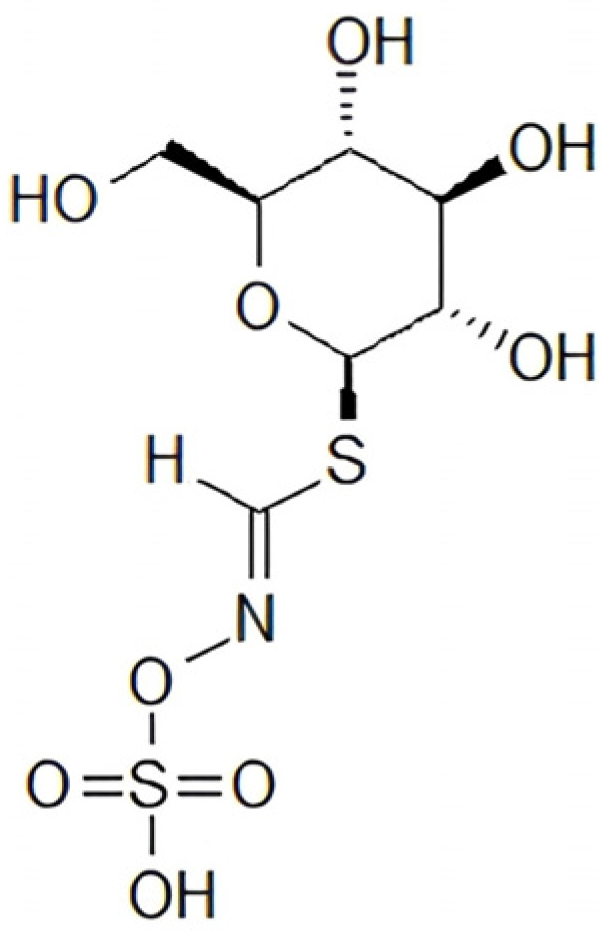


| Glucosinolate | Active Derivative | Effect on NF-κB | Effect on NRF2 | Effect on MMPs | References |
|---|---|---|---|---|---|
| Glucoalyssin | Alyssin | Inhibits NF-κB nuclear translocation: decreases TNF-α, IL-6, IL-8, CCL2, CXCL10 and COX-2. In vitro assays: HPDLCs. | Activates NRF2: increases HO-1 and NQO-1. In vitro assays: HPDLCs. | — | [153] |
| Glucobrassicin | Indole-3-carbinol (I3C)/3,3′-Diindolylmethane (DIM) | Inhibits NF-κB nuclear translocation: decreases TNF-α, IL-6, IL-1β, iNOS, VEGF and IL-8. In vitro assay: RAW 264.7. | Activates NRF2: increases HO-1, NQO1, GSTs and GCLC/GCLM. In vitro assay: HepG2-C8. | Decreases MMP-9 and uPA. In vitro assay: Prostate cancer cells (PC-3, LNCaP, and C4-2B), breast cancer cells (MCF-7 and MDA-MB-231), pancreatic cancer cells, and squamous cell carcinoma cells. In vivo assay: Xenograft models in SCID/NOD mice, orthotopic pancreatic cancer models, and specialized prostate cancer bone metastasis models. | [154,155,156,157,158,159,160,161,162] |
| Glucotropaeolin | Benzyl isothiocyanate (BITC) | Inhibits NF-κB nuclear translocation: decreases TNF-α, IL-1β, IL-6, iNOS, COX-2. In vitro assay: RAW 264.7, BV2. In vivo assay: TPA-induced mouse ear edema model and LPS-induced inflammatory response. | Activates NRF2: increases HO-1, NQO1, GSTs and CAT. In vitro assay: RAW 264.7 and Gastric epithelial cell models In vivo assay: Indomethacin-induced gastric injury model | Decreases MMP-2, MMP-9 and uPA; increase TIMP-2. In vitro assay: HT-29 human colon adenocarcinoma cells and SK-Hep1 human hepatocellular carcinoma cells | [163,164,165,166,167,168] |
| Glucoerucin | Erucin (ER) | Inhibits NF-κB nuclear translocation: decreases TNF-α, IL-1β, IL-6, iNOS, COX-2. In vitro assay: RAW 264.7, HUVEC. In vivo assay: TPA-induced mouse ear edema model and LPS-induced mouse peritonitis model. | Activates NRF2: increases HO-1, NQO1, GSTs and CAT. In vitro assay: HUVEC, TR146, HT-29. In vivo assay: C57BL/6 mice. | — | [169,170,171,172,173,174,175] |
| Glucohesperin | 6-Methylsulfinylhexyl isothiocyanate (6-MSITC) | Inhibits NF-κB signaling via competitive inhibition of GSK-3β: decreases IL-6, CXCL10, and STAT3 activation, and suppresses COX-2, iNOS, and NO production. In vitro assay: TR146 human oral epithelial cells and J774.1/RAW264 macrophages. In vivo assay: DSS-induced colitis models in BALB/c and C57BL/6 mice | Activates NRF2: increases HO-1, NQO1 and GSTs. In vitro assay: TR146 human oral epithelial cells and HepG2. In vivo assay: DSS-induced colitis model in C57BL/6 mice. | — | [176,177,178,179,180,181,182,183,184] |
| Glucoiberin | Iberin | Inhibits NF-κB nuclear translocation: decreases TNF-α, IL-6 and COX-2. In vitro assay: TNF-α-stimulated TR146 cells. In vivo assay: rat renal ischemia–reperfusion (IRI). | Activates NRF2: increases HO-1 and NQO1. In vitro assay: TR146 cells, fibroblasts NIH3T3. | — | [185,186,187] |
| Glucomoringin | Moringin (MIC-1) | Inhibits NF-κB nuclear translocation: decreases TNF-α, IL-1β, IL-6, IFN-α, and iNOS. In vitro assay: RAW 264.7, THP-1 and C2C12. In vivo assay: LPS-induced inflammation in C57BL/6 mice. | Activates NRF2: increases HO-1, NQO1 and GSTs. In vitro assay: RAW 264.7 and Hepa1c1c7. In vivo assay: LPS-induced inflammation in C57BL/6 mice. | Decreases MMP-2 and MMP-9. In vitro assay: 786-O and 769-P renal carcinoma cells | [188,189,190,191,192,193,194] |
| Gluconasturtiin | Phenethyl isothiocyanate (PEITC) | Inhibits NF-κB nuclear translocation: decreases TNF-α, IL-1β, IL-6, IL-8, NO, PGE2, iNOS, COX-2 and CXCL10; reduces STAT1 and STAT3 activation. In vitro assay: RAW 264.7, HMC-1, IPEC-J2, THP-1, HepG2, HT-29, PC-3 and GBM 8401 In vivo assay: C57BL/6J mice, TPA-induced ear edema (ICR mice) and xenograft tumor models | Activates NRF2: increases HO-1, NQO1, SOD, CAT, GSTs, GPx e GR; Restores GSH levels In vitro assay: HepG2, RAW 264.7, primary peritoneal macrophages In vivo assay: diabetic rats (acrylonitrile exposure), C57BL/6 WT vs. Nrf2 knockout | Decreases MMP-2 and MMP-9. In vitro assay: HT-29 colon cancer cells and SAS oral squamous carcinoma cells | [195,196,197,198,199,200,201,202,203,204,205,206] |
| Glucoraphanin | Sulforaphane (SFN) | Inhibits NF-κB nuclear translocation: decreases TNF-α, IL-1β, IL-6, IL-8, MCP-1, iNOS, COX-2, CXCL10; reduce STAT3 activation; decreases epithelial barrier disruption and inflammation in colitis. In vitro assay: RAW 264.7, HUVEC, TR146 and MCF-7. In vivo assay: BALB/c mice and C57BL/6 mice. | Activates NRF2: increases HO-1, NQO1, GSTs, PGC-1α; Restores GSH levels and mitochondrial DNA copy number. In vitro assay: RAW 264.7, HepG2 and HUVEC. In vivo assay: BALB/c mice and C57BL/6 mice. | Decreases MMP-2 and MMP-9. In vitro assay: U251MG glioblastoma cells and HT-29 colon cancer cells (decrease MMP-2 and MMP-9); MCF-7 breast cancer cells and AGS gastric cancer cells (decrease MMP-9) In vivo assay: LPS-induced acute lung injury model in BALB/c mice (decrease MMP-9 in lung tissue) | [207,208,209,210,211,212,213,214,215,216,217,218,219,220,221,222,223,224] |
| Glucoraphenin | Sulforaphene | Inhibits NF-κB nuclear translocation: decreases TNF-α, IL-1β, IL-6, IL-8, NO, iNOS, COX-2, and MCP-1 In vitro assay: RAW 264.7, BV-2 microglia, HaCaT and HepG2/Hep3B. In vivo assay: STZ-induced cognitive deficits in rats, D-galactose-induced kidney injury (C57BL/6 mice). | Activates NRF2: increases HO-1, NQO1, GCLM, SOD and CAT. In vitro assay: RAW 264.7, BMMs, HaCaT and HFF. In vivo assay: LPS-induced inflammatory bone erosion (C57BL/6 mice) and D-galactose-induced kidney damage | Decreases MMP-9 (osteoclastogenesis-associated). In vitro assay: RAW 264.7 and BMMs stimulated with RANKL for osteoclastogenesis In vivo assay: In vivo assay: LPS-induced bone erosion model (C57BL/6 mice) | [225,226,227,228,229,230] |
| Progoitrin | Goitrin | Mild NF-κB inhibition: decreases TNF-α, IL-6 and IL-1β. In vitro assay: RAW 264.7. In vivo assay: C57BL/6J mice. | — | — | [231] |
| Sinigrin | Allyl isothiocyanate (AITC) | Inhibits NF-κB nuclear translocation: decreases TNF-α, IL-1β, IL-6, iNOS, COX-2. In vitro assay: RAW 264.7, BV2, AML-12, HMC-1, BEAS-2B, HT1376 and THP-1-derived macrophages In vivo assay: C57BL/6 mice: NAFLD/hepatic steatosis (high-fat diet), Traumatic Brain Injury (TBI), BALB/c mice: allergic asthma and Periodontitis model. | Activates NRF2: increases HO-1, NQO1, GSTs and GSH levels. In vitro assay: RAW 264.7, primary astrocytes, fibroblasts In vivo assay: C57BL/6 mice: TBI, NAFLD/steatosis models and BALB/c asthma model | Decreases MMP-2 and MMP-9. In vitro assay: SK-Hep1 hepatoma cells | [232,233,234,235,236,237,238,239,240,241,242,243,244,245] |
Disclaimer/Publisher’s Note: The statements, opinions and data contained in all publications are solely those of the individual author(s) and contributor(s) and not of MDPI and/or the editor(s). MDPI and/or the editor(s) disclaim responsibility for any injury to people or property resulting from any ideas, methods, instructions or products referred to in the content. |
© 2026 by the authors. Licensee MDPI, Basel, Switzerland. This article is an open access article distributed under the terms and conditions of the Creative Commons Attribution (CC BY) license.
Share and Cite
Ressurreição, S.; Pinho, S.A.; Cruz, M.T.; Salgueiro, L.; Figueirinha, A. Glucosinolate Derivatives: Emerging Anti-Inflammatory Agents. Pharmaceuticals 2026, 19, 658. https://doi.org/10.3390/ph19050658
Ressurreição S, Pinho SA, Cruz MT, Salgueiro L, Figueirinha A. Glucosinolate Derivatives: Emerging Anti-Inflammatory Agents. Pharmaceuticals. 2026; 19(5):658. https://doi.org/10.3390/ph19050658
Chicago/Turabian StyleRessurreição, Sandrine, Sónia A. Pinho, Maria Teresa Cruz, Lígia Salgueiro, and Artur Figueirinha. 2026. "Glucosinolate Derivatives: Emerging Anti-Inflammatory Agents" Pharmaceuticals 19, no. 5: 658. https://doi.org/10.3390/ph19050658
APA StyleRessurreição, S., Pinho, S. A., Cruz, M. T., Salgueiro, L., & Figueirinha, A. (2026). Glucosinolate Derivatives: Emerging Anti-Inflammatory Agents. Pharmaceuticals, 19(5), 658. https://doi.org/10.3390/ph19050658