Review

Reviewing the Implication of Aldehyde Dehydrogenases in Male Reproduction: Prospects for New Therapeutic Approaches

by
Foteini Gkaitatzi
1,
Ilias Tsochantaridis
2,
Olga Pagonopoulou
3 and
Georgia-Persephoni Voulgaridou
4,*
1
PEDY—National Primary Health Care Network, 68132 Alexandroupolis, Greece
2
Department of Molecular Biology and Genetics, School of Health Sciences, Democritus University of Thrace, 68100 Alexandroupolis, Greece
3
Laboratory of Neurophysiology, Department of Medicine, School of Health Sciences, Democritus University of Thrace, 68100 Alexandroupolis, Greece
4
Laboratory of Physiology, Department of Medicine, School of Health Sciences, Democritus University of Thrace, 68100 Alexandroupolis, Greece
*
Author to whom correspondence should be addressed.
Pharmaceuticals 2026, 19(4), 617; https://doi.org/10.3390/ph19040617
Submission received: 28 January 2026 / Revised: 5 April 2026 / Accepted: 6 April 2026 / Published: 14 April 2026
(This article belongs to the Special Issue Therapeutic Potential of Aldehyde Dehydrogenases)

Abstract

The World Health Organization (WHO) defines infertility as the inability of a couple to conceive after at least 12 months of regular, unprotected sexual intercourse. The male factor appears to be contributing, solely or in combination with other causes, to approximately 50% of all infertility cases. Several etiological factors of male infertility have been identified; however, the exact molecular mechanisms underlying sperm dysfunction are not yet fully understood. Aldehyde dehydrogenases (ALDHs) are multifaceted metabolic enzymes that catalyze the detoxification of several aldehydes, thus acting as antioxidants, while they regulate additional homeostatic functions by contributing to retinoic acid (RA) synthesis. Consequently, they have been identified as crucial factors in various pathogenetic mechanisms. ALDHs hold physiological roles in the testis through supporting the Sertoli cell function, the steroidogenesis in Leydig cells, and the maintenance of sperm integrity. Current evidence supports that dysregulation of specific ALDHs isoforms could be associated with disrupted testicular cell function, including oxidative imbalance and altered RA synthesis. These irregularities could interfere with germ cell development and, subsequently, contribute to decline in reproductive function. In this paper, we are reviewing the role of ALDHs in male reproduction and how their dysregulation could be implicated in male infertility. Unraveling the mechanisms underlying the association of ALDHs with male reproductive function could hold clinical interest regarding the development of novel approaches for enhancing male fertility.

1. Introduction

Infertility is defined, according to the World Health Organization (WHO), as the inability of a couple to achieve pregnancy after, at least, 12 months of unprotected, frequent sexual intercourse [1]. It is estimated that infertility has a 17.5% lifetime prevalence and 12.6% period prevalence, with around 1 in 6 individuals experiencing infertility at least once in their lifetime [2]. In approximately 20% of affected couples, infertility is exclusively attributed to the male factor, while male infertility is involved as a cofactor in an additional 30–40% of cases. Consequently, 50% of all infertility cases are associated, to an extent, with reduced male reproductive potential [3,4,5].
Several studies indicate a decline in male reproductive parameters over the last few decades [6,7,8,9]. A meta-analysis by Levine et al. [8] on the global trends in specific sperm variables in studies published during 1973–2018 revealed declines of 51.6% and 62.3% for sperm concentration and total sperm count respectively among men from all continents. Additionally, the authors reported that the decline slope of the sperm concentration and total sperm count is getting steeper in the 21st century [8]. However, while the reduction in the semen parameters is generally accepted, it is not well determined whether this is translated into true reproductive malfunction [10].
Even though the deterioration in male fertility comes with a heavy financial and psychological burden, the etiological factors underlying male subfertility have not yet been fully clarified. This does not come as a surprise considering the multiple genetical, anatomical, endocrinal, metabolic, environmental and lifestyle-related factors associated with reproductive function [11]. Furthermore, in a relatively high proportion of cases (10–20%), male infertility is idiopathic; thus, semen analysis appears with normal parameters, and no specific cause can be identified [5].
Consequently, the management of male infertility is a multifaceted and challenging task, especially in cases where the pathophysiological basis is not well-defined or when multiple casual factors co-exist. Clinical approaches, depending on the causality, include drug and/or supplements administration (e.g., follicle-stimulating hormone (FSH), human chorionic gonadotropin (hCG), antioxidants, micronutrient supplements), changes in lifestyle (e.g., weight loss, increased physical activity, smoking cessation, reduced alcohol consumption), invasive microsurgical procedures (e.g., vasovasostomy, epididymovasostomy, sperm retrieval techniques), and genetic counseling [12,13]. Antioxidants have been shown to limit the negative effects of oxidative stress on sperm function and quality associated with male infertility. Supplementation with specific formulations can improve sperm parameters and fertility outcomes, although these effects vary depending on dosage, duration of administration, and individual health status [14]. While such approaches can serve as supportive treatment for male infertility, they should be applied with caution and with appropriate selection of patients who could potentially benefit.
It is apparent that unraveling the complex and diverse pathophysiological conditions leading to male subfertility as well as identifying novel diagnostic biomarkers and therapeutic targets is of crucial importance. This review highlights the roles of aldehyde dehydrogenases (ALDHs), a superfamily of antioxidant enzymes associated with stem cell phenotype and differentiation, in reproductive homeostasis. We summarize the current data on the involvement of ALDHs in testicular function and explore their potential contribution to the dysfunction leading to male infertility. To our knowledge, this is the first review to summarize the effects of ALDHs on male reproduction by elucidating these mechanisms, which may provide valuable clinical insights and support the development of novel therapeutic interventions.

2. Overview of the Aldehyde Dehydrogenase Superfamily

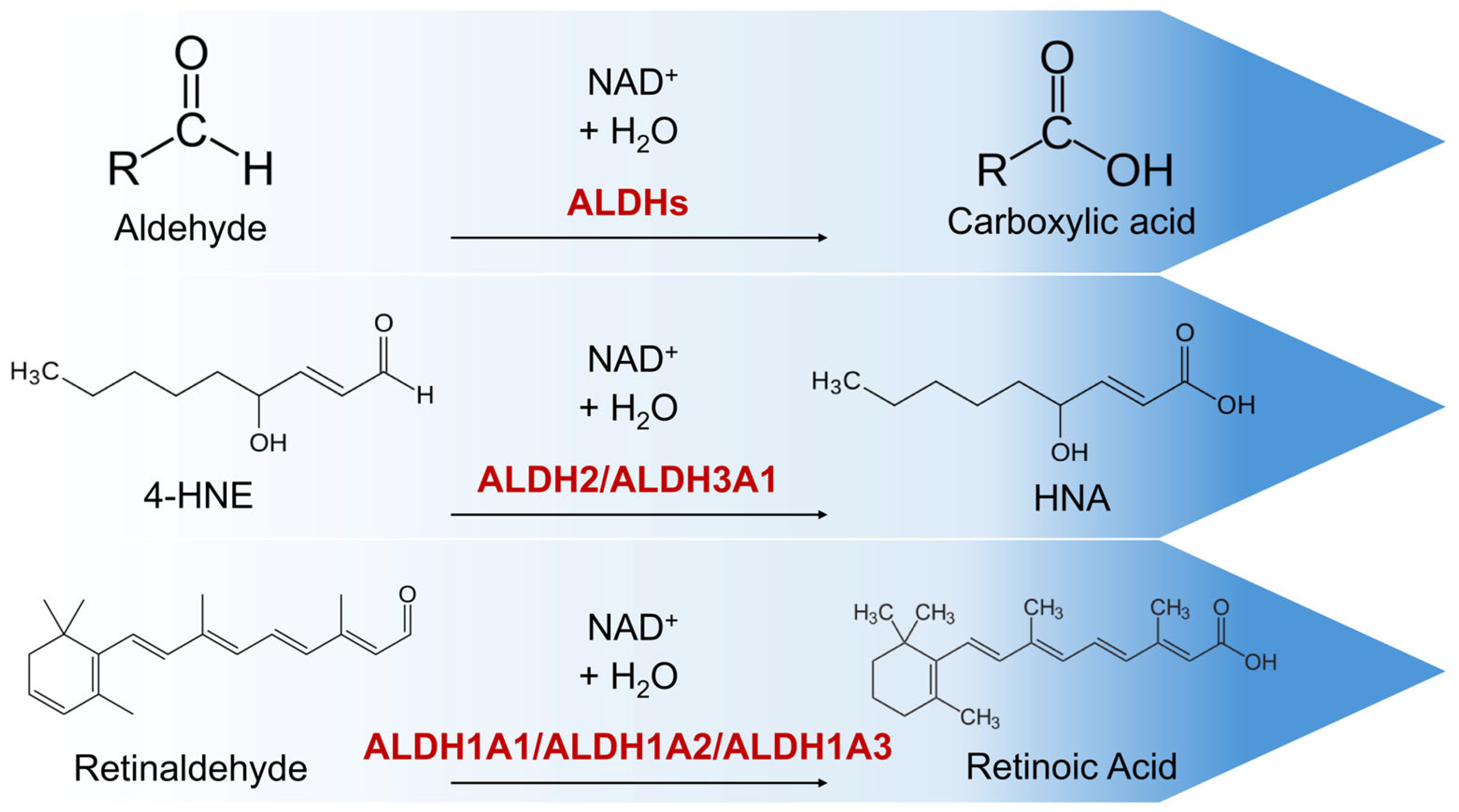
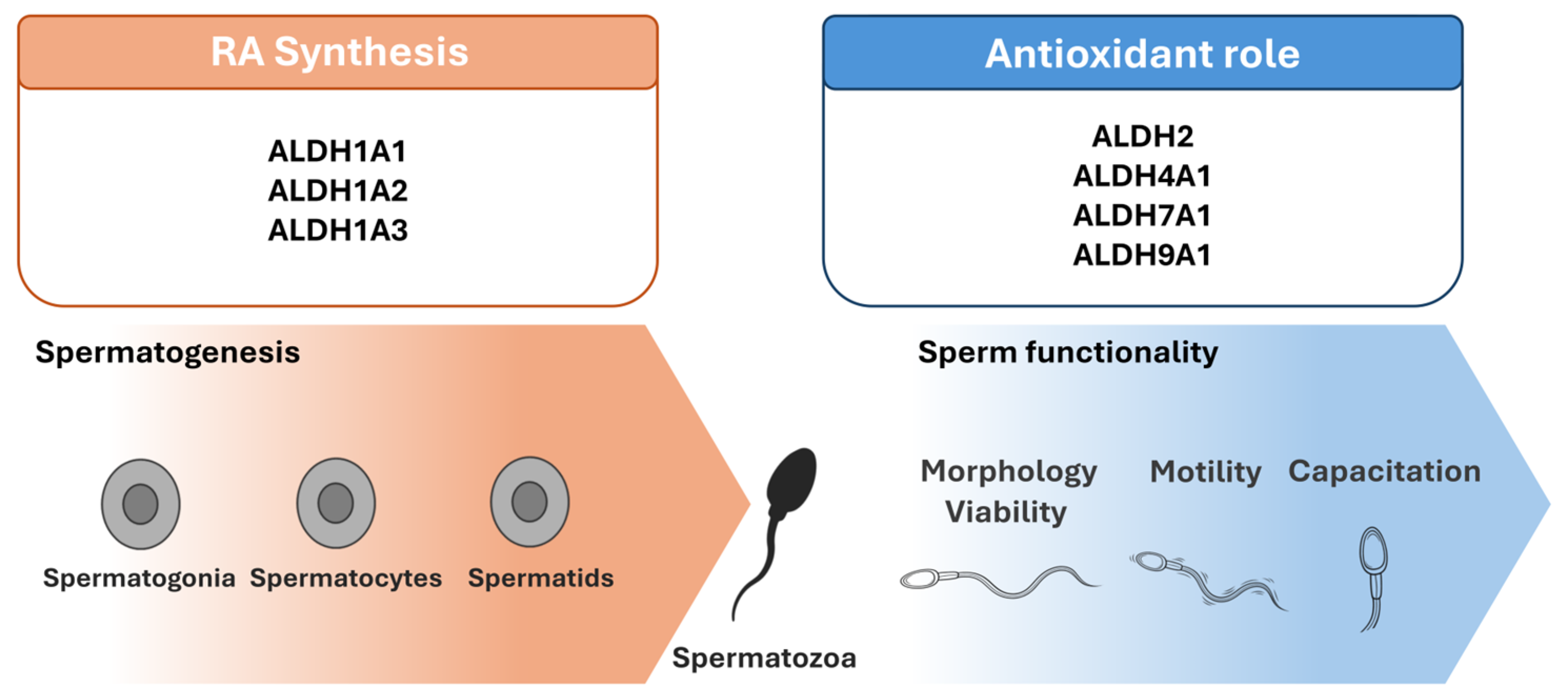
Members of the ALDH superfamily are encoded by 19 genes and are classified into 11 families and several subfamilies [15,16]. The dual role of ALDHs is that they act as antioxidants by catalyzing the oxidation of a wide variety of reactive and potentially toxic aldehydes to their corresponding carboxylic acids and contribute to the synthesis of important signaling molecules, such as retinoic acid (RA) (via the oxidation of retinaldehyde), which are involved in critical homeostatic processes such as differentiation (Figure 1).
ALDH expression is abundant mainly in tissues with increased metabolic activity and high antioxidant demands including the liver, brain, testis, and ovary. ALDH proteins share a conserved tertiary structure consisting of a catalytic domain with a cysteine residue, a cofactor binding domain for nicotinamide adenine dinucleotide phosphate (NADP+), and an oligomerization region required for their quaternary structure formation [17,18]. Individual ALDH isoforms differ in substrate specificity and intracellular localization [19]. The aldehyde dehydrogenase 1 family member A1 (ALDH1A1), aldehyde dehydrogenase 1 family member A2 (ALDH1A2), and aldehyde dehydrogenase 1 family member A3 (ALDH1A3) isoforms, also known as retinal dehydrogenases (RALDHs), catalyze the conversion of retinaldehyde to RA [20,21]. In the testicular tissue, the ALDH1A enzyme family plays a pivotal role in RA biosynthesis within the seminiferous epithelium, a process that is indispensable for proper spermatogenesis [21,22,23]. Aldehyde dehydrogenase 2 family member (ALDH2) has a crucial role in the detoxification of reactive aldehydes such as acetaldehyde and 4-hydroxynonenal (4-HNE) [24]. Enzymes of the aldehyde dehydrogenase 3 family member (ALDH3) family are nicotinamide adenine dinucleotide (NAD+) or NADP+ homodimers and oxidize a wide range of aromatic aldehydes [18]. This family, including aldehyde dehydrogenase 3 family member A1 (ALDH3A1), aldehyde dehydrogenase 3 family member A2 (ALDH3A2), aldehyde dehydrogenase 3 family member B1 (ALDH3B1) and aldehyde dehydrogenase 3 family member B2 (ALDH3B2), is characterized by its unique substrate specificity and shows certain catalytic activity against electrophiles derived from lipid peroxidation, such as 4-HNE, thereby supporting cellular defense against oxidative stress [25,26,27]. ALDH3A1 is predominantly expressed in epithelial tissues [26] and ALDH3A2 participates in the oxidation of long-chain fatty aldehydes, and its mutations lead to Sjögren–Larsson syndrome, an inherited neurocutaneous disorder [27]. Aldehyde dehydrogenase 4 family member A1 (ALDH4A1) is a member of the aldehyde dehydrogenase 4 family (ALDH4), which catalyzes the second step of the proline degradation pathway and is NAD+-dependent in the mitochondrial matrix [28]. Aldehyde dehydrogenase 9 family member A1 (ALDH9A1) in turn catalyzes the NAD+-dependent oxidation of a variety of aldehydes, including the carnitine precursor 4-trimethylaminobutyraldehyde (TMBAL) and the betaine aldehyde [29].

3. Retinoic Acid Signaling in Testicular Function

RA is a biological active metabolic product of vitamin A, which, by binding to nuclear receptors such as the retinoic acid receptors (RARs) and the retinoid X receptors (RXRs), regulates cellular differentiation, proliferation and apoptosis through specific signaling pathways [30,31]. Reproductive tissue formation and gametogenesis, including the initiation of meiosis, the regulation of gene expression of steroidogenic hormones, Leydig cell differentiation, and vascular remodeling, appear to depend on the enzymatic synthesis of RA, which is, among others, driven by ALDHs [32]. Genetic and/or functional disorder in the synthesis and signaling of RA can result in reproductive malfunction, including spermatogenesis arrest, testicular atrophy, and infertility [33].
In mammals, spermatogenesis is initiated at puberty [34,35,36]. During embryonic development, bipotential gonadal cells commit to the Sertoli cell lineage in the testis. Primordial germ cells (PGCs) arise in the epiblast and migrate to the developing gonadal ridge [37], where interactions with embryonic Sertoli cells promote seminiferous cord formation [38]. These germ cells subsequently proliferate mitotically to form gonocytes or prospermatogonia, which initially localize to the center of the seminiferous cords and later relocate to the periphery to establish the spermatogonial population in the juvenile testis.
Following puberty, spermatogenesis is a continuous, highly coordinated developmental process that is regulated by RA signaling and cellular interactions within the testicular microenvironment [39], following a species-specific and time-determined program [40]. Complex cellular and molecular interactions, supported by the nutrient environment of the seminiferous tubules, occur to ensure that spermatogenic stem cells (SSCs) enter the differentiation process through spermatogenesis [41]. SSCs represent a specialized population of undifferentiated spermatogonia that, through the property of self-renewal triggered by glial cell-derived neurotrophic factor (GDNF), support the production of germ cells [42]. Upon their commitment to differentiation, the proliferating undifferentiated spermatogonia enter this cyclical program consisting of several distinct stages [40,43,44,45]. During the seminiferous epithelial cycle, RA acts in a pulsatile manner, generating the spermatogenic wave necessary for SSC differentiation, initiation of meiosis, conversion of spermatogonia to spermatocytes and release of structurally mature sperm cells into the lumen of the seminiferous tubules [34,46,47,48]. In the context of asynchronous spermatogenesis, pulsatile RA signaling ensures continuous sperm production through asynchronous germ cell development [49,50]. The coordination of Sertoli and Leydig cells within the testicular microenvironment, along with the basement membrane, is essential for the differentiation process [51]. Sertoli cells, which are regulated by follicle-stimulating hormone (FSH), provide structural and metabolic support, create the blood–testis barrier (BTB) and, through paracrine signaling, regulate germ cell development [52], while Leydig cells support cell function through the production of androgens under the control of luteinizing hormone (LH) [53]. Notably, Sertoli cells synthesize all-trans-retinoic acid (atRA), via ALDH1A1 and/or ALDH1A2 [40], in a pulsatile manner [54]. Dynamic interactions between Sertoli cells and germ cells, accompanied by stage-specific transcriptional changes, are essential for the orderly progression of the seminiferous epithelium cycle [49,55,56]. Additionally, the complementary regulatory involvement of peritubular myeloid cells, resident macrophages and endocrine signaling from the hypothalamic–pituitary–gonadal axis further supports testicular homeostasis [41,57,58,59,60,61].
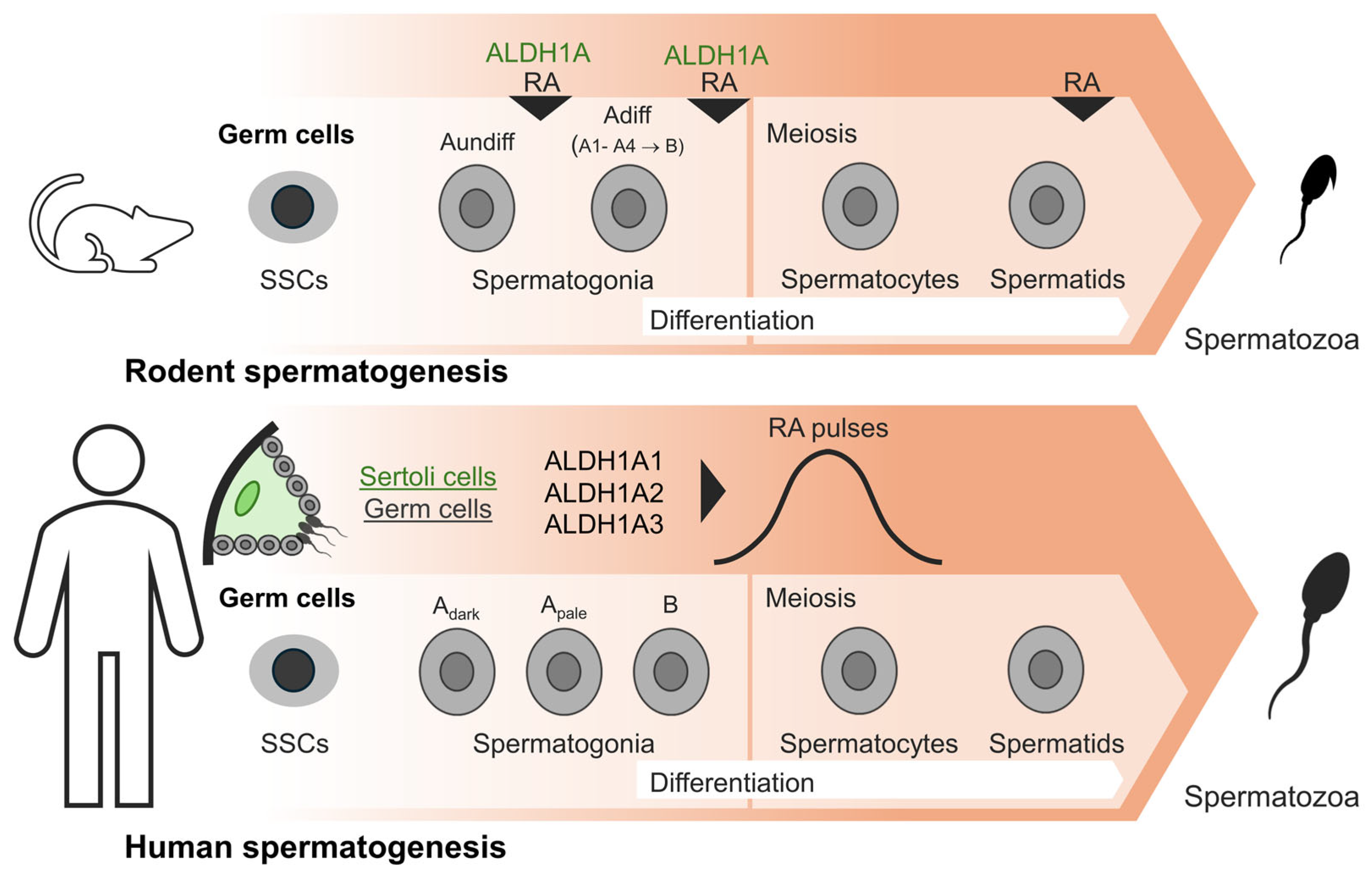
In mice, spermatogenesis proceeds in a cyclical and asynchronous way through 12 distinct stages, each defined by characteristic associations of germ cell subtypes [62], whereas in the rat testis, 14 stages (I–XIV) have been described [63]. It should be mentioned that in mice, the process begins around 3–5 days postpartum (DPP) and requires four successive epithelial cycles to generate mature elongated spermatids, with a total duration of approximately 35 days, with the first cycle being shorter, lasting approximately 6 days compared to subsequent cycles lasting 8.6 days [34,55,64,65]. The first wave of spermatogenesis is initiated by Neurogenin-3 (NGN3)-negative prospermatogonia differentiating into A1 spermatogonia, first detected at two days postpartum and progressing through A2, A3, A4, and type B spermatogonia by five days postpartum [34,66]. Undifferentiated spermatogonia, initially referred to as A single (As) spermatogonia, produce paired A (Apr) spermatogonia and then chains of 4 to 32 aligned (Aal) spermatogonia, by mitotic multiplication with Apr and Aal spermatogonia involving undifferentiated cells that retain stem cell properties [47]. RA fluctuations are stage-dependent, with the lowest expression levels observed during stages II–VI and the highest during stages VIII–IX, peaking at stage VIII, leading to the irreversible differentiation of undifferentiated A spermatogonia (Aundiff) to differentiated A1 spermatogonia (A1diff) [67], a key step known as the A to A1 transition [22,49,55,68,69] (Figure 2). The irreversible commitment of Aal spermatogonia to the A1 state initiates the differentiating program that ultimately produces preleptotene spermatocytes [34,70,71,72,73], which subsequently enter meiosis I to initiate the meiotic phase of spermatogenesis.
In primates, undifferentiated spermatogonia consist of A-dark and A-pale populations. In rhesus monkeys, A-pale spermatogonia undergo mitotic division at stage IX of the 12-stage seminiferous epithelium cycle to differentiate into B1 spermatogonia [70]. In the human testis, the seminiferous epithelium is organized into six stages (I–VI), with an estimated cycle duration of approximately 16 days [63] and spermatogonia are divided into dark type A (Ad), pale type A (Ap), and type B subtypes [74] (Figure 2). Concerning human spermatogenesis, it closely resembles that of rodents, as both systems show the progression from spermatogonia to spermatocytes and then to spermatids [56] and several spermatogonia markers are shared between species, with their human homologues potentially correlating with infertility-associated phenotypes [75]. However, despite their morphological similarity to undifferentiated spermatogonia in rodents, the precise identity and function of Ad and Ap cells in human spermatogenesis remain unclear and continue to be debated [76].

4. Oxidative Stress in Male Reproduction

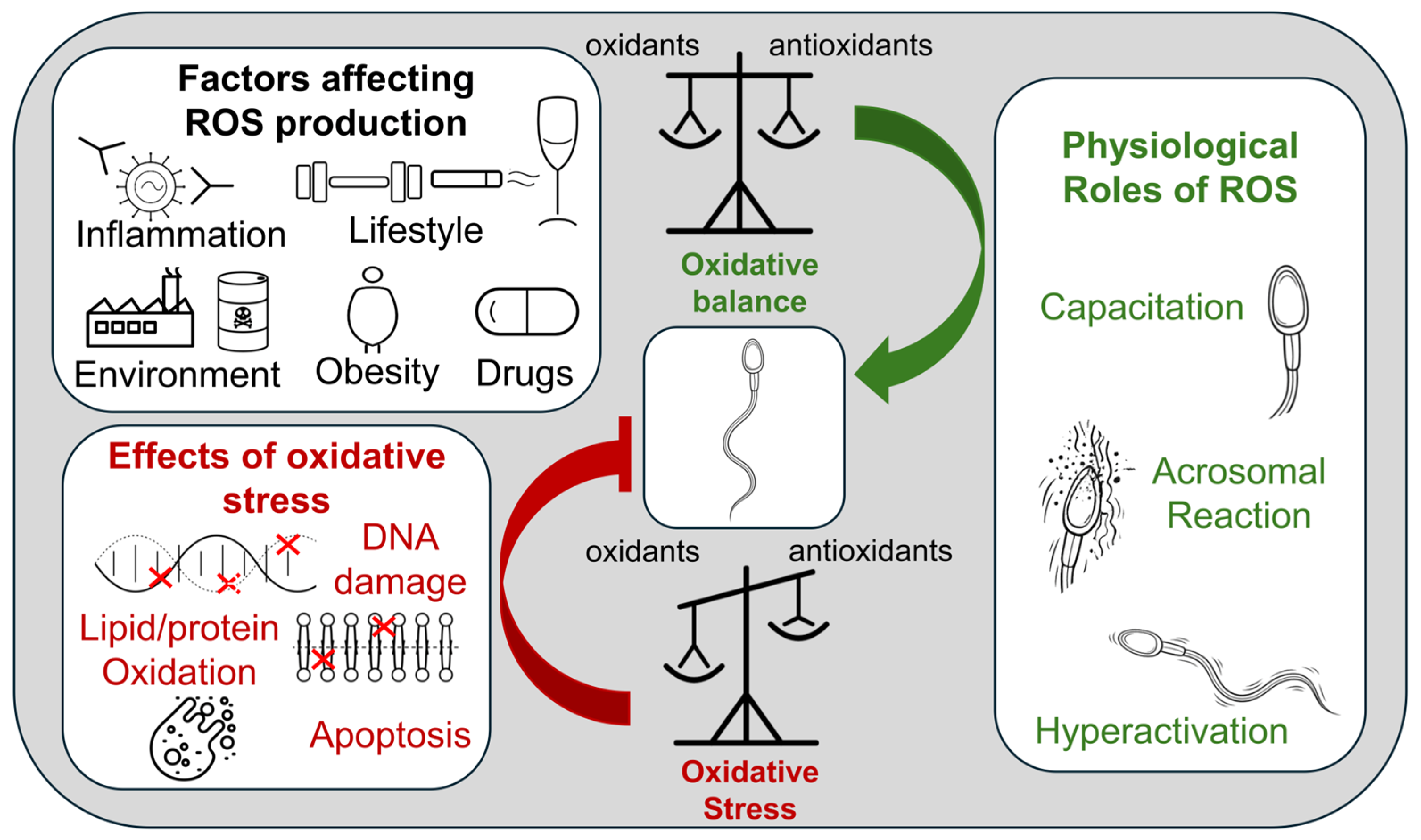
The inability of antioxidant defense mechanisms to balance the production of reactive oxygen species (ROS) results in oxidative stress (Figure 3).
Oxidative stress affects male fertility in approximately 7–10% of the global population and is responsible for 40–50% of idiopathic infertility cases [77]. ROS have a dual role in male reproduction [78]. They are produced normally by spermatozoa through the activity of reduced nicotinamide adenine dinucleotide phosphate (NADPH) oxidase and the reduced nicotinamide adenine dinucleotide (NADH) oxidoreductase system, in the plasma membrane and mitochondria respectively [79], and are required for the key functions of sperm maturation and fertilization. Notably, normal levels of ROS are necessary for a variety of crucial steps for successful fertilization such as sperm hyperactivation, capacitation, and acrosome reaction [78,80]. However, when ROS generation exceeds seminal antioxidant capacity, oxidative stress induces damage and reproductive malfunction. Excess ROS drive lipid peroxidation of the sperm’s polyunsaturated fatty acid (PUFA)-rich membrane and induce protein and deoxyribonucleic acid (DNA) damage, as well as cell apoptosis, impairing sperm motility, viability and fertilizing ability [81]. Spermatozoa are especially vulnerable to such oxidative damage because they have very limited cytoplasmic antioxidants and DNA repair mechanisms, and their membranes are highly enriched in PUFAs [78]. More specifically, elevated ROS levels are associated with mitochondrial dysfunction, sperm membrane lipid peroxidation, sperm DNA fragmentation (SDF) and sperm methylation [14,82]. Regarding lipid peroxidation, cytotoxic aldehydes such as 4-HNE and malondialdehyde (MDA) are produced, which bind to DNA and proteins, causing a decrease in sperm motility [83]. DNA fragmentation resulted from the oxidation of DNA, chromatin compaction, single-strand or double-strand DNA lesions, and activation of endonucleases and caspases [14]. As a result, mitochondria can be affected and therefore produce additional ROS due to dysfunction of their electron transport chain, leading to increased electron leakage. Damaged nuclear DNA can lead to DNA lesions that are transmitted to the embryo during its development [84]. The DNA fragmentation index (DFI) is a useful tool for assessing DNA damage, and a baseline of 30–50% is associated with enhanced infertility and increased pregnancy loss [85,86]. DNA fragmentation has also been linked with adverse outcomes after assisted reproduction by increasing the risk of pregnancy loss [87]. Increased ROS levels can result from either endogenous (e.g., NADPH oxidases, mitochondrial respiration, obesity, inflammation, varicocele) or exogenous (e.g., lifestyle, environmental pollutants, drugs) factors [88]. ROS originating from leukocytes, often due to infection and/or inflammation, can cause DNA fragmentation, protein oxidation, and lipid peroxidation, which, in turn, are linked with impaired sperm quality. Furthermore, mitochondrial dysfunction aggravates oxidative stress, thereby compromising adenosine triphosphate (ATP) production and mitochondrial DNA integrity, leading to energy deficits and reduced sperm motility [88]. Understanding the ROS-related mechanisms linked with infertility is crucial for identifying new approaches as well as improving current therapeutic strategies (e.g., anti-inflammatory and/or antioxidant supplementation) for improving sperm quality and reproductive function [89].

5. ALDH and Male Reproduction

5.1. ALDHs and RA Signaling

5.1.1. ALDH Enzymes in the Regulation of RA in Male Reproduction

As discussed, RA is vital for spermatogonial differentiation, meiotic initiation, and sperm maturation [40,90,91,92,93]. Proper spatial and temporal regulation of RA levels is critical, as both excessive [94] and insufficient [95,96,97] RA concentrations result in adverse reproductive outcomes. A notable effect of ALDH1A inhibition or vitamin A deficiency is the depletion of testicular RA, resulting in impaired spermatogenesis and male infertility [98,99,100]. Conversely, exogenous RA administration has been shown to downregulate ALDH1 mRNA levels in a dose-dependent manner, indicating the presence of a negative feedback regulatory mechanism [101].
Several studies highlighted the expression of ALDHs in the Sertoli and/or germ line cells, and their consequent contribution to the RA pulses. Regarding their availability, although ALDH1A1 is more abundant in the testis, ALDH1A2 is primarily responsible for RA synthesis during spermatogenesis, while ALDH1A3, though a minor contributor, is expressed in both germ and Sertoli cells [102,103]. Arnold et al. reported that ALDH1A2 activity is mainly localized in spermatogonia, spermatocytes and spermatids, as well as in the peritubular myoid cells (PMCs), with the presence of cellular retinol-binding protein I (CRBP-I) confirming this activity. They also showed that ALDH1A1 is found in Sertoli cells and PMCs, with reduced intratesticular 13-cisRA levels reflecting lower ALDH1A1 expression in men with abnormal semen parameters [102]. It is important to note that apart from its role in testicular physiology, ALDH1A1 also contributes to prostate bud differentiation in the murine urogenital mesenchyme (UGM) and urogenital sinus (UGS) through its involvement in RA synthesis [104,105]. ALDH1A1 is expressed at significantly higher levels in embryonic day 15.5 (E15.5) male UGM compared with female UGM. Inhibition of ALDH1A1 activity with diethylaminobenzaldehyde (DEAB), an ALDH antagonist, markedly reduced the formation of dihydrotestosterone (DHT)-induced homeobox transcription factor Nkx3.1-positive bud in female UGS cultures, whereas RA alone triggered only a limited response, demonstrating that RA can initiate Nkx3.1-positive epithelial specification but does not support full bud development. Furthermore, ALDH1A2 appeared to be involved in the generation of RA pulses in the testis by the Sertoli cells. These pulses activate the expression of gene 8 (Stra8), a key factor required for the initiation of meiosis in spermatogonia [106,107]. ALDH1A3 also supports ALDH1A2 in maintaining RA levels within the testicular microenvironment [108]. In Sertoli cells, ALDH1A1 activity was identified at stages I–VIII and ALDH1A2 activity at stages VII–XII, indicating that during the differentiation process, the initiation of RA production occurs earlier in Sertoli cells than in germ cells [63,108,109,110]. Across different animal species, ALDH1A expression and regulation in the testicular tissue has been shown to vary according to the developmental stage [30,108]. Ιn the canine testis, the expression of ALDH1A1, ALDH1A2 and ALDH1A3 varies from birth to adulthood. During adolescence, where the onset of meiosis and proliferation of germ cells occurs, RA production is mainly dependent on the activity of ALDH1A2, which remains elevated in adulthood, contributing to spermatogenesis [111]. Similarly, an increase in the mRNA and protein levels of ALDH1A2 was observed between the 10th and 20th day postnatally in mouse testis and remained high throughout adult life [112]. Furthermore, in chicken, upregulation of ALDH1A1 has been observed during the differentiation of embryonic stem cells (ESCs) into spermatogenic stem cells (SSCs) [113] and in the teleost fish, Nile tilapia (Oreochromis niloticus), ALDH1A2 expression exhibits an increase prior to the onset of meiosis, indicating its highly conserved role in early spermatogenesis across all vertebrate species [114]. In humans, the first cohort-based study quantifying ALDH1A2 protein levels in testicular tissue from fertile and infertile men was conducted by Amory et al. [115]. They found that ALDH1A2 was significantly reduced in infertile testes and strongly correlated with germ cell populations, particularly more differentiated types such as spermatids, while no association was observed with serum or intratesticular hormone levels. These findings aligned with murine studies identifying ALDH1A2 in germ cells, as shown through immunohistochemical analysis [116]. In contrast, ALDH1A1 and ALDH1A3 levels did not differ between groups and were localized to Leydig and Sertoli cells. The cohort included testicular tissue samples from 43 men, comprising 11 with normal spermatogenesis (primarily with obstructive azoospermia), 20 with Sertoli cell-only syndrome, eight with maturation arrest and four with hypospermatogenesis. Application of a novel mass spectrometry-based peptide assay revealed strong correlations between testicular ALDH1A2 protein levels and germ cell populations. Sertoli cell-only syndrome and hypospermatogenesis were associated with significant reductions in ALDH1A2 levels by 47% and 36% respectively relative to controls, while no significant difference was observed in maturation arrest compared to normal spermatogenesis. Levels were markedly lower in Sertoli cell-only syndrome than in normal tissue, with a moderate decrease in hypospermatogenesis likely reflecting residual germ cells. Elevated serum LH and FSH levels were inversely associated with testicular ALDH1A2, suggesting a compensatory hormonal response. ALDH1A2 expression is regulated by FSH [115], leading to indirect modulation of RA levels and influencing spermatogonial maturation and differentiation [34]. Regarding the function of FSH, in another study in monkey testes, it was found to modify RA signaling, either when administered alone or in combination with LH, significantly increasing the expression of cellular retinoic-binding protein 2 (CRABP2), while the levels of ALDH1A2 and, in the combined treatment, the levels of CRABP1 were reduced [117]. In another study of 19 infertile men with reduced testicular ALDH1A2 levels and low sperm counts, oral administration of isotretinoin, also known as 13-cis-retinoic acid, a retinoid derivative of vitamin A, at 20 mg twice daily for 20 weeks led to an increased sperm concentration and improved morphology [118]. In addition, the human testicular peritubular cells (HTPCs), which form a narrow compartment around the seminiferous tubules and contribute to sperm transport, have recently been characterized by novel features [119]. In situ analysis demonstrated that HTPCs express ALDH1A1 and ALDH1A3 [119]. These cells are capable of producing RA, with RA levels varying in response to fetal calf serum (FCS). While it remains unclear whether HTPC-derived RA directly affects spermatogenesis [55,108], smooth muscle cell (SMC) phenotype [120], or the production of GDNF by Sertoli cells [121], in situ expression of multiple subtypes of RARs supports a potential role in signaling [119].
Referring to the RA pulse, adequate RA levels during the spermatogenic cycle are essential for the proper regulation of spermatogenesis [47]. The production of retinal by retinol dehydrogenase 10 (RDH10) and its subsequent conversion to RA by ALDH1A1, ALDH1A2 and ALDH1A3 [22,23,46,122] results in the pulsatile production of RA along the seminiferous tubules [67]. Kent et al. investigated whether this pattern is expressed in a stage-specific manner [122]. Quantitative analysis showed that ALDH1A1, ALDH1A2, ALDH1A3, and aldehyde dehydrogenase family 8 member A1 (ALDH8A1), an isoform newly identified in the mouse testis, are not stage-specific in adult testes but vary during juvenile development, with ALDH1A2 protein expression exhibiting slight fluctuations before stabilizing in adulthood. Inhibition of ALDH activity resulted in decreased RA levels, increased blood–testis barrier permeability and meiotic deficits. These findings support a broader involvement of ALDH enzymes in spermatogenesis, rather than a role exclusively in regulating RA pulsatility [122,123]. RA signaling is, however, essential for the differentiation of undifferentiated spermatozoa [48,124]. Consistent with this, inhibition of RA biosynthesis with bis(dichloroacetyl)diamine (BDAD), also known as WIN 18,446, an aldehyde dehydrogenase inhibitor [125], caused the arrest of germ cells at the undifferentiated stage in rodent models [126,127]. Quantitative analyses further demonstrated that ALDH1A enzymes are responsible for more than 95% of all-trans RA production in wild-type mouse testes, with ALDH1A2 alone accounting for more than 61% of total atRA synthesis [128]. Surprisingly, trace amounts of atRA persisted in WIN-treated testes even though spermatogenesis had completely ceased [122,129,130], indicating that the A-to-A1 transition likely depends on a threshold level of atRA maintained by fully functional ALDH1A enzymes [129]. In addition, WIN 18,446 combined with exogenous RA supplementation at defined time points synchronized spermatogonial differentiation, enabling the study of their response to RA signals and the isolation of cells at different stages of spermatogenesis, while germ cell separation was simultaneously achieved through fluorescence-activated cell sorting (FACS) [90,124,131]. In cases where an endogenous RA pulse had occurred prior to WIN 18,446 administration, ALDH1A enzyme inhibition did not take effect immediately [129]. In relation to the above, the investigation of the pharmacological inhibition of ALDH1A enzymes is under examination as a potential strategy for reversible male contraception [132]. However, with regard to its clinical application as a reversible [133], non-hormonal male contraceptive [134,135,136,137], the use of WIN 18,446 is limited due to disulfiram-like effects resulting from the inhibition of ethanol-metabolizing enzymes following alcohol consumption [138,139,140,141,142,143]. Ongoing efforts to develop selective inhibitors of testicular RA synthesis that do not interfere with alcohol metabolism [125,133,143,144,145,146,147,148] have recently yielded covalent and non-covalent ALDH1A2 inhibitors, with direct binding studies and X-ray crystallography providing structural insights that guide the rational design of potent and selective candidates for male contraception.
Meiosis is a fundamental biological process that governs both spermatogenesis and oogenesis and ensures the generation of haploid gametes. Abnormalities at various stages of this process can affect reproduction [149] and understanding the regulatory mechanisms underlying this process could be a field of research in the treatment of male infertility [150]. The mechanisms triggering meiotic entry in male germ cells are still not completely understood. Findings from mice with cell-specific deletions of Aldh1a1, Aldh1a2 and Aldh1a3 have shown that ALDH1A1 activity in Sertoli cells drives the first meiotic wave at puberty, whereas subsequent cycles depend on ALDH1A2 activity within meiotic germ cells [151]. In turn, RA induces pre-meiotic transcriptional changes and Stra8 expression, which coincides with chromatin remodeling involving histone H3 lysine 27 trimethylation (H3K27me3) at the Stra8 promoter [152,153].
Recent findings have indicated that RA predominantly initiates the extensive differentiation progress of spermatogonia rather than directly inducing meiotic entry [154,155]. Notably, continuous suppression of RA synthesis following the onset of differentiation using WIN 18,446 did not prevent male germ cells from entering and completing meiosis at the expected time of Stra8 expression nor did it alter the expression of meiotic genes. In addition, knockout of all three Aldh1a genes in Sertoli cells of murine testes disrupted spermatogenesis as A spermatogonia failed to differentiate into A1 spermatogonia [69,123,156], with gross viability maintained [69]. Knockout studies of Aldh genes in mice showed that Aldh1a1-null mice are viable and fertile [157], Aldh1a3-null mice are born alive but die soon after birth from respiratory distress [158] and Aldh1a2-null mice die during embryogenesis at day E9.5 to E10.5 [159]. Due to early lethality in Aldh1a2 and Aldh1a3, conditional deletions were used to study ALDH1A function in testes. Either mice with Aldh1a1−/− or mice with Aldh1a2−/− alone did not exhibit impaired spermatogenesis and a conditional knockout of Aldh1a2 in germ cells, along with a tamoxifen-inducible knockout model after birth had no major effect on testicular RA levels or fertility, indicating the involvement of enzymes other than ALDH1A [64,129,160]. Spermatogenic differentiation was blocked when all three Aldh1a genes were deleted in Sertoli cells, which was restored by a single RA injection [69,156], while the presence of ALDH1A3 alone was not sufficient to maintain spermatogenesis regardless of its compensatory role in different tissues [69]. It has been shown that single deletion of Aldh1a2 or simultaneous deletion of Aldh1a1, Aldh1a2 and Aldh1a3 in germ cells has little effect on spermatogenesis and fertility [22,129], while combined deletion in both Sertoli cells and germ cells caused a complete failure that RA injection could not rescue [22]. These findings show that Sertoli cells’ RA pulse is required to initiate spermatogenesis while germ cell RA supports later progression.

5.1.2. Circadian Regulation of RA Biosynthesis by ALDHs in Sertoli Cells and Its Impact on Male Fertility

Sleep disorders negatively affect male reproductive health, with their underlying mechanism being related to the circadian rhythm [161]. Epidemiological evidence suggests that circadian rhythm disruption, a condition frequently observed in shift workers, is associated with male infertility [162,163]. The circadian clock is an endogenous mechanism that governs the 24 h rhythmic variation in the organism’s behavior and physiology, which is regulated by a core set of clock genes that coordinate transcription and translation autoregulatory feedback loops at the cellular level. It consists of a central circadian pacemaker in the hypothalamic suprachiasmatic nucleus (SCN) and peripheral clocks in other brain regions and tissues throughout the body, including the liver, muscle, adipose tissue, and testis, and its genes include circadian locomotor output cycle kaput (Clock), aryl hydrocarbon receptor nuclear translocator-like (Arntl), period (Per)1, Per2, Per3, cryptochrome (Cry)1, and Cry2, which are essential for the establishment and maintenance of the circadian rhythm [164,165,166]. When the stimuli from the Zeitgebers are transmitted to the SCN as electrical signals, the circadian rhythm of the clock is orchestrated by genes and proteins that form positive and negative feedback loops [167]. Specifically, CLOCK and BMAL1 form the basic core positive heterodimer complex (CLOCK/BMAL1), which, through its binding to a specific E-box sequence (5′-CACGTG-3′) in the promoters of Per1, Per2 and Per3, Cry1 and Cry2 and the related clock-controlled genes (CCGs), activates their rhythmic transcription [168,169,170,171]. Liu et al. [172] recently found that RA synthesis appears to be under circadian control. Their research showed that the circadian clock within Sertoli cells plays an essential role in synchronizing spermatogenic differentiation and supporting fertilization through the regulation of RA biosynthesis and receptor expression. The expression of genes related to RA signaling peaks in the evening or early night, suggesting a rhythmic pattern of endogenous RA activity in vertebrate testes. Time-series single-cell RNA sequencing (scRNA-seq) further revealed that aldh1a2 displays rhythmic expression specifically in Sertoli cells, indicating that both core circadian clock genes and their downstream targets may oscillate in a cell type-specific manner. In both zebrafish and mouse testes, a temporal pattern of gene expression related to spermatogenesis and sperm function has been observed. Consistent with this, quantitative real-time reverse transcription PCR (qRT-PCR) analysis in zebrafish testes confirmed that the rhythmic expression of these genes is restricted to Sertoli cells and is abolished in clock1a knockout mutants. ScRNA-seq identified the co-expression of aldh1a2 with circadian clock-regulating genes such as period 1b (per1b) and clock in Sertoli cells of zebrafish, mice and humans, suggesting the existence of an evolutionarily conserved mechanism for the circadian regulation of RA synthesis. Moreover, co-expression of Clock with aldh1a1 was also detected at the single-cell level, and immunohistochemical (IHC) staining demonstrated the colocalization of brain and muscle ARNT-like protein 1 (BMAL1) and ALDH1A2 proteins in mouse Sertoli cells. Genomic analysis revealed the presence of E-box enhancer elements in the first introns of aldh1a2 and retinoic acid receptor gamma a (rarga), which were shown through luciferase reporter assays to be transcriptionally activated by brain and muscle ARNT-like 1 bmal1b and clock1a genes, and repressed by the Cryptochrome-1ab (Cry1ab) gene. All these findings from the above research study [172] propose a spatially and temporally coordinated model of RA synthesis within the testis mediated by ALDH1A1 and ALDH1A2 activity. RA availability is aligned with germ cell development and highlights the role of ALDH-regulated RA production in maintaining male fertility, particularly under conditions of circadian rhythm disruption [164]. It should be noted that stress, associated with shift work, may also indirectly contribute to circadian rhythm disruption through alterations in cortisol secretion, potentially leading to inflammation and oxidative stress. This represents an interesting potential mechanism of reproductive dysregulation, including possible effects on RA signaling, which warrants further investigation.

5.2. ALDHs and Oxidative Status

5.2.1. Metabolic and Redox Functions of ALDH2 and Its Impact on Spermatogenesis

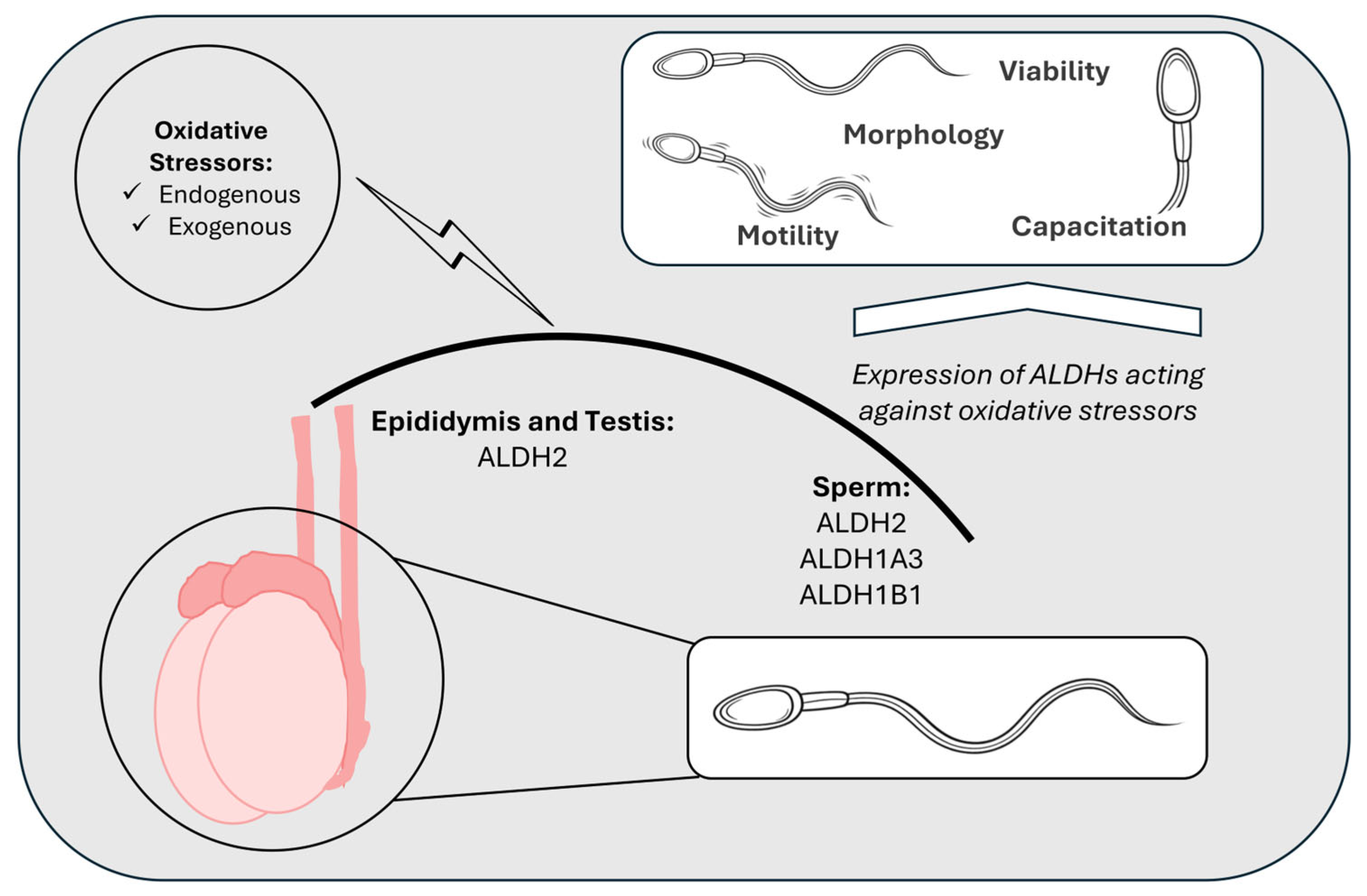
ALDHs, apart from their role in RA synthesis, appear to have a crucial role in the protection of spermatozoa functionality (e.g., motility, capacitation, acrosomal reaction) through their detoxifying activities and this becomes even more important under the influence of certain endogenous and exogenous sperm stressors (e.g., inflammation, alcohol consumption, environmental pollutants) (Figure 4).
It is known that ALDH1A1 and mitochondrial ALDH2 metabolize acetaldehyde to acetic acid during alcohol breakdown. The ALDH2*2 allele, which is highly prevalent in East Asian populations, results from a Glu487Lys substitution that inactivates the enzyme, leading to acetaldehyde accumulation after alcohol consumption and causing the characteristic facial flushing response [173]. In addition to ALDH2 deficiency, one of the most common inherited conditions affecting up to 40% of the Asian population and responsible for the Asian Hot Flash Syndrome [174], several findings also support its role in reproduction [175], with differences in sperm quality having been observed between ethnicities, and the involvement of different polymorphisms in these variations remaining under investigation [176,177]. During ethanol (EtOH) metabolism, acetaldehyde is generated not only by cytochrome P450 2E1 (CYP2E1) [178] but also by ALDH within the epididymis [179,180]. Spermatozoa from ALDH2 knockout mice have shown increased sensitivity to the toxicity of ethylene glycol monoethyl ether [181,182]. In the study of Taoto et al. [183], EtOH-treated rats showed histological alterations in the cauda epididymis and seminal vesicle, including epithelial thinning, fibrosis and increased apoptosis. However, in another study, selective knockdown of ALDH2 in germ cells did not affect spermatogenesis nor decrease testicular RA levels in mice [129]. Knockdown of ALDH2 in mice using CRISPR/Cas9 technology led to reduced seminiferous tubule thickness, reduced germ cell number, impaired spermatocyte development and impaired acrosome formation, resulting in oligoasthenoteratozoospermia, although morphological abnormalities in the head and tail remained unchanged [184]. These alterations were accompanied by elevated oxidative stress markers such as 4-HNE, 3-nitrotyrosine (3-ΝΤ) and MDA in both the testis and epididymis. In pigs, a recent quantitative proteomic analysis revealed that Meishan pigs exhibit higher ALDH2 expression than the less fertile Duroc breed [185]. Greenberg et al. [186] examined sperm parameters in relation to alcohol consumption in individuals carrying the ALDH2*2 polymorphism. In a cross-sectional study including 112 East Asian men, 40.2% of whom were ALDH2*2 carriers, alcohol consumption was found to be associated with reduced total and progressive sperm motility among carriers, whereas no adverse effects were observed in those with little or no alcohol consumption, indicating that the effect was dependent on alcohol intake. In another study, Le et al. [187] demonstrated that ethanol exposure has a genotype-specific effect on sperm motility. Sperm from individuals with the heterozygous (GA) or homozygous mutant (AA) ALDH2 genotype exhibited a more pronounced reduction in total motility following ethanol exposure. These findings suggest that ALDH2 deficiency may increase vulnerability due to ethanol exposure causing sperm dysfunction, underscoring its potential role in male fertility and the importance of further investigation, especially given that over 600 million people worldwide carry an ALDH2 mutation.

5.2.2. ALDHs in Sperm Motility and Capacitation Across Fertilization

Data on the role of ALDHs in sperm functionality arise mainly from studies conducted on stallions (adult male horses) and other mammals. Specifically, proteomic profiling of stallion seminal plasma has revealed molecular pathways associated with sperm motility with evidence suggesting that reduced ALDH expression may contribute to the decreased motility observed in infertile stallions [182,188]. The study by Gibb et al. [182] demonstrated the role of ALDH in protecting stallion sperm from oxidative stress induced by 4-HNE, as well as the involvement of glutathione S-transferase (GST) in the detoxification of aldehydes in vitro. In human sperm, adenosine triphosphate (ATP) production is mainly based on glycolysis [189], while in stallion sperm, it is highly dependent on oxidative phosphorylation (OXPHOS) [190,191], resulting in the higher production of reactive oxygen species (ROS) and lipid peroxidation products such as 4-HNE. This allows faster motility than in humans [190], but leads to oxidative damage and rapid loss in vitro [192], with initial activity maintained due to ALDH- and GST-mediated detoxification mechanisms [193,194]. ALDH1A3, ALDH1B1 and ALDH2 were isolated from ejaculated sperm. Among them, ALDH2 identified as a prognostic factor of fertility, possibly by protecting mitochondria, resulting in no loss of motility despite 4-HNE accumulation [190]. This is an evolutionary adaptation to oxidative stress specific to the stallion, which was also reinforced by the observation that upon exogenous administration of 4-HNE, ALDH remained in the midpiece, while 4-HNE adducts amassed in the post-acrosomal region in contrast to human sperm where 4-HNE is predominantly located in the midpiece [195,196]. Further, ALDH inhibition was found to increase 4-HNE levels in viable spermatozoa and significantly reduce both total and progressive motility after 24 h [197,198]. In another study of cryopreserved stallion semen, proteomic profiling revealed that cryopreservation disrupts sperm metabolism and redox balance, causing a significant decrease in antioxidant proteins such as mitochondrial superoxide dismutase 2 (SOD2) and ALDH2 [199], with lipid peroxidation products such as 4-HNE accumulating extensively during this process [200,201]. It has also been demonstrated in the study by Akbarinejad et al. that Activator of mitochondrial aldehyde deydrogonase (Alda-1), an activator of ALDH2, helps preserve mitochondrial function in equine spermatozoa during 72 h cooled storage, leading to enhanced ATP production, motility, and viability [202]. In addition, studies on water buffalo (Bubalus bubalis) bulls have shown that ALDH is highly expressed in the spermatozoa of high-fertile (HF) bulls [203], while ALDH2 is highly abundant in extracellular vesicles (EVs) derived from seminal plasma and plays an essential role in sperm motility [204]. During bovine sperm capacitation, several processes occur, such as cytoskeleton and membrane reorganization, vesicle transport, guanosine triphosphate (GTP) binding and redox regulation. This recruits several enzymes, including mitochondrial ALDH2 [205]. Mitochondrial ALDH2, by supporting sperm progressive motility through the elimination of electrophilic aldehydes [182], may further contribute to sperm capacitation and sperm–oocyte interaction via its association with testis-specific angiotensin-converting enzyme (tACE) in the post-acrosomal region and principal piece. tACE, an isozyme of somatic angiotensin-converting enzyme (sACE), regulates capacitation, acrosome reaction, and zona pellucida binding, relocating to the post-acrosomal region after capacitation [205]. In the same study, STRING analysis did not reveal any interaction between ALDH2 and the tACE network in Bos Taurus, in contrast to mass spectrometry results, possibly due to limited functional evidence. These findings raise the need for further isoform-specific studies across species, using flow cytometry and the Aldefluor system, especially regarding the effect of oxidative stress on human sperm function [206] and as the beneficial effects of Alda-1 could also affect sperm function in other species, including humans [196].

5.3. Environmental Modulations of ALDH Function in Male Reproduction

Environmental toxicants are increasingly recognized as major contributors to male infertility, with compounds such as heavy metals and plasticizers implicated in reproductive system damage. This damage is further influenced by genetic and lifestyle factors. Autophagy-related gene 5 (Atg5) contributes to RA biosynthesis in the testis, as Sertoli cell-specific Atg5 ablation leads to decreased testicular RA and ALDH1A1 levels [207]. In the study by Xiong et al. [207], mice with Sertoli cell-specific knockout of Atg5 were used to investigate how loss of autophagy influences cadmium (Cd)-induced testicular damage, a widespread dietary and waterborne contaminant that disrupts germ cell development and spermatogenesis. Autophagy, a cellular degradation and recycling process, supports Sertoli cell function and communication with germ cells, and its absence through Atg5 deficiency intensified the Cd-driven reduction in RA and its key synthesizing enzymes ALDH1A1 and ALDH1A2 in the testes, while overexpression of Wilms tumor 1 (Wt1) rescued the Cd-induced decline in ALDH1A1. A comparable reduction in ALDH1A1 expression has been observed in primary Sertoli cells exposed to 3-monochloropropane-1,2-diol (3-MCPD) [208]. In another study by Weng et al., exposure of C57BL/6 male mice to ethyl tertiary butyl ether (ETBE) showed that while only high concentrations impaired sperm motility and increased DNA damage in wild-type animals, even low concentrations caused testicular atrophy, reduced sperm counts, and severe genotoxicity in ALDH2 knockout and heterozygous mice. These results suggest that ALDH2 deficiency markedly increases susceptibility to ETBE-induced reproductive toxicity through the accumulation of acetaldehyde [209]. Additionally, chemoproteomic investigation of rodent testicular toxicity induced by the covalent Bruton’s tyrosine kinase (BTK) inhibitor N-(3-(5-fluoro-2-(4-(2-methoxyethoxy)phenylamino)pyrimidin-4-ylamino)phenyl) acrylamide (CC-292), a compound developed for hematologic cancers and inflammatory diseases, revealed its off-target interaction with ALDH1A1 and ALDH1A2 [210]. Using a biotin-labeled analog (292TC) and click chemistry-based proteomic profiling of testis homogenates, these enzymes were identified as covalent binding targets in both mice and rats. Molecular modeling suggested that CC-292 may bind to the NAD+ and retinal sites of human ALDH1A2, posing a potential reproductive risk and supporting its redesign to produce BTK inhibitors that do not interact with ALDH1A1 or ALDH1A2. Also, it has been shown that N-methylthioltetrazole, a toxic component of the β-lactam antibiotic cefamandole, inhibits aldehyde dehydrogenase activity and disrupts spermatogonial proliferation [211]. Furthermore, in the sperm of smokers, altered DNA methylation at specific CpG sites in the Aldh3b2 gene has been associated with reduced gene expression and negatively correlated with sperm quality parameters [212], suggesting that epigenetic modifications of key genes may contribute to smoke-induced impairments in sperm function [213].
As a key regulator of testicular homeostasis, the testicular immune microenvironment (TIM) becomes vulnerable when challenged by such contaminants, potentially leading to reproductive toxicity [214]. Macrophages (TMΦ) in both the interstitial (iTMΦ) and peritubular (pTMΦ) compartments of the mice testis have been shown to participate in the local regulation of RA signaling, partly through the expression of ALDH1A2 in both populations to facilitate spermatogonial cell proliferation and differentiation [215,216,217]. Their functional relevance is further supported by findings that the transient ablation of testicular macrophages impairs spermatogonial stem cell (SSC) differentiation through the disruption of colony-stimulating factor receptor (CSF1) and RA expression [41,57].

5.4. Additional Aspects of Selected ALDH Isoforms in Spermatogenesis and Male Reproductive Function

The study of another ALDH superfamily member, ALDH4A1, by Xiao et al. [218] revealed its essential role in mitochondrial proline metabolism and male fertility. CRISPR-Cas9-mediated knockout of Aldh4a1 in mice resulted in normal spermatogenesis but defective sperm maturation, characterized by impaired motility, abnormal morphology, elevated spontaneous acrosome reaction [219], and ultrastructural abnormalities in sperm mitochondria and neck. Based on the finding that oxidative stress rises with aging in the testis of mice as a result of decreased levels of antioxidant enzymes, Yen and Curran determined the gene expression of proline dehydrogenase (Prodh) and Aldh4a1, two proteins associated with proline catabolism in the testes of young and middle-aged mice. They reported relatively similar levels of Prodh expression in the two different age groups, while middle-aged mice exhibited lower expression levels of Aldh4a1 in comparison to the younger mice [220]. Furthermore, both Prodh and Aldh4a1 expression were at comparable levels in the liver of the examined groups, suggesting a tissue-specific regulation of these genes in the male reproductive systems. A reduction in ALDH4A1 could potentially lead to pyrroline-5-carboxylic acid (P5C) accumulation, and consequently to sperm dysfunction, as observed in C. elegans [221]. Additionally, due to its evolutionary conservation, Aldh4a1 is a promising candidate for the genetical diagnosis of male infertility.
Huang et al. [222], in their study on Ten-eleven 1 (Tet-1) deficiency in translocation and premature reproductive aging, observed that there was a decrease in ALDH3B1 expression accompanied by a decrease in Tet1 promoter occupancy in Tet1 knockout (Tet1−/−) spermatogonia. They used Integrative Genomics Viewer (IGV) to analyze 5-hydroxymethylcytosine (5hmC) enrichment at the Aldh3b1 promoter in both type A and type B spermatogonia, with stronger signals in the coding exon, indicating a positive regulatory role of 5hmC. Reduced ALDH3B1 expression in aged or Tet1−/− spermatogonia likely impairs retinol metabolism and decreases entry into meiosis. In addition, Laqqan et al. [223] reported that subfertility was linked to altered DNA methylation at CpG sites within the Aldh3b2 and prostaglandin I2 receptor (PTGIR) genes, as identified using the Illumina HumanMethylation450 BeadChip (450K) array [224].
In the study by Pini et al. [225], comparative proteomic analyses across vertebrates revealed a conserved molecular framework underlying sperm function, with a core set of proteins involved in key processes such as energy metabolism and fertilization. Among these, ALDH7A1, a metabolic enzyme that affects sperm motility, not previously linked to sperm development [226], was identified as conserved across species.
Proteomic analysis of testicular interstitial fluid (TIF) in men with azoospermia revealed that proteins associated with redox regulation, including 4-trimethylaminobutyraldehyde dehydrogenase (TMABA-DH), also known as ALDH9A1, were upregulated in cases with successful sperm retrieval compared to unsuccessful ones [227]. These findings implicate oxidative stress as a key determinant of retrieval outcomes and suggest that reducing testicular oxidative stress may enhance sperm recovery. Further, ALDH9A1, its human natural killer 1 (HNK1)-modified form, and other HNK1 glycoproteins appear to contribute to sperm negative selection in the utero-tubal junction (UTJ), with acrosome-reacted sperm localizing to protein-rich regions as mating enhances carbohydrate sulfotransferase 10 (CHST10) activity in the oviductal mucosa and drives the HNK1-dependent formation of acidic ALDH9A1 and four and a half LIM domains protein 1 (FHL1) variants in the same areas [228]. In the study by Fábrega-Guerén et al. [228], ALDH9A1 was reported for the first time on the sperm surface and in the acrosome in vivo, although it is first necessary to verify whether it is synthesized by the sperm. Probably, ALDH9A1 in close contact with sperm may regulate spermine levels, as it has been shown to be involved in spermine metabolism and Gamma-aminobutyric acid (GABA) production. Sperm with low spermine content reaching the UTJ could contact ALDH9A1-rich regions, increasing spermine above a critical threshold and triggering spontaneous acrosome reaction (sAR) or capacitation followed by AR due to GABA in the oviductal mucosa.

5.5. ALDH Enzymes as Functional Markers and Regulators of Spermatogonial Stem Cell (SSC) Function in Male Fertility Restoration

The generation of gametes from stem cells has emerged as a promising strategy to overcome infertility. Throughout the reproductive life span, continuous sperm production relies on the self-renewal and differentiation capacity of SSCs [229]. The ability to understand, manipulate and culture SSCs in vitro has opened new avenues in reproductive medicine and fertility preservation [230]. Especially, it has been shown that murine SSCs spontaneously transform into pluripotent embryonic stem cells (ESCs) under specific culture conditions [231,232]. Tapia et al. [233] and Chikhovskaya et al. [234] demonstrated that “embryonic-like colonies” derived from SSCs resemble mesenchymal stem cells (MSCs) rather than ESCs, suggesting that these colonies may originate from a subpopulation of mesenchymal progenitors (MPs) present in testicular cultures. SSCs have also been shown to be closely related to very small embryonic stem cells (VSELs). VSELs are characterized by their small size and expression of markers found in progenitor germ cells (PGSs). Although they rarely divide, they are known to survive gonadotoxic insults, such as chemotherapy, and serve as a reserve source for SSCs through asymmetric division [235]. It is important to mention that VSELs spontaneously differentiate into gametes under in vitro conditions, suggesting a potential role in fertility restoration therapies, especially after gonadotoxic treatments [236,237,238,239]. Their ability to regenerate stem cells opens new avenues in reproductive medicine [240,241], while the contribution to defining the factors that regulate SSC maintenance and self-renewal is important for understanding idiopathic infertility and developing therapeutic strategies for restoring fertility in patients receiving chemotherapy, especially during prepubertal development [242]. This evolving perspective in the field of oncofertility challenges the current necessity of germ cell or testicular tissue cryopreservation prior to cancer therapy and in the future, this approach may simplify fertility preservation strategies and improve outcomes for cancer patients [243,244,245]. Various markers contribute to the isolation of SSCs, such as ALDH, Nestin and Musashi-1, which are stemness-related markers and do not involve transcription factors or surface proteins [246]. Kanatsu-Shinohara et al. [247] developed a method for isolating SSCs among the ALDH-negative subpopulation of mouse testicular cells expressing CD9 or CDH1 by detecting the enzymatic activity of ALDH using the Aldefluor reagent. This enables the selective identification and enrichment of SSCs that are located in the basal compartment of the seminiferous epithelium where they adhere to the basement membrane [248]. Also, the isolation and further study of MSCs can be achieved through the detection of the high levels of ALDH observed in them [249]. Regarding fertility in prepubertal cancer patients after chemotherapy, it was found that germ cell depletion in recipient testes disrupted RA homeostasis and impaired spermatogenesis in transplanted donor tissue, possibly and partly due to reduced Aldh1a2 and sustained Cyp26b1 expression, while RA treatment restored spermatogenesis, suggesting that combining testis transplantation, RA supplementation, and microinsemination could be an effective strategy for fertility recovery in this patient group [39].
Although ALDH enzymes are commonly used as SSC markers, evidence from a study by Xu et al. [250] indicates that they also actively participate in the regulation of germ cell differentiation, with fatty acid oxidation (FAO) playing a key role during embryonic days E13.5–E15.5, when male germ cells progressively enter mitotic arrest alongside increasing the expression of carnitine palmitoyltransferase 1A (CPT1A). This is a mitochondrial transmembrane enzyme that allows fatty acids to enter the mitochondria, thereby controlling the rate-limiting step for the entire pathway. To investigate the importance of this pathway, pregnant mice were treated with etomoxir, a CPT1A inhibitor, during the same developmental period. This resulted in FAO inhibition leading to reduced acetylation of histone H3 at lysine 27 (H3K27ac) and downregulation of male differentiation-specific genes, resulting in premature PGC exit from mitotic arrest. Quantitative real-time PCR (qPCR) analysis of embryonic testes revealed increased expression of ALDH5 and ALDH9A1, along with enoyl coenzyme A delta isomerase 1 (ECI1), at E15.5 compared with E13.5, indicating their functional involvement in FAO-related metabolic regulation, which is essential for the proper differentiation of male germ cells. Through their study, they hypothesized that the inhibition of FAO during embryonic development may affect the normal energy metabolism of Sertoli cells, leading to increased apoptosis, resulting in a disruption of the microenvironment in the testes after birth and a possible increase in spermatogonia apoptosis.

6. Conclusions and Future Perspectives

ALDH isoforms contribute to male reproductive health through two fundamental and interconnected functions: RA synthesis and cellular antioxidant defense. This dual functionality underscores the importance of ALDHs in the maintenance of reproductive homeostasis and highlights their broad implications for male fertility (Figure 5).
Through their involvement in RA synthesis, ALDHs possess a crucial role in regulating spermatogenesis. They are expressed in both Sertoli and germ cells and, along with other metabolic enzymes, contribute to the creation of the RA pulses that drive spermatogonial differentiation and entry into meiotic division. Emerging evidence further supports that circadian rhythms may orchestrate these RA pulses through the temporal regulation of ALDH1A isoform expression, mainly, in Sertoli cells. Furthermore, ALDHs, with ALDH2 being the most well studied, appear to be significant for maintaining the functionality of spermatozoa by protecting against endogenous and exogenous oxidative stressors. Decreases in ALDH activity, whether due to environmental toxicants, genetic variants or epigenetic dysregulation, have been consistently associated with impaired sperm parameters.
Collectively, a vast amount of evidence supports the significance of ALDHs in reproductive function, through multiple mechanisms, across multiple mammalian species (Table 1).
This suggests that ALDHs may represent potential biomarkers for infertility diagnosis and possible targets for therapeutic interventions. However, more studies are required to elucidate: (i) the precise processes through which ALDHs coordinate RA signaling and redox balance and (ii) the isoform-specific contributions underlying these processes in humans. This is important, considering that current evidence is, to a high proportion, derived from studies in animal models. Additionally, investigation of other isoforms, such as the mitochondrial Aldehyde Dehydrogenase 1 Family Member L2 (ALDH1L2), which regulates NADPH for ROS detoxification and ATP production in sperm, despite evidence suggesting that its loss does not affect male fertility [251] and Betaine aldehyde dehydrogenase (BADH), which supports sperm motility and health through betaine synthesis [252], could provide new evidence and contribute further to the progress in this field.

Author Contributions

Conceptualization, F.G., I.T., O.P. and G.-P.V.; investigation, F.G., I.T. and G.-P.V.; writing—original draft preparation, F.G., I.T. and G.-P.V.; writing—review and editing, O.P. and G.-P.V.; supervision, O.P. and G.-P.V. All authors have read and agreed to the published version of the manuscript.

Funding

This research received no external funding.

Institutional Review Board Statement

Not applicable.

Informed Consent Statement

Not applicable.

Data Availability Statement

No new data were created or analyzed in this study. Data sharing is not applicable.

Acknowledgments

We would like to thank Nikolaos Chatzopoulos for his assistance in improving the visual quality of the figures.

Conflicts of Interest

The authors declare no conflicts of interest.

Abbreviations

The following abbreviations are used in this manuscript:
WHOWorld Health Organization
ALDHsAldehyde dehydrogenases
RARetinoic acid
FSHFollicle-stimulating hormone
hCGHuman chorionic gonadotropin
4-HNE4-hydroxynonenal-protein
SSCsSpermatogenic stem cells
GDNFGlial cell-derived neurotrophic factor
atRAAll-trans-retinoic acid
NGN3Neurogenin-3
ROSReactive oxygen species
MDAMalondialdehyde
ATPAdenosine triphosphate
PMCsPeritubular myoid cells
UGMUrogenital mesenchyme
UGSUrogenital sinus
DHTDihydrotestosterone

References

  1. Agarwal, A.; Baskaran, S.; Parekh, N.; Cho, C.L.; Henkel, R.; Vij, S.; Arafa, M.; Panner Selvam, M.K.; Shah, R. Male Infertility. Lancet 2021, 397, 319–333. [Google Scholar] [CrossRef] [PubMed]
  2. World Health Organization. Infertility Prevalence Estimates 1990–2021; Global Report; WHO: Geneva, Switzerland, 2023; pp. 1–98. [Google Scholar]
  3. Hull, M.G.R.; Glazener, C.M.A.; Kelly, N.J.; Conway, D.I.; Foster, P.A.; Hinton, R.A.; Coulson, C.; Lambert, P.A.; Watt, E.M.; Desai, K.M. Population Study of Causes, Treatment, and Outcome of Infertility. Br. Med. J. (Clin. Res. Ed.) 1985, 291, 1693–1697. [Google Scholar] [CrossRef] [PubMed]
  4. Schlegel, P.N.; Sigman, M.; Collura, B.; De Jonge, C.J.; Eisenberg, M.L.; Lamb, D.J.; Mulhall, J.P.; Niederberger, C.; Sandlow, J.I.; Sokol, R.Z.; et al. Diagnosis and Treatment of Infertility in Men: AUA/ASRM Guideline Part I. Fertil. Steril. 2021, 115, 54–61. [Google Scholar] [CrossRef]
  5. Leslie, S.W.; Soon-Sutton, T.L.; Khan, M.A. Male Infertility. In StatPearls; StatPearls Publishing: Treasure Island, FL, USA, 2024. [Google Scholar]
  6. Carlsen, E.; Giwercman, A.; Keiding, N.; Skakkebæk, N.E. Evidence for Decreasing Quality of Semen during Past 50 Years. BMJ 1992, 305, 609–613. [Google Scholar] [CrossRef]
  7. Levine, H.; Jørgensen, N.; Martino-Andrade, A.; Mendiola, J.; Weksler-Derri, D.; Mindlis, I.; Pinotti, R.; Swan, S.H. Temporal Trends in Sperm Count: A Systematic Review and Meta-Regression Analysis. Hum. Reprod. Update 2017, 23, 646. [Google Scholar] [CrossRef]
  8. Levine, H.; Jørgensen, N.; Martino-Andrade, A.; Mendiola, J.; Weksler-Derri, D.; Jolles, M.; Pinotti, R.; Swan, S.H. Temporal Trends in Sperm Count: A Systematic Review and Meta-Regression Analysis of Samples Collected Globally in the 20th and 21st Centuries. Hum. Reprod. Update 2023, 29, 157–176. [Google Scholar] [CrossRef]
  9. Swan, S.H.; Elkin, E.F.; Fenster, L. Have Sperm Densities Declined? A Reanalysis of Global Trend Data. Environ. Health Perspect. 1997, 105, 1228. [Google Scholar] [CrossRef]
  10. Pallotti, F.; Buonacquisto, A.; Cicolani, G.; Conflitti, A.C.; Lombardo, F.; Paoli, D. Evolution of the Incidence of Male Fertility Disorders over the Last Decades. Mol. Asp. Med. 2025, 105, 101398. [Google Scholar] [CrossRef]
  11. Eisenberg, M.L.; Esteves, S.C.; Lamb, D.J.; Hotaling, J.M.; Giwercman, A.; Hwang, K.; Cheng, Y.S. Male Infertility. Nat. Rev. Dis. Primers 2023, 9, 49. [Google Scholar] [CrossRef]
  12. Kaltsas, A.; Zachariou, A.; Dimitriadis, F.; Chrisofos, M.; Sofikitis, N. Empirical Treatments for Male Infertility: A Focus on Lifestyle Modifications and Medicines. Diseases 2024, 12, 209. [Google Scholar] [CrossRef] [PubMed]
  13. Minhas, S.; Boeri, L.; Capogrosso, P.; Cocci, A.; Corona, G.; Dinkelman-Smit, M.; Falcone, M.; Jensen, C.F.; Gül, M.; Kalkanli, A.; et al. European Association of Urology Guidelines on Male Sexual and Reproductive Health: 2025 Update on Male Infertility. Eur. Urol. 2025, 87, 601–616. [Google Scholar] [CrossRef]
  14. Bouhadana, D.; Godin Pagé, M.H.; Montjean, D.; Bélanger, M.C.; Benkhalifa, M.; Miron, P.; Petrella, F. The Role of Antioxidants in Male Fertility: A Comprehensive Review of Mechanisms and Clinical Applications. Antioxidants 2025, 14, 1013. [Google Scholar] [CrossRef]
  15. Xanthis, V.; Mantso, T.; Dimtsi, A.; Pappa, A.; Fadouloglou, V.E. Human Aldehyde Dehydrogenases: A Superfamily of Similar Yet Different Proteins Highly Related to Cancer. Cancers 2023, 15, 4419. [Google Scholar] [CrossRef]
  16. Xia, J.; Li, S.; Liu, S.; Zhang, L. Aldehyde Dehydrogenase in Solid Tumors and Other Diseases: Potential Biomarkers and Therapeutic Targets. MedComm 2023, 4, e195. [Google Scholar] [CrossRef] [PubMed]
  17. Koppaka, V.; Thompson, D.C.; Chen, Y.; Ellermann, M.; Nicolaou, K.C.; Juvonen, R.O.; Petersen, D.; Deitrich, R.A.; Hurley, T.D.; Vasiliou, V. Aldehyde Dehydrogenase Inhibitors: A Comprehensive Review of the Pharmacology, Mechanism of Action, Substrate Specificity, and Clinical Application. Pharmacol. Rev. 2012, 64, 520. [Google Scholar] [CrossRef]
  18. Heider, J.; Hege, D. The Aldehyde Dehydrogenase Superfamilies: Correlations and Deviations in Structure and Function. Appl. Microbiol. Biotechnol. 2025, 109, 106. [Google Scholar] [CrossRef] [PubMed]
  19. Tsochantaridis, I.; Roupas, A.; Mohlin, S.; Pappa, A.; Voulgaridou, G.P. The Concept of Cancer Stem Cells: Elaborating on ALDH1B1 as an Emerging Marker of Cancer Progression. Life 2023, 13, 197. [Google Scholar] [CrossRef]
  20. Vassalli, G. Aldehyde Dehydrogenases: Not Just Markers, but Functional Regulators of Stem Cells. Stem Cells Int. 2019, 2019, 3904645. [Google Scholar] [CrossRef] [PubMed]
  21. Ghyselinck, N.B.; Duester, G. Retinoic Acid Signaling Pathways. Development 2019, 146, dev167502. [Google Scholar] [CrossRef]
  22. Teletin, M.; Vernet, N.; Yu, J.; Klopfenstein, M.; Jones, J.W.; Feŕet, B.; Kane, M.A.; Ghyselinck, N.B.; Mark, M. Two Functionally Redundant Sources of Retinoic Acid Secure Spermatogonia Differentiation in the Seminiferous Epithelium. Development 2019, 146, dev170225. [Google Scholar] [CrossRef]
  23. Tong, M.H.; Yang, Q.E.; Davis, J.C.; Griswold, M.D. Retinol Dehydrogenase 10 Is Indispensible for Spermatogenesis in Juvenile Males. Proc. Natl. Acad. Sci. USA 2013, 110, 543–548. [Google Scholar] [CrossRef]
  24. Yoshida, A.; Rzhetsky, A.; Hsu, L.C.; Chang, C. Human Aldehyde Dehydrogenase Gene Family. Eur. J. Biochem. 1998, 251, 549–557. [Google Scholar] [CrossRef] [PubMed]
  25. Liu, Q.; Li, H.; Chen, X.; Luo, X. Dual Roles and Therapeutic Potential of ALDH3 Family Members in Cancer. Chem. Biol. Interact. 2025, 418, 111622. [Google Scholar] [CrossRef] [PubMed]
  26. Tsai, H.Y.; Hsu, Y.J.; Lu, C.Y.; Tsai, M.C.; Hung, W.C.; Chen, P.C.; Wang, J.C.; Hsu, L.A.; Yeh, Y.H.; Chu, P.; et al. Pharmacological Activation of Aldehyde Dehydrogenase 2 Protects Against Heatstroke-Induced Acute Lung Injury by Modulating Oxidative Stress and Endothelial Dysfunction. Front. Immunol. 2021, 12, 740562. [Google Scholar] [CrossRef]
  27. Marchitti, S.A.; Brocker, C.; Orlicky, D.J.; Vasiliou, V. Molecular Characterization, Expression Analysis, and Role of ALDH3B1 in the Cellular Protection against Oxidative Stress. Free Radic. Biol. Med. 2010, 49, 1432–1443. [Google Scholar] [CrossRef]
  28. Yoon, K.A.; Nakamura, Y.; Arakawa, H. Identification of ALDH4 as a P53-Inducible Gene and Its Protective Role in Cellular Stresses. J. Hum. Genet. 2004, 49, 134–140. [Google Scholar] [CrossRef] [PubMed]
  29. Wyatt, J.W.; Korasick, D.A.; Qureshi, I.A.; Campbell, A.C.; Gates, K.S.; Tanner, J.J. Inhibition, Crystal Structures, and in-Solution Oligomeric Structure of Aldehyde Dehydrogenase 9A1. Arch. Biochem. Biophys. 2020, 691, 108477. [Google Scholar] [CrossRef]
  30. Clagett-Dame, M.; Knutson, D. Vitamin A in Reproduction and Development. Nutrients 2011, 3, 385–428. [Google Scholar] [CrossRef]
  31. Schubert, M.; Germain, P. Retinoic Acid and Retinoid X Receptors. Cells 2023, 12, 864. [Google Scholar] [CrossRef]
  32. Yadu, N.; Kumar, P.G. Retinoic Acid Signaling in Regulation of Meiosis during Embryonic Development in Mice. Genesis 2019, 57, e23327. [Google Scholar] [CrossRef]
  33. Chatzi, C.; Brade, T.; Duester, G. Retinoic Acid Functions as a Key GABAergic Differentiation Signal in the Basal Ganglia. PLoS Biol. 2011, 9, e1000609. [Google Scholar] [CrossRef]
  34. Khanehzad, M.; Abbaszadeh, R.; Holakuyee, M.; Modarressi, M.H.; Nourashrafeddin, S.M. FSH Regulates RA Signaling to Commit Spermatogonia into Differentiation Pathway and Meiosis. Reprod. Biol. Endocrinol. 2021, 19, 4. [Google Scholar] [CrossRef]
  35. Plant, T.M. Undifferentiated Primate Spermatogonia and Their Endocrine Control. Trends Endocrinol. Metab. 2010, 21, 488–495. [Google Scholar] [CrossRef] [PubMed]
  36. Feng, C.W.; Bowles, J.; Koopman, P. Control of Mammalian Germ Cell Entry into Meiosis. Mol. Cell. Endocrinol. 2014, 382, 488–497. [Google Scholar] [CrossRef]
  37. McLaren, A. Gonad Development: Assembling the Mammalian Testis. Curr. Biol. 1998, 8, R175–R177. [Google Scholar] [CrossRef] [PubMed]
  38. Cool, J.; Defalco, T.; Capel, B. Testis Formation in the Fetal Mouse: Dynamic and Complex de Novo Tubulogenesis. WIREs Dev. Biol. 2012, 1, 847–859. [Google Scholar] [CrossRef]
  39. Tsuchimoto, A.; Tone, M.; Ogonuki, N.; Hada, M.; Ogura, A.; Takashima, S. Germ Cell Depletion in Recipient Testis Has Adverse Effects on Spermatogenesis in Orthotopically Transplanted Testis Pieces via Retinoic Acid Insufficiency. Sci. Rep. 2020, 10, 10796. [Google Scholar] [CrossRef]
  40. Zhao, Y.; Deng, S.; Li, C.; Cao, J.; Wu, A.; Chen, M.; Ma, X.; Wu, S.; Lian, Z. The Role of Retinoic Acid in Spermatogenesis and Its Application in Male Reproduction. Cells 2024, 13, 1092. [Google Scholar] [CrossRef] [PubMed]
  41. Potter, S.J.; De Falco, T. Role of the Testis Interstitial Compartment in Spermatogonial Stem Cell Function. Reproduction 2017, 153, R151. [Google Scholar] [CrossRef]
  42. Meng, X.; Lindahl, M.; Hyvönen, M.E.; Parvinen, M.; De Rooij, D.G.; Hess, M.W.; Raatikainen-Ahokas, A.; Sainio, K.; Rauvala, H.; Lakso, M.; et al. Regulation of Cell Fate Decision of Undifferentiated Spermatogonia by GDNF. Science 2000, 287, 1489–1493. [Google Scholar] [CrossRef]
  43. Afsartala, Z.; Rezvanfar, M.A.; Hodjat, M.; Tanha, S.; Assadollahi, V.; Bijangi, K.; Abdollahi, M.; Ghasemzadeh-Hasankolaei, M. Amniotic Membrane Mesenchymal Stem Cells Can Differentiate into Germ Cells in Vitro. In Vitro Cell. Dev. Biol. Anim. 2016, 52, 1060–1071. [Google Scholar] [CrossRef] [PubMed]
  44. Costa, G.M.J.; Leal, M.C.; França, L.R. Morphofunctional Evaluation of the Testis, Duration of Spermatogenesis and Spermatogenic Efficiency in the Japanese Fancy Mouse (Mus musculus molossinus). Zygote 2017, 25, 498–506. [Google Scholar] [CrossRef]
  45. Chen, H.; Murray, E.; Sinha, A.; Laumas, A.; Li, J.; Lesman, D.; Nie, X.; Hotaling, J.; Guo, J.; Cairns, B.R.; et al. Dissecting Mammalian Spermatogenesis Using Spatial Transcriptomics. Cell Rep. 2021, 37, 109915. [Google Scholar] [CrossRef]
  46. Endo, T.; Romer, K.A.; Anderson, E.L.; Baltus, A.E.; De Rooij, D.G.; Page, D.C. Periodic Retinoic Acid-STRA8 Signaling Intersects with Periodic Germ-Cell Competencies to Regulate Spermatogenesis. Proc. Natl. Acad. Sci. USA 2015, 112, E2347–E2356. [Google Scholar] [CrossRef]
  47. Endo, T.; Freinkman, E.; De Rooij, D.G.; Page, D.C. Periodic Production of Retinoic Acid by Meiotic and Somatic Cells Coordinates Four Transitions in Mouse Spermatogenesis. Proc. Natl. Acad. Sci. USA 2017, 114, E10132–E10141. [Google Scholar] [CrossRef] [PubMed]
  48. Hogarth, C.A.; Griswold, M.D. The Key Role of Vitamin A in Spermatogenesis. J. Clin. Investig. 2010, 120, 956–962. [Google Scholar] [CrossRef] [PubMed]
  49. Gewiss, R.; Topping, T.; Griswold, M.D. Cycles, Waves, and Pulses: Retinoic Acid and the Organization of Spermatogenesis. Andrology 2020, 8, 892–897. [Google Scholar] [CrossRef] [PubMed]
  50. Helsel, A.; Griswold, M.D. Retinoic Acid Signaling and the Cycle of the Seminiferous Epithelium. Curr. Opin. Endocr. Metab. Res. 2019, 6, 1. [Google Scholar] [CrossRef]
  51. De Rooij, D.G.; Russell, L.D. All You Wanted to Know about Spermatogonia but Were Afraid to Ask. J. Androl. 2000, 21, 776–798. [Google Scholar] [CrossRef]
  52. França, L.R.; Hess, R.A.; Dufour, J.M.; Hofmann, M.C.; Griswold, M.D. The Sertoli Cell: One Hundred Fifty Years of Beauty and Plasticity. Andrology 2016, 4, 189–212. [Google Scholar] [CrossRef]
  53. Payne, A.H.; Youngblood, G.L. Regulation of Expression of Steroidogenic Enzymes in Leydig Cells. Biol. Reprod. 1995, 52, 217–225. [Google Scholar] [CrossRef]
  54. Thumfart, K.M.; Mansuy, I.M. What Are Sertoli Cells? Historical, Methodological, and Functional Aspects. Andrology 2023, 11, 849–859. [Google Scholar] [CrossRef] [PubMed]
  55. Griswold, M.D. Spermatogenesis: The Commitment to Meiosis. Physiol. Rev. 2015, 96, 1–17. [Google Scholar] [CrossRef]
  56. Christine Schleif, M.; Havel, S.L.; Griswold, M.D. Function of Retinoic Acid in Development of Male and Female Gametes. Nutrients 2022, 14, 1293. [Google Scholar] [CrossRef]
  57. DeFalco, T.; Potter, S.J.; Williams, A.V.; Waller, B.; Kan, M.J.; Capel, B. Macrophages Contribute to the Spermatogonial Niche in the Adult Testis. Cell Rep. 2015, 12, 1107–1119. [Google Scholar] [CrossRef]
  58. Chen, L.Y.; Brown, P.R.; Willis, W.B.; Eddy, E.M. Peritubular Myoid Cells Participate in Male Mouse Spermatogonial Stem Cell Maintenance. Endocrinology 2014, 155, 4964–4974. [Google Scholar] [CrossRef]
  59. Chen, L.Y.; Willis, W.D.; Eddy, E.M. Targeting the Gdnf Gene in Peritubular Myoid Cells Disrupts Undifferentiated Spermatogonial Cell Development. Proc. Natl. Acad. Sci. USA 2016, 113, 1829–1834. [Google Scholar] [CrossRef]
  60. Kitadate, Y.; Jörg, D.J.; Tokue, M.; Maruyama, A.; Ichikawa, R.; Tsuchiya, S.; Segi-Nishida, E.; Nakagawa, T.; Uchida, A.; Kimura-Yoshida, C.; et al. Competition for Mitogens Regulates Spermatogenic Stem Cell Homeostasis in an Open Niche. Cell Stem Cell 2019, 24, 79–92.e6. [Google Scholar] [CrossRef]
  61. Tanaka, T.; Kanatsu-Shinohara, M.; Lei, Z.; Rao, C.V.; Shinohara, T. The Luteinizing Hormone-Testosterone Pathway Regulates Mouse Spermatogonial Stem Cell Self-Renewal by Suppressing WNT5A Expression in Sertoli Cells. Stem Cell Rep. 2016, 7, 279–291. [Google Scholar] [CrossRef] [PubMed]
  62. Russell, L.D.; Ettlin, R.A.; Hikim, A.P.S.; Clegg, E.D. Histological and Histopathological Evaluation of the Testis. Int. J. Androl. 1993, 16, 83. [Google Scholar] [CrossRef]
  63. Zhou, Y.; Wang, Y. Action and Interaction between Retinoic Acid Signaling and Blood-Testis Barrier Function in the Spermatogenesis Cycle. Cells 2022, 11, 352. [Google Scholar] [CrossRef] [PubMed]
  64. Evans, E.; Hogarth, C.; Mitchell, D.; Griswold, M. Riding the Spermatogenic Wave: Profiling Gene Expression Within Neonatal Germ and Sertoli Cells During a Synchronized Initial Wave of Spermatogenesis in Mice. Biol. Reprod. 2014, 90, 108. [Google Scholar] [CrossRef]
  65. Yoshida, S.; Sukeno, M.; Nakagawa, T.; Ohbo, K.; Nagamatsu, G.; Suda, T.; Nabeshima, Y.I. The First Round of Mouse Spermatogenesis Is a Distinctive Program That Lacks the Self-Renewing Spermatogonia Stage. Development 2006, 133, 1495–1505. [Google Scholar] [CrossRef]
  66. Drumond, A.L.; Meistrich, M.L.; Chiarini-Garcia, H. Spermatogonial Morphology and Kinetics during Testis Development in Mice: A High-Resolution Light Microscopy Approach. Reproduction 2011, 142, 145–155. [Google Scholar] [CrossRef]
  67. Hogarth, C.A.; Arnold, S.; Kent, T.; Mitchell, D.; Isoherranen, N.; Griswold, M.D. Processive Pulses of Retinoic Acid Propel Asynchronous and Continuous Murine Sperm Production. Biol. Reprod. 2015, 92, 1–11. [Google Scholar] [CrossRef]
  68. Agrimson, K.S.; Onken, J.; Mitchell, D.; Topping, T.B.; Chiarini-Garcia, H.; Hogarth, C.A.; Griswold, M.D. Characterizing the Spermatogonial Response to Retinoic Acid During the Onset of Spermatogenesis and Following Synchronization in the Neonatal Mouse Testis. Biol. Reprod. 2016, 95, 1–15. [Google Scholar] [CrossRef]
  69. Topping, T.; Griswold, M.D. Global Deletion of ALDH1A1 and ALDH1A2 Genes Does Not Affect Viability but Blocks Spermatogenesis. Front. Endocrinol. 2022, 13, 871225. [Google Scholar] [CrossRef]
  70. De Rooij, D.G.; Griswold, M.D. Questions about Spermatogonia Posed and Answered since 2000. J. Androl. 2012, 33, 1085–1095. [Google Scholar] [CrossRef]
  71. de Rooij, D.G. Proliferation and Differentiation of Spermatogonial Stem Cells. Reproduction 2001, 121, 347–354. [Google Scholar] [CrossRef] [PubMed]
  72. Li, X.; Long, X.y.; Xie, Y.j.; Zeng, X.; Chen, X.; Mo, Z.c. The Roles of Retinoic Acid in the Differentiation of Spermatogonia and Spermatogenic Disorders. Clin. Chim. Acta 2019, 497, 54–60. [Google Scholar] [CrossRef] [PubMed]
  73. Yoshida, S. Heterogeneous, Dynamic, and Stochastic Nature of Mammalian Spermatogenic Stem Cells. Curr. Top. Dev. Biol. 2019, 135, 245–285. [Google Scholar] [CrossRef]
  74. Clermont, Y. Renewal of Spermatogonia in Man. Am. J. Anat. 1966, 118, 509–524. [Google Scholar] [CrossRef]
  75. Xie, Y.; Wei, B.H.; Ni, F.D.; Yang, W.X. Conversion from Spermatogonia to Spermatocytes: Extracellular Cues and Downstream Transcription Network. Gene 2021, 764, 145080. [Google Scholar] [CrossRef]
  76. Boitani, C.; Di Persio, S.; Esposito, V.; Vicini, E. Spermatogonial Cells: Mouse, Monkey and Man Comparison. Semin. Cell Dev. Biol. 2016, 59, 79–88. [Google Scholar] [CrossRef] [PubMed]
  77. Agarwal, A.; Cannarella, R.; Saleh, R.; Harraz, A.M.; Kandil, H.; Salvio, G.; Boitrelle, F.; Kuroda, S.; Farkouh, A.; Rambhatla, A.; et al. Impact of Antioxidant Therapy on Natural Pregnancy Outcomes and Semen Parameters in Infertile Men: A Systematic Review and Meta-Analysis of Randomized Controlled Trials. World J. Mens Health 2023, 41, 14–48. [Google Scholar] [CrossRef] [PubMed]
  78. Pavuluri, H.; Bakhtiary, Z.; Panner Selvam, M.K.; Hellstrom, W.J.G. Oxidative Stress-Associated Male Infertility: Current Diagnostic and Therapeutic Approaches. Medicina 2024, 60, 1008. [Google Scholar] [CrossRef]
  79. Henkel, R.R. Leukocytes and Oxidative Stress: Dilemma for Sperm Function and Male Fertility. Asian J. Androl. 2011, 13, 43–52. [Google Scholar] [CrossRef] [PubMed]
  80. Agarwal, A.; Parekh, N.; Selvam, M.K.P.; Henkel, R.; Shah, R.; Homa, S.T.; Ramasamy, R.; Ko, E.; Tremellen, K.; Esteves, S.; et al. Male Oxidative Stress Infertility (MOSI): Proposed Terminology and Clinical Practice Guidelines for Management of Idiopathic Male Infertility. World J. Mens Health 2019, 37, 296. [Google Scholar] [CrossRef]
  81. Dutta, S.; Majzoub, A.; Agarwal, A. Oxidative Stress and Sperm Function: A Systematic Review on Evaluation and Management. Arab J. Urol. 2019, 17, 87–97. [Google Scholar] [CrossRef]
  82. Lushchak, V.I. Free Radicals, Reactive Oxygen Species, Oxidative Stress and Its Classification. Chem. Biol. Interact. 2014, 224, 164–175. [Google Scholar] [CrossRef]
  83. Koppers, A.J.; De Iuliis, G.N.; Finnie, J.M.; McLaughlin, E.A.; Aitken, R.J. Significance of Mitochondrial Reactive Oxygen Species in the Generation of Oxidative Stress in Spermatozoa. J. Clin. Endocrinol. Metab. 2008, 93, 3199–3207. [Google Scholar] [CrossRef]
  84. Montjean, D.; Beaumont, M.; Natiq, A.; Louanjli, N.; Hazout, A.; Miron, P.; Liehr, T.; Cabry, R.; Ratbi, I.; Benkhalifa, M. Genome and Epigenome Disorders and Male Infertility: Feedback from 15 Years of Clinical and Research Experience. Genes 2024, 15, 377. [Google Scholar] [CrossRef] [PubMed]
  85. Oleszczuk, K.; Augustinsson, L.; Bayat, N.; Giwercman, A.; Bungum, M. Prevalence of High DNA Fragmentation Index in Male Partners of Unexplained Infertile Couples. Andrology 2013, 1, 357–360. [Google Scholar] [CrossRef] [PubMed]
  86. Kumar, K.; Deka, D.; Singh, A.; Mitra, D.K.; Vanitha, B.R.; Dada, R. Predictive Value of DNA Integrity Analysis in Idiopathic Recurrent Pregnancy Loss Following Spontaneous Conception. J. Assist. Reprod. Genet. 2012, 29, 861–867. [Google Scholar] [CrossRef]
  87. Zini, A.; Boman, J.M.; Belzile, E.; Ciampi, A. Sperm DNA Damage Is Associated with an Increased Risk of Pregnancy Loss after IVF and ICSI: Systematic Review and Meta-Analysis. Hum. Reprod. 2008, 23, 2663–2668. [Google Scholar] [CrossRef] [PubMed]
  88. Wang, Y.; Fu, X.; Li, H. Mechanisms of Oxidative Stress-Induced Sperm Dysfunction. Front. Endocrinol. 2025, 16, 1520835. [Google Scholar] [CrossRef]
  89. Nazif, M.S.; Rehman, Z.U.; Khan, H.; Khan, F.A.; Hussain, T.; Ahmad, A.; Farmanullah; Husnain, A.; Muhammad, S.; Murtaza, G.; et al. Glycine Improved Cryopreserved Spermatozoa Quality in Achai Bull. Biomed Res. Int. 2022, 2022, 8282387. [Google Scholar] [CrossRef]
  90. Griswold, M.; Hogarth, C. Synchronizing Spermatogenesis in the Mouse. Biol. Reprod. 2022, 107, 1159–1165. [Google Scholar] [CrossRef]
  91. Santos, D.; Payan-Carreira, R. Retinoic Acid Signaling in Spermatogenesis and Male (in)Fertility. In Molecular Signaling in Spermatogenesis and Male Infertility; CRC Press: Boca Raton, FL, USA, 2019; pp. 63–76. [Google Scholar] [CrossRef]
  92. Busada, J.T.; Geyer, C.B. The Role of Retinoic Acid (RA) in Spermatogonial Differentiation. Biol. Reprod. 2015, 94, 10. [Google Scholar] [CrossRef]
  93. Beedle, M.T.; Hogarth, C.A.; Griswold, M.D. Role of Retinoic Acid Signaling in the Differentiation of Spermatogonia. In The Biology of Mammalian Spermatogonia; Springer: New York, NY, USA, 2017; pp. 133–146. [Google Scholar] [CrossRef]
  94. Kistler, A. Hypervitaminosis A: Side-Effects of Retinoids. Biochem. Soc. Trans. 1986, 14, 936–939. [Google Scholar] [CrossRef]
  95. McCaffery, P.J.; Adams, J.; Maden, M.; Rosa-Molinar, E. Too Much of a Good Thing: Retinoic Acid as an Endogenous Regulator of Neural Differentiation and Exogenous Teratogen. Eur. J. Neurosci. 2003, 18, 457–472. [Google Scholar] [CrossRef]
  96. Hall, J.A.; Grainger, J.R.; Spencer, S.P.; Belkaid, Y. The Role of Retinoic Acid in Tolerance and Immunity. Immunity 2011, 35, 13–22. [Google Scholar] [CrossRef]
  97. Ross, A.C.; Zolfaghari, R. Cytochrome P450s in the Regulation of Cellular Retinoic Acid Metabolism. Annu. Rev. Nutr. 2011, 31, 65–87. [Google Scholar] [CrossRef]
  98. Hogarth, C.A.; Griswold, M.D. Retinoic Acid Regulation of Male Meiosis. Curr. Opin. Endocrinol. Diabetes Obes. 2013, 20, 217–223. [Google Scholar] [CrossRef]
  99. Zhong, G.; Hogarth, C.; Snyder, J.M.; Palau, L.; Topping, T.; Huang, W.; Czuba, L.C.; LaFrance, J.; Ghiaur, G.; Isoherranen, N. The Retinoic Acid Hydroxylase Cyp26a1 Has Minor Effects on Postnatal Vitamin A Homeostasis, but Is Required for Exogenous AtRA Clearance. J. Biol. Chem. 2019, 294, 11166–11179. [Google Scholar] [CrossRef] [PubMed]
  100. Zhang, H.Z.; Hao, S.L.; Yang, W.X. How Does Retinoic Acid (RA) Signaling Pathway Regulate Spermatogenesis? Histol. Histopathol. 2022, 37, 1053–1064. [Google Scholar] [CrossRef]
  101. Kasimanickam, V.R.; Kasimanickam, R.K. Retinoic Acid Signaling Biomarkers after Treatment with Retinoic Acid and Retinoic Acid Receptor Alpha Antagonist (Ro 41-5253) in Canine Testis: An in Vitro Organ Culture Study. Theriogenology 2013, 79, 10–16. [Google Scholar] [CrossRef] [PubMed]
  102. Arnold, S.L.; Kent, T.; Hogarth, C.A.; Schlatt, S.; Prasad, B.; Haenisch, M.; Walsh, T.; Muller, C.H.; Griswold, M.D.; Amory, J.K.; et al. Importance of ALDH1A Enzymes in Determining Human Testicular Retinoic Acid Concentrations. J. Lipid Res. 2015, 56, 342. [Google Scholar] [CrossRef]
  103. Moretti, A.; Li, J.; Donini, S.; Sobol, R.W.; Rizzi, M.; Garavaglia, S. Crystal Structure of Human Aldehyde Dehydrogenase 1A3 Complexed with NAD+ and Retinoic Acid. Sci. Rep. 2016, 6, 35710. [Google Scholar] [CrossRef] [PubMed]
  104. Bryant, S.L.; Francis, J.C.; Lokody, I.B.; Wang, H.; Risbridger, G.P.; Loveland, K.L.; Swain, A. Sex Specific Retinoic Acid Signaling Is Required for the Initiation of Urogenital Sinus Bud Development. Dev. Biol. 2014, 395, 209–217. [Google Scholar] [CrossRef]
  105. Uno, W.; Ofuji, K.; Wymeersch, F.J.; Takasato, M. In Vitro Induction of Prostate Buds from Murine Urogenital Epithelium in the Absence of Mesenchymal Cells. Dev. Biol. 2023, 498, 49–60. [Google Scholar] [CrossRef]
  106. Bhattacharya, I.; Sharma, P.; Purohit, S.; Kothiyal, S.; Das, M.; Banerjee, A. Recent Update on Retinoic Acid-Driven Initiation of Spermatogonial Differentiation. Front. Cell Dev. Biol. 2022, 10, 833759. [Google Scholar] [CrossRef]
  107. Huang, Y.; Roig, I. Genetic Control of Meiosis Surveillance Mechanisms in Mammals. Front. Cell Dev. Biol. 2023, 11, 1127440. [Google Scholar] [CrossRef]
  108. Endo, T.; Mikedis, M.M.; Nicholls, P.K.; Page, D.C.; de Rooij, D.G. Retinoic Acid and Germ Cell Development in the Ovary and Testis. Biomolecules 2019, 9, 775. [Google Scholar] [CrossRef] [PubMed]
  109. Havel, S.L.; Griswold, M.D. Temporal Maturation of Sertoli Cells during the Establishment of the Cycle of the Seminiferous Epithelium. Biol. Reprod. 2024, 111, 959–974. [Google Scholar] [CrossRef]
  110. Sugimoto, R.; Nabeshima, Y.i.; Yoshida, S. Retinoic Acid Metabolism Links the Periodical Differentiation of Germ Cells with the Cycle of Sertoli Cells in Mouse Seminiferous Epithelium. Mech. Dev. 2012, 128, 610–624. [Google Scholar] [CrossRef] [PubMed]
  111. Kasimanickam, V.R. Expression of Retinoic Acid-Metabolizing Enzymes, ALDH1A1, ALDH1A2, ALDH1A3, CYP26A1, CYP26B1 and CYP26C1 in Canine Testis during Post-Natal Development. Reprod. Domest. Anim. 2016, 51, 901–909. [Google Scholar] [CrossRef] [PubMed]
  112. Wu, J.W.; Wang, R.Y.; Guo, Q.S.; Xu, C. Expression of the Retinoic Acid-Metabolizing Enzymes RALDH2 and CYP26b1 during Mouse Postnatal Testis Development. Asian J. Androl. 2008, 10, 569–576. [Google Scholar] [CrossRef]
  113. Zuo, Q.; Li, D.; Zhang, L.; Elsayed, A.K.; Lian, C.; Shi, Q.; Zhang, Z.; Zhu, R.; Wang, Y.; Jin, K.; et al. Study on the Regulatory Mechanism of the Lipid Metabolism Pathways during Chicken Male Germ Cell Differentiation Based on RNA-Seq. PLoS ONE 2015, 10, e0109469. [Google Scholar] [CrossRef]
  114. Feng, R.; Fang, L.; Cheng, Y.; He, X.; Jiang, W.; Dong, R.; Shi, H.; Jiang, D.; Sun, L.; Wang, D. Retinoic Acid Homeostasis through Aldh1a2 and Cyp26a1 Mediates Meiotic Entry in Nile Tilapia (Oreochromis niloticus). Sci. Rep. 2015, 5, 10131. [Google Scholar] [CrossRef]
  115. Amory, J.K.; Arnold, S.; Lardone, M.C.; Piottante, A.; Ebensperger, M.; Isoherranen, N.; Muller, C.H.; Walsh, T.; Castro, A. Levels of the Retinoic Acid Synthesizing Enzyme Aldehyde Dehydrogenase-1A2 Are Lower in Testicular Tissue from Men with Infertility. Fertil. Steril. 2014, 101, 960–966. [Google Scholar] [CrossRef]
  116. Vernet, N.; Dennefeld, C.; Rochette-Egly, C.; Oulad-Abdelghani, M.; Chambon, P.; Ghyselinck, N.B.; Mark, M. Retinoic Acid Metabolism and Signaling Pathways in the Adult and Developing Mouse Testis. Endocrinology 2006, 147, 96–110. [Google Scholar] [CrossRef]
  117. Nourashrafeddin, S.; Nourashrafeddin, S.; Rashidi, B.H. Gonadotropin Regulation of Retinoic Acid Activity in the Testis. Acta Med. Iran. 2018, 56, 34–42. [Google Scholar]
  118. Amory, J.K.; Ostrowski, K.A.; Gannon, J.R.; Berkseth, K.; Stevison, F.; Isoherranen, N.; Muller, C.H.; Walsh, T. Isotretinoin Administration Improves Sperm Production in Men with Infertility from Oligoasthenozoospermia: A Pilot Study. Andrology 2017, 5, 1115–1123. [Google Scholar] [CrossRef]
  119. Liebich, A.; Schmid, N.; Koupourtidou, C.; Herrmann, C.; Dietrich, K.G.; Welter, H.; Ninkovic, J.; Mayerhofer, A. The Molecular Signature of Human Testicular Peritubular Cells Revealed by Single-Cell Analysis. Cells 2022, 11, 3685. [Google Scholar] [CrossRef] [PubMed]
  120. Suganuma, E.; Sato, S.; Honda, S.; Nakazawa, A. All Trans Retinoic Acid Alleviates Coronary Stenosis by Regulating Smooth Muscle Cell Function in a Mouse Model of Kawasaki Disease. Sci. Rep. 2021, 11, 13856. [Google Scholar] [CrossRef] [PubMed]
  121. Saracino, R.; Capponi, C.; Di Persio, S.; Boitani, C.; Masciarelli, S.; Fazi, F.; Fera, S.; Vicini, E. Regulation of Gdnf Expression by Retinoic Acid in Sertoli Cells. Mol. Reprod. Dev. 2020, 87, 419–429. [Google Scholar] [CrossRef] [PubMed]
  122. Kent, T.; Arnold, S.L.; Fasnacht, R.; Rowsey, R.; Mitchell, D.; Hogarth, C.A.; Isoherranen, N.; Griswold, M.D. ALDH Enzyme Expression Is Independent of the Spermatogenic Cycle, and Their Inhibition Causes Misregulation of Murine Spermatogenic Processes. Biol. Reprod. 2016, 94, 1–13. [Google Scholar] [CrossRef] [PubMed]
  123. Gewiss, R.; Schleif, M.; Griswold, M. The Role of Retinoic Acid in the Commitment to Meiosis. Asian J. Androl. 2021, 23, 549–554. [Google Scholar] [CrossRef]
  124. Hogarth, C.A.; Evanoff, R.; Mitchell, D.; Kent, T.; Small, C.; Amory, J.K.; Griswold, M.D. Turning a Spermatogenic Wave into a Tsunami: Synchronizing Murine Spermatogenesis Using WIN 18,446. Biol. Reprod. 2013, 88, 1–9. [Google Scholar] [CrossRef]
  125. Chen, Y.; Zhu, J.Y.; Hong, K.H.; Mikles, D.C.; Georg, G.I.; Goldstein, A.S.; Amory, J.K.; Schönbrunn, E. Structural Basis of ALDH1A2 Inhibition by Irreversible and Reversible Small Molecule Inhibitors. ACS Chem. Biol. 2018, 13, 582–590. [Google Scholar] [CrossRef]
  126. Amory, J.K.; Muller, C.H.; Shimshoni, J.A.; Isoherranen, N.; Paik, J.; Moreb, J.S.; Amory, D.W.; Evanoff, R.; Goldstein, A.S.; Griswold, M.D. Suppression of Spermatogenesis by Bisdichloroacetyldiamines Is Mediated by Inhibition of Testicular Retinoic Acid Biosynthesis. J. Androl. 2011, 32, 111–119. [Google Scholar] [CrossRef]
  127. Hogarth, C.A.; Evanoff, R.; Snyder, E.; Kent, T.; Mitchell, D.; Small, C.; Amory, J.K.; Griswold, M.D. Suppression of Stra8 Expression in the Mouse Gonad by WIN 18,446. Biol. Reprod. 2011, 84, 957–965. [Google Scholar] [CrossRef]
  128. Arnold, S.L.M.; Kent, T.; Hogarth, C.A.; Griswold, M.D.; Amory, J.K.; Isoherranen, N. Pharmacological Inhibition of ALDH1A in Mice Decreases All-Trans Retinoic Acid Concentrations in a Tissue Specific Manner. Biochem. Pharmacol. 2015, 95, 177. [Google Scholar] [CrossRef] [PubMed]
  129. Beedle, M.T.; Stevison, F.; Zhong, G.; Topping, T.; Hogarth, C.; Isoherranen, N.; Griswold, M.D. Sources of All-Trans Retinal Oxidation Independent of the Aldehyde Dehydrogenase 1A Isozymes Exist in the Postnatal Testis. Biol. Reprod. 2019, 100, 547–560. [Google Scholar] [CrossRef]
  130. Paik, J.; Haenisch, M.; Muller, C.H.; Goldstein, A.S.; Arnold, S.; Isoherranen, N.; Brabb, T.; Treuting, P.M.; Amory, J.K. Inhibition of Retinoic Acid Biosynthesis by the Bisdichloroacetyldiamine WIN 18,446 Markedly Suppresses Spermatogenesis and Alters Retinoid Metabolism in Mice. J. Biol. Chem. 2014, 289, 15104. [Google Scholar] [CrossRef]
  131. Gewiss, R.L.; Shelden, E.A.; Griswold, M.D. STRA8 Induces Transcriptional Changes in Germ Cells during Spermatogonial Development. Mol. Reprod. Dev. 2021, 88, 128–140. [Google Scholar] [CrossRef]
  132. Fu, S.J.; Syu, M.S.; Tang, C.Y.; Huang, C.Y.; Jeng, C.J.; Tang, C.Y.; Hu, M.C. Regulation of Testosterone Synthesis in Leydig Cells by ClC-2 Chloride Channel. Reproduction 2025, 170, e240432. [Google Scholar] [CrossRef] [PubMed]
  133. Paik, J.; Haenisch, M.; Kim, A.; Snyder, J.M.; Amory, J.K. Return to Fertility, Toxicology, and Transgenerational Impact of Treatment with WIN 18,446, a Potential Male Contraceptive, in Mice. Contraception 2024, 129, 110306. [Google Scholar] [CrossRef] [PubMed]
  134. Norcross, N.R.; Georgiou, I.; Johnston, Z.C.; Gruber, F.S.; Swedlow, J.R.; Read, K.D.; Barratt, C.L.; Gilbert, I.H. Male Contraceptive Development: A Medicinal Chemistry Perspective. Eur. J. Med. Chem. 2022, 243, 114709. [Google Scholar] [CrossRef] [PubMed]
  135. Chauhan, A.; Prabha, V. Insight into the Trends in Male Contraception: An Advanced Study. In Recent Developments in Medicine and Medical Research; B P International: Tarkeshwar, India, 2021; Volume 5, pp. 112–134. [Google Scholar] [CrossRef]
  136. Verma, S.; Kumar, D.; Kumar, G.; Singh, A.P. Impending Contraceptives that Might Be a Positive Methodology Towards the Male Contraception. Int. J. Appl. Pharm. 2022, 14, 23–34. [Google Scholar] [CrossRef]
  137. Johnston, D.S. Pre-Clinical and Early Clinical Considerations for the Development of Non-Hormonal Contraceptives for Men. Andrology 2024, 12, 1558–1567. [Google Scholar] [CrossRef]
  138. Heilig, M.; Egli, M. Pharmacological Treatment of Alcohol Dependence: Target Symptoms and Target Mechanisms. Pharmacol. Ther. 2006, 111, 855–876. [Google Scholar] [CrossRef] [PubMed]
  139. Hogarth, C.A.; Amory, J.K.; Griswold, M.D. Inhibiting Vitamin A Metabolism as an Approach to Male Contraception. Trends Endocrinol. Metab. 2011, 22, 136–144. [Google Scholar] [CrossRef]
  140. Long, J.E.; Lee, M.S.; Blithe, D.L. Update on Novel Hormonal and Nonhormonal Male Contraceptive Development. J. Clin. Endocrinol. Metab. 2021, 106, e2381–e2392. [Google Scholar] [CrossRef]
  141. Service, C.A.; Puri, D.; Hsieh, T.-C.; Patel, D.P. Emerging Concepts in Male Contraception: A Narrative Review of Novel, Hormonal and Non-Hormonal Options. Ther. Adv. Reprod. Health 2023, 17, 26334941221138323. [Google Scholar] [CrossRef]
  142. Louwagie, E.J.; Quinn, G.F.L.; Pond, K.L.; Hansen, K.A. Male Contraception: Narrative Review of Ongoing Research. Basic Clin. Androl. 2023, 33, 30. [Google Scholar] [CrossRef] [PubMed]
  143. Yahya, N.A.; Noori, F.R.; Ibrahim, D.K. Recent Developments in Promising Hormonal and Non- Hormonal Male Contraceptives: A Review. J. Life Bio Sci. Res. 2024, 5, 24–33. [Google Scholar] [CrossRef]
  144. Haenisch, M.; Paik, J.; Kim, A.; Goldstein, A.; Amory, J.K. Determination of Pharmacological Inhibition of ALDH2 by Ethanol Clearance in Mice. Toxicol. Appl. Pharmacol. 2024, 483, 116801. [Google Scholar] [CrossRef]
  145. Yan, W.; Amory, J.K. Emerging Approaches to Male Contraception. Andrology 2024, 12, 1568–1573. [Google Scholar] [CrossRef]
  146. Abbe, C.R.; Page, S.T.; Thirumalai, A. Male Contraception. Yale J. Biol. Med. 2020, 93, 603. [Google Scholar] [CrossRef]
  147. Thirumalai, A.; Amory, J.K. Emerging Approaches to Male Contraception. Fertil. Steril. 2021, 115, 1369–1376. [Google Scholar] [CrossRef]
  148. Amory, J.K. What Are the Current Approaches to Non-Hormonal Male Contraception? In Handbook of Andrology; American Society of Andrology: East Dundee, IL, USA, 2023. [Google Scholar]
  149. Handel, M.A.; Schimenti, J.C. Genetics of Mammalian Meiosis: Regulation, Dynamics and Impact on Fertility. Nat. Rev. Genet. 2010, 11, 124–136. [Google Scholar] [CrossRef]
  150. Ishiguro, K. Mechanisms of Meiosis Initiation and Meiotic Prophase Progression during Spermatogenesis. Mol. Asp. Med. 2024, 97, 101282. [Google Scholar] [CrossRef]
  151. Edelsztein, N.Y.; Rey, R.A. Regulation of Meiosis Initiation in the Mammalian Testis: Novel Aspects. Curr. Opin. Endocr. Metab. Res. 2020, 14, 52–58. [Google Scholar] [CrossRef]
  152. Koubova, J.; Hu, Y.C.; Bhattacharyya, T.; Soh, Y.Q.S.; Gill, M.E.; Goodheart, M.L.; Hogarth, C.A.; Griswold, M.D.; Page, D.C. Retinoic Acid Activates Two Pathways Required for Meiosis in Mice. PLoS Genet. 2014, 10, e1004541. [Google Scholar] [CrossRef] [PubMed]
  153. Ishihara, T.; Fenelon, J.C.; Griffith, O.W.; Ishiguro, K.I.; Renfree, M.B. Conserved H3K27me3-Associated Chromatin Remodelling Allows STRA8 but Not MEIOSIN Expression in Mammalian Germ Cells. Reproduction 2023, 165, 507–520. [Google Scholar] [CrossRef]
  154. Kirsanov, O.; Johnson, T.A.; Niedenberger, B.A.; Malachowski, T.N.; Hale, B.J.; Chen, Q.; Lackford, B.; Wang, J.; Singh, A.; Schindler, K.; et al. Retinoic Acid Is Dispensable for Meiotic Initiation but Required for Spermiogenesis in the Mammalian Testis. Development 2023, 150, dev201638. [Google Scholar] [CrossRef] [PubMed]
  155. Johnson, T.A.; Niedenberger, B.A.; Kirsanov, O.; Harrington, E.V.; Malachowski, T.; Geyer, C.B. Differential Responsiveness of Spermatogonia to Retinoic Acid Dictates Precocious Differentiation but Not Meiotic Entry during Steady-State Spermatogenesis. Biol. Reprod. 2023, 108, 822–836. [Google Scholar] [CrossRef]
  156. Raverdeau, M.; Gely-Pernot, A.; Féret, B.; Dennefeld, C.; Benoit, G.; Davidson, I.; Chambon, P.; Marka, M.; Ghyselinck, N.B. Retinoic Acid Induces Sertoli Cell Paracrine Signals for Spermatogonia Differentiation but Cell Autonomously Drives Spermatocyte Meiosis. Proc. Natl. Acad. Sci. USA 2012, 109, 16582–16587. [Google Scholar] [CrossRef]
  157. Matt, N.; Dupé, V.; Garnier, J.M.; Dennefeld, C.; Chambon, P.; Mark, M.; Ghyselinck, N.B. Retinoic Acid-Dependent Eye Morphogenesis Is Orchestrated by Neural Crest Cells. Development 2005, 132, 4789–4800. [Google Scholar] [CrossRef]
  158. Dupé, V.; Matt, N.; Garnier, J.M.; Chambon, P.; Mark, M.; Ghyselinck, N.B. A Newborn Lethal Defect Due to Inactivation of Retinaldehyde Dehydrogenase Type 3 Is Prevented by Maternal Retinoic Acid Treatment. Proc. Natl. Acad. Sci. USA 2003, 100, 14036–14041. [Google Scholar] [CrossRef]
  159. Kumar, S.; Sandell, L.L.; Trainor, P.A.; Koentgen, F.; Duester, G. Alcohol and Aldehyde Dehydrogenases: Retinoid Metabolic Effects in Mouse Knockout Models. Biochim. Biophys. Acta (BBA)—Mol. Cell Biol. Lipids 2012, 1821, 198–205. [Google Scholar] [CrossRef]
  160. Jauregui, E.J.; Mitchell, D.; Garza, S.M.; Topping, T.; Hogarth, C.A.; Griswold, M.D. Leydig Cell Genes Change Their Expression and Association with Polysomes in a Stage-Specific Manner in the Adult Mouse Testis. Biol. Reprod. 2018, 98, 722. [Google Scholar] [CrossRef]
  161. Zhong, O.; Liao, B.; Wang, J.; Liu, K.; Lei, X.; Hu, L. Effects of Sleep Disorders and Circadian Rhythm Changes on Male Reproductive Health: A Systematic Review and Meta-Analysis. Front. Physiol. 2022, 13, 913369. [Google Scholar] [CrossRef]
  162. Hodžić, A.; Ristanović, M.; Zorn, B.; Tulić, C.; Maver, A.; Novaković, I.; Peterlin, B. Genetic Variation in Circadian Rhythm Genes CLOCK and ARNTL as Risk Factor for Male Infertility. PLoS ONE 2013, 8, e59220. [Google Scholar] [CrossRef] [PubMed]
  163. Liu, K.; Hou, G.; Wang, X.; Chen, H.; Shi, F.; Liu, C.; Zhang, X.; Han, F.; Yang, H.; Zhou, N.; et al. Adverse Effects of Circadian Desynchrony on the Male Reproductive System: An Epidemiological and Experimental Study. Hum. Reprod. 2020, 35, 1515–1528. [Google Scholar] [CrossRef] [PubMed]
  164. Boden, M.J.; Varcoe, T.J.; Kennaway, D.J. Circadian Regulation of Reproduction: From Gamete to Offspring. Prog. Biophys. Mol. Biol. 2013, 113, 387–397. [Google Scholar] [CrossRef] [PubMed]
  165. Li, C.; Xiao, S.; Hao, J.; Liao, X.; Li, G. Cry1 Deficiency Leads to Testicular Dysfunction and Altered Expression of Genes Involved in Cell Communication, Chromatin Reorganization, Spermatogenesis, and Immune Response in Mouse Testis. Mol. Reprod. Dev. 2018, 85, 325–335. [Google Scholar] [CrossRef]
  166. Zhang, P.; Li, C.; Gao, Y.; Leng, Y. Altered Circadian Clock Gene Expression in the Sperm of Infertile Men with Asthenozoospermia. J. Assist. Reprod. Genet. 2022, 39, 165–172. [Google Scholar] [CrossRef]
  167. Li, T.; Bai, Y.; Jiang, Y.; Jiang, K.; Tian, Y.; Gu, J.; Sun, F. The Potential Impacts of Circadian Rhythm Disturbances on Male Fertility. Front. Endocrinol. 2022, 13, 1001316. [Google Scholar] [CrossRef]
  168. Noh, J.-Y.; Han, D.-H.; Yoon, J.-A.; Kim, M.-H.; Kim, S.-E.; Ko, I.-G.; Kim, K.-H.; Kim, C.-J.; Cho, S. Circadian Rhythms in Urinary Functions: Possible Roles of Circadian Clocks? Int. Neurourol. J. 2011, 15, 64–73. [Google Scholar] [CrossRef]
  169. Walker, W.H.; Bumgarner, J.R.; Walton, J.C.; Liu, J.A.; Meléndez-Fernández, O.H.; Nelson, R.J.; Devries, A.C. Light Pollution and Cancer. Int. J. Mol. Sci. 2020, 21, 9360. [Google Scholar] [CrossRef]
  170. McAlpine, C.S.; Swirski, F.K. Circadian Influence on Metabolism and Inflammation in Atherosclerosis. Circ. Res. 2016, 119, 131–141. [Google Scholar] [CrossRef]
  171. Zhang, W.X.; Chen, S.Y.; Liu, C. Regulation of Reproduction by the Circadian Rhythms. Sheng Li Xue Bao 2016, 68, 799–808. [Google Scholar]
  172. Liu, T.; He, W.; Zhong, Z.; Lu, C.; Wu, L.; Wang, Z.; Smith, W.K.; Shi, Q.; Long, Q.; Wang, H. The Circadian Clock Orchestrates Spermatogonial Differentiation and Fertilization by Regulating Retinoic Acid Signaling in Vertebrates. Natl. Sci. Rev. 2025, 12, nwae456. [Google Scholar] [CrossRef]
  173. Morrison, H. Aldehyde Dehydrogenase. In Enzyme Active Sites and their Reaction Mechanisms; Elsevier: Amsterdam, The Netherlands, 2021; pp. 21–26. [Google Scholar] [CrossRef]
  174. Chen, C.H.; Ferreira, J.C.B.; Mochly-Rosen, D. ALDH2 and Cardiovascular Disease. Adv. Exp. Med. Biol. 2019, 1193, 53–67. [Google Scholar] [CrossRef] [PubMed]
  175. Gibb, Z.; Blanco-Prieto, O.; Bucci, D. The Role of Endogenous Antioxidants in Male Animal Fertility. Res. Vet. Sci. 2021, 136, 495–502. [Google Scholar] [CrossRef] [PubMed]
  176. Glazer, C.H.; Li, S.; Zhang, C.A.; Giwercman, A.; Bonde, J.P.; Eisenberg, M.L. Racial and Sociodemographic Differences of Semen Parameters Among US Men Undergoing a Semen Analysis. Urology 2019, 123, 126–132. [Google Scholar] [CrossRef] [PubMed]
  177. Khandwala, Y.S.; Zhang, C.A.; Li, S.; Behr, B.; Guo, D.; Eisenberg, M.L. Racial Variation in Semen Quality at Fertility Evaluation. Urology 2017, 106, 96–102. [Google Scholar] [CrossRef]
  178. Veith, A.; Moorthy, B. Role of Cytochrome P450s in the Generation and Metabolism of Reactive Oxygen Species. Curr. Opin. Toxicol. 2018, 7, 44–51. [Google Scholar] [CrossRef]
  179. Andrology, F.M.-I.J. Testicular and Epididymal Aldehyde Dehydrogenase in Rodents: Modulation by Ethanol and Disulfiram. Int. J. Androl. 1980, 3, 375–382. [Google Scholar] [CrossRef]
  180. Na, H.-K.; Lee, J.Y. Molecular Basis of Alcohol-Related Gastric and Colon Cancer. Int. J. Mol. Sci. 2017, 18, 1116. [Google Scholar] [CrossRef] [PubMed]
  181. Wang, R.S.; Ohtani, K.; Suda, M.; Kitagawa, K.; Nakayama, K.; Kawamoto, T.; Nakajima, T. Reproductive Toxicity of Ethylene Glycol Monoethyl Ether in Aldh2 Knockout Mice. Ind. Health 2007, 45, 574–578. [Google Scholar] [CrossRef] [PubMed]
  182. Gibb, Z.; Lambourne, S.R.; Curry, B.J.; Hall, S.E.; Aitken, R.J. Aldehyde Dehydrogenase Plays a Pivotal Role in the Maintenance of Stallion Sperm Motility. Biol. Reprod. 2016, 94, 133–134. [Google Scholar] [CrossRef]
  183. Taoto, C.; Tangsrisakda, N.; Thukhammee, W.; Phetcharaburanin, J.; Iamsaard, S.; Tanphaichitr, N. Rats Orally Administered with Ethyl Alcohol for a Prolonged Time Show Histopathology of the Epididymis and Seminal Vesicle Together with Changes in the Luminal Metabolite Composition. Biomedicines 2024, 12, 1010. [Google Scholar] [CrossRef]
  184. Lv, Y.; Yang, X.; Sun, X.; Lv, L.; Zhang, Z.; Li, C.; Gao, J.; Li, H.; Wen, Z.; Zhu, H. ALDH2 Plays a Role in Spermatogenesis and Male Fertility by Regulating Oxidative Stress in Mice. Exp. Cell Res. 2025, 444, 114397. [Google Scholar] [CrossRef]
  185. Xinhong, L.; Zhen, L.; Fu, J.; Wang, L.; Yang, Q.; Li, P.; Li, Y. Quantitative Proteomic Profiling Indicates the Difference in Reproductive Efficiency between Meishan and Duroc Boar Spermatozoa. Theriogenology 2018, 116, 71–82. [Google Scholar] [CrossRef] [PubMed]
  186. Greenberg, D.R.; Bhambvani, H.P.; Basran, S.S.; Salazar, B.P.; Rios, L.C.; Li, S.-J.; Chen, C.-H.; Mochly-Rosen, D.; Eisenberg, M.L. ALDH2 Expression, Alcohol Intake, and Semen Parameters Among East Asian Men. J. Urol. 2022, 208, 406–413. [Google Scholar] [CrossRef]
  187. Le, A.; Langroudi, A.; Basran, S.; Braga, R.; Chen, C.-H.; Mochly-Rosen, D.; Eisenberg, M. PD06-08 Exploring the Effects of Aldh2 Alcohol Intolerance and Alcohol Consumption on Male Fertility. J. Urol. 2025, 213, e172. [Google Scholar] [CrossRef]
  188. Talluri, T.R.; Kumaresan, A.; Paul, N.; Sinha, M.K.; Ebenezer Samuel King, J.P.; Elango, K.; Sharma, A.; Raval, K.; Legha, R.A.; Pal, Y. High Throughput Deep Proteomic Analysis of Seminal Plasma from Stallions with Contrasting Semen Quality. Syst. Biol. Reprod. Med. 2022, 68, 272–285. [Google Scholar] [CrossRef] [PubMed]
  189. Williams, A.C.; Ford, W.C.L. The Role of Glucose in Supporting Motility and Capacitation in Human Spermatozoa. J. Androl. 2001, 22, 680–695. [Google Scholar] [CrossRef] [PubMed]
  190. Gibb, Z.; Lambourne, S.R.; Aitken, R.J. The Paradoxical Relationship between Stallion Fertility and Oxidative Stress. Biol. Reprod. 2014, 91, 1–10. [Google Scholar] [CrossRef] [PubMed]
  191. Ferrusola, C.O.; Fernández, L.G.; Sandoval, C.S.; García, B.M.; Martínez, H.R.; Tapia, J.A.; Peña, F.J. Inhibition of the Mitochondrial Permeability Transition Pore Reduces “Apoptosis like” Changes during Cryopreservation of Stallion Spermatozoa. Theriogenology 2010, 74, 458–465. [Google Scholar] [CrossRef]
  192. Aitken, R.J.; Gibb, Z.; Mitchell, L.A.; Lambourne, S.R.; Connaughton, H.S.; De Iuliis, G.N. Sperm Motility Is Lost in Vitro as a Consequence of Mitochondrial Free Radical Production and the Generation of Electrophilic Aldehydes but Can Be Significantly Rescued by the Presence of Nucleophilic Thiols. Biol. Reprod. 2012, 87, 1–11. [Google Scholar] [CrossRef]
  193. Choudhary, S.; Xiao, T.; Srivastava, S.; Zhang, W.; Chan, L.L.; Vergara, L.A.; Van Kuijk, F.J.G.M.; Ansari, N.H. Toxicity and Detoxification of Lipid-Derived Aldehydes in Cultured Retinal Pigmented Epithelial Cells. Toxicol. Appl. Pharmacol. 2005, 204, 122–134. [Google Scholar] [CrossRef]
  194. Dias, G.M.; López, M.L.; Ferreira, A.T.S.; Chapeaurouge, D.A.; Rodrigues, A.; Perales, J.; Retamal, C.A. Thiol-Disulfide Proteins of Stallion Epididymal Spermatozoa. Anim. Reprod. Sci. 2014, 145, 29–39. [Google Scholar] [CrossRef]
  195. Aitken, R.J.; Whiting, S.; De Iuliis, G.N.; McClymont, S.; Mitchell, L.A.; Baker, M.A. Electrophilic Aldehydes Generated by Sperm Metabolism Activate Mitochondrial Reactive Oxygen Species Generation and Apoptosis by Targeting Succinate Dehydrogenase. J. Biol. Chem. 2012, 287, 33048–33060. [Google Scholar] [CrossRef]
  196. Moazamian, R.; Polhemus, A.; Connaughton, H.; Fraser, B.; Whiting, S.; Gharagozloo, P.; Aitken, R.J. Oxidative Stress and Human Spermatozoa: Diagnostic and Functional Significance of Aldehydes Generated as a Result of Lipid Peroxidation. Mol. Hum. Reprod. 2015, 21, 502–515. [Google Scholar] [CrossRef]
  197. Doorn, J.A.; Hurley, T.D.; Petersen, D.R. Inhibition of Human Mitochondrial Aldehyde Dehydrogenase by 4-Hydroxynon-2-Enal and 4-Oxonon-2-Enal. Chem. Res. Toxicol. 2006, 19, 102–110. [Google Scholar] [CrossRef]
  198. Zhong, H.; Yin, H. Role of Lipid Peroxidation Derived 4-Hydroxynonenal (4-HNE) in Cancer: Focusing on Mitochondria. Redox Biol. 2015, 4, 193–199. [Google Scholar] [CrossRef] [PubMed]
  199. Martín-Canoa, F.E.; Gaitskell-Phillipsa, G.; Ortiz-Rodrígueza, J.M.; Silva-Rodríguezb, A.; Románc, Á.; Rojo-Domínguezd, P.; Alonso-Rodríguezd, E.; Tapiad, J.A.; Gila, M.C.; Ortega-Ferrusola, C.; et al. Proteomic Profiling of Stallion Spermatozoa Suggests Changes in Sperm Metabolism and Compromised Redox Regulation after Cryopreservation. J. Proteom. 2020, 221, 103765. [Google Scholar] [CrossRef]
  200. Davila, M.P.; Muñoz, P.M.; Tapia, J.A.; Ferrusola, C.O.; Da Silva, C.C.B.; Peña, F.J. Inhibition of Mitochondrial Complex I Leads to Decreased Motility and Membrane Integrity Related to Increased Hydrogen Peroxide and Reduced ATP Production, While the Inhibition of Glycolysis Has Less Impact on Sperm Motility. PLoS ONE 2015, 10, e0138777. [Google Scholar] [CrossRef]
  201. Ortega-Ferrusola, C.; Muñoz, P.M.; Ortiz-Rodriguez, J.M.; Anel-López, L.; Da Silva, C.B.; Álvarez, M.; De Paz, P.; Tapia, J.A.; Anel, L.; Silva- Rodríguez, A.; et al. Depletion of Thiols Leads to Redox Deregulation, Production of 4-Hydroxinonenal and Sperm Senescence: A Possible Role for GSH Regulation in Spermatozoa. Biol. Reprod. 2019, 100, 1090–1107. [Google Scholar] [CrossRef]
  202. Akbarinejad, V.; Fathi, R.; Shahverdi, A.; Esmaeili, V.; Rezagholizadeh, A.; Ghaleno, L.R. Activator of Mitochondrial Aldehyde Dehydrogenase (Alda-1) Could Enhance Quality of Equine Cooled Semen by Ameliorating Loss of Mitochondrial Function Over Time. J. Equine Vet. Sci. 2018, 70, 63–70. [Google Scholar] [CrossRef]
  203. Karanwal, S.; Pal, A.; Chera, J.S.; Batra, V.; Kumaresan, A.; Datta, T.K.; Kumar, R. Identification of Protein Candidates in Spermatozoa of Water Buffalo (Bubalus bubalis) Bulls Helps in Predicting Their Fertility Status. Front. Cell Dev. Biol. 2023, 11, 1119220. [Google Scholar] [CrossRef] [PubMed]
  204. Badrhan, S.; Karanwal, S.; Pal, A.; Chera, J.S.; Chauhan, V.; Patel, A.; Bhakat, M.; Datta, T.K.; Kumar, R. Differential Protein Repertoires Related to Sperm Function Identified in Extracellular Vesicles (EVs) in Seminal Plasma of Distinct Fertility Buffalo (Bubalus bubalis) Bulls. Front. Cell Dev. Biol. 2024, 12, 1400323. [Google Scholar] [CrossRef] [PubMed]
  205. Ojaghi, M.; Varghese, J.; Kastelic, J.P.; Thundathil, J.C. Characterization of the Testis-Specific Angiotensin Converting Enzyme (TACE)-Interactome during Bovine Sperm Capacitation. Curr. Issues Mol. Biol. 2022, 44, 449–469. [Google Scholar] [CrossRef]
  206. Aitken, R.J.; Drevet, J.R.; Moazamian, A.; Gharagozloo, P. Male Infertility and Oxidative Stress: A Focus on the Underlying Mechanisms. Antioxidants 2022, 11, 306. [Google Scholar] [CrossRef]
  207. Xiong, Y.W.; Li, D.X.; Ling, Z.J.; Tan, L.L.; Zhang, Y.F.; Zhang, J.; Li, H.; Chang, W.; Zhu, H.L.; Zhang, J.; et al. Loss of Atg5 in Sertoli Cells Enhances the Susceptibility of Cadmium-Impaired Testicular Spermatogenesis in Mice. Food Chem. Toxicol. 2023, 179, 113967. [Google Scholar] [CrossRef]
  208. Xing, H.; Chen, S.; Wang, X.; Li, J.; Ren, F. 3-Monochloropropane-1,2-Diol Causes Spermatogenesis Failure in Male Rats via Sertoli Cell Dysfunction but Not Testosterone Reduction. Toxicol. Lett. 2022, 360, 1–10. [Google Scholar] [CrossRef] [PubMed]
  209. Weng, Z.; Ohtani, K.; Suda, M.; Yanagiba, Y.; Kawamoto, T.; Nakajima, T.; Wang, R.S. Assessment of the Reproductive Toxicity of Inhalation Exposure to Ethyl Tertiary Butyl Ether in Male Mice with Normal, Low Active and Inactive ALDH2. Arch. Toxicol. 2014, 88, 1007–1021. [Google Scholar] [CrossRef]
  210. Labenski, M.; Voortman, L.; Medikonda, A.P.; Sherratt, P.J.; Corin, A.F. A Chemoproteomics Approach to Determine the Mechanism of Testicular Toxicity for the Bruton’s Tyrosine Kinase Inhibitor CC-292. J. Pharmacol. Exp. Ther. 2021, 379, 166–174. [Google Scholar] [CrossRef] [PubMed]
  211. Picut, C.A.; Remick, A.K. Impact of Age on the Male Reproductive System from the Pathologist’s Perspective. Toxicol. Pathol. 2017, 45, 195–205. [Google Scholar] [CrossRef] [PubMed]
  212. Laqqan, M.M.; Yassin, M.M. Cigarette Heavy Smoking Alters DNA Methylation Patterns and Gene Transcription Levels in Humans Spermatozoa. Environ. Sci. Pollut. Res. 2022, 29, 26835–26849. [Google Scholar] [CrossRef]
  213. Crafa, A.; Cannarella, R.; Calogero, A.E.; Gunes, S.; Agarwal, A. Behind the Genetics: The Role of Epigenetics in Infertility-Related Testicular Dysfunction. Life 2024, 14, 803. [Google Scholar] [CrossRef]
  214. Li, H.; Wang, X.R.; Hu, Y.F.; Xiong, Y.W.; Zhu, H.L.; Huang, Y.C.; Wang, H. Advances in Immunology of Male Reproductive Toxicity Induced by Common Environmental Pollutants. Environ. Int. 2024, 190, 108898. [Google Scholar] [CrossRef]
  215. Fehervari, Z. Testicular Macrophage Origin. Nat. Immunol. 2017, 18, 1067. [Google Scholar] [CrossRef]
  216. Guo, J.; Grow, E.J.; Mlcochova, H.; Maher, G.J.; Lindskog, C.; Nie, X.; Guo, Y.; Takei, Y.; Yun, J.; Cai, L.; et al. The Adult Human Testis Transcriptional Cell Atlas. Cell Res. 2018, 28, 1141–1157. [Google Scholar] [CrossRef]
  217. Yadav, P.; Mali, P.C. Testicular Inflammation in Male Reproductive System. Open Explor. 2024, 4, 446–464. [Google Scholar] [CrossRef]
  218. Xiao, Y.; Wen, Z.Z.; Wu, B.; Zhu, H.X.; Zhang, A.Z.; Li, J.Y.; Gao, J.G. Deletion of Aldh4a1 Leads to Impaired Sperm Maturation in Mice. Mol. Biol. 2022, 56, 543–550. [Google Scholar] [CrossRef]
  219. Baldi, E.; Tamburrino, L.; Marchiani, S.; Breitbart, H.; Grinshtein, E. Mechanisms That Protect Mammalian Sperm from the Spontaneous Acrosome Reaction. Int. J. Mol. Sci. 2023, 24, 17005. [Google Scholar] [CrossRef] [PubMed]
  220. Yen, C.A.; Curran, S.P. Incomplete Proline Catabolism Drives Premature Sperm Aging. Aging Cell 2021, 20, e13308. [Google Scholar] [CrossRef] [PubMed]
  221. Yen, C.A.; Ruter, D.L.; Turner, C.D.; Pang, S.; Curran, S.P. Loss of Flavin Adenine Dinucleotide (FAD) Impairs Sperm Function and Male Reproductive Advantage in C. Elegans. Elife 2020, 9, e52899. [Google Scholar] [CrossRef]
  222. Huang, G.; Liu, L.; Wang, H.; Gou, M.; Gong, P.; Tian, C.; Deng, W.; Yang, J.; Zhou, T.T.; Xu, G.L.; et al. Tet1 Deficiency Leads to Premature Reproductive Aging by Reducing Spermatogonia Stem Cells and Germ Cell Differentiation. iScience 2020, 23, 100908. [Google Scholar] [CrossRef]
  223. Laqqan, M.; Tierling, S.; Alkhaled, Y.; Lo Porto, C.; Solomayer, E.F.; Hammadeh, M. Spermatozoa from Males with Reduced Fecundity Exhibit Differential DNA Methylation Patterns. Andrology 2017, 5, 971–978. [Google Scholar] [CrossRef]
  224. Åsenius, F.; Danson, A.F.; Marzi, S.J. DNA Methylation in Human Sperm: A Systematic Review. Hum. Reprod. Update 2020, 26, 841–873. [Google Scholar] [CrossRef]
  225. Pini, T.; Nixon, B.; Karr, T.L.; Teperino, R.; Sanz-Moreno, A.; Silva-Buttkus, P.d.; Tüttelmann, F.; Kliesch, S.; Gailus-Durner, V.; Fuchs, H.; et al. Towards a Kingdom of Reproductive Life—The Core Sperm Proteome. bioRxiv 2025. [Google Scholar] [CrossRef]
  226. Korasick, D.A.; Tanner, J.J. Impact of Missense Mutations in the ALDH7A1 Gene on Enzyme Structure and Catalytic Function. Biochimie 2021, 183, 49–54. [Google Scholar] [CrossRef] [PubMed]
  227. Huang, I.S.; Li, L.H.; Chen, W.J.; Huang, E.Y.H.; Juan, C.C.; Huang, W.J. Proteomic Analysis of Testicular Interstitial Fluid in Men with Azoospermia. Eur. Urol. Open Sci. 2023, 54, 88–96. [Google Scholar] [CrossRef]
  228. Fábrega-Guerén, F.; Andrade, J.C.; Zúñiga-Cóndor, M.; Morales, P.; Gómez-Silva, B.; Zúñiga, L.M. Mating Increases CHST10 Activity in Rat Oviductal Mucosa to Induce the Synthesis of HNK-1 Glycoproteins: Possible Role in Sperm–Oviduct Interactions. Int. J. Mol. Sci. 2025, 26, 3309. [Google Scholar] [CrossRef]
  229. Bhartiya, D. The Continued Presence of Stem Cells and Oogonia in the Adult Mammalian Ovary. Hum. Reprod. 2012, 27, 938. [Google Scholar] [CrossRef][Green Version]
  230. Takashima, S. Biology and Manipulation Technologies of Male Germline Stem Cells in Mammals. Reprod. Med. Biol. 2018, 17, 398–406. [Google Scholar] [CrossRef] [PubMed]
  231. Kanatsu-Shinohara, M.; Inoue, K.; Lee, J.; Yoshimoto, M.; Ogonuki, N.; Miki, H.; Baba, S.; Kato, T.; Kazuki, Y.; Toyokuni, S.; et al. Generation of Pluripotent Stem Cells from Neonatal Mouse Testis. Cell 2004, 119, 1001–1012. [Google Scholar] [CrossRef]
  232. Guan, K.; Nayernia, K.; Maier, L.S.; Wagner, S.; Dressel, R.; Jae, H.L.; Nolte, J.; Wolf, F.; Li, M.; Engel, W.; et al. Pluripotency of Spermatogonial Stem Cells from Adult Mouse Testis. Nature 2006, 440, 1199–1203. [Google Scholar] [CrossRef]
  233. Tapia, N.; Araúzo-Bravo, M.J.; Ko, K.; Schöler, H.R. Concise Review: Challenging the Pluripotency of Human Testis-Derived ESC-like Cells. Stem Cells 2011, 29, 1165–1169. [Google Scholar] [CrossRef] [PubMed]
  234. Chikhovskaya, J.V.; van Daleen, S.K.M.; Korver, C.M.; Repping, S.; van Pelt, A.M.M. Mesenchymal Origin of Multipotent Human Testis-Derived Stem Cells in Human Testicular Cell Cultures. Mol. Hum. Reprod. 2014, 20, 155–167. [Google Scholar] [CrossRef]
  235. Kurkure, P.; Prasad, M.; Dhamankar, V.; Bakshi, G. Very Small Embryonic-like Stem Cells (VSELs) Detected in Azoospermic Testicular Biopsies of Adult Survivors of Childhood Cancer. Reprod. Biol. Endocrinol. 2015, 13, 122. [Google Scholar] [CrossRef] [PubMed]
  236. Virant-Klun, I.; Zech, N.; Rzǒman, P.; Vogler, A.; Cvjetičanin, B.; Klemenc, P.; Maličev, E.; Meden-Vrtovec, H. Putative Stem Cells with an Embryonic Character Isolated from the Ovarian Surface Epithelium of Women with No Naturally Present Follicles and Oocytes. Differentiation 2008, 76, 843–856. [Google Scholar] [CrossRef]
  237. Sriraman, K.; Bhartiya, D.; Anand, S.; Bhutda, S. Mouse Ovarian Very Small Embryonic-like Stem Cells Resist Chemotherapy and Retain Ability to Initiate Oocyte-Specific Differentiation. Reprod. Sci. 2015, 22, 884–903. [Google Scholar] [CrossRef]
  238. Anand, S.; Patel, H.; Bhartiya, D. Chemoablated Mouse Seminiferous Tubular Cells Enriched for Very Small Embryonic-like Stem Cells Undergo Spontaneous Spermatogenesis in Vitro. Reprod. Biol. Endocrinol. 2015, 13, 33. [Google Scholar] [CrossRef][Green Version]
  239. Bhartiya, D.; Hinduja, I.; Patel, H.; Bhilawadikar, R. Making Gametes from Pluripotent Stem Cells—A Promising Role for Very Small Embryonic-like Stem Cells. Reprod. Biol. Endocrinol. 2014, 12, 114. [Google Scholar] [CrossRef] [PubMed]
  240. Bhartiya, D.; Shaikh, A.; Anand, S.; Patel, H.; Kapoor, S.; Sriraman, K.; Parte, S.; Unni, S. Endogenous, Very Small Embryonic-like Stem Cells: Critical Review, Therapeutic Potential and a Look Ahead. Hum. Reprod. Update 2016, 23, 41–76. [Google Scholar] [CrossRef]
  241. Ilic, D.; Telfer, E.E.; Ogilvie, C.; Kolundzic, N.; Khalaf, Y. What Can Stem Cell Technology Offer to IVF Patients? BJOG 2019, 126, 824–827. [Google Scholar] [CrossRef]
  242. Lord, T.; Oatley, J.M. Regulation of Spermatogonial Stem Cell Maintenance and Self-Renewal. In Biology of Mammalian Spermatogonia; Springer: New York, NY, USA, 2017; pp. 91–129. [Google Scholar] [CrossRef]
  243. Bhartiya, D. Use of Very Small Embryonic-like Stem Cells to Avoid Legal, Ethical, and Safety Issues Associated with Oncofertility. JAMA Oncol. 2016, 2, 689. [Google Scholar] [CrossRef]
  244. Bhartiya, D.; Anand, S.; Parte, S. VSELs May Obviate Cryobanking of Gonadal Tissue in Cancer Patients for Fertility Preservation. J. Ovarian Res. 2015, 8, 75. [Google Scholar] [CrossRef]
  245. Lord, T.; Nixon, B. Metabolic Changes Accompanying Spermatogonial Stem Cell Differentiation. Dev. Cell 2020, 52, 399–411. [Google Scholar] [CrossRef] [PubMed]
  246. Zhao, W.; Li, Y.; Zhang, X. Stemness-Related Markers in Cancer. Cancer Transl. Med. 2017, 3, 87. [Google Scholar] [CrossRef] [PubMed]
  247. Kanatsu-Shinohara, M.; Mori, Y.; Shinohara, T. Enrichment of Mouse Spermatogonial Stem Cells Based on Aldehyde Dehydrogenase Activity. Biol. Reprod. 2013, 89, 1–10. [Google Scholar] [CrossRef]
  248. Ebata, K.T.; Yeh, J.R.; Zhang, X.; Nagano, M.C. The Application of Biomarkers of Spermatogonial Stem Cells for Restoring Male Fertility. Dis. Markers 2008, 24, 267–276. [Google Scholar] [CrossRef]
  249. Sherman, S.E.; Kuljanin, M.; Cooper, T.T.; Putman, D.M.; Lajoie, G.A.; Hess, D.A. High Aldehyde Dehydrogenase Activity Identifies a Subset of Human Mesenchymal Stromal Cells with Vascular Regenerative Potential. Stem Cells 2017, 35, 1542–1553. [Google Scholar] [CrossRef] [PubMed]
  250. Xu, Y.; Xie, J. Etomoxir Regulates the Differentiation of Male Germ Cells by Specifically Reducing H3K27ac Level. BMC Dev. Biol. 2021, 21, 5. [Google Scholar] [CrossRef]
  251. Krupenko, N.I.; Sharma, J.; Pediaditakis, P.; Helke, K.L.; Hall, M.S.; Du, X.; Sumner, S.; Krupenko, S.A. Aldh1l2 Knockout Mouse Metabolomics Links the Loss of the Mitochondrial Folate Enzyme to Deregulation of a Lipid Metabolism Observed in Rare Human Disorder. Hum. Genom. 2020, 14, 41. [Google Scholar] [CrossRef] [PubMed]
  252. Mori, N.; Ishihara, M.; Tasaki, H.; Sankai, T.; Otsuki, J. The Effect of Betaine for Mouse Sperm Cryopreservation. Cryobiology 2022, 106, 157–159. [Google Scholar] [CrossRef] [PubMed]
Figure 1. Illustrative examples of ALDHs’ enzymatic activity. ALDHs catalyze the oxidation of aldehydes to their corresponding carboxylic acids. Certain isoforms exhibit strong antioxidant potential by detoxifying toxic aldehydes, by-products of lipid peroxidation, such as 4-HNE, while the ALDH1A subfamily contributes to the synthesis of RA and consequently regulates certain homeostatic mechanisms (e.g., differentiation). ALDHs, aldehyde dehydrogenases; 4-HNE, 4-hydroxynonenal-protein; ALDH1A, aldehyde dehydrogenase 1 family member A; RA, retinoic acid; NAD+: Nicotinamide Adenine Dinucleotide.
Pharmaceuticals 19 00617 g001
Figure 2. Schematic representation of the involvement of the ALDH1A subfamily in the biosynthesis of RA in the context of rodent and human spermatogenesis. RA regulates key spermatogenesis steps such as the transition of undifferentiated type A spermatogonia into differentiated spermatogonia as well as the entry of spermatocytes in meiosis. RA production is rhythmic within the seminiferous epithelial cycle. SSCs, spermatogenic stem cells; Aundiff, undifferentiated A spermatogonia; Adiff, differentiated A spermatogonia; Adark, A-dark spermatogonia; Apale, A-pale spermatogonia; B, type B spermatogonia; RA, retinoic acid; A1–A4, type A1, A2, A3, A4 spermatogonia.
Pharmaceuticals 19 00617 g002
Figure 3. The role of ROS and oxidative stress in male reproduction. Oxidative stress arises from the imbalance between the formation of ROS and the ability of the cellular antioxidant machinery to scavenge them. ROS, in physiological levels, are important for reproductive function; however, in case of imbalance, thus oxidative stress, increased ROS levels result in reproductive malfunction and sperm DNA damage. Increased ROS formation may originate from a variety of endogenous and exogenous stressors. ROS, reactive oxygen species; DNA, deoxyribonucleic acid.
Pharmaceuticals 19 00617 g003
Figure 4. ALDHs protect sperm viability and functionality from a variety of oxidative stressors through their antioxidant and metabolic activities. The expression profile of ALDH isoforms presented here is representative for mammalian species. Among these, ALDH2 is abundantly expressed in the testis and epididymis. ALDH1A3, ALDH1B1 and ALDH2 isoforms are also detected in ejaculated spermatozoa, and ALDH2 likely protects mitochondrial function in OXPHOS-dependent cells while supporting sperm quality. ALDHs, aldehydes dehydrogenases; ALDH1A3, aldehyde dehydrogenase 1 family member A3; ALDH1B1, aldehyde dehydrogenase 1B1; ALDH2, aldehyde dehydrogenase 2; OXPHOS, oxidative phosphorylation system.
Pharmaceuticals 19 00617 g004
Figure 5. Schematic of the main roles of ALDHs on male reproduction.
Pharmaceuticals 19 00617 g005
Table 1. Overview of ALDH isoforms associated with male infertility.
ALDH IsoformMain Mechanism RA SynthesisAntioxidant RoleMain Location Ref.
ALDH1A1Contributes to retinoic acid (RA) production, which regulates spermatogonial differentiation and the initiation of meiosis during spermatogenesisYes
(Retinal → RA)
Oxidation of reactive aldehydes such as acetaldehyde and lipid peroxidation-derived aldehydesSertoli cells and peritubular myoid cells of the testis. Also detected in Leydig cells and other somatic cells of the seminiferous epithelium[22,23,40,63,64,69,102,108,109,110,111,113,115,122,123,128,129,151,156,159,207,208,209,210]
ALDH1A2Primary enzyme for RA synthesis in the testis, generating RA pulses that trigger spermatogonial differentiation and meiotic entryYes
(primary testicular RA producer, accounts for a large fraction of atRA synthesis)
Minor direct antioxidant role
(retinal oxidation to retinoic acid)
Primarily expressed in germ cells and in Sertoli cells, peritubular myoid cells and interstitial and peritubular macrophages[22,23,40,63,64,69,102,106,107,108,109,110,111,112,114,115,116,122,123,125,128,129,151,156,210,215,216,217]
ALDH1A3Supports local RA production and maintenance of RA signaling in the seminiferous epithelium, contributing to germ cell differentiationYes
(contributes to RA synthesis but usually less than ALDH1A2)
Minor detoxification activity toward reactive aldehydesExpressed in Sertoli cells and germ cells in the seminiferous epithelium[22,23,40,64,69,102,103,108,111,115,122,123,128,129,156]
ALDH2Maintains sperm mitochondrial function and motility by detoxifying acetaldehyde and lipid peroxidation products and may further contribute to acrosome formation, sperm capacitation and sperm–oocyte interactionNoMajor mitochondrial detoxification enzyme for acetaldehyde and lipid-peroxidation products (e.g., 4-HNE, malondialdehyde)Predominantly localized in the mitochondria of spermatozoa, and also present in testicular tissue, epididymis and sperm[144,174,175,176,177,179,180,181,182,183,184,186,187,190,199,202,204,205,209]
ALDH4A1Mitochondrial proline metabolism → affects mitochondrial integrity & sperm maturation, motility, morphology and spontaneous acrosome reaction NoIndirect antioxidant role through mitochondrial proline metabolismLocalized primarily in mitochondria of testicular cells and spermatozoa[28,218,219,220]
ALDH7A1Conserved across species. Aldehyde metabolism affecting sperm metabolic homeostasis and sperm motilityNoDetoxifies α-aminoadipic semialdehyde (a-AASA) and other aldehyde intermediates involved in breakdown of lysineIdentified in spermatozoa and testicular tissue[225,226]
ALDH8A1Possible role in testicular aldehyde metabolism and metabolic regulation during spermatogenesisPossible (not confirmed)Limited evidence for antioxidant activityDetected in testicular tissue, particularly in mouse testis, according to proteomic studies[122]
ALDH9A1FAO-related metabolic regulation for proper differentiation of male germ cells, biogenic aldehyde metabolism and redox balance and triggering spontaneous acrosome reaction (sAR) or capacitation through the increase in spermine above a critical threshold NoOxidation of γ-trimethylaminobutyraldehyde and other biogenic aldehydes contributing to carnitine synthesis and may regulate spermine levels, through spermine metabolism and Gamma-aminobutyric acid (GABA) productionFound in testicular interstitial fluid, on the sperm surface and in the acrosome in vivo[29,227,228,250]
Disclaimer/Publisher’s Note: The statements, opinions and data contained in all publications are solely those of the individual author(s) and contributor(s) and not of MDPI and/or the editor(s). MDPI and/or the editor(s) disclaim responsibility for any injury to people or property resulting from any ideas, methods, instructions or products referred to in the content.