This is an early access version, the complete PDF, HTML, and XML versions will be available soon.
Article

Resveratrol Induces Proteasomal Degradation of PTPN1 to Enhance Cisplatin Sensitivity in Epstein–Barr Virus-Associated Malignancies


1
Key Laboratory of Carcinogenesis and Cancer Invasion of Chinese Ministry of Education, Xiangya Hospital, Central South University, Changsha 410078, China
2
Department of Pathology, National Clinical Research Center for Geriatric Diseases (Xiangya Hospital), Central South University, Changsha 410078, China
3
Key Laboratory of Carcinogenesis of National Health Commission, Cancer Research Institute, Xiangya School of Basic Medical Sciences, Central South University, Changsha 410078, China
4
Molecular Imaging Research Center, Central South University, Changsha 410078, China
*
Authors to whom correspondence should be addressed.
Pharmaceuticals 2026, 19(4), 603; https://doi.org/10.3390/ph19040603
Submission received: 16 March 2026 / Revised: 1 April 2026 / Accepted: 8 April 2026 / Published: 9 April 2026

Abstract

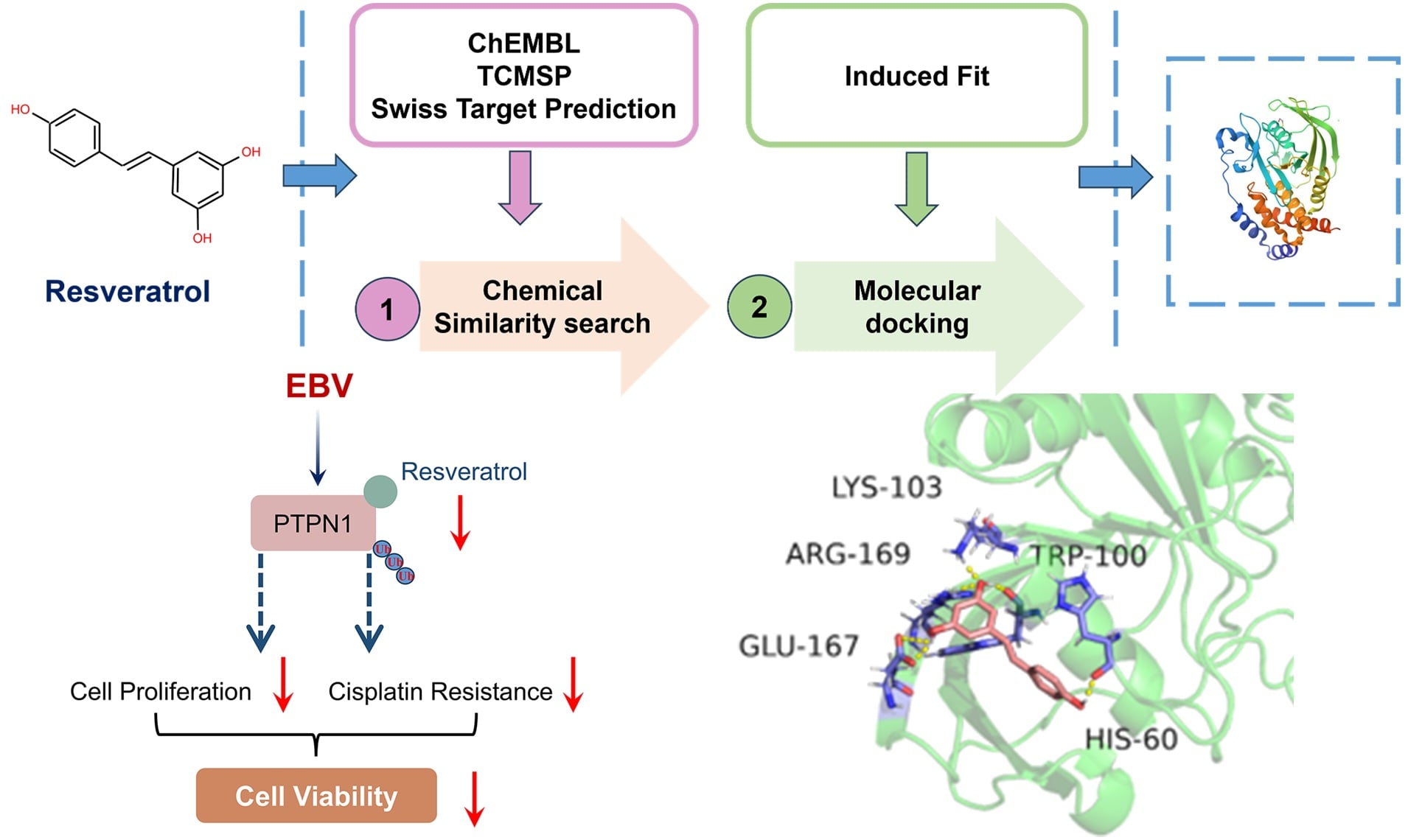
Background/Objectives: EBV is an oncogenic virus linked to NPC and GC, driving cisplatin resistance. Resveratrol has anticancer activity, but its targets and mechanisms against EBV-positive cancers remain unclear. Methods: We assessed resveratrol’s cytotoxicity in EBV-positive cells via functional assays, identified targets by chemical similarity search and molecular docking, and validated PTPN1 via in vitro experiments and nude mouse xenograft models. Results: Resveratrol inhibited EBV-positive cell viability in a time- and concentration- dependent manner, with IC50 values ranging from 35.85 to 145.7 μM across different cell lines at 24–72 h. Apoptosis rates increased by approximately 2- to 4-fold after 80 μM resveratrol treatment for 24 h. Resveratrol directly targeted PTPN1 (docking score = −4.89) and promoted its degradation via the proteasome pathway, as MG132 reversed this effect. Notably, resveratrol synergized with cisplatin (combination index < 1) to reverse cisplatin resistance in both in vitro and in vivo models. Furthermore, resveratrol induced EBV lytic reactivation through ROS production, as evidenced by the increased expression of BZLF1, BMRF1, and BALF2, which was attenuated by the ROS scavenger NAC. Conclusions: Our findings identify PTPN1 as a direct anticancer target of resveratrol in EBV-positive cancers. Resveratrol enhances the therapeutic efficacy of cisplatin via PTPN1 proteasomal degradation and induces EBV lytic reactivation through ROS accumulation. These findings provide a mechanistic basis for the development of novel combination therapies targeting EBV-associated malignancies.
Keywords: resveratrol; PTPN1; Epstein–Barr virus; cisplatin resveratrol; PTPN1; Epstein–Barr virus; cisplatin
Graphical Abstract