Radiation Biology of Radiopharmaceuticals: Beyond External Beam Radiation Therapy




Abstract
1. Introduction
1.1. Introduction to Types of Radiation Emitted from Decaying Radionuclides
1.2. Introduction to Radiation Interactions with Matter for the Transfer of Energy
1.2.1. Charged Particle Interactions
1.2.2. Photon Interactions
1.2.3. Neutron Interactions
1.2.4. Important Concepts Regarding Radiation Interaction and Absorbed Dose
2. Differences Between External Beam Radiation and Radiopharmaceutical Therapy
3. Radiation Biology Effects
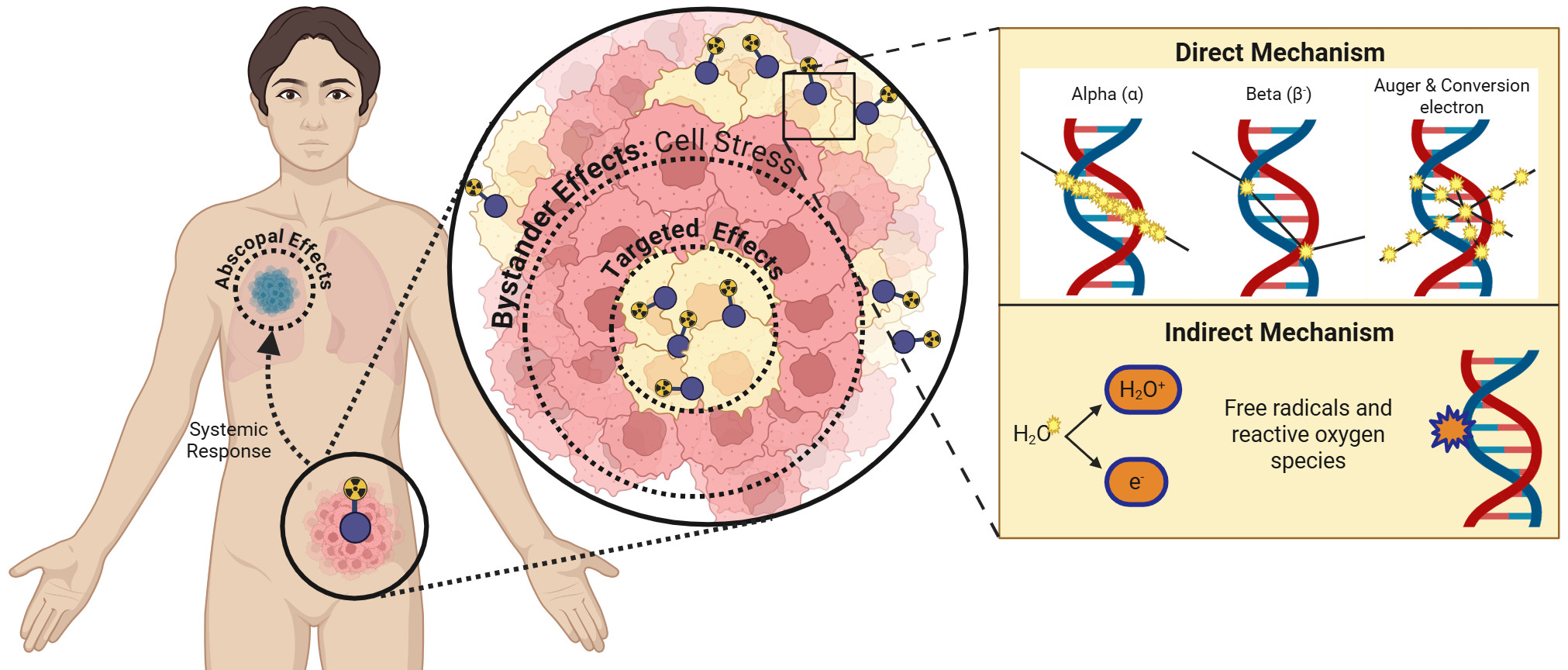
3.1. Targeted Radiation Biology Effects
3.1.1. Targeting DNA Damage
3.1.2. Targeting Other Critical Cellular Structures
3.2. Off-Target Radiation Biology Effects
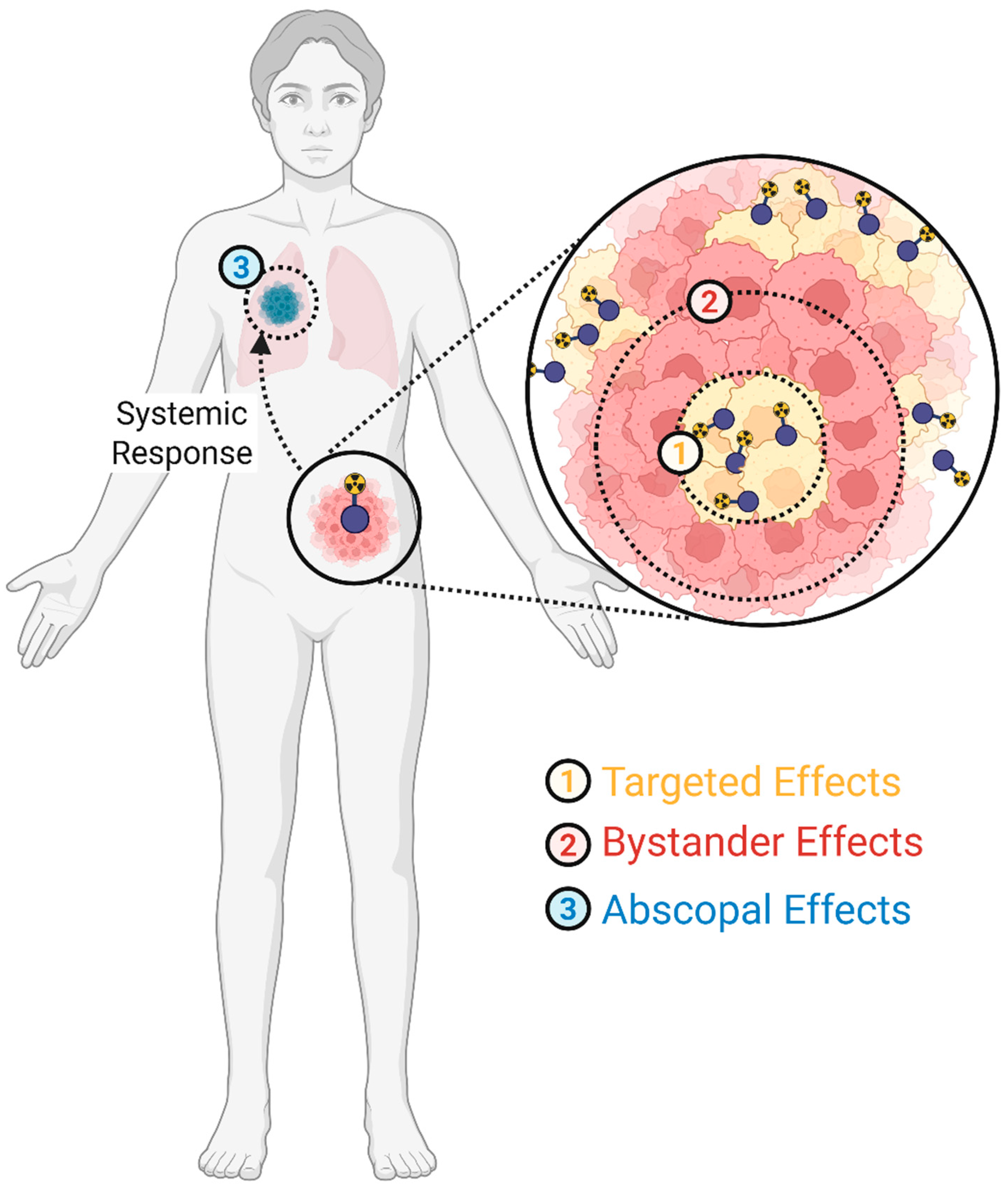
3.2.1. Activating Stress Signaling Pathways and Bystander Effects
3.2.2. Abscopal Effects
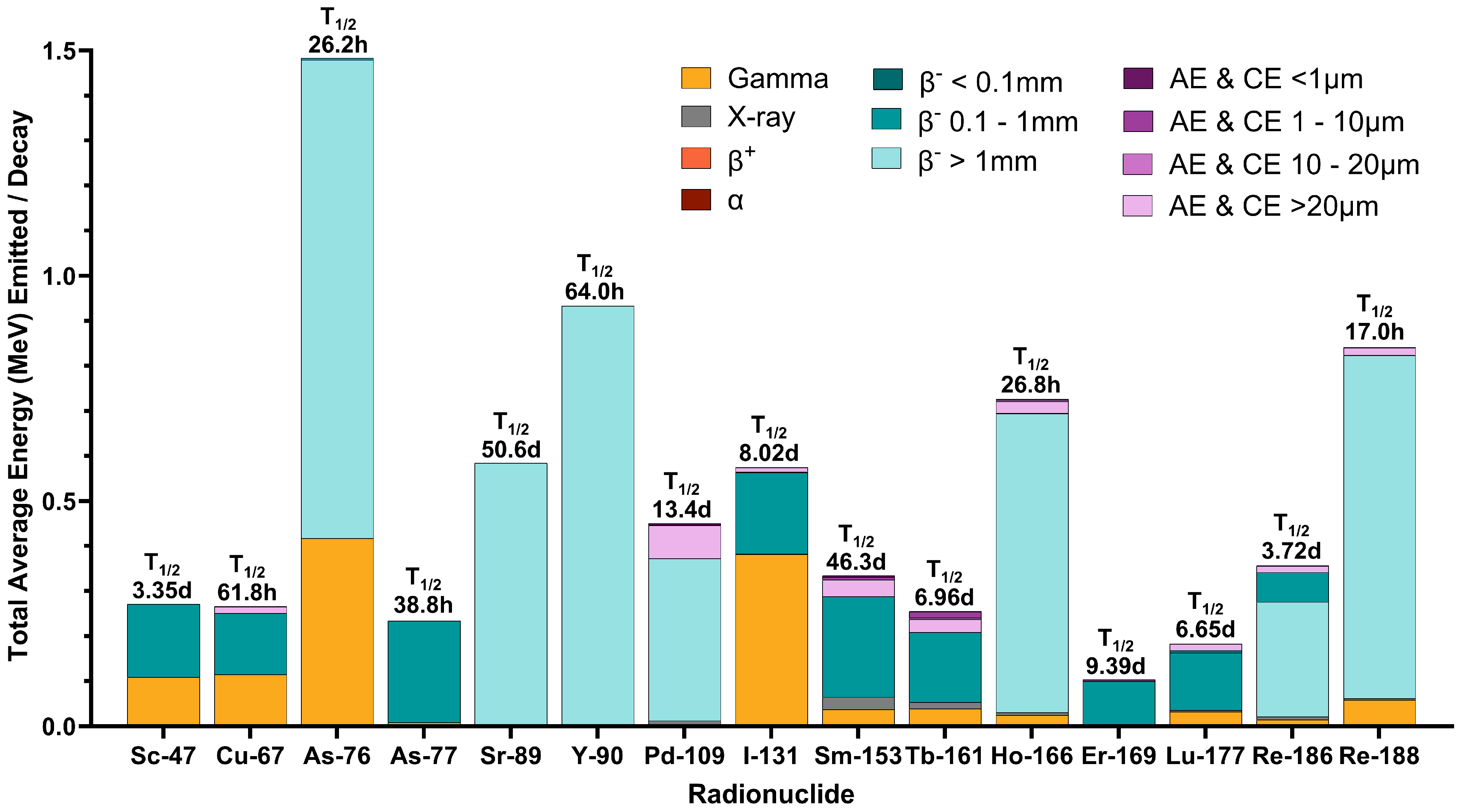
4. Therapeutic Radionuclides
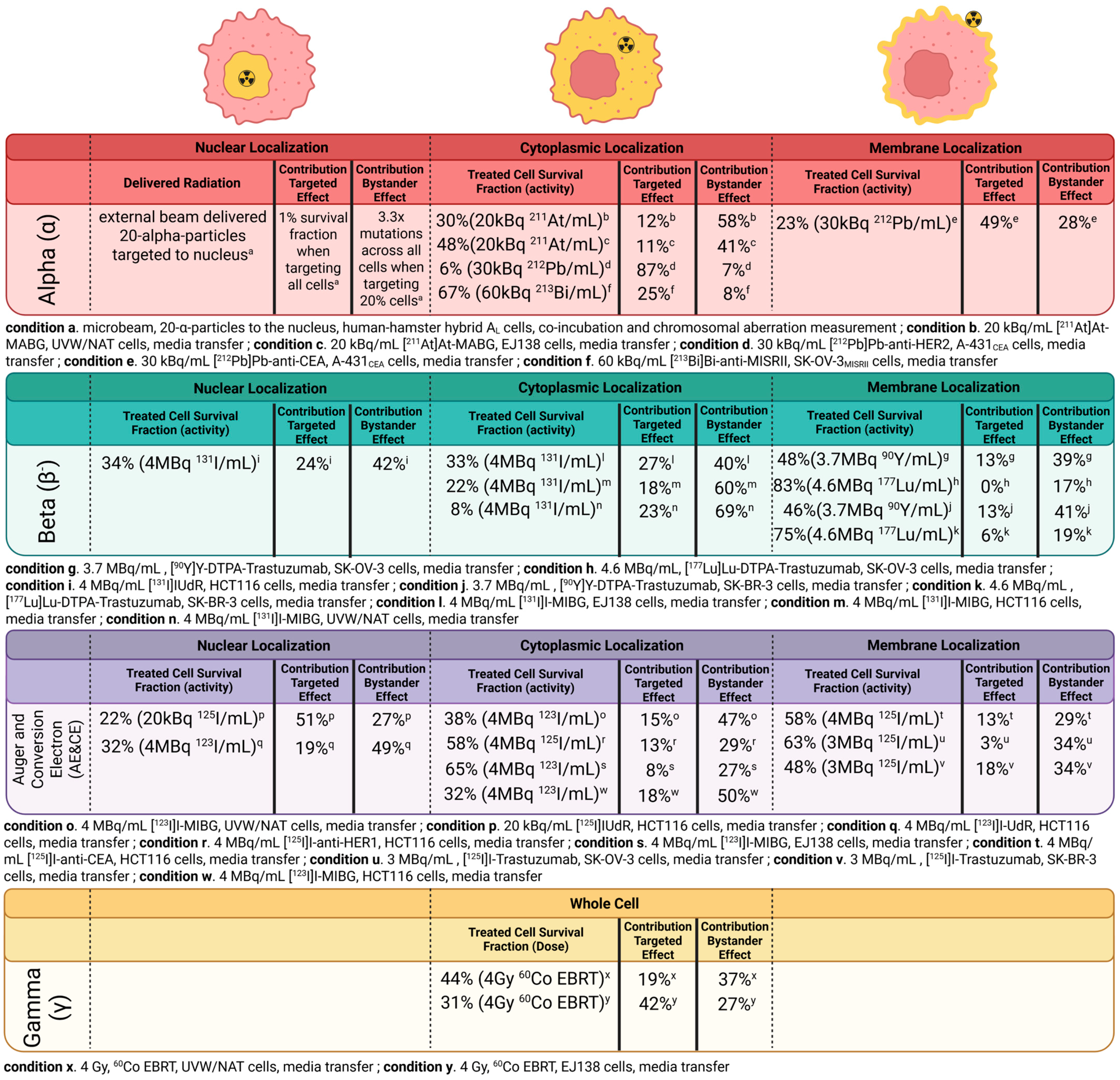
4.1. β−-Specific Radiation Biology Considerations
4.2. α-Specific Radiation Biology Considerations
4.3. Auger and Internal Conversion Electron-Specific Radiation Biology Considerations
5. Theranostic Considerations
5.1. Radiation Dosimetry
5.2. PET Imaging
5.3. SPECT Imaging
6. Methods and Techniques Employed to Understand Radiation Mechanisms
6.1. Clonogenic Assays
6.2. Comet Assays
6.3. Immunofluorescent Microscopy
6.4. Computational Monte Carlo Dosimetry
6.5. Medical Internal Radiation Dose (MIRD) Schema
7. Summary and Perspective
Author Contributions
Funding
Data Availability Statement
Acknowledgments
Conflicts of Interest
References
- Bodei, L.; Lewis, J.S.; Zeglis, B.M. Radiopharmaceutical Therapy; Springer Nature: Cham, Switzerland, 2023. [Google Scholar]
- Carlsson, S. A Glance at the History of Nuclear Medicine. Acta Oncol. 1995, 34, 1095–1102. [Google Scholar] [CrossRef]
- Orton, C.G. Uses of Therapeutic X Rays in Medicine. Health Phys. 1995, 69, 662–676. [Google Scholar] [CrossRef]
- Baatout, S. Radiobiology Textbook; Springer International Publishing: Mol, Belgium, 2023. [Google Scholar]
- Solnes, L.B.; Werner, R.A.; Jones, K.M.; Sadaghiani, M.S.; Bailey, C.R.; Lapa, C.; Pomper, M.G.; Rowe, S.P. Theranostics: Leveraging Molecular Imaging and Therapy to Impact Patient Management and Secure the Future of Nuclear Medicine. J. Nucl. Med. 2020, 61, 311–318. [Google Scholar] [CrossRef]
- Krane, K.S. Introductory Nuclear Physics; John Wiley & Sons, Ltd.: New York, NY, USA, 1988. [Google Scholar]
- Kassis, A.I. The Amazing World of Auger Electrons. Int. J. Radiat. Biol. 2004, 80, 789–803. [Google Scholar] [CrossRef]
- Knoll, G.F. Radiation Detection and Measurement; John Wiley & Sons, Inc.: New York, NY, USA, 1979. [Google Scholar]
- Cherry, S.R.; Sorenson, J.A.; Phelps, M.E. Physics of Nuclear Medicine, 4th ed.; Saunders: Philadelphia, PA, USA, 2012. [Google Scholar]
- Auger, P. The Auger Effect. Surf. Sci. 1975, 48, 1–8. [Google Scholar] [CrossRef]
- Cornelissen, B.; AVallis, K. Targeting the Nucleus: An Overview of Auger-Electron Radionuclide Therapy. Curr. Drug Discov. Technol. 2010, 7, 263–279. [Google Scholar] [CrossRef] [PubMed]
- Powsner, R.A.; Palmer, M.R.; Powsner, E.R. Essentials of Nuclear Medicine Physics, Instrumentation, and Radiation Biology, 4th ed.; John Wiley & Sons Ltd.: Hoboken, NJ, USA, 2022. [Google Scholar]
- Hubbell, J.H.; Seltzer, S.M. X-Ray Mass Attenuation Coefficients; National Institute of Standards and Technology (NIST): Gaithersburg, MD, USA, 2009. [Google Scholar]
- Howell, R.W.; Narra, V.R.; Sastry, K.S.R.; Rao, D.V. On the Equivalent Dose for Auger Electron Emitters. Radiat. Res. 1993, 134, 71–78. [Google Scholar] [CrossRef]
- Howell, R.W.; Rao, D.V.; Narra, V.R. The Question of Relative Biological Effectiveness and Quality Factor for Auger Emitters Incorporated into Proliferating Mammalian Cells. Radiat. Res. 1991, 128, 281–292. [Google Scholar] [CrossRef]
- Ku, A.; Facca, V.J.; Cai, Z.; Reilly, R.M. Auger Electrons for Cancer Therapy—A Review. EJNMMI Radiopharm. Chem. 2019, 4, 27. [Google Scholar] [CrossRef] [PubMed]
- Pouget, J.-P.; Lozza, C.; Deshayes, E.; Boudousq, V.; Navarro-Teulon, I. Introduction to Radiobiology of Targeted Radionuclide Therapy. Front. Med. 2015, 2, 12. [Google Scholar] [CrossRef]
- Sadhukhan, R.K.; Alam, M.J.; Synzynys, B.I. Contribution of Recoil Nucleus Energy to Total Absorbed Dose from Alpha and Beta Decay of Radionuclides Radium, Radon and Their Radioactive Progeny. In Proceedings of the 2024 13th ICECE, Dhaka, Bangladesh, 18–20 December 2024; pp. 11–15. [Google Scholar]
- Szucs, Z.; Van Rooyen, J.; Zeevaart, J.R. Recoil Effect on Beta-Decaying In Vivo Generators, Interpreted for 103Pd/103mRh. Appl. Radiat. Isot. 2009, 7–8, 1401–1404. [Google Scholar] [CrossRef]
- Zeevaart, J.R.; Szucs, Z.; Takacs, S.; Van Rooyen, J.; Jansen, D. Recoil and Conversion Electron Implications to Be Taken into Account in the Design of Therapeutic Radiopharmaceuticals Utilizing In Vivo Generators. J. Label. Comp. Radiopharm. 2012, 55, 115–119. [Google Scholar] [CrossRef]
- Crudo, J.; Duatti, A. Open Problems for the Preparation and Quality Control of Ac-225 Radiopharmaceuticals. Curr. Radiopharm. 2026, 19, 100004. [Google Scholar] [CrossRef]
- Pouget, J.-P. Basics of Radiobiology. Nucl. Med. Mol. Imaging 2022, 1, 30–51. [Google Scholar]
- Morris, Z.S.; Wang, A.Z.; Knox, S.J. The Radiobiology of Radiopharmaceuticals. Semin. Radiat. Oncol. 2021, 31, 20–27. [Google Scholar] [CrossRef] [PubMed]
- Paillas, S.; Ladjohounlou, R.; Lozza, C.; Pichard, A.; Boudousq, V.; Jarlier, M.; Sevestre, S.; Le Blay, M.; Deshayes, E.; Sosabowski, J.; et al. Localized Irradiation of Cell Membrane by Auger Electrons Is Cytotoxic Through Oxidative Stress-Mediated Nontargeted Effects. Antioxid. Redox Signal. 2016, 25, 467–484. [Google Scholar] [CrossRef]
- Pouget, J.-P.; Georgakilas, A.G.; Ravanat, J.L. Targeted and Off-Target (Bystander and Abscopal) Effects of Radiation Therapy: Redox Mechanisms and Risk/Benefit Analysis. Antioxid. Redox Signal. 2018, 29, 1447–1487. [Google Scholar] [CrossRef]
- Azami, A.; Suzuki, N.; Azami, Y.; Seto, I.; Sato, A.; Takano, Y.; Abe, T.; Teranishi, Y.; Tachibana, K.; Ohtake, T. Abscopal Effect Following Radiation Monotherapy in Breast Cancer: A Case Report. Mol. Clin. Oncol. 2018, 9, 283–286. [Google Scholar] [CrossRef]
- Brenneman, R.J.; Sharifai, N.; Fischer-Valuck, B.; Hassanzadeh, C.; Guzelian, J.; Chrisinger, J.S.A.; Michalski, J.M.; Oppelt, P.; Baumann, B.C. Abscopal Effect Following Proton Beam Radiotherapy in a Patient with Inoperable Metastatic Retroperitoneal Sarcoma. Front. Oncol. 2019, 9, 922. [Google Scholar] [CrossRef]
- Tsui, J.M.; Mihalcioiu, C.; Cury, F.L. Abscopal Effect in a Stage IV Melanoma Patient Who Progressed on Pembrolizumab. Cureus 2018, 10, e2238. [Google Scholar] [CrossRef]
- Abuodeh, Y.; Venkat, P.; Kim, S. Systematic Review of Case Reports on the Abscopal Effect. Curr. Probl. Cancer 2016, 40, 25–37. [Google Scholar] [CrossRef]
- Sage, E.; Shikazono, N. Radiation-Induced Clustered DNA Lesions: Repair and Mutagenesis. Free Radic. Biol. Med. 2017, 107, 125–135. [Google Scholar] [CrossRef]
- Pouget, J.-P.; Frelon, S.; Ravanat, J.L.; Testard, I.; Odin, F.; Cadet, J. Formation of Modified DNA Bases in Cells Exposed Either to Gamma Radiation or to High-LET Particles. Radiat. Res. 2002, 157, 589–595. [Google Scholar] [CrossRef]
- Jackson, S.P.; Bartek, J. The DNA-damage response in human biology and disease. Nature 2009, 461, 1071–1078. [Google Scholar] [CrossRef]
- Willers, H.; Dahm-Daphi, J.; Powell, S.N. Repair of Radiation Damage to DNA. Br. J. Cancer 2004, 90, 1297–1301. [Google Scholar] [CrossRef] [PubMed]
- Khazaei Monfared, Y.; Heidari, P.; Klempner, S.J.; Mahmood, U.; Parikh, A.R.; Hong, T.S.; Strickland, M.R.; Esfahani, S.A. DNA Damage by Radiopharmaceuticals and Mechanisms of Cellular Repair. Pharmaceutics 2023, 15, 2761. [Google Scholar] [CrossRef] [PubMed]
- Kassis, A.I. Therapeutic Radionuclides: Biophysical and Radiobiologic Principles. Semin. Nucl. Med. 2008, 23, 358–366. [Google Scholar] [CrossRef]
- Somosy, Z. Radiation Response of Cell Organelles. Micron 2000, 31, 165–181. [Google Scholar] [CrossRef] [PubMed]
- Rogounovitch, T.I.; Saenko, V.A.; Shimizu-Yoshida, Y.; Abrosimov, A.Y.; Lushnikov, E.F.; Rouminantsev, P.O.; Ohtsuru, A.; Namba, H.; Tsyb, A.F.; Yamashita, S. Large Deletions in Mitochondrial DNA in Radiation-Associated Human Thyroid Tumors. Cancer Res. 2002, 62, 7031–7041. [Google Scholar]
- Singh, G.; Hauswirth, W.W.; Ross, W.E.; Neims, A.H. A Method for Assessing Damage to Mitochondrial DNA Caused by Radiation and Epichiorohydrin. Mol. Pharmacol. 1985, 27, 167–170. [Google Scholar] [CrossRef]
- Gulyaeva, N.A.; Abdullaev, S.A.; Malakhova, L.V.; Antipova, V.N.; Bezlepkin, V.G.; Gaziev, A.I. Reduction of the Number of Mutant Copies of Mitochondrial DNA in Tissues of Irradiated Mice in the Postradiation Period. Russ. J. Genet. 2009, 45, 949–956. [Google Scholar] [CrossRef]
- Kam, W.W.Y.; Banati, R.B. Effects of Ionizing Radiation on Mitochondria. Free Radic. Biol. Med. 2013, 65, 607–619. [Google Scholar] [CrossRef] [PubMed]
- St Clair, D.K.; Steven Wan, X.; Oberley, T.D.; Muse, K.E.; St Clair, W.H. Suppression of Radiation-Induced Neoplastic Transformation by Overexpression of Mitochondrial Superoxide Dismutase. Mol. Carcinog. 1992, 6, 238–242. [Google Scholar] [CrossRef]
- Du, C.; Gao, Z.; Venkatesha, V.A.; Kalen, A.L.; Chaudhuri, L.; Spitz, D.R.; Cullen, J.J.; Oberley, L.W.; Goswami, P.C. Mitochondrial ROS and Radiation Induced Transformation in Mouse Embryonic Fibroblasts. Cancer Biol. Ther. 2009, 8, 1962–1971. [Google Scholar] [CrossRef] [PubMed]
- Motoori, S.; Majima, H.J.; Ebara, M.; Kato, H.; Hirai, F.; Kakinuma, S.; Yamaguchi, C.; Ozawa, T.; Nagano, T.; Tsujii, H.; et al. Overexpression of Mitochondrial Manganese Superoxide Dismutase Protects against Radiation-Induced Cell Death in the Human Hepatocellular Carcinoma Cell Line HLE1. Cancer Res. 2001, 61, 5382–5388. [Google Scholar]
- Holley, A.K.; Bakthavatchalu, V.; Velez-Roman, J.M.; St. Clair, D.K. Manganese Superoxide Dismutase: Guardian of the Powerhouse. Int. J. Mol. Sci. 2011, 12, 7114–7162. [Google Scholar] [CrossRef]
- Pouget, J.-P.; Constanzo, J. Revisiting the Radiobiology of Targeted Alpha Therapy. Front. Med. 2021, 8, 692436. [Google Scholar] [CrossRef]
- Wang, L.; Kuwahara, Y.; Li, L.; Baba, T.; Shin, R.-W.; Ohkubo, Y.; Ono, K.; Fukumoto, M. Analysis of Common Deletion (CD) and a Novel Deletion of Mitochondrial DNA Induced by Ionizing Radiation. Int. J. Radiat. Biol. 2007, 83, 433–442. [Google Scholar] [CrossRef]
- Zhou, X.; Li, N.; Wang, Y.; Wang, Y.; Zhang, X.; Zhang, H. Effects of X-Irradiation on Mitochondrial DNA Damage and Its Supercoiling Formation Change. Mitochondrion 2011, 11, 886–892. [Google Scholar] [CrossRef]
- Howell, R.W.; Bishayee, A. Bystander Effects Caused by Nonuniform Distributions of DNA-Incorporated 125I. Micron 2002, 33, 127–132. [Google Scholar] [CrossRef] [PubMed]
- Paillas, S.; Boudousq, V.; Piron, B.; Kersual, N.; Bardiès, M.; Chouin, N.; Bascoul-Mollevi, C.; Arnaud, F.X.; Pèlegrin, A.; Navarro-Teulon, I.; et al. Apoptosis and P53 Are Not Involved in the Anti-Tumor Efficacy of 125I-Labeled Monoclonal Antibodies Targeting the Cell Membrane. Nucl. Med. Biol. 2013, 40, 471–480. [Google Scholar] [CrossRef] [PubMed]
- Karam, J.; Constanzo, J.; Pichard, A.; Gros, L.; Chopineau, J.; Morille, M.; Pouget, J.P. Rapid Communication: Insights into the Role of Extracellular Vesicles during Auger Radioimmunotherapy. Int. J. Radiat. Biol. 2023, 99, 109–118. [Google Scholar] [CrossRef]
- Kishikawa, H.; Wang, K.; Adelstein, S.J.; Kassis, A.I. Inhibitory and Stimulatory Bystander Effects Are Differentially Induced by Iodine-125 and Iodine-123. Radiat. Res. 2006, 165, 688–694. [Google Scholar] [CrossRef]
- Xue, L.Y.; Butler, N.J.; Makrigiorgos, G.M.; Adelstein, S.J.; Kassis, A.I. Bystander Effect Produced by Radiolabeled Tumor Cells In Vivo. Proc. Natl. Acad. Sci. USA 2002, 99, 13765–13770. [Google Scholar] [CrossRef]
- Gaillard, S.; Pusset, D.; de Toledo, S.; Michel, F.; Edouard, A. Propagation Distance of the α-Particle-Induced Bystander Effect: The role of nuclear traversal and gap junction communication. Radiat. Res. 2009, 171, 513–520. [Google Scholar] [CrossRef]
- Bishayee, A.; Hill, H.Z.; Stein, D.; Rao, D.V.; Howell, R.W. Free Radical-Initiated and Gap Junction-Mediated Bystander Effect Due to Nonuniform Distribution of Incorporated Radioactivity in a Three-Dimensional Tissue Culture Model. Radiat. Res. 2001, 155, 335–344. [Google Scholar] [CrossRef]
- Boyd, M.; Sorensen, A.; McCluskey, A.G.; Mairs, R.J. Radiation Quality-Dependent Bystander Effects Elicited by Targeted Radionuclides. J. Pharm. Pharmacol. 2008, 60, 951–958. [Google Scholar] [CrossRef]
- Chen, S.; Zhao, Y.; Han, W.; Zhao, G.; Zhu, L.; Wang, J.; Bao, L.; Jiang, E.; Xu, A.; Hei, T.K.; et al. Mitochondria-Dependent Signaling Pathway Are Involved in the Early Process of Radiation-Induced Bystander Effects. Br. J. Cancer 2008, 98, 1839–1844. [Google Scholar] [CrossRef]
- Boyd, M.; Ross, S.C.; Dorrens, J.; Fullerton, N.E.; Ker, W.T.; Zalutsky, M.R.; Mairs, R.J. Radiation-Induced Biologic Bystander Effect Elicited In Vitro by Targeted Radiopharmaceuticals Labeled with α-, β-, and Auger Electron-Emitting Radionuclides. J. Nucl. Med. 2006, 47, 1007–1015. [Google Scholar] [PubMed]
- Gorman, S.; Tosetto, M.; Lyng, F.; Howe, O.; Sheahan, K.; O’Donoghue, D.; Hyland, J.; Mulcahy, H.; O’Sullivan, J. Radiation and Chemotherapy Bystander Effects Induce Early Genomic Instability Events: Telomere Shortening and Bridge Formation Coupled with Mitochondrial Dysfunction. Mutat. Res. Fundam. Mol. Mech. Mutagen. 2009, 669, 131–138. [Google Scholar] [CrossRef] [PubMed]
- Ladjohounlou, R.; Lozza, C.; Pichard, A.; Constanzo, J.; Karam, J.; Le Fur, P.; Deshayes, E.; Boudousq, V.; Paillas, S.; Busson, M.; et al. Drugs That Modify Cholesterol Metabolism Alter the P38/JNK-Mediated Targetedand Nontargeted Response to Alpha and Auger Radioimmunotherapy. Clin. Cancer Res. 2019, 25, 4775–4790. [Google Scholar] [CrossRef]
- Sharma, R.; Mukherjee, A.; Jagasia, P.; Singh, S.K. Assessing the Radiation-Induced Bystander Effect in Radionuclide Therapy Using Targeted Radiopharmaceuticals. EJNMMI Radiopharm. Chem. 2025, 10, 83. [Google Scholar] [CrossRef]
- Kadhim, M.A.; Lee, R.; Moore, S.R.; Macdonald, D.A.; Chapman, K.L.; Patel, G.; Prise, K.M. Genomic Instability after Targeted Irradiation of Human Lymphocytes: Evidence for Inter-Individual Differences under Bystander Conditions. Mutat. Res. Fundam. Mol. Mech. Mutagen. 2010, 688, 91–94. [Google Scholar] [CrossRef] [PubMed]
- Yamazaki, T.; Vanpouille-Box, C.; Demaria, S.; Galluzzi, L. Immunogenic Cell Death Driven by Radiation—Impact on the Tumor Microenvironment. Cancer Res. Treat. 2020, 180, 281–296. [Google Scholar]
- Golden, E.B.; Frances, D.; Pellicciotta, I.; Demaria, S.; Barcellos-Hoff, M.H.; Formenti, S.C. Radiation Fosters Dose-Dependent and Chemotherapy-Induced Immunogenic Cell Death. Oncoimmunology 2014, 3, e28518. [Google Scholar] [CrossRef]
- Rouanet, J.; Benboubker, V.; Akil, H.; Hennino, A.; Auzeloux, P.; Besse, S.; Pereira, B.; Delorme, S.; Mansard, S.; D’Incan, M.; et al. Immune Checkpoint Inhibitors Reverse Tolerogenic Mechanisms Induced by Melanoma Targeted Radionuclide Therapy. Cancer Immunol. Immunother. 2020, 69, 2075–2088. [Google Scholar] [CrossRef]
- Kerr, C.P.; Grudzinski, J.J.; Nguyen, T.P.; Hernandez, R.; Weichert, J.P.; Morris, Z.S. Developments in Combining Targeted Radionuclide Therapies and Immunotherapies for Cancer Treatment. Pharmaceutics 2023, 15, 128. [Google Scholar] [CrossRef]
- Kerr, C.P.; Sheehan-Klenk, J.; Grudzinski, J.J.; Adam, D.P.; Phuong Nguyen, T.T.; Ferreira, C.A.; Bates, A.M.; Jong Jin, W.; Kwon, O.; Olson, A.P.; et al. The Effects of Clinically Relevant Radionuclides on the Activation of a Type I Interferon Response Correlate with Radionuclide Half-Life and Linear Energy Transfer and Influence Radiopharmaceutical Antitumor Efficacy. Cancer Immunol. Res. 2025, 13, 119–1206. [Google Scholar] [CrossRef] [PubMed]
- Jagodinsky, J.C.; Harari, P.M.; Morris, Z.S. The Promise of Combining Radiation Therapy with Immunotherapy. Int. J. Radiat. Oncol. Biol. Phys. 2020, 108, 6–16. [Google Scholar] [CrossRef]
- Bernhardt, P.; Forssell-aronsson, E.; Jacobsson, L.; Skarnemark, G. Low-Energy Electron Emitters for Targeted Radiotherapy of Small Tumours. Acta Oncol. 2001, 40, 602–608. [Google Scholar] [CrossRef] [PubMed]
- Sastry, K.S.R.; Haydock, C.; Basha, A.M.; Rao, D.V. Electron Dosimetry for Radioimmunotherapy: Optimal Electron Energy. Radiat. Prot. Dosim. 1985, 13, 249–252. [Google Scholar] [CrossRef]
- Marion, J.B. The Effects of Nuclear Radiations. In Energy in Perspective; Elsevier: Amsterdam, The Netherlands, 1974; pp. 140–169. [Google Scholar]
- Goddu, S.M.; Howell, R.W.; Rao, D.V. Calculation of Equivalent Dose for Auger Electron Emitting Radionuclides Distributed in Human Organs. Acta Oncol. 1996, 35, 909–916. [Google Scholar] [CrossRef]
- Howell, R.W.; Narra, V.R.; Hou, D.; Terrone, D.A.; Harapanhalli, R.; Sastry, K.S.R.; Rao, D.V. Relative Biological Effectiveness of Auger Emitters for Cell Inactivation: In Vitro Versus In Vivo; American Inst. of Physics, Inc.: Woodbury, NY, USA, 1992; pp. 290–318. [Google Scholar]
- Seltzer, S.M. NIST 7. NIST Electron and Positron Stopping Power of Materials; National Institute of Standards and Technology (NIST): Gaithersburg, MD, USA, 2008. [Google Scholar]
- Baum, R.P.; Kulkarni, H.R.; Schuchardt, C.; Singh, A.; Wirtz, M.; Wiessalla, S.; Schottelius, M.; Mueller, D.; Klette, I.; Wester, H.J. 177Lu-Labeled Prostate-Specific Membrane Antigen Radioligand Therapy of Metastatic Castration-Resistant Prostate Cancer: Safety and Efficacy. J. Nucl. Med. 2016, 57, 1006–1013. [Google Scholar] [CrossRef]
- Agostinelli, S.; Allison, J.; Amako, K.; Apostolakis, J.; Araujo, H.; Arce, P.; Asai, M.; Axen, D.; Banerjee, S.; Barrand, G.; et al. GEANT4—A Simulation Toolkit. Nucl. Instrum. Methods Phys. Res. A 2003, 506, 250–303. [Google Scholar] [CrossRef]
- IAEA. Live Chart of Nuclides: Nuclear Structure and Decay Data. Available online: https://www.nndc.bnl.gov/nudat3/ (accessed on 15 January 2026).
- Eckerman, K.F.; Endo, A. MIRD: Radionuclide Data and Decay Schemes, 2nd ed.; Society of Nuclear Medicine: Reston, VA, USA, 2008. [Google Scholar]
- Champion, C.; Quinto, M.A.; Morgat, C.; Zanotti-Fregonara, P.; Hindié, E. Comparison between Three Promising β-Emitting Radionuclides, 67Cu, 47Sc and 161Tb, with Emphasis on Doses Delivered to Minimal Residual Disease. Theranostics 2016, 6, 1611–1618. [Google Scholar] [CrossRef]
- Hindie, E.; Zanotti-Fregonara, P.; Quinto, M.A.; Morgat, C.; Champion, C. Dose Deposits from 90Y, 177Lu, 111In, And 161Tb in Micrometastases of Various Sizes: Implications for Radiopharmaceutical Therapy. J. Nucl. Med. 2016, 57, 759–764. [Google Scholar] [CrossRef]
- Hemmingsson, J.; Svensson, J.; van der Meulen, N.P.; Müller, C.; Bernhardt, P. Active Bone Marrow S-Values for the Low-Energy Electron Emitter Terbium-161 Compared to S-Values for Lutetium-177 and Yttrium-90. EJNMMI Phys. 2022, 9, 65. [Google Scholar] [CrossRef]
- Holland, J.P.; Williamson, M.J.; Lewis, J.S. Unconventional Nuclides for Radiopharmaceuticals. Mol. Imaging 2010, 9, 1–20. [Google Scholar] [CrossRef]
- Kostelnik, T.I.; Orvig, C. Radioactive Main Group and Rare Earth Metals for Imaging and Therapy. Chem. Rev. 2019, 119, 902–956. [Google Scholar] [CrossRef] [PubMed]
- Sartor, O.; de Bono, J.; Chi, K.N.; Fizazi, K.; Herrmann, K.; Rahbar, K.; Tagawa, S.T.; Nordquist, L.T.; Vaishampayan, N.; El-Haddad, G.; et al. Lutetium-177–PSMA-617 for Metastatic Castration-Resistant Prostate Cancer. N. Engl. J. Med. 2021, 385, 1091–1103. [Google Scholar] [CrossRef] [PubMed]
- Strosberg, J.; El-Haddad, G.; Wolin, E.; Hendifar, A.; Yao, J.; Chasen, B.; Mittra, E.; Kunz, P.L.; Kulke, M.H.; Jacene, H.; et al. Phase 3 Trial of 177Lu-Dotatate for Midgut Neuroendocrine Tumors. N. Engl. J. Med. 2017, 376, 125–135. [Google Scholar] [CrossRef]
- Singh, S.; Halperin, D.; Myrehaug, S.; Herrmann, K.; Pavel, M.; Kunz, P.L.; Chasen, B.; Tafuto, S.; Lastoria, S.; Capdevila, J.; et al. [177Lu]Lu-DOTA-TATE plus Long-Acting Octreotide versus High-dose Long-Acting Octreotide for the Treatment of Newly Diagnosed, Advanced Grade 2–3, Well-Differentiated, Gastroenteropancreatic Neuroendocrine Tumours (NETTER-2): An Open-Label, Randomised, Phase 3 Study. Lancet 2024, 403, 2807–2817. [Google Scholar]
- Pouget, J.-P.; Gabina, P.M.; Herrmann, K.; Deandreis, D.; Konijnenberg, M.; Taieb, D.; van Leeuwen, F.W.B.; Kurth, J.; Eberlein, U.; Lassmann, M.; et al. EANM Expert Opinion: How Can Lessons from Radiobiology Be Applied to the Design of Clinical Trials? Part I: Back to the Basics of Absorbed Dose–Response and Threshold Absorbed Doses. Eur. J. Nucl. Med. Mol. Imaging 2025, 52, 1210–1222. [Google Scholar] [CrossRef]
- Elgqvist, J.; Frost, S.; Pouget, J.-P.; Albertsson, P. The Potential and Hurdles of Targeted Alpha Therapy—Clinical Trials and Beyond. Front. Oncol. 2014, 3, 324. [Google Scholar] [CrossRef]
- Schwartz, J.; Jaggi, J.S.; O’donoghue, J.A.; Ruan, S.; McDevitt, M.; Larson, S.M.; Scheinberg, D.A.; Humm, J.L. Renal Uptake of Bismuth-213 and Its Contribution to Kidney Radiation Dose Following Administration of Actinium-225-Labeled Antibody. Phys. Med. Biol. 2011, 56, 721–733. [Google Scholar] [CrossRef] [PubMed]
- Mirzadeh, S.; Kumar, K.; Gansow, O.A. The Chemical Fate of 212Bi-DOTA Formed by Beta-Decay of 212Pb(DOTA)2. Radiochim. Acta 1993, 60, 1–10. [Google Scholar] [CrossRef]
- Westrøm, S.; Generalov, R.; Bønsdorff, T.B.; Larsen, R.H. Preparation of 212Pb-Labeled Monoclonal Antibody Using a Novel 224Ra-Based Generator Solution. Nucl. Med. Biol. 2017, 51, 1–9. [Google Scholar] [CrossRef]
- Jaggi, J.S.; Kappel, B.J.; Mcdevitt, M.R.; Sgouros, G.; Flombaum, C.D.; Cabassa, C.; Scheinberg, D.A. Efforts to Control the Errant Products of a Targeted In Vivo Generator. Cancer Res. 2005, 65, 4888–4895. [Google Scholar] [CrossRef]
- Wild, D.; Frischknecht, M.; Zhang, H.; Morgenstern, A.; Bruchertseifer, F.; Boisclair, J.; Provencher-Bolliger, A.; Reubi, J.C.; Maecke, H.R. Alpha- versus Beta-Particle Radiopeptide Therapy in a Human Prostate Cancer Model (213Bi-DOTA-PESIN and 213Bi-AMBA versus 177Lu-DOTA-PESIN). Cancer Res. 2011, 71, 1009–1018. [Google Scholar] [CrossRef]
- Wang, G.; de Kruijff, R.M.; Rol, A.; Thijssen, L.; Mendes, E.; Morgenstern, A.; Bruchertseifer, F.; Stuart, M.C.A.; Wolterbeek, H.T.; Denkova, A.G. Retention Studies of Recoiling Daughter Nuclides of 225Ac in Polymer Vesicles. Appl. Radiat. Isot. 2014, 85, 45–53. [Google Scholar] [CrossRef]
- Arazi, L.; Cooks, T.; Schmidt, M.; Keisari, Y.; Kelson, I. Treatment of Solid Tumors by Interstitial Release of Recoiling Short-Lived Alpha Emitters. Phys. Med. Biol. 2007, 52, 5025–5042. [Google Scholar] [CrossRef]
- Josefsson, A.; Nedrow, J.; Ray, S.; Bruchertseifer, F.; Morgenstern, A.; Pomper, M.; Sgouros, G.; Hobbs, R. Pharmacokinetic Variability 225Ac and 213Bi from Vector Labeled 225Ac Cancer Therapy as a Function of Vector Type (Antibody vs. Small Molecule). J. Nucl. Med. 2018, 59, 137. [Google Scholar]
- Liubchenko, G.; Böning, G.; Zacherl, M.; Rumiantcev, M.; Unterrainer, L.M.; Gildehaus, F.J.; Brendel, M.; Resch, S.; Bartenstein, P.; Ziegler, S.I.; et al. Image-Based Dosimetry for [225Ac]Ac-PSMA-I&T Therapy and the Effect of Daughter-Specific Pharmacokinetics. Eur. J. Nucl. Med. Mol. Imaging 2024, 51, 2504–2514. [Google Scholar]
- Albertsson, P.; Back, T.; Bergmark, K.; Hallqvist, A.; Johansson, M.; Aneheim, E.; Lindegren, S.; Timperanza, C.; Smerud, K.; Palm, S. Astatine-211 Based Radionuclide Therapy: Current Clinical Trial Landscape. Front. Med. 2023, 9, 1076210. [Google Scholar] [CrossRef]
- Das, T.; Pillai, M.R.A. Options to Meet the Future Global Demand of Radionuclides for Radionuclide Therapy. Nucl. Med. Biol. 2013, 40, 23–32. [Google Scholar] [CrossRef] [PubMed]
- Miederer, M.; Benešov, M.; Mamat, C.; Kästner, D.; Pretze, M.; Michler, E.; Brogsitter, C.; Kotzerke, J.; Kopka, K.; Scheinberg, D.A. Alpha-Emitting Radionuclides: Current Status and Future Perspectives. Pharmaceuticals 2024, 17, 76. [Google Scholar] [CrossRef] [PubMed]
- Engle, J.W. The Production of Ac-225. Curr. Radiopharm. 2018, 11, 173–179. [Google Scholar] [CrossRef] [PubMed]
- Harvey, J.T. NorthStar Perspectives for Actinium-225 Production at Commercial Scale. Curr. Radiopharm. 2018, 11, 180–191. [Google Scholar] [CrossRef]
- Minnix, M.; Adhikarla, V.; Caserta, E.; Poku, E.; Rockne, R.; Shively, J.E.; Pichiorri, F. Comparison of CD38-Targeted a-Versus b-Radionuclide Therapy of Disseminated Multiple Myeloma in an Animal Model. J. Nucl. Med. 2021, 62, 795–801. [Google Scholar] [CrossRef]
- Ferreira, C.A.; Potluri, H.K.; Mahmoudian, M.; Massey, C.F.; Grudzinski, J.J.; Carston, A.M.; Clemons, N.B.; Idrissou, M.B.; Thickens, A.S.; Rosenkrans, Z.T.; et al. Immunomodulatory Effects of Alpha vs Beta Radiopharmaceutical Therapy in Murine Prostate Cancer. Front. Immunol. 2025, 16, 1563387. [Google Scholar] [CrossRef]
- Graf, F.; Fahrer, J.; Maus, S.; Morgenstern, A.; Bruchertseifer, F.; Venkatachalam, S.; Fottner, C.; Weber, M.M.; Huelsenbeck, J.; Schreckenberger, M.; et al. DNA Double Strand Breaks as Predictor of Efficacy of the Alpha-Particle Emitter Ac-225 and the Electron Emitter Lu-177 for Somatostatin Receptor Targeted Radiotherapy. PLoS ONE 2014, 9, e88239. [Google Scholar] [CrossRef]
- Song, H.; Hobbs, R.F.; Vajravelu, R.; Huso, D.L.; Esaias, C.; Apostolidis, C.; Morgenstern, A.; Sgouros, G. Radioimmunotherapy of Breast Cancer Metastases with α-Particle Emitter 225Ac: Comparing Efficacy with 213Bi and 90Y. Cancer Res. 2009, 69, 8941–8948. [Google Scholar] [CrossRef]
- Kratochwil, C.; Giesel, F.L.; Bruchertseifer, F.; Mier, W.; Apostolidis, C.; Boll, R.; Murphy, K.; Haberkorn, U.; Morgenstern, A. 213Bi-DOTATOC Receptor-Targeted Alpha-Radionuclide Therapy Induces Remission in Neuroendocrine Tumours Refractory to Beta Radiation: A First-in-Human Experience. Eur. J. Nucl. Med. Mol. Imaging 2014, 41, 2106–2119. [Google Scholar] [CrossRef]
- Strosberg, J.R.; Naqvi, S.; Lee Cohn, A.; Delpassand, E.S.; Jean Wagner, V.; Tworowska, I.; Torgue, J.; Woloski, R.; Manuel, A.; Alice Maluccio, M.; et al. Safety, Tolerability and Efficacy of 212Pb-DOTAMTATE as a Targeted Alpha Therapy for Subjects with Unresectable or Metastatic Somatostatin Receptor-Expressing Gastroenteropancreatic Neuroendocrine Tumors (SSTR + GEP-NETs): A Phase 2 Study. Ann. Oncol. 2025, 36, S630. [Google Scholar] [CrossRef]
- Oliveira-Silva, C.C.; Maillard, M.S.; Silva, R.; Sá, L.V. Dosimetry at Cellular Level for the Alpha-Emitting Radionuclides Actinium-225, Astatine-211 and Radium-223 for Bone Metastasis Cells from Castration Resistant Prostate Cancer. Phys. Med. Biol. 2024, 69, 205004. [Google Scholar] [CrossRef]
- Falzone, N.; Fernández-Varea, J.M.; Flux, G.; Vallis, K.A. Monte Carlo Evaluation of Auger Electron–Emitting Theranostic Radionuclides. J. Nucl. Med. 2015, 56, 1441–1446. [Google Scholar] [CrossRef]
- Thisgaard, H.; Jensen, M. 119Sb—A Potent Auger Emitter for Targeted Radionuclide Therapy. Med. Phys. 2008, 35, 3839–3846. [Google Scholar] [CrossRef]
- Saha, G.B. Fundamentals of Nuclear Pharmacy; Springer Nature: Cham, Switzerland, 2013. [Google Scholar]
- Pouget, J.-P.; Navarro-Teulon, I.; Bardiès, M.; Chouin, N.; Cartron, G.; Pèlegrin, A.; Azria, D. Clinical Radioimmunotherapy-the Role of Radiobiology. Nat. Rev. Clin. Oncol. 2011, 8, 720–734. [Google Scholar] [CrossRef]
- Chakravarty, N.; Rattan, S.S.; Singh, R.J.; Ramaswami, A. Decay Studies of 197Tl (2.84 H) and 197mHg (23.8 H). Radiochim. Acta 1993, 61, 9–14. [Google Scholar] [CrossRef]
- O’Donoghue, J.A.; Wheldon, T.E. Targeted Radiotherapy Using Auger Electron Emitters. Phys. Med. Biol. 1996, 41, 1973–1992. [Google Scholar] [CrossRef]
- Thisgaard, H.; Jensen, M.; Elema, D.R. Medium to Large Scale Radioisotope Production for Targeted Radiotherapy Using a Small PET Cyclotron. Appl. Radiat. Isot. 2011, 69, 1–7. [Google Scholar] [CrossRef]
- Filosofov, D.; Kurakina, E.; Radchenko, V. Potent Candidates for Targeted Auger Therapy: Production and Radiochemical Considerations. Nucl. Med. Biol. 2021, 94–95, 1–19. [Google Scholar] [CrossRef]
- Kassis, A.I.; Adelstein, S.J.; Haydock, C.; Sastry, K.S.R.; McElvany, K.D.; Welch, M.J. Lethality of Auger Electrons from the Decay of Bromine-77 in the DNA of Mammalian Cells. Radiat. Res. 1982, 90, 362. [Google Scholar] [CrossRef]
- Chan, P.C.; Lisco, E.; Lisco, H.; Adelstein, S.J. The Radiotoxicity of Iodine-125 in Mammalian Cells: II. A Comparative Study on Cell Survival and Cytogenetic Responses to 125IUdR, 131IUdR, and 3HTdR. Radiat. Res. 1976, 67, 332. [Google Scholar] [CrossRef] [PubMed]
- Narra, V.R.; Howell, R.W.; Harapanhalli, R.S.; Sastry, K.S.R.; Rao, D.V. Radiotoxicity of Some Iodine-123, Iodine-125 and Iodine-131-Labeled Compounds in Mouse Testes: Implications for Radiopharmaceutical Design. J. Nucl. Med. 1992, 33, 2196–2201. [Google Scholar] [PubMed]
- Adelstein, S.J.; Bloomer, W.D.; Kassis, A.I.; Sastry, K.S.R. Nuclear Medicine in Clinical Oncology; Springer: Berlin/Heidelberg, Germany, 1986. [Google Scholar]
- Snelling, L.; Miyamoto, C.T.; Bender, H.; Brady, L.W.; Steplewski, Z.; Class, R.; Emrich, J.; Rackover, M.A. Epidermal Growth Factor Receptor 425 Monoclonal Antibodies Radiolabeled with Iodine-125 in the Adjuvant Treatment of High-Grade Astrocytomas. Hybridoma 1995, 14, 111–114. [Google Scholar] [CrossRef]
- Aronsson, E.F.; Grétarsdóttir, J.; Jacobsson, L.; Bäck, T.; Hertzman, S.; Lindegren, S.; Karlsson, B.; Lindholm, L.; Holmberg, S.; Hafström, L.; et al. Therapy with 125I-Labelled Internalized and Non-Internalized Monoclonal Antibodies in Nude Mice with Human Colon Carcinoma Xenografts. Nucl. Med. Biol. 1993, 20, 133–144. [Google Scholar] [CrossRef]
- Kassis, A.I.; Adelstein, S.J.; Haydock, C.; Sastry, K.S.R. Radiotoxicity of 75Se and 35S: Theory and Application to a Cellular Model. Radiat. Res. 1980, 84, 407–425. [Google Scholar] [CrossRef] [PubMed]
- Volkert, W.A.; Goeckeler, W.F.; Ehrhardt, G.J.; Ketring, A.R. Therapeutic Radionuclides: Production and Decay Property Considerations. J. Nucl. Med. 1991, 32, 174–185. [Google Scholar]
- Kassis, A.I. Cancer Therapy with Auger Electrons: Are We Almost There? J. Nucl. Med. 2003, 44, 1479–1481. [Google Scholar]
- Hsiao, Y.Y.; Hung, T.H.; Tu, S.J.; Tung, C.J. Fast Monte Carlo Simulation of DNA Damage Induction by Auger-Electron Emission. Int. J. Radiat. Biol. 2014, 90, 392–400. [Google Scholar] [CrossRef]
- Kassis, A.A.I.; Fayad, F.; Kinsey, B.M.; Sastry, K.S.R.; Taube, R.A.; Adelstein, S.J. Radiotoxicity of 125I in Mammalian Cells. Radiat. Res. 2015, 111, 305–318. [Google Scholar] [CrossRef]
- Pouget, J.-P.; Santoro, L.; Raymond, L.; Chouin, N.; Bardiès, M.; Bascoul-Mollevi, C.; Huguet, H.; Azria, D.; Kotzki, P.-O.; Pèlegrin, M.; et al. Cell Membrane Is a More Sensitive Target than Cytoplasm to Dense Ionization Produced by Auger Electrons. Radiat. Res. 2008, 170, 192–200. [Google Scholar] [CrossRef]
- Knapp, F.F.; Dash, A. Auger Electron-Based Radionuclide Therapy. In Radiopharmaceuticals for Therapy; Springer: New Delhi, India, 2016; pp. 57–67. [Google Scholar]
- Bolcaen, J.; Gizawy, M.A.; Terry, S.Y.A.; Paulo, A.; Cornelissen, B.; Korde, A.; Engle, J.; Radchenko, V.; Howell, R.W. Marshalling the Potential of Auger Electron Radiopharmaceutical Therapy. J. Nucl. Med. 2023, 64, 1344–1351. [Google Scholar] [CrossRef]
- Bousis, C.; Emfietzoglou, D.; Hadjidoukas, P.; Nikjoo, H. Monte Carlo Single-Cell Dosimetry of Auger-Electron Emitting Radionuclides. Phys. Med. Biol. 2010, 55, 2555–2572. [Google Scholar] [CrossRef]
- Di Maria, S.; Belchior, A.; Pereira, E.; Quental, L.; Oliveira, M.C.; Mendes, F.; Lavrado, J.; Paulo, A.; Vaz, P. Dosimetry Assessment of DNA Damage by Auger-Emitting Radionuclides: Experimental and Monte Carlo Studies. Radiat. Phys. Chem. 2017, 140, 278–282. [Google Scholar] [CrossRef]
- Falzone, N.; Lee, B.Q.; Able, S.; Malcolm, J.; Terry, S.; Alayed, Y.; Vallis, K.A. Targeting Micrometastases: The Effect of Heterogeneous Radionuclide Distribution on Tumor Control Probability. J. Nucl. Med. 2019, 60, 250–258. [Google Scholar] [CrossRef] [PubMed]
- Puncher, M.R.B.; Blower, P.J. Radionuclide Targeting and Dosimetry at the Microscopic Level: The Role of Microautoradiography. Eur. J. Nucl. Med. 1994, 21, 1347–1365. [Google Scholar] [CrossRef] [PubMed]
- Bavelaar, B.M.; Lee, B.Q.; Gill, M.R.; Falzone, N.; Vallis, K.A. Subcellular Targeting of Theranostic Radionuclides. Front. Pharmacol. 2018, 9, 996. [Google Scholar] [CrossRef] [PubMed]
- Arnaud, F.X.; Paillas, S.; Pouget, J.P.; Incerti, S.; Bardiès, M.; Bordage, M.C. Complex Cell Geometry and Sources Distribution Model for Monte Carlo Single Cell Dosimetry with Iodine 125 Radioimmunotherapy. Nucl. Instrum. Methods Phys. Res. B 2016, 366, 227–233. [Google Scholar] [CrossRef]
- Bastiaannet, R.; Liatsou, I.; FHobbs, R.; Sgouros, G. Large-Scale In Vitro Microdosimetry via Live Cell Microscopy Imaging: Implications for Radiosensitivity and RBE Evaluations in Alpha-Emitter Radiopharmaceutical Therapy. J. Transl. Med. 2023, 21, 114. [Google Scholar] [CrossRef]
- Wahl, R.L.; Sunderland, J. Radiopharmaceutical Dosimetry for Cancer Therapy: From Theory to Practice. J. Nucl. Med. 2021, 62, 1S–2S. [Google Scholar] [CrossRef]
- O’Donoghue, J.; Zanzonico, P.; Humm, J.; Kesner, A. Dosimetry in Radiopharmaceutical Therapy. J. Nucl. Med. 2022, 63, 1467–1474. [Google Scholar] [CrossRef]
- Sgouros, G.; Dewaraja, Y.K.; Escorcia, F.; Graves, S.A.; Hope, T.A.; Iravani, A.; Pandit-Taskar, N.; Saboury, B.; James, S.S.; Zanzonico, P.B. Tumor Response to Radiopharmaceutical Therapies: The Knowns and the Unknowns. J. Nucl. Med. 2021, 62, 12S–22S. [Google Scholar]
- Katugampola, S.; Wang, J.; Howell, R.W. MIRD Pamphlet No. 31: MIRDcell V4—Artificial Intelligence Tools to Formulate Optimized Radiopharmaceutical Cocktails for Therapy. J. Nucl. Med. 2024, 65, 1965–1973. [Google Scholar] [CrossRef] [PubMed]
- Capala, J.; Graves, S.A.; Scott, A.; Sgouros, G.; James, S.S.; Zanzonico, P.; Zimmerman, B.E. Dosimetry for Radiopharmaceutical Therapy: Current Practices and Commercial Resources. J. Nucl. Med. 2021, 62, 3S–11S. [Google Scholar] [CrossRef] [PubMed]
- Sharma, S.; Pandey, M.K. Radiometals in Imaging and Therapy: Highlighting Two Decades of Research. Pharmaceuticals 2023, 16, 1460. [Google Scholar] [CrossRef] [PubMed]
- Khalil, M.M. Basic Science of PET Imaging; Springer International Publishing: Cham, Switzerland, 2016. [Google Scholar]
- Basu, S.; Kwee, T.C.; Surti, S.; Akin, E.A.; Yoo, D.; Alavi, A. Fundamentals of PET and PET/CT Imaging. Ann. N. Y. Acad. Sci. 2011, 1228, 1–18. [Google Scholar] [CrossRef]
- Cherry, S.R.; Jones, T.; Karp, J.S.; Qi, J.; Moses, W.W.; Badawi, R.D. Total-Body PET: Maximizing Sensitivity to Create New Opportunities for Clinical Research and Patient Care. J. Nucl. Med. 2018, 59, 3–12. [Google Scholar] [CrossRef]
- Cherry, S.R.; Badawi, R.D.; Karp, J.S.; Moses, W.W.; Price, P.; Jones, T. Total-Body Imaging: Transforming the Role of Positron Emission Tomography. Sci. Transl. Med. 2017, 9, eaaf6169. [Google Scholar] [CrossRef]
- Khalil, M.M. Basic Sciences of Nuclear Medicine; Springer Nature: Cham, Switzerland, 2021. [Google Scholar]
- Khalil, M.M.; Tremoleda, J.L.; Bayomy, T.B.; Gsell, W. Molecular SPECT Imaging: An Overview. Int. J. Mol. Imaging 2011, 2011, 796025. [Google Scholar] [CrossRef]
- Borgna, F.; Barritt, P.; Grundler, P.V.; Talip, Z.; Cohrs, S.; Zeevaart, J.R.; Köster, U.; Schibli, R.; van der Meulen, N.P.; Müller, C. Simultaneous Visualization of 161Tb-and 177Lu-Labeled Somatostatin Analogues Using Dual-Isotope SPECT Imaging. Pharmaceutics 2021, 13, 536. [Google Scholar] [CrossRef] [PubMed]
- Esquinas, P.L.; Rodríguez-Rodríguez, C.; Esposito, T.V.F.; Harboe, J.; Bergamo, M.; Celler, A.; Saatchi, K.; Sossi, V.; Häfeli, U.O. Dual SPECT Imaging of 111In and 67Ga to Simultaneously Determine in Vivo the Pharmacokinetics of Different Radiopharmaceuticals: A Quantitative Tool in Pre-Clinical Research. Phys. Med. Biol. 2018, 63, 235029. [Google Scholar] [CrossRef]
- Puck, T.T.; Marcus, P.I. Action of X-Rays on Mammalian Cells. J. Exp. Med. 1956, 103, 653–666. [Google Scholar] [CrossRef]
- Franken, N.A.P.; Rodermond, H.M.; Stap, J.; Haveman, J.; van Bree, C. Clonogenic Assay of Cells In Vitro. Nat. Protoc. 2006, 1, 2315–2319. [Google Scholar] [CrossRef]
- Kleijn, A.; Kloezeman, J.J.; Balvers, R.K.; van der Kaaij, M.; Dirven, C.M.F.; Leenstra, S.; Lamfers, M.L.M. A Systematic Comparison Identifies an ATP-Based Viability Assay as Most Suitable Read-Out for Drug Screening in Glioma Stem-Like Cells. Stem Cells Int. 2016, 2016, 5623235. [Google Scholar] [CrossRef]
- Kawada, K.; Yonei, T.; Ueoka, H.; Kiura, K.; Tabata, M.; Takigawa, N.; Harada, M.; Tanimoto, M. Comparison of Chemosensitivity Tests: Clonogenic Assay versus MTT Assay. Acta Med. Okayama 2002, 56, 129–134. [Google Scholar] [PubMed]
- Buch, K.; Peters, T.; Nawroth, T.; Sanger, M.; Schmidberger, H.; Langguth, P. Determination of Cell Survival after Irradiation via Clonogenic Assay versus Multiple MTT Assay—A Comparative Study. Radiat. Oncol. 2012, 7, 1. [Google Scholar] [CrossRef] [PubMed]
- Ostling, O.; Johanson, K.J. Microelectrophoreticstudy of Radiation-Induced DNA Damages in Individual Mammalian Cells. Biochem. Biophys. Res. Commun. 1984, 123, 291–298. [Google Scholar] [CrossRef]
- OCED. Test No. 489: In Vivo Mammalian Alkaline Comet Assay. In OECD Guidelines for the Testing of Chemicals; OECD Publishing: Paris, France, 2016. [Google Scholar]
- Fairbairn, D.W.; Olive, P.L.; O’neill, K.L. The Comet Assay: A Comprehensive Review. Mutat. Res. 1995, 339, 37–59. [Google Scholar] [CrossRef]
- Collins, A.R.; Oscoz, A.A.; Brunborg, G.; Gaivão, I.; Giovannelli, L.; Kruszewski, M.; Smith, C.C.; Štětina, R. The Comet Assay: Topical Issues. Mutagenesis 2008, 23, 143–151. [Google Scholar] [CrossRef] [PubMed]
- Møller, P. The Comet Assay: Ready for 30 More Years. Mutagenesis 2018, 33, 1–7. [Google Scholar] [CrossRef]
- Rogakou, E.P.; Pilch, D.R.; Orr, A.H.; Ivanova, V.S.; Bonner, W.M. DNA Double-Stranded Breaks Induce Histone H2AX Phosphorylation on Serine 139. J. Biol. Chem. 1998, 273, 5858–5868. [Google Scholar] [CrossRef]
- Mah, L.J.; El-Osta, A.; Karagiannis, T.C. Γh2AX: A Sensitive Molecular Marker of DNA Damage and Repair. Leukemia 2010, 24, 679–686. [Google Scholar] [CrossRef]
- Kinner, A.; Wu, W.; Staudt, C.; Iliakis, G. Gamma-H2AX in Recognition and Signaling of DNA Double-Strand Breaks in the Context of Chromatin. Nucleic Acids Res. 2008, 36, 5678–5694. [Google Scholar] [CrossRef]
- Popp, H.D.; Brendel, S.; Hofmann, W.K.; Fabarius, A. Immunofluorescence Microscopy of ΓH2AX and 53BP1 for Analyzing the Formation and Repair of DNA Double-Strand Breaks. J. Vis. Exp. 2017, 129, e56617. [Google Scholar]
- Atkinson, J.; Bezak, E.; Le, H.; Kempson, I. DNA Double Strand Break and Response Fluorescent Assays: Choices and Interpretation. Int. J. Mol. Sci. 2024, 25, 2227. [Google Scholar] [CrossRef]
- Escribano-Díaz, C.; Orthwein, A.; Fradet-Turcotte, A.; Xing, M.; Young, J.T.F.; Tkáč, J.; Cook, M.A.; Rosebrock, A.P.; Munro, M.; Canny, M.D.; et al. A Cell Cycle-Dependent Regulatory Circuit Composed of 53BP1-RIF1 and BRCA1-CtIP Controls DNA Repair Pathway Choice. Mol. Cell. 2013, 49, 872–883. [Google Scholar] [CrossRef]
- Baumann, P.; West, S.C. Role of the Human RAD51 Protein in Homologous Recombination and Double-Stranded-Break Repair. Trends Biochem. Sci. 1998, 23, 247–251. [Google Scholar] [CrossRef] [PubMed]
- Briesmeister, J. MCNP—A General Monte Carlo Code for Neutron and Photon Transport; Version SA Rep. LA-7396-M; Los Alamos National Laboratory: Los Alamos, NM, USA, 1986. [Google Scholar]
- Kawrakow, I.; Rogers, D.W.O. The EGSnrc Code System: Monte Carlo Simulation of Electron and Photon Transport; NRCC Report PIRS-701; National Research Council Canada: Ottawa, ON, Canada, 2025. [Google Scholar]
- Salvat, F. PENELOPE-2014: A Code System for Monte Carlo Simulation of Electron and Photon Transport; Nuclear Energy Agency: Barcelona, Spain, 2015. [Google Scholar]
- Grimes, J.; Uribe, C.; Celler, A. JADA: A Graphical User Interface for Comprehensive Internal Dose Assessment in Nuclear Medicine. Med. Phys. 2013, 40, 07251. [Google Scholar] [CrossRef] [PubMed]
- Kolbert, K.S.; Sgouros, G.; Scott, A.M.; Bronstein, J.E.; Malane, R.A.; Zhang, J.; Kalaigian, H.; McNamara, S.; Schwartz, L.; Larson, S.M. Implementation and Evaluation of Patient-Specific Three-Dimensional Internal Dosimetry. J. Nucl. Med. 1997, 38, 301–308. [Google Scholar]
- Lu, C.C.; Lin, H.H.; Chuang, K.S.; Dong, S.L.; Wu, J.; Ni, Y.C.; Jan, M.L. Development and Validation of a Fast Voxel-Based Dose Evaluation System in Nuclear Medicine. Radiat. Phys. Chem. 2014, 104, 355–359. [Google Scholar] [CrossRef]
- Yoriyaz, H.; Stabin, M.G.; Santos, A.D. Monte Carlo MCNP-4B-Based Absorbed Dose Distribution Estimates for Patient-Specific Dosimetry. J. Nucl. Med. 2001, 42, 662–669. [Google Scholar]
- Marcatili, S.; Pettinato, C.; Daniels, S.; Lewis, G.; Edwards, P.; Fanti, S.; Spezi, E. Development and Validation of RAYDOSE: A Geant4-Based Application for Molecular Radiotherapy. Phys. Med. Biol. 2013, 58, 2491–2508. [Google Scholar] [CrossRef]
- Dewaraja, Y.K.; Wilderman, S.J.; Ljungberg, M.; Koral, K.F.; Zasadny, K.; Kaminiski, M.S. Accurate Dosimetry in 131I Radionuclide Therapy Using Patient-Specific, 3-Dimensional Methods for SPECT Reconstruction and Absorbed Dose Calculation. J. Nucl. Med. 2005, 46, 840–849. [Google Scholar] [PubMed]
- Besemer, A.E.; Yang, Y.M.; Grudzinski, J.J.; Hall, L.T.; Bednarz, B.P. Development and Validation of RAPID: A Patient-Specific Monte Carlo Three-Dimensional Internal Dosimetry Platform. Cancer Biother. Radiopharm. 2018, 33, 155–165. [Google Scholar] [CrossRef]
- Chiavassa, S.; Bardiès, M.; Guiraud-Vitaux, F.; Bruel, D.; Jourdain, J.-R.; Franck, D.; Aubineau-Lanièce, I. OEDIPE: A Personalized Dosimetric Tool Associating Voxel-Based Models with MCNPX. Cancer Biother. Radiopharm. 2005, 20, 325–332. [Google Scholar] [CrossRef]
- Tagesson, M.; Ljungberg, M.; Strand, S. The SIMDOS Monte Carlo Code for Conversion of Activity Distributions to Absorbed Dose and Dose-Rate Distributions. In Sixth International Radiopharmaceutical Dosimetry Symposium, Gatlinburg, TN, USA, 7–10 May 1997; Stelson, A., Stabin, M., Sparks, R., Eds.; Oak Ridge Associated Universities: Gatlinburg, TN, USA, 1999; p. 425. [Google Scholar]
- Bednarz, B. Theranostics and Patient-Specific Dosimetry. Semin. Radiat. Oncol. 2023, 33, 317–326. [Google Scholar] [CrossRef] [PubMed]
- Graves, S.A.; Hobbs, R.F. Dosimetry for Optimized, Personalized Radiopharmaceutical Therapy. Semin. Radiat. Oncol. 2020, 31, 37–44. [Google Scholar] [CrossRef] [PubMed]
- Maria, A.; Maria, L. Monte Carlo Simulation in Radionuclide Therapy Dosimetry. Biomed. J. Sci. Tech. Res. 2019, 15, 11102–11117. [Google Scholar] [CrossRef]
- Howell, R.W.; Wessels, B.W.; Loevinger, R.; Bolch, W.E.; Brill, A.B.; Charkes, N.D.; Fisher, D.R.; Hays, M.T.; Howell, R.W.; Robertson, J.S.; et al. The MIRD Perspective 1999. J. Nucl. Med. 1999, 40, 3S–10S. [Google Scholar] [PubMed]
- Bartlett, R.M.; Bolch, W.E.; Bertrand Brill, A.; Dewaraja, Y.K.; Fahey, F.H.; Fisher, D.R.; Hobbs, R.F.; Howell, R.W.; Meredith, R.F.; Rajendran, J.G.; et al. The MIRD Primer 2022: A Complete Guide to Radiopharmaceutical Dosimetry; Society of Nuclear Medicine and Molecular Imaging: Reston, VA, USA, 2022. [Google Scholar]
- SNMMI MIRD Committee. MIRDsoft. Available online: https://mirdsoft.org/ (accessed on 15 January 2026).
- Stabin, M.G. OLINDA/EXM 2—The Next-Generation Personal Computer Software for Internal Dose Assessment in Nuclear Medicine. Health Phys. 2023, 124, 397–406. [Google Scholar] [CrossRef]
- Stabin, M.G.; Sparks, R.B.; Crowe, E. OLINDA/EXM: The Second-Generation Personal Computer Software for Internal Dose Assessment in Nuclear Medicine. J. Nucl. Med. 2005, 46, 1023–1027. [Google Scholar] [CrossRef] [PubMed]
- Zanzonico, P. The MIRD Schema for Radiopharmaceutical Dosimetry: A Review. J. Nucl. Med. Technol. 2024, 52, 74–85. [Google Scholar] [CrossRef] [PubMed]





| EBRT | RPT | Potential Implications for RPT | |
|---|---|---|---|
| Range | Long (~3% of 6 MV photons attenuated per cm traveled) | Short (<µm Auger, 10’s of µm α) to medium (mm β−) | When delivered to diseased cells, shorter-range radiation would result in less off-target radiation dose with minimized side effects. This would increase the therapeutic window, allowing administration of a higher, more cytotoxic radiation dose and potentially better treatment outcomes. |
| LET | Extremely low | High (Auger, α) and low (β−) | Delivered to the right location, high-LET radiation increases cytotoxicity and provides more lethal cell killing. |
| Particle Type and Energy | Uniform | Varied in type and energy according to radionuclide | Varied particle types and energies can elicit a combination of differing responses, which increases uncertainty in understanding induced effects. Thoughtful, careful study of these differences is needed to effectively tailor combinations of administered radiation towards desired outcomes. |
| Radiation Field | High, unidirectional fluence | Sparce, omnidirectional | The sparce, omnidirectional radiation field generated from radiopharmaceutical emissions provide more challenging dosimetry calculations, particularly when considering the cellular and subcellular scales. |
| Dose Rate | High (>1 Gy/min) | Low (0.1–1 Gy/h) and continuous according to radiological and biological half-life | A low dose rate could allow repair of sublethal damage, yet a low dose rate could induce a chronic environment of oxidative stress. |
| Absorbed Dose | Homogenous across tumor | Heterogenous due to varied tissue perfusion and receptor expression | Heterogenous dose distributions can account for increased uncertainty in observed absorbed dose responses, a poorly understood metric for RPT. |
| Relative Biological Effectiveness | Low | High (Auger, α) and low (β−) | High RBE from high-LET RPT results in more effective cell killing. |
| DNA Damage | Low complexity | High complexity (Auger, α) and low complexity (β−) | High-LET radiation induces more complex DNA damage, which is more difficult to repair and causes greater cell killing. |
| Tumor Cell Cycle Sensitivity | High, mitigated with fractionation | Potential synchronous effects | Potential G2/M cell cycle arrest due to significant complex DNA damage. |
| Targeted Effects | Primarily indirect mechanism | Option for primarily direct (Auger, α) or indirect mechanisms (β−) | Direct mechanisms of targeted damage are less susceptible to ion recombination or antioxidant neutralization, making direct mechanisms more lethal. |
| Impact of Hypoxia | Significant | Low for high-LET | Hypoxia increases radiation resistance, so high-LET radiation advantageously experiences less hypoxia-induced resistance. |
| Common Fractionation Schedules | Daily | Multiweek | Unoptimized, multiweek treatment schedules could be more or less convenient for patients. |
| Dosimetry Characterization | Personalized, prospective, and well defined | Standard dosing, little retrospective and poorly understood analysis. Many agents require a theranostic imaging pair. | Poorly understood dosimetry and non-clinically standardized, irregular dosimetry characterization likely contribute to uncertainties in measuring and understanding RPT absorbed dose response. |
| Emission | Particles | Multiplicity | E(min)–E(max) | Range | LET | RBE |
|---|---|---|---|---|---|---|
| α particle | Helium nuclei | 1 | 5–9 MeV | 40–100 µm | ~80 keV/μm | ~20 |
| β− particle | Energetic electron | 1 | 0.050–1.3 MeV | 0.05–6.2 mm | ~0.2 keV/μm | ~1 |
| Conversion & Auger electrons | Low energy electrons | 5–30 | eV–2.7 MeV | 2 nm–13.4 mm | ~2–26 keV/µm | ~5–20 |
| Radionuclide | Half-Life | Prominent Electron Emissions (IB) | Approx. CSDA Range in H2O (µm) |
|---|---|---|---|
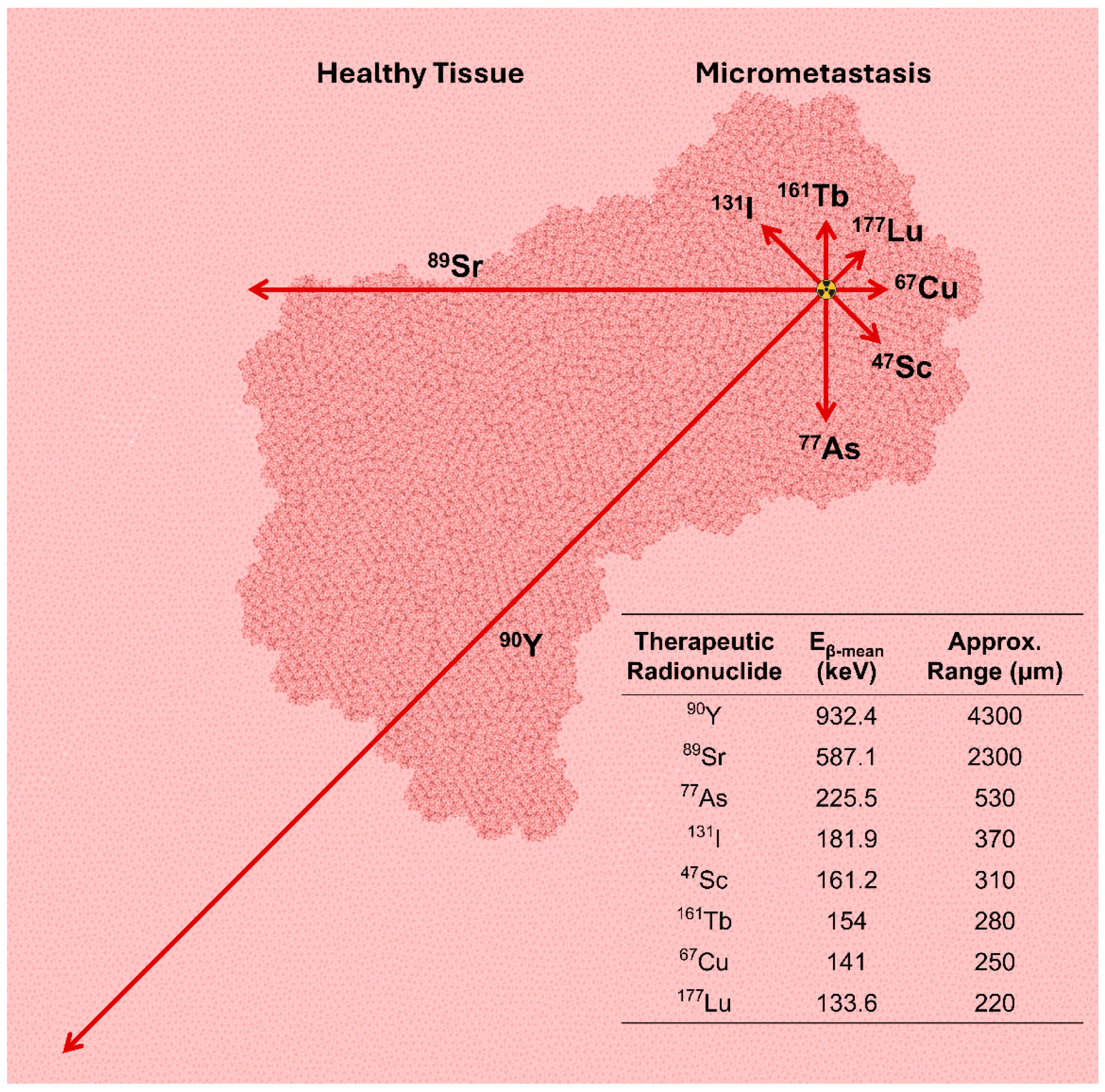
| 90Y | 64.05 h | β− = 932.4 keV (0.99985) | 4300 |
| 177Lu | 6.64 d | β− = 148.8 keV (0.7944) | 270 |
| 161Tb | 6.89 d | β− = 137.7 keV (0.257) | 240 |
| 157.4 keV (0.65) | 300 | ||
| AE = 5.16 keV (0.879) | 1.3 | ||
| CE = 16.6 keV (0.41) | 6.3 | ||
| 39.8 keV (0.424) | 30 |
Disclaimer/Publisher’s Note: The statements, opinions and data contained in all publications are solely those of the individual author(s) and contributor(s) and not of MDPI and/or the editor(s). MDPI and/or the editor(s) disclaim responsibility for any injury to people or property resulting from any ideas, methods, instructions or products referred to in the content. |
© 2026 by the authors. Licensee MDPI, Basel, Switzerland. This article is an open access article distributed under the terms and conditions of the Creative Commons Attribution (CC BY) license.
Share and Cite
Olson, A.P.; Engle, J.W.; Pandey, M.K. Radiation Biology of Radiopharmaceuticals: Beyond External Beam Radiation Therapy. Pharmaceuticals 2026, 19, 591. https://doi.org/10.3390/ph19040591
Olson AP, Engle JW, Pandey MK. Radiation Biology of Radiopharmaceuticals: Beyond External Beam Radiation Therapy. Pharmaceuticals. 2026; 19(4):591. https://doi.org/10.3390/ph19040591
Chicago/Turabian StyleOlson, Aeli P., Jonathan W. Engle, and Mukesh K. Pandey. 2026. "Radiation Biology of Radiopharmaceuticals: Beyond External Beam Radiation Therapy" Pharmaceuticals 19, no. 4: 591. https://doi.org/10.3390/ph19040591
APA StyleOlson, A. P., Engle, J. W., & Pandey, M. K. (2026). Radiation Biology of Radiopharmaceuticals: Beyond External Beam Radiation Therapy. Pharmaceuticals, 19(4), 591. https://doi.org/10.3390/ph19040591