Pharmacogenetic Associations with Statin Regimen Modification, Intolerance, and Adverse Outcomes in Coronary Artery Disease Patients
 , , and
Abstract
1. Introduction
2. Results
2.1. Baseline Clinical and Treatment Characteristics
2.2. Pharmacogenomic Profiles and Their Distribution Across Statin Regimen Change Groups
2.3. Clinical Outcomes and Muscle/Liver Biomarkers Across Statin Regimen Change Groups and Their Association with Pharmacogenomic Burden
2.4. PGx Burden and Composite Outcomes
2.5. Multivariable Predictors of Statin Intolerance
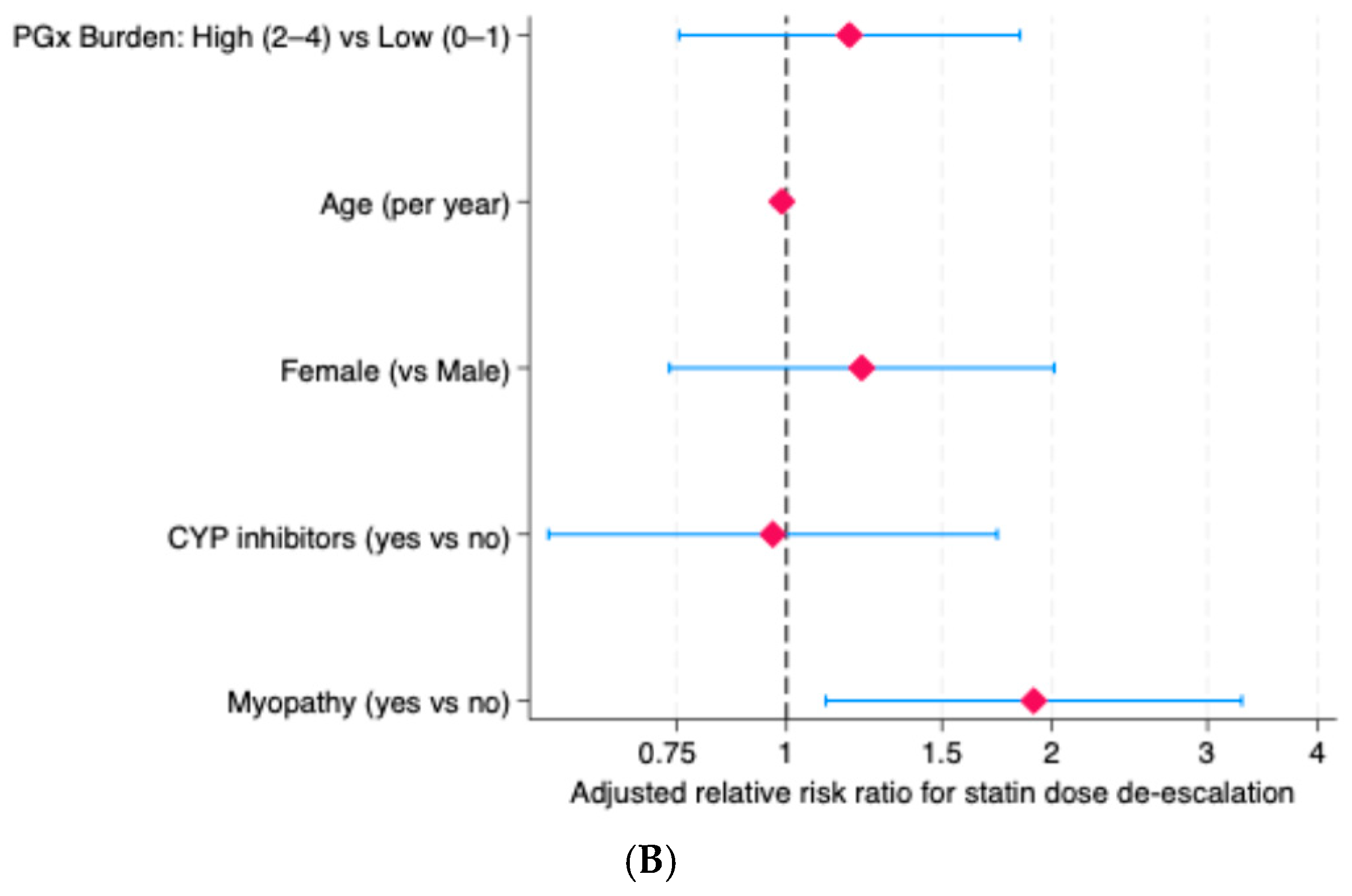
2.6. Predictors of Statin Dose Modification
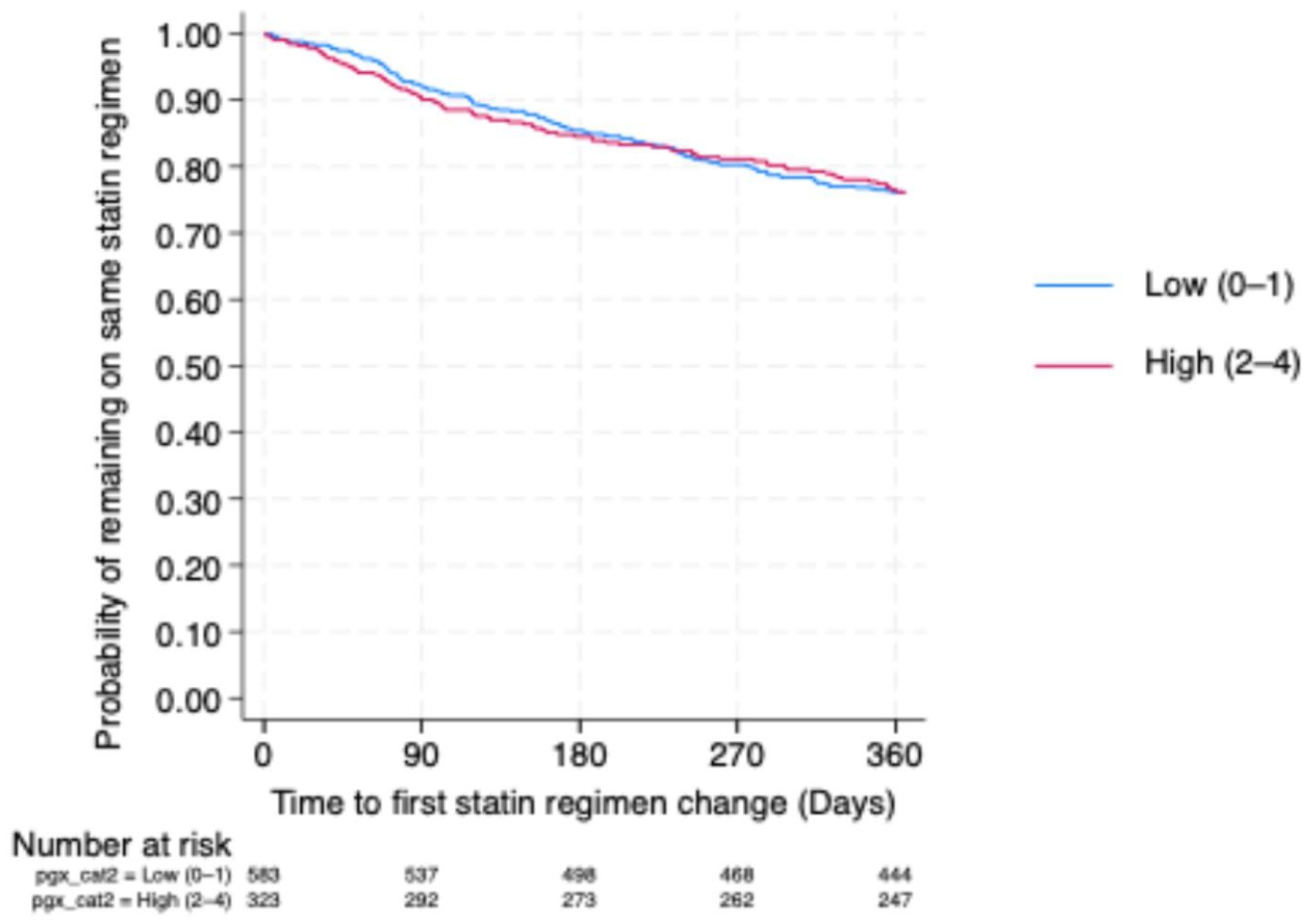
2.7. Association of Pharmacogenetic Burden with Time to Regimen Change
3. Discussion
4. Materials and Methods
4.1. Study Population and Data Sources
4.2. Statin User Identification
4.3. Clinical and Medication Data Collection
4.4. Assessment of Statin Exposure and Adherence
4.5. Definition of Statin Regimen Modification
4.6. Definition of Statin Intolerance Phenotypes
4.7. Definition of Myopathy and Composite Adverse Events
4.8. PGx Burden Score
4.9. Statistical Analysis
5. Conclusions
Author Contributions
Funding
Institutional Review Board Statement
Informed Consent Statement
Data Availability Statement
Conflicts of Interest
Abbreviations
| ACC | American College of Cardiology |
| AHA | American Heart Association |
| ALT | Alanine aminotransferase |
| AST | Aspartate aminotransferase |
| BCRP | Breast Cancer Resistance Protein |
| CAD | Coronary artery disease |
| CI | Confidence interval |
| CK | Creatine kinase |
| CPIC | Clinical Pharmacogenetics Implementation Consortium |
| EHR | Electronic health record |
| HDL | High-density lipoprotein |
| HMC | Hamad Medical Corporation |
| HR | Hazard ratio |
| HMG-CoA | 3-hydroxy-3-methylglutaryl-coenzyme A |
| LDL | Low-density lipoprotein |
| LDL-C | Low-density lipoprotein cholesterol |
| MAF | Minor allele frequency |
| MPR | Medication possession ratio |
| OR | Odds ratio |
| PGx | Pharmacogenetics |
| QCBio | Qatar Cardiovascular Biorepository |
| RRR | Relative risk ratio |
| SAMS | Statin-associated muscle symptoms |
References
- Tahaineh, L.; Alsou’b, N. Adherence to the 2018 American College of Cardiology and American Heart Association Guideline on the Management of Blood Cholesterol in ambulatory care settings: A cross-sectional study. Pharmacia 2024, 71, 1–7. [Google Scholar] [CrossRef]
- Grundy, S.M.; Stone, N.J.; Bailey, A.L.; Beam, C.; Birtcher, K.K.; Blumenthal, R.S.; Braun, L.T.; De Ferranti, S.; Faiella-Tommasino, J.; Forman, D.E. 2018 AHA/ACC/AACVPR/AAPA/ABC/ACPM/ADA/AGS/APhA/ASPC/NLA/PCNA guideline on the management of blood cholesterol: A report of the American College of Cardiology/American Heart Association Task Force on Clinical Practice Guidelines. J. Am. Coll. Cardiol. 2019, 73, e285–e350. [Google Scholar] [CrossRef]
- Stone, N.J.; Robinson, J.G.; Lichtenstein, A.H.; Bairey Merz, C.N.; Blum, C.B.; Eckel, R.H.; Goldberg, A.C.; Gordon, D.; Levy, D.; Lloyd-Jones, D.M.; et al. 2013 ACC/AHA guideline on the treatment of blood cholesterol to reduce atherosclerotic cardiovascular risk in adults: A report of the American College of Cardiology/American Heart Association Task Force on Practice Guidelines. J. Am. Coll. Cardiol. 2014, 63, 2889–2934. [Google Scholar] [CrossRef]
- Cholesterol Treatment Trialists Collaboration; Baigent, C.; Blackwell, L.; Emberson, J.; Holland, L.E.; Reith, C.; Bhala, N.; Peto, R.; Barnes, E.H.; Keech, A.; et al. Efficacy and safety of more intensive lowering of LDL cholesterol: A meta-analysis of data from 170,000 participants in 26 randomised trials. Lancet 2010, 376, 1670–1681. [Google Scholar] [CrossRef]
- Rodriguez, F.; Maron, D.J.; Knowles, J.W.; Virani, S.S.; Lin, S.; Heidenreich, P.A. Association of statin adherence with mortality in patients with atherosclerotic cardiovascular disease. JAMA Cardiol. 2019, 4, 206–213. [Google Scholar] [CrossRef]
- Toth, P.P.; Granowitz, C.; Hull, M.; Anderson, A.; Philip, S. Long-term statin persistence is poor among high-risk patients with dyslipidemia: A real-world administrative claims analysis. Lipids Health Dis. 2019, 18, 175. [Google Scholar] [CrossRef]
- Abed, W.; Abujbara, M.; Batieha, A.; Ajlouni, K. Statin Induced Myopathy Among Patients Attending the National Center for Diabetes, endocrinology, & genetics. Ann. Med. Surg. 2022, 74, 103304. [Google Scholar] [CrossRef] [PubMed]
- Neuvonen, P.J.; Niemi, M.; Backman, J.T. Drug interactions with lipid-lowering drugs: Mechanisms and clinical relevance. Clin. Pharmacol. Ther. 2006, 80, 565–581. [Google Scholar] [CrossRef]
- Niemi, M.; Pasanen, M.K.; Neuvonen, P.J. Organic anion transporting polypeptide 1B1: A genetically polymorphic transporter of major importance for hepatic drug uptake. Pharmacol. Rev. 2011, 63, 157–181. [Google Scholar] [CrossRef] [PubMed]
- Cooper-DeHoff, R.M.; Niemi, M.; Ramsey, L.B.; Luzum, J.A.; Tarkiainen, E.K.; Straka, R.J.; Gong, L.; Tuteja, S.; Wilke, R.A.; Wadelius, M. The clinical pharmacogenetics implementation consortium guideline for SLCO1B1, ABCG2, and CYP2C9 genotypes and statin-associated musculoskeletal symptoms. Clin. Pharmacol. Ther. 2022, 111, 1007–1021. [Google Scholar] [CrossRef] [PubMed]
- Niemi, M. Transporter pharmacogenetics and statin toxicity. Clin. Pharmacol. Ther. 2010, 87, 130–133. [Google Scholar] [CrossRef]
- The SEARCH Collaborative Group. SLCO1B1 variants and statin-induced myopathy—A genomewide study. N. Engl. J. Med. 2008, 359, 789–799. [Google Scholar] [CrossRef] [PubMed]
- Deng, J.W.; Song, I.S.; Shin, H.J.; Yeo, C.W.; Cho, D.Y.; Shon, J.H.; Shin, J.G. The effect of SLCO1B1*15 on the disposition of pravastatin and pitavastatin is substrate dependent: The contribution of transporting activity changes by SLCO1B1*15. Pharmacogenet Genom. 2008, 18, 424–433. [Google Scholar] [CrossRef] [PubMed]
- Shahrure, Z.M.; Irshaid, Y.M.; Mustafa, K.N.; Abujbara, M.A.; Al Shhab, M.; El-Khateeb, M.S.; Ajlouni, K.M. SLCO1B1 Gene Polymorphisms (rs2306283 and rs4149056) and Statin-Induced Myopathy in Jordanian Diabetics. Curr. Rev. Clin. Exp. Pharmacol. 2021, 16, 281–288. [Google Scholar] [CrossRef] [PubMed]
- Keskitalo, J.E.; Zolk, O.; Fromm, M.F.; Kurkinen, K.J.; Neuvonen, P.J.; Niemi, M. ABCG2 polymorphism markedly affects the pharmacokinetics of atorvastatin and rosuvastatin. Clin. Pharmacol. Ther. 2009, 86, 197–203. [Google Scholar] [CrossRef]
- Zhang, L.; Lv, H.; Zhang, Q.; Wang, D.; Kang, X.; Zhang, G.; Li, X. Association of SLCO1B1 and ABCB1 genetic variants with atorvastatin-induced myopathy in patients with acute ischemic stroke. Curr. Pharm. Des. 2019, 25, 1663–1670. [Google Scholar] [CrossRef]
- Mirosevic Skvrce, N.; Bozina, N.; Zibar, L.; Barisic, I.; Pejnovic, L.; Macolic Sarinic, V. CYP2C9 and ABCG2 polymorphisms as risk factors for developing adverse drug reactions in renal transplant patients taking fluvastatin: A case-control study. Pharmacogenomics 2013, 14, 1419–1431. [Google Scholar] [CrossRef]
- Ferri, N.; Corsini, A. Statin-associated muscle symptoms: Not simply a genetic predisposition. Atherosclerosis 2025, 400, 119047. [Google Scholar] [CrossRef]
- Bellosta, S.; Paoletti, R.; Corsini, A. Safety of statins: Focus on clinical pharmacokinetics and drug interactions. Circulation 2004, 109, III-50–III-57. [Google Scholar] [CrossRef]
- Turner, R.M.; Pirmohamed, M. Statin-Related Myotoxicity: A Comprehensive Review of Pharmacokinetic, Pharmacogenomic and Muscle Components. J. Clin. Med. 2019, 9, 22. [Google Scholar] [CrossRef]
- Hirota, T.; Ieiri, I. Interindividual variability in statin pharmacokinetics and effects of drug transporters. Expert Opin. Drug Metab. Toxicol. 2024, 20, 37–43. [Google Scholar] [CrossRef]
- Schachter, M. Chemical, pharmacokinetic and pharmacodynamic properties of statins: An update. Fundam. Clin. Pharmacol. 2005, 19, 117–125. [Google Scholar] [CrossRef] [PubMed]
- Romaine, S.P.; Bailey, K.M.; Hall, A.S.; Balmforth, A.J. The influence of SLCO1B1 (OATP1B1) gene polymorphisms on response to statin therapy. Pharmacogenomics J. 2010, 10, 1–11. [Google Scholar] [CrossRef]
- Abdel-Latif, R.; Badji, R.; Mohammed, S.; Al-Muftah, W.; Mbarek, H.; Darwish, D.; Assaf, D.; Al-Badriyeh, D.; Elewa, H.; Afifi, N.; et al. QPGx-CARES: Qatar pharmacogenetics clinical applications and research enhancement strategies. Clin. Transl. Sci. 2024, 17, e13800. [Google Scholar] [CrossRef]
- Svensson, E.; Nielsen, R.B.; Hasvold, P.; Aarskog, P.; Thomsen, R.W. Statin prescription patterns, adherence, and attainment of cholesterol treatment goals in routine clinical care: A Danish population-based study. Clin. Epidemiol. 2015, 7, 213–223. [Google Scholar] [CrossRef]
- Park, G.; Choi, E.Y.; Lee, S.H. Escalating Lipid Therapy After Achieving LDL-C <70 mg/dL With Moderate-Intensity Statins in High-Risk Patients. Korean Circ. J. 2025, 55, 426–436. [Google Scholar] [CrossRef]
- Thongtang, N.; Piyapromdee, J.; Tangkittikasem, N.; Samaithongcharoen, K.; Srikanchanawat, N.; Sriussadaporn, S. Efficacy and safety of switching from low-dose statin to high-intensity statin for primary prevention in type 2 diabetes: A randomized controlled trial. Diabetes Metab. Syndr. Obes. 2020, 13, 423–431. [Google Scholar] [CrossRef]
- Cai, T.; Abel, L.; Langford, O.; Monaghan, G.; Aronson, J.K.; Stevens, R.J.; Lay-Flurrie, S.; Koshiaris, C.; McManus, R.J.; Hobbs, F.D.R.; et al. Associations between statins and adverse events in primary prevention of cardiovascular disease: Systematic review with pairwise, network, and dose-response meta-analyses. BMJ 2021, 374, n1537. [Google Scholar] [CrossRef] [PubMed]
- Manocha, D.; Bansal, N.; Gumaste, P.; Brangman, S. Safety profile of high-dose statin therapy in geriatric patients with stroke. South. Med. J. 2013, 106, 658–664. [Google Scholar] [CrossRef]
- DeGorter, M.K.; Tirona, R.G.; Schwarz, U.I.; Choi, Y.-H.; Dresser, G.K.; Suskin, N.; Myers, K.; Zou, G.; Iwuchukwu, O.; Wei, W.-Q. Clinical and pharmacogenetic predictors of circulating atorvastatin and rosuvastatin concentrations in routine clinical care. Circ. Cardiovasc. Genet. 2013, 6, 400–408. [Google Scholar] [CrossRef] [PubMed]
- Kasela, S.; Luitva, L.B.; Krebs, K.; Estonian Biobank Research Team; Möls, M.; Milani, L.; Alver, M. Polygenic and pharmacogenomic contributions to medication dosing: A real-world longitudinal biobank study. J. Transl. Med. 2025, 23, 727. [Google Scholar] [CrossRef]
- Lee, H. SLCO1B1 Variant and Statin-Induced Myopathy: A Polygenic Risk Analysis in the UK Biobank. Doctoral Dissertation, Graduate School of Seoul National University, Seoul, Republic of Korea, 2025. [Google Scholar]
- Ahmed Feldman, M.; Billman, K.; Sennoun, M.; Ng, G.; Hussain, M.; Schlosser, E.G.; Hincapie, A.L.; Allen, J.D. Retrospective Evaluation of the Impact of SLCO1B1 Variation on Statin Effectiveness. J. Pers. Med. 2025, 15, 511. [Google Scholar] [CrossRef]
- Birmingham, B.K.; Bujac, S.R.; Elsby, R.; Azumaya, C.T.; Wei, C.; Chen, Y.; Mosqueda-Garcia, R.; Ambrose, H.J. Impact of ABCG2 and SLCO1B1 polymorphisms on pharmacokinetics of rosuvastatin, atorvastatin and simvastatin acid in Caucasian and Asian subjects: A class effect? Eur. J. Clin. Pharmacol. 2015, 71, 341–355. [Google Scholar] [CrossRef] [PubMed]
- Donnelly, L.; Doney, A.; Tavendale, R.; Lang, C.; Pearson, E.; Colhoun, H.; McCarthy, M.; Hattersley, A.; Morris, A.; Palmer, C. Common nonsynonymous substitutions in SLCO1B1 predispose to statin intolerance in routinely treated individuals with type 2 diabetes: A go-DARTS study. Clin. Pharmacol. Ther. 2011, 89, 210–216. [Google Scholar] [CrossRef]
- Wei, C.-Y.; Wen, M.-S.; Cheng, C.-K.; Sheen, Y.-J.; Yao, T.-C.; Lee, S.-L.; Wu, J.-Y.; Tsai, M.-F.; Li, L.-H.; Chen, C.-H. Clinical impact of pharmacogenetic risk variants in a large chinese cohort. Nat. Commun. 2025, 16, 6344. [Google Scholar] [CrossRef]
- El-Menyar, A.; Al Suwaidi, J.; Badii, R.; Mir, F.; Dalenberg, A.K.; Kullo, I.J. Discovering Novel Biochemical and Genetic Markers for Coronary Heart Disease in Qatari Individuals: The Initiative Qatar Cardiovascular Biorepository. Heart Views 2020, 21, 6–16. [Google Scholar] [CrossRef] [PubMed]
- Saad, M.; El-Menyar, A.; Kunji, K.; Ullah, E.; Al Suwaidi, J.; Kullo, I.J. Validation of Polygenic Risk Scores for Coronary Heart Disease in a Middle Eastern Cohort Using Whole Genome Sequencing. Circ. Genom. Precis. Med. 2022, 15, e003712. [Google Scholar] [CrossRef]
- Shah, K.K.; Touchette, D.R.; Marrs, J.C. Research and scholarly methods: Measuring medication adherence. J. Am. Coll. Clin. Pharm. 2023, 6, 416–426. [Google Scholar] [CrossRef]
- Sai, K.; Hanatani, T.; Azuma, Y.; Segawa, K.; Tohkin, M.; Omatsu, H.; Makimoto, H.; Hirai, M.; Saito, Y. Development of a detection algorithm for statin-induced myopathy using electronic medical records. J. Clin. Pharm. Ther. 2013, 38, 230–235. [Google Scholar] [CrossRef]
- Siddiqui, M.S.; Maroteau, C.; Veluchamy, A.; Tornio, A.; Tavendale, R.; Carr, F.; Abelega, N.U.; Carr, D.; Bloch, K.; Hallberg, P.; et al. A common missense variant of LILRB5 is associated with statin intolerance and myalgia. Eur. Heart J. 2017, 38, 3569–3575. [Google Scholar] [CrossRef]
- Pasternak, R.C.; Smith, S.C., Jr.; Bairey-Merz, C.N.; Grundy, S.M.; Cleeman, J.I.; Lenfant, C.; American College of Cardiology; Heart Association; National Heart, Lung, and Blood Institute. ACC/AHA/NHLBI Clinical Advisory on the Use and Safety of Statins. Stroke 2002, 33, 2337–2341. [Google Scholar] [CrossRef] [PubMed]
- Lonnberg, K.I.; Tornio, A.; Hirvensalo, P.; Keskitalo, J.; Mustaniemi, A.L.; Kiiski, J.I.; Filppula, A.M.; Niemi, M. Real-world pharmacogenetics of statin intolerance: Effects of SLCO1B1, ABCG2, and CYP2C9 variants. Pharmacogenet. Genom. 2023, 33, 153–160. [Google Scholar] [CrossRef] [PubMed]



| Gene | Variant (rsID) | Encoded Protein | Functional Consequence | Mechanistic Effect | Clinical Implication | CPIC Consideration |
|---|---|---|---|---|---|---|
| SLCO1B1 | c.521T>C (rs4149056) | OATP1B1 (hepatic uptake transporter) | Reduced OATP1B1 transporter function | Decreased hepatic uptake → Increased systemic statin exposure | Increased risk of statin-associated muscle symptoms (SAMS), especially with simvastatin | Avoid simvastatin; consider lower dose or alternative statin; CK monitoring if indicated |
| c.388A>G (rs2306283) | OATP1B1 | Altered transporter activity | Modifies SLCO1B1 function (substrate-dependent) | May influence plasma statin concentration | Incorporated into diplotype-based phenotype | |
| ABCG2 | c.421C>A (rs2231142) | BCRP (efflux transporter) | Reduced BCRP efflux function | Increased systemic exposure to atorvastatin and rosuvastatin | Potential increased myopathy risk (statin-specific) | Dose consideration for certain statins |
| CYP2C9 | *2 (rs1799853) | CYP2C9 enzyme | Reduced enzymatic activity | Decreased metabolic clearance (fluvastatin) | Modest increase in statin exposure | Dose consideration for certain statins |
| *3 (rs4986893) | CYP2C9 enzyme | Reduced enzymatic activity | Decreased metabolic clearance | Increased drug levels (substrate-dependent) | Dose consideration for certain statins |
| Variable | Overall | Escalation | De-Escalation | No Change | p-Value |
|---|---|---|---|---|---|
| N | 911 | 93 (10.21%) | 104 (11.42%) | 714 (78.38%) | |
| Demographics | |||||
| Age (years, mean ± SD) | 60.33 ± 10.71 | 61.71 ± 9.47 | 58.37 ± 10.32 | 60.43 ± 10.88 | 0.09 |
| Male (%) | 657 (72.12%) | 56 (60.22%) | 75 (72.12%) | 526 (73.67%) | 0.025 |
| Smoker | 222 (25.49%) | 22 (25.00%) | 29 (29.59%) | 171 (24.96%) | 0.613 |
| Comorbidity | |||||
| Diabetes | 715 (82.09%) | 79 (89.77%) | 81 (82.56%) | 555 (81.02) | 0.13 |
| Hypertension | 756 (86.80%) | 92 (93.18%) | 81 (82.65%) | 593 (86.57%) | 0.099 |
| Chronic kidney diseases | 268 (30.77%) | 26 (29.55%) | 34 (34.69%) | 208 (30.36%) | 0.663 |
| Heart Failure | 265 (30.42) | 27 (30.68%) | 36 (36.73%) | 202 (29.49%) | 0.345 |
| Asthma | 175 (20.09) | 26 (29.55%) | 24 (24.29%) | 125 (18.25%) | 0.023 |
| peripheral artery disease | 69 (7.92) | 9 (10.32) | 10 (10.20%) | 50 (7.30) | 0.426 |
| Hypothyroidism | 147 (16.88%) | 16 (18.18) | 22 (22.45) | 109 (15.91) | 0.255 |
| Stroke | 61 (7.0) | 6 (6.82) | 10 (1–0.20) | 45 (6.57%) | 0.418 |
| Baseline laboratory tests | |||||
| Total cholesterol (mmol/L) | 5(4.2–6) | 5.37 (4.4–6) | 5 (4.2–6.1) | 5 (4.1–5.96) | 0.219 |
| LDL (mmol/L) | 2.48 ± 0.99 | 2.59 ± 0.89 | 2.54 ± 1.09 | 2.45 ± 0.98 | 0.36 |
| HDL (mmol/L) | 1.03 (0.87–1.2) | 1.07 (0.91–1.23) | 0.97 (0.84–1.2) | 1.03 (0.88–1.2) | 0.09 |
| TGs (mmol/L) | 1.5 (1.1–2) | 1.6 (1.2–2.03) | 1.74 (1.3–2.3) | 1.47 (1.1–2)1.09 | 0.003 |
| Creatinine (µmol/L) | 80 (68–99.7) | 78.9 (62–97.3) | 78 (65.5–100)77.99 | 80.1 (68.6–99.7) | 0.43 |
| ALT (U/L) | 19 (13–26) | 18 (13–23) | 19 (13–26) | 19 (13–27) | 0.267 |
| AST (U/L) | 17 (14–22) | 17 (13–22) | 18(14–23) | 17(14–22) | 0.567 |
| Statin type | 0.244 | ||||
| Atorvastatin | 559 (61.36) | 48 (51.61) | 65.38 (65.38) | 443 (62.04) | |
| Rosuvastatin | 307 (33.70) | 40 (43.01%) | 32 (30.77) | 235 (32.91) | |
| Pravastatin | 22 (2.41) | 1 (1.08) | 1 (0.96) | 20 (2.80) | |
| Simvastatin | 20 (2.20) | 4 (4.30) | 2 (1.92) | 14 (1.96) | |
| Fluvastatin | 3 (0.33) | 0 (0) | 1 (0.96) | 2 (0.28) | |
| Statin Intensity | 0.001 | ||||
| Low | 15 (1.56) | 3 (3.23) | 0 (0) | 12 (1.68) | |
| Moderate | 406 (44.57) | 87 (93.55) | 18 (17.31) | 301 (42.16) | |
| High | 490 (53.79) | 3 (3.23) | 86 (82.69) | 401 (56.16) | |
| Interacting medications | |||||
| Any inhibitor % | 153 (16.79) | 17 (18.28) | 18 (17.31) | 118 (16.53) | 0.903 |
| Any inducer % | 3 (0.33) | 1 (1.08) | 1 (0.96) | 1 (0.14) | 0.163 |
| Genotype/PGx Marker | Genotype | Escalation | De-Escalation | No Change | p-Value |
|---|---|---|---|---|---|
| SLCO1B1 c.521T>C | TT | 69.89% | 60.58% | 64.29% | 0.692 |
| TC | 27.96% | 32.69% | 30.25% | ||
| CC | 1.08% | 5.77% | 4.48% | ||
| SLCO1B1 c.388A>G | AA | 23.66% | 27.88% | 26.61% | 0.139 |
| AG | 55.84% | 38.46% | 46.87% | ||
| GG | 18.28% | 32.69% | 25.07% | ||
| ABCG2 c.421G>T | GG | 89.25% | 86.54 | 87.82% | 0.631 |
| GT | 9.68% | 11.54 | 11.62% | ||
| TT | 1.08% | 0.96 | 0.42% | ||
| CYP2C9 *2/*3 carriers | 28.01% carriers | 43.01% carriers | 28.01% carriers | 0.006 |
| SLCO1B1 Diplotype | SCLO1B1 Phenotyping | Total | Escalation | De-Escalation | No Change | p-Value |
|---|---|---|---|---|---|---|
| *1/*1, *1/*37, *37/*37 | Normal Function | 578 (65.02) | 62 (69.66%) | 63 (61.76%) | 453 (64.90%) | 0.49 for all |
| *1/*5, *1/*15, *37/*5, *37/*15 | Decrease function | 272 (30.60) | 26 (29.21%) | 33 (32.35%) | 213 (30.60%) | |
| *5/*5, *5/*15, *15/*15 | Poor function | 39 (4.39) | 1 (1.12) | 6 (5.88) | 32 (4.58) |
| Outcome/Biomarkers | Escalation | De-Escalation | No Change | p (Group Comparison) | p (Group Comparison) | PGx Burden Association (p-Value) |
|---|---|---|---|---|---|---|
| Outcomes | ||||||
| Myopathy (%) | 14 (15.05%) | 24 (23.08%) | 94 (13.17%) | 0.027 | 0.027 | Low (0–1): 0.057 High (2–4): 0.234 |
| Liver injury (%) | 7 (7.53%) | 4 (3.85%) | 12 (1.68%) | 0.002 | 0.002 | Low (0–1): 0.026 High (2–4): 0.059 |
| Non-adherence < 80% (%) | 14 (15.05%) | 17 (16.35%) | 238 (33.33%) | <0.001 | <0.001 | Low (0–1): 0.001 High (2–4): 0.113 |
| Biomarkers | ||||||
| CK (U/L) (Median, Q1–Q3) | 679.50 (342.75–1454.75) | 320.50 (231.75–440.25) | 295.00 (247.00–491.50) | 0.074 | Low (0–1): 0.105; High (2–4): 0.641 | Low (0–1): 0.105; High (2–4): 0.641 |
| Myoglobin (ng/mL) (Median, Q1–Q3) | 261.00 (142.00–2521.00) | 1964.00 (109.00–3819.00) | 204.00 (149.00–423.50) | 0.913 | Low (0–1): 0.781; High (2–4): 1.000 | Low (0–1): 0.781; High (2–4): 1.000 |
| Troponin (ng/mL) (Median, Q1–Q3) | 463.30 (179.80–2469.25) | 303.50 (76.40–885.00) | 301.20 (90.60–1032.00) | 0.405 | Low (0–1): 0.876; High (2–4): 0.168 | Low (0–1): 0.876; High (2–4): 0.168 |
| TSH (mIU/L) (Median, Q1–Q3) | 1.98 (1.23–2.94) | 1.96 (1.17–2.77) | 1.97 (1.25–2.93) | 0.910 | Low (0–1): 0.465; High (2–4): 0.093 | Low (0–1): 0.465; High (2–4): 0.093 |
| Vitamin D (ng/mL) (Median, Q1–Q3) | 19.00 (15.00–27.50) | 21.00 (15.00–27.00) | 19.00 (14.00–26.00) | 0.560 | Low (0–1): 0.895; High (2–4): 0.259 | Low (0–1): 0.895; High (2–4): 0.259 |
| Creatinine (µmol/L) (Median, Q1–Q3) | 87.00 (69.25–109.75) | 91.00 (72.00–118.00) | 88.00 (73.00–114.00) | 0.598 | Low (0–1): 0.794; High (2–4): 0.646 | Low (0–1): 0.794; High (2–4): 0.646 |
| PGx Burden Category | Composite Outcome: No (%) | Composite Outcome: Yes (%) | OR | 95% CI | p-Value |
|---|---|---|---|---|---|
| Low (0–1) (ref) | 348 (59.28%) | 239 (40.72%) | 1.0 | Reference | |
| High (2–4) | 187 (57.41%) | 138 (42.59%) | 1.08 | 0.82–1.42 | 0.582 |
| Statin | Low Intensity Dosage (mg) | Moderate Intensity Dosage (mg) | High Intensity Dosage (mg) |
|---|---|---|---|
| Atorvastatin | - | 10–20 | 40–80 |
| Rosuvastatin | - | 5–10 | 20–40 |
| Simvastatin | 10 | 20–40 | - |
| Pravastatin | 10–20 | 40–80 | - |
| Fluvastatin | 20–40 | 80 | - |
| Gene | Variant (rsID) | Functional Effect | Genetic Model | Coding Scheme | Maximum Score |
|---|---|---|---|---|---|
| SLCO1B1 | Diplotype-based phenotype (rs4149056 c.521T>C + rs2306283 and c.388A>G) + | Reduced transporter activity | Phenotype-based | 0 = Normal function (*1/*1, *1/*37, *37/*37) 2 = Decreased or Poor function (*1/*5, *1/*15, *37/*5, *37/*15, *5/*5, *5/*15, *15/*15) | 2 |
| ABCG2 | c.421G>T (rs2231142) | Reduced efflux capacity (BCRP) | Dominant | 1 = GT/TT, 0 = GG | 1 |
| CYP2C9 | *2 or *3 | Reduced enzymatic activity | Dominant | 1 = any *2/*3, 0 = *1/*1 | 1 |
| Total PGx Burden Score | — | Cumulative functional impairment in statin disposition | — | Sum of all components | 0–4 |
Disclaimer/Publisher’s Note: The statements, opinions and data contained in all publications are solely those of the individual author(s) and contributor(s) and not of MDPI and/or the editor(s). MDPI and/or the editor(s) disclaim responsibility for any injury to people or property resulting from any ideas, methods, instructions or products referred to in the content. |
© 2026 by the authors. Licensee MDPI, Basel, Switzerland. This article is an open access article distributed under the terms and conditions of the Creative Commons Attribution (CC BY) license.
Share and Cite
Abdel-latif, R.; Mohammed, S.; Saad, M.; Kunji, K.; Al-Muftah, W.; El-Menyar, A.; Al Suwaidi, J. Pharmacogenetic Associations with Statin Regimen Modification, Intolerance, and Adverse Outcomes in Coronary Artery Disease Patients. Pharmaceuticals 2026, 19, 514. https://doi.org/10.3390/ph19030514
Abdel-latif R, Mohammed S, Saad M, Kunji K, Al-Muftah W, El-Menyar A, Al Suwaidi J. Pharmacogenetic Associations with Statin Regimen Modification, Intolerance, and Adverse Outcomes in Coronary Artery Disease Patients. Pharmaceuticals. 2026; 19(3):514. https://doi.org/10.3390/ph19030514
Chicago/Turabian StyleAbdel-latif, Rania, Shaban Mohammed, Mohamad Saad, Khalid Kunji, Wadha Al-Muftah, Ayman El-Menyar, and Jassim Al Suwaidi. 2026. "Pharmacogenetic Associations with Statin Regimen Modification, Intolerance, and Adverse Outcomes in Coronary Artery Disease Patients" Pharmaceuticals 19, no. 3: 514. https://doi.org/10.3390/ph19030514
APA StyleAbdel-latif, R., Mohammed, S., Saad, M., Kunji, K., Al-Muftah, W., El-Menyar, A., & Al Suwaidi, J. (2026). Pharmacogenetic Associations with Statin Regimen Modification, Intolerance, and Adverse Outcomes in Coronary Artery Disease Patients. Pharmaceuticals, 19(3), 514. https://doi.org/10.3390/ph19030514