Rational Design, Synthesis, and Systematic Evaluation of Redox-Responsive SN-38 Prodrugs for Selective Activation in Hypoxic Tumor Microenvironments

 , , and
Abstract
1. Introduction
2. Results
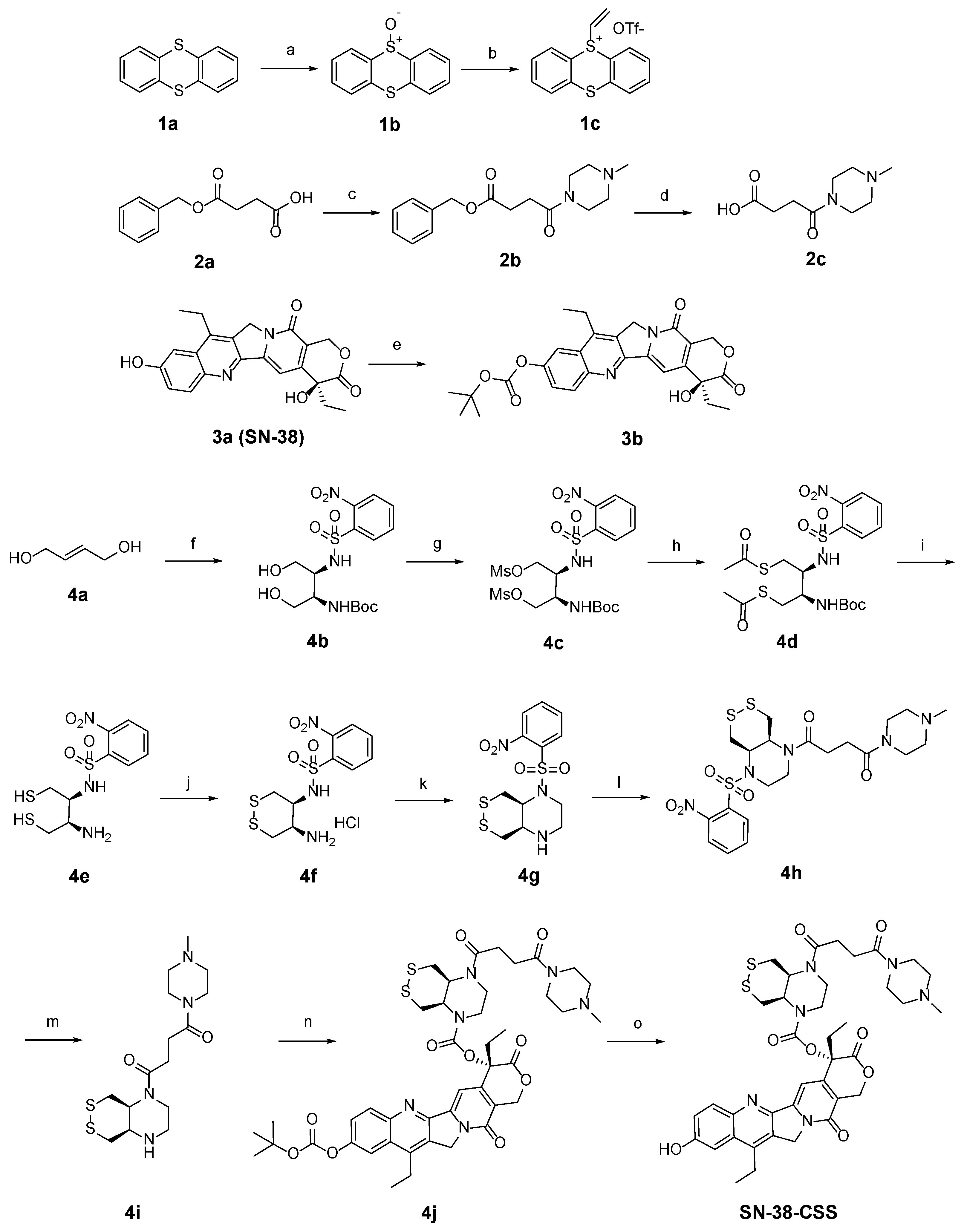
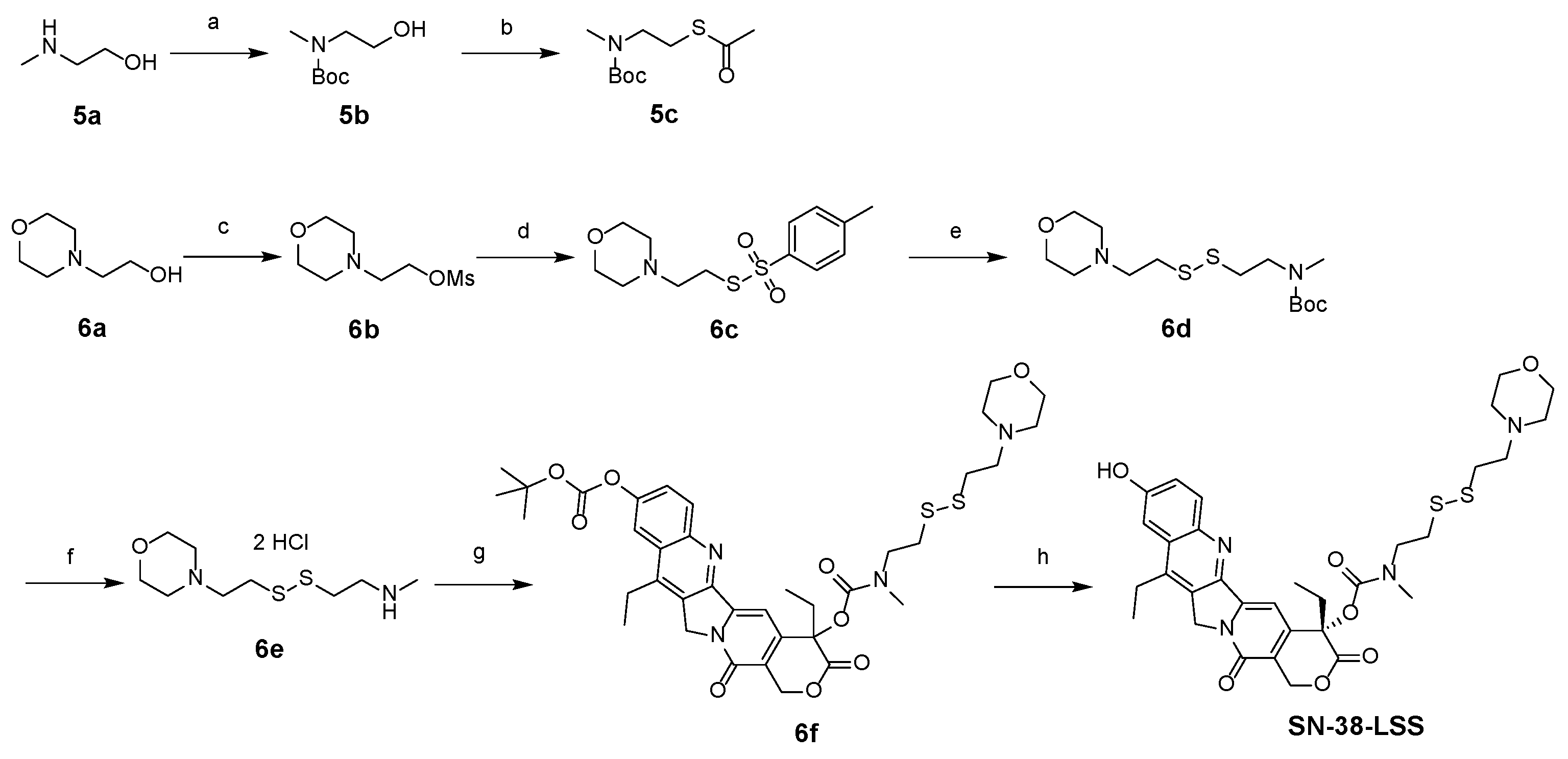
2.1. Design and Chemical Synthesis of SN-38-CSS and SN-38-LSS Prodrugs
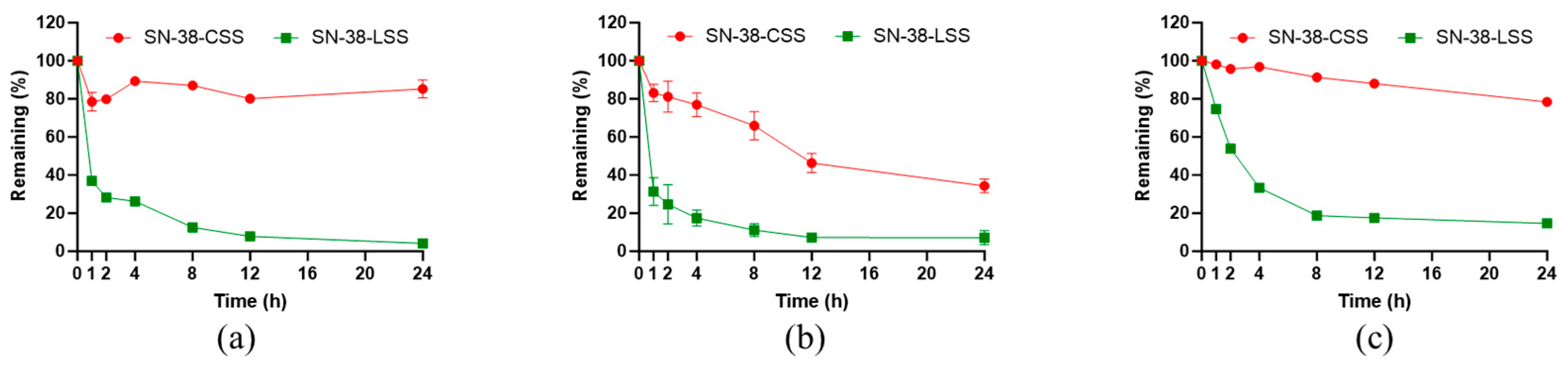
2.2. Stability Under Physiological pH Conditions
2.3. Plasma Stability Across Species
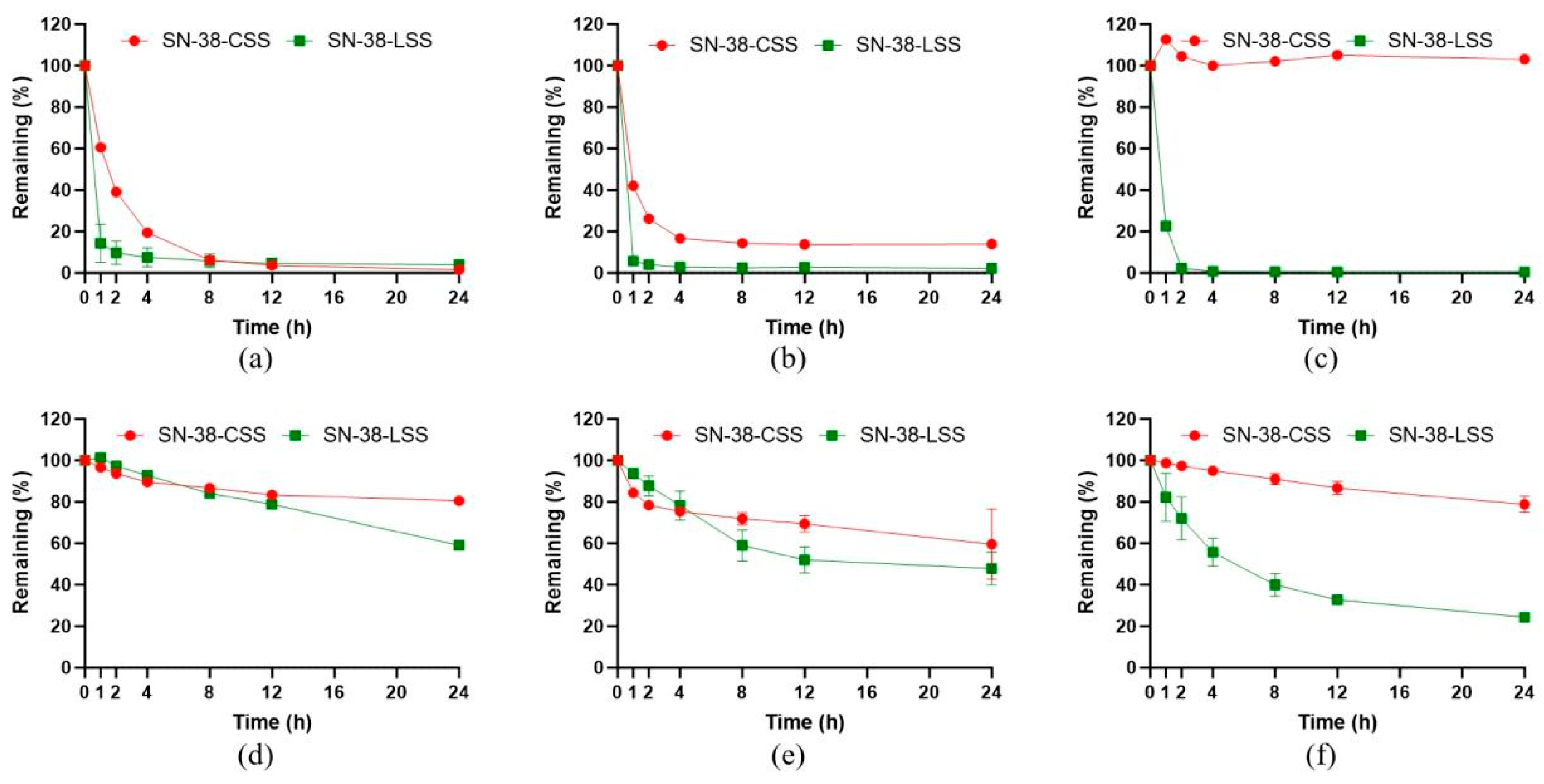
2.4. Redox-Responsive Drug Release Profiling
2.5. Cytotoxicity Under Normoxic Conditions (20% O2)
2.6. Cytotoxicity Under Hypoxic Conditions (5% O2)
3. Discussion
4. Materials and Methods
4.1. Chemical Synthesis and Characterization
4.1.1. Synthesis of Compound Thianthrene 5-Oxide (1b)
4.1.2. Synthesis of Compound 5-Vinyl-5H-thianthren-5-ium Tetrafluoroborate (1c)
4.1.3. Synthesis of Compound Benzyl 4-(4-Methylpiperazin-1-yl)-4-oxobutanoate (2b)
4.1.4. Synthesis of Compound 4-(4-Methylpiperazin-1-yl)-4-oxobutanoic Acid (2c)
4.1.5. Synthesis of Compound (S)-Tert-butyl (4,11-Diethyl-4-hydroxy-3,14-dioxo-3,4,12,14-tetrahydro-1H-pyrano[3′,4′:6,7]indolizino[1,2-b]quinolin-9-yl) Carbonate (3b)
4.1.6. Synthesis of Compound Tert-butyl ((2R,3S)-1,4-Dihydroxy-3-((2-nitrophenyl)sulfonamido)butan-2-yl)carbamate (4b)
4.1.7. Synthesis of Compound (2R,3S)-2-((Tert-butoxycarbonyl)amino)-3-((2-nitrophenyl)sulfonamido)butane-1,4-diyl Dimethanesulfonate (4c)
4.1.8. Synthesis of Compound S,S′-((2R,3S)-2-((Tert-butoxycarbonyl)amino)-3-((2-nitrophenyl)sulfonamido)butane-1,4-diyl) Diethanethioate (4d)
4.1.9. Synthesis of Compound N-((4S,5R)-5-Amino-1,2-dithian-4-yl)-2-nitrobenzenesulfonamide Hydrochloride (4f)
4.1.10. Synthesis of Compound (4aR,8aS)-1-((2-Nitrophenyl)sulfonyl)octahydro-[1,2]dithiino[4,5-b]pyrazine (4g)
4.1.11. Synthesis of Compound 1-(4-Methylpiperazin-1-yl)-4-((4aR,8aS)-4-((2-nitrophenyl)sulfonyl)hexahydro-[1,2]dithiino[4,5-b]pyrazin-1(2H)-yl)butane-1,4-dione (4h)
4.1.12. Synthesis of Compound 1-((4aR,8aS)-Hexahydro-[1,2]dithiino[4,5-b]pyrazin-1(2H)-yl)-4-(4-methylpiperazin-1-yl)butane-1,4-dione (4i)
4.1.13. Synthesis of Compound (S)-9-((Tert-butoxycarbonyl)oxy)-4,11-diethyl-3,14-dioxo-3,4,12,14-tetrahydro-1H-pyrano[3′,4′:6,7]indolizino[1,2-b]quinolin-4-yl (4aS,8aR)-4-(4-(4-Methylpiperazin-1-yl)-4-oxobutanoyl)hexahydro-[1,2]dithiino[4,5-b]pyrazine-1(2H)-carboxylate (4j)
4.1.14. Synthesis of Compound (S)-4,11-Diethyl-9-hydroxy-3,14-dioxo-3,4,12,14-tetrahydro-1H-pyrano[3′,4′:6,7]indolizino[1,2-b]quinolin-4-yl (4aS,8aR)-4-(4-(4-Methylpiperazin-1-yl)-4-oxobutanoyl)hexahydro-[1,2]dithiino[4,5-b]pyrazine-1(2H)-carboxylate (SN-38-CSS)
4.1.15. Synthesis of Compound Tert-butyl (2-Hydroxyethyl)(methyl)carbamate (5b)
4.1.16. Synthesis of Compound S-(2-((Tert-butoxycarbonyl)(methyl)amino)ethyl) Ethanethioate (5c)
4.1.17. Synthesis of Compound 2-Morpholinoethyl Methanesulfonate (6b)
4.1.18. Synthesis of Compound S-(2-Morpholinoethyl) 4-Methylbenzenesulfonothioate (6c)
4.1.19. Synthesis of Compound Tert-butyl Methyl(2-((2-morpholinoethyl)disulfanyl)ethyl)carbamate (6d)
4.1.20. Synthesis of Compound N-Methyl-2-((2-morpholinoethyl)disulfanyl)ethan-1-amine Dihydrochloride (6e)
4.1.21. Synthesis of Compound 9-((Tert-butoxycarbonyl)oxy)-4,11-diethyl-3,14-dioxo-3,4,12,14-tetrahydro-1H-pyrano[3′,4′:6,7]indolizino[1,2-b]quinolin-4-yl Methyl(2-((2-morpholinoethyl)disulfanyl)ethyl)carbamate (6f)
4.1.22. Synthesis of Compound (S)-4,11-Diethyl-9-hydroxy-3,14-dioxo-3,4,12,14-tetrahydro-1H-pyrano[3′,4′:6,7]indolizino[1,2-b]quinolin-4-yl Methyl(2-((2-morpholinoethyl)disulfanyl)ethyl)carbamate (SN-38-LSS)
4.2. Stability Studies in PBS Buffers at Different pH Values
4.3. Plasma Stability Across Species
4.4. Redox-Responsive Degradation Kinetics in Defined Thiol Environments
4.5. In Vitro Cytotoxicity Assay
4.6. Statistical Analysis
5. Conclusions
Supplementary Materials
Author Contributions
Funding
Institutional Review Board Statement
Informed Consent Statement
Data Availability Statement
Conflicts of Interest
Abbreviations
| ADC | antibody–drug conjugate |
| AcOH | acetic acid |
| Boc2O | di-tert-butyl dicarbonate |
| CCK-8 | cell counting kit-8 |
| CH3CN | acetonitrile |
| CH3OH/MeOH | methanol |
| CH3ONa | sodium methoxide |
| DCM | dichloromethane |
| DIAD | diisopropyl azodicarboxylate |
| DMAP | 4-dimethylaminopyridine |
| DMF | n,n-dimethylformamide |
| DMSO | dimethyl sulfoxide |
| DIPEA | n,n-diisopropylethylamine |
| DTT | dithiothreitol |
| EDCI | 1-ethyl-3-(3-dimethylaminopropyl)carbodiimide |
| GSH | glutathione |
| GSSG | glutathione disulfide |
| HATU | 1-[bis(dimethylamino)methylene]-1h-1,2,3-triazolo[4,5-b]pyridinium 3-oxide hexafluorophosphate |
| HPLC | high-performance liquid chromatography |
| HCl | hydrochloric acid |
| HRMS | high-resolution mass spectrometry |
| HOBT | 1-hydroxybenzotriazole |
| HSAc | thioacetic acid |
| IC50 | half-maximal inhibitory concentration |
| IR | Infrared |
| K2CO3 | potassium carbonate |
| KSAc | potassium thioacetate |
| KSTs | potassium p-toluenethiosulfonate |
| L-Cys | l-cysteine |
| MsCl | methanesulfonyl chloride |
| NADPH | nicotinamide adenine dinucleotide phosphate |
| NEt3 | triethylamine |
| NaClO | sodium hypochlorite |
| Pd/C | palladium on carbon |
| PPh3 | triphenylphosphine |
| Py | pyridine |
| ROS | reactive oxygen species |
| SEM | standard error of the mean |
| SN-38 | 7-ethyl-10-hydroxycamptothecin |
| TCEP | tris(2-carboxyethyl)phosphine |
| TFAA | trifluoroacetic anhydride |
| TfOH | trifluoromethanesulfonic acid |
| TFA | trifluoroacetic acid |
| THF | tetrahydrofuran |
| t1/2 | half-life |
| Trx | thioredoxin |
| TrxR | thioredoxin reductase |
| TME | tumor microenvironment |
| rt | room temperature |
| m.p. | melting point |
| 1H NMR | proton nuclear magnetic resonance spectroscopy |
| 13C NMR | carbon-13 nuclear magnetic resonance spectroscopy |
References
- Lin, K.; Gueble, S.E.; Sundaram, R.K.; Huseman, E.D.; Bindra, R.S.; Herzon, S.B. Mechanism-based design of agents that selectively target drug-resistant glioma. Science 2022, 377, 502–511. [Google Scholar] [CrossRef]
- Shui, L.; Wu, D.; Yang, K.; Sun, C.; Li, Q.; Yin, R. Bispecific antibodies: Unleashing a new era in oncology treatment. Mol. Cancer 2025, 24, 212. [Google Scholar] [CrossRef]
- Wang, X.; Zhuang, Y.; Wang, Y.; Jiang, M.; Yao, L. The recent developments of camptothecin and its derivatives as potential anti-tumor agents. Eur. J. Med. Chem. 2023, 260, 115710. [Google Scholar] [CrossRef]
- Hong, M.; Wang, J.; Chen, H.; Qi, J.; Ji, Q.; Liu, X.; Yue, Q.; Li, L.; Cheng, S. Synthesis and biological evaluation of folic acid-rotenol conjugate as a potent targeted anticancer prodrug. Eur. J. Pharmacol. 2024, 970, 176482. [Google Scholar] [CrossRef]
- Li, N.; Li, C.; Zhang, J.; Jiang, Q.; Wang, Z.; Nie, S.; Gao, Z.; Li, G.; Fang, H.; Ren, S.; et al. Discovery of semisynthetic celastrol derivatives exhibiting potent anti-ovarian cancer stem cell activity and STAT3 inhibition. Chem.-Biol. Interact. 2022, 366, 110172. [Google Scholar] [CrossRef] [PubMed]
- Shi, W.; Li, W.; Zhang, J.; Li, T.; Song, Y.; Zeng, Y.; Dong, Q.; Lin, Z.; Gong, L.; Fan, S.; et al. One-step synthesis of site-specific antibody–drug conjugates by reprograming IgG glycoengineering with LacNAc-based substrates. Acta Pharm. Sin. B 2022, 12, 2417–2428. [Google Scholar] [CrossRef] [PubMed]
- Lu, X.; Zhan, X.; Xia, G.; Wang, F.; Lv, M.; Liu, R.; Liu, Y.; Zi, C.; Li, G.; Wang, R.; et al. Improving Targeted Delivery and Antitumor Efficacy of TRAIL through Fusion with a B7H3-Antagonistic Affibody. Mol. Pharm. 2025, 22, 284–294. [Google Scholar] [CrossRef] [PubMed]
- Ulukan, H.; Swaan, P.W. Camptothecins: A review of their chemotherapeutic potential. Drugs 2002, 62, 2039–2057. [Google Scholar] [CrossRef]
- Garcia-Carbonero, R.; Supko, J.G. Current Perspectives on the Clinical Experience, Pharmacology, and Continued Development of the Camptothecins. Clin. Cancer Res. 2002, 8, 641–661. [Google Scholar]
- Gao, Y.; Li, W.; Chen, J.; Wang, X.; Lv, Y.; Huang, Y.; Zhang, Z.; Xu, F. Pharmacometabolomic prediction of individual differences of gastrointestinal toxicity complicating myelosuppression in rats induced by irinotecan. Acta. Pharm. Sin. B 2019, 9, 157–166. [Google Scholar] [CrossRef]
- Chen, J.; Zhou, L.; Wang, C.; Sun, Y.; Lu, Y.; Li, R.; Hu, X.; Chen, M.; Chen, L.; Chai, K.; et al. A multifunctional SN38-conjugated nanosystem for defeating myelosuppression and diarrhea induced by irinotecan in esophageal cancer. Nanoscale 2020, 12, 21234–21247. [Google Scholar] [CrossRef]
- Xu, Y.; Villalona-Calero, M.A. Irinotecan: Mechanisms of tumor resistance and novel strategies for modulating its activity. Ann. Oncol. 2002, 13, 1841–1851. [Google Scholar] [CrossRef] [PubMed]
- Rautio, J.; Kumpulainen, H.; Heimbach, T.; Oliyai, R.; Oh, D.; Järvinen, T.; Savolainen, J. Prodrugs: Design and clinical applications. Nat. Rev. Drug. Discov. 2008, 7, 255–270. [Google Scholar] [CrossRef]
- Tsuchikama, K.; Anami, Y.; Ha, S.Y.Y.; Yamazaki, C.M. Exploring the next generation of antibody–drug conjugates. Nat. Rev. Clin. Oncol. 2024, 21, 203–223. [Google Scholar] [CrossRef]
- Yang, Y.; Guo, Q.; Chen, X.; Zhang, J.; Guo, H.; Qian, W.; Hou, S.; Dai, J.; Li, B.; Guo, Y.; et al. Preclinical studies of a Pro-antibody-drug conjugate designed to selectively target EGFR-overexpressing tumors with improved therapeutic efficacy. mAbs 2016, 8, 405–413. [Google Scholar] [CrossRef]
- Yang, Y.; Guo, Q.; Xia, M.; Li, Y.; Peng, X.; Liu, T.; Tong, X.; Xu, J.; Guo, H.; Qian, W.; et al. Generation and characterization of a target-selectively activated antibody against epidermal growth factor receptor with enhanced anti-tumor potency. mAbs 2015, 7, 440–450. [Google Scholar] [CrossRef]
- Hanahan, D. Hallmarks of Cancer: New Dimensions. Cancer Discov. 2022, 12, 31–46. [Google Scholar] [CrossRef] [PubMed]
- Hanahan, D.; Weinberg, R.A. Hallmarks of Cancer: The Next Generation. Cell 2011, 144, 646–674. [Google Scholar] [CrossRef]
- Hayes, J.D.; Dinkova-Kostova, A.T.; Tew, K.D. Oxidative Stress in Cancer. Cancer Cell 2020, 38, 167–197. [Google Scholar] [CrossRef]
- Xing, J.; Lu, W.; Zhang, Y.; Yang, C.; Yang, J.; Shi, J.; Wang, Y. Design of prodrugs with reactive oxygen species as activators and their application in tumor therapy. Theranostics 2026, 16, 1295–1327. [Google Scholar] [CrossRef] [PubMed]
- Holmgren, A.; Lu, J. Thioredoxin and thioredoxin reductase: Current research with special reference to human disease. Biochem. Biophys. Res. Commun. 2010, 396, 120–124. [Google Scholar] [CrossRef]
- Xu, Q.; Zhang, J. Novel strategies for targeting the thioredoxin system for cancer therapy. Expert Opin. Drug Discov. 2022, 17, 437–442. [Google Scholar] [CrossRef] [PubMed]
- Xu, J.; Fang, J. How can we improve the design of small molecules to target thioredoxin reductase for treating cancer? Expert Opin. Drug Discov. 2021, 16, 331–333. [Google Scholar]
- Bian, M.; Fan, R.; Zhao, S.; Liu, W. Targeting the Thioredoxin System as a Strategy for Cancer Therapy. J. Med. Chem. 2019, 62, 7309–7321. [Google Scholar] [CrossRef] [PubMed]
- Zhang, L.; Duan, D.; Liu, Y.; Ge, C.; Cui, X.; Sun, J.; Fang, J. Highly selective off-on fluorescent probe for imaging thioredoxin reductase in living cells. J. Am. Chem. Soc. 2014, 136, 226–233. [Google Scholar] [CrossRef]
- Ma, H.; Zhang, J.; Zhang, Z.; Liu, Y.; Fang, J. A fast response and red emission probe for mammalian thioredoxin reductase. Chem. Commun. 2016, 52, 12060–12063. [Google Scholar] [CrossRef]
- Li, X.; Zhang, B.; Yan, C.; Li, J.; Wang, S.; Wei, X.; Jiang, X.; Zhou, P.; Fang, J. A fast and specific fluorescent probe for thioredoxin reductase that works via disulphide bond cleavage. Nat. Commun. 2019, 10, 2745. [Google Scholar] [CrossRef]
- Li, X.; Hou, Y.; Meng, X.; Ge, C.; Ma, H.; Li, J.; Fang, J. Selective Activation of a Prodrug by Thioredoxin Reductase Providing a Strategy to Target Cancer Cells. Angew. Chem. Int. Ed. 2018, 57, 6141–6145. [Google Scholar] [CrossRef]
- Wang, Q.; Guan, J.; Wan, J.; Li, Z. Disulfide based prodrugs for cancer therapy. RSC Adv. 2020, 10, 24397–24409. [Google Scholar] [CrossRef]
- Felber, J.G.; Zeisel, L.; Poczka, L.; Scholzen, K.; Busker, S.; Maier, M.S.; Theisen, U.; Brandstadter, C.; Becker, K.; Arner, E.S.J.; et al. Selective, Modular Probes for Thioredoxins Enabled by Rational Tuning of a Unique Disulfide Structure Motif. J. Am. Chem. Soc. 2021, 143, 8791–8803. [Google Scholar] [CrossRef]
- Felber, J.G.; Poczka, L.; Scholzen, K.C.; Zeisel, L.; Maier, M.S.; Busker, S.; Theisen, U.; Brandstadter, C.; Becker, K.; Arner, E.S.J.; et al. Cyclic 5-membered disulfides are not selective substrates of thioredoxin reductase, but are opened nonspecifically. Nat. Commun. 2022, 13, 1754. [Google Scholar] [CrossRef]
- Zeisel, L.; Felber, J.G.; Scholzen, K.C.; Schmitt, C.; Wiegand, A.J.; Komissarov, L.; Arnér, E.S.J.; Thorn-Seshold, O. Piperazine-Fused Cyclic Disulfides Unlock High-Performance Bioreductive Probes of Thioredoxins and Bifunctional Reagents for Thiol Redox Biology. J. Am. Chem. Soc. 2024, 146, 5204–5214. [Google Scholar] [CrossRef]
- Felber, J.G.; Kitowski, A.; Zeisel, L.; Maier, M.S.; Heise, C.; Thorn-Seshold, J.; Thorn-Seshold, O. Cyclic Dichalcogenides Extend the Reach of Bioreductive Prodrugs to Harness Thiol/Disulfide Oxidoreductases: Applications to seco-Duocarmycins Targeting the Thioredoxin System. ACS Cent. Sci. 2023, 9, 763–776. [Google Scholar] [CrossRef]
- Zeisel, L.; Felber, J.G.; Scholzen, K.C.; Poczka, L.; Cheff, D.; Maier, M.S.; Cheng, Q.; Shen, M.; Hall, M.D.; Arnér, E.S.J.; et al. Selective cellular probes for mammalian thioredoxin reductase TrxR1: Rational design of RX1, a modular 1,2-thiaselenane redox probe. Chem 2022, 8, 1493–1517. [Google Scholar] [CrossRef] [PubMed]
- Guo, G.; Ma, J.; Dong, Y.; Wu, Q.; Lv, J.; Shi, Y.; Yang, D. Visible Light/Copper Catalysis-Enabled Arylation and Alkenylation of Phosphorothioates via Site-Selective C–H Thianthrenation. Org. Lett. 2024, 26, 8382–8388. [Google Scholar] [CrossRef] [PubMed]
- Chen, Y.; Liu, F.; Pal, S.; Hu, Q. Proteolysis-targeting drug delivery system (ProDDS): Integrating targeted protein degradation concepts into formulation design. Chem. Soc. Rev. 2024, 53, 9582–9608. [Google Scholar] [CrossRef]
- Manzari, M.T.; Shamay, Y.; Kiguchi, H.; Rosen, N.; Scaltriti, M.; Heller, D.A. Targeted drug delivery strategies for precision medicines. Nat. Rev. Mater. 2021, 6, 351–370. [Google Scholar] [CrossRef] [PubMed]
- Liu, B.; Guo, H.; Zhang, J.; Xue, J.; Yang, Y.; Qin, T.; Xu, J.; Guo, Q.; Zhang, D.; Qian, W.; et al. In-Depth Characterization of a Pro-Antibody–Drug Conjugate by LC–MS. Mol. Pharm. 2016, 13, 2702–2710. [Google Scholar] [CrossRef]
- Fralish, Z.; Chen, A.; Khan, S.; Zhou, P.; Reker, D. The landscape of small-molecule prodrugs. Nat. Rev. Drug Discov. 2024, 23, 365–380. [Google Scholar] [CrossRef]
- Ruan, D.Y.; Wu, H.X.; Meng, Q.; Xu, R.H. Development of antibody-drug conjugates in cancer: Overview and prospects. Cancer Commun. 2023, 44, 3–22. [Google Scholar] [CrossRef]
- Zhang, J.; Li, X.; Han, X.; Liu, R.; Fang, J. Targeting the Thioredoxin System for Cancer Therapy. Trends Pharmacol. Sci. 2017, 38, 794–808. [Google Scholar] [CrossRef] [PubMed]
- Chang, B.; Xu, Q.; Guo, H.; Zhong, M.; Shen, R.; Zhao, L.; Zhao, J.; Ma, T.; Chu, Y.; Zhang, J.; et al. Puromycin Prodrug Activation by Thioredoxin Reductase Overcomes Its Promiscuous Cytotoxicity. J. Med. Chem. 2023, 66, 3250–3261. [Google Scholar] [CrossRef] [PubMed]





| Compounds | A549 | MDA-MB-468 | SK-BR-3 | MCF-7 | MDA-MB-231 | NCI-N87 |
|---|---|---|---|---|---|---|
| SN-38 | 0.14 ± 0.03 | 0.03 ± 0.01 | 0.03 ± 0.02 | 0.23 ± 0.14 | 0.44 ± 0.19 | 0.13 ± 0.12 |
| SN-38-CSS | 2.18 ± 0.45 | 0.39 ± 0.05 | 0.34 ± 0.09 | 2.41 ± 0.93 | 2.46 ± 1.04 | 0.34 ± 0.13 |
| SN-38-LSS | 4.58 ± 0.92 | 0.52 ± 0.19 | 0.24 ± 0.07 | 1.49 ± 0.55 | 2.77 ± 1.12 | 1.01 ± 0.12 |
| difference b | 15.6 | 13.0 | 11.3 | 10.5 | 5.6 | 2.6 |
| difference c | 32.7 | 17.3 | 8.0 | 6.5 | 6.3 | 7.8 |
| Compounds | MCF-7 | NCI-N87 | SK-BR-3 | MDA-MB-231 | A549 | MDA-MB-468 |
|---|---|---|---|---|---|---|
| SN-38 | 0.35 ± 0.08 | 0.02 ± 0.00 | 0.17 ± 0.02 | 0.74 ± 0.12 | 0.18 ± 0.03 | 0.01 ± 0.00 |
| SN-38-CSS | 0.63 ± 0.11 | 0.05 ± 0.01 | 0.6 ± 0.05 | 3.04 ± 0.71 | 0.94 ± 0.27 | 0.08 ± 0.01 |
| SN-38-LSS | 1.79 ± 0.35 | 0.10 ± 0.02 | 0.7 ± 0.05 | 2.86 ± 0.49 | 1.21 ± 0.21 | 0.13 ± 0.02 |
| difference b | 1.8 | 2.5 | 3.5 | 4.1 | 5.2 | 8.0 |
| difference c | 5.1 | 5.0 | 4.1 | 3.9 | 6.7 | 13.0 |
Disclaimer/Publisher’s Note: The statements, opinions and data contained in all publications are solely those of the individual author(s) and contributor(s) and not of MDPI and/or the editor(s). MDPI and/or the editor(s) disclaim responsibility for any injury to people or property resulting from any ideas, methods, instructions or products referred to in the content. |
© 2026 by the authors. Licensee MDPI, Basel, Switzerland. This article is an open access article distributed under the terms and conditions of the Creative Commons Attribution (CC BY) license.
Share and Cite
Dong, T.; Xu, J.; Wang, X.; Sun, Z.; Wang, S.; Chen, F.; Zhu, H.; Zhang, X.; Xu, S.; Zheng, C.; et al. Rational Design, Synthesis, and Systematic Evaluation of Redox-Responsive SN-38 Prodrugs for Selective Activation in Hypoxic Tumor Microenvironments. Pharmaceuticals 2026, 19, 515. https://doi.org/10.3390/ph19030515
Dong T, Xu J, Wang X, Sun Z, Wang S, Chen F, Zhu H, Zhang X, Xu S, Zheng C, et al. Rational Design, Synthesis, and Systematic Evaluation of Redox-Responsive SN-38 Prodrugs for Selective Activation in Hypoxic Tumor Microenvironments. Pharmaceuticals. 2026; 19(3):515. https://doi.org/10.3390/ph19030515
Chicago/Turabian StyleDong, Taimin, Jin Xu, Xiuling Wang, Ziqiao Sun, Shuo Wang, Fanghui Chen, Hanchuang Zhu, Xinyu Zhang, Shuhai Xu, Chunguang Zheng, and et al. 2026. "Rational Design, Synthesis, and Systematic Evaluation of Redox-Responsive SN-38 Prodrugs for Selective Activation in Hypoxic Tumor Microenvironments" Pharmaceuticals 19, no. 3: 515. https://doi.org/10.3390/ph19030515
APA StyleDong, T., Xu, J., Wang, X., Sun, Z., Wang, S., Chen, F., Zhu, H., Zhang, X., Xu, S., Zheng, C., Mao, D., Ren, T., Ni, Q., Xu, C., Shen, X., Li, N., Zhang, D., Ji, L., Guo, H., & Wang, X. (2026). Rational Design, Synthesis, and Systematic Evaluation of Redox-Responsive SN-38 Prodrugs for Selective Activation in Hypoxic Tumor Microenvironments. Pharmaceuticals, 19(3), 515. https://doi.org/10.3390/ph19030515