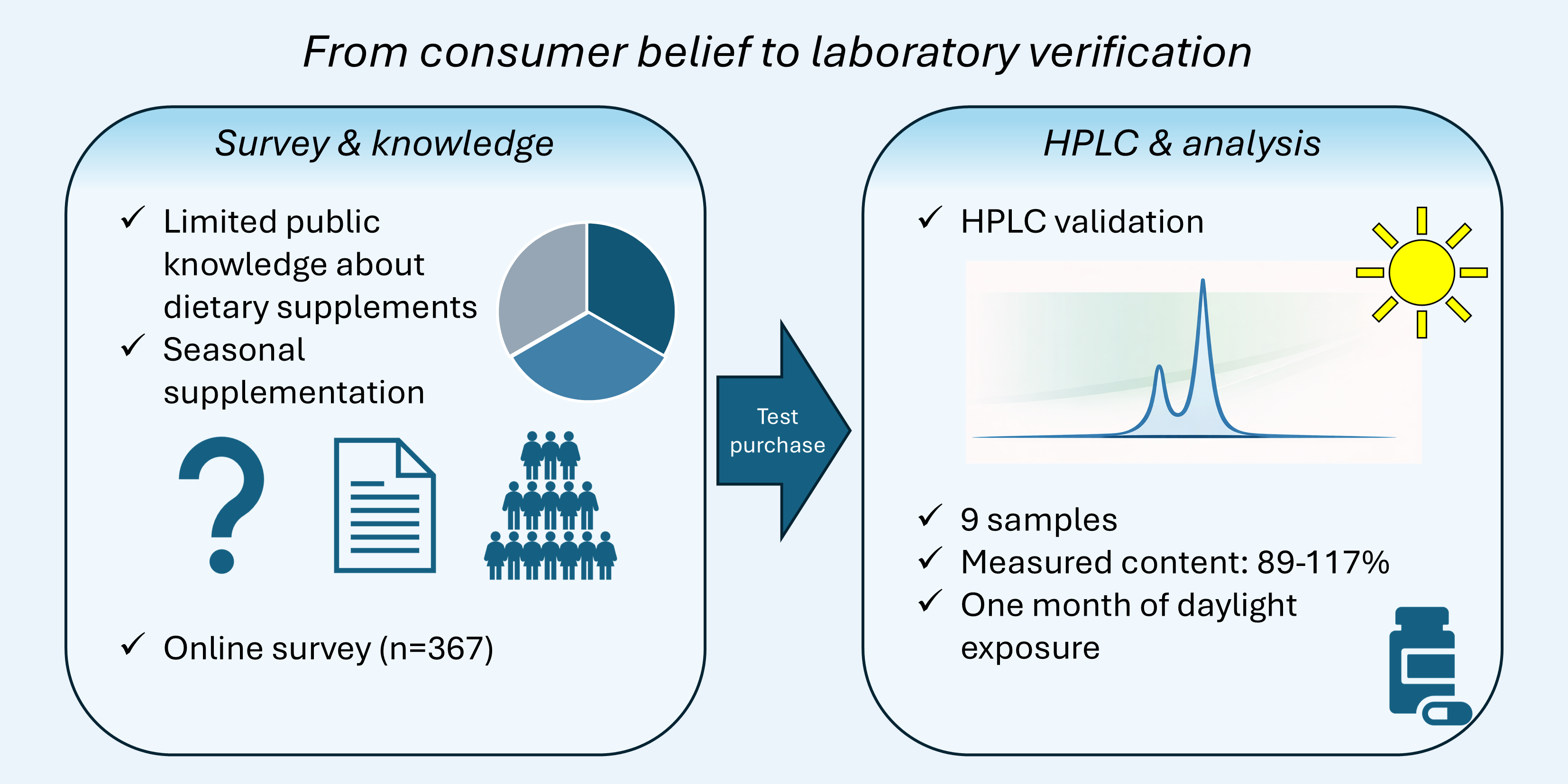
Quantitative Analysis of the Vitamin D3 Content in Dietary Supplements Marketed in Hungary Using High-Performance Liquid Chromatography

 , ,
, ,
Abstract
1. Introduction
2. Results
2.1. Public Survey
2.2. Validation Results
2.2.1. Suitability
2.2.2. Linearity and Range
2.2.3. Repeatability, LOD and LOQ
2.3. HPLC Measurements
2.3.1. Capsules
Stability of Capsules After One Month of Daylight Exposure
2.3.2. Tablets
3. Discussion
3.1. Questionnaire
3.2. HPLC Analysis
3.3. Limitations
3.4. Strengths
4. Materials and Methods
4.1. Materials
4.2. Methods
4.2.1. Survey Design
Study Design and Participants
Questionnaire Development
Data Collection and Storage
Ethical Considerations
Statistical Analysis
4.2.2. HPLC Method
Instrumentation
Type of Elution
Quantitative and Qualitative Analysis
4.2.3. Sample Preparation
Standard Solutions
Soft Gelatin Capsules
Tablets
4.2.4. Testing the Stability of the Preparations Under UV Light
4.2.5. Method Validation
5. Conclusions
Supplementary Materials
Author Contributions
Funding
Institutional Review Board Statement
Informed Consent Statement
Data Availability Statement
Acknowledgments
Conflicts of Interest
Abbreviations
| As | Symmetry Factor |
| AUC | Area Under the Curve |
| CVD | Cardiovascular Disease |
| DSGC | Dietary Supplement Gel Capsule |
| DSTB | Dietary Supplement Tablet |
| GDPR | General Data Protection Regulation |
| HPLC | High-Performance Liquid Chromatography |
| HPLC-UV | High-Performance Liquid Chromatography with Ultraviolet Detection |
| IPA | Isopropanol |
| KOH | Potassium Hydroxide |
| LOD | Limit of Detection |
| LOQ | Limit of Quantification |
| µg | Microgram |
| n | Absolute Number |
| PDTB | Pharmaceutical Drug Tablet |
| % | Percentage |
| R2 | Coefficient of Determination |
| RSD | Relative Standard Deviation |
| SD | Standard Deviation |
| UVB | Ultraviolet B |
| VDR | Vitamin D Receptor |
| 25(OH)D | 25-Hydroxyvitamin D |
| 1,25(OH)2D | 1,25-Dihydroxyvitamin D |
References
- Bikle, D.D. Vitamin D Metabolism, Mechanism of Action, and Clinical Applications. Chem. Biol. 2014, 21, 319–329. [Google Scholar] [CrossRef]
- Christakos, S.; Dhawan, P.; Verstuyf, A.; Verlinden, L.; Carmeliet, G. Vitamin D: Metabolism, Molecular Mechanism of Action, and Pleiotropic Effects. Physiol. Rev. 2016, 96, 365–408. [Google Scholar] [CrossRef] [PubMed]
- Adams, J.S.; Ramin, J.; Rafison, B.; Windon, C.; Windon, A.; Liu, P.T. Redefining Human Vitamin D Sufficiency: Back to the Basics. Bone Res. 2013, 1, 2–10. [Google Scholar] [CrossRef] [PubMed]
- Islam, H.; Hassaan, S.M.; Islam, R.; Islam, T.; Zaidi, F.; Rehman, H.U.; Haque, M.M.U.; Turabee, Z.; Asim, M.; Ahmad, I.; et al. Vitamin D’s Role in Cardiovascular Diseases. Discov. Med. 2024, 36, 1973–1986. [Google Scholar] [CrossRef] [PubMed]
- Pittas, A.G.; Kawahara, T.; Jorde, R.; Dawson-Hughes, B.; Vickery, E.M.; Angellotti, E.; Nelson, J.; Trikalinos, T.A.; Balk, E.M. Vitamin D and Risk for Type 2 Diabetes in People with Prediabetes: A Systematic Review and Meta-Analysis of Individual Participant Data From 3 Randomized Clinical Trials. Ann. Intern. Med. 2023, 176, 355–363. [Google Scholar] [CrossRef]
- Megna, M.; Ferrillo, M.; Barrea, L.; Patruno, C.; Muscogiuri, G.; Savastano, S.; Fabbrocini, G.; Napolitano, M. Vitamin D and Psoriasis: An Update for Dermatologists and Nutritionists. Minerva Endocrinol. 2020, 45, 138–147. [Google Scholar] [CrossRef]
- Muñoz, A.; Grant, W.B. Vitamin D and Cancer: An Historical Overview of the Epidemiology and Mechanisms. Nutrients 2022, 14, 1448. [Google Scholar] [CrossRef]
- Lips, P.; Cashman, K.D.; Lamberg-Allardt, C.; Bischoff-Ferrari, H.A.; Obermayer-Pietsch, B.; Bianchi, M.L.; Stepan, J.; El-Hajj Fuleihan, G.; Bouillon, R. Current Vitamin D Status in European and Middle East Countries and Strategies to Prevent Vitamin D Deficiency: A Position Statement of the European Calcified Tissue Society. Eur. J. Endocrinol. 2019, 180, P23–P54. [Google Scholar] [CrossRef]
- Zajkás, G.; Bíró, L.; Greiner, E.; Szórád, I.; Agoston, H.; Balázs, A.; Vitrai, J.; Hermann, D.; Boros, J.; Németh, R.; et al. Dietary survey in Hungary, 2003-2004. Micronutrients: Vitamins. Orv. Hetil. 2007, 148, 1593–1600. [Google Scholar] [CrossRef]
- Bischoff-Ferrari, H.A.; Dawson-Hughes, B.; Willett, W.C.; Staehelin, H.B.; Bazemore, M.G.; Zee, R.Y.; Wong, J.B. Effect of Vitamin D on Falls: A Meta-Analysis. JAMA 2004, 291, 1999–2006. [Google Scholar] [CrossRef]
- Meng, J.; Li, X.; Liu, W.; Xiao, Y.; Tang, H.; Wu, Y.; Xiong, Y.; Gao, S. The Role of Vitamin D in the Prevention and Treatment of SARS-CoV-2 Infection: A Meta-Analysis of Randomized Controlled Trials. Clin. Nutr. 2023, 42, 2198–2206. [Google Scholar] [CrossRef]
- Izzo, A.A.; Ernst, E. Interactions between Herbal Medicines and Prescribed Drugs: An Updated Systematic Review. Drugs 2009, 69, 1777–1798. [Google Scholar] [CrossRef]
- Abu Sa’aleek, A.; Alshishani, A.; Shaghlil, L.; Aljariri Alhesan, J.S.; Al-ebini, Y. Determination of Vitamin D3 in Pharmaceutical Products Using Salting-out Assisted Liquid–Liquid Extraction Coupled with Reversed Phase Liquid Chromatography. Microchem. J. 2023, 193, 109077. [Google Scholar] [CrossRef]
- Bilodeau, L.; Dufresne, G.; Deeks, J.; Clément, G.; Bertrand, J.; Turcotte, S.; Robichaud, A.; Beraldin, F.; Fouquet, A. Determination of Vitamin D3 and 25-Hydroxyvitamin D3 in Foodstuffs by HPLC UV-DAD and LC–MS/MS. J. Food Compos. Anal. 2011, 24, 441–448. [Google Scholar] [CrossRef]
- Tölgyesi, Á.; Girincsi, E.; Hermann, V.; Simon, A.; Bálint, M. Determination of Fat-Soluble Vitamins A, D2, D3, E and K3 by Isotope Dilution and LC-MS/MS Instrument Assembly. Élelmiszervizsgálati Közlemények 2022, 68, 3994–4005. [Google Scholar] [CrossRef]
- Wang, C.; Vriesekoop, F. Analysis of Vitamin D and Its Respective Vitamers by Liquid Chromatography with Triple Quadrupole Mass Spectrometry. In Food Chemistry; Mariutti, L., Vriesekoop, F., Eds.; Methods and Protocols in Food Science; Springer: New York, NY, USA, 2025; pp. 231–239. ISBN 978-1-07-164677-9. [Google Scholar]
- National Institute of Pharmacy and Nutrition (NNGYK). Dietary Supplements 2018. Available online: https://ogyei.gov.hu/etrend_kiegeszitok (accessed on 1 September 2024).
- Guidance Document for Competent Authorities for the Control of Compliance with EU Legislation on the Setting of Tolarences for Nutrient Values Declare on a Label. 2012. Available online: https://food.ec.europa.eu/system/files/2016-10/labelling_nutrition-vitamins_minerals-guidance_tolerances_1212_en.pdf (accessed on 1 September 2024).
- Vitamin D3 2000 IU. Available online: https://gymbeam.hu/vitamin-d3-5000-iu-gymbeam.html (accessed on 1 September 2024).
- Zaremba, S.M.M.; Conduit-Turner, K. Knowledge of Vitamin D and Practices of Vitamin D Supplementation in a Scottish Adult Population: A Cross-Sectional Study. Nutr. Health 2025, 31, 715–728. [Google Scholar] [CrossRef]
- Tanna, N.K.; Karki, M.; Webber, I.; Alaa, A.; El-Costa, A.; Blair, M. Knowledge, Attitudes, and Practices Associated with Vitamin D Supplementation: A Cross-Sectional Online Community Survey of Adults in the UK. PLoS ONE 2023, 18, e0281172. [Google Scholar] [CrossRef]
- Ong, S.W.; Kitchlu, A.; Cherney, D.Z.I.; Leung, K.; Chan, C.T.M. Virtual Pharmacy: An Integrated Collaborative Redesign Targeting Medication-Related Problems in Patients with Chronic Kidney Disease. Am. J. Nephrol. 2024, 55, 206–213. [Google Scholar] [CrossRef]
- Marawar, R.; Faraj, M.; Lucas, K.; Burns, C.V.; Garwood, C.L. Implementation of an Older Adult Epilepsy Clinic Utilizing Pharmacist Services. J. Am. Pharm. Assoc. 2021, 61, e93–e98. [Google Scholar] [CrossRef]
- Han, J.; Bhat, S.; Gowhari, M.; Gordeuk, V.R.; Saraf, S.L. Impact of a Clinical Pharmacy Service on the Management of Patients in a Sickle Cell Disease Outpatient Center. Pharmacother. J. Hum. Pharmacol. Drug Ther. 2016, 36, 1166–1172. [Google Scholar] [CrossRef]
- Szilvay, A.; Somogyi, O.; Meskó, A.; Zelkó, R.; Hankó, B. Qualitative and Quantitative Research of Medication Review and Drug-Related Problems in Hungarian Community Pharmacies: A Pilot Study. BMC Health Serv. Res. 2019, 19, 282. [Google Scholar] [CrossRef]
- Sleath, B.; Rubin, R.H.; Campbell, W.; Gwyther, L.; Clark, T. Physician–Patient Communication about over-the-Counter Medications. Soc. Sci. Med. 2001, 53, 357–369. [Google Scholar] [CrossRef]
- Schreiberné Molnár, E.; Nagy-Lőrincz, Z.; Nagy, B.; Bakacs, M.; Kis, O.; Sarkadi Nagy, E.; Martos, É. Hungarian Diet and Nutritional Status Survey—The OTAP2014 study. V. Vitamin intake of the Hungarian population. Orv. Hetil. 2017, 158, 1302–1313. [Google Scholar] [CrossRef] [PubMed][Green Version]
- Garg, S.; Sabri, D.; Kanji, J.; Rakkar, P.S.; Lee, Y.; Naidoo, N.; Svirskis, D. Evaluation of Vitamin D Medicines and Dietary Supplements and the Physicochemical Analysis of Selected Formulations. J. Nutr. Health Aging 2013, 17, 158–161. [Google Scholar] [CrossRef] [PubMed]
- Dickinson, A.; MacKay, D. Health Habits and Other Characteristics of Dietary Supplement Users: A Review. Nutr. J. 2014, 13, 14. [Google Scholar] [CrossRef] [PubMed]
- Crawford, C.; Avula, B.; Lindsey, A.T.; Walter, A.; Katragunta, K.; Khan, I.A.; Deuster, P.A. Analysis of Select Dietary Supplement Products Marketed to Support or Boost the Immune System. JAMA Netw. Open 2022, 5, e2226040. [Google Scholar] [CrossRef]
- Tucker, J.; Fischer, T.; Upjohn, L.; Mazzera, D.; Kumar, M. Unapproved Pharmaceutical Ingredients Included in Dietary Supplements Associated with US Food and Drug Administration Warnings. JAMA Netw. Open 2018, 1, e183337. [Google Scholar] [CrossRef]
- Parry-Billings, M.; MacLaren, D.P. The Effect of Sodium Bicarbonate and Sodium Citrate Ingestion on Anaerobic Power during Intermittent Exercise. Eur. J. Appl. Physiol. 1986, 55, 524–529. [Google Scholar] [CrossRef]
- Hemery, Y.M.; Fontan, L.; Moench-Pfanner, R.; Laillou, A.; Berger, J.; Renaud, C.; Avallone, S. Influence of Light Exposure and Oxidative Status on the Stability of Vitamins A and D3 during the Storage of Fortified Soybean Oil. Food Chem. 2015, 184, 90–98. [Google Scholar] [CrossRef]
- Domański, M.; Domańska, A.; Żukiewicz-Sobczak, W.; Weiner, M. ANALYSIS OF VITAMIN D CONTENT IN DIETARY SUPPLEMENTS AVAILABLE IN THE EU. Health Probl. Civiliz. 2023, 17, 97–102. [Google Scholar] [CrossRef]
- Caldwell, J.A.; McGraw, S.M.; Thompson, L.A.; Lieberman, H.R. A Survey Instrument to Assess Intake of Dietary Supplements, Related Products, and Caffeine in High-Use Populations. J. Nutr. 2018, 148, 1445S–1451S. [Google Scholar] [CrossRef]
- Sánchez-Oliver, A.J.; Domínguez, R.; López-Tapia, P.; Tobal, F.M.; Jodra, P.; Montoya, J.J.; Guerra-Hernández, E.J.; Ramos-Álvarez, J.J. A Survey on Dietary Supplement Consumption in Amateur and Professional Rugby Players. Foods 2020, 10, 7. [Google Scholar] [CrossRef]
- Elsahoryi, N.A.; Odeh, M.M.; Jadayil, S.A.; McGrattan, A.M.; Hammad, F.J.; Al-Maseimi, O.D.; Alzoubi, K.H. Prevalence of Dietary Supplement Use and Knowledge, Attitudes, Practice (KAP) and Associated Factors in Student Population: A Cross-Sectional Study. Heliyon 2023, 9, e14736. [Google Scholar] [CrossRef]
- Temova, Ž.; Roškar, R. Stability-Indicating HPLC–UV Method for Vitamin D3 Determination in Solutions, Nutritional Supplements and Pharmaceuticals. J. Chromatogr. Sci. 2016, 54, 1180–1186. [Google Scholar] [CrossRef]
- Byrdwell, W.C.; DeVries, J.; Exler, J.; Harnly, J.M.; Holden, J.M.; Holick, M.F.; Hollis, B.W.; Horst, R.L.; Lada, M.; Lemar, L.E.; et al. Analyzing Vitamin D in Foods and Supplements: Methodologic Challenges. Am. J. Clin. Nutr. 2008, 88, 554S–557S. [Google Scholar] [CrossRef]





| Variable | Category | n | % |
|---|---|---|---|
| Sex | Female | 251 | 60% |
| Male | 116 | 40% | |
| Age | Mean ± SD | 31.36 ± 12.48 | – |
| County of Residence | Baranya | 179 | 48.8% |
| Pest | 62 | 16.9% | |
| Tolna | 21 | 5.7% | |
| Zala | 16 | 4.4% | |
| Place of Residence | Capital city | 44 | 12% |
| County town | 171 | 46.6% | |
| City | 57 | 15.5% | |
| Small town | 23 | 6.3% | |
| Large village | 7 | 1.9% | |
| Village | 24 | 6.5% | |
| Hamlet | 41 | 11.2% | |
| Highest Education | Primary School | 4 | 1.1% |
| Vocational Secondary School | 9 | 2.5% | |
| Secondary School Diploma | 158 | 43.1% | |
| High School or University | 183 | 49.9% | |
| PhD/DLA | 13 | 3.5% |
| Statement | True | False | I Do Not Know |
|---|---|---|---|
| Dietary supplements are also considered food products. | 32.4% | 55.9% | 11.7% |
| The effectiveness of dietary supplements is not supported by clinical trials. | 22.6% | 65.9% | 11.4% |
| Dietary supplements do not require pre-market approval; their sale only needs to be reported. | 28.6% | 62.7% | 8.7% |
| Dietary supplements play an important role in disease prevention and treatment. | 70.8% | 16.3% | 12.8% |
| If we eat a balanced diet, there is no need for dietary supplements. | 48.2% | 42.5% | 9.3% |
| Code | Date of Analysis | Labeled Dose (µg) | Acceptable Dose Range (µg) | Measured Amount Per Serving (µg) | % of Labeled Dose | SD |
|---|---|---|---|---|---|---|
| DSGC1 | 17 September 2024 | 50 | 40–75 | 58.53 | 117.07 | 1.08 |
| DSGC2 | 16 September 2024 | 50 | 40–75 | 44.72 | 89.45 | 0.19 |
| DSGC3 | 16 September 2024 | 75 | 60–112.5 | 68.74 | 91.65 | 1.00 |
| DSGC4 | 17 September 2024 | 55 | 44–82.5 | 57.98 | 105.41 | 0.80 |
| DSGC5 | 23 September 2024 | 50 | 40–75 | 51.56 | 103.12 | 1.01 |
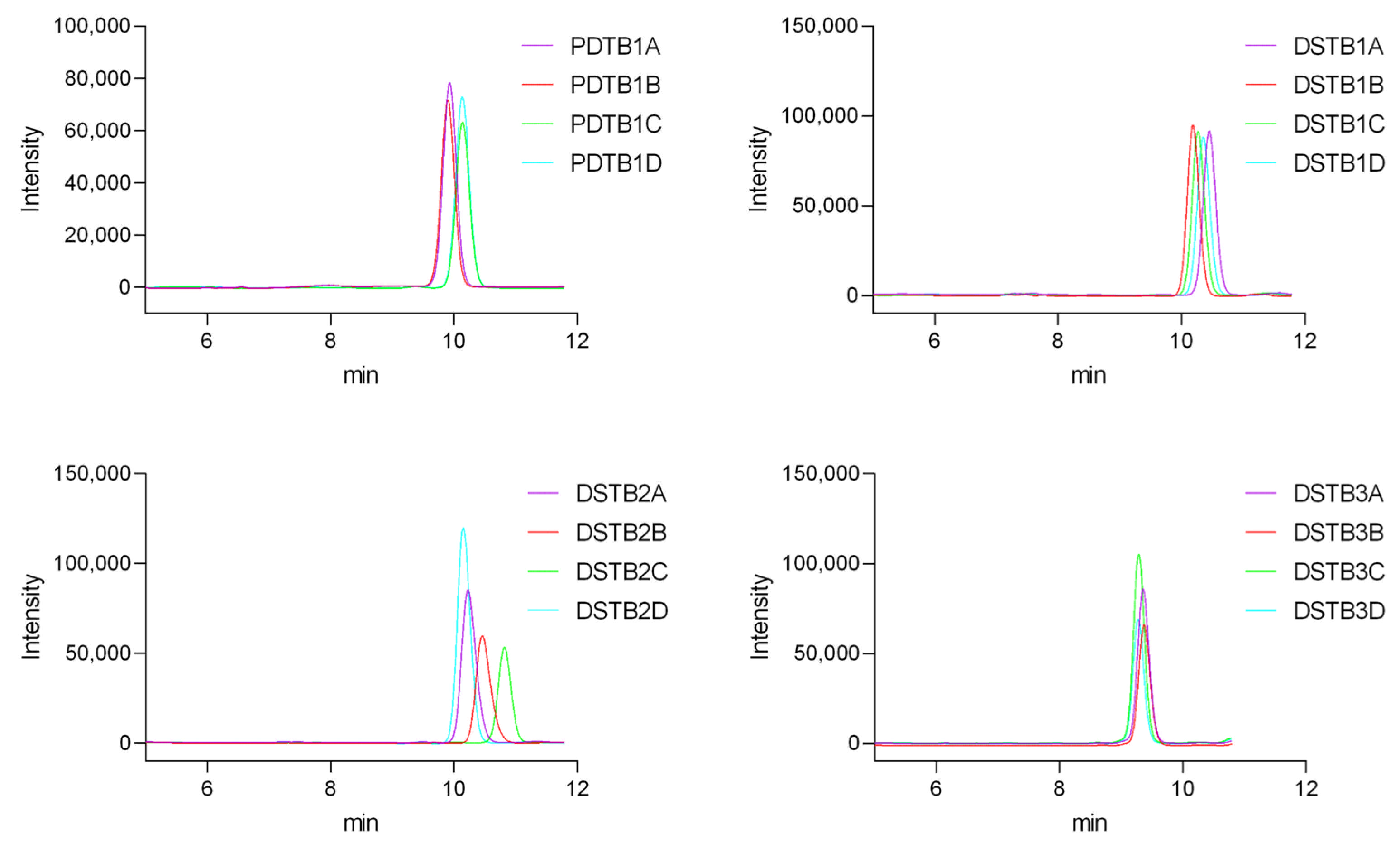
| DSTB1 | 14 November 2024 | 100 | 80–150 | 108.70 | 108.70 | 1.56 |
| DSTB2 | 15 November 2024 | 75 | 60–112.5 | 73.79 | 98.38 | 4.25 |
| DSTB3 | 20 December 2024 | 100 | 80–150 | 94.46 | 94.46 | 5.96 |
| PDTB1 | 14 November 2024 | 40 | 32–60 | 43.44 | 108.59 | 3.33 |
| Code | Date of Analysis | Labeled Dose (µg) | Acceptable Dose Range (µg) | Measured Amount Per Serving (µg) | % of Labeled Dose | SD |
|---|---|---|---|---|---|---|
| DSGC1 | 28 October 2024 | 50 | 40–75 | 57.04 | 114.08 | 0.10 |
| DSGC2 | 28 October 2024 | 50 | 40–75 | 38.16 | 76.32 | 13.14 |
| DSGC3 | 28 October 2024 | 75 | 60–112.5 | 77.29 | 103.05 | 0.45 |
| DSGC4 | 28 October 2024 | 55 | 44–82.5 | 65.42 | 118.94 | 1.25 |
Disclaimer/Publisher’s Note: The statements, opinions and data contained in all publications are solely those of the individual author(s) and contributor(s) and not of MDPI and/or the editor(s). MDPI and/or the editor(s) disclaim responsibility for any injury to people or property resulting from any ideas, methods, instructions or products referred to in the content. |
© 2026 by the authors. Licensee MDPI, Basel, Switzerland. This article is an open access article distributed under the terms and conditions of the Creative Commons Attribution (CC BY) license.
Share and Cite
Nagy, A.; Vida, R.G.; Fliszár-Nyúl, E.; Lovász, G.; Fábián, K.; Pozsgai, G. Quantitative Analysis of the Vitamin D3 Content in Dietary Supplements Marketed in Hungary Using High-Performance Liquid Chromatography. Pharmaceuticals 2026, 19, 493. https://doi.org/10.3390/ph19030493
Nagy A, Vida RG, Fliszár-Nyúl E, Lovász G, Fábián K, Pozsgai G. Quantitative Analysis of the Vitamin D3 Content in Dietary Supplements Marketed in Hungary Using High-Performance Liquid Chromatography. Pharmaceuticals. 2026; 19(3):493. https://doi.org/10.3390/ph19030493
Chicago/Turabian StyleNagy, András, Róbert György Vida, Eszter Fliszár-Nyúl, Gábor Lovász, Katalin Fábián, and Gábor Pozsgai. 2026. "Quantitative Analysis of the Vitamin D3 Content in Dietary Supplements Marketed in Hungary Using High-Performance Liquid Chromatography" Pharmaceuticals 19, no. 3: 493. https://doi.org/10.3390/ph19030493
APA StyleNagy, A., Vida, R. G., Fliszár-Nyúl, E., Lovász, G., Fábián, K., & Pozsgai, G. (2026). Quantitative Analysis of the Vitamin D3 Content in Dietary Supplements Marketed in Hungary Using High-Performance Liquid Chromatography. Pharmaceuticals, 19(3), 493. https://doi.org/10.3390/ph19030493