Abstract
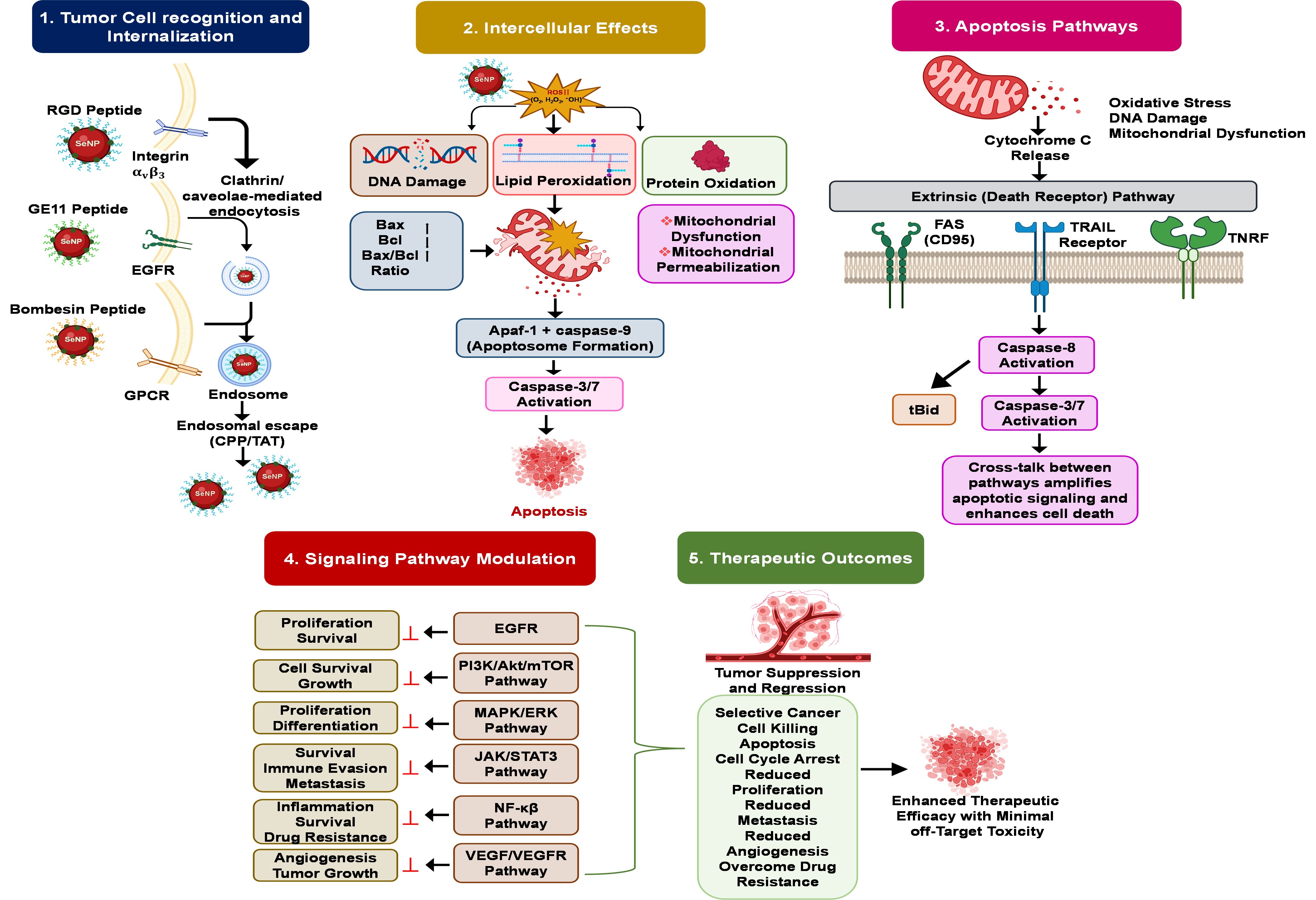
Lung cancer is among the most fatal malignancies worldwide, with approximately 85% of diagnosed cases being non-small-cell lung cancer (NSCLC). Despite the considerable progress in surgical, chemotherapeutic, radiotherapeutic, and immunological treatments, the prognosis of NSCLC remains poor due to late-stage diagnosis, molecular heterogeneity, treatment resistance, recurrence, and systemic toxicity. Therefore, there is an urgent need to develop more effective and less toxic therapies, and cancer nanotechnology has emerged as a promising approach. Selenium nanoparticles (SeNPs) are a viable option for lung cancer treatment because of their unique physicochemical and biochemical properties. They can be used for targeted drug delivery into cancer cells, as selenium possesses inherent anti-cancer properties, such as the induction of reactive oxygen species (ROS), mitochondrial disruption, DNA damage, cell-cycle arrest, and modulation of several signaling pathways, including PI3K/Akt, MAPK, NF-κβ, STAT3, and p53, leading to cancer cell death and repression of tumor progression. Green synthesis of SeNPs using plant-derived phytochemicals is a sustainable strategy as it allows for simultaneous reduction and stabilization of nanoparticles, with an additional therapeutic phytochemical effect against cancer. Various phytochemicals, such as flavonoids, polyphenols, terpenoids, and alkaloids, have the ability to chelate metal ions and act as reducing agents and stabilizers in the synthesis of SeNPs. The antioxidant, anti-inflammatory, anti-proliferative, and anti-metastatic activities of phytochemicals, along with their ability to inhibit the overexpressed enzymes, e.g., matrix metalloproteinases, in cancer cells, could provide an additional therapeutic benefit. However, the application of SeNPs in practice is limited by their low targeting ability, which results in poor bioavailability due to fast clearance from the bloodstream, reduced tumor accumulation, and poor cellular uptake. Conjugation of SeNPs with tumor-targeting peptides could enhance their delivery into the cancer cells. There is a variety of cell surface receptors that are overexpressed in lung cancer cells and can be used for targeted drug delivery. The most common receptors are EGFR, integrins, gastrin-releasing peptide receptor, neuropilin-1, and transferrin receptor. The ligands for these receptors, including the GE11 peptide for EGFR (epidermal growth factor receptor), RGD for integrins, bombesin for GRPR, and iRGD for neuropilin-1, could be used for targeting, as well as cell-penetrating peptides, such as TAT. This review discusses the current knowledge on the application of functionalized SeNPs for lung cancer treatment, specifically synthetic methods, physicochemical properties, mechanisms of action, and targeting strategies. Particular attention is paid to the combination of the anti-cancer effects of selenium and phytochemicals and their synergistic impact on tumor cell death. In addition, the challenges of the application of SeNPs for lung cancer treatment and possible future developments for functionalized SeNPs as novel therapeutic nanocarriers are discussed.




 ,
,