Bromocriptine, Selegiline and Amantadine in the Treatment of Depression—A Systematic Review

 ,
,  , , ,
, , ,
Abstract
1. Introduction
2. Materials and Methods
2.1. Inclusion and Exclusion Criteria
2.2. Search Strategy
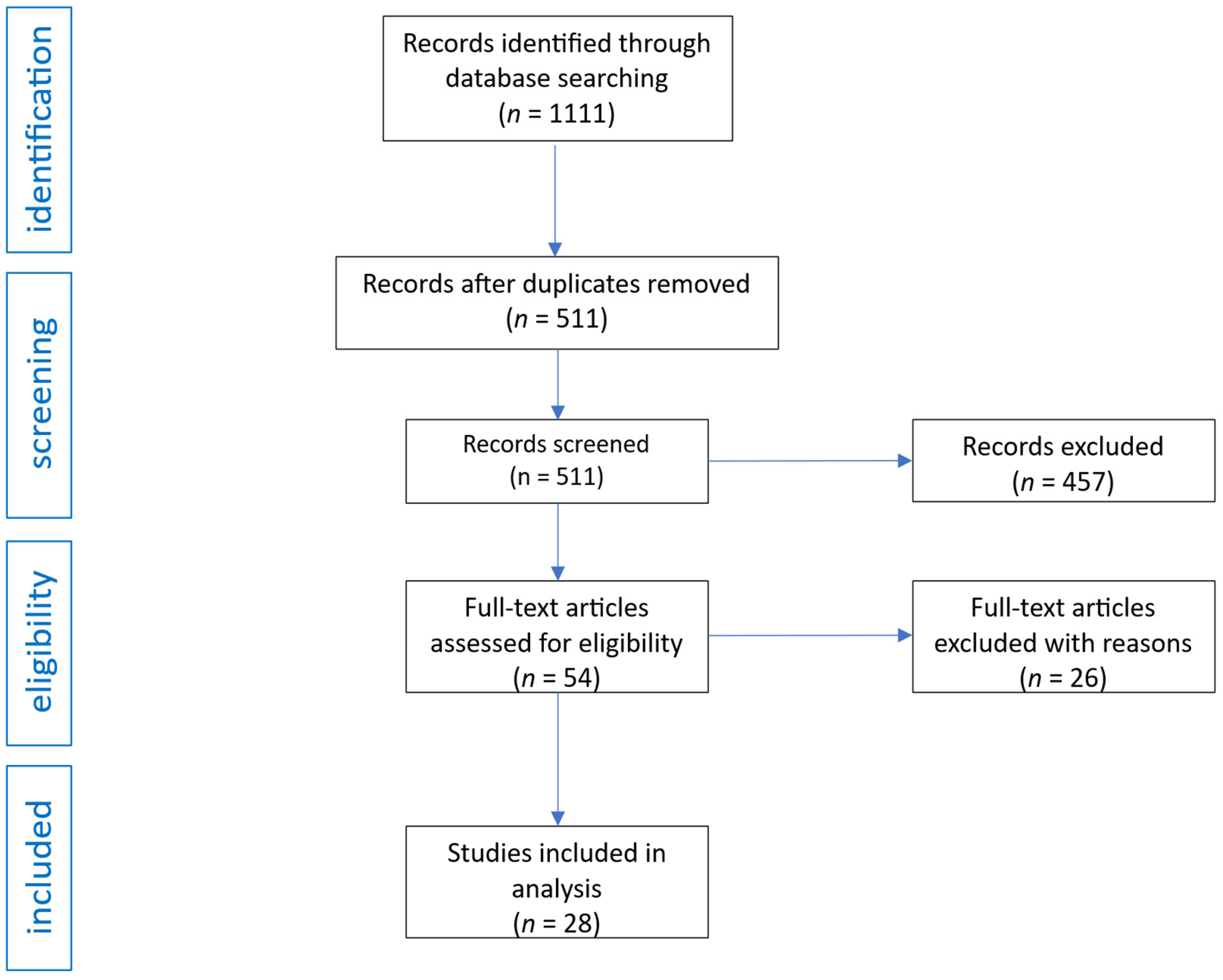
2.3. Eligible Studies
2.4. Data Extraction
2.5. Data Quality
3. Results
3.1. The Effect of Bromocriptine on Depression
3.2. The Effect of Amantadine on Depression
3.3. The Effect of Selegiline on Depression
4. Discussion
5. Conclusions
Supplementary Materials
Author Contributions
Funding
Data Availability Statement
Conflicts of Interest
References
- Polanczyk, G.V.; Salum, G.A.; Sugaya, L.S.; Caye, A.; Rohde, L.A. Annual research review: A meta-analysis of the worldwide prevalence of mental disorders in children and adolescents. J. Psychol. Psychiatr. 2015, 56, 345–365. [Google Scholar] [CrossRef] [PubMed]
- Avenevoli, S.; Swendsen, J.; He, J.-P.; Burstein, M.; Merikangas, K.R. Major depression in the National Comorbidity Survey–Adolescent Supplement: Prevalence, correlates, and treatment. J. Am. Acad. Child. Adolesc. Psychiatry 2015, 54, 37–44. [Google Scholar] [CrossRef] [PubMed]
- Birmaher, B.; Arvelaez, C.; Brent, D. Course and outcome of child and adolescent major depressive disorder. Child Adolesc. Psychiatr. Clin. 2002, 11, 619–637. [Google Scholar] [CrossRef] [PubMed]
- Cowen, P.J. Neuroendocrine and neurochemical processes in depression. Psychopathol. Rev. 2016, 1, 3–15. [Google Scholar] [CrossRef]
- Tundo, A.; Betro, S.; de Filippis, R.; Marchetti, F.; Nacca, D.; Necci, R.; Iommi, M. Pramipexole Augmentation for Treatment-Resistant Unipolar and Bipolar Depression in the Real World: A Systematic Review and Meta-Analysis. Life 2023, 13, 1043. [Google Scholar] [CrossRef]
- Whitton, A.E.; Treadway, M.T.; Pizzagalli, D.A. Reward processing dysfunction in major depression, bipolar disorder and schizophrenia. Curr. Opin. Psychiatry 2015, 28, 7–12. [Google Scholar] [CrossRef]
- Thomsen, K.R.; Whybrow, P.C.; Kringelbach, M.L. Reconceptualizing anhedonia: Novel perspectives on balancing the pleasure networks in the human brain. Front. Behav. Neurosci. 2015, 9, 49. [Google Scholar] [CrossRef]
- Treadway, M.T. The neurobiology of motivational deficits in depression—An update on candidate pathomechanisms. Curr. Top. Behav. Neurosci. 2016, 27, 337–355. [Google Scholar] [CrossRef] [PubMed]
- McClintock, S.M.; Husain, M.M.; Wisniewski, S.R.; Nierenberg, A.A.; Stewart, J.W.; Trivedi, M.H.; Cook, I.; Morris, D.; Warden, D.; Rush, A.J. Residual symptoms in depressed outpatients who respond by 50% but do not remit to antidepressant medication. J. Clin. Psychopharmacol. 2011, 31, 180–186. [Google Scholar] [CrossRef]
- Inoue, T.; Tsuchiya, K.; Miura, J.; Sakakibara, S.; Denda, K.; Kasahara, T.; Koyama, T. Bromocriptine treatment of tricyclic and heterocyclic antidepressant-resistant depression. Biol. Psychiatry 1996, 40, 151–153. [Google Scholar] [CrossRef]
- Kishimoto, A. Survey of treatment-resistant depression and new strategies for patients who failed to respond to treatments. No to Seishin no Igaku (Jpn. J. Biol. Psychiatry) 1993, 4, 147–154. (In Japanese) [Google Scholar]
- Murawiec, S.; Krzystanek, M. Symptom cluster-matching antidepressant treatment: A case series pilot study. Pharmaceuticals 2021, 14, 526. [Google Scholar] [CrossRef]
- Jeuring, H.W.; D’Angremont, E.; Tol, J.M.H.; Risselada, A.J.; Sommer, I.E.C.; Oude Voshaar, R.C. The effectiveness of off-label dopamine stimulating agents in depressive disorder: A systematic review and meta-analysis. Psychiatry Res. 2023, 319, 115010. [Google Scholar] [CrossRef]
- Page, M.J.; Moher, D.; Bossuyt, P.M.; Boutron, I.; Hoffmann, T.C.; Mulrow, C.D.; Shamseer, L.; Tetzlaff, J.M.; Akl, E.A.; Brennan, S.E.; et al. PRISMA 2020 explanation and elaboration: Updated guidance and exemplars for reporting systematic reviews. BMJ 2021, 372, n160. [Google Scholar] [CrossRef]
- Waehrens, J.; Gerlach, J. Bromocriptine and imipramine in endogenous depression. A double-blind controlled trial in out-patients. J. Affect. Disord. 1981, 3, 193–202. [Google Scholar] [CrossRef]
- Theohar, C.; Fischer-Cornelssen, K.; Brosch, H.; Fischer, E.K.; Petrovic, D. A comparative, multicenter trial between bromocriptine and amitriptyline in the treatment of endogenous depression. Arzneimittelforschung 1982, 32, 783–787. [Google Scholar] [PubMed]
- Nordin, C.; Siwers, B.; Bertilsson, L. Bromocriptine treatment of depressive disorders. Clinical and biochemical effects. Acta Psychiatr. Scand. 1981, 64, 25–33. [Google Scholar] [CrossRef]
- Barrett, K. Treating organic abulia with bromocriptine and lisuride: Four case studies. J. Neurol. Neurosurg. Psychiatry 1991, 54, 718–721. [Google Scholar] [CrossRef]
- Rogóz, Z.; Dziedzicka-Wasylewska, M.; Daniel, W.A.; Wójcikowski, J.; Dudek, D.; Wróbel, A.; Zieba, A. Effects of joint administration of imipramine and amantadine in patients with drug-resistant unipolar depression. Pharmacol. Rep. 2004, 56, 735–742. [Google Scholar] [PubMed]
- Stryjer, R.; Strous, R.D.; Shaked, G.; Bar, F.; Feldman, B.; Kotler, M.; Polak, L.; Rosenzcwaig, S.; Weizman, A. Amantadine as augmentation therapy in the management of treatment-resistant depression. Int. Clin. Psychopharmacol. 2003, 18, 93–96. [Google Scholar] [CrossRef] [PubMed]
- Rogóz, Z.; Skuza, G.; Daniel, W.A.; Wójcikowski, J.; Dudek, D.; Wróbel, A. Amantadine as an additive treatment in patients suffering from drug-resistant unipolar depression. Pharmacol. Rep. 2007, 59, 778–784. [Google Scholar] [PubMed]
- Ene-Stroescu, V.; Schultz, J.; Hahn, C.; Greenberg, B.D. Excellent response to amantadine in a patient with bipolar disorder and catatonia. J. Neuropsychiatry Clin. Neurosci. 2014, 26, E43. [Google Scholar] [CrossRef]
- Ferszt, R.; Bode, L.; Ludwig, H.; Herpetz, S. Amantadine revisited: An open trial of amantadine-sulfate treatment in chronically depressed patients with Borna disease virus infection. Pharmacopsychiatry 1999, 32, 142–147. [Google Scholar] [CrossRef]
- Bode, L.; Dietrich, D.E.; Stoyloff, R.; Emrich, H.M.; Ludwig, H. Amantadine and human Borna disease virus in vitro and in vivo in an infected patient with bipolar depression. Lancet 1997, 349, 178–179. [Google Scholar] [CrossRef]
- Ziedonis, D.M.; Kosten, T.R. Pharmacotherapy improves treatment outcome in depressed cocaine addicts. J. Psychoact. Drugs. 1991, 23, 417–425. [Google Scholar] [CrossRef]
- Kronenberger, B.; Berg, T.; Herrmann, E.; Hinrichsen, H.; Gerlach, T.; Buggisch, P.; Spengler, U.; Goeser, T.; Nasser, S.; Wursthorn, K.; et al. Efficacy of amantadine on quality of life in patients with chronic hepatitis C treated with interferon-alpha and ribavirin: Results from a randomized, placebo-controlled, double-blind trial. Eur. J. Gastroenterol. Hepatol. 2007, 19, 639–646. [Google Scholar] [CrossRef] [PubMed]
- Quarantini, L.C.; Miranda-Scippa, A.; Schinoni, M.I.; Sampaio, A.S.; Santos-Jesus, R.; Bressan, R.A.; Tatsch, F.; de Oliveira, I.; Parana, R. Effect of amantadine on depressive symptoms in chronic hepatitis C patients treated with pegylated interferon: A randomized, controlled pilot study. Clin. Neuropharmacol. 2006, 29, 138–143. [Google Scholar] [CrossRef] [PubMed]
- Krzystanek, M.; Pałasz, A. Possibility of a new indication for amantadine in the treatment of bipolar depression—Case series study. Pharmaceuticals 2020, 13, 326. [Google Scholar] [CrossRef]
- Pae, C.U.; Patkar, A.A.; Jang, S.; Portland, K.B.; Jung, S.; Nelson, J.C. Efficacy and safety of selegiline transdermal system (STS) for the atypical subtype of major depressive disorder: Pooled analysis of 5 short-term, placebo-controlled trials. CNS Spectr. 2014, 19, 324–329. [Google Scholar] [CrossRef] [PubMed]
- Bodkin, J.A.; Amsterdam, J.D. Transdermal selegiline in major depression: A double-blind, placebo-controlled, parallel-group study in outpatients. Am. J. Psychiatry 2002, 159, 1869–1875. [Google Scholar] [CrossRef]
- Amsterdam, J.D. A double-blind, placebo-controlled trial of the safety and efficacy of selegiline transdermal system without dietary restrictions in patients with major depressive disorder. J. Clin. Psychiatry 2003, 64, 208–214. [Google Scholar] [CrossRef]
- Jang, S.; Lee, S.-J.; Han, C.; Pae, C.-U. Predictors of relapse in patients with major depressive disorder in a 52-week, fixed dose, double blind, randomized trial of selegiline transdermal system (STS). J. Affect. Disord. 2013, 151, 854–859. [Google Scholar] [CrossRef]
- Amsterdam, J.D.; Bodkin, J.A. Selegiline transdermal system in the prevention of relapse of major depressive disorder: A 52-week, double-blind, placebo-substitution, parallel-group clinical trial. J. Clin. Psychopharmacol. 2006, 26, 579–586. [Google Scholar] [CrossRef]
- Lu, B.Y.; Price, R.B.; Praschan, N.C.; Jakubovski, E.; Murrough, J.W. Rapid and sustained improvement in treatment-refractory depression through use of acute intravenous ketamine and concurrent transdermal selegiline: A case series. J. Affect. Disord. 2020, 262, 40–42. [Google Scholar] [CrossRef] [PubMed]
- Feiger, A.D.; Rickels, K.; DeBattista, C.; Fieve, R.R.; Schneider, R.K.; Anderson, C. Selegiline transdermal system for the treatment of major depressive disorder: An 8-week, double-blind, placebo-controlled, flexible-dose titration trial. J. Clin. Psychiatry 2006, 67, 1354–1361. [Google Scholar] [CrossRef] [PubMed]
- DelBello, M.P.; Hochadel, T.J.; Portland, K.B.; Azzaro, A.J.; Katic, A.; Khan, A.; Emslie, G. A double-blind, placebo-controlled study of selegiline transdermal system in depressed adolescents. J. Child. Adolesc. Psychopharmacol. 2014, 24, 311–317. [Google Scholar] [CrossRef] [PubMed]
- Quitkin, F.M.; Liebowitz, M.R.; Stewart, J.W.; McGrath, P.J.; Harrison, W.; Rabkin, J.G.; Markowitz, J.; Davies, S.O. l-Deprenyl in atypical depressives. Arch. Gen. Psychiatry 1984, 41, 777–781. [Google Scholar] [CrossRef]
- Mendlewicz, J.; Youdim, M.B. Antidepressant potentiation of 5-hydroxytryptophan by L-deprenil in affective illness. J. Affect. Disord. 1980, 2, 137–146. [Google Scholar] [CrossRef]
- Kim, T.T.; Xu, C.; Amsterdam, J.D. Comparison of effectiveness and side effects of selegiline transdermal system versus oral monoamine oxidase inhibitors and tricyclic antidepressants for treatment-resistant depression. J. Affect. Disord. 2025, 376, 47–51. [Google Scholar] [CrossRef]
- Higuchi, H.; Yamaguchi, T.; Ishigooka, J. Remarkable effect of selegiline (L-deprenyl), a selective monoamine oxidase type-B inhibitor, in a patient with severe refractory depression: A case report. Clin. Neuropharmacol. 2005, 28, 191–192. [Google Scholar] [CrossRef]
- Mann, J.J.; Aarons, S.F.; Wilner, P.J.; Keilp, J.G.; Sweeney, J.A.; Pearlstein, T.; Frances, A.J.; Kocsis, J.H.; Brown, R.P. Controlled trial of antidepressant efficacy and side effects of (-)-deprenyl. A selective monoamine oxidase inhibitor. Arch. Gen. Psychiatry 1989, 46, 45–50. [Google Scholar] [CrossRef] [PubMed]
- Mendlewicz, J.; Youdim, M.B. L-Deprenil, a selective monoamine oxidase type B inhibitor, in the treatment of depression: A double blind evaluation. Br. J. Psychiatry 1983, 142, 508–511. [Google Scholar] [CrossRef] [PubMed]
- Thomas, B.H.; Ciliska, D.; Dobbins, M.; Micucci, S. A process for systematically reviewing the literature: Providing the research evidence for public health nursing interventions. Worldviews Evid.-Based Nurs. 2004, 1, 176–184. [Google Scholar] [CrossRef] [PubMed]
- Armijo-Olivo, S.; Stiles, C.R.; Hagen, N.A.; Biondo, P.D.; Cummings, G.G. Assessment of study quality for systematic reviews: A comparison of the Cochrane Collaboration Risk of Bias Tool and the Effective Public Health Practice Project Quality Assessment Tool: Methodological research. J. Eval. Clin. Pract. 2012, 18, 12–18. [Google Scholar] [CrossRef]
- Belujon, P.; Grace, A.A. Dopamine system dysregulation in major depressive disorders. Int. J. Neuropsychopharmacol. 2017, 20, 1036–1046. [Google Scholar] [CrossRef]
- Dunlop, B.W.; Nemeroff, C.B. The role of dopamine in the pathophysiology of depression. Arch. Gen. Psychiatry 2007, 64, 327–337. [Google Scholar] [CrossRef]
- Liebowitz, M.R.; Karoum, F.; Quitkin, F.M.; Davies, S.O.; Schwartz, D.; Levitt, M.; Linnoila, M. Biochemical effects of L-deprenyl in atypical depressives. Biol. Psychiatry 1985, 20, 558–565. [Google Scholar] [CrossRef]
- Aoki, F.Y.; Sitar, D.S. Clinical pharmacokinetics of amantadine hydrochloride. Clin. Pharmacokinet. 1988, 14, 35–51. [Google Scholar] [CrossRef]
- Pizzagalli, D.A. Depression, stress, and anhedonia: Toward a synthesis and integrated model. Annu. Rev. Clin. Psychol. 2014, 10, 393–423. [Google Scholar] [CrossRef]
- Sachs, G.S.; Yeung, P.P.; Rekeda, L.; Khan, A.; Adams, J.L.; Fava, M. Adjunctive Cariprazine for the Treatment of Patients With Major Depressive Disorder: A Randomized, Double-Blind, Placebo-Controlled Phase 3 Study. Am. J. Psychiatry 2023, 180, 241–251. [Google Scholar] [CrossRef]
- Kishi, T.; Sakuma, K.; Nomura, I.; Matsuda, Y.; Mishima, K.; Iwata, N. Brexpiprazole as Adjunctive Treatment for Major Depressive Disorder Following Treatment Failure With at Least One Antidepressant in the Current Episode: A Systematic Review and Meta-Analysis. Int. J. Neuropsychopharmacol. 2019, 22, 698–709. [Google Scholar] [CrossRef] [PubMed]
- Han, C.; Wang, S.M.; Lee, S.J.; Jun, T.Y.; Pae, C.U. Optimizing the Use of Aripiprazole Augmentation in the Treatment of Major Depressive Disorder: From Clinical Trials to Clinical Practice. Chonnam Med. J. 2015, 51, 66–80. [Google Scholar] [CrossRef]
- Page, M.J.; McKenzie, J.E.; Bossuyt, P.M.; Boutron, I.; Hoffmann, T.C.; Mulrow, C.D.; Shamseer, L.; Tetzlaff, J.M.; Akl, E.A.; Brennan, S.E.; et al. The PRISMA 2020 statement: An updated guideline for reporting systematic reviews. BMJ 2021, 372, n71. [Google Scholar] [CrossRef]


| Author | Study Type | Dopaminergic Drug | Participants | Intervention | QATQS |
|---|---|---|---|---|---|
| Waehrens et al. [15] | Double-blind randomized controlled trial | Bromocriptine | 33 outpatients with unipolar depression | 6-week treatment: bromocriptine (10–60 mg/day) vs. imipramine (75–250 mg/day) | 1 |
| Teohar et al. [16] | Double-blind multicenter randomized controlled trial | Bromocriptine | 83 patients with unipolar depression | Bromocriptine (30–50 mg) vs. amitriptyline (120–200 mg) | 1 |
| Nordin et al. [17] | Open clinical trial | Bromocriptine | 15 patients with depression; 12 completed 5-week treatment | Bromocriptine 20–60 mg/day for 5 weeks | 3 |
| Inoue et al. [10] | Open-label pilot study | Bromocriptine | 6 patients with treatment-resistant depression | Bromocriptine (15–52.5 mg/day) | 3 |
| Barrett et al. [18] | Case series | Bromocriptine | 4 patients with organic abulia and depressive symptoms | Bromocriptine (25–70 mg/day) | 3 |
| Author | Study Type | Dopaminergic Drug | Participants | Intervention | QATQS |
|---|---|---|---|---|---|
| Rogóz et al. [19] | Open-label prospective study | Amantadine | 12 patients with treatment-resistant unipolar depression | Imipramine 100–150 mg/day for 6 weeks, then imipramine + amantadine 100–150 mg/day for 6 weeks | 2 |
| Stryjer et al. [20] | Open-label prospective study | Amantadine | 8 patients with treatment-resistant depression | Amantadine up to 300 mg/day for 4 weeks as augmentation to ongoing antidepressants | 2 |
| Rogóz et al. [21] | Prospective controlled study (non-randomized) | Amantadine | 50 patients with treatment-resistant unipolar depression | Group 1: imipramine 100 mg/day for 12 weeks; Group 2: imipramine 100 mg/day for 6 weeks, then imipramine + amantadine 150 mg/day for 6 weeks | 2 |
| Ene-Stroescu et al. [22] | Case report | Amantadine | 58-year-old female with bipolar disorder and catatonia | Addition of amantadine to carbamazepine and lorazepam; rapid improvement in catatonia and depressive symptoms | 3 |
| Bode et al. [23] | Open-label prospective study | Amantadine | 30 patients with depression and BDV infection | Oral amantadine for 8–12 weeks; antidepressant response in 19/30 patients; correlated with BDV reduction | 2 |
| Bode et al. [24] | Case report | Amantadine | 67-year-old woman with BD-I, resistant depression, BDV infection | Amantadine (50–100 mg/day for 3 days, 200 mg/day for 6 weeks, 100 mg/day for 14 weeks, then 200 mg/day); dramatic symptom improvement from days 8–11, remission from day 15 | 3 |
| Ziedonis et al. [25] | Randomized placebo-controlled trial (RCT) | Amantadine | Cocaine-dependent patients with depression receiving methadone | 12-week treatment: placebo vs. amantadine vs. desipramine | 1 |
| Kronenberger et al. [26] | Randomized double-blind placebo-controlled trial | Amantadine | 267 patients with chronic hepatitis C treated with IFN-alpha + ribavirin | Amantadine (200 mg/day) vs. placebo for 48 weeks; quality of life assessed | 1 |
| Quarantini et al. [27] | Randomized controlled pilot study | Amantadine | 14 patients with hepatitis C treated with pegIFN + ribavirin | Amantadine (200 mg/day) vs. no amantadine for 24 weeks | 2 |
| Krzystanek et al. [28] | Case series | Amantadine | 4 patients with BD-I resistant to ≥2 antidepressants | 1 woman: 100 mg/day; 3 men: 200 mg/day | 3 |
| Author | Study Type | Dopaminergic Drug | Participants | Intervention | QATQS |
|---|---|---|---|---|---|
| Pae, Chi-Un et al. [29] | Randomized controlled trial | Transdermal selegiline | 1289 patients (352 with atypical depression) | STS (3–12 mg/24 h) vs. placebo for several weeks | 1 |
| Bodkin et al. [30] | Randomized, double-blind, placebo-controlled, 6-week parallel study | Transdermal selegiline | 177 adults (18–65 years), MDD (DSM-IV), 60% women, 93% White, 68% recurrent | 20 mg/day STS patch (20 cm2), daily for 6 weeks | 1 |
| Amsterdam et al. [31] | Randomized, double-blind, placebo-controlled, 8-week study | Transdermal selegiline | 289 adults (18–65 years), MDD (DSM-IV), HAMD-17 ≥ 20 | 20 mg/day STS (20 cm2), daily for 8 weeks | 2 |
| Jang et al. [32] | Randomized, double-blind, placebo-controlled 52-week study (maintenance phase) | Transdermal selegiline | 322 patients in remission after 10 weeks STS 6 mg/24 h, MDD (DSM-IV) | STS 6 mg/24 h vs. placebo for 52 weeks | 1 |
| Amsterdam et al. [33] | Randomized, double-blind, placebo-substitution controlled, 52-week study | Transdermal selegiline | 322 patients in remission after 10 weeks STS 6 mg/24 h, MDD (DSM-IV) | STS 6 mg/24 h vs. placebo for 52 weeks | 1 |
| Lu et al. [34] | Case series | Transdermal selegiline | 6 patients (36–84 years), MDD, resistant to ≥3 antidepressants, ECT ineffective or declined | STS 6 mg/24 h + 1–3 IV ketamine infusions (0.5 mg/kg), for several days to 2 weeks | 3 |
| Feiger et al. [35] | Randomized, double-blind, controlled trial | Transdermal selegiline | 265 patients with MDD (DSM-IV), no dietary restrictions | STS 6–12 mg/24 h for 8 weeks vs. placebo; outcomes: HAM-D28, MADRS, IDS-SR, Bech-6 | 2 |
| DelBello et al. [36] | Randomized, double-blind, placebo-controlled trial | Transdermal selegiline | 304 adolescents (12–17 years) with MDD (DSM-IV-TR), CDRS-R ≥ 45 | STS 6–12 mg/24 h vs. placebo; assessments: CDRS-R, CGI-S, CGI-I | 3 |
| Quitkin et al. [37] | Open comparative study | Oral selegiline | 17 patients with atypical depression | Selegiline for 6 weeks; 59% responders; doses often >10–20 mg/day; fewer side effects than classic MAOIs | 3 |
| Mendlewicz et al. [38] | Open-label phase + double-blind randomized phase | Oral selegiline | 14 in open phase, 58 in RCT (18 deprenyl + 5-HTP, 21 5-HTP, 19 placebo); unipolar and bipolar depression | Selegiline + L-5-HTP vs. 5-HTP vs. placebo; greatest improvement in combined group; correlated with platelet MAO-B | 3 |
| Kim et al. [39] | Retrospective clinical analysis | Transdermal selegiline | 117 adults, TRD (33 STS, 53 MAOI, 31 TCA) | STS 6 mg/24 h vs. oral MAOIs vs. TCA (1983–2015 data) | 3 |
| Higuchi et al. [40] | Case report | Oral selegiline | 1 patient with TRD | Selegiline 7.5 mg/day orally | 3 |
| Mann et al. [41] | Randomized controlled trial | Oral selegiline | 66 outpatients with depression | Selegiline: 10 mg/day (3 weeks), then 30 mg/day (3 weeks) vs. placebo | 2 |
| Mendlewicz et al. [42] | Randomized controlled trial | Oral selegiline | 27 patients with depression (MDD: n = 22, BD: n = 5), HDRS ≥ 25 | Selegiline 15 mg/day orally (5 mg 3×/day) vs. placebo | 1 |
| Drug | Common Adverse Events | Serious Adverse Events | Comparison to SSRIs/TCAs/MAOIs | Notable Safety Considerations |
|---|---|---|---|---|
| Bromocriptine | Nausea, dizziness, headache | Rare, none reported in reviewed studies | Less sedating and anticholinergic than TCAs | Risk of dopaminergic activation (mania, impulse control disorders) |
| Amantadine | Nausea, insomnia, agitation, mild GI symptoms | Rare psychiatric activation | Better tolerated than TCAs; limited data vs. SSRIs | Dopaminergic/glutamatergic activation may increase risk of agitation |
| Selegiline | Skin reactions at patch site, insomnia | Hypertensive crisis not reported at 6 mg/24 h | Fewer tyramine interactions than oral MAOIs | Mania risk in vulnerable individuals; higher doses require caution |
Disclaimer/Publisher’s Note: The statements, opinions and data contained in all publications are solely those of the individual author(s) and contributor(s) and not of MDPI and/or the editor(s). MDPI and/or the editor(s) disclaim responsibility for any injury to people or property resulting from any ideas, methods, instructions or products referred to in the content. |
© 2025 by the authors. Licensee MDPI, Basel, Switzerland. This article is an open access article distributed under the terms and conditions of the Creative Commons Attribution (CC BY) license (https://creativecommons.org/licenses/by/4.0/).
Share and Cite
Bieś, R.; Krzystanek, M.; Górski, M.; Koźmin-Burzyńska, A.; Warchala, A.; Trędzbor, B.; Martyniak, E.; Fojcik, J. Bromocriptine, Selegiline and Amantadine in the Treatment of Depression—A Systematic Review. Pharmaceuticals 2025, 18, 1664. https://doi.org/10.3390/ph18111664
Bieś R, Krzystanek M, Górski M, Koźmin-Burzyńska A, Warchala A, Trędzbor B, Martyniak E, Fojcik J. Bromocriptine, Selegiline and Amantadine in the Treatment of Depression—A Systematic Review. Pharmaceuticals. 2025; 18(11):1664. https://doi.org/10.3390/ph18111664
Chicago/Turabian StyleBieś, Rafał, Marek Krzystanek, Michał Górski, Agnieszka Koźmin-Burzyńska, Anna Warchala, Beata Trędzbor, Ewa Martyniak, and Joanna Fojcik. 2025. "Bromocriptine, Selegiline and Amantadine in the Treatment of Depression—A Systematic Review" Pharmaceuticals 18, no. 11: 1664. https://doi.org/10.3390/ph18111664
APA StyleBieś, R., Krzystanek, M., Górski, M., Koźmin-Burzyńska, A., Warchala, A., Trędzbor, B., Martyniak, E., & Fojcik, J. (2025). Bromocriptine, Selegiline and Amantadine in the Treatment of Depression—A Systematic Review. Pharmaceuticals, 18(11), 1664. https://doi.org/10.3390/ph18111664