Review

Sex-Gender Differences Are Completely Neglected in Treatments for Neuropathic Pain

1
Department of Biomedical Sciences, Section of Neurosciences and Clinical Pharmacology, University of Cagliari, 09042 Monserrato, CA, Italy
2
Department of Medical Sciences and Public Health, University of Cagliari, 09042 Monserrato, CA, Italy
3
Neuroscience Institute, Section of Cagliari, National Research Council, 09042 Monserrato, CA, Italy
4
Laboratory of Sex-Gender Medicine, National Institute of Biostructures and Biosystems, 07100 Sassari, SAR, Italy
*
Author to whom correspondence should be addressed.
These authors contributed equally to this work.
Pharmaceuticals 2024, 17(7), 838; https://doi.org/10.3390/ph17070838
Submission received: 2 June 2024 / Revised: 18 June 2024 / Accepted: 22 June 2024 / Published: 26 June 2024
(This article belongs to the Special Issue Sex Differences in Pharmaceutical Practice)

Abstract

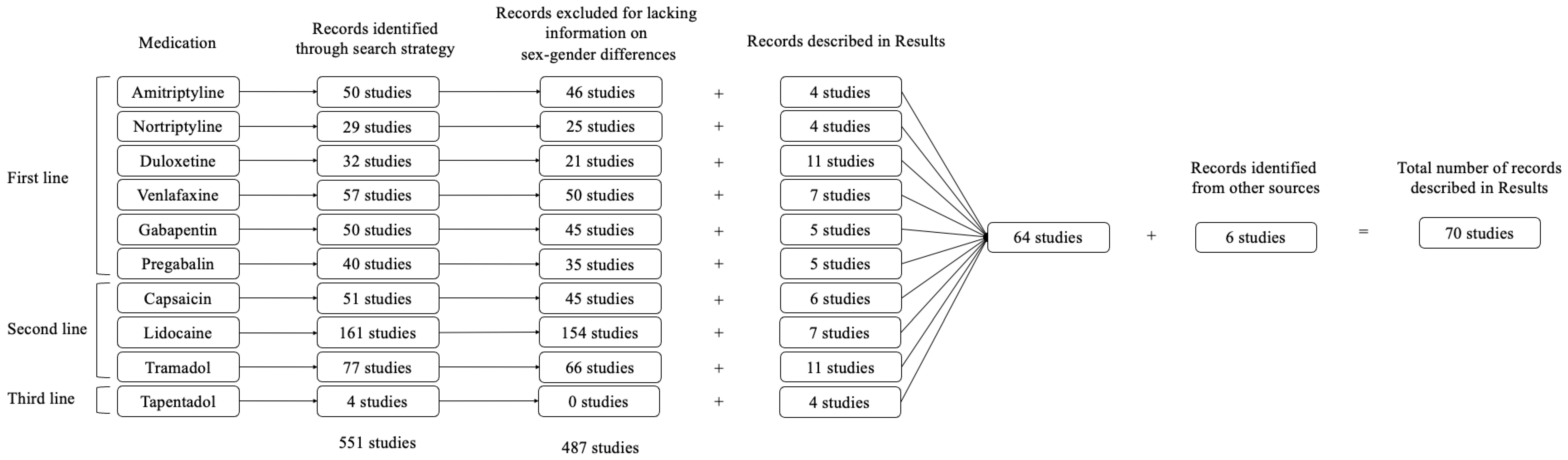
As sex-gender differences have been described in the responses of patients to certain medications, we hypothesized that the responses to medications recommended for neuropathic pain may differ between men and women. We conducted a literature review to identify articles reporting potential sex-gender differences in the efficacy and safety of these medications. Only a limited number of studies investigated potential sex-gender differences. Our results show that women seem to achieve higher blood concentrations than men during treatment with amitriptyline, nortriptyline, duloxetine, venlafaxine, and pregabalin. Compared to men, higher rates of women develop side effects during treatment with gabapentin, lidocaine, and tramadol. Globally, the sex-gender differences would suggest initially administering smaller doses of these medications to women with neuropathic pain compared to those administered to men. However, most of these differences have been revealed by studies focused on the treatment of other diseases (e.g., depression). Studies focused on neuropathic pain have overlooked potential sex-gender differences in patient responses to medications. Despite the fact that up to 60% of patients with neuropathic pain fail to achieve an adequate response to medications, the potential role of sex-gender differences in the efficacy and safety of pharmacotherapy has not adequately been investigated. Targeted studies should be implemented to facilitate personalized treatments for neuropathic pain.
Keywords: neuropathic pain; pharmacological treatment; sex-gender differences neuropathic pain; pharmacological treatment; sex-gender differences