Article

Association between WHO First-Step Analgesic Use and Risk of Breast Cancer in Women of Working Age


1
Department of Applied Statistics, School of Social Science, Gachon University, Seongnam-si 13120, Gyeinggi-do, Republic of Korea
2
Medical Informatics and Health Technology (MiT), Department of Health Care Management, College of Social Science, Gachon University, Seongnam-si 13120, Gyeinggi-do, Republic of Korea
*
Author to whom correspondence should be addressed.
Pharmaceuticals 2023, 16(2), 323; https://doi.org/10.3390/ph16020323
Submission received: 22 December 2022 / Revised: 30 January 2023 / Accepted: 13 February 2023 / Published: 20 February 2023
(This article belongs to the Section Pharmaceutical Technology)

Abstract

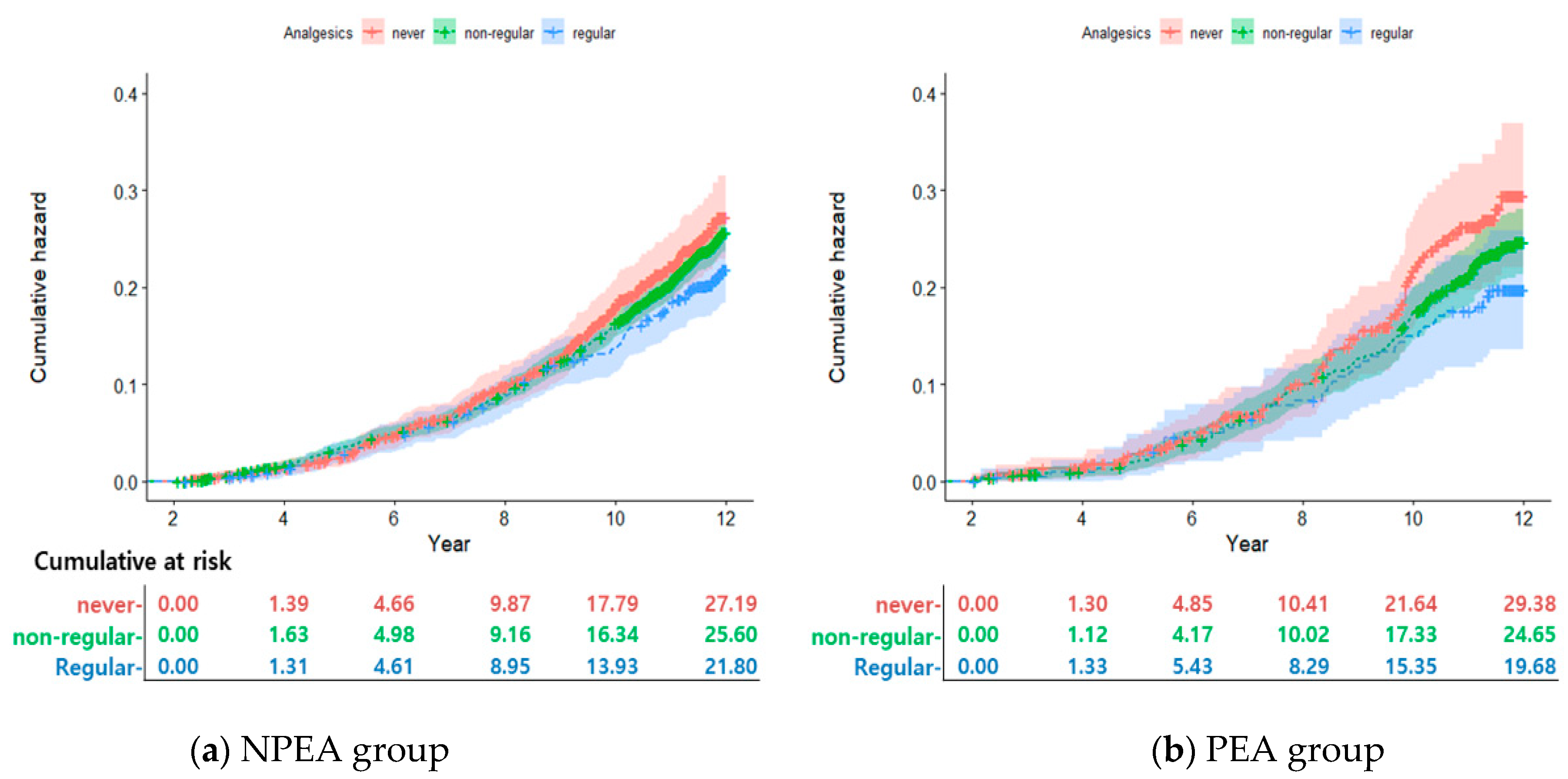
We assessed the association between breast cancer and analgesic use in women of a specific working-age group. The Korean National Health Insurance Service–National Sample Cohort database (KNHIS–NSC) data were analyzed. We calculated hazard ratios (HRs) with 95% confidence intervals (CIs) for patients’ cancer risk based on whether the women participated in economic activity (PEA or not PEA (NPEA) groups) and analgesic use. Additionally, breast cancer incidence variations by age group, and PEA or NPEAs, health behavior, Charlson Comorbidity Index, and analgesic use were evaluated. The PEA group had a higher cancer risk than the NPEA group (HR = 1.542, 95% CI: 1.345–1.768, p < 0.001). Breast cancer risk was high in the PEA, high income, and no history of exercise groups, but significantly reduced in the regular-use-of-analgesics group. Notably, the working age group of 40~49 years, within the PEA group, had the highest HR of breast cancer development (HR = 1.700, 95% CI = 1.361–2.124, p < 0.001); whereas regular analgesic use in those aged 25~39 years decreased breast cancer risk (HR = 0.611, 95% CI = 0.427–0.875, p < 0.05). In conclusion, our results suggest that individuals at a high-risk of comorbidity may benefit from regular use of analgesics, which may prove to be a useful strategy for breast cancer prevention in the Young-aged group.
Keywords: breast neoplasms; occupational health; age groups; economic status; analgesics breast neoplasms; occupational health; age groups; economic status; analgesics