


Magnesium in Ketamine Administration in Treatment-Resistant Depression
 , , ,
, , ,
Abstract
1. Introduction
2. Results
3. Discussion
4. Materials and Methods
4.1. Subjects
4.2. Study Protocol
4.3. Assays
4.4. Statistical Analysis
5. Limitations and Conclusions
Author Contributions
Funding
Institutional Review Board Statement
Informed Consent Statement
Data Availability Statement
Conflicts of Interest
References
- Gelenberg, A.J. The prevalence and impact of depression. J. Clin. Psychiatry 2010. [Google Scholar] [CrossRef] [Scilit]
- McIntyre, R.S.; Filteau, M.J.; Martin, L.; Patry, S.; Carvalho, A.; Cha, D.S.; Barakat, M.; Miguelez, M. Treatment-resistant depression: Definitions, review of the evidence, and algorithmic approach. J. Affect. Disord. 2014. [Google Scholar] [CrossRef] [Scilit]
- Ionescu, D.F.; Rosenbaum, J.F.; Alpert, J.E. Pharmacological approaches to the challenge of treatment-resistant depression. Dialogues Clin. Neurosci. 2015. [Google Scholar] [CrossRef] [Scilit]
- Gaynes, B.; Warden, D.; Trivedi, M.; Wisniewski, S.; Fava, M.; Rush, A.J. What Did STAR*D Teach Us? Results From a Large-Scale, Practical, Clinical Trial for Patients With Depression. Psychiatr. Serv. 2009. [Google Scholar] [CrossRef]
- Berman, R.M.; Cappiello, A.; Anand, A.; Oren, D.A.; Heninger, G.R.; Charney, D.S.; Krystal, J.H. Antidepressant effects of ketamine in depressed patients. Biol. Psychiatry 2000. [Google Scholar] [CrossRef] [Scilit]
- Zarate, C.A.; Singh, J.B.; Carlson, P.J.; Brutsche, N.E.; Ameli, R.; Luckenbaugh, D.A.; Charney, D.S.; Manji, H.K. A randomized trial of an N-methyl-D-aspartate antagonist in treatment-resistant major depression. Arch. Gen. Psychiatry 2006. [Google Scholar] [CrossRef] [Scilit]
- Razmjou, S.; Litteljohn, D.; Rudyk, C.; Syed, S.; Clarke, M.; Pentz, R.; Dwyer, Z.; Hayley, S. The interactive effects of ketamine and magnesium upon depressive-like pathology. Neuropsychiatr. Dis. Treat. 2016. [Google Scholar] [CrossRef] [Scilit]
- Serafini, G.; Howland, R.; Rovedi, F.; Girardi, P.; Amore, M. The Role of Ketamine in Treatment-Resistant Depression: A Systematic Review. Curr. Neuropharmacol. 2014. [Google Scholar] [CrossRef] [Scilit]
- Murck, H. Ketamine, magnesium and major depression—From pharmacology to pathophysiology and back. J. Psychiatr. Res. 2013. [Google Scholar] [CrossRef] [Scilit]
- Coyle, C.M.; Laws, K.R. The use of ketamine as an antidepressant: A systematic review and meta-analysis. Hum. Psychopharmacol. 2015. [Google Scholar] [CrossRef] [Scilit]
- Kishimoto, T.; Chawla, J.M.; Hagi, K.; Zarate, C.A.; Kane, J.M.; Bauer, M.; Correll, C.U. Single-dose infusion ketamine and non-ketamine N-methyl-d-aspartate receptor antagonists for unipolar and bipolar depression: A meta-analysis of efficacy, safety and time trajectories. Psychol. Med. 2016. [Google Scholar] [CrossRef] [Scilit]
- Cubała, W.J.; Landowski, J.; Szyszko, M.; Czarnowski, W. Magnesium in drug-naïve patients with a short-duration, first episode of major depressive disorder: Impact on psychopathological features. Magnes. Res. 2014. [Google Scholar] [CrossRef] [Scilit]
- Serefko, A.; Szopa, A.; Poleszak, E. Magnesium and depression. Magnes. Res. 2016. [Google Scholar] [CrossRef] [Scilit]
- Tarleton, E.K.; Littenberg, B.; MacLean, C.D.; Kennedy, A.G.; Daley, C. Role of magnesium supplementation in the treatment of depression: A randomized clinical trial. PLoS ONE 2017, 12, e0180067. [Google Scholar] [CrossRef] [Scilit]
- Tarleton, E.K.; Littenberg, B. Magnesium intake and depression in adults. J. Am. Board Fam. Med. 2015. [Google Scholar] [CrossRef] [Scilit]
- Cheungpasitporn, W.; Thongprayoon, C.; Mao, M.A.; Srivali, N.; Ungprasert, P.; Varothai, N.; Sanguankeo, A.; Kittanamongkolchai, W.; Erickson, S.B. Hypomagnesaemia linked to depression: A systematic review and meta-analysis. Intern. Med. J. 2015. [Google Scholar] [CrossRef] [Scilit]
- Poleszak, E.; Wlaź, P.; Kedzierska, E.; Nieoczym, D.; Wróbel, A.; Fidecka, S.; Pilc, A.; Nowak, G. NMDA/glutamate mechanism of antidepressant-like action of magnesium in forced swim test in mice. Pharmacol. Biochem. Behav. 2007. [Google Scholar] [CrossRef] [Scilit]
- Górska, N.; Cubała, W.J.; Słupski, J.; Gałuszko-Węgielnik, M. Ketamine and magnesium common pathway of antidepressant action. Magnes. Res. 2018. [Google Scholar] [CrossRef] [Scilit]
- Singewald, N.; Sinner, C.; Hetzenauer, A.; Sartori, S.B.; Murck, H. Magnesium-deficient diet alters depression- and anxiety-related behavior in mice—Influence of desipramine and Hypericum perforatum extract. Neuropharmacology 2004. [Google Scholar] [CrossRef] [Scilit]
- Szewczyk, B.; Szopa, A.; Serefko, A.; Poleszak, E.; Nowak, G. The role of magnesium and zinc in depression: Similarities and differences. Magnes. Res. 2018. [Google Scholar] [CrossRef] [Scilit] [PubMed]
- Poleszak, E.; Wlaź, P.; Szewczyk, B.; Kȩdzierska, E.; Wyska, E.; Librowski, T.; Szymura-Oleksiak, J.; Fidecka, S.; Pilc, A.; Nowak, G. Enhancement of antidepressant-like activity by joint administration of imipramine and magnesium in the forced swim test: Behavioral and pharmacokinetic studies in mice. Pharmacol. Biochem. Behav. 2005. [Google Scholar] [CrossRef] [Scilit] [PubMed]
- Begon, S.; Pickering, G.; Eschalier, A.; Mazur, A.; Rayssiguier, Y.; Dubray, C. Role of spinal NMDA receptors, protein kinase C and nitric oxide synthase in the hyperalgesia induced by magnesium deficiency in rats. Br. J. Pharmacol. 2001. [Google Scholar] [CrossRef] [Scilit]
- Orser, B.; Smith, D.; Henderson, S.; Gelb, A. Magnesium deficiency increases ketamine sensitivity in rats. Can. J. Anaesth. 1997. [Google Scholar] [CrossRef] [Scilit]
- Islam, M.R.; Islam, M.R.; ShalahuddinQusar, M.M.A.; Islam, M.S.; Kabir, M.H.; Mustafizur Rahman, G.K.M.; Islam, M.S.; Hasnat, A. Alterations of serum macro-minerals and trace elements are associated with major depressive disorder: A case-control study. BMC Psychiatry 2018. [Google Scholar] [CrossRef] [Scilit]
- Styczeń, K.; Siwek, M.; Sowa-Kućma, M.; Dudek, D.; Reczyński, W.; Szewczyk, B.; Misztak, P.; Topór-Mądry, R.; Opoka, W.; Nowak, G. The serum magnesium concentration as a potential state marker in patients with unipolar affective disorder. Psychiatr. Pol. 2015. [Google Scholar] [CrossRef] [Scilit]
- Cardoso, C.C.; Lobato, K.R.; Binfaré, R.W.; Ferreira, P.K.; Rosa, A.O.; Santos, A.R.S.; Rodrigues, A.L.S. Evidence for the involvement of the monoaminergic system in the antidepressant-like effect of magnesium. Prog. Neuro-Psychopharmacol. Biol. Psychiatry 2009. [Google Scholar] [CrossRef] [Scilit]
- Barragán-Rodríguez, L.; Rodríguez-Morán, M.; Guerrero-Romero, F. Efficacy and safety of oral magnesium supplementation in the treatment of depression in the elderly with type 2 diabetes: A randomized, equivalent trial. Magnes. Res. 2008. [Google Scholar] [CrossRef]
- Eby, G.A.; Eby, K.L. Rapid recovery from major depression using magnesium treatment. Med. Hypotheses 2006. [Google Scholar] [CrossRef] [Scilit]
- Nechifor, M. Magnesium in major depression. Magnes. Res. 2009. [Google Scholar] [CrossRef] [Scilit]
- Oye, I.; Paulsen, O.; Maurset, A. Effects of ketamine on sensory perception: Evidence for a role of N- methyl-D-aspartate receptors. J. Pharmacol. Exp. Ther. 1992, 260, 1209–1213. [Google Scholar] [PubMed]
- Rabiner, E.A. Imaging of striatal dopamine release elicited with NMDA antagonists: Is there anything there to be seen? J. Psychopharmacol. 2007. [Google Scholar] [CrossRef] [Scilit] [PubMed]
- Morgan, C.J.A.; Curran, H.V. Ketamine use: A review. Addiction 2012. [Google Scholar] [CrossRef] [Scilit]
- Gałuszko-Węgielnik, M.; Wiglusz, M.S.; Słupski, J.; Szałach, Ł.; Włodarczyk, A.; Górska, N.; Szarmach, J.; Jakuszkowiak-Wojten, K.; Wilkowska, A.; Cubała, W.J. Efficacy of ketamine in bipolar depression: Focus on anhedonia. Psychiatr. Danub. 2019, 31, 554–560. [Google Scholar] [PubMed]
- Lally, N.; Nugent, A.C.; Luckenbaugh, D.A.; Ameli, R.; Roiser, J.P.; Zarate, C.A. Anti-anhedonic effect of ketamine and its neural correlates in treatment-resistant bipolar depression. Transl. Psychiatry. 2014. [Google Scholar] [CrossRef] [Scilit]
- Cao, B.; Zhu, J.; Zuckerman, H.; Rosenblat, J.D.; Brietzke, E.; Pan, Z.; Subramanieapillai, M.; Park, C.; Lee, Y.; McIntyre, R.S. Pharmacological interventions targeting anhedonia in patients with major depressive disorder: A systematic review. Prog. Neuro-Psychopharmacol. Biol. Psychiatry 2019. [Google Scholar] [CrossRef] [Scilit]
- Włodarczyk, A.; Cubała, W.J. Safety and tolerability of ketamine use in treatment-resistant bipolar depression patients with regard to central nervous system symptomatology: Literature review and analysis. Medicina 2020, 56, 67. [Google Scholar] [CrossRef] [Scilit] [PubMed]
- Trivedi, M.H.; Corey-Lisle, P.K.; Guo, Z.; Lennox, R.D.; Pikalov, A.; Kim, E. Remission, response without remission, and nonresponse in major depressive disorder: Impact on functioning. Int. Clin. Psychopharmacol. 2009. [Google Scholar] [CrossRef] [Scilit]
- Romeo, V.; Cazzaniga, A.; Maier, J.A.M. Magnesium and the blood-brain barrier in vitro: Effects on permeability and magnesium transport. Magnes. Res. 2019. [Google Scholar] [CrossRef] [Scilit]
- Ryan, M.F.; Barbour, H. Magnesium measurement in routine clinical practice. Ann. Clin. Biochem. 1998. [Google Scholar] [CrossRef] [Scilit]
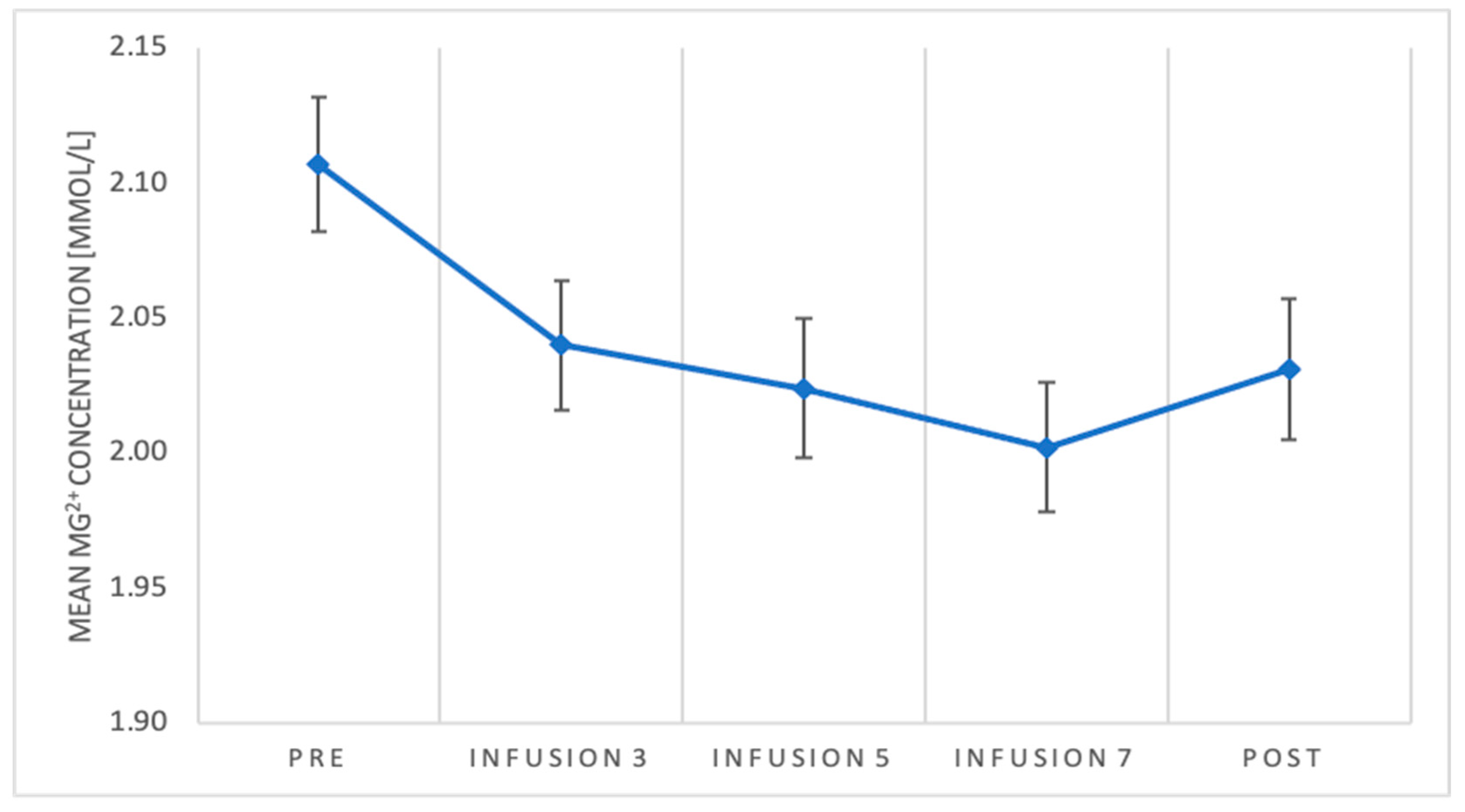
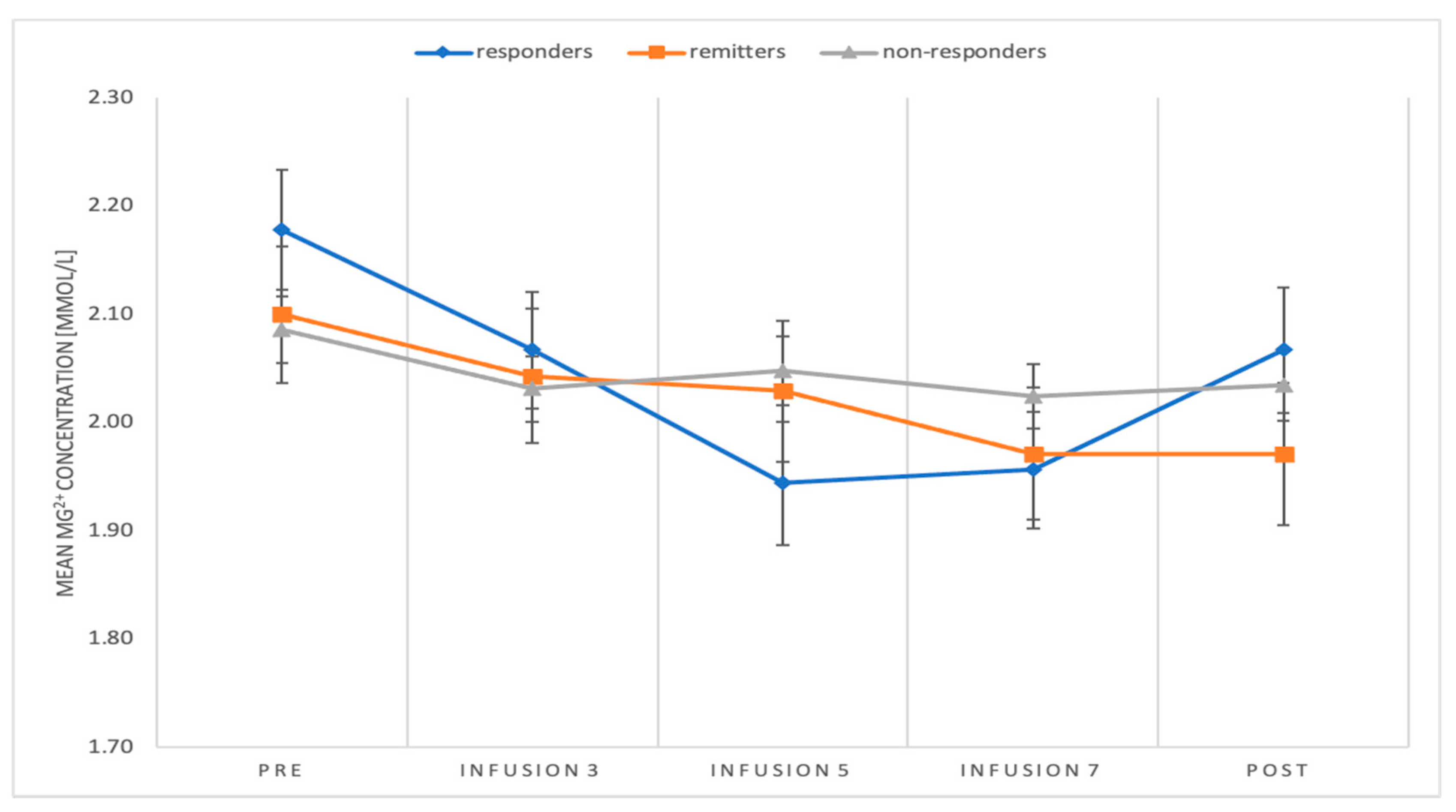

| N | Responder | Remitter | Non-Responder | p | V | |||
|---|---|---|---|---|---|---|---|---|
| Male | (%) | 21 (42.9) | 6 (66.7) | 2 (25.0) | 13 (40.6) | 0.229 | 0.26 | |
| Female | (%) | 28 (57.1) | 3 (33.3) | 6 (75.0) | 19 (59.4) | |||
| Mean age, in years | 50.02 | 53.11 | 42.88 | 50.94 | 0.336 | 0.00 | ||
| Occupation | 0.250 | 0.32 | ||||||
| Employed | 11 (22.4) | 2 (22.2) | 2 (25.0) | 7 (21.9) | ||||
| Unemployed | 27 (55.1) | 7 (77.8) | 3 (37.5) | 18 (56.2) | ||||
| Pension | 10 (20.4) | 0 (0) | 3 (37.5) | 7 (21.9) | ||||
| Seasonal work | 1 (2.0) | 0 (0) | 0 (0) | 1 (3.1) | ||||
| Education | 0.252 | 0.26 | ||||||
| Elementary or lower | 2 (4.1) | 0 (0) | 1 (12.5) | 1 (3.1) | ||||
| Vocational | 5 (10.2) | 2 (22.2) | 1 (12.5) | 2 (6.3) | ||||
| Secondary | 18 (36.7) | 1 (11.1) | 3 (37.5) | 14 (43.8) | ||||
| Higher | 24 (49.0) | 6 (66.7) | 3 (37.5) | 15 (46.9) | ||||
| BMI | 27.92 (5.67) | 28.00 (4.64) | 26.50 (4.72) | 28.25 (6.21) | 0.613 | 0.02 | ||
| Ketamine treatment for: | ||||||||
| MDD | 35 (71.4) | 8 (88.9) | 5 (62.5) | 22 (68.8) | 0.475 | 0.19 | ||
| BP | 14 (28.6) | 2 (11.1) | 5 (37.5) | 7 (31.2) | 0.485 | 0.18 | ||
| Comorbidity | 0.104 | 0.31 | ||||||
| 1 | 21 (42.9) | 6 (66.7) | 2 (25.0) | 13 (40.6) | ||||
| 2 | 10 (20.4) | 2 (22.2) | 1 (12.5) | 7 (21.9) | ||||
| 3 | 4 (8.2) | 1 (11.1) | 2 (25.0) | 1 (3.1) | ||||
| Arterial hypertension | 16 (32.7) | 6 (66.7) | 3 (37.5) | 7 (21.9) | 0.037 | 0.37 | ||
| BP | 4 (8.2) | 1 (11.1) | 2 (25.0) | 1 (3.1) | 0.052 | 0.66 | ||
| MDD | 12 (24.5) | 5 (55.6) | 1 (12.5) | 6 (18.8) | 0.177 | 0.33 | ||
| Diabetes mellitus | 3 (6.1) | 1 (11.1) | 2 (25.0) | 0 (0) | 0.021 | 0.39 | ||
| Hyperlipidaemia | 9 (18.4) | 3 (33.3) | 1 (12.5) | 5 (15.6) | 0.545 | 0.19 | ||
| Post-stroke | 3 (6.1) | 1 (11.1) | 0 (0) | 2 (6.3) | 0.731 | 0.14 | ||
| Post-myocardial infarction | 0 (0) | 0 (0) | 0 (0) | 0 (0) | - | - | ||
| Epilepsy | 6 (12.2) | 0 (0) | 3 (37.5) | 3 (9.4) | 0.060 | 0.36 | ||
| Other | 16 (32.7) | 2 (22.2) | 1 (12.5) | 13 (40.6) | 0.330 | 0.24 | ||
| Coexisting treatment | ||||||||
| TCA | 8 (16.3) | 1 (11.1) | 1 (13.5) | 6 (18.8) | 1.000 | 0.09 | ||
| Clomipramine | 4 (8.2) | 0 (0) | 1 (12.5) | 3 (9.4) | 0.789 | 0.15 | ||
| Amitriptyline | 4 (8.2) | 1 (11.1) | 0 (0) | 3 (9.4) | 1.000 | 0.13 | ||
| SSRI total | 23 (46.9) | 5 (55.6) | 2 (25.0) | 16 (50.0) | 0.413 | 0.20 | ||
| Fluvoxamine | 1 (2.0) | 0 (0) | 0 (0) | 1 (3.1) | 1.000 | 0.11 | ||
| Paroxetine | 5(10.2) | 1 (11.1) | 0 (0) | 4 (12.5) | 0.813 | 0.15 | ||
| Fluoxetine | 8 (16.3) | 2 (22.2) | 0 (0) | 6 (18.8) | 0.534 | 0.20 | ||
| Sertraline | 3 (6.1) | 1 (11.1) | 0 (0) | 2 (6.3) | 0.731 | 0.14 | ||
| Citalopram | 4 (8.2) | 0 (0) | 2 (25.0) | 2 (6.3) | 0.179 | 0.29 | ||
| Escitalopram | 2 (4.1) | 1 (11.1) | 0 (0) | 1 (3.1) | 0.578 | 0.18 | ||
| SNRI total | 11 (22.4) | 2 (22.2) | 2 (25.0) | 7 (21.9) | 1.000 | 0.03 | ||
| Venlafaxine | 8 (16.3) | 1 (11.1) | 1 (12.5) | 6 (18.8) | 1.000 | 0.10 | ||
| Duloxetine | 3 (6.1) | 1 (11.1) | 1 (12.5) | 1 (3.1) | 0.273 | 0.17 | ||
| Other ADTs: | 0.749 | 0.14 | ||||||
| 1 | 15 (30.6) | 4 (44.4) | 2 (25.0) | 9 (28.1) | ||||
| 2 | 3 (6.1) | 0 (0) | 1 (12.5) | 2 (6.3) | ||||
| Mirtazapine | 9 (18.4) | 2 (22.2) | 1 (12.5) | 6 (18.8) | 1.000 | 0.08 | ||
| Mianserin | 3 (6.1) | 1 (11.1) | 0 (0) | 2 (6.3) | 0.731 | 0.14 | ||
| Trazodone | 4 (8.2) | 1 (11.1) | 1 (12.5) | 2 (6.3) | 0.432 | 0.10 | ||
| Bupropion | 3 (6.1) | 0 (0) | 1 (12.5) | 2 (6.3) | 0.488 | 0.15 | ||
| Vortioxetine | 2 (4.1) | 0 (0) | 1 (12.5) | 1 (3.1) | 0.333 | 0.20 | ||
| Antipsychotics | 0.806 | 0.15 | ||||||
| 1 | 12 (24.5) | 2 (22.2) | 1 (12.5) | 9 (28.1) | ||||
| 2 | 5 (10.2) | 0 (0) | 1 (12.5) | 4 (12.5) | ||||
| Aripiprazole | 6 (12.2) | 0 (0) | 1 (12.5) | 5 (15.6) | 0.685 | 0.18 | ||
| Quetiapine | 10 (20.4) | 1 (11.1) | 1 (12.5) | 8 (25.0) | 0.668 | 0.16 | ||
| Olanzapine | 5 (10.2) | 1 (11.1) | 1 (12.5) | 3 (9.4) | 1.000 | 0.04 | ||
| Risperidone | 1 (2.0) | 0 (0) | 0 (0) | 1 (3.1) | 1.000 | 0.11 | ||
| Mood stabilisers | 0.348 | 0.29 | ||||||
| 1 | 15 (30.6) | 2 (22.2) | 4 (50.0) | 9 (28.1) | ||||
| 2 | 6 (12.2) | 1 (11.1) | 0 (0) | 5 (15.6) | ||||
| 3 | 1 (2.0) | 0 (0) | 1 (12.5) | 0 (0) | ||||
| Lithium | 5 (10.2) | 0 (0) | 1 (12,5) | 4 (12.5) | 0.643 | 0.16 | ||
| Valproate | 9 (18.4) | 2 (22.2) | 3 (37.5) | 4 (12.5) | 0.160 | 0.24 | ||
| Lamotrigine | 7 (14.3) | 1 (11.1) | 1 (12.5) | 5 (15.6) | 1.000 | 0.05 | ||
| Comorbidity | F | df | p | η2p |
|---|---|---|---|---|
| No. of comorbidities | 1.38 | 12 | 0.182 | 0.09 |
| Arterial hypertension | 0.45 | 4 | 0.771 | 0.01 |
| Diabetes mellitus | 0.60 | 4 | 0.664 | 0.01 |
| Hyperlipidemia | 0.48 | 4 | 0.750 | 0.01 |
| Stroke | 1.89 | 4 | 0.114 | 0.04 |
| Epilepsy | 1.45 | 4 | 0.220 | 0.03 |
| Other | 0.33 | 4 | 0.855 | 0.01 |
Publisher’s Note: MDPI stays neutral with regard to jurisdictional claims in published maps and institutional affiliations. |
© 2021 by the authors. Licensee MDPI, Basel, Switzerland. This article is an open access article distributed under the terms and conditions of the Creative Commons Attribution (CC BY) license (https://creativecommons.org/licenses/by/4.0/).
Share and Cite
Górska, N.; Cubała, W.J.; Słupski, J.; Wiglusz, M.S.; Gałuszko-Węgielnik, M.; Kawka, M.; Grzegorzewska, A. Magnesium in Ketamine Administration in Treatment-Resistant Depression. Pharmaceuticals 2021, 14, 430. https://doi.org/10.3390/ph14050430
Górska N, Cubała WJ, Słupski J, Wiglusz MS, Gałuszko-Węgielnik M, Kawka M, Grzegorzewska A. Magnesium in Ketamine Administration in Treatment-Resistant Depression. Pharmaceuticals. 2021; 14(5):430. https://doi.org/10.3390/ph14050430
Chicago/Turabian StyleGórska, Natalia, Wiesław Jerzy Cubała, Jakub Słupski, Mariusz Stanisław Wiglusz, Maria Gałuszko-Węgielnik, Mateusz Kawka, and Agata Grzegorzewska. 2021. "Magnesium in Ketamine Administration in Treatment-Resistant Depression" Pharmaceuticals 14, no. 5: 430. https://doi.org/10.3390/ph14050430
APA StyleGórska, N., Cubała, W. J., Słupski, J., Wiglusz, M. S., Gałuszko-Węgielnik, M., Kawka, M., & Grzegorzewska, A. (2021). Magnesium in Ketamine Administration in Treatment-Resistant Depression. Pharmaceuticals, 14(5), 430. https://doi.org/10.3390/ph14050430

