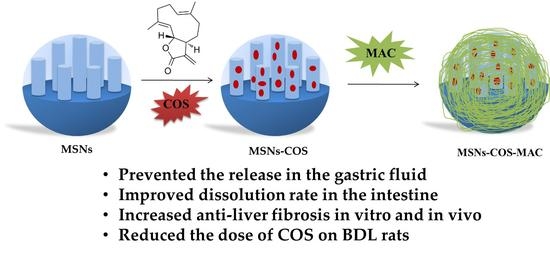
Costunolide Loaded in pH-Responsive Mesoporous Silica Nanoparticles for Increased Stability and an Enhanced Anti-Fibrotic Effect

Abstract
Share and Cite
Niu, X.; Wang, X.; Niu, B.; Meng, Y.; He, H.; Wang, Y.; Li, G. Costunolide Loaded in pH-Responsive Mesoporous Silica Nanoparticles for Increased Stability and an Enhanced Anti-Fibrotic Effect. Pharmaceuticals 2021, 14, 951. https://doi.org/10.3390/ph14100951
Niu X, Wang X, Niu B, Meng Y, He H, Wang Y, Li G. Costunolide Loaded in pH-Responsive Mesoporous Silica Nanoparticles for Increased Stability and an Enhanced Anti-Fibrotic Effect. Pharmaceuticals. 2021; 14(10):951. https://doi.org/10.3390/ph14100951
Chicago/Turabian StyleNiu, Xia, Xiaomei Wang, Bingyu Niu, Yanan Meng, Hongwei He, Yucheng Wang, and Guiling Li. 2021. "Costunolide Loaded in pH-Responsive Mesoporous Silica Nanoparticles for Increased Stability and an Enhanced Anti-Fibrotic Effect" Pharmaceuticals 14, no. 10: 951. https://doi.org/10.3390/ph14100951
APA StyleNiu, X., Wang, X., Niu, B., Meng, Y., He, H., Wang, Y., & Li, G. (2021). Costunolide Loaded in pH-Responsive Mesoporous Silica Nanoparticles for Increased Stability and an Enhanced Anti-Fibrotic Effect. Pharmaceuticals, 14(10), 951. https://doi.org/10.3390/ph14100951