Long-Acting Anti-HIV Drugs Targeting HIV-1 Reverse Transcriptase and Integrase



Abstract
1. Introduction
2. LA Antivirals Targeting HIV-1 RT
2.1. Long-Acting NRTIs
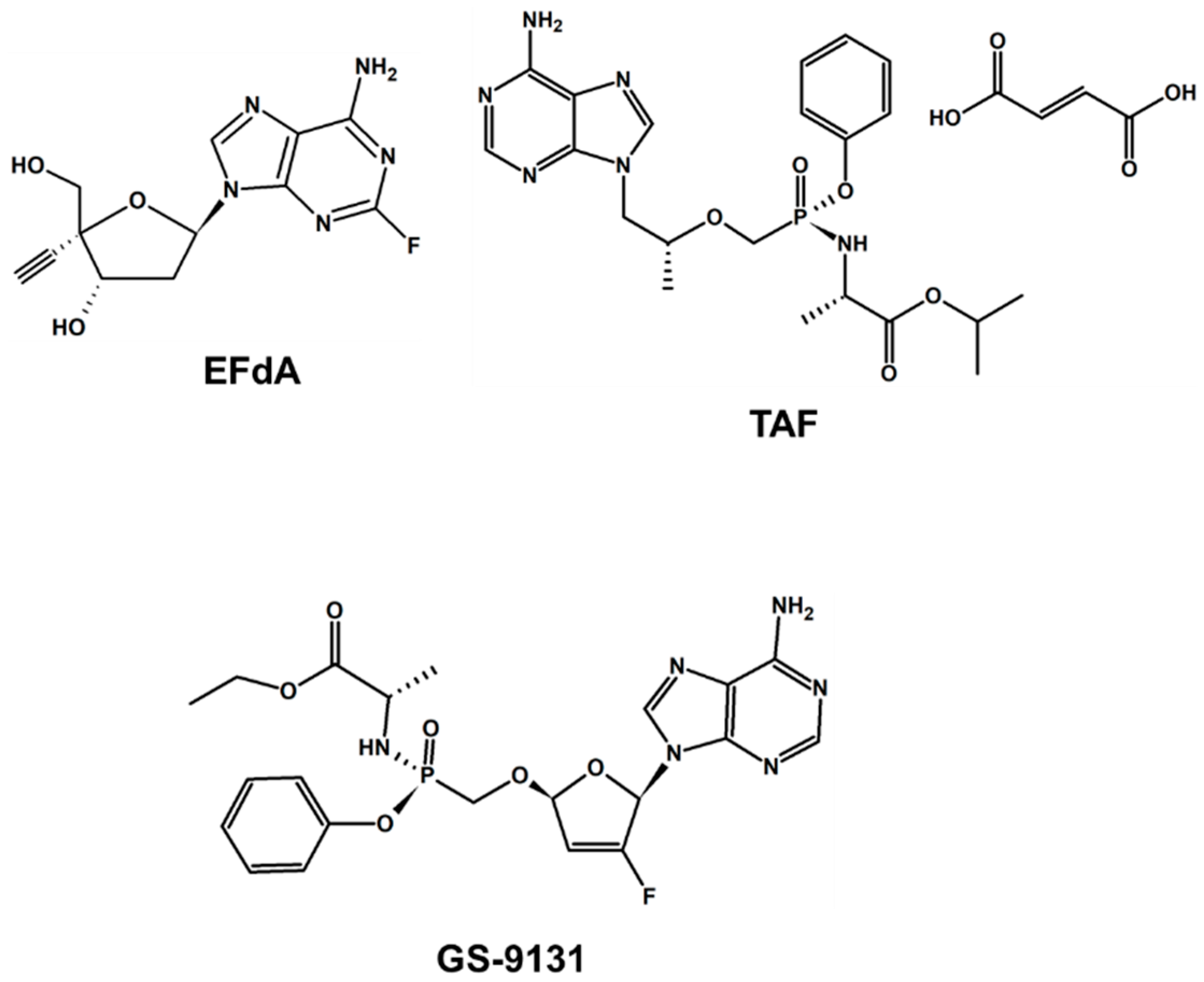
2.1.1. EFdA (Islatravir)
2.1.2. Tenofovir Alafenamide Fumarate
2.1.3. GS-9131 (Rovafovir Etalafenamide)
2.2. Long-Acting NNRTIs
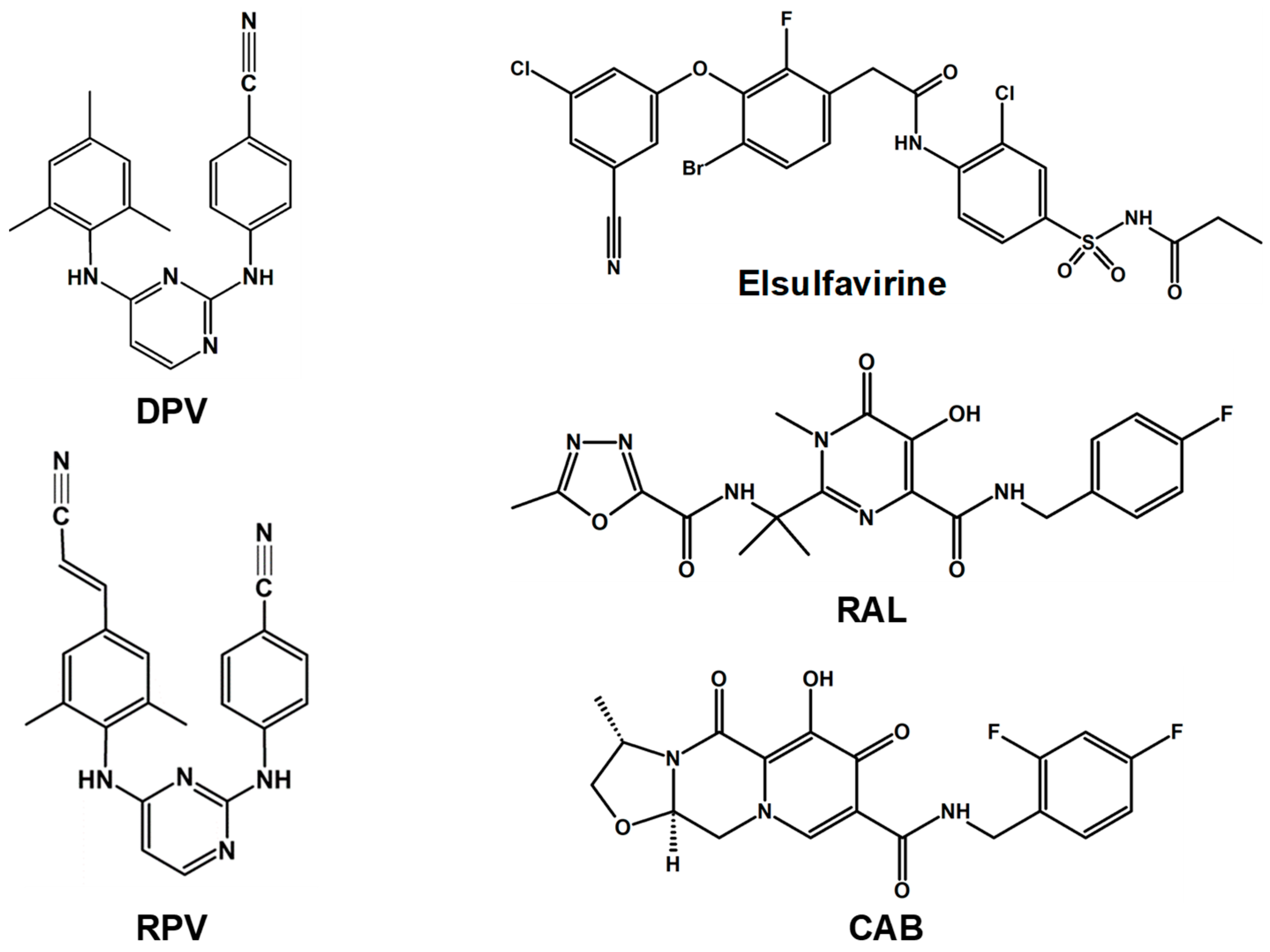
2.2.1. Dapivirine
2.2.2. Rilpivirine
2.2.3. Elsulfavirine
3. LA Antivirals Targeting HIV-1 IN
3.1. Cabotegravir
3.2. Raltegravir
4. Challenges of Subtype-Specific Polymorphisms and Pre-Existing Resistance Mutations
5. Clinical Challenges with LA Anti-HIV Compounds
6. Conclusions
Author Contributions
Funding
Conflicts of Interest
References
- Teeraananchai, S.; Kerr, S.J.; Amin, J.; Ruxrungtham, K.; Law, M.G. Life expectancy of HIV-positive people after starting combination antiretroviral therapy: A meta-analysis. HIV Med. 2017, 18, 256–266. [Google Scholar] [CrossRef] [PubMed]
- Gulick, R.M.; Flexner, C. Long-acting HIV drugs for treatment and prevention. Annu. Rev. Med. 2019, 70, 137–150. [Google Scholar] [CrossRef]
- Gunthard, H.F.; Saag, M.S.; Benson, C.A.; del Rio, C.; Eron, J.J.; Gallant, J.E.; Hoy, J.F.; Mugavero, M.J.; Sax, P.E.; Thompson, M.A.; et al. Antiretroviral drugs for treatment and prevention of HIV infection in adults: 2016 recommendations of the international antiviral society-USA panel. JAMA 2016, 316, 191–210. [Google Scholar] [CrossRef] [PubMed]
- Saag, M.S.; Benson, C.A.; Gandhi, R.T.; Hoy, J.F.; Landovitz, R.J.; Mugavero, M.J.; Sax, P.E.; Smith, D.M.; Thompson, M.A.; Buchbinder, S.P.; et al. Antiretroviral drugs for treatment and prevention of HIV infection in adults: 2018 recommendations of the international antiviral society-USA panel. JAMA 2018, 320, 379–396. [Google Scholar] [CrossRef] [PubMed]
- Preexposure Prophylaxis for the Prevention of HIV Infection in the United States—2017 Update: A Clinical Practice Guideline. Available online: https://www.cdc.gov/hiv/pdf/risk/prep/cdc-hiv-prep-guidelines-2017.pdf (accessed on 12 March 2019).
- Molina, J.M.; Capitant, C.; Spire, B.; Pialoux, G.; Cotte, L.; Charreau, I.; Tremblay, C.; Le Gall, J.M.; Cua, E.; Pasquet, A.; et al. On-demand preexposure prophylaxis in men at high risk for HIV-1 infection. N. Engl. J. Med. 2015, 373, 2237–2246. [Google Scholar] [CrossRef]
- McCormack, S.; Dunn, D.T.; Desai, M.; Dolling, D.I.; Gafos, M.; Gilson, R.; Sullivan, A.K.; Clarke, A.; Reeves, I.; Schembri, G.; et al. Pre-exposure prophylaxis to prevent the acquisition of HIV-1 infection (proud): Effectiveness results from the pilot phase of a pragmatic open-label randomised trial. Lancet 2016, 387, 53–60. [Google Scholar] [CrossRef]
- Winner, B.; Peipert, J.F.; Zhao, Q.; Buckel, C.; Madden, T.; Allsworth, J.E.; Secura, G.M. Effectiveness of long-acting reversible contraception. N. Engl. J. Med. 2012, 366, 1998–2007. [Google Scholar] [CrossRef]
- Rattan, J.; Noznesky, E.; Curry, D.W.; Galavotti, C.; Hwang, S.; Rodriguez, M. Rapid contraceptive uptake and changing method mix with high use of long-acting reversible contraceptives in crisis-affected populations in chad and the democratic republic of the congo. Glob. Health Sci. Pract. 2016, 4 (Suppl. 2), S5–S20. [Google Scholar] [CrossRef]
- Fok, W.K.; Blumenthal, P.D. HIV and contraception. Curr. Opin. Obstet. Gynecol. 2017, 29, 419–426. [Google Scholar] [CrossRef] [PubMed]
- Sarafianos, S.G.; Marchand, B.; Das, K.; Himmel, D.M.; Parniak, M.A.; Hughes, S.H.; Arnold, E. Structure and function of HIV-1 reverse transcriptase: Molecular mechanisms of polymerization and inhibition. J. Mol. Biol. 2009, 385, 693–713. [Google Scholar] [CrossRef] [PubMed]
- Singh, K.; Marchand, B.; Kirby, K.A.; Michailidis, E.; Sarafianos, S.G. Structural aspects of drug resistance and inhibition of HIV-1 reverse transcriptase. Viruses 2010, 2, 606–638. [Google Scholar] [CrossRef] [PubMed]
- Menendez-Arias, L. Molecular basis of human immunodeficiency virus drug resistance: An update. Antivir. Res. 2010, 85, 210–231. [Google Scholar] [CrossRef] [PubMed]
- Singh, K.; Flores, J.A.; Kirby, K.A.; Neogi, U.; Sonnerborg, A.; Hachiya, A.; Das, K.; Arnold, E.; McArthur, C.; Parniak, M.; et al. Drug resistance in non-b subtype HIV-1: Impact of HIV-1 reverse transcriptase inhibitors. Viruses 2014, 6, 3535–3562. [Google Scholar] [CrossRef] [PubMed]
- Das, K.; Martinez, S.E.; Bauman, J.D.; Arnold, E. HIV-1 reverse transcriptase complex with DNA and nevirapine reveals non-nucleoside inhibition mechanism. Nat. Struct. Mol. Biol. 2012, 19, 253–259. [Google Scholar] [CrossRef]
- Kawamoto, A.; Kodama, E.; Sarafianos, S.G.; Sakagami, Y.; Kohgo, S.; Kitano, K.; Ashida, N.; Iwai, Y.; Hayakawa, H.; Nakata, H.; et al. 2′-deoxy-4′-c-ethynyl-2-halo-adenosines active against drug-resistant human immunodeficiency virus type 1 variants. Int. J. Biochem. Cell Biol. 2008, 40, 2410–2420. [Google Scholar] [CrossRef] [PubMed]
- Michailidis, E.; Marchand, B.; Kodama, E.N.; Singh, K.; Matsuoka, M.; Kirby, K.A.; Ryan, E.M.; Sawani, A.M.; Nagy, E.; Ashida, N.; et al. Mechanism of inhibition of HIV-1 reverse transcriptase by 4′-ethynyl-2-fluoro-2′-deoxyadenosine triphosphate, a translocation-defective reverse transcriptase inhibitor. J. Biol. Chem. 2009, 284, 35681–35691. [Google Scholar] [CrossRef]
- Michailidis, E.; Huber, A.D.; Ryan, E.M.; Ong, Y.T.; Leslie, M.D.; Matzek, K.B.; Singh, K.; Marchand, B.; Hagedorn, A.N.; Kirby, K.A.; et al. 4′-ethynyl-2-fluoro-2′-deoxyadenosine (efda) inhibits HIV-1 reverse transcriptase with multiple mechanisms. J. Biol. Chem. 2014, 289, 24533–24548. [Google Scholar] [CrossRef] [PubMed]
- Michailidis, E.; Ryan, E.M.; Hachiya, A.; Kirby, K.A.; Marchand, B.; Leslie, M.D.; Huber, A.D.; Ong, Y.T.; Jackson, J.C.; Singh, K.; et al. Hypersusceptibility mechanism of tenofovir-resistant HIV to efda. Retrovirology 2013, 10, 65. [Google Scholar] [CrossRef] [PubMed]
- Salie, Z.L.; Kirby, K.A.; Michailidis, E.; Marchand, B.; Singh, K.; Rohan, L.C.; Kodama, E.N.; Mitsuya, H.; Parniak, M.A.; Sarafianos, S.G. Structural basis of HIV inhibition by translocation-defective rt inhibitor 4′-ethynyl-2-fluoro-2′-deoxyadenosine (efda). Proc. Natl. Acad. Sci. USA 2016, 113, 9274–9279. [Google Scholar] [CrossRef]
- Hachiya, A.; Reeve, A.B.; Marchand, B.; Michailidis, E.; Ong, Y.T.; Kirby, K.A.; Leslie, M.D.; Oka, S.; Kodama, E.N.; Rohan, L.C.; et al. Evaluation of combinations of 4′-ethynyl-2-fluoro-2′-deoxyadenosine with clinically used antiretroviral drugs. Antimicrob. Agents Chemother. 2013, 57, 4554–4558. [Google Scholar] [CrossRef]
- Markowitz, M.; Sarafianos, S.G. 4′-ethynyl-2-fluoro-2′-deoxyadenosine, mk-8591: A novel HIV-1 reverse transcriptase translocation inhibitor. Curr. Opin. HIV AIDS 2018, 13, 294–299. [Google Scholar] [CrossRef]
- Takamatsu, Y.; Das, D.; Kohgo, S.; Hayashi, H.; Delino, N.S.; Sarafianos, S.G.; Mitsuya, H.; Maeda, K. The high genetic barrier of efda/mk-8591 stems from strong interactions with the active site of drug-resistant HIV-1 reverse transcriptase. Cell Chem. Biol. 2018, 25, 1268–1278. [Google Scholar] [CrossRef] [PubMed]
- Maeda, K.; Desai, D.V.; Aoki, M.; Nakata, H.; Kodama, E.N.; Mitsuya, H. Delayed emergence of HIV-1 variants resistant to 4′-ethynyl-2-fluoro-2′-deoxyadenosine: Comparative sequential passage study with lamivudine, tenofovir, emtricitabine and bms-986001. Antivir. Ther. 2014, 19, 179–189. [Google Scholar] [CrossRef] [PubMed]
- Njenda, D.T.; Aralaguppe, S.G.; Singh, K.; Rao, R.; Sonnerborg, A.; Sarafianos, S.G.; Neogi, U. Antiretroviral potency of 4′-ethnyl-2′-fluoro-2′-deoxyadenosine, tenofovir alafenamide and second-generation nnrtis across diverse HIV-1 subtypes. J. Antimicrob. Chemother. 2018, 73, 2721–2728. [Google Scholar] [CrossRef] [PubMed]
- Grobler, J.; McHale, C.; Freddo, C.; Dreyer, D.; Sun, L.; Vavrek, M.; Breidinger, S.; Fillgrove, K.; Hazuda, D.; Lai, M.-T. Mk-8591 concentrations at sites of HIV transmission and replication. In Proceedings of the Conference on Retroviruses and Opportunistic Infections, Seattle, WA, USA, 13–16 February 2017. [Google Scholar]
- Barrett, S.E.; Teller, R.S.; Forster, S.P.; Li, L.; Mackey, M.A.; Skomski, D.; Yang, Z.; Fillgrove, K.L.; Doto, G.J.; Wood, S.L.; et al. Extended-duration mk-8591-eluting implant as a candidate for HIV treatment and prevention. Antimicrob. Agents Chemother. 2018, 62, e1058-18. [Google Scholar] [CrossRef] [PubMed]
- Flexner, C. Antiretroviral implants for treatment and prevention of HIV infection. Curr. Opin. HIV AIDS 2018, 13, 374–380. [Google Scholar] [CrossRef] [PubMed]
- Zhang, W.; Hu, M.; Shi, Y.; Gong, T.; Dezzutti, C.S.; Moncla, B.; Sarafianos, S.G.; Parniak, M.A.; Rohan, L.C. Vaginal microbicide film combinations of two reverse transcriptase inhibitors, efda and csic, for the prevention of HIV-1 sexual transmission. Pharm. Res. 2015, 32, 2960–2972. [Google Scholar] [CrossRef] [PubMed]
- Zhang, W.; Parniak, M.A.; Mitsuya, H.; Sarafianos, S.G.; Graebing, P.W.; Rohan, L.C. Preformulation studies of efda, a novel nucleoside reverse transcriptase inhibitor for HIV prevention. Drug Dev. Ind. Pharm. 2014, 40, 1101–1111. [Google Scholar] [CrossRef] [PubMed][Green Version]
- Zhang, W.; Parniak, M.A.; Sarafianos, S.G.; Cost, M.R.; Rohan, L.C. Development of a vaginal delivery film containing efda, a novel anti-HIV nucleoside reverse transcriptase inhibitor. Int. J. Pharm. 2014, 461, 203–213. [Google Scholar] [CrossRef]
- Murphey-Corb, M.; Rajakumar, P.; Michael, H.; Nyaundi, J.; Didier, P.J.; Reeve, A.B.; Mitsuya, H.; Sarafianos, S.G.; Parniak, M.A. Response of simian immunodeficiency virus to the novel nucleoside reverse transcriptase inhibitor 4′-ethynyl-2-fluoro-2′-deoxyadenosine in vitro and in vivo. Antimicrob. Agents Chemother. 2012, 56, 4707–4712. [Google Scholar] [CrossRef]
- Stoddart, C.A.; Galkina, S.A.; Joshi, P.; Kosikova, G.; Moreno, M.E.; Rivera, J.M.; Sloan, B.; Reeve, A.B.; Sarafianos, S.G.; Murphey-Corb, M.; et al. Oral administration of the nucleoside efda (4′-ethynyl-2-fluoro-2′-deoxyadenosine) provides rapid suppression of HIV viremia in humanized mice and favorable pharmacokinetic properties in mice and the rhesus macaque. Antimicrob. Agents Chemother. 2015, 59, 4190–4198. [Google Scholar] [CrossRef] [PubMed]
- Friedman, E.; Schuermann, D.; Rudd, D.J.; Fox-Bosetti, S.; Zhang, S.; Robberechts, M.; Hueser, H.; Hazuda, D.J.; Iwamoto, M.; Grobler, J. A single monotherapy dose of mk-8591, a novel nrti, suppresses HIV for 10 days. In Proceedings of the Conference on Retroviruses and Opportunistic Infections, Boston, MA, USA, 22–25 February 2016. [Google Scholar]
- Grobler, J.; Friedman, E.; Barrett, S.E.; Wood, S.L.; Ankrom, W.; Fillgrove, K.L.; Lai, M.-T.; Gindy, M.; Iwamoto, M.; Hazuda, D.J. Long-acting oral and parenteral dosing of mk-8591 for HIV treatment or prophylaxis. In Proceedings of the Conference on Retroviruses and Opportunistic Infections, Boston, MA, USA, 22–25 February 2016. [Google Scholar]
- Ruane, P.J.; DeJesus, E.; Berger, D.; Markowitz, M.; Bredeek, U.F.; Callebaut, C.; Zhong, L.; Ramanathan, S.; Rhee, M.S.; Fordyce, M.W.; et al. Antiviral activity, safety, and pharmacokinetics/pharmacodynamics of tenofovir alafenamide as 10-day monotherapy in HIV-1-positive adults. J. Acquir. Immune Defic. Syndr. 2013, 63, 449–455. [Google Scholar] [CrossRef]
- Margot, N.A.; Johnson, A.; Miller, M.D.; Callebaut, C. Characterization of HIV-1 resistance to tenofovir alafenamide in vitro. Antimicrob. Agents Chemother. 2015, 59, 5917–5924. [Google Scholar] [CrossRef]
- Sax, P.E.; Wohl, D.; Yin, M.T.; Post, F.; DeJesus, E.; Saag, M.; Pozniak, A.; Thompson, M.; Podzamczer, D.; Molina, J.M.; et al. Tenofovir alafenamide versus tenofovir disoproxil fumarate, coformulated with elvitegravir, cobicistat, and emtricitabine, for initial treatment of HIV-1 infection: Two randomised, double-blind, phase 3, non-inferiority trials. Lancet 2015, 385, 2606–2615. [Google Scholar] [CrossRef]
- Gunawardana, M.; Remedios-Chan, M.; Miller, C.S.; Fanter, R.; Yang, F.; Marzinke, M.A.; Hendrix, C.W.; Beliveau, M.; Moss, J.A.; Smith, T.J.; et al. Pharmacokinetics of long-acting tenofovir alafenamide (gs-7340) subdermal implant for HIV prophylaxis. Antimicrob. Agents Chemother. 2015, 59, 3913–3919. [Google Scholar] [CrossRef] [PubMed]
- Schlesinger, E.; Johengen, D.; Luecke, E.; Rothrock, G.; McGowan, I.; van der Straten, A.; Desai, T. A tunable, biodegradable, thin-film polymer device as a long-acting implant delivering tenofovir alafenamide fumarate for HIV pre-exposure prophylaxis. Pharm. Res. 2016, 33, 1649–1656. [Google Scholar] [CrossRef] [PubMed]
- O’Neill, A.M. Perceptual rotations on children’s rorschachs. J. Clin. Psychol. 1989, 45, 809–813. [Google Scholar] [CrossRef]
- Smith, J.M.; Moss, J.A.; Srinivasan, P.; Butkyavichene, I.; Gunawardana, M.; Fanter, R.; Miller, C.S.; Sanchez, D.; Yang, F.; Ellis, S.; et al. Novel multipurpose pod-intravaginal ring for the prevention of HIV, hsv, and unintended pregnancy: Pharmacokinetic evaluation in a macaque model. PLoS ONE 2017, 12, e0185946. [Google Scholar] [CrossRef] [PubMed]
- Cihlar, T.; Ray, A.S.; Boojamra, C.G.; Zhang, L.; Hui, H.; Laflamme, G.; Vela, J.E.; Grant, D.; Chen, J.; Myrick, F.; et al. Design and profiling of gs-9148, a novel nucleotide analog active against nucleoside-resistant variants of human immunodeficiency virus type 1, and its orally bioavailable phosphonoamidate prodrug, gs-9131. Antimicrob. Agents Chemother. 2008, 52, 655–665. [Google Scholar] [CrossRef]
- Ray, A.S.; Vela, J.E.; Boojamra, C.G.; Zhang, L.; Hui, H.; Callebaut, C.; Stray, K.; Lin, K.Y.; Gao, Y.; Mackman, R.L.; et al. Intracellular metabolism of the nucleotide prodrug gs-9131, a potent anti-human immunodeficiency virus agent. Antimicrob. Agents Chemother. 2008, 52, 648–654. [Google Scholar] [CrossRef] [PubMed]
- White, K.L.; Margot, N.; Stray, K.; Yu, H.; Stepan, G.; Boojamra, C.; Mackman, R.; Ray, A.; Miller, M.D.; Cilhar, T. Gs-9131 is a novel nrti with activity against nrti-resistant HIV-1. In Proceedings of the Conference on Retroviruses and Opportunistic Infections, Seattle, WA, USA, 13–16 February 2017. [Google Scholar]
- Mackman, R.L.; Ray, A.S.; Hui, H.C.; Zhang, L.; Birkus, G.; Boojamra, C.G.; Desai, M.C.; Douglas, J.L.; Gao, Y.; Grant, D.; et al. Discovery of gs-9131: Design, synthesis and optimization of amidate prodrugs of the novel nucleoside phosphonate HIV reverse transcriptase (rt) inhibitor gs-9148. Bioorg. Med. Chem. 2010, 18, 3606–3617. [Google Scholar] [CrossRef]
- Das, K.; Clark, A.D., Jr.; Lewi, P.J.; Heeres, J.; De Jonge, M.R.; Koymans, L.M.; Vinkers, H.M.; Daeyaert, F.; Ludovici, D.W.; Kukla, M.J.; et al. Roles of conformational and positional adaptability in structure-based design of tmc125-r165335 (etravirine) and related non-nucleoside reverse transcriptase inhibitors that are highly potent and effective against wild-type and drug-resistant HIV-1 variants. J. Med. Chem. 2004, 47, 2550–2560. [Google Scholar]
- Nel, A.; Haazen, W.; Nuttall, J.; Romano, J.; Rosenberg, Z.; van Niekerk, N. A safety and pharmacokinetic trial assessing delivery of dapivirine from a vaginal ring in healthy women. AIDS 2014, 28, 1479–1487. [Google Scholar] [CrossRef]
- Chen, B.A.; Panther, L.; Marzinke, M.A.; Hendrix, C.W.; Hoesley, C.J.; van der Straten, A.; Husnik, M.J.; Soto-Torres, L.; Nel, A.; Johnson, S.; et al. Phase 1 safety, pharmacokinetics, and pharmacodynamics of dapivirine and maraviroc vaginal rings: A double-blind randomized trial. J. Acquir. Immune Defic. Syndr. 2015, 70, 242–249. [Google Scholar] [CrossRef] [PubMed]
- Baeten, J.M.; Palanee-Phillips, T.; Brown, E.R.; Schwartz, K.; Soto-Torres, L.E.; Govender, V.; Mgodi, N.M.; Matovu Kiweewa, F.; Nair, G.; Mhlanga, F.; et al. Use of a vaginal ring containing dapivirine for HIV-1 prevention in women. N. Engl. J. Med. 2016, 375, 2121–2132. [Google Scholar] [CrossRef]
- Riddler, S.A.; Balkus, J.E.; Parikh, U.M.; Mellors, J.W.; Akello, C.; Dadabhai, S.; Mhlanga, F.; Ramjee, G.; Mayo, A.J.; Livant, E.; et al. Clinical and virologic outcomes following initiation of antiretroviral therapy among seroconverters in the mtn-020/aspire phase iii trial of the dapivirine vaginal ring. Clin. Infect. Dis. 2018. [Google Scholar] [CrossRef] [PubMed]
- Mensch, B.S.; Richardson, B.A.; Husnik, M.; Brown, E.R.; Kiweewa, F.M.; Mayo, A.J.; Baeten, J.M.; Palanee-Phillips, T.; van der Straten, A.; MTN-020/ASPIRE Study Team. Vaginal ring use in a phase 3 microbicide trial: A comparison of objective measures and self-reports of non-adherence in aspire. AIDS Behav. 2019, 23, 504–512. [Google Scholar] [CrossRef]
- Chitukuta, M.; Duby, Z.; Katz, A.; Nakyanzi, T.; Reddy, K.; Palanee-Phillips, T.; Tembo, T.; Etima, J.; Musara, P.; Mgodi, N.M.; et al. Negative rumours about a vaginal ring for HIV-1 prevention in sub-saharan africa. Cult. Health Sex. 2019, 1–16. [Google Scholar] [CrossRef] [PubMed]
- Palanee-Phillips, T.; Roberts, S.T.; Reddy, K.; Govender, V.; Naidoo, L.; Siva, S.; Gafoor, Z.; Pather, A.; Matovu, F.; Hlahla, K.; et al. Impact of partner-related social harms on women’s adherence to the dapivirine vaginal ring during a phase iii trial. J. Acquir. Immune Defic. Syndr. 2018, 79, 580–589. [Google Scholar] [CrossRef] [PubMed]
- Noguchi, L.M.; Hoesley, C.; Kelly, C.; Scheckter, R.; Bunge, K.; Nel, A.; Marzinke, M.A.; Hendrix, C.W.; Dezzutti, C.S.; Hillier, S.L.; et al. Pharmacokinetics of dapivirine transfer into blood plasma, breast milk, and cervicovaginal fluid of lactating women using the dapivirine vaginal ring. Antimicrob. Agents Chemother. 2019, 63, e01930-18. [Google Scholar] [CrossRef] [PubMed]
- Makanani, B.; Balkus, J.E.; Jiao, Y.; Noguchi, L.M.; Palanee-Phillips, T.; Mbilizi, Y.; Moodley, J.; Kintu, K.; Reddy, K.; Kabwigu, S.; et al. Pregnancy and infant outcomes among women using the dapivirine vaginal ring in early pregnancy. J. Acquir. Immune Defic. Syndr. 2018, 79, 566–572. [Google Scholar] [CrossRef]
- Murphy, D.J.; Desjardins, D.; Boyd, P.; Dereuddre-Bosquet, N.; Stimmer, L.; Caldwell, A.; Le Grand, R.; Kelly, C.; van Roey, J.; Malcolm, R.K. Impact of ring size and drug loading on the pharmacokinetics of a combination dapivirine-darunavir vaginal ring in cynomolgus macaques. Int. J. Pharm. 2018, 550, 300–308. [Google Scholar] [CrossRef]
- Cohen, C.; Wohl, D.; Arribas, J.; Henry, K.; Van Lunzen, J.; Bloch, M.; Towner, W.; Wilkins, E.; Wang, H.; White, K.; et al. Star study: Single tablet regimen emtricitabine/rilpivirine/tenofovir df is non-inferior to efavirenz/emtricitabine/tenofovir df in art-naïve adults. J. Int. AIDS Soc. 2012, 15 (Suppl. 4), 18221. [Google Scholar] [CrossRef]
- Cohen, C.J.; Andrade-Villanueva, J.; Clotet, B.; Fourie, J.; Johnson, M.A.; Ruxrungtham, K.; Wu, H.; Zorrilla, C.; Crauwels, H.; Rimsky, L.T.; et al. Rilpivirine versus efavirenz with two background nucleoside or nucleotide reverse transcriptase inhibitors in treatment-naive adults infected with HIV-1 (thrive): A phase 3, randomised, non-inferiority trial. Lancet 2011, 378, 229–237. [Google Scholar] [CrossRef]
- Jackson, A.G.; Else, L.J.; Mesquita, P.M.; Egan, D.; Back, D.J.; Karolia, Z.; Ringner-Nackter, L.; Higgs, C.J.; Herold, B.C.; Gazzard, B.G.; et al. A compartmental pharmacokinetic evaluation of long-acting rilpivirine in HIV-negative volunteers for pre-exposure prophylaxis. Clin. Pharmacol. Ther. 2014, 96, 314–323. [Google Scholar] [CrossRef]
- McGowan, I.; Dezzutti, C.S.; Siegel, A.; Engstrom, J.; Nikiforov, A.; Duffill, K.; Shetler, C.; Richardson-Harman, N.; Abebe, K.; Back, D.; et al. Long-acting rilpivirine as potential pre-exposure prophylaxis for HIV-1 prevention (the mwri-01 study): An open-label, phase 1, compartmental, pharmacokinetic and pharmacodynamic assessment. Lancet HIV 2016, 3, e569–e578. [Google Scholar] [CrossRef]
- Spreen, W.; Williams, P.; Margolis, D.; Ford, S.L.; Crauwels, H.; Lou, Y.; Gould, E.; Stevens, M.; Piscitelli, S. Pharmacokinetics, safety, and tolerability with repeat doses of gsk1265744 and rilpivirine (tmc278) long-acting nanosuspensions in healthy adults. J. Acquir. Immune Defic. Syndr. 2014, 67, 487–492. [Google Scholar] [CrossRef] [PubMed]
- Verloes, R.; Deleu, S.; Niemeijer, N.; Crauwels, H.; Meyvisch, P.; Williams, P. Safety, tolerability and pharmacokinetics of rilpivirine following administration of a long-acting formulation in healthy volunteers. HIV Med. 2015, 16, 477–484. [Google Scholar] [CrossRef] [PubMed]
- Williams, P.E.; Crauwels, H.M.; Basstanie, E.D. Formulation and pharmacology of long-acting rilpivirine. Curr. Opin. HIV AIDS 2015, 10, 233–238. [Google Scholar] [CrossRef] [PubMed]
- Bekker, L.-G.; Li, S.S.; Tolly, B.; Marzinke, M.A.; Mgodi, N.; Justman, J.E.; Swaminathan, S.; Adeyeye, A.; Farrior, J.H.; Sista, N. Hptn076:Tmc278 ls safe, tolarable, and acceptable for HIV preexposure prophylaxix. In Proceedings of the Conference on Retroviruses and Opportunistic Infections, Seattle, WA, USA, 13–16 February 2017. [Google Scholar]
- Margolis, D.A.; Gonzalez-Garcia, J.; Stellbrink, H.J.; Eron, J.J.; Yazdanpanah, Y.; Podzamczer, D.; Lutz, T.; Angel, J.B.; Richmond, G.J.; Clotet, B.; et al. Long-acting intramuscular cabotegravir and rilpivirine in adults with HIV-1 infection (latte-2): 96-week results of a randomised, open-label, phase 2b, non-inferiority trial. Lancet 2017, 390, 1499–1510. [Google Scholar] [CrossRef]
- Margolis, D.A.; Brinson, C.C.; Smith, G.H.R.; de Vente, J.; Hagins, D.P.; Eron, J.J.; Griffith, S.K.; Clair, M.H.S.; Stevens, M.C.; Williams, P.E.; et al. Cabotegravir plus rilpivirine, once a day, after induction with cabotegravir plus nucleoside reverse transcriptase inhibitors in antiretroviral-naive adults with HIV-1 infection (latte): A randomised, phase 2b, dose-ranging trial. Lancet Infect. Dis. 2015, 15, 1145–1155. [Google Scholar] [CrossRef]
- Al-Salama, Z.T. Elsulfavirine: First global approval. Drugs 2017, 77, 1811–1816. [Google Scholar] [CrossRef] [PubMed]
- Namasivayam, V.; Vanangamudi, M.; Kramer, V.G.; Kurup, S.; Zhan, P.; Liu, X.; Kongsted, J.; Byrareddy, S.N. The journey of HIV-1 non-nucleoside reverse transcriptase inhibitors (nnrtis) from lab to clinic. J. Med. Chem. 2018. [Google Scholar] [CrossRef]
- Rai, M.A.; Pannek, S.; Fichtenbaum, C.J. Emerging reverse transcriptase inhibitors for HIV-1 infection. Expert Opin Emerg Drugs 2018, 23, 149–157. [Google Scholar] [CrossRef] [PubMed]
- Hill, K.J.; Rogers, L.C.; Njenda, D.T.; Burke, D.H.; Sarafianos, S.G.; Sonnerborg, A.; Neogi, U.; Singh, K. Strain-specific effect on biphasic DNA binding by HIV-1 integrase. AIDS 2019, 33, 588–592. [Google Scholar] [CrossRef] [PubMed]
- Passos, D.O.; Li, M.; Yang, R.; Rebensburg, S.V.; Ghirlando, R.; Jeon, Y.; Shkriabai, N.; Kvaratskhelia, M.; Craigie, R.; Lyumkis, D. Cryo-em structures and atomic model of the HIV-1 strand transfer complex intasome. Science 2017, 355, 89–92. [Google Scholar] [CrossRef]
- Neogi, U.; Singh, K.; Aralaguppe, S.G.; Rogers, L.C.; Njenda, D.T.; Sarafianos, S.G.; Hejdeman, B.; Sonnerborg, A. Ex-vivo antiretroviral potency of newer integrase strand transfer inhibitors cabotegravir and bictegravir in HIV type 1 non-b subtypes. AIDS 2018, 32, 469–476. [Google Scholar]
- Oliveira, M.; Ibanescu, R.I.; Anstett, K.; Mesplede, T.; Routy, J.P.; Robbins, M.A.; Brenner, B.G.; Montreal Primary, H.I.V.C.S.G. Selective resistance profiles emerging in patient-derived clinical isolates with cabotegravir, bictegravir, dolutegravir, and elvitegravir. Retrovirology 2018, 15, 56. [Google Scholar] [CrossRef]
- Landovitz, R.J.; Li, S.; Grinsztejn, B.; Dawood, H.; Liu, A.Y.; Magnus, M.; Hosseinipour, M.C.; Panchia, R.; Cottle, L.; Chau, G.; et al. Safety, tolerability, and pharmacokinetics of long-acting injectable cabotegravir in low-risk HIV-uninfected individuals: Hptn 077, a phase 2a randomized controlled trial. PLoS Med. 2018, 15, e1002690. [Google Scholar] [CrossRef]
- Swindells, S.; Andrade-Villanueva, J.-F.; Gary, J.; Richmond, G.J.; Rizzardini, G.; Baumgarten, A.; Maria Del Mar Masia Del Mar, M.; Latiff, G.; Pokrovsky, V.; Mrus, J.M.; et al. Long-acting cabotegravir+rilpivirine maintenance therapy: Atlas week 48 results. In Proceedings of the Conference on Retroviruses and Opportunistic Infections, Seattle, WA, USA, 4–7 March 2019. [Google Scholar]
- Orkin, C.; Arastéh, K.; Hernández-Mora, M.C.; Pokrovsky, V.; Overton, E.T.; Overton, M.-P.; Oka, S.; D’Amico, R.; Dorey, D.; Griffith, S.K.; et al. Long-acting cabotegravir + rilpivirine for HIV maintenance: Flair week 48 results. In Proceedings of the Conference on Retroviruses and Opportunistic Infections, Seattle, WA, USA, 4–7 March 2019. [Google Scholar]
- Kovarova, M.; Swanson, M.D.; Sanchez, R.I.; Baker, C.E.; Steve, J.; Spagnuolo, R.A.; Howell, B.J.; Hazuda, D.J.; Garcia, J.V. A long-acting formulation of the integrase inhibitor raltegravir protects humanized blt mice from repeated high-dose vaginal HIV challenges. J. Antimicrob. Chemother. 2016, 71, 1586–1596. [Google Scholar] [CrossRef]
- Brenner, B.G. Resistance and viral subtypes: How important are the differences and why do they occur? Curr. Opin. HIV AIDS 2007, 2, 94–102. [Google Scholar] [CrossRef]
- Lessells, R.J.; Katzenstein, D.K.; de Oliveira, T. Are subtype differences important in HIV drug resistance? Curr. Opin. Virol. 2012, 2, 636–643. [Google Scholar] [CrossRef]
- Wainberg, M.A.; Brenner, B.G. The impact of HIV genetic polymorphisms and subtype differences on the occurrence of resistance to antiretroviral drugs. Mol. Biol. Int. 2012, 2012, 256982. [Google Scholar] [CrossRef] [PubMed]
- Sluis-Cremer, N.; Jordan, M.R.; Huber, K.; Wallis, C.L.; Bertagnolio, S.; Mellors, J.W.; Parkin, N.T.; Harrigan, P.R. E138a in HIV-1 reverse transcriptase is more common in subtype c than b: Implications for rilpivirine use in resource-limited settings. Antivir. Res. 2014, 107, 31–34. [Google Scholar] [CrossRef]
- Giannini, A.; Vicenti, I.; Materazzi, A.; Boccuto, A.; Dragoni, F.; Zazzi, M.; Saladini, F. The HIV-1 reverse transcriptase e138a natural polymorphism decreases the genetic barrier to resistance to etravirine in vitro. J. Antimicrob. Chemother. 2019, 74, 607–613. [Google Scholar] [CrossRef]
- Tambuyzer, L.; Nijs, S.; Daems, B.; Picchio, G.; Vingerhoets, J. Effect of mutations at position e138 in HIV-1 reverse transcriptase on phenotypic susceptibility and virologic response to etravirine. J. Acquir. Immune Defic. Syndr. 2011, 58, 18–22. [Google Scholar] [CrossRef] [PubMed]
- Tebit, D.M.; Lobritz, M.; Lalonde, M.; Immonen, T.; Singh, K.; Sarafianos, S.; Herchenroder, O.; Krausslich, H.G.; Arts, E.J. Divergent evolution in reverse transcriptase (rt) of HIV-1 group o and m lineages: Impact on structure, fitness, and sensitivity to nonnucleoside rt inhibitors. J. Virol. 2010, 84, 9817–9830. [Google Scholar] [CrossRef]
- Charpentier, C.; Descamps, D. Resistance to HIV integrase inhibitors: About r263k and e157q mutations. Viruses 2018, 10, 41. [Google Scholar] [CrossRef] [PubMed]
- Radzio, J.; Council, O.; Cong, M.-E.; Mitchell, J.; Ellis, S.; Huang, W.; Spreen, W.; Heneine, W.; Garcia-Lerma, G. Resistance emergence in macaques administered cabotegravir la during acute infection. In Proceedings of the Conference on Retroviruses and Opportunistic Infections 2017, Seattle, WA, USA, 13–16 February 2017. [Google Scholar]
- Wensing, A.M.; Calvez, V.; Gunthard, H.F.; Johnson, V.A.; Paredes, R.; Pillay, D.; Shafer, R.W.; Richman, D.D. 2017 update of the drug resistance mutations in HIV-1. Top. Antivir. Med. 2017, 24, 132–133. [Google Scholar]
- Rogers, L.; Obasa, A.E.; Jacobs, G.B.; Sarafianos, S.G.; Sönnerborg, A.; Neogi, U.; Singh, K. Structural implications of genotypic variations in HIV-1 integrase from diverse subtypes. Front. Microbiol. 2018, 9, 1754. [Google Scholar] [CrossRef]
- Gashnikova, N.M.; Astakhova, E.M.; Gashnikova, M.P.; Bocharov, E.F.; Petrova, S.V.; Pun′ko, O.A.; Popkov, A.V.; Totmenin, A.V. HIV-1 epidemiology, genetic diversity, and primary drug resistance in the tyumen oblast, russia. Biomed. Res. Int. 2016, 2016, 2496280. [Google Scholar] [CrossRef] [PubMed]
- Lapovok, I.; Laga, V.; Kazennova, E.; Bobkova, M. HIV type 1 integrase natural polymorphisms in viral variants circulating in fsu countries. Curr. HIV Res. 2017, 15, 318–326. [Google Scholar] [CrossRef] [PubMed]
- Gupta, R.K.; Chrystie, I.L.; O’Shea, S.; Mullen, J.E.; Kulasegaram, R.; Tong, C.Y. K65r and y181c are less prevalent in haart-experienced HIV-1 subtype a patients. AIDS 2005, 19, 1916–1919. [Google Scholar] [CrossRef]
- Doualla-Bell, F.; Avalos, A.; Brenner, B.; Gaolathe, T.; Mine, M.; Gaseitsiwe, S.; Oliveira, M.; Moisi, D.; Ndwapi, N.; Moffat, H.; et al. High prevalence of the k65r mutation in human immunodeficiency virus type 1 subtype c isolates from infected patients in botswana treated with didanosine-based regimens. Antimicrob. Agents Chemother. 2006, 50, 4182–4185. [Google Scholar] [CrossRef] [PubMed]
- Skhosana, L.; Steegen, K.; Bronze, M.; Lukhwareni, A.; Letsoalo, E.; Papathanasopoulos, M.A.; Carmona, S.C.; Stevens, W.S. High prevalence of the k65r mutation in HIV-1 subtype c infected patients failing tenofovir-based first-line regimens in south africa. PLoS ONE 2015, 10, e0118145. [Google Scholar] [CrossRef] [PubMed]
- Smit, E.; White, E.; Clark, D.; Churchill, D.; Zhang, H.; Collins, S.; Pillay, D.; Sabin, C.; Nelson, M.; Winston, A.; et al. An association between k65r and HIV-1 subtype c viruses in patients treated with multiple nrtis. J. Antimicrob. Chemother. 2017, 72, 2075–2082. [Google Scholar] [CrossRef] [PubMed]
- Chan, P.A.; Huang, A.; Kantor, R. Low prevalence of transmitted k65r and other tenofovir resistance mutations across different HIV-1 subtypes: Implications for pre-exposure prophylaxis. J. Int. AIDS Soc. 2012, 15, 17701. [Google Scholar] [CrossRef]
- TenoRes Study, G. Global epidemiology of drug resistance after failure of who recommended first-line regimens for adult HIV-1 infection: A multicentre retrospective cohort study. Lancet Infect. Dis. 2016, 16, 565–575. [Google Scholar]



| Drug Class | Drug | Formulation | Clinical Trial Stage |
|---|---|---|---|
| NRTI | EFdA | Implant (vaginal film, subcutaneous polyethylene vinyl acetate membrane) | Phase II |
| TAF | Implant (multipurpose intravaginal ring, subdermal polyvinyl acid membrane, subcutaneous thin-film polycaprolactone) Injectable (subcutaneous nanosuspension) | Preclinical | |
| GS-9131 | Injectable (intravenous propylene or polyethylene glycol in citric acid) | Preclinical | |
| NNRTI | DPV | Implant (vaginal ring) | Phase III |
| RPV | Injectable (subcutaneous/intramuscular nanosuspension) Implant (microarray patch) Topical (nanoformulation) | Phase III | |
| Elsulfavirine | Injectable (subcutaneous/intramuscular nanosuspension) | Preclinical | |
| INSTI | CAB | Injectable (intramuscular nanosuspension) | Phase III |
| RAL | Injectable (subcutaneous nanosuspension) | Preclinical |
© 2019 by the authors. Licensee MDPI, Basel, Switzerland. This article is an open access article distributed under the terms and conditions of the Creative Commons Attribution (CC BY) license (http://creativecommons.org/licenses/by/4.0/).
Share and Cite
Singh, K.; Sarafianos, S.G.; Sönnerborg, A. Long-Acting Anti-HIV Drugs Targeting HIV-1 Reverse Transcriptase and Integrase. Pharmaceuticals 2019, 12, 62. https://doi.org/10.3390/ph12020062
Singh K, Sarafianos SG, Sönnerborg A. Long-Acting Anti-HIV Drugs Targeting HIV-1 Reverse Transcriptase and Integrase. Pharmaceuticals. 2019; 12(2):62. https://doi.org/10.3390/ph12020062
Chicago/Turabian StyleSingh, Kamal, Stefan G. Sarafianos, and Anders Sönnerborg. 2019. "Long-Acting Anti-HIV Drugs Targeting HIV-1 Reverse Transcriptase and Integrase" Pharmaceuticals 12, no. 2: 62. https://doi.org/10.3390/ph12020062
APA StyleSingh, K., Sarafianos, S. G., & Sönnerborg, A. (2019). Long-Acting Anti-HIV Drugs Targeting HIV-1 Reverse Transcriptase and Integrase. Pharmaceuticals, 12(2), 62. https://doi.org/10.3390/ph12020062