Contactless Microwave-Based Estimation of Complex Permittivity of Masonry Materials: A Frequency-Domain Approach

 ,
,  , , and
Abstract
1. Introduction
1.1. The Impact of Moisture on Building Structures
1.2. Types of Moisture
- Capillary moisture—resulting from capillary rise of ground moisture;
- Condensation moisture—formed because of water vapor diffusion and its condensation on the surface of a partition;
- Flood moisture—associated with water absorption under conditions of excessive water presence in the surroundings;
- Installation-related moisture—caused by failures or leakage in water installations;
- Human-generated moisture—associated with various activities carried out by occupants, such as washing and drying;
- Technological moisture introduced into the building—resulting from transport, storage, and wet construction processes during building erection.
1.3. Methods for Determining Moisture Content in Materials
1.4. Electrical Permittivity of Materials
1.5. Microwave Method
- Open-ended probe, where a section of open-ended transmission line (usually a coaxial line) is used as a kind of contact sensor [38] for measuring the reflection coefficient and further calculating the permittivity of a material in contact with the opened end of the line;
- Resonance-based method, where a resonant cavity or planar resonant circuit is used for sensing the permittivity of a material sample placed inside the cavity or in contact with the planar version of the resonance circuit. Here, the concept is to measure a shift in the resonance frequency and change in a quality factor and then derive the sample permittivity value [39,40,41,42,43];
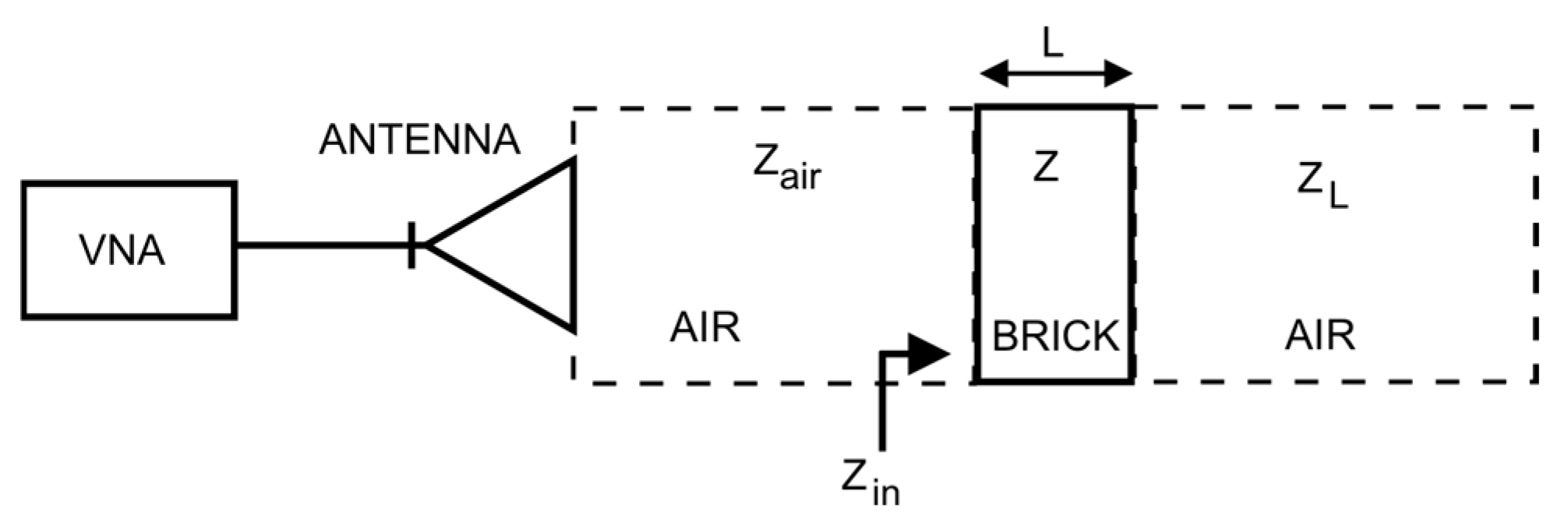
- Transmission methods are based on the measurement of reflection and transmission coefficients, usually the complete scattering matrix, most often by means of a vector network analyser operating in a two-port configuration. The sample may be placed in a waveguide or measured in free space. An alternative approach involves a time-domain analysis of the pulses emitted, reflected, and transmitted through a sample. In free-space systems, the measurement setup additionally includes two antennas, and the method allows the investigation of materials of practically arbitrary dimensions without extracting samples and placing them in a waveguide [44,45,46,47,48,49,50,51,52];
- Reflection methods are based on the measurement of the reflection coefficient, typically using a vector network analyser in a one-port configuration, with the sample placed either in a waveguide or in free space. The analysis may be performed either in the time domain, using signals reflected from the front and back surfaces of the sample, or in the frequency domain, based on the reflection coefficient. In free-space systems, the setup requires only one antenna and enables measurements of materials of arbitrary size without the need to extract samples or place them in a dedicated waveguide arrangement [53,54]. An interesting variant of this approach is microwave ellipsometry, in which two antennas are used and the reflected wave incident at an oblique angle onto the material surface is analysed [55];
- Radar-based methods form a separate, although methodologically related, group. These methods employ radar systems, most commonly ground-penetrating radar (GPR), to scan the investigated material and determine its internal layered structure as well as to estimate electrical permittivity. Such techniques require movement of the radar relative to the surface of the tested object and use dedicated GPR signal-processing techniques or synthetic aperture radar (SAR) methods [56,57,58].
2. Materials and Methods
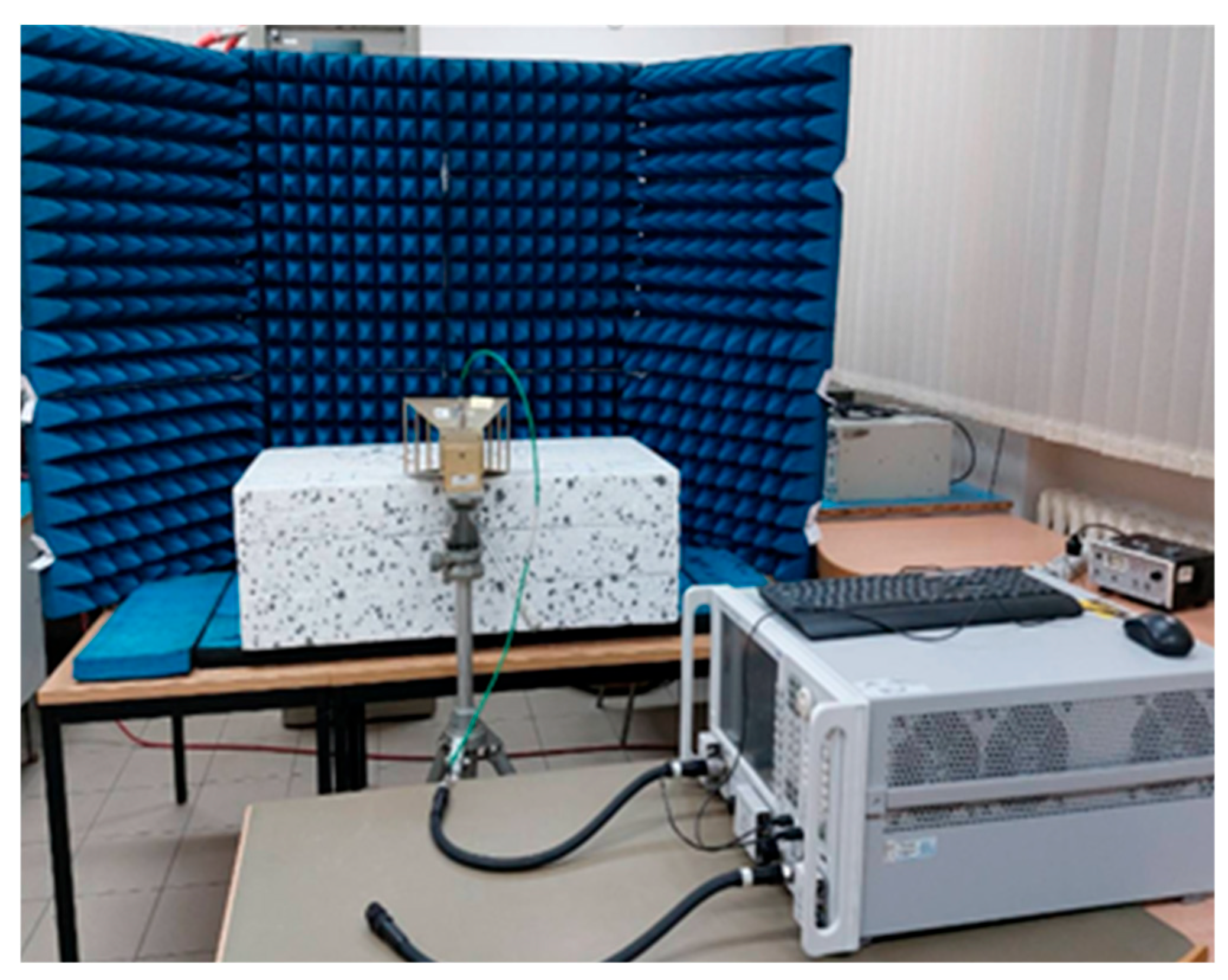
2.1. Concept of Measurement Test Stand
2.2. Samples
2.3. Permittivity Estimation Approach
2.3.1. Determination of Apparent Permittivity Using Time-Domain Method
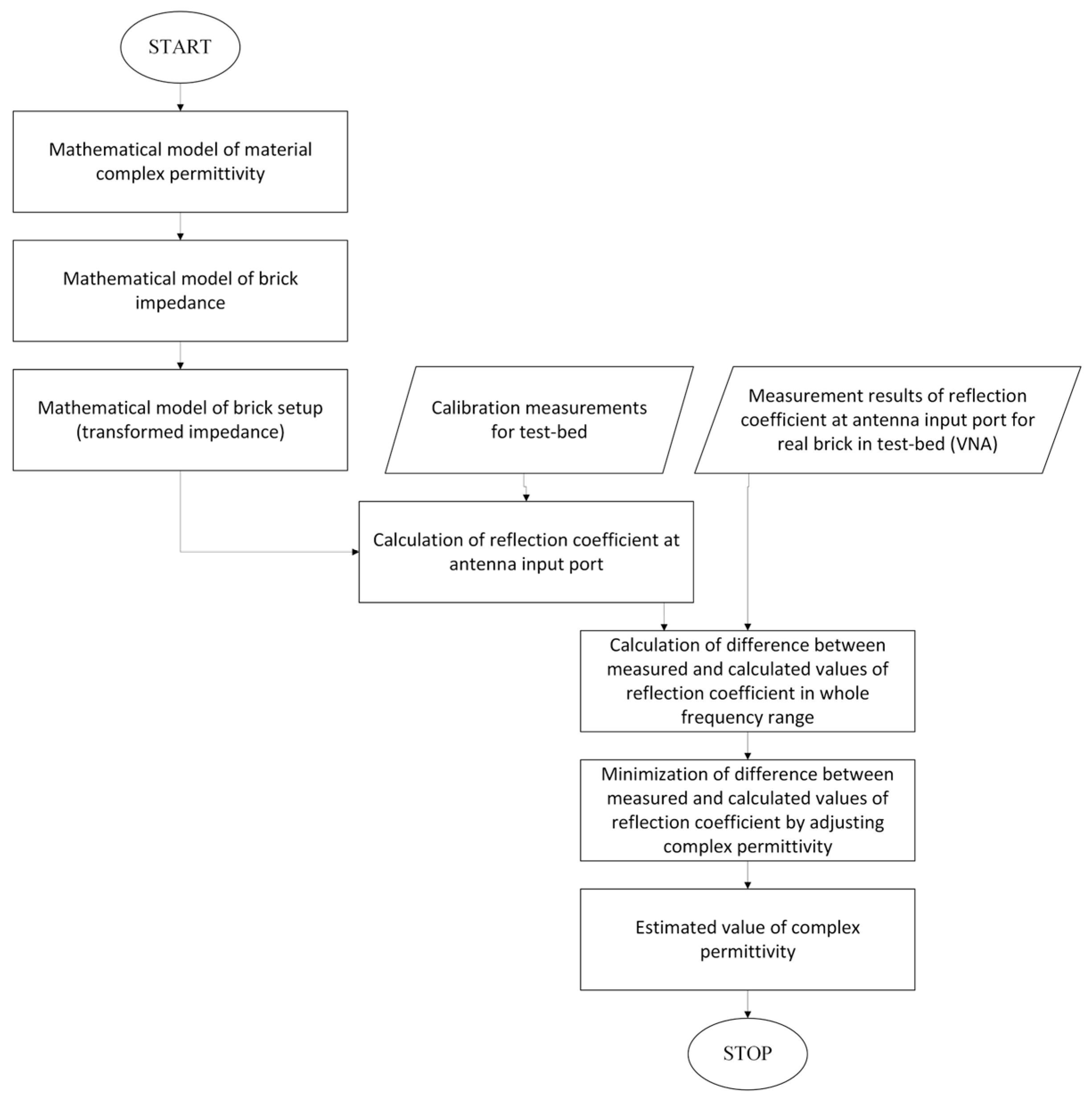
2.3.2. Methodology of Apparent Permittivity Determination Using the Frequency-Domain Method
2.3.3. Assumed Model of Material Permittivity
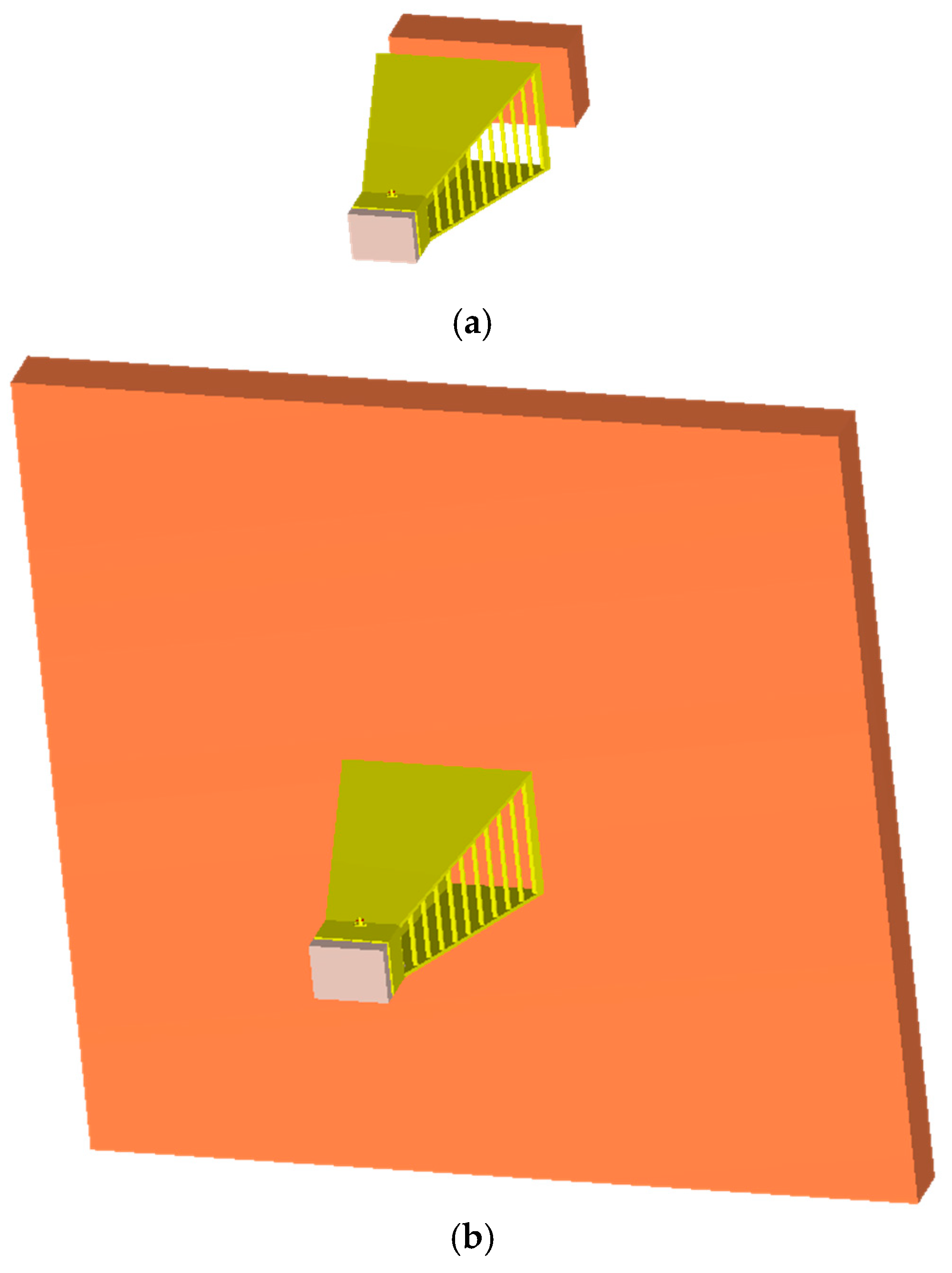
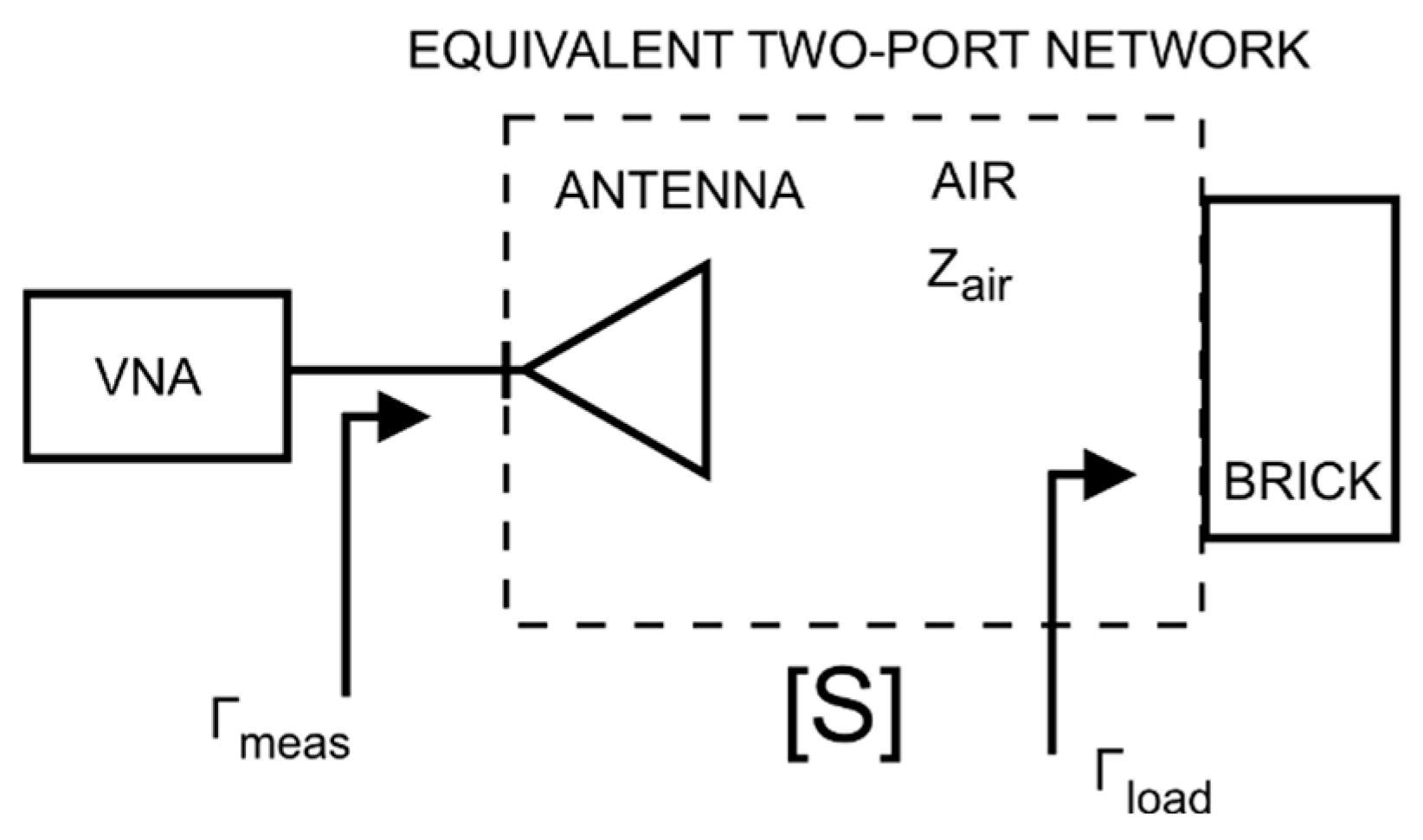
2.3.4. Model of EM Wave Propagation in Measured Medium
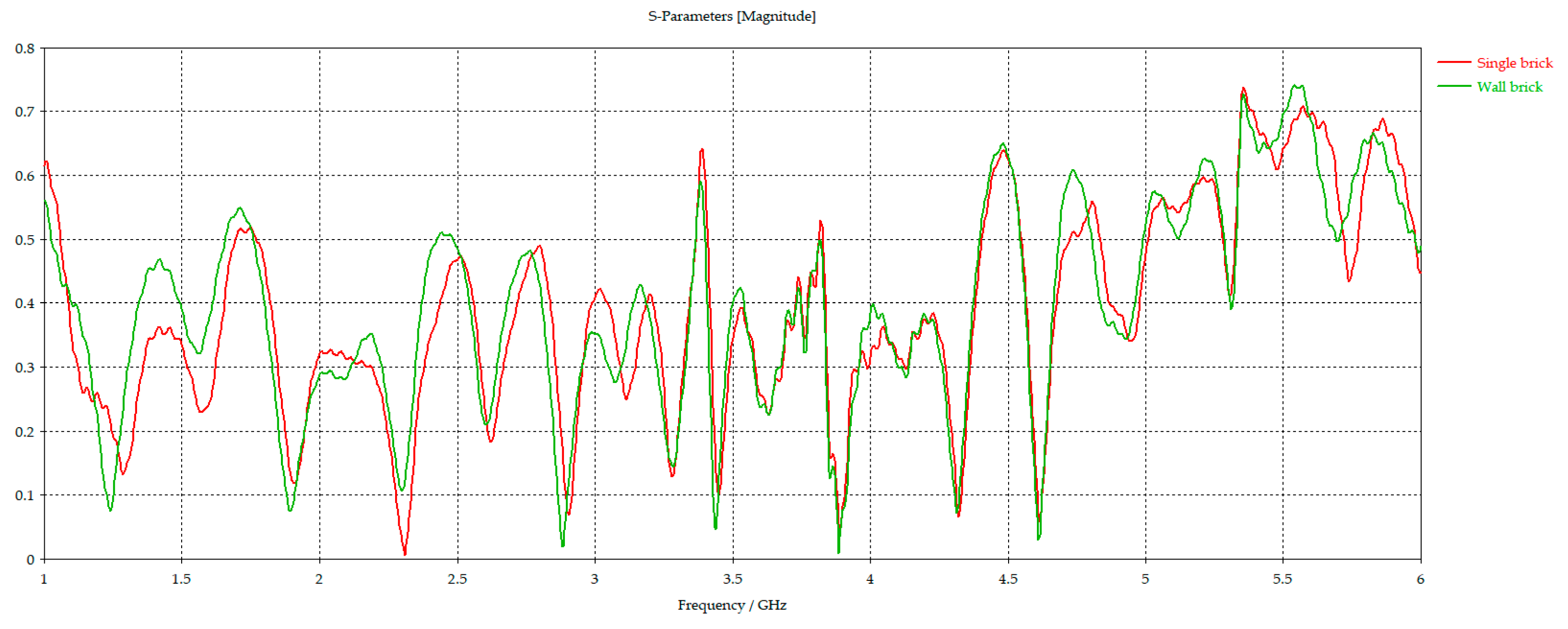
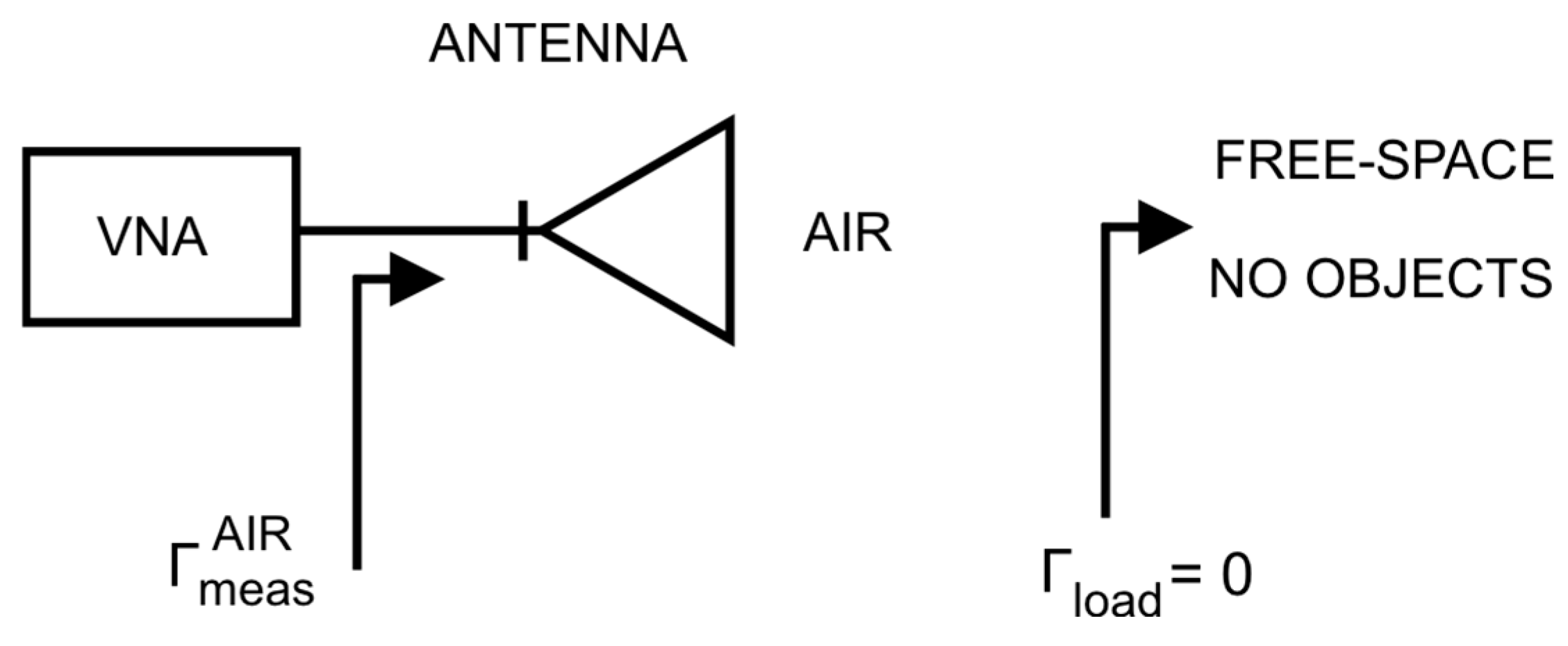
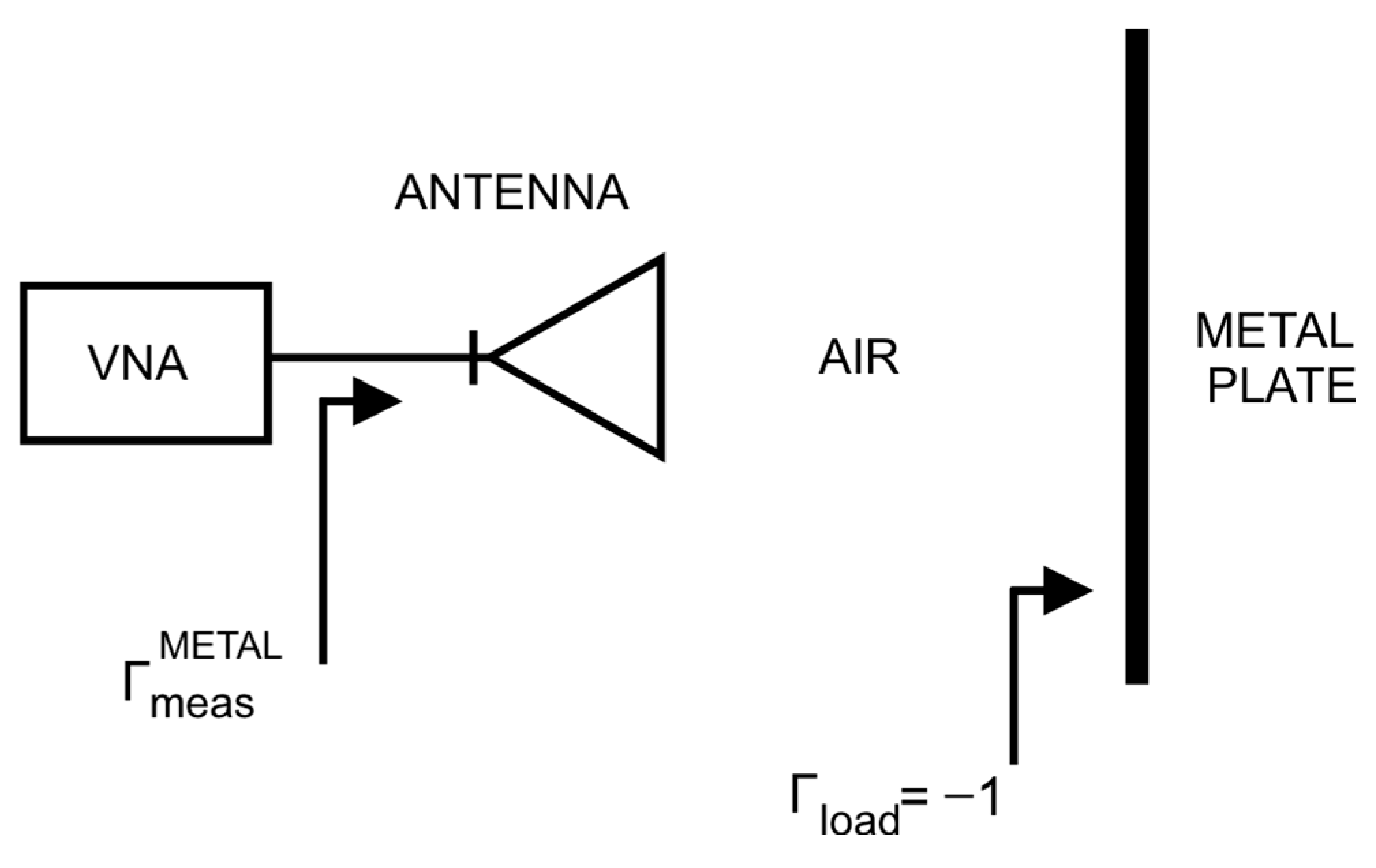
2.3.5. Calibration of Antenna Parameters and EM Wave Propagation Effects
3. Results
3.1. Reference Data
3.2. Estimated Real Part of Relative Permittivity Using Frequency Domain Analysis
4. Discussion
5. Summary and Conclusions
Author Contributions
Funding
Institutional Review Board Statement
Informed Consent Statement
Data Availability Statement
Conflicts of Interest
References
- Ksit, B.; Szymczak-Graczyk, A.; Nazarewicz, B. Diagnostics and Renovation of Moisture Affected Historic Buildings. Civ. Environ. Eng. Rep. 2022, 32, 59–73. [Google Scholar] [CrossRef]
- Zhaxi, Q.; Zhou, H.; Long, Z.; Guo, J.; Zhou, Y.; Zhang, Z. Nondestructive Measurement of the Water Content in Building Materials by Single-Sided NMR-MOUSE. Sustainability 2023, 15, 11096. [Google Scholar] [CrossRef]
- Szymczak-Graczyk, A.; Korentz, J.; Garbowski, T. Digital Twin Model for Predicting Hygrothermal Performance of Building Materials from Moisture Permeability Tests. Materials 2025, 18, 4360. [Google Scholar] [CrossRef]
- Reijula, K. Buildings with Moisture Problems—A New Challenge to Occupational Health Care. Scand. J. Work Environ. Health 1996, 22, 1–3. [Google Scholar] [CrossRef][Green Version]
- Żukiewicz-Sobczak, W.; Sobczak, P.; Krasowska, E.; Zwoliński, J.; Chmielewska-Badora, J.; Galińska, E.M. Allergenic Potential of Moulds Isolated from Buildings. Ann. Agric. Environ. Med. 2013, 20, 500–503. [Google Scholar]
- Zhang, H.; Davigny, A.; Colas, F.; Poste, Y.; Robyns, B. Fuzzy Logic Based Energy Management Strategy for Commercial Buildings Integrating Photovoltaic and Storage Systems. Energy Build. 2012, 54, 196–206. [Google Scholar] [CrossRef]
- Santos, W.N.D. Experimental Investigation of the Effect of Moisture on Thermal Conductivity and Specific Heat of Porous Ceramic Materials. J. Mater. Sci. 2000, 35, 3977–3982. [Google Scholar] [CrossRef]
- Trojan, M. One-Dimensional, Steady-State Heat Conduction. In Encyclopedia of Thermal Stresses; Springer: Dordrecht, The Netherlands, 2014; pp. 3483–3498. [Google Scholar]
- Gold, V.; McNaught, A. (Eds.) The IUPAC Compendium of Chemical Terminology: The Gold Book, 5th ed.; International Union of Pure and Applied Chemistry (IUPAC): Durham, NC, USA, 2025. [Google Scholar]
- Karoglou, M.; Moropoulou, A.; Maroulis, Z.B.; Krokida, M.K. Water Sorption Isotherms of Some Building Materials. Dry. Technol. 2005, 23, 289–303. [Google Scholar] [CrossRef]
- Zhang, M.; Qin, M.; Rode, C.; Chen, Z. Moisture Buffering Phenomenon and Its Impact on Building Energy Consumption. Appl. Therm. Eng. 2017, 124, 337–345. [Google Scholar] [CrossRef]
- Abadie, M.O.; Mendonça, K.C. Moisture Performance of Building Materials: From Material Characterization to Building Simulation Using the Moisture Buffer Value Concept. Build. Environ. 2009, 44, 388–401. [Google Scholar] [CrossRef]
- Ramos, N.M.M.; Delgado, J.M.P.Q.; de Freitas, V.P. Influence of Finishing Coatings on Hygroscopic Moisture Buffering in Building Elements. Constr. Build. Mater. 2010, 24, 2590–2597. [Google Scholar] [CrossRef]
- Lopez-Carreon, I.; Jahan, E.; Yari, M.H.; Esmizadeh, E.; Riahinezhad, M.; Lacasse, M.; Xiao, Z.; Dragomirescu, E. Moisture Ingress in Building Envelope Materials: (II) Transport Mechanisms and Practical Mitigation Approaches. Buildings 2025, 15, 762. [Google Scholar] [CrossRef]
- Afif-Khouri, E.; Lozano-Martínez, A.; de Rego, J.I.L.; López-Gallego, B.; Forjan-Castro, R. Capillary Rise and Salt Weathering in Spain: Impacts on the Degradation of Calcareous Materials in Historic Monuments. Buildings 2025, 15, 2285. [Google Scholar] [CrossRef]
- Qin, S.; Chen, C.; Zhang, M. Modeling of Concrete Deterioration under External Sulfate Attack and Drying–Wetting Cycles: A Review. Materials 2024, 17, 3334. [Google Scholar] [CrossRef] [PubMed]
- Morillas, H.; Maguregui, M.; Gómez-Laserna, O.; Trebolazabala, J.; Madariaga, J.M. Could Marine Aerosol Contribute to Deteriorate Building Materials from Interior Areas of Lighthouses? An Answer from the Analytical Chemistry Point of View. J. Raman Spectrosc. 2013, 44, 1700–1710. [Google Scholar] [CrossRef]
- Stolarska, A.; Garbalińska, H. Assessment of Suitability of Some Chosen Functions for Describing of Sorption Isotherms in Building Materials. Heat Mass Transf. 2017, 53, 1603–1617. [Google Scholar] [CrossRef]
- Cai, H.; Guo, Z.; Wu, J.; Yang, Y.; Zhou, T.; Huang, W.; Zhang, M.; Hou, N.; Sun, Q.; Li, Y.; et al. Moisture Content Measurement of Textile Fabrics Based on Microwave Pseudo Waveguide and Neural Network Modeling. Sens. Actuators Phys. 2026, 397, 117275. [Google Scholar] [CrossRef]
- Otten, K.A.; Brischke, C.; Meyer, C. Material Moisture Content of Wood and Cement Mortars—Electrical Resistance-Based Measurements in the High Ohmic Range. Constr. Build. Mater. 2017, 153, 640–646. [Google Scholar] [CrossRef]
- Hoła, A. Methodology of the Quantitative Assessment of the Moisture Content of Saline Brick Walls in Historic Buildings Using Machine Learning. Arch. Civ. Mech. Eng. 2023, 23, 141. [Google Scholar] [CrossRef]
- Flor, O.; Palacios, H.; Suárez, F.; Salazar, K.; Reyes, L.; González, M.; Jiménez, K. New Sensing Technologies for Grain Moisture. Agriculture 2022, 12, 386. [Google Scholar] [CrossRef]
- Ruiz Valero, L.; Flores Sasso, V.; Prieto Vicioso, E. In Situ Assessment of Superficial Moisture Condition in Façades of Historic Building Using Non-Destructive Techniques. Case Stud. Constr. Mater. 2019, 10, e00228. [Google Scholar] [CrossRef]
- Suchorab, Z.; Widomski, M.K.; Łagód, G.; Barnat-Hunek, D.; Smarzewski, P. Methodology of Moisture Measurement in Porous Materials Using Time Domain Reflectometry. Chem.-Didact.-Ecol.-Metrol. 2015, 19, 97–107. [Google Scholar] [CrossRef][Green Version]
- Song, B.-K.; Mulla, T.; Choi, S.-B. Controllable Water Droplet for Microsystem Actuators: An Experimental Analysis. Front. Mater. 2018, 5, 54. [Google Scholar] [CrossRef]
- Suchorab, Z.; Tabiś, K.; Brzyski, P.; Szczepaniak, Z.; Rogala, T.; Susek, W.; Łagód, G. Comparison of the Moist Material Relative Permittivity Readouts Using the Non-Invasive Reflectometric Sensors and Microwave Antenna. Sensors 2022, 22, 3622. [Google Scholar] [CrossRef] [PubMed]
- Malmberg, C.G.; Maryott, A.A. Dielectric Constant of Water from 0 to 100 C. J. Res. Natl. Bur. Stand. 1956, 56, 1. [Google Scholar] [CrossRef]
- Matsuoka, T.; Fujita, S.; Morishima, S.; Mae, S. Precise Measurement of Dielectric Anisotropy in Ice Ih at 39 GHz. J. Appl. Phys. 1997, 81, 2344–2348. [Google Scholar] [CrossRef]
- Hartlieb, P.; Antretter, T.; Meisels, R.; Toifl, M.; Kuchar, F. Dataset of Dielectric Measurements of Granite, Sandstone and Basalt at High Temperature and Various Frequencies. Zenodo 2021. [Google Scholar] [CrossRef]
- Gulisano, F.; Gallego, J.; Trigos, L.; Apaza Apaza, F.R. Dielectric Characterisation of Asphalt Mortars for Microwave Heating Applications. Constr. Build. Mater. 2021, 308, 125048. [Google Scholar] [CrossRef]
- Piladaeng, N.; Angkawisittpan, N.; Homwuttiwong, S. Determination of Relationship between Dielectric Properties, Compressive Strength, and Age of Concrete with Rice Husk Ash Using Planar Coaxial Probe. Meas. Sci. Rev. 2016, 16, 14–20. [Google Scholar] [CrossRef]
- Wen, S.; Chung, D.D.L. Effect of Admixtures on the Dielectric Constant of Cement Paste. Cem. Concr. Res. 2001, 31, 673–677. [Google Scholar] [CrossRef]
- López-Buendía, A.M.; García-Baños, B.; Urquiola, M.M.; Catalá-Civera, J.M.; Peñaranda-Foix, F.L. Evidence of a New Phase in Gypsum–Anhydrite Transformations under Microwave Heating by in Situ Dielectric Analysis and Raman Spectroscopy. Phys. Chem. Chem. Phys. 2020, 22, 27713–27723. [Google Scholar] [CrossRef]
- Yang, X.D.; Cao, M.; Hong, W.B.; Li, L.; Chen, X.M. Preparation and Microwave Dielectric Properties of Calcite (CaCO3) Ceramics. Ceram. Int. 2024, 50, 36948–36954. [Google Scholar] [CrossRef]
- Okamura, S. Microwave Technology for Moisture Measurement. Subsurf. Sens. Technol. Appl. 2000, 1, 205–227. [Google Scholar] [CrossRef]
- Krupka, J. Microwave Measurements of Electromagnetic Properties of Materials. Materials 2021, 14, 5097. [Google Scholar] [CrossRef] [PubMed]
- Liu, C.; Liao, C.; Peng, Y.; Zhang, W.; Wu, B.; Yang, P. Microwave Sensors and Their Applications in Permittivity Measurement. Sensors 2024, 24, 7696. [Google Scholar] [CrossRef]
- Asilian Bidgoli, H.; Schieda, N.; Rossa, C. A Simplified Formulation of the Reflection Coefficient of an Open-Ended Coaxial Probe in Multilayered Media. IEEE Trans. Microw. Theory Tech. 2024, 72, 6485–6495. [Google Scholar] [CrossRef]
- Camacho Hernandez, J.N.; Link, G. Innovative Approaches on the Estimation of the Effective Permittivity of Fibrous Media. Materials 2025, 18, 14. [Google Scholar] [CrossRef]
- Pourafzal, A.; Roi-Taravella, T.; Cheffena, M.; Yayilgan, S.Y. A Low-Cost and Accurate Microwave Sensor System for Permittivity Characterization. IEEE Sens. J. 2023, 23, 1234–1248. [Google Scholar] [CrossRef]
- Wang, S.; Lin, L.H.; HuYan, S.; Chung, K.L.; Ye, T.; Liang, L.; Ni, J.; Yang, Y. A Novel High-Q Microwave Resonant Cavity Sensor for Complex Permittivity Characterization. In Proceedings of the 2025 IEEE 8th International Conference on Electronic Information and Commununication Technology (ICEICT), Weihai, China, 26–28 July 2025. [Google Scholar] [CrossRef]
- Roslan, H.S.; Said, M.A.M.; Zakaria, Z.; Misran, M.H.; Yusop, N.; Bahar, A.A.M.; Yusri, M.S. High Sensitivity Microwave Sensor for Material Characterization Using Square Split Ring Resonator. In Proceedings of the 2022 IEEE International RF and Microwave Conference (RFM), Kuala Lumpur, Indonesia, 19–21 December 2022; IEEE: New York, NY, USA, 2022; pp. 1–4. [Google Scholar]
- Ali, L.; Wang, C.; Meng, F.-Y.; Adhikari, K.K.; Wei, Y.-C.; Zhao, M. High-Sensitivity Accurate Characterization of Complex Permittivity Using Inter-Digital Capacitor-Based Planar Microwave Sensor. In Proceedings of the 2021 4th International Conference on Information Communication and Signal Processing (ICICSP), Shanghai, China, 24–26 September 2021. [Google Scholar]
- Trabelsi, S.; Nelson, S.O.; Ramahi, O. A Low-Cost Microwave Moisture Sensor. In Proceedings of the 36th European Microwave Conference, Manchester, UK, 10–15 September 2006. [Google Scholar]
- Hasar, U.C. A Microcontroller-Based Microwave Measurement System for Permittivity Determination of Fresh Cement-Based Materials. In Proceedings of the 2007 IEEE Instrumentation & Measurement Technology Conference IMTC 2007, Warsaw, Poland, 1–3 May 2007; IEEE: New York, NY, USA, 2007; pp. 1–6. [Google Scholar]
- Ait Benali, L.; Tribak, A.; Terhzaz, J.; Mediavilla Sánchez, Á. An Accurate Method to Estimate Complex Permittivity of Dielectric Materials at X-Band Frequencies. Int. J. Microw. Opt. Technol. 2020, 151, 10–16. [Google Scholar]
- Conrat, J.-M.; Aliouane, M.; Cousin, J.-C.; Begaud, X. Building Material Permittivity and Conductivity Estimation from 2 to 260 GHz. In Proceedings of the EuMW 2024, Paris, France, 24–26 September 2024. [Google Scholar]
- Akuthota, B.; Zoughi, R.; Kurtis, K. Determination of Dielectric Property Profile in Cement-Based Materials Using Microwave Reflection and Transmission Properties. In Proceedings of the 21st IEEE Instrumentation and Measurement Technology Conference, Como, Italy, 18–20 May 2004; IEEE: New York, NY, USA, 2004; Volume 1, pp. 327–332. [Google Scholar] [CrossRef]
- Ho, M.-C.; Le, T.-H. Accurate Estimation without Calibration of the Complex Relative Permittivity of Multilayer Dielectric Material Based on the Finite Integration Technique. Eng. Technol. Appl. Sci. Res. 2023, 13, 10664–10669. [Google Scholar] [CrossRef]
- Pisa, S.; Pittella, E.; Piuzzi, E.; D’Atanasio, P.; Zambotti, A. Permittivity Measurement on Construction Materials through Free Space Method. In Proceedings of the 2017 IEEE International Instrumentation and Measurement Technology Conference (I2MTC), Torino, Italy, 22–25 May 2017; IEEE: New York, NY, USA, 2017; pp. 1–4. [Google Scholar]
- Trabelsi, S.; Nelson, S.O.; Lewis, M. Practical Microwave Meter for Sensing Moisture and Density of Granular Materials. In Proceedings of the 2008 IEEE Instrumentation and Measurement Technology Conference, Victoria, BC, Canada, 12–15 May 2008; IEEE: New York, NY, USA, 2008; pp. 1021–1025. [Google Scholar]
- Damez, R.; Artillan, P.; Hellouin de Menibus, A.; Bermond, C.; Xavier, P. Effect of Water Content on Microwave Dielectric Properties of Building Materials. Constr. Build. Mater. 2020, 263, 120107. [Google Scholar] [CrossRef]
- Nguyen, L.C.; Ho, M.C.; Le, T.-H. A New Approach to Estimate the Complex Relative Permittivity of Materials Based on Free-Space Reflection Method. Adv. Electromagn. 2020, 9, 19–24. [Google Scholar] [CrossRef]
- Vertiy, A.A.; Melezhik, P.N.; Poyedinchuk, A.Y.; Mizrakhy, S.V.; Nesterov, P.K.; Vertiy, A.A.; Melezhik, P.N.; Poyedinchuk, A.Y.; Mizrakhy, S.V.; Nesterov, P.K. Dielectric Permittivity Profile Reconsctruction in Microwave Band for Layered Dielectric Slab Located in the Standard Metal Waveguide. In Proceedings of the 17th International Conference on Mathematical Methods in Electromagnetic Theory MMET, Kyiv, Ukraine, 2–5 July 2018; IEEE: New York, NY, USA, 2018; pp. 217–220. [Google Scholar] [CrossRef]
- Sagnard, F.; Bentabet, F.; Vignat, C. In Situ Measurements of the Complex Permittivity of Materials Using Reflection Ellipsometry in the Microwave Band: Theory (Part I). IEEE Trans. Instrum. Meas. 2005, 54, 1266–1273. [Google Scholar] [CrossRef]
- Alsaleh, N.; Pomorski, D.; Sebbache, M.; Haddadi, K. Machine Learning-Based Monostatic Microwave Radar for Building Material Classification. In Proceedings of the 2023 IEEE International Instrumentation and Measurement Technology Conference (I2MTC), Kuala Lumpur, Malaysia, 22–25 May 2023; IEEE: New York, NY, USA, 2023; pp. 1–5. [Google Scholar]
- Haas, A.; Peichl, M.; Dill, S. Layer Determination of Building Structures with SAR in near Field Environment. In Proceedings of the 2019 16th European Radar Conference (EuRAD), Paris, France, 2–4 October 2019; IEEE: New York, NY, USA, 2019; pp. 209–212. [Google Scholar]
- Lan, T.; Sun, X.; Yang, X.; Gong, J.; Hu, X. Layered Media Parameter Estimation Based on Hyperbolic Fitting in GPR B-Scan. IEEE Geosci. Remote Sens. Lett. 2025, 22, 7505305. [Google Scholar] [CrossRef]
- Rizou, M.E.; Marcelli, R.; Capoccia, G.; Proietti, E. Non-Destructive Microwave Techniques for the Quantification and Elimination of Moisture in Cultural Heritage Monuments. J. Cult. Herit. 2024, 67, 270–276. [Google Scholar] [CrossRef]
- Muradov, M.; Kot, P.; Markiewicz, J.; Łapiński, S.; Tobiasz, A.; Onisk, K.; Shaw, A.; Hashim, K.; Zawieska, D.; Mohi-Ud-Din, G. Non-Destructive System for in-Wall Moisture Assessment of Cultural Heritage Buildings. Measurement 2022, 203, 111930. [Google Scholar] [CrossRef]
- Blackham, D. Use of Network Analyzer and Coaxial Probe to Determine Complex Permittivity. MRS Online Proc. Libr. 1990, 189, 123–128. [Google Scholar] [CrossRef]
- Sánchez-Sevilleja, S.; García-Rodríguez, M.; Masa-Campos, J.L.; Cuerda-Muñoz, J.M. Antenna Model with Pattern Optimization Based on Genetic Algorithm for Satellite-Based SAR Mission. Sensors 2025, 25, 4835. [Google Scholar] [CrossRef]
- Vaquero, Á.F.; Córcoles, J. Convex Formulations for Antenna Array Pattern Optimization Through Linear, Quadratic, and Second-Order Cone Programming. Mathematics 2025, 13, 1796. [Google Scholar] [CrossRef]
- Aman; Singh, V.; Bhattacharyya, S. Retrieval of Electrical and Physical Properties of Dielectric Samples Using Time-Domain Multiple Reflection Method. IET Microw. Antennas Propag. 2020, 14, 701–706. [Google Scholar] [CrossRef]
- Frenzel, D.; Blaschke, O.; Franzen, C.; Brand, F.; Haas, F.; Troi, A.; Drese, K.S. Quantification of Moisture in Masonry via AI-Evaluated Broadband Radar Reflectometry. Heritage 2023, 6, 5030–5050. [Google Scholar] [CrossRef]
- Malicki, M.A.; Skierucha, W.M. A Manually Controlled TDR Soil Moisture Meter Operating with 300 Ps Rise-Time Needle Pulse. Irrig. Sci. 1989, 10, 153–163. [Google Scholar] [CrossRef]
- Pedreño-Molina, J.L.; Monzó-Cabrera, J.; Lozano-Guerrero, A.; Toledo-Moreo, A. Design and Validation of a Ten-Port Waveguide Reflectometer Sensor: Application to Efficiency Measurement and Optimization of Microwave-Heating Ovens. Sensors 2008, 8, 7833–7849. [Google Scholar] [CrossRef]
- La Gioia, A.; Porter, E.; Merunka, I.; Shahzad, A.; Salahuddin, S.; Jones, M.; O’Halloran, M. Open-Ended Coaxial Probe Technique for Dielectric Measurement of Biological Tissues: Challenges and Common Practices. Diagnostics 2018, 8, 40. [Google Scholar] [CrossRef]
- Cho, K.; Jo, S.; Noh, Y.-H.; Lee, N.; Kim, S.; Yook, J.-G. Complex Permittivity Measurements of Steel Fiber-Reinforced Cementitious Composites Using a Free-Space Reflection Method with a Focused Beam Lens Horn Antenna. Sensors 2021, 21, 7789. [Google Scholar] [CrossRef]
- Šarolić, A.; Matković, A. Dielectric Permittivity Measurement Using Open-Ended Coaxial Probe—Modeling and Simulation Based on the Simple Capacitive-Load Model. Sensors 2022, 22, 6024. [Google Scholar] [CrossRef]
- Gonçalves, F.J.F.; Pinto, A.G.M.; Mesquita, R.C.; Silva, E.J.; Brancaccio, A. Free-Space Materials Characterization by Reflection and Transmission Measurements Using Frequency-by-Frequency and Multi-Frequency Algorithms. Electronics 2018, 7, 260. [Google Scholar] [CrossRef]
- Sheen, J. Study of Microwave Dielectric Properties Measurements by Various Resonance Techniques. Measurement 2005, 37, 123–130. [Google Scholar] [CrossRef]
- Choroszucho, A.; Butrylo, B.; Steckiewicz, A.; Stankiewicz, J.M. Determination of the Effective Electromagnetic Parameters of Complex Building Materials for Numerical Analysis of Wireless Transmission Networks. Electronics 2020, 9, 1569. [Google Scholar] [CrossRef]
- Raagulan, K.; Kim, B.M.; Chai, K.Y. Recent Advancement of Electromagnetic Interference (EMI) Shielding of Two Dimensional (2D) MXene and Graphene Aerogel Composites. Nanomaterials 2020, 10, 702. [Google Scholar] [CrossRef] [PubMed]
- Huang, Q.; Xie, W.; Alqahtany, F.Z.; Cao, T.; Mersal, G.A.M.; Toktarbay, Z. Study on Thin-Layer Broadband Metamaterial Absorber Based on Composite Multi-Opening Ring Pattern of Magnetic Dielectric Layers. Adv. Compos. Hybrid. Mater. 2025, 8, 180. [Google Scholar] [CrossRef]
- Gonçalves, F.J.F.; Brancaccio, A.; Ferreira, L.A.; da Silva, E.J. A Free-Space Transmission Setup for Material Parameters Estimation with Affordable and Non-Synchronized Software-Defined Radios in the 0.85–1.55 GHz Band. Appl. Sci. 2023, 13, 3010. [Google Scholar] [CrossRef]
- Abdelsamei, E.; Sheishah, D.; Tobak, Z.; Ali, A.M.; Barta, K.; Fannakh, A.; Magyar, G.; Blanka-Végi, V.; Sipos, G. Assessing the Compaction Quality of Dolomitic Asphalt Pavements Using Ground Penetrating Radar. Appl. Sci. 2025, 15, 2501. [Google Scholar] [CrossRef]
- Juan, C.G.; Bronchalo, E.; Potelon, B.; Quendo, C.; Sabater-Navarro, J.M. Glucose Concentration Measurement in Human Blood Plasma Solutions with Microwave Sensors. Sensors 2019, 19, 3779. [Google Scholar] [CrossRef]
- Suchorab, Z.; Widomski, M.K.; Łagód, G.; Barnat-Hunek, D.; Majerek, D. A Noninvasive TDR Sensor to Measure the Moisture Content of Rigid Porous Materials. Sensors 2018, 18, 3935. [Google Scholar] [CrossRef] [PubMed]
- Futa, A.; Jastrzębska, M.; Paśnikowska-Łukaszuk, M.; Wośko, E.; Suchorab, Z. Improving the Calibration of Surface Time Domain Reflectometry Sensors for Moisture Evaluation of Building Materials Using the Analysis of Covariance Method. Adv. Sci. Technol. Res. J. 2023, 17, 326–336. [Google Scholar] [CrossRef]




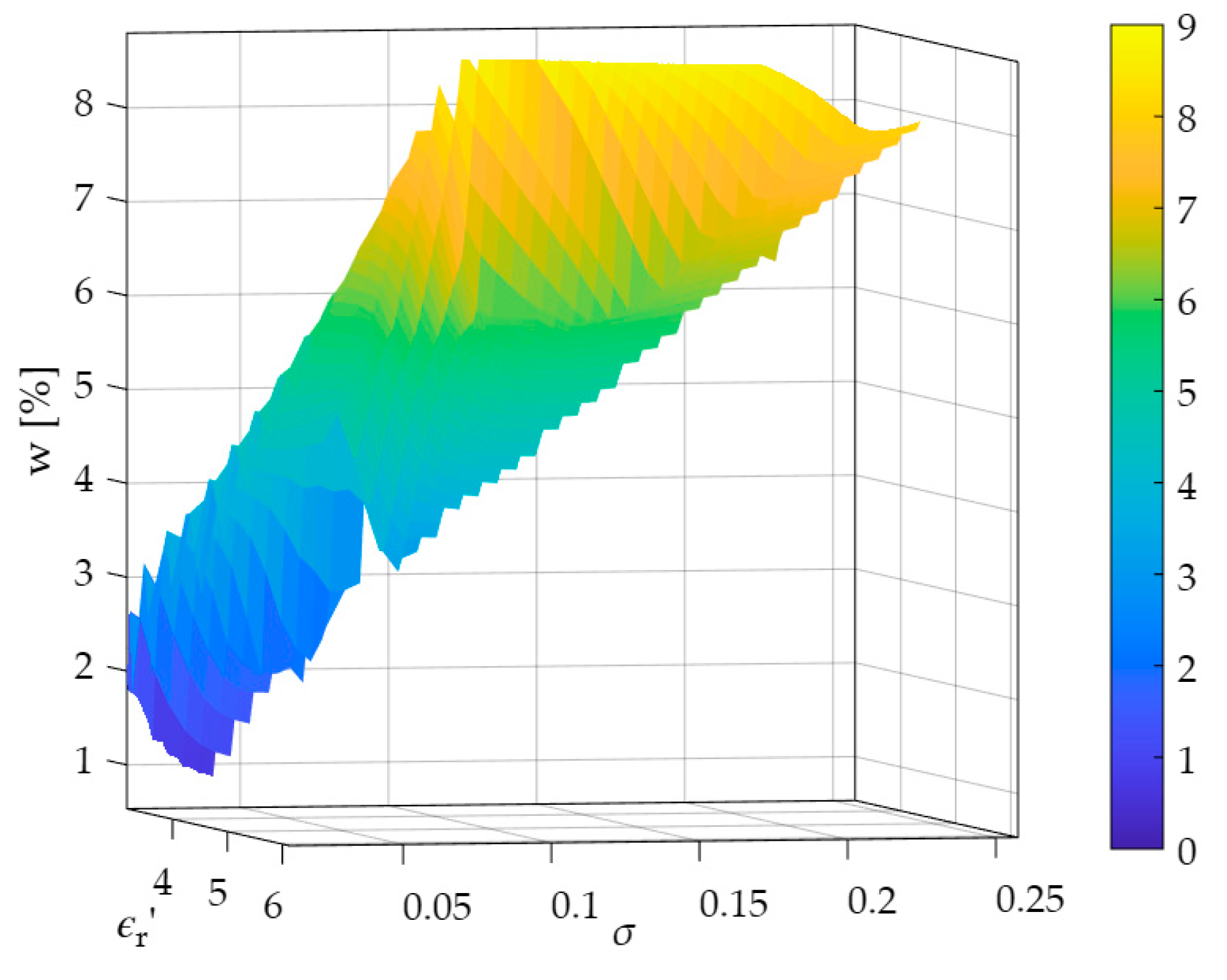

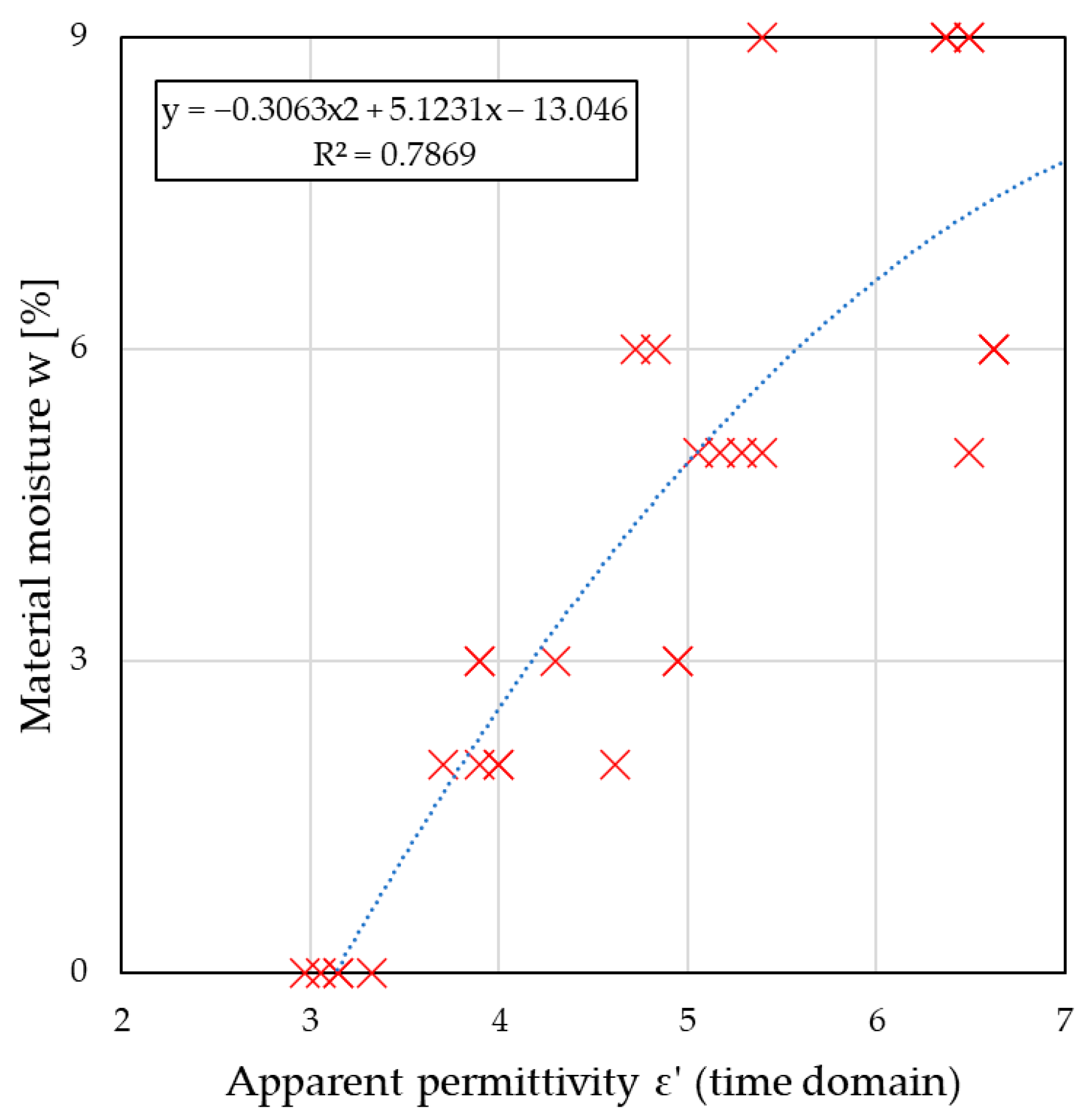
| Moisture [%] | Apparent Permittivity | |||||
|---|---|---|---|---|---|---|
| Sample 1 | Sample 2 | Sample 3 | Sample 4 | Sample 5 | Mean | |
| 0 | 3.06 | 3.15 | 3.15 | 3.33 | 2.97 | 3.12 |
| 2 | 3.99 | 3.99 | 3.89 | 3.70 | 4.61 | 4.04 |
| 3 | 3.89 | 3.89 | 4.29 | 4.94 | 4.94 | 4.39 |
| 5 | 5.28 | 5.40 | 5.06 | 5.17 | 6.49 | 5.48 |
| 6 | 4.83 | 4.72 | 6.62 | 6.62 | 6.62 | 5.88 |
| 9 | 6.49 | 6.37 | 6.49 | 6.37 | 5.40 | 6.22 |
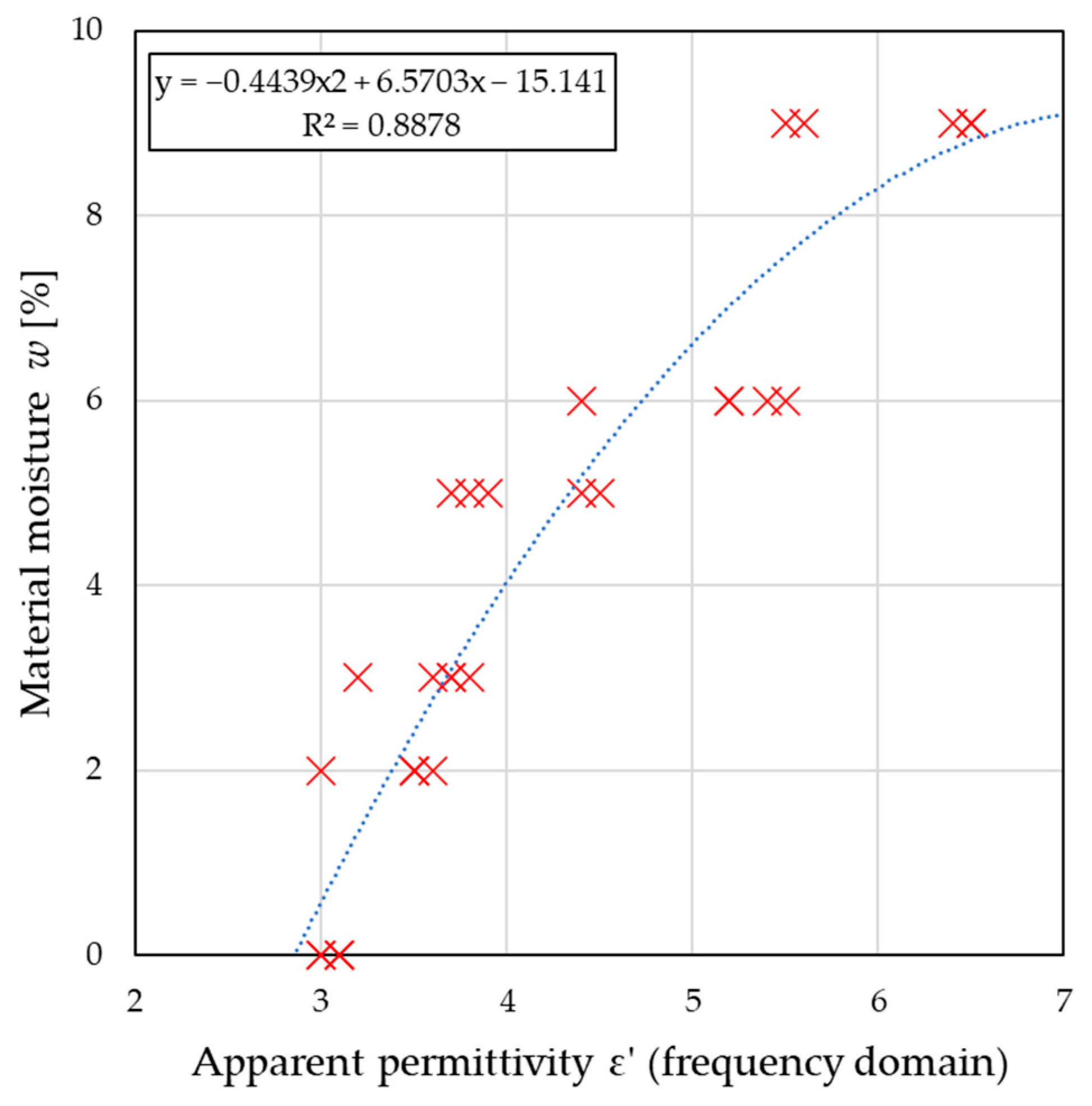
| Moisture [%] | Estimated ε′ | |||||
|---|---|---|---|---|---|---|
| Sample 1 | Sample 2 | Sample 3 | Sample 4 | Sample 5 | Mean | |
| 0 | 3.1 | 3.1 | 3.1 | 3.0 | 3.0 | 3.06 |
| 2 | 3.5 | 3.5 | 3.5 | 3.0 | 3.6 | 3.42 |
| 3 | 3.7 | 3.7 | 3.6 | 3.2 | 3.8 | 3.6 |
| 5 | 3.9 | 3.8 | 4.4 | 3.7 | 4.5 | 4.06 |
| 6 | 5.2 | 5.4 | 5.5 | 4.4 | 5.2 | 5.14 |
| 9 | 6.4 | 6.5 | 6.5 | 5.5 | 5.6 | 6.1 |
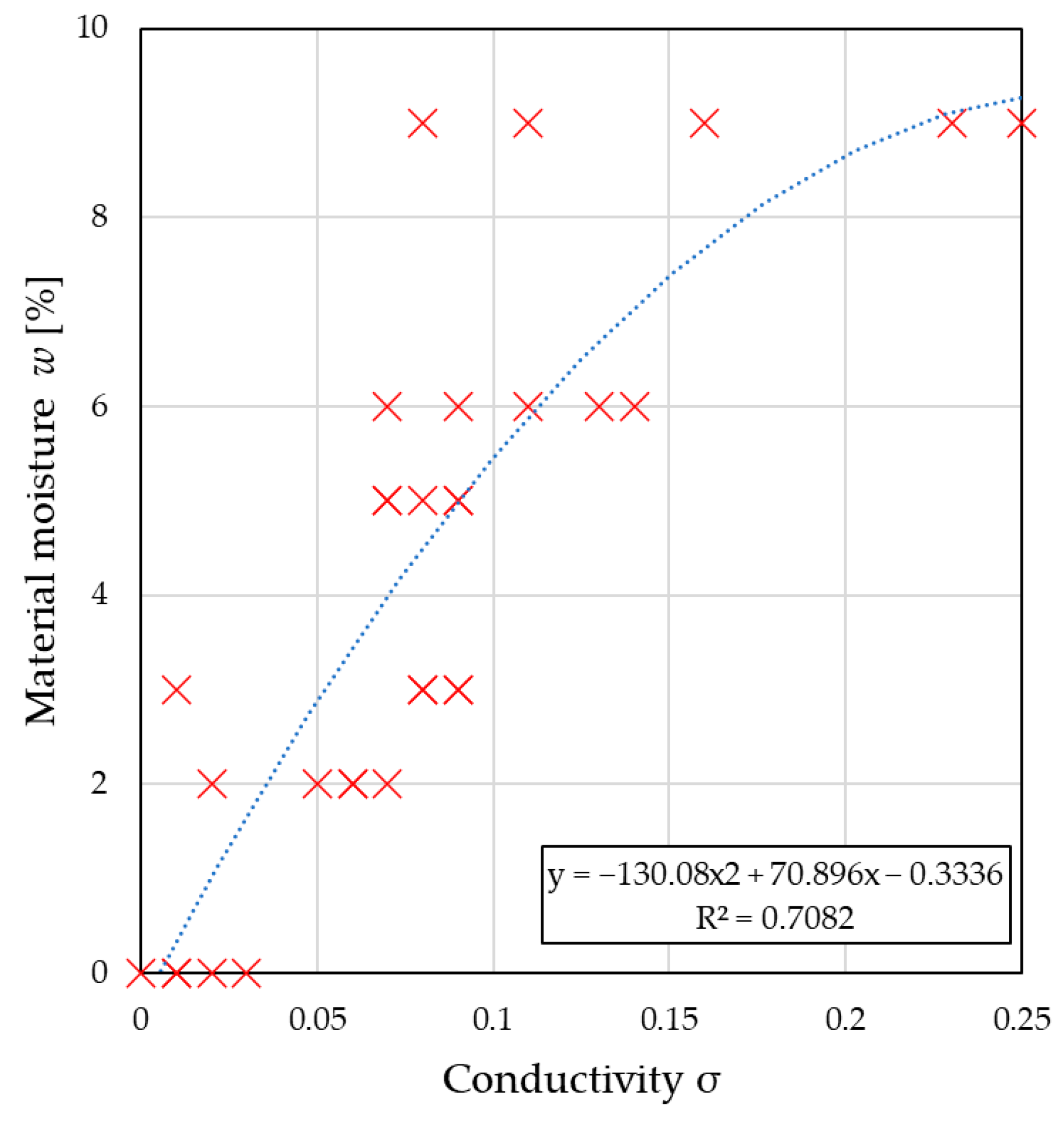
| Moisture [%] | Estimated σ | |||||
|---|---|---|---|---|---|---|
| Sample 1 | Sample 2 | Sample 3 | Sample 4 | Sample 5 | Mean | |
| 0 | 0.01 | 0.02 | 0.01 | 0.00 | 0.03 | 0.014 |
| 2 | 0.05 | 0.06 | 0.06 | 0.02 | 0.07 | 0.052 |
| 3 | 0.08 | 0.09 | 0.08 | 0.01 | 0.09 | 0.070 |
| 5 | 0.07 | 0.07 | 0.09 | 0.08 | 0.09 | 0.080 |
| 6 | 0.11 | 0.13 | 0.14 | 0.07 | 0.09 | 0.108 |
| 9 | 0.23 | 0.16 | 0.25 | 0.08 | 0.11 | 0.166 |
Disclaimer/Publisher’s Note: The statements, opinions and data contained in all publications are solely those of the individual author(s) and contributor(s) and not of MDPI and/or the editor(s). MDPI and/or the editor(s) disclaim responsibility for any injury to people or property resulting from any ideas, methods, instructions or products referred to in the content. |
© 2026 by the authors. Licensee MDPI, Basel, Switzerland. This article is an open access article distributed under the terms and conditions of the Creative Commons Attribution (CC BY) license.
Share and Cite
Szczepaniak, Z.; Juszczyński, P.; Susek, W.; Tabiś, K.; Suchorab, Z. Contactless Microwave-Based Estimation of Complex Permittivity of Masonry Materials: A Frequency-Domain Approach. Sensors 2026, 26, 2693. https://doi.org/10.3390/s26092693
Szczepaniak Z, Juszczyński P, Susek W, Tabiś K, Suchorab Z. Contactless Microwave-Based Estimation of Complex Permittivity of Masonry Materials: A Frequency-Domain Approach. Sensors. 2026; 26(9):2693. https://doi.org/10.3390/s26092693
Chicago/Turabian StyleSzczepaniak, Zenon, Paweł Juszczyński, Waldemar Susek, Krzysztof Tabiś, and Zbigniew Suchorab. 2026. "Contactless Microwave-Based Estimation of Complex Permittivity of Masonry Materials: A Frequency-Domain Approach" Sensors 26, no. 9: 2693. https://doi.org/10.3390/s26092693
APA StyleSzczepaniak, Z., Juszczyński, P., Susek, W., Tabiś, K., & Suchorab, Z. (2026). Contactless Microwave-Based Estimation of Complex Permittivity of Masonry Materials: A Frequency-Domain Approach. Sensors, 26(9), 2693. https://doi.org/10.3390/s26092693