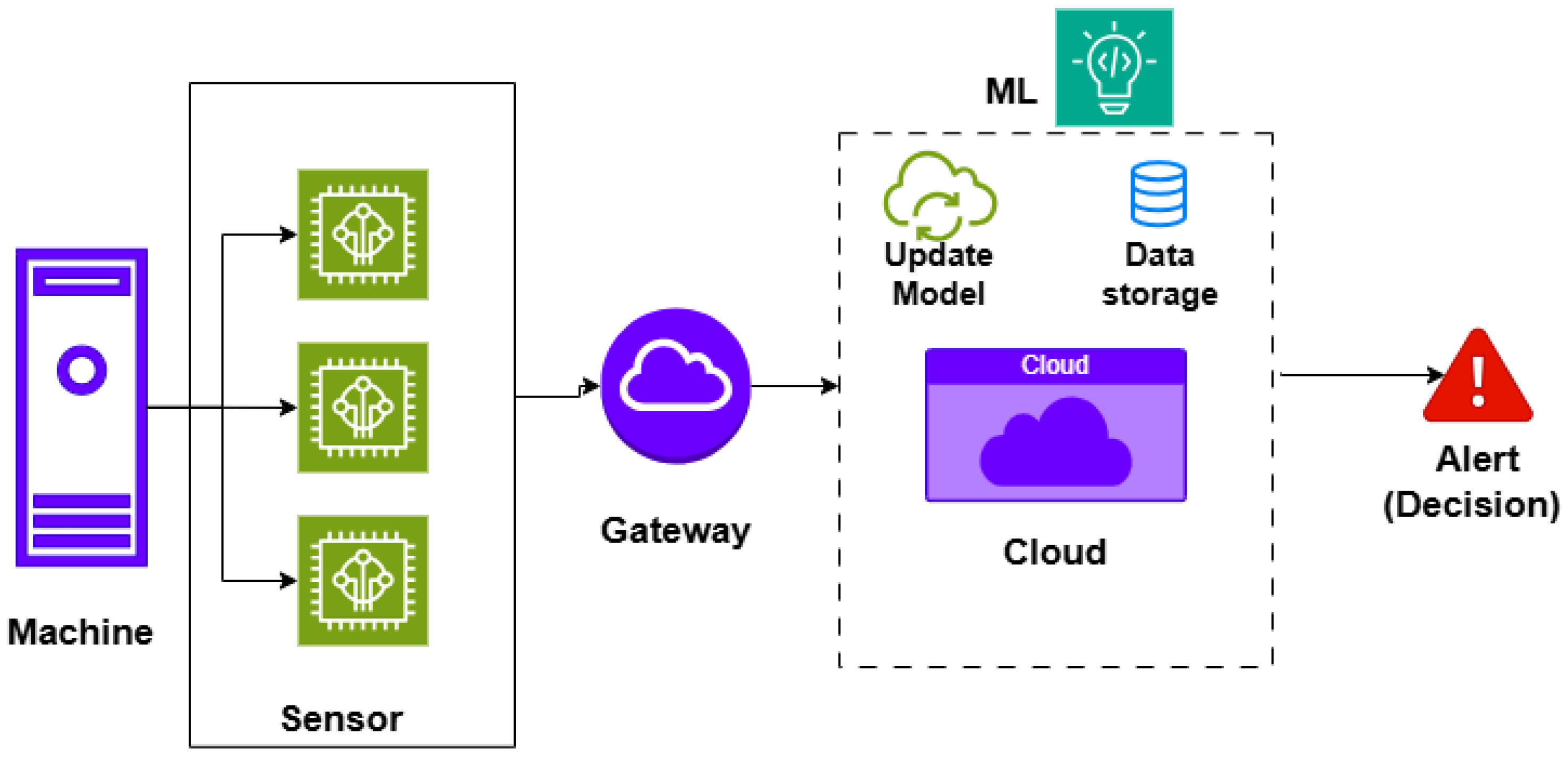
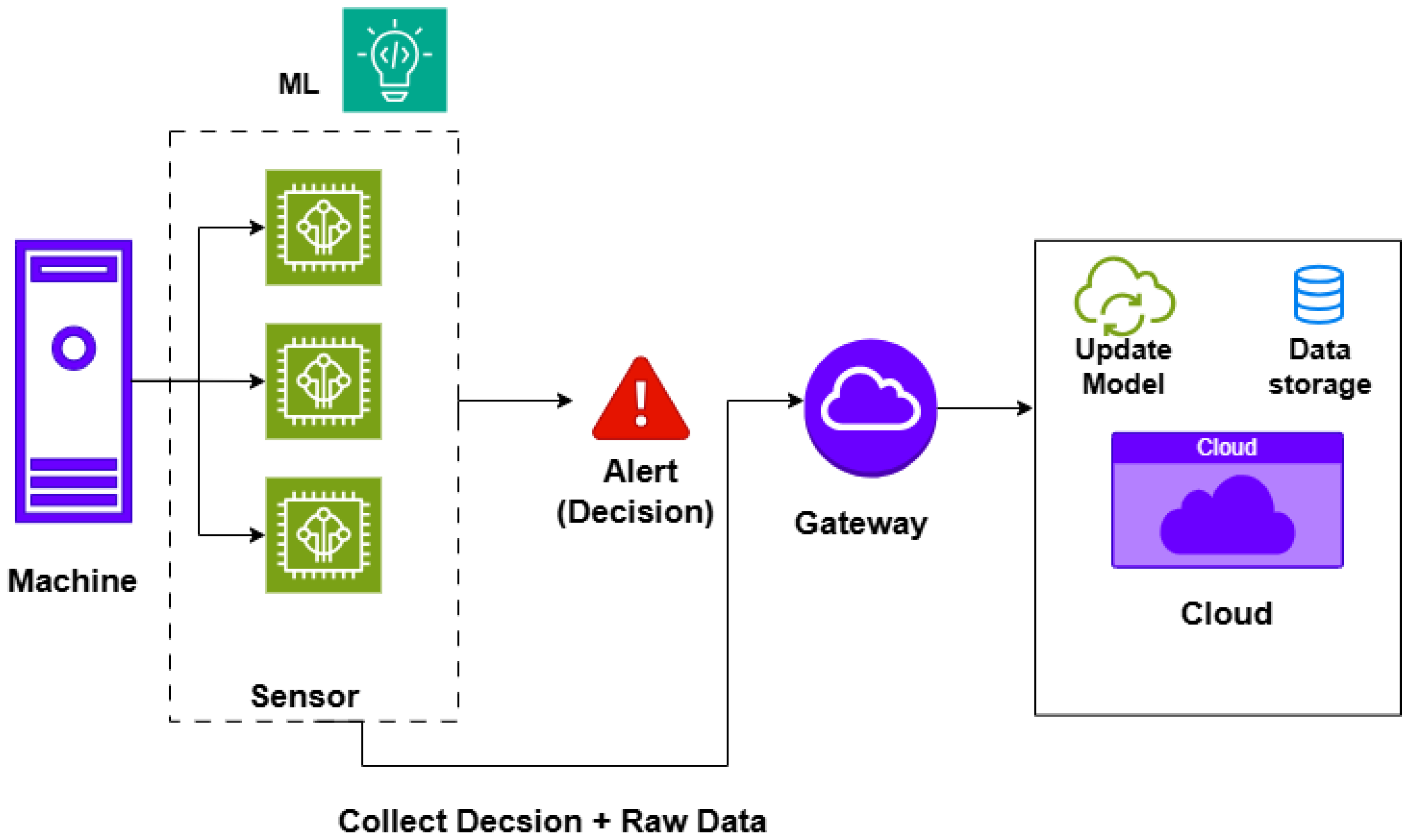
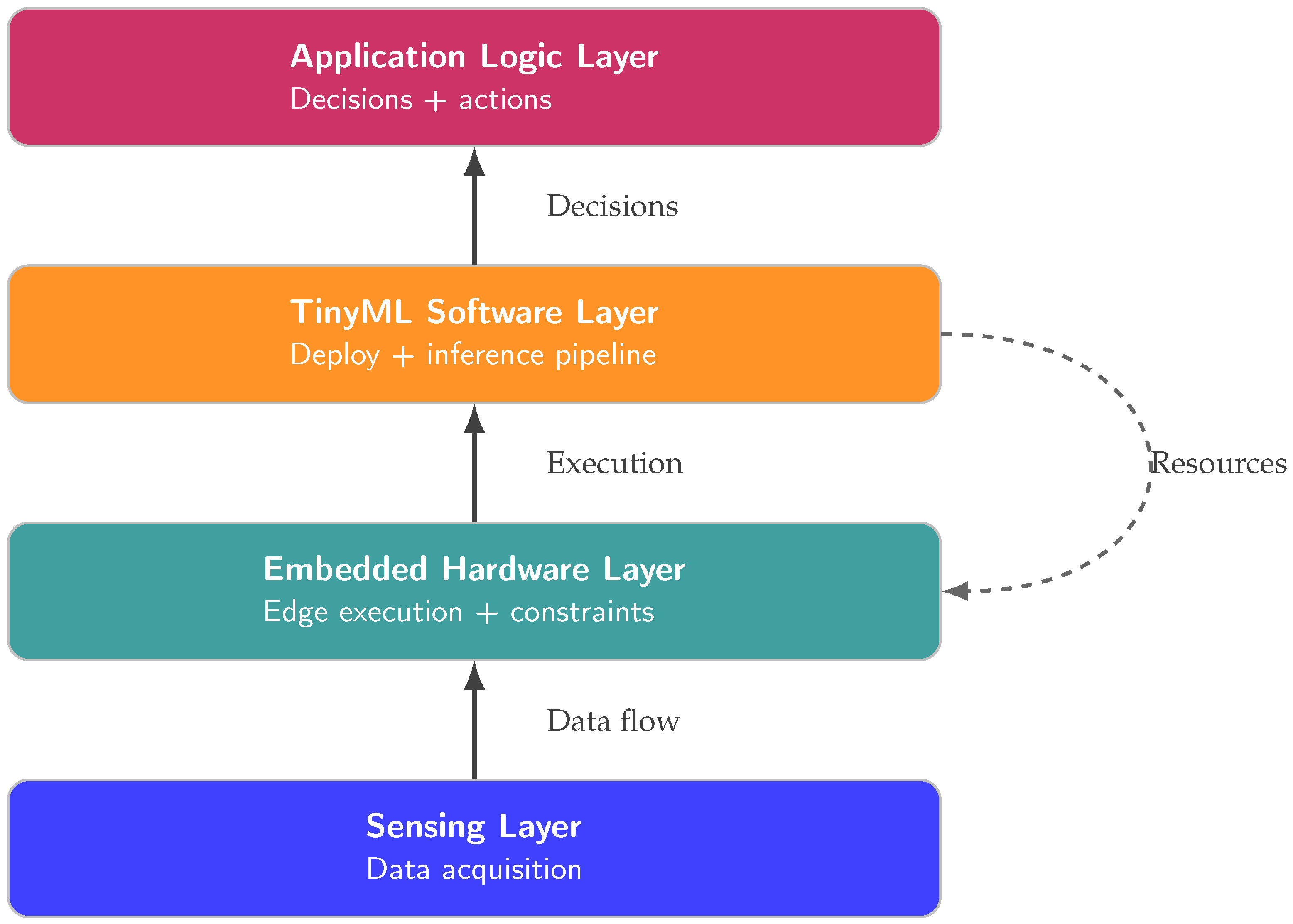
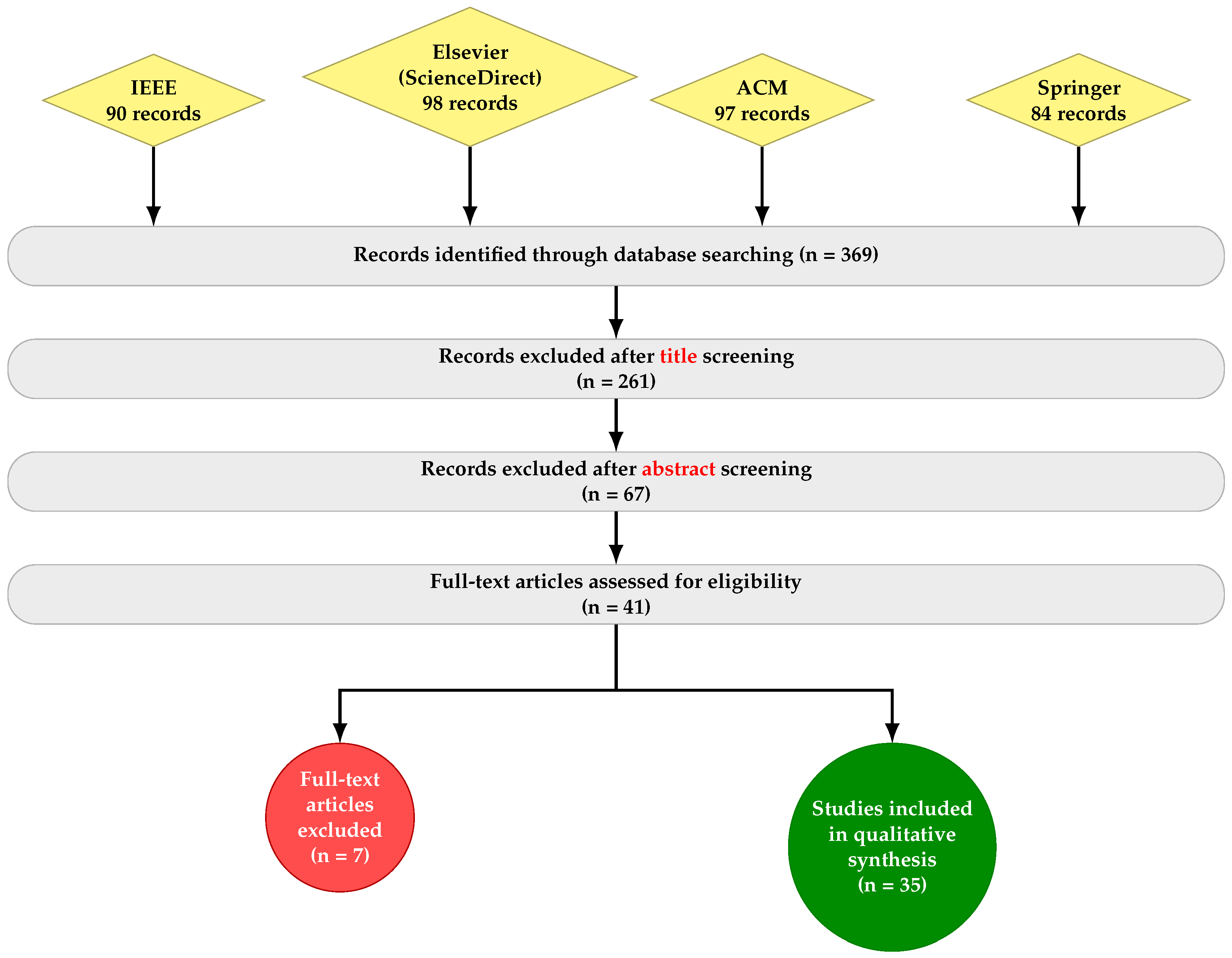
TinyML in Industrial IoT: A Systematic Review of Applications, System Components, and Methodologies



Abstract
1. Introduction
1.1. Motivation for a Systematic Literature Review on TinyML in IIoT
1.2. Overview of Existing Reviews on TinyML in IIoT
1.3. Research Gap
1.4. Research Questions
- RQ1: In which industrial domains and operational tasks has TinyML been applied within IIoT systems?
- RQ2: What system components (hardware platforms, software frameworks, and sensor modalities) are most commonly used for deploying TinyML in IIoT?
- RQ3: What methodologies (datasets, model architectures, and optimization strategies) in TinyML-IIoT are employed to adapt ML models for resource-constrained IIoT devices?
- RQ4: How is the performance of TinyML models in IIoT applications evaluated, and what metrics are most frequently reported?
- RQ5: What are the key limitations and open research challenges in applying TinyML to IIoT, and what future research directions are proposed?
1.5. Contributions
- 1.
- Comprehensive synthesis of TinyML in IIoT: It explicitly examines how TinyML has been adopted in IIoT systems across different domains such as predictive maintenance, quality control, anomaly detection, and smart energy management.
- 2.
- Analysis of hardware and software ecosystems: It identifies the most common microcontroller units (MCUs)/edge devices, software frameworks (e.g., TensorFlow Lite Micro, Edge Impulse), and sensor modalities used for deploying TinyML in IIoT.
- 3.
- Evaluation of datasets, model architectures, and optimization techniques: It analyzes the datasets, model types, and optimization techniques used to adapt ML algorithms for resource-constrained industrial environments, including model compression, quantization, and pruning.
- 4.
- Performance assessment and benchmarking: It summarizes how TinyML performance in IIoT is evaluated, highlighting frequently reported metrics such as accuracy, inference latency, and energy efficiency.
- 5.
- Identification of challenges and future research directions: It highlights the technical and methodological limitations reported in the literature, including deployment complexity, scalability, and lack of standardized benchmarking, and outlines promising future research directions.
1.6. Layout of the SLR
2. Research Methodology
2.1. Background on Categories
2.1.1. Problem-Driven Classification
2.1.2. SystemComponent Taxonomy: Hardware, Frameworks, and Sensors
2.1.3. Methodologies: Datasets, Model Architectures, and Optimization Strategies
- First, the dataset dimension addresses the types of data sources used for training and evaluation. Datasets are organized into two categories: (1) operational and real-world sensor datasets, which reflect actual operating conditions in industrial or experimental environments, and (2) public, benchmark, and synthetic datasets, which include standardized datasets and simulated data used to support reproducible experimentation [33,38]. This classification clarifies the context in which models are trained and tested, without evaluating data quality or outcomes.
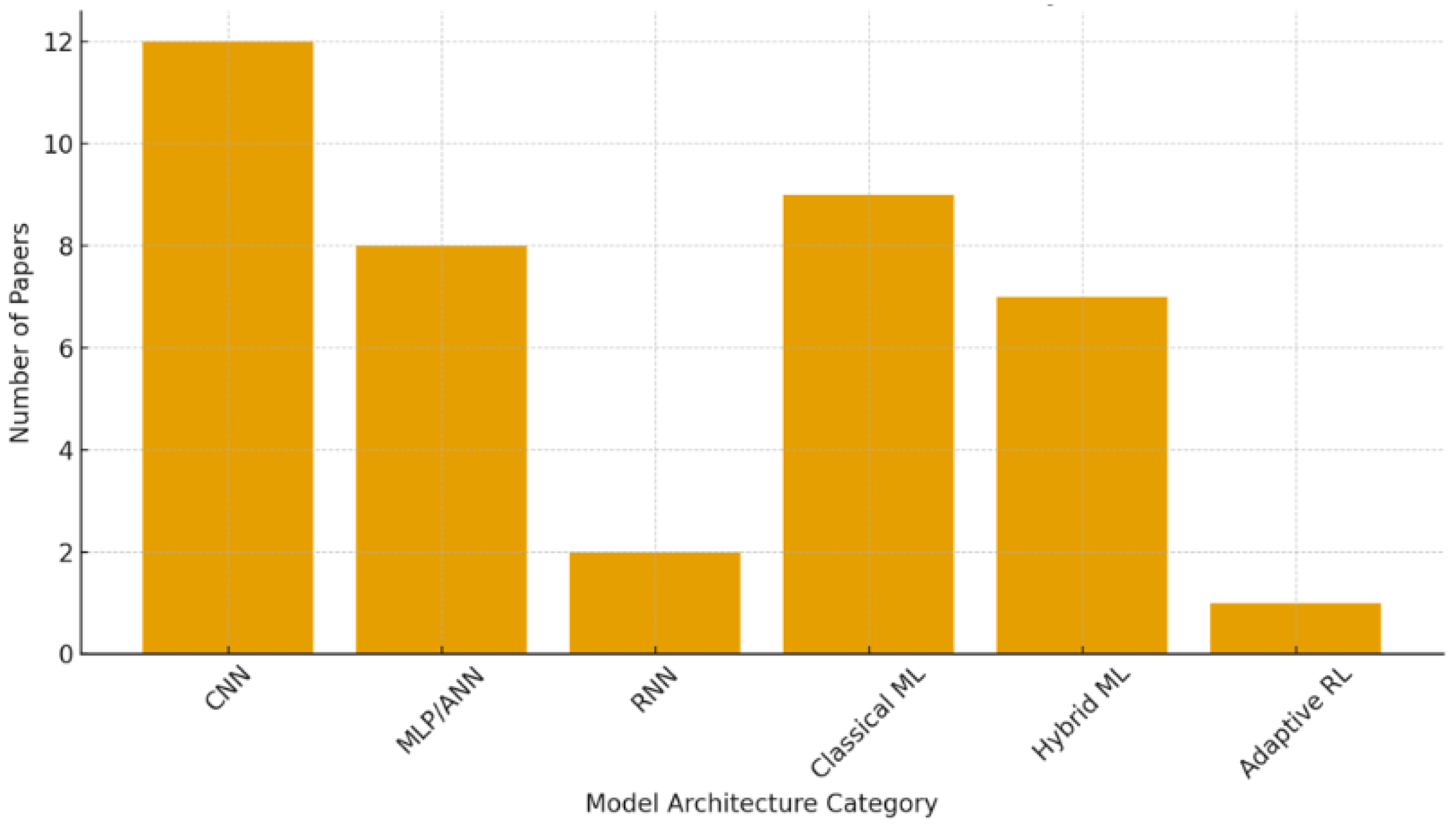
- Second, this category introduces a classification of model architectures used in TinyML systems. This dimension focuses on the structural design of the models, which determines how input data are processed on embedded devices. It captures architectures suitable for different data representations, such as image data, time-series signals, and low-dimensional sensor measurements [34].
- Third, this category describes optimization techniques. Optimization is considered a set of strategies that may target the model structure, numerical representation, execution behavior, or learning process. These techniques are organized into clearly defined categories based on how they are reported in the reviewed literature, supporting a structured and reproducible presentation [37].
2.2. Review Protocol Development
2.2.1. Selection and Rejection Criteria
- Subject relevance: Studies must explicitly address TinyML or on-device machine learning within an industrial or IIoT context, and provide evidence relevant to at least one of the research questions (applications, system components, methodologies, performance, or challenges).
- Alignment with classification categories: Each study must contribute to at least one of the three dimensions defined in the background on categories: (i) problem-driven classification, (ii) system components (hardware, frameworks, sensors), or (iii) methodologies (datasets, model architectures, optimization strategies).
- Publication period: Only studies published between 2018 and 2026 were included to capture the emergence and evolution of TinyML in IIoT. Earlier works were excluded unless foundational to TinyML or embedded ML.
- Publication source: Only peer-reviewed journal articles and conference papers indexed in IEEE Xplore, Elsevier (ScienceDirect), SpringerLink, and the ACM Digital Library were considered to ensure scientific rigor.
- Industrial relevance: Included studies must demonstrate a clear connection between TinyML techniques and industrial or IIoT applications.
- Results-oriented evidence: Studies must report experimental results, quantitative evaluations, prototypes, or real-world/industrial testbeds. Conceptual, theoretical, or purely survey-based works without empirical validation were excluded.
- Redundancy: Duplicate or substantially overlapping publications were removed, with preference given to the most complete, updated, or extended version of the study.
2.2.2. Search Process
(“TinyML” OR “Tiny Machine Learning” OR “on-device machine learning” OR “micro ML” OR “embedded machine learning” OR “low-power ML”)
AND
(“Industrial Internet of Things” OR “IIoT” OR “industrial IoT” OR “Industry 4.0” OR “smart factory” OR “connected industrial devices”)
2.2.3. Data Extraction and Synthesis

| Description | Synthesized Results (Tables) |
|---|---|
| IIoT domain classification | Table 4: TinyML–IIoT studies classified by industrial domain and application. |
| Performance evaluation | Table 5, Table 6, Table 7, Table 8 and Table 9: Performance results of TinyML–IIoT applications across accuracy, latency, memory, and energy. |
| Hardware platforms | Table 10: Hardware platforms grouped by microcontroller family, processor architecture, integrated accelerators, and connectivity features. |
| Software frameworks | Table 11: Software frameworks and platforms in TinyML–IIoT studies. |
| Sensor modalities and properties | Table 12: Sensor types in TinyML–IIoT and their measured properties. |
| Datasets | Table 13: Operational and real-world sensor datasets used in TinyML–IIoT studies. Table 14: Public, benchmark, and synthetic datasets used for TinyML evaluation. |
| Model architectures | Table 15: Summary of model architectures used in the reviewed TinyML–IIoT studies. |
| Optimization techniques | Table 16: Categories of optimization techniques applied in TinyML–IIoT systems. |
| Additional synthesis dimension. | Table 17: Summary mapping of data types, model families, and typical optimization techniques (synthesized from Table 13, Table 14, Table 15 and Table 16). |
| Refs. | IIoT Domain | Number of Articles |
|---|---|---|
| [34,44,45,46,47,48] | Smart Manufacturing & Predictive Maintenance | 6 |
| [45,47,49,50] | Industrial Equipment/Condition Monitoring | 4 |
| [51,52,53,54] | Smart Energy Management | 4 |
| [46,55,56,57,58,59] | Quality Control & Anomaly Detection | 6 |
| [33,36,37,38,60,61,62,63,64,65,66,67,68,69,70,71,72,73] | General Applications | 18 |
| Ref. | Accuracy/F1 (%) | Memory Flash/RAM (KB) | Latency (ms) | Energy per Inference |
|---|---|---|---|---|
| [44] | 99.0 | 512/64 | – | Self-powered (piezoelectric harvester) |
| [34] | – (RUL: RMSE/score) | 2048/512 | 1.81 | – |
| [45] | F1-normal: 91.3/F1-abnormal: 67.9 | 1024/256 | – | 13.3–20.6 J/inference |
| [46] | F1-normal: 87.6/F1-states: 96.8 | 1024/256 | 0.106 | 1.16 µJ/inference |
| [47] | 99.36 | 1024/256 | 30 | – |
| [48] | 96.4 | – | – | – |
| Ref. | Accuracy/F1 (%) | Memory Flash/RAM (KB) | Latency (ms) | Energy per Inference |
|---|---|---|---|---|
| [47] | 99.36 | 1024/256 | 30 | – |
| [49] | 96.5 (F1: 96.64) | 8192/512 | 25 | – |
| [45] | F1-normal: 91.3/F1-abnormal: 67.9 | 1024/256 | – | 13.3–20.6 J/inference |
| [50] | – | 1024/256 | – | – |
| Ref. | Result/Contribution | Memory Flash/RAM (KB) | Latency (ms) | Energy Metric |
|---|---|---|---|---|
| [51] | SoC error metrics | 1024/256 | – | – |
| [52] | Energy efficiency improvement: 38% | 512/64 | – | – |
| [53] | Energy profiling (TinyEP) | 2048/264 | 0.1 | – |
| [54] | Energy reduction: 29%; Compression gain: 18% | 2048/786 | – | – |
| Ref. | Accuracy/F1 (%) | Memory Flash/RAM (KB) | Latency (ms) | Energy per Inference |
|---|---|---|---|---|
| [46] | F1-normal: 87.6/F1-states: 96.8 | –/– | 0.106 | 1.16 J/inference |
| [55] | 99/98 | –/– | 240/233 | 192/186 mJ |
| [56] | 100/99.8/100 | 8.1/0.8 | 1.16 | – |
| [57] | 98 | –/– | – | – |
| [58] | – | –/– | – | – |
| [59] | F1: 97.46% (TinyFL), 96.92% (TTFL) | 16 | 16,490 | 4.28 |
| Ref. | Contribution Type | Role of TinyML | IIoT Relevance | Best Results |
|---|---|---|---|---|
| [60] | Model management & on-device learning | Online, meta-learning, adaptive edge models | Useful for dynamic and evolving industrial environments | Up to +12% accuracy improvement |
| [36] | TinyML deployment workflow | Quantization, deployment pipeline for MCUs | Applicable to any MCU-based IIoT deployment | ESP-FOMO (60–70% accuracy) |
| [61] | Framework comparison | Evaluation of TinyML toolchains | Helps select suitable tools for IIoT systems | – |
| [62] | Embedded AI benchmarking | Performance evaluation of TinyML tools | Supports IIoT integrators in toolchain selection | – |
| [63] | Distributed TinyML learning | Model splitting across multiple edge nodes | Ideal for large industrial sensor networks | 89% latency reduction |
| [64] | Federated learning (FL + TL) | On-device training with privacy preservation | Useful for decentralized IIoT systems | 86.48% accuracy |
| [65] | FL over LoRa mesh networks | Low-power, low-bandwidth collaborative learning | Suitable for remote and bandwidth-limited IIoT | – |
| [66] | Distributed TinyML on sensor networks | Model partitioning & distributed execution | Useful for dense IIoT sensing with strict memory limits | 95.5% validation accuracy |
| [67] | Continual TinyML learning | Quantized latent replay | Adapts to changing IIoT operating conditions | – |
| [33] | General-purpose vibration classification | Running-state recognition on the MCU | Transferable to industrial mobile assets | >99% accuracy |
| [38] | TinyML-based data compression | Edge compression of vibration signals | Reduces wireless load in SHM & other IIoT systems | 99.96% compression (TAC) |
| [68] | Impact localization (SHM) | Lightweight vibration classification on the MCU | Applicable to structural monitoring in IIoT | 98.71% accuracy (Random Forest) |
| [69] | TinyML-based vision system | Embedded visual landing guidance | Transferable to industrial robotics & drones | – |
| [70] | Parallelized classical ML | Ultra-efficient non-neural ML inference | Suitable for battery-powered IIoT sensors | 3.7 J per inference |
| [71] | Processing-in-sensor architecture | Ternary MLP executed directly in the sensor frontend | Reduces communication in IIoT sensing layers | – |
| [37] | Approximate TinyML kernels | Energy-efficient CNN kernels | Useful for industrial vision workloads | 72.4% (approximate AlexNet) |
| [72] | TinyML anomaly detection for IoT devices | Real-time threat/anomaly detection at the edge | Supports IIoT safety and device protection | – |
| [73] | Memory-efficient anomaly detection | Low-memory time-series inference on MCU | Applicable to IIoT anomaly detection pipelines | 2–7× memory reduction; <0.1 s inference latency |
| Refs. | Device/Board | CPU/Architecture | Integrated Accelerators | Connectivity |
|---|---|---|---|---|
| nRF52 Family (BLE-based MCUs) | ||||
| [44] | nRF52832 | ARM Cortex M4, 64 MHz | FPU | BLE, GPIO |
| [50] | Arduino Nano 33 BLE Sense | Cortex M4F @ 64 MHz | FPU | BLE |
| [68] | Arduino Nano 33 BLE Sense | Cortex M4F @ 64 MHz | FPU | BLE |
| [60] | Arduino Nano 33 BLE Sense | Cortex M4F @ 64 MHz | FPU | BLE |
| [63] | nRF52840 board | Cortex M4 @ 64 MHz | – | BLE |
| [58] | Custom nRF52832 + BHI260AP | Cortex M4 @ 64 MHz + sensor hub | Sensor fusion engine | BLE, NFC |
| [46] | Arduino Nano 33 BLE Sense; RP2040 | Cortex M4 @ 64 MHz; Cortex M0+, 133 MHz | FPU (nRF52840) | BLE, USB |
| [45] | Arduino Nano 33 BLE Sense; Raspberry Pi Pico | Cortex M4 @ 64 MHz; Cortex M0+, 133 MHz | FPU (nRF52840) | BLE, USB |
| STM32 Family | ||||
| [34] | STM32F767ZI | Cortex M7 @ 216 MHz | FPU | USB |
| [37] | STM32U575ZI Q | Cortex M33, 160 MHz | – | UART, SPI, I2C, USB, GPIO |
| [38] | STM32 (LoRa node) | Cortex M4 up to 80 MHz | – | LoRaWAN |
| [61] | STM32F401RE; STM32H743; Raspberry Pi 4 | Cortex M4; Cortex M7; Cortex A72 | – | – |
| [62] | STM32 NUCLEO L4R5ZI; Renesas RX65N | Cortex M4; RXv2 | – | – |
| ESP32/ESP8266 Family | ||||
| [33] | ESP32 | Xtensa dual core @ 240 MHz | – | Wi-Fi |
| [66] | ESP32 S3 | Xtensa LX7, dual core | – | Wi-Fi, BLE, GPIO |
| [36] | ESP32 CAM | Xtensa 32 bit @ 240 MHz | – | Wi-Fi, Bluetooth |
| [49] | Seeed XIAO ESP32S3 | Xtensa LX7, dual core | AI accelerator | Wi Fi, BLE, MQTT |
| [73] | ESP8266/ESP32 | Generic MCU | – | – |
| [59] | ESP32-S3 | Xtensa LX7 dual-core MCU | – | LoRaWAN |
| Accelerator-Based and Vision-Oriented Platforms | ||||
| [55,69] | OpenMV Cam H7 Plus | Cortex M7 @ 480 MHz | – | Camera, USB, UART, SPI |
| [70] | GAPUINO (GAP8) | RISC V (PULP) | ART accelerator, DSP, FPU | – |
| [70] | VCU118 FPGA | FPGA based | Hardware acceleration | – |
| [56] | Wio Terminal | Cortex M4F (ATSAMD51) @ 120 MHz | – | Wi-Fi, BLE, LCD, GPIO, USB |
| Multi-board/Mixed-Hardware Platforms | ||||
| [53] | Raspberry Pi Pico W | Dual core Cortex M0+ @ 240 MHz | – | Wi Fi, BLE, ADC, GPIO |
| [57] | Nano 33 BLE Sense; Portenta H7 | Cortex M4F; Cortex M7 + Cortex M4 | – | BLE; Wi-Fi, BLE, USB |
| [51] | Arduino Nano 33 BLE Sense; ESP32 S3 | Cortex M4; Xtensa @ 240 MHz | – | BLE; Wi Fi, BLE, USB |
| [64] | Arduino WiFi Rev2; ESP8266; ESP32; MKR1010; RPi Zero W; RPi 3B+ | Cortex M0+/M4; Xtensa; ARM1176; Cortex A53 | – | Wi-Fi, BLE, USB |
| Heterogeneous and Multi-Processor Platforms | ||||
| [67] | VEGA SoC + STM32L476RG | RISC V multi core + Cortex M4 | Parallel ML accelerator | SPI, UART, I2C |
| [65] | Portenta H7; TTGO LoRa32 | Cortex M7/M4; Xtensa LX6 | – | LoRa, UART |
| Benchmarking/Simulation/Hardware Not Specified | ||||
| [47,48,52,54,71,72] | – | – | – | – |
| Refs. | Software Framework/Platform | Total Articles |
|---|---|---|
| [38,46,52,53,59,60,62,63,64,66,67,70,73] | Custom Proprietary Frameworks | 13 |
| [33,34,36,44,51,55,56,57,61,62,69] | TensorFlow Lite Micro (TFLM) | 11 |
| [45,47,50,60,63,64,65,68,70,73] | Direct On Device Implementation | 10 |
| [33,36,49,57] | Edge Impulse Platform | 4 |
| [54,58,71,72] | Simulation-Based | 4 |
| [37,53,62] | ARM CMSIS NN/DSP Libraries | 3 |
| [34,62] | STM X CUBE AI Toolchain | 2 |
| [46] | Imagimob Studio | 1 |
| [61] | Larq/QKeras Frameworks | 1 |
| Refs. | Sensor Type | Measured Property |
|---|---|---|
| [33,38,44,47,49,50,58,68,73] | Motion and Vibration Sensors (Micro-Electro-Mechanical Systems (MEMS)) | Accelerometer, gyroscope, IMU, piezoelectric sensors |
| [46,59] | Pressure and Flow Sensors | Hydraulic pressure sensors, differential pressure sensors |
| [50,56,66] | Environmental and Chemical Sensors | Gas sensors, temperature, humidity, environmental sensing |
| [55,57,69] | Vision and Imaging Sensors | RGB cameras, IR cameras |
| [51,53] | Energy Measurement Sensors | Voltage and current sensing |
| [48,65] | Acoustic and Audio Sensors | Microphones, audio waveforms |
| Ref. | Dataset Type | Source/Origin | Dataset Size |
|---|---|---|---|
| [44] | Vibration signals (piezoelectric) | Custom-collected | Not specified |
| [45] | Duty cycle operational data | Industrial dataset | Not specified |
| [50] | IMU and temperature signals | Custom pump testbed | Not specified |
| [57] | IR thermography images | Custom PV dataset | 2000 images |
| [55] | Industrial product images | Custom industrial dataset | Not specified |
| [33] | MEMS accelerometer signals | Collected from rail vehicles | Not specified |
| [38] | Bridge vibration and strain data | Real-world bridge monitoring | Not specified |
| [46] | Hydraulic pressure and motor speed | Industrial system logs | 170,000 samples; 603 cycles |
| [56] | Gas sensor VOC responses | Custom-collected | 2334 samples |
| [69] | RGB landing pad images | Custom aerial dataset | 13,576 positive; 12,807 negative |
| [68] | Piezoelectric impact signals | Custom dataset | 771 instances; 5000 samples each |
| [49] | Motor vibration (IMU) | Custom-collected | Not specified |
| [53] | Energy profiling traces | Custom-collected | Not specified |
| [51] | Battery voltage, current, and temperature | Custom-collected | Not specified |
| [48] | Acoustic emission ultrasonic signals | Laboratory experiment (turbine blade) | Not specified |
| [58] | IMU motion data | Custom human subject dataset | Not specified |
| [73] | Industrial IoT time series | Real industrial datasets | Not specified |
| [66] | Environmental IoT sensor readings | Custom ESP32 network | Not specified |
| [59] | IIoT machinery telemetry | CAN bus (SAE J1939) | 12-dimensional feature vector |
| Ref. | Dataset Type | Source/Origin | Dataset Size |
|---|---|---|---|
| [54] | Simulated IIoT process data | Synthetic simulation | Not specified |
| [34] | Degradation/RUL time series | Public NASA C MAPSS | 4 subsets |
| [47] | Bearing vibration windows | Public Afshar dataset | 10,000 sample windows |
| [70] | Speech, image, and sound benchmarks | MLPerf Tiny (Speech Commands, CIFAR 10, ToyADMOS) | 105 k; 60 k; 7 k |
| [71] | Digit, fashion, and face images | MNIST, Fashion MNIST, CBCL Face | 70 k; 70 k; unspecified |
| [60] | Character, audio, and presence data | Omniglot, Speech Commands, Siemens | Omniglot: 1623 classes |
| [63] | Time series classification | UCR Archive | Not specified |
| [64] | ECG, mobility, and operational signals | MIT BIH, PTB, Car Trips, DeepEST | DeepEST: 45,500 samples |
| [72] | IoT telemetry data | ToN IoT benchmark | 23,500 instances |
| [61] | Activity and vibration datasets | PAMAP2, SHL, CWRU | SHL: 750 h |
| [65] | Keyword spotting (KWS) audio | Public GitHub dataset | 480 audio samples |
| [67] | Image and KWS datasets | CIFAR 10, Speech Commands | Not specified |
| [37] | Image classification | Public CIFAR 10 dataset | 60,000 images |
| [62] | Mixed benchmarks (image, audio, anomaly) | MNIST, CIFAR 10/100, VWW, ToyADMOS, etc. | Standard sizes |
| [52] | Task scheduling and energy logs | Synthetic simulation | Not specified |
| Refs. | Model Structure | No. of Articles |
|---|---|---|
| [34,36,37,47,49,55,57,61,69] | CNN | 12 |
| [38,44,45,46,50,58,63,68,70,72,73] | Classical ML | 9 |
| [33,53,56,59,60,64,65,66,71] | MLP/ANN | 9 |
| [48,54,60,63,67,71,72] | Hybrid ML | 7 |
| [51] | RNN/LSTM | 2 |
| [52] | Adaptive RL | 1 |
| Refs. | Technique Category | Description |
|---|---|---|
| [34,47,49,55,56] | Post Training Quantization | Reduces numerical precision to decrease model size, memory usage, and inference latency. |
| [34,49,55] | Pruning/Weight Reduction | Removes redundant parameters or factors from network matrices to reduce computational cost. |
| [37] | Approximate Computing | Replaces exact convolution operations with approximate MAC operations to lower energy consumption and latency. |
| [59,60] | Meta Learning/Online Optimization | Improves learning efficiency, reduces communication overhead, and enables adaptation under resource constraints. |
| [52] | Reinforcement Learning Optimization | Adaptive scheduling mechanisms to reduce latency and improve energy efficiency. |
| [54] | Metaheuristic Optimization | Global optimization of routing and compression strategies for energy-efficient IIoT networks. |
| Data Type | Typical Model Families | Common Optimization Techniques |
|---|---|---|
| Vibration and acoustic signals | CNNs (1D/2D), Autoencoders | Quantization (8-bit), pruning, depthwise separable convolutions |
| Environmental and energy sensor data | MLPs, Classical ML (SVM, k-NN, RF) | Feature reduction (PCA, manual selection), fixed-point arithmetic, lightweight feature extraction |
| Sequential time-series (motor current, pressure, vibration sequences) | RNN, LSTM, GRU | Sequence truncation, recurrent kernel quantization, weight sharing |
3. Problem-Driven Classification of TinyML-IIoT Research
- Smart Manufacturing & Predictive Maintenance: Address TinyML-based systems designed to predict equipment failures or estimate the Remaining Useful Life (RUL), including approaches based on vibration analysis, motor condition monitoring, and the early detection of failure indicators.
- Industrial Equipment/Condition Monitoring: Continuous monitoring of the physical or operational state of equipment using smart sensors and embedded TinyML models to detect deviations or abnormal conditions before failures occur.
- Smart Energy Management: Improving energy efficiency via load scheduling and optimizing low-power device operation, using on-device TinyML for real-time processing of consumption/generation signals.
- Quality Control & Anomaly Detection in Production Lines: Applying TinyML for detecting visual/operational defects during manufacturing, including edge computer vision to enhance quality and reduce errors.
- General Application: Explore more generic TinyML-based IIoT contributions that are not tightly bound to a single, clearly defined industrial use case, such as cross-domain optimization frameworks, architecture-level enhancements, or broadly applicable monitoring and analysis solutions that can be instantiated in multiple industrial scenarios.
3.1. Smart Manufacturing and Predictive Maintenance
3.2. Industrial Equipment/Condition Monitoring
3.3. Smart Energy Management
3.4. Quality Control and Anomaly Detection in Production Lines
3.5. General-Purpose TinyML Contributions for IIoT
3.5.1. Frameworks and Deployment Pipelines
3.5.2. Distributed, Federated, and Continual Learning
3.5.3. General-Purpose Monitoring and Sensing Applications
3.5.4. Compute-Level and Architectural Optimizations
4. System Component Taxonomy: Hardware, Frameworks, and Sensors
4.1. Hardware Platforms and Constraints
4.2. Frameworks and Toolchains
4.3. Sensing Modalities
5. Methodologies: Datasets, Model Architectures, and Optimization Strategies
5.1. Dataset Characteristics and Challenges
5.1.1. Operational and Real-World Sensor Datasets
5.1.2. Public, Benchmark, and Synthetic Datasets
5.2. Model Architectures
5.3. Optimization Technique
6. Challenges and Future Directions
6.1. Challenges
6.2. Future Directions
7. Answers to Formulated Research Questions and Limitations of the SLR
7.1. Answers to Formulated Research Questions
- RQ1: In which industrial domains and operational tasks has TinyML been applied within IIoT systems?
- RQ2: What system components (hardware platforms, software frameworks, and sensor modalities) are most commonly used for deploying TinyML in IIoT?
- RQ3: What methodologies (datasets, model architectures, and optimization strategies) in TinyML–IIoT techniques are employed to adapt ML models for resource-constrained IIoT devices?
- RQ4: How is the performance of TinyML models in IIoT applications evaluated, and what metrics are most frequently reported?
- RQ5: What are the key limitations and open research challenges in applying TinyML to IIoT, and what future research directions are proposed?
7.2. Limitations of the Research
8. Conclusions
Author Contributions
Funding
Institutional Review Board Statement
Informed Consent Statement
Data Availability Statement
Acknowledgments
Conflicts of Interest
References
- Tsoukas, V.; Gkogkidis, A.; Boumpa, E.; Kakarountas, A. A Review on the emerging technology of TinyML. ACM Comput. Surv. 2024, 56, 1–37. [Google Scholar] [CrossRef]
- Al-Fuqaha, A.; Guizani, M.; Mohammadi, M.; Aledhari, M.; Ayyash, M. Internet of things: A survey on enabling technologies, protocols, and applications. IEEE Commun. Surv. Tutor. 2015, 17, 2347–2376. [Google Scholar] [CrossRef]
- Shahgholian, G. A brief review on microgrids: Operation, applications, modeling, and control. Int. Trans. Electr. Energy Syst. 2021, 31, e12885. [Google Scholar] [CrossRef]
- Sisinni, E.; Saifullah, A.; Han, S.; Jennehag, U.; Gidlund, M. Industrial internet of things: Challenges, opportunities, and directions. IEEE Trans. Ind. Inform. 2018, 14, 4724–4734. [Google Scholar] [CrossRef]
- Salih, K.O.M.; Rashid, T.A.; Radovanovic, D.; Bacanin, N. A comprehensive survey on the Internet of Things with the industrial marketplace. Sensors 2022, 22, 730. [Google Scholar] [CrossRef] [PubMed]
- Dini, P.; Diana, L.; Elhanashi, A.; Saponara, S. Overview of AI-models and tools in embedded IIoT applications. Electronics 2024, 13, 2322. [Google Scholar] [CrossRef]
- Qiu, F.; Kumar, A.; Hu, J.; Sharma, P.; Tang, Y.B.; Xu, X.Y.; Hong, J. A Review on Integrating IoT, IIoT, and Industry 4.0: A Pathway to Smart Manufacturing and Digital Transformation. IET Inf. Secur. 2025, 2025, 9275962. [Google Scholar] [CrossRef]
- Sonbul, O.S.; Rashid, M. Towards the structural health monitoring of bridges using wireless sensor networks: A systematic study. Sensors 2023, 23, 8468. [Google Scholar] [CrossRef] [PubMed]
- Sonbul, O.S.; Rashid, M. Bridge Structural Health Monitoring: A Multi-Dimensional Taxonomy and Evaluation of Anomaly Detection Methods. Buildings 2025, 15, 3603. [Google Scholar] [CrossRef]
- Alves, J.; Sousa, P.; Cruz, T.; Mendes, J. A review of architecture features for distributed and resilient industrial cyber–physical systems. J. Manuf. Syst. 2025, 82, 1069–1090. [Google Scholar] [CrossRef]
- Arif, M.; Rashid, M. A Literature Review on Model Conversion, Inference, and Learning Strategies in EdgeML with TinyML Deployment. Comput. Mater. Contin. 2025, 83, 13–64. [Google Scholar] [CrossRef]
- Yelchuri, H.; Rashmi, R. A Review of TinyML. arXiv 2022, arXiv:2211.04448. [Google Scholar] [CrossRef]
- Somvanshi, S.; Islam, M.M.; Chhetri, G.; Chakraborty, R.; Mimi, M.S.; Shuvo, S.A.; Islam, K.S.; Javed, S.; Rafat, S.A.; Dutta, A.; et al. From tiny machine learning to tiny deep learning: A survey. ACM Comput. Surv. 2025, 58, 168. [Google Scholar] [CrossRef]
- Kallimani, R.; Pai, K.; Raghuwanshi, P.; Iyer, S.; López, O.L. TinyML: Tools, applications, challenges, and future research directions. Multimed. Tools Appl. 2024, 83, 29015–29045. [Google Scholar] [CrossRef]
- Essahraui, S.; Lamaakal, I. A Comprehensive Survey of TinyML-Based Biometric Recognition for IoT Edge Devices. IEEE Internet Things J. 2026, 13, 10564–10588. [Google Scholar] [CrossRef]
- Aziz, S.; Chetty, G.; Goecke, R.; Fernandez-Rojas, R. A Systematic Literature Review of Healthcare Embedded Systems Using AI-based Biosignal Analysis. ACM Comput. Surv. 2026, 58, 234. [Google Scholar] [CrossRef]
- Zhang, R.; Liu, G.; Liu, Y.; Zhao, C.; Wang, J.; Xu, Y.; Niyato, D.; Kang, J.; Li, Y.; Mao, S.; et al. Toward edge general intelligence with agentic AI and agentification: Concepts, technologies, and future directions. IEEE Commun. Surv. Tutor. 2026, 28, 4285–4318. [Google Scholar] [CrossRef]
- Gill, S.S.; Golec, M.; Hu, J.; Xu, M.; Du, J.; Wu, H.; Walia, G.K.; Murugesan, S.S.; Ali, B.; Kumar, M.; et al. Edge AI: A taxonomy, systematic review and future directions. Clust. Comput. 2025, 28, 18. [Google Scholar] [CrossRef]
- Ooko, S.O.; Karume, S.M. Application of Tiny Machine Learning in Predictive Maintenance in Industries. J. Comput. Theor. Appl. 2024, 2, 131–150. [Google Scholar] [CrossRef]
- Lamaakal, I.; Essahraui, S.; Maleh, Y.; El Makkaoui, K.; Ouahbi, I.; Bouami, M.F.; Abd El-Latif, A.A.; Almousa, M.; Peng, J.; Niyato, D. A Comprehensive Survey on Tiny Machine Learning for Human Behavior Analysis. IEEE Internet Things J. 2025, 12, 32419–32443. [Google Scholar] [CrossRef]
- Antonini, M.; Pincheira, M.; Vecchio, M.; Antonelli, F. An Adaptable and Unsupervised TinyML Anomaly Detection System for Extreme Industrial Environments. Sensors 2023, 23, 2344. [Google Scholar] [CrossRef]
- Elhanashi, A.; Dini, P.; Saponara, S.; Zheng, Q. Advancements in TinyML: Applications, Limitations, and Impact on IoT Devices. Electronics 2024, 13, 3562. [Google Scholar] [CrossRef]
- Schizas, N.; Karras, A.; Karras, C.; Sioutas, S. TinyML for ultra-low power AI and large scale IoT deployments: A systematic review. Future Internet 2022, 14, 363. [Google Scholar] [CrossRef]
- Capogrosso, L.; Cunico, F.; Cheng, D.S.; Fummi, F.; Cristani, M. A machine learning-oriented survey on tiny machine learning. IEEE Access 2024, 12, 23406–23426. [Google Scholar] [CrossRef]
- Chevtchenko, S.F.; Rocha, E.D.S.; Dos Santos, M.C.M.; Mota, R.L.; Vieira, D.M.; De Andrade, E.C.; De Araújo, D.R.B. Anomaly detection in industrial machinery using IoT devices and machine learning: A systematic mapping. IEEE Access 2023, 11, 128288–128305. [Google Scholar] [CrossRef]
- Azari, M.S.; Flammini, F.; Santini, S.; Caporuscio, M. A systematic literature review on transfer learning for predictive maintenance in industry 4.0. IEEE Access 2023, 11, 12887–12910. [Google Scholar] [CrossRef]
- Presciuttini, A.; Cantini, A.; Costa, F.; Portioli-Staudacher, A. Machine learning applications on IoT data in manufacturing operations and their interpretability implications: A systematic literature review. J. Manuf. Syst. 2024, 74, 477–486. [Google Scholar] [CrossRef]
- de Oliveira Santos, F.; Hahn, I.S. A systematic literature review and taxonomy proposition of machine learning techniques in smart manufacturing. Multidiscip. Bus. Rev. 2023, 16, 66–88. [Google Scholar] [CrossRef]
- Heydari, S.; Mahmoud, Q.H. Tiny machine learning and on-device inference: A survey of applications, challenges, and future directions. Sensors 2025, 25, 3191. [Google Scholar] [CrossRef]
- Terziyska, M.; Ilieva, I.; Terziyski, Z.; Komitov, N. A Review of the Transition from Industry 4.0 to Industry 5.0: Unlocking the Potential of TinyML in Industrial IoT Systems. Sci 2026, 8, 10. [Google Scholar] [CrossRef]
- Shabir, M.Y.; Torta, G.; Damiani, F. TinyML model compression: A comparative study of pruning and quantization on selected standard and custom neural networks. Telecommun. Syst. 2025, 88, 132. [Google Scholar] [CrossRef]
- Abubakar, M.; Sattar, A.; Manzoor, H.; Farooq, K.; Yousif, M. Iiot: An infusion of embedded systems, tinyml, and federated learning in industrial iot. J. Comput. Biomed. Inform. 2025, 8, 1–14. [Google Scholar]
- Zhou, S.; Du, Y.; Chen, B.; Li, Y.; Luan, X. An Intelligent IoT Sensing System for Rail Vehicle Running States Based on TinyML. IEEE Access 2022, 10, 98860–98871. [Google Scholar] [CrossRef]
- Athanasakis, G.; Filios, G.; Katsidimas, I.; Nikoletseas, S.; Panagiotou, S.H. TinyML-based approach for Remaining Useful Life Prediction of Turbofan Engines. In Proceedings of the IEEE International Conference on Emerging Technologies and Factory Automation, ETFA; Institute of Electrical and Electronics Engineers Inc.: Piscataway, NJ, USA, 2022. [Google Scholar] [CrossRef]
- Njor, E.; Hasanpour, M.A.; Madsen, J.; Fafoutis, X. A holistic review of the tinyml stack for predictive maintenance. IEEE Access 2024, 12, 184861–184882. [Google Scholar] [CrossRef]
- Xu, F. TinyMLEdge: A Workflow for Deploying TinyML Models in Industrial Edge Devices. In Proceedings of the IEEE International Conference on Industrial Informatics (INDIN); Institute of Electrical and Electronics Engineers Inc.: Piscataway, NJ, USA, 2024. [Google Scholar] [CrossRef]
- Armeniakos, G.; Mentzos, G.; Soudris, D. Accelerating TinyML Inference on Microcontrollers Through Approximate Kernels. In Proceedings of the IEEE International Conference on Electronics, Circuits, and Systems; Institute of Electrical and Electronics Engineers Inc.: Piscataway, NJ, USA, 2024. [Google Scholar] [CrossRef]
- Medeiros, T.; Amaral, M.; Targino, M.; Silva, M.; Silva, I.; Sisinni, E.; Ferrari, P. TinyML Custom AI Algorithms for Low-Power IoT Data Compression: A Bridge Monitoring Case Study. In Proceedings of the 2023 IEEE International Workshop on Metrology for Industry 4.0 and IoT, MetroInd4.0 and IoT; Institute of Electrical and Electronics Engineers Inc.: Piscataway, NJ, USA, 2023; pp. 54–59. [Google Scholar] [CrossRef]
- Page, M.J.; McKenzie, J.E.; Bossuyt, P.M.; Boutron, I.; Hoffmann, T.C.; Mulrow, C.D.; Shamseer, L.; Tetzlaff, J.M.; Akl, E.A.; Brennan, S.E.; et al. The PRISMA 2020 statement: An updated guideline for reporting systematic reviews. BMJ 2021, 372, n71. [Google Scholar] [CrossRef] [PubMed]
- Alghamdi, M.J.; Rashid, M.; Arif, M. From Segmentation to Disease Prediction: A Systematic Review of AI Methods for Adipose Tissue Analysis in Medical Imaging. IEEE Access 2026, 14, 9729–9757. [Google Scholar] [CrossRef]
- Tasadduq, I.A.; Rashid, M. Toward Intelligent Underwater Acoustic Systems: Systematic Insights into Channel Estimation and Modulation Methods. Electronics 2025, 14, 2953. [Google Scholar] [CrossRef]
- Sonbul, O.; Rashid, M. Algorithms and Techniques for the Structural Health Monitoring of Bridges: Systematic Literature Review. Sensors 2023, 23, 4230. [Google Scholar] [CrossRef] [PubMed]
- Rashid, M.; Anwar, M.W.; Khan, A.M. Toward the tools selection in model based system engineering for embedded systems—A systematic literature review. J. Syst. Softw. 2015, 106, 150–163. [Google Scholar] [CrossRef]
- Chen, Z.; Gao, Y.; Liang, J. A Self-Powered Predictive Maintenance System Based on Piezoelectric Energy Harvesting and TinyML. In Proceedings of the International Symposium on Low Power Electronics and Design; Institute of Electrical and Electronics Engineers Inc.: Piscataway, NJ, USA, 2023. [Google Scholar] [CrossRef]
- Martinez-Rau, L.S.; Zhang, Y.; Oelmann, B.; Bader, S. On-Device Anomaly Detection in Conveyor Belt Operations. IEEE Open J. Instrum. Meas. 2025, 4, 2500609. [Google Scholar] [CrossRef]
- Martinez-Rau, L.S.; Zhang, Y.; Oelmann, B.; Bader, S. TinyML Anomaly Detection for Industrial Machines with Periodic Duty Cycles. In Proceedings of the 2024 IEEE Sensors Applications Symposium, SAS; Institute of Electrical and Electronics Engineers Inc.: Piscataway, NJ, USA, 2024. [Google Scholar] [CrossRef]
- Thota, Y.R.; Afshar, M.; Boden, S.; Dunlap, B.; Akin, B.; Nikoubin, T. TinyML Enabled Real-Time Bearing Fault Classification in Motors Using Vibration Signals. In Proceedings of the ACM Great Lakes Symposium on VLSI, GLSVLSI; Association for Computing Machinery: New York, NY, USA, 2025; pp. 911–915. [Google Scholar] [CrossRef]
- Holsamudrkar, N.; Sikdar, S.; Kalgutkar, A.P.; Banerjee, S.; Mishra, R. A hybrid hierarchical health monitoring solution for autonomous detection, localization and quantification of damage in composite wind turbine blades for tinyML applications. Sci. Rep. 2025, 15, 12380. [Google Scholar] [CrossRef]
- Arciniegas, S.; Rivero, D.; Piñan, J.; Diaz, E.; Rivas, F. IoT device for detecting abnormal vibrations in motors using TinyML. Discov. Internet Things 2025, 5, 41. [Google Scholar] [CrossRef]
- Antonini, M.; Pincheira, M.; Vecchio, M.; Antonelli, F. A TinyML approach to non-repudiable anomaly detection in extreme industrial environments. In Proceedings of the 2022 IEEE International Workshop on Metrology for Industry 4.0 and IoT, MetroInd 4.0 and IoT; Institute of Electrical and Electronics Engineers Inc.: Piscataway, NJ, USA, 2022; pp. 397–402. [Google Scholar] [CrossRef]
- Dvsr, S.; Badachi, C.; Nagawaram, C.; Kondoju, P.C.; Dhanamjayulu, C.; Kamwa, I. State of Charge Estimation for Li-Ion Batteries: An Edge-Based Data-Driven Approach. IEEE Access 2025, 13, 106703–106723. [Google Scholar] [CrossRef]
- Saraswathi, S. Optimizing Latency and Energy Efficiency in Edge Computing with Reinforcement Learning and TinyML. In Proceedings of the 2025 International Conference on Emerging Smart Computing and Informatics, ESCI 2025; Institute of Electrical and Electronics Engineers Inc.: Piscataway, NJ, USA, 2025. [Google Scholar] [CrossRef]
- Muller, K.; Weidner, J.; Franchi, N.; Wagemann, P. TinyEP: TinyML-Enhanced Energy Profiling for Extreme Edge Devices. IEEE Access 2024, 12, 193747–193762. [Google Scholar] [CrossRef]
- Thuppari, C.; Jannu, S.; Edla, D.R.; Vidyarthi, A.; Agarwal, K.K.; Alkhayyat, A. Energy-Aware Compression and Consumption Algorithms for Efficient TinyML Model Using Aquila Optimization in Industrial IoT. IEEE Trans. Consum. Electron. 2025, 71, 334–342. [Google Scholar] [CrossRef]
- Albanese, A.; Nardello, M.; Fiacco, G.; Brunelli, D. Tiny Machine Learning for High Accuracy Product Quality Inspection. IEEE Sens. J. 2023, 23, 1575–1583. [Google Scholar] [CrossRef]
- Shamim, M.Z.M. TinyML Model for Classifying Hazardous Volatile Organic Compounds Using Low-Power Embedded Edge Sensors: Perfecting Factory 5.0 Using Edge AI. IEEE Sens. Lett. 2022, 6, 6003204. [Google Scholar] [CrossRef]
- Mellit, A.; Blasuttigh, N.; Pavan, A.M. TinyML for fault diagnosis of Photovoltaic Modules using Edge Impulse Platform. In Proceedings of the 11th International Conference on Smart Grid, icSmartGrid 2023; Institute of Electrical and Electronics Engineers Inc.: Piscataway, NJ, USA, 2023. [Google Scholar] [CrossRef]
- Selvaraj, V.; Nagaraj, A.; Whiffen, B.G.; Min, S. Manufacturing Letters Development of a Wireless Smart Sensor System and Case Study on Lifting Risk Assessment. Manuf. Lett. 2024, 41, 229–240. [Google Scholar]
- Sanchez, O.T.; Rodrigues, A.; Borges, G.; Raposo, D.; Boavida, F.; Silva, J.S. A Framework for Tiny Federated Learning in Resource-Constrained IIoT Environments: A Case Study. IEEE Internet Things J. 2026. [Google Scholar] [CrossRef]
- Ren, H.; Anicic, D.; Li, X.; Runkler, T. On-device Online Learning and Semantic Management of TinyML Systems. ACM Trans. Embed. Comput. Syst. 2024, 23, 55. [Google Scholar] [CrossRef]
- Pau, D.; Lattuada, M.; Loro, F.; Vita, A.D.; Licciardo, G.D. Comparing Industry Frameworks with Deeply Quantized Neural Networks on Microcontrollers. In Proceedings of the Digest of Technical Papers—IEEE International Conference on Consumer Electronics; Institute of Electrical and Electronics Engineers Inc.: Piscataway, NJ, USA, 2021. [Google Scholar] [CrossRef]
- Hasanpour, M.A.; Kirkegaard, M.; Fafoutis, X. EdgeMark: An automation and benchmarking system for embedded artificial intelligence tools. J. Syst. Archit. 2025, 167, 103488. [Google Scholar] [CrossRef]
- Gräfe, A.; Mager, F.; Zimmerling, M.; Trimpe, S. RockNet: Distributed Learning on Ultra-Low-Power Devices. ACM Trans.-Cyber-Phys. Syst. 2025, 10, 14. [Google Scholar] [CrossRef]
- Ficco, M.; Guerriero, A.; Milite, E.; Palmieri, F.; Pietrantuono, R.; Russo, S. Federated learning for IoT devices: Enhancing TinyML with on-board training. Inf. Fusion 2024, 104, 102189. [Google Scholar] [CrossRef]
- Giménez, N.L.; Solé, J.M.; Freitag, F. Embedded federated learning over a LoRa mesh network. Pervasive Mob. Comput. 2023, 93, 101819. [Google Scholar] [CrossRef]
- Yuan, Z.; Law, K.L.E. Distributed TinyML on Resource-Constrained IoT Sensor Networks. In Proceedings of the 2024 IEEE 10th World Forum on Internet of Things, WF-IoT 2024; Institute of Electrical and Electronics Engineers Inc.: Piscataway, NJ, USA, 2024; pp. 457–462. [Google Scholar] [CrossRef]
- Ravaglia, L.; Rusci, M.; Nadalini, D.; Capotondi, A.; Conti, F.; Benini, L. A TinyML Platform for on-Device Continual Learning with Quantized Latent Replays. IEEE J. Emerg. Sel. Top. Circuits Syst. 2021, 11, 789–802. [Google Scholar] [CrossRef]
- Katsidimas, I.; Kotzakolios, T.; Nikoletseas, S.; Panagiotou, S.H.; Tsakonas, C. Smart Objects: Impact localization powered by TinyML. In Proceedings of the SenSys 2022—Proceedings of the 20th ACM Conference on Embedded Networked Sensor Systems; Association for Computing Machinery, Inc.: Piscataway, NJ, USA, 2022; pp. 947–953. [Google Scholar] [CrossRef]
- Santoro, L.; Albanese, A.; Canova, M.; Rossa, M.; Fontanelli, D.; Brunelli, D. A Plug-and-Play TinyML-based Vision System for Drone Automatic Landing. In Proceedings of the 2023 IEEE International Workshop on Metrology for Industry 4.0 and IoT, MetroInd4.0 and IoT; Institute of Electrical and Electronics Engineers Inc.: Piscataway, NJ, USA, 2023; pp. 293–298. [Google Scholar] [CrossRef]
- Tabanelli, E.; Tagliavini, G.; Benini, L. DNN Is Not All You Need: Parallelizing Non-neural ML Algorithms on Ultra-low-power IoT Processors. ACM Trans. Embed. Comput. Syst. 2023, 22, 56. [Google Scholar] [CrossRef]
- Tabrizchi, S.; Gaire, R.; Angizi, S.; Roohi, A. SenTer: A Reconfigurable Processing-in-Sensor Architecture Enabling Efficient Ternary MLP. In Proceedings of the ACM Great Lakes Symposium on VLSI, GLSVLSI; Association for Computing Machinery: New York, NY, USA, 2023; pp. 497–502. [Google Scholar] [CrossRef]
- Katib, I.; Albassam, E.; Sharaf, S.A.; Ragab, M. Safeguarding IoT consumer devices: Deep learning with TinyML driven real-time anomaly detection for predictive maintenance. Ain Shams Eng. J. 2025, 16, 103281. [Google Scholar] [CrossRef]
- Sun, Y.; Chen, T.; Nguyen, Q.V.H.; Yin, H. TinyAD: Memory-Efficient Anomaly Detection for Time-Series Data in Industrial IoT. IEEE Trans. Ind. Inform. 2024, 20, 824–834. [Google Scholar] [CrossRef]
- Adhikary, S.; Dutta, S. FedTinyWolf—A Memory Efficient Federated Embedded Learning Mechanism. IEEE Embed. Syst. Lett. 2024, 16, 513–516. [Google Scholar] [CrossRef]


| Ref. | Year | Focus | Main Limitations |
|---|---|---|---|
| TinyML-focused Reviews | |||
| [23] | 2022 | Systematic review of TinyML for low-power AI and IoT; focused on model compression and quantization. | Did not include industrial or IIoT use cases; focused on general IoT. |
| [24] | 2024 | Broad survey on TinyML; covered algorithm, hardware, and co-design approaches. | Lacked analysis of industrial integration and IIoT applications. |
| [19] | 2024 | Review of TinyML for predictive maintenance using vibration and temperature sensors. | Focused only on predictive maintenance; ignored broader IIoT areas. |
| Reviews Focused on ML in IIoT | |||
| [25] | 2023 | Mapping of ML-based anomaly detection in IIoT; surveyed industrial ML approaches. | Depended on cloud/server ML; no TinyML or edge inference. |
| [26] | 2023 | Review of predictive maintenance techniques for Industry 4.0. | Ignored TinyML and energy-efficient on-device ML. |
| [27] | 2024 | Review of ML on IoT manufacturing data; emphasized model interpretability. | Did not address TinyML or embedded system constraints. |
| [28] | 2023 | Systematic review and taxonomy of ML in smart manufacturing. | Focused on general ML; lacked TinyML or low-power edge systems. |
| Surveys on TinyML and Edge Intelligence | |||
| [29] | 2025 | TinyML, focused mainly on general IoT and embedded AI scenarios. | Did not specifically analyze TinyML deployment in IIoT environments. |
| [30] | 2026 | Review of TinyML in IIoT within the transition from Industry 4.0 to Industry 5.0. | Emphasized conceptual perspectives of Industry 5.0 rather than detailed analysis of TinyML deployment. |
| This Study | |||
| This Study | 2026 | TinyML; IIoT, model optimization, hardware components, software frameworks, datasets. | Broader Edge AI frameworks and large-scale industrial AI systems are beyond the scope. |
| No. | Search Term | IEEE | Elsevier | Springer | ACM |
|---|---|---|---|---|---|
| Main Keywords | |||||
| 1 | Edge AI | 13,917 | 214,725 | 15,007 | 77,740 |
| 2 | TinyML | 721 | 383 | 1 | 346 |
| 3 | Industrial Internet of Things (IIoT) | 4484 | 4814 | 31 | 802 |
| 4 | Tiny Machine Learning | 1681 | 27,963 | 4366 | 10,960 |
| 5 | On-device Machine Learning | 1116 | 220,693 | 20,762 | 85,916 |
| 6 | Micro ML | 1044 | 813,641 | 55,166 | 23,755 |
| 7 | Embedded Machine Learning | 33,800 | 184,910 | 22,622 | 90,328 |
| 8 | Low-power ML | 868 | 1,000,000+ | 96,996 | 105,998 |
| 9 | Industry 4.0 | 12,347 | 363,694 | 18,096 | 19,677 |
| 10 | Smart Factory | 6669 | 36,374 | 2150 | 6142 |
| Combined Keywords (Main Term + Domain/Application) | |||||
| 11 | Edge AI AND IIoT | 203 | 2165 | 351 | 395 |
| 12 | TinyML AND IIoT | 7 | 44 | 7 | 34 |
| 13 | TinyML AND Industrial IoT | 35 | 175 | 33 | 121 |
| 14 | TinyML AND Smart Factory | 6 | 44 | 7 | 71 |
| 15 | TinyML AND Predictive Maintenance | 23 | 144 | 34 | 194 |
| 16 | TinyML AND Anomaly Detection | 87 | 176 | 41 | 129 |
Disclaimer/Publisher’s Note: The statements, opinions and data contained in all publications are solely those of the individual author(s) and contributor(s) and not of MDPI and/or the editor(s). MDPI and/or the editor(s) disclaim responsibility for any injury to people or property resulting from any ideas, methods, instructions or products referred to in the content. |
© 2026 by the authors. Licensee MDPI, Basel, Switzerland. This article is an open access article distributed under the terms and conditions of the Creative Commons Attribution (CC BY) license.
Share and Cite
Alharthi, S.; Rashid, M.; Aljabri, M. TinyML in Industrial IoT: A Systematic Review of Applications, System Components, and Methodologies. Sensors 2026, 26, 2550. https://doi.org/10.3390/s26082550
Alharthi S, Rashid M, Aljabri M. TinyML in Industrial IoT: A Systematic Review of Applications, System Components, and Methodologies. Sensors. 2026; 26(8):2550. https://doi.org/10.3390/s26082550
Chicago/Turabian StyleAlharthi, Shahad, Muhammad Rashid, and Malak Aljabri. 2026. "TinyML in Industrial IoT: A Systematic Review of Applications, System Components, and Methodologies" Sensors 26, no. 8: 2550. https://doi.org/10.3390/s26082550
APA StyleAlharthi, S., Rashid, M., & Aljabri, M. (2026). TinyML in Industrial IoT: A Systematic Review of Applications, System Components, and Methodologies. Sensors, 26(8), 2550. https://doi.org/10.3390/s26082550