Surrogate-Based EM Design of RF and Microwave Components: A Systematic Review of Workflow Roles, Inverse Design, Multifidelity, and Active Learning



Highlights
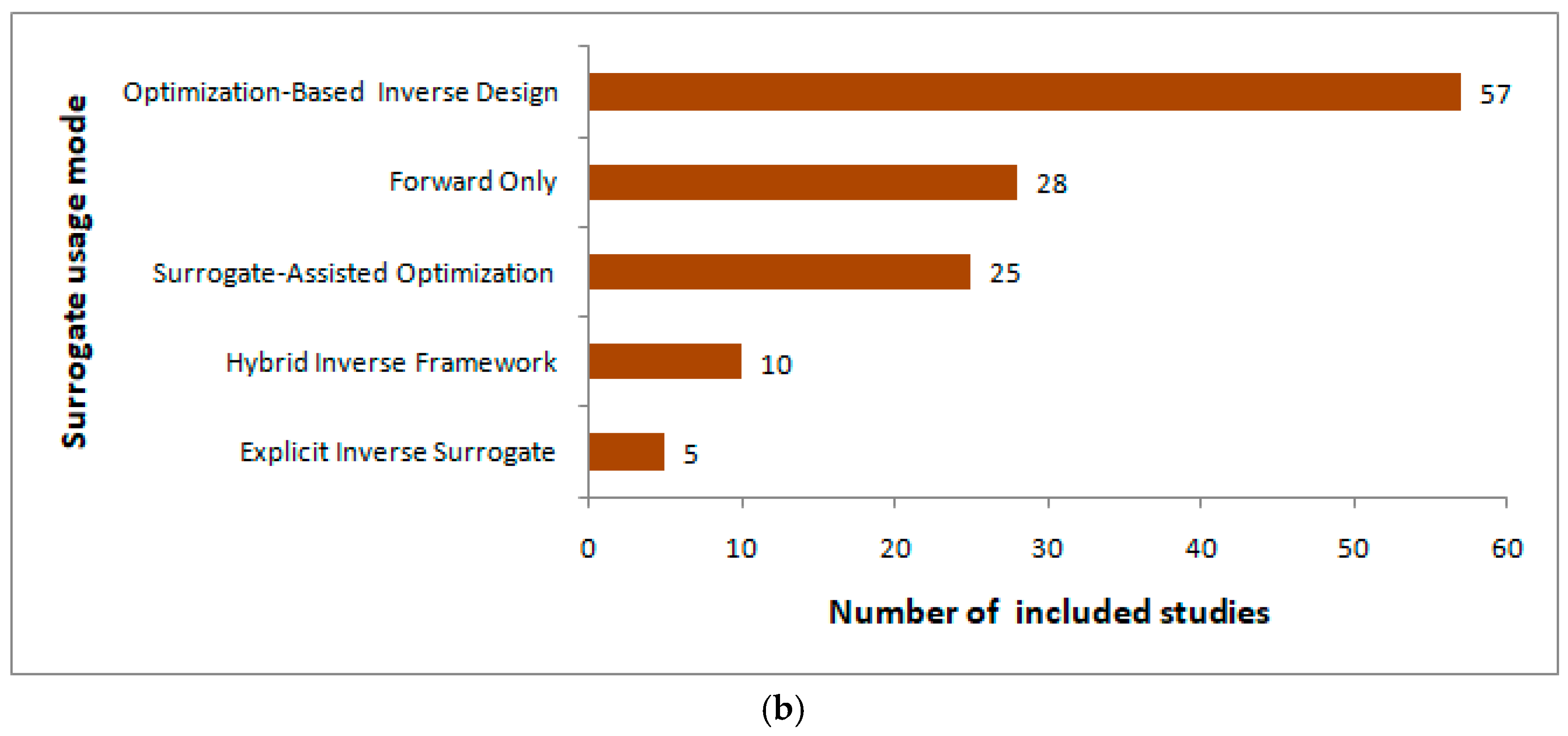
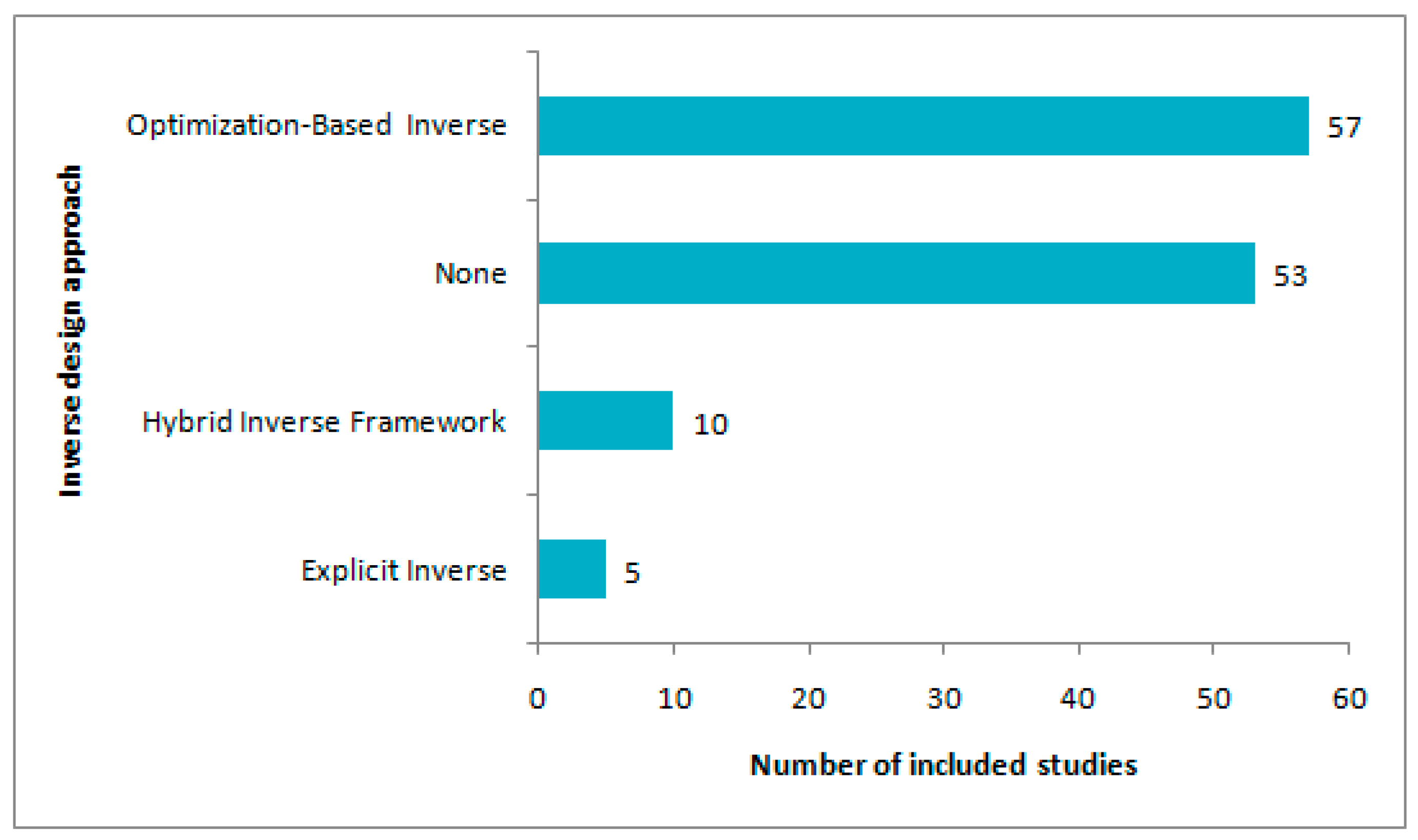
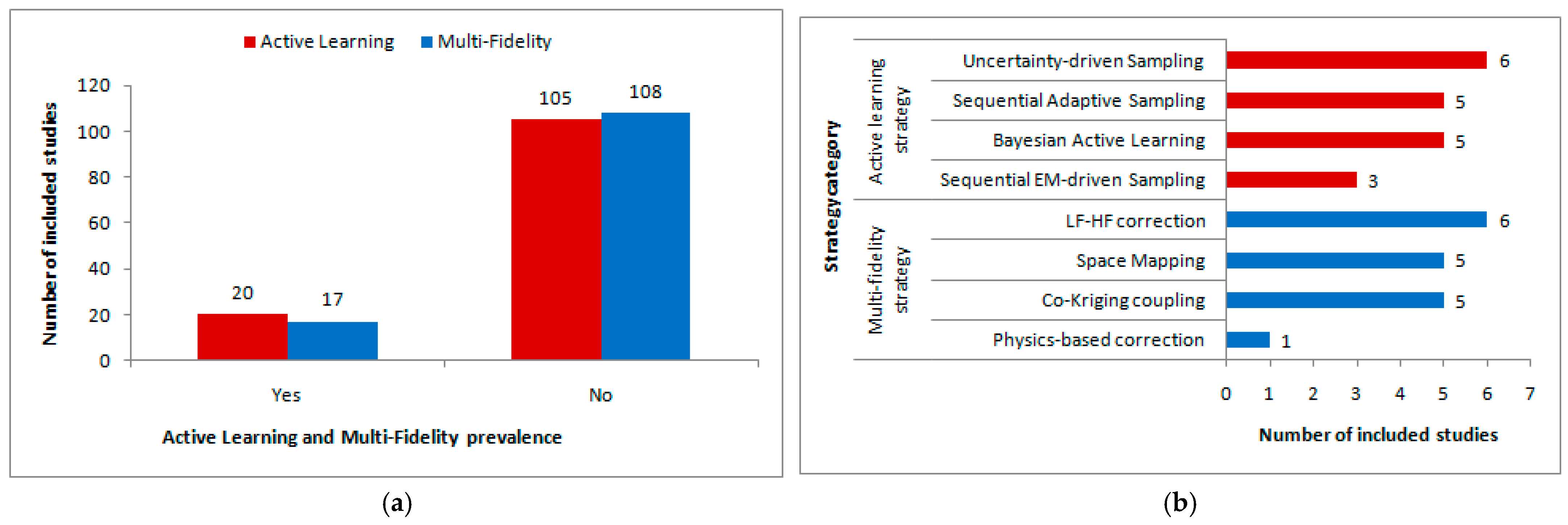
- Optimization-based inverse design is the most commonly used approach, whereas multifidelity and active learning are less frequently adopted.
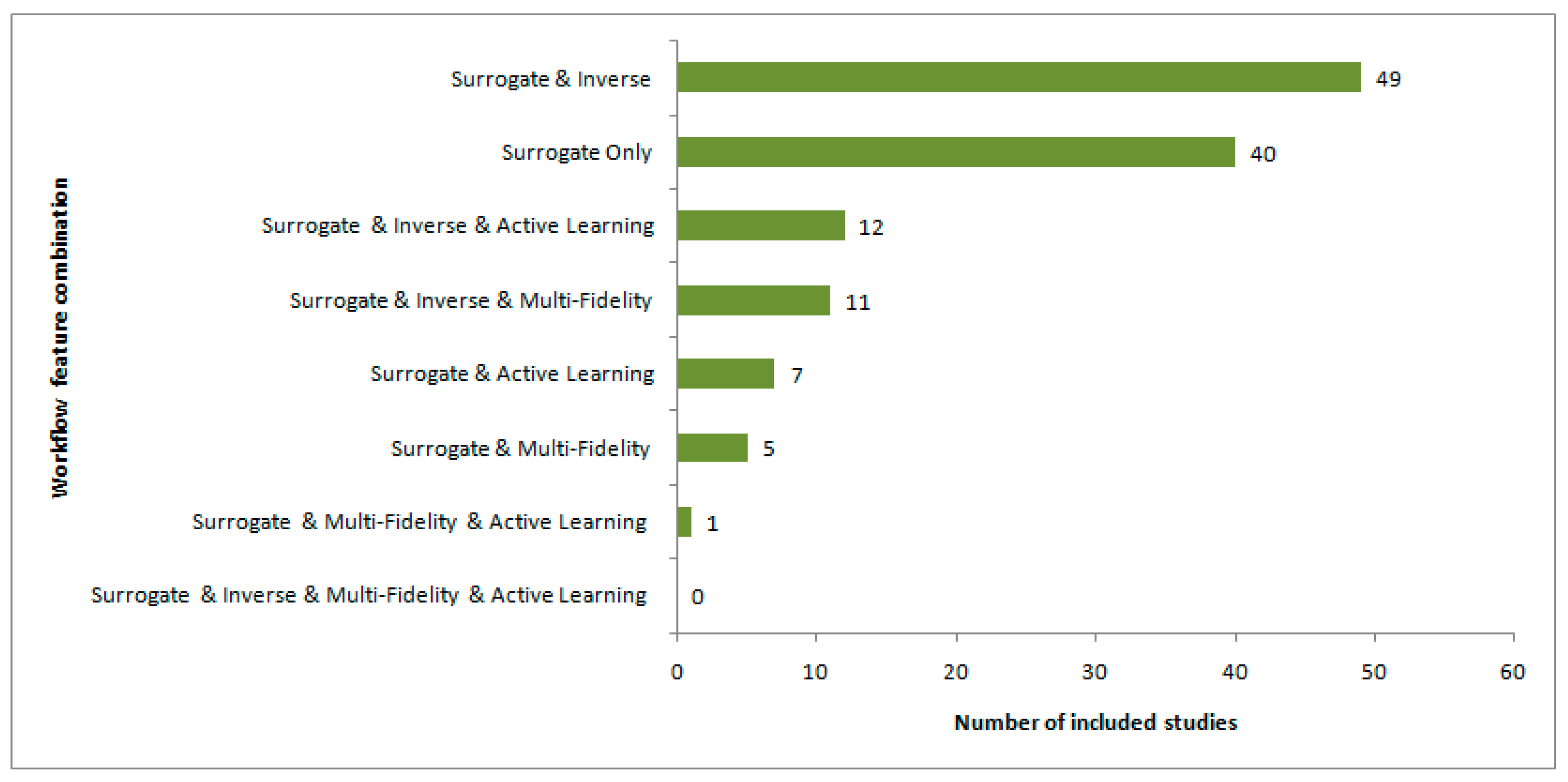
- A unified workflow integrating surrogate modeling, inverse design, multifidelity interaction, and active learning has not yet been demonstrated in the RF and microwave literature.
Abstract
1. Introduction
1.1. Background and Motivation
1.2. Review Scope and Research Questions
- Role of Surrogate Models in RF/Microwave Design Workflows: How are surrogate models functionally positioned within RF and microwave design workflows?
- Inverse-Design Adoption: To what extent are surrogate models used in inverse RF/microwave design, either through explicit inverse mapping or optimization-based inverse design?
- MultiFidelity Integration: How frequently are multifidelity or variable-fidelity EM strategies integrated into surrogate-based RF/microwave design and optimization workflows?
- Active Learning Adoption: To what extent is active learning or adaptive sampling systematically incorporated into RF and microwave surrogate modeling workflows?
- Unified Workflow: Do existing studies implement a unified workflow that combines surrogate modeling, inverse design, multifidelity interaction, and active learning within a unified RF/microwave design framework?
2. Materials and Methods
2.1. Search Strategy and Study Identification
2.2. Eligibility Criteria
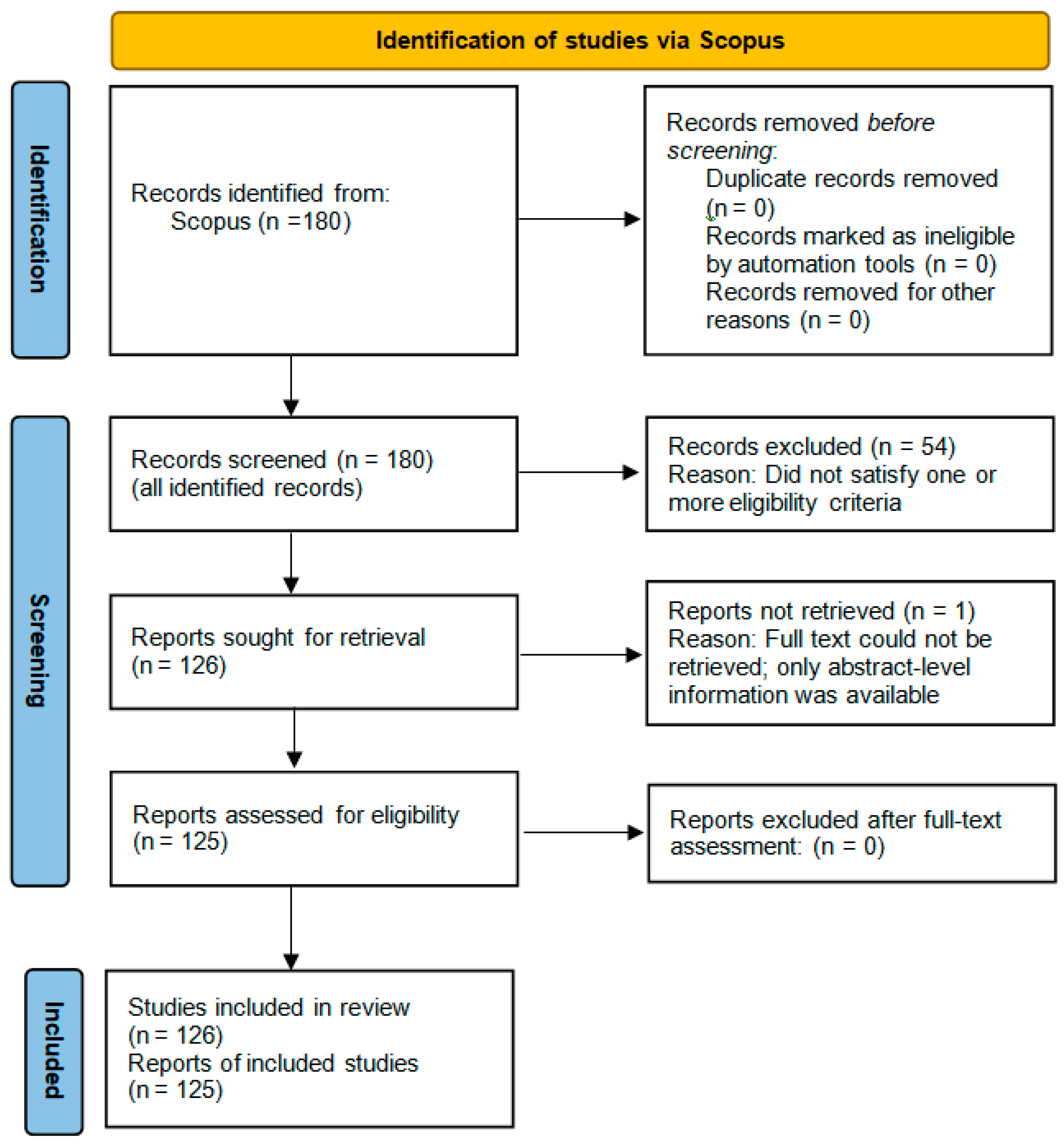
2.3. Study Selection Process and Final Review Corpus
2.4. Classification Principles
2.4.1. Mapping and Technical Classification Fields
2.4.2. Decision Rules for Mapping Table Fields
2.4.3. Decision Rules for Technical Classification Fields
2.4.4. Consistency Rules and Derived Fields
2.4.5. Taxonomy Assignment
2.4.6. Assessment of Reporting Sufficiency and Classification Consistency
- Were the RF/microwave design target and application context described clearly enough to support eligibility and scope classification?
- Were the surrogate model and its functional role in the workflow described clearly enough to support mapping-table classification?
- Was the methodological workflow described clearly enough to support the classification of design optimization, inverse-design approach, multifidelity interaction, and active learning?
- Were the reported methods and results sufficiently clear to support technical characterization, taxonomy assignment, and later cross-study synthesis?
3. Results
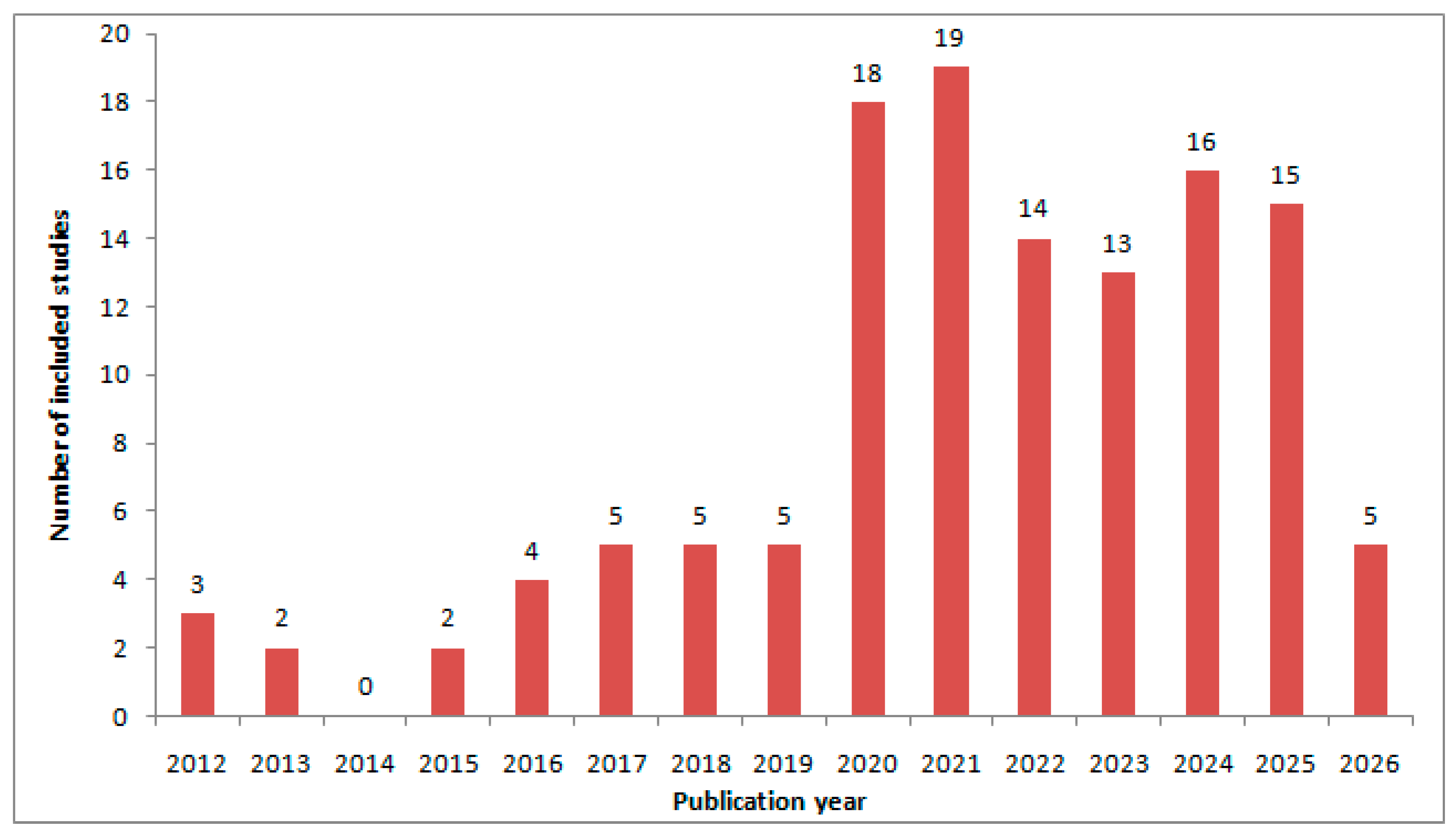
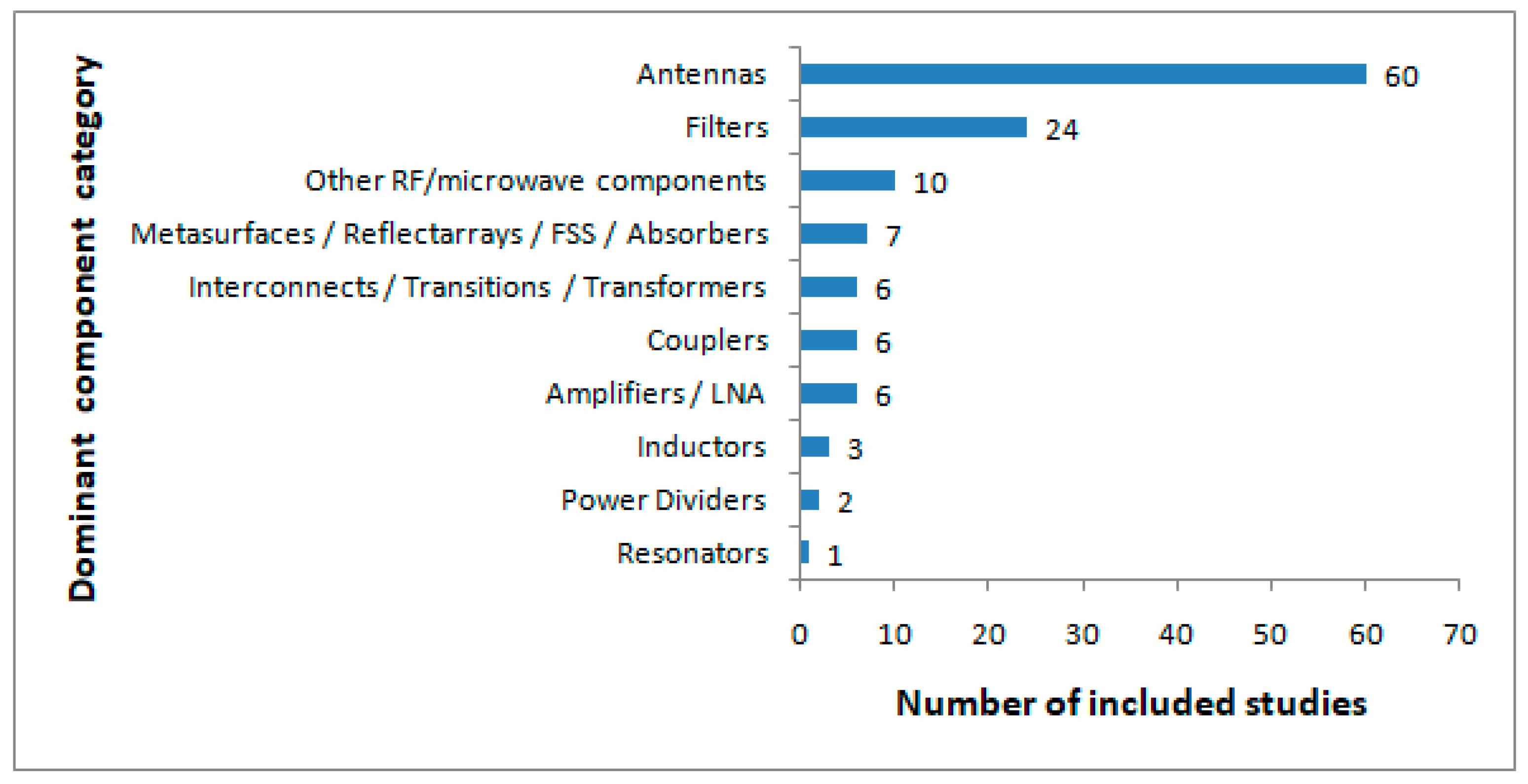
3.1. Overview of the Included Studies
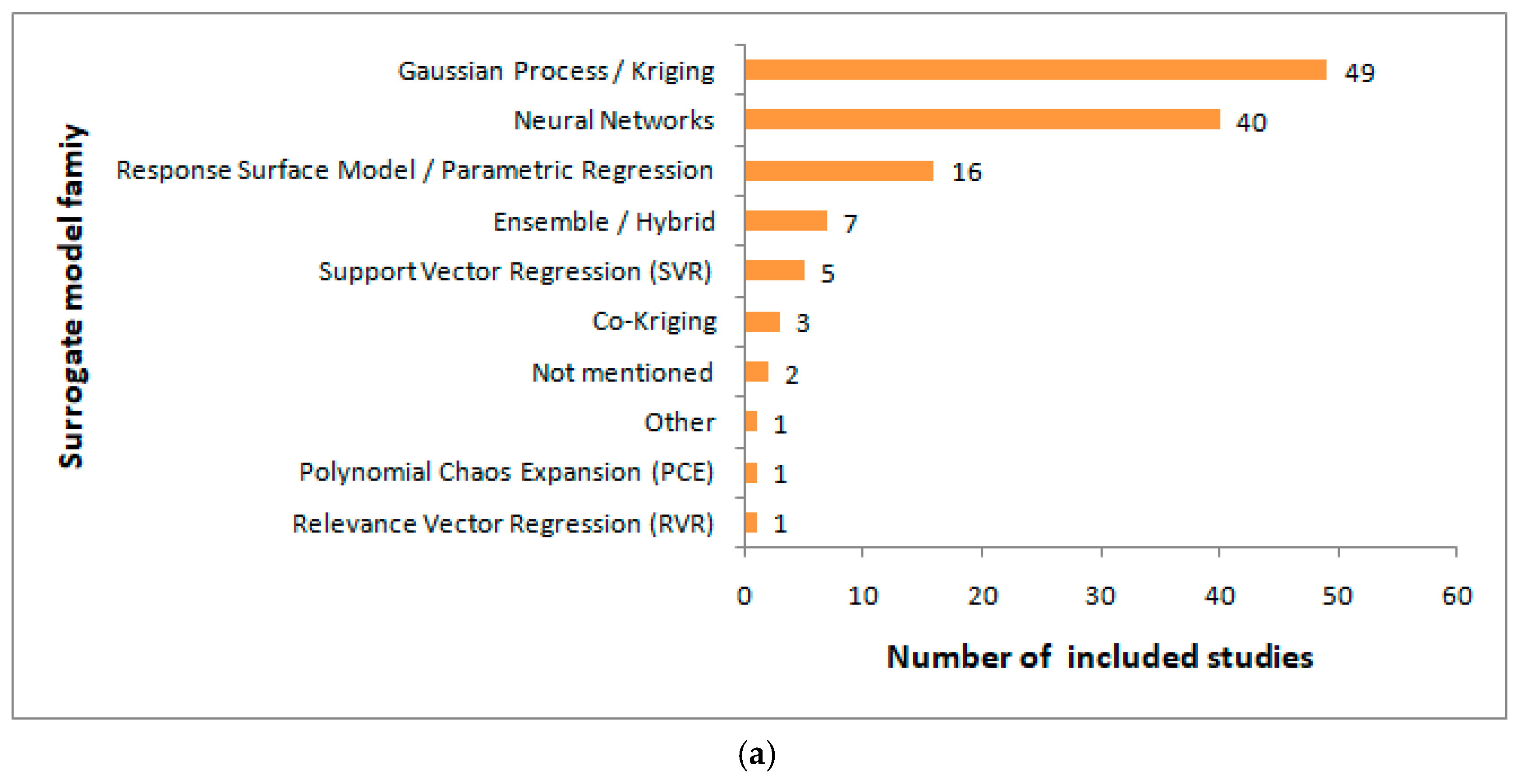
3.2. Surrogate Families and Workflow Roles
3.3. Adoption of Inverse Design
3.4. Adoption of Multifidelity and Active Learning
3.5. Workflow Feature Combinations and the Unified-Workflow Question
3.6. Functional Workflow Taxonomy of the Studies Included in This Review
3.7. Reporting Quality and Classification Transparency
4. Discussion
4.1. Interpretation of the Main Findings
4.2. Limitations and Future Directions
5. Conclusions
Supplementary Materials
Author Contributions
Funding
Institutional Review Board Statement
Informed Consent Statement
Data Availability Statement
Conflicts of Interest
References
- Chen, X.; Wei, Z.; Li, M.; Rocca, P. A review of deep learning approaches for inverse scattering problems (invited review). Prog. Electromagn. Res. 2020, 167, 67–81. [Google Scholar] [CrossRef] [Scilit]
- El Misilmani, H.M.; Naous, T.; Al Khatib, S.K. A review on the design and optimization of antennas using machine learning algorithms and techniques. Int. J. RF Microw. Comput.-Aided Eng. 2020, 30, e22356. [Google Scholar] [CrossRef] [Scilit]
- Sagar, M.S.; Ouassal, H.; Omi, A.I.; Wisniewska, A.; Jalajamony, H.M.; Fernandez, R.E.; Sekhar, P.K. Application of machine learning in electromagnetics: Mini-review. Electronics 2021, 10, 2752. [Google Scholar] [CrossRef] [Scilit]
- Roy, C.; Wu, K. A review of electromagnetics-based microwave circuit design optimization. IEEE Microw. Mag. 2024, 25, 16–40. [Google Scholar] [CrossRef] [Scilit]
- Gajbhiye, P.; Singh, S.; Kumar Sharma, M. A comprehensive review of AI and machine learning techniques in antenna design optimization and measurement. Discov. Electron. 2025, 2, 46. [Google Scholar] [CrossRef] [Scilit]
- Sendrea, R.E.; Zekios, C.L.; Georgakopoulos, S.V. A review of multi-fidelity learning approaches for electromagnetic problems. Electronics 2025, 14, 89. [Google Scholar] [CrossRef] [Scilit]
- Gazda, C.; Couckuyt, I.; Rogier, H.; Vande Ginste, D.; Dhaene, T. Constrained multiobjective optimization of a common-mode suppression filter. IEEE Trans. Electromagn. Compat. 2012, 54, 704–707. [Google Scholar] [CrossRef] [Scilit]
- Kozieł, S.; Ogurtsov, S.; Couckuyt, I.; Dhaene, T. Cost-efficient electromagnetic-simulation-driven antenna design using co-Kriging. IET Microw. Antennas Propag. 2012, 6, 1521–1528. [Google Scholar] [CrossRef] [Scilit]
- Liu, B.; Deferm, N.; Zhao, D.; Reynaert, P.; Gielen, G.G.E. An efficient high-frequency linear RF amplifier synthesis method based on evolutionary computation and machine learning techniques. IEEE Trans. Comput.-Aided Des. Integr. Circuits Syst. 2012, 31, 981–993. [Google Scholar] [CrossRef] [Scilit]
- Kozieł, S.; Leifsson, L.; Couckuyt, I.; Dhaene, T. Robust variable-fidelity optimization of microwave filters using co-Kriging and trust regions. Microw. Opt. Technol. Lett. 2013, 55, 765–769. [Google Scholar] [CrossRef] [Scilit]
- Kozieł, S.; Ogurtsov, S.; Couckuyt, I.; Dhaene, T. Variable-fidelity electromagnetic simulations and co-kriging for accurate modeling of antennas. IEEE Trans. Antennas Propag. 2013, 61, 1301–1308. [Google Scholar] [CrossRef] [Scilit]
- Kozieł, S.; Bekasiewicz, A. Recent developments in simulation-driven multi-objective design of antennas. Bull. Pol. Acad. Sci. Tech. Sci. 2015, 63, 781–789. [Google Scholar] [CrossRef] [Scilit]
- Kozieł, S.; Cheng, Q.S.; Bandler, J.W. Feature-based surrogates for low-cost microwave modelling and optimisation. IET Microw. Antennas Propag. 2015, 9, 1706–1712. [Google Scholar] [CrossRef] [Scilit]
- Chávez-Hurtado, J.L.; Rayas-Sanchez, J.E. Polynomial-based surrogate modeling of RF and microwave circuits in frequency domain exploiting the multinomial theorem. IEEE Trans. Microw. Theory Tech. 2016, 64, 4371–4381. [Google Scholar] [CrossRef] [Scilit]
- Gongal-Reddy, V.M.R.; Zhang, S.; Zhang, C.; Zhang, Q.J. Parallel computational approach to gradient based EM optimization of passive microwave circuits. IEEE Trans. Microw. Theory Tech. 2016, 64, 44–59. [Google Scholar] [CrossRef] [Scilit]
- Leszczynska, N.; Couckuyt, I.; Dhaene, T.; Mrozowski, M. Low-cost surrogate models for microwave filters. IEEE Microw. Wirel. Compon. Lett. 2016, 26, 969–971. [Google Scholar] [CrossRef] [Scilit]
- Ulaganathan, S.; Kozieł, S.; Couckuyt, I.; Laermans, E.; Dhaene, T. Data-driven model based design and analysis of antenna structures. IET Microw. Antennas Propag. 2016, 10, 1428–1434. [Google Scholar] [CrossRef] [Scilit]
- Liu, B.; Irvine, A.; Akinsolu, M.; Arabi, O.; Grout, V.; Ali, N. GUI design exploration software for microwave antennas. J. Comput. Des. Eng. 2017, 4, 274–281. [Google Scholar] [CrossRef] [Scilit]
- Liu, B.; Yang, H.; Lancaster, M.J. Global optimization of microwave filters based on a surrogate model-assisted evolutionary algorithm. IEEE Trans. Microw. Theory Tech. 2017, 65, 1976–1985. [Google Scholar] [CrossRef] [Scilit]
- Passos, F.; Roca, E.; Castro-López, R.; Fernandez-Fernandez, F.V. Radio-frequency inductor synthesis using evolutionary computation and Gaussian-process surrogate modeling. Appl. Soft Comput. 2017, 60, 495–507. [Google Scholar] [CrossRef] [Scilit]
- Passos, F.; Roca, E.; Castro-López, R.; Fernandez-Fernandez, F.V. An inductor modeling and optimization toolbox for RF circuit design. Integr. VLSI J. 2017, 58, 463–472. [Google Scholar] [CrossRef] [Scilit]
- Rayas-Sanchez, J.E.; Chávez-Hurtado, J.L.; Brito-Brito, Z. Optimization of full-wave EM models by low-order low-dimension polynomial surrogate functionals. Int. J. Numer. Model. Electron. Netw. Devices Fields 2017, 30, e2094. [Google Scholar] [CrossRef] [Scilit]
- Hassan, A.K.S.O.; Etman, A.S.; Soliman, E.A. Optimization of a novel nano antenna with two radiation modes using Kriging surrogate models. IEEE Photonics J. 2018, 10, 4800807. [Google Scholar] [CrossRef] [Scilit]
- Kozieł, S.; Bekasiewicz, A. Computationally efficient two-objective optimization of compact microwave couplers through corrected domain patching. Metrol. Meas. Syst. 2018, 25, 139–157. [Google Scholar] [CrossRef] [Scilit]
- Passos, F.; Roca, E.; Castro-López, R.; Fernandez-Fernandez, F.V. A comparison of automated RF circuit design methodologies: Online versus offline passive component design. IEEE Trans. Very Large Scale Integr. (VLSI) Syst. 2018, 26, 2386–2394. [Google Scholar] [CrossRef] [Scilit]
- Wu, S.; Cao, W.; Liu, C.; Wu, M. A computer-aided tuning method for microwave filters by combing T-S fuzzy neural networks and improved space mapping. CMES Comput. Model. Eng. Sci. 2018, 116, 433–453. [Google Scholar] [CrossRef] [Scilit]
- Wu, S.; Cao, W.; Wu, M.; Liu, C. Microwave filter modeling and intelligent tuning. J. Adv. Comput. Intell. Intell. Inform. 2018, 22, 924–932. [Google Scholar] [CrossRef] [Scilit]
- Akinsolu, M.; Liu, B.; Grout, V.; Lazaridis, P.I.; Mognaschi, M.E.; Di Barba, P. A parallel surrogate model assisted evolutionary algorithm for electromagnetic design optimization. IEEE Trans. Emerg. Top. Comput. Intell. 2019, 3, 93–105. [Google Scholar] [CrossRef] [Scilit]
- Hua, Q.; Huang, Y.; Song, C.; Akinsolu, M.; Liu, B.; Jia, T.; Xu, Q.; Alieldin, A. A novel compact quadruple-band indoor base station antenna for 2G/3G/4G/5G systems. IEEE Access 2019, 7, 151350–151358. [Google Scholar] [CrossRef] [Scilit]
- Liu, B.; Akinsolu, M.; Ali, N.; Abd-Alhameed, R. Efficient global optimisation of microwave antennas based on a parallel surrogate model-assisted evolutionary algorithm. IET Microw. Antennas Propag. 2019, 13, 149–155. [Google Scholar] [CrossRef] [Scilit]
- Prado, D.R.; López-Fernández, J.A.; Arrebola, M.; Goussetis, G. Support vector regression to accelerate design and crosspolar optimization of shaped-beam reflectarray antennas for space applications. IEEE Trans. Antennas Propag. 2019, 67, 1659–1668. [Google Scholar] [CrossRef] [Scilit]
- Song, Y.; Cheng, Q.S.; Kozieł, S. Multi-fidelity local surrogate model for computationally efficient microwave component design optimization. Sensors 2019, 19, 3023. [Google Scholar] [CrossRef] [Scilit] [PubMed]
- Al-Mansoori, M.; Neira, E.; Lalléchère, S.; Kasmi, C.; Vega, F.; Alyafei, F. Assessing vircators’ reliability through uncertainty and sensitivity analyses using a surrogate model. IEEE Access 2020, 8, 205022–205033. [Google Scholar] [CrossRef] [Scilit]
- Arabi, O.; See, C.H.; Ullah, A.; Ali, N.; Liu, B.; Abd-Alhameed, R.; McEwan, N.J.; Excell, P.S. Compact wideband MIMO diversity antenna for mobile applications using multi-layered structure. Electronics 2020, 9, 1307. [Google Scholar] [CrossRef] [Scilit]
- Chen, X.; Tian, Y.; Zhang, T.; Gao, J. Differential evolution based manifold Gaussian process machine learning for microwave filter’s parameter extraction. IEEE Access 2020, 8, 146450–146462. [Google Scholar] [CrossRef] [Scilit]
- Ding, S.; Pichon, L. Sensitivity analysis of an implanted antenna within surrounding biological environment. Energies 2020, 13, 996. [Google Scholar] [CrossRef] [Scilit]
- Gao, J.; Tian, Y.; Chen, X. Antenna optimization based on co-training algorithm of Gaussian process and support vector machine. IEEE Access 2020, 8, 211380–211390. [Google Scholar] [CrossRef] [Scilit]
- Gao, J.; Tian, Y.; Zheng, X.; Chen, X. Resonant frequency modeling of microwave antennas using Gaussian process based on semisupervised learning. Complexity 2020, 2020, 3485469. [Google Scholar] [CrossRef] [Scilit]
- Garbuglia, F.; Spina, D.; Deschrijver, D.; Dhaene, T. Evaluation of generative modeling techniques for frequency responses. Eng. Proc. 2020, 3, 7. [Google Scholar] [CrossRef] [Scilit]
- Kozieł, S.; Pietrenko-Dąbrowska, A. Fast and reliable knowledge-based design closure of antennas by means of iterative prediction-correction scheme. Eng. Comput. 2020, 38, 3710–3731. [Google Scholar] [CrossRef] [Scilit]
- Kozieł, S.; Pietrenko-Dąbrowska, A. On computationally-efficient reference design acquisition for reduced-cost constrained modeling and re-design of compact microwave passives. IEEE Access 2020, 8, 203317–203330. [Google Scholar] [CrossRef] [Scilit]
- Kozieł, S.; Pietrenko-Dąbrowska, A. Recent advances in high frequency modeling by means of domain confinement and nested kriging. IEEE Access 2020, 8, 189326–189342. [Google Scholar] [CrossRef] [Scilit]
- Kozieł, S.; Pietrenko-Dąbrowska, A. Rapid optimization of compact microwave passives using Kriging surrogates and iterative correction. IEEE Access 2020, 8, 53587–53594. [Google Scholar] [CrossRef] [Scilit]
- Kozieł, S.; Pietrenko-Dąbrowska, A.; Al Hasan, M. Design-oriented two-stage surrogate modeling of miniaturized microstrip circuits with dimensionality reduction. IEEE Access 2020, 8, 121744–121754. [Google Scholar] [CrossRef] [Scilit]
- Passos, F.; Roca, E.; Sieiro, J.; Fiorelli, R.; Castro-López, R.; Lopez-Villegas, J.M.; Fernandez-Fernandez, F.V. A multilevel bottom-up optimization methodology for the automated synthesis of RF systems. IEEE Trans. Comput.-Aided Des. Integr. Circuits Syst. 2020, 39, 560–571. [Google Scholar] [CrossRef] [Scilit]
- Pietrenko-Dąbrowska, A.; Kozieł, S. Nested kriging surrogates for rapid multi-objective optimization of compact microwave components. Appl. Comput. Electromagn. Soc. J. 2020, 35, 1344–1345. [Google Scholar] [CrossRef] [Scilit]
- Pietrenko-Dąbrowska, A.; Kozieł, S. Low-cost surrogate modeling of miniaturized microwave components using nested kriging. Appl. Comput. Electromagn. Soc. J. 2020, 35, 1346–1347. [Google Scholar] [CrossRef] [Scilit]
- Rufuie, M.R.; Lamęcki, A.; Sypek, P.; Mrozowski, M. Residue-pole methods for variability analysis of S-parameters of microwave devices with 3D FEM and mesh deformation. Radioengineering 2020, 29, 10–20. [Google Scholar] [CrossRef] [Scilit]
- Ullah, U.; Kozieł, S.; Ben Mabrouk, I.B. Rapid redesign and bandwidth/size tradeoffs for compact wideband circular polarization antennas using inverse surrogates and fast EM-based parameter tuning. IEEE Trans. Antennas Propag. 2020, 68, 81–89. [Google Scholar] [CrossRef] [Scilit]
- Zhang, X.Y.; Tian, Y.; Zheng, X. Antenna optimization design based on deep Gaussian process model. Int. J. Antennas Propag. 2020, 2020, 2154928. [Google Scholar] [CrossRef] [Scilit]
- Abdullah, M.; Kozieł, S. A novel versatile decoupling structure and expedited inverse-model-based re-design procedure for compact single- and dual-band MIMO antennas. IEEE Access 2021, 9, 37656–37667. [Google Scholar] [CrossRef] [Scilit]
- Al-Mansoori, M.; Neira, E.; Lalléchère, S.; Vega, F.; Fichte, L.O.; Nezhi, Z.; Kasmi, C.; Stiemer, M. A framework for peak power exceedances of high power microwave radiators applied to a vircator surrogate model. Prog. Electromagn. Res. B 2021, 91, 39–57. [Google Scholar] [CrossRef] [Scilit]
- Belen, M.A.; Mahouti, P.; Kozieł, S.; Caliskan, A.; Szczepański, S. On decomposition-based surrogate-assisted optimization of leaky wave antenna input characteristics for beam scanning applications. IEEE Access 2021, 9, 161318–161325. [Google Scholar] [CrossRef] [Scilit]
- Çalik, N.; Belen, M.A.; Mahouti, P.; Kozieł, S. Accurate modeling of frequency selective surfaces using fully-connected regression model with automated architecture determination and parameter selection based on Bayesian optimization. IEEE Access 2021, 9, 38396–38410. [Google Scholar] [CrossRef] [Scilit]
- Canelas, A.; Passos, F.; Lourenço, N.; Martins, R.; Roca, E.; Castro-López, R.; Horta, N.; Fernandez-Fernandez, F.V. Hierarchical yield-aware synthesis methodology covering device-, circuit-, and system-level for radiofrequency ICs. IEEE Access 2021, 9, 124152–124164. [Google Scholar] [CrossRef] [Scilit]
- Fuhrländer, M.; Schöps, S. Yield optimization using hybrid Gaussian process regression and a genetic multi-objective approach. Adv. Radio Sci. 2021, 19, 41–48. [Google Scholar] [CrossRef] [Scilit]
- Kozieł, S.; Mahouti, P.; Çalik, N.; Belen, M.A.; Szczepański, S. Improved modeling of microwave structures using performance-driven fully-connected regression surrogate. IEEE Access 2021, 9, 71470–71481. [Google Scholar] [CrossRef] [Scilit]
- Kozieł, S.; Pietrenko-Dąbrowska, A. Global EM-driven optimization of multi-band antennas using knowledge-based inverse response-feature surrogates. Knowl.-Based Syst. 2021, 227, 107189. [Google Scholar] [CrossRef] [Scilit]
- Kurgan, P. Efficient surrogate modeling and design optimization of compact integrated on-chip inductors based on multi-fidelity EM simulation models. Micromachines 2021, 12, 1341. [Google Scholar] [CrossRef] [Scilit]
- Li, R.; Tian, Y.; Li, P. Antenna modeling based on two-stage Gaussian process considering sensitivity information. IEEE Access 2021, 9, 70443–70454. [Google Scholar] [CrossRef] [Scilit]
- Mahouti, P.; Kizilay, A.; Tari, O.; Belen, A.; Belen, M.A.; Caliskan, A. Design optimization of ultra-wideband Vivaldi antenna using artificial intelligence. Appl. Comput. Electromagn. Soc. J. 2021, 36, 1594–1601. [Google Scholar] [CrossRef] [Scilit]
- Nan, J.; Xie, H.; Gao, M.; Song, Y.; Yang, W. Design of UWB antenna based on improved deep belief network and extreme learning machine surrogate models. IEEE Access 2021, 9, 126541–126549. [Google Scholar] [CrossRef] [Scilit]
- Naseri, P.; Hum, S.V. A generative machine learning-based approach for inverse design of multilayer metasurfaces. IEEE Trans. Antennas Propag. 2021, 69, 5725–5739. [Google Scholar] [CrossRef] [Scilit]
- Nguyen, T.; Shi, B.; Ma, H.; Li, E.P.; Chen, X.; Cangellaris, A.C.; Schutt-Ainé, J. Comparative study of surrogate modeling methods for signal integrity and microwave circuit applications. IEEE Trans. Compon. Packag. Manuf. Technol. 2021, 11, 1369–1379. [Google Scholar] [CrossRef] [Scilit]
- Pietrenko-Dąbrowska, A.; Kozieł, S. Design centering of compact microwave components using response features and trust regions. Energies 2021, 14, 8550. [Google Scholar] [CrossRef] [Scilit]
- Pietrenko-Dąbrowska, A.; Kozieł, S. Fast design closure of compact microwave components by means of feature-based metamodels. Electronics 2021, 10, 10. [Google Scholar] [CrossRef] [Scilit]
- Tian, Y.; Ding, W.T.; Li, P. Resonant frequency modeling of microstrip antenna based on deep kernel learning. IEEE Access 2021, 9, 39067–39076. [Google Scholar] [CrossRef] [Scilit]
- Üstün, D.; Toktas, F. Surrogate-based computational analysis and design for H-shaped microstrip antenna. J. Electromagn. Waves Appl. 2021, 35, 71–82. [Google Scholar] [CrossRef] [Scilit]
- Zhang, J.; Akinsolu, M.; Liu, B.; Vandenbosch, G.A.E. Automatic AI-driven design of mutual coupling reducing topologies for frequency reconfigurable antenna arrays. IEEE Trans. Antennas Propag. 2021, 69, 1831–1836. [Google Scholar] [CrossRef] [Scilit]
- Belen, A.; Tari, O.; Mahouti, P.; Belen, M.A.; Caliskan, A. Surrogate-based design optimization of multi-band antenna. Appl. Comput. Electromagn. Soc. J. 2022, 37, 34–40. [Google Scholar] [CrossRef] [Scilit]
- Belen, M.A.; Güneş, F. Surrogate based design optimization of low noise amplifier for ISM band. Sigma J. Eng. Nat. Sci. 2022, 40, 491–499. [Google Scholar] [CrossRef] [Scilit]
- de Witte, D.; Qing, J.; Couckuyt, I.; Dhaene, T.; Vande Ginste, D.; Spina, D. A robust Bayesian optimization framework for microwave circuit design under uncertainty. Electronics 2022, 11, 2267. [Google Scholar] [CrossRef] [Scilit]
- Ding, W.T.; Meng, F.; Tian, Y.; Yuan, H.N. Antenna optimization based on auto-context broad learning system. Int. J. Antennas Propag. 2022, 2022, 7338164. [Google Scholar] [CrossRef] [Scilit]
- Massa, A.; Salucci, M. On the design of complex EM devices and systems through the system-by-design paradigm: A framework for dealing with the computational complexity. IEEE Trans. Antennas Propag. 2022, 70, 1328–1343. [Google Scholar] [CrossRef] [Scilit]
- Melo, M.C.D.; Santos, P.B.; Faustino, E.; Bastos-Filho, C.J.A.; Cerqueira Sodré Junior, A. Computational intelligence-based methodology for antenna development. IEEE Access 2022, 10, 1860–1870. [Google Scholar] [CrossRef] [Scilit]
- Ohira, M.; Ma, Z. Surrogate-based EM optimization using neural networks for microwave filter design. IEICE Trans. Electron. 2022, 105, 466–473. [Google Scholar] [CrossRef] [Scilit]
- Üstün, D.; Toktas, F.; Toktas, A. An optimized surrogate model using differential evolution algorithm for computing parameters of antennas. Int. J. Numer. Model. Electron. Netw. Devices Fields 2022, 35, e2951. [Google Scholar] [CrossRef] [Scilit]
- Wang, Z.; Qin, J.; Hu, Z.; He, J.; Tang, D. Multi-objective antenna design based on BP neural network surrogate model optimized by improved Sparrow search algorithm. Appl. Sci. 2022, 12, 12543. [Google Scholar] [CrossRef] [Scilit]
- Wei, Y.; Qi, G.; Wang, Y.; Yan, N.; Zhang, Y.; Feng, L. Efficient microwave filter design by a surrogate-model-assisted decomposition-based multi-objective evolutionary algorithm. Electronics 2022, 11, 3309. [Google Scholar] [CrossRef] [Scilit]
- Zhang, J.; Akinsolu, M.; Liu, B.; Zhang, S. Design of zero clearance SIW endfire antenna array using machine learning-assisted optimization. IEEE Trans. Antennas Propag. 2022, 70, 3858–3863. [Google Scholar] [CrossRef] [Scilit]
- Zhang, Y.; Wang, X.; Wang, Y.; Yan, N.; Feng, L.; Zhang, L. Accurate design of microwave filter based on surrogate model-assisted evolutionary algorithm. Electronics 2022, 11, 3705. [Google Scholar] [CrossRef] [Scilit]
- Zhang, Z.; Liu, B.; Yu, Y.; Cheng, Q.S. A microwave filter yield optimization method based on off-line surrogate model-assisted evolutionary algorithm. IEEE Trans. Microw. Theory Tech. 2022, 70, 2925–2934. [Google Scholar] [CrossRef] [Scilit]
- Zheng, Q.; Guo, C.; Ding, J.; Akinsolu, M.; Liu, B.; Vandenbosch, G.A.E. A wideband low-RCS metasurface-inspired circularly polarized slot array based on AI-driven antenna design optimization algorithm. IEEE Trans. Antennas Propag. 2022, 70, 8584–8589. [Google Scholar] [CrossRef] [Scilit]
- Behera, B.R.; Alsharif, M.H.; Jahid, A. Investigation of a circularly polarized metasurface antenna for hybrid wireless applications. Micromachines 2023, 14, 2172. [Google Scholar] [CrossRef] [Scilit] [PubMed]
- Belen, A.; Belen, M.A. Data-driven modeling of band-pass filter for sub-5G applications. Microw. Opt. Technol. Lett. 2023, 65, 2210–2216. [Google Scholar] [CrossRef] [Scilit]
- Fu, H.; Tian, Y.; Meng, F.; Li, Q.; Ren, X. Microstrip antenna modelling based on image-based convolutional neural network. Electron. Lett. 2023, 59, e12910. [Google Scholar] [CrossRef] [Scilit]
- Garbuglia, F.; Spina, D.; Deschrijver, D.; Couckuyt, I.; Dhaene, T. Bayesian optimization for microwave devices using deep GP spectral surrogate models. IEEE Trans. Microw. Theory Tech. 2023, 71, 2311–2318. [Google Scholar] [CrossRef] [Scilit]
- Jamshidi, M.; Yahya, S.I.; Roshani, S.; Chaudhary, M.A.; Yasin, Y.Y.; Roshani, S. A fast surrogate model-based algorithm using multilayer perceptron neural networks for microwave circuit design. Algorithms 2023, 16, 324. [Google Scholar] [CrossRef] [Scilit]
- Manfredi, P. Probabilistic uncertainty quantification of microwave circuits using Gaussian processes. IEEE Trans. Microw. Theory Tech. 2023, 71, 2360–2372. [Google Scholar] [CrossRef] [Scilit]
- Pietrenko-Dąbrowska, A.; Kozieł, S.; Zhang, Q.J. Cost-efficient two-level modeling of microwave passives using feature-based surrogates and domain confinement. Electronics 2023, 12, 3560. [Google Scholar] [CrossRef] [Scilit]
- Ren, X.; Tian, Y.; Li, Q.; Fu, H. Resonant frequency modelling of microstrip antennas by consensus network and Student’s-T process. Appl. Comput. Electromagn. Soc. J. 2023, 38, 987–997. [Google Scholar] [CrossRef] [Scilit]
- Roshani, S.; Kozieł, S.; Yahya, S.I.; Chaudhary, M.A.; Yasin, Y.Y.; Roshani, S.; Gołuński, L. Mutual coupling reduction in antenna arrays using artificial intelligence approach and inverse neural network surrogates. Sensors 2023, 23, 7089. [Google Scholar] [CrossRef] [Scilit] [PubMed]
- Sarkar, D.; Khan, T.; Kishk, A.A. Machine learning assisted hybrid electromagnetic modeling framework and its applications to UWB MIMO antennas. IEEE Access 2023, 11, 19645–19656. [Google Scholar] [CrossRef] [Scilit]
- Tulum, M.A.; Türk, A.S.; Mahouti, P. Data driven surrogate modeling of phase array antennas using deep learning for millimetric band applications. IEEE Access 2023, 11, 114415–114423. [Google Scholar] [CrossRef] [Scilit]
- Wei, Z.; Zhou, Z.; Wang, P.; Ren, J.; Yin, Y.; Pedersen, G.F.; Shen, M. Fully automated design method based on reinforcement learning and surrogate modeling for antenna array decoupling. IEEE Trans. Antennas Propag. 2023, 71, 660–671. [Google Scholar] [CrossRef] [Scilit]
- Xue, L.; Liu, B.; Yu, Y.; Cheng, Q.S.; Imran, M.; Qiao, T. An unsupervised microwave filter design optimization method based on a hybrid surrogate model-assisted evolutionary algorithm. IEEE Trans. Microw. Theory Tech. 2023, 71, 1159–1170. [Google Scholar] [CrossRef] [Scilit]
- Bereket, M.; Belen, M.A. Data-driven surrogate modeling of dielectric reflectarray antenna using 3D printing technology for X band applications. Microw. Opt. Technol. Lett. 2024, 66, e34153. [Google Scholar] [CrossRef] [Scilit]
- Dávalos-Guzmán, J.; Chávez-Hurtado, J.L.; Brito-Brito, Z. Integrative BNN-LHS surrogate modeling and thermo-mechanical-EM analysis for enhanced characterization of high-frequency low-pass filters in COMSOL. Micromachines 2024, 15, 647. [Google Scholar] [CrossRef] [Scilit]
- Gocen, C.; Akdag, I.; Mahouti, T.; Belen, M.A.; Palandoken, M.; Mahouti, P. Knowledge-based methodology of CPW-fed open stub loaded C-shaped microstrip antenna by surrogate-based modeling. Int. J. RF Microw. Comput.-Aided Eng. 2024, 2024, 6247693. [Google Scholar] [CrossRef] [Scilit]
- Ha, T.D.; Nie, X.; Akinsolu, M.; Liu, B.; Chen, P.Y. An artificial-intelligence-assisted optimization of imperceptible multimode rectenna. IEEE Antennas Wirel. Propag. Lett. 2024, 23, 3559–3563. [Google Scholar] [CrossRef] [Scilit]
- Haque, M.A.; Ahammed, M.S.; Ananta, R.A.; AlJaloud, K.; Jizat, N.M.; Abdulkawi, W.M.; Nahin, K.H.; Al-Bawri, S.S. Broadband high gain performance MIMO antenna array for 5G mm-wave applications-based gain prediction using machine learning approach. Alex. Eng. J. 2024, 104, 665–679. [Google Scholar] [CrossRef] [Scilit]
- Haque, M.A.; Ananta, R.A.; Nirob, J.H.; Ahammed, M.S.; Sawaran Singh, N.S.S.; Paul, L.C.; Algarni, A.D.; El-Affendi, M.; Ateya, A.A. Performance improvement of THz MIMO antenna with graphene and prediction bandwidth through machine learning analysis for 6G application. Results Eng. 2024, 24, 103216. [Google Scholar] [CrossRef] [Scilit]
- Khan, M.R.; Zekios, C.L.; Bhardwaj, S.; Georgakopoulos, S.V. A deep learning convolutional neural network for antenna near-field prediction and surrogate modeling. IEEE Access 2024, 12, 39737–39747. [Google Scholar] [CrossRef] [Scilit]
- Pietrenko-Dąbrowska, A.; Kozieł, S.; Gołuński, L. Cost-efficient globalized parameter optimization of microwave components through response-feature surrogates and nature-inspired metaheuristics. IEEE Access 2024, 12, 79051–79065. [Google Scholar] [CrossRef] [Scilit]
- Prabhakar, D.; Karunakar, P.; Rama Rao, S.V.R.; Kalyanapu, K. Prediction of microstrip antenna dimension using optimized auto-metric graph neural network. Intell. Syst. Appl. 2024, 21, 200326. [Google Scholar] [CrossRef] [Scilit]
- Stanovov, V.; Khodenkov, S.; Gorbunov, S.; Rozhnov, I.; Kazakovtsev, L. Surrogate-assisted differential evolution for the design of multimode resonator topology. Sensors 2024, 24, 5057. [Google Scholar] [CrossRef] [Scilit]
- Su, J.L.; You, J.W.; Chen, L.; Yu, X.Y.; Yin, Q.C.; Yuan, G.H.; Huang, S.Q.; Ma, Q.; Zhang, J.N.; Cui, T.J. MetaPhyNet: Intelligent design of large-scale metasurfaces based on physics-driven neural network. J. Phys. Photonics 2024, 6, 035010. [Google Scholar] [CrossRef] [Scilit]
- Wang, J.; Zhou, L.; Fan, C. A machine learning-based method for co-design and optimization of microwave-absorbing/load-bearing multifunctional structures. Smart Mater. Struct. 2024, 33, 045023. [Google Scholar] [CrossRef] [Scilit]
- Wang, Z.; Zhang, L.; Li, K.L.; Qi, L. Efficient microwave filter design using differential evolution algorithm with chain local search in MOEA/D framework. IEICE Electron. Express 2024, 21, 20240492. [Google Scholar] [CrossRef] [Scilit]
- Yahya, M.S.; Soeung, S.; Abdul Rahim, S.K.A.; Musa, U.; Ba-Hashwan, S.S.; Haque, M.A. Machine learning-optimized compact frequency reconfigurable antenna with RSSI enhancement for long-range applications. IEEE Access 2024, 12, 10970–10987. [Google Scholar] [CrossRef] [Scilit]
- Yang, J.; Xu, L.; Yang, K. Design and optimization of a fan-out wafer-level packaging-based integrated passive device structure for FMCW radar applications. Micromachines 2024, 15, 1311. [Google Scholar] [CrossRef] [Scilit] [PubMed]
- Zhai, M.; Zhang, T.; Pei, R.; Leach, M.; Lim, E.G.; Wang, Z.; Wang, J.; Hua, Q.; Akinsolu, M.; Liu, B.; et al. A reflecting/absorbing dual-mode textile metasurface design. IEEE Antennas Wirel. Propag. Lett. 2024, 23, 3043–3047. [Google Scholar] [CrossRef] [Scilit]
- Åkerstedt, L.; Blanco, D.; Jonsson, B.L.G. On adaptive frequency sampling for data-driven model order reduction applied to antenna responses. IEEE Trans. Antennas Propag. 2025, 73, 5741–5750. [Google Scholar] [CrossRef] [Scilit]
- Dávalos-Guzmán, J.; Chávez-Hurtado, J.L.; Brito-Brito, Z. Accelerating high-frequency circuit optimization using machine learning-generated inverse maps for enhanced space mapping. Electronics 2025, 14, 3097. [Google Scholar] [CrossRef] [Scilit]
- Elabbasi, M.K.; Madi, M.; Kabalan, K.Y.; Salah, J. Optimizing microstrip patch antenna performance: Leveraging machine learning for comparative analysis of antenna dimensions and slot structures. Results Eng. 2025, 28, 107523. [Google Scholar] [CrossRef] [Scilit]
- Hu, C.; Zeng, S.; Li, C. Expensive highly constrained antenna design using surrogate-assisted evolutionary optimization. Electronics 2025, 14, 3613. [Google Scholar] [CrossRef] [Scilit]
- Jiang, L.; Huang, T.; Wang, Y.; Tao, L.; Deng, W.K.; Jin, X.L.; Gong, D.P. Subtractive clustering-assisted surrogate model to fast optimal design of traveling wave tubes. Int. J. RF Microw. Comput.-Aided Eng. 2025, 2025, 8295978. [Google Scholar] [CrossRef] [Scilit]
- Josiah Samuel Raj, J.S.; Gopalan, G. Compact bi-slot patch antenna with tapered edges for Ka-band applications featuring machine learning-assisted performance prediction. Int. J. Environ. Eng. Educ. 2025, 7, 196–207. [Google Scholar] [CrossRef] [Scilit]
- Karantoumanis, E.; Zygiridis, T.; Ploskas, N. A surrogate-based adaptive sampling approach for electromagnetic problems. Int. J. Numer. Model. Electron. Netw. Devices Fields 2025, 38, e70121. [Google Scholar] [CrossRef] [Scilit]
- Li, G.; Xue, S.; Mu, J.; Liu, S.; Zhang, Q.; Wu, W.; Wang, Z.; Ma, Z.; Diwu, D.; Wang, C. The multi-objective optimization of a dual C-type gold ribbon interconnect structure considering its geometrical parameter fluctuation. Micromachines 2025, 16, 914. [Google Scholar] [CrossRef] [Scilit]
- Lindemans, Y.; Ullrick, T.; Couckuyt, I.; Pattyn, T.; Deschrijver, D.; Vande Ginste, D.; Dhaene, T. Spectral Bayesian optimization using a physics-informed rational Szegö kernel for microwave design. IEEE Trans. Compon. Packag. Manuf. Technol. 2025, 15, 1836–1846. [Google Scholar] [CrossRef] [Scilit]
- Liu, W.; Zhao, Y.; Zhang, S.; Xie, D.; Wu, H. Behaviour prediction of via-holes transition based on transfer learning. IET Microw. Antennas Propag. 2025, 19, e70035. [Google Scholar] [CrossRef] [Scilit]
- Liu, Z.; Shan, G.; Chen, Z.; Yang, Y. Physics-guided neural surrogate model with particle swarm-based multi-objective optimization for quasi-coaxial TSV interconnect design. Micromachines 2025, 16, 1134. [Google Scholar] [CrossRef] [Scilit] [PubMed]
- Sjödin, M.; Talcoth, O.; Chang, H.; Zhou, H.; Andersson, K. Comparison of circuit models for ML-assisted microwave circuit design. IEEE J. Microw. 2025, 5, 1358–1369. [Google Scholar] [CrossRef] [Scilit]
- Tian, Y.; Sun, J.; Zhu, Z. Skip-connected CNN exploiting BNN surrogate for antenna modelling. Int. J. Antennas Propag. 2025, 2025, 4999463. [Google Scholar] [CrossRef] [Scilit]
- Zhai, M.; Zhang, T.; Pei, R.; He, H.; Zhang, L.; Leach, M.; Lim, E.G.; Wang, Z.; Wang, J.; Hua, Q.; et al. An ultra-light, low-cost reflecting/absorbing dual-mode metasurface. Mater. Des. 2025, 257, 114470. [Google Scholar] [CrossRef] [Scilit]
- Zhang, L.; Gan, S.; Xue, J. Optimization design of microwave filters based on deep learning and metaheuristic algorithms. Electronics 2025, 14, 3305. [Google Scholar] [CrossRef] [Scilit]
- Colak, B.; Belen, M.A.; Anka, F.; Tari, O.; Mahouti, P.; Akgöl, O. A microstrip monopole antenna design for 5G sub-6 GHz applications using deep learning. IET Commun. 2026, 20, e70127. [Google Scholar] [CrossRef] [Scilit]
- Kalantarnia, A.; Mirzabeigi, A. Machine learning approach for predicting electromagnetic shielding effectiveness of metallic grids in the time and frequency domains. IET Sci. Meas. Technol. 2026, 20, e70048. [Google Scholar] [CrossRef] [Scilit]
- Sukpreecha, K.; Phaebua, K.; Lertwiriyaprapa, T.; Torrungrueng, D.; Chou, H.T. Adaptive sampling for spherical near-field antenna measurements via uncertainty-driven Gaussian process regression. IEEE Open J. Antennas Propag. 2026, 7, 483–497. [Google Scholar] [CrossRef] [Scilit]
- Yang, X.; Nan, J.; Wang, M. Antenna modeling and optimization based on 1D GP-HetCNN surrogates and intelligent methods. Discover Appl. Sci. 2026, 8, 119. [Google Scholar] [CrossRef] [Scilit]
- Ye, S.; Tian, Y.; Tan, G. GPR antenna modelling based on DML exploiting cosine similarity metric. IET Microw. Antennas Propag. 2026, 20, e70086. [Google Scholar] [CrossRef] [Scilit]





| Review | Main Focus | Why This Review Is Useful | Why It Does Not Replace Our Review |
|---|---|---|---|
| [1] | Review of DL approaches for inverse-scattering problems | It summarizes DL methods for inverse scattering, discusses combinations of neural networks with underlying physics, and highlights challenges and limitations in inverse EM reconstruction. | It focuses on inverse-scattering problems rather than surrogate-assisted RF and microwave component design and optimization workflows. |
| [2] | Review of ML in antenna design and optimization | It focuses on ML methods for antenna design, including regression models, antenna synthesis, and antenna analysis. | It focuses on antenna design and does not provide a broad workflow synthesis across RF and microwave component classes. |
| [3] | Broad review of ML applications in electromagnetics | It provides a broad overview of ML applications across electromagnetics, including antenna design, inverse scattering, radar, sensing, and fault detection. | It is a broad application-level review rather than a synthesis focused on surrogate-assisted RF and microwave design workflows. |
| [4] | Review of EM-based optimization algorithms, including direct and surrogate optimization methods | It provides strong methodological coverage of EM optimization strategies, including surrogate model and ANN-based optimization approaches; examples include transmission lines, filters, and antennas. | It focuses on algorithm categories rather than on the workflow-level synthesis of surrogate-assisted design practice across RF and microwave component studies. |
| [5] | Review of AI/ML in antenna design, optimization, and measurement | It reviews recent AI/ML approaches for antenna-related design and measurement; additionally, it discusses associated challenges, limitations, and future opportunities. | It focuses on antenna design and discusses the broad AI/ML scope rather than being centered on surrogate-assisted RF and microwave design workflows across component classes. |
| [6] | Review of multifidelity learning approaches for EM problems | It focuses on multifidelity surrogate modeling for EM forward and inverse problems, including low-fidelity data generation and physics-based learning approaches. | It mainly focuses on the multifidelity methodology rather than the broader workflow-level synthesis of surrogate-assisted RF and microwave component design across component classes. |
| Our review | A systematic review of surrogate-assisted EM-driven design and optimization across RF and microwave component classes | It provides a structured synthesis of the application of surrogate-assisted methods across different RF and microwave component categories. | It complements previous specialized reviews by examining surrogate-assisted RF and microwave design practice across component classes within a single review framework. |
| Representative References | Functional Workflow Taxonomy | Number of Studies | Percentage (%) |
|---|---|---|---|
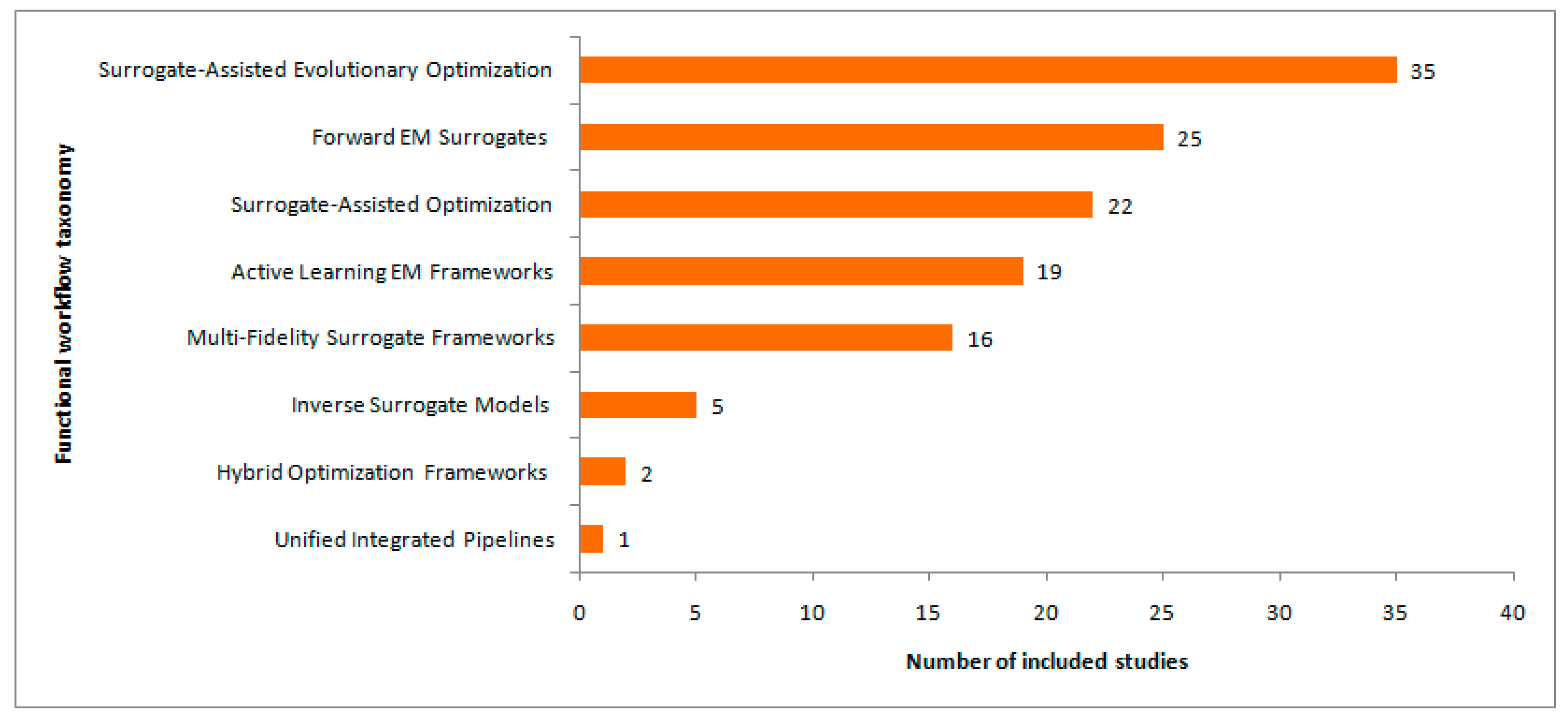
| [56] | Unified Integrated Pipelines | 1 | 0.8% |
| [22,127] | Hybrid Optimization Frameworks | 2 | 1.6% |
| [57,92,93,105,115] | Inverse Surrogate Models | 5 | 4.0% |
| [8,10,11,12,18,24,26,27,32,34,42,55,59,60,114,122] | Multifidelity Surrogate Frameworks | 16 | 12.8% |
| [7,9,19,20,30,58,72,74,87,95,96,104,106,113,117,119,121,128,130] | Active Learning EM Frameworks | 19 | 15.2% |
| [13,15,16,31,37,40,41,43,44,49,51,52,65,66,68,76,85,94,107,110,118,129] | Surrogate-Assisted Optimization | 22 | 17.6% |
| [14,17,33,35,36,38,39,48,54,62,64,67,73,77,86,88,89,90,91,98,101,102,103,125,132] | Forward EM Surrogate Models | 25 | 20.0% |
| [21,23,25,28,29,45,46,50,53,61,63,69,70,71,75,78,79,80,81,82,83,84,97,99,100,108,109,111,112,116,120,123,124,126,131] | Surrogate-Assisted Evolutionary Optimization | 35 | 28.0% |
| Total | 125 |
Disclaimer/Publisher’s Note: The statements, opinions and data contained in all publications are solely those of the individual author(s) and contributor(s) and not of MDPI and/or the editor(s). MDPI and/or the editor(s) disclaim responsibility for any injury to people or property resulting from any ideas, methods, instructions or products referred to in the content. |
© 2026 by the authors. Licensee MDPI, Basel, Switzerland. This article is an open access article distributed under the terms and conditions of the Creative Commons Attribution (CC BY) license.
Share and Cite
Prousali, M.; Tsitsos, S. Surrogate-Based EM Design of RF and Microwave Components: A Systematic Review of Workflow Roles, Inverse Design, Multifidelity, and Active Learning. Sensors 2026, 26, 2504. https://doi.org/10.3390/s26082504
Prousali M, Tsitsos S. Surrogate-Based EM Design of RF and Microwave Components: A Systematic Review of Workflow Roles, Inverse Design, Multifidelity, and Active Learning. Sensors. 2026; 26(8):2504. https://doi.org/10.3390/s26082504
Chicago/Turabian StyleProusali, Maria, and Stelios Tsitsos. 2026. "Surrogate-Based EM Design of RF and Microwave Components: A Systematic Review of Workflow Roles, Inverse Design, Multifidelity, and Active Learning" Sensors 26, no. 8: 2504. https://doi.org/10.3390/s26082504
APA StyleProusali, M., & Tsitsos, S. (2026). Surrogate-Based EM Design of RF and Microwave Components: A Systematic Review of Workflow Roles, Inverse Design, Multifidelity, and Active Learning. Sensors, 26(8), 2504. https://doi.org/10.3390/s26082504