A Hybrid CNN–Transformer Approach for Photovoltaic Cell Defect Classification Using Electroluminescence Imaging



Abstract
1. Introduction
Contributions of This Study
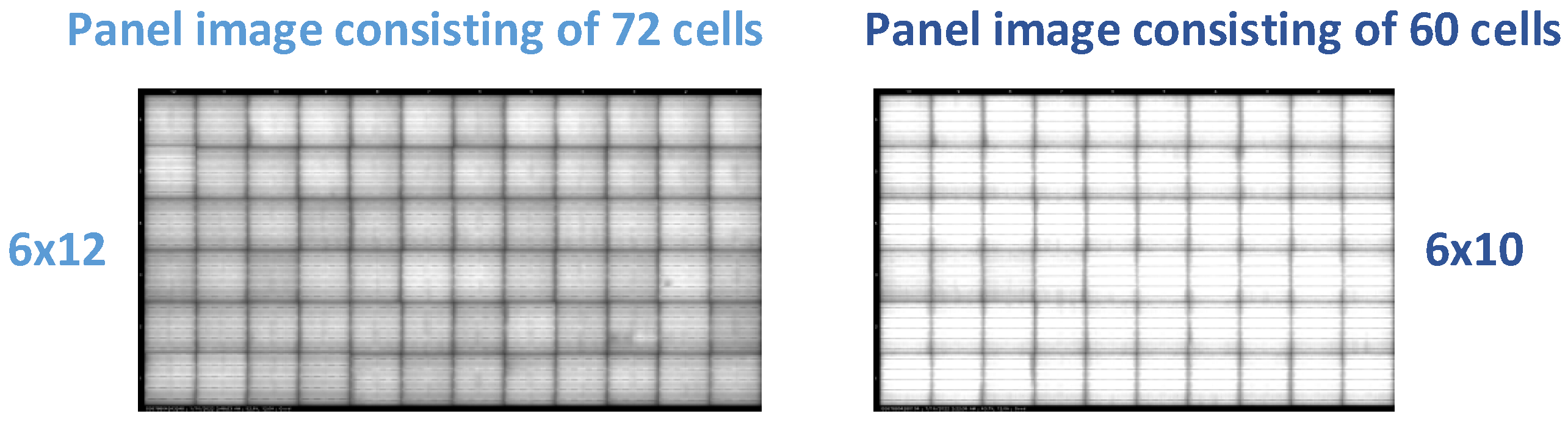
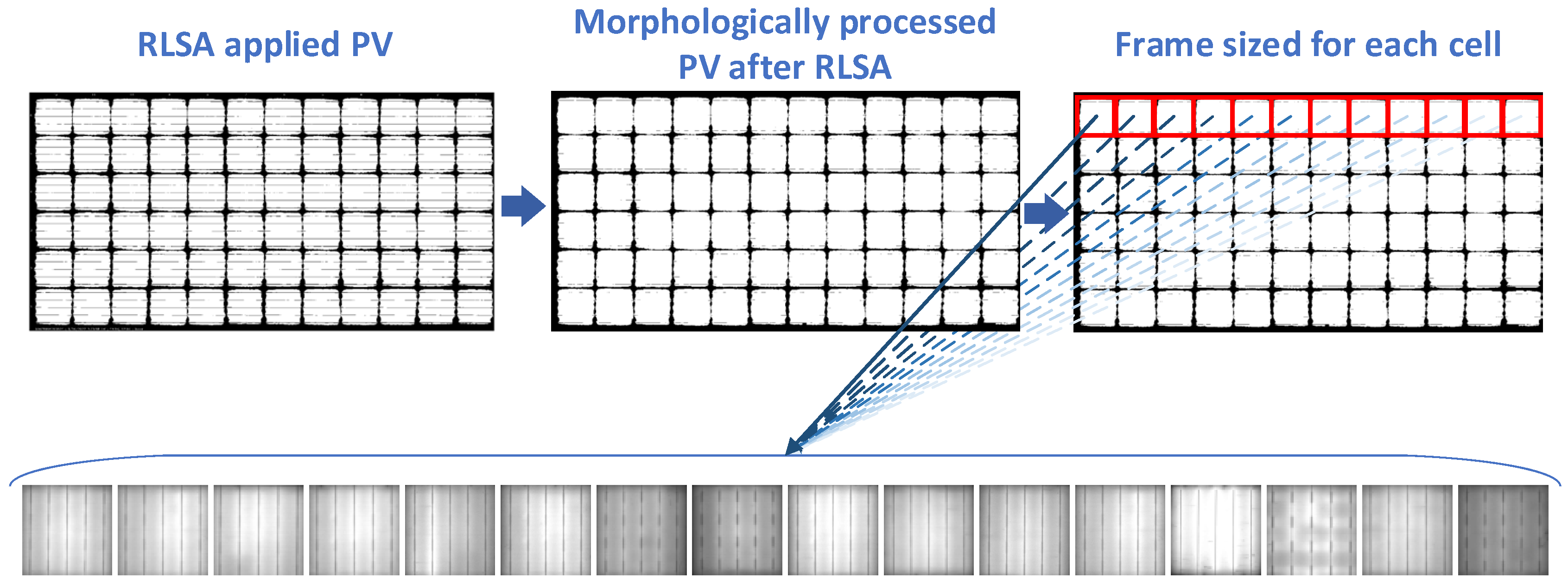
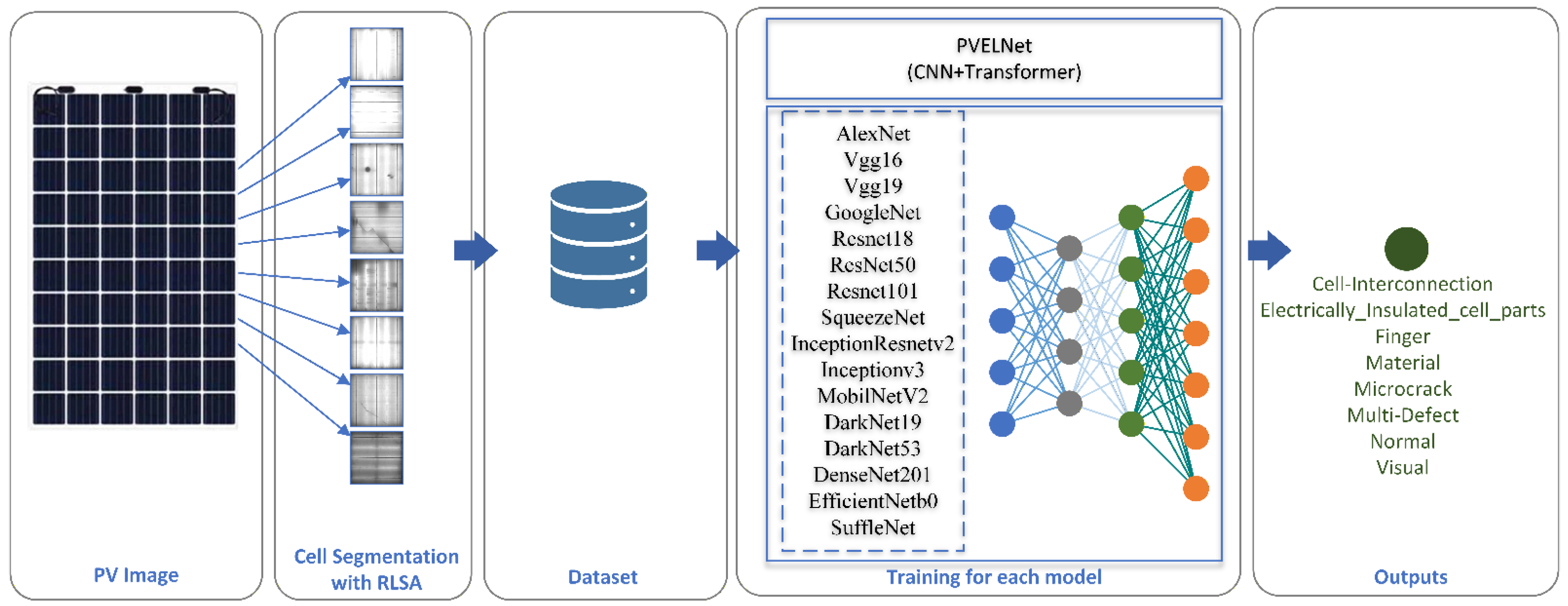
- Enhanced RLSA (Run Length Smoothing Algorithm)-based cell segmentation: In this study, an enhanced RLSA-based method was applied for the automatic segmentation of PV panels of different sizes. This method enabled the segmentation of 60-cell and 72-cell panels without requiring manual intervention. Cell segmentation was performed on the panel using morphological operations applied after the current RLSA method, and the cells were recorded.
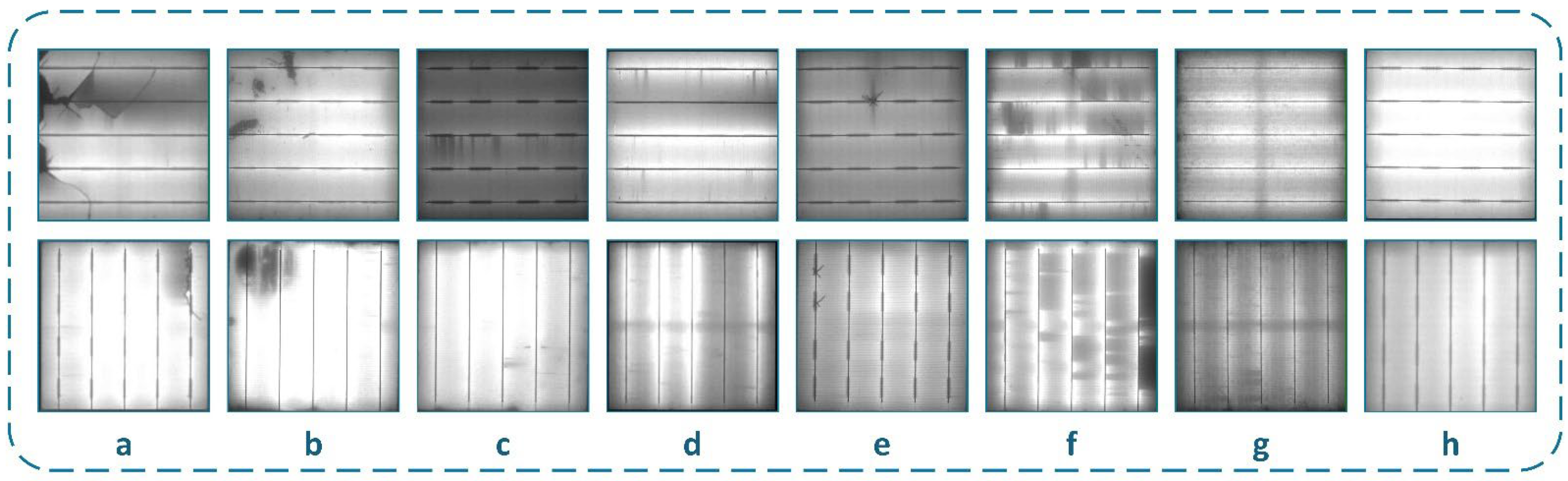
- A balanced new dataset consisting of eight classes: PV panel images taken from an actual production line were used in this study. Approximately 5 million cell images were obtained from 94,000 panel images, and cell labeling was performed in eight different defect classes with the support of experts. These classes are: Fragmented Cell (Electrically Insulated Cell Parts), Material Defective Cell (Material), Finger Defective Cell (Finger), Cell-Interconnection Problem (Cell-Interconnection), Microcrack Cell (Microcrack), Multi-Defect Cell (Multi-Defect), Visual Defect Cell, and Normal Cell. A class-balanced experimental dataset was constructed, with 5000 images for 7 classes and 2538 images for 1 class. This created dataset is more balanced and has a significantly higher number of images than the datasets found in the literature.
- Comprehensive classification comparison with 16 deep learning models: Sixteen models (AlexNet, Vgg16, Vgg19, ResNet18, ResNet50, ResNet101, GoogleNet, InceptionV2, InceptionV3, DenseNet201, MobileNetV2, ShuffleNet, SqueezeNet, DarkNet19, DarkNet53, EfficientNetB0) were used for the classification of cell defects and defect types. The results obtained from the models were analyzed using comprehensive metrics such as Precision, Recall, F1-Score, and Confusion Matrix for comparison. The strengths and weaknesses of the architectures, computational complexity, and costs were compared.
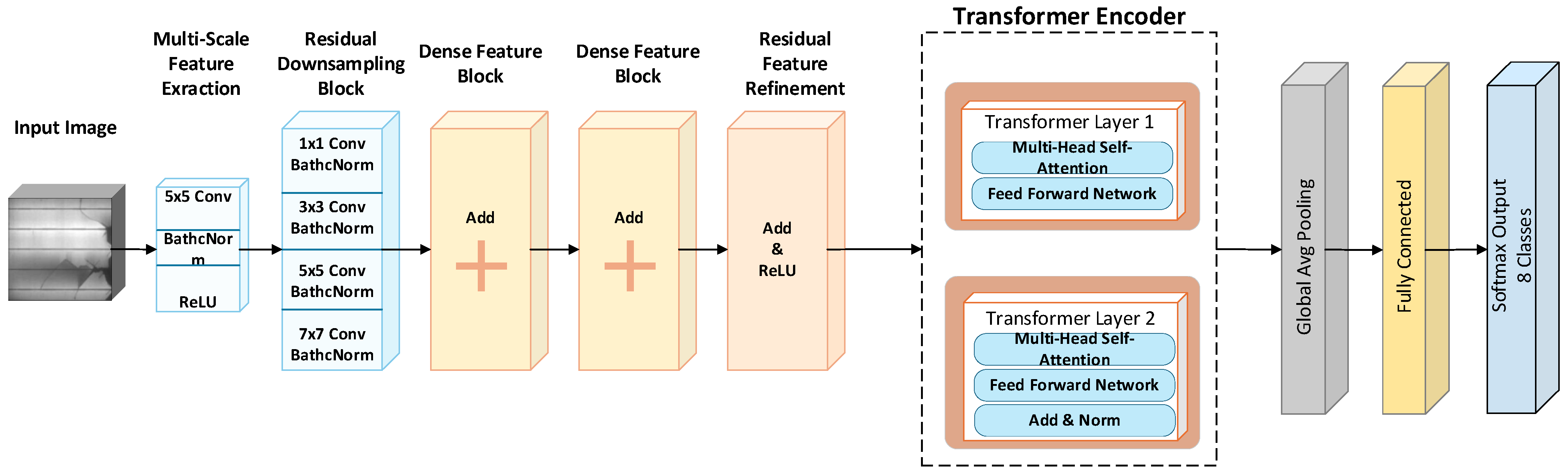
- A New Hybrid Deep Learning Model: PVELNet: The PVELNet model, a novel and original hybrid deep learning architecture designed to classify defects and defect types in PV cells, is presented. The model is a unique architecture that incorporates a CNN–Transformer hybrid structure. By combining the CNN’s ability to learn local features with the Transformer’s self-attention mechanism for learning global dependencies, a new model has been created. The model is a lightweight alternative with a low number of parameters.
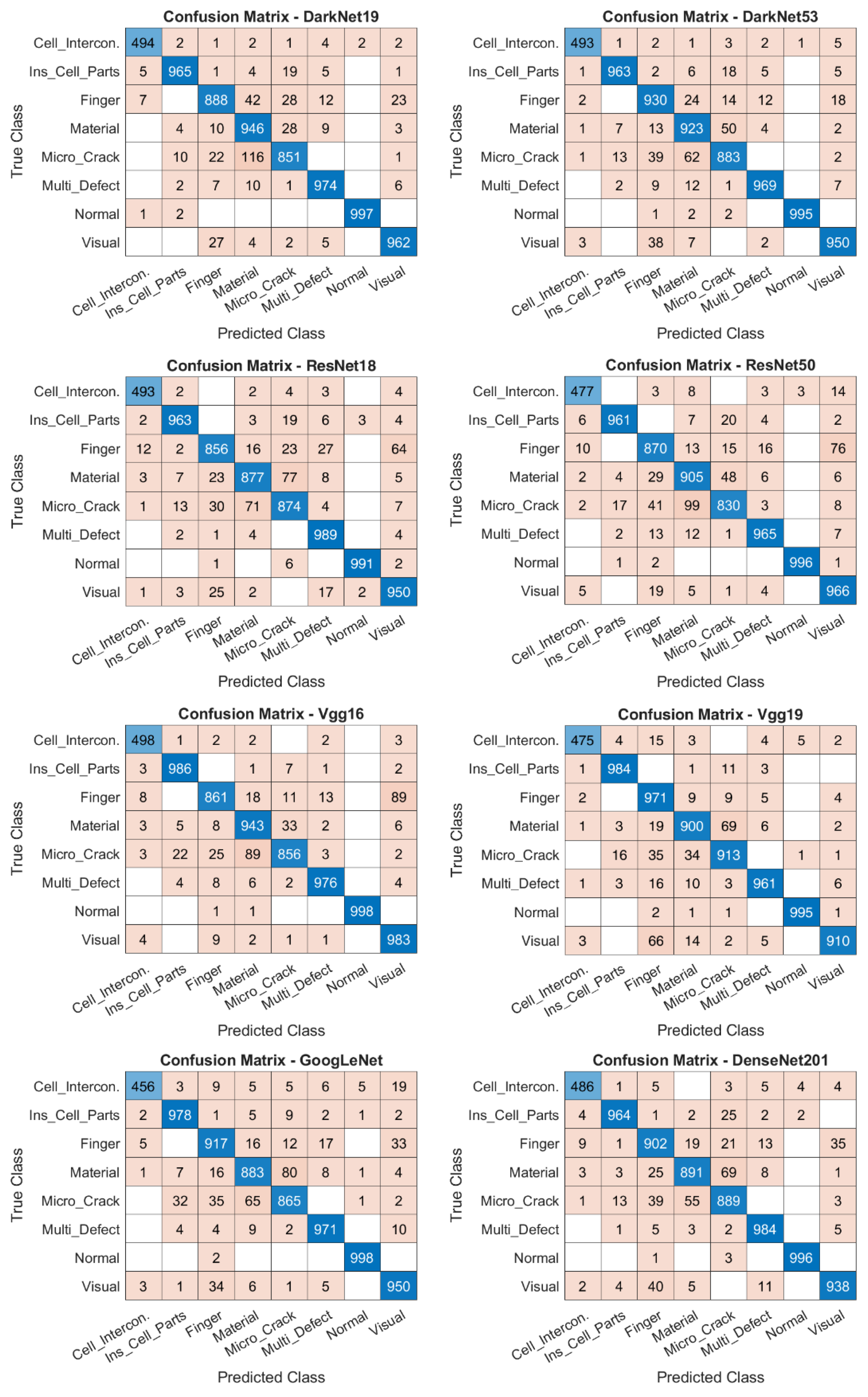
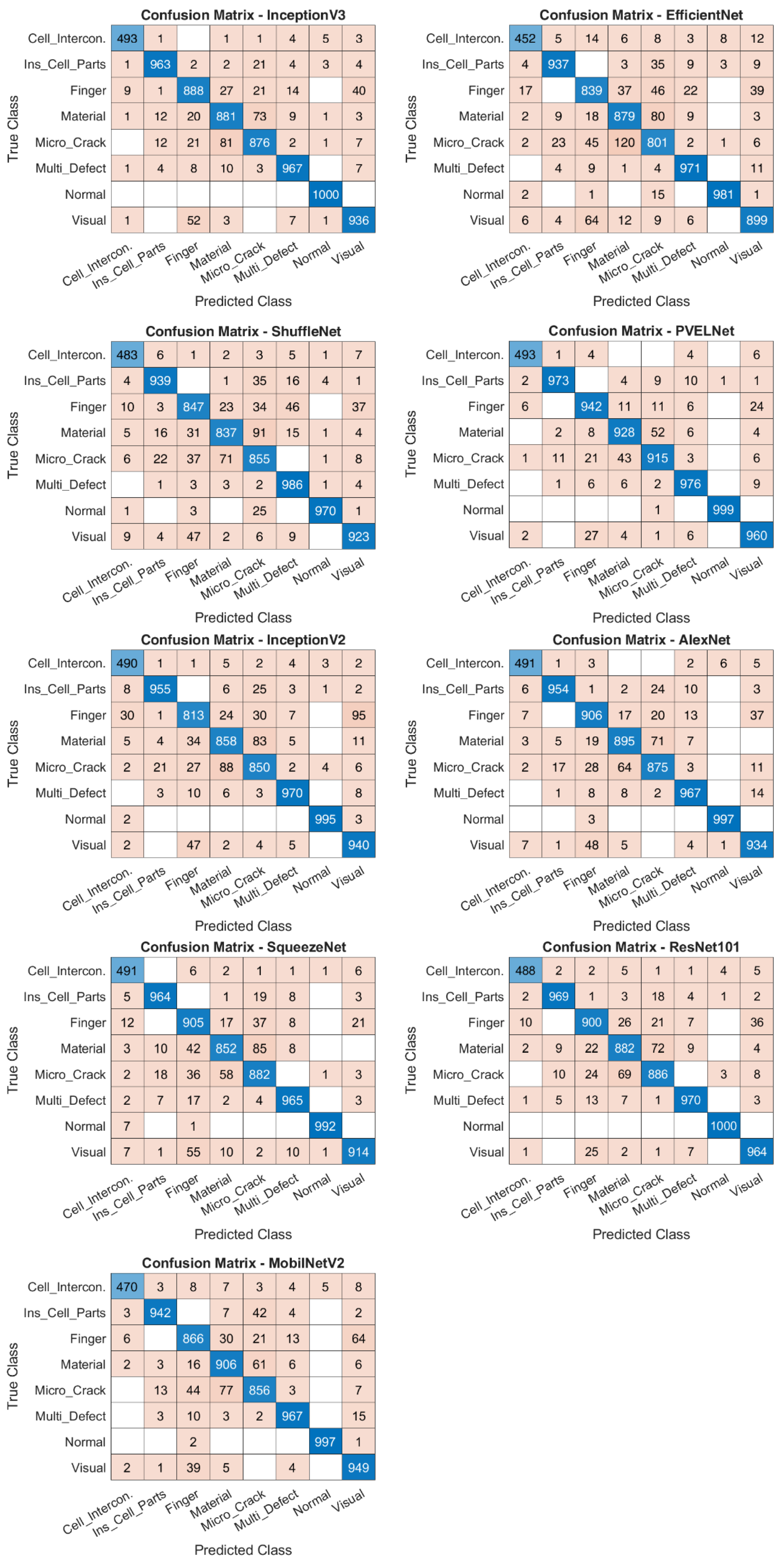
- Detailed performance analysis and comparative results: The proposed PVELNet model has been compared in detail with 16 deep learning models. The F1-Score, Recall, Precision, and Confusion Matrix results for each model are provided. Furthermore, the performance of each model in each class is examined in detail according to these evaluation metrics.
2. Related Works
2.1. Datasets and Methods in the Literature
2.2. Systematic Analysis of the Literature
2.3. Interim Evaluation and Motivation for the Work
3. Materials and Methods
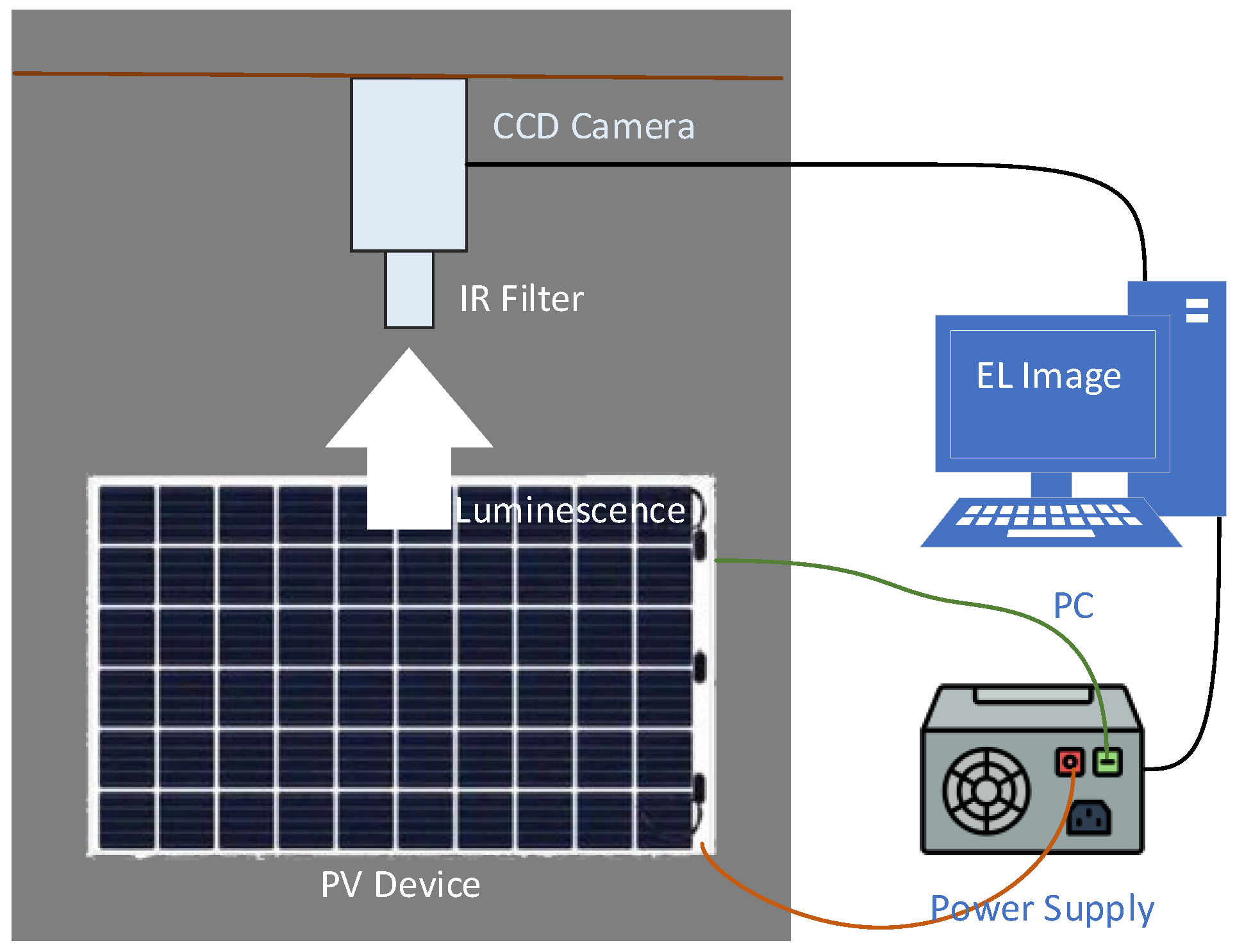
3.1. Acquisition of the Dataset
3.2. Segmenting Panel Images into Cells
| Algorithm 1: Enhanced RLSA-Based Segmentation for Panel-to-Cell Extraction |
| Input: EL panel image I Output: Set of segmented cell images {C1, C2, …, Cn} 1: Convert I to grayscale image Ig 2: Apply thresholding to obtain binary image Ib 3: Apply Run-Length Smoothing Algorithm (RLSA) on Ib to enhance horizontal and vertical continuity 4: Remove small non-cell regions using area-based filtering (e.g., bwareaopen) 5: Apply morphological closing (dilation followed by erosion) to strengthen fragmented cell boundaries 6: Perform connected component labeling on the refined image 7: Identify candidate cell regions based on geometric constraints 8: Select the first valid cell region and determine its bounding box: (x1, y1, x2, y2) 9: Compute cell width (w) and height (h) from the bounding box 10: Initialize grid-based propagation using (w, h) 11: For each grid position across the panel image do 12: Define ROI using: x = x1 + k × w y = y1 + m × h 13: Extract ROI as candidate cell image Ci 14: Validate ROI based on boundary clarity and size constraints 15: If valid: 16: Store Ci with panel ID and cell index 17: Else: 18: Discard ROI 19: End For 20: Return all valid segmented cell imageslgorithm 1. Enhanced RLSA-Based Segmentation for Panel-to-Cell Extraction |
3.3. Cell Defect Classification
3.4. Data Distribution and Data Augmentation
3.5. Used Deep Learning Models
3.6. Recommended Model: PVELNet
3.7. Evaluation Metrics
4. Experimental Results
4.1. Comparison of Overall Performances
4.2. PVELNet Performance Analysis
4.3. Confusion Matrix Results Analysis
5. Discussion
6. Conclusions
Author Contributions
Funding
Institutional Review Board Statement
Informed Consent Statement
Data Availability Statement
Acknowledgments
Conflicts of Interest
References
- Sun, J.; Xie, Y.; Zhou, S.; Dan, J. The role of solar energy in achieving net-zero emission and green growth: A global analysis. Econ. Change Restruct. 2024, 57, 46. [Google Scholar] [CrossRef]
- Yadav, A.S.; Agrawal, V. Renewable Energy Sources: An Application Guide; LAP LAMBERT Academic Publishing: Saarbrücken, Germany, 2018. [Google Scholar]
- Karaağaç, M.O.; Ergün, A.; Arslan, O.; Kayfeci, M. Introduction to solar panels. In Handbook of Thermal Management Systems; Elsevier: Amsterdam, The Netherlands, 2023; pp. 541–556. [Google Scholar]
- Potthoff, T.; Bothe, K.; Eitner, U.; Hinken, D.; Köntges, M. Detection of the voltage distribution in photovoltaic modules by electroluminescence imaging. Prog. Photovolt. Res. Appl. 2010, 18, 100–106. [Google Scholar] [CrossRef]
- Maziuk, M.; Jasińska, L.; Domaradzki, J.; Chodasewicz, P. Imaging methods of detecting defects in photovoltaic solar cells and modules: A survey. Metrol. Meas. Syst. 2023, 30, 381–401. [Google Scholar] [CrossRef]
- Puranik, V.E.; Kumar, R.; Gupta, R. Progress in module level quantitative electroluminescence imaging of crystalline silicon PV module: A review. Sol. Energy 2023, 264, 111994. [Google Scholar] [CrossRef]
- Jahn, U.; Herz, M.; Köntges, M.; Parlevliet, D.; Paggi, M.; Tsanakas, I.; Stein, J.; Berger, K.A.; Ranta, S.; French, R.H. Review on Infrared and Electroluminescence Imaging for PV Field Applications: International Energy Agency Photovoltaic Power Systems Programme; International Energy Agency: Paris, France, 2018. [Google Scholar]
- Doğan, F.; Türkoğlu, I. Comparison of Leaf Classification Performance of Deep Learning Algorithms. Sak. Univ. J. Comput. Inf. Sci. 2018, 1, 10–21. [Google Scholar]
- Karimi, A.M.; Fada, J.S.; Hossain, M.A.; Yang, S.; Peshek, T.J.; Braid, J.L.; French, R.H. Automated pipeline for photovoltaic module electroluminescence image processing and degradation feature classification. IEEE J. Photovolt. 2019, 9, 1324–1335. [Google Scholar] [CrossRef]
- Lin, H.-H.; Dandage, H.K.; Lin, K.-M.; Lin, Y.-T.; Chen, Y.-J. Efficient cell segmentation from electroluminescent images of single-crystalline silicon photovoltaic modules and cell-based defect identification using deep learning with pseudo-colorization. Sensors 2021, 21, 4292. [Google Scholar] [CrossRef]
- Kaligambe, A.; Fujita, G. A deep learning-based framework for automatic detection of defective solar photovoltaic cells in electroluminescence images using transfer learning. In Proceedings of the 2023 4th International Conference on High Voltage Engineering and Power Systems (ICHVEPS); IEEE: New York, NY, USA, 2023; pp. 81–85. [Google Scholar]
- Grisanti, M.; Spatafora, M.A.N.; Ortis, A.; Battiato, S. E-ELPV: Extended ELPV dataset for accurate solar cells defect classification. In Proceedings of the Proceedings of SAI Intelligent Systems Conference; Springer: Berlin/Heidelberg, Germany, 2023; pp. 837–848. [Google Scholar]
- Deitsch, S.; Buerhop-Lutz, C.; Sovetkin, E.; Steland, A.; Maier, A.; Gallwitz, F.; Riess, C. Segmentation of photovoltaic module cells in electroluminescence images. arXiv 2018, arXiv:1806.06530. [Google Scholar] [CrossRef]
- Wang, Z.; Zheng, P.; Bahadir Kocer, B.; Kovac, M. Drone-Based Solar Cell Inspection With Autonomous Deep Learning. In Infrastructure Robotics: Methodologies, Robotic Systems and Applications; IEEE: New York, NY, USA, 2024; pp. 337–365. [Google Scholar]
- Doğan, F.; Türkoğlu, İ. Derin öğrenme modelleri ve uygulama alanlarına ilişkin bir derleme. Dicle Üniversitesi Mühendislik Fakültesi Mühendislik Derg. 2019, 10, 409–445. [Google Scholar] [CrossRef]
- Khandagale, S.D.; Patil, S.M. Classification of Defects in Photovoltaic Cells from Electroluminescence Images using Advanced Deep Learning Techniques. In Proceedings of the 2024 2nd DMIHER International Conference on Artificial Intelligence in Healthcare, Education and Industry (IDICAIEI); IEEE: New York, NY, USA, 2024; pp. 1–5. [Google Scholar]
- Wang, J.; Bi, L.; Sun, P.; Jiao, X.; Ma, X.; Lei, X.; Luo, Y. Deep-learning-based automatic detection of photovoltaic cell defects in electroluminescence images. Sensors 2022, 23, 297. [Google Scholar] [CrossRef] [PubMed]
- Wiliani, N.; Khawa, T.; Ramli, S. Introduction to Surface Damage on Solar Panels with Feature Extraction using Statistical Methods. J. Asiimetrik J. Ilm. Rekayasa Inov. 2025, 7, 201–208. [Google Scholar] [CrossRef]
- Ariffin, Z.K.; Shahbudin, S.; Zolkapli, M.; Rahman, F.Y.A.; Suliman, S.I. Photovoltaic (PV) Module Defects Classification Analysis Using EfficientNet Architecture in Electroluminescence (EL) Images. In Proceedings of the 2025 IEEE 16th Control and System Graduate Research Colloquium (ICSGRC); IEEE: New York, NY, USA, 2025; pp. 132–137. [Google Scholar]
- Su, B.; Zhou, Z.; Chen, H. PVEL-AD: A large-scale open-world dataset for photovoltaic cell anomaly detection. IEEE Trans. Ind. Inform. 2022, 19, 404–413. [Google Scholar] [CrossRef]
- Fioresi, J.; Colvin, D.J.; Frota, R.; Gupta, R.; Li, M.; Seigneur, H.P.; Vyas, S.; Oliveira, S.; Shah, M.; Davis, K.O. Automated defect detection and localization in photovoltaic cells using semantic segmentation of electroluminescence images. IEEE J. Photovolt. 2021, 12, 53–61. [Google Scholar] [CrossRef]
- İmak, A. Automatic classification of defective photovoltaic module cells based on a novel CNN-PCA-SVM deep hybrid model in electroluminescence images. Turk. J. Sci. Technol. 2024, 19, 497–508. [Google Scholar] [CrossRef]
- Ayturan, K.; Sarıkamış, B.; Akşahin, M.F.; Kutbay, U. SPHERE: Benchmarking YOLO vs. CNN on a novel dataset for high-accuracy solar panel defect detection in renewable energy systems. Appl. Sci. 2025, 15, 4880. [Google Scholar] [CrossRef]
- Rahman, A. Solar panel surface defect and dust detection: Deep learning approach. J. Imaging 2025, 11, 287. [Google Scholar] [CrossRef]
- Almashhadani, R.A.I.; Hock, G.C.; Nordin, F.H.B.; Abdulrazzak, H.N. Electroluminescence images for solar cell fault detection using deep learning for binary and multiclass classification. SSRG Int. J. Electr. Electron. Eng. 2024, 11, 150–160. [Google Scholar] [CrossRef]
- Mewada, H.; Syamsundar, L.; Thakkar, H.K. Electroluminescence image-based defective photovoltaic (solar) cell detection using a modified deep convolutional neural network. Renew. Energy Gener. Appl. ICREGA 2024, 24, 13–20. [Google Scholar]
- Ahmad, A.; Jin, Y.; Zhu, C.; Javed, I.; Maqsood, A.; Akram, M.W. Photovoltaic cell defect classification using convolutional neural network and support vector machine. IET Renew. Power Gener. 2020, 14, 2693–2702. [Google Scholar] [CrossRef]
- Acikgoz, H.; Korkmaz, D.; Budak, U. Photovoltaic cell defect classification based on integration of residual-inception network and spatial pyramid pooling in electroluminescence images. Expert Syst. Appl. 2023, 229, 120546. [Google Scholar] [CrossRef]
- Aktaş, M.; Doğan, F.; Türkoğlu, İ. Classification of Solar Cells EL Images with Different Busbars Via Deep Learning Models. Sak. Univ. J. Comput. Inf. Sci. 2024, 7, 217–226. [Google Scholar] [CrossRef]
- Rozi, M.W.F.M.; Shahbudin, S. Photovoltaic module defects classification analysis using ShuffleNet architecture in electroluminescence images. In Proceedings of the 2023 9th International Conference on Computer and Communication Engineering (ICCCE); IEEE: New York, NY, USA, 2023; pp. 294–298. [Google Scholar]
- Korkmaz, D.; Açıkgöz, H. Elektrolüminesans Görüntülerde Arızalı Fotovoltaik Panel Hücrelerin Evrişimli Sinir Ağı ile Otomatik Sınıflandırılması. Fırat Üniversitesi Mühendislik Bilim. Derg. 2022, 34, 589–600. [Google Scholar] [CrossRef]
- Demirci, M.Y.; Beşli, N.; Gümüşçü, A. An improved hybrid solar cell defect detection approach using Generative Adversarial Networks and weighted classification. Expert Syst. Appl. 2024, 252, 124230. [Google Scholar] [CrossRef]
- Zhang, Z.; Yang, Y.; Jian, X. Defect analysis using electroluminescence imaging in photovoltaic modules. Meas. Sci. Technol. 2025, 36, 085404. [Google Scholar] [CrossRef]
- Manandhar, P.; Rafiq, H.; Kumar, S.; Qureshi, O.A.; Rodriguez-Ubinas, E. Identification of micro-defects in solar cells using electroluminescence images via hybrid approach. In Proceedings of the 2023 Middle East and North Africa Solar Conference (MENA-SC); IEEE: New York, NY, USA, 2023; pp. 1–3. [Google Scholar]
- Alanazi, M.; Alamri, Y.A. SolarFaultAttentionNet: Dual-Attention Framework for Enhanced Photovoltaic Fault Classification. Inventions 2025, 10, 91. [Google Scholar] [CrossRef]
- Niu, M.; Li, J.; Li, M.; Zhao, Y.; Liu, Y.; Wen, S. Defect Detection in Solar Panels Based on PV-Flow. In Proceedings of the 2024 WRC Symposium on Advanced Robotics and Automation (WRC SARA); IEEE: New York, NY, USA, 2024; pp. 368–373. [Google Scholar]
- Duranay, Z.B. Fault detection in solar energy systems: A deep learning approach. Electronics 2023, 12, 4397. [Google Scholar] [CrossRef]
- Liu, Q.; Liu, M.; Wang, C.; Wu, Q.J. An efficient CNN-based detector for photovoltaic module cells defect detection in electroluminescence images. Sol. Energy 2024, 267, 112245. [Google Scholar] [CrossRef]
- Pratt, L.; Mattheus, J.; Klein, R. A benchmark dataset for defect detection and classification in electroluminescence images of PV modules using semantic segmentation. Syst. Soft Comput. 2023, 5, 200048. [Google Scholar] [CrossRef]
- Sachdeva, B.; Gill, K.S.; Kumar, M.; Rawat, R.S. Future-Proofing Solar Panel Maintenance: Early Detection Using VGG16-Based Systems. In Proceedings of the 2024 10th International Conference on Electrical Energy Systems (ICEES); IEEE: New York, NY, USA, 2024; pp. 1–4. [Google Scholar]
- Tella, H.; Mohandes, M.; Liu, B.; Rehman, S.; Al-Shaikhi, A. Deep learning system for defect classification of solar panel cells. In Proceedings of the 2022 14th International Conference on Computational Intelligence and Communication Networks (CICN); IEEE: New York, NY, USA, 2022; pp. 448–453. [Google Scholar]
- Bharathi, S.; Venkatesan, P. Enhanced Classification of Faults of Photovoltaic Module Through Generative Adversarial Network. Int. J. Electr. Electron. Res. 2022, 10, 579–584. [Google Scholar] [CrossRef]
- Boubaker, S.; Kamel, S.; Ghazouani, N.; Mellit, A. Assessment of machine and deep learning approaches for fault diagnosis in photovoltaic systems using infrared thermography. Remote Sens. 2023, 15, 1686. [Google Scholar] [CrossRef]
- Kim, T.; Yeo, B.C. A Study on the Optimization of Fine-tuning and Dataset for Defect Detection Models in Photovoltaic Modules Images. J. Korean Sol. Energy Soc. 2025, 45, 67–79. [Google Scholar] [CrossRef]
- Eesaar, H.; Joe, S.; Rehman, M.U.; Jang, Y.; Chong, K.T. SEiPV-Net: An efficient deep learning framework for autonomous multi-defect segmentation in electroluminescence images of solar photovoltaic modules. Energies 2023, 16, 7726. [Google Scholar] [CrossRef]
- Mazen, F.M.A.; Shaker, Y.O.; Seoud, R.A.A. Attention-based SegNet: Toward refined semantic segmentation of PV modules defects. IEEE Access 2024, 12, 100792–100804. [Google Scholar] [CrossRef]
- Liu, Y.; Wu, Y.; Yuan, Y.; Zhao, L. Deep learning-based method for defect detection in electroluminescent images of polycrystalline silicon solar cells. Opt. Express 2024, 32, 17295–17317. [Google Scholar] [CrossRef]
- Jha, A.; Rawat, Y.; Vyas, S. Advancing automatic photovoltaic defect detection using semi-supervised semantic segmentation of electroluminescence images. Eng. Appl. Artif. Intell. 2025, 160, 111790. [Google Scholar] [CrossRef]
- Zhao, Y.; Zhan, K.; Wang, Z.; Shen, W. Deep learning-based automatic detection of multitype defects in photovoltaic modules and application in real production line. Prog. Photovolt. Res. Appl. 2021, 29, 471–484. [Google Scholar] [CrossRef]
- Chen, Y.; Liu, W.; Zhang, T.; Chen, Z.; Gan, H.; Zhang, J.; Cai, C.; Xiong, L. Investigation of crack detection in solar cells by context integration and attention enhanced feature pyramid network. In Proceedings of the Sixth Conference on Frontiers in Optical Imaging and Technology: Imaging Detection and Target Recognition; SPIE: Bellingham, WA, USA, 2024; Volume 13156, pp. 446–452. [Google Scholar]
- Xu, W.; Shi, Y.; Yang, R.; Ye, B.; Qiang, H. Automatic classification of defective solar panels in electroluminescence images based on random connection network. Electronics 2024, 13, 2429. [Google Scholar] [CrossRef]
- Wong, K.Y.; Casey, R.G.; Wahl, F.M. Document analysis system. IBM J. Res. Dev. 1982, 26, 647–656. [Google Scholar] [CrossRef]
- Krizhevsky, A.; Sutskever, I.; Hinton, G.E. ImageNet Classification with Deep Convolutional Neural Networks. Adv. Neural Inf. Process. Syst. 2012, 25, 1097–1105. [Google Scholar] [CrossRef]
- Simonyan, K.; Zisserman, A. Very Deep Convolutional Networks for Large-Scale Image Recognition. arXiv 2014, arXiv:1409.1556. [Google Scholar]
- Szegedy, C.; Liu, W.; Jia, Y.; Sermanet, P.; Reed, S.; Anguelov, D.; Erhan, D.; Vanhoucke, V.; Rabinovich, A.; Liu, W.; et al. Going Deeper with Convolutions. In Proceedings of the IEEE Conference on Computer Vision and Pattern Recognition, Boston, MA, USA, 7–12 June 2015; pp. 1–9. [Google Scholar]
- He, K.; Zhang, X.; Ren, S.; Sun, J. Deep residual learning for image recognition. In Proceedings of the IEEE Conference on Computer Vision and Pattern Recognition, Las Vegas, NV, USA, 27–30 June 2016; pp. 770–778. [Google Scholar]
- Iandola, F.N. SqueezeNet: AlexNet-level accuracy with 50× fewer parameters and <0.5 MB model size. arXiv 2016, arXiv:1602.07360. [Google Scholar]
- Szegedy, C.; Ioffe, S.; Vanhoucke, V.; Alemi, A. Inception-v4, inception-resnet and the impact of residual connections on learning. In Proceedings of the AAAI Conference on Artificial Intelligence, San Francisco, CA, USA, 4–9 February 2017; Volume 31. [Google Scholar]
- Szegedy, C.; Vanhoucke, V.; Ioffe, S.; Shlens, J.; Wojna, Z. Rethinking the inception architecture for computer vision. In Proceedings of the IEEE Conference on Computer Vision and Pattern Recognition, Las Vegas, NV, USA, 27–30 June 2016; pp. 2818–2826. [Google Scholar]
- Sandler, M.; Howard, A.; Zhu, M.; Zhmoginov, A.; Chen, L.-C. Mobilenetv2: Inverted residuals and linear bottlenecks. In Proceedings of the IEEE Conference on Computer Vision and Pattern Recognition, Salt Lake City, UT, USA, 28–22 June 2018; pp. 4510–4520. [Google Scholar]
- Redmon, J.; Farhadi, A. YOLO9000: Better, faster, stronger. In Proceedings of the IEEE Conference on Computer Vision and Pattern Recognition, Honolulu, HI, USA, 21–26 July 2017; pp. 7263–7271. [Google Scholar]
- Redmon, J.; Farhadi, A. Yolov3: An incremental improvement. arXiv 2018, arXiv:1804.02767. [Google Scholar] [CrossRef]
- Huang, G.; Liu, Z.; Van Der Maaten, L.; Weinberger, K.Q. Densely connected convolutional networks. In Proceedings of the IEEE Conference on Computer Vision and Pattern Recognition, Honolulu, HI, USA, 21–26 July 2017; pp. 4700–4708. [Google Scholar]
- Tan, M.; Le, Q. Efficientnet: Rethinking model scaling for convolutional neural networks. In Proceedings of the International Conference on Machine Learning; PMLR: Cambridge, MA, USA, 2019; pp. 6105–6114. [Google Scholar]
- Zhang, X.; Zhou, X.; Lin, M.; Sun, J. Shufflenet: An extremely efficient convolutional neural network for mobile devices. In Proceedings of the IEEE Conference on Computer Vision and Pattern Recognition, Salt Lake City, UT, USA, 18–22 June 2018; pp. 6848–6856. [Google Scholar]



| Dataset Name | Defect Types | Total Image Count | Used Method | Achieved Success |
|---|---|---|---|---|
| Wiliani et al. Dataset [18] | 4 (Cracks, Scratches, Stains, Good) | 4000 | Tissue Feature Extraction | - |
| EfficientNet Dataset [19] | 3 (Contact Defects, Cracks, Related Issues) | 1437 | EfficientNet (B0–B7) | 93.93% Accuracy |
| İmak EL Dataset [22] | 2 (Defective, Functional) | 2624 | CNN-PCA-SVM Hybrid Model | 92.19% Accuracy |
| PVEL-AD Dataset [20] | 10 (Various Internal Defects) | 36,543 | Deep Learning Object Detection | The first comparison provided |
| SPHERE Dataset [23] | 3 (Broken, Clean, Dirty) | 6079 | YoloV8-m, YoloV9-e, Private CNN | 97.26% Accuracy (YoloV8-m) |
| Rahman Dataset [24] | 5 (Flawless, Dust, Flawed, Physical Damage, Scratches) | 8973 | YoLov11 | mAP @0.5 of 85% |
| UCF EL Failure Dataset [21] | 5 (Cracks, Contact Interruptions, Cell-Interconnection Failures, Contact Corrosion) | 17,064 | ResNet-50 via Deeplabv3 | 0.95 weighted F1-Score |
| Evaluation Criteria | Common Findings in the Literature | Observed Differences | Reasons for Differences |
|---|---|---|---|
| Dataset Size and Diversity | Most studies emphasize the importance of large datasets with various defect types to improve model generalizability and robustness [19,20,37,38]. Many datasets contain thousands to tens of thousands of images with multiple defect classes [20,21,37]. | Some studies work with smaller datasets or specific subsets due to limited availability or focus; for example, datasets with only a few hundred images [19,39,40]. | Differences arise from the availability of annotated data, intended use cases (e.g., production line vs. research), and imaging/acquisition methods that affect dataset size. |
| Imaging Modalities | EL imaging is primarily used due to its ability to clearly reveal micro-defects [19,28,41]. IR imaging is common, especially for thermal-related defects [42,43] and some studies combine modalities for richer data [44]. | Some studies focus solely on one modality (e.g., only IR [37] or only EL [19]) or integrate limited modalities reflecting specific detection targets or equipment availability [44]. | Variation stems from the targeted defect types, the cost and accessibility of imaging technologies, and the operational environment (laboratory/field). |
| Class Distribution Balance | There is a general consensus that class imbalance is a significant challenge in PV defect datasets. Many studies have addressed this by applying data augmentation (GANs, synthetic data) [42]. Some models apply class weighting strategies in their loss functions to reduce imbalance effects [45,46]. | The scope and methods for addressing imbalance vary; some datasets inherently have more balanced class distributions, while others report serious imbalances requiring advanced augmentation [20]. | Differences are related to the dataset source (general/proprietary), the prevalence of errors in real-world data, and the availability of sources for augmentation techniques. |
| Annotation Detail Level and Standards | Several studies facilitate semantic segmentation and object detection tasks by providing high-quality annotations, including pixel-level segmentation masks and bounding boxes [21,39,47]. Semi-supervised and few-shot learning approaches have also been investigated to reduce annotation effort [48]. | Other datasets use coarser annotations, such as bounding boxes without image-level labels or segmentation masks [37,49]; annotation consistency varies depending on the challenges of manual labeling [50]. | Discrepancies arise from annotation costs, the purpose of the dataset (classification vs. segmentation), and the availability of expert annotation. Semi-supervised methods help bridge these gaps. |
| Data Augmentation Applications | There is consensus on the use of data augmentation methods, including geometric transformations, GAN (Generative Adversarial Network)-based synthetic image generation, and contrast enhancement, to improve model robustness and address dataset limitations [42,51]. Scaling is particularly emphasized in small or unbalanced datasets [22]. | There is variation in the types and scope of augmentation; some studies use simple augmentations (translation, rotation), while others use more advanced GANs or synthetic data generation [42]. | Differences arise from variations in computational resources, dataset size, and the complexity of the defect features that models aim to capture. |
| Defect Class | Primary Cause | EL Image Characteristics | Expected Performance Impact |
|---|---|---|---|
| Electrically Insulated Cell Parts | Conductivity loss in soldered regions, ribbon discontinuities, poor soldering, corrosion, or mechanical stress | Dark segments along the connection line, localized brightness loss, asymmetric emission pattern | Weakening of current flow and reduced cell output; indicates poor electrical continuity |
| Material Defect | Structural inconsistencies related to wafer quality, diffusion process, or metallization deviations | Uneven brightness, cloudy regions, reduced contrast | May have limited visual effect in some cases, but can reduce current production and may be confused with other classes |
| Finger Defect | Breakage, thinning, or interruption of conductive fingers | Linear dark bands, discontinuous illumination along finger lines | Increased local resistance, weakened current collection, possible power loss and local heating |
| Cell-Interconnection | Severe structural damage, fragmentation, or breakage affecting interconnection paths | Disrupted cell regions, broken or separated structural appearance | Significant reduction in electricity generation, local power loss, increased thermal stress, and higher hot-spot risk |
| Microcrack | Thermo-mechanical stress during production, transport, assembly, or field operation | Thin branching lines, isolated dark islands, reduced emission in cracked regions | Initially limited impact, but performance degrades over time as crack growth reduces current-carrying area; may lead to hot spots |
| Multi-Defect | Simultaneous occurrence of two or more defects (e.g., Microcrack + Finger, Material + Connection Problem) | Overlapping linear defects, regional darkening, weakened connection lines | Greater performance loss than single-defect cases due to compound fault effects |
| Visual | Imaging or acquisition errors rather than physical cell damage (focus shift, blur, exposure error, sensor noise, shadowing, cropping) | Low contrast, blur, noisy appearance, shadowed or improperly framed cell image | No direct physical defect implication; included to prevent confusion between acquisition artifacts and real defects |
| Normal | No structural, electrical, or material defect | Uniform healthy EL appearance without abnormal dark regions | Represents normal electricity generation and healthy cell condition |
| Classes | Total Image Count |
|---|---|
| Cell-Interconnection | 2538 |
| Electrically_Insulated_Cell_parts | 5000 |
| Finger | 5000 |
| Material | 5000 |
| Microcrack | 5000 |
| Multi-Defect | 5000 |
| Normal | 5000 |
| Visual | 5000 |
| Classes | Test Images | Training Images Before Augmentation | Training Images After Augmentation | Final Total Images |
|---|---|---|---|---|
| Cell-Interconnection | 508 | 677 | 2030 | 2538 |
| Electrically_Insulated_Cell_parts | 1000 | 1480 | 4000 | 5000 |
| Finger | 1000 | 4000 | 4000 | 5000 |
| Material | 1000 | 4000 | 4000 | 5000 |
| Microcrack | 1000 | 4000 | 4000 | 5000 |
| Multi-Defect | 1000 | 4000 | 4000 | 5000 |
| Normal | 1000 | 4000 | 4000 | 5000 |
| Visual | 1000 | 1450 | 4000 | 5000 |
| Category | Models |
|---|---|
| Classic CNN | AlexNet, VGG16, VGG19 |
| Residual Networks | ResNet18/50/101 |
| Dense Networks | DenseNet201 |
| Inception-Based Models | GoogLeNet, InceptionV2, InceptionV3 |
| Lightweight/Mobile | MobileNetV2, ShuffleNet, SqueezeNet |
| Scalable | EfficientNetB0 |
| YOLO-Based Backbone | DarkNet19, DarkNet53 |
| Architecture | Layers | Connections | Convolution Layers | Parameters | Memory (Mb) |
|---|---|---|---|---|---|
| AlexNet [53] | 25 | - | 8 | 61 m | 233 |
| Vgg16 [54] | 41 | - | 16 | 138 m | 528 |
| Vgg19 [54] | 47 | - | 19 | 144 m | 548 |
| GoogleNet [55] | 144 | 170 | 22 | 7 m | 26.7 |
| Resnet18 [56] | 72 | 79 | 18 | 11.7 m | 44.6 |
| ResNet50 [56] | 177 | 192 | 50 | 25.6 m | 97.8 |
| Resnet101 [56] | 347 | 379 | 101 | 44.6 m | 171 |
| SqueezeNet [57] | 68 | 75 | 18 | 1.24 m | 4.7 |
| InceptionResnetv2 [58] | 825 | 922 | 164 | 55.9 m | 213 |
| InceptionV3 [59] | 316 | 350 | 48 | 23.9 m | 91.1 |
| MobileNetV2 [60] | 153 | 162 | 23 | 3.5 m | 13.6 |
| DarkNet19 [61] | 64 | 63 | 19 | 20.8 m | 79.6 |
| DarkNet53 [62] | 184 | 206 | 53 | 41.6 m | 159 |
| DenseNet201 [63] | 709 | 806 | 201 | 20 m | 77.3 |
| EfficientNetb0 [64] | 289 | 362 | 82 | 5.31 m | 20.4 |
| ShuffleNet [65] | 171 | 186 | 50 | 1.4 m | 5.5 |
| PVELNet | 132 | 151 | 26 | 1.79 m | 7.98 |
| Hyperparameter | Value | Information |
|---|---|---|
| Transfer learning | By changing the last layer | The original classification layer has been redefined according to the number of classes in the study. |
| Data splitting ratio | 80% training—20% test | Randomized class-based partitioning. |
| Input size | Model-specific (224 × 224 × 3) | The images have been resized to the input size expected by the relevant model. |
| Optimization algorithm | SGDM | Stochastic Gradient Descent with Momentum. |
| Initial learning rate | 0.0002 | The initial step size of the training. |
| Learning rate schedule | Piecewise | The learning rate is reduced at specific epoch intervals. |
| Learning rate drop factor | 0.001 | LR = LR × 0.001 (each drop). |
| Learning rate drop period | Six epochs | The learning rate is reduced every six epochs. |
| Maximum epoch | 10 | Maximum number of passes over the training dataset. |
| Mini-batch size | 64 | Number of samples used in each iteration. |
| FC weight learning rate | 10 | Accelerated learning for the newly added fully connected layer. |
| FC bias learning rate | 10 | Accelerated learning for bias terms. |
| Training data shuffle | Randomized | Data shuffling is randomized at the beginning of each epoch. |
| Metric | Equation | Feature |
|---|---|---|
| Precision | TPc: number of true-positives | |
| Recall | FPc: number of false-positives | |
| Accuracy | FNc: number of false-negatives | |
| F1-Score | It is calculated by taking the harmonic mean of the Precision and Recall values. |
| F1-Score | |||||||||
|---|---|---|---|---|---|---|---|---|---|
| Cell-Interconnection | Electrically Insulated Cell Parts | Finger | Material | Microcrack | Multi-Defect | Normal | Visual | Mean | |
| DarkNet19 | 0.97 | 0.97 | 0.91 | 0.89 | 0.88 | 0.97 | 1.00 | 0.96 | 0.94 |
| DarkNet53 | 0.98 | 0.97 | 0.91 | 0.91 | 0.90 | 0.97 | 1.00 | 0.96 | 0.95 |
| MobileNetV2 | 0.95 | 0.96 | 0.87 | 0.89 | 0.86 | 0.97 | 1.00 | 0.92 | 0.93 |
| ResNet18 | 0.97 | 0.97 | 0.88 | 0.89 | 0.87 | 0.96 | 0.99 | 0.93 | 0.93 |
| ResNet50 | 0.94 | 0.96 | 0.87 | 0.91 | 0.83 | 0.97 | 1.00 | 0.97 | 0.93 |
| ResNet101 | 0.96 | 0.97 | 0.90 | 0.88 | 0.89 | 0.97 | 1.00 | 0.96 | 0.94 |
| Vgg16 | 0.97 | 0.98 | 0.90 | 0.91 | 0.90 | 0.98 | 1.00 | 0.94 | 0.95 |
| Vgg19 | 0.96 | 0.98 | 0.91 | 0.91 | 0.91 | 0.97 | 0.99 | 0.94 | 0.95 |
| SqueezeNet | 0.95 | 0.96 | 0.88 | 0.88 | 0.87 | 0.97 | 0.99 | 0.94 | 0.93 |
| GoogleNet | 0.94 | 0.97 | 0.91 | 0.89 | 0.88 | 0.97 | 1.00 | 0.94 | 0.93 |
| DenseNet201 | 0.96 | 0.97 | 0.89 | 0.90 | 0.88 | 0.97 | 1.00 | 0.94 | 0.94 |
| AlexNet | 0.96 | 0.96 | 0.90 | 0.90 | 0.88 | 0.96 | 1.00 | 0.93 | 0.94 |
| InceptionV3 | 0.97 | 0.97 | 0.89 | 0.88 | 0.88 | 0.96 | 0.99 | 0.94 | 0.94 |
| EfficientNetb0 | 0.91 | 0.95 | 0.84 | 0.85 | 0.80 | 0.96 | 0.98 | 0.91 | 0.90 |
| InceptionV2 | 0.94 | 0.96 | 0.84 | 0.86 | 0.85 | 0.97 | 0.99 | 0.91 | 0.92 |
| ShuffleNet | 0.94 | 0.94 | 0.86 | 0.86 | 0.83 | 0.95 | 0.98 | 0.93 | 0.91 |
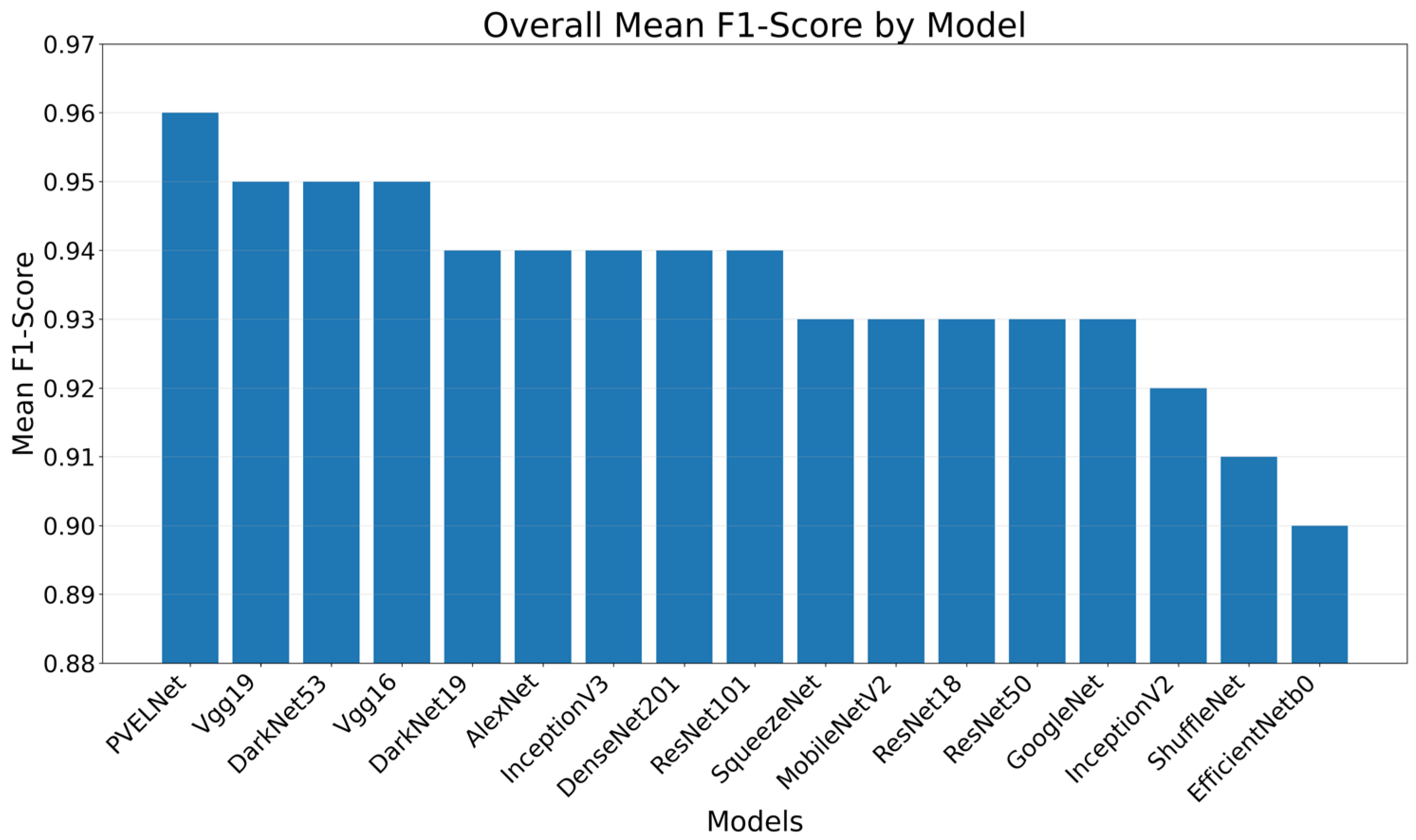
| PVELNet | 0.97 | 0.98 | 0.94 | 0.93 | 0.92 | 0.97 | 1.00 | 0.96 | 0.96 |
| Recall | |||||||||
|---|---|---|---|---|---|---|---|---|---|
| Cell-Interconnection | Electrically Insulated Cell Parts | Finger | Material | Microcrack | Multi-Defect | Normal | Visual | Mean | |
| DarkNet19 | 0.97 | 0.97 | 0.89 | 0.95 | 0.85 | 0.97 | 1.00 | 0.96 | 0.94 |
| DarkNet53 | 0.97 | 0.96 | 0.93 | 0.92 | 0.88 | 0.97 | 1.00 | 0.95 | 0.95 |
| MobileNetV2 | 0.93 | 0.94 | 0.87 | 0.91 | 0.86 | 0.97 | 1.00 | 0.95 | 0.93 |
| ResNet18 | 0.97 | 0.96 | 0.86 | 0.88 | 0.87 | 0.99 | 0.99 | 0.95 | 0.93 |
| ResNet50 | 0.94 | 0.96 | 0.87 | 0.91 | 0.83 | 0.97 | 1.00 | 0.97 | 0.93 |
| ResNet101 | 0.96 | 0.97 | 0.90 | 0.88 | 0.89 | 0.97 | 1.00 | 0.96 | 0.94 |
| Vgg16 | 0.98 | 0.99 | 0.86 | 0.94 | 0.86 | 0.98 | 1.00 | 0.98 | 0.95 |
| Vgg19 | 0.94 | 0.98 | 0.97 | 0.90 | 0.91 | 0.96 | 1.00 | 0.91 | 0.95 |
| SqueezeNet | 0.97 | 0.96 | 0.91 | 0.85 | 0.88 | 0.97 | 0.99 | 0.91 | 0.93 |
| GoogleNet | 0.90 | 0.98 | 0.92 | 0.88 | 0.87 | 0.97 | 1.00 | 0.95 | 0.93 |
| DenseNet201 | 0.96 | 0.96 | 0.90 | 0.89 | 0.89 | 0.98 | 1.00 | 0.94 | 0.94 |
| AlexNet | 0.97 | 0.95 | 0.91 | 0.90 | 0.88 | 0.97 | 1.00 | 0.93 | 0.94 |
| InceptionV3 | 0.97 | 0.96 | 0.89 | 0.88 | 0.88 | 0.97 | 1.00 | 0.94 | 0.94 |
| EfficientNetb0 | 0.89 | 0.94 | 0.84 | 0.88 | 0.80 | 0.97 | 0.98 | 0.90 | 0.90 |
| InceptionV2 | 0.96 | 0.96 | 0.81 | 0.86 | 0.85 | 0.97 | 1.00 | 0.94 | 0.92 |
| ShuffleNet | 0.95 | 0.94 | 0.85 | 0.84 | 0.86 | 0.99 | 0.97 | 0.92 | 0.91 |
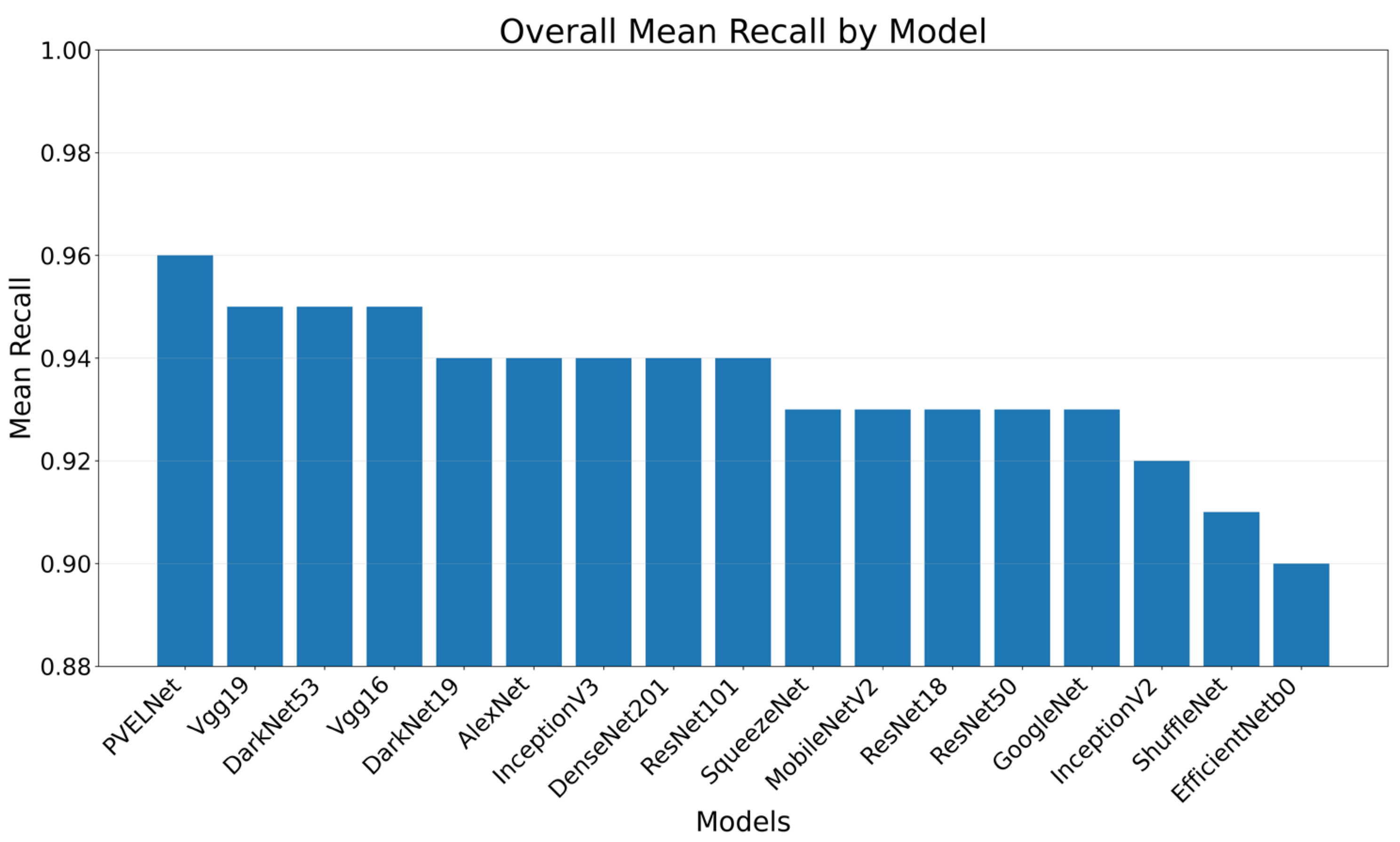
| PVELNet | 0.97 | 0.97 | 0.94 | 0.93 | 0.92 | 0.98 | 1.00 | 0.96 | 0.96 |
| Precision | |||||||||
|---|---|---|---|---|---|---|---|---|---|
| Cell-Interconnection | Electrically Insulated Cell Parts | Finger | Material | Microcrack | Multi-Defect | Normal | Visual | Mean | |
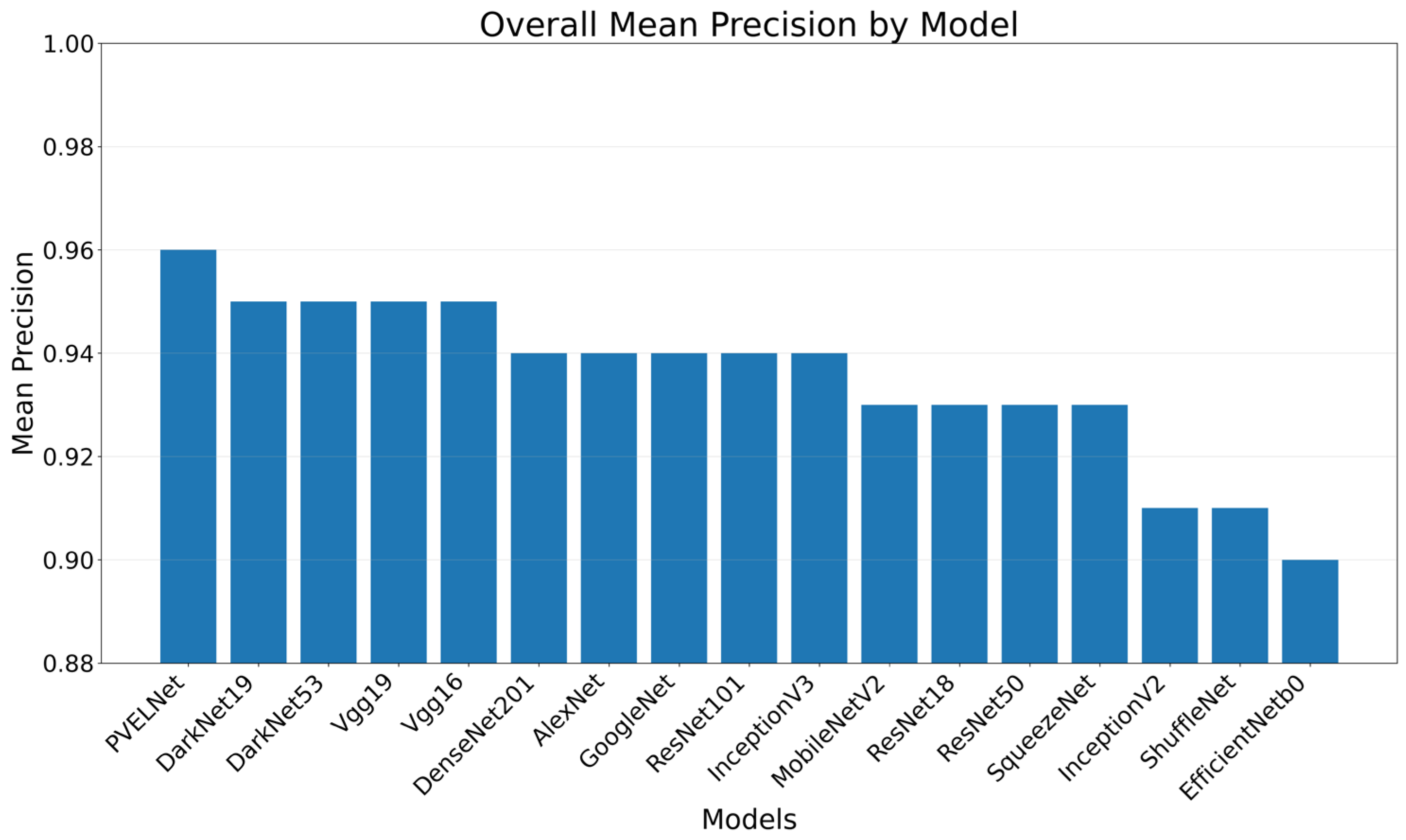
| DarkNet19 | 0.97 | 0.98 | 0.93 | 0.84 | 0.92 | 0.97 | 1.00 | 0.96 | 0.95 |
| DarkNet53 | 0.98 | 0.98 | 0.90 | 0.89 | 0.91 | 0.97 | 1.00 | 0.96 | 0.95 |
| MobileNetV2 | 0.97 | 0.98 | 0.88 | 0.88 | 0.87 | 0.97 | 1.00 | 0.90 | 0.93 |
| ResNet18 | 0.96 | 0.97 | 0.91 | 0.90 | 0.87 | 0.94 | 0.99 | 0.91 | 0.93 |
| ResNet50 | 0.95 | 0.98 | 0.89 | 0.86 | 0.91 | 0.96 | 1.00 | 0.89 | 0.93 |
| ResNet101 | 0.97 | 0.97 | 0.91 | 0.89 | 0.89 | 0.97 | 0.99 | 0.94 | 0.94 |
| Vgg16 | 0.96 | 0.97 | 0.94 | 0.89 | 0.94 | 0.98 | 1.00 | 0.90 | 0.95 |
| Vgg19 | 0.98 | 0.97 | 0.86 | 0.93 | 0.91 | 0.98 | 0.99 | 0.98 | 0.95 |
| SqueezeNet | 0.93 | 0.96 | 0.85 | 0.90 | 0.86 | 0.97 | 1.00 | 0.96 | 0.93 |
| GoogleNet | 0.98 | 0.95 | 0.90 | 0.89 | 0.89 | 0.96 | 0.99 | 0.93 | 0.94 |
| DenseNet201 | 0.96 | 0.98 | 0.89 | 0.91 | 0.88 | 0.96 | 0.99 | 0.95 | 0.94 |
| AlexNet | 0.95 | 0.97 | 0.89 | 0.90 | 0.88 | 0.96 | 0.99 | 0.93 | 0.94 |
| InceptionV3 | 0.97 | 0.97 | 0.90 | 0.88 | 0.88 | 0.96 | 0.99 | 0.94 | 0.94 |
| EfficientNetb0 | 0.93 | 0.95 | 0.85 | 0.83 | 0.80 | 0.95 | 0.99 | 0.92 | 0.90 |
| InceptionV2 | 0.91 | 0.97 | 0.87 | 0.87 | 0.85 | 0.97 | 0.99 | 0.88 | 0.91 |
| ShuffleNet | 0.93 | 0.95 | 0.87 | 0.89 | 0.81 | 0.92 | 0.99 | 0.94 | 0.91 |
| PVELNet | 0.98 | 0.98 | 0.93 | 0.93 | 0.92 | 0.97 | 1.00 | 0.95 | 0.96 |
| Model | Accuracy | Memory Space (MB) | |
|---|---|---|---|
| 1 | DarkNet19 | 94.26 | 219 |
| 2 | DarkNet53 | 94.65 | 446 |
| 3 | MobileNetV2 | 92.61 | 36.8 |
| 4 | ResNet18 | 93.14 | 125 |
| 5 | ResNet50 | 92.83 | 267 |
| 6 | ResNet101 | 94.02 | 478 |
| 7 | Vgg16 | 94.58 | 1443 |
| 8 | Vgg19 | 94.69 | 1505 |
| 9 | SqueezeNet | 92.77 | 13.3 |
| 10 | GoogleNet | 93.47 | 74.7 |
| 11 | DenseNet201 | 93.90 | 232 |
| 12 | AlexNet | 93.49 | 650 |
| 13 | InceptionV3 | 93.29 | 253 |
| 14 | EfficientNetb0 | 90.02 | 59.2 |
| 15 | InceptionV2 | 91.52 | 617 |
| 16 | ShuffleNet | 91.10 | 19.9 |
| 17 | PVELNet | 95.71 | 46.1 |
Disclaimer/Publisher’s Note: The statements, opinions and data contained in all publications are solely those of the individual author(s) and contributor(s) and not of MDPI and/or the editor(s). MDPI and/or the editor(s) disclaim responsibility for any injury to people or property resulting from any ideas, methods, instructions or products referred to in the content. |
© 2026 by the authors. Licensee MDPI, Basel, Switzerland. This article is an open access article distributed under the terms and conditions of the Creative Commons Attribution (CC BY) license.
Share and Cite
Aktaş, M.; Doğan, F.; Türkoğlu, İ. A Hybrid CNN–Transformer Approach for Photovoltaic Cell Defect Classification Using Electroluminescence Imaging. Sensors 2026, 26, 2450. https://doi.org/10.3390/s26082450
Aktaş M, Doğan F, Türkoğlu İ. A Hybrid CNN–Transformer Approach for Photovoltaic Cell Defect Classification Using Electroluminescence Imaging. Sensors. 2026; 26(8):2450. https://doi.org/10.3390/s26082450
Chicago/Turabian StyleAktaş, Miktat, Ferdi Doğan, and İbrahim Türkoğlu. 2026. "A Hybrid CNN–Transformer Approach for Photovoltaic Cell Defect Classification Using Electroluminescence Imaging" Sensors 26, no. 8: 2450. https://doi.org/10.3390/s26082450
APA StyleAktaş, M., Doğan, F., & Türkoğlu, İ. (2026). A Hybrid CNN–Transformer Approach for Photovoltaic Cell Defect Classification Using Electroluminescence Imaging. Sensors, 26(8), 2450. https://doi.org/10.3390/s26082450