Article

Assessing Spatial and Spatiotemporal Tactile Working Memory Using Adaptive Staircase Procedures

1
The Faculty of Industrial Engineering, Mechanical Engineering, and Computer Science, University of Iceland, 102 Reykjavík, Iceland
2
Icelandic Vision Laboratory, Faculty of Psychology, University of Iceland, 102 Reykjavík, Iceland
*
Author to whom correspondence should be addressed.
Sensors 2026, 26(8), 2361; https://doi.org/10.3390/s26082361
Submission received: 9 February 2026 / Revised: 5 April 2026 / Accepted: 8 April 2026 / Published: 11 April 2026
(This article belongs to the Section Wearables)

Abstract

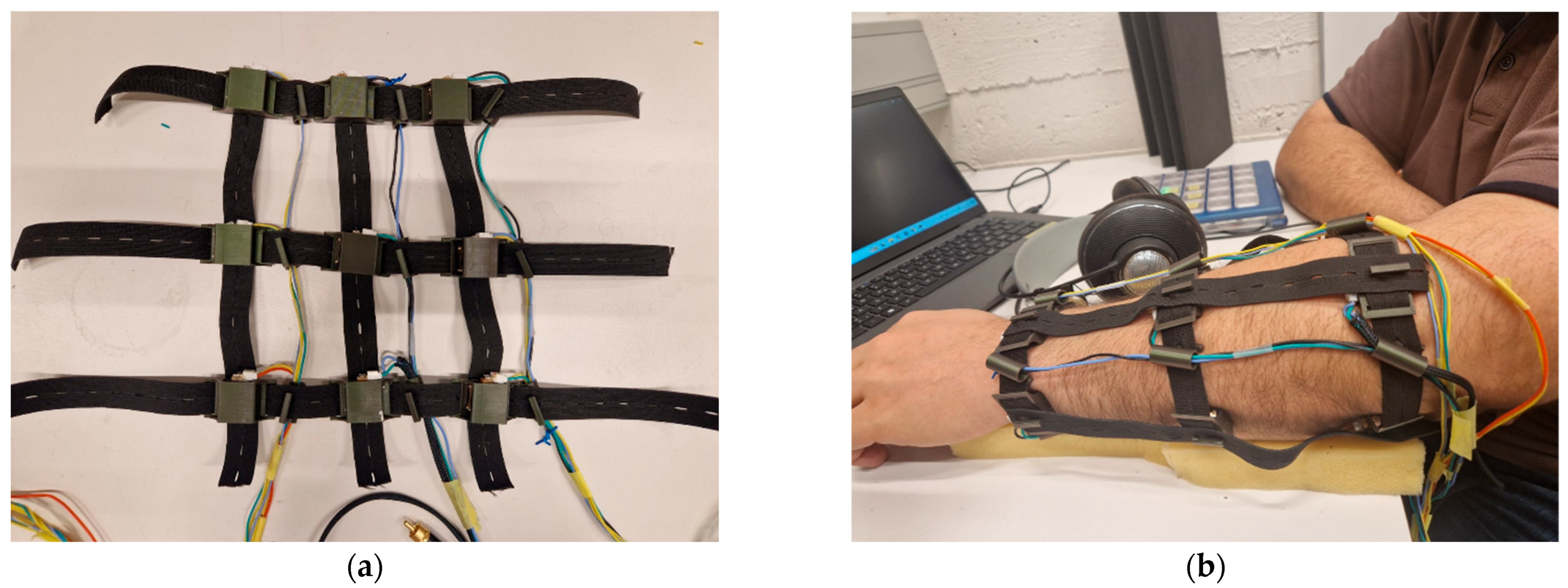
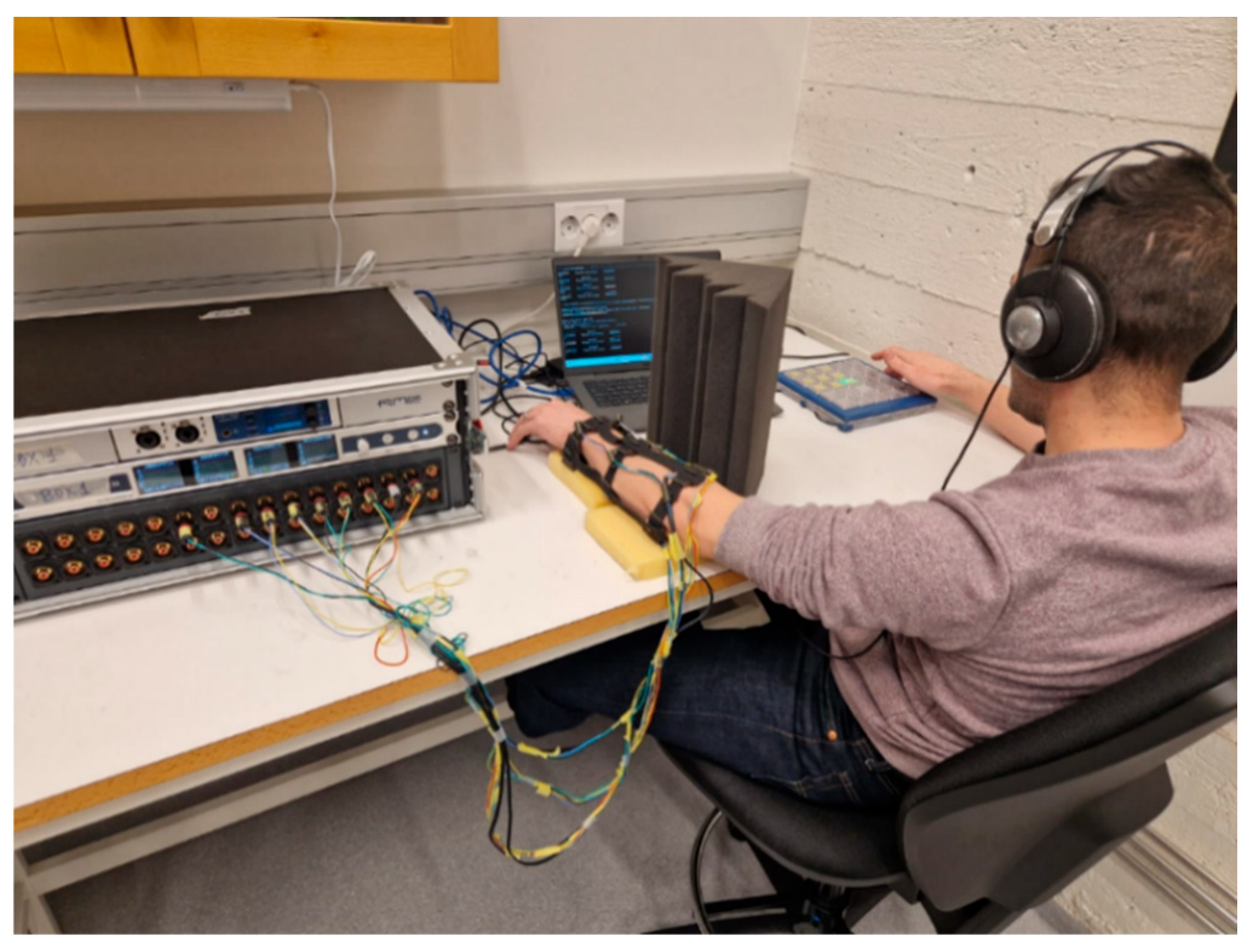
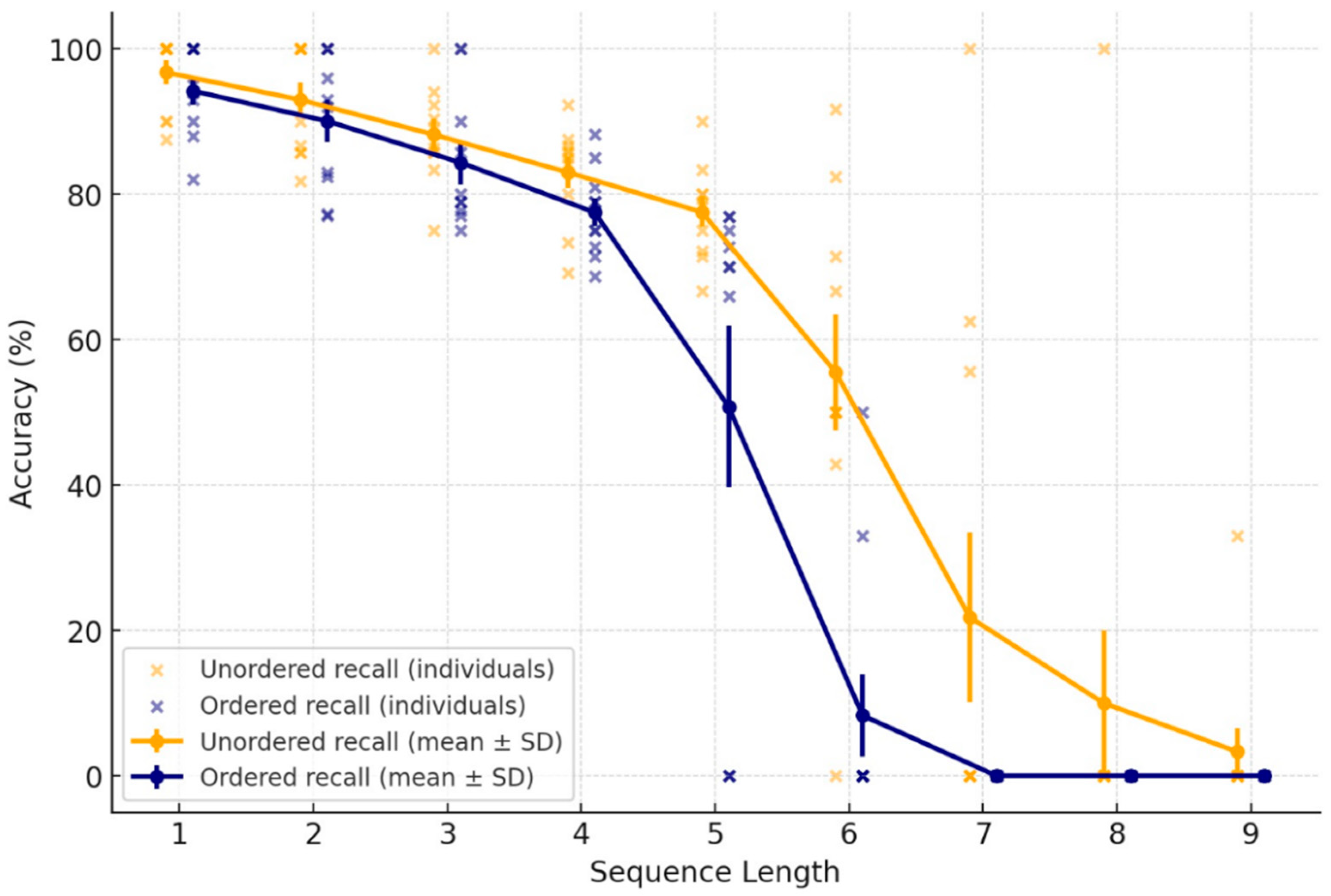
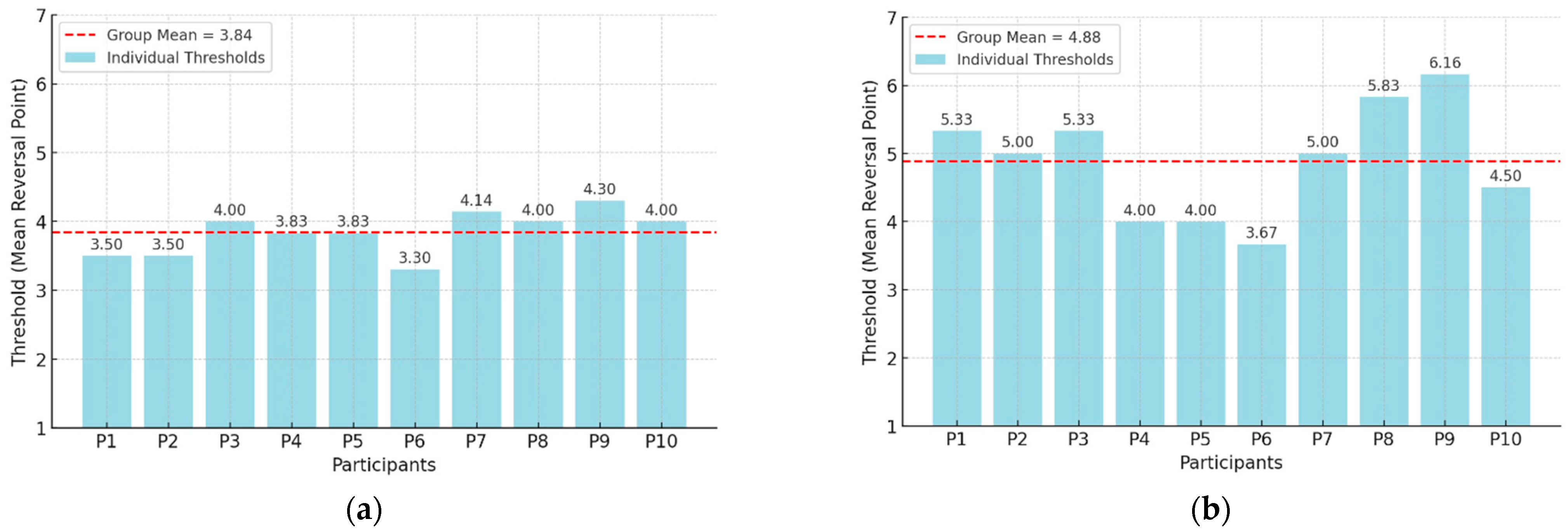
Tactile working memory limits the amount of information that can be processed through touch, with important implications for the design of haptic communication systems. Although visual and auditory working memory have been extensively investigated, tactile working memory, particularly for spatial and spatiotemporal sequences, remains less well understood. The present study examined tactile working memory capacity in two psychophysical experiments. Participants reproduced sequential vibrotactile stimuli delivered to the forearm via a 3 × 3 array of voice-coil actuators by entering responses through keypresses. Both experiments employed an adaptive 3-up/1-down staircase procedure, in which sequence length was adjusted according to response accuracy, and thresholds were estimated from reversal points. In Experiment 1 (Ordered Recall), participants reproduced both the spatial locations and the temporal order of stimulation, yielding a memory capacity threshold of approximately four items. In Experiment 2 (Unordered Recall), participants recalled only the set of stimulated locations without regard to order, resulting in a higher threshold of approximately five items. These results demonstrate that incorporating temporal sequencing demands into spatial recall substantially increases cognitive load and reduces effective tactile memory capacity. The findings clarify fundamental limits of tactile working memory and provide practical guidance for the development of haptic interfaces, wearable feedback systems, and sensory substitution technologies that must balance information complexity with human cognitive constraints.
Keywords: vibrotactile wearable device; tactile feedback; stimuli discrimination; tactile working memory; vibrotactile patterns; haptic interface vibrotactile wearable device; tactile feedback; stimuli discrimination; tactile working memory; vibrotactile patterns; haptic interface