Article

Using Electrostatic Mapping to Understand PANI-MWCNTs’ NH3 Sensing


by
Alessia Famengo
1,†,
Carmen Marinela Mihailescu
2,†,
Mihaela Savin
2,†,
Alexandru Grigoroiu
2,†,
Carmen Moldovan
2 and
Maria Losurdo
1,*
1
Institute of Condensed Matter Chemistry and Technologies for Energy—National Research Council of Italy (CNR-ICMATE), 35127 Padua, Italy
2
National Institute for Research and Development in Microtechnologies (IMT), 077190 Bucharest, Romania
*
Author to whom correspondence should be addressed.
These authors contributed equally to this work.
Sensors 2026, 26(7), 2169; https://doi.org/10.3390/s26072169
Submission received: 17 February 2026 / Revised: 17 March 2026 / Accepted: 23 March 2026 / Published: 31 March 2026
(This article belongs to the Section Chemical Sensors)

Abstract

This study investigates the electrostatic and electrochemical behavior of polyaniline (PANI) and its composite with amine-functionalized multi-walled carbon nanotubes (PANI/MWCNT–NH2) to elucidate the mechanisms governing ammonia (NH3) sensing. High-resolution atomic force microscopy (AFM) coupled with electrostatic force microscopy (EFM) demonstrates that pristine PANI forms granular macroaggregates with localized charge distribution, whereas MWCNT incorporation promotes worm-like percolative networks that enhance charge delocalization and conductivity. Electrochemical characterization by cyclic voltammetry (CV) and electrochemical impedance spectroscopy (EIS) corroborates these nanoscale observations, revealing significantly improved interfacial electron transfer kinetics in the composite. Upon exposure to NH3, pristine PANI undergoes rapid de-doping and nonlinear signal suppression, while the composite exhibits a more progressive electrochemical modulation. Overall, the results demonstrate that NH3 sensing in PANI-based films is governed not solely by electroactive material content but by the interplay between nanoscale morphology, electrostatic heterogeneity, and charge transport topology. The nanotube-mediated formation of delocalized and percolative conductive pathways provides structural and electrochemical robustness, enabling tunable, high-sensitivity operation suitable for next-generation, low-power ammonia sensing platforms.

1. Introduction

Ammonia (NH3) is a toxic and corrosive gas widely released from agricultural, industrial, and biomedical sources, and has been classified as a critical air pollutant due to its harmful effects on human health even at low concentrations [1]. Reliable, low-power, room-temperature sensing of NH3 is therefore essential for environmental monitoring, industrial safety, and for emerging non-invasive diagnostic applications such as breath analysis for liver and kidney dysfunction [2,3,4,5,6].
Conducting polymers, such as polyaniline (PANI), have been extensively investigated as active sensing layers for NH3 detection because of their reversible protonation/deprotonation behavior, facile electrochemical synthesis, and chemical stability under ambient conditions [7,8,9,10,11]. The sensing performance of PANI thin films strongly depends on their nanoscale morphology and local charge distribution, which are influenced by synthesis parameters and the presence of nanofillers [12,13,14,15,16,17].
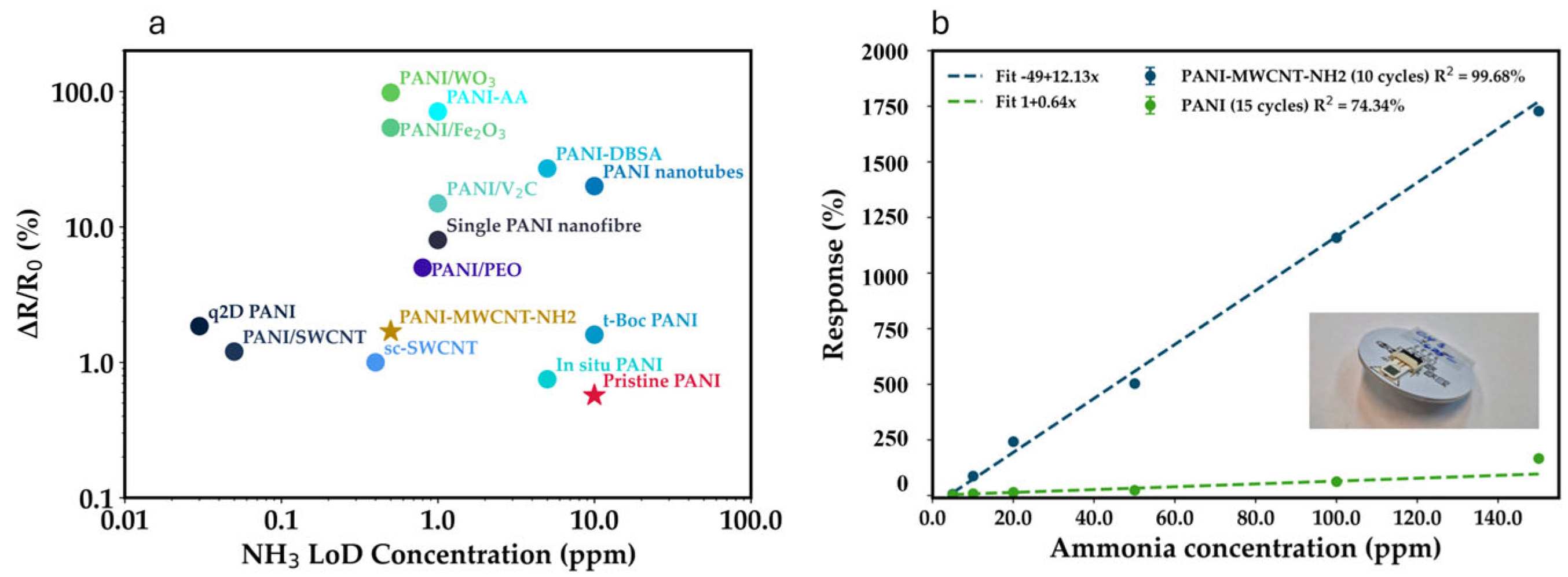
To enhance its charge transport properties and active surface area, PANI is being combined with carbon-based nanomaterials, including multi-walled carbon nanotubes (MWCNTs) functionalized with –COOH or –NH2 groups, as well as with oxide nanostructures (e.g., Fe2O3, WO3, …). Such hybrid PANI/carbon composites exhibit improved conductivity, higher density of active adsorption sites, and superior sensitivity to NH3 compared to pristine PANI [18,19,20,21,22], as aminated MWCNTs promote interfacial interactions with PANI and facilitate efficient modulation of the electron transport pathways upon NH3 exposure [23]. An overview of the various investigated PANI composites [24], in terms of their NH3 sensing performance, is given in Figure 1; in the same plot, the functional sensing data obtained by our PANI-MWCNTs are also reported for comparison. More details about PANI-based NH3 sensing performance in terms of limit of detection (LoD) and sensitivity are given in Table 1. This shows the affinity of PANI composites for ammonia detection, and the wide interest in the literature for improving the performance of such systems.
Conventional sensor characterization methodologies predominantly exploit bulk electrochemical techniques—including cyclic voltammetry (CV), electrochemical impedance spectroscopy (EIS), and macroscopic conductance measurements—to assess device performance. Although these methods yield valuable data, they are inherently limited by their spatial averaging, precluding the resolution of local electrostatic heterogeneities within the films.
Nanoscale heterogeneities in surface potential, charge distribution, and interfacial polarization significantly impact gas–solid interaction mechanisms; however, their characterization remains insufficiently addressed in current research. Electrostatic force microscopy (EFM) and Kelvin probe force microscopy (KPFM) represent suitable scanning probe methodologies that enable comprehensive mapping of nanoscale electronic and electrostatic properties. These techniques facilitate the simultaneous acquisition of high-resolution topographical information and spatially resolved surface potential mappings, and, under specific operational modes, allow direct interrogation of local charge distributions. Consequently, the utilization of EFM is essential for elucidating the intricate, spatially dependent processes underlying sensor functionality at the nanoscale [28,29,30,31,32,33,34].
The present study seeks to characterize the electrostatic properties of electrochemically synthesized polyaniline (PANI) and PANI/multi-walled carbon nanotube–NH2 (MWCNT–NH2) composite thin films. With the reproducibility and stability of the PANI–MWCNT–NH2 sensing architecture having been previously demonstrated under gas-phase-ammonia exposure (Figure 1b), where sensors fabricated using the same electrochemical protocol exhibited consistent response and recovery characteristics [22], the present work builds on this validated platform and focuses on elucidating the nanoscale electrostatic and electrochemical mechanisms governing the observed sensing behavior.
Employing AFM in conjunction with EFM, we establish direct correlations between nanoscale morphological features, composite aggregate architecture, and the spatial distribution of local electrostatic potential and surface charge. This investigation holds particular significance within the domain of PANI-based sensor technologies, which are garnering increasing attention due to their adjustable electrical characteristics, environmental robustness, and broad applicability in electronic devices, chemical sensing, and energy storage systems. The nanoscale electrostatic phenomena revealed by EFM are validated through CV and EIS, thereby facilitating a direct association between localized charge arrangements and overall electrochemical performance. Through the integration of functionalized MWCNT-NH2 within PANI matrices, we demonstrate enhancements in electrical conductivity, mechanical integrity, and sensitivity, underscoring the potential of these composites for advanced sensor applications. By spatially resolving the electrostatic landscape at the nanoscale, this work elucidates the influence of microstructural heterogeneity and nanotube-enabled percolation pathways on the functional attributes and operational efficacy of PANI-based composite sensors.

2. Materials and Methods

2.1. Reagents

Aniline monomers, sulfuric acid (H2SO4), potassium chloride (KCl), phosphate-buffered saline (PBS), potassium ferricyanide/potassium ferrocyanide redox couples ([Fe(CN)6]3−/4−), and other analytical-grade reagents were purchased from (Merck Group, Darmstadt, Germany). Amine-functionalized multi-wall carbon nanotubes (MWCNT–NH2; outer diameter, <20 nm; inside diameter, 4 nm; Ash, 0 wt%; purity, >99 wt%; length, 1–12 um) were supplied by Cheap Tubes Inc. (Cambridgeport, VT, USA). Silver conductive paste used for electrical contacts was obtained from RS Components S.r.l (Sesto San Giovanni, Italy). All aqueous solutions were prepared using ultrapure water.

2.2. Electrosynthesis

Polyaniline and PANI–MWCNT–NH2 films were electrodeposited via cyclic voltammetry (CV) following the same protocol described in our previous work [22], with an electropolymerization process consisting of 20 cycles.

2.3. Sensor Preparation

The sensors were deposited on miniaturized gold interdigitated electrodes (IDEs) fabricated on 0.1 mm thick alumina substrates (KYOCERA, Esslingen, Germany), following the same design and fabrication protocol as previously reported by our group [22]. The IDEs consisted of 80 electrode pairs with a digit width of 10 µm and an active area of 5 mm × 8 mm.

2.4. Characterizations

Electrochemical impedance spectroscopy (EIS) and cyclic voltammetry (CV) measurements were carried out using a VoltaLab PGZ100 potentiostat/galvanostat (Radiometer Analytical, France) and the VoltaMaster 4 software. Impedance spectra were recorded over a frequency range of 100 kHz to 0.1 Hz by applying a small-amplitude sinusoidal perturbation around the open-circuit potential. EIS data were fitted using a Randles-type equivalent circuit consisting of the solution resistance (Rs), charge-transfer resistance (Rct), and a constant phase element (CPE) to account for non-ideal capacitive behavior at the electrode–electrolyte interface. The same circuit configuration was applied to all impedance spectra. Curve fitting was performed using VoltaMaster 4 software (Radiometer Analytical), and fitting quality was evaluated based on the chi-square (χ2) values provided by the software.
AFM–EFM measurements were recorded with a PARK NX10 instrument (Park Systems, Republic of Korea) under ambient condition at room temperature using a cantilever SPARK 70 with a Pt-coated Si tip (frequency ≈ 55 kHz, Spring Constant ≈ 2 N/m, Q factor ≈ 230).
In this configuration, AFM/EFM topography and potential maps were acquired in non-contact mode, the topography being obtained through the tip scanning the surface with the cantilever oscillating in frequency. Simultaneously, an AC bias of frequency ω was applied to the tip, which senses the electrostatic force of the charged (biased) surface. The tip motion affected by the force was analyzed and yielded the EFM amplitude and phase, giving information on surface charges. Samples were biased at 3.0 V, and Ag paste was used to make the electrical contact between the sample and the metallic sample holder. Scan rates were varied in the 0.1–0.3 Hz range. AFM and EFM data were analyzed with the Smart Analysis software-Ver. 1.4.3-1480 provided by Park Instrument. AFM images were processed with the flatten function to correct sample tilting when needed.
In EFM, the fundamental operating principle relies on the detection of electrostatic forces between a conductive probe tip and a biased sample surface. When a voltage is applied between the tip and the sample, an electrostatic force (Fe) proportional to the quantity of charge and electrical field gradients present in the sample surface arises, leading to the cantilever bending (X) [35]. Thus, by scanning the tip across the sample surface, EFM enables qualitative mapping of local charge distributions.

3. Results

3.1. AFM and EFM Nanoscale Mapping

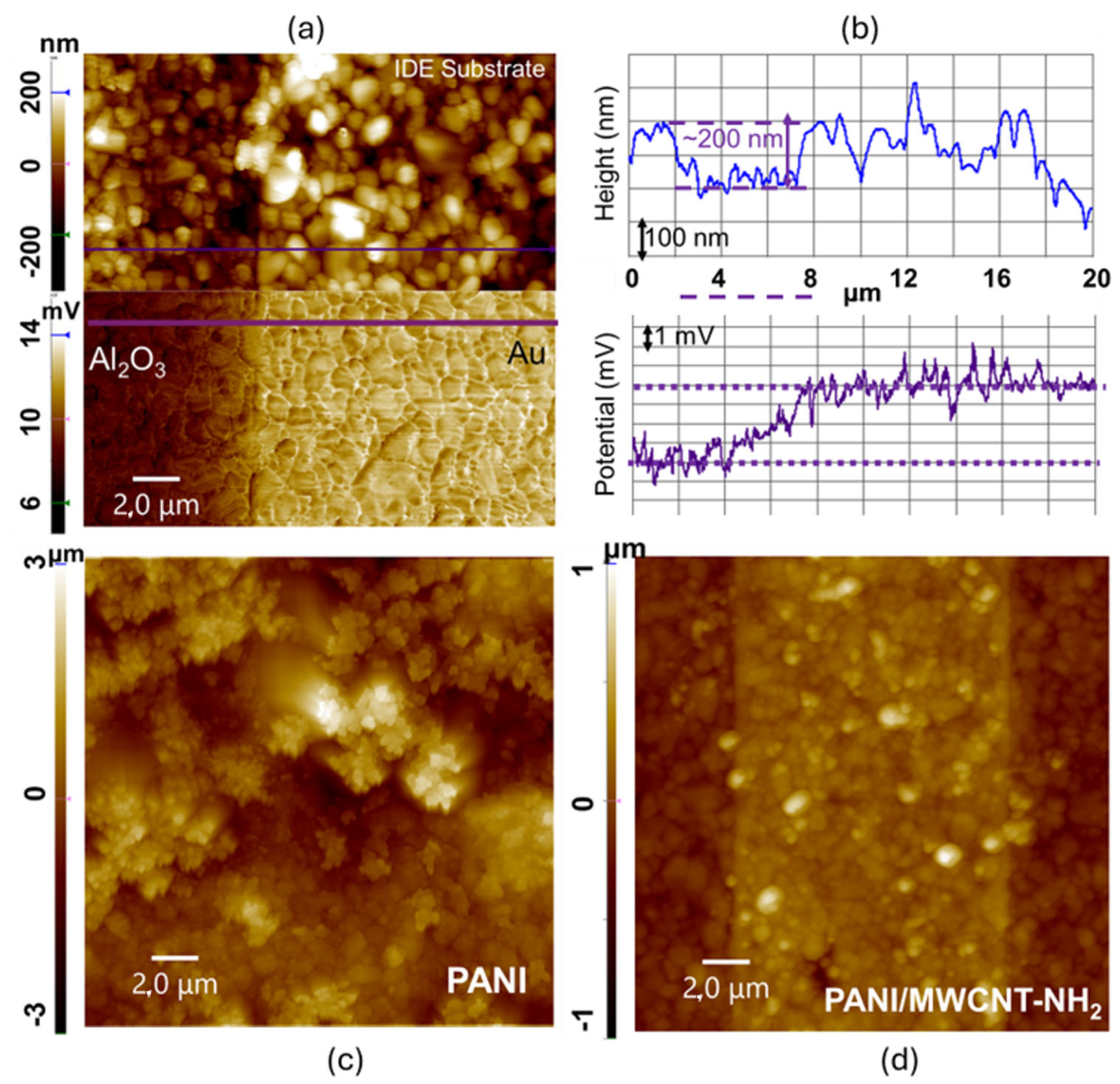
Figure 2 shows the AFM topography of PANI-only films and of PANI/MWCNT-NH2 obtained by depositing PANI together with a suspension of MWCNT-NH2 after 20 CV-cycles, as well as of the starting IDE substrate. Specifically, Figure 2a shows the AFM topography and corresponding EFM potential map of the interdigitated Au/Al2O3 substrate consisting of 10-µm-wide Au electrodes with an approximate height of 200 nm, as confirmed by the topographic line profile in Figure 2b. Despite the rough morphology due to the grain structure of Au/Al2O3, a clear potential contrast—arising from the distinct electrical properties of metallic Au versus insulating Al2O3—is observed in the corresponding EFM map (Figure 2a). The measured potential difference of ~3.8 ± 0.2 mV demonstrates the sensitivity of EFM in resolving local charge distributions independently of surface roughness and morphology, consistent with previous studies highlighting EFM’s ability to discriminate conductive/insulating regions in heterogeneous thin-film systems. The PANI-only films (Figure 2c) display multilayered granular domains formed by the aggregation of individual polymer particles with a diameter < 200 nm. These grains exhibit lateral dimensions of approximately 1 µm, and typical heights in the 800 nm–1 µm range, in agreement with earlier observations of PANI emeraldine salt films, where granular and micro-/macro-aggregated morphologies are characteristic of the doped forms of PANI. AFM studies have shown that PANI undergoes significant morphological variations depending on electrochemical state, dopant type, and synthesis route, often exhibiting increased roughness in conductive vs. nonconductive states. With increasing film thickness, these PANI grains coalesce into larger macroaggregates, reflecting the intrinsic tendency of PANI chains to form hierarchical microstructures [31]. Figure 2d highlights the significant morphological differences introduced by incorporating NH2-functionalized MWCNTs into the PANI matrix. Although PANI-only films deposit uniformly over both Au and Al2O3 at a 20 µm × 20 µm scan scale, the PANI/MWCNT-NH2 composite deposits predominantly on Au electrodes. Thus, a visible contrast due to the Au and Al2O3 of the IDEs can again be seen. From this preferential localization of deposition, it can be inferred that the enhanced conductivity introduced by MWCNTs directs the electrodeposition along conductive Au electrode pathways.
This phenomenon can be attributed to the formation of an interconnected nanotube-mediated conductive network, which facilitates charge transport during polymer growth. Functionalization of MWCNTs with amino (–NH2) groups further promotes chemical interactions with PANI. NH2 groups increase local electron density and create favorable hydrogen bonding sites, strengthening the PANI–MWCNT interaction. Density Functional Theory (DFT) and molecular dynamics simulations have also demonstrated that NH2-functionalized PANI and CNTs exhibit enhanced adsorption affinity for ammonia (NH3) due to acid–base interactions, increased local charge density, and stronger non-covalent bonding—effects that also influence electrodeposition behavior by locally enriching NH3 and modifying doping levels [36]. During electrodeposition, PANI macromolecules are known to wrap around MWCNTs via π–π stacking and electrostatic interactions, increasing film connectivity and electroactive surface area.
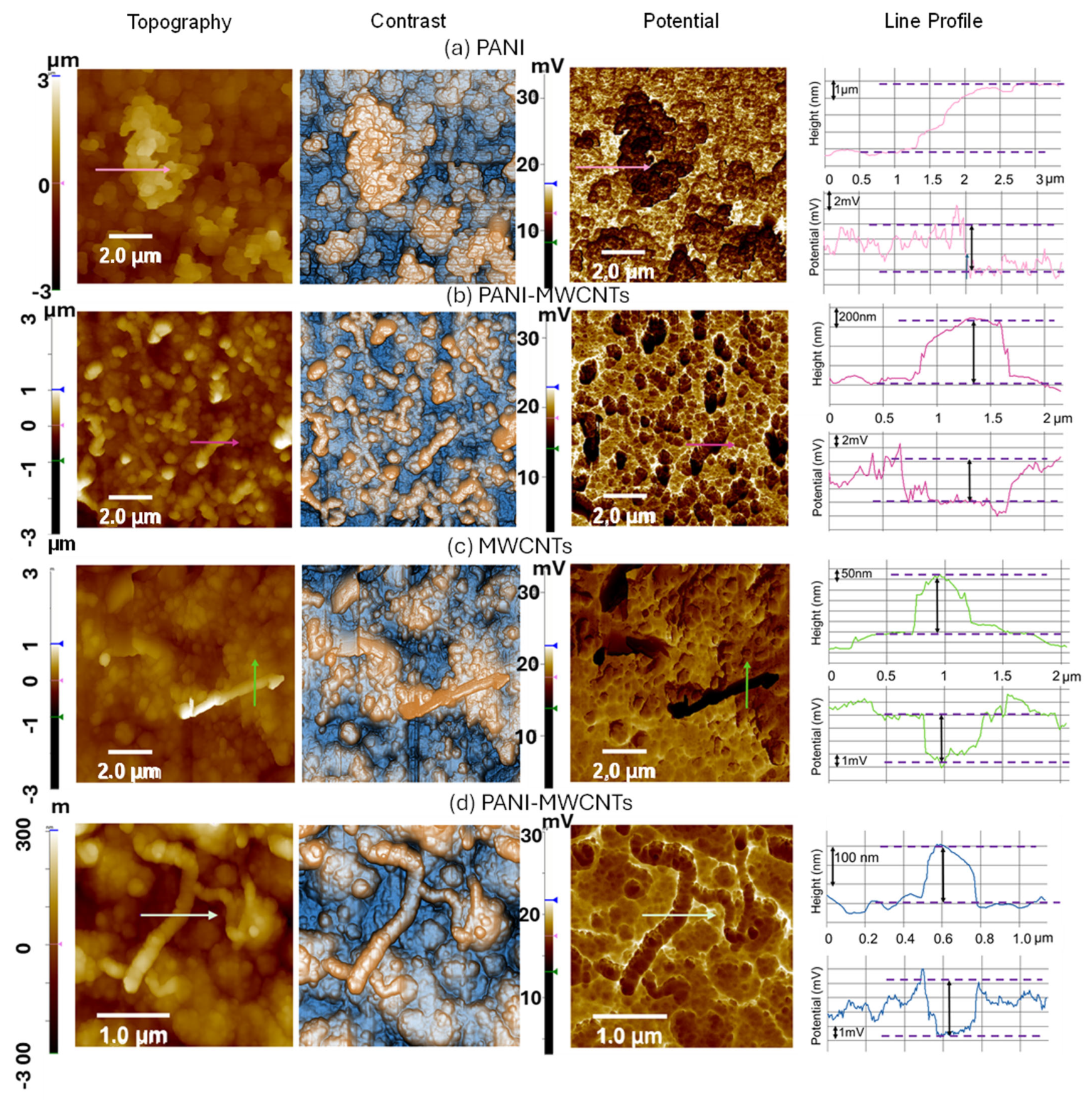
Figure 3 provides better insight into the PANI-MWCNT films with EFM potential maps that spatially resolve local charge distribution within the examined thin films. The topography of PANI in Figure 3a shows large macro-aggregates. The corresponding observed enhancement in charge density within the darker domains of PANI macro-aggregates (see the EFM map in Figure 3a) is ascribed to the presence of larger polymeric assemblies, which promote augmented charge trapping and accumulation, consistent with the established literature on charge localization in conducting polymer systems. It is inferred that accumulation of charge in those macro-aggregates of PANI causes significant imbalance in charge distribution and, consequently, in conductivity, which may affect the sensing response to NH3. Conversely, Figure 3b–d demonstrate that the addition of MWCNTs as dopants substantially influences the topography and charge density distribution within the PANI matrix. AFM topography and contrast images of PANI-MWCNTs in Figure 3b–d reveal characteristic “worm-like” or fibrillar aggregates corresponding to MWCNTs coated with PANI chains. As an example, Figure 3c clearly shows a worm-like aggregate approximately 4 μm in length and ~500 nm in diameter that originates from an MWCNT-NH2 enveloped by PANI. The corresponding EFM map and amplitude profile reveal that these PANI-coated MWCNT structures exhibit higher electrical conductivity than the surrounding PANI matrix, with elevated local potentials ranging from 4.6 to 6.4 mV, indicative of enhanced charge transport. Moreover, the analysis of Figure 3b suggests that MWCNTs play a pivotal role in suppressing the formation of large PANI aggregates and instead facilitate the creation of a more homogeneous, percolative network of conductive pathways mediated by PANI-wrapped MWCNTs. This synergy between PANI and functionalized CNTs is well documented and includes improvements in dielectric performance, optical properties, and electrochemical responses. The worm-like nanotube–polymer aggregates and the markedly different microstructure of the composite film compared to pristine PANI confirm that MWCNTs—especially NH2-functionalized ones—act not only as conductive scaffolds but also as chemical modulators of PANI electrodeposition, morphology, and local dopant dynamics. This MWCNT doping methodology enables controlled modulation of the film’s electronic properties, thereby enhancing its electrical conductivity—a feature critical for advanced electronic and sensor applications. Recent studies corroborate that MWCNT incorporation improves charge carrier mobility and network connectivity, leading to superior conductive pathways [37,38,39].

3.2. Electrochemical Validation of AFM and EFM Observations

3.2.1. Baseline Electrochemical Behavior and Electroactive Area

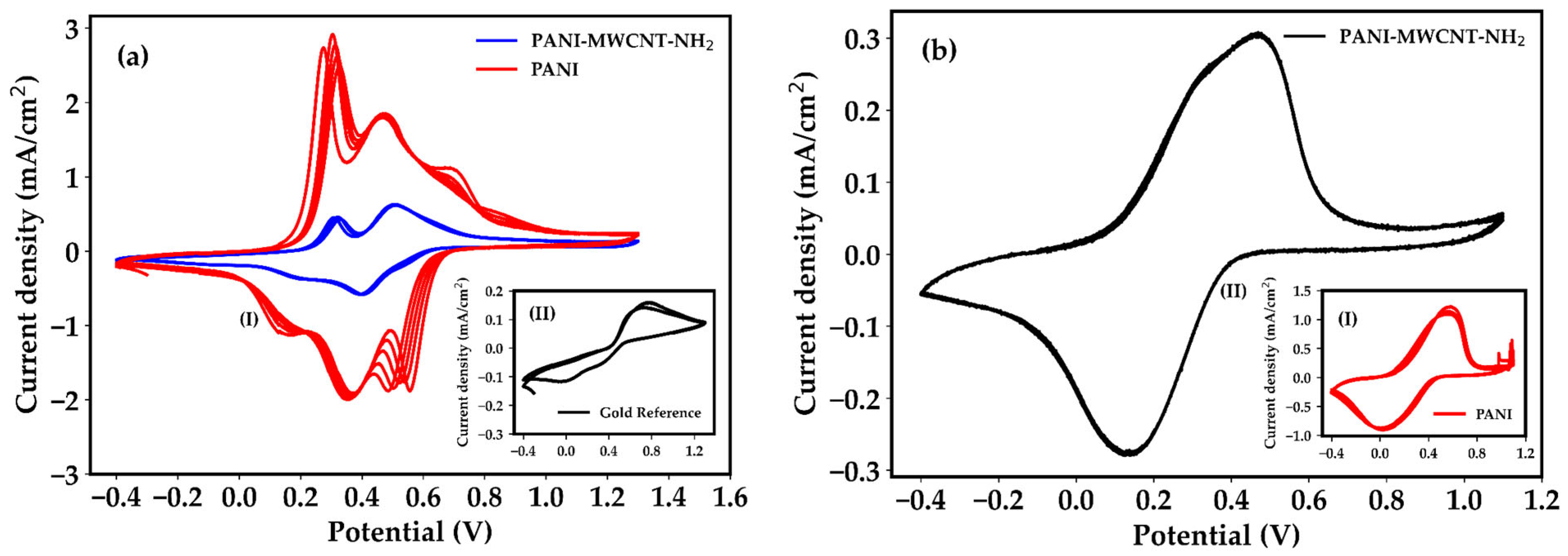
The interfacial electron transfer properties of the electrodeposited films were first evaluated using the reversible [Fe(CN)6]3−/4− redox couple in 0.1 M H2SO4. A bare interdigitated gold electrode was used as reference to decouple the contribution of the conductive substrate from that of the polymer-based active layers. Cyclic voltammetry revealed a progressive increase in faradaic currents when moving from the bare Au IDE to PANI and further to the composite-modified electrodes (Figure 4a, panels I and II). The higher peak currents observed in pristine PANI (Figure 4a, panel I, red curve), compared to both the bare Au interdigitated electrode (panel II) and the PANI–MWCNT–NH2 composite (Figure 4a, panel I, blue curve), indicate a larger electroactive polymer fraction, which is consistent with the highly developed surface morphology evidenced by AFM. AFM analysis further revealed that PANI forms compact aggregates and exhibits localized charge distribution, with electronic transport predominantly governed by hopping processes between polymer domains. More importantly at this stage, the magnitude of the faradaic current measured by cyclic voltammetry mainly reflects the electroactive area accessible to the redox probe rather than the intrinsic electron transfer kinetics of the films.

3.2.2. Intrinsic Electrochemical Activity of PANI and Composite Films

To probe the intrinsic electrochemical activity of the polymer matrix (which reflects the material’s intrinsic capability to engage in electrochemical processes, irrespective of external redox probes, substrate effects, or electrode geometry), CV was subsequently performed in 0.1 M KCl in the absence of any redox mediator. Under these conditions, the voltametric response originates from the redox transitions of polyaniline itself, and involves proton-coupled electron transfer between its leucoemeraldine, emeraldine, and pernigraniline states. As shown in Figure 4b, pristine PANI exhibits higher faradaic peak currents but a less regular voltametric response, whereas the composite displays lower peak currents accompanied by more gradual and stabilized behavior. Notably, the peak-to-peak potential separation (ΔEp) is smaller for the PANI–MWCNT–NH2 (ΔEp = 316 mV) composite than for pristine PANI (ΔEp = 579 mV), indicating faster electron transfer kinetics at the electrode–electrolyte interface. Those observations suggest that, although the polymer-only film contains a larger fraction of redox-active material, the incorporation of MWCNT–NH2 enhances charge propagation and reduces kinetic limitations by providing efficient conductive pathways within the composite matrix. Such behavior is consistent with the AFM and EFM observations, which revealed an interconnected worm-like morphology and a more delocalized charge distribution in the composite, characteristics that favor efficient charge transport across the active layer.

3.3. Charge-Transfer Kinetics and Correlation with EFM Charge Distribution

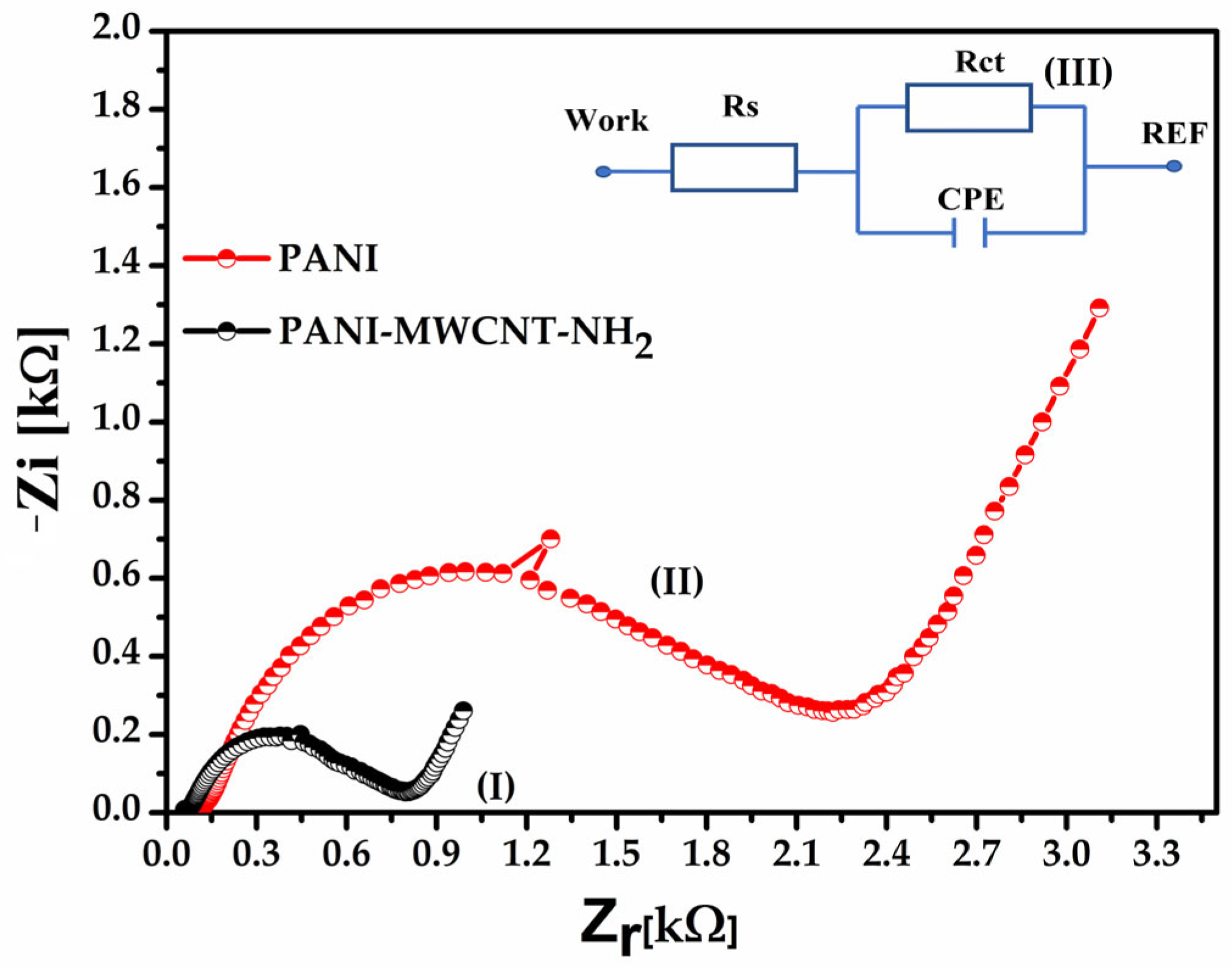
While cyclic voltammetry provides qualitative insight into electroactive surface area and intrinsic redox activity, electrochemical impedance spectroscopy (EIS), represented as Nyquist plots (−Z″ vs. Z′), provides quantitative information on interfacial charge-transfer kinetics. Quantitatively, this structural and electrostatic reorganization is reflected in a marked reduction in the charge-transfer resistance (Rct), which decreases from an average of 1.2 kΩ for pristine PANI (Figure 5, I) to 400 Ω for the PANI–MWCNT–NH2 composite (Figure 5, II). This nearly threefold decrease in Rct confirms that MWCNT incorporation enhances interfacial electron transfer efficiency rather than merely increasing the electroactive area. The Rct values were obtained by fitting the impedance spectra using the VoltaMaster 4 software and a modified Randles equivalent circuit. The fitting quality was verified through low χ2 values and randomly distributed residuals, which confirmed the robustness of the extracted parameters. This behavior correlates directly with the EFM observations, where larger ΔEp values for PANI indicated more localized charge states, whereas the reduced electrostatic contrast observed for the composite reflects charge delocalization. The lower Rct values measured for the PANI–MWCNT–NH2 films therefore support the formation of nanotube-mediated percolation pathways that facilitate long-range electron transport across the interface. These results demonstrate that NH2-functionalized MWCNTs enhance baseline electron transfer efficiency by promoting charge delocalization and establishing percolative transport pathways across the composite film.

3.4. Ammonia-Induced De-Doping: Comparative CV Response

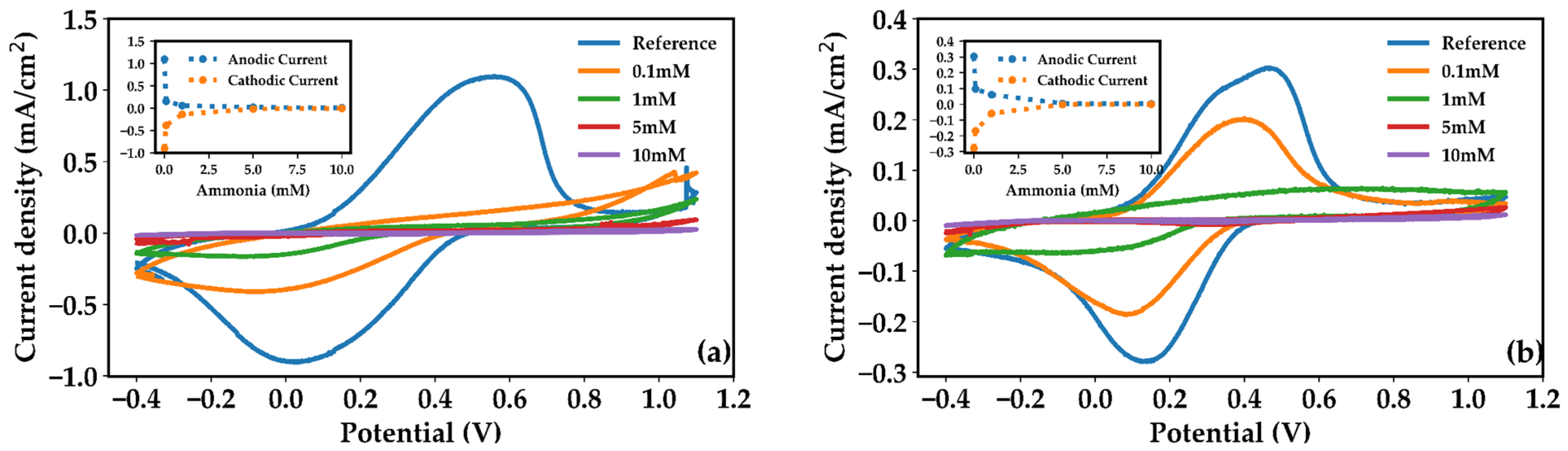
The interaction with dissolved ammonia was investigated by recording cyclic voltammograms in 0.1 M KCl containing increasing concentrations of dissolved NH3. For pristine PANI, exposure to dissolved ammonia induces a rapid and strongly nonlinear suppression of the voltametric response (Figure 6a), consistent with fast deprotonation of the emeraldine salt and abrupt loss of mobile charge carriers. In contrast, the composite (Figure 6b) exhibits a more progressive and controlled evolution of the CV signal with increasing ammonia concentration. This behavior suggests that, although ammonia effectively interacts with the active layer in both cases, the nanotube network redistributes the de-doping-induced perturbation through alternative charge transport pathways, leading to a more progressive modulation of the electrochemical response.
While cyclic voltammetry mainly reflects the accessible electroactive polymer fraction, electrochemical impedance spectroscopy provides a quantitative assessment of the interfacial charge-transfer kinetics, allowing the distinct contributions of PANI and MWCNTs to be disentangled.

3.5. Impedance Response Under Ammonia Exposure

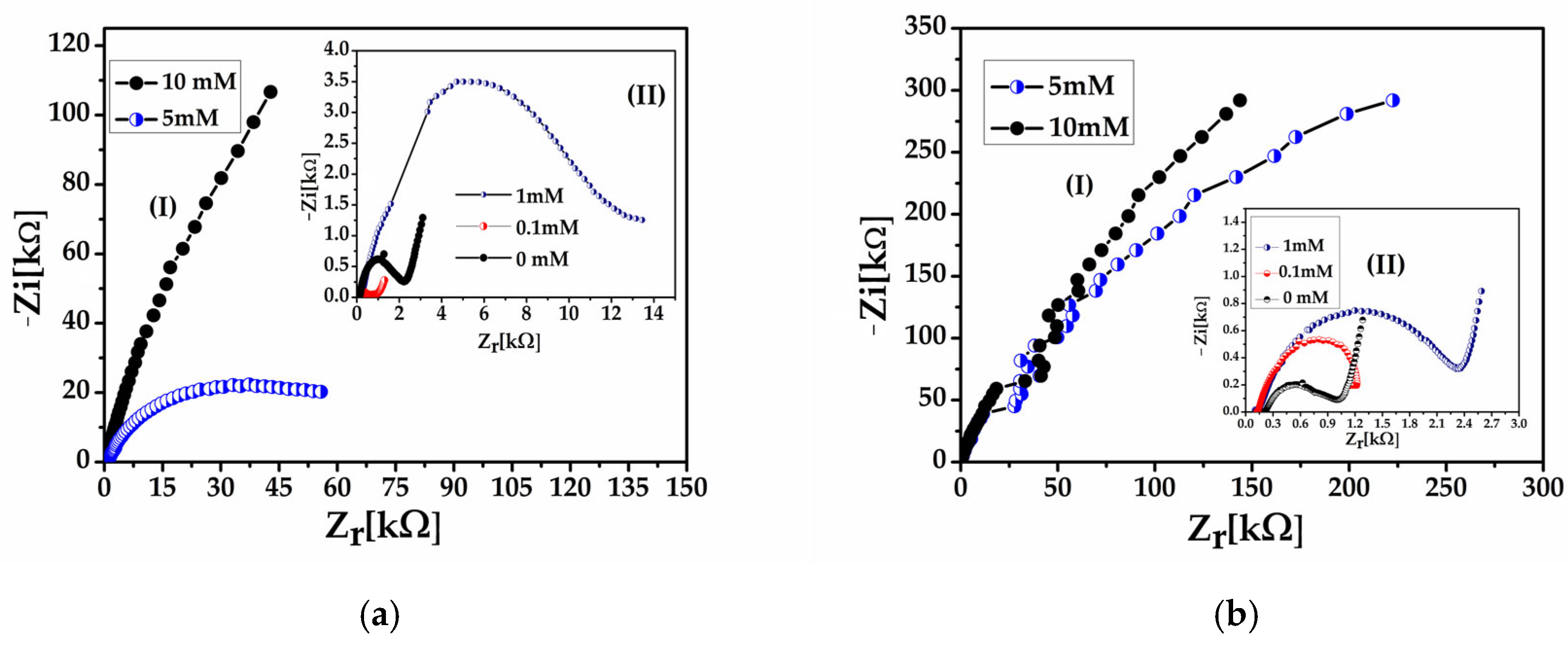
The impact of ammonia on electron transfer kinetics was further elucidated by EIS measurements performed after exposure to increasing NH3 concentrations. As shown in Figure 7a, pristine PANI exhibits a rapid and strongly nonlinear increase in charge-transfer resistance and reaches values on the order of hundreds of kilo-ohms (≈661.7 kΩ) at the highest ammonia concentration (panel I), indicative of fast and poorly controlled de-doping of the polymer matrix. At lower ammonia concentrations (panel II), the impedance response of PANI is weakly defined, with no clearly developed semicircular feature, suggesting limited accommodation of NH3 at the polymer–electrolyte interface.
In contrast, the PANI/MWCNT–NH2 composite (Figure 7b) displays a much more pronounced and concentration-dependent increase in RCT, approaching the mega-ohm range (≈1.051 MΩ) at 10 mM NH3 (panel I). At low ammonia concentrations (panel II), a partially developed semicircular response is still observed, indicating a more organized interfacial charge-transfer process prior to extensive de-doping. This amplified impedance response reflects enhanced ammonia interaction and preconcentration within the nanotube-containing architecture, leading to a more extensive modulation of the interfacial electron transfer process. A clear difference in the ammonia interaction mechanism thus emerges from the impedance data. While the PANI–MWCNT–NH2 composite exhibits two-regime behavior—characterized by gradual adsorption at low concentrations (Figure 7b, panel II) followed by a threshold-driven response at higher ammonia levels (Figure 7b, panel I)—pristine PANI responds in an abrupt and highly nonlinear manner (Figure 7a), with no evident accommodation regime. Notably, the transition from a partially defined semicircular response at low ammonia concentrations to diffusion-dominated impedance behavior at higher concentrations further supports the role of the nanotube framework in stabilizing charge transport prior to extensive polymer de-doping.
It is worth noting that the superior ammonia sensitivity of the PANI–MWCNT–NH2 composite compared to pristine PANI has already been demonstrated under gas phase conditions in our earlier work, where direct gas–solid interactions and efficient nanotube-assisted adsorption played a dominant role [22]. In contrast, the liquid phase electrochemical measurements discussed here display a buffered and diffusion-limited response yet remain fully consistent with the gas phase findings by highlighting the role of nanotube-mediated charge transport and response stabilization. It is well established that molecular diffusivity in gases is several orders of magnitude higher than in liquids. Typical diffusion coefficients for small gaseous species, including ammonia in air, are on the order of 10−5 m2/s, whereas analogous diffusion of solutes in aqueous media occurs with coefficients on the order of 10−9–10−10 m2/s, reflecting much faster mass transport in the gas phase compared to the liquid phase [40].
Under ammonia exposure, the composite exhibits a larger Rct modulation compared to pristine PANI, indicating that the nanotube-mediated network does not prevent de-doping but amplifies the interfacial perturbation induced by NH3 adsorption.

4. Conclusions

This study demonstrates that the sensing behavior of PANI-based thin films is governed by the organization and transport dynamics of charge within the films. AFM and EFM reveal that the composite architecture promotes charge delocalization and the formation of conductive pathways, while CV and EIS provide functional validation of these nanoscale features. Pristine PANI, despite exhibiting a larger electroactive fraction and higher baseline faradaic currents, displays pronounced charge localization and limited electron transfer efficiency, which make its conductivity highly vulnerable to abrupt ammonia-induced de-doping. In contrast, the incorporation of NH2-functionalized MWCNTs generates interconnected, worm-like percolative pathways that promote charge delocalization, reduce charge-transfer resistance, and modulate electrochemical response under increasing NH3 concentrations. Quantitatively, MWCNT incorporation reduces ΔEp from 579 mV to 316 mV and decreases Rct from ~1.2 kΩ to ~400 Ω under baseline conditions. Upon exposure to 10 mM NH3, Rct increases to approximately 661 kΩ for pristine PANI and to 1.05 MΩ for the PANI–MWCNT–NH2 composite, reflecting ~1.6-fold higher Rct values in the composite system. The incorporation of amine-functionalized carbon nanotubes promotes charge delocalization and transport resilience, leading to a gradual and threshold-controlled impedance response, and enabling the production of robust, next-generation ammonia sensors suitable for low-power environmental and biomedical applications.

Author Contributions

Conceptualization, M.L. and C.M.; methodology, C.M.M., M.S., A.G. and A.F.; formal analysis investigation, C.M.M., M.S., A.G. and A.F.; resources, M.L. and C.M.; data curation, C.M.M., M.S., A.G. and A.F.; writing—original draft preparation, C.M.M., M.S., A.G., A.F., M.L. and C.M.; writing—review and editing, all authors; supervision, M.L. and C.M.; funding acquisition, M.L. and C.M. All authors have read and agreed to the published version of the manuscript.

Funding

This research was funded by the European Union’s Horizon Europe research and innovation program under grant no. 101079455 Net4Air.

Institutional Review Board Statement

Not applicable.

Informed Consent Statement

Not applicable.

Data Availability Statement

Research data will be made available upon request from the corresponding author.

Conflicts of Interest

The authors declare no conflicts of interest. The funders had no role in the design of the study; in the collection, analysis, or interpretation of data; in the writing of the manuscript; or in the decision to publish the results.

Abbreviations

The following abbreviations are used in this manuscript:
PANIPolyaniline
MWCNTsMulti-Wall Carbon Nanotubes
PANI/MWCNT–NH2Polyaniline/Aminated Multi-Wall Carbon Nanotubes
CNTsCarbon Nanotubes
AFMAtomic Force Microscopy
EFMElectrostatic Force Microscopy
EISElectrochemical Impedance Spectroscopy
CVCyclic Voltammetry
DFTDensity Functional Theory

References

  1. World Health Organization. Ambient Air Pollution: Pollutants; World Health Organization: Geneva, Switzerland, 2021. [Google Scholar]
  2. Korotcenkov, G. Handbook of Gas Sensor Materials; Conventional approaches; Springer: Berlin/Heidelberg, Germany, 2013; Volume 1, pp. 19–23. [Google Scholar]
  3. Bikov, A.; Lázár, Z.; Horvath, I. Established methodological issues in electronic nose research: How far are we from using these instruments in clinical settings of breath analysis? J. Breath Res. 2015, 9, 034001. [Google Scholar] [CrossRef] [PubMed]
  4. Righettoni, M.; Amann, A.; Pratsinis, S.E. Breath analysis by nanostructured metal oxides as chemo-resistive gas sensors. Mater. Today 2015, 18, 163–171. [Google Scholar] [CrossRef]
  5. Chan, M.J.; Li, Y.J.; Wu, C.C.; Lee, Y.C.; Zan, H.W.; Meng, H.F.; Hsieh, M.-H.; Lai, C.-S.; Tian, Y.C. Breath ammonia is a useful biomarker predicting kidney function in chronic kidney disease patients. Biomedicines 2020, 8, 468. [Google Scholar] [CrossRef] [PubMed]
  6. Reis, T.; Moura, P.C.; Gonçalves, D.; Ribeiro, P.A.; Vassilenko, V.; Fino, M.H.; Raposo, M. Ammonia Detection by Electronic Noses for a Safer Work Environment. Sensors 2024, 24, 3152. [Google Scholar] [CrossRef] [PubMed]
  7. Tanguy, N.R.; Arjmand, M.; Yan, N. Nanocomposite of nitrogen-doped graphene/polyaniline for enhanced ammonia gas detection. Adv. Mater. Inter. 2019, 6, 1900552. [Google Scholar] [CrossRef]
  8. Gutnik, I.V.; Dyachkova, T.P.; Burakova, E.A.; Tugolukov, E.N.; Rukhov, A.V.; Titov, G.A. Polyaniline and its composites with carbon nanomaterials: Preparation, properties, application. Adv. Mater. Technol. 2024, 9, 132–151. [Google Scholar] [CrossRef]
  9. Kulkarni, S.B.; Navale, Y.H.; Navale, S.T.; Stadler, F.J.; Patil, V.B. Room temperature ammonia gas sensing properties of polyaniline nanofibers. J. Mater. Sci. Mater. Electron. 2019, 30, 8371–8380. [Google Scholar] [CrossRef]
  10. Wang, L.; Huang, H.; Xiao, S.; Cai, D.; Liu, Y.; Liu, B.; Wang, D.; Wang, C.; Li, H.; Wang, T. Enhanced sensitivity and stability of room-temperature NH3 sensors using core–shell CeO2 nanoparticles@ cross-linked PANI with p–n heterojunctions. ACS Appl. Mater. Interfaces 2014, 6, 14131–14140. [Google Scholar] [CrossRef]
  11. Wang, P.; Tang, C.; Song, H.; Zhang, L.; Lu, Y.; Huang, F. 1D/2D heterostructured WS2@ PANI composite for highly sensitive, flexible, and room temperature ammonia gas sensor. ACS Appl. Mater. Interfaces 2024, 16, 14082–14092. [Google Scholar] [CrossRef]
  12. Virji, S.; Huang, J.; Kaner, R.B.; Weiller, B.H. Polyaniline nanofiber gas sensors: Examination of response mechanisms. Nano Lett. 2004, 4, 491–496. [Google Scholar] [CrossRef]
  13. Virji, S. Polyaniline Nanofiber Gas Sensors. Master’s Thesis, University of California, Los Angeles, CA, USA, 2005. [Google Scholar]
  14. Stejskal, J.; Gilbert, R.G. Polyaniline. Preparation of a conducting polymer (IUPAC technical report). Pure Appl. Chem. 2002, 74, 857–867. [Google Scholar] [CrossRef]
  15. Sen, T.; Mishra, S.; Shimpi, N.G. Synthesis and sensing applications of polyaniline nanocomposites: A review. RSC Adv. 2016, 6, 42196–42222. [Google Scholar] [CrossRef]
  16. Majeed, A.H.; Mohammed, L.A.; Hammoodi, O.G.; Sehgal, S.; Alheety, M.A.; Saxena, K.K.; Dadoosh, S.A.; Mohammed, I.K.; Jasim, M.M.; Salmaan, N.U. A review on polyaniline: Synthesis, properties, nanocomposites, and electrochemical applications. Int. J. Polym. Sci. 2022, 2022, 9047554. [Google Scholar] [CrossRef]
  17. Shawky, N.A.; Abdallah, S.M.; Sorour, M.H.; Abouelata, A.M.A.; Abdel-Fatah, M.A. Electrochemical Polymerization of Polyaniline: A Comprehensive Review of Synthesis Conditions, Nanocomposites, and Industrial Applications. Cureus J. 2025, 2, es44388-025-04726-2. [Google Scholar] [CrossRef]
  18. Zhang, W.; Cao, S.; Wu, Z.; Zhang, M.; Cao, Y.; Guo, J.; Zhong, F.; Duan, H.; Jia, D. High-performance gas sensor of polyaniline/carbon nanotube composites promoted by interface engineering. Sensors 2019, 20, 149. [Google Scholar] [CrossRef] [PubMed]
  19. Ma, J.; Fan, H.; Li, Z.; Jia, Y.; Yadav, A.K.; Dong, G.; Wang, W.; Dong, W.; Wang, S. Multi-walled carbon nanotubes/polyaniline on the ethylenediamine modified polyethylene terephthalate fibers for a flexible room temperature ammonia gas sensor with high responses. Sens. Actuators B Chem. 2021, 334, 129677. [Google Scholar] [CrossRef]
  20. Xue, L.; Wang, W.; Guo, Y.; Liu, G.; Wan, P. Flexible polyaniline/carbon nanotube nanocomposite film-based electronic gas sensors. Sens. Actuators B Chem. 2017, 244, 47–53. [Google Scholar] [CrossRef]
  21. Zhuang, Y.; Wang, X.; Lai, P.; Li, J.; Chen, L.; Lin, Y.; Wang, F. Wireless flexible system for highly sensitive ammonia detection based on polyaniline/carbon nanotubes. Biosensors 2024, 14, 191. [Google Scholar] [CrossRef]
  22. Grigoroiu, A.; Mihailescu, C.M.; Savin, M.; Moldovan, C.A.; Brasoveanu, C.; Dinulescu, S.; Djourelov, N.; Cristian, G.V.; Brincoveanu, O.; Craciun, G.; et al. Facile electrodeposition-based chemosensors using PANI and C-hybrid nanomaterials for the selective detection of ammonia and nitrogen dioxide at room temperature. Chemosensors 2023, 11, 132. [Google Scholar] [CrossRef]
  23. Norizan, M.N.; Zulaikha, N.S.; Norhana, A.B.; Syakir, M.I.; Norli, A. Carbon nanotubes-based sensor for ammonia gas detection—An overview. Polimery 2021, 66, 175–186. [Google Scholar] [CrossRef]
  24. Zhang, T.; Qi, H.; Liao, Z. Engineering crystalline quasi-two-dimensional polyaniline thin film with enhanced electrical and chemiresistive sensing performances. Nat. Commun. 2019, 10, 4225. [Google Scholar] [CrossRef]
  25. Li, S.; Liu, A.; Yang, Z.; Zhao, L.; Wang, J.; Liu, F.; You, R.; He, J.; Wang, C.; Yan, X.; et al. Design and preparation of the WO3 hollow spheres@ PANI conducting films for room temperature flexible NH3 sensing device. Sens. Actuators B Chem. 2019, 289, 252–259. [Google Scholar] [CrossRef]
  26. Li, Y.; Zhao, H.; Ban, H.; Yang, M. Composites of Fe2O3 nanosheets with polyaniline: Preparation, gas sensing properties and sensing mechanism. Sens. Actuators B Chem. 2017, 245, 34–43. [Google Scholar] [CrossRef]
  27. Wang, X.; Zhang, D.; Zhang, H.; Gong, L.; Yang, Y.; Zhao, W.; Yu, S.; Yin, Y.; Sun, D. In situ polymerized polyaniline/MXene (V2C) as building blocks of superca-pacitor and ammonia sensor self-powered by electromagnetic-triboelectric hybrid generator. Nano Energy 2021, 88, 106242. [Google Scholar] [CrossRef]
  28. Melitz, W.; Shen, J.; Kummel, A.C.; Lee, S. Kelvin probe force microscopy and its application. Sur. Sci. Rep. 2011, 66, 1–27. [Google Scholar] [CrossRef]
  29. Xie, H.; Zhang, H.; Hussain, D.; Meng, X.; Song, J.; Sun, L. Multiparametric Kelvin probe force microscopy for the simultaneous mapping of surface potential and nanomechanical properties. Langmuir 2017, 33, 2725–2733. [Google Scholar] [CrossRef]
  30. Marchi, F.; Dianoux, R.; Smilde, H.J.H.; Mur, P.; Comin, F.; Chevrier, J. Characterisation of trapped electric charge carriers behaviour at nanometer scale by electrostatic force microscopy. J. Electrost. 2008, 66, 538–547. [Google Scholar] [CrossRef]
  31. Garrett, J.L.; Munday, J.N. Fast, high-resolution surface potential measurements in air with heterodyne Kelvin probe force microscopy. Nanotechnology 2016, 27, 245705. [Google Scholar] [CrossRef]
  32. Gu, M.; Kim, B.S. Electrochemistry of multilayer electrodes: From the basics to energy applications. Acc. Chem. Res. 2020, 54, 57–69. [Google Scholar] [CrossRef]
  33. Kim, Y.M.; Lee, J.; Jeon, D.J.; Oh, S.E.; Yeo, J.S. Advanced atomic force microscopy-based techniques for nanoscale characterization of switching devices for emerging neuromorphic applications. Appl. Microsc. 2021, 51, 7. [Google Scholar] [CrossRef]
  34. Ranka, P.; Sethi, V.; Contractor, A.Q. Direct Imaging of Charge/Dopant Distribution in PANI/PSS Thin Films Using Advanced Frequency Modulation Electrostatic Force Microscopy. Langmuir 2024, 40, 21995–22005. [Google Scholar] [CrossRef]
  35. Park Systems. Training Guide EFM/KPFM ver. 1.3; Park Systems: Suwon, Republic of Korea, 2023. [Google Scholar]
  36. Nulimu, A.; Aldongarov, A.; Sarsenova, S.; Ibrayeva, A.; Karibayev, M. Unraveling the Role of Functional Groups in Polyaniline for Ammonia Sensing: A Theoretical Approach. Eng. Sci. 2025, 36, 1616. [Google Scholar]
  37. Zhang, C.; Li, H.; Liu, Y.; Li, P.; Liu, S.; He, C. Advancement of polyaniline/carbon nanotubes based thermoelectric composites. Materials 2022, 15, 8644. [Google Scholar] [CrossRef]
  38. Rudenko, R.M.; Voitsihovska, O.O.; Abakumov, A.A.; Nikolenko, A.S.; Poroshin, V.M. Effect of carbon nanotubes on the electrical properties of ternary PVDF/PANI/MWCNT nanocomposite in a wide temperature range of 4.2–340 K. Diam. Relat. Mater. 2024, 143, 110924. [Google Scholar] [CrossRef]
  39. Yu, P.; Wu, R.; Liu, C.; Lan, J.; Lin, Y.; Yang, X. Polyaniline/SWCNT composite films prepared via the solvent-induced strategy for flexible energy harvesting. Sustain. Energy Fuels 2023, 7, 172–180. [Google Scholar] [CrossRef]
  40. Ariyadi, H.M.; Cera-Manjarres, A.; Coronas, A. Absorption behaviour and diffusivity of ammonia in ionic liquids. In Proceedings of the 5th IIR International Conference on Thermophysical Properties and Transfer Processes of Refrigerants, Seoul, Republic of Korea, 23–26 April 2017. [Google Scholar]
Figure 1. (a) Plot of ΔR/R0 vs. NH3 concentration of our PANI-MWCNT-NH2 composite (STAR symbol) in comparison to other reported PANI-based sensors from the literature. (b) Comparison of the responses of pristine PANI and composite PANI-MWCNT-NH2 sensing layers to gaseous ammonia (data from ref. [22]).
Sensors 26 02169 g001
Figure 2. AFM topography images at a 20 µm × 20 µm scan scale of (a) pristine IDE substrate, with the bottom panel comprising an EFM map showing the conductive Au and insulating Al2O3 interdigit (each 10 µm wide). (b) The corresponding line profiles of height (top panel) and potential (bottom panel), taken along the purple lines in (a). (c) PANI electrodeposited on IDE. (d) PANI-MWCNT-NH2 electrodeposited on IDE (20 cycles of CV (both (c,d))).
Sensors 26 02169 g002
Figure 3. Images of AFM topography at a 10 µm × 10 µm scan scale (left panel), enhanced-palette mode contrast topography (central panel—yellow-blue maps), and EFM maps (right panel) with the corresponding line profiles of (a) the PANI sample, (b) PANI/MWCNT-NH2 with different MWCNTs, (c) another zone of the PANI/MWCNT sample emphasizing the presence of an MWCNT spotted on the polymer surface, and (d) an MWCNT embedded in a polymer layer. All samples are electrodeposited with 20 cycles.
Sensors 26 02169 g003
Figure 4. (a) Cyclic voltammograms of pristine PANI (red) and PANI–MWCNT–NH2 composite (blue) recorded on interdigitated gold electrodes in 0.1 M H2SO4 containing the ferri/ferrocyanide redox couple (I); the cyclic voltammogram of the bare interdigitated gold electrode recorded in the same electrolyte is shown in the inset (II). (b) Cyclic voltammograms of pristine PANI (I, inset) and PANI–MWCNT–NH2 composite (II) recorded in 0.1 M KCl, highlighting the intrinsic electrochemical activity of the polymer-based films in the absence of an external redox probe.
Sensors 26 02169 g004
Figure 5. Nyquist plots (−Zi vs. Zr) of pristine PANI (red symbols) and PANI–MWCNT–NH2 composite (black symbols) recorded on interdigitated gold electrodes in 0.1 M KCl, highlighting the intrinsic interfacial charge-transfer behavior of the two active layers in the absence of an external redox probe. The inset (III) presents the modified Randles equivalent circuit used for fitting, which comprised the solution resistance (Rs) in series with a parallel Rct–CPE element. Rs represents the electrolyte resistance, Rct corresponds to the interfacial charge-transfer resistance, and the constant phase element (CPE) accounts for the non-ideal capacitive response arising from surface roughness and heterogeneity of the polymer/composite films.
Sensors 26 02169 g005
Figure 6. (a) Cyclic voltammograms of pristine PANI and PANI–MWCNT–NH2 composite recorded on interdigitated gold electrodes in 0.1 M KCl in the absence (reference) and presence of increasing concentrations of dissolved ammonia (0.1, 1, 5, and 10 mM). (b) Cyclic voltammograms of the PANI–MWCNT–NH2 composite recorded under the same experimental conditions, highlighting the progressive modulation of the voltametric response upon increasing the NH3 concentration. All measurements were performed at a scan rate of 50 mV s−1.
Sensors 26 02169 g006
Figure 7. Nyquist plots of (a) pristine PANI and (b) PANI–MWCNT–NH2 composite recorded on interdigitated gold electrodes in 0.1 M KCl after exposure to increasing concentrations of dissolved ammonia. In each panel, (I) shows the impedance response at higher ammonia concentrations (5 and 10 mM), highlighting the pronounced increase in charge-transfer resistance, while (II) presents the corresponding low-concentration regime (0, 0.1, and 1 mM) for clarity. The evolution of the impedance response and effective semicircle diameter reflects the progressive modulation of interfacial charge-transfer processes induced by ammonia adsorption. Fitting was performed using the equivalent circuit presented in Figure 5.
Sensors 26 02169 g007
Table 1. Representative PANI-based ammonia sensors’ properties according to the literature.
Sensing LayerLoD Concentration (ppm)Sensitivity (%)
q2D PANI 10.031.85
PANI nanotubes 11020
t-Boc PANI 1101.6
PANI-DBSA 1527
In situ PANI 150.75
PANI-AA 1171
Single PANI nanofiber 118
PANI/PEO 10.85
sc-SWCNT 10.488
PANI/SWCNT 10.051.2
PANI/WO3 20.598
PANI/Fe2O3 30.554
PANI/V2C 4114.9
PANI 5100.5
PANI-MWCNT-NH2 50.571.69
1 Ref. [24], 2 Ref. [25], 3 Ref. [26], 4 Ref. [27], 5 Ref. [22].
Disclaimer/Publisher’s Note: The statements, opinions and data contained in all publications are solely those of the individual author(s) and contributor(s) and not of MDPI and/or the editor(s). MDPI and/or the editor(s) disclaim responsibility for any injury to people or property resulting from any ideas, methods, instructions or products referred to in the content.