Extremely Large-Aperture Arrays for V2X Communication, Localization and Sensing

 , , ,
, , ,  , and
, and
Abstract
1. Introduction
1.1. State of the Art
1.2. Contribution
2. V2X Communication and Use Cases
2.1. 5G-V2X and Beyond
2.2. Use Cases
Implications for ELAA Near-Field-Enabled V2X
- High-data-rate short-range links: Richer perception information (beyond CAM/DENM) can require wideband transmissions and high spectral efficiency, especially under mobility.
- Selective connectivity among specific neighbors: Many interactions are pairwise or group-specific, favoring unicast/groupcast links and spatial selectivity rather than pure broadcast.
- Accurate relative localization and sensing support: Reliable fusion of shared perception and safe maneuver coordination require precise relative geometry estimation, ideally integrated with the communication process.
3. Preliminaries: Large Antenna Arrays and Near-Field Operations
Signal Model
4. ELAA for V2X Communications
4.1. Beamfocusing
Numerical Example
4.2. LOS-MIMO
Numerical Example
5. ELAA for V2X Localization and Sensing
5.1. Single-Anchor Near-Field Localization and Sensing
5.1.1. Near-Field Active Localization
5.1.2. Near-Field Passive Localization
5.1.3. Numerical Example
5.2. Predictive Beamforming
- 1.
- Beam Sweeping: Vehicles transmit and receive signals in multiple angular directions to determine the optimal beam alignment. This process is similar to what is used in 5G networks, where the transmitter and receiver test various angles until they find the best one. However, it is a relatively slow process and may not be suitable for high-speed vehicle scenarios or when large arrays (i.e., numerous narrow beams) are adopted.
- 2.
- Beam Tracking: After the initial beamsweeping phase, the system continuously monitors position changes and dynamically updates the beam direction. Techniques such as periodic receiver feedback or predictive filtering (e.g., Kalman Filter) can enhance accuracy.
- 3.
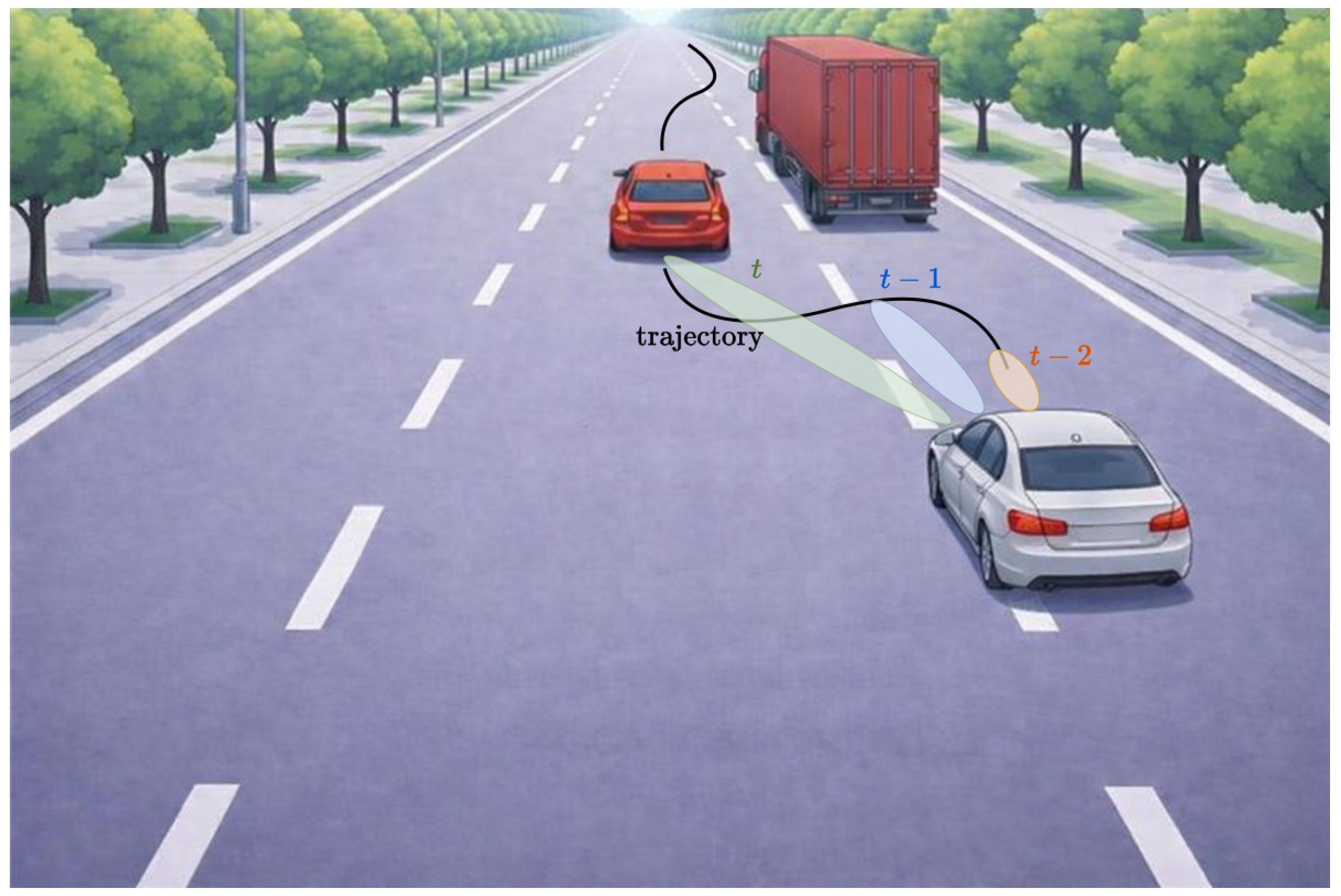
- Predictive Beam Steering: This method exploits navigation data and on-board sensors, including the global positioning system (GPS), the inertial measurement unit (IMU), LiDAR, radar, and cameras, to predict the vehicle trajectory and proactively estimate the optimal beam direction. By leveraging machine learning- and AI-based algorithms, the system dynamically adapts to lane changes, road curvature, and variations in vehicle acceleration [87].
- 4.
- Side-Information-Assisted Beamforming: In addition to the GPS and sensors, vehicles can exchange state information (speed, acceleration, and direction) to improve beam alignment. This approach reduces the time required to find the optimal beam.
Numerical Example
6. Conclusions and Future Research Directions
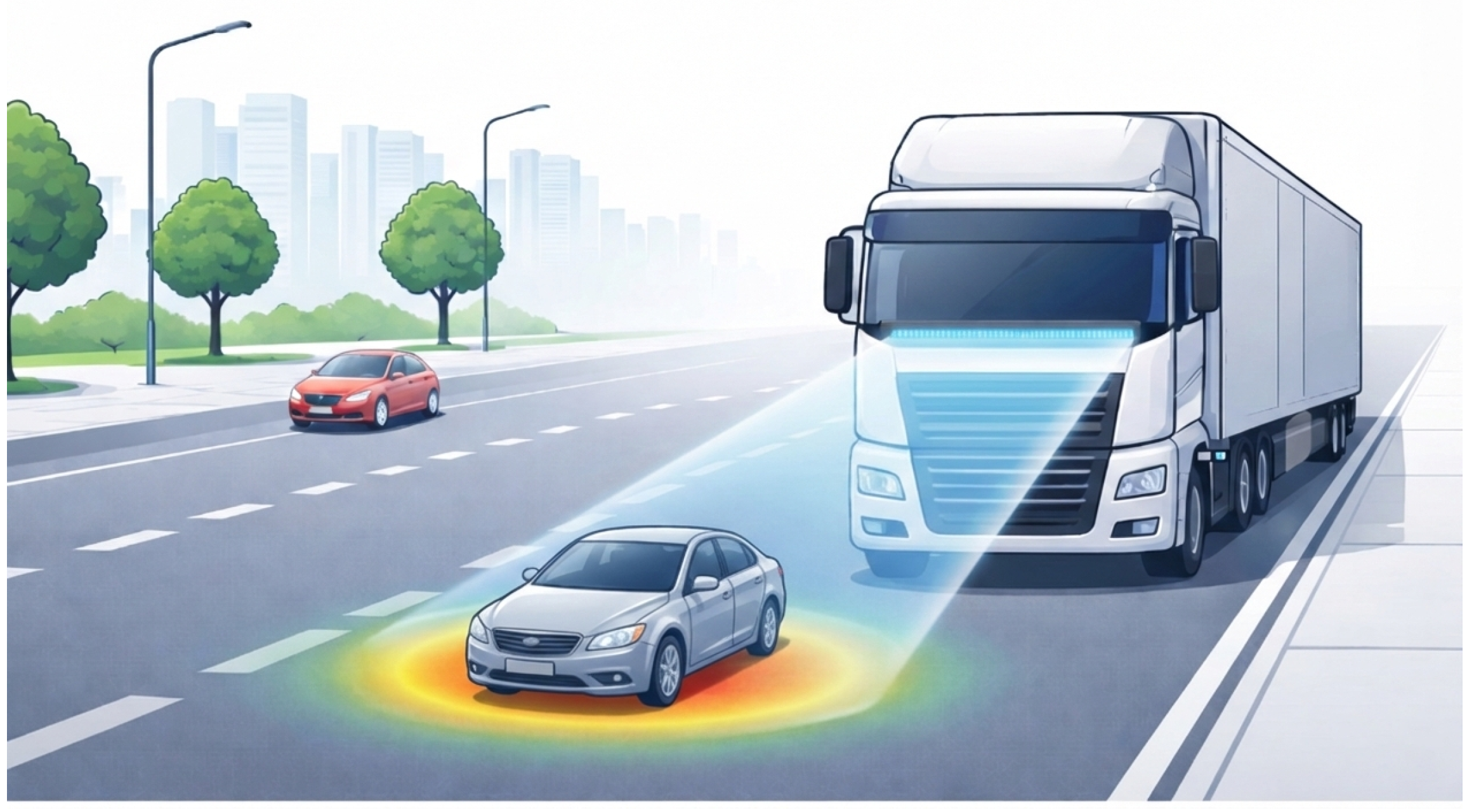
- Discussion of near-field beamfocusing in multi-user MIMO V2X communication, improving interference mitigation and spatial reuse.
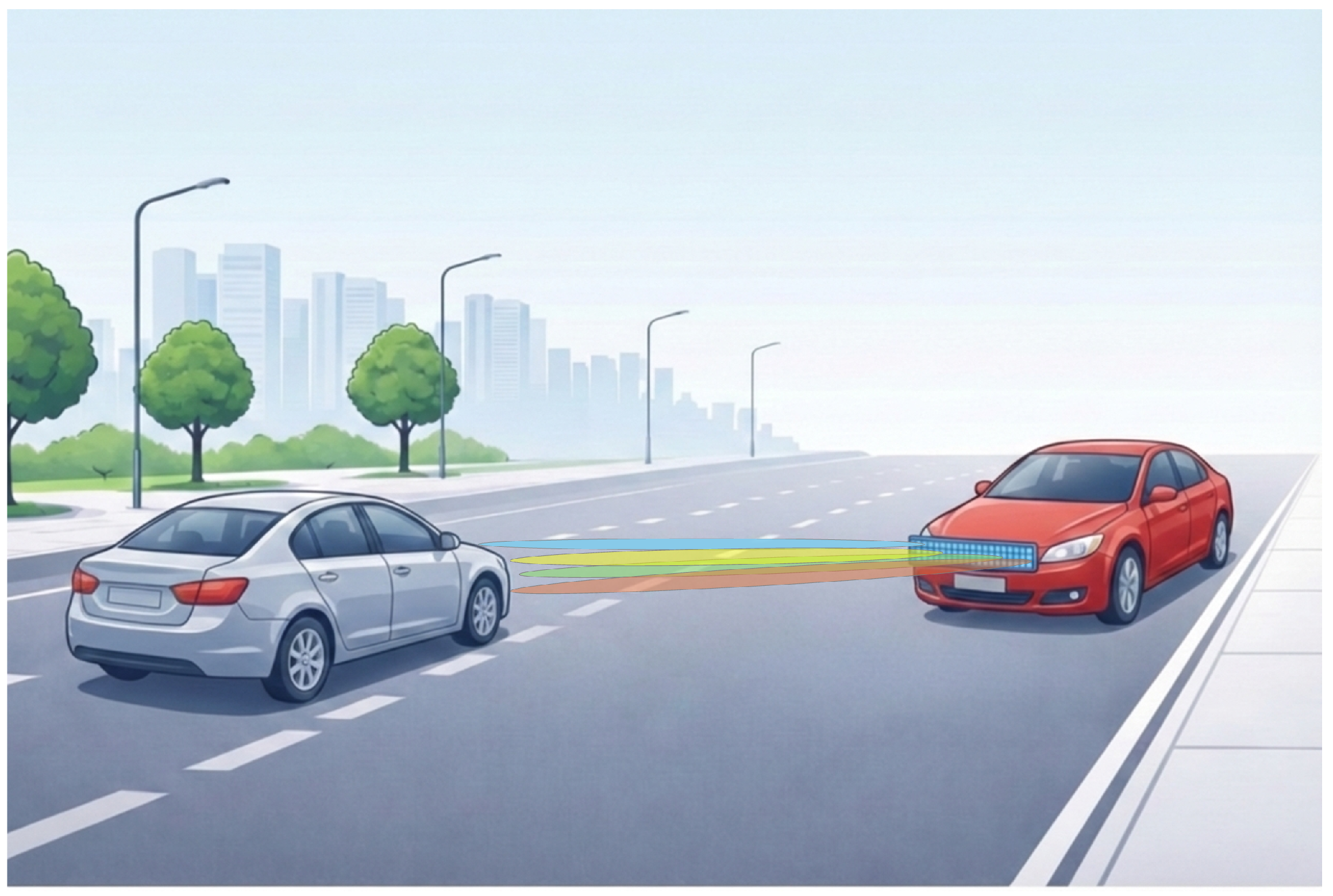
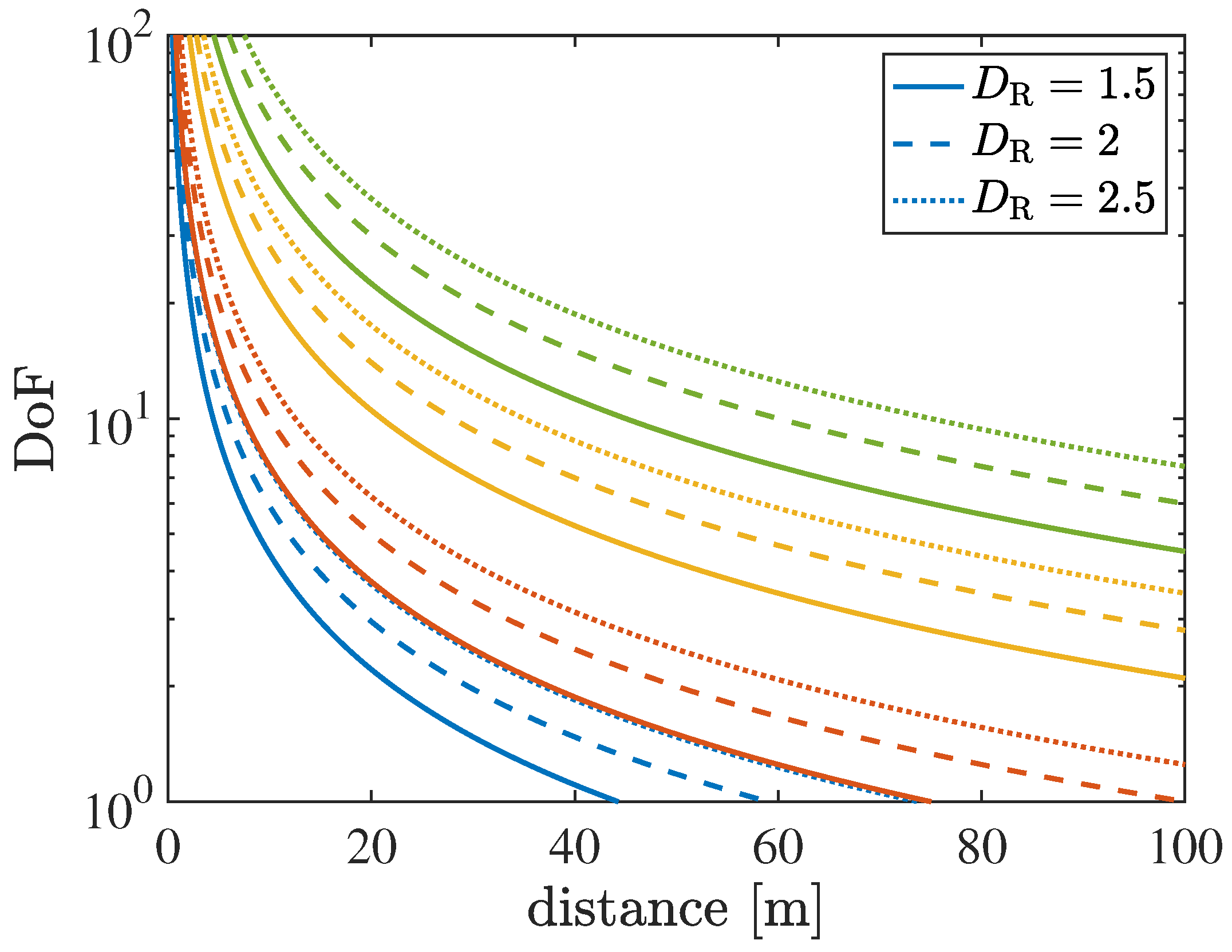
- Analysis of LOS-MIMO in short-range vehicular links, quantifying achievable DoFs as a function of array size, carrier frequency, and inter-vehicular distance.
- Investigation of single-anchor localization using ELAA-equipped vehicles through both classical transmitter localization and radar-based sensing, methods particularly effective for platooning and short-range scenarios.
- Study of predictive beamforming via Doppler analysis on ELAAs, applicable to both direct communication and radar-based sensing, allowing anticipatory alignment of beams for dynamic vehicular scenarios.
- Examination of the impact of carrier frequency and array scaling on communication, localization, and sensing performance, covering the FR1, FR2, and FR3 frequency ranges.
- Implementation-related aspects: Realizing extremely large arrays on vehicles involves significant structural and mechanical challenges. Vehicle surfaces are often non-flat, potentially requiring conformal arrays. Achieving coverage may require multiple arrays on different faces of the vehicle or circular arrays mounted on the roof. Circular arrays could also mitigate issues associated with null directions of linear arrays. Ensuring phase coherence across such large arrays is critical, and synchronization or positioning errors can significantly impact performance, especially at higher carrier frequencies. In addition, mutual coupling and vehicle-induced pattern distortion should be carefully considered. Research is needed to evaluate practical integration, robustness, and calibration procedures for in-field deployment. This also requires novel and ad hoc near-field V2X channel measurements and modeling.
- CSI acquisition and signal processing: Near-field communication and sensing with ELAAs pose significant signal-processing challenges. CSI acquisition presents several issues that are not encountered in conventional far-field scenarios. First, the acquisition process is strongly dependent on the underlying array technology: in implementations such as holographic surfaces, DMAs, dynamic arrays, or hybrid architectures, the CSI values may not be directly accessible for each antenna, requiring novel reconstruction strategies. High-resolution channel estimation needs extended codebooks and fine spatial sampling, which increases computational complexity. Joint estimation of channel state and relative position/orientation could provide efficiency gains, but it requires practical algorithms capable of handling the near-field regime. Specifically, joint multi-parameter estimation (e.g., range, angle, radial velocity, transverse velocity, orientation, etc.) in the near field (dealing with not only high-dimensional signals measured over large apertures but also wide bandwidths and long acquisition times) constitutes a challenging signal-processing problem that must be carefully addressed to ensure computationally feasible and practically implementable solutions. Efficient beam management, adaptive beamforming, and predictive processing leveraging motion and Doppler information with low-complexity solutions remain important open problems. Optimal waveform design for joint communication and multi-parameter estimation under near-field conditions represents another potential investigation area.
- Hardware–algorithm co-design: Ad hoc solutions are required to enable the practical realization of ELAAs while maintaining acceptable hardware complexity (e.g., number of RF chains) and energy consumption. In this context, sparse arrays, metasurface-based antennas, reconfigurable antennas, holographic surfaces, and hybrid array architectures should be systematically investigated to identify practical solutions for vehicular near-field operations across different frequency bands. A key challenge lies in achieving an optimal trade-off between processing performed at the hardware and software (baseband/algorithmic) levels, as well as in the electromagnetic domain.
- Radar target modeling and processing: Near-field ISAC operations may involve very short distances between the antenna arrays and the targets. In such scenarios, the classical point-target assumption is often violated. Consequently, a single object (e.g., a reflective vehicle) must be modeled as an extended target, which in turn requires appropriate modifications of the signal-processing algorithms employed for detection and parameter estimation.
- Transmit power and regulatory constraints: Regulatory limits typically involve equivalent isotropically radiated power (EIRP), thus imposing constraints on the per-element transmit power of ELAA systems. Since, near-field effects are more pronounced at high frequencies, where typically lower transmit power levels are used, the interplay among near-field benefits and available transmit power must be carefully investigated. Future research should explore power allocation strategies (even in the presence of spatial non-stationary conditions), energy-efficient designs, and techniques to maintain the required performance level while respecting regulatory constraints.
- Electromagnetic exposure and safety: Large arrays generate complex electromagnetic fields. Ensuring compliance with exposure limits, both out of the vehicle and in the vehicle, for human safety is crucial, particularly for the passenger compartments. Research is needed to quantify exposure, design arrays with minimal impact on occupants, and develop safe operational protocols.
- Frequency allocation, interference, and resource management: Different frequency bands present diverse propagation and interference characteristics. Understanding which services can be allocated to each band while considering broadcast versus unicast transmission is critical. Policy design is needed to enable high-data-rate communication with relevant vehicles while minimizing interference and to determine which types of data (e.g., processed sensor information versus raw measurements) should be transmitted under varying network conditions. A practical near-field ISAC roadmap should explicitly address coexistence between communication/ISAC waveforms and today’s mmWave radar operations, including mutual interference and harmonized spectrum-sharing strategies. New cross-layer mechanisms are required for user grouping, pilot allocation, and scheduling based on polar separability, as well as robust focusing under position uncertainty.
- Mobility and dynamic environment considerations: High-speed vehicular scenarios introduce rapid changes in channel conditions. Research should focus on mobility-aware operations, rapid adaptation to dynamic topologies, and the integration of ELAA sensing capabilities to predict and respond to environmental changes in real time. Multi-vehicle coordination and cooperative localization/sensing strategies remain largely unexplored in the near-field regime. Moreover, efficient algorithms are required to handle the dynamicity of vehicular scenarios with frequent variations, blockages, or partial occlusion of ELAAs.
- Integration with network standards and protocols: Practical deployment of ELAA-based ISAC requires harmonization with emerging 6G vehicular standards, such as NR-V2X- and 3GPP-defined sidelink procedures. Research should address protocol design, signaling overhead, and backward compatibility with existing vehicular communication infrastructure.
Author Contributions
Funding
Data Availability Statement
Conflicts of Interest
Abbreviations
- The following abbreviations are used in this manuscript:
| 5G | fifth generation |
| 6G | sixth generation |
| AI | artificial intelligence |
| AoA | angle of arrival |
| CAM | cooperative awareness message |
| CP | cyclic prefix |
| CPM | collective perception message |
| CRLB | Cramér–Rao lower bound |
| CSI | channel state information |
| DENM | decentralized environmental notification message |
| DoF | degrees of freedom |
| EIRP | equivalent isotropically radiated power |
| ELAA | extremely large aperture array |
| GNSS | global navigation satellite system |
| GPS | global positioning system |
| IMU | inertial measurement unit |
| ISAC | integrated sensing and communication |
| LOS | line-of-sight |
| LTE | long-term evolution |
| mmWave | millimeter-wave |
| MIMO | multiple-input multiple-output |
| MUSIC | multiple signal classification |
| NLOS | non-line-of-sight |
| NR | new radio |
| OFDM | orthogonal frequency-division multiplexing |
| RCS | radar cross section |
| RSU | road side unit |
| SNR | signal-to-noise ratio |
| SVD | singular value decomposition |
| TDoA | time-difference-of-arrival |
| ToA | time-of-arrival |
| TWR | two-way ranging |
| ULA | uniform linear array |
| V2V | vehicle-to-vehicle |
| V2X | vehicle-to-everything |
| VRU | vulnerable road user |
| XL-MIMO | extremely large-scale MIMO |
References
- Liu, R.; Hua, M.; Guan, K.; Wang, X.; Zhang, L.; Mao, T.; Zhang, D.; Wu, Q.; Jamalipour, A. 6G Enabled Advanced Transportation Systems. IEEE Trans. Intell. Transp. Syst. 2024, 25, 10564–10580. [Google Scholar] [CrossRef]
- Bazzi, A.; Berthet, A.O.; Campolo, C.; Masini, B.M.; Molinaro, A.; Zanella, A. On the Design of Sidelink for Cellular V2X: A Literature Review and Outlook for Future. IEEE Access 2021, 9, 97953–97980. [Google Scholar] [CrossRef]
- Dardari, D.; Decarli, N. Holographic Communication Using Intelligent Surfaces. IEEE Commun. Mag. 2021, 59, 35–41. [Google Scholar] [CrossRef]
- Zhang, H.; Shlezinger, N.; Guidi, F.; Dardari, D.; Imani, M.F.; Eldar, Y.C. Beam Focusing for Near-Field Multiuser MIMO Communications. IEEE Trans. Wirel. Commun. 2022, 21, 7476–7490. [Google Scholar] [CrossRef]
- Dardari, D. Communicating With Large Intelligent Surfaces: Fundamental Limits and Models. IEEE J. Sel. Areas Commun. 2020, 38, 2526–2537. [Google Scholar] [CrossRef]
- Chen, H.; Keskin, M.F.; Sakhnini, A.; Decarli, N.; Pollin, S.; Dardari, D.; Wymeersch, H. 6G Localization and Sensing in the Near Field: Features, Opportunities, and Challenges. IEEE Wirel. Commun. 2024, 31, 260–267. [Google Scholar] [CrossRef]
- Wang, Z.; Mu, X.; Liu, Y. Near-Field Velocity Sensing and Predictive Beamforming. IEEE Trans. Veh. Technol. 2025, 74, 1806–1810. [Google Scholar] [CrossRef]
- Matricardi, E.; Favarelli, E.; Pucci, L.; Xu, W.; Paolini, E.; Giorgetti, A. Toward Intelligent Roads: Uniting Sensing and Communication in Mobile Networks. Sensors 2025, 25, 778. [Google Scholar] [CrossRef]
- Harounabadi, M.; Soleymani, D.M.; Bhadauria, S.; Leyh, M.; Roth-Mandutz, E. V2X in 3GPP Standardization: NR Sidelink in Release-16 and Beyond. IEEE Commun. Stand. Mag. 2021, 5, 12–21. [Google Scholar] [CrossRef]
- 3GPP. Study on NR Vehicle-to-Everything (V2X). Technical Report TR 38.885, 3rd Generation Partnership Project (3GPP). 2019. Available online: https://portal.3gpp.org/desktopmodules/Specifications/SpecificationDetails.aspx?specificationId=3497 (accessed on 8 January 2026).
- Liu, F.; Cui, Y.; Masouros, C.; Xu, J.; Han, T.X.; Eldar, Y.C.; Buzzi, S. Integrated Sensing and Communications: Toward Dual-Functional Wireless Networks for 6G and Beyond. IEEE J. Sel. Areas Commun. 2022, 40, 1728–1767. [Google Scholar] [CrossRef]
- 3GPP. Overall Description of Radio Access Network (RAN) Aspects for Vehicle-to-Everything (V2X) Based on LTE and NR. Technical Report ETSI TR 137 985, ETSI/3GPP. 2022. Available online: https://www.etsi.org/deliver/etsi_tr/137900_137999/137985/17.01.01_60/tr_137985v170101p.pdf (accessed on 8 January 2026).
- 3GPP. Release 16. 2020. Available online: https://www.3gpp.org/specifications-technologies/releases/release-16 (accessed on 8 January 2026).
- 3GPP. Release 18. 2022. Available online: https://www.3gpp.org/specifications-technologies/releases/release-18 (accessed on 8 January 2026).
- Li, J.; Niu, Y.; Wu, H.; Ai, B.; Chen, S.; Feng, Z.; Zhong, Z.; Wang, N. Mobility Support for Millimeter Wave Communications: Opportunities and Challenges. IEEE Commun. Surv. Tutor. 2022, 24, 1816–1842. [Google Scholar] [CrossRef]
- Limani Fazliu, Z.; Malandrino, F.; Chiasserini, C.F.; Nordio, A. A Belief Propagation Solution for Beam Coordination in mmWave Vehicular Networks. IEEE Trans. Wirel. Commun. 2022, 21, 10809–10823. [Google Scholar] [CrossRef]
- Tan, J.; Luan, T.H.; Guan, W.; Wang, Y.; Peng, H.; Zhang, Y.; Zhao, D.; Lu, N. Beam Alignment in mmWave V2X Communications: A Survey. IEEE Commun. Surv. Tutor. 2024, 26, 1676–1709. [Google Scholar] [CrossRef]
- Adnan, M.; Silva, A.; Krzymien, L.; Dinis, R. A Survey on Positioning for mmWave Distributed MIMO Systems: Challenges, Solution Techniques, and Applications. IEEE Access 2025, 13, 205882–205914. [Google Scholar] [CrossRef]
- Lv, J.; He, X.; Luo, T. Blockage Avoidance Based Sensor Data Dissemination in Multi-Hop MmWave Vehicular Networks. IEEE Trans. Veh. Technol. 2021, 70, 8898–8911. [Google Scholar] [CrossRef]
- Saikia, P.; Singh, K.; Singh, S.K.; Huang, W.J.; Li, C.P.; Biswas, S. Beamforming Design in Vehicular Communication Systems with Multiple Reconfigurable Intelligent Surfaces: A Deep Learning Approach. IEEE Access 2023, 11, 100832–100844. [Google Scholar] [CrossRef]
- CEPT ECC. ECC/DEC/(04)03 of 19 March 2004 on the Frequency Band 77–81 GHz to be Designated for the Use of Automotive Short Range Radars (Corrected 6 March 2015). ECC Decision. 2015. Available online: https://docdb.cept.org/download/1696 (accessed on 8 January 2026).
- ETSI EN 302 264; Short Range Devices; Transport and Traffic Telematics (TTT); Short Range Radar Equipment Operating in the 77 GHz to 81 GHz Band; Harmonised Standard Covering the Essential Requirements of Article 3.2 of Directive 2014/53/EU. European Telecommunications Standards Institute (ETSI): Sophia Antipolis, France, 2017.
- Wen, D.; Zhou, Y.; Li, X.; Shi, Y.; Huang, K.; Letaief, K.B. A Survey on Integrated Sensing, Communication, and Computation. arXiv 2024, arXiv:2408.08074. [Google Scholar] [CrossRef]
- Giovannetti, C.; Decarli, N.; Bartoletti, S.; Stirling-Gallacher, R.A.; Masini, B.M. Target positioning accuracy of V2X sidelink joint communication and sensing. IEEE Wirel. Commun. Lett. 2023, 13, 849–853. [Google Scholar] [CrossRef]
- Bartoletti, S.; Decarli, N.; Masini, B.M.; Giovannetti, C.; Zanella, A.; Bazzi, A.; Stirling-Gallacher, R.A. Integration of Sensing and Localization in V2X Sidelink Communications. IEEE Commun. Mag. 2024, 62, 185–191. [Google Scholar] [CrossRef]
- Decarli, N.; Bartoletti, S.; Bazzi, A.; Stirling-Gallacher, R.A.; Masini, B.M. Performance Characterization of Joint Communication and Sensing With Beyond 5G NR-V2X Sidelink. IEEE Trans. Veh. Technol. 2024, 73, 10044–10059. [Google Scholar] [CrossRef]
- Lu, H.; Zeng, Y.; You, C.; Han, Y.; Zhang, J.; Wang, Z.; Dong, Z.; Jin, S.; Wang, C.X.; Jiang, T.; et al. A Tutorial on Near-Field XL-MIMO Communications Toward 6G. IEEE Commun. Surv. Tutor. 2024, 26, 2213–2257. [Google Scholar] [CrossRef]
- Carvalho, E.D.; Ali, A.; Amiri, A.; Angjelichinoski, M.; Heath, R.W. Non-Stationarities in Extra-Large-Scale Massive MIMO. IEEE Wirel. Commun. 2020, 27, 74–80. [Google Scholar] [CrossRef]
- Yang, X.; Cao, F.; Matthaiou, M.; Jin, S. On the Uplink Transmission of Extra-Large Scale Massive MIMO Systems. IEEE Trans. Veh. Technol. 2020, 69, 15229–15243. [Google Scholar] [CrossRef]
- Wang, Z.; Zhang, J.; Du, H.; Sha, W.E.I.; Ai, B.; Niyato, D.; Debbah, M. Extremely Large-Scale MIMO: Fundamentals, Challenges, Solutions, and Future Directions. IEEE Wirel. Commun. 2024, 31, 117–124. [Google Scholar] [CrossRef]
- Wang, Z.; Zhang, J.; Du, H.; Niyato, D.; Cui, S.; Ai, B.; Debbah, M.; Letaief, K.B.; Poor, H.V. A Tutorial on Extremely Large-Scale MIMO for 6G: Fundamentals, Signal Processing, and Applications. IEEE Commun. Surv. Tutor. 2024, 26, 1560–1605. [Google Scholar] [CrossRef]
- Liu, Y.; Ouyang, C.; Wang, Z.; Xu, J.; Mu, X.; Swindlehurst, A.L. Near-Field Communications: A Comprehensive Survey. IEEE Commun. Surv. Tutor. 2024, 27, 1687–1728. [Google Scholar] [CrossRef]
- Ikram, M.; Sultan, K.S.; Abbosh, A.M.; Nguyen-Trong, N. Sub-6 GHz and mm-Wave 5G Vehicle-to-Everything (5G-V2X) MIMO Antenna Array. IEEE Access 2022, 10, 49688–49695. [Google Scholar] [CrossRef]
- Kamran Ishfaq, M.; Babale, S.A.; Chattha, H.T.; Himdi, M.; Raza, A.; Younas, M.; Rahman, T.A.; Abdul Rahim, S.K.; Khawaja, B.A. Compact Wide-Angle Scanning Multibeam Antenna Array for V2X Communications. IEEE Antennas Wirel. Propag. Lett. 2021, 20, 2141–2145. [Google Scholar] [CrossRef]
- Islam, S.; Kim, H.; Dinh Nguyen, T.; Kim, S.; Yoo, H. Reconfigurable mmWave Planar Phased Array Featuring Wide Elevation and Full Azimuth Spatial Coverage for 5G Vehicular Application. IEEE Access 2025, 13, 8740–8752. [Google Scholar] [CrossRef]
- Chen, K.; Xu, J.; Tang, S.Y.; Wang, Y.; Hong, W. Millimeter-Wave Active Beam-Tilted Phased Array Modules and Seamless Integration Design With Ultrawideband Sub-6 GHz Antenna for Future V2X Applications. IEEE Trans. Antennas Propag. 2025, 73, 2737–2753. [Google Scholar] [CrossRef]
- Decarli, N.; Guerra, A.; Giovannetti, C.; Guidi, F.; Masini, B.M. V2X Sidelink Localization of Connected Automated Vehicles. IEEE J. Sel. Areas Commun. 2024, 42, 120–133. [Google Scholar] [CrossRef]
- Nasr, A.; Sarabandi, K.; Takla, M. Multi-beam Dual-Polarized Windshield Antenna with Wide Elevation Coverage for 5G V2X Applications. In Proceedings of the 2020 IEEE International Symposium on Antennas and Propagation and North American Radio Science Meeting, Montreal, QC, Canada, 5–10 July 2020; pp. 1333–1334. [Google Scholar] [CrossRef]
- CEPT ECC. ECC/DEC/(08)01 of 14 March 2008 on the Harmonised Use of the 5875–5925 MHz Frequency Band for Intelligent Transport Systems (ITS). ECC Decision. 2008. Available online: https://docdb.cept.org/download/3047 (accessed on 8 January 2026).
- ETSI EN 302 571; Intelligent Transport Systems (ITS); Radiocommunications Equipment Operating in the 5855 MHz to 5925 MHz Frequency Band; Harmonised Standard Covering the Essential Requirements of Article 3.2 of Directive 2014/53/EU. European Telecommunications Standards Institute (ETSI): Sophia Antipolis, France, 2016.
- 3GPP. Architecture Enhancements for 5G System (5GS) to Support Vehicle-to-Everything (V2X) Services. Technical Specification ETSI TS 123 287 (3GPP TS 23.287), ETSI/3GPP. 2022. Available online: https://portal.3gpp.org/desktopmodules/Specifications/SpecificationDetails.aspx?specificationId=3578 (accessed on 8 January 2026).
- 3GPP. Service Requirements for Enhanced V2X Scenarios. Technical Specification ETSI TS 122 186 (3GPP TS 22.186), ETSI/3GPP. Release 15. 2018. Available online: https://portal.3gpp.org/desktopmodules/Specifications/SpecificationDetails.aspx?specificationId=3180 (accessed on 8 January 2026).
- 3GPP. Study on Enhancement of 3GPP Support for 5G V2X Services. Technical Report TR 22.886, 3rd Generation Partnership Project (3GPP). See Version History at the 3GPP Spec Page. 2017. Available online: https://portal.3gpp.org/desktopmodules/Specifications/SpecificationDetails.aspx?specificationId=3108 (accessed on 8 January 2026).
- 3GPP. V2X Services Based on NR; User Equipment (UE) Radio Transmission and Reception. Technical Report TR 38.886, ATIS/3GPP. Release 16. 2020. Available online: https://portal.3gpp.org/desktopmodules/Specifications/SpecificationDetails.aspx?specificationId=3615 (accessed on 8 January 2026).
- Garcia, M.H.C.; Molina-Galan, A.; Boban, M.; Gozalvez, J.; Coll-Perales, B.; Şahin, T.; Kousaridas, A. A Tutorial on 5G NR V2X Communications. IEEE Commun. Surv. Tutor. 2021, 23, 1972–2026. [Google Scholar] [CrossRef]
- 3GPP. Release 17. Available online: https://www.3gpp.org/specifications-technologies/releases/release-17 (accessed on 8 January 2026).
- Ganesan, K.; Rouil, R.A.; Mezzavilla, M.; Li, J.; Wang, L. NR Sidelink Enhancement in 3GPP Release 17. J. ICT Stand. 2021, 9, 79–90. [Google Scholar] [CrossRef]
- 3GPP. User Equipment (UE) Radio Transmission and Reception for Enhanced NR Sidelink. Technical Report TR 38.785, 3rd Generation Partnership Project (3GPP). Release 17 (Initial Planned). 2021. Available online: https://portal.3gpp.org/desktopmodules/Specifications/SpecificationDetails.aspx?specificationId=3888 (accessed on 8 January 2026).
- Lin, X. An Overview of 5G Advanced Evolution in 3GPP Release 18. IEEE Commun. Stand. Mag. 2022, 6, 77–83. [Google Scholar] [CrossRef]
- Qualcomm. A Closer Look at 5G Advanced Release 18. White Paper. 2023. Available online: https://www.qualcomm.com/content/dam/qcomm-martech/dm-assets/documents/a-closer-look-at-5g-advanced-release-18-web.pdf (accessed on 8 January 2026).
- ITU-R. Framework and Overall Objectives of the Future Development of IMT for 2030 and Beyond; Recommendation ITU-R M.2160-0; International Telecommunication Union, Radiocommunication Sector (ITU-R): Geneva, Switzerland, 2023. [Google Scholar]
- Balanis, C.A. Antenna Theory: Analysis and Design; Wiley: Hoboken, NJ, USA, 2016. [Google Scholar]
- Björnson, E.; Demir, O.T.; Sanguinetti, L. A Primer on Near-Field Beamforming for Arrays and Reconfigurable Intelligent Surfaces. In Proceedings of the 2021 55th Asilomar Conference on Signals, Systems, and Computers, Pacific Grove, CA, USA, 31 October 2021–3 November 2021; pp. 105–112. [Google Scholar] [CrossRef]
- Decarli, N.; Dardari, D. Communication Modes With Large Intelligent Surfaces in the Near Field. IEEE Access 2021, 9, 165648–165666. [Google Scholar] [CrossRef]
- Abdallah, A.; Hussain, A.; Celik, A.; Eltawil, A.M. Exploring Frontiers of Polar-Domain Codebooks for Near-Field Channel Estimation and Beam Training: A comprehensive analysis, case studies, and implications for 6G. IEEE Signal Process. Mag. 2025, 42, 45–59. [Google Scholar] [CrossRef]
- Hussain, A.; Abdallah, A.; Eltawil, A.M. Redefining Polar Boundaries for Near-Field Channel Estimation for Ultra-Massive MIMO Antenna Array. IEEE Trans. Wirel. Commun. 2025, 24, 8193–8207. [Google Scholar] [CrossRef]
- Dardari, D. Over-the-Air Multifunctional Wideband Electromagnetic Signal Processing Using Dynamic Scattering Arrays. IEEE Trans. Wirel. Commun. 2026, 25, 5016–5028. [Google Scholar] [CrossRef]
- Chen, K.; Qi, C.; Li, G.Y.; Dobre, O.A. Near-Field Multiuser Communications Based on Sparse Arrays. IEEE J. Sel. Top. Signal Process. 2024, 18, 619–632. [Google Scholar] [CrossRef]
- Liu, M.; Li, M.; Liu, R.; Liu, Q. Dynamic Hybrid Beamforming Designs for ELAA Near-Field Communications. IEEE J. Sel. Areas Commun. 2025, 43, 644–658. [Google Scholar] [CrossRef]
- Tagliaferri, D.; Mizmizi, M.; Oliveri, G.; Spagnolini, U.; Massa, A. Reconfigurable and Static EM Skins on Vehicles for Localization. IEEE Trans. Wirel. Commun. 2024, 23, 16155–16171. [Google Scholar] [CrossRef]
- Shlezinger, N.; Alexandropoulos, G.C.; Imani, M.F.; Eldar, Y.C.; Smith, D.R. Dynamic Metasurface Antennas for 6G Extreme Massive MIMO Communications. IEEE Wirel. Commun. 2021, 28, 106–113. [Google Scholar] [CrossRef]
- Cui, M.; Dai, L. Channel Estimation for Extremely Large-Scale MIMO: Far-Field or Near-Field? IEEE Trans. Commun. 2022, 70, 2663–2677. [Google Scholar] [CrossRef]
- Antonelli, L.; D’Amico, A.A.; Sanguinetti, L. An Enhanced Polar-Domain Dictionary Design for Elevated BSs in Near-Field U-MIMO. arXiv 2026, arXiv:2602.04331. [Google Scholar]
- Shi, X.; Wang, J.; Sun, Z.; Song, J. Spatial-Chirp Codebook-Based Hierarchical Beam Training for Extremely Large-Scale Massive MIMO. IEEE Trans. Wirel. Commun. 2024, 23, 2824–2838. [Google Scholar] [CrossRef]
- Liu, S.; Yu, X.; Gao, Z.; Xu, J.; Ng, D.W.K.; Cui, S. Sensing-Enhanced Channel Estimation for Near-Field XL-MIMO Systems. IEEE J. Sel. Areas Commun. 2025, 43, 628–643. [Google Scholar] [CrossRef]
- Wang, Z.; Mu, X.; Liu, Y. Beamfocusing Optimization for Near-Field Wideband Multi-User Communications. IEEE Trans. Commun. 2025, 73, 555–572. [Google Scholar] [CrossRef]
- Hu, W.; He, Z.; Xu, W.; Huang, Y.; Wing Kwan Ng, D.; Al-Dhahir, N. Energy-Efficient Hybrid Beamfocusing for Near-Field Integrated Sensing and Communication. IEEE Trans. Signal Process. 2025, 73, 4011–4026. [Google Scholar] [CrossRef]
- Sun, P.; Wang, B. Near-Field Beam Focusing for Integrated Sensing and Communication Systems. IEEE Internet Things J. 2025, 12, 18643–18650. [Google Scholar] [CrossRef]
- Tse, D.; Viswanath, P. Fundamentals of Wireless Communication; Cambridge University Press: Cambridge, UK, 2005. [Google Scholar]
- Miller, D.A.B. Communicating with waves between volumes: Evaluating orthogonal spatial channels and limits on coupling strengths. Appl. Opt. 2000, 39, 1681–1699. [Google Scholar] [CrossRef]
- Friedlander, B. Localization of Signals in the Near-Field of an Antenna Array. IEEE Trans. Signal Process. 2019, 67, 3885–3893. [Google Scholar] [CrossRef]
- Guerra, A.; Guidi, F.; Dardari, D.; Djurić, P.M. Near-Field Tracking With Large Antenna Arrays: Fundamental Limits and Practical Algorithms. IEEE Trans. Signal Process. 2021, 69, 5723–5738. [Google Scholar] [CrossRef]
- Guerra, A.; Guidi, F.; Dardari, D. Single-anchor localization and orientation performance limits using massive arrays: MIMO vs. beamforming. IEEE Trans. Wirel. Commun. 2018, 17, 5241–5255. [Google Scholar] [CrossRef]
- Pucci, L.; Paolini, E.; Giorgetti, A. System-Level Analysis of Joint Sensing and Communication Based on 5G New Radio. IEEE J. Select. Areas Commun. 2022, 40, 2043–2055. [Google Scholar] [CrossRef]
- Führling, N.; Sandoval, I.A.M.; de Abreu, G.T.F.; Seco-Granados, G.; González G., D.; Gonsa, O. Fundamental Limits of Rigid Body Localization. arXiv 2025, arXiv:2507.22573. [Google Scholar] [CrossRef]
- Garcia, N.; Fascista, A.; Coluccia, A.; Wymeersch, H.; Aydogdu, C.; Mendrzik, R.; Seco-Granados, G. Cramér-Rao Bound Analysis of Radars for Extended Vehicular Targets With Known and Unknown Shape. IEEE Trans. Signal Process. 2022, 70, 3280–3295. [Google Scholar] [CrossRef]
- Wang, Y.; Tao, M.; Sun, S. Cramér-Rao Bound Analysis and Beamforming Design for Integrated Sensing and Communication With Extended Targets. IEEE Trans. Wirel. Commun. 2024, 23, 15987–16000. [Google Scholar] [CrossRef]
- Dehkordi, S.K.; Pucci, L.; Jung, P.; Giorgetti, A.; Paolini, E.; Caire, G. Multistatic Parameter Estimation in the Near/Far Field for Integrated Sensing and Communication. IEEE Trans. Wirel. Commun. 2024, 23, 17929–17944. [Google Scholar] [CrossRef]
- Kay, S.M. Fundamentals of Statistical Processing: Estimation Theory; Prentice-Hall Signal Processing Series; Prectice Hall: Upper Saddle River, NJ, USA, 1993; Volume 1. [Google Scholar]
- El Korso, M.N.; Boyer, R.; Renaux, A.; Marcos, S. Conditional and unconditional Cramér–Rao bounds for near-field source localization. IEEE Trans. Signal Process. 2010, 58, 2901–2907. [Google Scholar] [CrossRef]
- Decarli, N.; Dardari, D. Ziv-Zakai Bound for Near-Field Localization and Sensing. In Proceedings of the 2025 59th Asilomar Conference on Signals, Systems, and Computers, Pacific Grove, CA, USA, 26–29 October 2025; pp. 1–5. [Google Scholar]
- Zhang, X.; Chen, W.; Zheng, W.; Xia, Z.; Wang, Y. Localization of Near-Field Sources: A Reduced-Dimension MUSIC Algorithm. IEEE Commun. Lett. 2018, 22, 1422–1425. [Google Scholar] [CrossRef]
- Yuan, X.; Zhang, M.; Zheng, Y.; Teng, B.; Jiang, W. Scalable Near-Field Localization Based on Partitioned Large-Scale Antenna Array. IEEE Trans. Wirel. Commun. 2025, 24, 2203–2217. [Google Scholar] [CrossRef]
- Meng, C.; Wang, Z.; Wei, Z.; Liu, Y.; Feng, Z. Near-Field Motion Parameter Estimation: A Variational Bayesian Approach. IEEE Trans. Wirel. Commun. 2026, 25, 832–847. [Google Scholar] [CrossRef]
- Mizmizi, M.; Linsalata, F.; Brambilla, M.; Morandi, F.; Dong, K.; Magarini, M.; Nicoli, M.; Khormuji, M.N.; Wang, P.; Pitaval, R.A.; et al. Fastening the initial access in 5G NR sidelink for 6G V2X networks. Veh. Commun. 2022, 33, 100402. [Google Scholar] [CrossRef]
- Brambilla, M.; Nicoli, M.; Pietrobon, S.S.; Spagnolini, U. Sensor-Aided Beam Tracking for Connected Vehicles in Multi-Lane Scenarios. Sensors 2020, 20, 2934. [Google Scholar] [CrossRef]
- Fabiani, M.; Silva, D.; Abdallah, A.; Celik, A.; Eltawil, A.M. Multi-Modal Sensing and Communication for V2V Beam Tracking via Camera and GPS Fusion. In Proceedings of the 2024 58th Asilomar Conference on Signals, Systems, and Computers, Pacific Grove, CA, USA, 27–30 October 2024; pp. 1–6. [Google Scholar] [CrossRef]
- Alshumayri, K.A.; Masood, M.; Nasir, A.A. Near-Field Velocity Estimation and Predictive Beamforming with Modular Linear Array. arXiv 2025, arXiv:2511.06383. [Google Scholar] [CrossRef]
- Jiang, H.; Wang, Z.; Liu, Y.; Shin, H.; Nallanathan, A.; Liu, Y. Near-Field Sensing Enabled Predictive Beamforming: Fundamentals, Framework, and Opportunities. arXiv 2025, arXiv:2506.09225. [Google Scholar] [CrossRef]
- Giovannetti, C.; Bacchielli, T.; Giorgetti, A.; Dardari, D.; Decarli, N. Error Bound Analysis for Velocity Estimation in Near-Field Bistatic Radar Systems. IEEE Trans. Aerosp. Electron. Syst. 2025, 1–18. [Google Scholar] [CrossRef]
- Giovannetti, C.; Decarli, N.; Dardari, D. Performance Bounds for Velocity Estimation with Extremely Large Aperture Arrays. IEEE Wirel. Commun. Lett. 2024, 13, 3513–3517. [Google Scholar] [CrossRef]
- Liu, F.; Yuan, W.; Masouros, C.; Yuan, J. Radar-assisted predictive beamforming for vehicular links: Communication served by sensing. IEEE Trans. Wirel. Commun. 2020, 19, 7704–7719. [Google Scholar] [CrossRef]



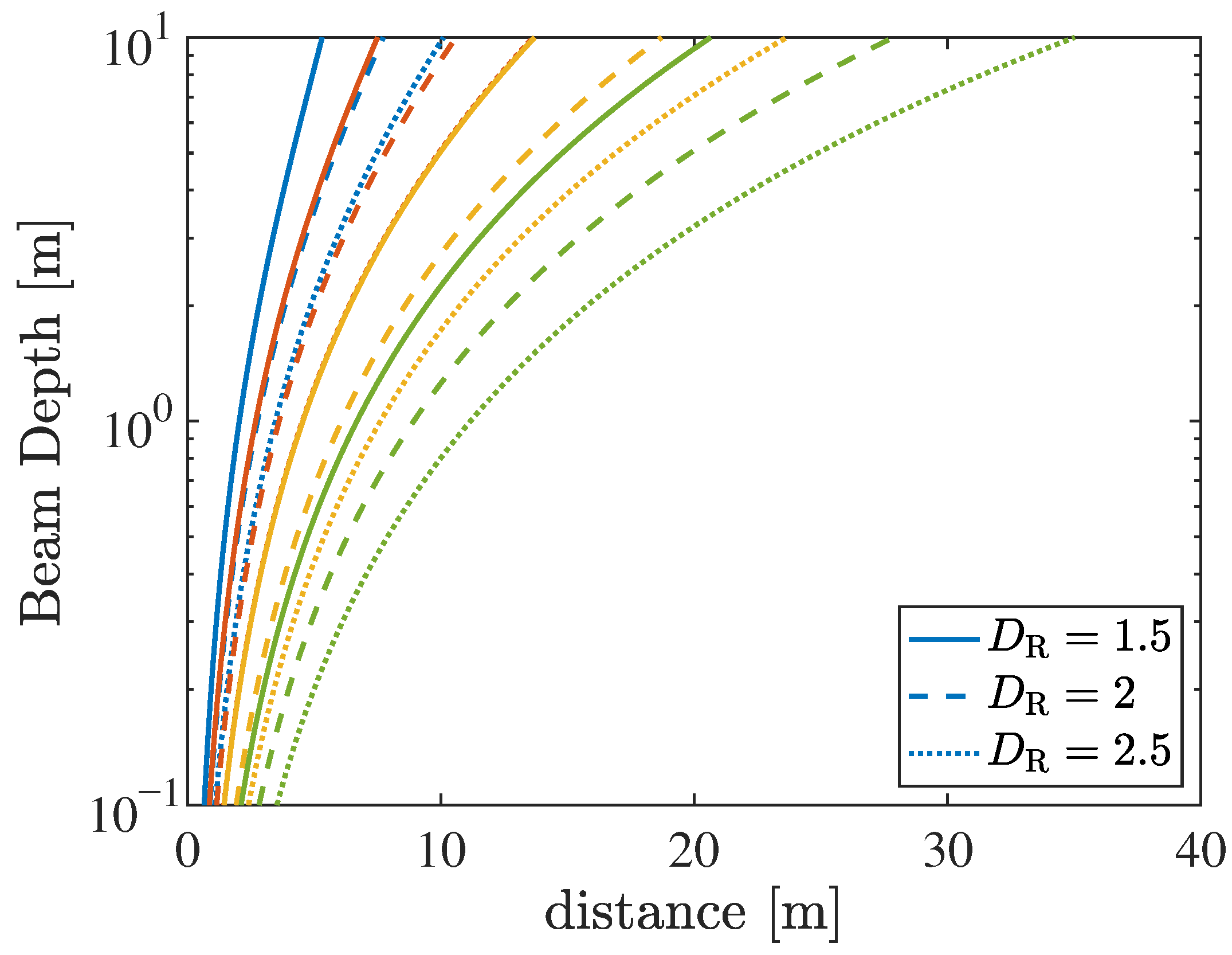
| Aperture D [m] | 5.9 GHz | 10 GHz | 28 GHz | 60 GHz |
|---|---|---|---|---|
| 1.5 | 89 | 150 | 420 | 900 |
| 2.0 | 157 | 267 | 747 | 1600 |
| 2.5 | 246 | 417 | 1167 | 2500 |
| Aperture D [m] | 5.9 GHz | 10 GHz | 28 GHz | 60 GHz |
|---|---|---|---|---|
| 1.5 | 59 | 100 | 280 | 600 |
| 2.0 | 79 | 133 | 373 | 800 |
| 2.5 | 98 | 167 | 467 | 1000 |
Disclaimer/Publisher’s Note: The statements, opinions and data contained in all publications are solely those of the individual author(s) and contributor(s) and not of MDPI and/or the editor(s). MDPI and/or the editor(s) disclaim responsibility for any injury to people or property resulting from any ideas, methods, instructions or products referred to in the content. |
© 2026 by the authors. Licensee MDPI, Basel, Switzerland. This article is an open access article distributed under the terms and conditions of the Creative Commons Attribution (CC BY) license.
Share and Cite
Decarli, N.; Giovannetti, C.; Guidi, F.; Guerra, A.; Zanella, A.; Masini, B.M. Extremely Large-Aperture Arrays for V2X Communication, Localization and Sensing. Sensors 2026, 26, 1563. https://doi.org/10.3390/s26051563
Decarli N, Giovannetti C, Guidi F, Guerra A, Zanella A, Masini BM. Extremely Large-Aperture Arrays for V2X Communication, Localization and Sensing. Sensors. 2026; 26(5):1563. https://doi.org/10.3390/s26051563
Chicago/Turabian StyleDecarli, Nicolò, Caterina Giovannetti, Francesco Guidi, Anna Guerra, Alberto Zanella, and Barbara Mavì Masini. 2026. "Extremely Large-Aperture Arrays for V2X Communication, Localization and Sensing" Sensors 26, no. 5: 1563. https://doi.org/10.3390/s26051563
APA StyleDecarli, N., Giovannetti, C., Guidi, F., Guerra, A., Zanella, A., & Masini, B. M. (2026). Extremely Large-Aperture Arrays for V2X Communication, Localization and Sensing. Sensors, 26(5), 1563. https://doi.org/10.3390/s26051563