The 12 November 2025 Ugly Duckling Geomagnetic Storm: From the Sun to the Earth

 , , , , , , , , , , , , and
Highlights
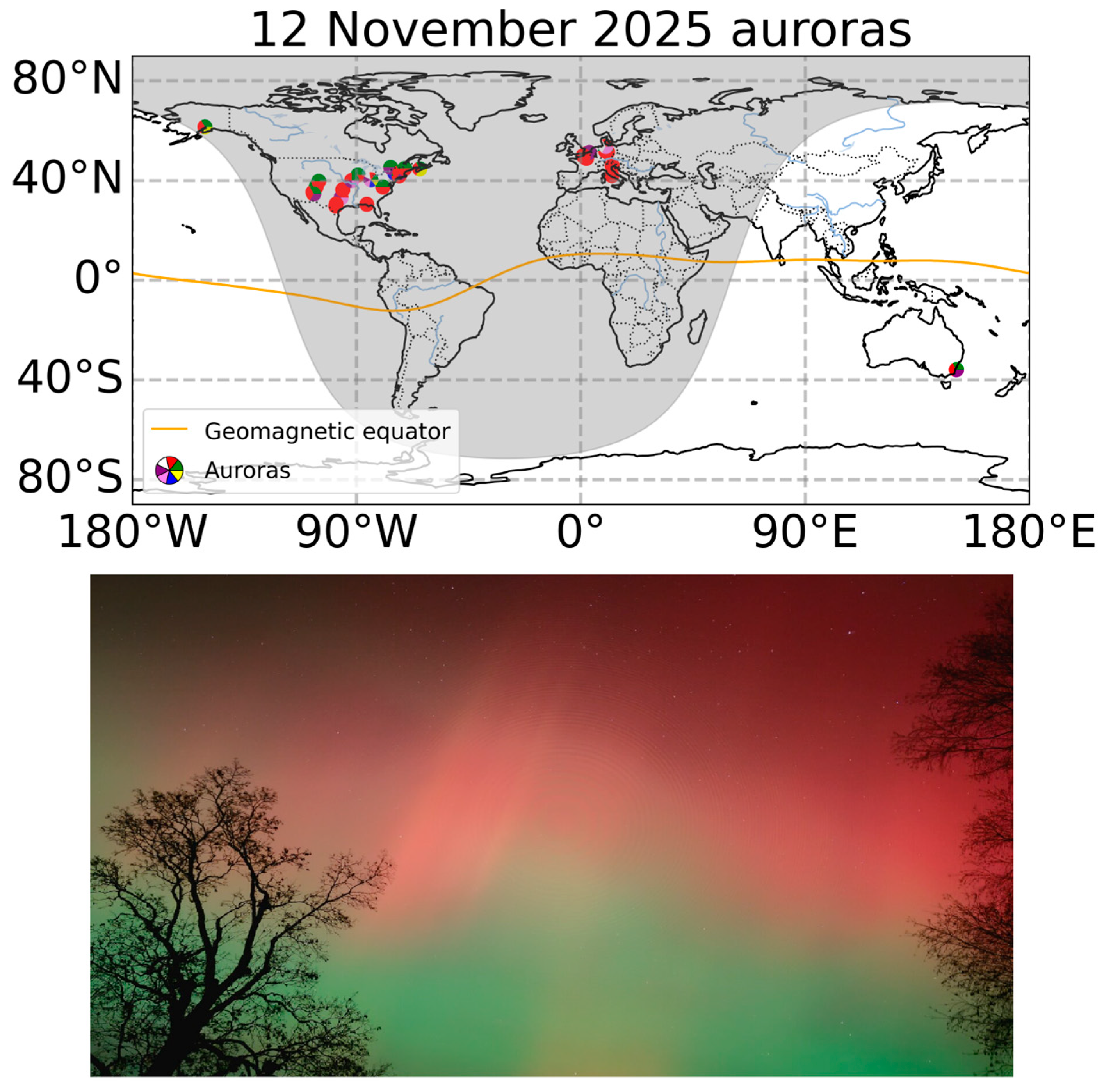
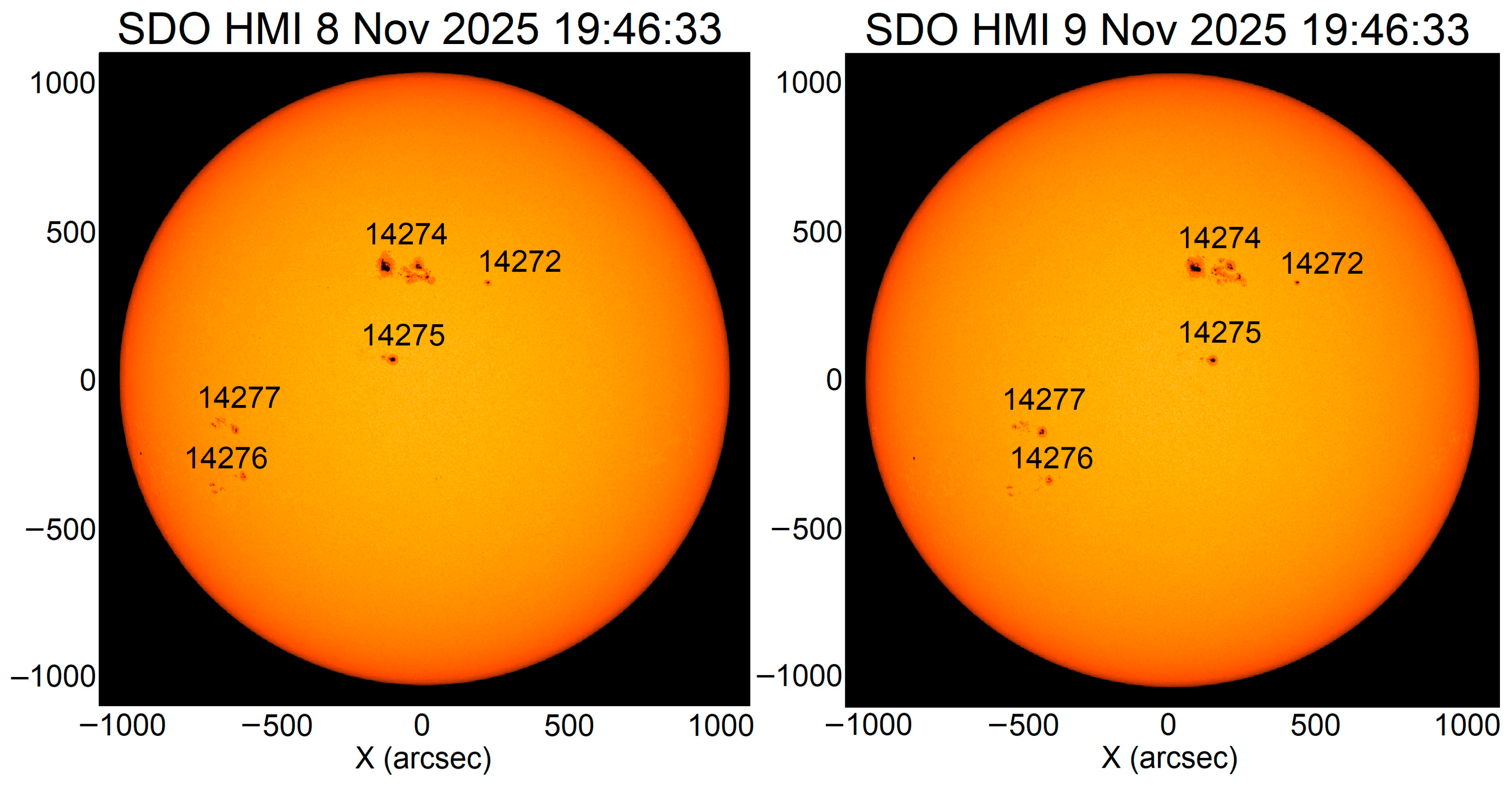
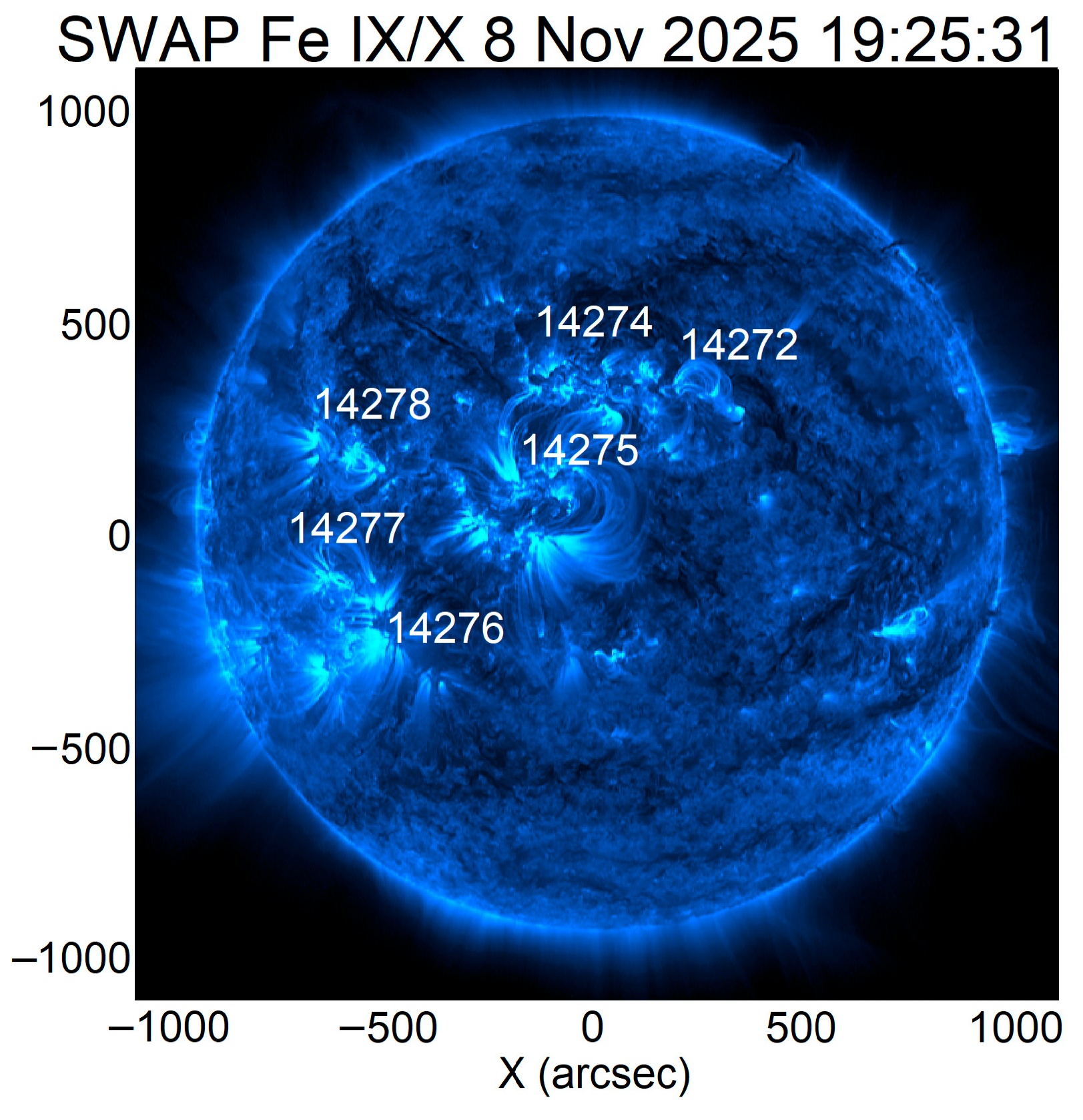
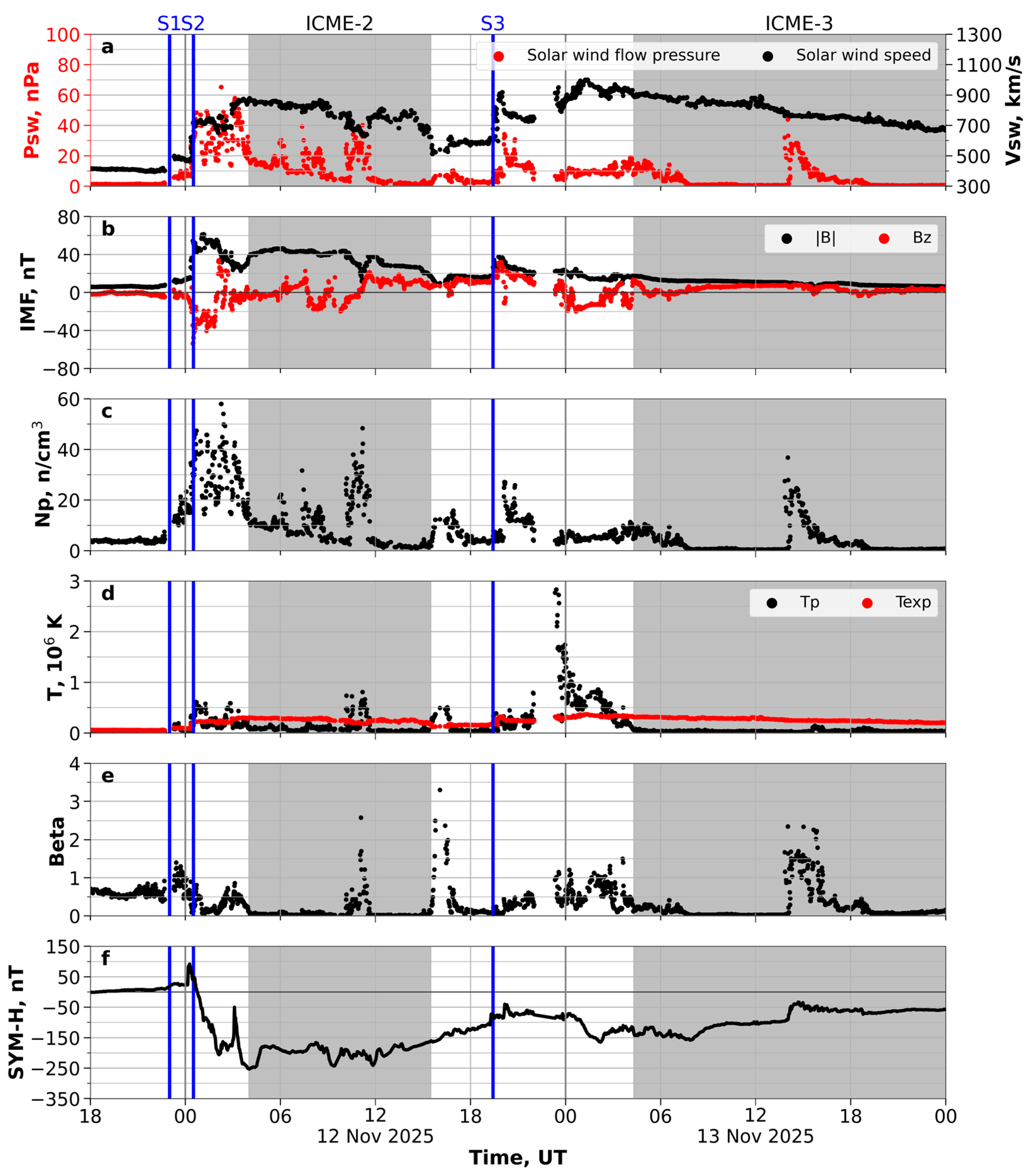
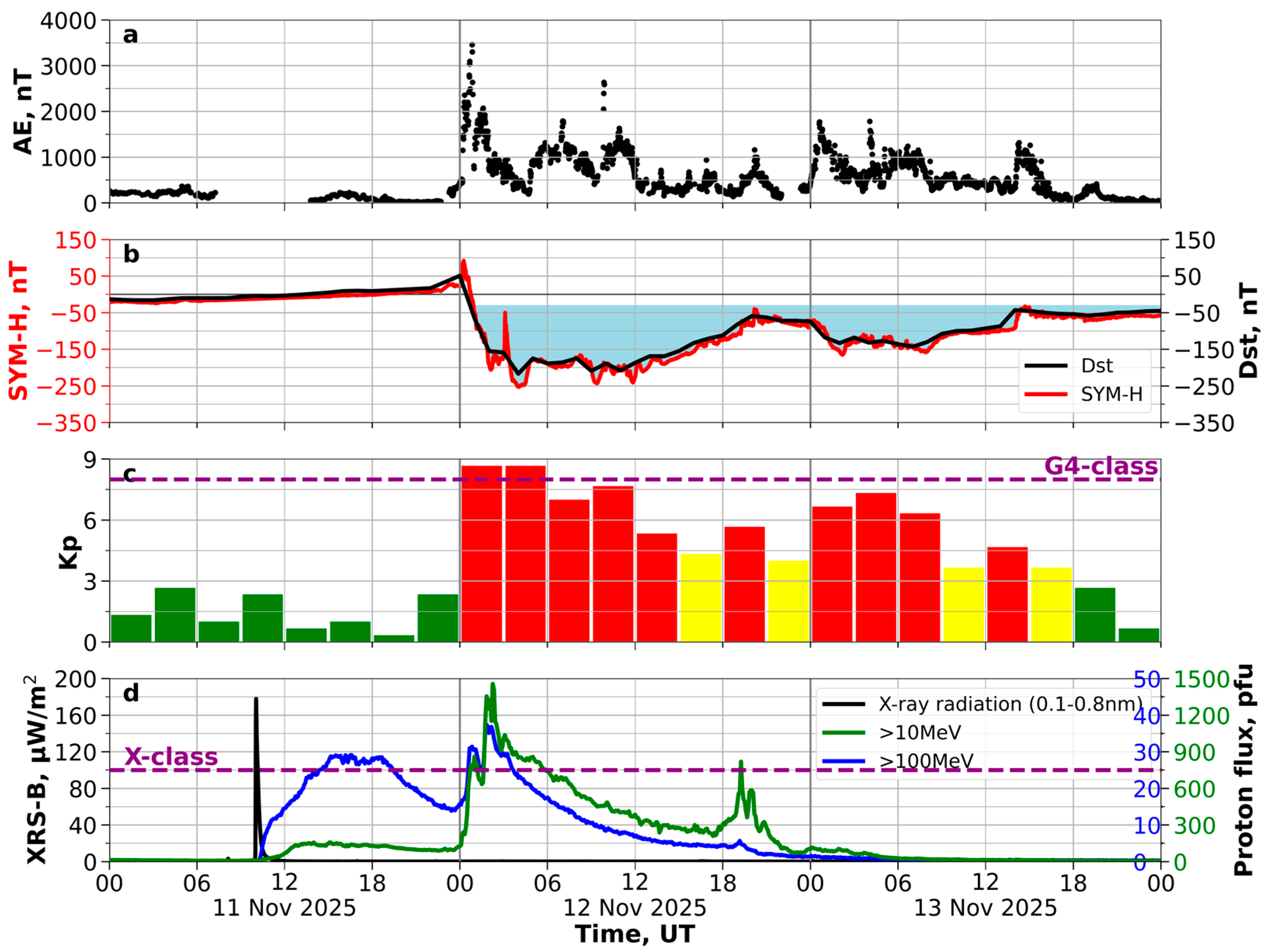
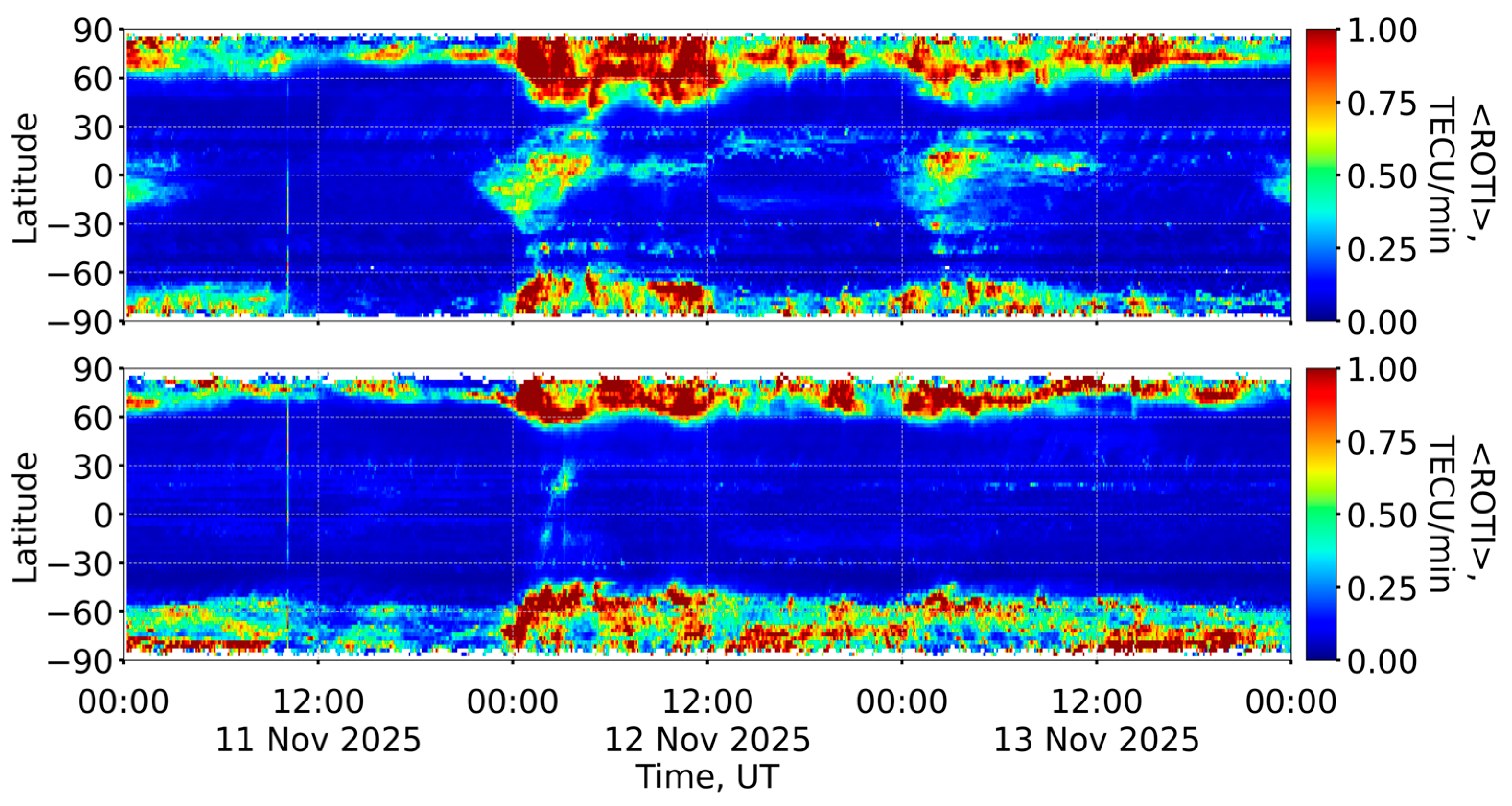
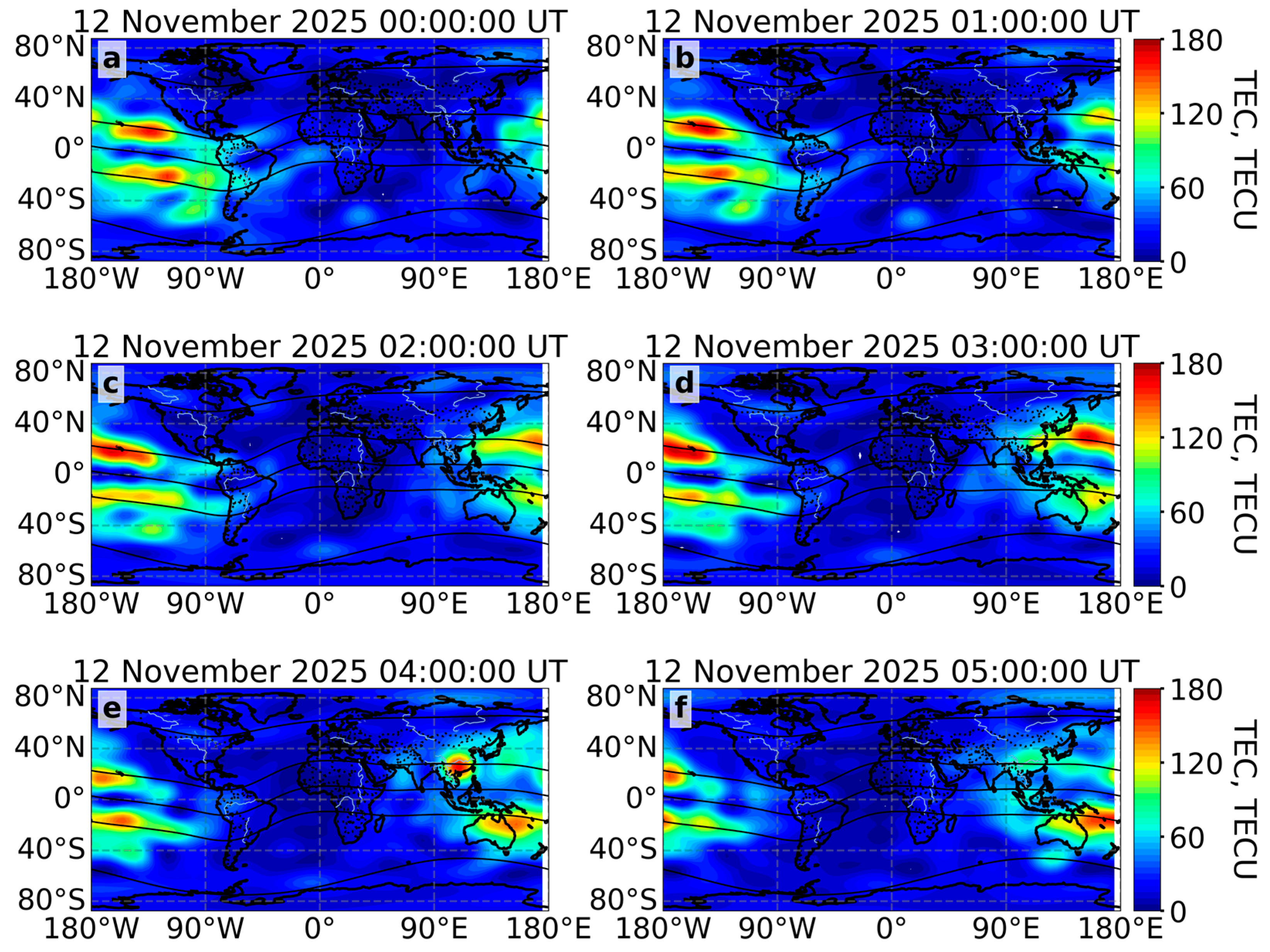
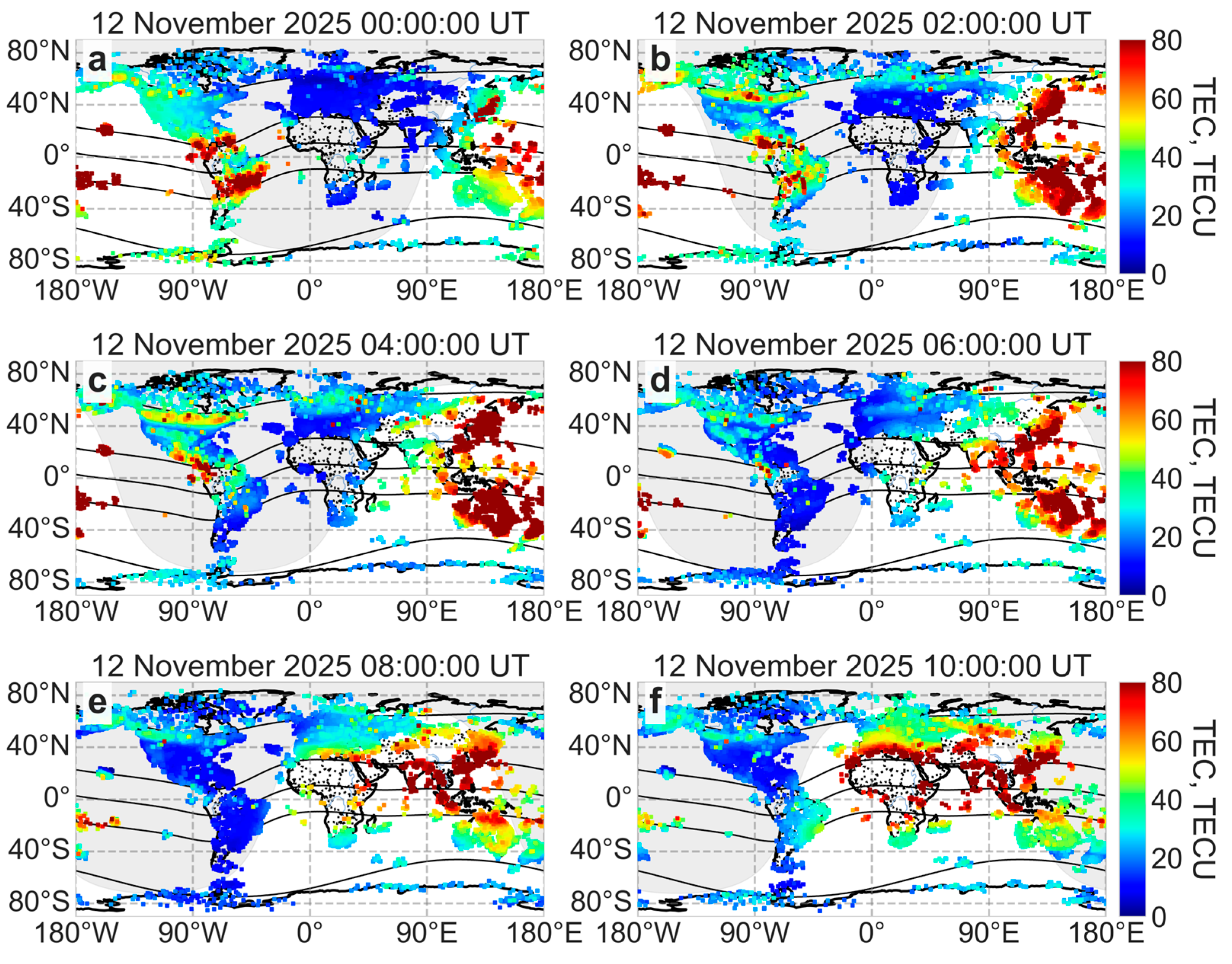
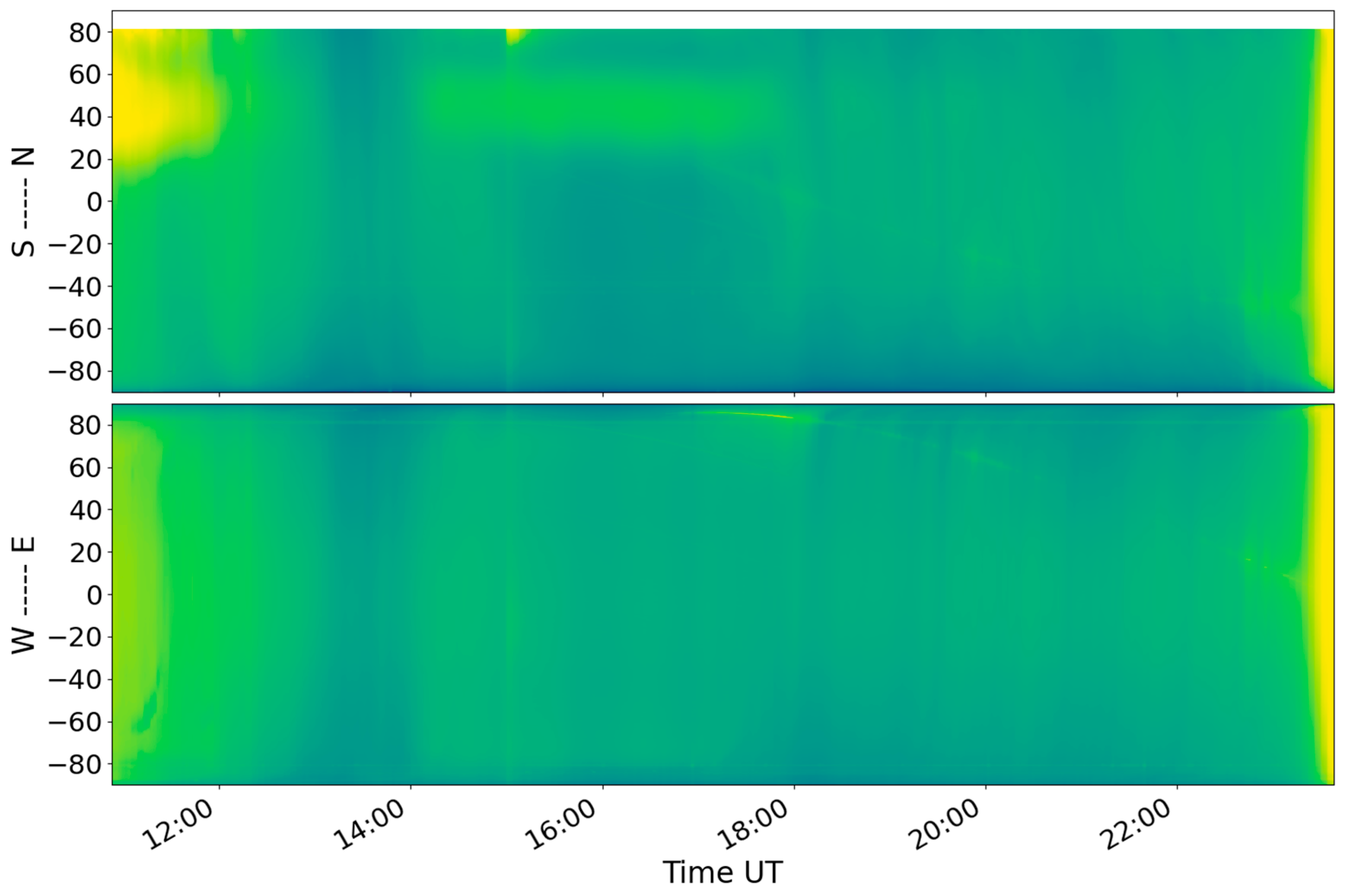
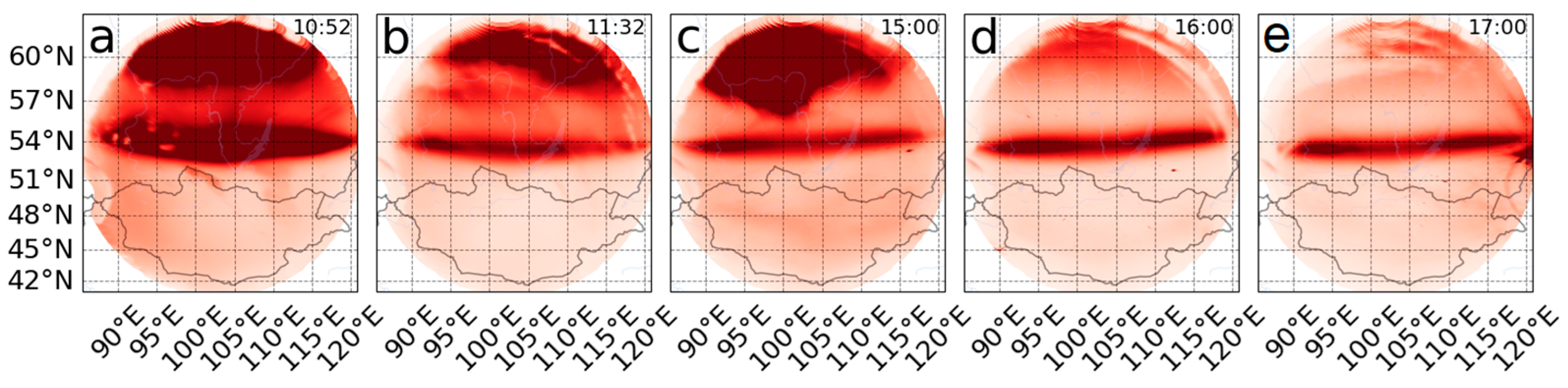
- In November 2025, a series of consecutive coronal mass ejections associated with X-class solar flares from AR 14274 caused a severe geomagnetic storm (Kp = 9-, Dst = −217 nT and SYM-H = −254 nT). This resulted in the enhancement (up to 175 TECU) and poleward shift (8–10°) of equatorial anomaly crests, an equatorward-shifted auroral oval, and the appearance of SAR arcs and auroras at mid-latitudes.
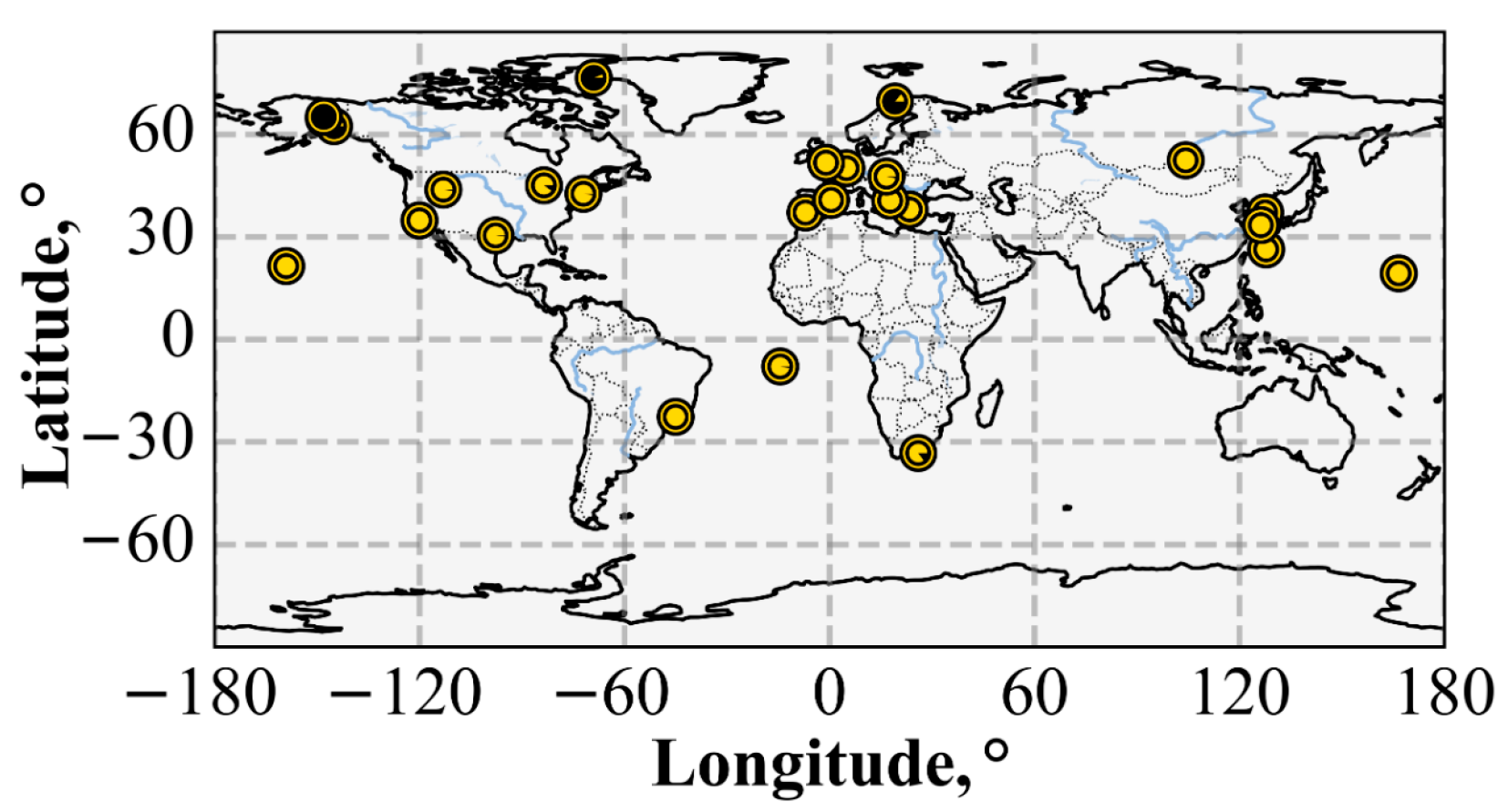
- During the 12 November 2025 G4 geomagnetic storm, a super equatorial plasma bubble was recorded almost reaching the auroral oval boundary in the American sector.
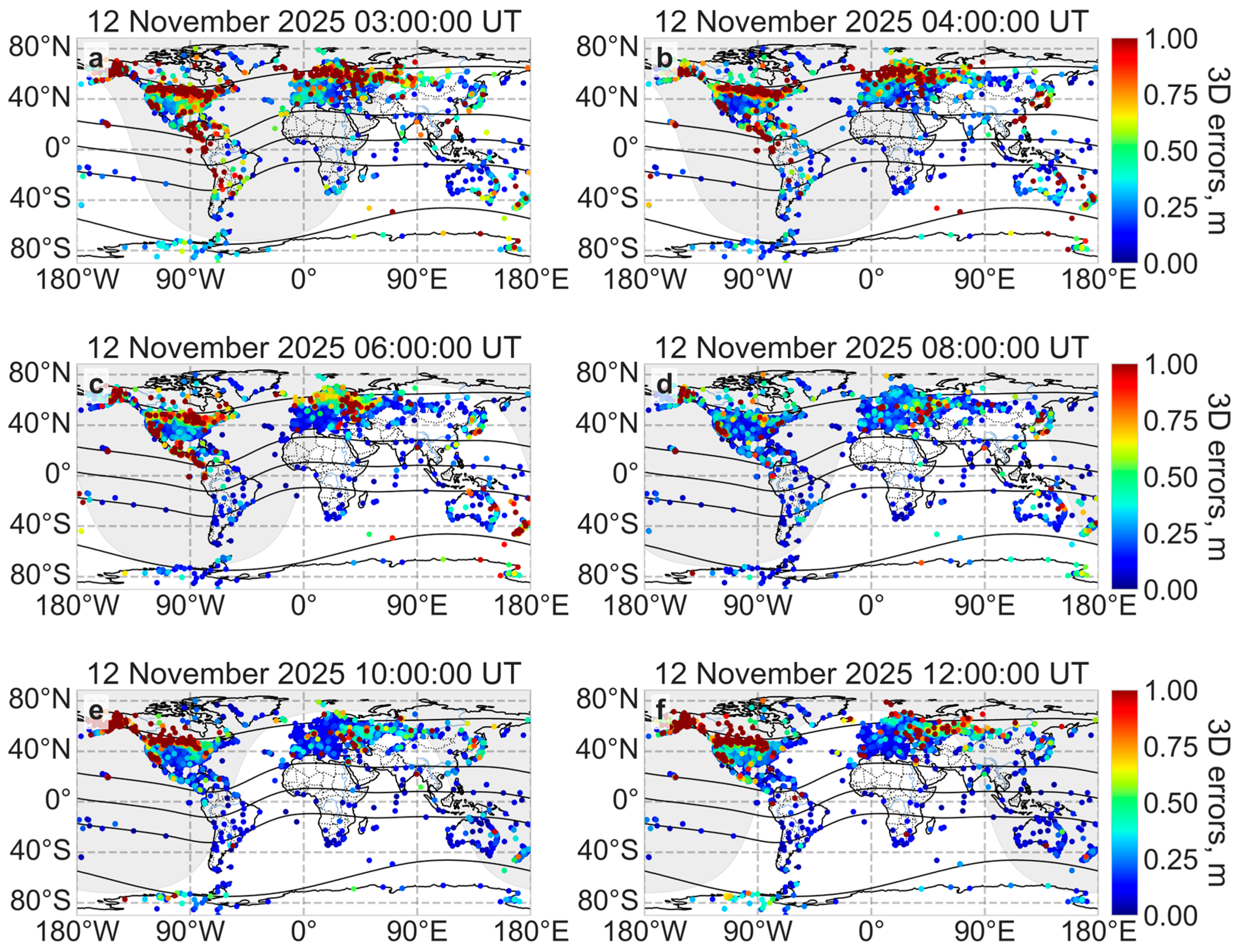
- GPS kinematic Precise Point Positioning errors increased to 2–3 m at high latitudes and in regions affected by the equatorial bubble.
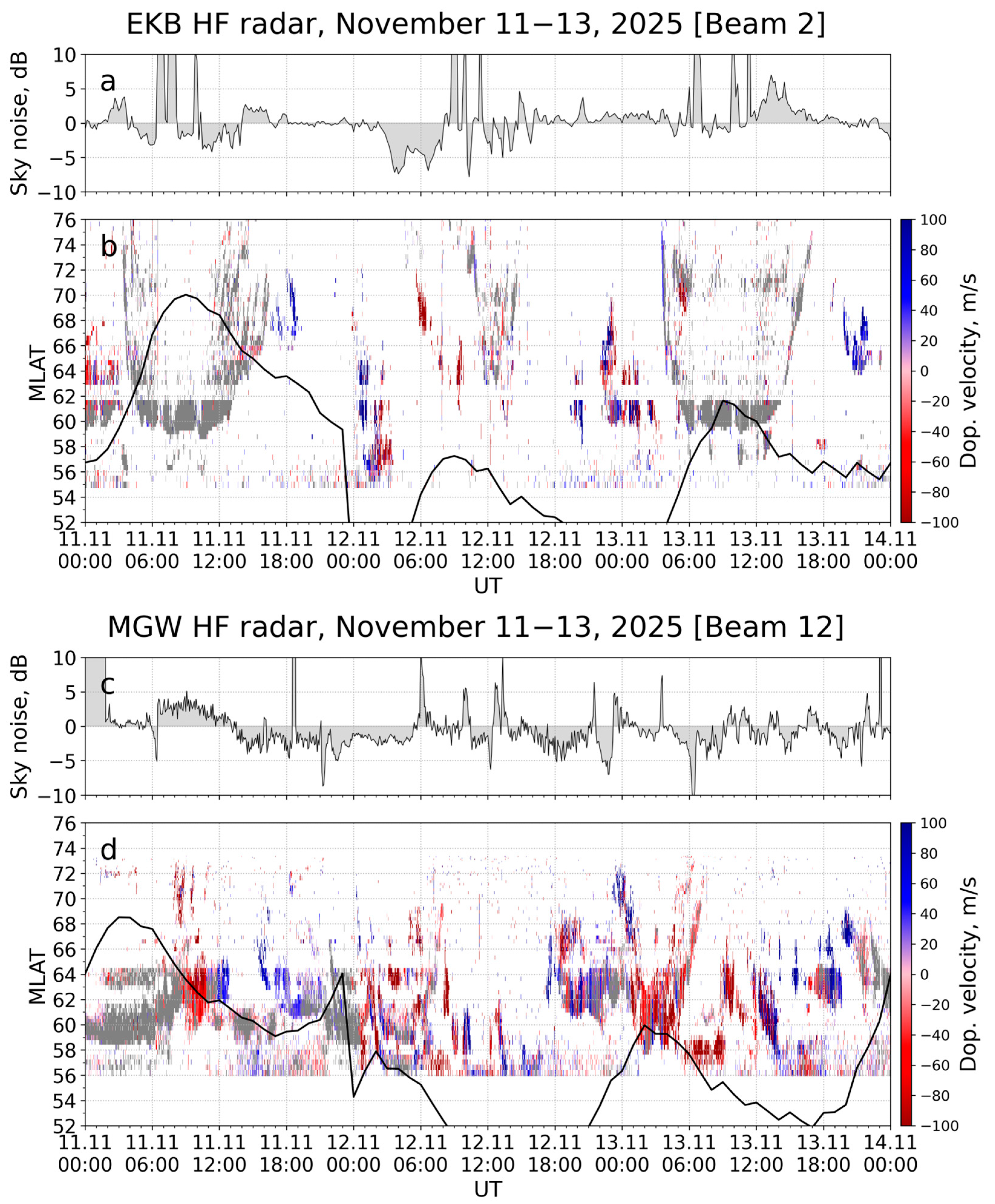
- During the main phase, a shift in the auroral oval resulted in radio aurora and signal absorption, which limited the potential of high-frequency radars at mid-latitudes.
Abstract
1. Introduction
2. Data and Methodology
3. Results
3.1. Solar Activity
3.2. Solar Wind Conditions
3.3. Geomagnetic Conditions
3.4. Cosmic Ray Intensity: Forbush Decrease and Ground-Level Enhancement
3.5. Ionospheric and Atmospheric Response to the Geomagnetic Storm
3.5.1. Global Ionospheric Structures
ROTI Data for Small-Scale Ionospheric Irregularities
Global Ionospheric Maps of Total Electron Content
3.5.2. Mid-Latitude Ionosphere (Over Irkutsk)
3.5.3. Optical Effects
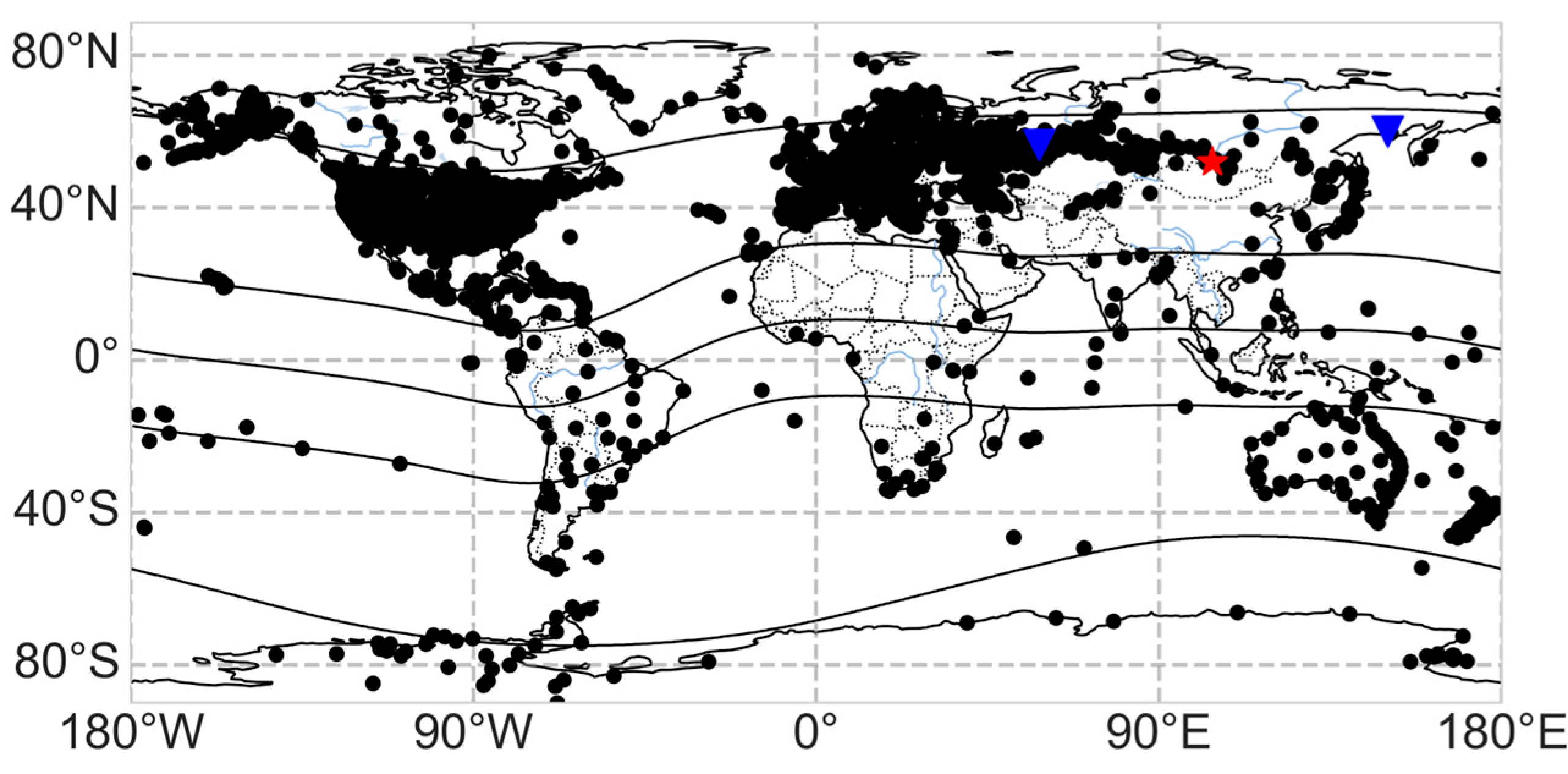
3.6. GPS Positioning Errors
3.7. High-Frequency Radio Wave Propagation
3.8. Blackouts in High-Frequency Radio Sounding Data
4. Discussion
5. Conclusions
- A series of three powerful X-class solar flares, an X1.7 (9 November 2025), an X1.2 (10 November 2025), and an X5.1 (11 November 2025) solar flare, originated from the same active region in November 2025. Each flare was accompanied by a coronal mass ejection (CME). The complex shock-ICME structure arrived at Earth, triggering a severe geomagnetic storm (Kp = 9-, Dst = −217 nT and SYM-H = −254 nT). On 13 November 2025, during the storm’s recovery phase, the CME-related shock from the most powerful X5.1 solar flare arrived, causing a renewed drop in Dst and a second enhancement of geomagnetic activity.
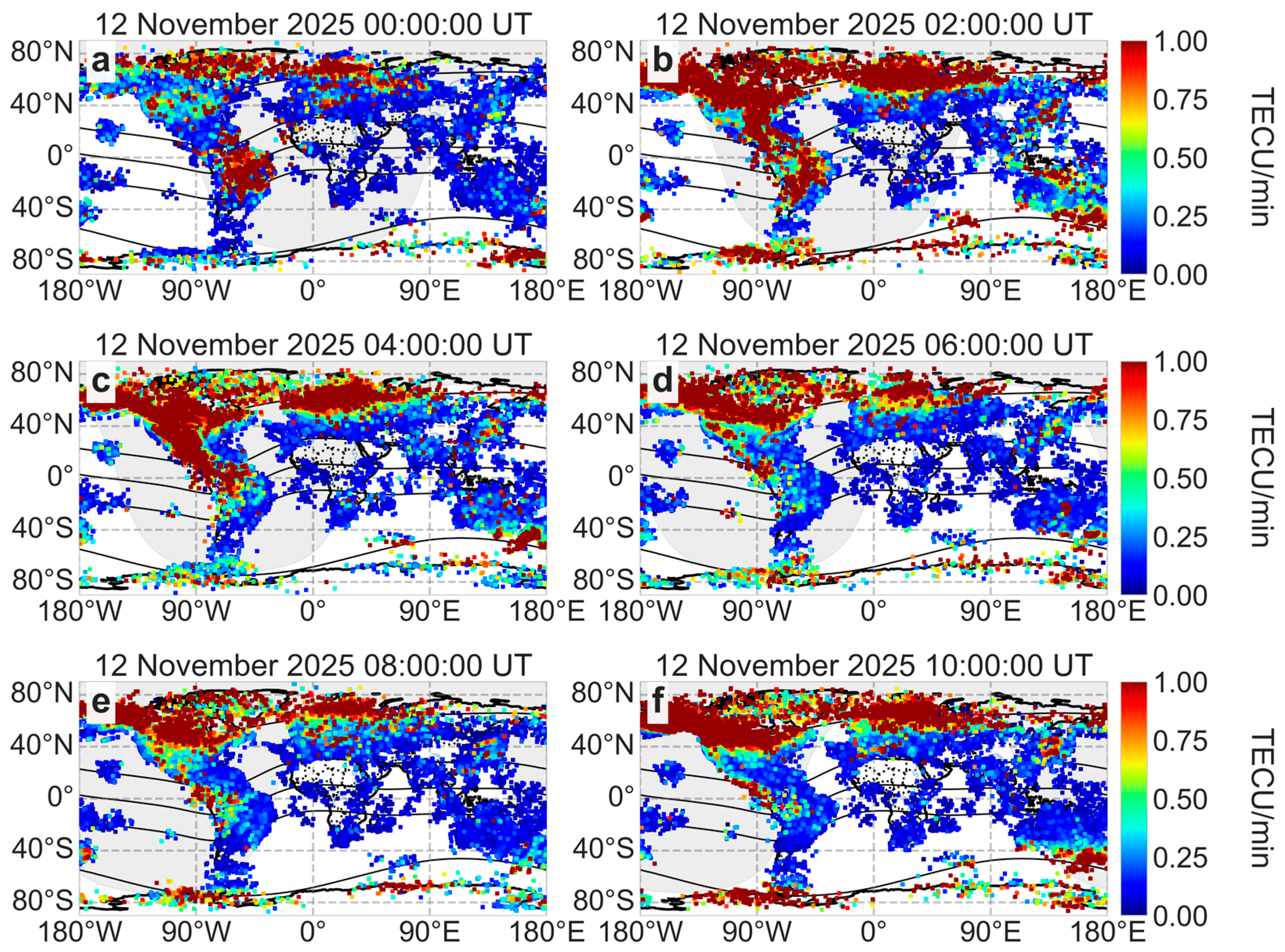
- The auroral oval expanded equatorward, reaching latitudes of ~35° N in the American sector and ~45° N in the European sector. The ROTI reached 1.5–2 TECU/min.
- We recorded a super equatorial plasma bubble almost reaching the auroral oval boundary in the American sector. The equatorial anomaly crests intensified up to 175 TECU and shifted poleward by 8–10°.
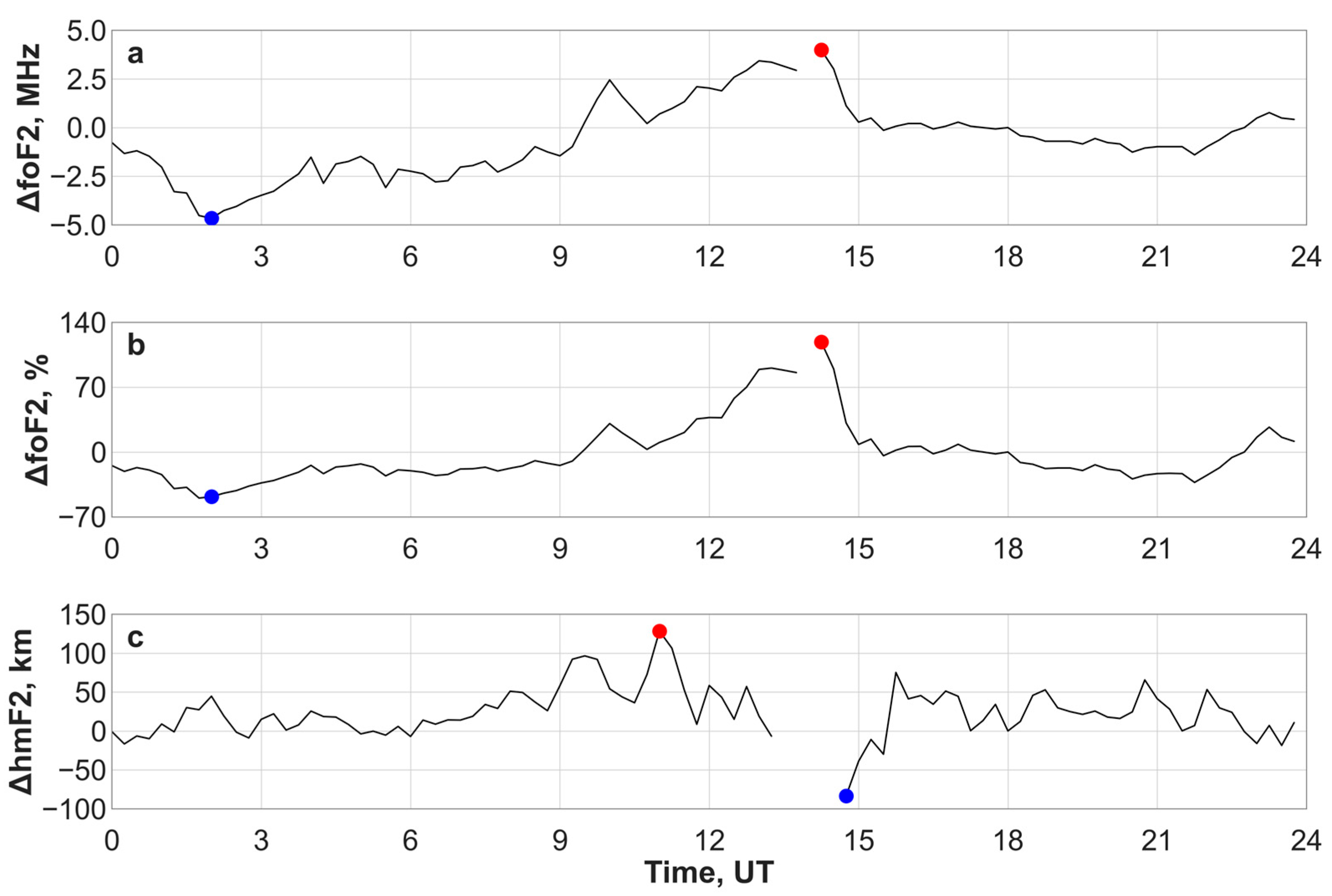
- During the main phase, the critical frequency (foF2) exhibited a strong negative disturbance (−50%) at mid-latitudes, followed by an unusually prolonged and intense positive phase exceeding +100%.
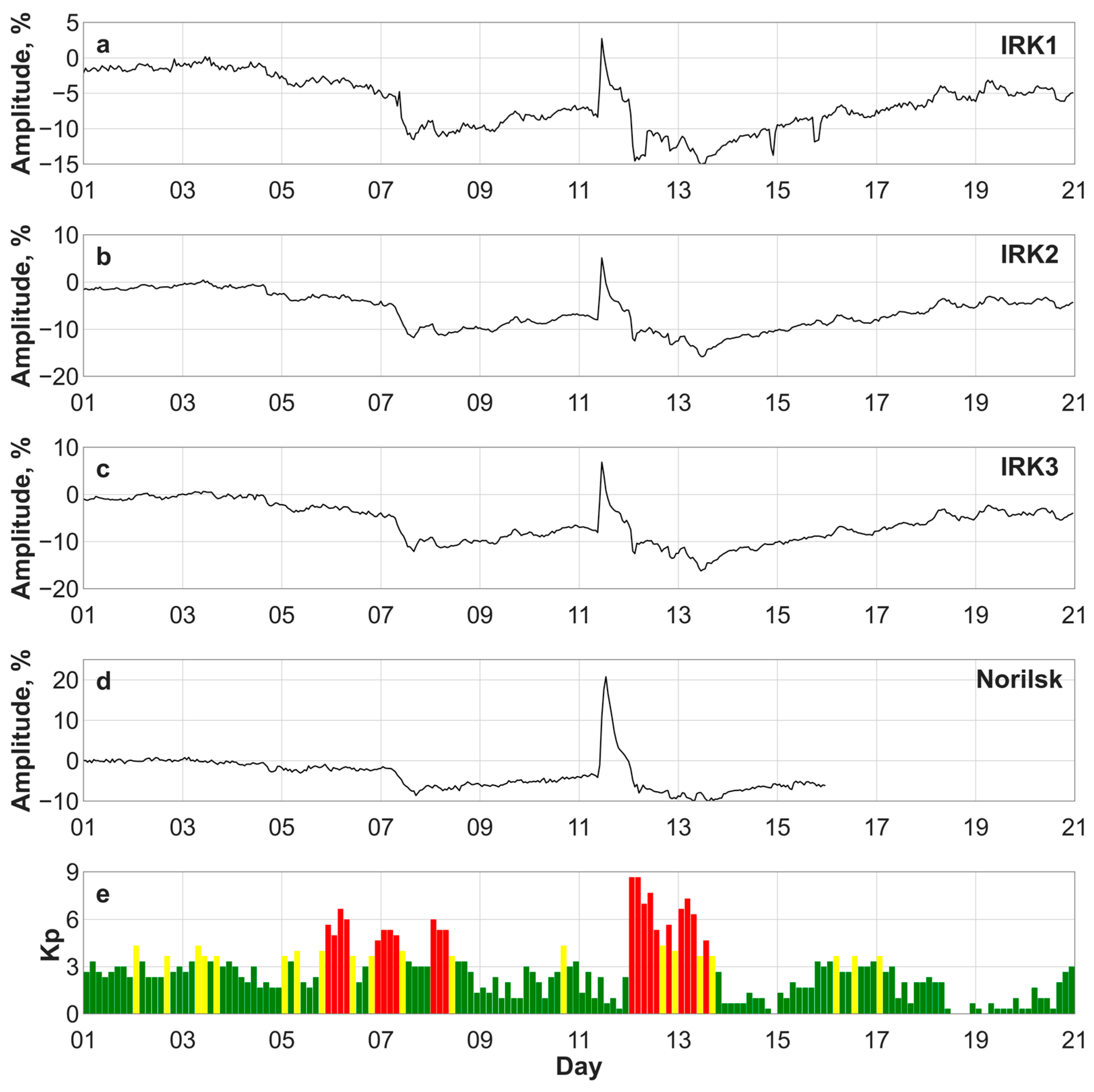
- The geomagnetic storm was accompanied by a Forbush effect (decrease in the intensity of cosmic rays), against which a ground-level enhancement (GLE77) was recorded.
- Mid-latitude auroras were recorded in the OI 630 nm airglow. In addition, the SAR arc was recorded; its width changed from ~40 degrees to ~20 degrees during the geomagnetic storm.
- At high latitudes, high-frequency radio waves suffered from absorption: the blackouts occurred in 80% or more measurements. At mid-latitudes, the blackouts occurred in fewer than 3% of measurements.
- GPS positioning errors in PPP mode increased to 2–3 m at high latitudes and in regions affected by the super equatorial bubble. This displacement of the increased positioning errors correlated to the expansion of the boundaries of the auroral oval and the increased ionization.
Supplementary Materials
Author Contributions
Funding
Institutional Review Board Statement
Informed Consent Statement
Data Availability Statement
Acknowledgments
Conflicts of Interest
Abbreviations
| ACE | Advanced Composition Explorer |
| AR | Active Regions |
| CME | Coronal Mass Ejection |
| GAMP | GNSS Analysis Software for Multi-Constellation and Multi-Frequency Precise Positioning |
| GIM | Global Ionospheric Maps |
| GIRO | Global Ionospheric Radio Observatory |
| GLE | Ground-Level Enhancement |
| GNSS | Global Navigation Satellite Systems |
| GOES | Geostationary Operational Environmental Satellite |
| CORS | Continuously Operating Reference Stations |
| GPS | Global Positioning System |
| Dst | Disturbance Storm Time Index |
| foF2 | Critical Frequency of the F2 Layer Maxima |
| hmF2 | Height of the F2 Layer Maxima |
| ICME | Interplanetary Coronal Mass Ejection |
| IMF | Interplanetary Magnetic Field |
| ISTP SB RAS | Institute of Solar-Terrestrial Physics of Siberian Branch of Russian Academy of Sciences |
| L1 | The First Lagrange Point |
| MIT | Main Ionospheric Trough |
| MLAT | Magnetic Latitude |
| NmF2 | Electron Density of the F2 Layer Maxima |
| NOAA | National Oceanic and Atmospheric Administration |
| pfu | Proton Flux Unit |
| PPP | Precise Point Positioning |
| ROTI | Rate Of TEC Index |
| SAR arc | Stable Auroral Red Arc |
| SECIRA | Network of Coherent Ionospheric Radars |
| SIDC | Solar Influences Data Analysis Center |
| SIMuRG | System for Ionosphere Monitoring and Research from GNSS |
| SDO | Solar Dynamic Observatory |
| SuperDARN | Super Dual Auroral Radar Network |
| TEC | Total Electron Content |
| TECU | Total Electron Content Unit |
References
- Danilov, A.; Lastovicka, J. Effects of Geomagnetic Storms on the Ionosphere and Atmosphere. Int. J. Geomagn. Aeron. 2001, 2, 209–224. [Google Scholar]
- Mendillo, M. Storms in the Ionosphere: Patterns and Processes for Total Electron Content. Rev. Geophys. 2006, 44, 2005RG000193. [Google Scholar] [CrossRef]
- Cander, L.R. Ionospheric Storm Morphology. In Ionospheric Space Weather; Springer Geophysics; Springer International Publishing: Cham, Switzerland, 2019; pp. 95–133. ISBN 978-3-319-99330-0. [Google Scholar]
- Yeh, K.C.; Liu, C.H. Radio Wave Scintillations in the Ionosphere. Proc. IEEE 1982, 70, 324–360. [Google Scholar] [CrossRef]
- Pilipenko, V. Space Weather Impact on Ground-Based Technological Systems. Sol.-Terr. Phys. 2021, 7, 68–104. [Google Scholar] [CrossRef]
- Berngardt, O. Space Weather Impact on Radio Device Operation. Sol.-Terr. Phys. 2017, 3, 37–53. [Google Scholar] [CrossRef]
- Demyanov, V.; Yasyukevich, Y. Space Weather: Risk Factors for Global Navigation Satellite Systems. Sol.-Terr. Phys. 2021, 7, 28–47. [Google Scholar] [CrossRef]
- Luo, X.; Gu, S.; Lou, Y.; Xiong, C.; Chen, B.; Jin, X. Assessing the Performance of GPS Precise Point Positioning Under Different Geomagnetic Storm Conditions during Solar Cycle 24. Sensors 2018, 18, 1784. [Google Scholar] [CrossRef] [PubMed]
- Béland, J.; Small, K. Space Weather Effects on Power Transmission Systems: The Cases of Hydro-Québec and Transpower New ZealandLtd. In Effects of Space Weather on Technology Infrastructure; Daglis, I.A., Ed.; NATO Science Series II: Mathematics, Physics and Chemistry; Kluwer Academic Publishers: Dordrecht, The Netherlands, 2005; Volume 176, pp. 287–299. ISBN 978-1-4020-2748-2. [Google Scholar]
- Thaduri, A.; Galar, D.; Kumar, U. Space Weather Climate Impacts on Railway Infrastructure. Int. J. Syst. Assur. Eng. Manag. 2020, 11, 267–281. [Google Scholar] [CrossRef]
- Wang, C.; Richardson, J.D.; Burlaga, L. Propagation of the Bastille Day 2000 CME Shock in the Outer Heliosphere. Sol. Phys. 2001, 204, 413–423. [Google Scholar] [CrossRef]
- Jacobsen, K.S.; Andalsvik, Y.L. Overview of the 2015 St. Patrick’s Day Storm and Its Consequences for RTK and PPP Positioning in Norway. J. Space Weather Space Clim. 2016, 6, A9. [Google Scholar] [CrossRef]
- Tsurutani, B.T.; Judge, D.L.; Guarnieri, F.L.; Gangopadhyay, P.; Jones, A.R.; Nuttall, J.; Zambon, G.A.; Didkovsky, L.; Mannucci, A.J.; Iijima, B.; et al. The October 28, 2003 Extreme EUV Solar Flare and Resultant Extreme Ionospheric Effects: Comparison to Other Halloween Events and the Bastille Day Event. Geophys. Res. Lett. 2005, 32, 2004GL021475. [Google Scholar] [CrossRef]
- Pulkkinen, A.; Lindahl, S.; Viljanen, A.; Pirjola, R. Geomagnetic Storm of 29–31 October 2003: Geomagnetically Induced Currents and Their Relation to Problems in the Swedish High-voltage Power Transmission System. Space Weather 2005, 3, 2004SW000123. [Google Scholar] [CrossRef]
- Shen, C.; Xu, M.; Wang, Y.; Chi, Y.; Luo, B. Why the Shock-ICME Complex Structure Is Important: Learning from the Early 2017 September CMEs. Astrophys. J. 2018, 861, 28. [Google Scholar] [CrossRef]
- Ruffa, J.A.; Bay, M.; Ward, D.K.; Gonzales, P.J.; Bartusek, L.M.; Pesnell, W.D. NASA’s Solar Dynamics Observatory (SDO): A Systems Approach to a Complex Mission. In Proceedings of the 2012 IEEE Aerospace Conference, Big Sky, MT, USA, 3–10 March 2012; IEEE: Piscataway, NJ, USA, 2012; pp. 1–12. [Google Scholar]
- Berghmans, D.; Hochedez, J.F.; Defise, J.M.; Lecat, J.H.; Nicula, B.; Slemzin, V.; Lawrence, G.; Katsyiannis, A.C.; Der Linden, R.V.; Zhukov, A.; et al. SWAP Onboard PROBA 2, a New EUV Imager for Solar Monitoring. Adv. Space Res. 2006, 38, 1807–1811. [Google Scholar] [CrossRef]
- King, J.H.; Papitashvili, N.E. Solar Wind Spatial Scales in and Comparisons of Hourly Wind and ACE Plasma and Magnetic Field Data. J. Geophys. Res. 2005, 110, 2004JA010649. [Google Scholar] [CrossRef]
- Yasyukevich, Y.V.; Kiselev, A.V.; Zhivetiev, I.V.; Edemskiy, I.K.; Syrovatskii, S.V.; Maletckii, B.M.; Vesnin, A.M. SIMuRG: System for Ionosphere Monitoring and Research from GNSS. GPS Solut. 2020, 24, 69. [Google Scholar] [CrossRef]
- Pi, X.; Mannucci, A.J.; Lindqwister, U.J.; Ho, C.M. Monitoring of Global Ionospheric Irregularities Using the Worldwide GPS Network. Geophys. Res. Lett. 1997, 24, 2283–2286. [Google Scholar] [CrossRef]
- Li, J.; Ma, G.; Maruyama, T.; Wan, Q.; Fan, J.; Zhang, J.; Wang, X. ROTI Keograms Based on CMONOC to Characterize the Ionospheric Irregularities in 2014. Earth Planets Space 2022, 74, 149. [Google Scholar] [CrossRef]
- Padokhin, A.M.; Andreeva, E.S.; Nazarenko, M.O.; Kalashnikova, S.A. Phase-Difference Approach for GNSS Global Ionospheric Total Electron Content Mapping. Radiophys. Quantum Electron. 2022, 65, 481–495. [Google Scholar] [CrossRef]
- Liu, Q.; Hernández-Pajares, M.; Lyu, H.; Goss, A. Influence of Temporal Resolution on the Performance of Global Ionospheric Maps. J. Geod. 2021, 95, 34. [Google Scholar] [CrossRef]
- Roma-Dollase, D.; Hernández-Pajares, M.; Krankowski, A.; Kotulak, K.; Ghoddousi-Fard, R.; Yuan, Y.; Li, Z.; Zhang, H.; Shi, C.; Wang, C.; et al. Consistency of Seven Different GNSS Global Ionospheric Mapping Techniques during One Solar Cycle. J. Geod. 2018, 92, 691–706. [Google Scholar] [CrossRef]
- Dow, J.M.; Neilan, R.E.; Rizos, C. The International GNSS Service in a Changing Landscape of Global Navigation Satellite Systems. J. Geod. 2009, 83, 191–198. [Google Scholar] [CrossRef]
- Zhou, F.; Dong, D.; Li, W.; Jiang, X.; Wickert, J.; Schuh, H. GAMP: An Open-Source Software of Multi-GNSS Precise Point Positioning Using Undifferenced and Uncombined Observations. GPS Solut. 2018, 22, 33. [Google Scholar] [CrossRef]
- Ratovsky, K.G.; Medvedev, A.V.; Tolstikov, M.V.; Kushnarev, D.S. Case Studies of Height Structure of TID Propagation Characteristics Using Cross-Correlation Analysis of Incoherent Scatter Radar and DPS-4 Ionosonde Data. Adv. Space Res. 2008, 41, 1454–1458. [Google Scholar] [CrossRef]
- Lukovnikova, A. Present State of Cosmic Ray Stations of the Institute of Solar-Terrestrial Physics of Siberian Branch of the Russian Academy of Sciences (ISTP SB RAS). J. Phys. Conf. Ser. 2015, 632, 012067. [Google Scholar] [CrossRef]
- Vasilyev, R.; Artamonov, M.; Beletsky, A.; Zorkaltseva, O.; Komarova, E.; Medvedeva, I.; Mikhalev, A.; Podlesny, S.; Ratovsky, K.; Syrenova, T.; et al. Scientific Goals of Optical Instruments of the National Heliogeophysical Complex. Sol.-Terr. Phys. 2020, 6, 84–97. [Google Scholar] [CrossRef]
- Berngardt, O.; Kurkin, V.; Kushnarev, D.; Grkovich, K.; Fedorov, R.; Orlov, A.; Harchenko, V. ISTP SB RAS Decameter Radars. Sol.-Terr. Phys. 2020, 6, 63–73. [Google Scholar] [CrossRef]
- Clette, F.; Lefèvre, L. SILSO Sunspot Number, V2.0. 2015.
- Gopalswamy, N.; Thompson, W.T.; Davila, J.M.; Kaiser, M.L.; Yashiro, S.; Mäkelä, P.; Michalek, G.; Bougeret, J.-L.; Howard, R.A. Relation Between Type II Bursts and CMEs Inferred from STEREO Observations. Sol. Phys. 2009, 259, 227–254. [Google Scholar] [CrossRef]
- Papitashvili, N.E.; King, J.H. OMNI 5-Min Data Set. Space Physics Data Facility. 2020. Available online: https://spase-metadata.org/NASA/NumericalData/OMNI/HighResolutionObservations/Version1/PT5M (accessed on 24 February 2026).
- Richardson, I.G.; Cane, H.V. Regions of Abnormally Low Proton Temperature in the Solar Wind (1965–1991) and Their Association with Ejecta. J. Geophys. Res. 1995, 100, 23397–23412. [Google Scholar] [CrossRef]
- Yermolaev, Y.I.; Nikolaeva, N.S.; Lodkina, I.G.; Yermolaev, M.Y. Catalog of Large-Scale Solar Wind Phenomena during 1976–2000. Cosm. Res 2009, 47, 81–94. [Google Scholar] [CrossRef]
- Richardson, I.G.; Cane, H.V. Near-Earth Interplanetary Coronal Mass Ejections During Solar Cycle 23 (1996–2009): Catalog and Summary of Properties. Sol. Phys. 2010, 264, 189–237. [Google Scholar] [CrossRef]
- Matzka, J.; Stolle, C.; Yamazaki, Y.; Bronkalla, O.; Morschhauser, A. The Geomagnetic Kp Index and Derived Indices of Geomagnetic Activity. Space Weather 2021, 19, e2020SW002641. [Google Scholar] [CrossRef]
- Sugiura, M. Hourly Values of Equatorial Dst for the IGY; Annals of the International Geophysical Year; Pergamon Press: Oxford, UK, 1964; Volume 35, pp. 9–45. [Google Scholar]
- Wanliss, J.A.; Showalter, K.M. High-resolution Global Storm Index: Dst versus SYM-H. J. Geophys. Res. 2006, 111, 2005JA011034. [Google Scholar] [CrossRef]
- Rassoul, H.K.; Rohrbaugh, R.P.; Tinsley, B.A.; Slater, D.W. Spectrometric and Photometric Observations of Low-latitude Aurorae. J. Geophys. Res. 1993, 98, 7695–7709. [Google Scholar] [CrossRef]
- Mikhalev, A. Mid-Latitude Aurora in Solar Cycles 23–24 from Observations in the South of Eastern Siberia. Sol.-Terr. Phys. 2019, 5, 66–73. [Google Scholar] [CrossRef]
- Deminov, M.G.; Shubin, V.N. Empirical Model of the Location of the Main Ionospheric Trough. Geomagn. Aeron. 2018, 58, 348–355. [Google Scholar] [CrossRef]
- Gonzalez-Esparza, J.A.; Sanchez-Garcia, E.; Sergeeva, M.; Corona-Romero, P.; Gonzalez-Mendez, L.X.; Valdes-Galicia, J.F.; Aguilar-Rodriguez, E.; Rodriguez-Martinez, M.; Ramirez-Pacheco, C.; Castellanos, C.I.; et al. The Mother’s Day Geomagnetic Storm on 10 May 2024: Aurora Observations and Low Latitude Space Weather Effects in Mexico. Space Weather 2024, 22, e2024SW004111. [Google Scholar] [CrossRef]
- Li, Y.; Zhang, H.; Xu, F.; Ding, Q.; Tang, L. Super Equatorial Plasma Bubbles Observed Over South America During the October 10 and 11, 2024 Strong Geomagnetic Storm. IEEE Geosci. Remote Sens. Lett. 2025, 22, 1002105. [Google Scholar] [CrossRef]
- Astafyeva, E.; Zakharenkova, I.; Förster, M. Ionospheric Response to the 2015 St. Patrick’s Day Storm: A Global Multi-instrumental Overview. JGR Space Phys. 2015, 120, 9023–9037. [Google Scholar] [CrossRef]
- Yasyukevich, Y.V.; Vasiliev, R.V.; Rubtsov, A.V.; Alsatkin, S.S.; Artamonov, M.F.; Beletsky, A.B. Extreme Magnetic Storm of May 10–19, 2024: Coupling Between Neutral and Charged Components of the Upper Atmosphere and the Effect on Radio Systems. Dokl. Earth Sci. 2025, 520, 33. [Google Scholar] [CrossRef]
- Cherniak, I.; Zakharenkova, I. Dependence of the High-Latitude Plasma Irregularities on the Auroral Activity Indices: A Case Study of 17 March 2015 Geomagnetic Storm. Earth Planet Space 2015, 67, 151. [Google Scholar] [CrossRef]
- Yao, Y.; Liu, L.; Kong, J.; Zhai, C. Analysis of the Global Ionospheric Disturbances of the March 2015 Great Storm. JGR Space Phys. 2016, 121, 12–157. [Google Scholar] [CrossRef]
- Ledvina, B.M.; Makela, J.J.; Kintner, P.M. First Observations of Intense GPS L1 Amplitude Scintillations at Midlatitude. Geophys. Res. Lett. 2002, 29, 4-1–4-4. [Google Scholar] [CrossRef]
- Fremouw, E.J.; Secan, J.A.; Lansinger, J.M. Spectral Behavior of Phase Scintillation in the Nighttime Auroral Region. Radio Sci. 1985, 20, 923–933. [Google Scholar] [CrossRef]
- Chernyshov, A.A.; Klimenko, M.V.; Nosikov, I.A.; Borchevkina, O.P.; Timchenko, A.V.; Efishov, I.I.; Sinevich, A.A.; Ryakhovsky, I.A.; Yakimova, G.A.; Bessarab, F.S.; et al. Effects in the Upper Atmosphere and Ionosphere in the Subauroral Region during Victory Day 2024 Geomagnetic Storm (May 10–12, 2024). Adv. Space Res. 2025, 76, 7325–7350. [Google Scholar] [CrossRef]
- Danilchuk, E.; Yasyukevich, Y.; Vesnin, A.; Klyusilov, A.; Zhang, B. Impact of the May 2024 Extreme Geomagnetic Storm on the Ionosphere and GNSS Positioning. Remote Sens. 2025, 17, 1492. [Google Scholar] [CrossRef]
- Luo, X.; Aa, E.; Wang, X.; Luo, B. Strong Longitudinal and Latitudinal Differences of Ionospheric Responses in North American and European Sectors During the 10–11 October 2024 Geomagnetic Storm. Remote Sens. 2026, 18, 256. [Google Scholar] [CrossRef]
- Sahai, Y.; Fagundes, P.R.; Bittencourt, J.A. Transequatorial F-Region Ionospheric Plasma Bubbles: Solar Cycle Effects. J. Atmos. Sol.-Terr. Phys. 2000, 62, 1377–1383. [Google Scholar] [CrossRef]
- Tulasi Ram, S.; Ajith, K.K.; Yamamoto, M.; Otsuka, Y.; Yokoyama, T.; Niranjan, K.; Gurubaran, S. Fresh and Evolutionary-type Field-aligned Irregularities Generated near Sunrise Terminator Due to Overshielding Electric Fields. JGR Space Phys. 2015, 120, 5922–5930. [Google Scholar] [CrossRef]
- Huang, F.; Lei, J.; Xiong, C.; Zhong, J.; Li, G. Observations of Equatorial Plasma Bubbles during the Geomagnetic Storm of October 2016. Earth Planet. Phys. 2021, 5, 416–426. [Google Scholar] [CrossRef]
- Ma, G.; Maruyama, T. A Super Bubble Detected by Dense GPS Network at East Asian Longitudes. Geophys. Res. Lett. 2006, 33, 2006GL027512. [Google Scholar] [CrossRef]
- Zakharenkova, I.; Cherniak, I.; Krankowski, A.; Valladares, C.E.; De La Jara Sanchez, C. On Detection of Super Equatorial Plasma Bubbles in the American Sector During the 10–11 October 2024 Geomagnetic Storm. JGR Space Phys. 2025, 130, e2025JA033709. [Google Scholar] [CrossRef]
- Pulinets, S.; Kotonaeva, N.; Depuev, V.; Tsybulya, K. Ionospheric Response to the Geomagnetic Storm of 12–14 November 2025, Based on Multi-Parameter Analysis of Data from the LAERT Topside Sounder. Atmosphere 2026, 17, 150. [Google Scholar] [CrossRef]
- Pulinets, S.; Tsybulya, K.; Depuev, V.; Danilov, I.; Pulinets, M. Ionospheric Topside Sounding Revival. Adv. Space Res. 2026, 77, 2574–2587. [Google Scholar] [CrossRef]
- Suraina; Rakhman, A.; Abadi, P.; Kilowasid, L.O.M.M.; Putra, A.Y.; Perwitasari, S.; Irnaka, T.M. Pre-Sunrise Equatorial Plasma Bubble Over Indonesia During the 11 May 2024 Super Geomagnetic Storm. Earth Space Sci. 2025, 12, e2024EA004152. [Google Scholar] [CrossRef]
- Cherniak, I.; Zakharenkova, I. Development of the Storm-Induced Ionospheric Irregularities at Equatorial and Middle Latitudes During the 25–26 August 2018 Geomagnetic Storm. Space Weather 2022, 20, e2021SW002891. [Google Scholar] [CrossRef]
- Luan, X. Equatorial Ionization Anomaly Variations During Geomagnetic Storms. In Geophysical Monograph Series; Huang, C., Lu, G., Zhang, Y., Paxton, L.J., Eds.; Wiley: Hoboken, NJ, USA, 2021; pp. 301–312. ISBN 978-1-119-50755-0. [Google Scholar]
- Kelley, M.C. The Earth’s Ionosphere: Plasma Physics and Electrodynamics, 2nd ed.; International Geophysics Series; Academic Press: Amsterdam, The Netherlands; Boston, MA, USA, 2009; ISBN 978-0-12-088425-4. [Google Scholar]
- Tsurutani, B.T.; Verkhoglyadova, O.P.; Mannucci, A.J.; Saito, A.; Araki, T.; Yumoto, K.; Tsuda, T.; Abdu, M.A.; Sobral, J.H.A.; Gonzalez, W.D.; et al. Prompt Penetration Electric Fields (PPEFs) and Their Ionospheric Effects during the Great Magnetic Storm of 30–31 October 2003. J. Geophys. Res. 2008, 113, 2007JA012879. [Google Scholar] [CrossRef]
- Blanc, M.; Richmond, A.D. The Ionospheric Disturbance Dynamo. J. Geophys. Res. 1980, 85, 1669–1686. [Google Scholar] [CrossRef]
- Bhattacharyya, A. Equatorial Plasma Bubbles: A Review. Atmosphere 2022, 13, 1637. [Google Scholar] [CrossRef]
- Tsurutani, B.; Mannucci, A.; Iijima, B.; Abdu, M.A.; Sobral, J.H.A.; Gonzalez, W.; Guarnieri, F.; Tsuda, T.; Saito, A.; Yumoto, K.; et al. Global Dayside Ionospheric Uplift and Enhancement Associated with Interplanetary Electric Fields. J. Geophys. Res. 2004, 109, 2003JA010342. [Google Scholar] [CrossRef]
- Mannucci, A.J.; Tsurutani, B.T.; Iijima, B.A.; Komjathy, A.; Saito, A.; Gonzalez, W.D.; Guarnieri, F.L.; Kozyra, J.U.; Skoug, R. Dayside Global Ionospheric Response to the Major Interplanetary Events of October 29–30, 2003 “Halloween Storms”. Geophys. Res. Lett. 2005, 32, 2004GL021467. [Google Scholar] [CrossRef]
- Yang, Z.; Morton, Y.T.J.; Zakharenkova, I.; Cherniak, I.; Song, S.; Li, W. Global View of Ionospheric Disturbance Impacts on Kinematic GPS Positioning Solutions During the 2015 St. Patrick’s Day Storm. JGR Space Phys. 2020, 125, e2019JA027681. [Google Scholar] [CrossRef]
- Nie, W.; Rovira-Garcia, A.; Li, M.; Fang, Z.; Wang, Y.; Zheng, D.; Xu, T. The Mechanism for GNSS-Based Kinematic Positioning Degradation at High-Latitudes Under the March 2015 Great Storm. Space Weather 2022, 20, e2022SW003132. [Google Scholar] [CrossRef]
- Yang, Z.; Morton, Y.T.J. Impacts of the May 2024 Extreme Geomagnetic Storm on Global High-Accuracy GPS Positioning Solutions. Space Weather 2025, 23, e2025SW004547. [Google Scholar] [CrossRef]
- Zakharenkova, I.; Cherniak, I. Effects of Storm-Induced Equatorial Plasma Bubbles on GPS-Based Kinematic Positioning at Equatorial and Middle Latitudes during the September 7–8, 2017, Geomagnetic Storm. GPS Solut. 2021, 25, 132. [Google Scholar] [CrossRef]
- Astafyeva, E.; Yasyukevich, Y.V.; Maletckii, B.; Oinats, A.; Vesnin, A.; Yasyukevich, A.S.; Syrovatskii, S.; Guendouz, N. Ionospheric Disturbances and Irregularities During the 25–26 August 2018 Geomagnetic Storm. JGR Space Phys. 2022, 127, e2021JA029843. [Google Scholar] [CrossRef]
- Berngardt, O.I.; Ruohoniemi, J.M.; Nishitani, N.; Shepherd, S.G.; Bristow, W.A.; Miller, E.S. Attenuation of Decameter Wavelength Sky Noise during X-Ray Solar Flares in 2013–2017 Based on the Observations of Midlatitude HF Radars. J. Atmos. Sol.-Terr. Phys. 2018, 173, 1–13. [Google Scholar] [CrossRef]
- Ponomarchuk, S.; Zolotukhina, N.; Kurkin, V.; Belinskaya, A.; Grozov, V.; Oinats, A.; Poddelsky, A.; Podlesnyi, A.; Cedrik, M. Effects of the May 10–13, 2024 Magnetic Storm in the Asian Region of Russia from Ionospheric Sounding with a Continuous Chirp Signal. Sol.-Terr. Phys. 2025, 11, 14–28. [Google Scholar] [CrossRef]
- Nishida, A. Geomagnetic Diagnosis of the Magnetosphere; Physics and Chemistry in Space; Springer: Berlin/Heidelberg, Germany, 1978; Volume 9, ISBN 978-3-642-86827-6. [Google Scholar]
- Burke, W.J.; Huang, C.Y.; Marcos, F.A.; Wise, J.O. Interplanetary Control of Thermospheric Densities during Large Magnetic Storms. J. Atmos. Sol.-Terr. Phys. 2007, 69, 279–287. [Google Scholar] [CrossRef]



| Day of Month | Time of Maximum, UT | X-Ray Class | Arrival Shock Waves in Lagrange Point L1 1 (ACE) | Arrival Shock Waves to the Earth’s Bow Shock Nose (Estimated) | Speed of CME-Related Shock 2, km/s |
|---|---|---|---|---|---|
| 03 | 10:11 | M5.0 | |||
| 04 | 17:34 | X1.8 | |||
| 05 | 11:19 | M7.45 | |||
| 05 | 22:07 | M8.6 | |||
| 09 | 07:35 | X1.7 | 11 November at 22:15 UT | 11 November at 23:15 UT | 804 |
| 10 | 09:19 | X1.2 | 11 November at 23:38 UT | 12 November at 00:20 UT | 1320 |
| 11 | 10:04 | X5.1 | 12 November at 18:53 UT | 12 November at 19:45 UT | 1350 |
| 14 | 08:30 | X4.0 |
Disclaimer/Publisher’s Note: The statements, opinions and data contained in all publications are solely those of the individual author(s) and contributor(s) and not of MDPI and/or the editor(s). MDPI and/or the editor(s) disclaim responsibility for any injury to people or property resulting from any ideas, methods, instructions or products referred to in the content. |
© 2026 by the authors. Licensee MDPI, Basel, Switzerland. This article is an open access article distributed under the terms and conditions of the Creative Commons Attribution (CC BY) license.
Share and Cite
Yasyukevich, Y.; Danilchuk, E.; Beletsky, A.; Borvenko, E.; Chernyshov, A.; Fainshtein, V.; Ivanova, V.; Khabituev, D.; Kravtsova, M.; Oinats, A.; et al. The 12 November 2025 Ugly Duckling Geomagnetic Storm: From the Sun to the Earth. Sensors 2026, 26, 1490. https://doi.org/10.3390/s26051490
Yasyukevich Y, Danilchuk E, Beletsky A, Borvenko E, Chernyshov A, Fainshtein V, Ivanova V, Khabituev D, Kravtsova M, Oinats A, et al. The 12 November 2025 Ugly Duckling Geomagnetic Storm: From the Sun to the Earth. Sensors. 2026; 26(5):1490. https://doi.org/10.3390/s26051490
Chicago/Turabian StyleYasyukevich, Yury, Ekaterina Danilchuk, Aleksandr Beletsky, Egor Borvenko, Aleksandr Chernyshov, Victor Fainshtein, Vera Ivanova, Denis Khabituev, Marina Kravtsova, Alexey Oinats, and et al. 2026. "The 12 November 2025 Ugly Duckling Geomagnetic Storm: From the Sun to the Earth" Sensors 26, no. 5: 1490. https://doi.org/10.3390/s26051490
APA StyleYasyukevich, Y., Danilchuk, E., Beletsky, A., Borvenko, E., Chernyshov, A., Fainshtein, V., Ivanova, V., Khabituev, D., Kravtsova, M., Oinats, A., Olemskoy, S., Padokhin, A., Ratovsky, K., Sdobnov, V., Vesnin, A., Yasyukevich, A., & Yazev, S. (2026). The 12 November 2025 Ugly Duckling Geomagnetic Storm: From the Sun to the Earth. Sensors, 26(5), 1490. https://doi.org/10.3390/s26051490