A Two-Step Sensor Fusion Methodology to Assess Damage on Drone Propellers by Audio and Radar Measurements

 ,
,  ,
,  , , , ,
  and
and 
Abstract
1. Introduction
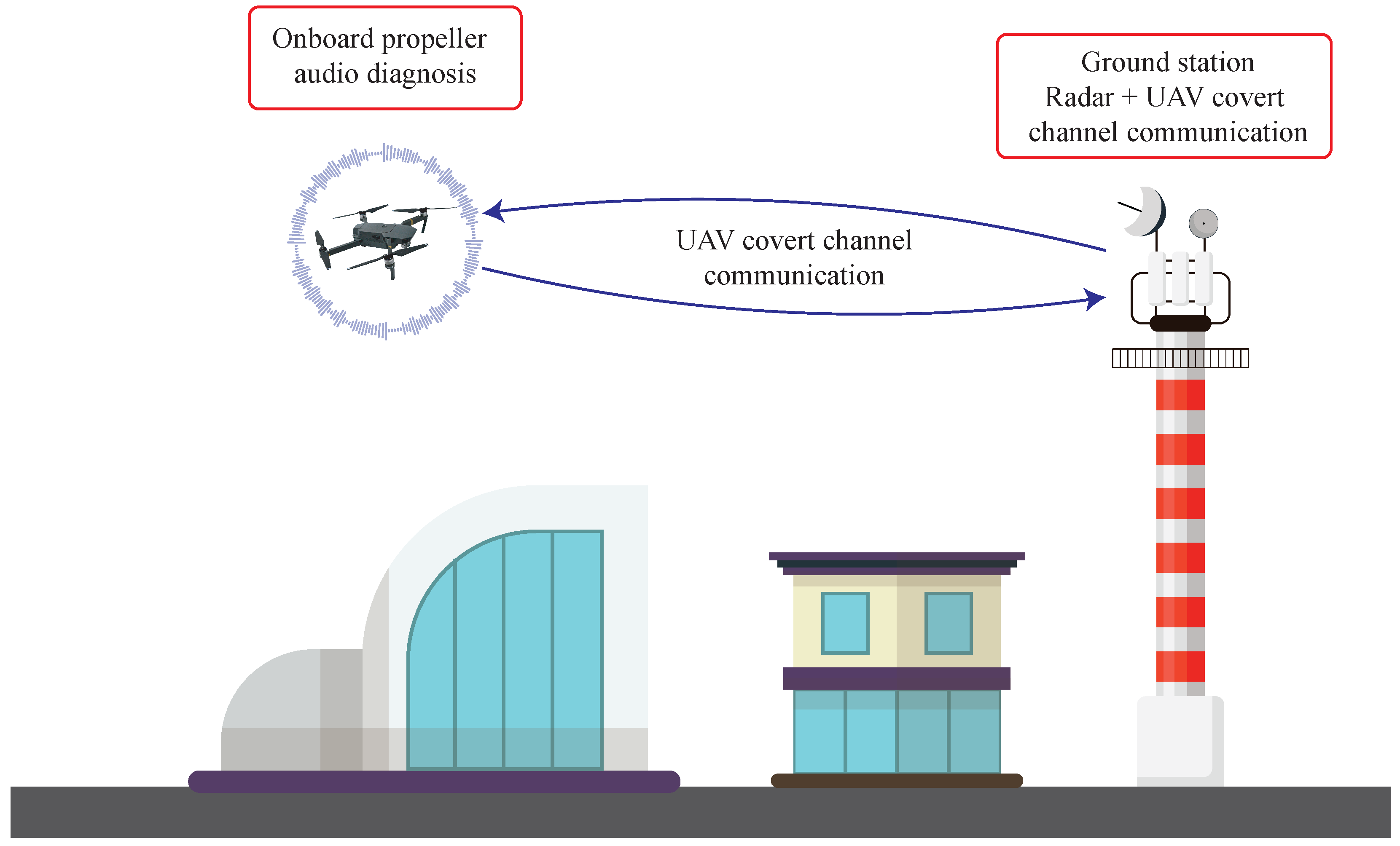
2. Application Scenario
3. Experimental Setup
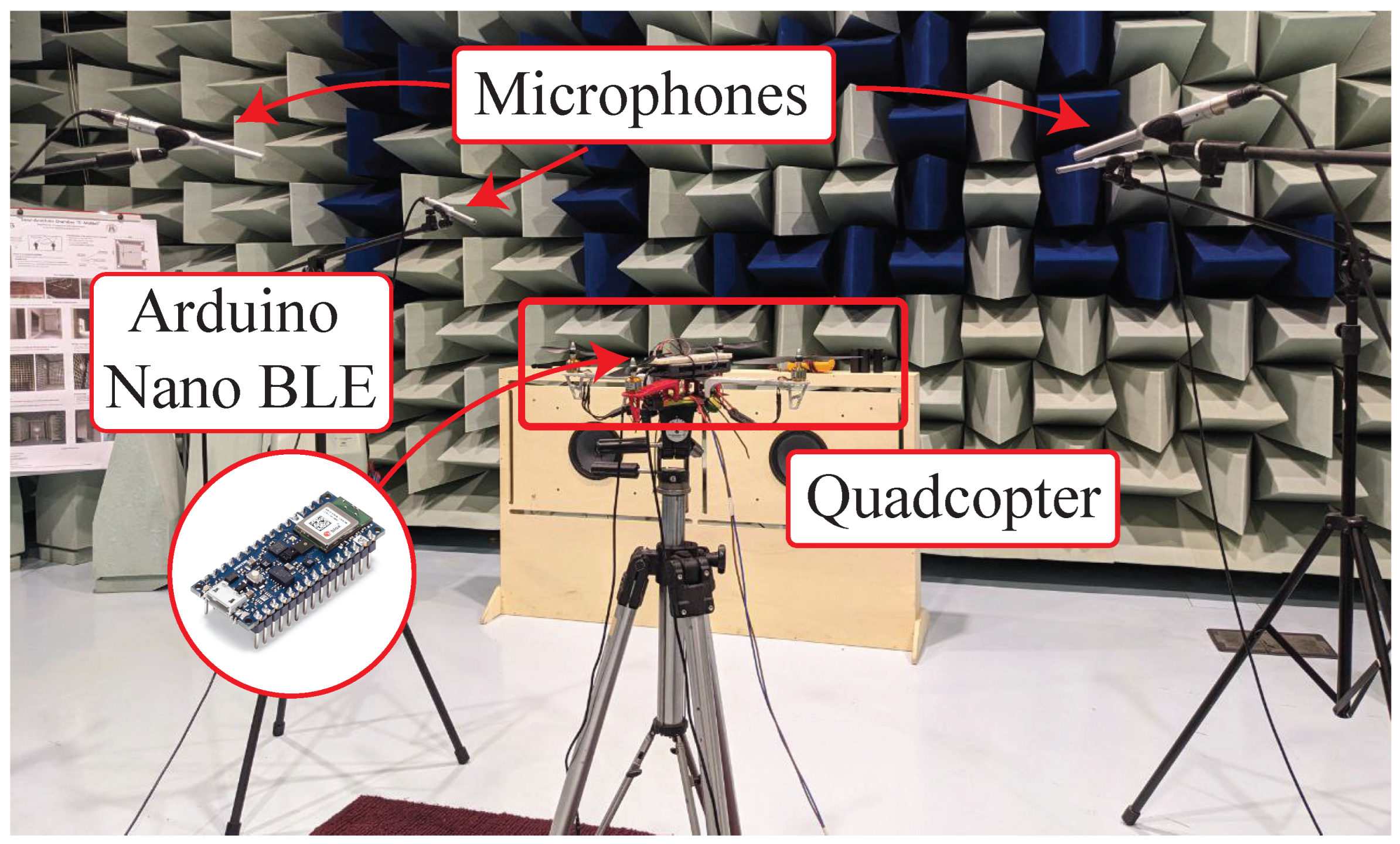
3.1. Quadcopter Setup
3.2. Audio Acquisition Systems
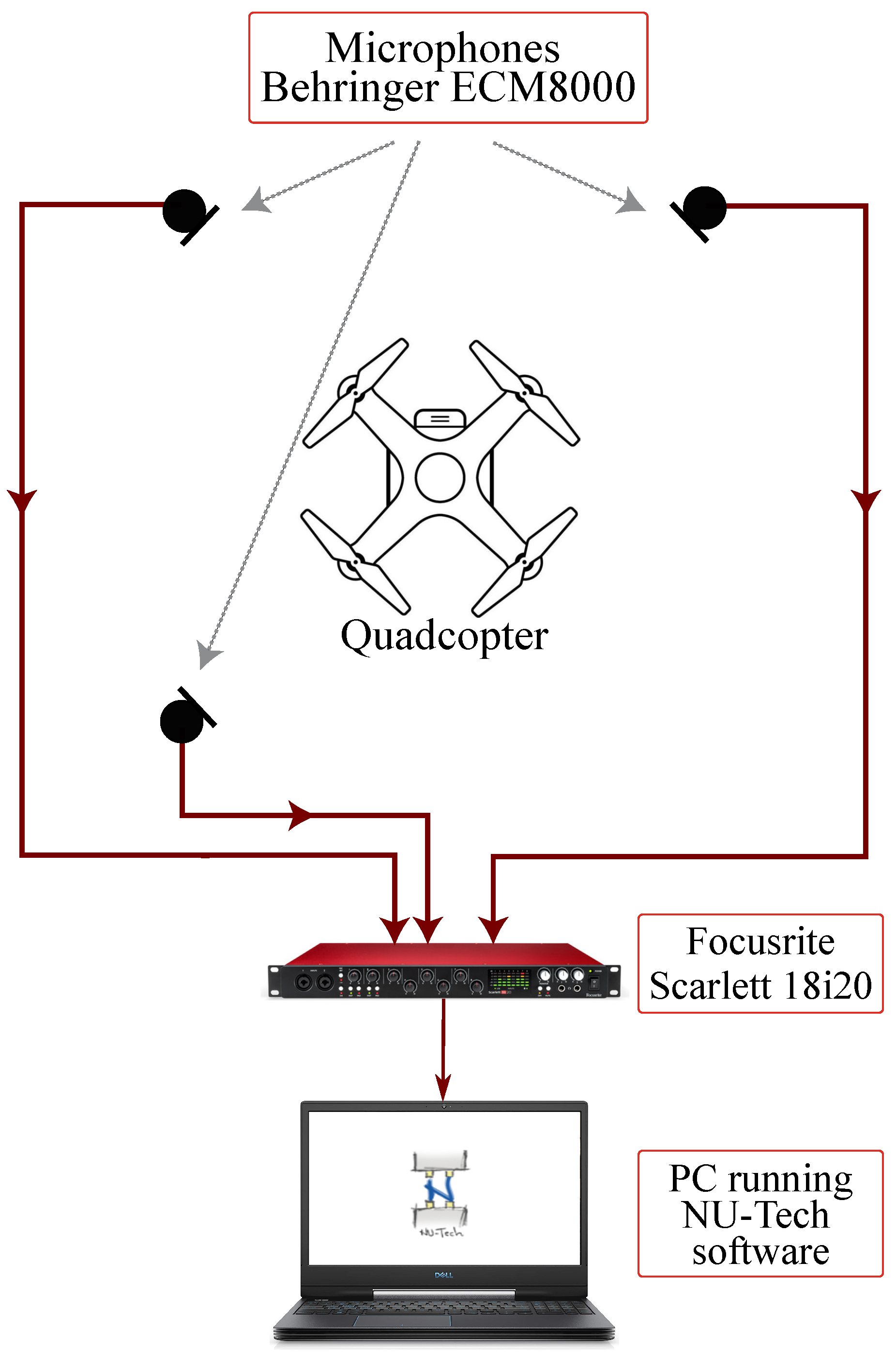
3.2.1. Data Acquisition System Using Professional Microphones
3.2.2. Embedded Data Acquisition System
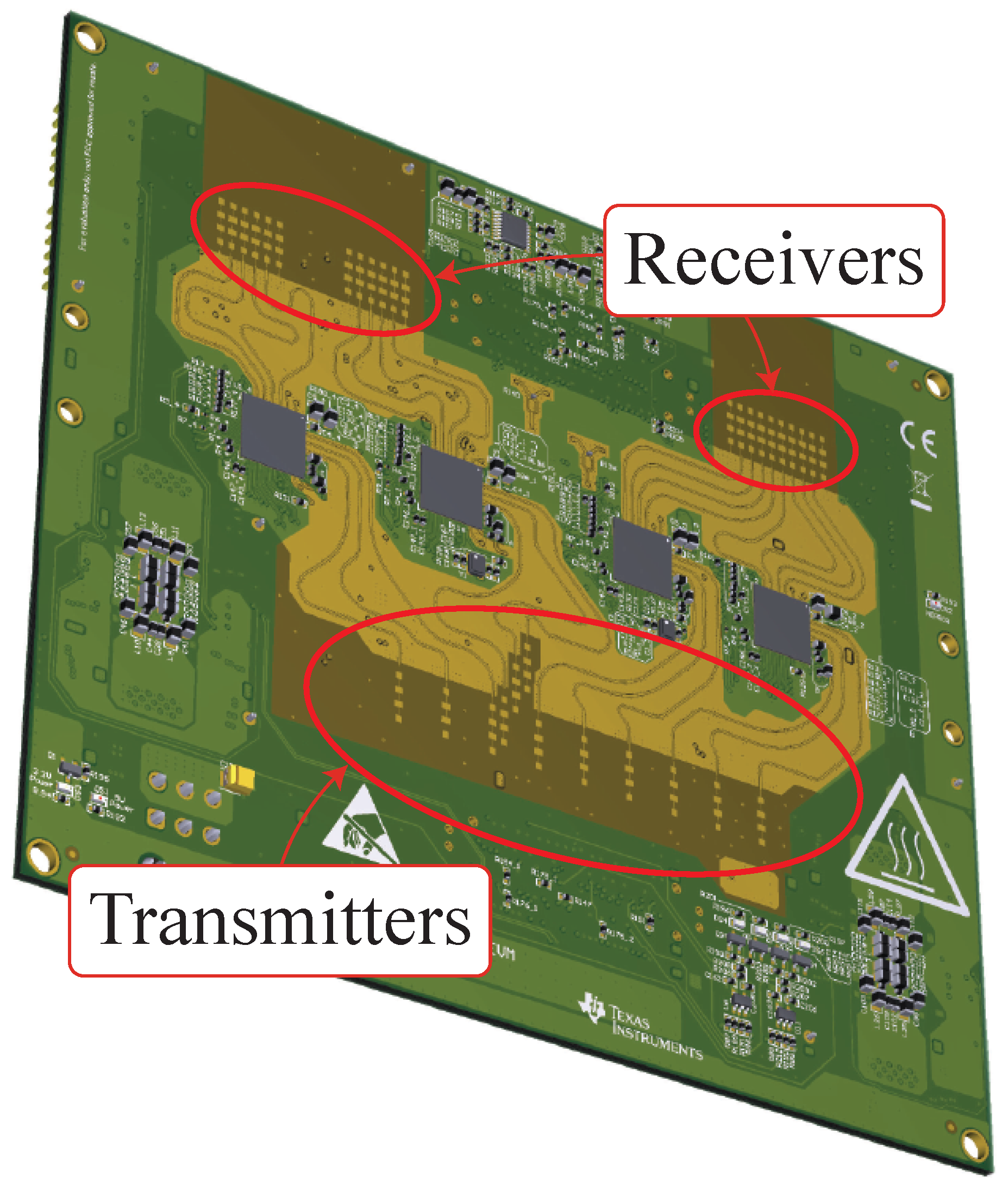
3.3. Radar System and Displacement Measurement Method
4. Dataset Description
4.1. Audio Datasets
4.2. Radar Vibration Displacement Signals
5. Machine Learning Model
5.1. Feature Extraction Phase
5.2. Neural Network
5.3. Embedded Machine Learning Model
6. Results and Discussion
6.1. Embedded ML Audio Model Classification Performances
6.2. Radar Displacement Results
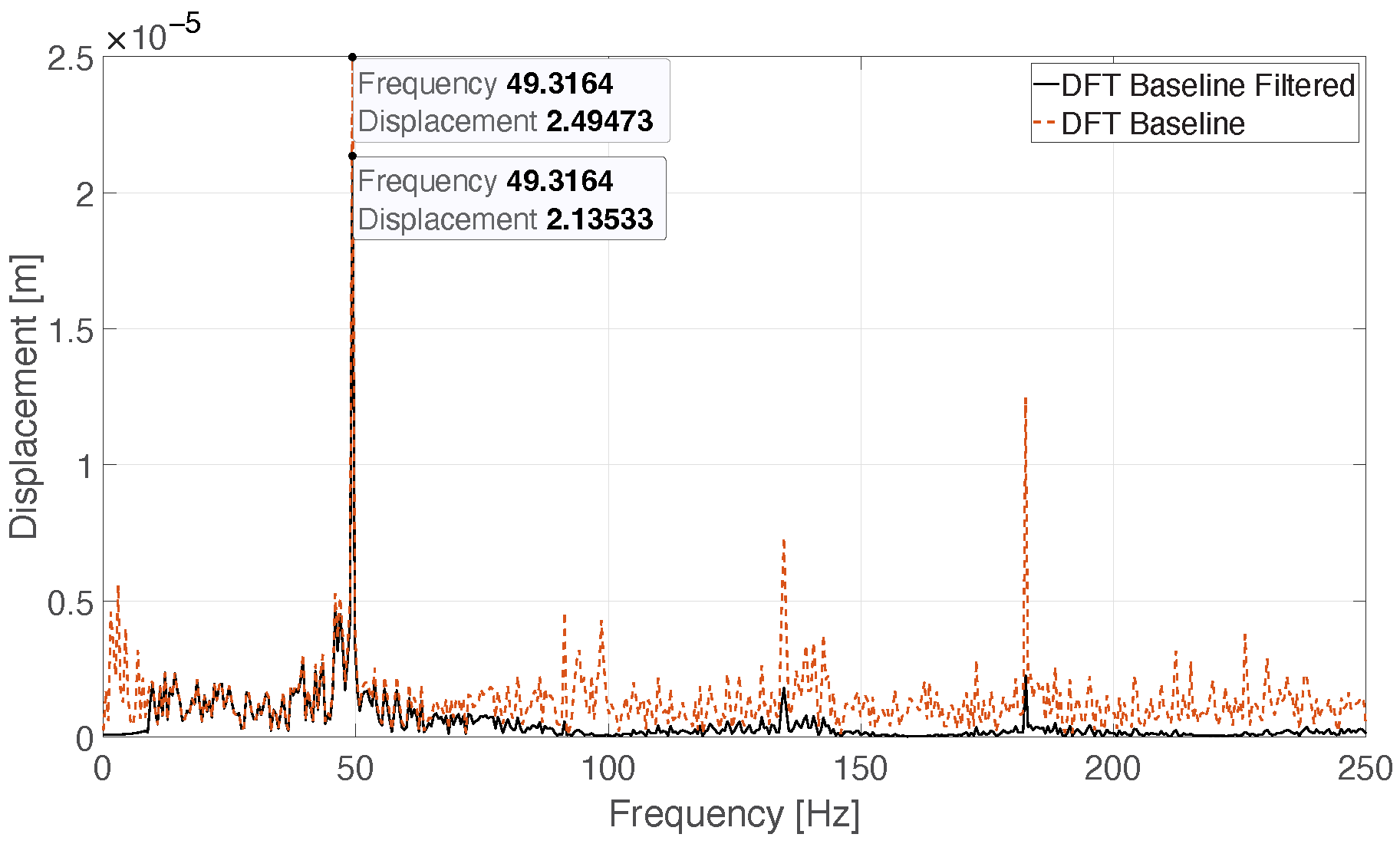
- and are chosen according to the vibration peak frequency. With and , the first zero of the magnitude frequency response of the filter is , while the peak of the vibration is . This way, its frequency falls within the first lobe of the filter.
- The high-pass filter is used to remove the low vibration frequencies. The method used to obtain the displacement measurement is to select the highest peak and store the collected value. As the low frequency components can be high but not significant for the proposed method, the high-pass filter is used to remove them.
6.3. Discussion
7. Conclusions
Author Contributions
Funding
Institutional Review Board Statement
Informed Consent Statement
Data Availability Statement
Conflicts of Interest
References
- Zhang, Z.; Zhu, L. A Review on Unmanned Aerial Vehicle Remote Sensing: Platforms, Sensors, Data Processing Methods, and Applications. Drones 2023, 7, 398. [Google Scholar] [CrossRef]
- Fitzpatrick, A.; Mathews, R.P.; Singhvi, A.; Arbabian, A. Multi-modal sensor fusion towards three-dimensional airborne sonar imaging in hydrodynamic conditions. Commun. Eng. 2023, 2, 16. [Google Scholar] [CrossRef]
- He, Y.; Huang, F.; Wang, D.; Chen, B.; Zhang, R. Emergency Communications in Post-Disaster Scenarios: IoT-Enhanced Airship and Buffer Support. IEEE Internet Things J. 2025, 12, 11457–11468. [Google Scholar] [CrossRef]
- Nex, F.; Remondino, F. UAV for 3D mapping applications: A review. Appl. Geomat. 2014, 6, 1–15. [Google Scholar] [CrossRef]
- Shakhatreh, H.; Sawalmeh, A.H.; Al-Fuqaha, A.; Dou, Z.; Almaita, E.; Khalil, I.; Othman, N.S.; Khreishah, A.; Guizani, M. Unmanned aerial vehicles (UAVs): A survey on civil applications and key research challenges. IEEE Access 2019, 7, 48572–48634. [Google Scholar] [CrossRef]
- Menouar, H.; Guvenc, I.; Akkaya, K.; Uluagac, A.S.; Kadri, A.; Tuncer, A. UAV-enabled intelligent transportation systems for the smart city: Applications and challenges. IEEE Commun. Mag. 2017, 55, 22–28. [Google Scholar] [CrossRef]
- Bruschi, V.; Cecchi, S.; Ciattaglia, G.; Iadarola, G.; Peruzzi, G.; Pozzebon, A.; Spinsante, S. Lightweight UAV Propeller Fault Detection Through Audio Signals Measurements. In Proceedings of the 2024 IEEE International Instrumentation and Measurement Technology Conference (I2MTC), Glasgow, UK, 20–23 May 2024; pp. 1–6. [Google Scholar]
- Abbas, N.; Abbas, Z.; Liu, X.; Khan, S.S.; Foster, E.D.; Larkin, S. A Survey: Future Smart Cities Based on Advance Control of Unmanned Aerial Vehicles (UAVs). Appl. Sci. 2023, 13, 9881. [Google Scholar] [CrossRef]
- Peng, H.; Mao, Z.; Jiang, B.; Cheng, Y. Bayesian Semantic-Guided Attribute Transfer-Based Dual-Driven Fault Diagnosis for UAVs Swarm Systems With Unseen Faults. IEEE Trans. Ind. Inform. 2025, 21, 6690–6700. [Google Scholar] [CrossRef]
- Al-Emadi, S.; Al-Ali, A.; Al-Ali, A. Audio-Based Drone Detection and Identification Using Deep Learning Techniques with Dataset Enhancement through Generative Adversarial Networks. Sensors 2021, 21, 4953. [Google Scholar] [CrossRef] [PubMed]
- Bertocco, M.; Brighente, A.; Ciattaglia, G.; Gambi, E.; Peruzzi, G.; Pozzebon, A.; Spinsante, S. Malicious Drone Identification by Vibration Signature Measurement: A Radar-Based Approach. IEEE Trans. Instrum. Meas. 2025, 74, 8004415. [Google Scholar] [CrossRef]
- Ciattaglia, G.; Iadarola, G.; Senigagliesi, L.; Spinsante, S.; Gambi, E. UAV Propeller Rotational Speed Measurement through FMCW Radars. Remote Sens. 2023, 15, 270. [Google Scholar] [CrossRef]
- Puchalski, R.; Giernacki, W. UAV Fault Detection Methods, State-of-the-Art. Drones 2022, 6, 330. [Google Scholar] [CrossRef]
- García-Gomez, J.; Bautista-Durán, M.; Gil-Pita, R.; Rosa-Zurera, M. Feature Selection for Real-Time Acoustic Drone Detection Using Genetic Algorithms. In Proceedings of the Audio Engineering Society Convention 142, Berlin, Germany, 20–22 May 2017. [Google Scholar]
- Bondyra, A.; Kołodziejczak, M.; Kulikowski, R.; Giernacki, W. An Acoustic Fault Detection and Isolation System for Multirotor UAV. Energies 2022, 15, 3955. [Google Scholar] [CrossRef]
- Altinors, A.; Yol, F.; Yaman, O. A sound based method for fault detection with statistical feature extraction in UAV motors. Appl. Acoust. 2021, 183, 108325. [Google Scholar] [CrossRef]
- Yi, W.; Choi, J.W.; Lee, J.W. Sound-based drone fault classification using multitask learning. In Proceedings of the 29th International Congress on Sound and Vibration, Prague, Czech Republic, 9–13 July 2023. [Google Scholar]
- Chen, V.C. The Micro-Doppler Effect in Radar; Artech House: Norwood, MA, USA, 2019. [Google Scholar]
- Ritchie, M.; Fioranelli, F.; Griffiths, H.; Torvik, B. Monostatic and bistatic radar measurements of birds and micro-drone. In Proceedings of the 2016 IEEE Radar Conference (RadarConf), Philadelphia, PA, USA, 2–6 May 2016; pp. 1–5. [Google Scholar] [CrossRef]
- Kang, K.B.; Choi, J.H.; Cho, B.L.; Lee, J.S.; Kim, K.T. Analysis of Micro-Doppler Signatures of Small UAVs Based on Doppler Spectrum. IEEE Trans. Aerosp. Electron. Syst. 2021, 57, 3252–3267. [Google Scholar] [CrossRef]
- Ciattaglia, G.; Bertocco, M.; Brighente, A.; Gambi, E.; Peruzzi, G.; Pozzebon, A.; Spinsante, S. Good Vibes: A PWM-Enabled Covert Channel for Securing UAVs Operations. In Proceedings of the 2025 IEEE Sensors Applications Symposium (SAS), Newcastle, UK, 8–10 July 2025; pp. 1–6. [Google Scholar]
- European Telecommunications Standards Institute. ETSI TR 103 148 V1.1.1: Electromagnetic Compatibility and Radio Spectrum Matters (ERM); System Reference Document (SRdoc); Technical Characteristics of Radio Equipment to be Used in the 76 GHz to 77 GHz Band, Short-Range Radar to be Fitted on Fixed Transport Infrastructure; European Telecommunications Standards Institute: Valbonne, France, 2014. [Google Scholar]
- European Telecommunications Standards Institute. ETSI EN 302 264 V2.1.1: Short Range Devices; Transport and Traffic Telematics (TTT); Short Range Radar Equipment Operating in the 77 GHz to 81 GHz Band, Harmonised Standard Covering the Essential Requirements of Article 3.2 of Directive 2014/53/EU; European Telecommunications Standards Institute: Valbonne, France, 2017. [Google Scholar]
- Ciattaglia, G.; Iadarola, G.; Battista, G.; Senigagliesi, L.; Gambi, E.; Castellini, P.; Spinsante, S. Displacement Evaluation by mmWave FMCW Radars: Method and Performance Metrics. IEEE Trans. Instrum. Meas. 2024, 73, 1–13. [Google Scholar] [CrossRef]
- myRIO-1900. Available online: https://www.ni.com/zh-cn/search.html?q=myRIO-1900 (accessed on 1 December 2023).
- Katta, S.S.; Vuojärvi, K.; Nandyala, S.; Kovalainen, U.M.; Baddeley, L. Real-world on-board uav audio data set for propeller anomalies. In Proceedings of the ICASSP 2022-2022 IEEE International Conference on Acoustics, Speech and Signal Processing (ICASSP), Singapore, 23–27 May 2022; pp. 146–150. [Google Scholar]
- Doyon-D’Amour, F.; Stalder, C.; Hodges, T.; Stephan, M.; Wu, L.; Koukoulas, T.; Leahy, S.; St-Gelais, R. Vibration Sensitivity of one-port and two-port MEMS microphones. IEEE Sens. J. 2024, 24, 28625–28633. [Google Scholar] [CrossRef]
- King, C.B.; Monti, C. Microphone vibration sensitivity: What it is, why it is important, and how to measure it. In Proceedings of the Meetings on Acoustics, Nashville, TN, USA, 5–9 December 2022; AIP Publishing: Melville, NY, USA, 2022; Volume 50. [Google Scholar]
- Lattanzi, A.; Bettarelli, F.; Cecchi, S. NU-Tech: The Entry Tool of the hArtes Toolchain for Algorithms Design. In Proceedings of the 124th Audio Engineering Society Convention, Amsterdam, The Netherlands, 17–20 May 2008; pp. 1–8. [Google Scholar]
- ISO 3745:2012; Acoustics—Determination of Sound Power Levels and Sound Energy Levels of Noise Sources Using Sound Pressure—Precision Methods for Anechoic Rooms and Hemi-Anechoic Rooms. ISO—International Organization for Standardization: Geneva, Switzerland, 2012.
- Li, J.; Stoica, P. MIMO radar with colocated antennas. IEEE Signal Process. Mag. 2007, 24, 106–114. [Google Scholar] [CrossRef]
- Texas Instruments. TIDEP-01012 Imaging Radar Using Cascaded mmWave Sensor Reference Design. Available online: https://www.ti.com/tool/TIDEP-01012 (accessed on 24 June 2024).
- Palanisamy, R.P.; Kulkarni, C.S.; Corbetta, M.; Banerjee, P. Fault detection and Performance Monitoring of Propellers in Electric UAV. In Proceedings of the 2022 IEEE Aerospace Conference (AERO), Big Sky, MT, USA, 5–12 March 2022; pp. 1–6. [Google Scholar]
- Elshaar, M.E.; Ismail, M.A.; Abdallah, A.M.; Alqutub, A.M.; Takeyeldein, M.M.; Quan, Q. UAV Propeller: Fault Detection, Characterization, and Calibration: A Comprehensive Study. IEEE Access 2025, 13, 187564–187583. [Google Scholar] [CrossRef]
- Pose, C.; Giribet, J.; Torre, G. Propeller damage detection, classification and estimation in multirotor vehicles. IEEE Trans. Robot. 2025, 41, 2213–2229. [Google Scholar] [CrossRef]
- Wu, J.; Liu, Q.; Zhang, M.; Pan, Z.; Li, H.; Tan, K.C. HuRAI: A brain-inspired computational model for human-robot auditory interface. Neurocomputing 2021, 465, 103–113. [Google Scholar] [CrossRef]
- Kutsumi, Y.; Kanegawa, N.; Zeida, M.; Matsubara, H.; Murayama, N. Automated Bowel Sound and Motility Analysis with CNN Using a Smartphone. Sensors 2023, 23, 407. [Google Scholar] [CrossRef] [PubMed]
- Khalilabadi, M.R. Underwater Ship-radiated Acoustic Noise Recognition Based on Mel-Spectrogram and Convolutional Neural Network. Int. J. Coastal, Offshore Environ. Eng. 2023, 8, 10–15. [Google Scholar]
- Brighente, A.; Conti, M.; Peruzzi, G.; Pozzebon, A. ADASS: Anti-Drone Audio Surveillance Sentinel via Embedded Machine Learning. In Proceedings of the 2023 IEEE Sensors Applications Symposium (SAS), Ottawa, ON, Canada, 18–20 July 2023; pp. 1–6. [Google Scholar]
- Schafer, R.W. What Is a Savitzky-Golay Filter? [Lecture Notes]. IEEE Signal Process. Mag. 2011, 28, 111–117. [Google Scholar] [CrossRef]
- Gorry, P.A. General least-squares smoothing and differentiation by the convolution (Savitzky-Golay) method. Anal. Chem. 1990, 62, 570–573. [Google Scholar] [CrossRef]
- Mirabilii, D.; Habets, E.A.P. Spatial Coherence-Aware Multi-Channel Wind Noise Reduction. IEEE/ACM Trans. Audio Speech Lang. Process. 2020, 28, 1974–1987. [Google Scholar] [CrossRef]
- Park, J.; Park, J.; Lee, S.; Kim, J.; Hahn, M. Coherence-based Dual Microphone Wind Noise Reduction by Wiener Filtering. In Proceedings of the 8th International Conference on Signal Processing Systems, Auckland, New Zealand, 21–24 November 2016; pp. 170–172. [Google Scholar] [CrossRef]



| Parameter Name | Value |
|---|---|
| 77 GHz | |
| B | 3.99 GHz |
| 167 µs | |
| 12 | |
| T | 2 ms |
| 512 | |
| 12 MHz |
| Model Version | RAM Occupancy | Flash Occupancy | Execution Time |
|---|---|---|---|
| Complete | 152.1 kB | 72.6 kB | 2200.0 ms |
| Quantised | 41.9 kB | 56.4 kB | 486.0 ms |
| Filter Type | Parameter Name | Value |
|---|---|---|
| Savitzky–Golay | 3 | |
| Savitzky–Golay | 9 | |
| High Pass | Type | Butterworth |
| High Pass | Pass Frequency | 10 Hz |
| High Pass | Filter Order | 3 |
| Propeller Status | [Hz] | [Hz] | [m] | [m] |
|---|---|---|---|---|
| Baseline | 49.57 | 0.31 | 16 | 4 |
| Fault 0.5 cm | 48.94 | 1.45 | 17 | 3 |
| Fault 1 cm | 51.83 | 0.32 | 36 | 7 |
| Cut 0.5 cm | 46.76 | 0.98 | 11 | 2 |
| Cut 1 cm | 42.32 | 13.07 | 7 | 1 |
| Cut 1.5 cm | 47.66 | 0.99 | 2 | 3 |
| Cut 2 cm | 49.61 | 0.32 | 10 | 3 |
Disclaimer/Publisher’s Note: The statements, opinions and data contained in all publications are solely those of the individual author(s) and contributor(s) and not of MDPI and/or the editor(s). MDPI and/or the editor(s) disclaim responsibility for any injury to people or property resulting from any ideas, methods, instructions or products referred to in the content. |
© 2026 by the authors. Licensee MDPI, Basel, Switzerland. This article is an open access article distributed under the terms and conditions of the Creative Commons Attribution (CC BY) license.
Share and Cite
Ciattaglia, G.; Peruzzi, G.; Bertocco, M.; Bruschi, V.; Cecchi, S.; Iadarola, G.; Pozzebon, A.; Spinsante, S. A Two-Step Sensor Fusion Methodology to Assess Damage on Drone Propellers by Audio and Radar Measurements. Sensors 2026, 26, 1429. https://doi.org/10.3390/s26051429
Ciattaglia G, Peruzzi G, Bertocco M, Bruschi V, Cecchi S, Iadarola G, Pozzebon A, Spinsante S. A Two-Step Sensor Fusion Methodology to Assess Damage on Drone Propellers by Audio and Radar Measurements. Sensors. 2026; 26(5):1429. https://doi.org/10.3390/s26051429
Chicago/Turabian StyleCiattaglia, Gianluca, Giacomo Peruzzi, Matteo Bertocco, Valeria Bruschi, Stefania Cecchi, Grazia Iadarola, Alessandro Pozzebon, and Susanna Spinsante. 2026. "A Two-Step Sensor Fusion Methodology to Assess Damage on Drone Propellers by Audio and Radar Measurements" Sensors 26, no. 5: 1429. https://doi.org/10.3390/s26051429
APA StyleCiattaglia, G., Peruzzi, G., Bertocco, M., Bruschi, V., Cecchi, S., Iadarola, G., Pozzebon, A., & Spinsante, S. (2026). A Two-Step Sensor Fusion Methodology to Assess Damage on Drone Propellers by Audio and Radar Measurements. Sensors, 26(5), 1429. https://doi.org/10.3390/s26051429