Research on Dynamic Spectrum Sharing in the Internet of Vehicles Based on Blockchain and Game Theory
Abstract
1. Introduction
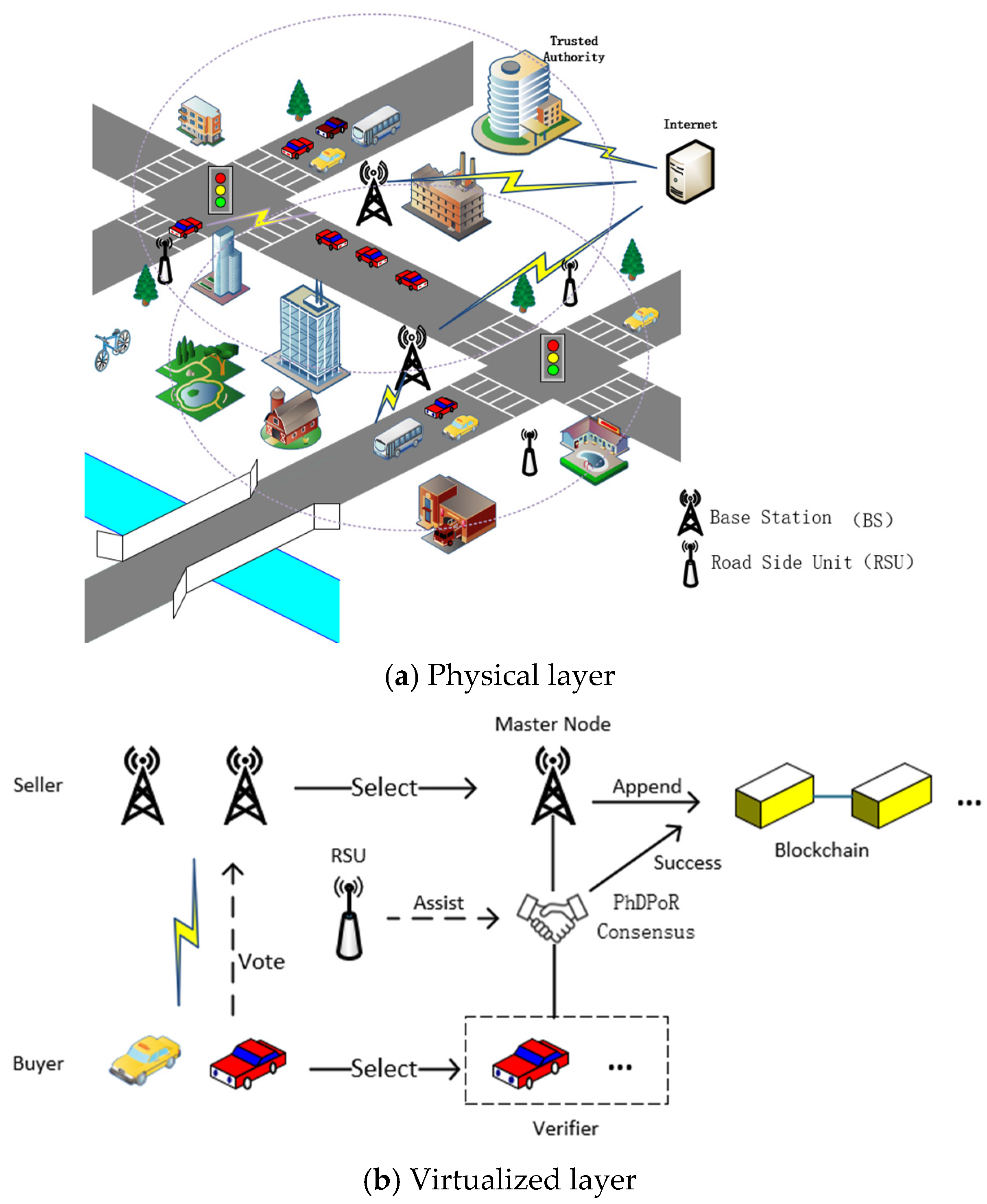
- A classification method based on vehicle demand urgency is proposed. The higher the vehicle demand urgency is, the higher the vehicle priority is. The priority of vehicle demand plays a role in the consensus mechanism PhDPoR with voting rights.
- The PhDPoR consensus algorithm is proposed, which achieves the optimal solution for spectrum resource allocation in terms of economic efficiency while ensuring consensus determinism.
- We model the interaction between buyers and sellers in this scenario as an MLMF Stackelberg game, use asymmetric pricing to conduct dynamic spectrum trading, optimize the allocation of spectrum resources, and prove the existence of Stackelberg equilibrium.
- We introduce reputation evaluation into vehicles and base stations, and select master nodes and verifiers according to reputation. Reputation evaluation plays an important role in resource allocation and block verification tasks.
2. Related Work
3. System Model
3.1. Model Architecture
3.2. Vehicle Demand Urgency Index
3.3. Smart Contract
4. Formulate the Problem
4.1. Profit Model
4.2. MLMF Stackelberg Game Model
- The seller’s base station sets the price of the unit spectrum based on the comprehensive consideration of its own remaining spectrum and operating costs.
- The buyer responds with the amount of spectrum required to be purchased based on the initial price of the spectrum in combination with its own spectrum demand.
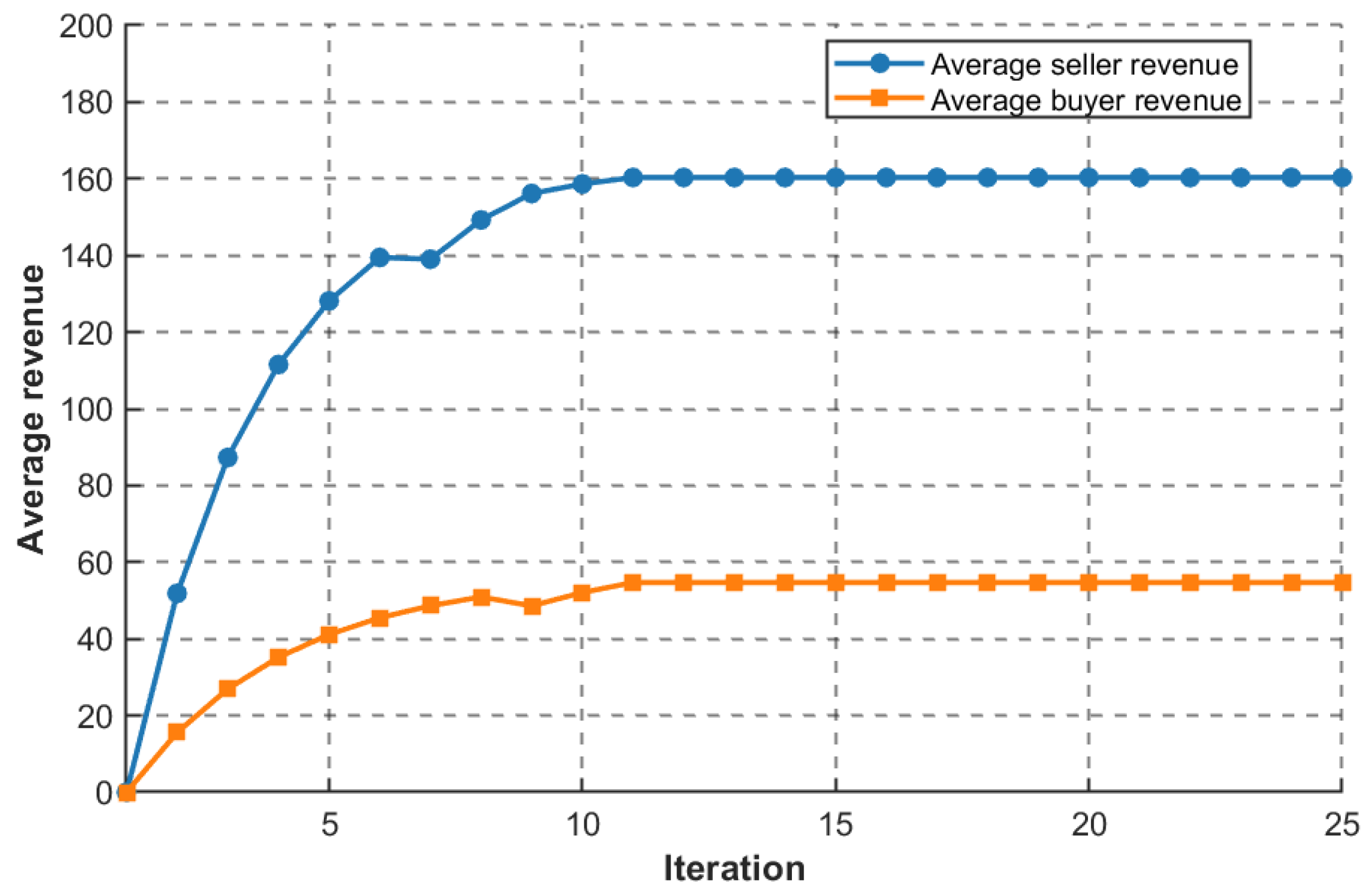
- The buyer and the seller calculate their own profits based on the mutual information, and evaluate whether they can improve their own profits by changing their strategies. If there is a better strategy, the buyer and the seller make their own adjustments and return to the first step.
- When both sides have no better strategy to improve their own returns, it is regarded as reaching SE and the game is over.
5. Consensus Plan
5.1. Calculation of Voting Rights
5.2. Node Reputation Calculation
5.3. Block Message Storage
5.4. Reputation-Based Verifier Selection
5.5. PhDPoR Consensue Process
5.6. Threat and Security Analysis
5.7. Total Computing Power Consumption
- Energy consumption during the resource allocation phase: This phase involves the iterative convergence of the game, where represents the number of iterations required to reach equilibrium. The total energy is the sum of the computational costs of the base station and all vehicles:
- Consensus Phase Energy Consumption: This phase consumes resources for reputation calculation, voting power calculation, and block verification. The energy consumption for validators is:where is the effective switched capacitor, is the processor frequency, and , , and represent the number of CPU cycles for reputation calculation, voting power calculation, and block verification, respectively.
5.8. Time Delay
- Spectrum allocation time: The allocation phase is based on an MLMF Stackelberg game, which involves iterative interactions between the base station and the vehicle. Let be the number of iterations required for the game to reach a Stackelberg equilibrium (SE). In each iteration, the time consumption consists of data transmission latency and computation latency, as detailed below:where and are the average downlink and uplink data transmission rates, respectively; and are the data sizes of the price broadcast message and bandwidth request message, respectively; and and are the computation times for the base station and the vehicle, respectively.
- Consensus Phase Time: The consensus delay in the PhDPoR mechanism mainly stems from block propagation and the voting process among validators; let be the block size and be the number of validators. The consensus delay is as follows:where is the number of CPU clock cycles required to verify a single digital signature, is the number of transactions in the block, and is the size of the voting signature message.
6. Experimental Simulation
6.1. Simulation Environment
6.2. Simulation Result
6.2.1. Performance Evaluation
6.2.2. Equilibrium Evaluation of MLMF Stackelberg Games
6.2.3. Validity of Priority and Reputation Values
6.2.4. Utility Optimization and Safety Assessment
7. Conclusions and Prospect
Author Contributions
Funding
Institutional Review Board Statement
Informed Consent Statement
Data Availability Statement
Conflicts of Interest
Appendix A
References
- Kumar, V.; Ali, R.; Sharma, P. IoV-6G+: A secure blockchain-based data collection and sharing framework for Internet of vehicles in 6G-assisted environment. Veh. Commun. 2024, 47, 100783. [Google Scholar]
- Xia, S.; Lin, F.; Chen, Z.; Tang, C.; Ma, Y.; Yu, X. A Bayesian game based vehicle-to-vehicle electricity trading scheme for blockchain-enabled internet of vehicles. IEEE Trans. Veh. Technol. 2020, 69, 6856–6868. [Google Scholar]
- Hua, W.; Zhou, Y.; Qadrdan, M.; Wu, J.; Jenkins, N. Blockchain enabled decentralized local electricity markets with flexibility from heating sources. IEEE Trans. Smart Grid 2022, 14, 1607–1620. [Google Scholar] [CrossRef]
- Sun, Z.; Qi, F.; Liu, L.; Xing, Y.; Xie, W. Energy-efficient spectrum sharing for 6G ubiquitous IoT networks through blockchain. IEEE Internet Things J. 2022, 10, 9342–9352. [Google Scholar] [CrossRef]
- Ucer, E.; Buckreus, R.; Kisacikoglu, M.C.; Bulut, E.; Guven, M.; Sozer, Y.; Giubbolini, L. A flexible V2V charger as a new layer of vehicle-grid integration framework. In Proceedings of the 2019 IEEE Transportation Electrification Conference and Expo (ITEC), Detroit, MI, USA, 19–21 June 2019; pp. 1–7. [Google Scholar]
- Natarajan, H.; Krause, S.; Gradstein, H. Distributed Ledger Technology and Blockchain; World Bank Group: Washington, DC, USA, 2017. [Google Scholar]
- Belotti, M.; Božić, N.; Pujolle, G.; Secci, S. A vademecum on blockchain technologies: When, which, and how. IEEE Commun. Surv. Tutor. 2019, 21, 3796–3838. [Google Scholar]
- Zhang, L.; Luo, M.; Li, J.; Au, M.H.; Choo, K.-K.R.; Chen, T.; Tian, S. Blockchain based secure data sharing system for Internet of vehicles: A position paper. Veh. Commun. 2019, 16, 85–93. [Google Scholar] [CrossRef]
- Qiu, J.; Grace, D.; Ding, G.; Yao, J.; Wu, Q. Blockchain-based secure spectrum trading for unmanned-aerial-vehicle-assisted cellular networks: An operator’s perspective. IEEE Internet Things J. 2019, 7, 451–466. [Google Scholar]
- Zhang, Y.; Jiang, J.; Li, Y. Intelligent analysis and application of judicial big data sharing based on blockchain. In Proceedings of the 2023 6th International Conference on Artificial Intelligence and Big Data (ICAIBD), Chengdu, China, 26–29 May 2023; pp. 592–596. [Google Scholar]
- Mitola, J.; Maguire, G.Q. Cognitive radio: Making software radios more personal. IEEE Pers. Commun. 2002, 6, 13–18. [Google Scholar]
- Chen, G.; Zhu, H.; Xu, Y.; Song, T.; Hu, J. A novel joint spectrum sensing and resource allocation scheme in cognitive internet of vehicles networks. IEEE Trans. Veh. Technol. 2024, 73, 13412–13424. [Google Scholar] [CrossRef]
- Singh, P.K.; Singh, R.; Nandi, S.K.; Ghafoor, K.Z.; Rawat, D.B.; Nandi, S. Blockchain-based adaptive trust management in internet of vehicles using smart contract. IEEE Trans. Intell. Transp. Syst. 2020, 22, 3616–3630. [Google Scholar] [CrossRef]
- Liu, T.; Wu, J.; Chen, L.; Wu, Y.; Li, Y. Smart contract-based long-term auction for mobile blockchain computation offloading. IEEE Access 2020, 8, 36029–36042. [Google Scholar] [CrossRef]
- Xue, L.; Yang, W.; Chen, W.; Huang, L. STBC: A novel blockchain-based spectrum trading solution. IEEE Trans. Cogn. Commun. Netw. 2021, 8, 13–30. [Google Scholar] [CrossRef]
- Liang, Y.; Lu, C.; Zhao, Y.; Sun, C. Interference-based consensus and transaction validation mechanisms for blockchain-based spectrum management. IEEE Access 2021, 9, 90757–90766. [Google Scholar] [CrossRef]
- Li, Q.; Wang, Q.; Zhao, H.; Chang, T.; Yang, Y.; Xia, S. Dynamic credible spectrum sharing based on smart contract in vehicular networks. Mathematics 2024, 12, 1929. [Google Scholar] [CrossRef]
- Zhao, Y.; Wang, Y.; Wang, P.; Yu, H. PBTM: A privacy-preserving announcement protocol with blockchain-based trust management for IoV. IEEE Syst. J. 2021, 16, 3422–3432. [Google Scholar] [CrossRef]
- Daian, P.; Pass, R.; Shi, E. In Snow white: Robustly reconfigurable consensus and applications to provably secure proof of stake. In Proceedings of the International Conference on Financial Cryptography and Data Security, Frigate Bay, Saint Kitts and Nevis, 18–22 February 2019; Springer: Berlin/Heidelberg, Germany, 2019; pp. 23–41. [Google Scholar]
- Zheng, Z.; Xie, S.; Dai, H.-N.; Chen, X.; Wang, H. Blockchain challenges and opportunities: A survey. Int. J. Web Grid Serv. 2018, 14, 352–375. [Google Scholar] [CrossRef]
- Androulaki, E.; Barger, A.; Bortnikov, V.; Cachin, C.; Christidis, K.; De Caro, A.; Enyeart, D.; Ferris, C.; Laventman, G.; Manevich, Y. Hyperledger fabric: A distributed operating system for permissioned blockchains. In Proceedings of the Thirteenth Eurosys Conference, Porto, Portugal, 23–26 April 2018; pp. 1–15. [Google Scholar]
- Hu, Z.; Liu, B.; Shen, A.; Luo, J. Blockchain-based resource allocation mechanism for the internet of vehicles: Balancing efficiency and security. IEEE Trans. Netw. Serv. Manag. 2024, 21, 3971–3987. [Google Scholar] [CrossRef]
- Shen, B.; Shen, Y.; Ji, W. Profit optimization in service-oriented data market: A Stackelberg game approach. Future Gener. Comput. Syst. 2019, 95, 17–25. [Google Scholar]
- Feng, Z.; Li, G.; Xu, Y.; Chen, X.; Li, W.; Wang, L.; Xu, Y.; Jiao, Y. Spectrum compensation-based joint communication and jamming channel allocation: A hierarchical stochastic potential game approach. IEEE Trans. Veh. Technol. 2022, 72, 4046–4051. [Google Scholar] [CrossRef]
- Hosseini, M.; Ghazizadeh, R. Stackelberg game-based deployment design and radio resource allocation in coordinated UAVs-assisted vehicular communication networks. IEEE Trans. Veh. Technol. 2022, 72, 1196–1210. [Google Scholar] [CrossRef]
- Saha, R.K. Exploiting in-building small cell architecture for realizing dynamic spectrum sharing techniques. In Proceedings of the 2019 IEEE International Symposium on Dynamic Spectrum Access Networks (DySPAN), Newark, NJ, USA, 11–14 November 2019; pp. 1–2. [Google Scholar]
- Suriya, M.; Sumithra, M.G. Overview of spectrum sharing and dynamic spectrum allocation schemes in cognitive radio networks. In Proceedings of the 2022 8th International Conference on Advanced Computing and Communication Systems (ICACCS), Coimbatore, India, 25–26 March 2022; pp. 934–937. [Google Scholar]



| Vehicle Purpose | Demand Type | Vehicle Examples | Social Impact | Priority Level | Urgency Index Value |
|---|---|---|---|---|---|
| Special Purpose | Emergency | Ambulance, fire truck, police car | Emergency Safety | 1 | 1.0 |
| Special Purpose | General | Tanker, tow truck | Special Needs | 2 | 0.6 |
| Public Transport | Logistics/Public Transit | Express truck, logistics trailer, bus, tour bus | Social Transport | 3 | 0.6 |
| Private/Sedan | Commercial/Private | Rideshare car, taxi, hitchhiking car, private car | General Transport | 4 | 0.2 |
| Module Name | Trigger Condition | Input Parameters | Description |
|---|---|---|---|
| InitGame | Vehicle Request | RequestMsg | Initializes game |
| TriggerConsensus | Equilibrium Reached | Proposes a new block | |
| ExecuteAllocation | Consensus > 2/3 | BlockData | Executes transfer |
| UpdateReputation | Audit Completed | AuditResult | Updates reputation |
| Parameter | Value |
|---|---|
| Blockchain type | Alliance Blockchain |
| Number of base stations | 4 |
| Number of RSUs | 8 |
| Number of vehicles | [20–120] |
| Base station transmission radius | 5 km |
| RSU transmission radius | 300 m |
| Speed of vehicle movement | [60–75] km/h |
| Vehicle priority | [1, 4] |
| Block size | 1.0 MB |
| Block propagation delay | 0.42 S |
| Noise power | −174 dBm/Hz |
| Transmission power | 1.2 W |
| Buyer 1 | Buyer 2 | Buyer 3 | Buyer 4 | Buyer 5 | Buyer 6 | Buyer 7 | Buyer 8 | |
|---|---|---|---|---|---|---|---|---|
| Without reputation | 115 | 220 | 140 | 180 | 110 | 136 | 210 | 215 |
| With reputation | 120 | 195 | 143 | 255 | 305 | 126 | 215 | 207 |
Disclaimer/Publisher’s Note: The statements, opinions and data contained in all publications are solely those of the individual author(s) and contributor(s) and not of MDPI and/or the editor(s). MDPI and/or the editor(s) disclaim responsibility for any injury to people or property resulting from any ideas, methods, instructions or products referred to in the content. |
© 2026 by the authors. Licensee MDPI, Basel, Switzerland. This article is an open access article distributed under the terms and conditions of the Creative Commons Attribution (CC BY) license.
Share and Cite
Shen, X.; Li, M.; Yang, J.; Yi, J. Research on Dynamic Spectrum Sharing in the Internet of Vehicles Based on Blockchain and Game Theory. Sensors 2026, 26, 1190. https://doi.org/10.3390/s26041190
Shen X, Li M, Yang J, Yi J. Research on Dynamic Spectrum Sharing in the Internet of Vehicles Based on Blockchain and Game Theory. Sensors. 2026; 26(4):1190. https://doi.org/10.3390/s26041190
Chicago/Turabian StyleShen, Xianhao, Mingze Li, Jiazhi Yang, and Jinsheng Yi. 2026. "Research on Dynamic Spectrum Sharing in the Internet of Vehicles Based on Blockchain and Game Theory" Sensors 26, no. 4: 1190. https://doi.org/10.3390/s26041190
APA StyleShen, X., Li, M., Yang, J., & Yi, J. (2026). Research on Dynamic Spectrum Sharing in the Internet of Vehicles Based on Blockchain and Game Theory. Sensors, 26(4), 1190. https://doi.org/10.3390/s26041190