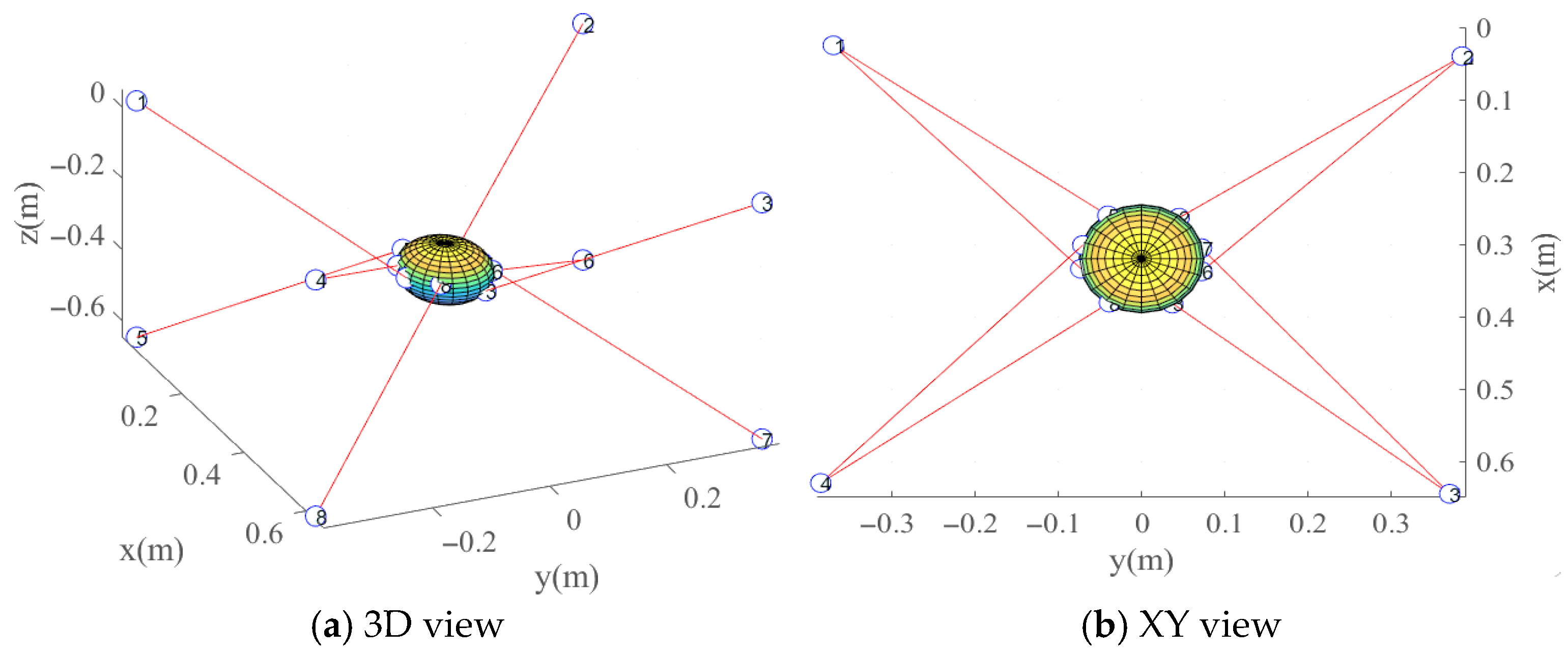
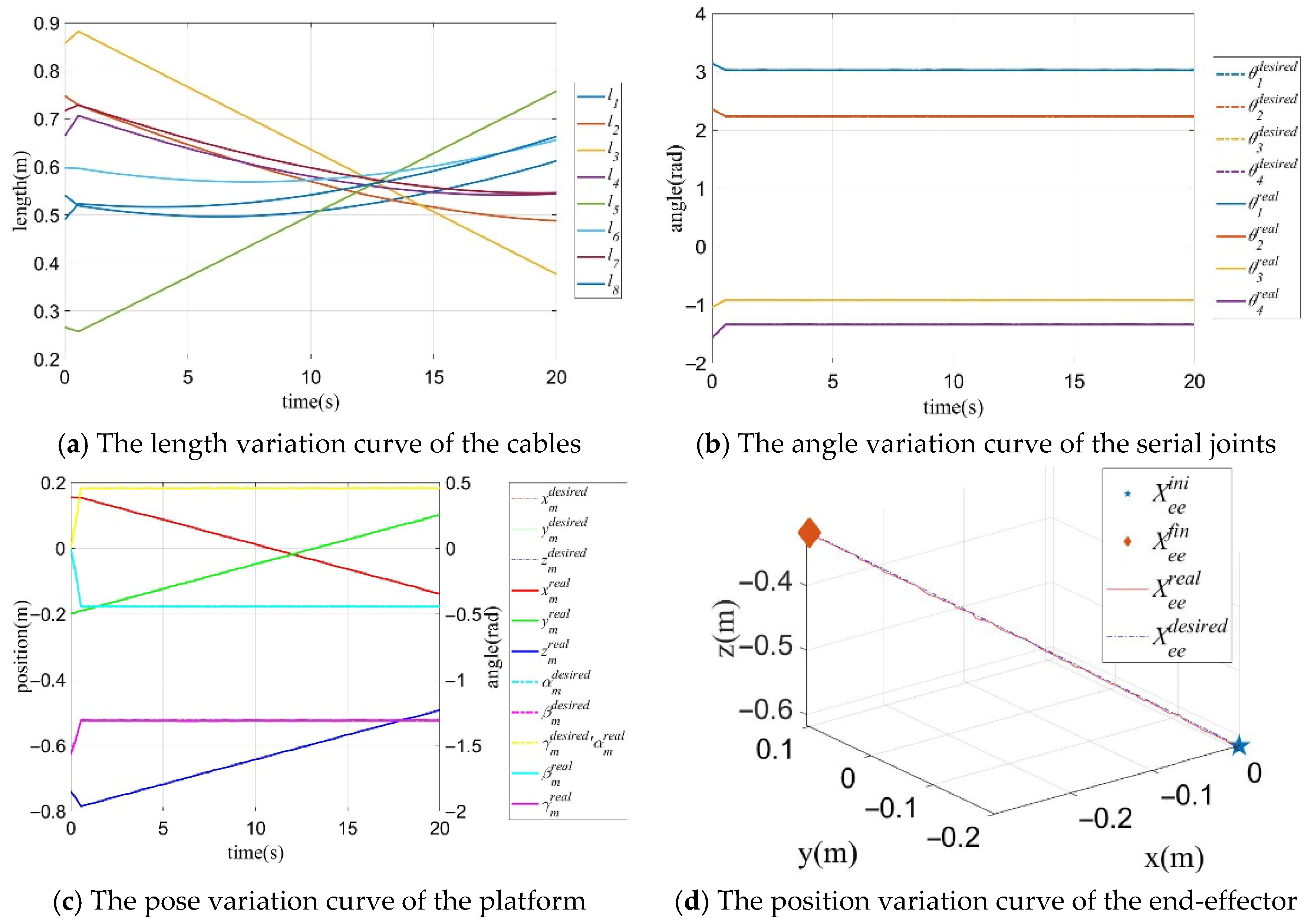
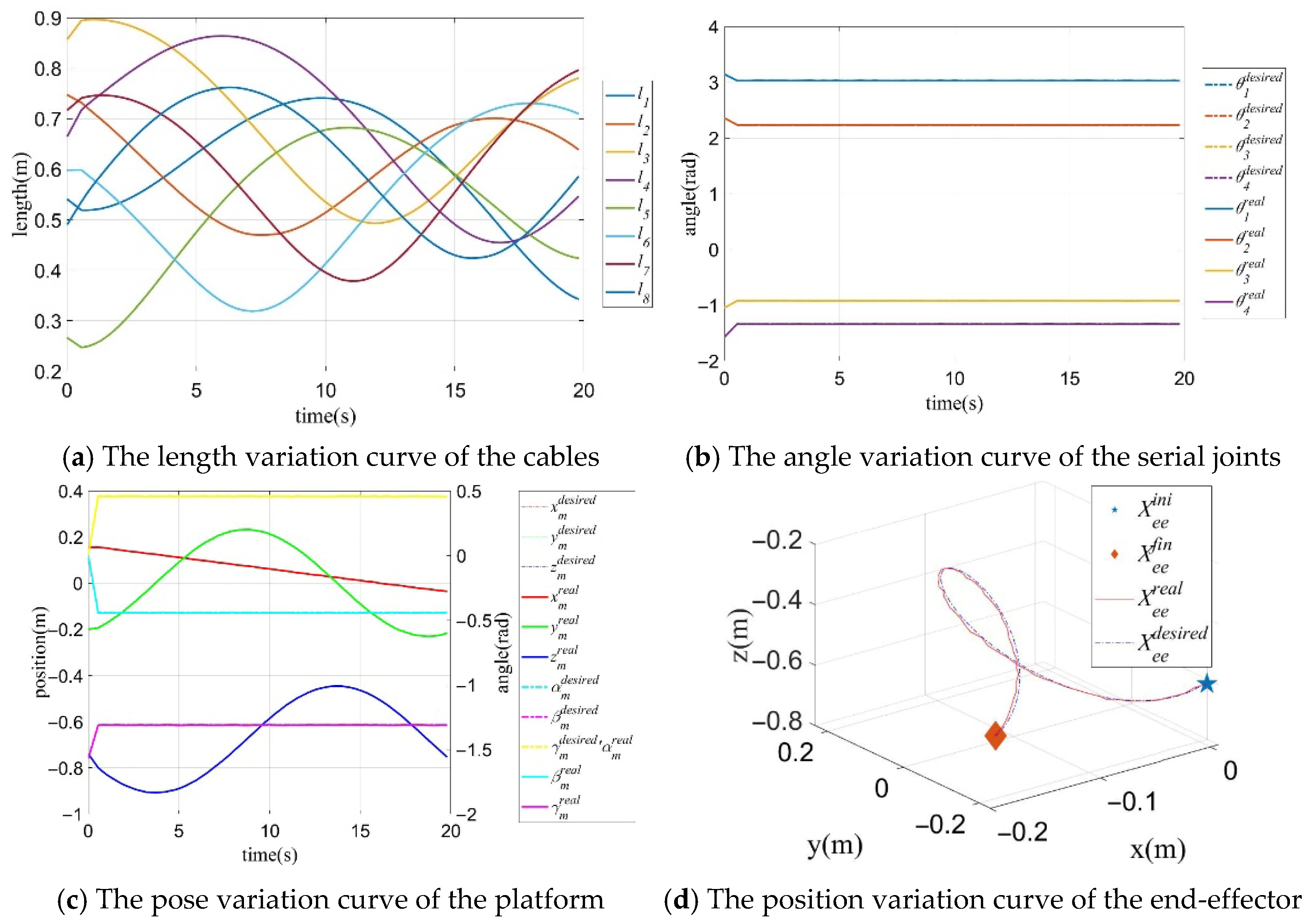
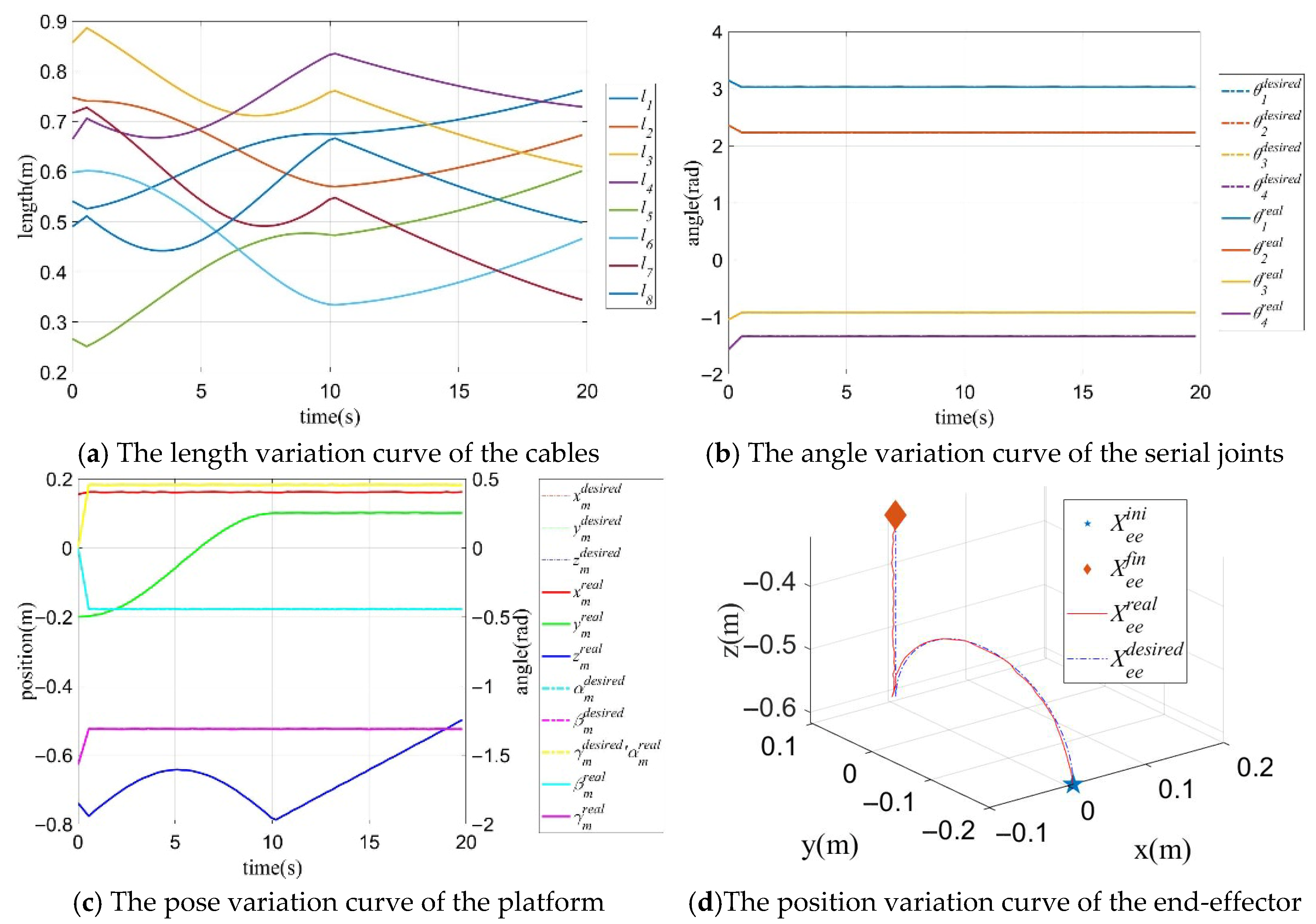
A Cable-Driven Hybrid Robot with Series-Parallel Coupling: Design, Modeling, Optimization Analysis, and Trajectory Tracking


Abstract
1. Introduction
2. Design of the Hybrid Robot
2.1. Function Analysis and Prototype Design
2.2. Hardware and Software System Design
3. Coupled Kinematic and Static Modeling
3.1. Motor-to-Cable FKs
3.2. Cable-to-End FKs
3.3. IKs of the CDHR
3.4. Static Modeling
4. Coupled Workspace Modeling and Analysis
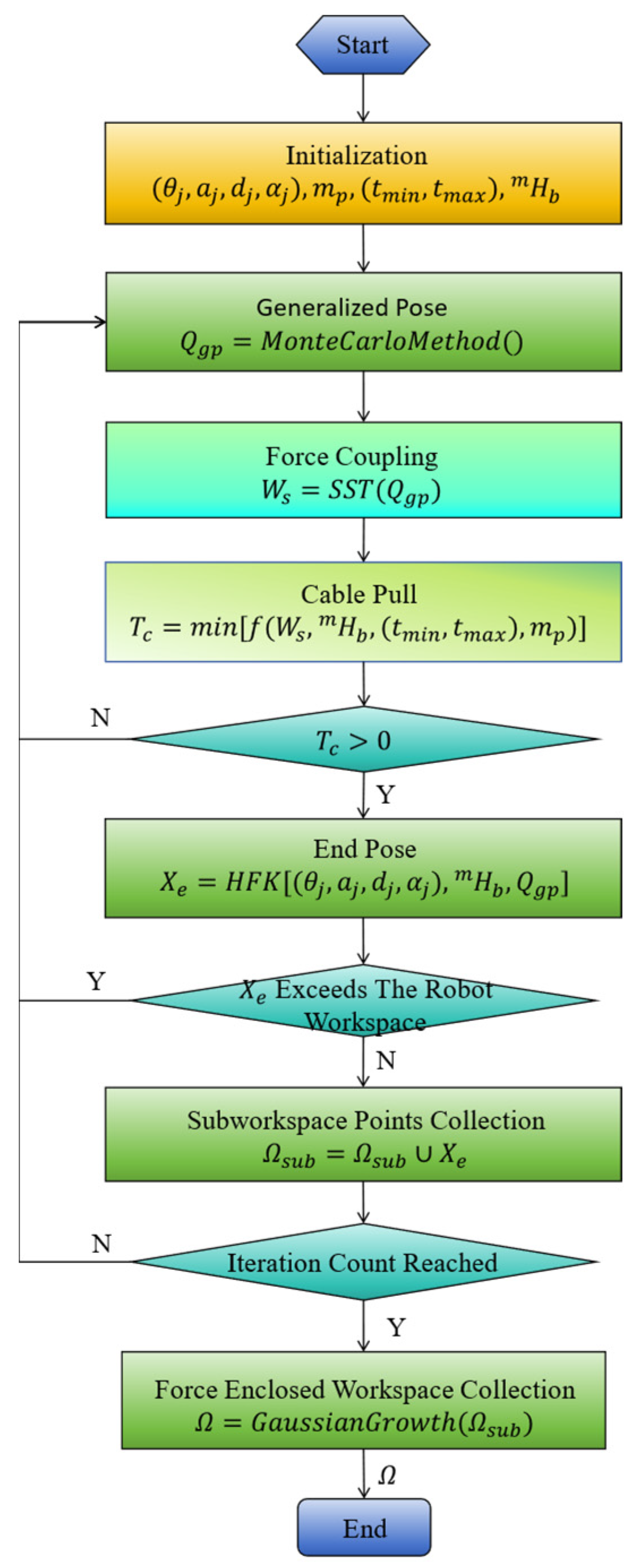
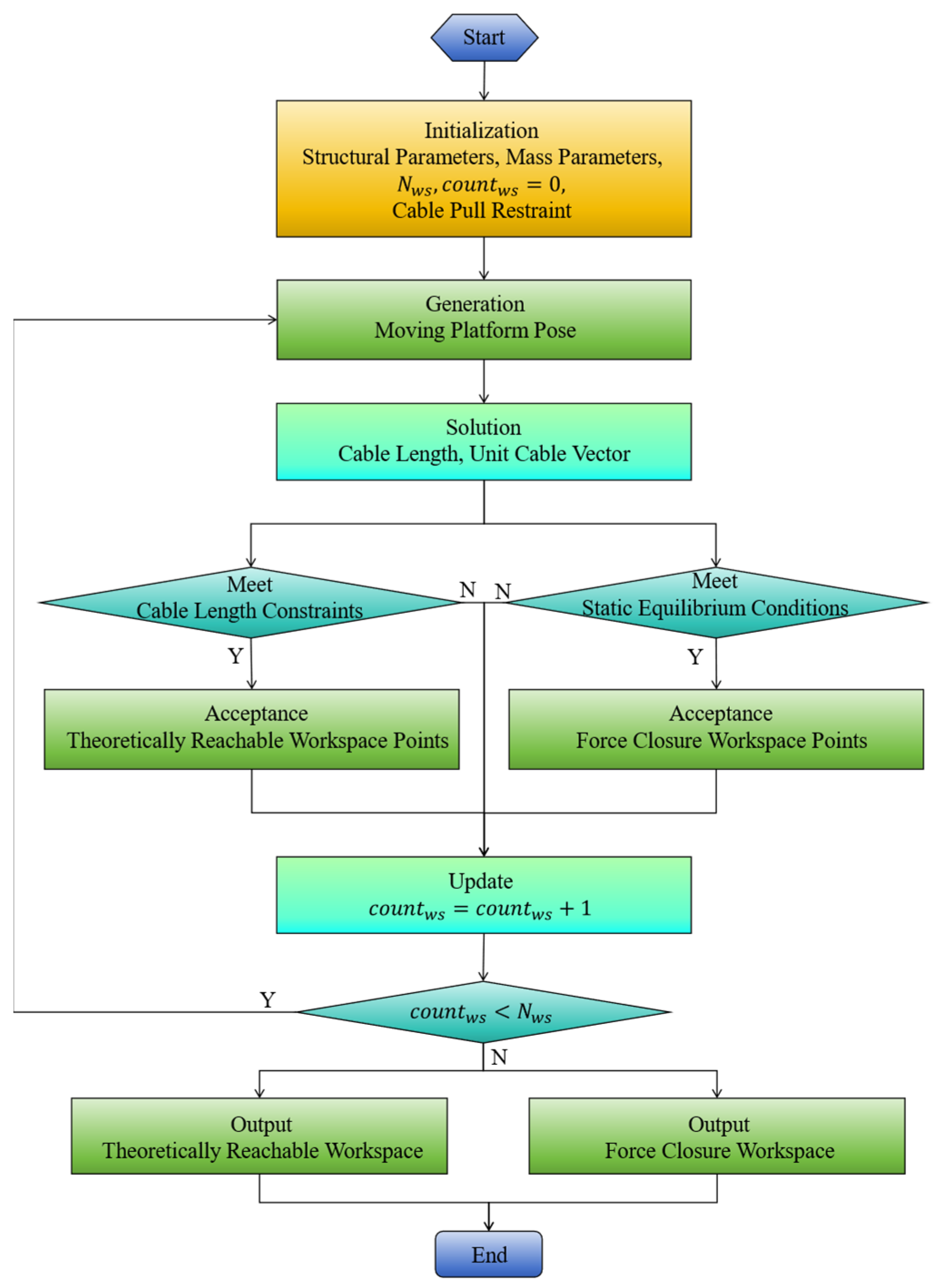
4.1. Coupled Workspace Modeling
- Constrained Workspace of the SM
- Constrained Workspace of the SM
- Complete FCW
4.2. Workspace Analysis
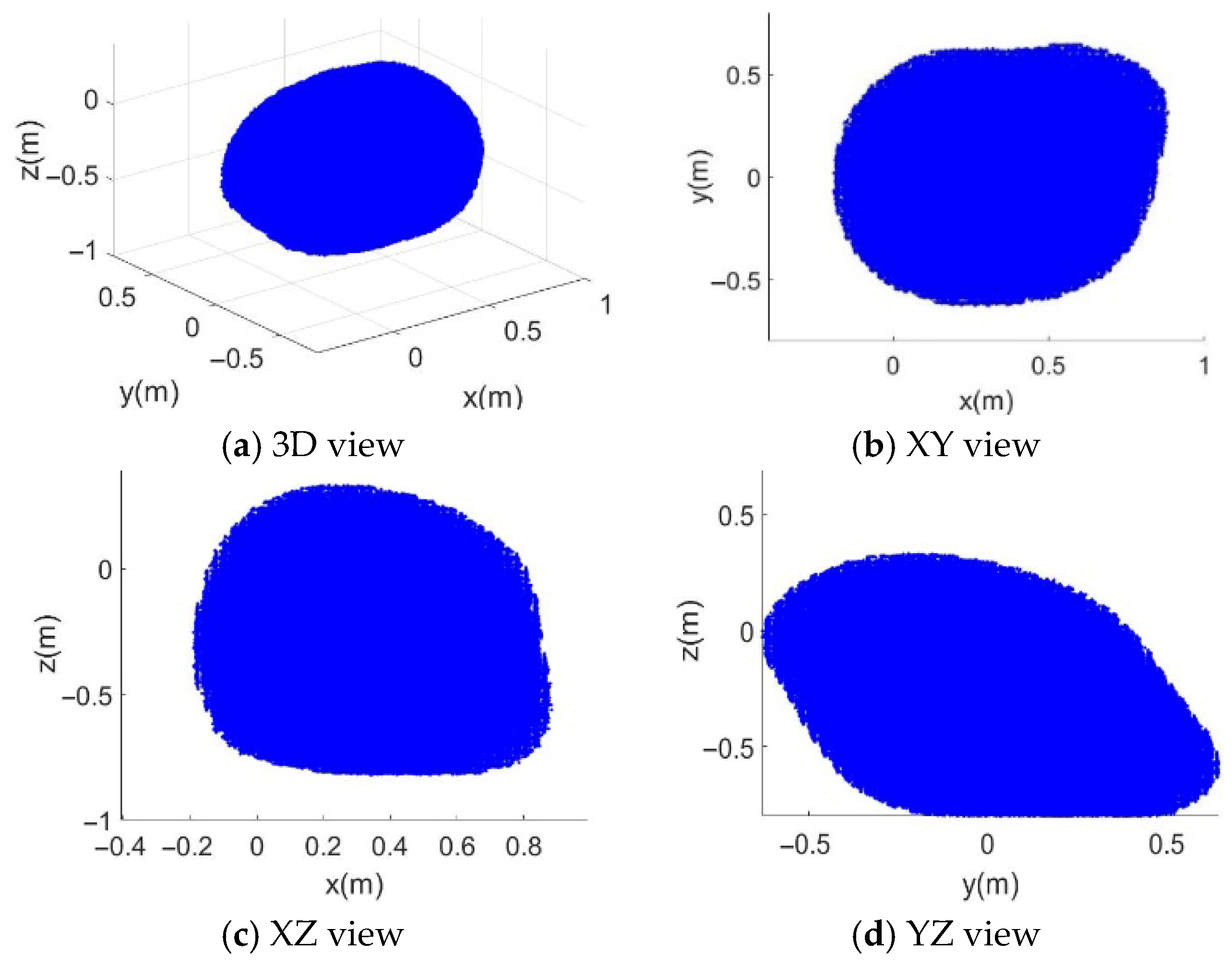
- Coupled Workspace Analysis
- Workspace Analysis of Arm Flexibility
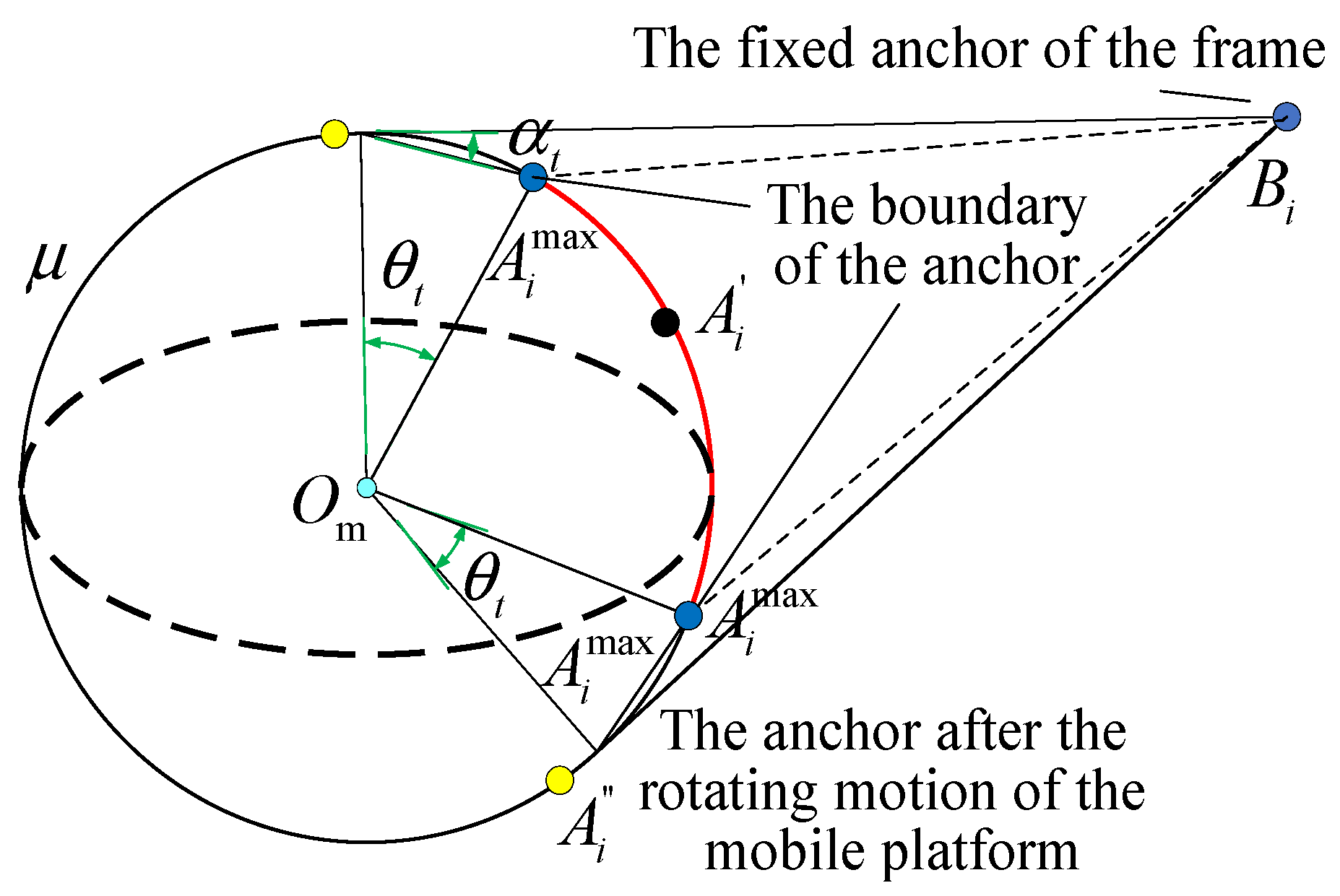
5. Dynamic Anchor Seat Position Optimization Method Based on the Global Condition Number
6. Vision-Based Self-Calibration Method for Kinematic Parameters
6.1. Multi-Mapping Calibration Problem of the Hybrid Robot
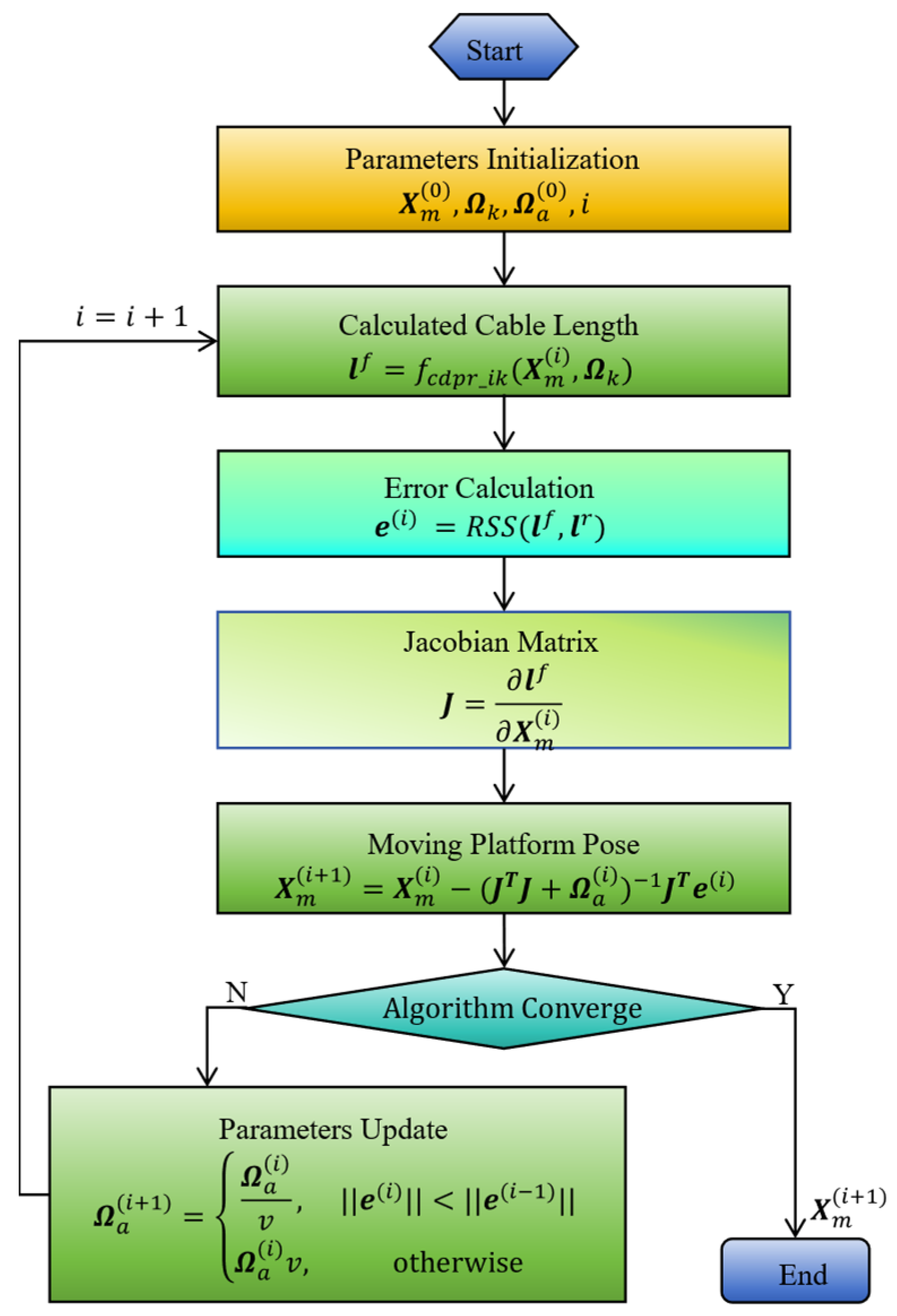
6.2. Resolving of the Self-Calibration Equation for the CDHR
| Algorithm 1: Kinematic Parameter Self-Calibration Algorithm for Cable-Driven Hybrid Robots |
| Input: Structural height , measured cable length set , convergence threshold , Output: Calibrated parameters . Initialization: Initialize parameter vector . Data Collection: Collect cable length data for poses, satisfying . do: using Equation (43) with current parameters. Construct the least-squares objective function: . using the Levenberg–Marquardt (LM) algorithm. Calculate residuals and check for convergence. End Return Optimized parameter set . |
7. Model Predictive Control-Based Trajectory Tracking Method
8. Simulation and Experiment Study
8.1. Simulation Study
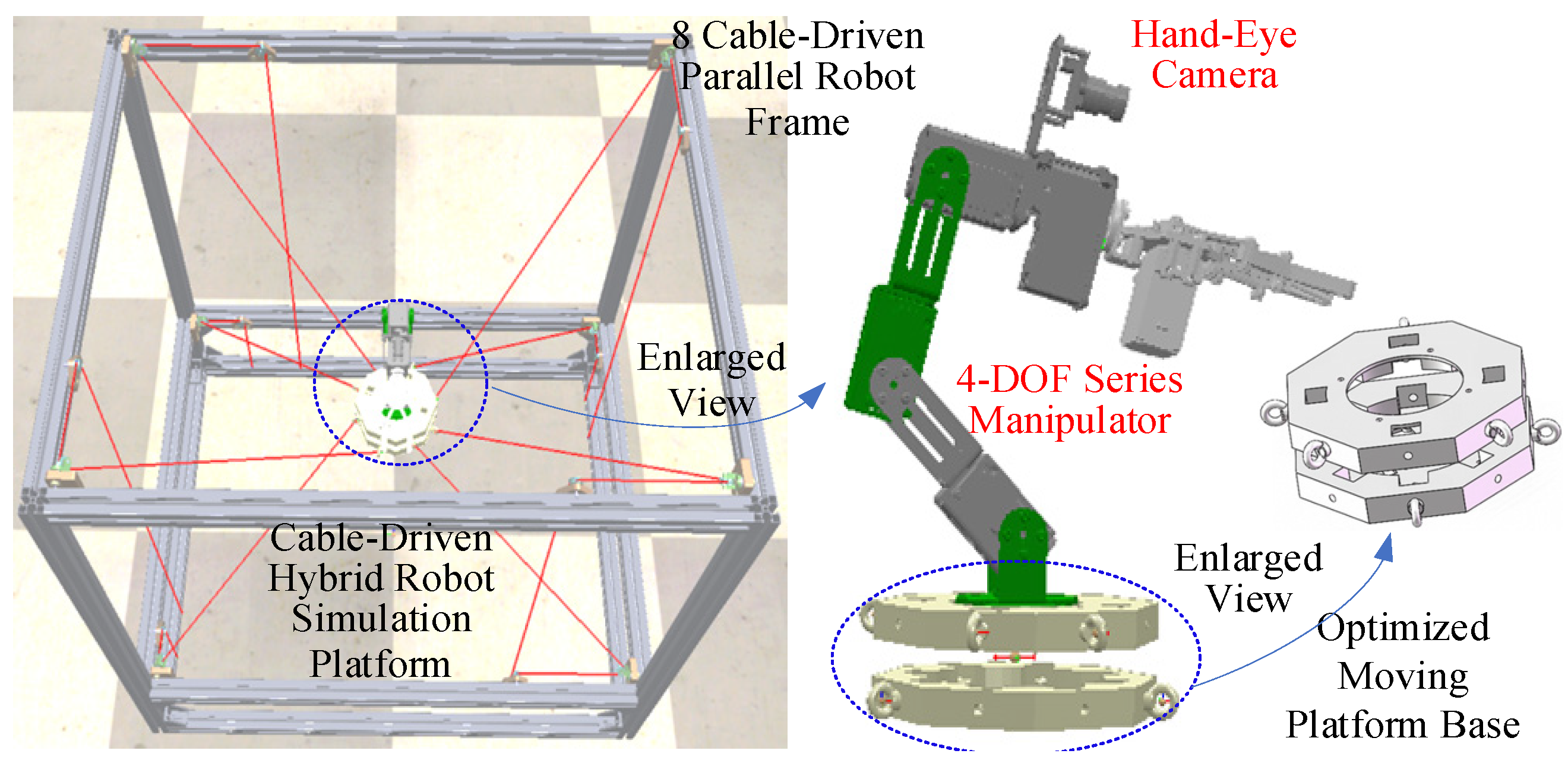
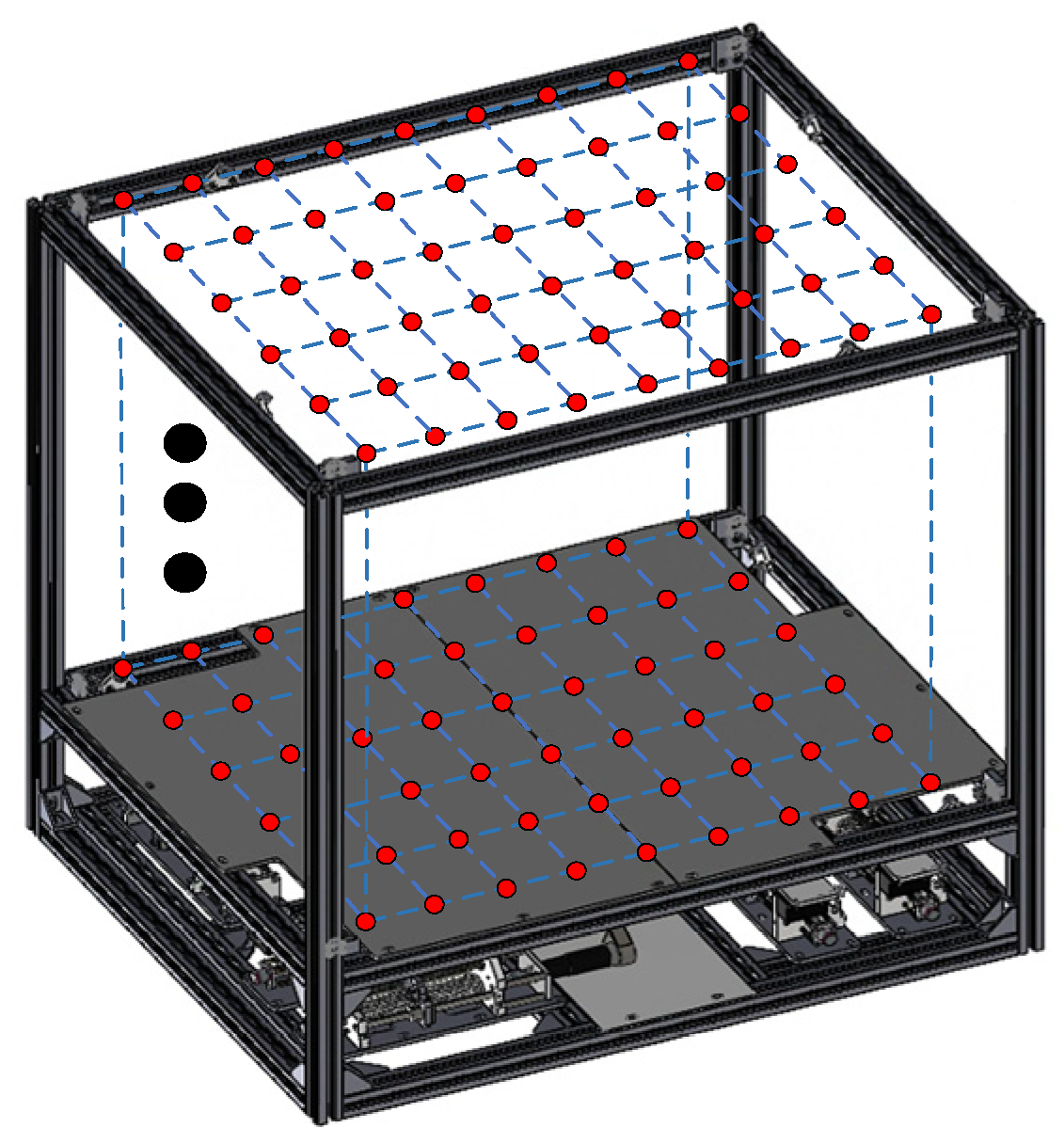
8.1.1. Simulation System Setup
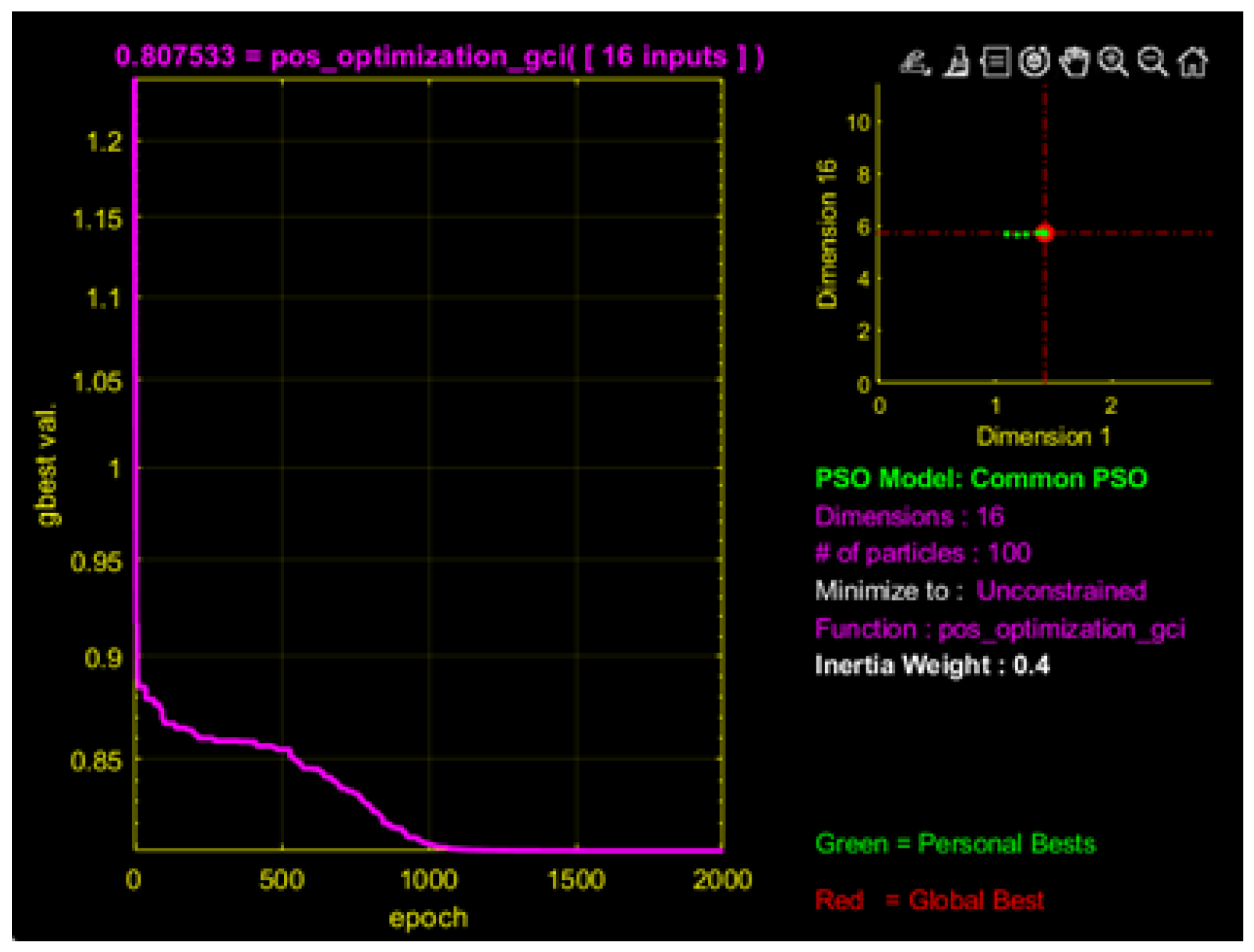
8.1.2. Numerical Optimization of the Dynamic Anchor Seat Position
8.1.3. Simulation of Self-Calibration of Structural Parameters
8.1.4. Simulation of Trajectory Tracking
8.2. Experiment Study
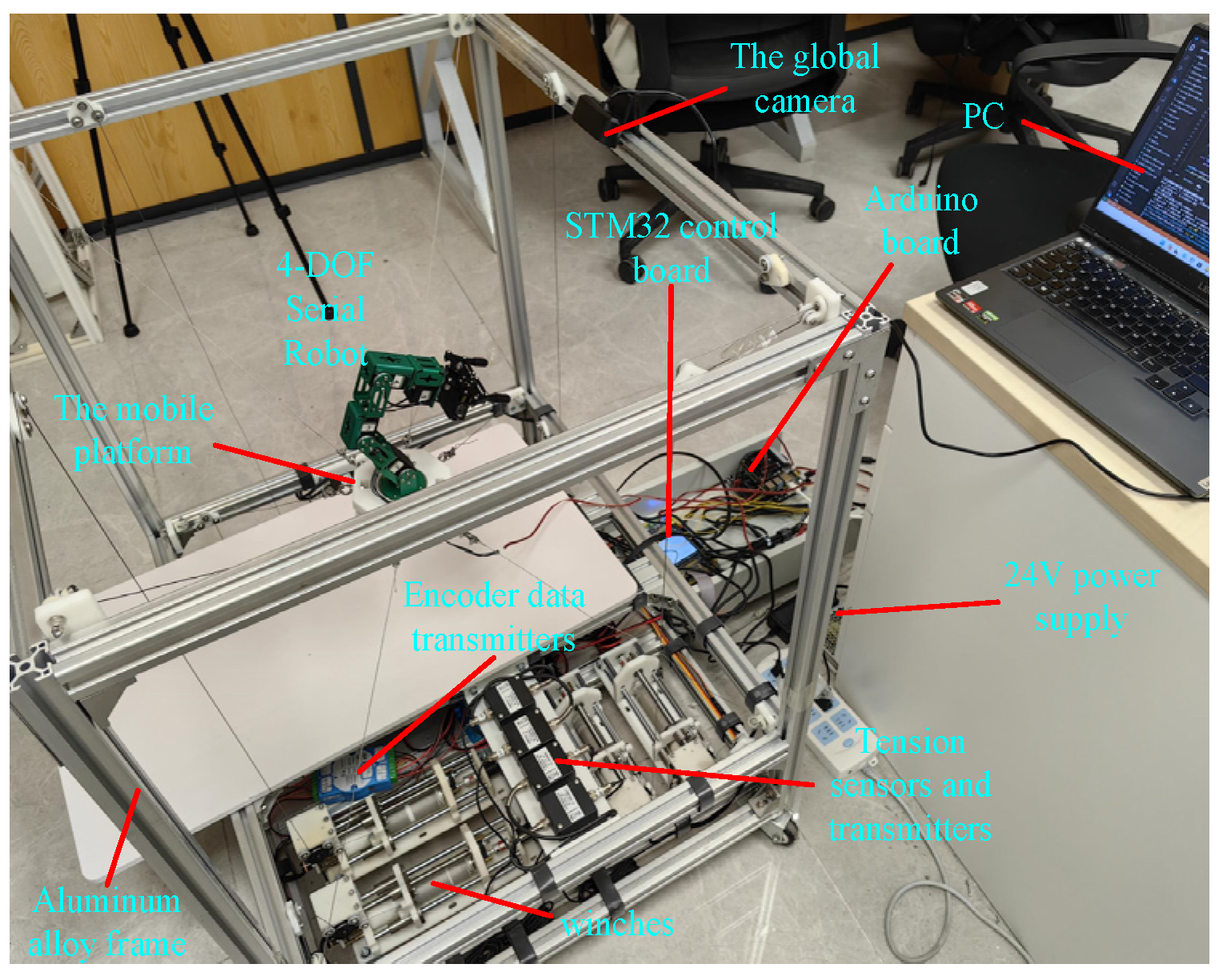
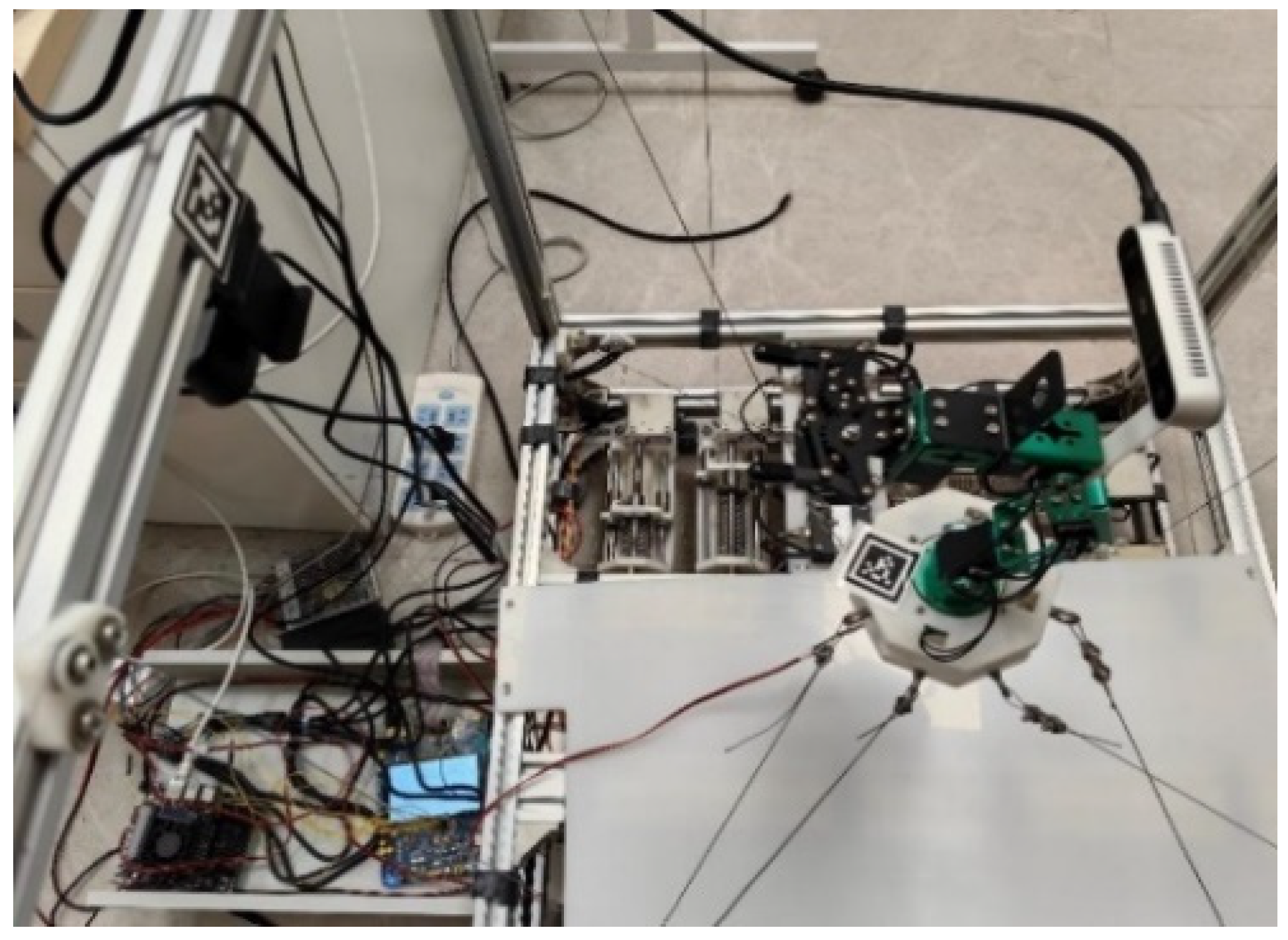
8.2.1. Experiment System Setup
8.2.2. Self-Calibration Experiment of System Parameters
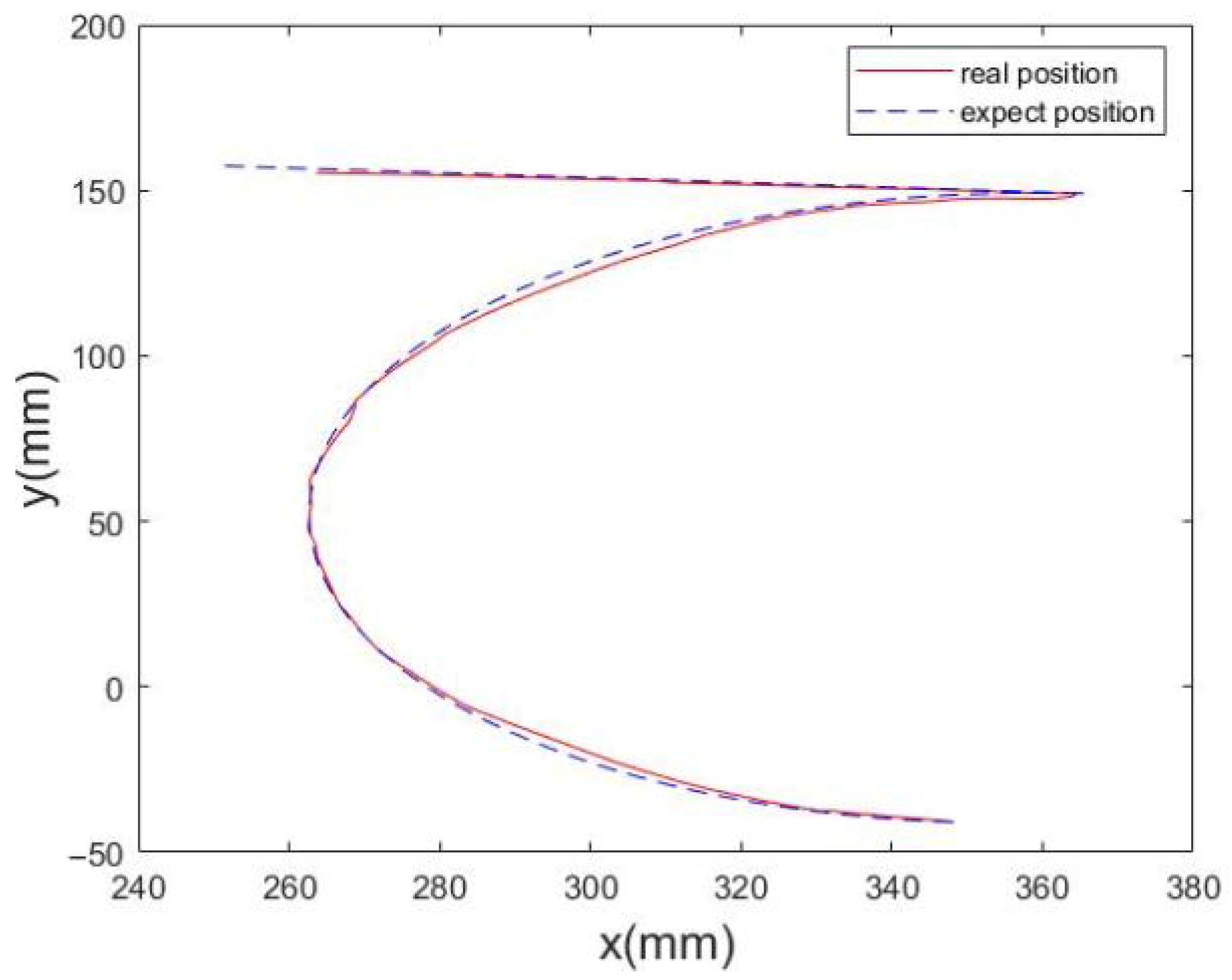
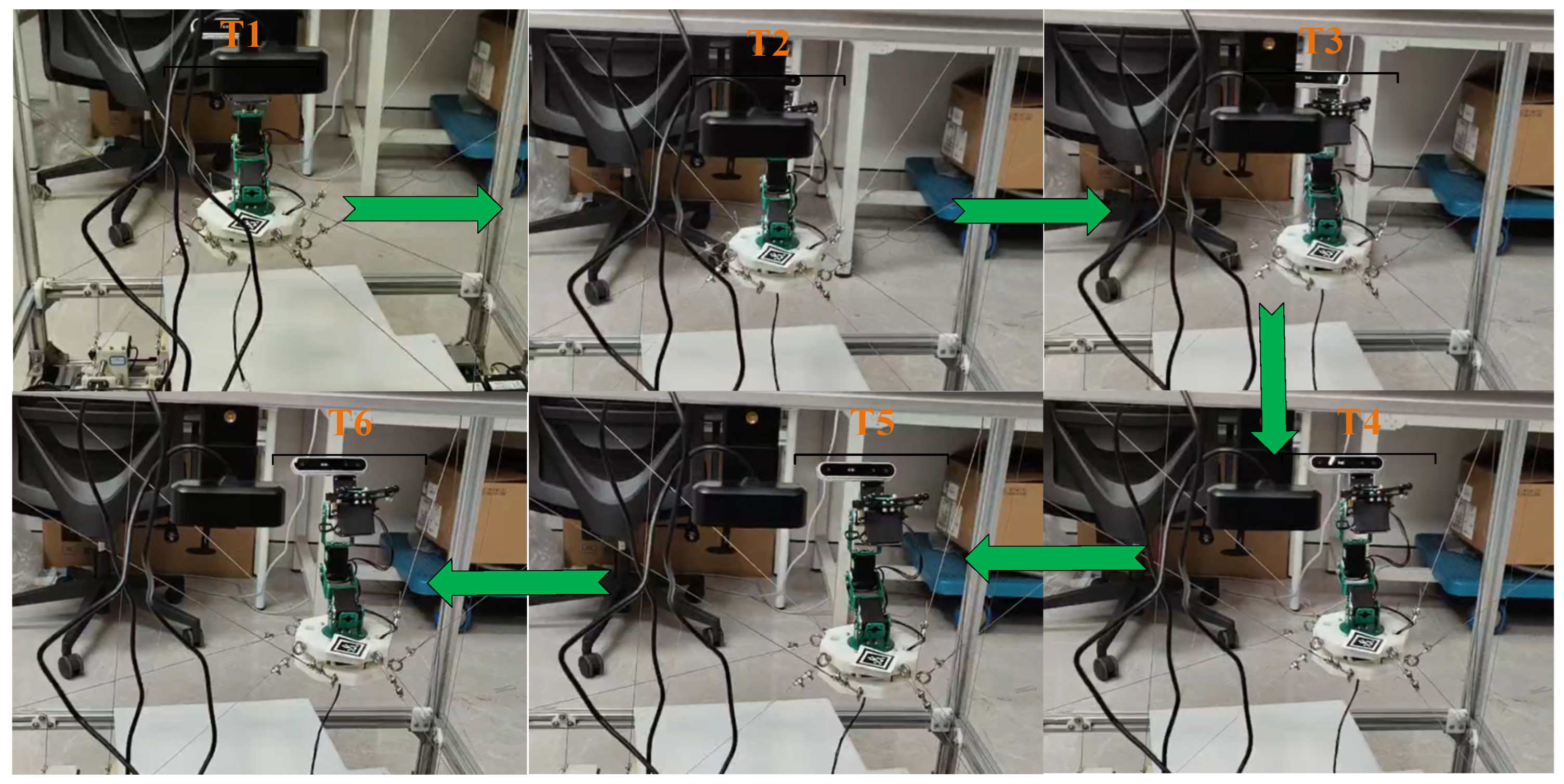
8.2.3. Trajectory Tracking Experiment
9. Discussion
Supplementary Materials
Author Contributions
Funding
Institutional Review Board Statement
Informed Consent Statement
Data Availability Statement
Conflicts of Interest
References
- Osumi, H.; Utsugi, Y.; Koshikawa, M. Development of a Manipulator Suspended by Parallel Wire Structure. In Proceedings of the 2000 IEEE/RSJ International Conference on Intelligent Robots and Systems (IROS 2000) (Cat. No.00CH37113); IEEE: New York, NY, USA, 2000; Volume 1, pp. 498–503. [Google Scholar]
- Tang, X. An Overview of the Development for Cable-Driven Parallel Manipulator. Adv. Mech. Eng. 2014. [Google Scholar] [CrossRef]
- An, H.; Yu, D.; Xu, W.; Yuan, H. Modeling and Cooperation Method for Movable Anchor Winch Cable-Driven Parallel Robot. IEEE/ASME Trans. Mechatron. 2024, 30, 3584–3595. [Google Scholar] [CrossRef]
- Xu, W.; Yan, P.; Wang, F.; Yuan, H.; Liang, B. Vision-Based Simultaneous Measurement of Manipulator Configuration and Target Pose for an Intelligent Cable-Driven Robot. Mech. Syst. Signal Process. 2022, 165, 108347. [Google Scholar] [CrossRef]
- Youssef, K.; Otis, M.J.-D. Reconfigurable Fully Constrained Cable Driven Parallel Mechanism for Avoiding Interference between Cables. Mech. Mach. Theory 2020, 148, 103781. [Google Scholar] [CrossRef]
- Bales, I.; Zhang, H. A Six Degrees-of-Freedom Cable-Driven Robotic Platform for Head–Neck Movement. Sci. Rep. 2024, 14, 8750. [Google Scholar] [CrossRef]
- Tang, S.; Yao, J.; Yu, Y. Design and Mechanical Analysis of a Novel Modular Bionic Earthworm Robot with Upright Functionality. Sci. Rep. 2025, 15, 3829. [Google Scholar] [CrossRef] [PubMed]
- Chen, Q.; Zi, B.; Sun, Z.; Li, Y.; Xu, Q. Design and Development of a New Cable-Driven Parallel Robot for Waist Rehabilitation. IEEE/ASME Trans. Mechatron. 2019, 24, 1497–1507. [Google Scholar] [CrossRef]
- An, H.; Yuan, H.; Tang, K.; Xu, W.; Wang, X. A Novel Cable-Driven Parallel Robot with Movable Anchor Points Capable for Obstacle Environments. IEEE/ASME Trans. Mechatron. 2022, 27, 5472–5483. [Google Scholar] [CrossRef]
- Rasheed, T.; Long, P.; Caro, S. Wrench-Feasible Workspace of Mobile Cable-Driven Parallel Robots. J. Mech. Robot. 2019, 12, 031009. [Google Scholar] [CrossRef]
- Pinto, A.M.; Moreira, E.; Lima, J.; Sousa, J.P.; Costa, P. A Cable-Driven Robot for Architectural Constructions: A Visual-Guided Approach for Motion Control and Path-Planning. Auton. Robot. 2017, 41, 1487–1499. [Google Scholar] [CrossRef]
- Chaikalis, D.; Khorrami, F.; Tzes, A. Adaptive Control Approaches for an Unmanned Aerial Manipulation System. In Proceedings of the 2020 International Conference on Unmanned Aircraft Systems (ICUAS); IEEE: New York, NY, USA, 2020; pp. 498–503. [Google Scholar]
- El-Ghazaly, G.; Gouttefarde, M.; Creuze, V. Hybrid Cable-Thruster Actuated Underwater Vehicle-Manipulator Systems: A Study on Force Capabilities. In Proceedings of the 2015 IEEE/RSJ International Conference on Intelligent Robots and Systems (IROS); IEEE: New York, NY, USA, 2015; pp. 1672–1678. [Google Scholar]
- Gao, B.; Song, H.; Zhao, J.; Guo, S.; Sun, L.; Tang, Y. Inverse Kinematics and Workspace Analysis of a Cable-Driven Parallel Robot with a Spring Spine. Mech. Mach. Theory 2014, 76, 56–69. [Google Scholar] [CrossRef]
- Lau, D.; Eden, J.; Tan, Y.; Oetomo, D. CASPR: A Comprehensive Cable-Robot Analysis and Simulation Platform for the Research of Cable-Driven Parallel Robots. In Proceedings of the 2016 IEEE/RSJ International Conference on Intelligent Robots and Systems (IROS); IEEE: New York, NY, USA, 2016; pp. 3004–3011. [Google Scholar]
- Pham, C.B.; Yeo, S.H.; Yang, G.; Kurbanhusen, M.S.; Chen, I.-M. Force-Closure Workspace Analysis of Cable-Driven Parallel Mechanisms. Mech. Mach. Theory 2006, 41, 53–69. [Google Scholar] [CrossRef]
- Diao, X.; Ma, O. A Method of Verifying Force-Closure Condition for General Cable Manipulators with Seven Cables. Mech. Mach. Theory 2007, 42, 1563–1576. [Google Scholar] [CrossRef]
- Yang, G.; Pham, C.B.; Yeo, S.H. Workspace Performance Optimization of Fully Restrained Cable-Driven Parallel Manipulators. In Proceedings of the 2006 IEEE/RSJ International Conference on Intelligent Robots and Systems; IEEE: New York, NY, USA, 2006; pp. 85–90. [Google Scholar]
- Song, C.; Lau, D. Workspace-Based Model Predictive Control for Cable-Driven Robots. IEEE Trans. Robot. 2022, 38, 2577–2596. [Google Scholar] [CrossRef]
- Nguyen, D.Q.; Gouttefarde, M. Study of Reconfigurable Suspended Cable-Driven Parallel Robots for Airplane Maintenance. In Proceedings of the 2014 IEEE/RSJ International Conference on Intelligent Robots and Systems; IEEE: New York, NY, USA, 2014; pp. 1682–1689. [Google Scholar]
- Arai, T.; Matsumura, S.; Yoshimura, Y.; Osumi, H. A Proposal for a Wire Suspended Manipulator: A Kinematic Analysis. Robotica 1999, 17, 3–9. [Google Scholar] [CrossRef]
- Khalilpour, S.A.; Khorrambakht, R.; Taghirad, H.D.; Cardou, P. Robust Cascade Control of a Deployable Cable-Driven Robot. Mech. Syst. Signal Process. 2019, 127, 513–530. [Google Scholar] [CrossRef]
- Tjahjowidodo, T.; Zhu, K.; Dailey, W.; Burdet, E.; Campolo, D. Multi-Source Micro-Friction Identification for a Class of Cable-Driven Robots with Passive Backbone. Mech. Syst. Signal Process. 2016, 80, 152–165. [Google Scholar] [CrossRef]
- Yuan, H.; You, X.; Zhang, Y.; Zhang, W.; Xu, W. A Novel Calibration Algorithm for Cable-Driven Parallel Robots with Application to Rehabilitation. Appl. Sci. 2019, 9, 2182. [Google Scholar] [CrossRef]
- Borgstrom, P.H.; Borgstrom, N.P.; Stealey, M.J.; Jordan, B.; Sukhatme, G.S.; Batalin, M.A.; Kaiser, W.J. Design and Implementation of NIMS3D, a 3-D Cabled Robot for Actuated Sensing Applications. IEEE Trans. Robot. 2009, 25, 325–339. [Google Scholar] [CrossRef]
- Zhang, Z.; Xie, G.; Shao, Z.; Gosselin, C. Kinematic Calibration of Cable-Driven Parallel Robots Considering the Pulley Kinematics. Mech. Mach. Theory 2022, 169, 104648. [Google Scholar] [CrossRef]
- Wang, H.; Gao, T.; Kinugawa, J.; Kosuge, K. Finding Measurement Configurations for Accurate Robot Calibration: Validation with a Cable-Driven Robot. IEEE Trans. Robot. 2017, 33, 1156–1169. [Google Scholar] [CrossRef]
- Ma, Q.; Goh, Z.; Ruan, S.; Chirikjian, G.S. Probabilistic Approaches to the AXB = YCZ Calibration Problem in Multi-Robot Systems. Auton. Robot. 2018, 42, 1497–1520. [Google Scholar] [CrossRef]
- Peng, J.; Xu, W.; Wang, F.; Han, Y.; Liang, B. A Hybrid Hand–Eye Calibration Method for Multilink Cable-Driven Hyper-Redundant Manipulators. IEEE Trans. Instrum. Meas. 2021, 70, 5010413. [Google Scholar] [CrossRef]
- Harms, S.; Bizcocho, C.G.; Wakizono, H.; Murasaki, K.; Kawagoe, H.; Nagaoka, K. Tetherbot: Experimental Demonstration and Path Planning of Cable-Driven Climbing in Microgravity. Robotics 2024, 13, 130. [Google Scholar] [CrossRef]
- Michelin, M.; Hervé, P.E.; Tempier, O.; Izard, J.B.; Gouttefarde, M. Path Following Demonstration of a Hybrid Cable-Driven Parallel Robot. In Proceedings of the Cable-Driven Parallel Robots; Gouttefarde, M., Bruckmann, T., Pott, A., Eds.; Springer International Publishing: Cham, Switzerland, 2021; pp. 323–335. [Google Scholar]
- Song, J.; Wang, M.; Wu, J.; Liu, Q.; Yang, S. Workspace Analysis and Dynamic Modeling of 6-DoF Multi-Pattern Cable-Driven Hybrid Mobile Robot. Machines 2025, 13, 659. [Google Scholar] [CrossRef]
- Peng, J.; Guo, Y.H.; Meng, D.; Han, Y. Kinematics, Statics Modeling and Workspace Analysis of a Cable-Driven Hybrid Robot. Multibody Syst. Dyn. 2023, 61, 163–193. [Google Scholar] [CrossRef]
- Sun, C.; Gao, H.; Liu, Z.; Xiang, S.; Yu, H.; Li, N.; Deng, Z. Design and Optimization of Three-Degree-of-Freedom Planar Adaptive Cable-Driven Parallel Robots Using the Cable Wrapping Phenomenon. Mech. Mach. Theory 2021, 166, 104475. [Google Scholar] [CrossRef]
- Olson, E. AprilTag: A Robust and Flexible Visual Fiducial System. In Proceedings of the 2011 IEEE International Conference on Robotics and Automation; IEEE: New York, NY, USA, 2011; pp. 3400–3407. [Google Scholar]
- Niemeyer, G.; Slotine, J.-J.E. Telemanipulation with Time Delays. Int. J. Robot. Res. 2004, 23, 873–890. [Google Scholar] [CrossRef]
- Middleton, R.H.; Goodwin, G.C. Digital Control and Estimation: A Unified Approach; Prentice Hall Professional Technical Reference: Upper Saddle River, NJ, USA, 1990. [Google Scholar]



| Methods | Modeling | Working Space Analysis | Calibration | Control |
|---|---|---|---|---|
| Harms et al. [30] | Hybrid climbing CDPR; Kinematic & static models; Non-modular. | - | - | - |
| Michelin et al. [31] | 6-DOF CDPR + 7-DOF arm; Redundancy used for obstacle avoidance; Not modular. | - | - | Redundancy-based path following; Coupling-aware tension regulation not considered. |
| Song et al. [32] | Multi-pattern hybrid CDPR; Geometric and dynamic models; Parallel–serial force coupling neglected. | Geometric workspace analysis for two modes; No movable-anchor optimization. | - | - |
| An et al. [9] | CDPR with movable anchors (M-CDPR); Kinematics | Movable anchors; ≈456% increase in feasible workspace | - | Obstacle-aware motion planning; Parallel-only, no hybrid coupling control |
| Borgström et al. [25] | NIMS3D CDPR; Full kinematic | - | In-field self-calibration for Rapid deployment | Feedback tracking with optimized tension distribution |
| Variable | Meaning |
|---|---|
| , , , , | The global frame of the CDHR, the mobile platform frame, the jth joint frame of the SM, the base frame of the SM mounted on the moving platform, the tips frame for the CDHR |
| , , , , | The origin of the CDHR global frame, the origin of the moving platform frame, the origin of the base frame for the SM mounted on the moving platform, the origin of the jth joint frame for the SM, the origin of the tips frame for the CDHR |
| Number of cables connected to the moving platform | |
| Number of joints of the SM mounted on the moving platform | |
| The DOFs of the moving platform | |
| Generalized DOFs of the CDHR | |
| The DOFs of the end-effector for the CDHR | |
| Index related to the number of cables | |
| Index related to the SM | |
| Anchor seat connecting the moving platform to the ith cable (dynamic anchor seat) | |
| Anchor seat connecting the frame to the ith cable (fixed anchor seat) | |
| Position vector of the fixed anchor seat relative to the global frame | |
| Position vector of the dynamic anchor seat relative to the mobile frame | |
| Length of the ith cable | |
| The direction vector of the ith cable, from the dynamic anchor seat to the fixed anchor seat | |
| The unit direction vector of the ith cable | |
| The vector containing the lengths of all cables | |
| The matrix containing the direction vectors of all cables | |
| Tension magnitude of the ith cable | |
| Tension vector of the ith cable | |
| Moment caused by the tension of the ith cable | |
| Position vector of the origin Om of the moving frame relative to the global frame {G} | |
| The joint angle of the jth joint of the SM | |
| The vector containing the joint angles of all joints in the SM | |
| The vector containing the rotation angles of all motors in the CDPR | |
| Pose of the moving platform frame relative to the global frame |
| Name | (°) | d (m) | a (m) | (°) |
|---|---|---|---|---|
| Joint 1 | 0 | 0.0500 | 1.5708 | 0 |
| Joint 2 | 90 | 0 | 0.0829 | 0 |
| Joint 3 | 0 | 0 | 0 | 0 |
| Joint 4 | 0 | 0 | 0.1658 | 0 |
| Name | x-Axis | y-Axis | z-Axis |
|---|---|---|---|
| Minimum | 0.06 | −0.36 | −0.62 |
| Maximum | 0.62 | 0.36 | 0 |
| Spacing | 0.02 | 0.02 | 0.02 |
| Maximum Iterations | Population Size | Personal Learning Factor | Global Learning Factor | Initial Inertia Weight | Final Inertia Weight |
|---|---|---|---|---|---|
| 2000 | 100 | 2 | 2 | 0.9 | 0.4 |
| Name | (m) | (m) | (m) | (m) | (m) | (m) | (m) | (m) |
|---|---|---|---|---|---|---|---|---|
| Position |
| Variable | True Value | Measured Average Value | ||||
|---|---|---|---|---|---|---|
| Position (mm) | Orientation (°) | Position (mm) | Orientation (°) | Position (mm) | Orientation (°) | |
| −334.00 −370.00 −900.00 | - | −334.05 −370.03 −900.04 | - | 0.07 | - | |
| −334.00 385.00 −885.00 | - | −334.03 385.01 −885.04 | - | 0.05 | - | |
| −334.00 370.00 −280.00 | - | −334.03 370.02 −280.09 | - | 0.10 | - | |
| −334.00 −385.00 −295.00 | - | −334.04 −385.02 −295.08 | - | 0.09 | - | |
| 316.00 −370.00 −900.00 | - | 316.04 −370.07 −900.02 | - | 0.08 | - | |
| 316.00 385.00 −885.00 | - | 316.03 385.04 −855.02 | - | 0.03 | - | |
| 316.00 370.00 280.00 | - | 316.07 370.01 −280.06 | - | 0.05 | - | |
| 316.00 −385.06 −295.10 | - | 316.02 −385.10 −295.08 | - | 0.05 | - | |
| 0 0 0 | −0.04 −0.04 −180.00 | −0.03 −0.06 −0.07 | −0.04 −0.06 −180.07 | 0.10 | 0.07 | |
| 6.30 38.39 92.70 | −89.22 −89.22 −90.79 | 6.29 38.40 92.61 | −89.25 −89.25 −90.81 | 0.09 | 0.05 | |
| Name | Trajectory Equations | |
|---|---|---|
| Case A | Straight line trajectory | where are the starting pose and the ending pose of the end-effector, respectively. |
| Case B | Spiral trajectory | where are the starting pose and the ending pose of the end−effector, respectively, is the radius of the circle, is the initial angle of the circle trajectory corresponding to . |
| Case C | “2”-type trajectory | where the circular arc segment of shape 2 is an 1800 semicircle, and the remaining part is a straight-line segment. |
| Categories | Name | Maximum Dimension Errors | Maximum 2-Norm Error | ||||||
|---|---|---|---|---|---|---|---|---|---|
| x (mm) | y (mm) | z (mm) | (°) | (°) | (°) | Position (mm) | Attitude (°) | ||
| Case A | Straight line trajectory | 0.0460 | 0.0360 | 0.0190 | 0.0099 | 0.0062 | 0.0116 | 0.0480 | 0.0147 |
| Case B | Spiral trajectory | 0.0390 | 0.0300 | 0.0180 | 0.0124 | 0.0050 | 0.0129 | 0.0440 | 0.0179 |
| Case C | “2”-type trajectory | 0.0400 | 0.0300 | 0.0140 | 0.0117 | 0.0049 | 0.0128 | 0.0440 | 0.0172 |
| Value | Calibrated Value | |
|---|---|---|
| Position (m) | Orientation (°) | |
| [0.3513, −0.0093, −0.6181]T | - | |
| [−0.3698, −0.0079, −0.5995]T | - | |
| [−0.3633, −0.0169, −0.0153]T | - | |
| [0.3817, −0.0198, −0.0288]T | - | |
| [0.3495, 0.6103, −0.6187]T | - | |
| [−0.3784, 0.6182, −0.6076]T | - | |
| [−0.3442, 0.6081, −0.0285]T | - | |
| [0.3575, 0.6032, −0.0533]T | - | |
| [0.0235, 0.0198, 0.1066]T | [0.0344, −90.7450, 0.0344]T | |
| [−0.0190, −0.0061, −0.0093]T | [0.0688, 0.1375, 180.5963]T | |
| Categories | Name | Maximum Dimension Errors | Maximum 2-Norm Error | ||||||
|---|---|---|---|---|---|---|---|---|---|
| x (mm) | y (mm) | z (mm) | (°) | (°) | (°) | Position (mm) | Attitude (°) | ||
| Case A | Straight line trajectory | 0.1167 | 0.0091 | 0.0023 | 0.0169 | 0.3076 | 0.4794 | 0.1171 | 0.5689 |
| Case B | Arc trajectory | 0.1182 | 0.1899 | 0.0014 | 0.0154 | 0.3314 | 0.4338 | 0.1907 | 0.5462 |
| Case C | “2”-type trajectory | 0.1003 | 0.1958 | 0.0020 | 0.0181 | 0.3257 | 0.4902 | 0.2224 | 0.5887 |
| Semicircular Arc Starting Point | Semicircular Arc Endpoint (Line Starting Point) | Line Segment Endpoint | |||
|---|---|---|---|---|---|
| Position (m) | Attitude (°) | Position (m) | Attitude (°) | Position (m) | Attitude (°) |
Disclaimer/Publisher’s Note: The statements, opinions and data contained in all publications are solely those of the individual author(s) and contributor(s) and not of MDPI and/or the editor(s). MDPI and/or the editor(s) disclaim responsibility for any injury to people or property resulting from any ideas, methods, instructions or products referred to in the content. |
© 2026 by the authors. Licensee MDPI, Basel, Switzerland. This article is an open access article distributed under the terms and conditions of the Creative Commons Attribution (CC BY) license.
Share and Cite
Xue, Z.; Yang, Z.; Hu, J.; Zhu, B.; Peng, J. A Cable-Driven Hybrid Robot with Series-Parallel Coupling: Design, Modeling, Optimization Analysis, and Trajectory Tracking. Sensors 2026, 26, 1147. https://doi.org/10.3390/s26041147
Xue Z, Yang Z, Hu J, Zhu B, Peng J. A Cable-Driven Hybrid Robot with Series-Parallel Coupling: Design, Modeling, Optimization Analysis, and Trajectory Tracking. Sensors. 2026; 26(4):1147. https://doi.org/10.3390/s26041147
Chicago/Turabian StyleXue, Zhifu, Zhiquan Yang, Junyi Hu, Bin Zhu, and Jianqing Peng. 2026. "A Cable-Driven Hybrid Robot with Series-Parallel Coupling: Design, Modeling, Optimization Analysis, and Trajectory Tracking" Sensors 26, no. 4: 1147. https://doi.org/10.3390/s26041147
APA StyleXue, Z., Yang, Z., Hu, J., Zhu, B., & Peng, J. (2026). A Cable-Driven Hybrid Robot with Series-Parallel Coupling: Design, Modeling, Optimization Analysis, and Trajectory Tracking. Sensors, 26(4), 1147. https://doi.org/10.3390/s26041147