Electrochemical Biosensors for Cancer Diagnosis and Prognosis Using Protein Biomarkers: Current Trends, Advances, and Clinical Translation Potential



Abstract
1. Introduction
2. Requirements for Accurate Biosensors and Receptors Used in Their Design
- ○
- Circulating tumor cells (CTCs), which are rare intact malignant cells released from primary and/or metastatic lesions into the bloodstream. CTC enumeration and molecular profiling (e.g., epithelial/mesenchymal markers, mutation status, therapy-response signatures) provide prognostic information and enable longitudinal monitoring of tumor evolution [14].
- ○
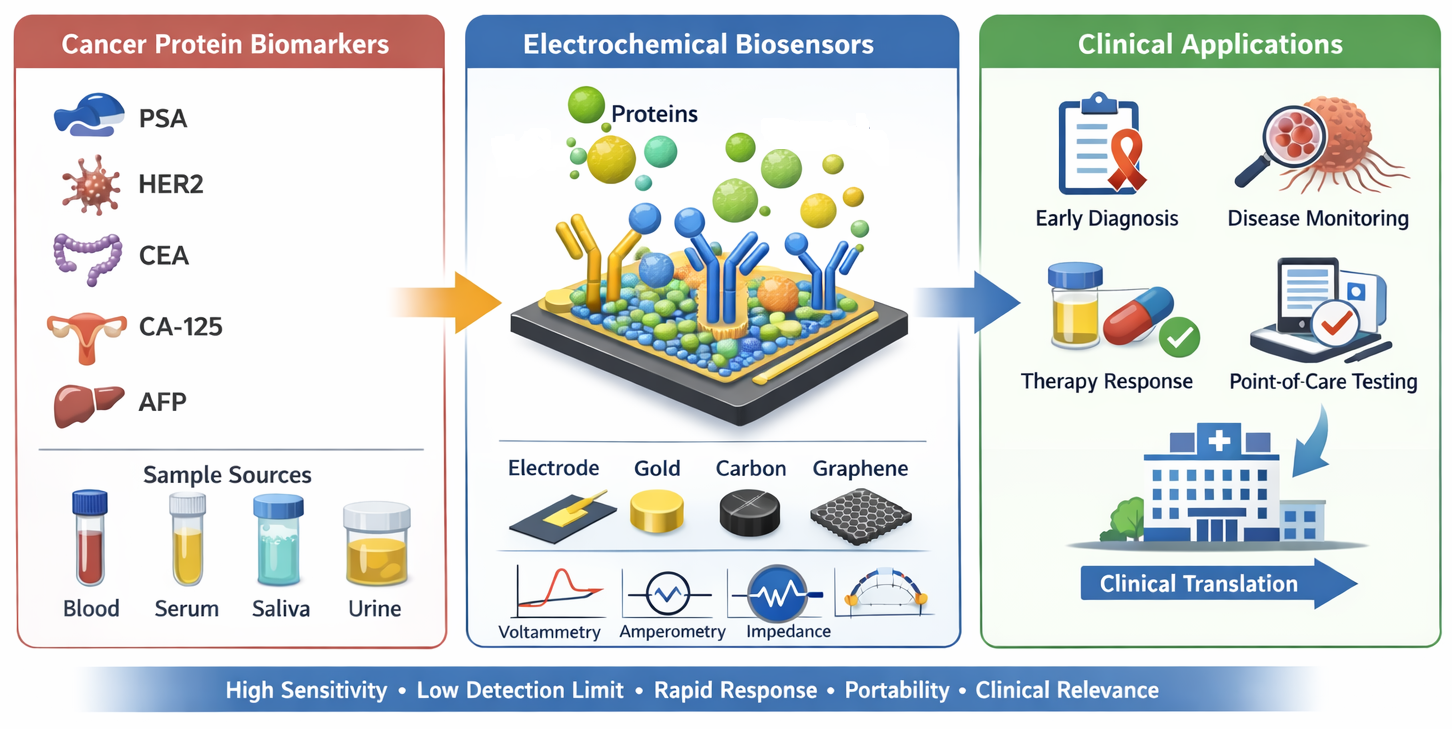
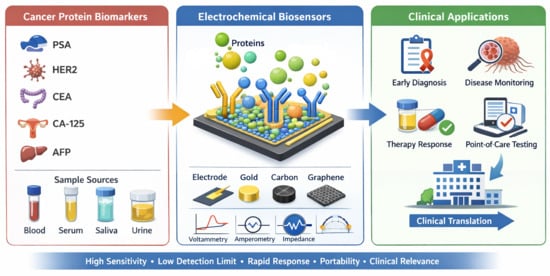
- Proteins, shed or secreted by tumors and the tumor microenvironment, including cytokines, growth factors, and tumor-associated antigens. Representative examples include PSA (prostate cancer), CA 19-9 (pancreatic cancer), CEA (colorectal and other cancers), AFP (hepatocellular carcinoma), and CA-125 (ovarian cancer) [15].
- ○
- ○
- MicroRNAs, which are endogenous, small (~18–25 nucleotides) non-coding RNAs that regulate gene expression post-transcriptionally by binding target mRNAs. In cancer, dysregulated microRNA expression reflects key oncogenic processes (proliferation, invasion, EMT, drug resistance). Circulating microRNAs originate from tumor cells and surrounding tissues and are present in biofluids either bound to proteins (e.g., Argonaute complexes) or packaged within lipoproteins and extracellular vesicles, which enhances their stability and makes them attractive liquid biopsy biomarkers [18,19].
- ○
- Extracellular vesicles (EVs), which are membrane-enclosed nanoparticles secreted by the majority of cell types, including tumor cells, and widely distributed across biofluids such as blood, urine, and saliva. EVs carry tumor-informative cargo: proteins, lipids, metabolites, DNA, mRNA, and microRNAs, which reflect the molecular state of the originating cells. Because EVs protect their molecular cargo from degradation and can be selectively enriched using surface markers (e.g., epithelial cell-adhesion molecules and the tetraspanin proteins CD63 and CD81), they are highly relevant for cancer diagnostics, disease stratification, and monitoring [20,21].
- ○
- Tumor-derived metabolites, which are low-molecular-weight metabolic products altered by tumor metabolism and/or the tumor microenvironment and detectable in biofluids. Examples include lactate (enhanced glycolysis/Warburg effect), 2-hydroxyglutarate (IDH-mutant tumors), sarcosine (reported in prostate cancer), choline-containing metabolites (membrane turnover), and selected amino acid and TCA-cycle intermediates. Metabolite panels can complement genomic and proteomic markers by reporting functional and dynamic changes in tumor biology [22,23].
- Non-uniform protein expression and secretion across tumor clones/regions gives inconsistent “tumor signal” in blood. If only some subclones (or tumor areas) express/secret a candidate protein, the circulating level can be intermittent or low, increasing overlap with noncancer controls and weakening specificity. Intratumor heterogeneity and branched evolution are, thus, widely recognized obstacles for validation of any biomarker that assumes a single, stable tumor state [24,25,26].
- Temporal heterogeneity (evolution over time or due to treatment pressure) can result in cancer signatures drifting. As tumors evolve, the dominant clones and their secreted proteins can change, so a marker that looked “specific” at one time point may become less discriminative later, and vice versa [25,26].
- Microenvironment and host-response proteins contaminate the signal which results in cancer versus, e.g., inflammation, becoming hard to separate. Many circulating proteins reflect immune activation, stromal remodeling, or systemic inflammation rather than tumor-exclusive biology; those processes also occur in benign disease, infection, obesity, autoimmune conditions, etc., which increases false positives and reduces specificity [27,28,29].
- Secretome heterogeneity and dilution in blood mask low-abundance tumor-derived proteins. Tumor-secreted/shed proteins enter a high-dynamic-range background (abundant plasma proteins) and are additionally shaped by clearance and peripheral production. Heterogeneity in what the tumor secretes amplifies this problem and can push distributions of cases and controls to overlap [28,29,30].
- Finally, “single-biomarker” logic breaks in heterogeneous early disease can result in poor apparent specificity in real-world screening. It is increasingly argued that protein biomarker tests need higher dimensionality (panels, multi-omics, machine-learning models) because heterogeneity makes single proteins insufficiently specific and robust [31,32,33].
3. Basic Electrochemical Platforms for Electrochemical Detection of Proteins
4. Basic Electrochemical Techniques Used for Electrochemical Biosensing
5. Electrochemical Assays for Specific Proteins Detection
5.1. HER-2/neu

5.2. PSA

5.3. EGFR
5.4. α-Fetoprotein
5.5. Osteopontin
5.6. Mucins
5.6.1. MUC1
5.6.2. CA 15-3
5.6.3. CA 125
5.7. Vascular Endothelial Growth Factor


| Strategy | Technique | Linear Range | LOD | Interference Studies | Ref. |
|---|---|---|---|---|---|
| GCE(SPCE)/AuNPs-rGO/MUA-MPA/Ab/BSA/VEFG | FFTAV | 0.01–100 U mL−1 | GCE: 29.1 fg mL−1 SPCE: 352 fg mL−1 | PDGF, TGFβ, HAS, BMP, IGF-1 | [165] |
| FTO/AuNPs/MAA/Ab/BSA/VEFG | EIS | 0.1 pg mL−1–0.1 µg mL−1 | 0.05 pg mL−1 | IFNγ, IGF-1, IL-2, | [166] |
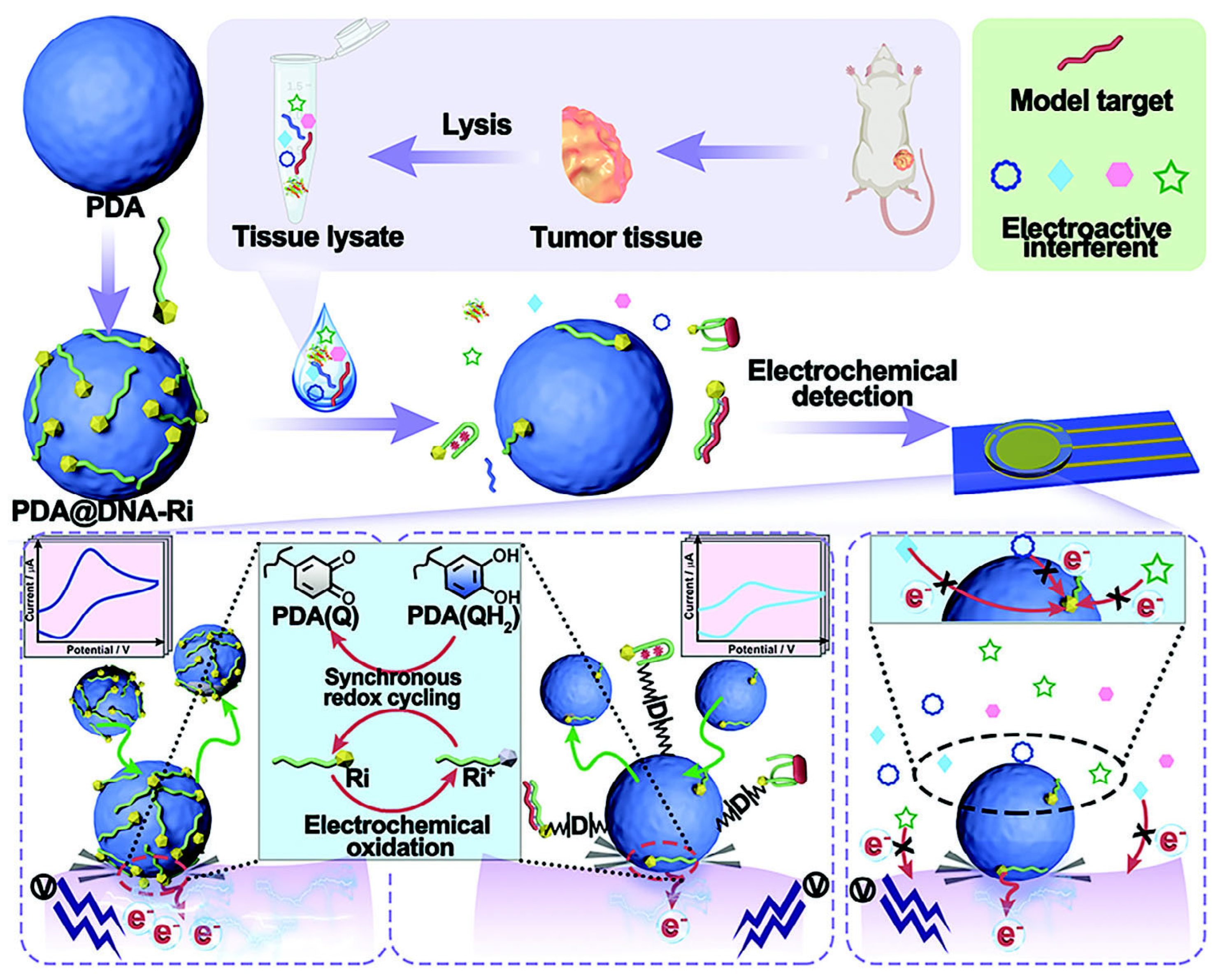
| SPCE/PDA@DNA-Ri/VEFG | CV | 10 pM–10 nM | 2.8 pM | GTP, CTP, UTP | [167] |
| SPE/MWCNTs/MOF/Ab/HSA/VEFG | DPV | 100–480 pg mL−1 | 50 pg mL−1 | BSA, Glu, Cho | [168] |
| GCE/rGO/GDP/VEFG | CA | 13 fM–130 nM | 0.0013 pM | IgG | [156] |
| AuE/PDA-G/Apt/BSA/VEGF165 | EIS | 100–1000 pg mL−1 | 0.3 pg mL−1 | BSA, IgG, Fibrinogen | [170] |
5.8. Carcinoembryonic Antigen

6. Commercial Biosensors for Cancer Detection and Future Perspectives
Funding
Data Availability Statement
Conflicts of Interest
References
- Siegel, R.L.; Miller, K.D.; Wagle, N.S.; Jemal, A. Cancer statistics, 2023. CA Cancer J. Clin. 2023, 73, 17–48. [Google Scholar] [CrossRef]
- Ferlay, J.; Colombet, M.; Soerjomataram, I.; Parkin, D.M.; Piñeros, M.; Znaor, A.; Bray, F. Cancer statistics for the year 2020: An overview. Int. J. Cancer 2021, 149, 778–789. [Google Scholar] [CrossRef] [PubMed]
- Sung, H.; Ferlay, J.; Siegel, R.L.; Laversanne, M.; Soerjomataram, I.; Jemal, A.; Bray, F. Global Cancer Statistics 2020: GLOBOCAN Estimates of Incidence and Mortality Worldwide for 36 Cancers in 185 Countries. CA Cancer J. Clin. 2021, 71, 209–249. [Google Scholar] [CrossRef]
- World Cancer Research Fund: Cancer Survival Statistics, 2025. Available online: https://www.wcrf.org/cancer-trends/cancer-survival-statistics/ (accessed on 1 December 2025).
- Coleman, M.P.; Forman, D.; Bryant, H.; Butler, J.; Rachet, B.; Maringe, C.; Nur, U.; Tracey, E.; Coory, M.; Hatcher, J.; et al. Cancer survival in Australia, Canada, Denmark, Norway, Sweden, and the UK, 1995–2007 (the International Cancer Benchmarking Partnership): An analysis of population-based cancer registry data. Lancet 2011, 377, 127–138. [Google Scholar] [CrossRef]
- Raab, S.S.; Grzybicki, D.M. Quality in cancer diagnosis. CA Cancer J. Clin. 2010, 60, 139–165. [Google Scholar] [CrossRef] [PubMed]
- WHO. WHO Report on Cancer. Setting Priorities, Investing Wisely and Providing Care for All; WHO: Geneva, Switzerland, 2020; ISBN 978-92-4-000129-9. [Google Scholar]
- Dragani, T.A.; Matarese, V.; Colombo, F. Biomarkers for Early Cancer Diagnosis: Prospects for Success through the Lens of Tumor Genetics. BioEssays 2020, 42, 1900122. [Google Scholar] [CrossRef] [PubMed]
- Malecka, K.; Mikuła, E.; Ferapontova, E.E. Design Strategies for Electrochemical Aptasensors for Cancer Diagnostic Devices. Sensors 2021, 21, 736. [Google Scholar] [CrossRef]
- Gubala, V.; Harris, L.F.; Ricco, A.J.; Tan, M.X.; Williams, D.E. Point of Care Diagnostics: Status and Future. Anal. Chem. 2012, 84, 487–515. [Google Scholar] [CrossRef]
- Monteil, S.; Casson, A.J.; Jones, S.T. Electronic and electrochemical viral detection for point-of-care use: A systematic review. PLoS ONE 2021, 16, e0258002. [Google Scholar] [CrossRef]
- Christodouleas, D.C.; Kaur, B.; Chorti, P. From Point-of-Care Testing to eHealth Diagnostic Devices (eDiagnostics). ACS Cent. Sci. 2018, 4, 1600–1616. [Google Scholar] [CrossRef]
- Rolfo, C.; Russo, A. Liquid biopsy for early stage lung cancer moves ever closer. Nat. Rev. Clin. Oncol. 2020, 17, 523–524. [Google Scholar] [CrossRef]
- Lin, D.; Shen, L.; Luo, M.; Zhang, K.; Li, J.; Yang, Q.; Zhu, F.; Zhou, D.; Zheng, S.; Chen, Y.; et al. Circulating tumor cells: Biology and clinical significance. Signal Transduct. Target. Ther. 2021, 6, 404. [Google Scholar] [CrossRef]
- Borrebaeck, C.A. Precision diagnostics: Moving towards protein biomarker signatures of clinical utility in cancer. Nat. Rev. Cancer 2017, 17, 199–204. [Google Scholar] [CrossRef]
- Fitzgerald, R.C.; Antoniou, A.C.; Fruk, L.; Rosenfeld, N. The future of early cancer detection. Nat. Med. 2022, 28, 666–677. [Google Scholar] [CrossRef] [PubMed]
- Jung, K.; Fleischhacker, M.; Rabien, A. Cell-free DNA in the blood as a solid tumor biomarker—A critical appraisal of the literature. Clin. Chim. Acta 2010, 411, 1611–1624. [Google Scholar] [CrossRef]
- Cortez, M.A.; Bueso-Ramos, C.; Ferdin, J.; Lopez-Berestein, G.; Sood, A.K.; Calin, G.A. MicroRNAs in body fluids—The mix of hormones and biomarkers. Nat. Rev. Clin. Oncol. 2011, 8, 467–477. [Google Scholar] [CrossRef]
- Fendler, A.; Stephan, C.; Yousef, G.M.; Kristiansen, G.; Jung, K. The translational potential of microRNAs as biofluid markers of urological tumours. Nat. Rev. Urol. 2016, 13, 734–752. [Google Scholar] [CrossRef] [PubMed]
- Greening, D.W.; Xu, R.; Rai, A.; Suwakulsiri, W.; Chen, M.; Simpson, R.J. Clinical relevance of extracellular vesicles in cancer—Therapeutic and diagnostic potential. Nat. Rev. Clin. Oncol. 2025, 22, 924–952. [Google Scholar] [CrossRef] [PubMed]
- Möller, A.; Lobb, R.J. The evolving translational potential of small extracellular vesicles in cancer. Nat. Rev. Cancer 2020, 20, 697–709. [Google Scholar] [CrossRef]
- García-Cañaveras, J.C.; Lahoz, A. Tumor Microenvironment-Derived Metabolites: A Guide to Find New Metabolic Therapeutic Targets and Biomarkers. Cancers 2021, 13, 3230. [Google Scholar] [CrossRef]
- Hanash, S.M.; Baik, C.S.; Kallioniemi, O. Emerging molecular biomarkers—Blood-based strategies to detect and monitor cancer. Nat. Rev. Clin. Oncol. 2011, 8, 142–150. [Google Scholar] [CrossRef] [PubMed]
- Gerlinger, M.; Rowan, A.J.; Horswell, S.; Larkin, J.; Endesfelder, D.; Gronroos, E.; Martinez, P.; Matthews, N.; Stewart, A.; Tarpey, P.; et al. Intratumor Heterogeneity and Branched Evolution Revealed by Multiregion Sequencing. N. Engl. J. Med. 2012, 366, 883–892. [Google Scholar] [CrossRef]
- Ramón, Y.C.S.; Sesé, M.; Capdevila, C.; Aasen, T.; De Mattos-Arruda, L.; Diaz-Cano, S.J.; Hernández-Losa, J.; Castellví, J. Clinical implications of intratumor heterogeneity: Challenges and opportunities. J. Mol. Med. 2020, 98, 161–177. [Google Scholar] [CrossRef]
- McGranahan, N.; Swanton, C. Clonal Heterogeneity and Tumor Evolution: Past, Present, and the Future. Cell 2017, 168, 613–628. [Google Scholar] [CrossRef]
- Sallam, R.M. Proteomics in cancer biomarkers discovery: Challenges and applications. Dis. Markers 2015, 2015, 321370. [Google Scholar] [CrossRef]
- Veyssière, H.; Bidet, Y.; Penault-Llorca, F.; Radosevic-Robin, N.; Durando, X. Circulating proteins as predictive and prognostic biomarkers in breast cancer. Clin. Proteom. 2022, 19, 25. [Google Scholar] [CrossRef]
- Bhawal, R.; Oberg, A.L.; Zhang, S.; Kohli, M. Challenges and Opportunities in Clinical Applications of Blood-Based Proteomics in Cancer. Cancers 2020, 12, 2428. [Google Scholar] [CrossRef] [PubMed]
- Beutgen, V.M.; Shinkevich, V.; Pörschke, J.; Meena, C.; Steitz, A.M.; Pogge von Strandmann, E.; Graumann, J.; Gómez-Serrano, M. Secretome Analysis Using Affinity Proteomics and Immunoassays: A Focus on Tumor Biology. Mol. Cell. Proteom. 2024, 23, 100830. [Google Scholar] [CrossRef] [PubMed]
- Barker, A.D.; Alba, M.M.; Mallick, P.; Agus, D.B.; Lee, J.S.H. An Inflection Point in Cancer Protein Biomarkers: What was and What’s Next. Mol. Cell. Proteom. 2023, 22, 100569. [Google Scholar] [CrossRef]
- Passaro, A.; Al Bakir, M.; Hamilton, E.G.; Diehn, M.; André, F.; Roy-Chowdhuri, S.; Mountzios, G.; Wistuba, I.I.; Swanton, C.; Peters, S. Cancer biomarkers: Emerging trends and clinical implications for personalized treatment. Cell 2024, 187, 1617–1635. [Google Scholar] [CrossRef]
- Zhou, Y.; Tao, L.; Qiu, J.; Xu, J.; Yang, X.; Zhang, Y.; Tian, X.; Guan, X.; Cen, X.; Zhao, Y. Tumor biomarkers for diagnosis, prognosis and targeted therapy. Signal Transduct. Target. Ther. 2024, 9, 132. [Google Scholar] [CrossRef]
- Qoronfleh, M.W.; Al-Dewik, N. Cancer Biomarkers: Reflection on Recent Progress, Emerging Innovations, and the Clinical Horizon. Cancers 2025, 17, 2981. [Google Scholar] [CrossRef] [PubMed]
- Álvarez-Martos, I.; Møller, A.; Ferapontova, E.E. Dopamine binding and analysis in undiluted human serum and blood by the RNA-aptamer electrode. ACS Chem. Neurosci. 2019, 10, 1706–1715. [Google Scholar] [CrossRef]
- Nair, P.R.; Alam, M.A. Screening-Limited Response of NanoBiosensors. Nano Lett. 2008, 8, 1281–1285. [Google Scholar] [CrossRef]
- Squires, T.M.; Messinger, R.J.; Manalis, S.R. Making it stick: Convection, reaction and diffusion in surface-based biosensors. Nat. Biotechnol. 2008, 26, 417–426. [Google Scholar] [CrossRef]
- Alvarez-Martos, I.; Campos, R.; Ferapontova, E.E. Surface state of the dopamine RNA aptamer affects specific recognition and binding of dopamine by the aptamer-modified electrodes. Analyst 2015, 140, 4089–4096. [Google Scholar] [CrossRef]
- Gan, S.D.; Patel, K.R. Enzyme Immunoassay and Enzyme-Linked Immunosorbent Assay. J. Investig. Dermatol. 2013, 133, 1–3. [Google Scholar] [CrossRef]
- Tighe, P.J.; Ryder, R.R.; Todd, I.; Fairclough, L.C. ELISA in the multiplex era: Potentials and pitfalls. PROTEOMICS—Clin. Appl. 2015, 9, 406–422. [Google Scholar] [CrossRef]
- Koilakou, S.; Petrou, P. Economic Evaluation of Monoclonal Antibodies in Metastatic Colorectal Cancer: A Systematic Review. Mol. Diagn. Ther. 2021, 25, 715–734. [Google Scholar] [CrossRef] [PubMed]
- Wu, Y.; Yi, M.; Zhu, S.; Wang, H.; Wu, K. Recent advances and challenges of bispecific antibodies in solid tumors. Exp. Hematol. Oncol. 2021, 10, 56. [Google Scholar] [CrossRef] [PubMed]
- Ellington, A.D.; Szostak, J.W. Selection in vitro of single stranded DNA molecules that fold into specific ligand-binding structures. Nature 1992, 355, 850–852. [Google Scholar] [CrossRef]
- Hermann, T.; Patel, D.J. Adaptive recognition by nucleic acid aptamers. Science 2000, 287, 820–825. [Google Scholar] [CrossRef] [PubMed]
- Mpofu, K.; Chauke, S.; Thwala, L.; Mthunzi-Kufa, P. Aptamers and antibodies in optical biosensing. Disc. Chem. 2025, 2, 23. [Google Scholar] [CrossRef]
- Ma, H.; Ó’Fágáin, C.; O’Kennedy, R. Antibody stability: A key to performance—Analysis, influences and improvement. Biochimie 2020, 177, 213–225. [Google Scholar] [CrossRef]
- Correia, I.R. Stability of IgG isotypes in serum. mAbs 2010, 2, 221–232. [Google Scholar] [CrossRef]
- Thiviyanathan, V.; Gorenstein, D.G. Aptamers and the next generation of diagnostic reagents. Proteom. Clin. Appl. 2012, 6, 563–573. [Google Scholar] [CrossRef]
- Kratschmer, C.; Levy, M. Effect of Chemical Modifications on Aptamer Stability in Serum. Nucleic Acid Ther. 2017, 27, 335–344. [Google Scholar] [CrossRef] [PubMed]
- Jarczewska, M.; Kekedy-Nagy, L.; Nielsen, J.S.; Campos, R.; Kjems, J.; Malinowska, E.; Ferapontova, E.E. Electroanalysis of pM-levels of urokinase plasminogen activator in serum by phosphorothioated RNA aptamer. Analyst 2015, 140, 3794–3802. [Google Scholar] [CrossRef]
- Arbabi-Ghahroudi, M. Camelid Single-Domain Antibodies: Historical Perspective and Future Outlook. Front. Immunol. 2017, 8, 1589. [Google Scholar] [CrossRef]
- Kolkman, J.A.; Law, D.A. Nanobodies—From llamas to therapeutic proteins. Drug Discov. Today Technol. 2010, 7, e139–e146. [Google Scholar] [CrossRef]
- Pleiner, T.; Bates, M.; Trakhanov, S.; Lee, C.T.; Schliep, J.E.; Chug, H.; Böhning, M.; Stark, H.; Urlaub, H.; Görlich, D. Nanobodies: Site-specific labeling for super-resolution imaging, rapid epitope-mapping and native protein complex isolation. eLife 2015, 4, e11349. [Google Scholar] [CrossRef]
- Zupancic, J.M.; Schardt, J.S.; Desai, A.A.; Makowski, E.K.; Smith, M.D.; Pornnoppadol, G.; Garcia de Mattos Barbosa, M.; Cascalho, M.; Lanigan, T.M.; Tessier, P.M. Engineered Multivalent Nanobodies Potently and Broadly Neutralize SARS-CoV-2 Variants. Adv. Ther. 2021, 4, 2100099. [Google Scholar] [CrossRef]
- Díaz-Fernández, A.; Ferapontov, A.; Vendelbo, M.H.; Ferapontova, E.E. Electrochemical Cellulase-Linked ELASA for Rapid Liquid Biopsy Testing of Serum HER-2/neu. ACS Measur. Sci. Au 2023, 3, 226–235. [Google Scholar] [CrossRef]
- Huang, L.; Zhang, C.; Ye, R.; Yan, B.; Zhou, X.; Xu, W.; Guo, J. Capacitive biosensors for label-free and ultrasensitive detection of biomarkers. Talanta 2024, 266, 124951. [Google Scholar] [CrossRef]
- Cecchetto, J.; Fernandes, F.C.B.; Lopes, R.; Bueno, P.R. The capacitive sensing of NS1 Flavivirus biomarker. Biosens. Bioelectron. 2017, 87, 949–956. [Google Scholar] [CrossRef]
- Baradoke, A.; Hein, R.; Li, X.; Davis, J.J. Reagentless Redox Capacitive Assaying of C-Reactive Protein at a Polyaniline Interface. Anal. Chem. 2020, 92, 3508–3511. [Google Scholar] [CrossRef] [PubMed]
- Díaz-Fernández, A.; Ferapontova, E.E. Electrochemical ELASA: Improving early cancer detection and monitoring. Anal. Bioanal. Chem. 2023, 415, 3831–3846. [Google Scholar] [CrossRef] [PubMed]
- Fapyane, D.; Ferapontova, E.E. Electrochemical assay for a total cellulase activity with improved sensitivity. Anal. Chem. 2017, 89, 3959–3965. [Google Scholar] [CrossRef]
- Ruiz-Valdepeñas Montiel, V.; Povedano, E.; Vargas, E.; Torrente-Rodríguez, R.M.; Pedrero, M.; Reviejo, A.J.; Campuzano, S.; Pingarrón, J.M. Comparison of different strategies for the development of highly sensitive electrochemical nucleic acid biosensors using neither nanomaterials nor nucleic acid amplification. ACS Sens. 2018, 3, 211–221. [Google Scholar] [CrossRef] [PubMed]
- Kimmel, D.W.; LeBlanc, G.; Meschievitz, M.E.; Cliffel, D.E. Electrochemical Sensors and Biosensors. Anal. Chem. 2012, 84, 685–707. [Google Scholar] [CrossRef]
- Wei, D.; Bailey, M.J.A.; Andrew, P.; Ryhänen, T. Electrochemical biosensors at the nanoscale. Lab Chip 2009, 9, 2123–2131. [Google Scholar] [CrossRef]
- Scholz, F. (Ed.) Electroanalytical Methods: Guide to Experiments and Applications; Springer: Berlin/Heidelberg, Germany, 2010; p. 359. [Google Scholar]
- Molina, A.; Gonzalez, J. Pulse Voltammetry in Physical Electrochemistry and Electroanalysis: Theory and Applications; Springer International Publishing AG: Cham, Switzerland, 2016. [Google Scholar]
- Mirceski, V.; Lovric, M. Genuine differential voltammetry. Talanta 2024, 279, 126560. [Google Scholar] [CrossRef]
- Chen, A.; Shah, B. Electrochemical sensing and biosensing based on square wave voltammetry. Anal. Methods 2013, 5, 2158–2173. [Google Scholar] [CrossRef]
- Xu, Q.; Pan, Y.; Li, W.; Yang, Z. 6-Amperometric sensors. In Fundamentals of Sensor Technology; Barhoum, A., Altintas, Z., Eds.; Woodhead Publishing: Sawston, UK, 2023; pp. 123–145. [Google Scholar]
- Macdonald, J.R.; Johnson, W.B. Fundamentals of Impedance Spectroscopy. In Impedance Spectroscopy; Wiley Online Library: Hoboken, NJ, USA, 2005; pp. 1–26. [Google Scholar]
- Huang, J.; Li, Z.; Liaw, B.Y.; Zhang, J. Graphical analysis of electrochemical impedance spectroscopy data in Bode and Nyquist representations. J. Power Sources 2016, 309, 82–98. [Google Scholar] [CrossRef]
- Yarden, S.; Sliwkowski, M.X. Untangling the ErbB signalling network. Nat. Rev. Mol. Cell Biol. 2001, 2, 127–137. [Google Scholar] [CrossRef] [PubMed]
- Ross, J.S.; Slodkowska, E.A.; Symmans, W.F.; Pusztai, L.; Ravdin, P.M.; Hortobagyi, G.N. The HER-2 receptor and breast cancer: Ten years of targeted anti-HER-2 therapy and personalized medicine. Oncologist 2009, 14, 320–368. [Google Scholar] [CrossRef] [PubMed]
- Emami, M.; Shamsipur, M.; Saber, R.; Irajirad, R. An electrochemical immunosensor for detection of a breast cancer biomarker based on antiHER2–iron oxide nanoparticle bioconjugates. Analyst 2014, 139, 2858–2866. [Google Scholar] [CrossRef]
- Salimian, R.; Kékedy-Nagy, L.; Ferapontova, E. Specific picomolar detection of a breast cancer biomarker HER-2/neu protein in serum: Electrocatalytically amplified electroanalysis by the aptamer/PEG-modified electrode. ChemElectroChem 2017, 4, 872–879. [Google Scholar] [CrossRef]
- Zhu, Y.; Chandra, P.; Shim, Y.-B. Ultrasensitive and Selective Electrochemical Diagnosis of Breast Cancer Based on a Hydrazine–Au Nanoparticle–Aptamer Bioconjugate. Anal. Chem. 2013, 85, 1058–1064. [Google Scholar] [CrossRef]
- Malecka, K.; Pankratov, D.; Ferapontova, E.E. Femtomolar electroanalysis of a breast cancer biomarker HER-2/neu protein in human serum by the cellulase-linked sandwich assay on magnetic beads. Anal. Chim. Acta 2019, 1077, 140–149. [Google Scholar] [CrossRef]
- Boonkaew, S.; Teodori, L.; Vendelbo, M.H.; Kjems, J.; Ferapontova, E.E. Nanobodies’ duo facilitates ultrasensitive serum HER-2/neu immunoassays via enhanced avidity interactions. Anal. Chim. Acta 2025, 1335, 343472. [Google Scholar] [CrossRef]
- Boonkaew, S.; Linfield, S.; Ferapontova, E.E. High-capacitance air-brushed electrodes for capacitive label-free bioassays. Talanta 2025, 293, 128118. [Google Scholar] [CrossRef] [PubMed]
- Boonkaew, S.; Ferapontova, E.E. Capacitive Lateral Flow Test for sub-fM Analysis of Serum HER-2/neu Using a Magnetic Cellulase-Linked Aptamer Sandwich Strategy. Anal. Chem. 2026, 98, 1370–1379. [Google Scholar] [CrossRef] [PubMed]
- Díaz-Fernández, A.; Ferapontova, E.E. Covalent Hemin/G4 complex-linked sandwich bioassay on magnetic beads for femtomolar HER-2/neu detection in human serum via direct electrocatalytic reduction of oxygen. Anal. Chim. Acta 2022, 1219, 340049. [Google Scholar] [CrossRef]
- Filella, X.; Fernández-Galan, E.; Fernández Bonifacio, R.; Foj, L. Emerging biomarkers in the diagnosis of prostate cancer. Pharmacogenom. Pers. Med. 2018, 11, 83–94. [Google Scholar] [CrossRef]
- Lucia, M.S.; Darke, A.K.; Goodman, P.J.; La Rosa, F.G.; Parnes, H.L.; Ford, L.G.; Coltman, C.A., Jr.; Thompson, I.M. Pathologic Characteristics of Cancers Detected in the Prostate Cancer Prevention Trial: Implications for Prostate Cancer Detection and Chemoprevention. Cancer Prev. Res. 2008, 1, 167–173. [Google Scholar] [CrossRef]
- Thompson, I.M.; Pauler, D.K.; Goodman, P.J.; Tangen, C.M.; Lucia, M.S.; Parnes, H.L.; Minasian, L.M.; Ford, L.G.; Lippman, S.M.; Crawford, E.D.; et al. Prevalence of Prostate Cancer among Men with a Prostate-Specific Antigen Level ≤4.0 ng per Milliliter. N. Engl. J. Med. 2004, 350, 2239–2246. [Google Scholar] [CrossRef]
- Miller, D.C.; Gruber, S.B.; Hollenbeck, B.K.; Montie, J.E.; Wei, J.T. Incidence of Initial Local Therapy Among Men With Lower-Risk Prostate Cancer in the United States. J. Natl. Cancer Inst. 2006, 98, 1134–1141. [Google Scholar] [CrossRef]
- Porzycki, P.; Ciszkowicz, E. Modern biomarkers in prostate cancer diagnosis. Cent. Eur. J. Urol. 2020, 73, 300–306. [Google Scholar] [CrossRef]
- Alarcón-Zendejas, A.P.; Scavuzzo, A.; Jiménez-Ríos, M.A.; Álvarez-Gómez, R.M.; Montiel-Manríquez, R.; Castro-Hernández, C.; Jiménez-Dávila, M.A.; Pérez-Montiel, D.; González-Barrios, R.; Jiménez-Trejo, F.; et al. The promising role of new molecular biomarkers in prostate cancer: From coding and non-coding genes to artificial intelligence approaches. Prostate Cancer Prostatic Dis. 2022, 25, 431–443. [Google Scholar] [CrossRef] [PubMed]
- Damborska, D.; Bertok, T.; Dosekova, E.; Holazova, A.; Lorencova, L.; Kasak, P.; Tkac, J. Nanomaterial-based biosensors for detection of prostate specific antigen. Microchim. Acta 2017, 184, 3049–3067. [Google Scholar] [CrossRef]
- Chang, Y.; Wang, M.; Wang, L.; Xia, N. Recent Progress in Electrochemical Biosensors for Detection of Prostate-Specific Antigen. Int. J. Electrochem. Sci. 2018, 13, 4071–4084. [Google Scholar] [CrossRef]
- Xu, L.; Wen, Y.; Pandit, S.; Mokkapati, V.; Mijakovic, I.; Li, Y.; Ding, M.; Ren, S.; Li, W.; Liu, G. Graphene-based biosensors for the detection of prostate cancer protein biomarkers: A review. BMC Chem. 2019, 13, 112. [Google Scholar] [CrossRef] [PubMed]
- Traynor, S.M.; Pandey, R.; Maclachlan, R.; Hosseini, A.; Didar, T.F.; Li, F.; Soleymani, L. Review—Recent Advances in Electrochemical Detection of Prostate Specific Antigen (PSA) in Clinically-Relevant Samples. J. Electrochem. Soc. 2020, 167, 037551. [Google Scholar] [CrossRef]
- Nasimi, H.; Madsen, J.S.; Zedan, A.H.; Malmendal, A.; Osther, P.J.S.; Alatraktchi, F.A. Protein biomarker detection in prostate cancer: A comprehensive review of electrochemical biosensors. Sens. Actuators Rep. 2023, 6, 100168. [Google Scholar] [CrossRef]
- Díaz-Fernández, A.; Miranda-Castro, R.; de-los-Santos-Álvarez, N.; Rodríguez, E.F.; Lobo-Castañón, M.J. Focusing aptamer selection on the glycan structure of prostate-specific antigen: Toward more specific detection of prostate cancer. Biosens. Bioelectron. 2019, 128, 83–90. [Google Scholar] [CrossRef]
- White, K.Y.; Rodemich, L.; Nyalwidhe, J.O.; Comunale, M.A.; Clements, M.A.; Lance, R.S.; Schellhammer, P.F.; Mehta, A.S.; Semmes, O.J.; Drake, R.R. Glycomic Characterization of Prostate-Specific Antigen and Prostatic Acid Phosphatase in Prostate Cancer and Benign Disease Seminal Plasma Fluids. J. Proteome Res. 2009, 8, 620–630. [Google Scholar] [CrossRef]
- Meany, D.L.; Zhang, Z.; Sokoll, L.J.; Zhang, H.; Chan, D.W. Glycoproteomics for Prostate Cancer Detection: Changes in Serum PSA Glycosylation Patterns. J. Proteome Res. 2009, 8, 613–619. [Google Scholar] [CrossRef] [PubMed]
- Tabarés, G.; Radcliffe, C.M.; Barrabés, S.; Ramírez, M.; Aleixandre, R.N.; Hoesel, W.; Dwek, R.A.; Rudd, P.M.; Peracaula, R.; de Llorens, R. Different glycan structures in prostate-specific antigen from prostate cancer sera in relation to seminal plasma PSA. Glycobiology 2005, 16, 132–145. [Google Scholar] [CrossRef] [PubMed]
- Gilgunn, S.; Conroy, P.J.; Saldova, R.; Rudd, P.M.; O’Kennedy, R.J. Aberrant PSA glycosylation—A sweet predictor of prostate cancer. Nat. Rev. Urol. 2013, 10, 99–107. [Google Scholar] [CrossRef]
- Díaz-Fernández, A.; Miranda-Castro, R.; de-los-Santos-Álvarez, N.; Lobo-Castañón, M.J.; Estrela, P. Impedimetric aptamer-based glycan PSA score for discrimination of prostate cancer from other prostate diseases. Biosens. Bioelectron. 2021, 175, 112872. [Google Scholar] [CrossRef] [PubMed]
- Díaz-Fernández, A.; Ryø Jochumsen, M.; Christensen, N.L.; Dalsgaard Sørensen, K.; Bouchelouche, K.; Borre, M.; Holm Vendelbo, M.; Ferapontova, E.E. Liquid-Biopsy Glycan Score Biomarker Accurately Indicates and Stratifies Primary and Metastatic Prostate Cancers. Anal. Chem. 2024, 96, 18815–18823. [Google Scholar] [CrossRef]
- Butler, W.; Huang, J. Glycosylation Changes in Prostate Cancer Progression. Front. Oncol. 2021, 11, 809170. [Google Scholar] [CrossRef]
- Cotchim, S.; Kongkaew, S.; Thavarungkul, P.; Kanatharana, P.; Limbut, W. An Unlabeled Electrochemical Immunosensor Uses Poly(thionine) and Graphene Quantum Dot-Modified Activated Marigold Flower Carbon for Early Prostate Cancer Detection. Biosensors 2024, 14, 589. [Google Scholar] [CrossRef]
- Safarpoor, M.; Asfaram, A.; Ghaedi, M.; Dinarvand, R. Ultrasensitive electrochemical biosensor based on MXene quantum dots for prostate cancer biomarker detection. Sci. Rep. 2025, 15, 42722. [Google Scholar] [CrossRef]
- Feng, S.; Khan, R.; Lee, S.; Kim, S.J.; Kim, T.; Lee, Y.J. MXene/PEDOT:PSS-based dual-biomarker impedimetric immunosensor for accurate differentiation of prostate cancer from BPH through urinary detection. Biosens. Bioelectron. 2025, 289, 117888. [Google Scholar] [CrossRef]
- Cao, Y.; Tang, Y.; Ai, J.; Peng, J. Wireless detection of dual prostate cancer biomarkers using ferrocenecarboxylic acid-functionalized mesoporous carbon nanospheres without electrode modifications. Biosens. Bioelectron. 2025, 281, 117477. [Google Scholar] [CrossRef] [PubMed]
- Cheng, A.; Guo, S.; Wang, Z.; Lan, K.; Liu, Z.; Wang, Y.; Chen, R.; Qin, G. High-performance affinity peptide sensor for prostate specific antigen detection. Biomed. Mater. 2025, 20, 025033. [Google Scholar] [CrossRef]
- Nicholson, R.I.; Gee, J.M.; Harper, M.E. EGFR and cancer prognosis. Eur. J. Cancer 2001, 37, S9–S15. [Google Scholar] [CrossRef]
- Sigismund, S.; Avanzato, D.; Lanzetti, L. Emerging functions of the EGFR in cancer. Mol. Oncol. 2018, 12, 3–20. [Google Scholar] [CrossRef] [PubMed]
- Uribe, M.L.; Marrocco, I.; Yarden, Y. EGFR in Cancer: Signaling Mechanisms, Drugs, and Acquired Resistance. Cancers 2021, 13, 2748. [Google Scholar] [CrossRef]
- Ahn, M.J.; Sun, J.M.; Lee, S.H.; Ahn, J.S.; Park, K. EGFR TKI combination with immunotherapy in non-small cell lung cancer. Expert Opin. Drug Saf. 2017, 16, 465–469. [Google Scholar] [CrossRef]
- Huang, L.; Fu, L. Mechanisms of resistance to EGFR tyrosine kinase inhibitors. Acta Pharm. Sin. B 2015, 5, 390–401. [Google Scholar] [CrossRef]
- Tan, C.S.; Kumarakulasinghe, N.B.; Huang, Y.Q.; Ang, Y.L.E.; Choo, J.R.; Goh, B.C.; Soo, R.A. Third generation EGFR TKIs: Current data and future directions. Mol. Cancer 2018, 17, 29. [Google Scholar] [CrossRef] [PubMed]
- Zhang, Q.; Wang, R.; Xu, L. Clinical advances in EGFR-TKI combination therapy for EGFR-mutated NSCLC: A narrative review. Transl. Cancer Res. 2023, 12, 3764–3778. [Google Scholar] [CrossRef]
- Tang, S.; Xu, Q.; Liu, M.; Zhu, Y.; Zhang, G.; Tang, X. Highly sensitive electrochemical immunosensor based on SiO2 nanospheres for detection of EGFR as colorectal cancer biomarker. Alex. Eng. J. 2024, 89, 53–59. [Google Scholar] [CrossRef]
- Sana, T.; Sharma, P.; Khanuja, M.; Narang, J. Detection of uterine cancer biomarker EGFR through an aptasensor utilizing a carbon electrode modified with silver nanowires. Mater. Chem. Phys. 2024, 319, 129412. [Google Scholar] [CrossRef]
- He, L.; Wei, Y.; Chen, C.; Li, C.; Xu, Y.; Chen, M. Simultaneous EGFR mutation detection using a sensitive dual-target biosensor based on 3D hollow carbon nanosphere synergy with circular bipedal DNA walkers. Mikrochim. Acta 2025, 192, 607. [Google Scholar] [CrossRef]
- Gillespie, J.R.; Uversky, V.N. Structure and function of alpha-fetoprotein: A biophysical overview. Biochim. Biophys. Acta 2000, 1480, 41–56. [Google Scholar] [CrossRef] [PubMed]
- Mizejewski, G.J. Biological role of alpha-fetoprotein in cancer: Prospects for anticancer therapy. Expert Rev. Anticancer Ther. 2002, 2, 709–735. [Google Scholar] [CrossRef]
- Munson, P.V.; Adamik, J.; Butterfield, L.H. Immunomodulatory impact of alpha-fetoprotein. Trends Immunol. 2022, 43, 438–448. [Google Scholar] [CrossRef]
- Hu, X.; Chen, R.; Wei, Q.; Xu, X. The Landscape Of Alpha Fetoprotein In Hepatocellular Carcinoma: Where Are We? Int. J. Biol. Sci. 2022, 18, 536–551. [Google Scholar] [CrossRef]
- Pak, V. The use of alpha-fetoprotein for the delivery of cytotoxic payloads to cancer cells. Ther. Deliv. 2014, 5, 885–892. [Google Scholar] [CrossRef] [PubMed]
- Taura, N.; Fukuda, S.; Ichikawa, T.; Miyaaki, H.; Shibata, H.; Honda, T.; Yamaguchi, T.; Kubota, Y.; Uchida, S.; Kamo, Y.; et al. Relationship of alpha-fetoprotein levels and development of hepatocellular carcinoma in hepatitis C patients with liver cirrhosis. Exp. Ther. Med. 2012, 4, 972–976. [Google Scholar] [CrossRef] [PubMed]
- Durazo, F.A.; Blatt, L.M.; Corey, W.G.; Lin, J.H.; Han, S.; Saab, S.; Busuttil, R.W.; Tong, M.J. Des-gamma-carboxyprothrombin, alpha-fetoprotein and AFP-L3 in patients with chronic hepatitis, cirrhosis and hepatocellular carcinoma. J. Gastroenterol. Hepatol. 2008, 23, 1541–1548. [Google Scholar] [CrossRef]
- Ding, Y.; Zhang, M.; Ding, M.; Ji, X.; Song, X.; Ding, C. Ultrasensitive Electrochemical Biosensor Based on Efficient PDA-APDMAO Antifouling Interface and Dual-Signal Ratio Strategy for Trace Detection of Alpha-Fetoprotein in Human Serum. Anal. Chem. 2024, 96, 14108–14115. [Google Scholar] [CrossRef] [PubMed]
- Su, X.; Chen, J.; Wu, S.; Qiu, Y.; Pan, Y. A Signal-On Microelectrode Electrochemical Aptamer Sensor Based on AuNPs-MXene for Alpha-Fetoprotein Determination. Sensors 2024, 24, 7878. [Google Scholar] [CrossRef]
- Tan, X.; Wang, B.; Chen, X.; Liu, Y.; Wu, D.; Liang, J.; Li, G. Orthogonal signal-transducing electrochemical dual-aptasensor for ultrasensitive parallel detection of GP73 and AFP in serum. Anal. Chim. Acta 2025, 1370, 344396. [Google Scholar] [CrossRef]
- Cui, C.; Xu, M.; Guan, Q.; Wang, X.; Yang, G.; Zhang, Z.; Du, J. Electrochemical detection of alpha-fetoprotein using graphene-assisted sensors: A novel approach for liver cancer screening. Alex. Eng. J. 2025, 123, 511–518. [Google Scholar] [CrossRef]
- Wang, J.; Kan, C.; Gao, M.; Jin, B. Ultrasensitive Electrochemical Aptasensor for Alpha-Fetoprotein Detection Based on Cadmium Telluride/Cadmium Selenide/Polyaniline-Cosensitized Structure. Electroanalysis 2025, 37, e12037. [Google Scholar] [CrossRef]
- Wang, J.; Yang, M.; Chen, Y.; Li, S.; He, Y.; Wu, S.; Yu, Y.; Ding, K. Sensitive detection of α-Fetoprotein using an electrochemiluminescence sensor combining molecular imprinting and aptamer recognition on a graphite carbon nitride/polypyrrole platform. J. Electroanal. Chem. 2025, 981, 119008. [Google Scholar] [CrossRef]
- Liu, Y.; Yan, X.; Fan, R. Relationship between SPP1 (Osteopontin) and extracellular matrix dynamics: A comprehensive review. Front. Med. 2025, 12, 1700652. [Google Scholar] [CrossRef]
- Zhao, Y.; Huang, Z.; Gao, L.; Ma, H.; Chang, R. Osteopontin/SPP1: A potential mediator between immune cells and vascular calcification. Front. Immunol. 2024, 15, 1395596. [Google Scholar] [CrossRef]
- Icer, M.A.; Gezmen-Karadag, M. The multiple functions and mechanisms of osteopontin. Clin. Biochem. 2018, 59, 17–24. [Google Scholar] [CrossRef] [PubMed]
- Shevde, L.A.; Samant, R.S. Role of osteopontin in the pathophysiology of cancer. Matrix Biol. 2014, 37, 131–141. [Google Scholar] [CrossRef]
- Wei, R.; Wong, J.P.C.; Kwok, H.F. Osteopontin—A promising biomarker for cancer therapy. J. Cancer 2017, 8, 2173–2183. [Google Scholar] [CrossRef]
- Kong, X.; Zhang, Y.; Liu, Y.; Lyu, J.; Yin, Z.Z. An electrochemical microsensor for osteopontin based on a molecularly imprinted layer and a built-in probe-functionalized acupuncture needle. Anal. Methods 2025, 17, 2902–2910. [Google Scholar] [CrossRef]
- Rezaei, Z.; Navarro Torres, A.; Ge, D.; Wang, T.; Mendez Teran, E.C.; Garcia Vera, S.E.; Bassous, N.J.; Soria, O.Y.P.; Avila Ramirez, A.E.; Flores Campos, L.M.; et al. Noninvasive and Continuous Monitoring of On-Chip Stem Cell Osteogenesis Using a Reusable Electrochemical Immunobiosensor. ACS Sens. 2024, 9, 2334–2345. [Google Scholar] [CrossRef]
- Zhou, Y.; Lv, Z.; Geng, Y.; Liu, R. An electrochemical RNA aptasensor based on sheet-like alpha-Fe2O3/Fe3O4 magnetic nanocomposites and CRISPR/Cas13a system for supersensitive detection of osteopontin. Bioelectrochemistry 2026, 167, 109085. [Google Scholar] [CrossRef]
- Dkhar, D.S.; Mahapatra, S.; Chandra, P. An electrochemically charged nanoengineered bioelectronic immunosensing device for osteopontin detection in serum samples. Nanoscale 2025, 17, 13668–13684. [Google Scholar] [CrossRef] [PubMed]
- Kufe, D.W. Mucins in cancer: Function, prognosis and therapy. Nat. Rev. Cancer 2009, 9, 874–885. [Google Scholar] [CrossRef] [PubMed]
- Corfield, A.P. Mucins: A biologically relevant glycan barrier in mucosal protection. Biochim. Biophys. Acta 2015, 1850, 236–252. [Google Scholar] [CrossRef] [PubMed]
- Bhatia, R.; Gautam, S.K.; Cannon, A.; Thompson, C.; Hall, B.R.; Aithal, A.; Banerjee, K.; Jain, M.; Solheim, J.C.; Kumar, S.; et al. Cancer-associated mucins: Role in immune modulation and metastasis. Cancer Metastasis Rev. 2019, 38, 223–236. [Google Scholar] [CrossRef]
- Jonckheere, N.; Skrypek, N.; Van Seuningen, I. Mucins and pancreatic cancer. Cancers 2010, 2, 1794–1812. [Google Scholar] [CrossRef]
- Kaur, S.; Kumar, S.; Momi, N.; Sasson, A.R.; Batra, S.K. Mucins in pancreatic cancer and its microenvironment. Nat. Rev. Gastroenterol. Hepatol. 2013, 10, 607–620. [Google Scholar] [CrossRef]
- Giamougiannis, P.; Martin-Hirsch, P.L.; Martin, F.L. The evolving role of MUC16 (CA125) in the transformation of ovarian cells and the progression of neoplasia. Carcinogenesis 2021, 42, 327–343. [Google Scholar] [CrossRef]
- Li, X.; Xu, Y.; Zhang, L. Serum CA153 as biomarker for cancer and noncancer diseases. Prog. Mol. Biol. Transl. Sci. 2019, 162, 265–276. [Google Scholar] [CrossRef]
- Gautam, S.K.; Khan, P.; Natarajan, G.; Atri, P.; Aithal, A.; Ganti, A.K.; Batra, S.K.; Nasser, M.W.; Jain, M. Mucins as Potential Biomarkers for Early Detection of Cancer. Cancers 2023, 15, 1640. [Google Scholar] [CrossRef]
- Felder, M.; Kapur, A.; Gonzalez-Bosquet, J.; Horibata, S.; Heintz, J.; Albrecht, R.; Fass, L.; Kaur, J.; Hu, K.; Shojaei, H.; et al. MUC16 (CA125): Tumor biomarker to cancer therapy, a work in progress. Mol. Cancer 2014, 13, 129. [Google Scholar] [CrossRef]
- Que, L.; Zhang, H.; Qi, X.; Gu, X.; Gao, H.; Zhou, Y.; Chang, D.; Pan, H. Ultra-responsive label-free electrochemical aptamer sensor based on 3D-CdCo-ONSs@AuNPs for detection of tumour marker MUC1. Microchem. J. 2025, 212, 113363. [Google Scholar] [CrossRef]
- Zhang, H.; Gao, H.; Liu, S.; Ren, X.; Que, L.; Gu, X.; Rong, S.; Ma, H.; Ruan, J.; Miao, M.; et al. Dual electrochemical signal “signal-on-off” sensor based on CHA-Td-HCR and CRISPR-Cas12a for MUC1 detection. Talanta 2024, 279, 126665. [Google Scholar] [CrossRef] [PubMed]
- Kuang, K.; Lu, Y.; Chen, Y.; Zhang, P.; Jia, N. Double-enhanced sandwich electrochemiluminescence aptasensor based on g-C3N4-Au-luminol nanocomposites and ZnCuS nanosheets for highly sensitive detection of mucin 1. Talanta 2024, 273, 125867. [Google Scholar] [CrossRef] [PubMed]
- Sawy, A.M.; Anis, B.; Cui, S.; Hassan, R.Y.A. Using Ru-PdO@MXenes-Nanostructured Electrochemical Immunosensing System for Selective Detection of Multiple Breast Biomarkers (HER2 and MUC1). ACS Appl. Bio Mater. 2025, 8, 5743–5756. [Google Scholar] [CrossRef] [PubMed]
- Akkapinyo, C.; Lieberzeit, P.A.; Wolschann, P.; Poo-Arporn, R.P. CA 15-3-specific molecularly imprinted polymer nanoparticles-based voltammetric sensor for breast cancer monitoring. Talanta 2025, 288, 127746. [Google Scholar] [CrossRef]
- Chen, S.; Wang, C.; Tang, T.; Zhang, X.; Wang, Z.; Yuan, X. Anti-fouling portable electrochemical device for simultaneous detection of CEA and CA15-3 in serum and nipple discharge. Biosens. Bioelectron. 2026, 291, 118030. [Google Scholar] [CrossRef]
- Cui, C.; Liu, N.; Nian, Q.; Xia, Y.; Zhao, L.; Hu, L.; Bai, H.; Jiang, D. Ultrasensitive ECL immunoassay for CA15-3 via self-enhanced L012-loaded ZnNi-MOF as an emitter and CeO2-Pt as a co-reaction accelerator. Talanta 2025, 283, 127120. [Google Scholar] [CrossRef]
- Wang, S.; Yuan, J.; Wang, C.; Wang, T.; Zhao, F.; Zeng, B. CdS/Bi2S3/NiS ternary heterostructure-based photoelectrochemical immunosensor for the sensitive detection of carbohydrate antigen 125. Anal. Chim. Acta 2024, 1312, 342765. [Google Scholar] [CrossRef]
- Yang, M.; Wang, L.; Xie, C.; Lu, H.; Wang, J.; Li, Y.; Li, H.; Yang, J.; Zhang, T.; Liu, S. A disposable ultrasensitive immunosensor based on MXene/NH2-CNT modified screen-printed electrode for the detection of ovarian cancer antigen CA125. Talanta 2025, 281, 126893. [Google Scholar] [CrossRef]
- Jin, W.; Chen, R.; Wu, L.; Peng, C.; Song, Y.; Miao, L.; Wang, L. An “on-off” electrochemical immunosensor for the detection of the glycan antigen CA125 by amplification signals using electropositive COFs. Talanta 2025, 286, 127593. [Google Scholar] [CrossRef]
- Wu, L.; Chen, R.; Jin, W.; Peng, C.; Wang, L.; Miao, L.; Song, Y. An electrochemical immunosensor for carbohydrate antigen CA125 based on electroactive COFs as a signal probe. Talanta 2025, 286, 127546. [Google Scholar] [CrossRef]
- Ferrara, N.; Adamis, A.P. Ten years of anti-vascular endothelial growth factor therapy. Nat. Rev. Drug Discov. 2016, 15, 385–403. [Google Scholar] [CrossRef] [PubMed]
- Geindreau, M.; Ghiringhelli, F.; Bruchard, M. Vascular Endothelial Growth Factor, a Key Modulator of the Anti-Tumor Immune Response. Int. J. Mol. Sci. 2021, 22, 4871. [Google Scholar] [CrossRef]
- Perez-Gutierrez, L.; Ferrara, N. Biology and therapeutic targeting of vascular endothelial growth factor A. Nat. Rev. Mol. Cell Biol. 2023, 24, 816–834. [Google Scholar] [CrossRef]
- Guo, X.; Yi, H.; Li, T.C.; Wang, Y.; Wang, H.; Chen, X. Role of Vascular Endothelial Growth Factor (VEGF) in Human Embryo Implantation: Clinical Implications. Biomolecules 2021, 11, 253. [Google Scholar] [CrossRef] [PubMed]
- Roy, H.; Bhardwaj, S.; Yla-Herttuala, S. Biology of vascular endothelial growth factors. FEBS Lett. 2006, 580, 2879–2887. [Google Scholar] [CrossRef] [PubMed]
- Aragon-Vela, J.; Casuso, R.A. Effect of hypoxia-inducible factor 1 on vascular endothelial growth factor expression in exercised human skeletal muscle: A systematic review and meta-analysis. Am. J. Physiol. Cell Physiol. 2025, 329, C272–C282. [Google Scholar] [CrossRef]
- Ramakrishnan, S.; Anand, V.; Roy, S. Vascular endothelial growth factor signaling in hypoxia and inflammation. J. Neuroimmune Pharmacol. 2014, 9, 142–160. [Google Scholar] [CrossRef]
- Tirpe, A.A.; Gulei, D.; Ciortea, S.M.; Crivii, C.; Berindan-Neagoe, I. Hypoxia: Overview on Hypoxia-Mediated Mechanisms with a Focus on the Role of HIF Genes. Int. J. Mol. Sci. 2019, 20, 6140. [Google Scholar] [CrossRef]
- Heidari, N.; Sajedi, R.H.; Kharat, A.N.; Bonakdar, A.; Mirzazadeh, J.; Qaraei, K.K.; Norouzi, P. A novel label-free immunosensor for detection of VEGF using FFT admittance voltammetry. Bioelectrochemistry 2025, 165, 108948. [Google Scholar] [CrossRef]
- Yarjoo, S.; Siampour, H.; Khalilipour, M.; Sajedi, R.H.; Bagheri, H.; Moshaii, A. Gold nanostructure-enhanced immunosensing: Ultra-sensitive detection of VEGF tumor marker for early disease diagnosis. Sci. Rep. 2024, 14, 10450. [Google Scholar] [CrossRef]
- Xie, X.; Jin, K.; Wang, Z.; Wang, S.; Zhu, J.; Huang, J.; Tang, S.; Cai, K.; Zhang, J. Constraint Coupling of Redox Cascade and Electron Transfer Synchronization on Electrode-Nanosensor Interface for Repeatable Detection of Tumor Biomarkers. Small Methods 2024, 8, e2301330. [Google Scholar] [CrossRef]
- Zizzari, I.G.; Gigli, V.; Gentili, T.; Tortolini, C.; Latini, A.; Rughetti, A.; di Gregorio, M.C.; Isidori, A.; Nuti, M.; Antiochia, R. An ecofriendly iron MOF-based immunosensor for sensitive detection of vascular endothelial growth factor in the serum of cancer patients. Nanoscale 2025, 17, 8790–8802. [Google Scholar] [CrossRef]
- Peiris-Pages, M. The role of VEGF 165b in pathophysiology. Cell Adhes. Migr. 2012, 6, 561–568. [Google Scholar] [CrossRef]
- Liao, Y.; Hu, H.; Tang, Z.; Deng, D.; Li, C. Development of a polydopamine-graphene nanocomposite electrochemical aptasensor for sensitive detection of lung cancer biomarker VEGF(165). Biomed. Mater. 2025, 20, 055009. [Google Scholar] [CrossRef]
- Grunnet, M.; Sorensen, J.B. Carcinoembryonic antigen (CEA) as tumor marker in lung cancer. Lung Cancer 2012, 76, 138–143. [Google Scholar] [CrossRef] [PubMed]
- Hall, C.; Clarke, L.; Pal, A.; Buchwald, P.; Eglinton, T.; Wakeman, C.; Frizelle, F. A Review of the Role of Carcinoembryonic Antigen in Clinical Practice. Ann. Coloproctol. 2019, 35, 294–305. [Google Scholar] [CrossRef] [PubMed]
- Sun, H.; Liu, J.; Zhang, Q.; Yang, L.; Zhou, M.; Song, D. Advances in carcinoembryonic antigen detection: A review of clinical applications and standardization. Anal. Bioanal. Chem. 2025, 417, 1751–1764. [Google Scholar] [CrossRef]
- Wang, R.; Wang, Q.; Li, P. Significance of carcinoembryonic antigen detection in the early diagnosis of colorectal cancer: A systematic review and meta-analysis. World J. Gastrointest. Surg. 2023, 15, 2907–2918. [Google Scholar] [CrossRef] [PubMed]
- Manaf, B.A.A.; Hong, S.P.; Rizwan, M.; Arshad, F.; Gwenin, C.; Ahmed, M.U. Recent advancement in sensitive detection of carcinoembryonic antigen using nanomaterials based immunosensors. Surf. Interfaces 2023, 36, 102596. [Google Scholar] [CrossRef]
- Meng, Q.; Shi, S.; Liang, C.; Liang, D.; Xu, W.; Ji, S.; Zhang, B.; Ni, Q.; Xu, J.; Yu, X. Diagnostic and prognostic value of carcinoembryonic antigen in pancreatic cancer: A systematic review and meta-analysis. OncoTargets Ther. 2017, 10, 4591–4598. [Google Scholar] [CrossRef]
- Hadian, M.; Rabbani, M.; Shariati, L.; Ghasemi, F.; Presley, J.F.; Sanati, A. MXene Nanoconfinement of SAM-Modified Molecularly Imprinted Electrochemical Biosensor for Point-of-Care Monitoring of Carcinoembryonic Antigen. ACS Sens. 2025, 10, 857–867. [Google Scholar] [CrossRef]
- Lei, L.; Zhang, J.; Zhang, W.; Hao, J.; Wu, K. Ultrasensitive carbon nanotube-bridged MXene conductive network arrays for one-step homogeneous electrochemical immunosensing of tumor markers. Biosens. Bioelectron. 2024, 263, 116609. [Google Scholar] [CrossRef]
- Zhang, G.; Zhang, H.; Fu, Y.; Xia, P.; Chen, C.; Wei, Y.; Qu, S.; Feng, S. Construction of electrochemical immunosensor from MXene/multi-walled carbon nanotubes/gold nanoparticles for specific detection of carcinoembryonic antigen. Mikrochim. Acta 2024, 191, 626. [Google Scholar] [CrossRef]
- Chen, S.; Tian, S.; Wang, Y.; Li, M.; Tang, D. Harnessing bifunctional nanozyme with potent catalytic and signal amplification for innovating electrochemical immunoassay. Biosens. Bioelectron. 2025, 278, 117340. [Google Scholar] [CrossRef]
- Mao, L.; Li, M.; Li, Z.; Feng, Y.; Liu, L.; Qin, R.; Yuan, L. Development of a label-free electrochemical immunosensor based on self-assembled peptide-templated Au/Cu bimetallic nanozymes for sensitive detection of carcinoembryonic antigen (CEA). Mikrochim. Acta 2025, 192, 375. [Google Scholar] [CrossRef]
- Chen, Q.; He, Q.; Wang, Y.; Huang, C.; Lin, Y.; Wang, J.; Shen, W.; Qiu, B.; Xu, X. Aptamer-controlled peroxidase activity of platinum nanoparticles/Fe-MOF nanozyme for highly effective voltammetric detection of carcinoembryonic antigen. Microchem. J. 2024, 201, 110609. [Google Scholar] [CrossRef]
- Qin, Z.; Wang, X.; Wang, X.; Xue, Q.; Yang, J.; Li, C.; Yang, H. Label-free electrochemical biosensor based on AuNPs and PCL-b-PHEAA amphiphilic copolymer for highly sensitive detection of CEA. Mikrochim. Acta 2025, 192, 207. [Google Scholar] [CrossRef]
- Cai, Y.; Bi, Z.; Geng, X.; Chi, J.; Gao, M.; Liu, Y.; Qiu, Z.; Zhang, X.; Yu, L.; Chen, Z.; et al. Ultrasensitive CEA detection using SiO2/AuNPs-mediated dual inhibition in a signal-off-type photoelectrochemical immunosensor. Anal. Chim. Acta 2025, 1345, 343745. [Google Scholar] [CrossRef] [PubMed]
- Sobhanparast, S.; Shahbazi-Derakhshi, P.; Soleymani, J.; Amiri-Sadeghan, A.; Herischi, A.; Chaparzadeh, N.; Aftabi, Y. A novel electrochemical immunosensor based on biomaterials for detecting carcinoembryonic antigen biomarker in serum samples. Sci. Rep. 2025, 15, 25396. [Google Scholar] [CrossRef] [PubMed]
- Kiio, L.K.; Onyatta, J.O.; Ndangili, P.M.; Oloo, F.; Santamaria, C.; Montuenga, L.M.; Mbui, D.N. Ultrasensitive immunosensor for multiplex detection of cancer biomarkers carcinoembryonic antigen (CEA) and yamaguchi sarcoma viral oncogene homolog 1 (YES1) based on eco-friendly synthesized gold nanoparticles. Talanta 2024, 266, 124934. [Google Scholar] [CrossRef]
- Kudriavtseva, A.; Orlov, A.V.; Nikitin, M.P.; Tsarik, K.; Bobrinetskiy, I.; Nikitin, P.I. Graphene-based dual-mode electrochemical-FET aptasensor for rapid zeptomolar detection of CEA. Mikrochim. Acta 2025, 192, 831. [Google Scholar] [CrossRef] [PubMed]
- Khonyoung, S.; Mangkronkaew, P.; Klayprasert, P.; Puangpila, C.; Palanisami, M.; Arivazhagan, M.; Jakmunee, J. Point-of-Care Detection of Carcinoembryonic Antigen (CEA) Using a Smartphone-Based, Label-Free Electrochemical Immunosensor with Multilayer CuONPs/CNTs/GO on a Disposable Screen-Printed Electrode. Biosensors 2024, 14, 600. [Google Scholar] [CrossRef]
- Huang, Y.; Lu, W.; Che, S.; Zhang, X.; Yuan, X. Self-powered dual-photoelectrode photoelectrochemical aptasensor amplified by hemin/G-quadruplex-based DNAzyme. Mikrochim. Acta 2025, 192, 74. [Google Scholar] [CrossRef]
- Bo, Y.; Li, L.; Miao, P.; Li, C.; Chang, J.; Zhang, Y.; Lv, Y.; Yang, X.; Zhang, J.; Yan, M. 2D Z-scheme ZnIn2S4/g-C3N4 heterojunction based on photoelectrochemical immunosensor with enhanced carrier separation for sensitive detection of CEA. Biosens. Bioelectron. 2024, 247, 115926. [Google Scholar] [CrossRef]
- Zhang, D.; Gao, M.; Xue, X.; Ren, X.; Feng, R.; Wu, D.; Liu, X.; Wei, Q. Triple signal-enhanced electrochemiluminescence strategy using iron-based metal-organic frameworks modified with Ru(II) complexes for carcino-embryonic antigen detection. Talanta 2024, 267, 125239. [Google Scholar] [CrossRef]
- Garcia-Cordero, J.L.; Maerkl, S.J. Microfluidic systems for cancer diagnostics. Curr. Opin. Biotechnol. 2020, 65, 37–44. [Google Scholar] [CrossRef]
- Mazzaracchio, V.; Arduini, F. Smart microfluidic devices integrated in electrochemical point-of-care platforms for biomarker detection in biological fluids. Anal. Bioanal. Chem. 2026, 418, 459–481. [Google Scholar] [CrossRef]
- Zignani, A. A Healthy Connection: How Bluetooth® Technology Boosts Healthcare Outcomes. Available online: https://www.bluetooth.com/blog/a-healthy-connection-how-bluetooth-technology-boosts-healthcare-outcomes/ (accessed on 29 January 2026).
- Wu, Z.; Qiao, Z.; Chen, S.; Fan, S.; Liu, Y.; Qi, J.; Lim, C.T. Interstitial fluid-based wearable biosensors for minimally invasive healthcare and biomedical applications. Commun. Mater. 2024, 5, 33. [Google Scholar] [CrossRef]
- Horvath, A.R.; Lord, S.J.; StJohn, A.; Sandberg, S.; Cobbaert, C.M.; Lorenz, S.; Monaghan, P.J.; Verhagen-Kamerbeek, W.D.J.; Ebert, C.; Bossuyt, P.M.M. From biomarkers to medical tests: The changing landscape of test evaluation. Clin. Chim. Acta 2014, 427, 49–57. [Google Scholar] [CrossRef] [PubMed]
- Xu, Y.; Zhu, S.; Xia, C.; Yu, H.; Shi, S.; Chen, K.; He, Y.; Deng, C.; Jin, H.; Liu, J.; et al. Liquid biopsy-based multi-cancer early detection: An exploration road from evidence to implementation. Sci. Bull. 2025, 70, 2852–2867. [Google Scholar] [CrossRef] [PubMed]
- Sartori, F.; Codicè, F.; Caranzano, I.; Rollo, C.; Birolo, G.; Fariselli, P.; Pancotti, C. A Comprehensive Review of Deep Learning Applications with Multi-Omics Data in Cancer Research. Genes 2025, 16, 648. [Google Scholar] [CrossRef] [PubMed]
- Vosoughi, P.; Naghib, S.M.; Takdehghan, G. Machine learning in cancer prognostic and diagnostic biomarkers: A promising approach for early cancer detection. Sens. Actuators Rep. 2025, 10, 100385. [Google Scholar] [CrossRef]


| Protein Name | Types of Cancer | Liquid Biopsy FDA-Approved |
|---|---|---|
| Human Epidermal Growth Factor Receptor-2 (HER-2/neu) | Breast, stomach, ovary, uterine, colon, bladder, lung, cervix, and esophagus cancer | No |
| Prostate-Specific Antigen (PSA) | Prostate cancer, metastatic prostate cancer | Yes |
| EGFR | Non-small cell lung cancer, colorectal cancer, cell carcinoma, glioblastoma and subsets of breast, bladder, and ovarian cancers, | No |
| α-Fetoprotein (AFP) | Liver and hepatocellular carcinomas | Yes |
| Osteopontin (OPN) | Breast, prostate, colon, liver, and lung cancer, mesothelioma | No |
| Mucins and derivatives | Bladder, breast, colon, lung, prostate, pancreatic, and ovarian carcinomas | No |
| Vascular Endothelial Growth Factor (VEGF) | Found in various tumors in response to hypoxia but not in normal tissue | No |
| Carcinoembryonic Antigen (CEA) | Colon, breast, gastric, pancreatic and NSC lung cancer | No |
| Strategy | Technique | Linear Range | LOD | Interference Studies | Ref. |
|---|---|---|---|---|---|
| AuE/AuNPs/MPA7Cys/Fe3O4 NPs-PEG-Ab | DPV | 0.01–10 ng mL−1 and 10–100 ng mL−1 | 1.0 pg mL−1 | Serum samples | [73] |
| AuE/t-PEG-SAM/MB-Apt/HER-2/[Fe(CN)6]4−/3− | CV | 1 pM–10 nM | 1.0 pM | BSA, serum | [74] |
| GCE/SA DBP-AuNPs/Ab/HER-2/Apt-AuNPs-Hyd/AgNO3 | CV | 0.1 pg mL−1–10 ng mL−1 | 1.4 fM | SK-BR-3, MCF-7, MCF 10A, HeLa | [75] |
| GrE/NC/MBs-Ab/HER-2/Apt-cellulase | CC | 0.1 fM–0.1 nM | 0.1 fM | uPA, Thr, HSA, serum | [55] |
| GrE/NC/MBs-Nb/HER-2/Nb-cellulase | CC | 0.1 fM–1 pM | 0.1 fM | uPA, Thr, HSA, serum | [77] |
| PETf/AirB GrE/NC/MBs-Apt1/HER-2/Apt2-cellulase | CC | 0.1 fM–10 pM | 0.1 fM | uPA, Thr, HSA, serum | [78] |
| Electrochemical lateral flow test/SPE/NC/MBs-Apt1/Apt2-cellulase | CC | 0.1 fM–10 pM | 0.1 fM | uPA, Thr, HSA, serum | [79] |
| GrE(SPE)/MBs-Apt1(Ab)/HER-2/Apt2-G4/Hemin | CV/CC | 0.1 fM–10 pM | Ab-Apt: 1 fM Apt-Apt: 10 fM | uPA, HSA, Thr, serum | [80] |
| Strategy | Technique | Linear Range | LOD | Interference Studies | Ref. |
|---|---|---|---|---|---|
| SPAuE/SAM/Strep/bAb/PSA/Apt-HRP/TMB | DPV | 0.26–62.5 ng mL−1 | 0.66 ng mL−1 | rPSA, NGAL | [97] |
| GrE/NC/MBs-Ab/PSA/Apt-cellulase | CC | 0.5–50 ng mL−1 | 0.50 ng mL−1 | - | [98] |
| SPE/MG/GQD/PTH/Anti-PSA-Ab/BSA/PSA | DPV | 0.0125–1.0 ng mL−1; 1–80 ng mL−1 | 0.005 ng mL−1 | CEA, CA125, CA153, BSA, UA, AA, Glu | [100] |
| GCE/PANI@Ti3C2-AuQD/Ab/BSA/PSA | DPV | 2 fg mL−1–2 pg mL−1 | 0.61 fg mL−1 | IgG, Strep, CEA, AFP | [101] |
| SPAuE/MX-PP/Ab/BSA/PSA | EIS | 0.01–600 ng mL−1 | 4.96 × 10⁻⁵ ng mL−1 | BSA, Glu, UA, AUM | [102] |
| SPE/HMCNs-FCA-Hb/Ab1/PSA/Ab2-TMB(Hb) | DPV | 0.001–30 ng mL−1 | 0.11 pg mL−1 | Trp, Cys, Glutamate, Lys, UA, BSA, Glu | [103] |
| AuE/SWCNTs/Peptide/PSA | R × t | 1 × 10⁻¹³–1 × 10⁻⁴ µg µL−1 | 1 × 10⁻⁷ ng mL−1 | BSA, IgG | [104] |
| Strategy | Technique | Linear Range | LOD | Interference Studies | Ref. |
|---|---|---|---|---|---|
| AuE/SiO2NS/Ab/EGFR/bAtp/Strep-ALP | LSV | 1–1000 ng mL−1 | 0.06 ng mL−1 | IgG, IgA, IgM, Lysozyme, Thr | [112] |
| SPCE/AgNWs/Apt/EGFR/[Fe(CN)6]3−/4− | CV | 0.01 ng mL−1–1.0 μg mL−1 | 0.01 ng mL−1 | PDGF | [113] |
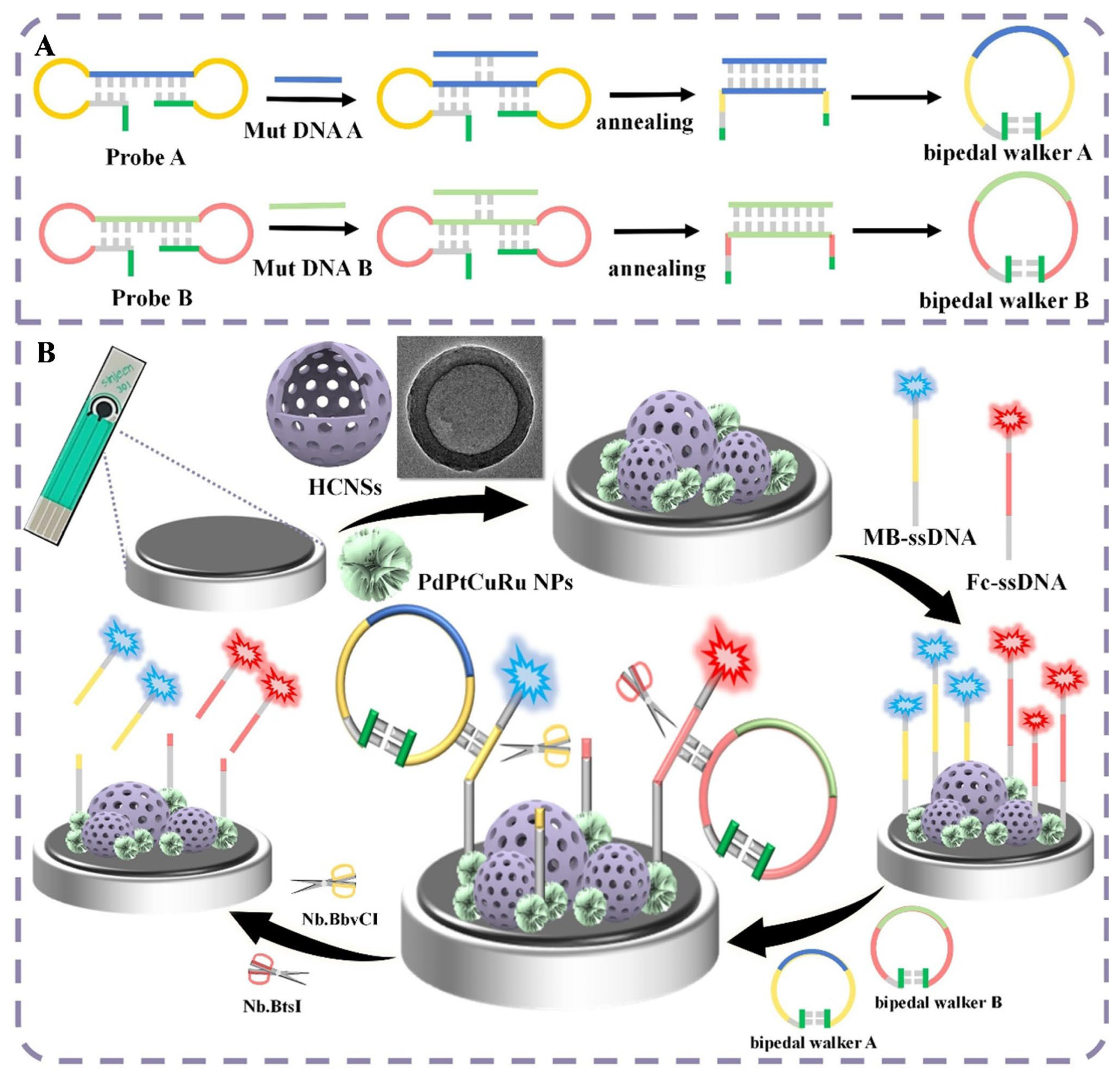
| SPCE/3D-HCNSs/PdPtCuRu NPs/MB-ssDNA+Fc-ssDNA/EGFR-related bpwDNA A and B | EIS | 1.0 × 10⁻⁶–1.0 × 10⁻¹ nM | Bpwalker A and B: 3.4 fM and 2 fM | Wt DNA | [114] |
| Strategy | Technique | Linear Range | LOD | Interference Studies | Ref. |
|---|---|---|---|---|---|
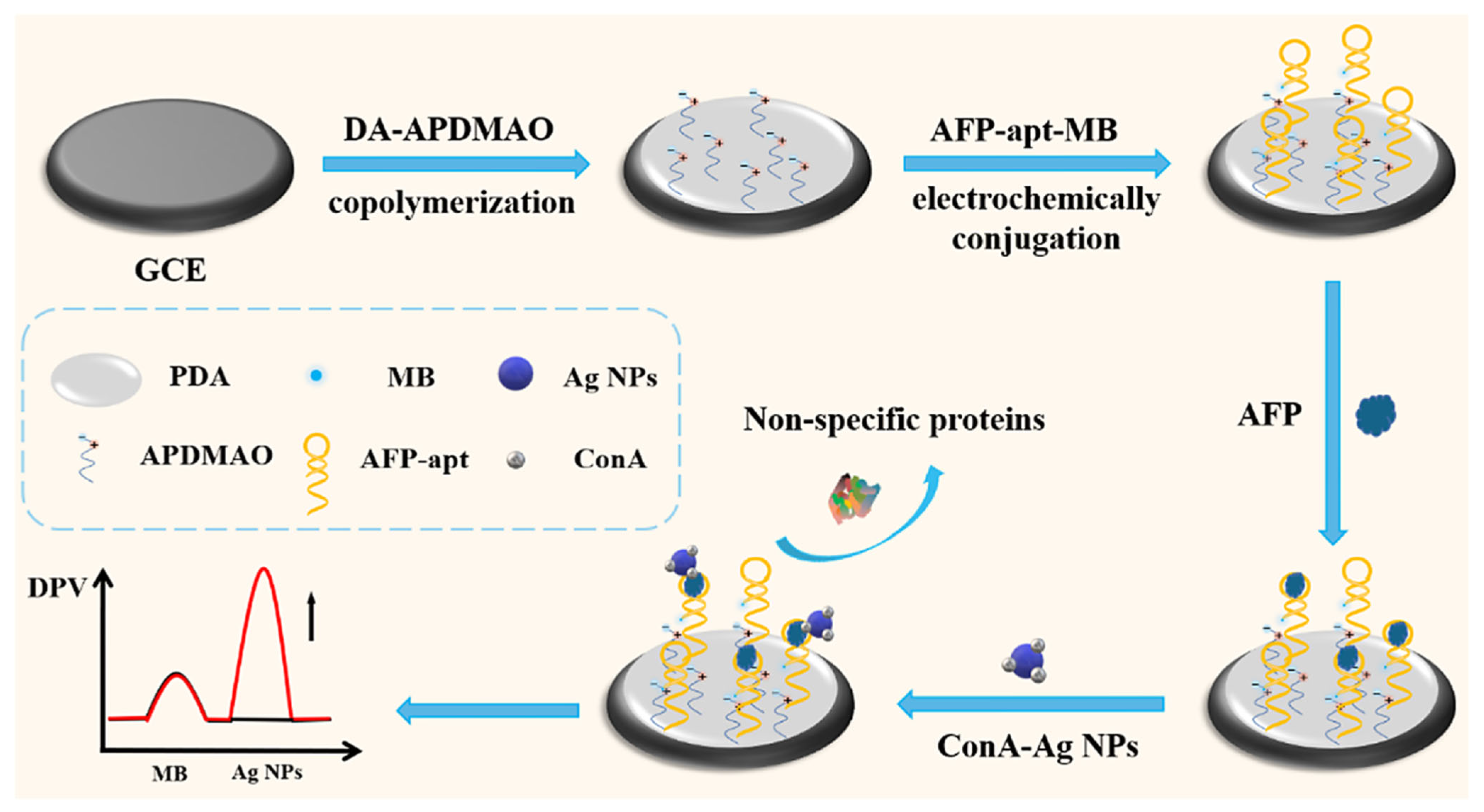
| GCE/APDMAO/Apt1-MB/AFP/ConA-Ag NPs | DPV | 10 fg mL−1–10 ng mL−1 | 3.41 fg mL−1 | Lys, HSA, IgG, PSA, GLO, CEA, BSA, Thr | [122] |
| SPE/AuNPs-Ti3AlC2/Apt-MB/AFP | DPV | 1.0–300 ng mL−1 | 0.05 ng mL−1 | BSA, PSA, IgG, HGB, OVA | [123] |
| SPE/AuNPs/rGOCu2O-Apt/BSA/AFP | DPV | 0.001–100 ng mL−1 | 1.77 pg mL−1 | HSA, IgG, LDL, BSA | [124] |
| GCE/rGO-Au-Fe3O4/Apt-TB/BSA/AFP | SWV | 0.1–500 ng mL−1 | 0.03 ng mL−1 | CEA, BSA, IgG, PSA | [125] |
| GCE/PANI/CdTe/CdSe/DNA/MCH/AFP | DPV | 1–10 μg mL−1 | 1 pg mL−1 | MUC1, IL-6, CEA, IgG | [126] |
| GCE/GCN/PPy/Apt/AFP | ECL | 1 × 10⁻¹¹–1 × 10⁻⁵ µg mL−1 | 10−11 µg mL−1 | BSA, Thr | [127] |
| Strategy | Technique | Linear Range | LOD | Interference Studies | Ref. |
|---|---|---|---|---|---|
| ANME/AuNPs/4-MPBA/OPN/pMB/pDA | DPV | 0.01–1000 ng mL−1 | 3 pg mL−1 | MSLN, VEGF, PPZ, CPZ, Mg2+, Na+, DA | [133] |
| Au/SAM/Strep/bAb/OPN | EIS | 0.5−512 pg mL−1 | 0.171 pg mL−1 | IL-8; CK-MB, VEGF | [134] |
| MGCE/Au@α-Fe2O3/Fe3O4/Apt1/OPN/Apt2/Cas13a | DPV | 1.0 pg mL−1–10 ng mL−1 | 0.33 pg mL−1 | NCL, HN-RNP-A1, AFP, Tau | [135] |
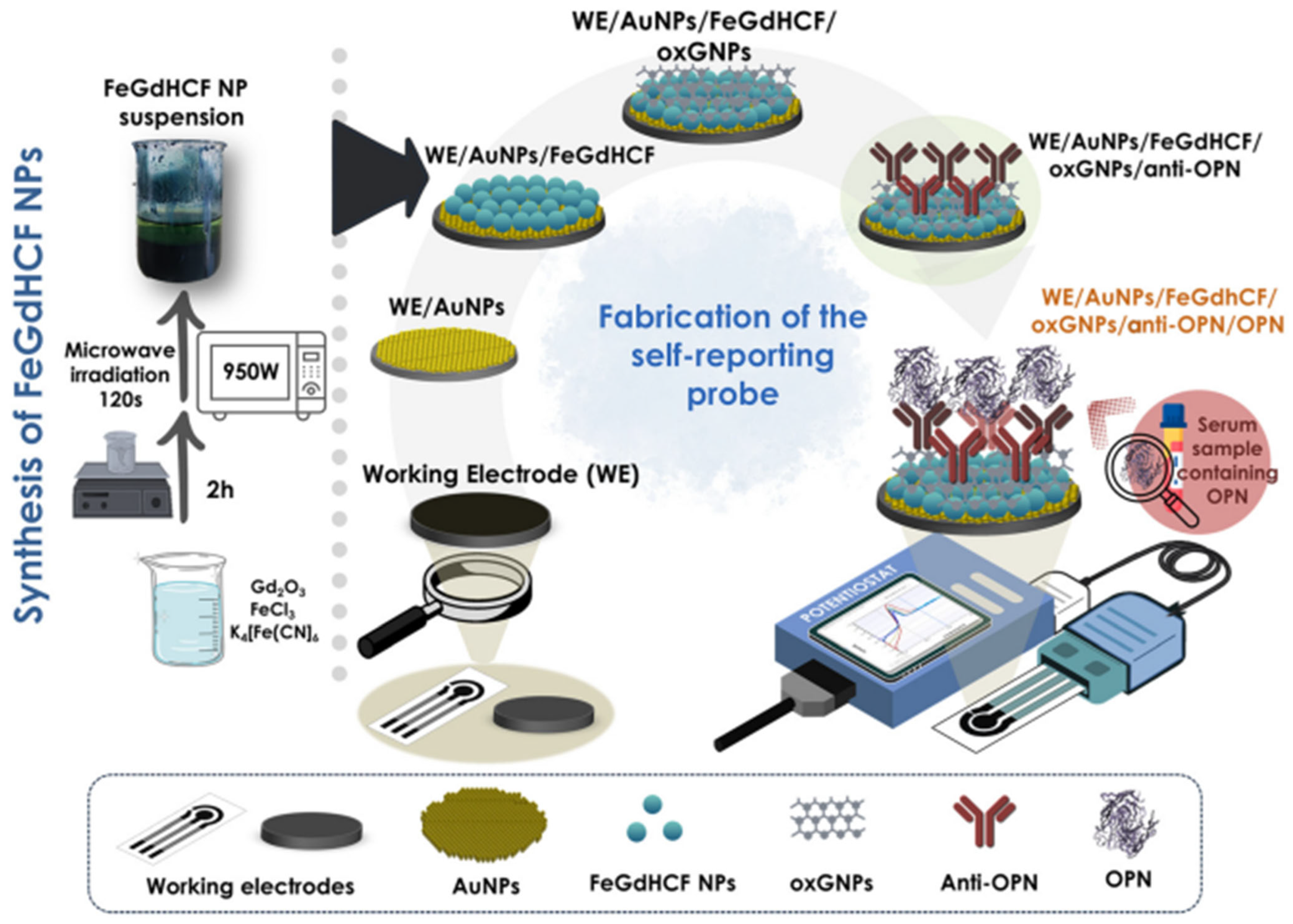
| GCE/Au/FeGdHCFNPs/oxGNPs/anti-OPN/OPN | DPV | 5 × 10² 1–2 × 10⁶ pg mL−1 | 0.437 pg mL−1 | ALP, Glu, DA, UA, Urea, VEGF, His, AA, BSA, HSA, Creatinine, Chloramphenicol | [136] |
| Strategy | Technique | Linear Range | LOD | Interference Studies | Ref. |
|---|---|---|---|---|---|
| GCE/3D-CdCo-ONSs@AuNPs/Apt/BSA/MUC1 | DPV | 10 pg mL−1–100 μg mL−1 | 0.96 µg mL−1 | UA, AA, HER2, CA125, CA199, CEA | [146] |
| GCE/Au/Apt1/MCH/Cas12a/CrRNA/MB (on signal) GCE/Au/Apt1/MCH/MNP-HP2- Cas12a/CrRNA/Apt2-MgAl-LDH@Fc-AuFe-MIL-101 (off signal) | DPV | 10 fg mL−1–100 ng mL−1 | 5.97 fg mL−1 for MB 0.43 fg mL−1 for Fc | HER2, CA153, cTnI, Mb | [147] |
| g-C3N4/Au-luminol/Apt1/BSA/MUC1/ZnCuS-Apt2 | ECL | 1 × 10⁻⁴ ng mL−1–1 × 10³ ng mL−1 | 5 × 10⁻⁵ ng mL−1 | AFP, CEA, HSA, Insulin | [148] |
| SPE/Ru-Pd@MXene-PANI-(Co-PP)/Au/ATP/Anti-MUC1/BSA/MUC1 | EIS | 1 fg mL−1–200 ng mL−1 | 0.28 fg mL−1 | Survivin, AFP, Glu, BSA | [149] |
| SPCE/MWCNT/Au/4-ATP/nanoMIPs/CA15-3-activ-ated silica gel | SWV | 1–100 U mL−1 | 0.14 U mL−1 | HSA, IgG, CEA, Glu, AA | [150] |
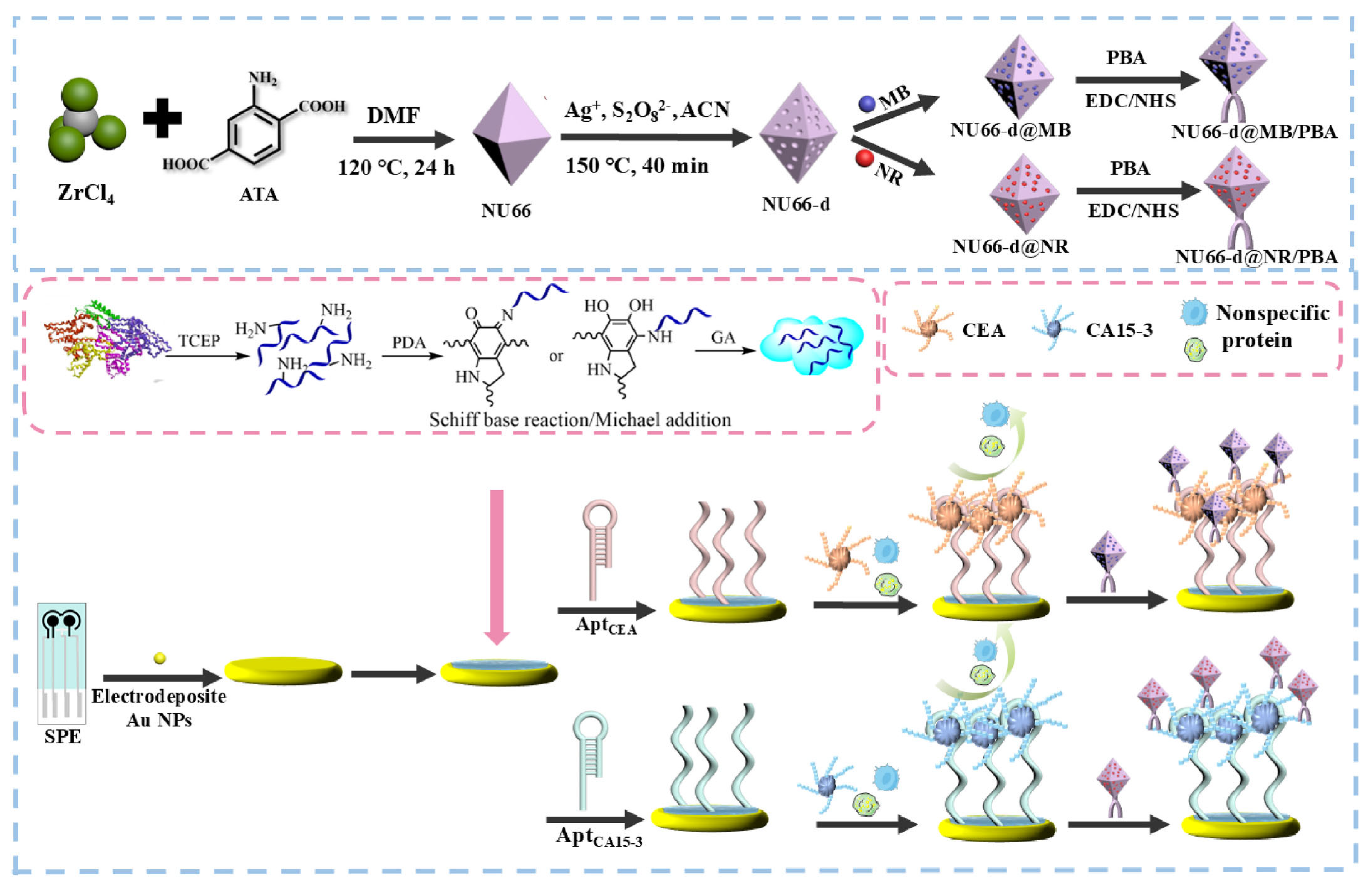
| SPE/Au/BSA-PDA/Glut/AptCA15-3/CA15-3/NU66-d@NR | DPV | 0.01–1000 U mL−1 | 0.0032 U mL−1 | CEA, AFP, IgG, IgM | [151] |
| GCE/CeO2-Pt-Streptavidin/Biotin-Ab1/BSA/CA15-3/Ab2@PEI-L012/ZnNi-MOF | ECL | 0.0005–50 U mL−1 | 5.75 × 10⁻⁵ U mL−1 | CEA, AFP, PSA | [152] |
| ITO/Cds/Bi2S3/NiS/Ab1/BSA/CA 125 | PEC | 1 pg mL−1–50 ng mL−1 | 0.85 pg mL−1 | CEA, HE4, BSA, Creatine, UA, Glu, Cys | [153] |
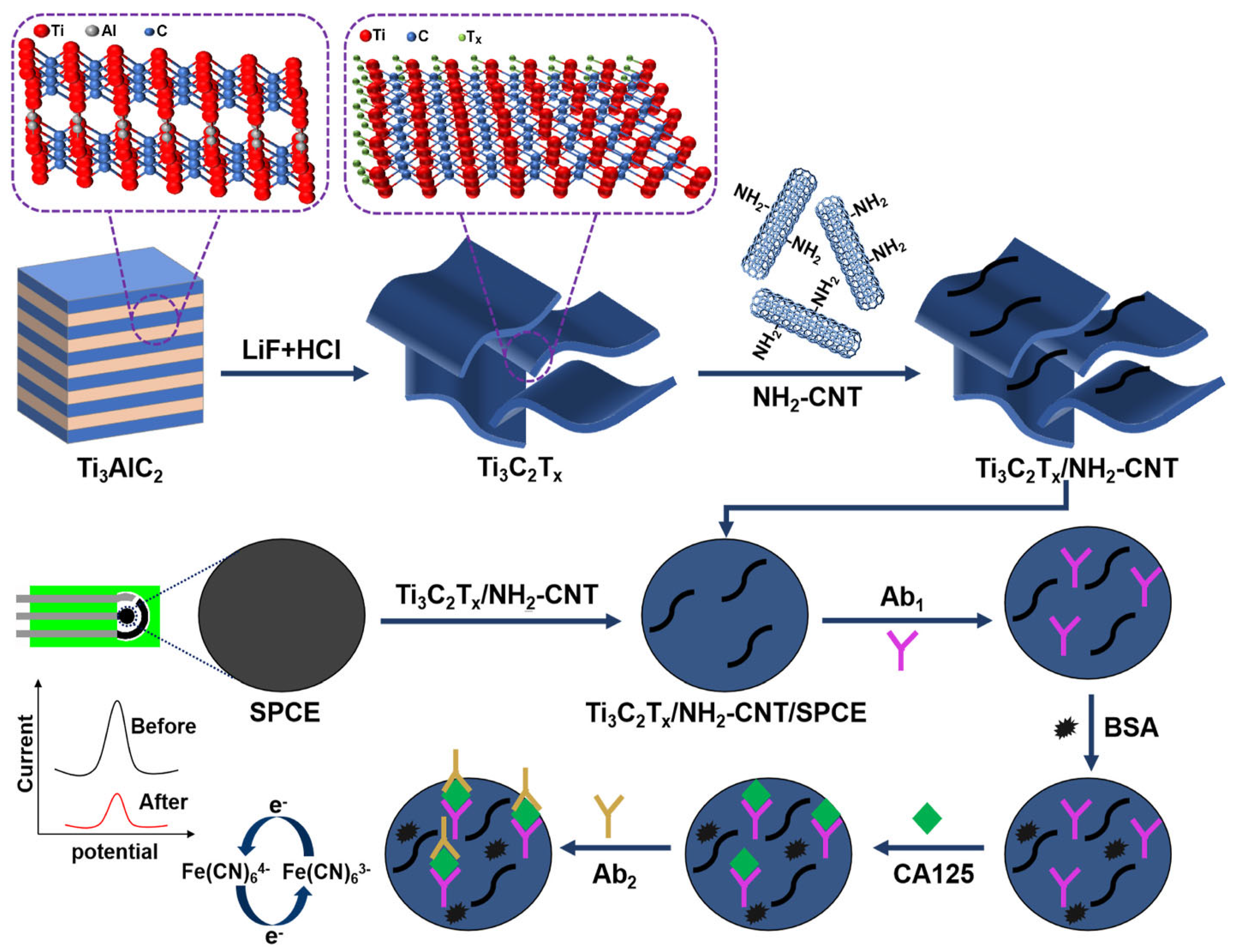
| SPCE/CNT-NH2/Ti3C2Tx/Ab1/BSA/CA 125/Ab2 | DPV | 1 mUmL−1–500 U mL−1 | 1 mU mL−1 | PSA, CysC, LAM, ProGRP | [154] |
| GCE/TD-COF/Ab1/BSA/CA 125/Ab2/AuNPs@COFBTT-DGMH | DPV | 0.00027–100 U mL−1 | 0.089 mU mL−1 | NaCl, Ser, Glu, Cys, Arg | [155] |
| GCE/EP-COFDha-Tab/Ab1/BSA/CA 125/Ab2-AuNPs@COFDAAQ-TFP | DPV | 0.01–100 U mL−1 | 0.0067 U mL−1 | KCl, DA, Glu, Fru, NaNO2, Man, Trp, Thr, Tyr, Cys, Arg | [156] |
| Strategy | Technique | Linear Range | LOD | Interference Studies | Ref. |
|---|---|---|---|---|---|
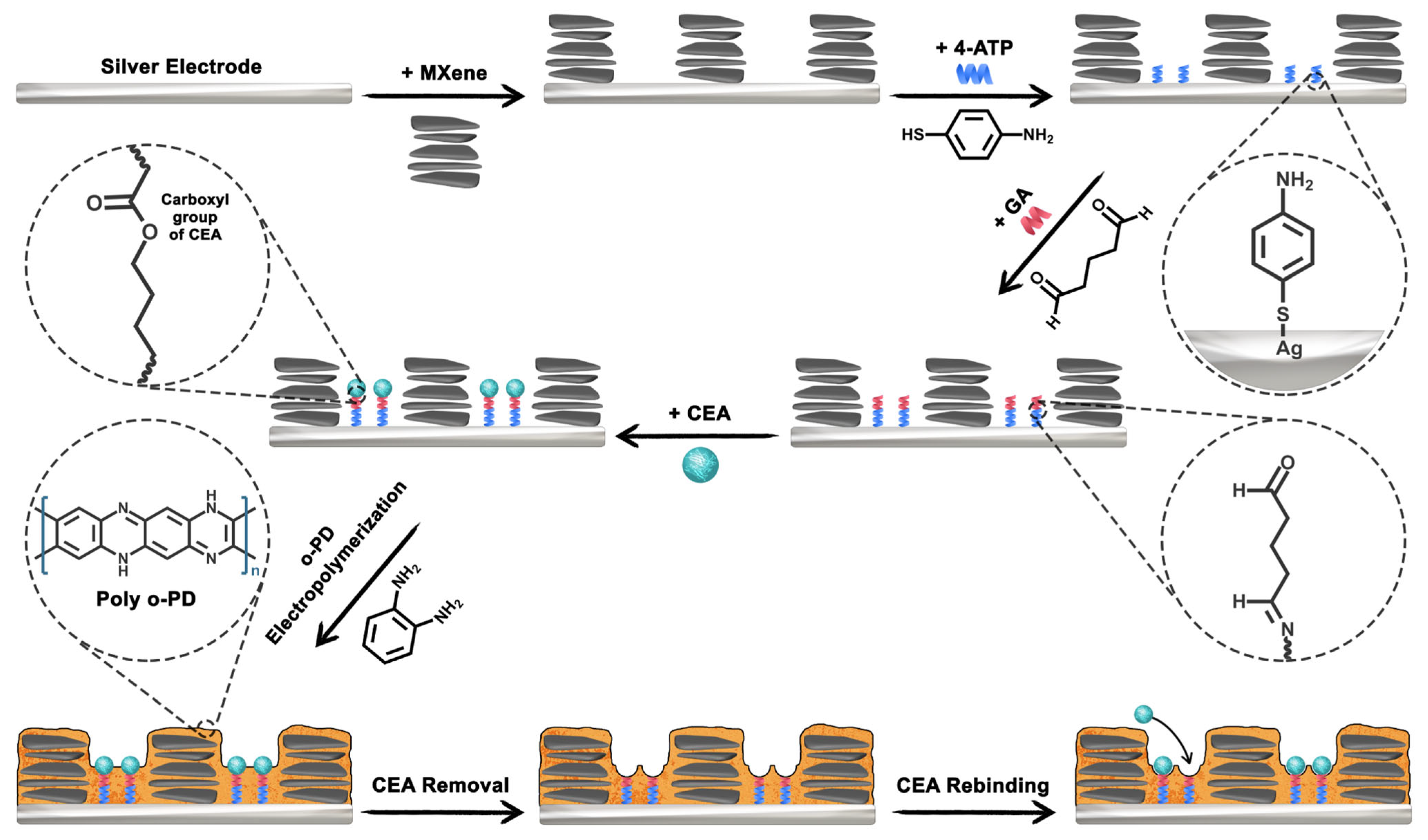
| AgE/Ti3C2TX/4-ATP/GA/CEA/Poly o-PD | EIS | 10–100 ng mL−1 | 9.41 ng mL−1 | CRP, Fibrinogen | [177] |
| SPCE-MX@CNT/MB/Ab1/BSA/CEA/Ab2-ALP | DPV | 0.005–1.0 ng mL− 1 | 1.6 pg mL−1 | Hb, AFP, HSA, Cys | [178] |
| ITO/Ti3AlC2/MWCNTs/Au/s-Ab/BSA/CEA | DPV | 0.050–200 ng mL−1 | 0.015 ng mL−1 | UA, Glu, AA, DA, BSA, PSA, AFP | [179] |
| SPE/Ab1/CEA/Ab2-AuNPs-GOx | DPV | 0.020–100 ng mL−1 | 0.013 ng mL−1 | HER2, PSA, cTnI, AFP | [180] |
| GCE/CS-Fc/i3k@Au/Cu/Ab/BSA/CEA | SWV | 1.25–200 ng mL−1 | 0.15 ng mL−1 | MUC1, IgG, MMP-2, MMP-7 | [181] |
| GCE/MOF-Fe/PtNPs/Apt/CEA | DPV | 0.003–15.0 ng mL−1 | 1 pg mL−1 | Cys, PSA, BSA, AFP | [182] |
| AuE/SAM/AuNPs/SH-pt1/BSA/CEA/Apt2- COOH/PCL-b-PHEAA | EIS | 100 fg mL−1–200 ng mL−1 | 6 × 10⁻² pg mL−1 | HER2, CYFRA21-1, cTnI | [183] |
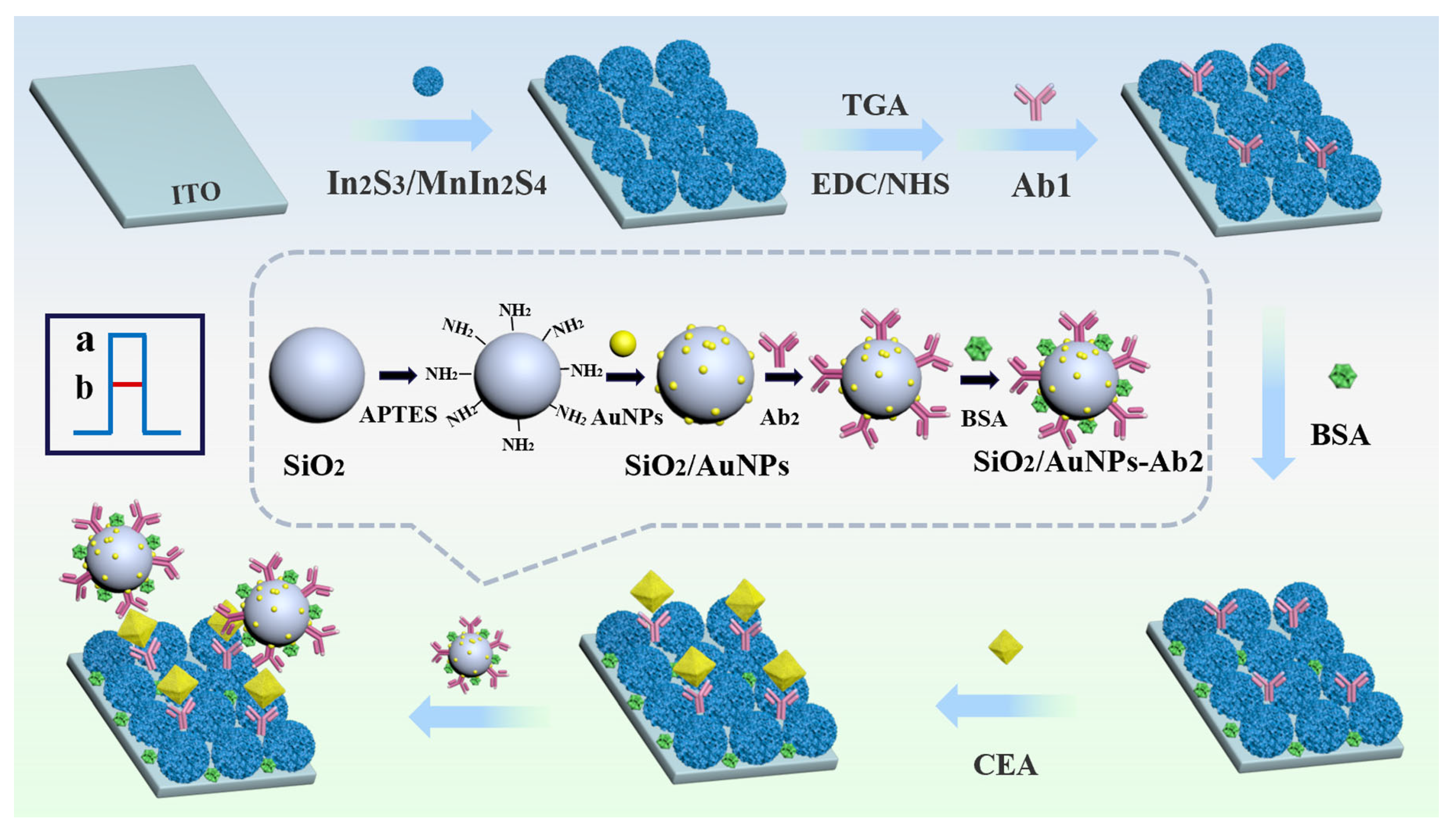
| ITO/In2S3/MnIn2S4/TGA/Ab1/BSA/CEA/Ab2-AuNPs/SiO2 | PEC | 0.5 pg mL−1–100 ng mL−1 | 0.143 pg mL−1 | IgG, Thr, NSE | [184] |
| GCE/SA/AuNPs/γ.MnO2-CS/Ab/BSA/CEA | DPV | 10 fg mL−1–0.1 µg mL−1 | 9.57 fg mL−1 | Vit C, Glu, Gly | [185] |
| GCE/Au/Prot-G/GA/Ab1/BSA/CEA/Ab2-HRP-AuNPs | DPV | 0.1–50 ng mL−1 | 0.0022 ng mL−1 | VEGF, BSA, Cys, GAPDH | [186] |
| iDE/rGO/PBASE/Apt/BSA/CEA | CV | 0.1 fg mL−1–10 ng mL−1 | 0.33 zM | CYFRA21 | [187] |
| SPCE/GO/CNTs/CuONPs/Ab/BSA/CEA | CV | 0.1 ng mL−12–5.0 ng mL−1 | 0.08 ng mL−1 | IgG, BSA, AFP, CYFRA21-1, CA 125 | [188] |
| ITO/AuNP/CuBi2O4/MCH/Apt1/CEA/Apt2-G4/Hemin | PC | 0.1 pg mL−1–10 ng mL−1 | 0.021 pg mL−1 | AFP, BSA, IgG, PSA | [189] |
| FTO/ZnIn2S4/g-C3N4/AuNPs/Ab1/BSA/CEA/Ab2-BiVO4- | PC | 0.0001–100 ng mL−1 | 0.03 pg mL−1 | PSA, AFP, NSE, HIG, HSA | [190] |
| GCE/MoS2@Au-Ab1/BSA/CEA/Ab2-NH2-MIL88(Fe)/Ru(bpy)32+ | ECL | 0.1 pg mL−1−100 ng mL− 1 | 38.9 fg mL−1 | NSE, CYFRA21-1 | [191] |
Disclaimer/Publisher’s Note: The statements, opinions and data contained in all publications are solely those of the individual author(s) and contributor(s) and not of MDPI and/or the editor(s). MDPI and/or the editor(s) disclaim responsibility for any injury to people or property resulting from any ideas, methods, instructions or products referred to in the content. |
© 2026 by the authors. Licensee MDPI, Basel, Switzerland. This article is an open access article distributed under the terms and conditions of the Creative Commons Attribution (CC BY) license.
Share and Cite
López Mujica, M.E.J.; Ferapontova, E.E. Electrochemical Biosensors for Cancer Diagnosis and Prognosis Using Protein Biomarkers: Current Trends, Advances, and Clinical Translation Potential. Sensors 2026, 26, 1139. https://doi.org/10.3390/s26041139
López Mujica MEJ, Ferapontova EE. Electrochemical Biosensors for Cancer Diagnosis and Prognosis Using Protein Biomarkers: Current Trends, Advances, and Clinical Translation Potential. Sensors. 2026; 26(4):1139. https://doi.org/10.3390/s26041139
Chicago/Turabian StyleLópez Mujica, Michael E. J., and Elena E. Ferapontova. 2026. "Electrochemical Biosensors for Cancer Diagnosis and Prognosis Using Protein Biomarkers: Current Trends, Advances, and Clinical Translation Potential" Sensors 26, no. 4: 1139. https://doi.org/10.3390/s26041139
APA StyleLópez Mujica, M. E. J., & Ferapontova, E. E. (2026). Electrochemical Biosensors for Cancer Diagnosis and Prognosis Using Protein Biomarkers: Current Trends, Advances, and Clinical Translation Potential. Sensors, 26(4), 1139. https://doi.org/10.3390/s26041139