1. Introduction
While the commercial deployment of fifth-generation (5G) mobile networks continues to accelerate worldwide, researchers have already turned their attention to the development of beyond-5G (B5G) and sixth-generation (6G) communication systems. In this context, several advanced transmission technologies have attracted rapidly growing interest, including extremely large-scale multiple-input multiple-output (XL-MIMO) communication [
1,
2,
3], Terahertz (THz) communication [
4,
5], and intelligent reflecting surface (IRS)-assisted communication [
6,
7,
8,
9]. In particular, XL-MIMO extends the paradigm of massive MIMO by scaling antenna arrays to an order of magnitude larger than those in current systems, promising substantial gains in spectral efficiency and network capacity [
10,
11]. As communication technology evolves toward 6G, antenna scales are further expanding to the level of thousands of elements to support higher data rates, ultra-low latency, and ubiquitous coverage. Thus, extremely large-scale antenna arrays (ELAAs) have emerged as a key enabling technology for 6G communications [
12,
13,
14].
Unlike conventional massive MIMO systems [
15,
16,
17,
18], which primarily operate in the far-field region, ELAAs are prone to operating in the near-field region when serving users or scatterers [
19,
20]. This unique characteristic arises from their significantly extended physical apertures; when combined with the continuous shrinkage of cell sizes in ultra-dense deployment scenarios, this greatly reduces the probability that users or scatterers are located beyond the far-field boundary. The transition from conventional massive MIMO to ELAAs leads to a substantial extension of the Rayleigh distance, a critical boundary that defines the division between the near-field and far-field regions and is mathematically proportional to the square of the array aperture [
21,
22]. This remarkable expansion of the Rayleigh distance implies that, in numerous practical operational scenarios of ELAA systems, the electromagnetic (EM) radiation field generated by the ELAA shifts from the far-field region to the near-field region. Within the near-field range, the plane-wave assumption, which is widely adopted in traditional channel modeling [
23,
24,
25], no longer holds; instead, spherical-wave effects become predominant. These effects give rise to noticeable phase curvature and non-uniform amplitude variations during signal propagation, which directly alter channel characteristics and introduce spatial non-stationarity [
26]. Such changes pose new and unprecedented challenges for accurate channel modeling, efficient beamforming design, and overall system performance optimization. Notably, most existing research works on ELAA systems are still reliant on the plane-wave approximation, thereby overlooking the significant impact of near-field effects on system performance metrics, including ergodic channel capacity. Particularly in the context of the continuous increase in antenna array size—an inevitable trend to meet the ever-growing demand for high data rates and ultra-reliable communication—the accuracy of near-field channel modeling becomes increasingly crucia [
27]. It directly determines the effectiveness of subsequent signal processing strategies and the achievable performance upper bound of ELAA systems, making it an indispensable research focus in the development of next-generation communication technologies [
26,
28].
In XL-MIMO communication systems, antenna elements are typically arranged densely with half-wavelength or smaller spacing, which leads to significant electromagnetic mutual coupling between elements [
29,
30,
31,
32]. This structural coupling alters the input impedance distribution at the antenna ports, thereby affecting the current distribution and overall radiation characteristics of the array. Conventional beamforming designs often assume mutually independent antenna elements, neglecting mutual coupling effects, an oversight that can introduce noticeable performance degradation in extremely large arrays [
10]. For instance, the authors in [
33] investigated the output signal-to-interference-noise ratio (SINR) of an adaptive array while accounting for mutual coupling, with simulation results confirming that coupling degrades array performance. Similarly, ref. [
34] examined the impact of mutual coupling in spatially correlated large antenna arrays for millimeter-wave systems, concluding that coupling can significantly reduce spatial correlation for side-by-side dipole elements. In such cases, the change in effective antenna gain caused by mutual coupling becomes a dominating effect and ultimately determines the antenna array performance. Conventional beamforming designs are typically predicated on the assumption of mutually independent antenna elements, neglecting the effects of mutual coupling. This simplification risks overestimating the potential performance gains of ELAAs [
10]. Existing research has proposed mutual coupling modeling methods based on impedance matrices. For example, ref. [
35] provides an in-depth study of coupling in linear antenna arrays, while studies on mutual coupling in extremely large-scale planar array antennas are relatively scarce. The computational complexity of these methods increases sharply with array size, making them difficult to scale to extremely large arrays, and they lack a joint optimization framework with near-field beamforming.
To address the issues mentioned above, this paper proposes a beamforming framework for extremely large-scale planar arrays that comprehensively considers near-field propagation and structural mutual coupling. The main tasks of this work are: to establish a near-field channel model based on a spherical-wave array response; to characterize inter-element mutual coupling via a two-dimensional impedance network; to introduce a low-complexity matrix inversion method based on the Neumann series approximation; and to obtain the optimal beam through eigen-decomposition. Finally, the performance differences of various beamforming schemes under near-field coupling conditions are compared and analyzed, validating the effectiveness of the proposed framework. This work provides a scalable, physically interpretable theoretical framework and practical guidance for near-field beamforming design in extremely large-scale antenna arrays.
2. Materials and Methods
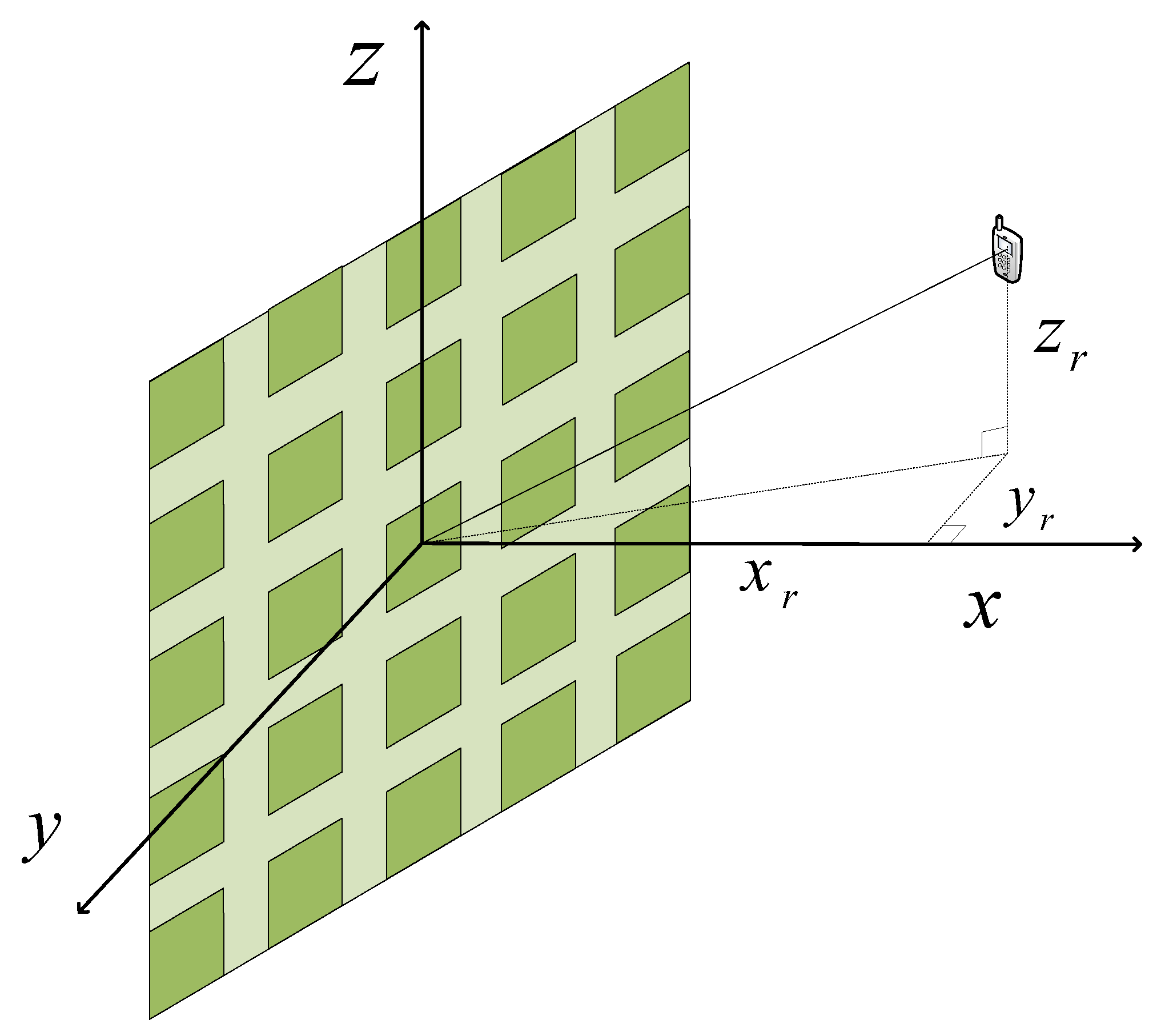
We consider a large-scale MIMO system in which the transmitter employs a planar antenna array and the receiver uses a single antenna, as illustrated in
Figure 1. The transmitter uses an
planar array on the
-plane (
), and the single-antenna receiver is located at
. The array comprises
M rows and
N columns, for a total of
elements. The carrier wavelength is
, where
f denotes the carrier frequency and
c is the speed of light. The inter-element spacing is set to half the wavelength, i.e.,
. The array aperture lies on the
-plane (thus
), and its geometric center is placed at the origin of the three-dimensional Cartesian coordinate system. To maintain the array center exactly at the origin for any array size, we adopt a symmetric indexing scheme for the row position
m and column position
n. Specifically, for odd values of
M and
N, we use centered integer indices
and
. For even values of
M and
N, the indices are defined as half-integers to ensure symmetry without a central element at the origin:
and
. The physical position of each element
is consistently given by
. Under this convention, the Cartesian coordinates of the
-th element are
; the physical aperture spans
and
along the
y- and
z-axes, respectively, which motivates a near-field treatment for large apertures.
In the large-aperture regime, the far-field plane-wave assumption is no longer valid. We therefore adopt a near-field (spherical-wave) channel model in which propagation is determined by the per-element distance to the receiver at
. The distance from the
-th element to the receiver is given by:
Under free-space line-of-sight (LoS) propagation, the complex baseband field of a spherical wave over the path length
exhibits two fundamental effects: (i) a
phase advance that is linear in the wavenumber
, yielding the factor
, and (ii) an
amplitude decay due to spherical spreading, for which the field magnitude scales as
(and the received power scales as
). Ignoring element patterns and polarization, the near-field array-response entry associated with the
-th element is modeled as [
20]:
where
represents the distance from the
-th element to the receiver. Unlike the far-field plane-wave approximation, this spherical-wave model accurately captures the phase curvature essential for near-field analysis in ELAAs.
In traditional MIMO systems, it is typically assumed that antenna elements are mutually independent. However, in extremely large-scale antenna arrays, this assumption becomes invalid due to significant mutual coupling effects. Mutual coupling results in electromagnetic interactions between adjacent antenna elements, which in turn alters current distributions and distorts the array radiation pattern, thus degrading overall system performance.
To characterize this effect, we introduce a coupling impedance matrix model. The mutual coupling among elements is represented by a complex impedance matrix , whose entries reflect the self and mutual impedances between antenna elements.
We consider the horizontal and vertical coupling structures of a planar array separately. Let
and
denote the coupling matrices along the horizontal and vertical directions, respectively. Both matrices share the same symmetric tridiagonal Toeplitz structure. We define a generic coupling matrix
with the following structure [
35]:
where
and
. Here,
is the self-impedance of each antenna element, and
denotes the mutual impedance between adjacent elements. The mutual impedances are obtained by employing the electromotive force method due to its numerical convenience [
36].
The full two-dimensional coupling matrix
is then constructed via the Kronecker product:
According to reference [
35], the overall coupling matrix that includes the load impedance
is given by:
where
is the load impedance at each antenna port, and
denotes the identity matrix of dimension
.
Finally, the complete coupling matrix is given by the formula:
Clearly, the
part of the formula involves considerable computational complexity. Therefore, we use the Neumann series approximation to solve the inverse matrix [
28,
37]. The detailed derivation process can be found in
Appendix A:
2.1. Eigenmode-Based Beamforming Optimization
2.1.1. Received Complex Baseband Signal
Let
denote the transmit beamforming vector (a total power constraint
will be imposed in subsequent subsections). After passing through the structural coupling network, the effective port-current (or excitation) becomes
, where
represents, respectively, the no-coupling baseline, the exact impedance-based coupling, or its low-complexity approximation (cf.
Section 2). The per-element near-field response toward the receiver is captured by
(cf.
Section 2), and
denotes a path-loss normalization constant.
Under free-space LoS propagation, the complex baseband received signal can be written as:
where
n models receiver noise (e.g.,
). Since the focus of this section is power-maximizing beamforming, we first neglect noise for clarity, which yields:
Equation (
10) shows that the received power is governed by the coherent projection of the
coupling-shaped excitation
onto the near-field array response
, scaled by
C. This expression forms the objective for the beamforming optimization developed in the remainder of this section.
2.1.2. Uncoupled Baseline: Maximum Ratio Transmission (MRT)
We set
for the no-coupling baseline. The received complex baseband signal and the corresponding received power are:
where
denotes the near-field (spherical-wave) array-response vector and
is the transmit beamforming vector subject to
.
Maximizing (
12) under the total power constraint is equivalent to:
where
is Hermitian, positive semidefinite, and rank one.
According to the Cauchy–Schwarz inequality, we can deduce that:
with equality if and only if
is collinear with
. Hence the MRT beamformer (unique up to a global phase) is:
and the optimal received power is:
2.1.3. Eigen-Decomposition Based Beamforming (EVD)
Based on the received signal and power in (
10), we rewrite the power using
as a Hermitian quadratic form.
Define the Hermitian matrix:
so that the received power can be written as a quadratic form
. Maximizing
under the total power constraint is therefore equivalent to the Rayleigh-quotient program:
Let the effective channel be
. Then
admits the rank–one outer-product representation:
(i) Hermitian. Using
and
:
(ii) Positive semidefinite. For any
:
Thus .
(iii) Rank one. If , then and . Otherwise, for any , , which is always a scalar multiple of . Therefore is one-dimensional and . Equivalently, shows that is an eigenvector with the unique nonzero eigenvalue , while all vectors orthogonal to lie in the null space of .
Since
is Hermitian rank one, its eigen-decomposition is [
38]:
with the (unit–norm) dominant eigenvector:
The optimizer of (
18) is the dominant eigenvector scaled to meet the power constraint:
The EVD solution thus coincides with coupling-aware MRT: normalize the effective channel and scale by . In practice, one need not explicitly form or factorize ; computing and normalizing avoids large-scale EVD and improves numerical stability.
Then the received power under the coupling-aware eigenmode precoding is given by:
By substituting the optimal precoding vector
, which is the principal eigenvector of the matrix
, the maximum received power can be expressed as:
where
represents the maximum available power gain achievable by the proposed eigenmode method.
2.2. Channel Model with Multipath Scattering
To evaluate the robustness of the proposed near-field coupling optimization in realistic electromagnetic environments, we extend the deterministic line-of-sight (LoS) model to a comprehensive multipath channel model. Following the statistical framework for millimeter-wave propagation in [
39], the aggregate channel vector
is characterized by the superposition of a dominant LoS path and multiple non-line-of-sight (NLoS) scattering components [
39],
where
P denotes the number of resolvable scattering clusters caused by environmental obstacles.
2.2.1. Deterministic LoS Component
The LoS component
represents the direct spherical wavefront from the transmitter to the receiver in the near-field region. The
l-th element is:
where
K is the Rician factor representing the power ratio between LoS and NLoS components, and
is the distance from the
l-th antenna element at position
to the intended receiver at position
.
2.2.2. Stochastic NLoS Component with Uniform Spherical Wavefront
In near-field scenarios, all multipath components exhibit spherical wavefronts at the receiver array. Each NLoS path corresponds to a scattering cluster with distinct spatial characteristics. The
l-th element of the
p-th NLoS component is modeled as:
where:
is the complex gain of the p-th scattering cluster, capturing both amplitude fluctuation and random phase shift;
is the distance from the l-th antenna element to the p-th scatterer at position ;
is the power fraction of the p-th NLoS path, satisfying .
The total NLoS power is normalized such that , ensuring that the total channel power when considering unit antenna gains.
3. Results
This section presents simulation results that evaluate the impact of structural mutual coupling and different beamforming strategies in a near-field large-scale MIMO system. Unless otherwise stated, the planar antenna array consists of
rows and
columns, with an inter-element spacing of
and a carrier frequency of 30 GHz. The receiver is positioned at
m. The self-impedance of each antenna element is set to
, and the mutual impedance between adjacent elements is
. According to the theoretical derivation of the approximation method, the Neumann series expansion becomes invalid when the coupling matrix loses its diagonal dominance. For comparative analysis, both
and
are also assigned the same value of
in a separate evaluation, following the parameter values established in [
34].
Five transmission schemes are compared: (i) uncoupled maximum ratio transmission (MRT), (ii) MRT with structural mutual coupling, (iii) uniform excitation under coupling, (iv) MRT based on the Neumann series coupling approximation, and (v) eigenmode-based optimization using the approximate coupling matrix. The received power is evaluated over transmit power levels ranging from 10 dBm to 40 dBm.
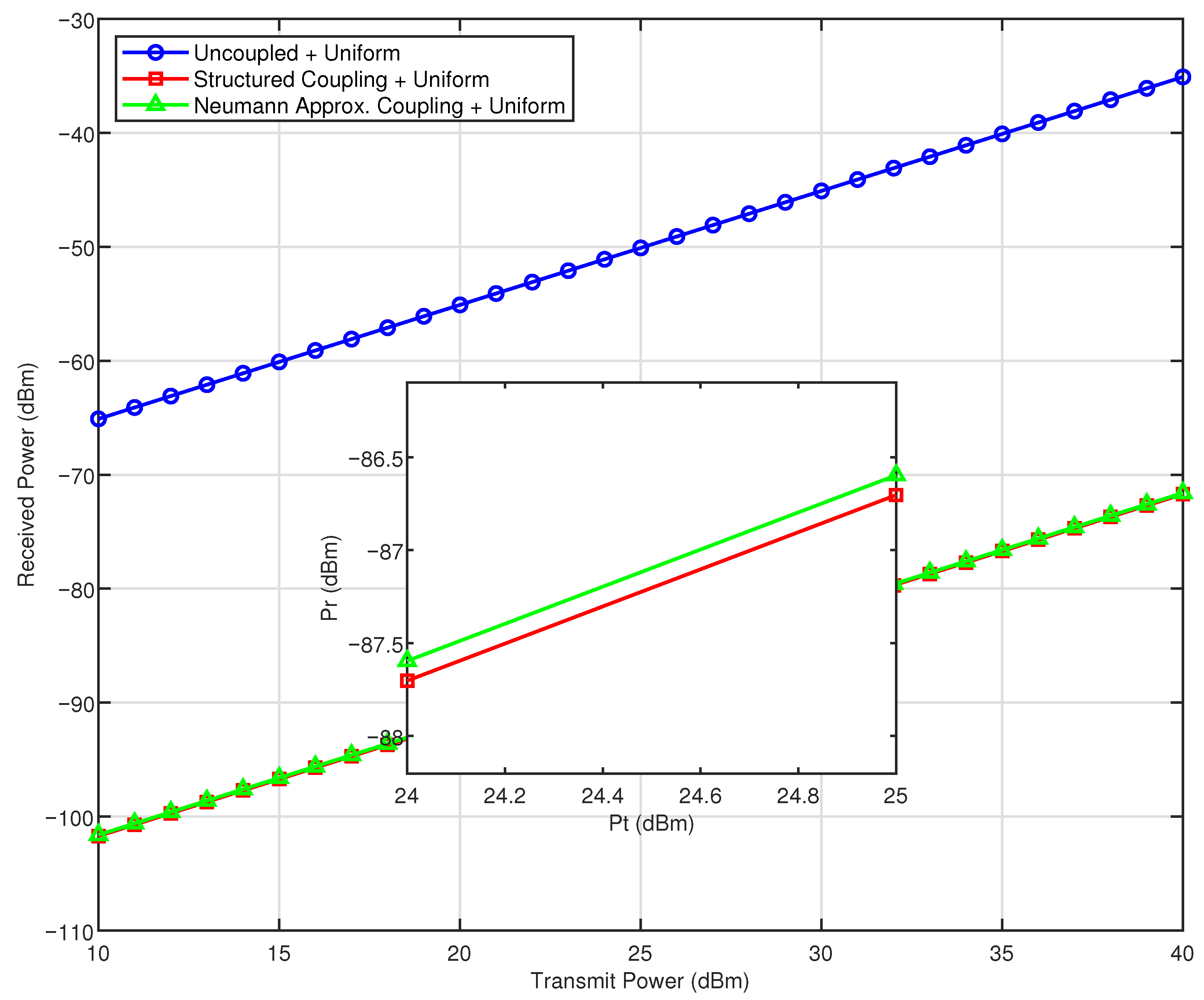
Figure 2 shows the effect of structural and approximate coupling on the received signal power. It compares the performance of three transmission schemes: uncoupled MRT (theoretical upper bound), MRT with full structural coupling, and MRT based on the Neumann series approximation. In the uncoupled case, received power increases linearly with transmit power, representing ideal transmission without mutual coupling. Introducing structural coupling causes a significant drop in received power, highlighting the performance degradation due to mutual coupling in dense arrays. Although the Neumann series approximation does not completely remove coupling effects, it provides a computationally efficient approximation and leads to a modest performance improvement.
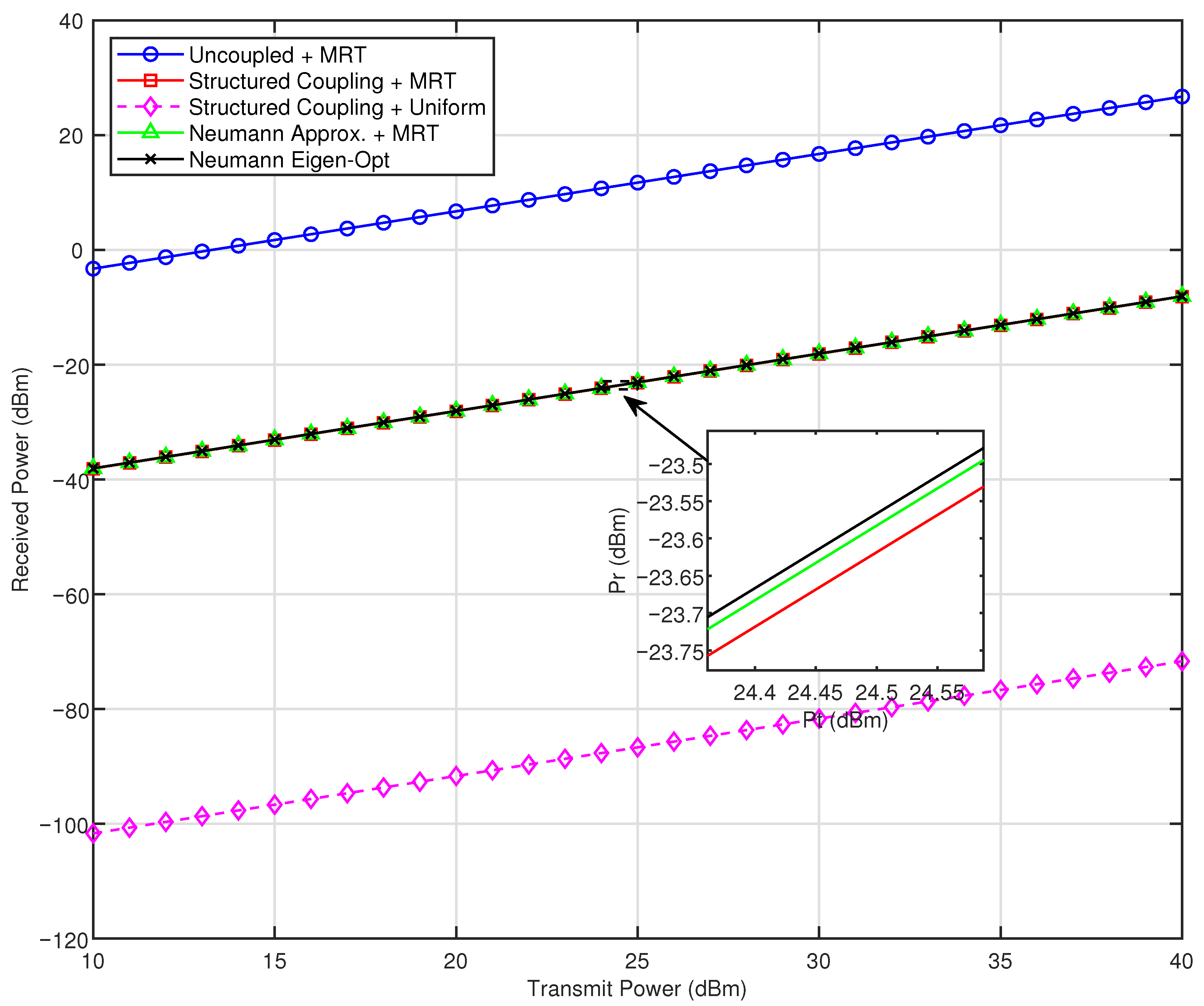
Figure 3 further examines how different optimized coupling schemes affect the received signal power measured at test points. The curves show that once optimization is applied, both the full structured-coupling model and its Neumann series approximation deliver clear performance gains. Using the full structured-coupling matrix as the optimization variable gives a strong boost in received power, proving that properly handling mutual coupling can effectively offset its usual performance degradation. On the other hand, using the Neumann approximation for matrix inversion achieves nearly the same improvement while significantly reducing computational load. Moreover, the eigenmode transmission method slightly outperforms the coupling-aware MRT in numerical results.
In
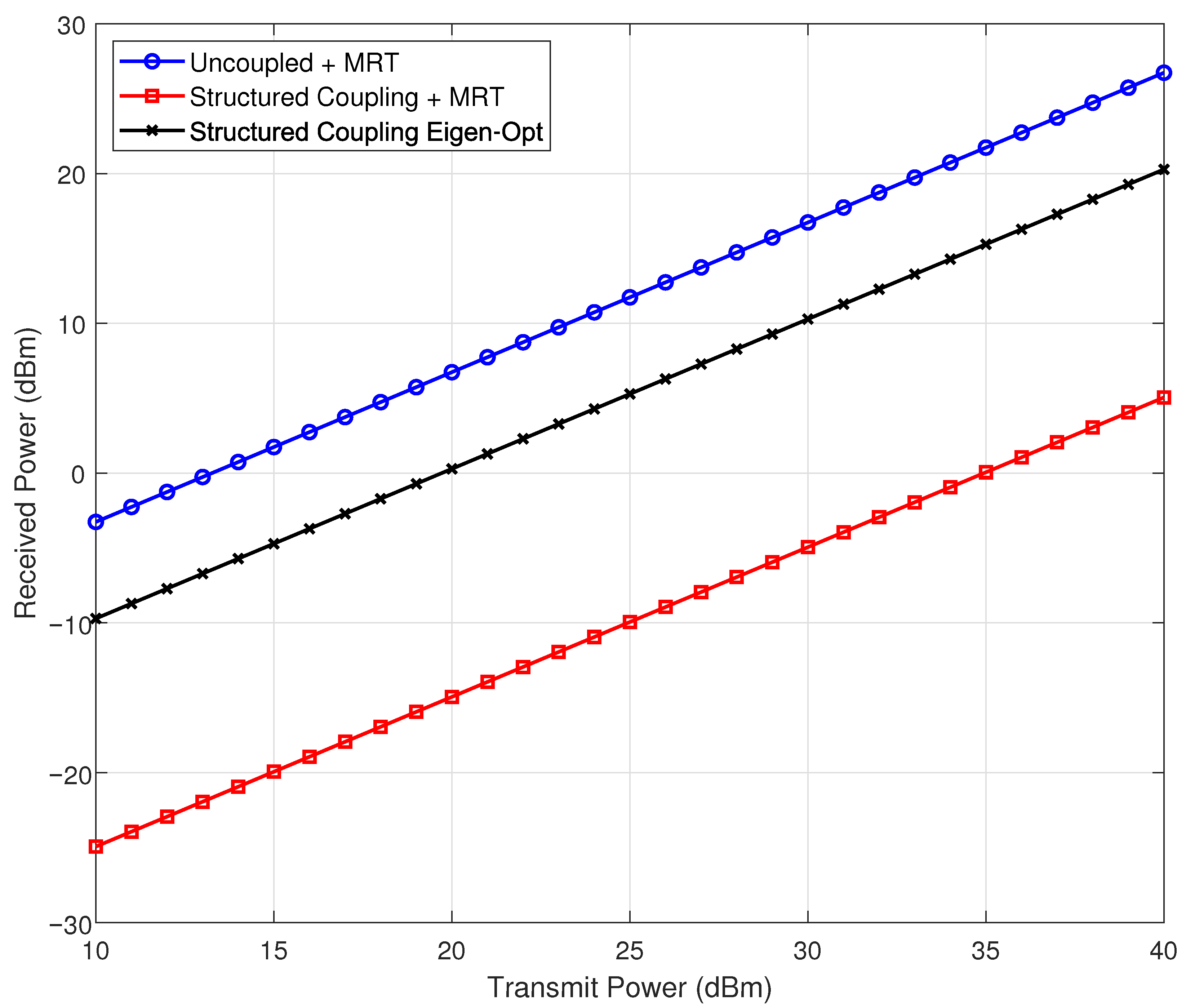
Figure 4, the mutual impedance
between adjacent elements is modified. Under these conditions, the coupling matrix loses its diagonal dominance, rendering the Neumann series approximation inapplicable. Consequently, eigenvalue decomposition is performed directly on the structured coupling matrix. The results show that eigenvector-based optimization provides a measurable improvement in received signal power over conventional approaches.
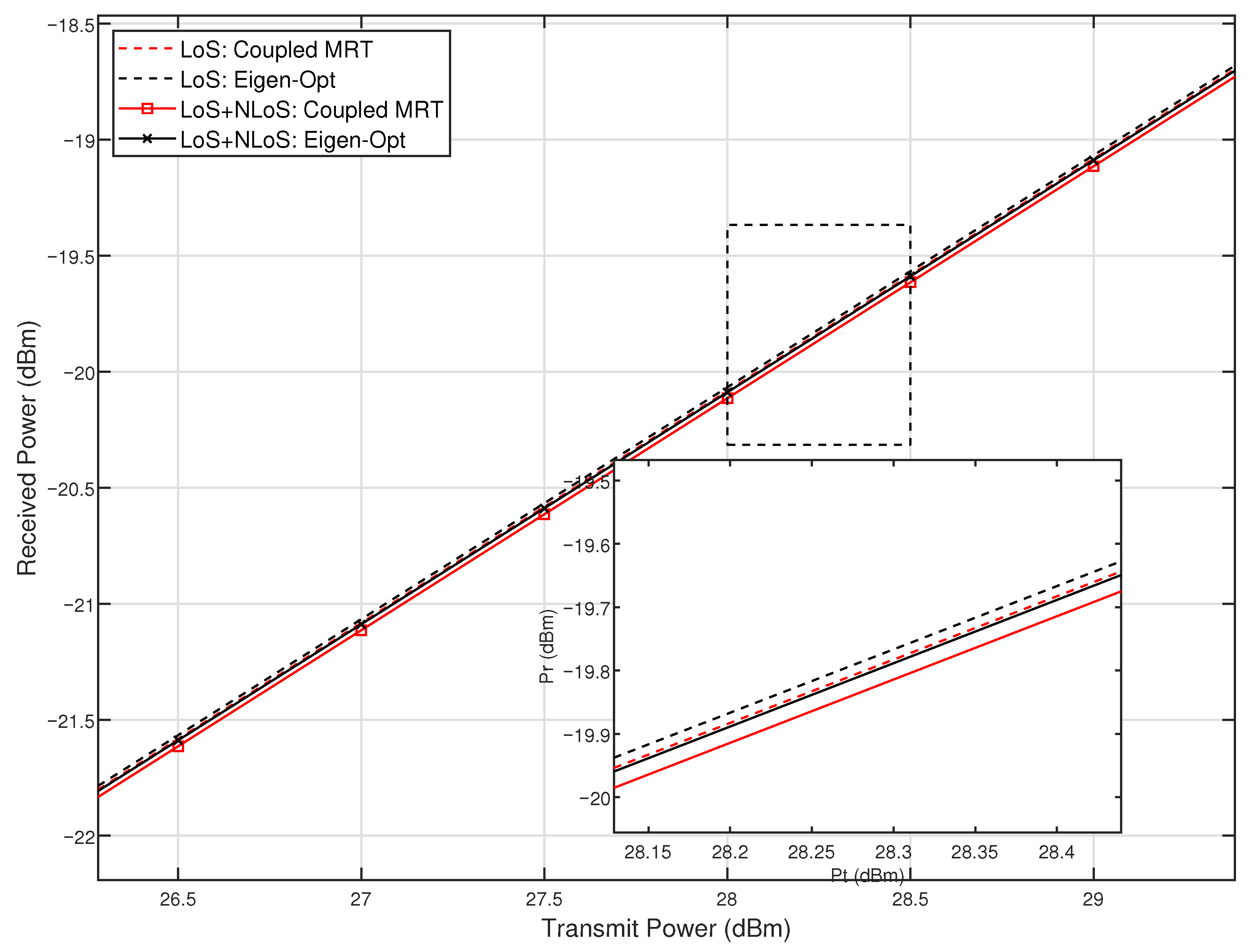
Figure 5 further comparatively analyzes the received power performance of different beamforming schemes in a near-field multipath propagation environment. The simulation curves show that, under line-of-sight (LoS) propagation conditions, the eigen-optimization-based beamforming scheme exhibits a significant performance advantage compared to the maximum ratio transmission (MRT) scheme based on the structural coupling model. This result verifies the effectiveness of the eigen-optimization method as predicted by the theoretical analysis. When non-line-of-sight (NLoS) multipath scattering components are introduced into the channel, the received power of all schemes decreases to a certain extent, reflecting the general challenge posed by scattering environments to beamforming performance. However, under multipath conditions, the eigen-optimization scheme still maintains a performance advantage relative to the structural coupling MRT scheme, demonstrating its relatively good robustness in complex channel environments. The locally enlarged view further indicates that the eigen-optimization method can maintain stable performance gains across different transmit power levels. In summary, the eigen-optimization method not only effectively suppresses mutual coupling effects between antennas but also exhibits favorable transmission performance under the influence of multipath interference, thereby providing a reliable technical approach for beamforming design in practical near-field communication systems.
5. Conclusions
This paper mainly introduces a complex large-scale planar array antenna considering structural coupling. The channel is modeled by the spherical wave array response, and the mutual coupling is derived in the form of a Kronecker product. In order to maintain the scalability, the Neumann series approximation of inverse coupling operator is proposed, which avoids the huge amount of calculation of direct matrix inversion.
On this basis, we demonstrate that coupling-aware power maximization exhibits a rank-one Hermitian structure and that the eigen-decomposition-based solution is equivalent to coupling-aware maximum ratio transmission (MRT). This leads to a simple and numerically stable implementation—achieved by normalizing the effective channel instead of performing large-scale eigen-decomposition. The simulation results confirm the theoretical analysis: uncoupled MRT serves as an ideal performance upper bound. Among coupling-aware designs, eigen-decomposition with Neumann approximation yields the highest received signal power, followed by MRT based on the Neumann model, whereas non-adaptive MRT with full structural coupling and uniform excitation exhibits poorer performance. These findings highlight the necessity of incorporating mutual coupling into near-field beamforming design, particularly for systems with large apertures.
In addition to the baseline LoS analysis, we extend our investigation to multipath-rich environments to evaluate the robustness of the proposed framework. Simulation results in Rician fading channels (K = 10 dB) reveal that while all schemes experience performance degradation due to scattering-induced interference, the eigen-optimization approach maintains its superiority. Specifically, it demonstrates improvement over conventional coupling-aware MRT in multipath scenarios, effectively mitigating both mutual coupling and inter-path interference. Furthermore, the performance gap between eigen-optimization and the ideal uncoupled upper bound widens compared to pure LoS conditions, highlighting the compounded challenges of near-field operation in scattering environments. These findings underscore the necessity of joint optimization that simultaneously addresses mutual coupling and multipath characteristics, particularly for large-scale arrays deployed in practical propagation conditions. Future research will integrate element radiation patterns and polarization effects, extend the framework to wideband and multi-user scenarios, and further investigate calibration and hardware non-idealities.