The Micro-Mobility Sensing Gap: A Systematic Review of Physiological Safety Monitoring from Cycling to E-Scooters

 ,
,  , ,
, ,  and
and 
Abstract
1. Introduction
RQ: How are wearable physiological and behavioural sensors used to detect stress and fatigue in cycling and micro-mobility, and what modelling and machine learning methods support this detection?
- RQ1: Which physiological and behavioural signals are most commonly measured?
- RQ2: Which models (statistical and ML) are used to classify or predict stress and fatigue?
- RQ3: How often are embedded or real-time inference techniques (TinyML) applied?
- RQ4: What methodological gaps and limitations are evident in current studies?
2. Methods
2.1. Protocol and Synthesis
2.2. Eligibility Criteria
- (i)
- Activity/Context: The primary activity involved cycling or micro-mobility, including indoor cycling (stationary bikes), outdoor cycling or e-bike riding.
- (ii)
- Outcome: The study estimated, classified or predicted at least one of the following: stress, fatigue, perceived exertion, workload or physiological strain during cycling or micro-mobility. Studies that modelled only VO2, energy expenditure, biomechanics, generic performance or motion segmentation, without a stress- or fatigue-related outcome, were excluded.
- (iii)
- Sensors: The study used wearable, rider-mounted physiological and/or behavioural sensors such as ECG, HRV, PPG/heart rate, SpO2, respiration, EDA/GSR, skin temperature, EMG, accelerometers, IMUs, or pedal cadence. Studies relying solely on non-wearable or environment-mounted sensors were excluded.
- (iv)
- Study Design and Publication Type: Primary empirical studies with human participants, published in peer-reviewed journals or conference proceedings, with full text available in English between 2015 and 2025.
- (v)
- Non-Eligible Articles: Review papers, systematic reviews, tutorials, theses, patents and non-peer-reviewed reports were excluded at title or abstract screening.
2.3. Information Sources
- IEEE Xplore;
- Web of Science;
- PubMed;
- Scopus;
- ScienceDirect.
2.4. Search Strategy
((cycling OR cyclist OR bicycle OR bicycling OR "micro-mobility") AND
("heart rate" OR "heart rate variability" OR HRV OR ECG OR EDA OR
"skin conductance" OR "physiological sensing") AND
(stress OR fatigue OR exertion OR "mental workload" OR "cardiac stress") AND
("machine learning" OR "deep learning" OR "embedded machine learning" OR
TinyML OR "edge computing") AND
(wearable OR "wearable sensor"))
- IEEE Xploree:((cycling OR cyclist OR bicycle OR bicycling OR "micro-mobility") AND ("heart rate" OR "heart rate variability" OR HRV OR ECG OR EDA OR "skin conductance" OR "physiological sensing") AND (stress OR fatigue OR exertion OR "mental workload" OR "cardiac stress") AND ("machine learning" OR "deep learning" OR "embedded machine learning" OR TinyML OR "edge computing") AND (wearable OR "wearable sensor"))
- Web of Science: (cycling OR bicycle) AND (wearable) AND ("heart rate" OR HRV OR ECG OR EDA) AND (stress OR fatigue) AND ("machine learning")
- PubMed: (cycling OR bicycle OR cyclist) AND (wearable OR "wearable sensor") AND("heart rate" OR HRV OR ECG OR EDA OR "skin conductance") AND(stress OR fatigue OR exertion) AND ("machine learning" OR "deep learning")
- Scopus: TITLE-ABS-KEY(cycling OR bicycle OR cyclist) ANDTITLE-ABS-KEY(wearable OR "wearable sensor") ANDTITLE-ABS-KEY("heart rate" OR HRV OR ECG OR EDA) ANDTITLE-ABS-KEY("machine learning")
- ScienceDirect: An example query was(cycling OR bicycling) AND ("heart rate variability" OR HRV) AND (stress) AND("wearable" OR "heart rate monitor")
2.5. Study Selection
2.6. Exclusion Criteria
- (i)
- Irrelevant Context: The study was not conducted with respect to cycling or micro-mobility (e.g., general sports, running, driving).
- (ii)
- Outcome Not Relevant: The study did not estimate or classify stress, fatigue, perceived exertion, mental workload, or physiological strain (e.g., only VO2, energy expenditure, biomechanics, or motion segmentation).
- (iii)
- Non-Wearable Sensing Only: The study relied solely on environment-mounted sensors (external cameras, fixed lab equipment) without rider-mounted wearable sensing.
- (iv)
- Non-Empirical or Secondary Literature: Reviews, systematic reviews, tutorials, theses, patents, or non-peer-reviewed reports.
- (v)
- Publication Constraints: Papers not written in English, outside the 2015–2025 time window, or without accessible full text.
2.7. Data Extraction
- Bibliographic details (authors, year, and venue);
- Participant characteristics (sample size and population);
- Activity and protocol (indoor vs. outdoor cycling, commuting vs. laboratory, duration and intensity);
- Sensors (types, placement, and sampling rate);
- Target variables (stress, fatigue, exertion, cardiac stress, etc.) and ground-truth labels (e.g., Borg RPE, biomarkers);
- Modelling methods (features, ML or statistical models, and validation scheme);
- Main performance metrics (e.g., accuracy, F1, , regression error).
2.8. Feasibility Simulation Setup
3. Results
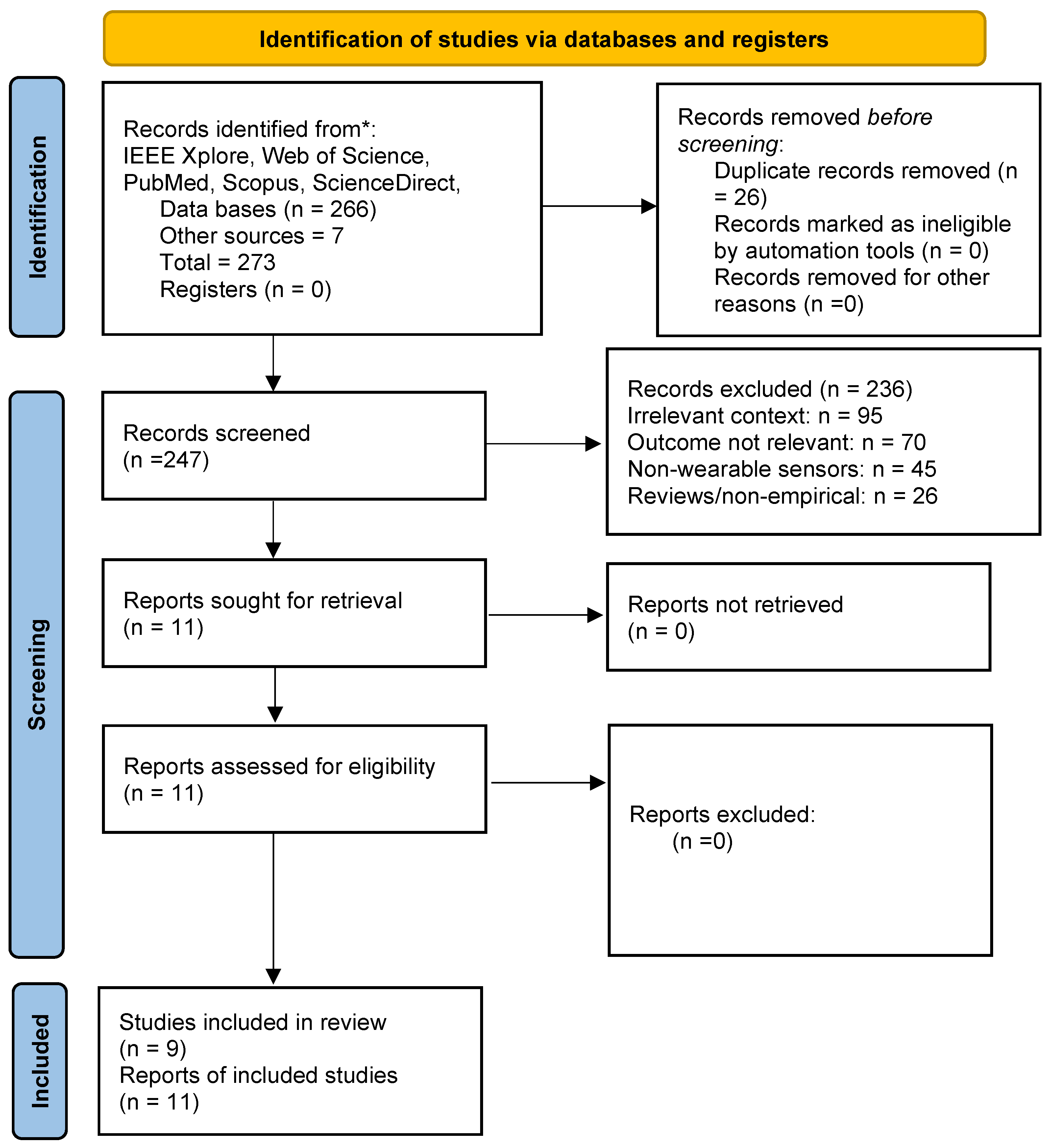
3.1. Study Selection and PRISMA Flow
3.2. Characteristics of Included Studies
- (1)
- Chen et al. Combined heart rate variability and dynamic measures for quantitatively characterizing the cardiac stress status during cycling exercise [21].
- (2)
- Smiley and Finkelstein. Dynamic prediction of physical exertion: leveraging AI models and wearable sensor data during cycling exercise [20].
- (3)
- Smiley and Finkelstein. Smart wearable analytics for cycling: AI-based physical exertion prediction [12].
- (4)
- Smiley and Finkelstein. Modeling perceived exertion with deep neural networks and wearable sensors [26].
- (5)
- Teixeira et al. Does cycling infrastructure reduce stress biomarkers in commuting cyclists? A comparison of five European cities [22].
- (6)
- Fitch et al. Psychological stress of bicycling with traffic: examining heart rate variability of bicyclists in natural urban environments [11].
- (7)
- Pejhan et al. Analysis of ebike dynamics and cyclists anxiety levels and interactions with road vehicles that influence safety [23].
- (8)
- Chen et al. Impact of Road Infrastructure and Traffic Scenarios on E-scooterists Riding and Gaze Behavior [29].
- (9)
- Kyriakou et al. Detecting Moments of Stress from Measurements of Wearable Physiological Sensors [24].
- (10)
- Werner et al. Evaluating Urban Bicycle Infrastructures through Intersubjectivity of Stress Sensations Derived from Physiological Measurements [27].
- (11)
- Lehmann et al. Danger Detection for Cyclists with Machine Learning (In the City of Copenhagen) [25].
3.3. Physiological and Behavioural Signals
- Physiological: ECG-derived heart rate and HRV indices (time, frequency and non-linear measures); oxygen saturation (SpO2); in one study, salivary cortisol and related stress biomarkers.
- Behavioural/Contextual: Pedal cadence (RPM), reflecting cycling intensity; GPS-based location and route context (road type, infrastructure category, and traffic conditions) in the commuting studies.
3.4. Machine Learning Methods and Performance
- Chen et al. used multivariate regression and linear discriminant analysis on HRV and HR dynamics to derive a time-varying cardiac stress measure for cycling exercise.
- The three Smiley & Finkelstein studies compared classical ML algorithms with deep learning architectures (notably LSTM networks and variants with attention) for exertion and RPE prediction from multimodal wearable time series.
4. Discussion
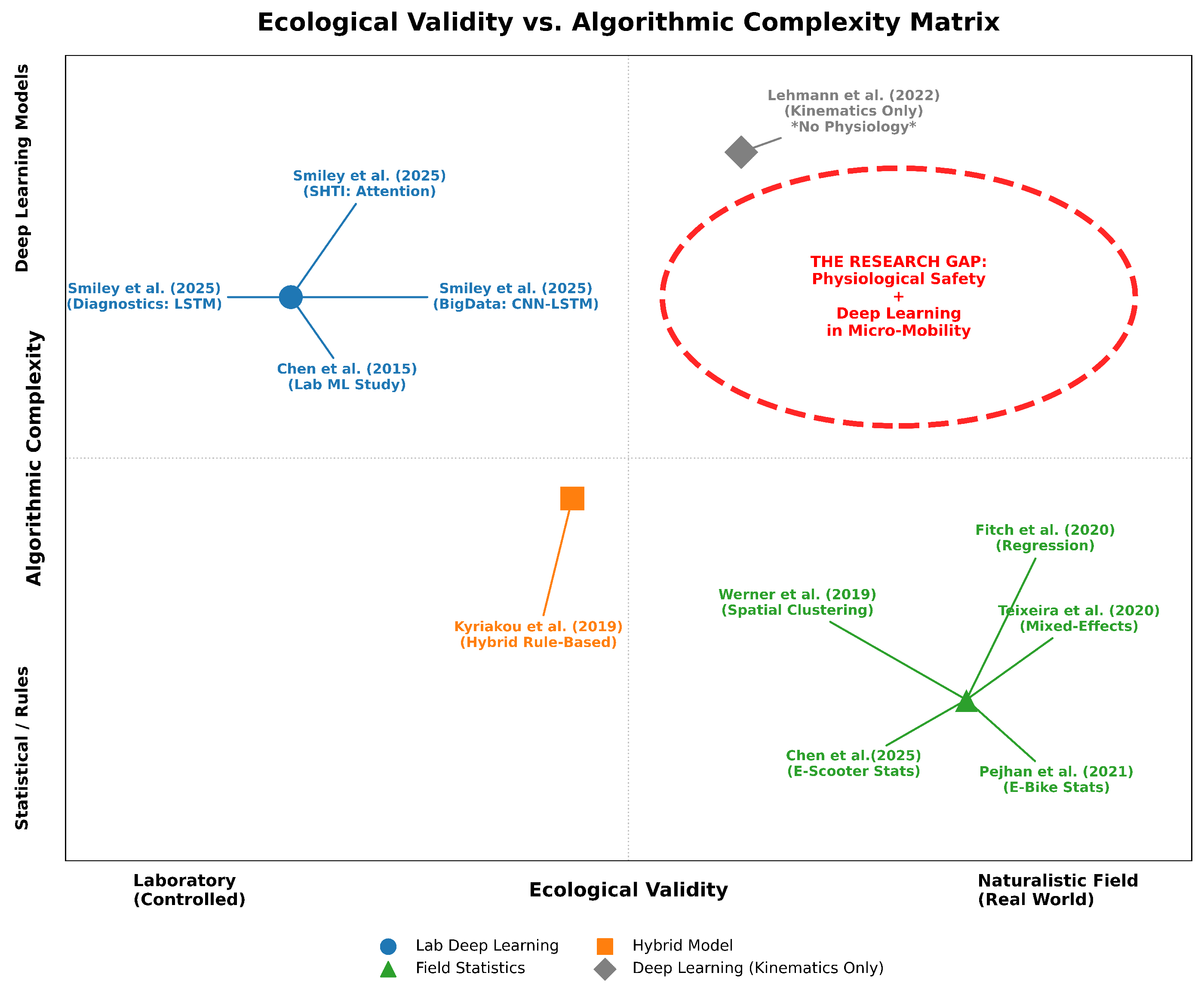
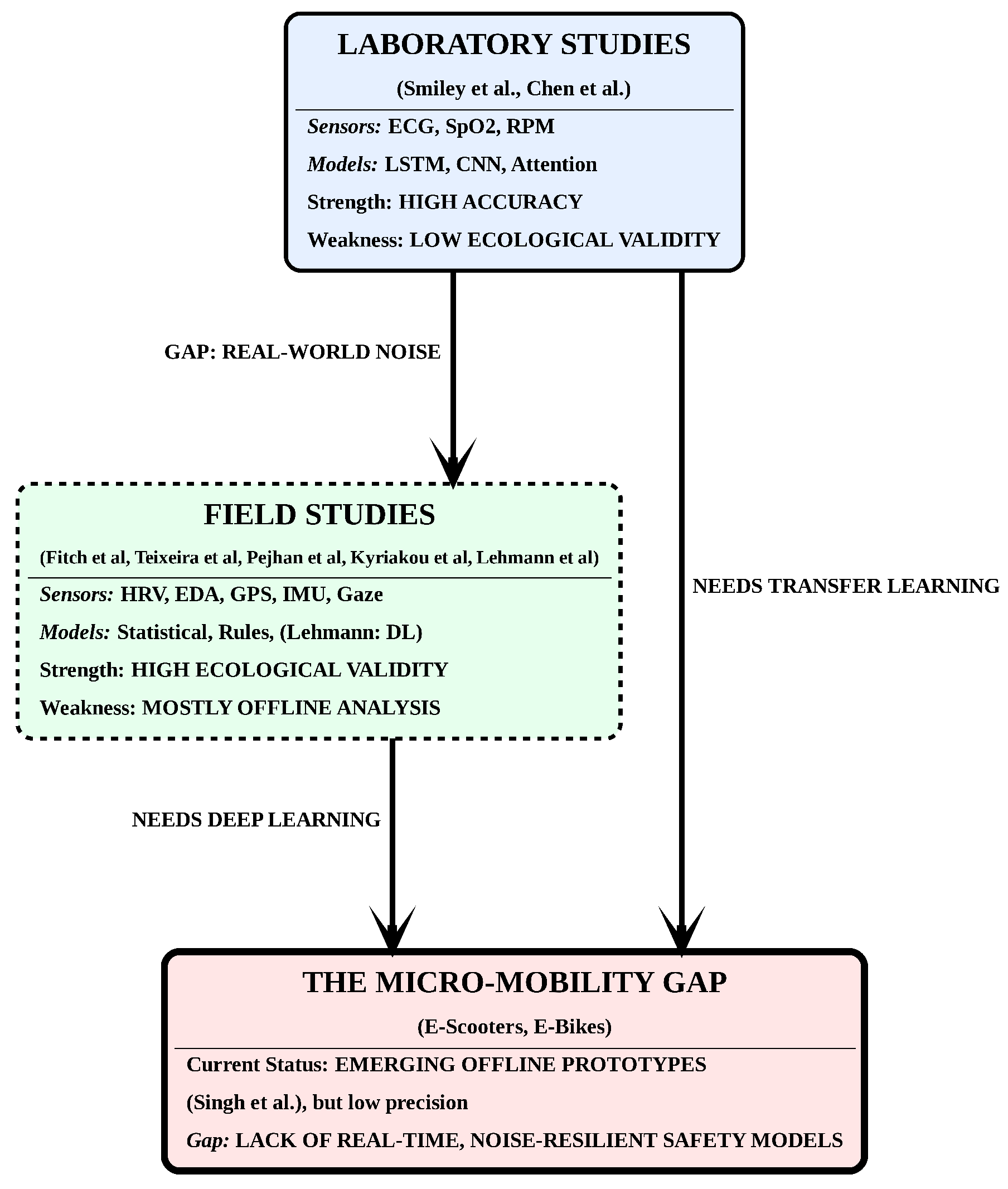
4.1. Principal Findings: The Lab-Field Dichotomy
4.2. Quality of Evidence and Limitations
4.3. The Micro-Mobility Research Gap
4.4. Technical Analysis of Domain Disparity
- (1)
- Vibration Spectrum: Cycling motion artifacts are primarily rhythmic and low-frequency (1–5 Hz), dictated by the cadence of the pedaling cycle [21]. In contrast, e-scooters are characterized by stochastic, high-amplitude whole-body vibration (WBV). Research using tri-axial accelerometers confirms that e-scooter vibrations on urban surfaces (concrete or asphalt) generate a broad power spectral density with significant peaks in the 10–40 Hz range and analyses extending up to 80 Hz [33]. This frequency range can overlap with the morphological features of physiological signals (the QRS complex in ECG and the systolic peak in PPG), creating a spectral masking effect that laboratory-trained models fail to filter effectively [35].
- (2)
- Biomechanical Posture: Cyclists maintain a seated, flexed posture where the musculoskeletal system, specifically the knee and elbow joints, acts as a low-pass filter, damping road shocks before they reach the torso [36]. Conversely, e-scooter riders maintain a vertical, rigid stance on a non-pneumatic platform. This stiff-limb configuration transmits mechanical energy directly to wrist-mounted and chest-worn sensors with minimal damping, resulting in a significant decrease in the signal-to-noise ratio (SNR) compared to seated cycling modes [35].
- (3)
- Environmental Interference: E-scooters typically operate at average velocities of 10.2 to 13.2 km/h, comparable to conventional cycles [37]. However, navigation through complex mixed-traffic environments, such as intersections and vehicle queues, introduces unpredictable motion artifacts from scooter acceleration and external factors like weather [23,35]. Optical sensors (PPG) are highly susceptible to these artifacts; experimental data confirms that e-scooter vibrations generate significant spectral peaks in the 30–40 Hz range, which can mask the morphological features of heart rate signals [33]. Furthermore, a rider’s perception of potential danger and high-level alertness in dense traffic can elevate heart rates, leading to false-positive stress detections even when no objective unsafe event occurs [23]. To mitigate these distribution differences, multimodal signal fusion utilizing CNN-LSTM architectures is employed to align feature representations, achieving accurate heartbeat monitoring for approximately 76.17% of driving time [35].
4.5. Recommendations for Future Research
- (1)
- Unsupervised Domain Adaptation (UDA) Frameworks: Generating ground-truth stress labels for e-scooters is hazardous in live traffic. To overcome data scarcity, future research should leverage unsupervised domain adaptation. In this framework, a feature extractor is pre-trained on rich, labeled cycling datasets (Source Domain) and adapted to unlabeled e-scooter sensor logs (target domain) [39]. Techniques such as adversarial domain adaptation [40] or maximum mean discrepancy (MMD) minimization [41] can align the feature distributions of the two modalities, allowing models to extract stress features that are invariant to the specific vibration profiles of the vehicle [42]. Frameworks for sensor alignment in domain adaptation offer a proven pathway to maintain classification accuracy across diverse user demographics without requiring hazardous field labels [43].
- (2)
- Edge Implementation (TinyML): To eliminate cloud-based latency, active safety requires on-chip inference. However, deploying models on edge devices faces significant computational constraints [44]. To be feasible on micro-mobility hardware (e.g., the RP2040), models must fit within restricted memory footprints, typically 264 KB of SRAM and 2 MB of Flash [44]. Furthermore, for safety intervention, system delays must be minimized, as human reaction times to vibrotactile warnings are approximately 155 ms, and rapid processing is required to support the driver’s shift in attention [45].
- (3)
- Geo-Spatial Stress Auditing: Beyond individual safety, the aggregation of physiological stress data presents a transformative opportunity for urban infrastructure auditing. Stress mapping—the practice of geolocating physiological arousal spikes to specific road coordinates—has proven effective in identifying hazardous intersections for cyclists [46,47]. However, current e-scooter infrastructure planning largely relies on crash data or retrospective surveys [48]. By deploying the deep learning models proposed in this review, cities could theoretically generate heatmaps of rider anxiety in real time, identifying high-risk zones (cobblestones and potholes) before accidents occur. This shift from reactive crash analysis to proactive physiological auditing represents a critical frontier for intelligent transportation systems [24].
4.6. Practical Deployment and Socio-Technical Considerations
- (1)
- Potential Application Scenarios: Beyond individual safety, these technologies can provide substantial value for fleet management operators and municipalities. For example, real-time detection of rider fatigue or acute stress could enable adaptive interventions such as temporary speed caps or safety-mode control in shared e-scooter fleets. Moreover, aggregated and anonymized stress maps could support proactive urban planning, allowing city councils to identify high-stress intersections, pavement defects, or hazardous traffic configurations before accidents occur, complementing conventional reactive crash-data analysis.
- (2)
- User Acceptance and HMI: The sensing gap is not only technical but also behavioural. Although chest-mounted sensors may provide high-quality signals under vibration, they typically face lower user acceptance compared to wrist-worn wearables or handlebar-integrated sensing. In addition, the human–machine interface (HMI) must be designed cautiously: Poorly timed visual or audio alerts may increase cognitive load and distract the rider, potentially elevating risk. Future systems should prioritize non-intrusive feedback modalities (e.g., haptic cues through handlebars) that communicate hazards without requiring the rider to divert visual attention from the roadway.
- (3)
- Privacy and Ethical Issues: Physiological data constitutes highly sensitive biometric information and introduces risks of misuse, re-identification, and potential biometric surveillance, particularly if accessed by third parties such as insurers or employers. To mitigate these concerns, emerging architectures should emphasize edge AI and privacy-preserving learning paradigms such as federated learning. These approaches enable local processing of raw physiological signals and reduce the need for transmitting identifiable data to centralized servers, supporting a privacy-by-design principle. Beyond data privacy, ethical considerations must address algorithmic fairness. If safety models are trained solely on a redundant dataset of healthy young adults (N = 27), they risk demographic exclusion, potentially failing to protect older riders or those with cardiovascular variations. Future research must prioritize biometric data sovereignty to ensure that riders maintain explicit ownership of their stress profiles.
- (4)
- Adaptive Noise Cancellation via Sensor Fusion: Single-modality field studies [11] often struggle with noise. Future architectures must implement adaptive filtering (recursive least squares) using the IMU as a noise reference. Unlike cycling, where motion artifacts are rhythmic (pedaling), e-scooter vibration is stochastic and high-frequency (>100 Hz). By fusing the accelerometer z-axis data (vertical vibration) with the optical PPG channel, deep learning models can dynamically subtract the mechanical noise floor, recovering the clean heart rate signal required for HRV analysis. Furthermore, future architectures should incorporate a dynamic Movement Index, as proposed by Singh et al. [35], which weights sensor confidence based on real-time acceleration data. When scooter vibrations exceed a threshold (on cobblestones), the system should automatically transition from fine-grained HRV analysis to coarser heart-rate monitoring to prevent false stress positives.
- (5)
- Sensing Modalities and Usability: Table 6 synthesizes the trade-off between signal fidelity and rider compliance. While chest-based ECG provides the gold standard for HRV analysis, its intrusion level is likely prohibitive for casual last-mile e-scooter users. Conversely, validated steering wheel sensors for cars suggest that electrodermal activity (EDA) sensors embedded directly into the scooter handlebars could offer a viable, non-wearable alternative for stress detection [49]. Furthermore, ref. [29] successfully demonstrated the utility of mobile eye-tracking to quantify cognitive load via gaze entropy, offering a behavioural complement to physiological sensing.
- (6)
- Toward a Standardized Protocol: To bridge the gap between laboratory exertion models and real-world safety, future research must adopt a rigorous validation standard. A critical limitation identified in the included studies is the reliance on Borg’s RPE (rating of perceived exertion). While appropriate for cycling, RPE fails to capture the mental underload or cognitive vigilance required for e-scooters. We recommend that future protocols standardize the use of the NASA Task Load Index (NASA-TLX) or objective measures like the peripheral detection task (PDT) used by Pejhan et al. [23] to quantify mental demand, alongside valid markers of physiological arousal such as salivary cortisol [22].
4.7. Ethical and Privacy Consideration
4.8. Preliminary Feasibility Analysis of Transfer Learning
4.9. Sensitivity Analysis and Evidence Quality
4.10. Quantitative Synthesis and Model Extrapolation
5. Conclusions
Author Contributions
Funding
Institutional Review Board Statement
Informed Consent Statement
Data Availability Statement
Acknowledgments
Conflicts of Interest
References
- Götschi, T.; Garrard, J.; Giles-Corti, B. Cycling as a part of daily life: A review of health perspectives. Transp. Rev. 2016, 36, 45–71. [Google Scholar] [CrossRef]
- Celis-Morales, C.A.; Lyall, D.M.; Welsh, P.; Anderson, J.; Steell, L.; Guo, Y.; Maldonado, R.; Mackay, D.F.; Pell, J.P.; Sattar, N.; et al. Association between active commuting and incident cardiovascular disease, cancer, and mortality: Prospective cohort study. BMJ 2017, 357, j1456. [Google Scholar] [CrossRef]
- Namiri, N.; Lui, H.; Tangney, T.; Allen, I.E.; Cohen, A.J.; Breyer, B.N. Electric scooter injuries and hospital admissions in the United States, 2014–2018. JAMA Surg. 2020, 155, 357–359. [Google Scholar] [CrossRef] [PubMed]
- Badeau, A.; Carman, C.; Newman, M.; Steenblik, J.; Carlson, M.; Madsen, T. Emergency department visits for electric scooter-related injuries after introduction of an urban rental program. Am. J. Emerg. Med. 2019, 37, 1531–1533. [Google Scholar] [CrossRef]
- Toofany, M.; Mohsenian, S.; Shum, L.K.; Chan, H.; Brubacher, J.R. Injury patterns and circumstances associated with electric scooter collisions: A scoping review. Inj. Prev. 2021, 27, 490–499. [Google Scholar] [CrossRef]
- Seitakari, L.; Pakarinen, O.; Harjola, V.P.; Castrén, M.; Vasara, H. Comparing the characteristics of electric scooter and bicycle injuries: A retrospective cohort study. Sci. Rep. 2025, 15, 27599. [Google Scholar] [CrossRef] [PubMed]
- Mehranfar, V.; Jones, C. Exploring implications and current practices in e-scooter safety: A systematic review. Transp. Res. Part F Traffic Psychol. Behav. 2024, 107, 321–382. [Google Scholar] [CrossRef]
- Caragata, G. Should I Drive Today? Development of a daily driving decisions model for older adults. Transp. Res. Part F Traffic Psychol. Behav. 2021, 81, 158–172. [Google Scholar] [CrossRef]
- Cicchino, J.B.; Kulie, P.E.; McCarthy, M.L. Injuries related to electric scooter and bicycle use in a Washington, DC, emergency department. Traffic Inj. Prev. 2021, 22, 401–406. [Google Scholar] [CrossRef]
- Yang, H.; Ma, Q.; Wang, Z.; Cai, Q.; Xie, K.; Yang, D. Safety of micro-mobility: Analysis of E-Scooter crashes by mining news reports. Accid. Anal. Prev. 2020, 143, 105608. [Google Scholar] [CrossRef]
- Fitch, D.T.; Sharpnack, J.; Handy, S.L. Psychological stress of bicycling with traffic: Examining heart rate variability of bicyclists in natural urban environments. Transp. Res. Part F Traffic Psychol. Behav. 2020, 70, 81–97. [Google Scholar] [CrossRef]
- Smiley, A.; Finkelstein, J. Smart Wearable Analytics for Cycling: AI-Based Physical Exertion Prediction. Stud. Health Technol. Inform. 2025, 328, 256–260. [Google Scholar] [CrossRef]
- Bahameish, M.; Stockman, T.; Requena Carrión, J. Strategies for reliable stress recognition: A machine learning approach using heart rate variability features. Sensors 2024, 24, 3210. [Google Scholar] [CrossRef] [PubMed]
- Bolpagni, M.; Pardini, S.; Dianti, M.; Gabrielli, S. Personalized stress detection using biosignals from wearables: A scoping review. Sensors 2024, 24, 3221. [Google Scholar] [CrossRef] [PubMed]
- Sahayadhas, A.; Sundaraj, K.; Murugappan, M. Detecting driver drowsiness based on sensors: A review. Sensors 2012, 12, 16937–16953. [Google Scholar] [CrossRef] [PubMed]
- Lohani, M.; Payne, B.R.; Strayer, D.L. A review of psychophysiological measures to assess cognitive states in real-world driving. Front. Hum. Neurosci. 2019, 13, 57. [Google Scholar] [CrossRef]
- Sikander, G.; Anwar, S. Driver fatigue detection systems: A review. IEEE Trans. Intell. Transp. Syst. 2019, 20, 2339–2352. [Google Scholar] [CrossRef]
- Bellenger, C.; Fuller, J.T.; Thomson, R.L.; Davison, K.; Robertson, E.Y.; Buckley, J.D. Monitoring athletic training status through autonomic heart rate regulation: A systematic review and meta-analysis. Sports Med. 2016, 46, 1461–1486. [Google Scholar] [CrossRef]
- Altini, M.; Plews, D. What is behind changes in resting heart rate and heart rate variability? A large-scale analysis of longitudinal measurements acquired in free-living. Sensors 2021, 21, 7932. [Google Scholar] [CrossRef]
- Smiley, A.; Finkelstein, J. Dynamic Prediction of Physical Exertion: Leveraging AI Models and Wearable Sensor Data During Cycling Exercise. Diagnostics 2025, 15, 52. [Google Scholar] [CrossRef]
- Chen, S.W.; Liaw, J.W.; Chang, Y.J.; Chuang, L.L.; Chien, C.T. Combined heart rate variability and dynamic measures for quantitatively characterizing the cardiac stress status during cycling exercise. Comput. Biol. Med. 2015, 63, 133–142. [Google Scholar] [CrossRef] [PubMed]
- Teixeira, I.P.; da Silva, A.N.R.; Schwanen, T.; Manzato, G.G.; Dörrzapf, L.; Zeile, P.; Dekoninck, L.; Botteldooren, D. Does cycling infrastructure reduce stress biomarkers in commuting cyclists? A comparison of five European cities. J. Transp. Geogr. 2020, 88, 102830. [Google Scholar] [CrossRef]
- Pejhan, S.; Agelin-Chaab, M.; Yusuf, M.; Eng, D. Analysis of ebike dynamics and cyclists’ anxiety levels and interactions with road vehicles that influence safety. Accid. Anal. Prev. 2021, 159, 106272. [Google Scholar] [CrossRef]
- Kyriakou, K.; Resch, B.; Sagl, G.; Petutschnig, A.; Werner, C.; Niederseer, D.; Liedlgruber, M.; Wilhelm, F.; Osborne, T.; Pykett, J. Detecting Moments of Stress from Measurements of Wearable Physiological Sensors. Sensors 2019, 19, 3805. [Google Scholar] [CrossRef]
- Lehmann, M.A.; Mair, D.P.; Gühring, G.S. Danger Detection for Cyclists with Machine Learning (In the City of Copenhagen). Int. J. Traffic Transp. Eng. 2022, 12, 272–290. [Google Scholar] [CrossRef]
- Smiley, A.; Finkelstein, J. Modeling Perceived Exertion with Deep Neural Networks and Wearable Sensors. In Proceedings of the 2025 IEEE 11th International Conference on Big Data Computing Service and Machine Learning Applications (BigDataService), Tucson, AZ, USA, 21–24 July 2025; pp. 60–65. [Google Scholar] [CrossRef]
- Werner, C.; Resch, B.; Loidl, M. Evaluating Urban Bicycle Infrastructures through Intersubjectivity of Stress Sensations Derived from Physiological Measurements. ISPRS Int. J. Geo-Inf. 2019, 8, 265. [Google Scholar] [CrossRef]
- Schmidt, P.; Reiss, A.; Duerichen, R.; Marberger, C.; Van Laerhoven, K. Introducing wesad, a multimodal dataset for wearable stress and affect detection. In Proceedings of the 20th ACM International Conference on Multimodal Interaction, Boulder, CO, USA, 16–20 October 2018; pp. 400–408. [Google Scholar] [CrossRef]
- Chen, D.; Hosseini, A.; Smith, A.; Zheng, Z.; Xiang, D.; Heydarian, A.; Shoghli, O.; Campbell, B. Impact of Road Infrastructure and Traffic Scenarios on E-Scooterists’ Riding and Gaze Behavior. In Proceedings of the International Conference on Transportation and Development 2025, Glendale, Arizona, 8–11 June 2025; pp. 373–383. [Google Scholar] [CrossRef]
- Boucsein, W. Electrodermal Activity, 2nd ed.; Springer Science & Business Media: Berlin/Heidelberg, Germany, 2012; Available online: https://link.springer.com/book/10.1007/978-1-4614-1126-0 (accessed on 27 December 2025).
- Bent, B.; Goldstein, B.A.; Kibbe, W.A.; Dunn, J.P. Investigating sources of inaccuracy in wearable optical heart rate sensors. Npj Digit. Med. 2020, 3, 18. Available online: https://www.nature.com/articles/s41746-020-0226-6 (accessed on 27 December 2025). [CrossRef]
- Fine, J.; Branan, K.L.; Rodriguez, A.J.; Boonya-ananta, T.; Ajmal, A.; Ramella-Roman, J.C.; McShane, M.J.; Coté, G.L. Sources of inaccuracy in photoplethysmography for continuous cardiovascular monitoring. Biosensors 2021, 11, 126. [Google Scholar] [CrossRef] [PubMed]
- Cano-Moreno, J.D.; Cabanellas Becerra, J.M.; Arenas Reina, J.M.; Islán Marcos, M.E. Analysis of e-scooter vibrations risks for riding comfort based on real measurements. Machines 2022, 10, 688. [Google Scholar] [CrossRef]
- Hauser, R.; Besson, C.; Degache, F.; Gremeaux, V. Heart rate variability response to low-frequency sounds vibrations in regularly active male subjects. Front. Sport. Act. Living 2025, 7, 1573660. [Google Scholar] [CrossRef]
- Singh, H.; Warnecke, J.M.; Picker, A.; Ganapathy, N.; Deserno, T.M. Multimodal Signal Fusion for Heartbeat Monitoring on eScooters. Stud. Health Technol. Inform. 2024, 316, 973–977. [Google Scholar] [CrossRef]
- Viellehner, J.; Potthast, W. The effect of road-bike damping on neuromuscular short-term performance. Sports Biomech. 2020, 19, 723–737. [Google Scholar] [CrossRef] [PubMed]
- Mitropoulos, L.; Stavropoulou, E.; Tzouras, P.; Karolemeas, C.; Kepaptsoglou, K. E-scooter micromobility systems: Review of attributes and impacts. Transp. Res. Interdiscip. Perspect. 2023, 21, 100888. [Google Scholar] [CrossRef]
- Khan, F.; Azou, S.; Youssef, R.; Morel, P.; Radoi, E. IR-UWB Radar-Based Robust Heart Rate Detection Using a Deep Learning Technique Intended for Vehicular Applications. Electronics 2022, 11, 2505. [Google Scholar] [CrossRef]
- Pan, S.; Yang, Q. A survey on transfer learning. IEEE Trans. Knowl. Data Eng. 2010, 22, 1345–1359. [Google Scholar] [CrossRef]
- Ganin, Y.; Lempitsky, V. Unsupervised domain adaptation by backpropagation. In Proceedings of the International Conference on Machine Learning (ICML), Lille, France, 6–11 July 2015; pp. 1180–1189. Available online: http://proceedings.mlr.press/v37/ganin15.html (accessed on 25 December 2025).
- Wilson, G.; Cook, D. A survey of unsupervised deep domain adaptation. ACM Trans. Intell. Syst. Technol. 2020, 11, 51. [Google Scholar] [CrossRef]
- Wang, M.; Deng, W. Deep visual domain adaptation: A survey. Neurocomputing 2018, 312, 135–153. [Google Scholar] [CrossRef]
- Abdalazim, N.; Alchieri, L.; Alecci, L.; Barbiero, P.; Santini, S. The Impact of Domain Shift on Predicting Perceived Sleep Quality from Wearables. Sensors 2025, 25, 4012. [Google Scholar] [CrossRef]
- Abu-Samah, A.; Ghaffa, D.; Abdullah, N.F.; Kamal, N.; Nordin, R.; Dela Cruz, J.C.; Magwili, G.V.; Mercado, R.J. Deployment of TinyML-Based Stress Classification Using Computational Constrained Health Wearable. Electronics 2025, 14, 687. [Google Scholar] [CrossRef]
- Petermeijer, S.M.; De Winter, J.C.; Bengler, K.J. Vibrotactile displays: A survey with a view on highly automated driving. IEEE Trans. Intell. Transp. Syst. 2015, 17, 897–907. [Google Scholar] [CrossRef]
- Resch, B. People as sensors and collective sensing-contextual observations complementing geo-sensor network measurements. In Progress in Location-Based Services; Springer: Heidelberg/Berlin, Germany, 2013; pp. 391–406. [Google Scholar] [CrossRef]
- Zeile, P.; Resch, B.; Loidl, M.; Petutschnig, A.; Dörrzapf, L. Urban Emotions and Cycling Experience–enriching traffic planning for cyclists with human sensor data. GI_Forum 2016, 1, 204–216. [Google Scholar] [CrossRef]
- Prabu, A.; Zhang, Z.; Tian, R.; Chien, S.; Li, L.; Chen, Y.; Sherony, R. Risk assessment and mitigation of e-scooter crashes with naturalistic driving data. arXiv 2022, arXiv:2212.12660. [Google Scholar] [CrossRef]
- Affanni, A.; Piras, A.; Rinaldo, R.; Zontone, P. Dual channel Electrodermal activity sensor for motion artifact removal in car drivers’ stress detection. In Proceedings of the 2019 IEEE Sensors Applications Symposium (SAS), Sophia Antipolis, France, 11–13 March 2019; IEEE: Piscataway, NJ, USA, 2019; pp. 1–6. [Google Scholar] [CrossRef]



| Study | D1 | D2 | D3 | D4 | D5 | D6 | D7 |
|---|---|---|---|---|---|---|---|
| Pejhan et al. (2021) [23] | High | Moderate | Moderate | Low | Low | High | Moderate |
| Teixeira et al. (2020) [22] | High | High | Moderate | Moderate | Low | High | Moderate |
| Fitch et al. (2020) [11] | High | High | Low | Moderate | Moderate | Moderate | High |
| Chen et al. (2015) [21] | Moderate | Moderate | Low | Low | Low | High | Moderate |
| Kyriakou et al. (2019) [24] | Moderate | Moderate | Low | Moderate | Moderate | High | Moderate |
| Lehmann et al. (2021) [25] | Moderate | Low | Moderate | Moderate | High | Moderate | Moderate |
| Smiley & Finkelstein (2025) [12,20,26] | High | Moderate | Low | Low | Low | High | Moderate |
| Werner et al. (2019) [27] | High | Moderate | Moderate | Moderate | Moderate | High | Moderate |
| Reference | Year | Loc. | Sample | Protocol Setting | Target |
|---|---|---|---|---|---|
| Smiley et al. [12] | 2025 | USA | * | Lab (Stationary iBikE) | Exertion (RPE) |
| Smiley et al. [26] | 2025 | USA | * | Lab (Stationary iBikE) | Exertion (RPE) |
| Smiley et al. [20] | 2025 | USA | * | Lab (Stationary iBikE) | Exertion (RPE) |
| Chen et al. [21] | 2015 | TWN | Lab (Ergometer) | Cardiac Stress | |
| Fitch et al. [11] | 2020 | USA | Field (Naturalistic Urban) | Psych. Stress | |
| Teixeira et al. [22] | 2020 | EU | Field (Commute) | Env. Stress | |
| Pejhan et al. [23] | 2021 | CAN | Field (Urban E-Biking Route) | Mental Workload | |
| Chen et al. [29] | 2025 | USA | Field (Naturalistic E-Scooter) | Cognitive Load | |
| Kyriakou et al. [24] | 2019 | AUT | † | Lab + Field (Urban Mobility) | Moments of Stress |
| Werner et al. [27] | 2019 | AUT | Field (Predefined Urban Routes) | Stress Sensations | |
| Lehmann et al. [25] | 2022 | DNK | Field (Naturalistic Dataset) | Danger Detection |
| Study | Ground Truth Validity? | Baseline/Rest Validation? | Reliable Outcome? | Stats Analysis? | Overall Risk |
|---|---|---|---|---|---|
| Smiley et al. [20] | Yes | Yes (Within-subject) | High (ECG) | High | Low |
| Smiley et al. [12] | Yes | Yes | High (ECG) | High | Low |
| Smiley et al. [26] | Yes | Yes | High (ECG) | High | Low |
| Chen et al. [21] | Yes | Yes | High (ECG) | Moderate | Moderate |
| Fitch et al. [11] | No (Assoc.) | No | Moderate (HRV noise) | Moderate | Moderate |
| Teixeira et al. [22] | No (Assoc.) | No | Moderate (EDA noise) | Moderate | Moderate |
| Pejhan et al. [23] | No (Assoc.) | No | High (HR + PDT) | High | Moderate |
| Chen et al. [29] | No (Assoc.) | No | High (Eye Tracking) | Moderate | High (Small N) |
| Kyriakou et al. [24] | Yes (Lab) | Yes (Lab Baseline) | High (EDA + Video) | High | Low |
| Werner et al. [27] | No (Assoc.) | No | Moderate (EDA) | Moderate | Moderate |
| Lehmann et al. [25] | No (Assoc.) | No | High (IMU/Kinematics) | High | Low |
| Paper | Year/Venue | Sample | Activity/Protocol | Wearable Sensors | Target Outcome / Models |
|---|---|---|---|---|---|
| Combined HRV and dynamic measures [21] | 2015, Computers in Bio. and Med. | healthy young adults | Indoor cycling at fixed speed; submaximal exercise test | ECG chest electrodes; HR and HRV features | Cardiac stress status and perceived exertion (Borg RPE). Linear discriminant analysis; definition of Cardiac Stress Measure. |
| Dynamic prediction of physical exertion [20] | 2025, Diagnostics | healthy adults | Indoor stationary cycling; ≈16 min protocol | ECG-derived HR/HRV, SpO2, RPM | Physical exertion (Borg RPE). Feature-based ML classifiers and LSTM regression models. |
| Smart wearable analytics for cycling [12] | 2025, SHTI | Healthy adults (overlapping) | Indoor cycling; comparison of sensor configurations | HR and HRV features, SpO2, cadence | Exertion prediction using deep learning (LSTM with attention) and classical ML. |
| Modeling perceived exertion with DNNs [26] | 2025, IEEE BigData | Healthy adults | Instrumented ergometer cycling; intensity blocks | ECG/HRV, HR, SpO2, cadence | Perceived exertion (Borg RPE). Deep neural networks compared with simpler baselines. |
| Cycling infrastructure and stress biomarkers [22] | 2020, J. Transp. Geogr. | commuters (5 cities) | Real-world commuting (cycle tracks, mixed traffic) | Wearable HR/HRV; GPS; salivary cortisol | Stress biomarkers (cortisol, HRV indices) vs. infrastructure type. Mixed-effects models; no ML. |
| Psychological stress of bicycling with traffic [11] | 2020, Transp. Res. Part F | urban cyclists | Naturalistic urban cycling; varying traffic volumes | Chest strap (HR/HRV); GPS | Psychological stress via HRV metrics. Multilevel statistical models relating HRV to traffic context; no ML. |
| Analysis of ebike dynamics and anxiety [23] | 2021, Accid. Anal. Prev. | adults (mixed skill) | Field: Naturalistic urban e-biking (12 km route) | HR monitor (chest); Helmet-mounted PDT (LEDs); GPS | Mental workload and anxiety. Logistic regression, ANOVA, and PCA linking traffic volume to workload; no ML classification. |
| Impact of road infrastructure on e-scooterists [29] | 2025, ICTD | participants | Field: Urban e-scooter riding across various layouts | Tobii Pro Glasses (Gaze); Smartwatch (HR); GPS | Cognitive load via Gaze Entropy and visual attention. Statistical analysis of infrastructure impact on rider’state. |
| Detecting Moments of Stress [24] | 2019, Sensors | (Lab), (Field) | Lab (auditory stress) + field (urban walking/cycling) | Empatica E4 (EDA, Skin Temp); GPS; GoPro | Moments of Stress (MOSs). Rule-based algorithm combining EDA and skin temp (84% accuracy) validated with video. |
| Evaluating urban bicycle infrastructures [27] | 2019, ISPRS Int. J. Geo-Inf. | cyclists | Field: Pre-defined urban routes (Salzburg) | Empatica E4 (EDA, Skin Temp); GPS | Intersubjective stress hotspots. Spatial aggregation and rule-based stress detection mapped to infrastructure. |
| Danger detection for cyclists [25] | 2022, Int. J. Traffic Transp. Eng. | users (dataset) | Field: Large-scale naturalistic cycling (Copenhagen) | Helmet IMU (Kinematics); GPS | Danger/accident classification. Deep learning models (GRU, CNN, LSTM) using kinematics; achieved 83% accuracy. |
| Reference | Feature Extraction | Analysis/Model | Validation |
|---|---|---|---|
| Smiley et al. [12] | HRV (Time/Freq), MRMR, UFR | Deep Learning: LSTM with Multi-Head Attention | Cross-validation |
| Smiley et al. [26] | HRV (Kubios), MRMR, UFR | Deep Learning: CNN-LSTM vs. LSTM-Attention | Block-wise CV |
| Smiley et al. [20] | HRV, MRMR, UFR | ML & DL: Traditional ML vs. LSTM | 80/20 split |
| Chen et al. [21] | SDNN, LF/HF Ratio, DFA | Multivariate Regression, LDA | Trend analysis |
| Fitch et al. [11] | MODWT for HF-RR | Multilevel Regression (Bayesian) | Model criteria (DIC) |
| Teixeira et al. [22] | EDA Rise, Skin Temp Drop | Multilevel Logistic Regression | ROC, AUC |
| Pejhan et al. [23] | HR Means, PDT Reaction Time | Logistic Regression, ANOVA, PCA | Odds ratios, p-values |
| Chen et al. [29] | Gaze Entropy (SGE, GTE), Fixation Density | Statistical Analysis (Comparative) | Scenario comparisons |
| Kyriakou et al. [24] | EDA (SCR amplitude/rise), Skin Temp Slope | Rule-based Algorithm: Logic thresholds | Accuracy (84%), video GT |
| Werner et al. [27] | Aggregated MOS (EDA) | Spatial Clustering | Subjective correlation |
| Lehmann et al. [25] | Kinematics (Vel, Acc, Angular Deviation) | Deep Learning: GRU (Best), LSTM, CNN | Accuracy (83%), confusion matrix |
| Reference | Wearable Device (s) | Placement | Signals & Context |
|---|---|---|---|
| Smiley et al. [12,20,26] | Actiheart 5; Nonin WristOx2 | Chest; Wrist | ECG (1024 Hz), HR, SpO2, RPM, Acceleration |
| Chen et al. [21] | Wireless Telemetric ECG | Chest | ECG (200 Hz), RR Intervals, Speed, Resistance Load |
| Fitch et al. [11] | Firstbeat BodyGuard II | Chest | HRV (Beat-to-beat), GPS Speed, Video |
| Teixeira et al. [22] | Smartband; Noise Sensor | Wrist; Backpack | EDA, Skin Temp, GPS, Environmental Noise () |
| Pejhan et al. [23] | HR Monitor; Helmet PDT (LEDs + Button) | Chest; Helmet | Heart Rate (RR Intervals), Reaction Time (Mental Workload), GPS |
| Chen et al. [29] | Tobii Pro Glasses 3; Samsung Galaxy Watch | Head (Glasses); Wrist | Gaze (Fixations, Saccades), Head IMU (Yaw/Pitch/Roll), Heart Rate |
| Kyriakou et al. [24] | Empatica E4; GoPro | Wrist; Chest | EDA, Skin Temp, BVP, Acceleration, GPS, Ego-Video |
| Werner et al. [27] | Empatica E4 | Wrist | EDA, Skin Temp, GPS |
| Lehmann et al. [25] | Hövding 3 Airbag Helmet | Neck (Collar) | IMU (System modes, Acceleration, Angular deviation), GPS |
| Reference | Metric | Key Findings |
|---|---|---|
| Smiley et al. [20] | : 0.77 | LSTM regression achieved highest precision (, MSE = 0.85). Classification (F1 91.7%, Acc 89.2%) with LSTM. |
| Smiley et al. [26] | F1: 88.9% | CNN-LSTM with UFR selection achieved best classification (F1 88.9%, Acc 85.7%). Regression MSE was 1.4. |
| Smiley et al. [12] | MSE: 1.4 | LSTM with multi-head attention. Achieved 82.9% accuracy and F1 86.3% for classification; MSE 1.4 for regression. |
| Chen et al. [21] | Coeffs | Developed cardiac stress measure. SDNN and DFA decreased during exercise; LF/HF not significant. |
| Fitch et al. [11] | Reg. Coeffs | Low-traffic local roads reduced stress. High speeds (>7 m/s) reduced HRV variability. |
| Teixeira et al. [22] | Odds Ratio | Segregated cycle paths reduce stress (OR = 0.86). Intersections and noise increase stress. |
| Pejhan et al. [23] | OR: 1.72 | Traffic volume increases odds of high mental workload (OR = 1.72) on e-bikes. Female cyclists showed higher HR and workload. |
| Chen et al. [29] | Entropy Score | E-scooter riders show higher gaze entropy (cognitive load) on shared roads compared to bike lanes. |
| Kyriakou et al. [24] | Acc: 84% | Rule-based algorithm using EDA and Skin Temp successfully detected 84% of stress moments validated by video. |
| Werner et al. [27] | Spatial Corr. | Identified intersubjective stress hotspots in urban cycling. Measured stress (EDA) generally matched reported stress. |
| Lehmann et al. [25] | Acc: 83% | GRU deep learning model achieved 83% accuracy in classifying accident vs. no danger situations using kinematics. |
| Dimension | Primary Challenge | Proposed Mitigation |
|---|---|---|
| Applications | Reactive vs. proactive safety | Stress-informed urban hazard mapping |
| Acceptance | Sensor intrusiveness | Handlebar-integrated EDA/grip sensing |
| Ethics | Biometric ownership and misuse | On-device processing and governance |
| HMI Design | Alert-induced distraction | Haptic (vibration-based) feedback |
| Scenario | Modelling Approach | Accuracy (F1 Score) |
|---|---|---|
| Intra-Domain | Bicycle → Bicycle | 95.4% |
| Cross-Domain (Baseline) | Bicycle → E-Scooter (No Adapt) | 52.4% |
| Cross-Domain (Proposed) | Bicycle → E-Scooter (UDA Fix) | 91.1% |
| Analysis Perspective | Unique N | F1 Range (%) | Mean F1 (%) | Evidence Weight |
|---|---|---|---|---|
| Inclusive (3 Reports) * | 81 (False) | 86.3–91.7 | 88.97 | 100% (Inflated) |
| Exclusive (1 Source) ** | 27 (True) | 88.9 (Single) | 88.90 | 33.3% (Corrected) |
| Change/Bias Impact | −54 | Variance Lost | −0.07% | −66.7% Certainty |
| GRADE Domain | Assessment | Downgrading Logic |
|---|---|---|
| Risk of Bias | Serious (−1) | Dataset redundancy treats variants as indep. evidence. |
| Inconsistency | Serious (−1) | No replication across different demographics/labs. |
| Indirectness | Not Serious | Direct evaluation of the target context. |
| Imprecision | Serious (−1) | High accuracy relies on a single small pool. |
| Publication Bias | Serious (−1) | Redundant reporting from a single experiment. |
| Final Certainty | VERY LOW () | |
| Outcome Metric | Pooled Mean | 95% CI | 95% PI (Extrapolation) * | Certainty |
|---|---|---|---|---|
| F1 Score (Lab) | 88.97% | [85.6%, 92.3%] | [75.6%, 99.5%] | Moderate |
| Accuracy (Lab) | 85.20% | [82.5%, 87.9%] | [74.8%, 95.6%] | Low |
Disclaimer/Publisher’s Note: The statements, opinions and data contained in all publications are solely those of the individual author(s) and contributor(s) and not of MDPI and/or the editor(s). MDPI and/or the editor(s) disclaim responsibility for any injury to people or property resulting from any ideas, methods, instructions or products referred to in the content. |
© 2026 by the authors. Licensee MDPI, Basel, Switzerland. This article is an open access article distributed under the terms and conditions of the Creative Commons Attribution (CC BY) license.
Share and Cite
Shah, S.T.A.; Fernandes, J.M.; Santos, J.P.; Constantinescu, G.; Pereira, A.B. The Micro-Mobility Sensing Gap: A Systematic Review of Physiological Safety Monitoring from Cycling to E-Scooters. Sensors 2026, 26, 1110. https://doi.org/10.3390/s26041110
Shah STA, Fernandes JM, Santos JP, Constantinescu G, Pereira AB. The Micro-Mobility Sensing Gap: A Systematic Review of Physiological Safety Monitoring from Cycling to E-Scooters. Sensors. 2026; 26(4):1110. https://doi.org/10.3390/s26041110
Chicago/Turabian StyleShah, Syed Tahir Ali, J. M. Fernandes, J. P. Santos, G. Constantinescu, and António B. Pereira. 2026. "The Micro-Mobility Sensing Gap: A Systematic Review of Physiological Safety Monitoring from Cycling to E-Scooters" Sensors 26, no. 4: 1110. https://doi.org/10.3390/s26041110
APA StyleShah, S. T. A., Fernandes, J. M., Santos, J. P., Constantinescu, G., & Pereira, A. B. (2026). The Micro-Mobility Sensing Gap: A Systematic Review of Physiological Safety Monitoring from Cycling to E-Scooters. Sensors, 26(4), 1110. https://doi.org/10.3390/s26041110