Fault Diagnosis Method for Reciprocating Compressors Based on Spatio-Temporal Feature Fusion

 , and
, and
Abstract
1. Introduction
- (1)
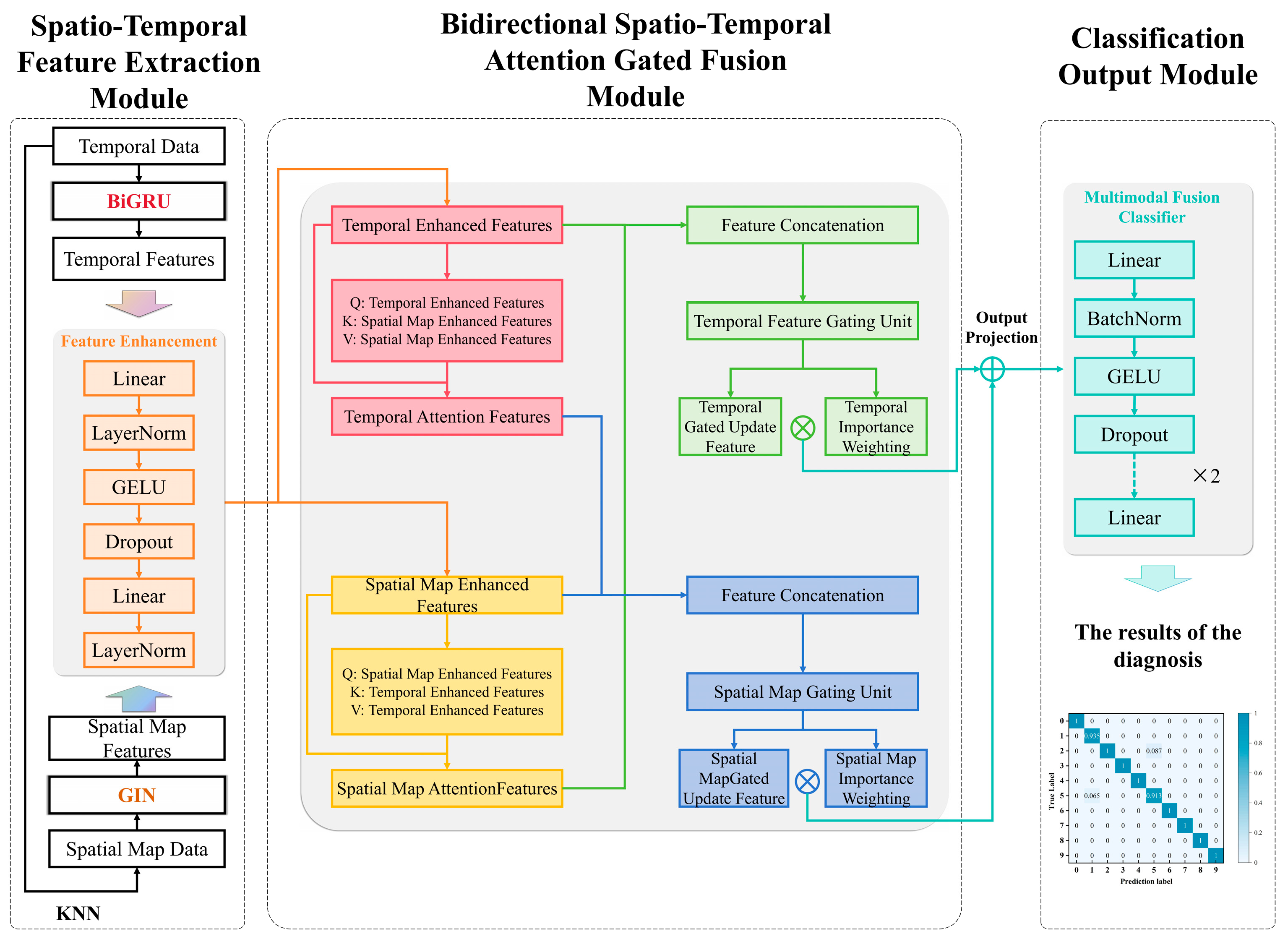
- The spatio-temporal feature extraction component employs a multi-layered stacked bidirectional gated recurrent unit (BiGRU) incorporating batch normalisation. to enhance the extraction of temporal dependencies from long-term sequence data. Concurrently, a graph structure is constructed using K-Nearest Neighbours (KNN) and combined with an improved graph isomorphism network (GIN) to transform one-dimensional signals into graph data, thereby capturing spatial variations in fault information. The robustness of the spatial features is further enhanced through a multilayer perceptron (MLP) layer with an enhanced and regularised design.
- (2)
- The spatio-temporal fusion component implements a bidirectional multi-head attention mechanism to enhance temporal and spatial features, generating augmented features from dual perspectives. This is combined with a cross-modal gated update mechanism and learnable weight parameters to dynamically retain the highly discriminative features.
- (3)
- The classification output section employs multilevel fully connected layers and a regularisation design. This approach prevents the loss of high-dimensional feature information while enhancing the model’s generalisation capability, ensuring precise fault classification.
2. Theoretical Basis
2.1. Graph Neural Network
2.2. Bidirectional Gated Recurrent Unit
3. Methodologies
3.1. Model Construction
- (1)
- Spatio-Temporal Feature Extraction Module
- (2)
- Bidirectional Spatio-Temporal Attention Gate Fusion Module
- (3)
- Classification Output Module
3.2. Steps of Fault Diagnosis
- (1)
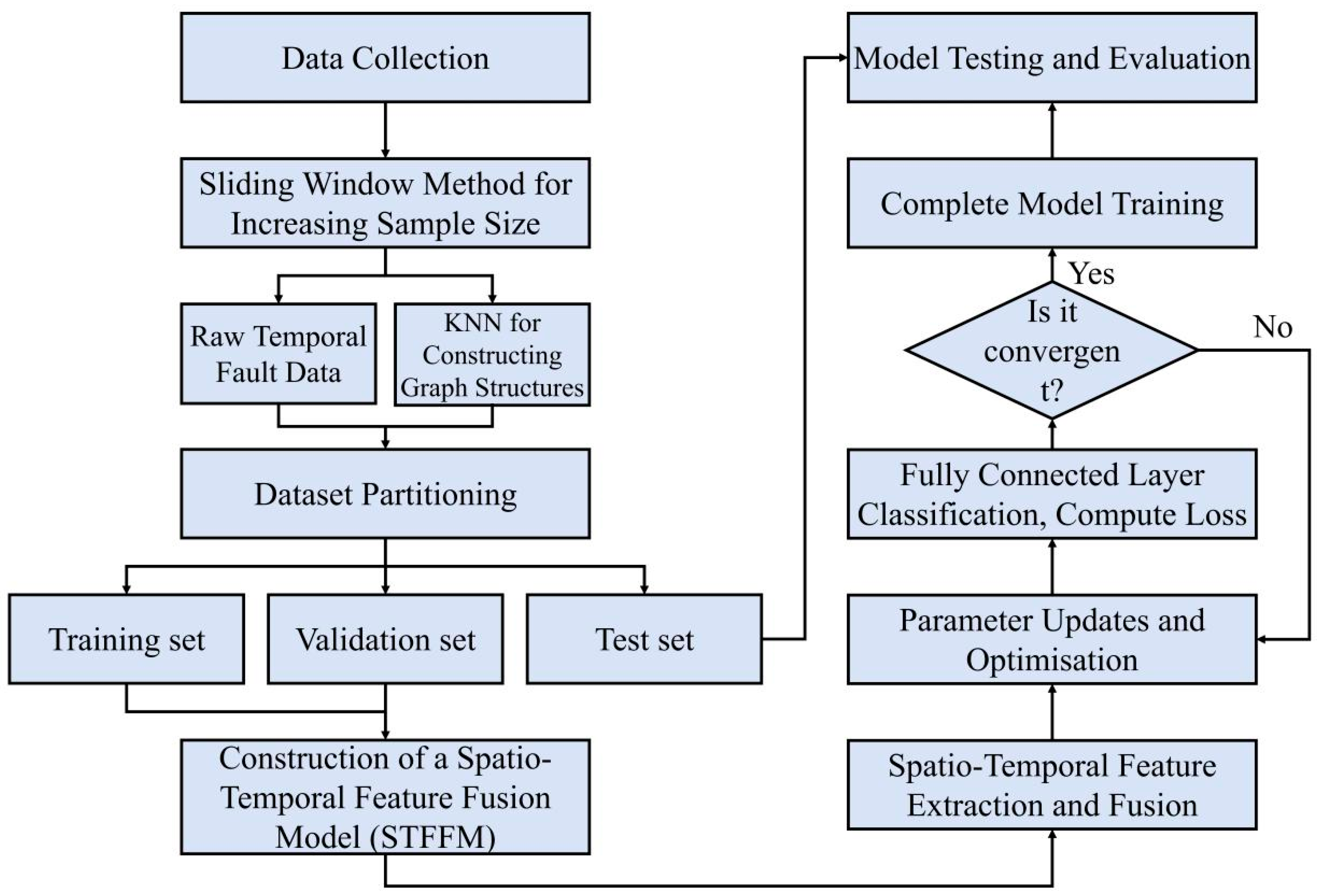
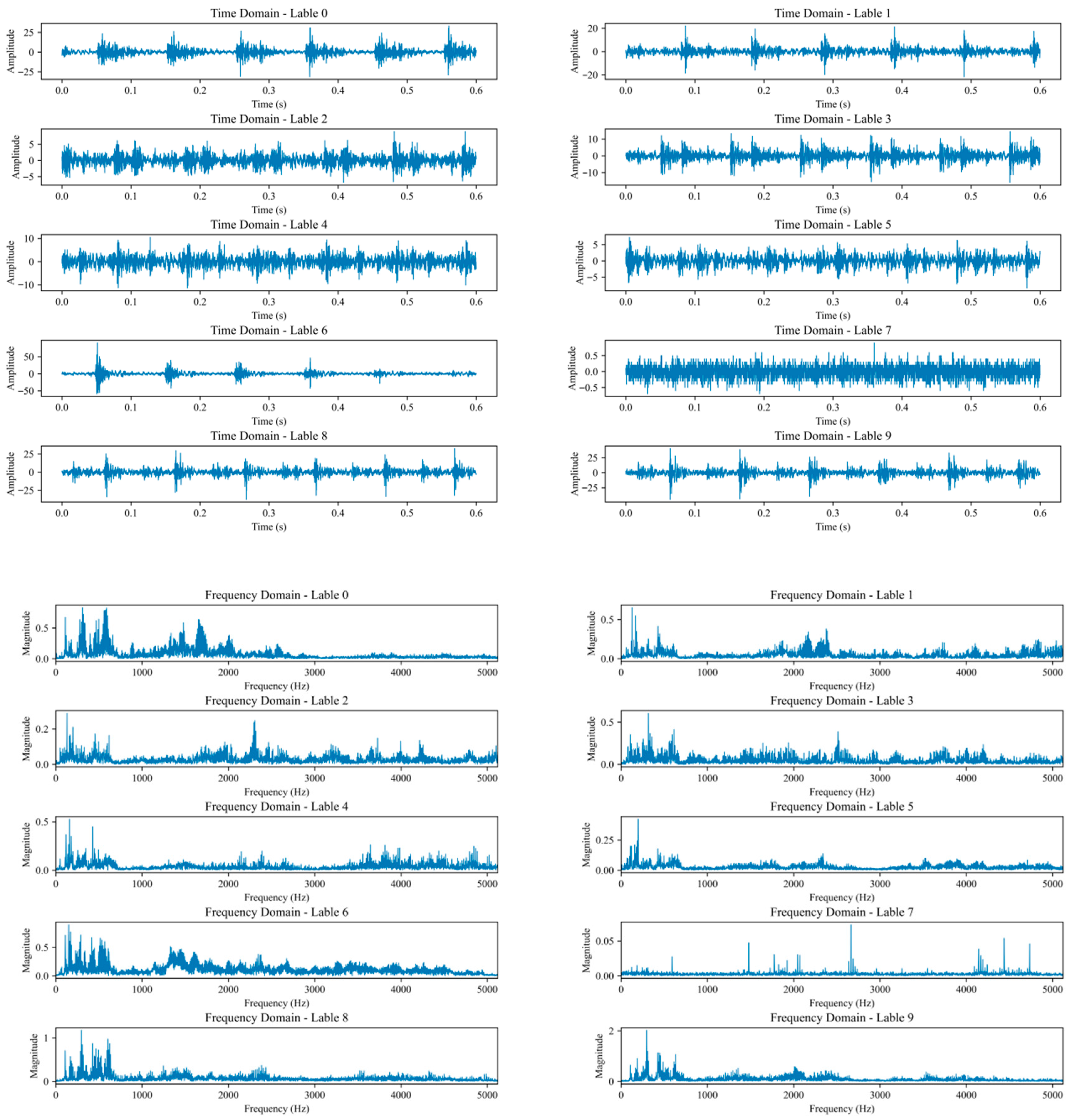
- Fault data acquisition and preprocessing: Multi-sensor time-series signals are collected from reciprocating compressors, and the sliding window method is employed to augment the sample size.
- (2)
- Constructing Graph Structures via KNN Algorithm: Each time-series sample is treated as a graph node. The Euclidean distance or cosine similarity is calculated between samples, with K nearest neighbours per node forming edges weighted by similarity values. The original fault labels were retained as node labels.
- (3)
- Dataset partitioning: Hierarchical sampling is employed to proportionally divide the merged temporal and graph samples into training, validation, and test sets. This ensured a consistent fault category distribution across all sets, mitigating the model evaluation bias caused by class imbalance.
- (4)
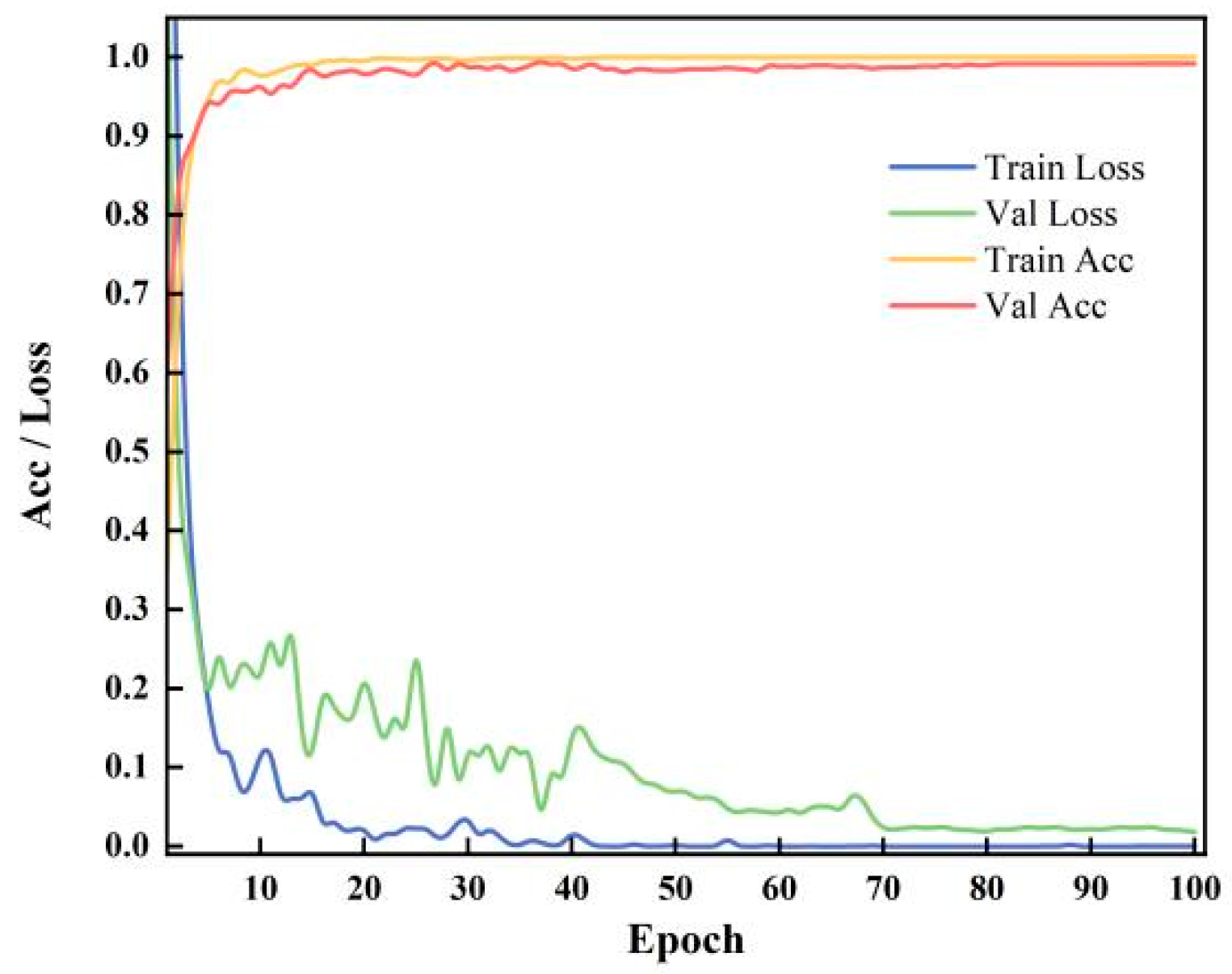
- Model Construction and Training: A spatio-temporal feature fusion model is constructed. BiGRU is employed to extract temporal features, whereas GIN is used to extract spatial features for feature fusion. Cross-modal feature fusion is achieved using a spatio-temporal bidirectional attention gating module. The output is mapped to the fault category space via a fully connected layer to produce the classification results.During training, the training set was inputted, employing the cross-entropy loss function and AdamW optimiser for parameter updates. The model performance is evaluated on the validation set after each iteration, monitoring changes in loss and accuracy to save the model weights, yielding optimal validation set performance.
- (5)
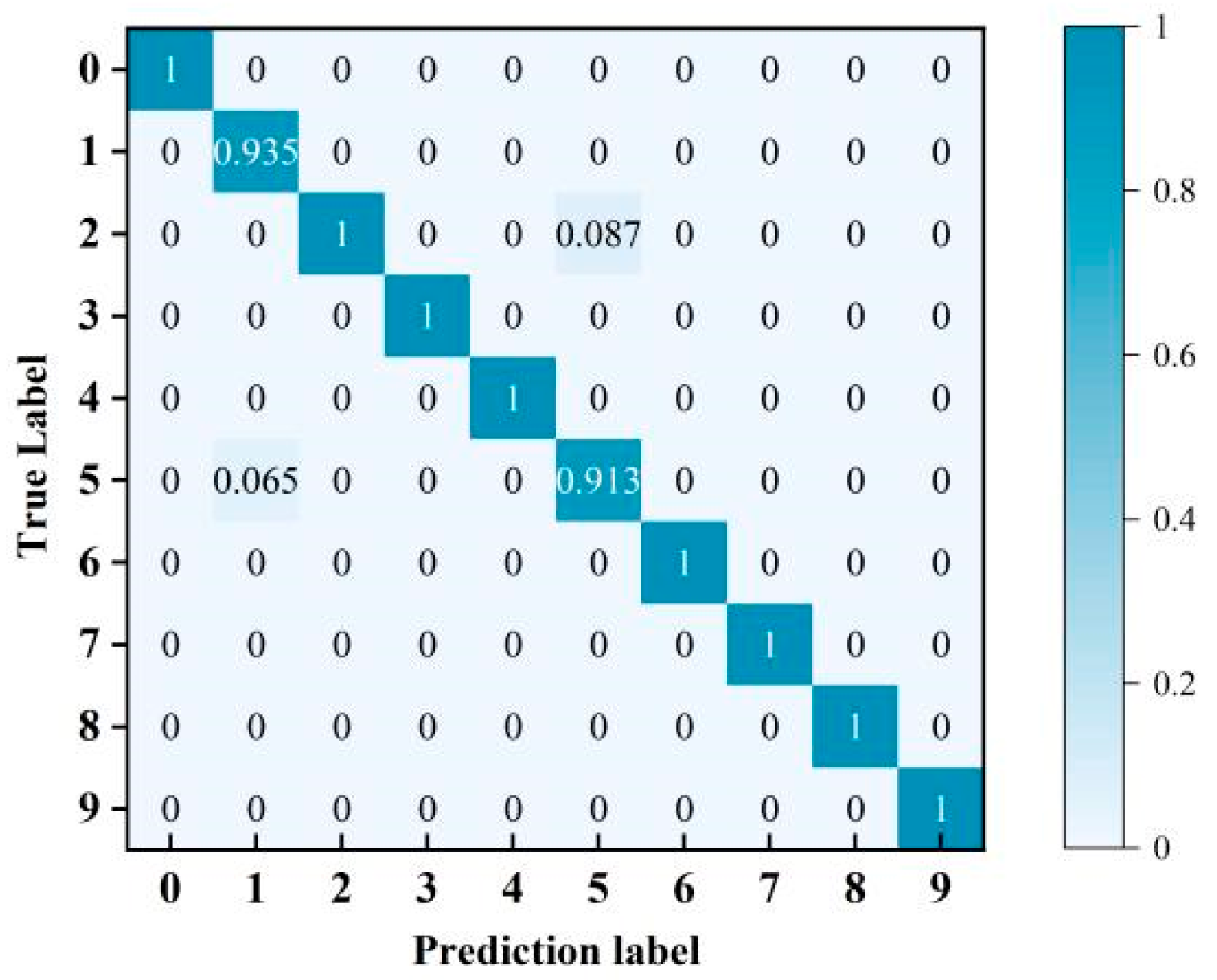
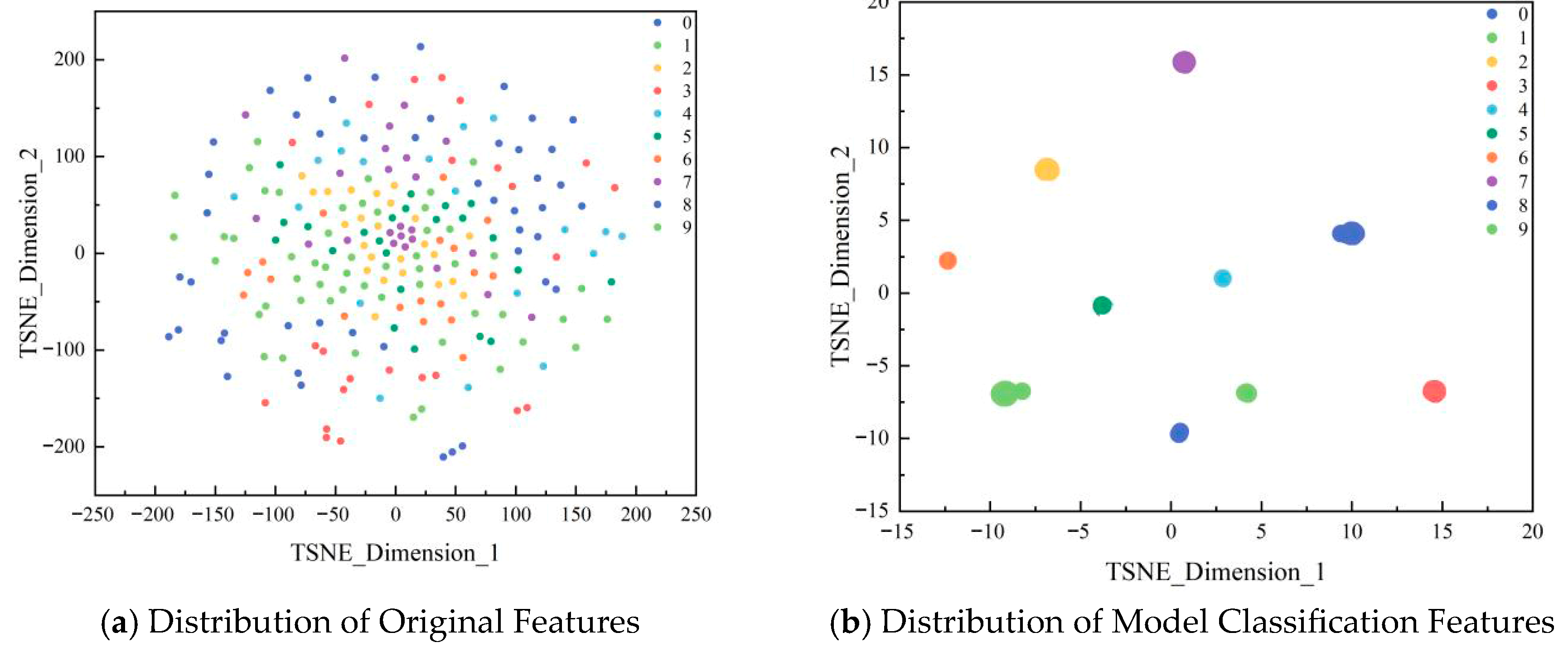
- Model Testing and Evaluation: The optimal model is loaded to perform fault diagnosis inference on the test set. The model performance was assessed using metrics such as classification accuracy and precision. Combined with TSNE visualisation analysis of the class separability of the fused features, this validates the model’s capability to identify compressor faults.
4. Case Study
4.1. Data Sources
4.2. Data Preprocessing
4.3. Analysis of Experimental Results
5. Discussion
5.1. Model Ablation
5.2. Comparison of Different Methods
6. Conclusions
- (1)
- Through the synergistic operation of the spatio-temporal feature extraction module, spatio-temporal dual-selection attention-gated fusion module, and classification output module, the model effectively extracts and integrates spatio-temporal correlation information of faults, achieving precise fault diagnosis, with an average accuracy rate of 99.14%.
- (2)
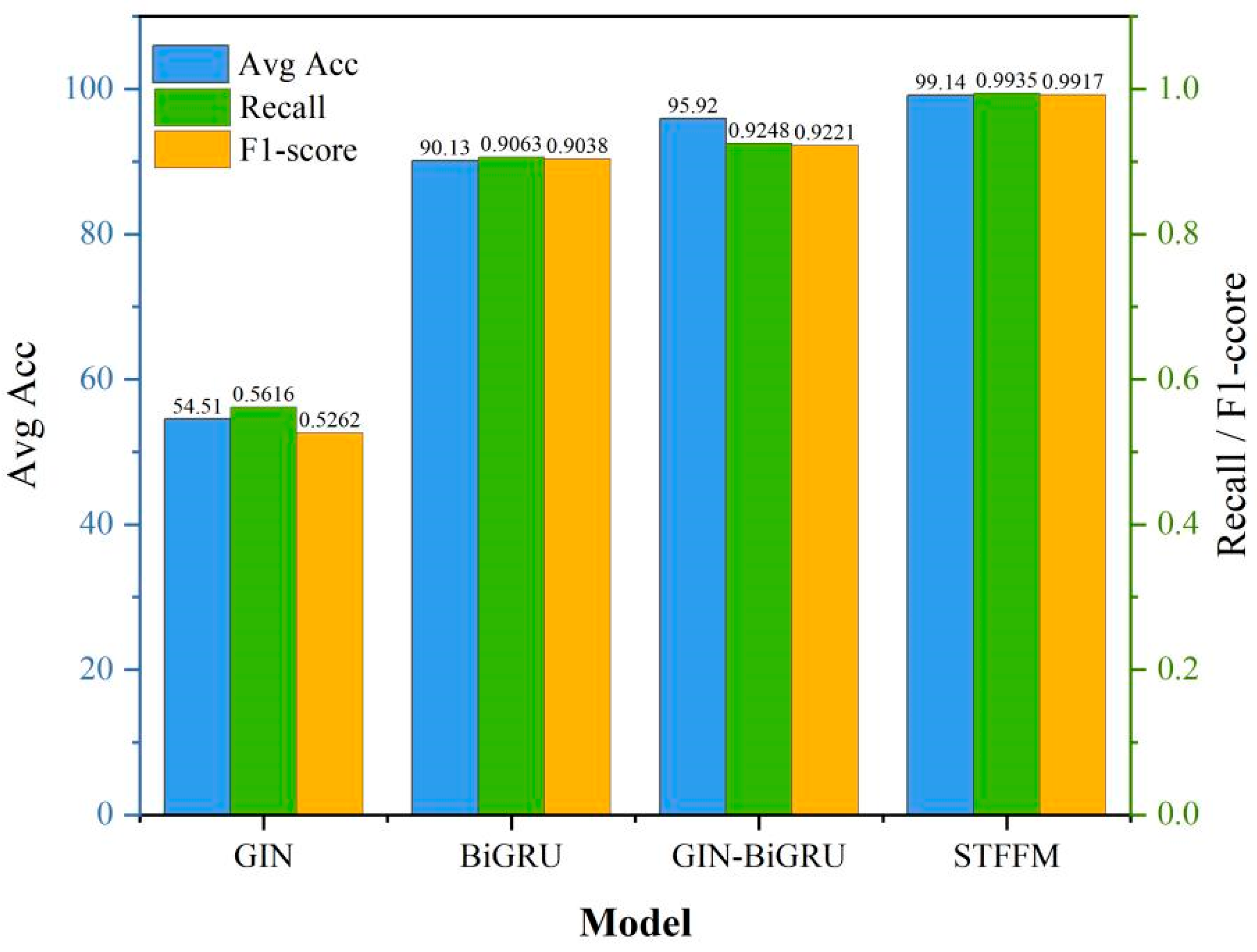
- Model ablation experiments validated the complementary nature of spatio-temporal information. The enhanced BiGRU design effectively strengthens the extraction of temporal dependencies in long-term sequence data, while the modified graph isomorphism network (GIN) effectively captures spatial variations in fault information. Integrating these through spatio-temporal bidirectional attention gating achieves a dynamic complementary fusion of spatio-temporal features. The resulting GIN-BiGRU-STFFM model demonstrated accuracy improvements of 44.63%, 7.01%, and 3.22% over GIN, BiGRU, and GIN-BiGRU, respectively.
- (3)
- The spatio-temporal feature fusion model effectively captures temporal and spatial graph domain information, demonstrating significant superiority over other network architectures. It achieves performance gains of 10.61%, 4.97%, and 2.07% over the traditional SSA-KELM, Improved MEEMD-SqueezeNet, and AVSMF methods, respectively, while outperforming the state-of-the-art MPMRNet and T-DBN approaches by 0.86% and 7.14%, respectively.
Author Contributions
Funding
Data Availability Statement
Conflicts of Interest
References
- Liu, H.M.; Lü, Q.; Yu, X.L. Review on fault diagnosis of reciprocating compressors based on artificial intelligence. Fluid Mach. 2020, 48, 65–70. (In Chinese) [Google Scholar]
- Li, T.F. Fault diagnosis of reciprocating natural gas compressor units based on multi-scale empirical mode decomposition. China Pet. Chem. Stand. Qual. 2025, 45, 19–21. (In Chinese) [Google Scholar]
- Qi, G.; Zhu, Z.; Erqinhu, K.; Chen, Y.; Chai, Y.; Sun, J. Fault-diagnosis for reciprocating compressors using big data and machine learning. Simul. Model. Pract. Theory 2018, 80, 104–127. [Google Scholar] [CrossRef]
- Wang, H.F.; Wang, Z.L. Fault Diagnosis of Reciprocating Compressors Based on VMD-SDP Fusion Image and CNN. Noise Vib. Control 2023, 43, 116. (In Chinese) [Google Scholar]
- Zhang, J.; Yuan, Y.; Wang, Y.; Zhang, C.; Chen, Y.; Zhao, D. Thermodynamic performance analysis of reciprocating compressor based on suction valve independent operation model under capacity control conditions. Appl. Therm. Eng. 2025, 261, 125201. [Google Scholar] [CrossRef]
- Wang, Y.; Xue, C.; Jia, X.; Peng, X. Fault diagnosis of reciprocating compressor valve with the method integrating acoustic emission signal and simulated valve motion. Mech. Syst. Signal Process. 2015, 56, 197–212. [Google Scholar] [CrossRef]
- Li, X.; Peng, X.; Zhang, Z.; Jia, X.; Wang, Z. A new method for nondestructive fault diagnosis of reciprocating compressor by means of strain-based p–V diagram. Mech. Syst. Signal Process. 2019, 133, 106268. [Google Scholar] [CrossRef]
- Tian, H.; Li, R.; Yang, L. Operation status monitoring of reciprocating compressors based on the fusion of spatio-temporal multiple information. Measurement 2022, 204, 112087. [Google Scholar] [CrossRef]
- Tang, Y.; Xiao, X.; Guan, M.T. Fault diagnosis method for reciprocating compressors based on multi-source signal fusion. J. Shandong Univ. (Eng. Sci.) 2023, 53, 10–19. (In Chinese) [Google Scholar] [CrossRef]
- Cabrera, D.; Guamán, A.; Zhang, S.; Cerrada, M.; Sánchez, R.V.; Cevallos, J.; Li, C. Bayesian approach and time series dimensionality reduction to LSTM-based model-building for fault diagnosis of a reciprocating compressor. Neurocomputing 2020, 380, 51–66. [Google Scholar] [CrossRef]
- Zhao, N.; Zhang, J.; Ma, W.; Jiang, Z.; Mao, Z. Variational time-domain decomposition of reciprocating machine multi-impact vibration signals. Mech. Syst. Signal Process. 2022, 172, 108977. [Google Scholar] [CrossRef]
- Zhou, D.; Huang, D.; Hao, J.; Ren, Y.; Jiang, P.; Jia, X. Vibration-based fault diagnosis of the natural gas compressor using adaptive stochastic resonance realized by Generative Adversarial Networks. Eng. Fail. Anal. 2020, 116, 104759. [Google Scholar] [CrossRef]
- He, D.; Wu, J.; Jin, Z.; Huang, C.; Wei, Z.; Yi, C. AGFCN: A bearing fault diagnosis method for high-speed train bogie under complex working conditions. Reliab. Eng. Syst. Saf. 2025, 258, 110907. [Google Scholar] [CrossRef]
- Xu, K.; Hu, W.; Leskovec, J.; Jegelka, S. How powerful are graph neural networks? arXiv 2018, arXiv:1810.00826. [Google Scholar] [CrossRef]
- Liu, H.; Zhang, F.; Tan, Y.; Huang, L.; Li, Y.; Huang, G.; Zeng, A. Multi-scale quaternion CNN and BiGRU with cross self-attention feature fusion for fault diagnosis of bearing. Meas. Sci. Technol. 2024, 35, 086138. [Google Scholar] [CrossRef]
- Xu, Z.; Li, Y.F.; Huang, H.Z.; Deng, Z.; Huang, Z. A novel method based on CNN-BiGRU and AM model for bearing fault diagnosis. J. Mech. Sci. Technol. 2024, 38, 3361–3369. [Google Scholar] [CrossRef]
- Maaten, L.V.D.; Hinton, G. Visualizing data using t-SNE. J. Mach. Learn. Res. 2008, 9, 2579–2605. [Google Scholar]
- Zhang, J.; Duan, L.; Luo, S.; Li, K. Fault diagnosis of reciprocating machinery based on improved MEEMD-SqueezeNet. Measurement 2023, 217, 113026. [Google Scholar] [CrossRef]
- Zhang, L.J.; Duan, L.X.; Wan, F. Residual network diagnosis method for reciprocating compressor faults. J. Electron. Meas. Instrum. 2021, 35, 38–46. (In Chinese) [Google Scholar] [CrossRef]
- Jiang, X.H.; Tang, Y.; Guan, M.T. Few-Shot Fault Diagnosis Method for Reciprocating Compressors Based on Feature Transfer. J. Univ. Electron. Sci. Technol. China 2025, 54, 706–716. Available online: https://link.cnki.net/urlid/51.1207.tn.20250508.0905.002 (accessed on 9 May 2025). (In Chinese)
- Fang, Z.; Wang, W.; Cao, Y.; Li, Q.; Lin, Y.; Li, T.; Wu, S. Reciprocating compressors intelligent fault diagnosis under multiple operating conditions based on adaptive variable scale morphological filter. Measurement 2024, 224, 113778. [Google Scholar] [CrossRef]



| Layer | Component | Input Dimensions | Output Dimensions |
|---|---|---|---|
| Input Layer | Sequential Signal Preprocessing | 32 | (32, 32) |
| Layer 1 BiGRU | BidirectionalGRU + BatchNorm + GELU | (32, 32) | (32, 256) |
| Layer 2 BiGRU | BidirectionalGRU + BatchNorm + GELU | (32, 256) | (32, 512) |
| Output Layer | Final Time Step + Dropout + Dropout | (32, 512) | 512 |
| Layer | Component | Input Dimensions | Output Dimensions |
|---|---|---|---|
| Input Layer | Primitive Node Characteristics | 1 | 1 |
| Layer 1 GINConv | MLP + GINConv + BatchNorm + GELU | 1 | 128 |
| Layer 2 GINConv | MLP + GINConv + BatchNorm + GELU | 128 | 256 |
| Layer 3 GINConv | MLP + GINConv + BatchNorm + GELU | 256 | 512 |
| Output Layer | Global Average Pooling + Dropout | 512 | 512 |
| Fault Type | Label | Fault Name |
|---|---|---|
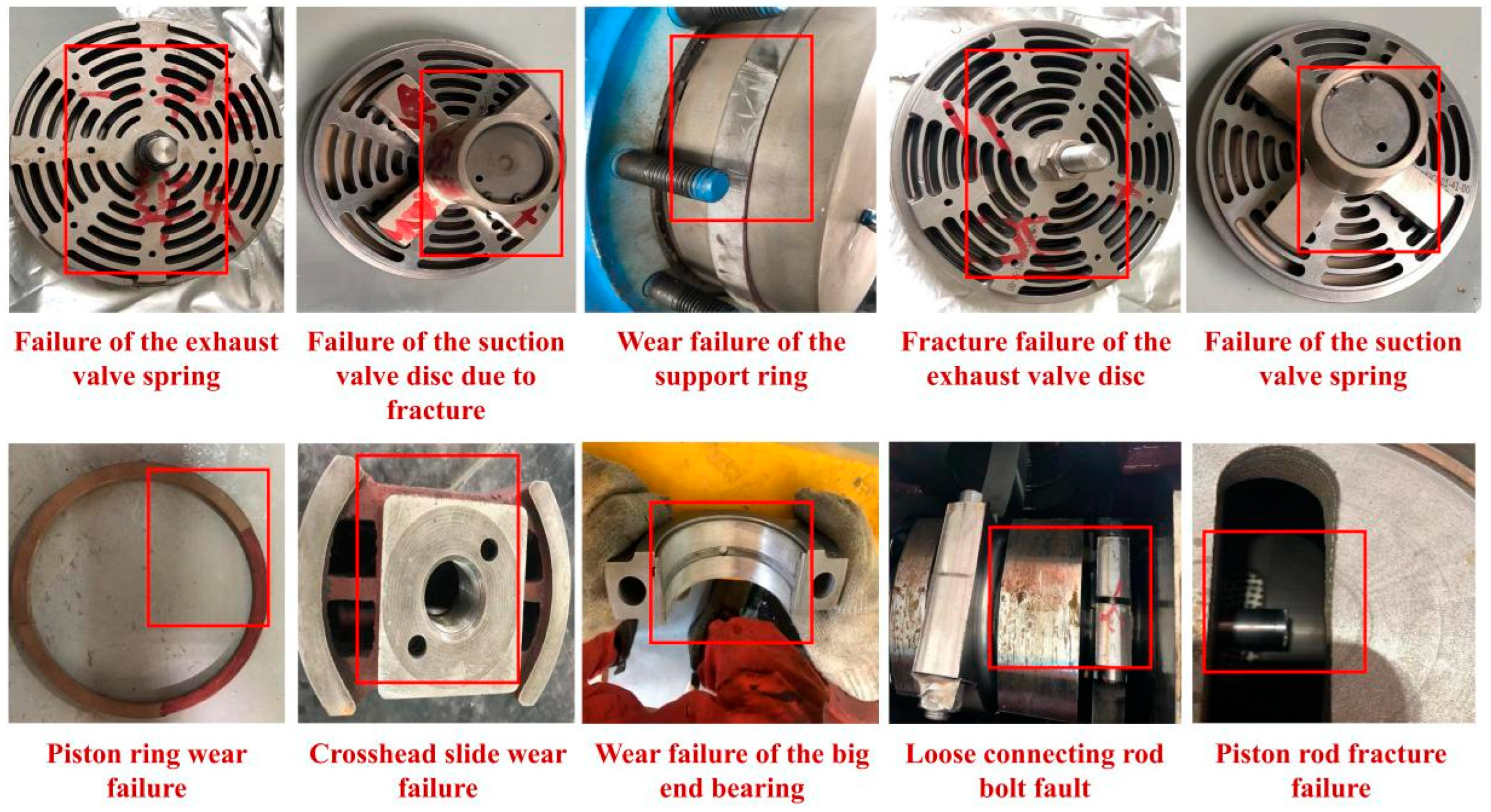
| Single fault mode | 1 | Cylinder 1 failure of the exhaust valve spring |
| 2 | Cylinder 1 failure of the suction valve disc due to fracture | |
| 3 | Cylinder 1 wear failure of the support ring | |
| 4 | Cylinder 2 fracture failure of the exhaust valve disc | |
| 5 | Cylinder 2 failure of the suction valve spring | |
| Compound failure mode | 6 | Cylinder 1 piston rod fracture failure & Cylinder 2 piston ring wear failure |
| 7 | Cylinder 1 crosshead slide wear failure & Cylinder 2 piston ring wear failure | |
| 8 | Cylinder 2 wear failure of the big end bearing & Cylinder 1 crosshead slide wear failure | |
| 9 | Cylinder 2 loose connecting rod bolt fault & Cylinder 1 crosshead slide wear failure | |
| Normal mode | 0 | Normal |
| Label | Precision | Recall | F1-Score | Support |
|---|---|---|---|---|
| 0 | 1.0000 | 1.0000 | 1.0000 | 26 |
| 1 | 1.0000 | 0.9355 | 0.9667 | 31 |
| 2 | 1.0000 | 1.0000 | 1.0000 | 24 |
| 3 | 1.0000 | 1.0000 | 1.0000 | 24 |
| 4 | 0.9048 | 1.0000 | 0.9500 | 19 |
| 5 | 1.0000 | 1.0000 | 1.0000 | 23 |
| 6 | 1.0000 | 1.0000 | 1.0000 | 19 |
| 7 | 1.0000 | 1.0000 | 1.0000 | 24 |
| 8 | 1.0000 | 1.0000 | 1.0000 | 21 |
| 9 | 1.0000 | 1.0000 | 1.0000 | 22 |
| Accuracy | - | - | 0.9914 | 233 |
| Macro avg | 0.9905 | 0.9935 | 0.9917 | 233 |
| Weighted avg | 0.9922 | 0.9914 | 0.9915 | 233 |
| Model Number | Ablation Model Name | Parameter Settings |
|---|---|---|
| M1 | GIN | Learning rate: 0.001 batch size = 32 optimiser: AdamW Epoch = 100 |
| M2 | BiGRU | |
| M3 | GIN-BiGRU | |
| M4 | STFFM |
| Method | Average Accuracy | Reference | Method Introduction |
|---|---|---|---|
| SSA-KELM | 88.53% | Tang et al. 2023 [9] | Multi-source signal fusion |
| Improved MEEMD-SqueezeNet | 94.27% | Zhang et al. 2023 [18] | Combining multi-scale information fusion with deep learning |
| MPMRNet | 98.28% | Zhang et al. 2021 [19] | Residual network diagnostic method |
| T-DBN | 92.00% | Jiang et al. 2025 [20] | Feature transfer method |
| AVSMF | 97.07% | Fang et al. 2024 [21] | Adaptive variable-scale shape filter |
| STFFM | 99.14% | Proposed Method | Spatio-temporal feature fusion |
Disclaimer/Publisher’s Note: The statements, opinions and data contained in all publications are solely those of the individual author(s) and contributor(s) and not of MDPI and/or the editor(s). MDPI and/or the editor(s) disclaim responsibility for any injury to people or property resulting from any ideas, methods, instructions or products referred to in the content. |
© 2026 by the authors. Licensee MDPI, Basel, Switzerland. This article is an open access article distributed under the terms and conditions of the Creative Commons Attribution (CC BY) license.
Share and Cite
Xu, H.; Ji, X.; Qin, X.; An, W.; Zhang, F.; Duan, L.; Wang, J. Fault Diagnosis Method for Reciprocating Compressors Based on Spatio-Temporal Feature Fusion. Sensors 2026, 26, 798. https://doi.org/10.3390/s26030798
Xu H, Ji X, Qin X, An W, Zhang F, Duan L, Wang J. Fault Diagnosis Method for Reciprocating Compressors Based on Spatio-Temporal Feature Fusion. Sensors. 2026; 26(3):798. https://doi.org/10.3390/s26030798
Chicago/Turabian StyleXu, Haibo, Xiaolong Ji, Xiaogang Qin, Weizheng An, Fengli Zhang, Lixiang Duan, and Jinjiang Wang. 2026. "Fault Diagnosis Method for Reciprocating Compressors Based on Spatio-Temporal Feature Fusion" Sensors 26, no. 3: 798. https://doi.org/10.3390/s26030798
APA StyleXu, H., Ji, X., Qin, X., An, W., Zhang, F., Duan, L., & Wang, J. (2026). Fault Diagnosis Method for Reciprocating Compressors Based on Spatio-Temporal Feature Fusion. Sensors, 26(3), 798. https://doi.org/10.3390/s26030798