Enhancing User Experience in Virtual Reality Through Optical Flow Simplification with the Help of Physiological Measurements: Pilot Study

 , , ,
, , , 

Abstract
1. Introduction
2. Materials and Methods
2.1. Participants
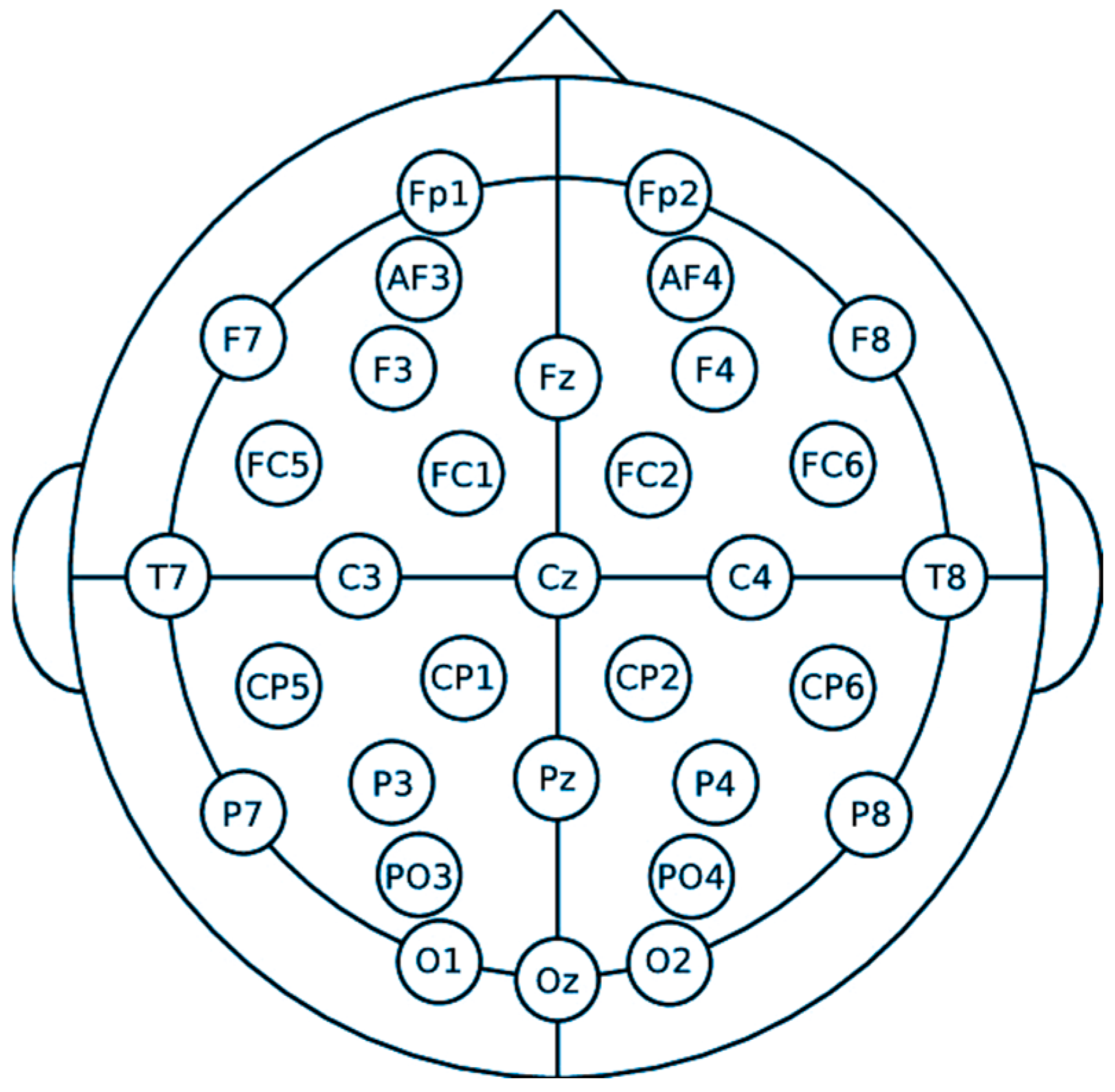
2.2. Apparatus
2.3. Pre-Processing
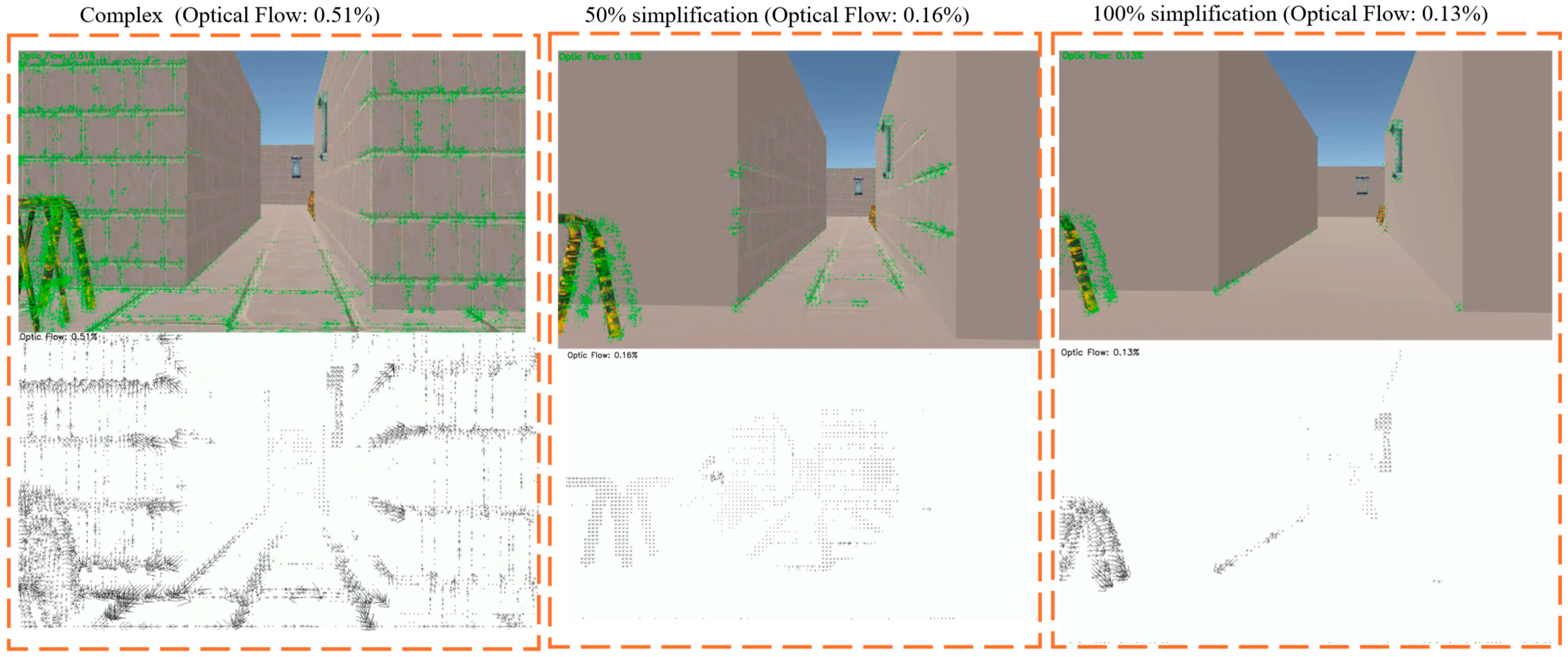
2.4. Geometrical Simplification and Optical Flow Analysis
- from frame 1.
- from frame 2.
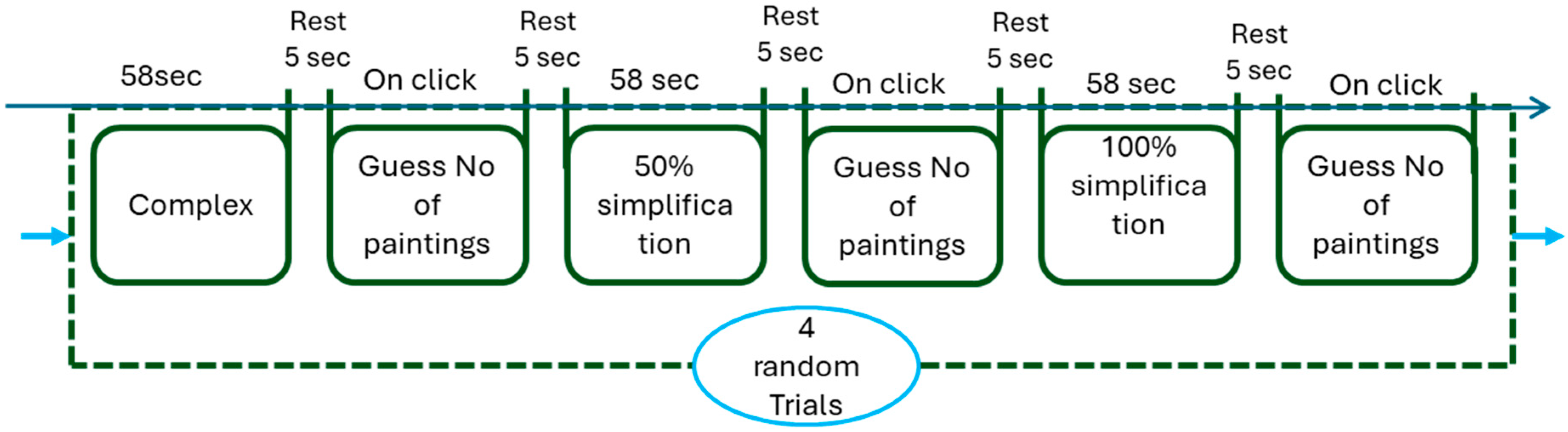
2.5. Data Collection Protocols
3. Results and Discussion
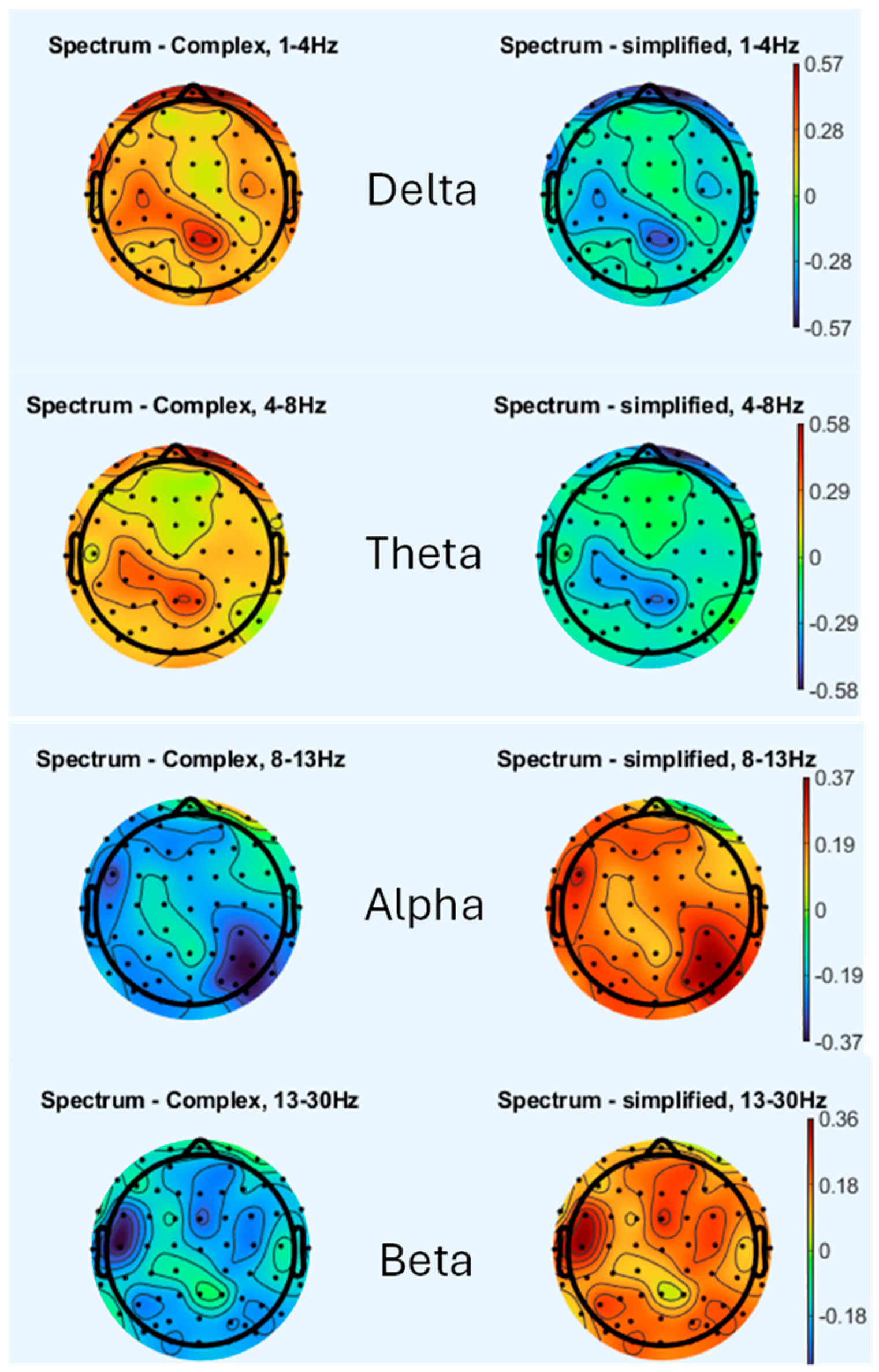
3.1. Brain Topography
3.2. Statistical Analysis and Results
3.3. Simulator Sickness Questionnaire
3.4. Limitations
3.5. Future Works
4. Conclusions
Author Contributions
Funding
Institutional Review Board Statement
Informed Consent Statement
Data Availability Statement
Conflicts of Interest
Abbreviations
| VR | Virtual Reality |
| EEG | Electroencephalography |
| FNIRS | Function Near-Infrared Spectroscopy |
| CS | Cybersickness |
| FOV | Field Of View |
| OF | Optical Flow |
| VRISE | Virtual Reality induced symptoms and effects |
| SSQ | Simulator Sickness Questionnaire |
| HMD | Head-mounted display |
| BMI | Brain–machine interface |
References
- Halbig, A.; Latoschik, M.E. A Systematic Review of Physiological Measurements, Factors, Methods, and Applications in Virtual Reality. Front. Virtual Real. 2021, 2, 694567. [Google Scholar] [CrossRef] [Scilit]
- Yildirim, C. Cybersickness during VR Gaming Undermines Game Enjoyment: A Mediation Model. Displays 2019, 59, 35–43. [Google Scholar] [CrossRef] [Scilit]
- Rebenitsch, L.; Owen, C. Review on Cybersickness in Applications and Visual Displays. Virtual Real. 2016, 20, 101–125. [Google Scholar] [CrossRef] [Scilit]
- Jang, K.M.; Kwon, M.; Nam, S.G.; Kim, D.M.; Lim, H.K. Estimating Objective (EEG) and Subjective (SSQ) Cybersickness in People with Susceptibility to Motion Sickness. Appl. Ergon. 2022, 102, 103731. [Google Scholar] [CrossRef] [Scilit]
- Romeni, S.; Toni, L.; Artoni, F.; Micera, S. Decoding Electroencephalographic Responses to Visual Stimuli Compatible with Electrical Stimulation. APL Bioeng. 2024, 8, 026123. [Google Scholar] [CrossRef] [Scilit]
- Adhanom, I.B.; Al-Zayer, M.; Macneilage, P.; Folmer, E. Field-of-View Restriction to Reduce VR Sickness Does Not Impede Spatial Learning in Women. ACM Trans. Appl. Percept. 2021, 18, 1–17. [Google Scholar] [CrossRef] [Scilit]
- Fernandes, A.S.; Feiner, S.K. Combating VR Sickness through Subtle Dynamic Field-of-View Modification. In Proceedings of the 2016 IEEE Symposium on 3D User Interfaces (3DUI), Greenville, SC, USA, 19–20 March 2016; IEEE: Piscataway, NJ, USA, March 2016; pp. 201–210. [Google Scholar]
- Lan, Y.-T.; Ren, K.; Wang, Y.; Zheng, W.-L.; Li, D.; Lu, B.-L.; Qiu, L. Seeing through the Brain: Image Reconstruction of Visual Perception from Human Brain Signals. arXiv 2023, arXiv:2308.02510. [Google Scholar] [CrossRef] [Scilit]
- Van Der Meer, A.L.H.; Fallet, G.; Van Der Weel, F.R. Perception of Structured Optic Flow and Random Visual Motion in Infants and Adults: A High-Density EEG Study. Exp. Brain Res. 2008, 186, 493–502. [Google Scholar] [CrossRef] [Scilit]
- Chattha, U.A.; Janjua, U.I.; Anwar, F.; Madni, T.M.; Cheema, M.F.; Janjua, S.I. Motion Sickness in Virtual Reality: An Empirical Evaluation. IEEE Access 2020, 8, 130486–130499. [Google Scholar] [CrossRef] [Scilit]
- Smith, S.P. Comparing Virtual Environments for Cybersickness Using a Cumulative Optical Flow Entropy Metric. IEEE Access 2021, 9, 68898–68904. [Google Scholar] [CrossRef] [Scilit]
- Warren, W. Direction of Self-Motion is Perceived from Optical Flow. Nature 1988, 336, 162–163. [Google Scholar] [CrossRef] [Scilit]
- Beauchemin, S.S.; Barron, J.L. The Computation of Optical Flow. ACM Comput. Surv. 1995, 27, 433–466. [Google Scholar] [CrossRef] [Scilit]
- Li, X.; Zhu, C.; Xu, C.; Zhu, J.; Li, Y.; Wu, S. VR Motion Sickness Recognition by Using EEG Rhythm Energy Ratio Based on Wavelet Packet Transform. Comput. Methods Programs Biomed. 2020, 188, 105266. [Google Scholar] [CrossRef] [Scilit] [PubMed]
- Krokos, E.; Varshney, A. Quantifying VR Cybersickness Using EEG. Virtual Real. 2022, 26, 77–89. [Google Scholar] [CrossRef] [Scilit]
- Chen, Y.C.; Duann, J.R.; Chuang, S.W.; Lin, C.L.; Ko, L.W.; Jung, T.P.; Lin, C.T. Spatial and Temporal EEG Dynamics of Motion Sicknes. Neuroimage 2010, 49, 2862–2870. [Google Scholar] [CrossRef] [Scilit] [PubMed]
- Naqvi, S.A.A.; Badruddin, N.; Jatoi, M.A.; Malik, A.S.; Hazabbah, W.; Abdullah, B. EEG Based Time and Frequency Dynamics Analysis of Visually Induced Motion Sickness (VIMS). Australas. Phys. Eng. Sci. Med. 2015, 38, 721–729. [Google Scholar] [CrossRef] [Scilit]
- Wu, F.; Suma Rosenberg, E. Adaptive Field-of-View Restriction: Limiting Optical Flow to Mitigate Cybersickness in Virtual Reality. In Proceedings of the ACM Symposium on Virtual Reality Software and Technology, VRST 2022, Tsukuba, Japan, 29 November–1 December 2022. [Google Scholar] [CrossRef] [Scilit]
- Page, D.; Lindeman, R.W.; Lukosch, S. Identifying Strategies to Mitigate Cybersickness in Virtual Reality Induced by Flying with an Interactive Travel Interface. Multimodal Technol. Interact. 2023, 7, 47. [Google Scholar] [CrossRef] [Scilit]
- Chang, E.; Hwang, I.; Jeon, H.; Chun, Y.; Kim, H.T.; Park, C. Effects of Rest Frames on Cybersickness and Oscillatory Brain Activity. In Proceedings of the 2013 International Winter Workshop on Brain-Computer Interface (BCI), Gangwon Province, Republic of Korea, 18–20 February 2013; IEEE: Piscataway, NJ, USA, 2013; pp. 62–64. [Google Scholar]
- Sriramprakash, S.; Prasanna, V.D.; Murthy, O.V.R. Stress Detection in Working People. In Procedia Computer Science; Elsevier B.V.: Amsterdam, The Netherlands, 2017; Volume 115, pp. 359–366. [Google Scholar]
- Won, J.H.; Kim, Y.S. A New Approach for Reducing Virtual Reality Sickness in Real Time: Design and Validation Study. JMIR Serious Games 2022, 10, e36397. [Google Scholar] [CrossRef] [Scilit]
- Wen, E.; Kaluarachchi, T.I.; Siriwardhana, S.; Tang, V.; Billinghurst, M.; Lindeman, R.W.; Yao, R.; Lin, J.; Nanayakkara, S. VRhook: A Data Collection Tool for VR Motion Sickness Research. In Proceedings of the UIST 2022—35th Annual ACM Symposium on User Interface Software and Technology, Bend, OR, USA, 29 October–2 November 2022. [Google Scholar] [CrossRef] [Scilit]
- Ozkan, A.; Uyan, U.; Celikcan, U. Effects of Speed, Complexity and Stereoscopic VR Cues on Cybersickness Examined via EEG and Self-Reported Measures. Displays 2023, 78, 102415. [Google Scholar] [CrossRef] [Scilit]
- Kennedy, R.S.; Lane, N.E.; Berbaum, K.S.; Lilienthal, M.G. Simulator Sickness Questionnaire: An Enhanced Method for Quantifying Simulator Sickness. Int. J. Aviat. Psychol. 1993, 3, 203–220. [Google Scholar] [CrossRef] [Scilit]
- Hirzle, T.; Cordts, M.; Rukzio, E.; Gugenheimer, J.; Bulling, A. A Critical Assessment of the Use of SSQ as a Measure of General Discomfort in VR Head-Mounted Displays. In Proceedings of the 2021 CHI Conference on Human Factors in Computing Systems, Virtually Online, 8–13 May 2021; ACM: New York, NY, USA, 2021; pp. 1–14. [Google Scholar]
- Somrak, A.; Pogačnik, M.; Guna, J. Suitability and Comparison of Questionnaires Assessing Virtual Reality-Induced Symptoms and Effects and User Experience in Virtual Environments. Sensors 2021, 21, 1185. [Google Scholar] [CrossRef] [Scilit]
- AL-Quraishi, M.; Elamvazuthi, I.; Daud, S.; Parasuraman, S.; Borboni, A. EEG-Based Control for Upper and Lower Limb Exoskeletons and Prostheses: A Systematic Review. Sensors 2018, 18, 3342. [Google Scholar] [CrossRef] [Scilit]
- Hasan, S.; Wang, J.; Anwar, M.S.; Zhang, H.; Liu, Y.; Yang, L. Investigating the Potential of VR in Language Education: A Study of Cybersickness and Presence Metrics. In Proceedings of the 2024 13th International Conference on Educational and Information Technology, ICEIT 2024, Chengdu, China, 22–24 March 2024; Institute of Electrical and Electronics Engineers Inc.: Piscataway, NJ, USA, 2024; pp. 189–196. [Google Scholar]
- Demirel, B.U.; Dogan, A.H.; Rossie, J.; Mobus, M.; Holz, C. Beyond Subjectivity: Continuous Cybersickness Detection Using EEG-Based Multitaper Spectrum Estimation; IEEE: Piscataway, NJ, USA, 2025. [Google Scholar]
- Kemeny, A.; George, P.; Mérienne, F.; Colombet, F. New VR Navigation Techniques to Reduce Cybersickness; Science Arts & Métiers (SAM): Talence, France, 2017. [Google Scholar]
- Zielasko, D.; Freitag, S.; Weyers, B.; Wolfgang Kuhlen, T.; Meißner, A.; Kuhlen, T.W. Dynamic Field of View Reduction Related to Subjective Sickness Measures in an HMD-Based Data Analysis Task. arXiv 2018, arXiv:2403.07992. [Google Scholar]
- Yip, S.H.; Ng, A.K.T.; Lau, H.Y.K.; Saunders, J.A. Preregistered Test of Whether a Virtual Nose Reduces Cybersickness. Cogn. Res. Princ. Implic. 2024, 9, 74. [Google Scholar] [CrossRef] [Scilit]
- Nie, T.; Pospick, C.H.; Cantory, V.; Zhang, D.; Deguzman, J.J.; Interrante, V.; Adhanom, I.B.; Rosenberg, E.S. Peripheral Teleportation: A Rest Frame Design to Mitigate Cybersickness During Virtual Locomotion RF 0 RF 1 User RF 0 RF 1/User RF 0 RF 1 User RF 0/User RF 1; IEEE: Piscataway, NJ, USA, 2025. [Google Scholar]
- Lou, R.; Merienne, F.; So, R.H.Y.; Chan, T.T.; Bechmann, D. Geometric Simplification for Reducing Optic Flow in VR. In Proceedings of the 2022 IEEE International Symposium on Mixed and Augmented Reality Adjunct, ISMAR-Adjunct 2022, Singapore, 17–21 October 2022; pp. 682–685. [Google Scholar] [CrossRef] [Scilit]
- Lou, R. Geometric Deformation for Reducing Optic Flow and Cybersickness Dose Value in VR; Science Arts & Métiers (SAM): Talence, France, 2022; pp. 1–2. [Google Scholar]
- Liu, R.; Xu, M.; Zhang, Y.; Peli, E.; Hwang, A.D. A Pilot Study on Electroencephalogram-Based Evaluation of Visually Induced Motion Sickness. J. Imaging Sci. Technol. 2020, 64, jist0685. [Google Scholar] [CrossRef] [Scilit] [PubMed]
- Vieira, R.; Moreno, P.; Vourvopoulos, A. EEG-Based Action Anticipation in Human-Robot Interaction: A Comparative Pilot Study. Front. Neurorobot. 2024, 18, 1491721. [Google Scholar] [CrossRef] [Scilit]
- Marcel, S.; Millán, J.D.R. Person Authentication Using Brainwaves (EEG) and Maximum A Posteriori Model Adaptation; IEEE: Piscataway, NJ, USA, 2007; Volume 1. [Google Scholar]
- Weech, S.; Kenny, S.; Barnett-Cowan, M. Presence and Cybersickness in Virtual Reality Are Negatively Related: A Review. Front. Psychol. 2019, 10, 158. [Google Scholar] [CrossRef] [Scilit]
- AbdelAal, M.A.; Alsawy, A.A.; Hefny, H.A. EEG-Based Emotion Recognition Using a Wrapper-Based Feature Selection Method. In Proceedings of the Advances in Intelligent Systems and Computing; Springer: Berlin/Heidelberg, Germany, 2018; Volume 639, pp. 247–256. [Google Scholar]
- Farnebäck, G. Two-Frame Motion Estimation Based on Polynomial Expansion. In Proceedings of the Scandinavian Conference on Image Analysis, Halmstad, Sweden, 29 June–2 July 2013. [Google Scholar]
- Zhu, Y.; Jiang, G.; Liang, Z.; Wang, Y. Flow-Aware Diffusion for Real-Time VR Restoration: Enhancing Spatiotemporal Coherence and Efficiency. arXiv 2025, arXiv:2506.18786. [Google Scholar]
- Lim, H.K.; Ji, K.; Woo, Y.S.; Han, D.U.; Lee, D.H.; Nam, S.G.; Jang, K.M. Test-Retest Reliability of the Virtual Reality Sickness Evaluation Using Electroencephalography (EEG). Neurosci. Lett. 2021, 743, 135589. [Google Scholar] [CrossRef] [Scilit]
- Kim, Y.Y.; Kim, H.J.; Kim, E.N.; Ko, H.D.; Kim, H.T. Characteristic Changes in the Physiological Components of Cybersickness. Psychophysiology 2005, 42, 616–625. [Google Scholar] [CrossRef] [Scilit] [PubMed]
- Jang, K.M.; Woo, Y.S.; Lim, H.K. Electrophysiological Changes in the Virtual Reality Sickness: EEG in the VR Sickness. In Proceedings of the Web3D 2020: 25th ACM Conference on 3D Web Technology 2020, Virtual Event, Republic of Korea, 9–13 November 2020. [Google Scholar] [CrossRef] [Scilit]
- Van der Lee, G.; Lécuyer, A.; Naud, M.; Scherer, R.; Cabestaing, F.; Si-Mohammed, H. Towards the Automatic Detection of Vection in Virtual Reality Using EEG. arXiv 2024, arXiv:2412.18445. [Google Scholar] [CrossRef] [Scilit]
- Yang, A.H.X.; Kasabov, N.K.; Cakmak, Y.O. Prediction and Detection of Virtual Reality Induced Cybersickness: A Spiking Neural Network Approach Using Spatiotemporal EEG Brain Data and Heart Rate Variability. Brain Inform. 2023, 10, 15. [Google Scholar] [CrossRef] [Scilit] [PubMed]
- Lilliefors, H.W. On the Kolmogorov-Smirnov Test for Normality with Mean and Variance Unknown. J. Am. Stat. Assoc. 1967, 62, 399–402. [Google Scholar] [CrossRef]
- Shapiro, S.S.; Wilk, M.B. An Analysis of Variance Test for Normality (Complete Samples). Biometrika 1965, 52, 591–611. [Google Scholar] [CrossRef] [Scilit]
- Anderson, T.W.; Darling, D.A. Asymptotic Theory of Certain “Goodness of Fit” Criteria Based on Stochastic Processes. Ann. Math. Stat. 1952, 23, 193–212. [Google Scholar] [CrossRef] [Scilit]



| Condition | Mean | Median |
|---|---|---|
| Complex | 2.13 | 2.16 |
| simplified 50% | 0.69 | 0.58 |
| simplified 100% | 0.51 | 0.38 |
| Scenes | Delta | Theta | Alpha | Beta | Gamma | Total |
|---|---|---|---|---|---|---|
| Complex | 1.02 | 0.99 | 0.81 | 0.92 | 0.87 | 0.92 |
| Simp50 | 0.98 | 0.98 | 0.86 | 0.93 | 0.92 | 0.93 |
| Simp100 | 0.99 | 0.97 | 0.94 | 1 | 0.98 | 0.98 |
| Statistics | p | |
|---|---|---|
| Kolmogorov–Smirnov | 0.08 | 0.887 |
| Kolmogorov–Smirnov (Lilliefors Corr.) | 0.08 | 0.58 |
| Shapiro–Wilk | 0.98 | 0.728 |
| Anderson–Darling | 0.34 | 0.483 |
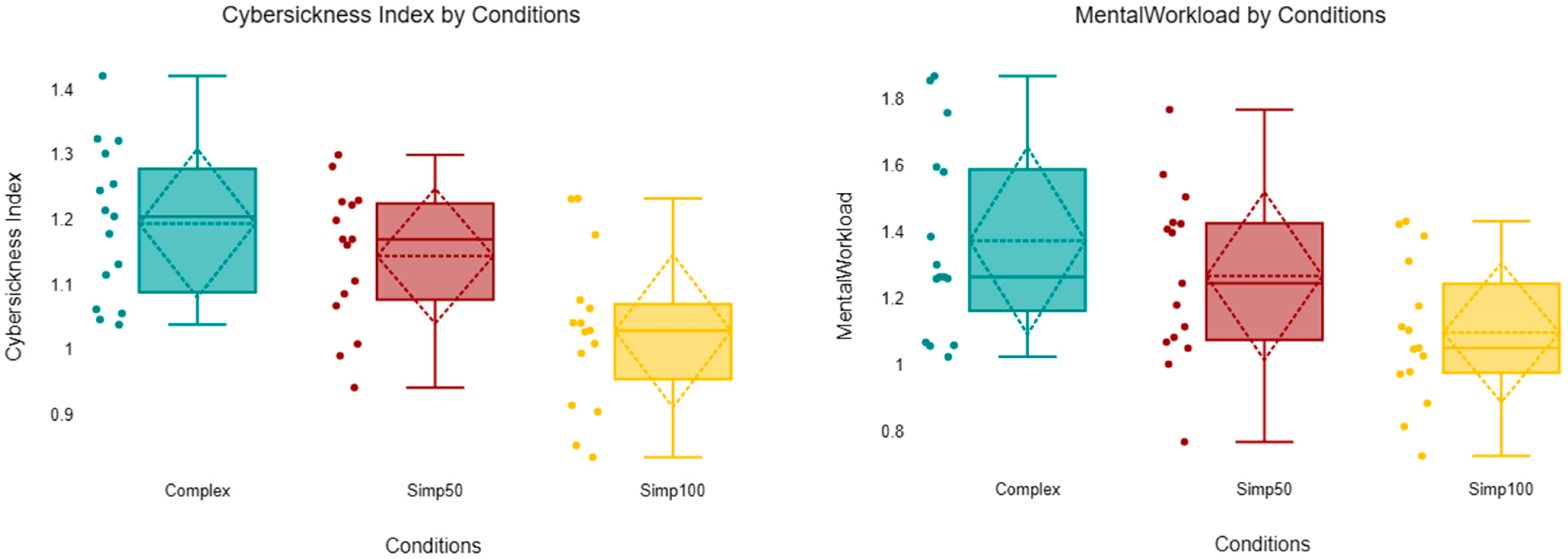
| Conditions | MWI | CS | Std |
|---|---|---|---|
| Complex | 1.37 | 1.19 | 0.12 |
| 50% Simplification | 1.27 | 1.14 | 0.11 |
| 100% Simplification | 1.10 | 1.03 | 0.12 |
Disclaimer/Publisher’s Note: The statements, opinions and data contained in all publications are solely those of the individual author(s) and contributor(s) and not of MDPI and/or the editor(s). MDPI and/or the editor(s) disclaim responsibility for any injury to people or property resulting from any ideas, methods, instructions or products referred to in the content. |
© 2026 by the authors. Licensee MDPI, Basel, Switzerland. This article is an open access article distributed under the terms and conditions of the Creative Commons Attribution (CC BY) license.
Share and Cite
Abdalhadi, A.; Koundal, N.; Moosavi, M.S.; Lou, R.; Yusoff, M.Z.b.; Merienne, F.; Saad, N.M. Enhancing User Experience in Virtual Reality Through Optical Flow Simplification with the Help of Physiological Measurements: Pilot Study. Sensors 2026, 26, 610. https://doi.org/10.3390/s26020610
Abdalhadi A, Koundal N, Moosavi MS, Lou R, Yusoff MZb, Merienne F, Saad NM. Enhancing User Experience in Virtual Reality Through Optical Flow Simplification with the Help of Physiological Measurements: Pilot Study. Sensors. 2026; 26(2):610. https://doi.org/10.3390/s26020610
Chicago/Turabian StyleAbdalhadi, Abdualrhman, Nitin Koundal, Mahdiyeh Sadat Moosavi, Ruding Lou, Mohd Zuki bin Yusoff, Frédéric Merienne, and Naufal M. Saad. 2026. "Enhancing User Experience in Virtual Reality Through Optical Flow Simplification with the Help of Physiological Measurements: Pilot Study" Sensors 26, no. 2: 610. https://doi.org/10.3390/s26020610
APA StyleAbdalhadi, A., Koundal, N., Moosavi, M. S., Lou, R., Yusoff, M. Z. b., Merienne, F., & Saad, N. M. (2026). Enhancing User Experience in Virtual Reality Through Optical Flow Simplification with the Help of Physiological Measurements: Pilot Study. Sensors, 26(2), 610. https://doi.org/10.3390/s26020610