Physiological Effects of Far-Infrared-Emitting Garments on Sleep, Thermoregulation, and Autonomic Function Assessed Using Wearable Sensors

Highlights
- A multimodal wearable sensing system enabled simultaneous evaluation of sleep architecture, thermoregulation, and autonomic activity under far-infrared (FIR) and control garment conditions.
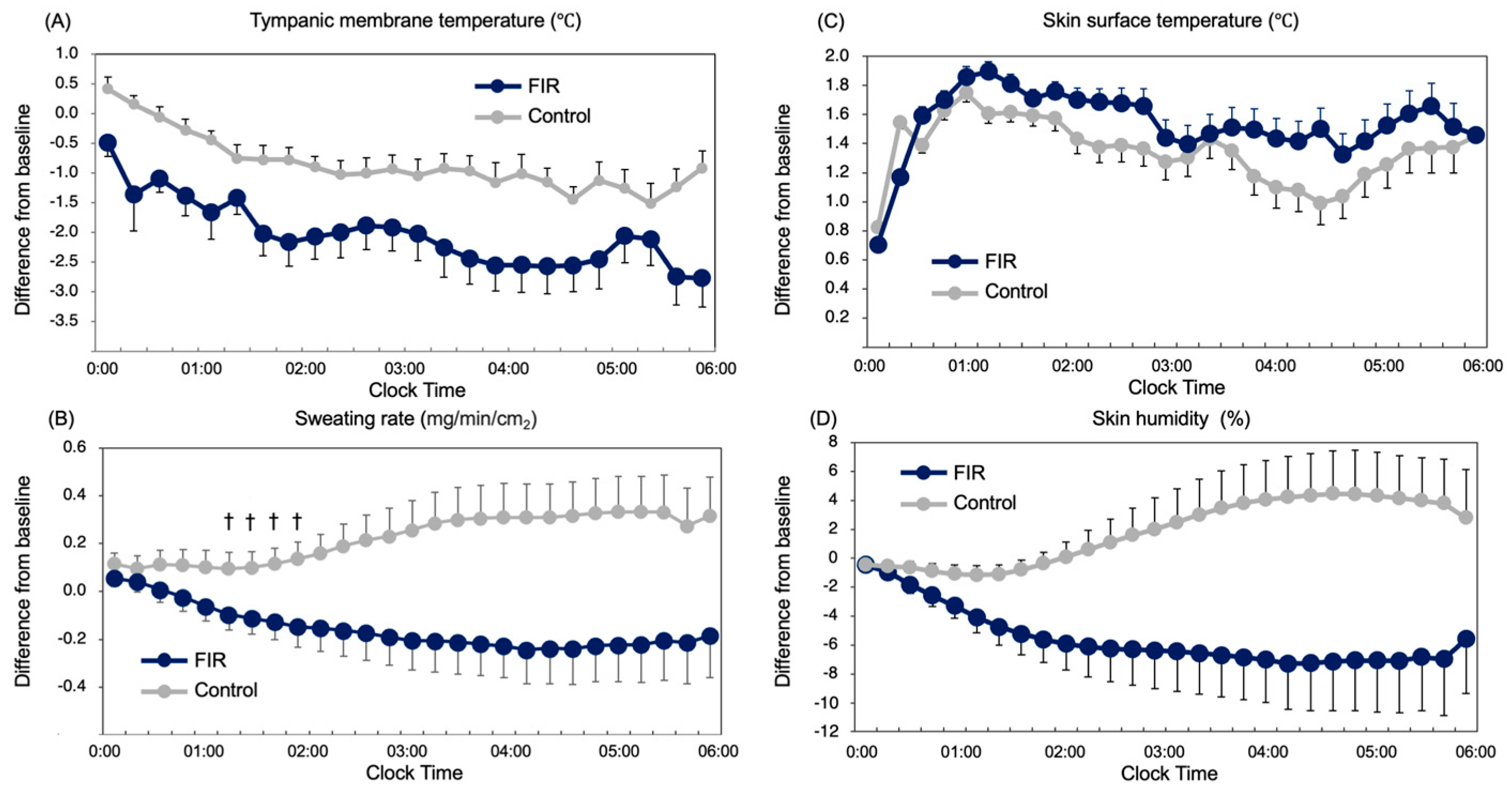
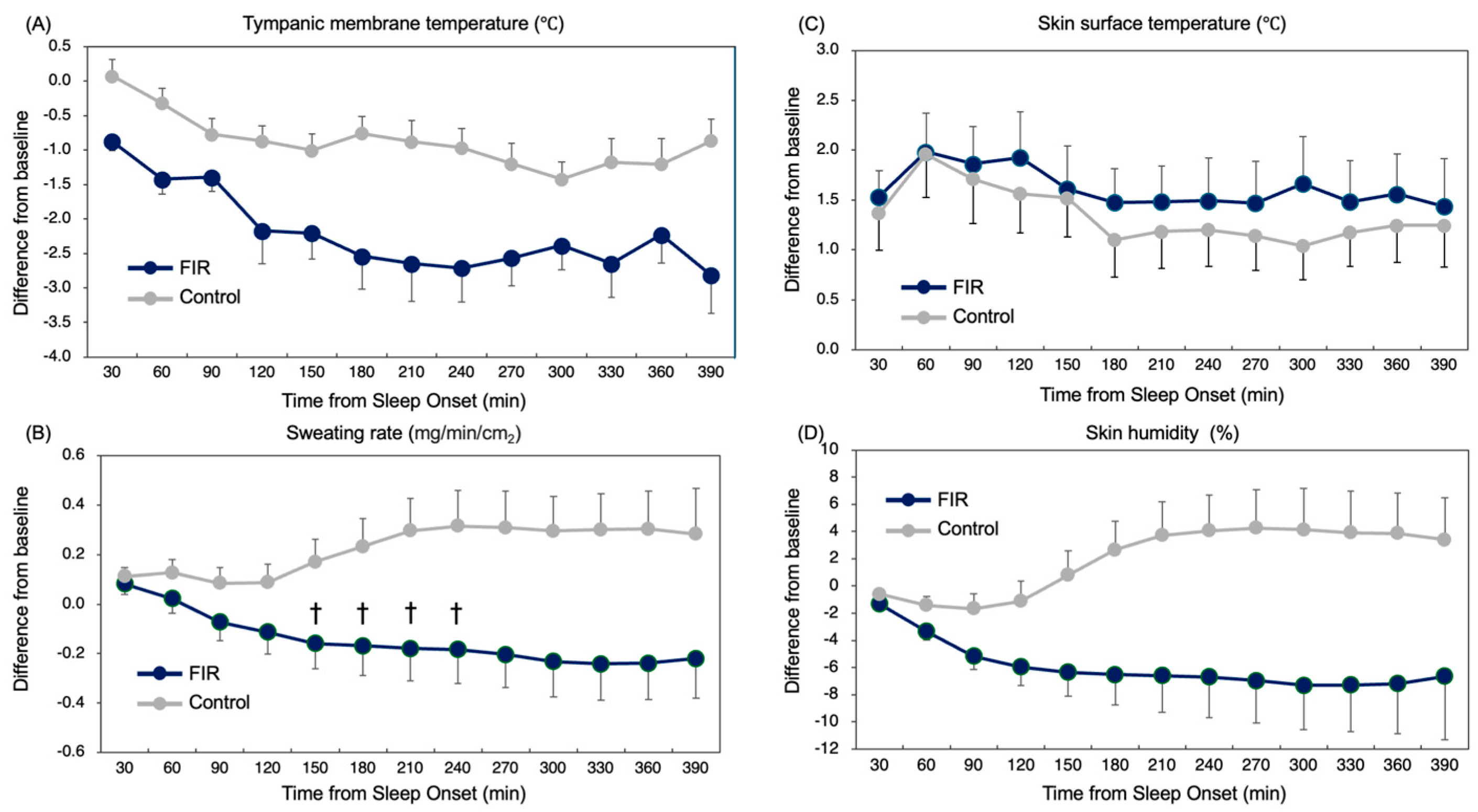
- FIR garments modestly enhanced nocturnal heat dissipation, reflected by lower tympanic temperature and reduced sweating during the mid-sleep period.
- The proportion of rapid eye movement (REM) sleep increased without changes in total sleep time, indicating a redistribution of sleep stages under altered thermal conditions.
- These findings support the physiological feasibility of assessing functional sleepwear using integrated measures of thermal regulation and autonomic activity.
- Multimodal wearable sensing provides a useful framework for objectively evaluating subtle sleep-related effects of textile-based interventions.
Abstract
1. Introduction
- (1)
- Enhance nocturnal heat dissipation, reflected by lower tympanic temperature and reduced sweating;
- (2)
- Modify sleep structure, particularly facilitating the expression of REM sleep;
- (3)
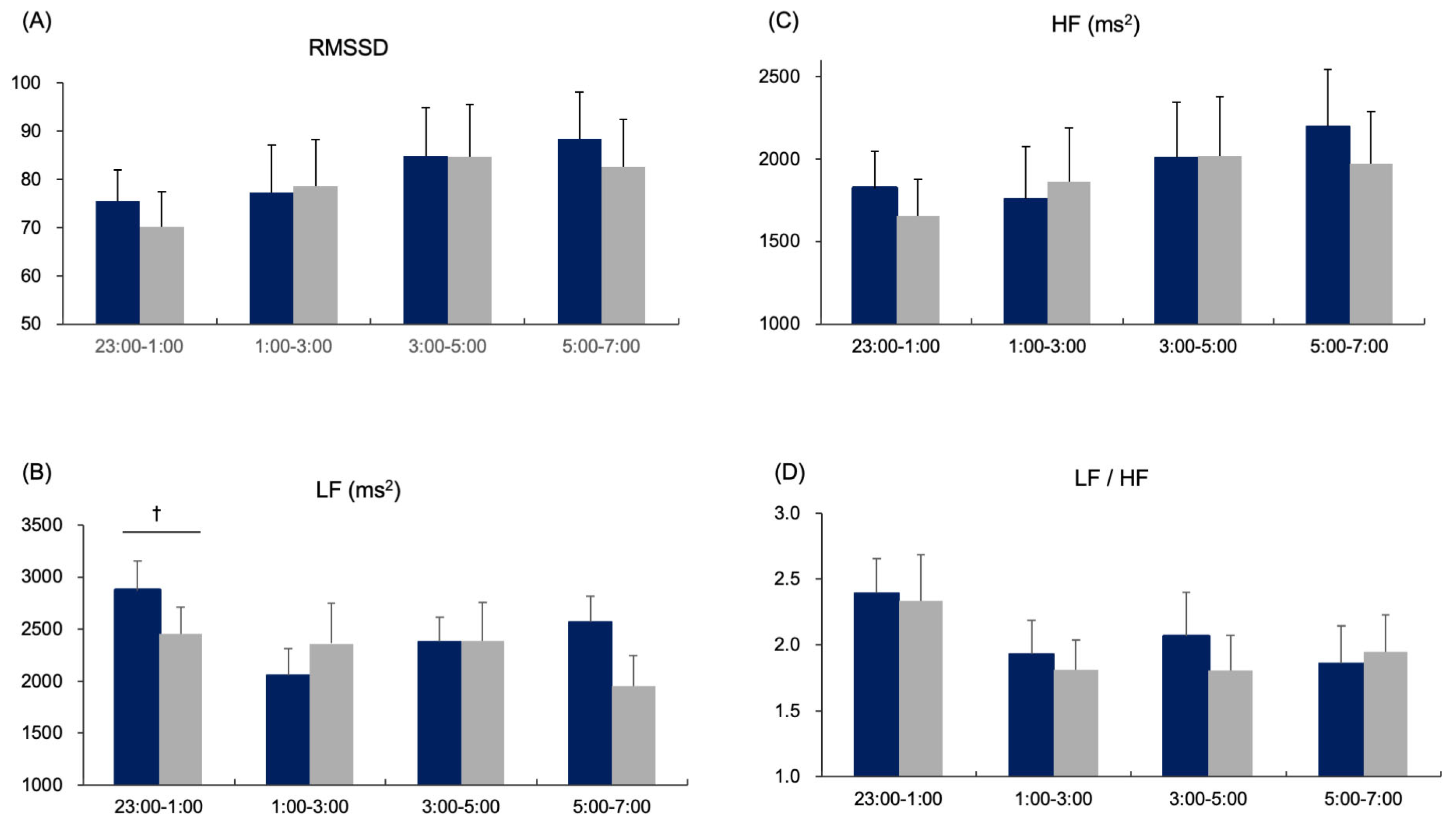
- Induce transient autonomic adjustments during early sleep without sympathetic activation.
2. Materials and Methods
2.1. Study Design
2.2. Participants
2.3. FIR and Control Garments
2.4. Procedures
2.5. Physiological Signal Acquisitions
2.6. Data Segmentation and Analysis
3. Results
3.1. Subjective Sleep
3.2. Sleep Variables
3.3. Thermoregulation
3.4. Autonomic Activity
4. Discussion
5. Conclusions
Supplementary Materials
Author Contributions
Funding
Institutional Review Board Statement
Informed Consent Statement
Data Availability Statement
Acknowledgments
Conflicts of Interest
References
- Cerri, M.; Amici, R. Thermoregulation and Sleep: Functional Interaction and Central Nervous Control. Compr. Physiol. 2021, 11, 1591–1604. [Google Scholar] [CrossRef]
- Harding, E.C.; Franks, N.P.; Wisden, W. Sleep and Thermoregulation. Curr. Opin. Physiol. 2020, 15, 7–13. [Google Scholar] [CrossRef]
- Troynikov, O.; Watson, C.G.; Nawaz, N. Sleep Environments and Sleep Physiology: A Review. J. Therm. Biol. 2018, 78, 192–203. [Google Scholar] [CrossRef]
- Kräuchi, K.; Cajochen, C.; Werth, E.; Wirz-Justice, A. Functional Link Between Distal Vasodilation and Sleep-Onset Latency? Am. J. Physiol. Regul. Integr. Comp. Physiol. 2000, 278, R741–R748. [Google Scholar] [CrossRef] [PubMed]
- Van Someren, E.J.W. Mechanisms and Functions of Coupling Between Sleep and Temperature Rhythms. Prog. Brain Res. 2006, 153, 309–324. [Google Scholar] [PubMed]
- Okamoto-Mizuno, K.; Mizuno, K. Effects of thermal environment on sleep and circadian rhythm. J. Physiol. Anthropol. 2012, 31, 14. [Google Scholar] [CrossRef] [PubMed]
- Chen, Y.; Wang, R. Structure Design of Unidirectional Moisture Transfer Fabric with High Wool Content Based on Multiple Differential Effects. Sci. Rep. 2025, 15, 29997. [Google Scholar] [CrossRef] [PubMed]
- Peng, Y.; Cui, Y. Thermal Management with Innovative Fibers and Textiles: Manipulating Heat Transport, Storage and Con-version. Natl. Sci. Rev. 2024, 11, nwae295. [Google Scholar] [CrossRef]
- Chow, C.M.; Shin, M.; Mahar, T.J.; Halaki, M.; Ireland, A. The Impact of Sleepwear Fiber Type on Sleep Quality under Warm Ambient Conditions. Nat. Sci. Sleep 2019, 11, 167–178. [Google Scholar] [CrossRef]
- Ha, H.; Qaiser, N.; Yun, T.G.; Cheong, J.Y.; Lim, S.; Hwang, B. Sensing Mechanism and Application of Mechanical Strain Sensors: A Mini-Review. Facta Univ. Ser. Mech. Eng. 2023, 21, 751–772. [Google Scholar] [CrossRef]
- Milić, D.; Marinković, Ž.; Ćojbašić, Ž. Geometrically Nonlinear Analysis of Piezoelectric Active Laminated Shells by Means of Isogeometric Fe Formulation. Facta Univ. Ser. Mech. Eng. 2023, 23, 387–405. [Google Scholar] [CrossRef]
- Csernai, M.; Bikár, G.; Horváth, G.; Bodizs, R.; Deli, L.; Suták, A.; Bartsch, R.P.; Schulz, H. Dynamics of sleep oscillations is coupled to brain temperature. J. Physiol. 2019, 597, 2643–2660. [Google Scholar] [CrossRef]
- Matsuo, M.; Masuda, F.; Sumi, Y.; Takahashi, M.; Yamada, N.; Ohira, M.H.; Fujiwara, K.; Kanemura, T.; Kadotani, H. Comparisons of Portable Sleep Monitors of Different Modalities: Potential as Naturalistic Sleep Recorders. Front. Neurol. 2016, 7, 110. [Google Scholar] [CrossRef] [PubMed]
- Seol, J.; Chiba, S.; Kawana, F.; Tsumoto, S.; Masaki, M.; Tominaga, M.; Amemiya, T.; Tani, A.; Hiei, T.; Yoshimine, H.; et al. Validation of Sleep-Staging Accuracy for an in-Home Sleep Electroencephalography Device Compared with Simultaneous Polysomnography in Patients with Obstructive Sleep Apnea. Sci. Rep. 2024, 14, 3533. [Google Scholar] [CrossRef]
- Sakamoto, H.; Yoshida, Y.; Yuda, E. Prediction of Sleep Indices Using Continuous Data Analysis of Core Body Tem-perature Variation. In Proceedings of the 9th International Symposium on Affective Science and Engineering, Online, 8 March 2023; pp. 1–3. [Google Scholar] [CrossRef]
- Brage, S.; Brage, N.; Franks, P.W.; Ekelund, U.; Wareham, N.J. Reliability and Validity of the Combined Heart Rate and Movement Sensor Actiheart. Eur. J. Clin. Nutr. 2005, 59, 561–570. [Google Scholar] [CrossRef]
- He, P.; Low, R.J.Y.; Burns, S.F.; Lipik, V.; Tok, A.I.Y. Enhanced Far-Infrared Emissivity, UV Protection, and Near-Infrared Shielding of Polypropylene Composites via Incorporation of Natural Mineral for Functional Fabric Development. Sci. Rep. 2023, 13, 22329. [Google Scholar] [CrossRef]
- Yu, J.; Zhou, S.; Zhang, J.; Li, Z. Recent progress in far-infrared materials for biomedical applications. Mater. Today Bio 2021, 12, 100157. [Google Scholar] [CrossRef]
- Vatansever, F.; Hamblin, M.R. Far Infrared Radiation (FIR): Its Biological Effects and Medical Applications. Photonics Lasers Med. 2012, 4, 255–266. [Google Scholar] [CrossRef]
- Tsai, S.-R.; Hamblin, M.R. Biological Effects and Medical Applications of Infrared Radiation. J. Photochem. Photobiol. B 2017, 170, 197–207. [Google Scholar] [CrossRef]
- Bontemps, B.; Gruet, M.; Vercruyssen, F.; Louis, J. Utilisation of Far Infrared-Emitting Garments for Optimising Performance and Recovery in Sport: Real Potential or New Fad? A Systematic Review. PLoS ONE 2021, 16, e0251282. [Google Scholar] [CrossRef] [PubMed]
- Chen, S.-C.; Cheung, T.-W.; Yu, B.Y.-M.; Chan, M.-Y.; Yeung, W.-F.; Li, L. Improving Sleep with Far-Infrared-Emitting Pajamas: A Pilot Randomized Controlled Trial. Int. J. Environ. Res. Public Health 2023, 20, 3870. [Google Scholar] [CrossRef]
- Lee, M.-C.; Ho, C.-S.; Hsu, Y.-J.; Kan, N.-W.; Fei, C.-Y.; Yang, H.-J.; Huang, C.-C. The Impact of DAZZEON αSleep® Far-Infrared Blanket on Sleep, Blood Pressure, Vascular Health, Muscle Function, Inflammation, and Fatigue. Clocks Sleep 2024, 6, 499–516. [Google Scholar] [CrossRef]
- Raymann, R.J.E.M.; Swaab, D.F.; Van Someren, E.J.W. Skin Deep: Enhanced Sleep Depth by Cutaneous Temperature Manipu-lation. Brain J. Neurol. 2008, 131, 500–513. [Google Scholar] [CrossRef] [PubMed]
- Cerri, M.; Luppi, M.; Tupone, D.; Zamboni, G.; Amici, R. REM Sleep and Endothermy: Potential Sites and Mechanism of a Reciprocal Interference. Front. Physiol. 2017, 8, 624. [Google Scholar] [CrossRef]
- Luppi, M.; Martelli, D.; Amici, R. The Role of Autonomic Nervous System in Sleep and Thermoregulation. Curr. Opin. Physiol. 2019, 15, 94–100. [Google Scholar]
- Faul, F.; Erdfelder, E.; Lang, A.-G.; Buchner, A. G*Power 3: A Flexible Statistical Power Analysis Program for the Social, Be-havioral, and Biomedical Sciences. Behav. Res. Methods 2007, 39, 175–191. [Google Scholar] [CrossRef]
- Tsuzuki, K. Effects of Thermal Environment on Human Sleep and Thermoregulation. Jpn. J. Biometeorol. 2014, 50, 125–134. [Google Scholar] [CrossRef]
- Iber, C.; Ancoli-Israel, S.; Chesson, A.; Quan, S. The AASM Manual for the Scoring of Sleep and Associated Events: Rules, Termi-nology and Technical Specifications; American Academy of Sleep Medicine: Westchester, IL, USA, 2007. [Google Scholar]
- Parmeggiani, P.L. Thermoregulation and Sleep. Front. Biosci. 2003, 8, s557–s567. [Google Scholar] [CrossRef]
- Crandall, C.G. Heat Stress and Baroreflex Regulation of Blood Pressure. Med. Sci. Sports Exerc. 2008, 40, 2063. [Google Scholar] [CrossRef] [PubMed]
- Billman, G.E. The LF/HF Ratio Does Not Accurately Measure Cardiac Sympatho-Vagal Balance. Front. Physiol. 2013, 4, 26. [Google Scholar] [CrossRef]
- Flouris, A.D.; Poirier, M.P.; Bravi, A.; Wright-Beatty, H.; Boulay, P.; Sigal, R.J.; Kenny, G.P. Does Heart Rate Variability Reflect Thermoregulatory Responses to Heat Stress? J. Appl. Physiol. 2014, 116, 110–118. [Google Scholar]



| Parameters | FIR | Control | t | p | d |
|---|---|---|---|---|---|
| Sleepiness on rising | 49.6 (6.6) | 48.4 (7.0) | 0.715 | 0.486 | 0.169 |
| Initiation and maintenance of sleep | 39.5 (7.2) | 38.8 (12.8) | 0.207 | 0.839 | 0.066 |
| Frequent dreaming | 47.6 (9.5) | 50.6 (9.9) | 1.107 | 0.287 | 0.316 |
| Feeling refreshed on waking | 50.7 (6.7) | 47.7 (8.3) | 1.413 | 0.179 | 0.397 |
| Sleep length | 47.2 (8.1) | 45.4 (11.8) | 0.602 | 0.557 | 0.174 |
| Variables | FIR | Control | t | p | d | |
|---|---|---|---|---|---|---|
| Time in Bed | Total recording time (TRT) (min) | 400.0 (6.7) | 402.6 (6.4) | 0.167 | 0.870 | 0.053 |
| Total sleep time (TST) (min) | 366.7 (6.1) | 381.0 (6.4) | 0.708 | 0.490 | 0.253 | |
| Sleep onset latency (min) | 33.1 (0.6) | 43.7 (0.7) | 0.981 | 0.343 | 0.255 | |
| Sleep efficiency (TST/TRT) (%) | 84.5 (12.2) | 84.7 (12.7) | 0.053 | 0.959 | 0.019 | |
| Wake after sleep onset (min) | 36.4 (0.6) | 27.7 (0.5) | 0.479 | 0.639 | 0.185 | |
| Sleep stages (absolute time) | N1 (min) | 31.7 (0.5) | 35.3 (0.6) | 0.715 | 0.486 | 0.230 |
| N2 (min) | 178.3 (3.0) | 201.0 (3.4) | 1.798 | 0.094 | 0.604 | |
| N3 (min) | 73.1 (1.2) | 72.6 (1.2) | 0.041 | 0.968 | 0.013 | |
| REM (min) | 83.3 (1.4) | 71.4 (1.2) | 1.620 | 0.108 | 0.379 | |
| Sleep stages (relative time) | %N1 (% TRT) | 9.0 (5.0) | 9.4 (3.4) | 0.282 | 0.782 | 0.084 |
| %N2 (% TRT) | 48.6 (5.5) | 53.0 (8.1) | 1.631 | 0.125 | 0.636 | |
| %N3 (% TRT) | 20.1 (8.4) | 18.9 (8.1) | 0.506 | 0.620 | 0.143 | |
| %REM (% TRT) | 22.2 (6.5) | 18.6 (6.5) | 2.465 | 0.027 | 0.567 |
Disclaimer/Publisher’s Note: The statements, opinions and data contained in all publications are solely those of the individual author(s) and contributor(s) and not of MDPI and/or the editor(s). MDPI and/or the editor(s) disclaim responsibility for any injury to people or property resulting from any ideas, methods, instructions or products referred to in the content. |
© 2026 by the authors. Licensee MDPI, Basel, Switzerland. This article is an open access article distributed under the terms and conditions of the Creative Commons Attribution (CC BY) license.
Share and Cite
Nishida, M.; Nishii, T.; Suyama, S.; Youn, S. Physiological Effects of Far-Infrared-Emitting Garments on Sleep, Thermoregulation, and Autonomic Function Assessed Using Wearable Sensors. Sensors 2026, 26, 550. https://doi.org/10.3390/s26020550
Nishida M, Nishii T, Suyama S, Youn S. Physiological Effects of Far-Infrared-Emitting Garments on Sleep, Thermoregulation, and Autonomic Function Assessed Using Wearable Sensors. Sensors. 2026; 26(2):550. https://doi.org/10.3390/s26020550
Chicago/Turabian StyleNishida, Masaki, Taku Nishii, Shutaro Suyama, and Sumi Youn. 2026. "Physiological Effects of Far-Infrared-Emitting Garments on Sleep, Thermoregulation, and Autonomic Function Assessed Using Wearable Sensors" Sensors 26, no. 2: 550. https://doi.org/10.3390/s26020550
APA StyleNishida, M., Nishii, T., Suyama, S., & Youn, S. (2026). Physiological Effects of Far-Infrared-Emitting Garments on Sleep, Thermoregulation, and Autonomic Function Assessed Using Wearable Sensors. Sensors, 26(2), 550. https://doi.org/10.3390/s26020550